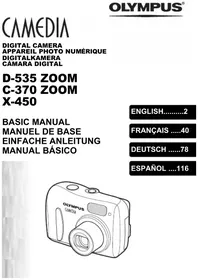
X-450 - Camera OLYMPUS - Free user manual and instructions
Find the device manual for free X-450 OLYMPUS in PDF.



| Product Type | Compact digital camera |
| Brand | Olympus |
| Model | X-450 |
| Effective Resolution | 3.2 megapixels |
| Sensor | CCD 1/2.7", 3.34 million total pixels |
| Lens | Olympus 5.8–17.4 mm (equiv. 38–114 mm in 35 mm), f/2.9–5.0 |
| Optical Zoom | 3x |
| Digital Zoom | Up to 12x (combined) |
| LCD Screen | 1.5", TFT color, 130,000 pixels |
| Internal Memory | 12 MB |
| Storage Media | xD-Picture Card (16–512 MB) |
| Power Supply | 2 AA alkaline or Ni-MH batteries (optional AC adapter) |
| Dimensions (W×H×D) | 87.5 × 62.5 × 38.5 mm (without protrusions) |
| Weight | 140 g (without batteries or card) |
| Shooting Modes | P-Auto, Portrait, Landscape, Night Scene, Self Portrait, Video |
| Flash | Built-in, modes: auto, red-eye reduction, fill-in, off. Range: 0.2–3.8 m (W), 0.5–2.2 m (T) |
| Shutter Speed | 1–1/2000 s (2 s in Night Scene mode) |
| Exposure Compensation | ±2.0 EV in 1/3 EV steps |
| Self-timer | 10 s |
| Video Recording | QuickTime Motion JPEG, max resolution 320×240 |
| Connectivity | USB (mini-B), VIDEO OUT, DC input |
| Menu Languages | French, English, German, Spanish, Japanese, etc. |
| Care and Cleaning | Clean with a soft, dry cloth. Do not use solvents. |
| Safety | Do not disassemble. Avoid shocks and moisture. Use only recommended batteries. |
Frequently Asked Questions - X-450 OLYMPUS
User questions about X-450 OLYMPUS
0 question about this device. Answer the ones you know or ask your own.
Ask a new question about this device
Download the instructions for your Camera in PDF format for free! Find your manual X-450 - OLYMPUS and take your electronic device back in hand. On this page are published all the documents necessary for the use of your device. X-450 by OLYMPUS.
USER MANUAL X-450 OLYMPUS
natural_image
Line drawing of a Olympus camera with lens and control buttons (no text or symbols on body)CONTENTS
GETTING STARTED 4
MENU FUNCTIONS 18
SHOOTING....21
Shooting mode. 21
Taking still pictures 23
If correct focus cannot be obtained (Focus lock) . . . . 24
Recording movies 25
Zooming in on a subject. 26
Using the flash 27
Macro mode shooting 28
Using the self-timer 29
Varying the image brightness (Exposure compensation) 30
PLAYBACK 31
Viewing still pictures. 31
Close-up playback 32
Index display 32
Viewing movies 33
Protecting pictures 33
Erasing pictures 34
PRINT RESERVATION/DIRECT PRINT 35
DOWNLOADING PICTURES TO A COMPUTER ..... 36
ERROR CODES 37
SPECIFICATIONS 38
These instructions are only for quick reference. For more details on the functions described here, refer to the “Reference Manual” on CD-ROM.
■ Before using your camera, read this manual carefully to ensure correct use.
We recommend that you take test shots to get accustomed to your camera before taking important photographs.
These instructions are only a basic manual. For more details on the functions described here, refer to the Reference Manual on the CD-ROM.
For customers in North and South America
For customers in USA
Declaration of Conformity
Model Number : D-535 ZOOM/C-370 ZOOM/X-450
Trade Name : OLYMPUS
Responsible Party : OLYMPUS IMAGING AMERICA INC.
Address : Two Corporate Center Drive, PO Box 9058, Melville,
New York 11747-9058 U.S.A.
Telephone Number :1-631-844-5000
Tested To Comply With FCC Standards
FOR HOME OR OFFICE USE
This device complies with Part 15 of the FCC rules. Operation is subject to the following two conditions:
(1) This device may not cause harmful interference.
(2) This device must accept any interference received, including interference that may cause undesired operation.
For customers in Canada
This Class B digital apparatus meets all requirements of the Canadian Interference-Causing Equipment Regulations.
For customers in Europe

“CE” mark indicates that this product complies with the European requirements for safety, health, environment and customer protection.
"CE" mark cameras are intended for sales in Europe.
Trademarks
• IBM is a registered trademark of International Business Machines Corporation.
- Microsoft and Windows are registered trademarks of Microsoft Corporation.
• Macintosh is a trademark of Apple Computer Inc.
- All other company and product names are registered trademarks and/or trademarks of their respective owners.
- The standards for camera file systems referred to in this manual are the “Design Rule for Camera File System/DCF” standards stipulated by the Japan Electronics and Information Technology Industries Association (JEITA).
GETTING STARTED
NAMES OF PARTS
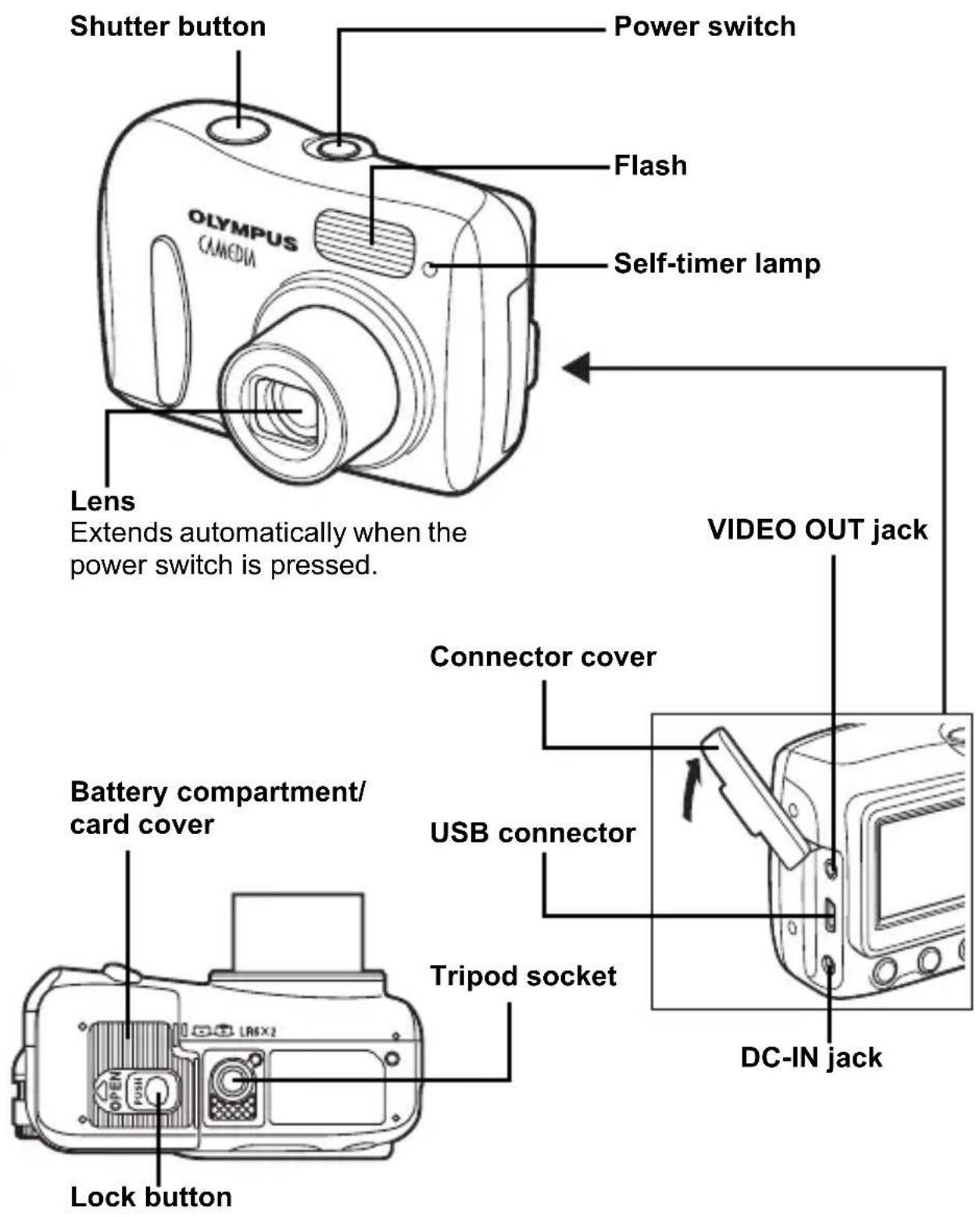
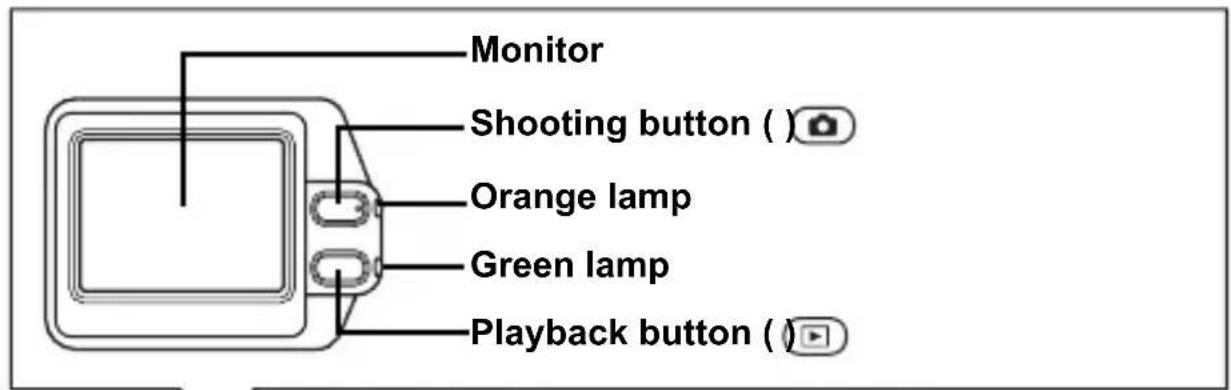

En
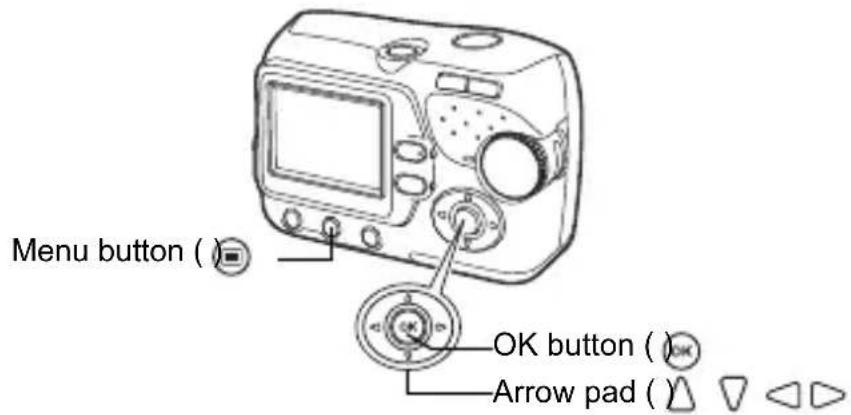
Arrow pad
Buttons on the arrow pad have their respective functions. They are also used as direction buttons. △, and indicate which button to be pressed.

MONITOR INDICATIONS
Shooting mode
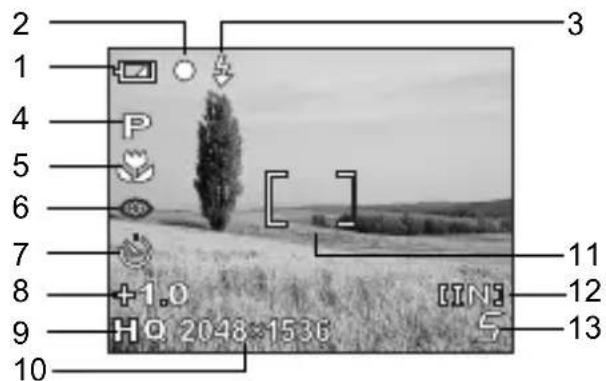
Still picture
![1 4 5 6 7 8 9 10 +1.0 HQ 320×240 [ ] 11 12 13](/content/2026/04/634838/images/826604f3f9ce3dbd820e48c7632644d363d079842ea4c88bf64749cb264905e4.jpg)
Movie
En
| Items Indications | ||
| 1 | Battery check, | 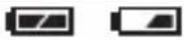 |
| 2 | Green lamp | [mmol] |
| 3 | Flash standbyCamera movement warning/ Flash charge |  |
| 4 | Shooting mode, , , , | 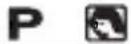     |
| 5 | Macro mode, |  |
| 6 | Flash mode, , |  |
| 7 | S e l f - t i m e r |  |
| 8 | Exposure compensation -2.0 – +2.0 | |
| 9 | Record mode SHQ, HQ, SQ1, SQ2 | |
| 10 | Resolution | 2048×1536, 1600×1200, 640×480, etc. |
| 11 | AF target mark | [ ] |
| 12 | Current memory * | [IN], [xD] |
| 13 | Number of storable still picturesRemaining recording time | 500:36 |
* The [IN] indicator is displayed when you are storing pictures in the camera's internal memory. The [xD] indicator is displayed when the card is inserted.
![2 1 4 [IN] 5x10 100-0018 HQ SIZE: 2048x1536 +1.0 '04.10.10 12:30 18 3 5 6 7 8 9 10](/content/2026/04/634838/images/862a4065a573bb40499d3a4e062a28c3e9decc24e6c4b0ec7ce5117fd13d5756.jpg)
Still picture Movie
![2 1 4 [IN] 100-0018 HQ SIZE: 320x240 +1.0 '04.10.10 12:30 00:00/00:15 11 5 6 7 8 9 10](/content/2026/04/634838/images/b25c64304deaab2550c6ab8e09fc3bcfcf892d7873fdeb7694d1f836cbeb04e6.jpg)
| Items Indications | ||
| 1 | Battery check, |   |
| 2 | Current memory * [IN], [xD] | |
| 3 | Print reservation, Number of prints |  x 10 x 10 |
| 4 | File number 100-0018 | |
| 5 | P ro t e c t |  |
| 6 | Record mode SHQ, HQ, SQ1, SQ2 | |
| 7 | Resolution | 2048×1536, 1600×1200, 640×480, etc. |
| 8 | Exposure compensation -2.0 – +2.0 | |
| 9 | Date and time '04.10.10 12:30 | |
| 10 | Number of frames Elapsed time/Total recording time (movie) | 18 00:00/00:15 |
| 11 | Movie |  |
* The [IN] indicator is displayed when you are storing pictures in the camera's internal memory. The [xD] indicator is displayed when the card is inserted.
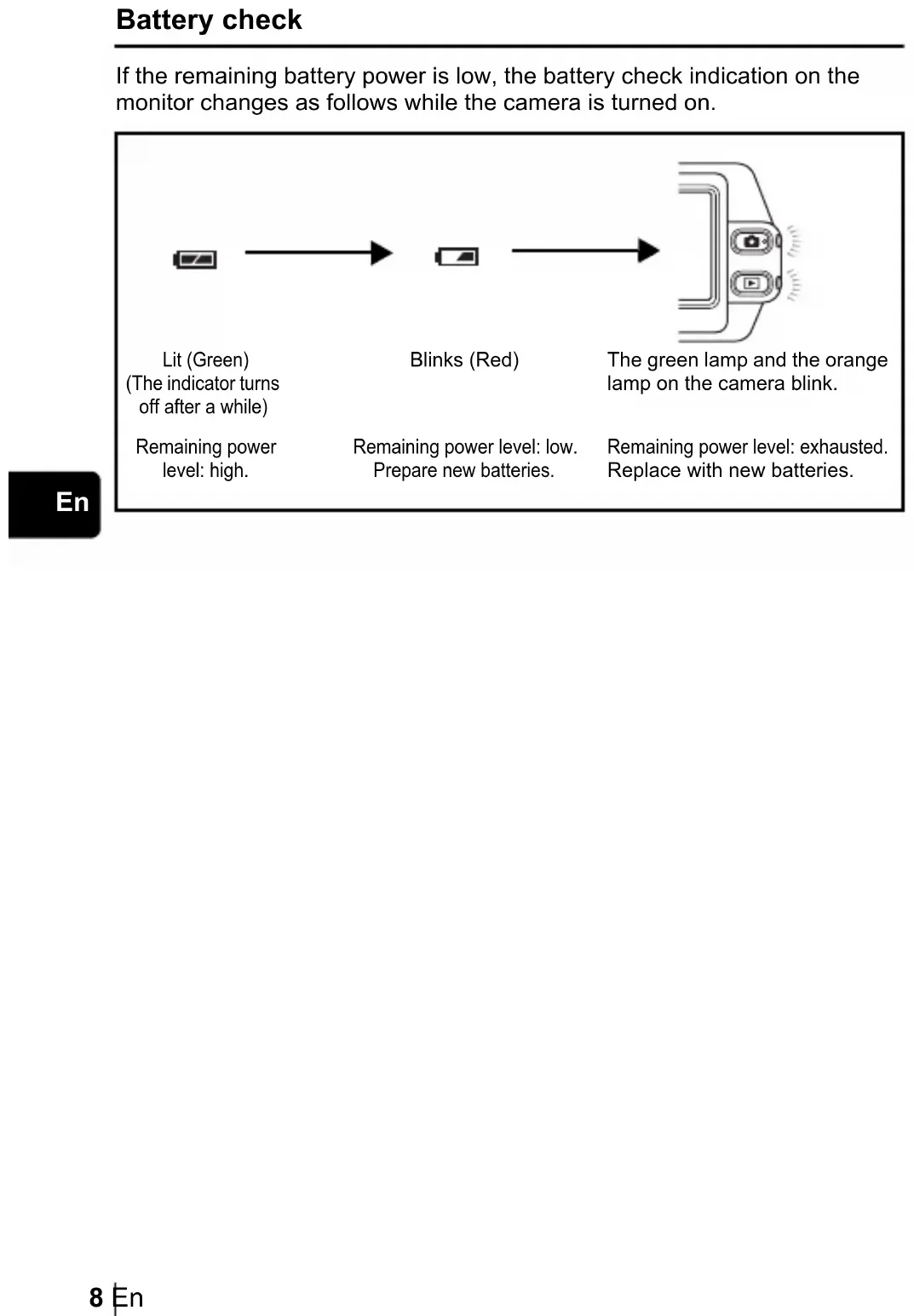
Battery check
If the remaining battery power is low, the battery check indication on the monitor changes as follows while the camera is turned on.

flowchart
graph LR
    A["Device 1"] --> B["Device 2"]
    B --> C["Device 3"]
Lit (Green) (The indicator turns off after a while)
Remaining power level: high.
Blinks (Red)
Remaining power level: low. Prepare new batteries.
The green lamp and the orange lamp on the camera blink.
Remaining power level: exhausted. Replace with new batteries.
ATTACHING THE STRAP
1 Thread the short end of the strap through the strap eyelet.
2 Thread the long end of the strap through the loop that has already gone through the eyelet.
3 Pull the strap tight, making sure that it is securely fastened and does not come loose.

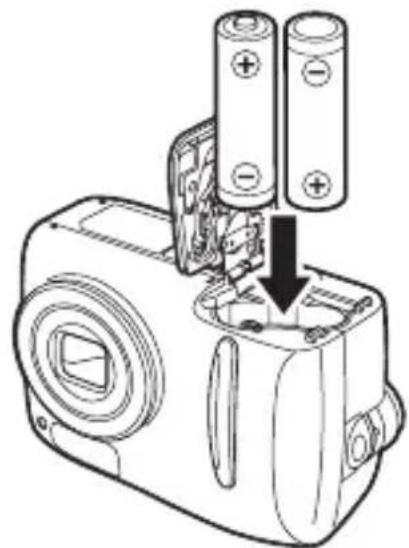
LOADING THE BATTERIES
Important
Manganese (zinc-carbon) batteries and lithium battery packs (CR-V3) cannot be used.
1 Make sure the camera is turned off.
• The monitor is off.
- The green lamp and the orange lamp on the camera are off.
• The lens is not extended.

2 Holding the lock button, slide the battery compartment/card cover in the direction of .and then lift it in the direction of .B
- Use the ball of your finger to slide the cover. Do not use your fingernail as this could result in injury.
- With the bottom of the camera facing up, open the battery compartment/card cover as shown in the illustration.

Battery compartment/card cover
3 Insert the batteries, making sure that they are correctly oriented as shown in the illustration.
- The battery insertion direction is indicated in the battery compartment and on the bottom of the camera.
natural_image
Diagram of a camera with two batteries and a device housing, showing internal components and a downward arrow indicating a process (no text or symbols present)4 Holding the batteries down with the battery compartment/card cover, close the cover in the direction of and slide it in the direction of
- If the battery compartment/card cover is hard to close, do not force it. With the battery compartment/card cover shut, press the mark firmly and push it in the direction of .D


ABOUT THE INTERNAL MEMORY AND THE CARD
Images taken are stored in the internal memory.
You can also use an optional xD-Picture Card (referred to as "card" in this manual) to store images. The card has greater capacity than the internal memory, and so, is able to store more images. The card is convenient, for example, when you are traveling and you want to take a lot of pictures.
Internal memory basics
The internal memory corresponds to a film of normal camera for recording pictures you have taken.
Pictures recorded and stored in the internal memory can easily be erased, overwritten, and/or edited on a PC. The internal memory cannot be replaced or removed from the camera.
Relationship between the internal memory and the card
The monitor displays which type of the memory (internal or card) is being used for shooting and displaying images.
Shooting mode Playback mode
![P HQ 2048-1536 [IN] Current memory [IN] HQ 04.10.10 12:30 18](/content/2026/04/634838/images/7933146038f25eee37ddf7b2b4f87a944c3441f50d7f7d4cb7be606145263c15.jpg)
| Monitor indications | Shooting mode Playback mode |
| [IN] | Stores to the internal memory. Plays the images stored in the internal memory. |
| [xD] | Stores to the card. Plays the images stored on the card. |
- The internal memory and the card cannot be used at the same time.
- When the card is inserted, the internal memory is disabled.
- When you want to use the internal memory, remove the card.
INSERTING A CARD (OPTIONAL)
An optional card (xD-Picture Card) is available for this camera.
1 Make sure the camera is turned off.
• The monitor is off.
- The green lamp and the orange lamp on the camera are off.
• The lens is not extended.

2 Holding the lock button, slide the battery compartment/card cover in the direction of and then lift it in the direction of B
- Use the ball of your finger to slide the cover. Do not use your fingernail as this could result in injury.
- With the bottom of the camera facing up, open the battery compartment/card cover as shown in the illustration.

Inserting the card
3 Face the card the correct way and insert it into the card slot as shown in the illustration.
- Insert the card while keeping it straight.
- The card stops with a click when it is inserted all the way.
- Inserting the card the wrong way or at an angle could damage the contact area or cause the card to jam.
- If the card is not inserted all the way, data may not be written to the card.

Removing the card
3 Push the card all the way in to unlock it, and let it return slowly.
- The card is ejected a short way and then stops.
Note
Releasing your finger quickly after pushing the card all the way in may cause it to eject forcefully out of the slot.
- Hold the card straight and pull it out.

natural_image
Line drawing of a camera module with internal components and a handle (no text or symbols)En

natural_image
Line drawing of a digital camera with an open lid and internal components, showing no text or symbols.4 Holding the batteries down with the battery compartment/card cover, close the cover in the direction of ⓐ and slide it in the direction of Ⓓ
- If the battery compartment/card cover is hard to close, do not force it. With the battery compartment/card cover shut, press the mark firmly and push it in the direction of .D

Power on: Press the power switch.
The lens extends and the subject is displayed on the monitor. The orange lamp lights.
The camera is ready for shooting (shooting mode).

En
Power off: Press the power switch.
The camera turns off. (The monitor also turns off.) The orange lamp goes out.

TIPS
• To save battery power, the camera automatically enters to the sleep mode and stops operating if not used for 30 seconds. The monitor switches off automatically. Press the shutter button, or to turn the monitor on. You can select the length of time after which the camera automatically enters to the sleep mode.
- If the camera is not operated for 15 minutes after the camera enters sleep mode, it automatically retracts the lens and turns off. To resume operation, turn on the power again.
Switching between the shooting mode and the playback mode

Switching to the shooting mode (Shooting mode)
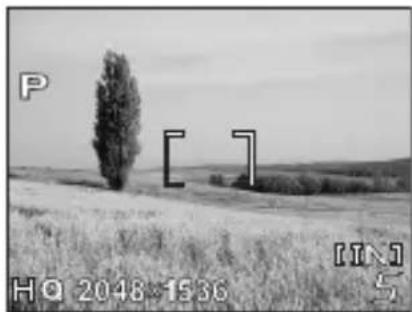
natural_image
Black-and-white landscape photo showing a lone tree in a field with no visible text or symbols- The object is displayed on the monitor.
• The orange lamp lights.

Switching to the playback mode (Playback mode)

• The last taken picture is displayed on the monitor.
• The green lamp on the camera lights.
SELECTING A LANGUAGE
1 Press the power switch.
- The camera turns on in the shooting mode.
- The lens extends and the monitor turns on.
• The orange lamp lights.
2 Press
- The menu screen is displayed.
3 Press on the arrow pad to select [].
- The selected item is displayed in yellow.
![OLYMPUS X-450 - Press on the arrow pad to select []. - 1](/content/2026/04/634838/images/4b5e3a8efa8d5cb2c976bea570c4130e9dde66150e31c423c37e16ae7ddbc30d.jpg)
4 Press or ▶
5 Press to select a language, and press.

6 Press to exit the menu.
7 Press the power switch to turn the camera off.
SETTING THE DATE AND TIME
1 Press the power switch.
- The camera turns on in the shooting mode.
- The lens extends and the monitor turns on.
• The orange lamp lights.
2 Press
- The menu screen is displayed.
3 Press on the arrow pad to select [].
![OLYMPUS X-450 - Press on the arrow pad to select []. - 1](/content/2026/04/634838/images/09c968ee1bf74007fbc0b14a1522c6e5744fcd50b71148305c647b900f7679d8.jpg)
- The selected item is displayed in yellow.
4 Press or
5 Press to select one of the following date formats: Y-M-D (Year/Month/Day), M-D-Y (Month/Day/Year), D-M-Y (Day/Month/Year). Then press ▶
- Move to the year setting.
- The following steps show the procedure used when the date and time settings are set to Y-M-D.
6 Press to set the year, and press to move to the month setting.
• To move back to the previous setting, press
• The first two digits of the year are fixed.
7 Repeat this procedure until the date and time are completely set.
- The camera only displays the time in 24-hour time system ("2 p.m." would be "14:00").
8 Press OK
- For a more accurate setting, press when the time signal hits 00 seconds. The clock starts when you press the button.
9 Press to exit the menu.
10 Press the power switch to turn the camera off.

- The date and time settings will be returned to the factory default settings if the camera is left without the battery for approximately 1 day.
MENU FUNCTIONS
HOW TO USE THE MENUS
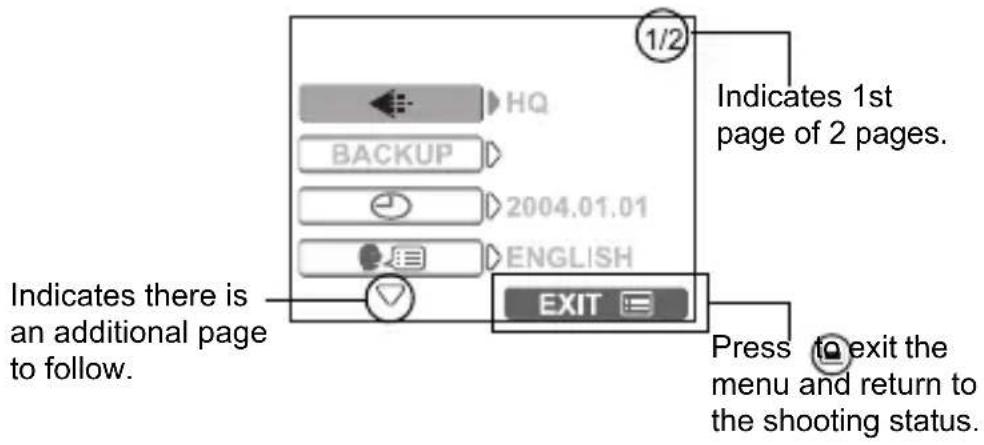
When you turn on the camera and press ,the menu is displayed on the monitor. From this menu, you can configure various settings of the camera.
1 Press to display the menu.
About the menu screen
2 Press to select an item, and press or . OK
3 Press to select a setting.
Press or to complete the setting.
4 Press to exit the menu and return to the shooting status.
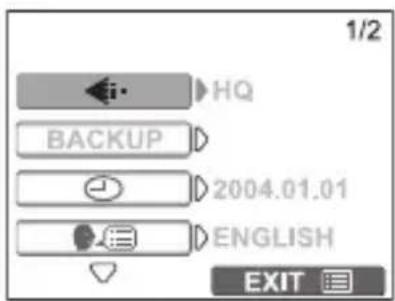

| Sets the image quality and resolution. Still picture : [SHQ], [HQ], [SQ1], [SQ2] Movie : [HQ], [SQ] | |
| BACKUP | Copies images stored in the internal memory to the card. This setting is not available when the card is not inserted. |
| Sets the date and time. | |
| Selects a language for on-screen display. | |
| SLEEP | Sets the time period that the camera automatically enters to the sleep mode. |
| VIDEO OUT | Selects [NTSC] or [PAL] according to your TV's video signal type. TV video signal types differ depending on the region. |
| MEMORY FORMAT(CARD FORMAT) | Formats the internal memory or the card. |
| PIXEL MAPPING | Checks the CCD and image processing functions for errors. |
These instructions are only for quick reference. For more details on the functions described here, refer to the “Reference Manual” on CD-ROM.


 | Runs through all saved pictures one after another. Select a single slide show with [ ] on [ ] for a continuous slide show. |
| BACKUP | Copies images stored in the internal memory to the card. This setting is not available when the card is not inserted. |
 | Stores print reservation information on the card. This setting is not available when the card is not inserted. |
| Protects pictures from accidental erasure. | |
 | Rotates pictures [ ] (clockwise) or [ ] (counterclockwise). |
| MEMORY SETUP (CARD SETUP) | Erases all images/data stored in the internal memory or on the card. |
 | Sets the date and time. |
 | Selects a language for on-screen display. |
| SLEEP | Sets the time period that the camera automatically enters to the sleep mode. |
| VIDEO OUT | Selects [NTSC] or [PAL] according to your TV's video signal type. TV video signal types differ depending on the region. |
 | Selects the number of frames in the index display. |
SHOOTING
SHOOTING MODE
This camera allows you to take still pictures and record movies.
To take still pictures, use the mode dial to select one of the shooting modes. Each mode already has the optimal settings for its purpose and conditions.
You can change the mode with the camera turned on.
As you set the mode dial, the description for each mode is displayed on the monitor.
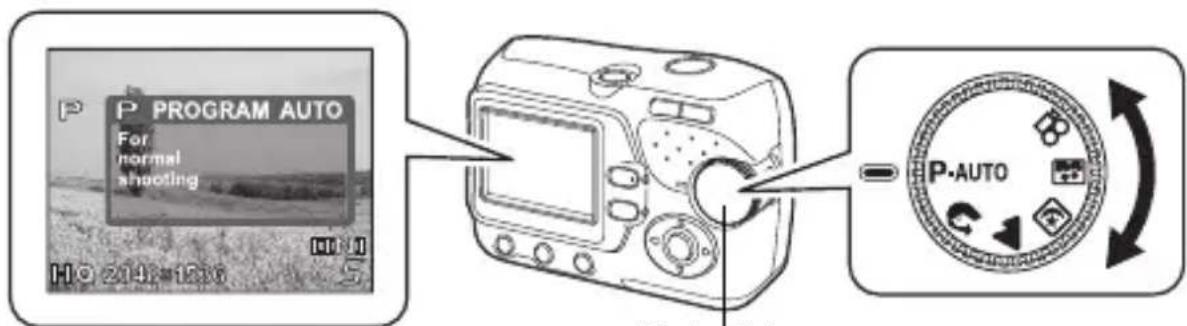
Mode dial
P-AUTO PROGRAM AUTO
Used for regular photography. The camera automatically makes the settings for natural color balance. Other functions, such as the flash mode can be adjusted manually.

PORTRAIT
Suitable for taking a portrait-style shot of a person. The camera automatically sets the optimal shooting conditions.

LANDSCAPE
Suitable for taking pictures of landscapes and other outdoor scenes. The camera automatically sets the optimal shooting conditions.

NIGHT SCENE
Suitable for shooting pictures in the evening or at night. The camera sets a slower shutter speed than is used in normal shooting. If you take a picture of a street at night in any other mode, the lack of brightness will result in a dark picture with only dots of light showing. In this mode, the true appearance of the street is captured. The camera automatically sets the optimal shooting conditions. If you use the flash, you can take pictures of both your subject and the night background.

SELF PORTRAIT
Enables you to take a picture of yourself while holding the camera. Point the lens at yourself and the focus will be locked on you.
The camera automatically sets the optimal shooting conditions. The zoom is fixed in the wide position and cannot be changed.

MOVIE
Lets you record movies.
The focus and zoom are locked. If the distance to the subject changes, focus may be compromised. You cannot record movies with sound.
En
TAKING STILL PICTURES
You can take still pictures simply by pressing the shutter button as you look at the monitor.
The recorded picture will be stored on the card if you have inserted one, or in the internal memory if you have not inserted a card.
1 Press the power switch.
- The camera turns on in the shooting mode.
- The lens extends and the monitor turns on.
• The orange lamp lights.
2 Turn the mode dial to select , P-AUTO or
3 Position the AF target mark on the subject while looking at the monitor and decide on composition.
4 Press the shutter button gently (halfway) to adjust the focus.
- When the focus and exposure are locked, the green lamp on the monitor lights steadily (Focus Lock).
- When the flash is ready to fire, the mark lights.
5 Press the shutter button all the way (fully).
• The camera takes the picture.
- The orange lamp blinks while the picture is being stored in the internal memory or on the card. The next shot is available when the orange lamp stops blinking.
IF CORRECT FOCUS CANNOT BE OBTAINED (FOCUS LOCK)
When the subject to be focused is not on the AF target mark (not positioned in the center of the composition), you can use the following steps to obtain the correct focus on the subject. This operation is referred to as "focus lock".
1 Press the power switch.
• The camera turns on in the shooting mode.
• The lens extends and the monitor turns on.
• The orange lamp lights.
2 Turn the mode dial and select a shooting mode.
3 Position the AF target mark on the subject you want to focus on.
- When shooting a hard-to-focus subject, point the camera at an object about the same distance away as the subject.
![HQ 2048×1536 [IN] 5 AF target mark](/content/2026/04/634838/images/13fc26b7e33f464ab55abedc0425d0d78477779ba99d8f97f10e23a172739243.jpg)
4 Press the shutter button halfway until the green lamp lights.
- When the green lamp lights steadily, the focus and the exposure are locked.
- When the green lamp blinks, the focus and exposure are not locked. Release your finger from the shutter button, re-position your subject and press the shutter button halfway again.
5 Keeping the shutter button pressed halfway, recompose your shot.
6 Press the shutter button fully.
![Green lamp P [ ] HQ 2038-1536 [SIN] 5](/content/2026/04/634838/images/d7b14a24b94918164c906b2a10159850d7a4ec4e088989e0a47c5c296ddf1aee.jpg)
RECORDING MOVIES
You can record movies with this camera. You can playback the recorded movies with this camera. Sound can not be recorded. The focus and zoom are locked. If the distance to the subject changes, focus may be compromised.
1 Press the power switch.
- The camera turns on in the shooting mode.
- The lens extends and the monitor turns on.
• The orange lamp lights.
2 Turn the mode dial to .
- The remaining recording time of the internal memory or the card is displayed.
3 Decide on composition.
- You can use the zoom button to enlarge the subject.
4 Press the shutter button halfway.
5 Press the shutter button fully to start recording.
- The camera fixes the focus and zoom.
- During movie recording, lights red.
6 Press the shutter button again to stop recording.
- When the remaining recording time has been used up, recording stops automatically.
- If the internal memory or the card still has free space, the remaining recording time is displayed and the camera is ready to shoot the next movie.

- During movie recording, the flash is disabled.
- If your remaining recording time is shorter than usual, try formatting the internal memory and/or the card with the camera before using it.
ZOOMING IN ON A SUBJECT
Telephoto and wide-angle shooting are possible at 3x magnification (the optical zoom limit, equivalent to 38 mm – 114 mm on a 35 mm camera). By combining the optical zoom with the digital zoom, zoom magnification can be increased to a maximum of approximately 12x.
1 Press the power switch.
• The camera turns on in the shooting mode.
• The lens extends and the monitor turns on.
• The orange lamp lights.
2 Press the zoom button.
Wide-angle: Press the zoom button toward W to zoom out.
Telephoto: Press the zoom button toward T to zoom in.


natural_image
Black-and-white landscape photo showing a lone tree in a field, with no visible text or symbols.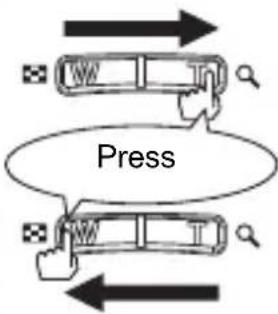
![P W T [ ] HQ 2048 1536 [IN] 5](/content/2026/04/634838/images/556352726bca3e5742367b5a066fc36a376053967daba9ea424cb01add236e3c.jpg)
The cursor moves left and right on the zoom indicator according to the zoom magnification.
- The white area of the zoom indicator indicates the optical zoom. The red area of the zoom indicator indicates the digital zoom. The digital zoom is available when the cursor is reached the red area as pressing the zoom button toward T.
3 Take the picture.

• Pictures taken with the digital zoom may appear grainy.
- Camera movement is likely to occur at higher magnifications. Stabilize the camera with a tripod, etc. to avoid camera movement.
USING THE FLASH
1 Press the power switch.
- The camera turns on in the shooting mode.
- The lens extends and the monitor turns on.
• The orange lamp lights.
2 Press flash mode button ( ).
- Flash setting screen is displayed.
3 Press to select the flash mode, and press. OK
- You can also set by pressing repeatedly.
- If not used for about 3 seconds, the camera applies the current settings, and the setting screen disappears.
4 Press the shutter button halfway.
- When the flash is set to fire, the mark lights steadily.
5 Press the shutter button fully to take the picture.
Flash working range
W (max.): Approx. 0.2 m to 3.8 m (0.7 ft. to 12.5 ft.)
T (max.): Approx. 0.5 m to 2.2 m (1.6 ft. to 7.2 ft.)
Auto-flash (No indication)
The flash fires automatically in low light or backlight conditions.
Red-eye reduction flash ( )
The red-eye reduction flash mode significantly reduces this phenomenon by emitting pre-flashes before firing the regular flash.
Fill-in flash ( )
The flash fires regardless of the available light.
Flash off ( )
The flash does not fire even in low light conditions.
MACRO MODE SHOOTING
Macro shooting 🎨 : Use when shooting subjects close to you (W: 20 cm to 50 cm (0.7 ft. to 1.6 ft.)/T: 50 cm to 90 cm 1.6 ft. to 3.0 ft.)).
Super macro shooting ( ) Use when shooting subjects as close as 2 cm/0.8".
1 Press the power switch.
- The camera turns on in the shooting mode.
- The lens extends and the monitor turns on.
• The orange lamp lights.
2 Press (▷)
- The setting screen for the macro shooting is displayed.
3 Press to select macro mode, and press . OK
- If not used for about 3 seconds, the camera applies the current settings, and the setting screen disappears.
4 Take the picture.
USING THE SELF-TIMER
This function is useful for taking pictures where you want to be included in the photograph. Fix the camera securely on a tripod or set it on a level surface for self-timer shooting.
1 Press the power switch.
- The camera turns on in the shooting mode.
- The lens extends and the monitor turns on.
• The orange lamp lights.
2 Press ◀ Ⓧ ).
- The self-timer setting screen is displayed.
3 Press to select [ON], and press.
- If not used for about 3 seconds, the camera applies the current settings, and the setting screen disappears.
4 Take the picture.
- The self-timer lamp lights up for approximately 10 seconds, and starts blinking. After blinking for approximately 2 seconds, the picture is taken.
- In the movie mode, press the shutter button again to stop the shooting.
- Press to stop the self-timer once activated.
- The self-timer mode is automatically canceled after one shot.
VARYING THE IMAGE BRIGHTNESS (EXPOSURE COMPENSATION)
This function allows you to make fine changes to the automatic exposure setting. You can adjust the exposure in the range of ±2.0 in 1/3EV steps. When the setting is changed, you can check the result on the monitor.
1 Press the power switch.
- The camera turns on in the shooting mode.
- The lens extends and the monitor turns on.
• The orange lamp lights.
2 Press △ (Z).
- The setting screen for the exposure compensation is displayed.
3 Press to select the exposure compensation value, and press OK
- Select a [ + ] value to brighten the image or a [ - ] value to darken the image.
- If not used for about 3 seconds, the camera applies the current settings, and the setting screen disappears.
4 Take the picture.
PLAYBACK
VIEWING STILL PICTURES
When the card is inserted, the images stored on the card are displayed. To display the images stored in the internal memory, remove the card.
1 Press the power switch to turn the camera on, and press

- Playback mode is set.
• The green lamp on the camera lights. - The monitor turns on and displays the last picture taken (single-frame playback).
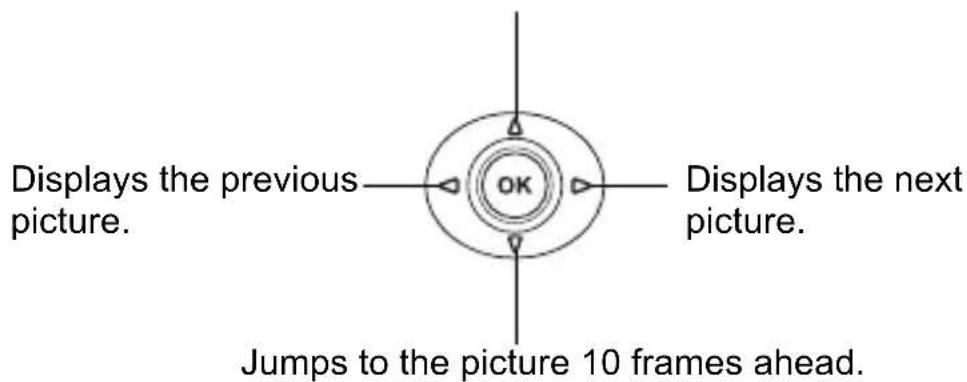
2 Use the arrow pad to playback other pictures.
Jumps to the picture 10 frames back.
En
3 Press the power switch to turn the camera off.
• The monitor and camera turn off.
• The green lamp on the camera goes out.
CLOSE-UP PLAYBACK
Pictures displayed on the monitor can be enlarged in steps up to 4 times the original size.
1 Press the power switch to turn the camera on, and press ☐.
- Playback mode is set.
• The green lamp on the camera lights.
2 Use the arrow pad to select the still picture you want to enlarge.
- You cannot enlarge pictures with
- In the index display, press the zoom button toward T ( ) to display the selected picture in full-screen mode (single-frame playback).

3 Press the zoom button toward T ().
- The magnification increases each time the zoom button is pressed toward T ( )
- To return the picture to the original size (1x), press the zoom button toward W ( )
- By using the arrow pad while the enlarged picture is displayed, you can shift the picture in the desired direction, enabling you to view a different portion.
INDEX DISPLAY
This function lets you show several pictures at the same time on the monitor.
1 Press the power switch to turn the camera on, and press
▶
- Playback mode is set.
• The green lamp on the camera lights.
2 Press the zoom button toward W ( ) to switch to the index display.
- Use the arrow pad to select the picture.
- To return to the single-frame playback, press the zoom button toward T ( ) or


natural_image
Grid of nine grayscale flower images labeled 1 through 9, showing natural scenes and landscapes (no text or symbols beyond labels)Index display
VIEWING MOVIES
1 Press the power switch to turn the camera on, and press 📋.
- Playback mode is set.
• The green lamp on the camera lights.
2 Use the arrow pad to display the picture with .
3 Press OK
- The movie is played back. When the playback ends, the display automatically returns to the playback mode.
- Press to stop the movie playback. Press to select [EXIT], and press OK
PROTECTING PICTURES
You are recommended to protect important pictures to avoid accidentally erasing them.
1 Press the power switch to turn the camera on, and press ☐.
- Playback mode is set.
• The green lamp on the camera lights.
2 Select [] from the menu, and press . OK
3 Press to select the picture to be protected.
4 Press to select [ON], and press . OK
- To cancel protection, select [OFF].
5 Press to select [EXIT], and press . OK
- Press to exit the menu.

Note
- Protected pictures cannot be erased by the single-frame/all-frame erase functions, but they are all erased when you format the internal memory or the card.
ERASING PICTURES
This function enables the camera to erase the recorded pictures. The “single-frame erase” function erases only the current frame on the screen. The “all-frame erase” function erases all frames stored in the internal memory or on the card.
- To erase the pictures stored in the internal memory, remove the card first.
- To erase the pictures stored on the card, you should insert the card first.

Note
- You cannot erase pictures that are protected. Cancel the protection before erasing such pictures.
- Once erased, pictures cannot be restored. Be careful not to accidentally erase pictures you want to keep.
Single-frame erase
En
1 Press the power switch to turn the camera on, and press 📋.
- Playback mode is set.
- The green lamp on the camera lights.
2 Use the arrow pad to display the picture you want to erase.
3 Press
4 Press to select [YES], and press . OK
- The picture is erased and the menu is closed.
All-frame erase
1 In the playback mode, select [MEMORY SETUP] from the menu, and press OK
- When the card is inserted, select [CARD SETUP].
2 Press to select [ALL ERASE], and press . OK
3 Press to select [YES], and press . OK
- All the pictures are erased.
PRINT RESERVATION/DIRECT PRINT
WITH PRINT RESERVATION (DPOF)
DPOF is short for Digital Print Order Format. DPOF is the format used to record automatic print information from digital cameras.
Only the images stored on the card can be reserved to print. Insert the card recording the images into the camera before making print reservation.
If a card containing print reservation data is taken to a print shop that supports the DPOF format, the pictures can be printed according to the DPOF reservations. Or pictures can be printed out at home on a personal DPOF-compatible printer.
All-frame reservation
You can print one copy of all images stored on the card. Select whether the print date or time will also be included.
You cannot change the number of copies for this feature. If you want to change the number, first make the all-frame reservation, and then change the number of copies using the single-frame reservation function.
Single-frame reservation
Use this feature to print only selected pictures. It is also used to change the reserved number of prints and the date/time settings. Display the frame you want to print and set the desired number of copies.
Resetting the print reservation data
This function resets all the print reservation data for the pictures stored in the card. To cancel printing individually, use the single-frame reservation function.
DIRECT PRINT (PictBridge)
By connecting the camera to a PictBridge-compatible printer with the USB cable, you can print out recorded pictures directly without the use of a computer.
PictBridge is the standard for connecting digital cameras and printers of different makers and printing out pictures directly.
PRINT Prints the selected picture.
PRINT ORDER Prints the pictures according to the print reservation data on the card. If no print reservations have been made, this option is not available.
For more details, refer to the "Reference Manual" on CD-ROM.
DOWNLOADING PICTURES TO A COMPUTER
For editing, and managing image files using with personal computer, install the OLYMPUS Master software on the CD-ROM supplied with the camera. After install the OLYMPUS Master software, connect the camera to the personal computer with USB cable for downloading the images taken by the camera.
What is OLYMPUS Master?
OLYMPUS Master is application software for editing images taken with a digital camera on a computer. Installing it on your computer lets you do the following:
En
Download images from the camera or other media
View images and movies
You can run a slideshow and play back movie.
Manage images
You can organize your images by shooting date on a calendar display and entering key words to help you find them easily.
Edit images
You can rotate images, trim them and change the size.
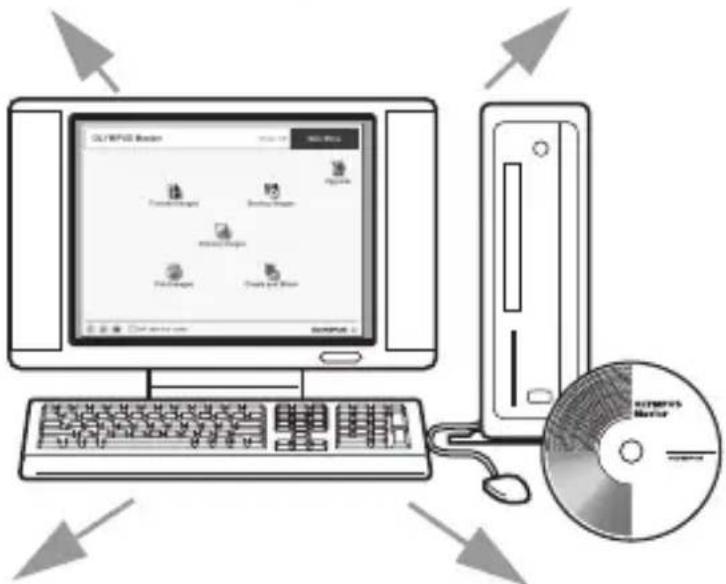
Edit images with the filter and correction functions
Print images
You can print images and make indexes, calendars and postcards.
For more details, refer to the "Reference Manual" on CD-ROM.
ERROR CODES
| Monitor indication | Possible cause Corrective action | |
 NO CARD NO CARD | The card is not inserted, or it cannot be recognized. | Insert a card or insert a different card. If the problem persists, format the card. If the card cannot be formatted, it cannot be used.Pictures can be stored in the internal memory if no card is inserted. |
 CARD ERROR CARD ERROR | There is a problem with the card. | This card cannot be used. Insert a new card. |
 WRITE PROTECT WRITE PROTECT | Writing to the card is prohibited. | Read-only setting is applied to the card by a PC.Cancel the setting using the PC. |
 MEMORY FULL MEMORY FULL | There is no empty space in the internal memory, so it cannot record new data. | Insert a card and copy the pictures to the card, or erase unwanted pictures.Before erasing, download important images to a PC. |
 CARD FULL CARD FULL | The card is full. The print reservation or backing up of the internal memory is not allowed. | Replace the card or erase unwanted pictures. Before erasing, download important images to a PC. |
 NO PICTURE NO PICTURE | There are no pictures in the internal memory or the card. | The internal memory or the card contains no pictures. Record pictures. |
 PICTURE ERROR PICTURE ERROR | The selected picture has a problem, therefore it cannot be played back on this camera. | Use image processing software to view the picture on a PC. If that cannot be done, the image file is damaged. |
 CARD-COVER OPEN CARD-COVER OPEN | The battery compartment/ card cover is open. | Close the battery compartment/card cover. |
 | The card is not formatted. | Format the card.All data on the card will be deleted. |
SPECIFICATIONS
Product type : Digital camera (for shooting and displaying)
Recording system
Still picture : Digital recording, JPEG (in accordance with Design rule for Camera File system (DCF))
Applicable : Exif 2.2, Digital Print Order Format (DPOF), standards PRINT Image Matching II, PictBridge
Movie : QuickTime Motion JPEG support
Memory : Internal memory (12 MB), xD-Picture Card (16 – 512 MB)
No. of storable pictures
When an internal memory is used : Approx. 5 frames (SHQ : 2048 x 1536) Approx. 14 frames (HQ : 2048 x 1536) Approx. 18 frames (SQ1 : 1600 x 1200) Approx. 68 frames (SQ2 : 640 x 480)
No. of effective pixels : 3,200,000 pixels
Image pickup device : 1/2.7" CCD solid-state image pickup, 3,340,000 pixels (gross)
Lens : Olympus lens 5.8 mm to 17.4 mm, f2.9 to 5.0 (equivalent to 38 mm to 114 mm lens on 35 mm camera)
Photometric system : Center-weighted metering
Shutter speed : 1 to 1/2000 sec. (NIGHT SCENE mode: 2 sec)
Shooting range : 0.5 m (1.6 ft.) to (W), 0.9 m (3.0 ft.) to (T) (normal) 0.2 m (0.7 ft.) to 0.5m (1.6 ft.) (W), 0.5 m (1.6 ft.) to 0.9 m (3.0 ft.) (T) (macro mode)
Monitor : 1.5" TFT color LCD display, 130,000 pixels
Outer connector : DC-IN jack, USB connector (mini-B), VIDEO OUT jack
Automatic calendar : 2004 up to 2099 system
Operating environment
Temperature : 0^ C to 40^ C ( 32^ F to 104^ F) (operation) - 20^ C to 60^ C (- 4^ F to 140^ F) (storage)
Humidity : 30% to 90% (operation) 10% to 90% (storage)
Power supply : 2 AA (R6) alkaline batteries or NiMH batteries.
AC adapter (optional) Manganese (zinc-carbon) batteries and lithium battery packs (CR-V3) cannot be used.
Dimensions : 87.5 mm (W) x 62.5 mm (H) x 38.5 mm (D)
(3.4" x 2.5" x 1.5") (excluding protrusions)
Weight : 140 g (0.3 lb) (without batteries and/or card)
SPECIFICATIONS ARE SUBJECT TO CHANGE WITHOUT ANY NOTICE OR OBLIGATION ON THE PART OF THE MANUFACTURER.
TABLE DES MATIÈRES
GUIDE RAPIDE DE DÉMARRAGE 42
FONCTIONS DU MENU 56
PRISE DE VUES 59
Adresse : Two Corporate Center Drive, PO Box 9058,
Melville, New York 11747-9058 U.S.A.
natural_image
Pure diagram of a camera lens assembly without any text, numbers, or symbolsnatural_image
Diagram of a camera with two batteries and a mechanical component, showing no text or symbols
natural_image
Technical line drawing of a camera module with internal components and a close-up view (no text or symbols)natural_image
Line drawing of a digital camera with internal components and a mounted screen (no text or symbols)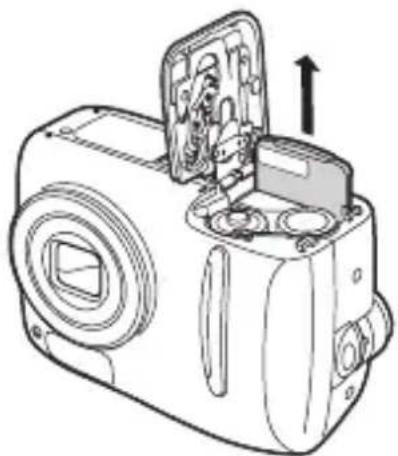
natural_image
Line drawing of a digital camera with an open lid and internal components, showing no text or symbols.Fr
MISE EN MARCHE/ARRÊT
natural_image
Black-and-white landscape photo showing a lone tree in a field with no visible text or symbolsSI UNE MISE AU POINT SATISFAISANTE EST IMPOSSIBLE (MÉMORISATION DE LA MISE AU POINT)

![P W T [ ] HQ 2048-15:36 IN 5](/content/2026/04/634838/images/762e526448982fa425bcbd0d8e77841d4538c54e7f57331c8b060b9cdb8bf658.jpg)
natural_image
Grid of nine black-and-white flower images with no visible text or symbols, labeled [IN] and 1/2 at top corners.Affichage d'index
LECTURE DE VIDÉOS
flowchart
graph LR
    A["Battery"] --> B["Battery"]
    B --> C["Connector"]
natural_image
Diagram of a camera with two batteries and a device housing, showing internal components and a downward arrow indicating a process (no text or symbols present)

natural_image
Line drawing of a camera module with internal components and a handle (no text or symbols)
natural_image
Line drawing of a digital camera with an open lid and internal components, showing no text or symbols.De
natural_image
Black-and-white landscape photo showing a lone tree in a field with no visible text or symbolsnatural_image
Grid of nine black-and-white flower images labeled 1 through 9, each with a camera icon and a scale bar (no text or symbols beyond labels)Indexwiedergabe
MOVIE-WIEDERGABE
natural_image
Diagram of a camera with two batteries and a device inside, showing internal components and a downward arrow indicating a process (no text or symbols present)Es
ACERCA DE LA MEMORIA INTERNA Y LA TARJETA
natural_image
Line drawing of a camera module with an attached cover and screw base (no text or symbols)
natural_image
Line drawing of a digital camera with an open lid and internal components, showing no text or symbols.natural_image
Black-and-white landscape photo showing a lone tree in an open field with no visible text or symbolsnatural_image
Black-and-white landscape photo of a lone tree in an open field, with timestamp and HQ logo visible (no readable text or symbols)natural_image
Black-and-white landscape photo showing a tree in a field with a camera interface overlay (no readable text or symbols)
![P W T [ ] IN HQ 2048-1536](/content/2026/04/634838/images/622249d5c7331ded6870b203fe4ae122afcdb4e8e4ebdb1cbefc9edd926d0316.jpg)
natural_image
Grid of nine black-and-white flower images with no visible text or symbols, labeled [IN] and 1/2 at top corners.Conector exterior : Jack DC-IN, conector USB (mini-B), jack VIDEO
OUT
Shinjuku Monolith, 3-1 Nishi-Shinjuku 2-chome, Shinjuku-ku, Tokyo, Japan
OLYMPUS IMAGING AMERICA INC.
Two Corporate Center Drive, Po Box 9058, Melville, NY 11747-9058, U.S.A.
Tel. 631-844-5000
Technical Support (USA)
24/7 online automated help: http://www.olympusamerica.com/support
Phone customer support: Tel. 1-888-553-4448 (Toll-free)
Our phone customer support is available from 8 am to 10 pm
(Monday to Friday) ET
E-Mail: distec@olympus.com
Olympus software updates can be obtained at: http://www.olympus.com/digital
OLYMPUS EUROPA GMBH
Premises: Wendenstrasse 14-18, 20097 Hamburg, Germany
Tel: +49 40-23 77 3-0 / Fax: +49 40-23 07 61
Goods delivery: Bredowstrasse 20, 22113 Hamburg, Germany
Letters: Postfach 10 49 08, 20034 Hamburg, Germany
European Technical Customer Support:
Please visit our homepage http://www.olympus-europa.com
or call our TOLL FREE NUMBER*: 00800 - 67 10 83 00
for Austria, Belgium, Denmark, Finland, France, Germany, Italy, Luxemburg, Netherlands, Norway, Portugal, Spain, Sweden, Switzerland, United Kingdom
* Please note some (mobile) phone services/provider do not permit access or request an additional prefix to +800 numbers.
For all not listed European Countries and in case that you can't get connected to the above mentioned number please make use of the following
CHARGED NUMBERS: +49 180 5 - 67 10 83 or +49 40 - 237 73 899
Our Technical Customer Support is available from 9 am to 6 pm MET (Monday to Friday)

- CONTENTS
- GETTING STARTED 4
- MENU FUNCTIONS 18
- SHOOTING....21
- PLAYBACK 31
- PRINT RESERVATION/DIRECT PRINT 35
- DOWNLOADING PICTURES TO A COMPUTER ..... 36
- ERROR CODES 37
- SPECIFICATIONS 38
- For customers in North and South America
- For customers in USA
- For customers in Canada
- For customers in Europe
- Trademarks
- GETTING STARTED
- Arrow pad
- MONITOR INDICATIONS
- Shooting mode
- Battery check
- ATTACHING THE STRAP
- LOADING THE BATTERIES
- Important
- Holding the lock button, slide the battery compartment/card cover in the direction of .and then lift it in the direction of .B
- Insert the batteries, making sure that they are correctly oriented as shown in the illustration.
- Holding the batteries down with the battery compartment/card cover, close the cover in the direction of and slide it in the direction of
- ABOUT THE INTERNAL MEMORY AND THE CARD
- Internal memory basics
- Relationship between the internal memory and the card
- INSERTING A CARD (OPTIONAL)
- Make sure the camera is turned off.
- Holding the lock button, slide the battery compartment/card cover in the direction of and then lift it in the direction of B
- Inserting the card
- Face the card the correct way and insert it into the card slot as shown in the illustration.
- Removing the card
- Push the card all the way in to unlock it, and let it return slowly.
- Note
- Holding the batteries down with the battery compartment/card cover, close the cover in the direction of ⓐ and slide it in the direction of Ⓓ
- Power on: Press the power switch.
- En
- Power off: Press the power switch.
- TIPS
- Switching between the shooting mode and the playback mode
- SELECTING A LANGUAGE
- Press the power switch.
- Press
- Press on the arrow pad to select [].
- Press or ▶
- Press to select a language, and press.
- Press to exit the menu.
- Press the power switch to turn the camera off.
- SETTING THE DATE AND TIME
- Press or
- Press to select one of the following date formats: Y-M-D (Year/Month/Day), M-D-Y (Month/Day/Year), D-M-Y (Day/Month/Year). Then press ▶
- MENU FUNCTIONS
- HOW TO USE THE MENUS
- Press to display the menu.
- SHOOTING
- P-AUTO PROGRAM AUTO
- PORTRAIT
- LANDSCAPE
- NIGHT SCENE
- SELF PORTRAIT
- MOVIE
- TAKING STILL PICTURES
- Turn the mode dial to select , P-AUTO or
- Position the AF target mark on the subject while looking at the monitor and decide on composition.
- Press the shutter button gently (halfway) to adjust the focus.
- Press the shutter button all the way (fully).
- IF CORRECT FOCUS CANNOT BE OBTAINED (FOCUS LOCK)
- Turn the mode dial and select a shooting mode.
- Position the AF target mark on the subject you want to focus on.
- Press the shutter button halfway until the green lamp lights.
- Keeping the shutter button pressed halfway, recompose your shot.
- Press the shutter button fully.
- RECORDING MOVIES
- Turn the mode dial to .
- Decide on composition.
- Press the shutter button halfway.
- Press the shutter button fully to start recording.
- Press the shutter button again to stop recording.
- ZOOMING IN ON A SUBJECT
- Press the zoom button.
- Take the picture.
- USING THE FLASH
- Press flash mode button ( ).
- Press to select the flash mode, and press. OK
- Press the shutter button fully to take the picture.
- Auto-flash (No indication)
- Red-eye reduction flash ( )
- Fill-in flash ( )
- Flash off ( )
- MACRO MODE SHOOTING
- Press (▷)
- Press to select macro mode, and press . OK
- Take the picture.
- USING THE SELF-TIMER
- Press ◀ Ⓧ ).
- Press to select [ON], and press.
- VARYING THE IMAGE BRIGHTNESS (EXPOSURE COMPENSATION)
- Press △ (Z).
- Press to select the exposure compensation value, and press OK
- PLAYBACK
- VIEWING STILL PICTURES
- Press the power switch to turn the camera on, and press
- Use the arrow pad to playback other pictures.
- Press the power switch to turn the camera off.
- CLOSE-UP PLAYBACK
- INDEX DISPLAY
- VIEWING MOVIES
- PROTECTING PICTURES
- ERASING PICTURES
- Single-frame erase
- All-frame erase
- PRINT RESERVATION/DIRECT PRINT
- WITH PRINT RESERVATION (DPOF)
- All-frame reservation
- Single-frame reservation
- Resetting the print reservation data
- DIRECT PRINT (PictBridge)
- DOWNLOADING PICTURES TO A COMPUTER
- What is OLYMPUS Master?
- View images and movies
- Manage images
- Edit images
- Print images
- ERROR CODES
- SPECIFICATIONS
- TABLE DES MATIÈRES
- GUIDE RAPIDE DE DÉMARRAGE 42
- FONCTIONS DU MENU 56
- PRISE DE VUES 59
- MISE EN MARCHE/ARRÊT
- SI UNE MISE AU POINT SATISFAISANTE EST IMPOSSIBLE (MÉMORISATION DE LA MISE AU POINT)
- LECTURE DE VIDÉOS
- MOVIE-WIEDERGABE
- ACERCA DE LA MEMORIA INTERNA Y LA TARJETA
- OLYMPUS IMAGING AMERICA INC.
- Technical Support (USA)
- OLYMPUS EUROPA GMBH
- European Technical Customer Support:
Brand : OLYMPUS
Model : X-450
Category : Camera