USER MANUAL WTD1171A BRANDT
INSTALLATION, OPERATING AND MAINTENANCE INSTRUCTIONS
Contents
Safety /environment and savings 2
Releasing, moving and levelling 3
Connecting to the cold water supply 3
Draining away the waste water 3
Connecting to the electricity supply 3
Sorting and checking your washing 4
Access to the machine's drum 4
Inserting your washing 4
Closing the drum 4
Cleaning products 4
Programming 5-7
Details of the functions and the options ....7-8
Changing a programme. 9
Automatic safety systems 9
Characteristics 9
Running maintenance 10
Cleaning the pump and drying filters 10
Incidents that may arise 11
Textile care codes 11
Incidents notified on the display, which you can repair yourself 12
BEFORE READING THESE INSTRUCTIONS, REMOVE THE ILLUSTRATED PAGES IN THE CENTRE OF THIS DOCUMENT
This machine is only designed for domestic use and to wash, rinse, spin and, depending on the model,
dry machine-washable textiles.
You will find the following symbols used throughout this manual. They mean:
Safety instructions (for your machine and your washing), which must be observed
An electrical risk,
Important advice and information
Safety advice
In this manual, you will find the instructions required for the safety, installation and use of your machine and the relevant guarantees. Please keep these and pass them on if you sell the machine.
- Dispose of the packaging and of your worn-out machine (after rendering it unusable by removing the hoses, cutting the power cable and breaking the lock on the lid) in accordance with the prevailing regulations.
- For a new installation, the machine must be connected to the water supply with a new hose: the old hose must not be re-used.
- Do not let children play with the machine or the cleaning and maintenance products (water unsuitable for drinking, ingestion of the products, risk of physical harm, etc.). Keep pets away from the machine.
- Protect your property and your machine by checking the condition of the hoses regularly. Never use solvents, inflammable products, explosive products or aerosols near to or in your machine. Use the machine in a well-ventilated, frost-free area and do not use an extension lead or a multiple adapter.
- Switch off the power supply to your machine after use.
- If your machine should break down, call a qualified washing machine engineer.
- Only use your machine in accordance with the instructions in this manual. Only use washing and maintenance products approved for domestic machines.
For washer-dryers:
Some liquid detergent manufacturers may provide a plastic device, meant to be placed in the washing machine drum together with the laundry, for the gradual release of the liquid detergent. If you are using this device, please ensure that it is removed from the drum before you activate the drying cycle as its plastic material cannot withstand the high temperature of the drying process.
Environment and savings
- Fill your machine to the maximum. You thereby optimise your water and electricity consumption.
- Only programme a pre-wash when absolutely necessary: e.g. for heavily soiled sports or working clothes, etc.
- A programme with no pre-wash is sufficient for slightly or moderately soiled clothes.
- For slightly soiled clothes, select a short washing cycle (or an «Express» cycle, depending on the model).
- Gauge the amount of detergent according to the water hardness, the degree of soiling and the amount of washing. Always follow the manufacturer's instructions on the detergent packets.
For washer-dryers:
- If you spin at high speed, little dampness will remain and you will therefore consume little electricity. Even synthetic textiles can be spun before drying.
- Choosing your drying time well also helps to save water and electricity.
- Avoid wasting water and electricity by not over-drying your laundry.
Releasing your machine
First of all remove the piece of expanded polystyrene from under the lid. (Keep the transport material: you will need it if you move).
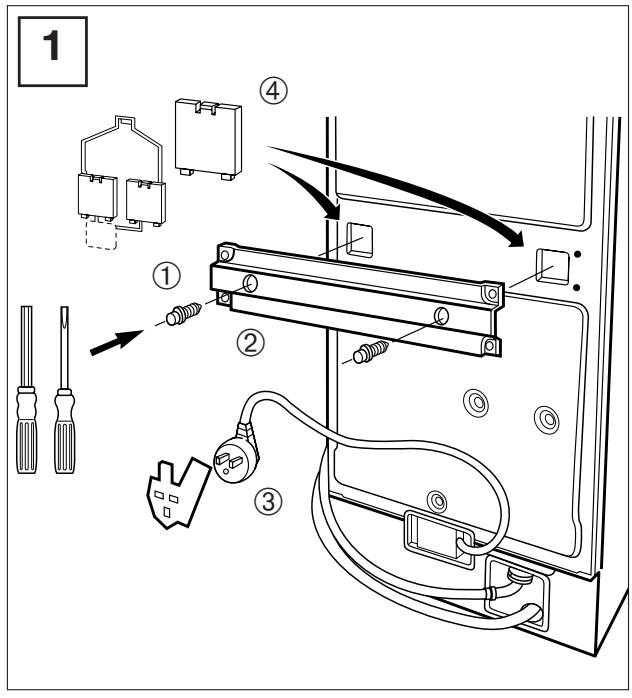
Rear transport clamp FIG. 1 ① to ④
① Unscrew the 6 screws using a No. 10 tube spanner or a straight-edged screwdriver.
② Remove the clamp.
③ Free the power cable from the plastic holder clipping it to the transport clamp.
④ Plug the holes left by the clamp using the plugs supplied and re-screw the 4 external screws into the casing.
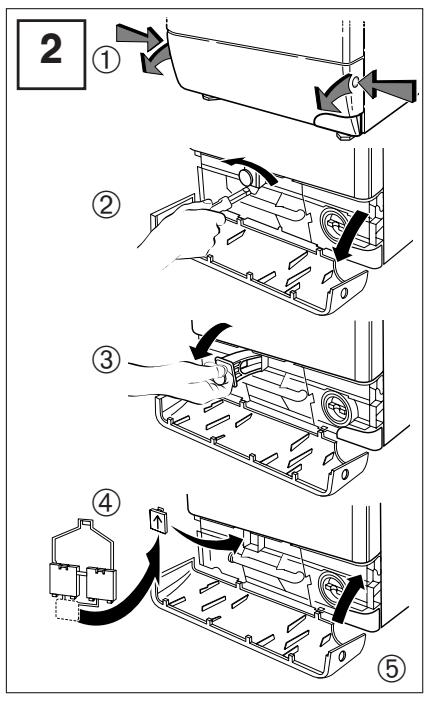
Front transport clamp FIG. 2 ① to ⑤
① Unclip the plinth by pressing simultaneously on the side knobs and pulling them towards you.
② Unscrew the screw holding the red plastic «front» clamp.
③ Remove the front clamp.
④ Plug the hole left by the clamp with the remaining plug.
⑤ Clip the plinth on again.
Moving and levelling
Setting on castors, moving
To move your machine, unclip and slide the castor release handle from right to left.
A Your machine must not still be on its castors when in operation. Check that it is plumb and stable to avoid vibration during spinning.
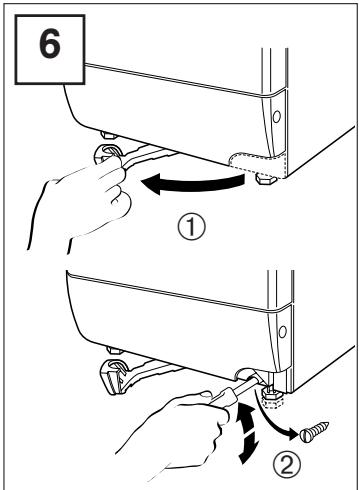
Levelling FIG. 6 ① ②
- Set your machine on its castors.
- Unscrew the two screws with a straight-edged screwdriver.
- Level the machine by adjusting the two feet using a flat spanner or a pair of pliers.
- Set the machine back on the floor by sliding the castor release lever to check the chocking.
- If the machine is correctly level, retighten the two locking screws.
To align your machine with your units, you can break off the fixing hooks for the hoses.
Take care not to squash the hoses!
If you cannot avoid installing the machine on a carpeted floor, adjust the feet so as to leave a large gap for ventilation.
Connecting your machine
Connecting to the cold water supply (FIG. 5)
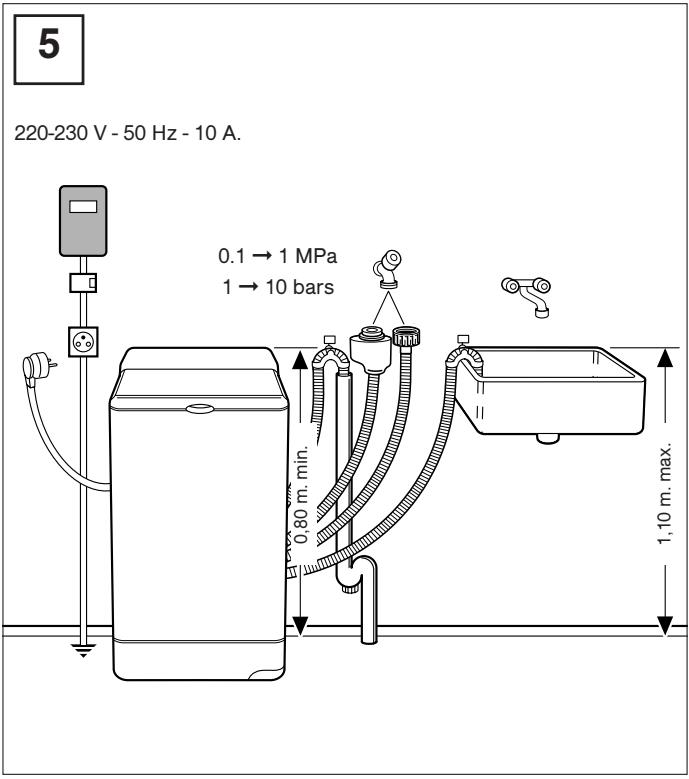
Your washing machine can be connected to any cold water pipe. Connect the supply hose provided to a threaded 20x27 tap (3/4 BSP) not forgetting to insert the seal supplied (depending on the model, the hose may already be fitted with a seal).
Water pressure may vary from 0.1 to 1MPa (1 10 bars). If the pressure is high, please provide a pressure regulator. Your water supplier can provide the necessary advice.
Draining away the waste water (FIG. 5)
NB: Ensure that the drain hose is tied firmly in place with cord, etc. to avoid a possible flood. In all cases, the height of the drain hose bracket must be between 0.80m minimum and 1.10m maximum above the floor. The hose must be fastened to avoid it breaking and its opening must be above the surface of the water being drained away.
Connecting to the electrical supply (FIG. 5)
Please refer to the «Characteristics» section. The socket must be easily accessible but out of children's reach.
The installation must conform to the country's regulations, in particular as regards earthing requirements and installation in showerrooms. The machine must be earthed.
Never use an extension lead or a multiple adapter for connecting to the socket.
- We cannot be held responsible for any incident caused by poor earthing of the machine or poor electrical installation.
The machine must be switched off (in the «Stop» position) when connecting to the electrical supply.
Failure to observe the following advice can cause severe and even irremediable damage (damage to the drum, torn washing, etc.) and rescinds the guarantee.
Sorting your washing
- Ensure that all your washing is machine-washable: check the labels on your washing (type, temperature, type of cleaning, etc.).
- Ensure that your coloureds do not run.
- When washing a mixed load, use the washing programme for the most delicate textiles in the mix.
Checking your washing
- Empty the pockets and close any zips and press-studs.
- Remove any curtain hooks or place your curtains and any small items of laundry (ribbons, handkerchiefs, etc.) in a net bag. Button up pillowcases, etc.
- Remove any poorly attached buttons, pins and hooks.
Access to the machine's drum (FIGs. 3 - 4)
- Proceed as follows:
- Check that the machine is switched off.
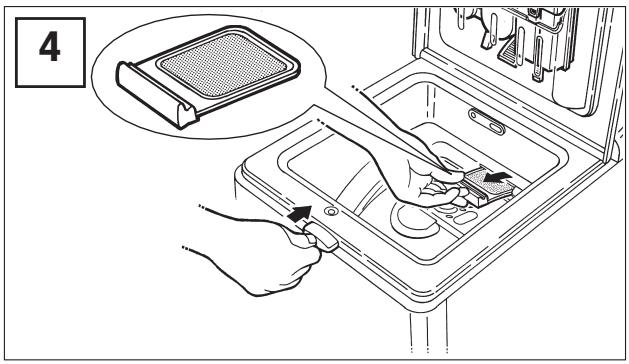
- Open the machine's door (FIG. 4).
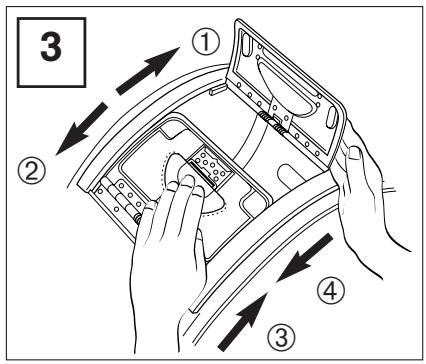
- Press the button on the front flap. (FIG. 3 ① ②)
Loading your washing
-
For optimum washing performance, place the previously sorted and folded washing in the drum, distributing it evenly without heaping it up. Mix large and small items to obtain optimum spin-drying without unbalancing.
-
Check that no items have fallen down the side the drum.
Closing the drum
- Close the drum using both hands, ensuring that the button returns to the correct position. The coloured section must be visible (FIG. 3 ③ ④).
CHECK THAT NO WASHING IS CAUGHT BETWEEN THE TWO FLAPS.
Checking your washing before drying (only for washer-dryer models)
Your washing is composed of different types of fibres, of different origins: the various items may therefore behave very differently during drying.
As a general rule, all machine-washable textiles can be dried in a domestic tumble dryer except for:
- Woollens, silks, net curtains, plasticised fabrics, tights and nylon stockings
-
Chlorofibres (Thermolactyl* for example)
-
Registered trademark
-
Foam, plastic or rubber-coated items or any items with a framework that could become detached, bulky items (duvets, eiderdowns, etc.)
- Washing that has not been spun
- Items washed with chemical products.
You must however avoid drying light textiles and thick cotton textiles at the same time. The weight of the thick cotton textiles can crease lighter ones.
It is better to dry textiles not guaranteed colourfast separately.
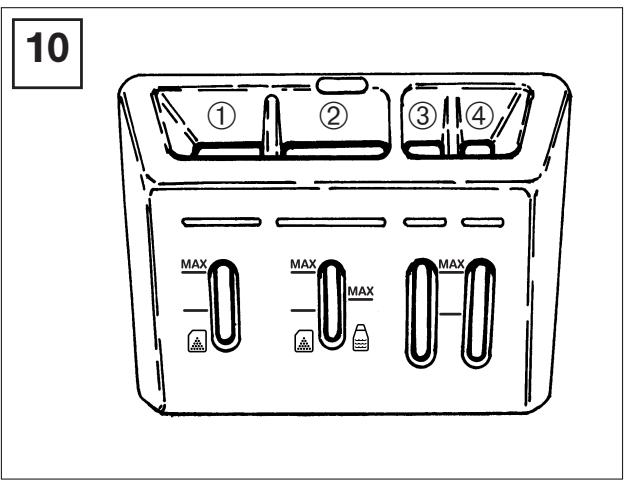
Washing products (Fig 10)
Filling the detergent dispensers
① |Pre-wash dispenser (powder
② || Wash dispenser (powder or liquid)
The WASH dispenser may contain either powder or liquid but liquid detergents should not be used with programmes WITH pre-wash.
③ Bleach: bleach can be used as a disinfecting or bleaching agent. Concentrated bleach must be diluted.
④ Softener: Concentrated softener should be diluted with warm water.
Loading the washing products
Follow the dosage instructions on the pack. Warning: these are generally recommended for a full load of washing. Adapt the amounts to suit the condition of your washing.
Too much detergent can cause foam. An excessive amount of foam reduces your machine's performance and increases the washing time and water consumption.
We recommend the use of "low suds" detergent on your washing machine.
Do not forget to reduce the amounts when using concentrated detergents. See the instructions on the pack.
Reduce the product amounts by 10%
When the water is soft, when your washing is only slightly soiled and there is only a small amount. When the washing programme is short.
Detergents for woollens and delicate fabrics
Use an appropriate detergent for washing these textiles (avoid putting the detergent directly into the drum because some of these products can attack the metal).
Programming
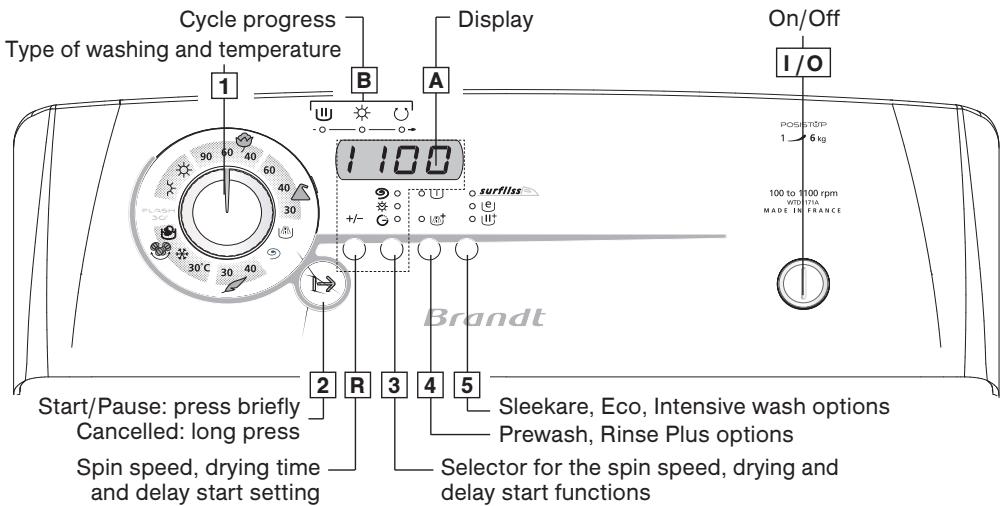
① Apart from the «On/Off» button, all the buttons are sensitive and therefore do not remain depressed. During programming, all the buttons except for «Start/Pause» can be kept depressed but, for more precise adjustment, we recommend that you operate them with a series of brief presses. You should operate the «Start/Pause» by pressing it briefly except when cancelling the programme, in which case it should be kept depressed. (*) Details of the function are provided in the following pages.
If one of the cycle progress lights is lit when you switch on, cancel before carrying out any other operation. Warning: the «On/Off» button cannot cancel a programme.
| Full programming (combined with drying or not) | Lights and/or display |
| • Press in the «On/Off» button I/O (1). | |
| • Turn the selector 1 to select the programme and the washing temperature. The machine proposes the recommended spin speed for the type of textile selected. | Light ⑨ + spin speed recommended on A |
| • Use the setting button R:
- Either to alter the proposed spin speed. (If you programme for sequenced drying, select the highest spin speed possible)
- Or to select drip dry.
The cycle will finish with a gentle spin at 100 rpm
- Or to select stopping with the drum full of water.
The machine will stop with the drum full of water before the final spin. | Light ⑨ + e.g.: 8800 or 18800 or 18885 |
| • Select, or not, any of the following options:
- «Prewash» and/or «Rinse Plus» via button 4
- «Sleekare» and/or «ECO» and «Intensive» via button 5
- Subsequent immediate drying via button 3 then, via button R, set the desired drying time (for the washing load to be dried, see the Programmes table) | + selected options
+ e.g.: 18.35 |
| • Select immediate start by pressing the «Start/Pause» button 2 ... | Light ⑪ + display of washing time remaining A |
| • ... Or select a start delayed by 1 - 19 hours by using button 3 to select this option and then using button R to set the period of the delay. | Light ⑨ + display of time remaining before the cycle starts A |
Programming
① After spinning, the machine positions the drum automatically with the opening at the top to help you in removing your laundry. This operation takes 3 minutes at most.
- Then the message «-0» appears on the display, indicating the end of the cycle (2).
Wait a moment of two for the lid to unlock so that you can remove your laundry. Release the «On/Off» I/O button (3).

| Programming a Drying Only cycle: | Lights and/or display |
| • Press in the «On/Off» button I/O. | Light and selected option |
| • Turn the selector 1 to select a normal or mixed drying programme to suit your type of washing |
| • Select the «Sleekare» option, or not, via button 5. This option finishes your programme with a 2 hour «Resting» period (see Function Details) |
| • Set the desired time via button R (only dry washing that has been spun at least at 800 rpm) | Light + e.g. 18.35 |
| • Select immediate start by pressing the «Start/Pause» button 2... | + light B + countdown of the remaining cycle time on A |
| • ... Or select a start delayed by 1 - 19 hours by using button 3 to select this option and then using button R to set the period of the delay. | Light G + display of time remaining before the cycle starts A |
Adding or removing an item during the cycle (impossible during spin):
| • Press the «Start/Pause» button 2 to interrupt the cycle.
• Add or remove the items of laundry.
• Press the «Start/Pause» button 2 to restart the cycle.
(*) The lid may take 1-2 minutes to unlock
If you have selected a «Delay Start», you can instantaneously access the drum at any time during the phase before the washing cycle starts, without having to interrupt and restart the cycle. | Flashing light B
+ counter A stopped
Light B permanently lit
+ counter A restarts |
Cancelling during programming or washing or during a pause:
| ·Hold down the «Start/Pause» button 2 for at least 1 second.
This can be done at any time during the cycle or during programming, or even during a pause.
i If you do this while the machine is waiting to start during a delay start, only the delay start is cancelled. | Return to initial display |
Maintaining your washing machine's performance:
- At the end of the cycle, you must clean the dryer filter (see the Chapter on "RUNNING MAINTENANCE").
For more information, please refer to the section on «DETAILS OF THE FUNCTIONS».
Important: If you have stopped your machine by pressing the «On/Off» button or after a power failure, when the power is restored the washing cycle automatically returns to the point at which it was interrupted.


Programming
(1) - Before starting your machine, check that the power cable is plugged in and the water tap is open. Also ensure that the drum doors and the lid are firmly closed.
(2) - During the «end of cycle» phase, the machine will not recognize your pressing one of the 2,3,4,5 or buttons but does allow you to return to «programming» mode.
(3) - As a safety measure, it is advisable to unplug the power cable and turn off the water tap.
To select the most suitable programme for your type of washing, follow the instructions on the labels attached to most items.
| Programmes table | Temperature (°C) | Max. load (kg) | UJ+ | Rinse Plus | Sleekare | Eco | UJ+ | Drip-dry | Rinse hold | Drying: Normal or Mixed | Type of drying and drying time |
| Type of fabric | Max. load (kg) | very dry | dry | iron dry |
| COTTON /WHITES | 40°-90° | 6 | ● | ● | ● | ● | ● | ● | ● | ● | 3 | 11/4 to 13/4 h | 1 to 11/2 h | 30 min to 1h |
| COLOURS/SYNTHETICS | 30°-60° | 3 | ● | ● | ● | ● | ● | ● | ● | ● | 1,5 | 1 to 11/2 h | 45 min to 1h | 30 min to 45 min |
| DELICATE | 30°-40° | 2 | | ● | ● | | | ● | ● | ● | 1 | 45 min to 1h | 30 min | 30 min to 45 min |
| WOOL | -30° | 1,5 | | ● | | | | ● | ● | Cannot be machine dried |
| SILK | | 1 | | ● | | | | ● | ● | Cannot be machine dried |
| Special programmes |
| FLASH 30' | 40° | 3 | | | | | | ● | ● | Cannot be machine dried |
| RINSE only | | Depending on the textile | | | | | | ● | ● | Cannot be machine dried |
| SPIN only | | | | | | | ● | | Before drying, select the "Maximum" speed the washing can withstand. |
| Normal Drying Only: COTTON / WHITES / COLOURS | See above to select the load, drying time and type of drying for your type of textiles |
| Mixed Drying Only: SYNTHETICS / DELICATE |
These functions can be used alone or in combinations: illogical combinations are impossible.
Details of the functions
COTTON
If your washing comprises hard-wearing white or coloured COTTONS
When washing coloureds do not exceed a maximum temperature of 60^
During the first few minutes of this programme, your machine automatically calculates the best programme to run for a perfect wash.
COLOURS / SYNTHETICS
If your washing comprises DELICATE COLOURS, HARD-WEARING SYNTHETICS of MIXED FIBRES
DELICATE
If your washing comprises NET CURTAINS, DELICATE FABRICS or FRAGILE TEXTILES
WOOL

If your washing comprises WOOLLENS or MACHINE-WASHABLE WOOLLENS.
SILK
If your washing comprises SILK or PARTICULARLY DELICATE FABRICS
FLASH 30
This programme enables you to refresh a small load of 3kg of lightly soiled washing composed of WHITE or COLOURED COTTONS or HARDWEARING SYNTHETICS.
The cycle time is restricted to around 30 minutes. In this programme, the washing temperature is automatically programmed to 40^ .
For this programme, the doses of detergent should be reduced by half.
RINSE ONLY «I」
A separate rinse followed by a choice of:
- Either spin and drain
- Or drain only («Drip-dry» option)
- Or a stop with the drum full of water.
SPIN ONLY ⑨
This allows a separate spin and drain.
In the case of «Rinse only» followed by a spin or of «Spin only», take care to select a suitable spin speed for the type of washing in the machine.
Details of the options
Prewash U
Specially designed for heavily soiled washing (mud, blood, etc.).
Detergent must be placed in the « container in the products' box.
Rinse Plus
Especially for sensitive and allergic skin: adds a Rinse Plus to the washing cycle.
Sleekare surffliss
Makes your washing easier to iron.
This option allows you to wash and spin your washing more gently without any loss of performance.
Eco e
The «Eco» function provides you with perfect washing results while saving on energy. It reduces the washing temperature and increases the agitation period.
Intensive wash ^+
This function improves washing performance and handles reputedly stubborn stains by automatically increasing the temperature in the drum and the agitation time.
Resting period at the end of the drying cycle
To use this function, you must first programme the "Sleekare" option.
Your laundry will rest for 2 hours after the drying cycle is complete. The «U» light remains lit throughout the resting period.
To access your laundry during this period, cancel the option by pressing the «Start/Pause» button 2 for at least one second.
Delay start
You can delay the start of your programme by 1 to 19 hours to take advantage of off-peak rates or finish the cycle at a particular time.
To do this, press button 3 and select function «G» (delay start). Then press button R and select the cycle starting time.
While the machine is waiting to start, display A shows the time remaining before the cycle effectively starts.
Remaining time
During programming, pressing button 3 until the 3 lights go out lets you know the length of the selected cycle*.
If you select the «time remaining» function while the machine is waiting to start in «Delay Start» mode, it is the selected programme's time that is permanently displayed.
(*) The time indicated by the machine at the start of the programme may vary during the course of the cycle:
- If you change the washing temperature (even during a spin) or if you add or cancel options, the time will be recalculated and updated on the display.
- Certain operating variables (for instance: detection of imbalance or foam, etc.) can also alter the cycle's duration.
- If there is a power failure during washing, when the power is restored, the time displayed may be less than the actual remaining time. This time will be updated at the start of the rinsing phase.
Rinse hold
This is used for textiles that you do not wish to spin or if you envisage being absent for a long time after the washing is finished.
When this function is selected, the cycle interrupts before the final spin, enabling your washing to soak in the water to avoid creasing.
When the machine stops with the drum full of water, display A does not count off the time remaining but remains fixed (including the point).
Then:
- You either wish to drain and spin.
In which case, select the Spin function « 2 » using button 3 then use button to set a suitable spin speed for your type of washing. The programme will shut down automatically.
- Or you just wish to drain.
In which case, select the Spin function «⑨» and then use button R to display 1800 («Drip-dry» function).
Modifying a washing or drying programme
During programming:
You can alter anything before you press the «Start / Pause» button ② «I→».
After the cycle starts:
- You cannot alter the type of textile (for example, change from «COTTON» to «SYNTHETICS» or from «SYNTHETICS» to «DELICATES», etc.).
If you turn the programme selector 1 to a different textile, the progress cycle light B which is lit at the time, and the display A flash for a few seconds to indicate that such an alteration is prohibited and will not be effected.
To change the type of fabric during the cycle, you must cancel the current programme and then programme a new cycle.
However, you can change the washing temperature at the start of the washing phase for the same type of textile.
The time remaining will then be adjusted accordingly.
- You can also change the spin speed throughout the cycle.
- You can select «Drip-dry» and «Rinse hold» up to the end of rinsing.
Automatic safety systems
Lid opening safety system:
As soon as washing commences, the lid on your machine is locked.
When the cycle is finished or when the machine has stopped with the drum full of water, the lid unlocks.
If you have programmed a «Delay start», the lid is not locked until the waiting period is over and the cycle starts.
If you wish to open the lid during the cycle, press button 2 «I→» briefly and wait 1-2 minutes for the safety system to unlock the lid.
Water safety system:
The water is constantly controlled when the machine is operating to prevent any possible overflow.
- You can change the period for a “delay start” period throughout the whole of the waiting period, right up to the effective cycle starting time.
If you wish to cancel "Delay start" during this period, set display A to 0 and then briefly press button 2 1 . The cycle will then start immediately.
- You can only activate option «U» (Prewash) during the waiting period for a «Delay start».
- You can activate option «L» (Rinse Plus) up to the point that rinsing commences.
- You can only modify the options «Surfliss» (Sleekare), «L» (Eco) and «L+» (Intensive) during the waiting period for a «Delay start».
- You can deactivate all the options at any time during the cycle provided that the particular action has not already been completed.
- You cannot programme or modify a drying after the start of a washing or drying cycle.
At the end of the cycle:
When your display shows «-0-», you can programme a new cycle without releasing the «On/Off» button [1/0].
All you need to do is press any of the buttons 2,3,4,5 or R.
The machine is then ready for programming again.
Spin safety system:
Your washing machine is fitted with a safety system that restricts the spin when poor load distribution is detected.
In this case, your washing may be insufficiently spun. Redistribute your washing in the drum and programme a new spin.
Anti-foam system:
You machine can detect when too much foam is being produced during spinning.
At such times, spinning stops and the machine drains.
The cycle then restarts, adapting the spin rates and possibly adding an extra rinse.
Characteristics
«Filt» message: (only for washing machines)
After a certain number of cycles, your machine (depending on the model) will warn you that you should clean the pump filter. At the end of the cycle, the display A flashes and then shows:
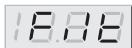
This information disappears as soon as you programme a new washing cycle or when the «On/Off» button I/O is released.
If you do not clean the pump filter regularly, this will affect your machine's performance.
Cleaning the pump filter: (for washing machines AND washer-dryers)
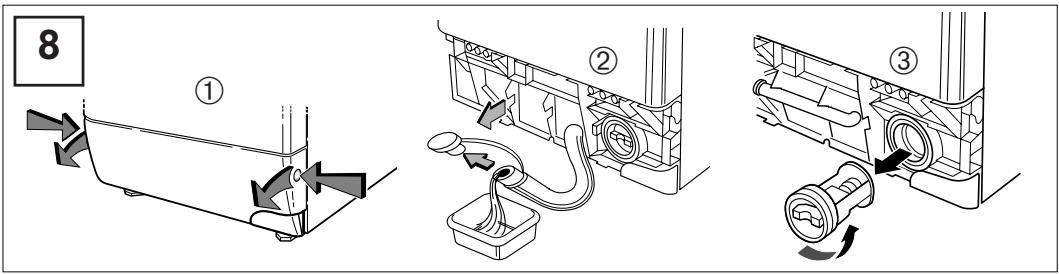
First of all drain the machine and then disconnect the plug (FIG. 8)
- Remove the plinth and place a floor cloth and a flat container under the access to the pump.
- If your machine is fitted with one, remove the purge hose.
- Open the stopper at the end of the hose and let the water flow into the container.
- Close the stopper, ensuring that it is pushed in well and reclip it in place.
- Unscrew the stopper for the drain pump's filter.
- Clean the filter. To re-insert it, snap it in by orienting the small lug on the cylindrical surface upwards and screwing the stopper in fully.
- Re-install the plinth in its original position.
When you next wash, check that there are no leaks during filling.
Cleaning the machine
- Only use a sponge, liquid soap and water to clean the casing, the entry to the drum, the control panel and the products' box, etc.
- Never use: abrasive powders, metal or plastic sponges, alcohol-based products, thinners, etc.
Cleaning the detergent dispensers
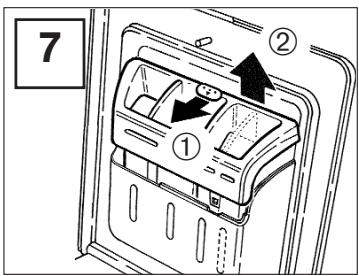
- Pull the knob forward (FIG. 7 ①), and lift the dispensers out (FIG. 7 ②),
- Clean everything with warm water, not forgetting to wash the removable siphon (blue). Check that you have replaced it correctly.
- Then re-insert the whole dispensers, checking that they are positioned correctly.
Replacing the power cable: For the sake of your safety, this must necessarily be done by the manufacturer's After-Sales service or a qualified electrician.
Regularly check: The condition of the water supply and drain hoses. If you notice the slightest cracking, do not hesitate to replace them.
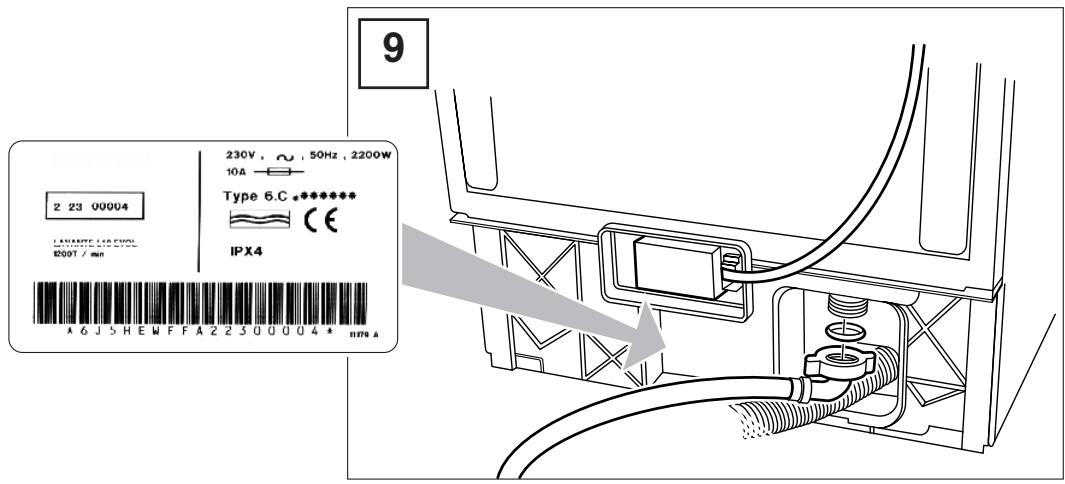
Replacing the water supply hose (FIG. 9): When changing, check that the hose is tight and that there is a seal on both ends.
When there is a risk of frost: Drain the drain circuit as shown above.
Removing the drum's paddle:
If an item of washing falls between the drum and the side of the tub, empty the drum and close it.
- Turn the drum until the paddle locks.
- Unscrew the screw between the two openings (stamped TORX, T20) and remove it. The paddle will fall into the drum (use a terry towelling towel to cushion its fall as a precaution).
- Turn the drum back and open it.
- Recover the fallen item through the holes revealed by removing the paddle.
- To refit the paddle, slip it from front to back over its support.
- Close the drum and turn it. Hold the paddle while you re-insert the screw.
Cleaning the drying filter: (only for washer-dryers)
Clean this after every drying operation:
- Remove the filter from its housing (on the right, near to the opening for the drum) and pull it towards you (FIG. 4).
- Clean it dry, removing any fluff it may have caught.
- Replace it in its housing, pushing it in fully.
Points to be checked in the event of an incident occurring: (1) Washing machines (2) Washer-dryers
| Possible causes / Remedies | Possible causes / Remedies |
| The cycle does not start (1 and 2)
·You have not pressed the «Start /Pause» button.
·There is no power to the machine:
-Check that the plug is correctly fitted in the socket.
-Check the circuit breaker and the fuses.
·The water tap is shut off.
·The machine's lid is not closed properly. | The drum doors open too slowly (depending on the model)
·Your machine has not operated for a long time.
·It is located in too cold a position.
·Detergent residue (powder) is blocking the hinges.
-In all cases, everything returns to normal once the doors have opened initially. |
| Heavy vibration during spin (1 and 2)
·Your machine has not been correctly released:
-Check that all the transport material has been removed (see «RELEASEASING»).
·The floor is not horizontal.
·Your machine is not stable on its four feet (see «LEVELELLING»). | A pool of water forms around the machine (1 and 2)
▲First of all remove the electrical plug from the socket and close the water tap. Then check whether:
·The drain hose bracket is wrongly positioned in the drain pipe.
·The water hose's connections to the machine and the tap are properly watertight:
-Check that the seals are in place and the connections are tight. |
| The washing is not spun or is insufficiently spun (1 and 2)
·You have selected a programme with no spin, for example «Drip-dry」.
·The spin safety system has detected poor distribution of the washing in the drum:
-Untangle the washing and programme a new spin. | Foam overflows (1 and 2)
·You have used too much detergent.
·You have not used a detergent designed for washing machines:
-Drain and then programme several rinses. Then restart the washing programme.
■Use «low suds» detergent. |
| The machine does not drain (1 and 2)
·You have programmed «Rinse hold」.
·The pump or the drain filter is blocked:
-Clean them (see «RUNNING MAINTENANCE」).
·The drain hose is kinked or squashed. | The drying cycle does not start (2)
·You have not selected a drying time. |
| You wish just to wash but a drying cycle starts automatically (2)
·You have programmed a drying cycle. | The washing is not as dry as you wish (2)
·The drying programme selected is not suitable for the type of textile placed in the machine (Pay attention to the information provided on the labels sewn on the clothes).
·The drying time selected is not suitable:
-For the level of dryness desired: increase or reduce the drying time accordingly.
·The load of dried washing is greater than the maximum authorised load (see “PROGRAMMES TABLE”).
·The washing to be dried has not been spun sufficiently. |
| The lid does not open (1 and 2)
·The programme has not yet finished.
·The lid remains locked throughout the programme. |
Textile maintenance codes:

Do not exceed the indicated temperature.

Cold diluted bleach can be used.

Ironing:
cold
medium
hot.
Dry cleaning.

Heavy drying in a domestic machine.
Gentle drying in a domestic machine.
Incidents notified on the display, which you can repair yourself
Your machine can automatically detect certain operating faults.
Particular messages are shown on the display to indicate what these faults are:
| Message | Possible causes / Remedies |
| 1888 | Filling fault. Check that the water tap is on, then press the «I→» button again to restart the cycle. |
| 1888 | Draining fault. Clean the pump filter (see the chapter on «CLEANING THE PUMP FILTER» for the procedure), then press the «I→» button again to restart the cycle. |
| 1888 | Locking fault. Check that the lid is closed correctly, then press the «I→» button again to restart the cycle. |
If the fault persists, contact your breakdown engineer.
Incidents notified on the display, which require a service engineer
| Message | Possible causes / Remedies
Heating fault. This message, which appears at the end of the cycle, indicates that the machine did not achieve the washing temperature you selected. |
| 1883 | Programming card fault. For your own safety, disconnect the machine and contact your breakdown engineer. |
| 1884 | Washing temperature fault. |
| 1885 | Drum rotation fault. After switching the machine off, check whether an item of washing or an object has slipped between the drum and the side of the tub, causing a blockage (see the section on «RUNNING MAINTENANCE»: removing the drum's paddle" for details on how to access the bottom of the tub). If the fault persists, contact your breakdown engineer. |
| 1886 | Overflow. When this fault is detected, the supply of water is automatically cut off, the machine is drained and the cycle stops. |
| 1887 | Fault in the electronic unit. Your machine shuts down completely for its own safety. |
| 1888 | Drying temperature fault. (Only for washer-dryer models). |
| 1889 | Heating fault. This message, which appears at the end of the cycle, indicates that the machine did not achieve the drying temperature you selected. (Only for washer-dryer models). |
When one of these faults occurs, do not forget to note down the message displayed (d03, d04, ... d23) so that you can inform your breakdown engineer of this during your call, making his work easier.
After-Sales service
Any work on your machine must be performed either by your dealer or by a qualified electrician approved by the manufacturer or his agent.
When you call, cite your machine's complete reference (model, type and serial No.). This information is shown on the information plate fixed to the rear of your machine (see FIG. 9).
You also find this information on a sticker fixed to the base of the machine, behind the front plinth.