CAF-1408A - Coffee maker BRANDT - Free user manual and instructions
Find the device manual for free CAF-1408A BRANDT in PDF.



| Product type | Drip coffee maker |
| Brand | BRANDT |
| Model | CAF-1408A |
| Capacity | 1.25 L (approx. 10 cups) |
| Power | 800 W (typical value) |
| Voltage | 220-240 V ~ 50/60 Hz |
| Material | Plastic, glass (carafe) |
| Dimensions (approx.) | 28 x 18 x 32 cm |
| Weight (approx.) | 1.5 kg |
| Main functions | Anti-drip system, warming plate, power indicator light |
| Safety | Manual switch-off, do not leave unattended, unplug before cleaning |
| Maintenance | Cleaning of removable parts (carafe, filter basket) in dishwasher or soapy water; descaling with vinegar |
| Spare parts | Glass carafe, filter basket, paper filter (not included) |
| Repairability | Brandt authorized after-sales service for repairs and original parts |
| Usage | Household use only |
| General information | Compliant with European directives on electromagnetic compatibility and low voltage |
Frequently Asked Questions - CAF-1408A BRANDT
User questions about CAF-1408A BRANDT
0 question about this device. Answer the ones you know or ask your own.
Ask a new question about this device
Download the instructions for your Coffee maker in PDF format for free! Find your manual CAF-1408A - BRANDT and take your electronic device back in hand. On this page are published all the documents necessary for the use of your device. CAF-1408A by BRANDT.
USER MANUAL CAF-1408A BRANDT
natural_image
Illustration of a Brandt brand water dispenser with black and silver casing, no visible text or symbols on the device itself.CAFETIÈRE FILTRE / KAFFEMASKINE / DRIP COFFEE MAKER / CAFETERA DE GOTEO
MOD.:
CAF-1408 A
FagorBrandt SAS - Locataire-gérant - SAS au capital de 20.000.000 euros -
natural_image
Illustration of a hand pouring liquid into a container with a lid, no text or symbols presentFig. D
natural_image
Illustration of a glass coffee maker with lid and handle, showing internal layers and a black arrow indicating rotation (no text or symbols)Fig. F
natural_image
Illustration of a kitchen pot with a lid and handle, showing liquid level and upward arrow (no text or symbols)Fig. C
natural_image
Diagram of a mechanical device with a downward arrow indicating process (no text or symbols present)Fig. E
natural_image
Illustration of a kitchen pot with a lid and handle, showing liquid level (no text or symbols)Fig. A
FR
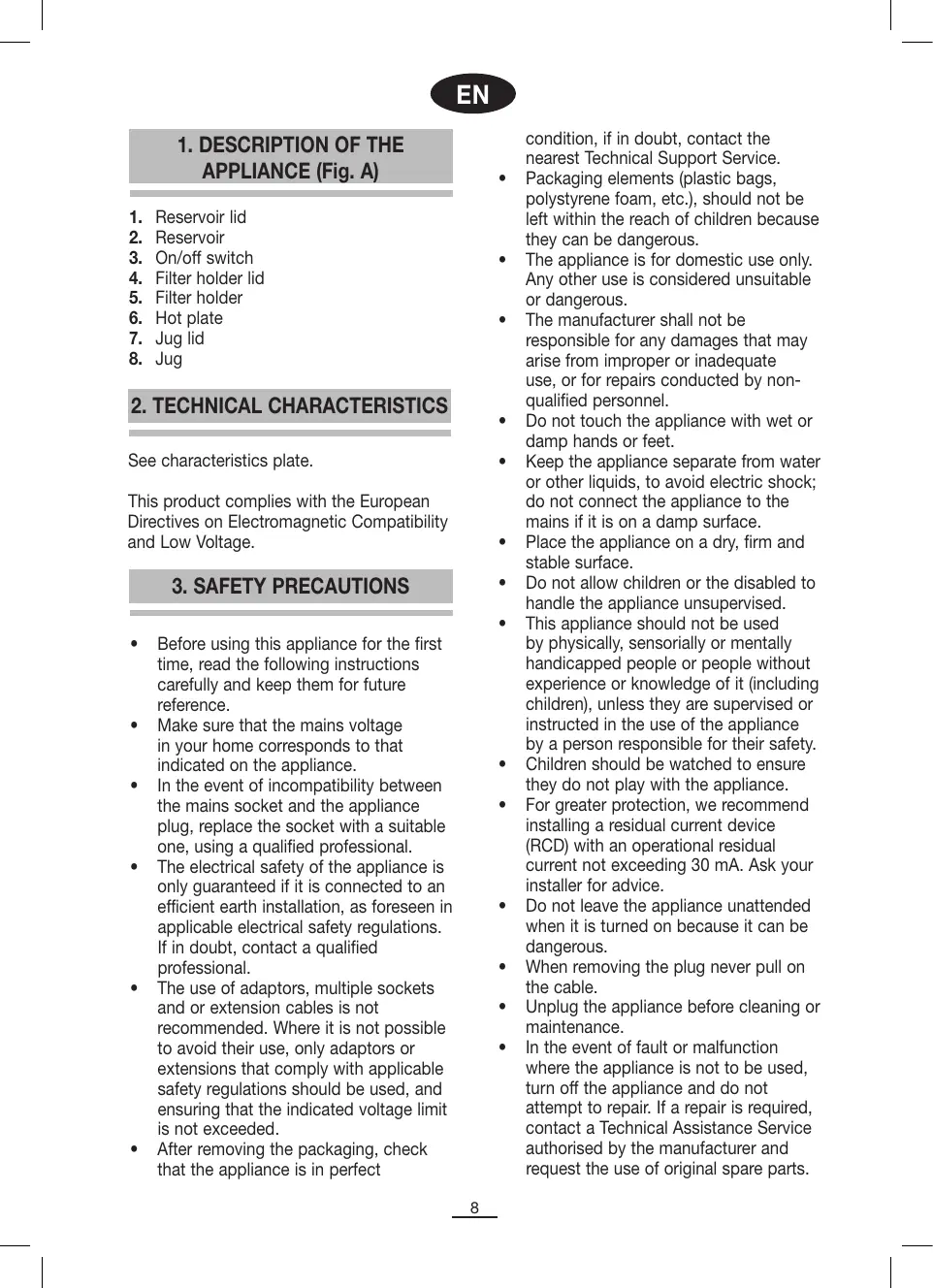
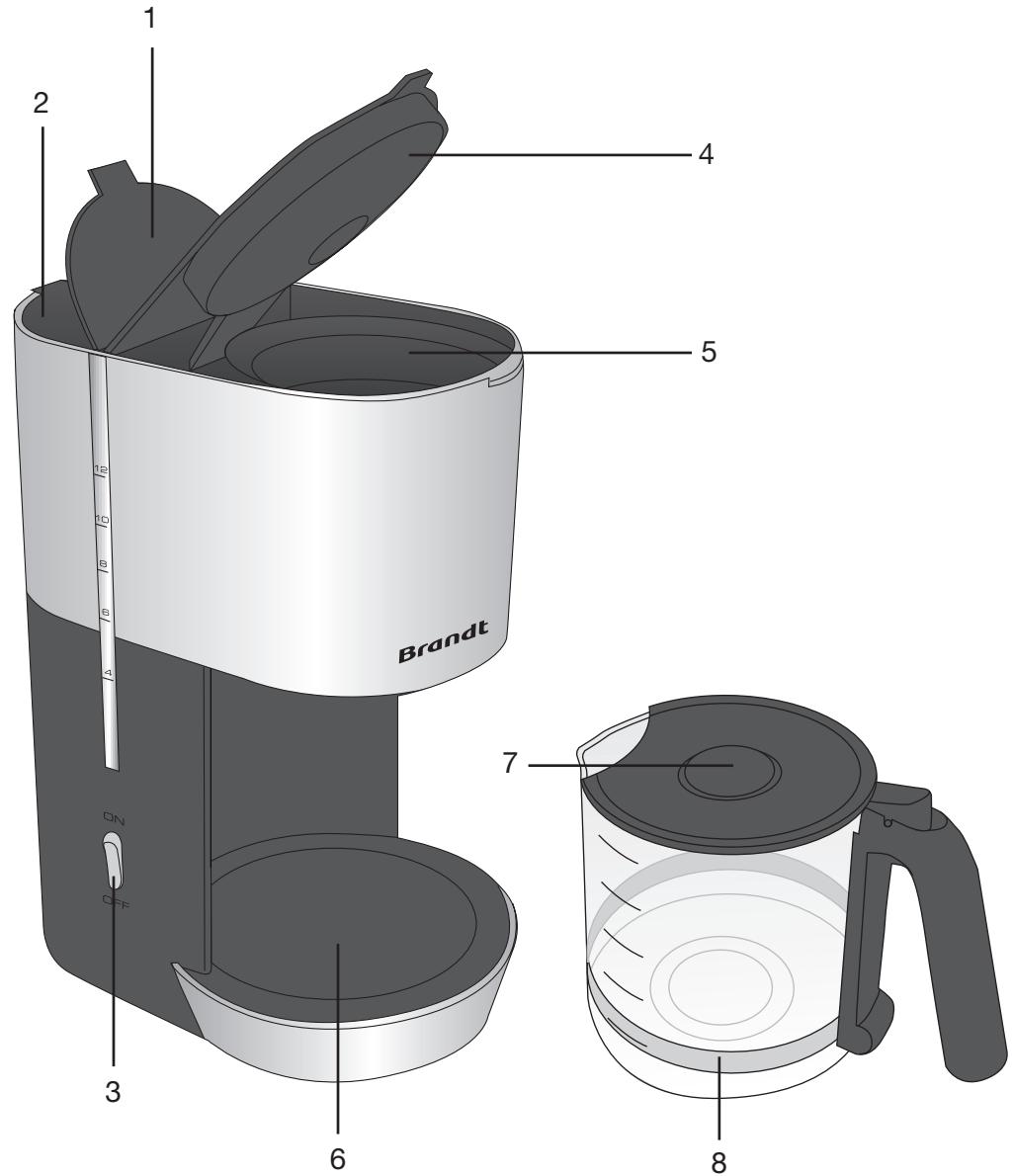
1. DESCRIPTION DE L'APPAREIL (Fig. A)
See characteristics plate.
This product complies with the European Directives on Electromagnetic Compatibility and Low Voltage.
3. SAFETY PRECAUTIONS
- Before using this appliance for the first time, read the following instructions carefully and keep them for future reference.
- Make sure that the mains voltage in your home corresponds to that indicated on the appliance.
- In the event of incompatibility between the mains socket and the appliance plug, replace the socket with a suitable one, using a qualified professional.
- The electrical safety of the appliance is only guaranteed if it is connected to an efficient earth installation, as foreseen in applicable electrical safety regulations. If in doubt, contact a qualified professional.
- The use of adaptors, multiple sockets and or extension cables is not recommended. Where it is not possible to avoid their use, only adaptors or extensions that comply with applicable safety regulations should be used, and ensuring that the indicated voltage limit is not exceeded.
- After removing the packaging, check that the appliance is in perfect
condition, if in doubt, contact the nearest Technical Support Service.
- Packaging elements (plastic bags, polystyrene foam, etc.), should not be left within the reach of children because they can be dangerous.
- The appliance is for domestic use only. Any other use is considered unsuitable or dangerous.
- The manufacturer shall not be responsible for any damages that may arise from improper or inadequate use, or for repairs conducted by non-qualified personnel.
- Do not touch the appliance with wet or damp hands or feet.
- Keep the appliance separate from water or other liquids, to avoid electric shock; do not connect the appliance to the mains if it is on a damp surface.
- Place the appliance on a dry, firm and stable surface.
- Do not allow children or the disabled to handle the appliance unsupervised.
- This appliance should not be used by physically, sensorially or mentally handicapped people or people without experience or knowledge of it (including children), unless they are supervised or instructed in the use of the appliance by a person responsible for their safety.
- Children should be watched to ensure they do not play with the appliance.
- For greater protection, we recommend installing a residual current device (RCD) with an operational residual current not exceeding 30 mA. Ask your installer for advice.
- Do not leave the appliance unattended when it is turned on because it can be dangerous.
- When removing the plug never pull on the cable.
- Unplug the appliance before cleaning or maintenance.
-
In the event of fault or malfunction where the appliance is not to be used, turn off the appliance and do not attempt to repair. If a repair is required, contact a Technical Assistance Service authorised by the manufacturer and request the use of original spare parts.
-
If the cable for this appliance is damaged, contact an authorised Technical Assistance Service for it to be replaced.
- Do not leave the appliance exposed to the elements (rain, sun, ice, etc.).
- Do not use or let any part of the appliance come into contact or near hot surfaces (kitchen gas or electric hobs or ovens).
- Do not use detergents or abrasive sponges to clean the appliance.
- Do not touch the hot surfaces. Use the handles.
- Do not let the cable come into contact with the hot parts of the appliance.
- Do not allow all the liquid to evaporate. Do not heat the jug when empty.
- Do not use a jug which is broken or has a loose or weakened handle. Replace it at any sign of damage. A crack or a chip in the glass may cause the jug to break or to contaminate the liquid it contains with glass particles.
- Do not clean the jug with any kind of abrasive scourer or cleaners which may scratch and weaken the glass.
- The jug is designed for use with this appliance only. Do not place the jug on or near to a hot surface (heater, stove, cooking surface, hot oven, microwave oven, etc.)
- Avoid handling it carelessly and knocking it.
4. BEFORE USING FOR THE FIRST TIME
- Before using your coffee maker for the first time, familiarise yourself with all the parts. Read all the instructions carefully.
- Lift open the filter holder lid (4), take out the filter holder (5) and clean them together with the jug (8) and the jug lid (7) in warm, soapy water. Rinse well, dry them and reassemble.
- To clean the inside, operate the coffee maker twice running without coffee. To do this, follow the instructions in the next section.
5. MAKING COFFEE
- Place the coffee maker onto a flat, stable surface.
- Open the reservoir lid (1) and fill the reservoir (2) with fresh, cold water (see Fig. B) up to the level corresponding to the desired number of cups of coffee. Do not exceed the maximum level of the reservoir.
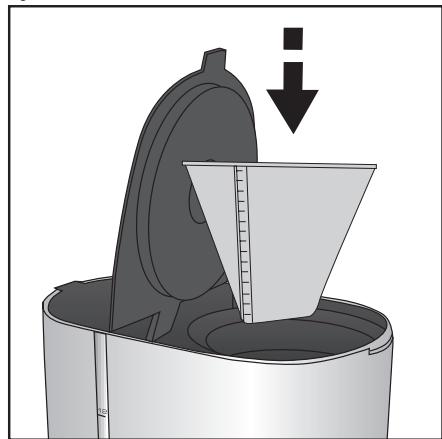
- Open the filter holder lid (4) and place the paper filter into the filter holder as shown in figure C.
- Fill the paper filter with the required amount of ground coffee and close the filter holder lid (4). We suggest one level tablespoonful of coffee per cup of coffee. Once you have used the coffee maker several times, you will be able to adjust the amount of coffee according to your taste.
- Place the jug (8) with its lid (7) duly in place, onto the hot plate (6). The jug will open the anti-drip valve when placed correctly onto the plate; otherwise the filtered coffee will not pass into the jug and the filter may overflow.
- Plug the appliance in and turn the coffee maker on by pressing the on/off switch (3). The indicator light will come on. The water will begin to filter through the coffee maker, pouring the coffee into the jug.
- Once the coffee is ready, the hot plate (6) will keep the coffee hot by means of the hot plate.
- Turn the coffee maker off by pressing the on/off switch (3) and unplug the coffee maker.
N.B.: The coffee maker is fitted with an anti-drip system; this prevents the coffee from dripping onto the plate (6) when the jug is not properly in place or when it has been removed from the appliance.
6. TIPS FOR GOOD COFFEE
To give the coffee a better flavour and aroma, we advise you to use freshly ground coffee.
Medium-ground coffee should be used; it should not be too finely ground.
Store the coffee in a dry place. Once the packet of coffee has been opened, it can be kept well-sealed in the refrigerator in order to maintain its aroma.
This coffee maker will keep the coffee hot by means of the hot plate (6), but for best results, drink the coffee as soon as it has been made.
7. CLEANING THE COFFEE MAKER
Before cleaning the coffee maker, turn it off, unplug the coffee maker and wait for it to cool down.
Clean the hot plate (6) with a cloth which has been moistened with soapy water.
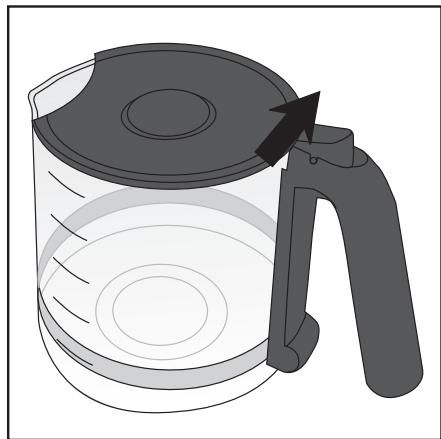
To remove the lid from the jug (7), push the hinge part of the lid to one side (fig. D).
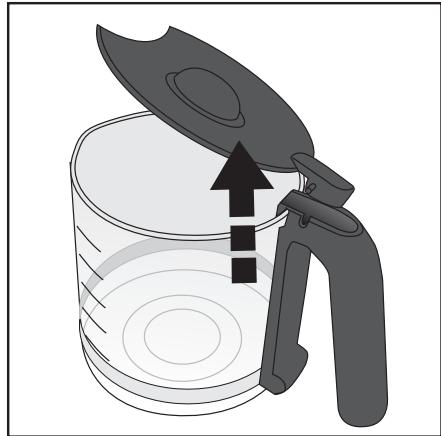
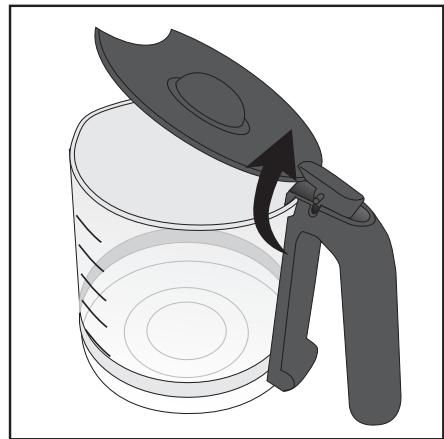
Turn and lift the other side (fig. E), the pin will spring out of the hinge and you will be able to remove the lid (fig. F).
Wash the filter holder (5), the jug (8) and the jug lid (7) in soapy water or in the dishwasher, rinse well and dry the parts before reassembling them.
To remove stains from the jug (8), rub with bicarbonate of soda or a soft cloth. For stubborn stains, fill the jug with hot water, add 2 spoonfuls of dishwasher detergent and leave to soak for several hours. Wash and rinse the jug well.
Clean the outside of the coffee maker with a damp cloth.
Do not use detergents or abrasive products to clean the coffee maker.
Do not immerse the appliance in water or in any other liquid.
DESCALING:
Depending on the hardness of the water and how often you use the appliance, the channels may become blocked, due to the content of lime scale in the water. A sign of this is when the filtering process takes longer than normal. To prevent this, proceed as follows:
- Fill the reservoir (2) with one part vinegar and three parts water.
- Plug in the coffee maker and operate it.
- After 30 seconds, turn the coffee maker off.
- Wait for 30 minutes to allow the vinegar to perform its cleaning action and turn the coffee maker on again.
- Once the coffee-making cycle has finished, turn the coffee maker off.
- Repeat this operation 2 or 3 times, depending on the amount of lime scale.
- Once the coffee maker has been descaled, operate it 2 or 3 times with water only, to remove any remaining vinegar.
8. INFORMATION FOR THE CORRECT DISPOSAL OF ELECTRICAL AND ELECTRONIC APPLIANCES
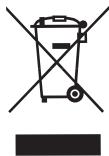
At the end of its working life, the product must not be disposed of as urban waste. It must be taken to a special local authority differentiated waste collection centre or to
a dealer providing this service. Disposing of a household appliance separately avoids possible negative consequences for the environment and health deriving from inappropriate disposal and enables the constituent materials to be recovered to obtain significant savings in energy and resources.
To remind you that you must collaborate with a selective collection scheme, the symbol shown appears on the product warning you not to dispose of it in traditional refuse containers.
For further information, contact your local authority or the shop where you bought the product.