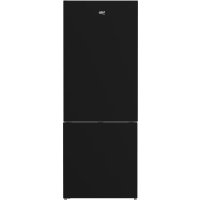
USER MANUAL BFBF2715GSIM BEKO
Please read this manual before using the product!
Dear Customer,
We'd like you to make the best use of our product, which has been manufactured in modern facilities with care and meticulous quality controls.
Thus, we advise you to read the entire user manual before you use the product. In case the product changes hands, do not forget to hand the guide to its new owner along with the product.
This guide will help you use the product quickly and safely.
- Please read the user guide carefully before installing and operating the product. • Always observe the applicable safety instructions.
- Keep the user guide within easy reach for future use.
- Please read any other documents provided with the product.
Keep in mind that this user guide may apply to several product models. The guide clearly indicates any variations of different models.
 | Important information and useful tips. |
 | Risk of life and property. |
 | Risk of electric shock. |
 | The product's packaging is made of recyclable materials, in accordance with the National Environment Legislation. |
1 Important instructions for safety and environment 3
1.1 General safety....3 1.1.1 HCA warning 4 1.1.2 For products with a water dispenser ..... 4 1.2 Intended use....5 1.4 Compliance with WEEE Directive and Disposing of the Waste Product: 5 1.5 Compliance with RoHS Directive:....5 1.6 Package information....5
2 Your Refrigerator 7
3 Installation 8
3.1. Right place for installation ..... 8 3.2. Attaching the plastic wedges ..... 8 3.3. Adjusting the stands 8 3.4. Power connection ..... 9 3.5. Connecting the water hose to the refrigerator 9 3.6. Connecting the water line to the water supply9 3.7. Reversing the doors .....10 3.8. Reversing the doors ..... 11
4 Preparation 13
4.1. What to do for energy saving ..... 13 4.2. First Use 13
5 Operating the product 14
5.1. Indicator panel ..... 14 5.2. Egg holder 16 5.3. Fan....16 5.4. Zero degree compartment.....16 5.5. Automatic ice machine ..... 16 5.6. Freezing fresh food ..... 17 5.7. Recommendations for storing frozen foods 17 5.8. Deep freezer details ..... 18 5.9. Placing the food ..... 18 5.10. Door open alert 18 5.11. Changing the opening direction of the door 18 5.12. Interior light ..... 18
6 Maintenance and cleaning 19
6.1. Avoiding bad odors ..... 19 6.2. Protecting the plastic surfaces ..... 19 6.3. Door Glasses 19
7 Troubleshooting 20
1 Important instructions for safety and environment
This section contains safety instructions that will help protect from risk of personal injury or property damage. Failure to follow these instructions shall void any warranty.
Intended use
- WARNING: Keep ventilation openings, in the appliance enclosure or in the built-in structure, clear of obstruction.
- WARNING: Do not use mechanical devices or other means to accelerate the defrosting process, other than those recommended by the manufacturer.
- WARNING: Do not damage the refrigerant circuit.
NOTE : This warning is only applicable to appliances with refrigerating circuits which are accessible to the user.
- WARNING: Do not use electrical appliances inside the food storage compartments of the appliance, unless they are of the type recommended by the manufacturer. This appliance is intended to be used in household and similar applications such as – staff kitchen areas in shops, offices and other working environments; – farm houses and by clients in hotels, motels and other residential type environments;
- bed and breakfast type environments; – catering and similar non-retail applications.
1.1 General safety
- This product can be used by children aged 8 years and above and by persons with reduced physical, sensory, or mental capabilities, or lack of experience and knowledge, provided they have been given supervision or instruction concerning use of the appliance in a safe way and understand the hazards involved. Children shall not play with the appliance. Cleaning and user maintenance shall not be made by children without supervision.
- Unplug the product if a failure occurs while it is in use.
- If the product has a failure, it should not be operated unless it is repaired by the Authorised Service Agent. There is a risk of electric shock!
- Connect the product to a grounded outlet protected by a fuse complying with the values on the rating plate. Have the grounding installation made by a qualified electrician. Our company shall not be liable for any damages that may arise if the product is used without grounding in accordance with local regulations.
- Unplug the product when not in use.
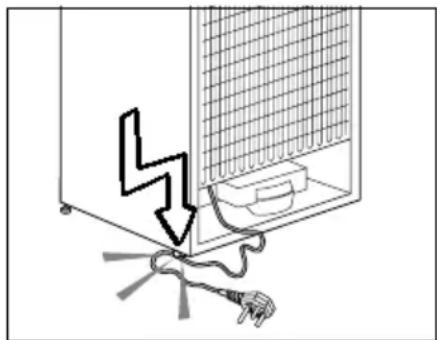
- Never wash the product by spreading or pouring water onto it! There is a risk of electric shock!
- Never touch the plug with wet hands! Never unplug by pulling on the cable; always pull out by grasping the plug.
- It is recommended to clean the tip of the plug regularly with a dry cloth.
- Do not plug the refrigerator if the wall outlet is loose.
- Never connect your refrigerator to electricity-saving systems. Such systems are harmful to the product.
- Unplug the product during installation, maintenance, cleaning, and repairing procedures.
- Always have the installation and repairing procedures carried out by the Authorised Service Agent. Manufacturer shall not be held liable for damages that may arise from procedures carried out by unauthorised persons.
- Do not eat cone ice cream and ice cubes immediately after you take them out of the freezer compartment! This may cause frostbite in your mouth!
- Do not touch frozen food by hand! They may stick to your hand!
- Do not put bottled and canned liquid beverages in the freezer compartment. They may burst!
- Never use steam and steam assisted cleaning materials to clean or defrost the refrigerator. Steam will cause short circuit or electric shock
Safety and environment instructions
since it would get into contact with the electrical parts in the refrigerator!
- Do not use mechanical devices or other methods to accelerate the defrosting process, other than those recommended by the manufacturer.
- Never use the parts on your refrigerator such as the door and drawer as a means of support or step. This will cause the product to tip over or parts of it get damaged.
- Do not damage the cooling circuit, where the refrigerant is circulating, with drilling or cutting tools. The refrigerant that might blow out when the gas channels of the evaporator, pipe extensions or surface coatings are punctured may cause skin irritations and eye injuries.
- Do not cover or block the ventilation holes on the refrigerator with any material.
- Place the beverage with higher proofs tightly closed and vertically.
- Do not use gaseous sprays near the product since there is the risk of fire or explosion!
- Flammable items or products that contain flammable gases (e.g. spray) as well as the explosive materials should never be kept in the appliance.
- Do not place containers filled with liquid on top of the product. Spilling water on an electrical component may cause electric shocks or risk of fire.
- Do not store products (vaccines, heat-sensitive medicines, scientific materials, etc.) that require precise temperature control in the refrigerator.
- If you will not operate the product for a long period of time, unplug it and unload the food.
- If the product is equipped with blue light, do not look at the blue light with optical tools.
- Exposing the product to rain, snow, sun, and wind is dangerous with respect to electrical safety.
- In products with mechanical control (thermostat), wait for at least 5 minutes to plug in the product again after unplugging it.
- Do not overload the product. It may fall when the door is opened, and cause injury or damage. Similar problems may occur in case of putting things on top of the product.
- If the product's door is equipped with a handle, do not pull by the handle when changing the place of the product. The handle may get loose.
- Pay attention not to have your hand or any part of your body get caught by the moving parts inside the product.
1.1.1 HCA warning
- If your product's cooling system contains R600a:
This gas is flammable. Therefore, pay attention to not damaging the cooling system and piping during usage and transportation. In the event of damage, keep your product away from potential fire sources that can cause the product to catch fire and ventilate the room in which the unit is placed.
Ignore this warning if your product's cooling system contains R134a.
The type of gas used in the product is stated on the type plate which is on the left wall inside the refrigerator.
Never throw the product in fire for disposal.
| If the product is equipped with a cooling system containing R134a gas, ignore this warning. |
| You can learn the gas used in production of your product on the rating plate located on the left inner part of it. |
 | WARNING: Never dispose the product in fire. |
1.1.2 For products with a water dispenser
- Pressure for cold water inlet shall be maximum 90 psi (620 kPa). If your water pressure exceeds 80 psi (550 kPa), use a pressure limiting valve in your mains
Safety and environment instructions
system. If you do not know how to check your water pressure, ask for the help of a professional plumber.
- If there is risk of water hammer effect in your installation, always use a water hammer prevention equipment in your installation. Consult Professional plumbers if you are not sure that there is no water hammer effect in your installation.
- Do not install on the hot water inlet. Take precautions against of the risk of freezing of the hoses. Water temperature operating interval shall be 33° F ( 0.6° C) minimum and 100° F ( 38° C) maximum.
- Use only potable water.
1.2 Intended use
- This product has been designed for domestic use. It is not suitable for commercial use and it must not be used out of its intended use.
- Product must be used only for storing food.
- The manufacturer waives any responsibility arisen from incorrect usage or transportation.
- Original spare parts will be provided for 10 years, following the product purchasing date.
1.3 Children's safety
- If the door has a lock, the key should be kept away from reach of children.
- Children must be supervised to prevent them from tampering with the product.
DANGER: Risk of child entrapment. Before you throw away your old refrigerator or freezer:
- Take off the doors.
- Leave the shelves in place so that children may not easily climb inside.
1.4 Compliance with WEEE Directive and Disposing of the Waste Product:
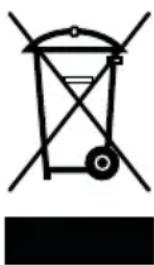
This product complies with EU WEEE Directive (2012/19/EU). This product bears a classification symbol for waste electrical and electronic equipment (WEEE). This product has been manufactured with high quality parts and materials which can be reused and are suitable for recycling. Do not dispose of the waste product with normal domestic and other wastes at the end of its service life. Take it to the collection center for the recycling of electrical and electronic equipment. Please consult your local authorities to learn about these collection centers.
1.5 Compliance with RoHS Directive:
The product you have purchased complies with EU RoHS Directive (2011/65/EU). It does not contain harmful and prohibited materials specified in the Directive.
- Packaging materials of the product are manufactured from recyclable materials in accordance with our National Environment Regulations. Do not dispose of the packaging materials together with the domestic or other wastes. Take them to the packaging material collection points designated by the local authorities.
- Contact qualified personnel for disposal.
- Contact qualified personnel for servicing.
Safety and environment instructions
DANGER: Risk of fire or explosion. Flammable refrigerant used. Do not use mechanical devices to defrost refrigerator. Do not puncture refrigerant tubing.

DANGER: Risk of fire or explosion. Flammable refrigerant used. To be repaired only by trained service personnel. Do not puncture refrigerant tubing.

CAUTION: Risk of fire or explosion. Flammable refrigerant used. Consult repair manual/owner's guide before attempting to service this product. All safety precautions must be followed.
CAUTION: Risk of fire or explosion. Dispose of property in accordance with federal or local regulations. Flammable refrigerant used.
CAUTION: Risk of fire or explosion due to puncture of refrigerant tubing; follow handling instructions carefully. Flammable refrigerant used.
2 Your Refrigerator
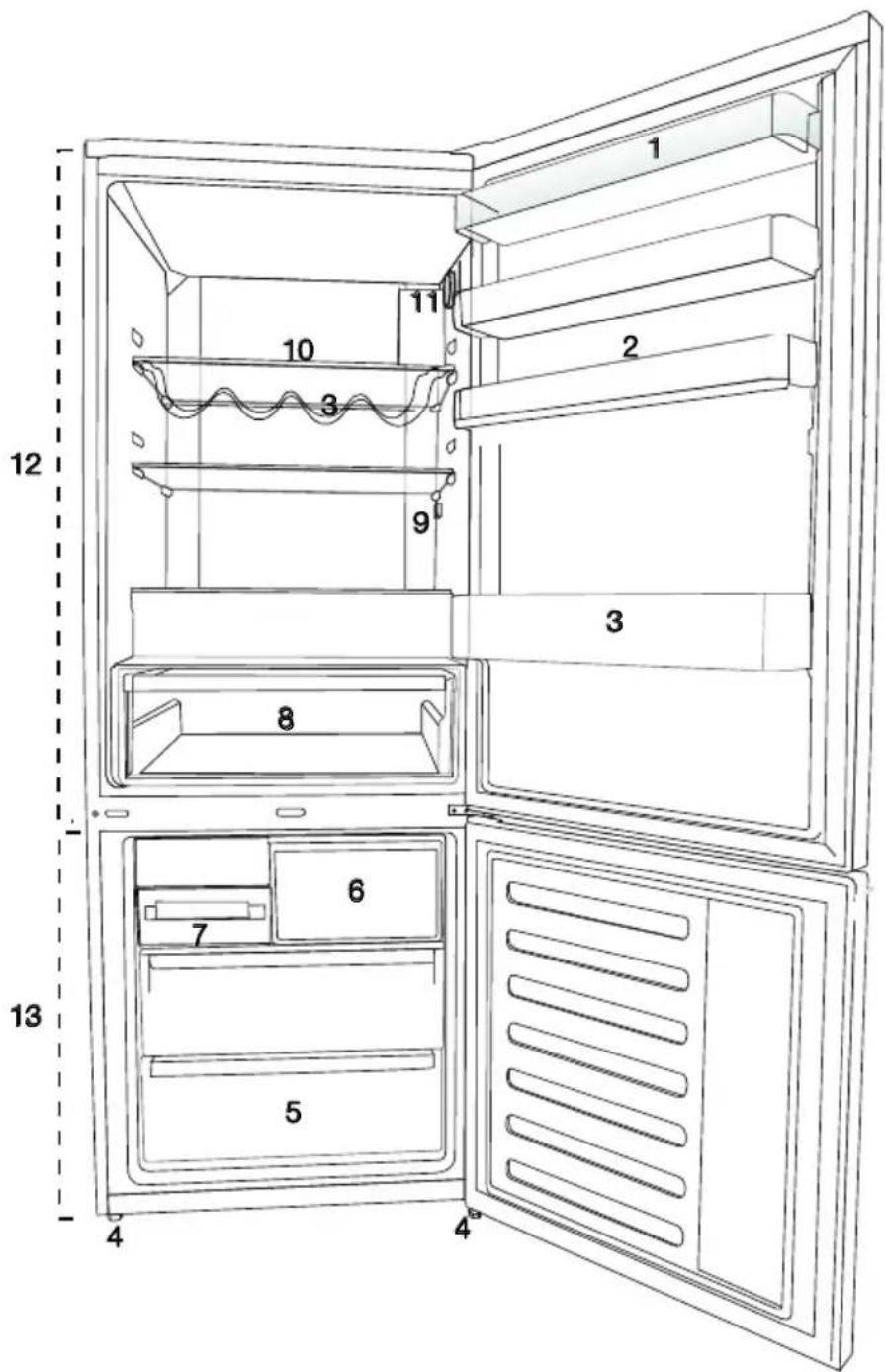
- Cooler compartment door shelf
- Egg section
- Bottle shelf
- Adjustable legs
- Deep freezer compartment
- Quick freeze compartment
- Automatic ice machine
- Vegetable bin
- Interior light
- Cooler compartment glass shelf
- Temperature adjustment button
- Cooler compartment
- Freezer compartment

Pictures given in this manual are provided as examples and may not exactly match your product. If your product does not include the relevant parts, the information pertains to other models.
3 Installation
3.1. Right place for installation
Contact the Authorized Service for the product's installation. To prepare the product for installation, see the information in the user guide and ensure that the electric and water utilities are as required. If not, call an electrician and plumber to arrange the utilities as necessary.
 | WARNING: The manufacturer assumes no responsibility for any damage caused by the work carried out by unauthorized persons. |
 | WARNING: The product's power cable must be unplugged during installation. Failure to do so may result in death or serious injuries! |
 | WARNING: If the door span is too narrow for the product to pass, remove the door and turn the product sideways; if this does not work, contact the authorized service. |
- Place the product on a flat surface to avoid vibration.
- Place the product at least 30 cm away from heaters, stoves, and similar sources of heat, and at least 5 cm away from electric ovens.
- Do not expose the product to direct sunlight or keep it in damp environments.
- The product requires adequate air circulation to function efficiently.
- If the product will be placed in an alcove, remember to leave at least 5 cm distance between the product and the ceiling and walls.
- Do not install the product in environments with temperatures below -5°C.
3.2. Attaching the plastic wedges
Use the plastic wedges provided with the product to ensure sufficient space for air circulation between the product and the wall.
- To attach the wedges, remove the screws on the product and use the screws provided with the wedges.
- Attach 2 plastic wedges on the ventilation cover as shown in the figure.
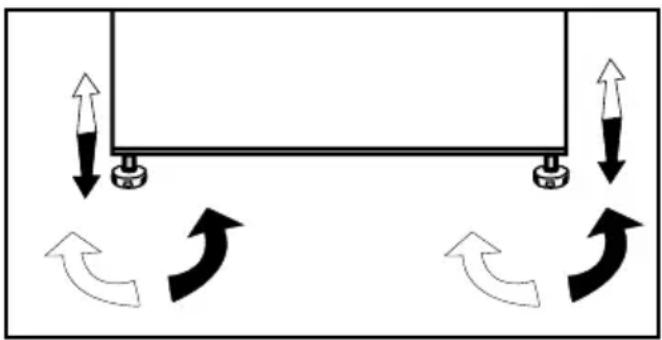
3.3. Adjusting the stands
If the product is not in a balanced position, adjust the front adjustable stands by rotating them right or left.
Installation
3.4. Power connection
| WARNING: Do not use extension or multi sockets in power connection. |
| WARNING: Damaged power cable must be replaced by Authorized Service. |
| When placing two coolers in adjacent position, leave at least 4 cm distance between the two units. |
- Our firm will not assume responsibility for any damages due to usage without earthing and power connection in compliance with national regulations.
- The power cable plug must be easily accessible after installation.
- Do not use a multi-group plug with or without an extension cable between the wall socket and the refrigerator.
| Hot Surface Warning!Side walls of your product is equipped with refrigerant pipes to improve the cooling system. Refrigerant with high temperatures may flow through these areas, resulting in hot surfaces on the side walls. This is normal and does not need any servicing. Please pay attention while touching these areas. |
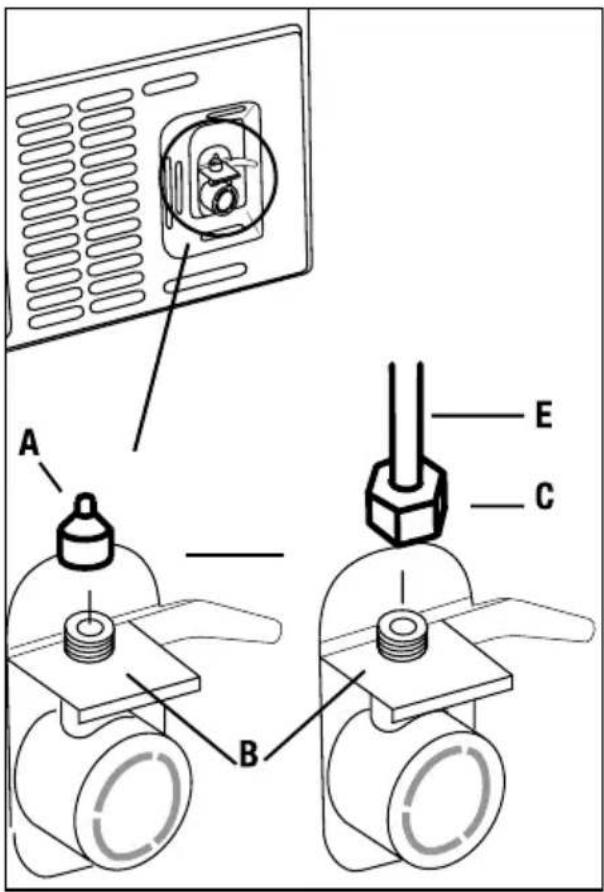
3.5. Connecting the water hose to the refrigerator
- Slip the union (b) onto the water hose (a).
- Push the water hose downwards firmly to slip it onto the water inlet valve (c).
- Tighten the union (c) by hand to secure it onto the water inlet valve.

Normally, you are not required to tighten the union with a tool. However, you can use a spanner or pliers to tighten the union if there is a leakage.
3.6. Connecting the water line to the water supply
Connect the water line to a water supply valve. If a valve is not present or you are not sure, consult a qualified plumber.
Installation
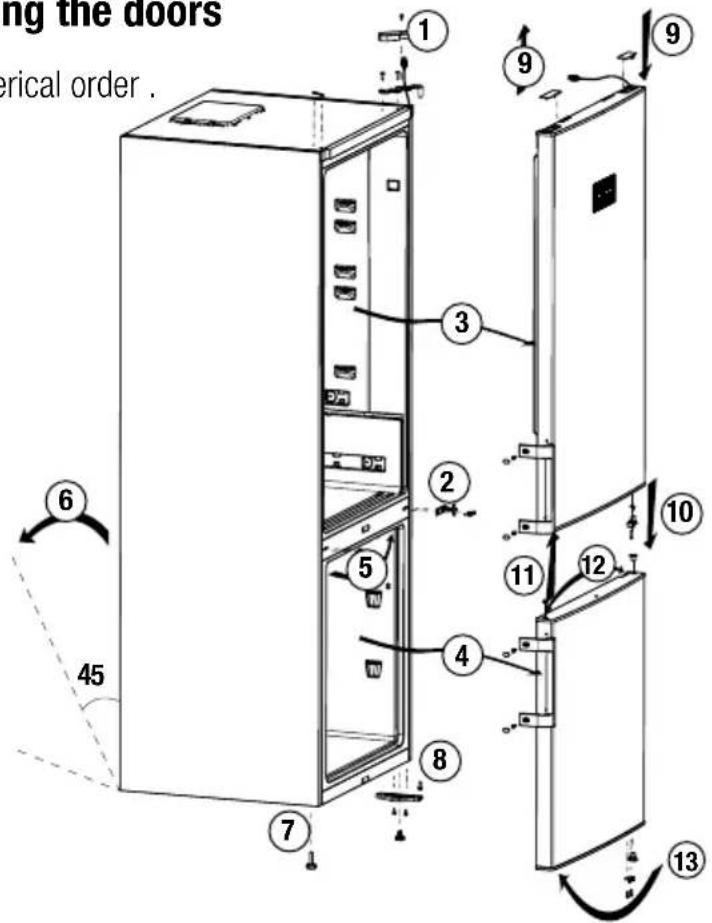
3.7. Reversing the doors
Proceed in numerical order.
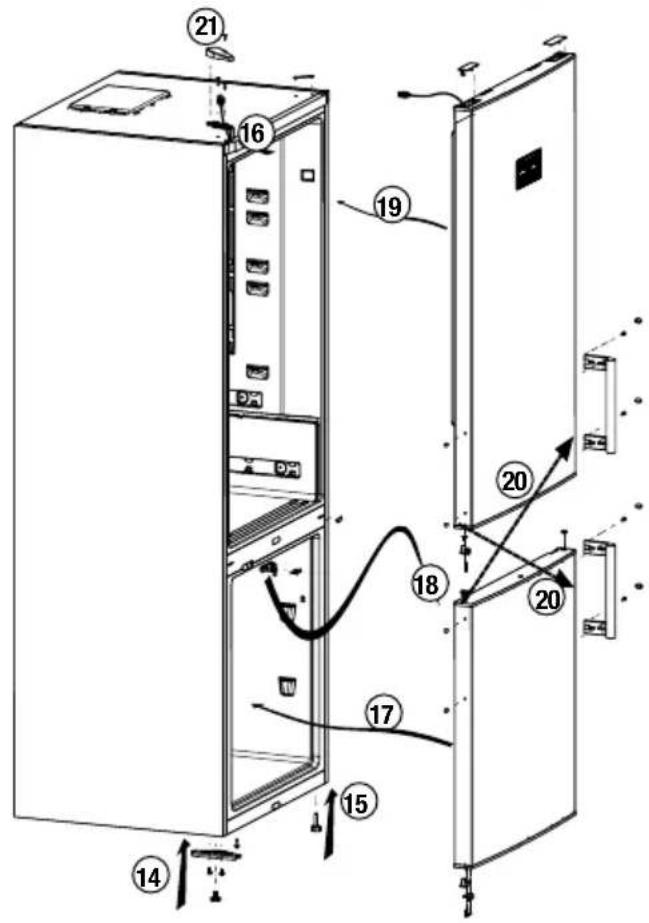
Installation
3.8. Reversing the doors
Proceed in numerical order.
![graph TD A["1: Opening"] --> B["2: Side"] B --> C["3: Side"] C --> D["4: Side"] D --> E["5: Side"] E --> F["6: Side"] F --> G["7: Side"] G --> H["8: Side"] H --> I["9: Side"] I --> J["10: Side"] J --> K["11: Side"] K --> L["12: Side"] L --> M["13: Side"] M --> N["14: Side"] N --> O["15: Side"] O -->…](/content/2026/04/618726/images/6c78bb17a7c4494f13f8059cfec8070a5ddf4f4362b9927b99e6e6f786f9207f.jpg)
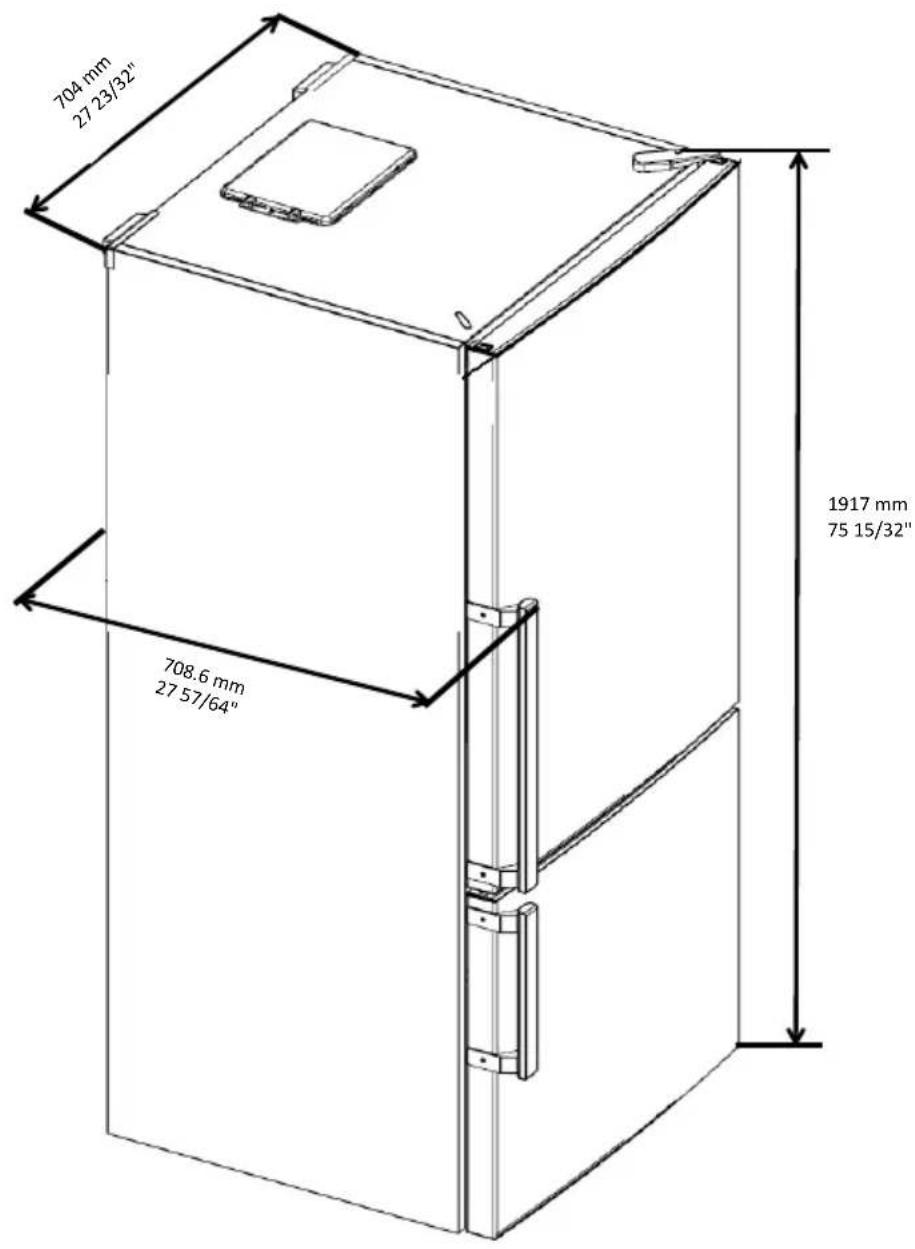
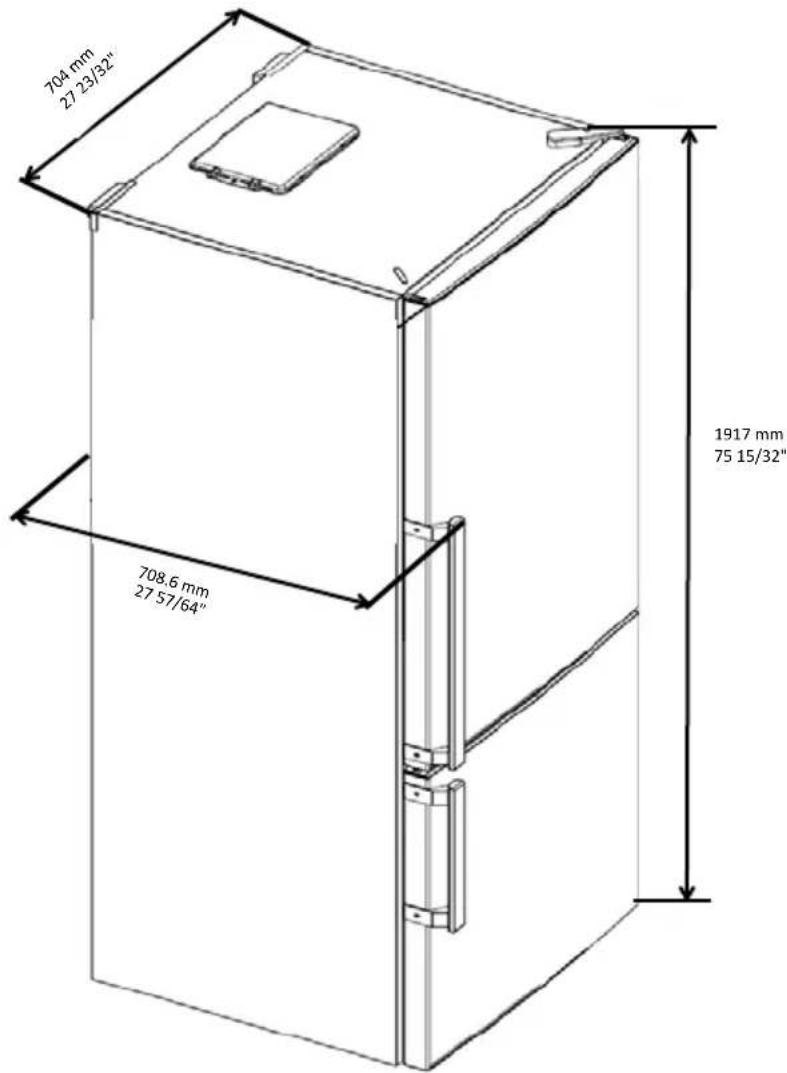
| Height (cm/inch) unpacked 19 | 17 -75 15/32” |
| Width (cm/inch) unpacked 704 | -27 23/32” |
| Depth (cm/inch) unpacked 708 | .6- 27 57/64” |
| Height (cm/inch)packed 1978 | - 77 7/8” |
| Width (cm/inch)packed 747 | - 29 13/32” |
| Depth (cm/inch) packed 742 | - 29 7/32” |
| Gross Weight (Kg) / lbs 90 | - 198.5 |
| Net Weight (Kg) / lbs 84 | - 184 |
4 Preparation
4.1. What to do for energy saving
Connecting the product to electronic energy-saving systems is harmful, as it may damage the product.
- Do not keep the refrigerator doors open for long periods.
- Do not place hot food or beverages into the refrigerator.
- Do not overfill the refrigerator; blocking the internal air flow will reduce cooling capacity.
- In order to store the maximum amount of food into the cooler compartment of your refrigerator, you should take out the upper drawers and place it onto the glass rack. The declared energy consumption of your refrigerator was determined by taking out the cooler, ice tray and upper drawers in a way that will enable maximum storage. Using the below drawer when storing is strongly recommended. Energy saving function should be activated for best energy consumption.
- You should not block the airflow by putting food in front of the cooler fan. A space of minimum 3cm must be left in front of the protective fan wire when placing food.
- Since hot and humid air will not directly penetrate into your product when the doors are not opened, your product will optimize itself in conditions sufficient to protect your food. Functions and components such as compressor, fan, heater, defrost, lighting, display and so on will operate according to the needs to consume minimum energy under these circumstances.
- Depending on the product's features; defrosting frozen foods in the cooler compartment will ensure energy saving and preserve food quality.
- Food should be stored using the drawers in the cooler compartment in order to ensure energy saving and protect food in better conditions.
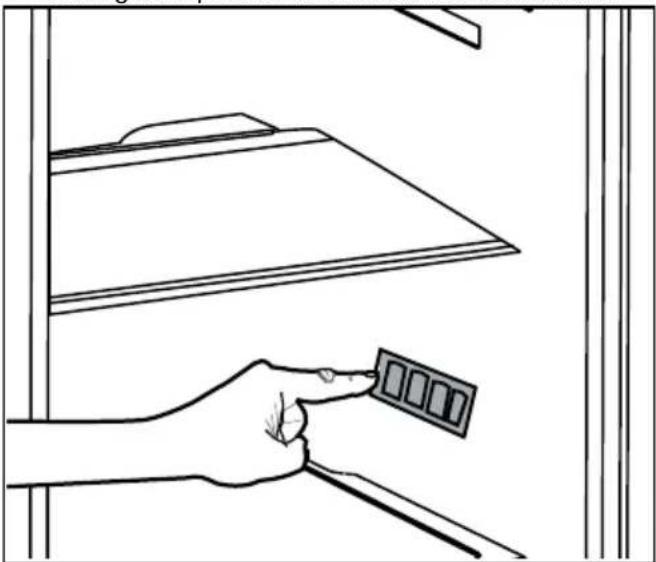
- Food packages should not be in direct contact with the heat sensor located in the cooler compartment. If they are in contact with the sensor, energy consumption of the appliance might increase.
- Make sure the foods are not in contact with the cooler compartment temperature sensor described below.
4.2. First Use
Before using your refrigerator, make sure the necessary preparations are made in line with the instructions in "Safety and environment instructions" and "Installation" sections.
- Keep the product running with no food inside for 6 and do not open the door, unless absolutely necessary.
 | A sound will be heard when the compressor is engaged. It is normal to hear sound even when the compressor is inactive, due to the compressed liquids and gasses in the cooling system. |
 | Front edges of the product might heat up. This is normal. These areas are designed to warm up in order to prevent condensation. |
 | In some models indicator panel turns off automatically 5 minutes after the door closes. It will be reactivated when the door is open or any button is pressed. |
5 Operating the product
5.1. Indicator panel
Indicator panels may vary according to the product model.
Audio – visual functions on the indicator panel help you in using your product.
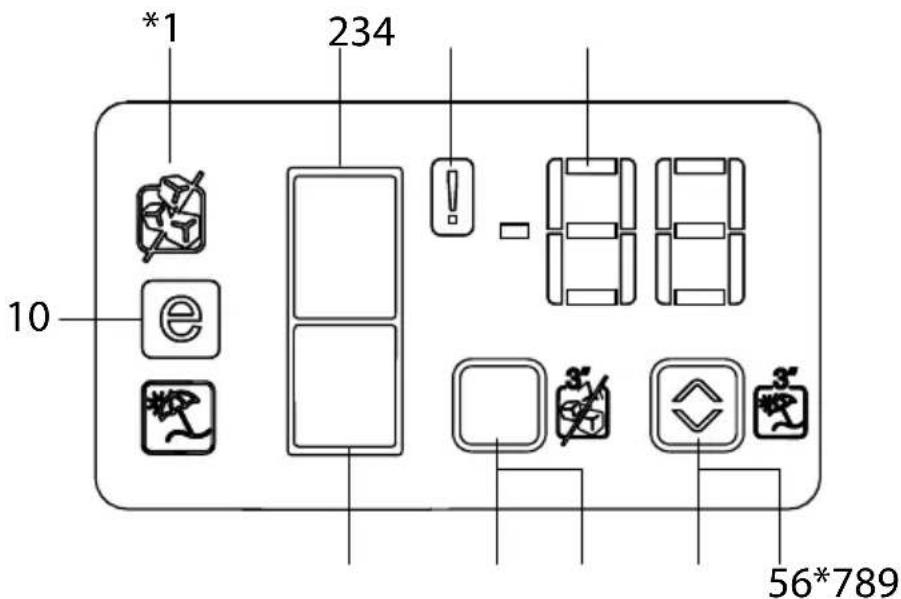
- Automatic Ice Machine Off/On indicator
- Fridge Compartment Indicator
- Error Status Indicator
- Temperature Indicator
- Vacation Button
- Temperature Setting Button
- Ice Cancel Button
- Compartment Selection Button
- Freezer Compartment Indicator
- Economy Mode Indicator

*Optional: The figures in this user guide are intended as drafts and may not perfectly match your product. If your product does not comprise the relevant parts, the information pertains to other models.
Using the product
1. Automatic Ice Machine Off/On indicator
This symbol appears on the display when Ice Off function is activated.
2. Fridge Compartment Indicator
Fridge compartment light illuminates when adjusting the fridge compartment temperature.
3. Error Status Indicator
If your refrigerator does not cool adequately or if there is a sensor failure, this indicator will be activated. When this indicator is active, the Freezer Compartment Temperature indicator will display "e" and the Fridge Compartment Temperature Indicator will display numbers such as "1,2,3...". These numbers on the indicator provide information about the error to the service personnel.
4. Temperature Indicator
Indicates the temperatures of the fridge and freezer compartments.
Press and hold this button for 3 seconds to activate the Vacation function. Press this button again to deactivate the selected function.
Changes the temperature of the relevant compartment between -24°C / -11°F ... -18°C / 0°F and 8°C / 46°F ... 1°C / 33°F.
The refrigerator stops ice production when you press the selection button for 3 seconds.
8. Refrigerator Compartment
Selection Button: Press the Refrigerator Compartment Selection Button to switch between the fridge and freezer compartments.
9. Freezer Compartment Indicator
The freezer compartment light illuminates when adjusting the freezer compartment temperature.
10. Economy Mode Indicator
This indicates that the refrigerator is running in energy-efficient mode. This indicator will be active if the Freezer Compartment temperature is set to -18°C / 0°F.
Using the product
5.2. Egg holder
You can place the egg holder on the door or body rack of your choice. If you decide to place it on the body rack, it is recommended to prefer the lower shelves as they are colder.
Do not place the egg holder in the freezer compartment.
5.3. Fan
The fan is designed to distribute and circulate the cold air inside your refrigerator homogeneously. The operating time of the fan may vary depending on the features of your product.
While in some products the fan only operates with the compressor, in others the control system determines the operating time based on the need for cooling.
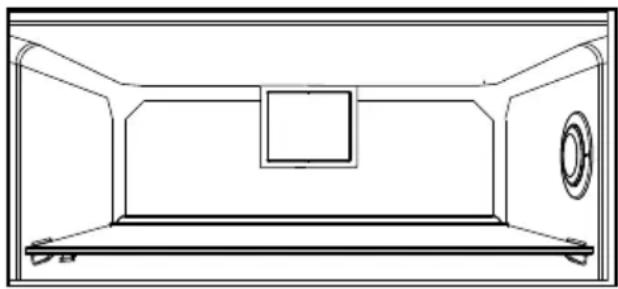
5.4. Zero degree compartment
*optional
Use this compartment to keep delicatessen at lower temperatures or meat products for immediate consumption.
The zero degree compartment is the coolest place where foods such as dairy products, meat, fish, and chicken can be stored in ideal storage conditions. Vegetables and/or fruits should not be stored in this compartment.
5.5. Automatic ice machine *optional
The automatic ice machine enables you to easily make ice in your refrigerator. To obtain ice from the ice machine, take out the water tank in the cooler compartment, fill it with water, and fix it back.
The first ice will be ready in about 2 hours in the ice machine drawer in the cooler compartment. After placing the full water tank, you can obtain about 60-70 cubes of ice until it is fully empty. If the water in the tank has waited for 2-3 weeks, it should be changed.

In products with an automatic ice machine, you might hear a sound when pouring the ice. This sound is normal and is not a sign of failure.
Using the product
5.6. Freezing fresh food
- To preserve food quality, the food items placed in the freezer compartment must be frozen as quickly as possible, use the rapid freezing for this.
- Freezing the food items when fresh will extend the storage time in the freezer compartment.
- Pack the food items in air-tight packs and seal tightly.
- Make sure the food items are packed before putting in the freezer. Use freezer holders, tinfoil and damp-proof paper, plastic bag or similar packaging materials instead of traditional packaging paper.
Ice in the freezing compartment thaws automatically.
- Mark each food pack by writing the date on the package before freezing. This will allow you to determine the freshness of each pack every time the freezer is opened. Keep the earlier food items in the front to ensure they are used first.
- Frozen food items must be used immediately after defrosting and should not be frozen again.
- Do not free large quantities of food at once.
5.7. Recommendations for storing frozen foods
The compartment must be set to at least -18°C .
- Place the food items in the freezer as quickly as possible to avoid defrosting.
- Before freezing, check the "Expiry Date" on the package to make sure it is not expired.
- Make sure the food's packaging is not damaged.
Using the product
5.8. Deep freezer details
Food items can only be preserved for extended periods at or below a temperature of -18°C. You can keep the foods fresh for months (in a deep freezer at or below temperatures of -18°C). The food items to be frozen must not contact the already-frozen food inside to avoid partial defrosting.
Boil the vegetables and filter the water to extend the frozen storage time. Place the food in air-tight packages after filtering and place in the freezer. Bananas, tomatoes, lettuce, celery, boiled eggs, potatoes, and similar food items should not be frozen. In case this food rots, only nutritional values and eating qualities will be negatively affected. A rotting threatening human health is not in question.
5.9. Placing the food
| Freezer compartment shelves | Various frozen goods including meat, fish, ice cream, vegetables etc. |
| Cooler compartment shelves | Food items inside pots, capped plate and capped cases, eggs (in capped case) |
| Cooler compartment door shelves | Small and packed food or beverages |
| Vegetable bin | Fruits and vegetables |
| Fresh food compartment | Delicatessen (breakfast food, meat products to be consumed in short notice) |
5.10. Door open alert (Optional)
An audible alert will be heard if the product's door remains open for at least 1 minute. The audible alert will stop when the door is closed or any button on the display (if available) is pressed.
Door open alert is indicated to the user both audibly and visually. Interior lighting will turn off if the warning continues for 10 min.
5.11. Changing the opening direction of the door
You can change the direction of opening of your refrigerator depending on the location where you use it. When you need this, consult the closest Authorized Service.
The explanation above is a general statement. You should check the warning tag located inside the product package about the changeability of direction of the door.
5.12. Interior light
Interior light uses a LED type lamp. Contact the authorized service for any problems with this lamp.
Lamp(s) used in this appliance cannot be used for house lighting. Intended use of this lamp is to help the user place food into the refrigerator / freezer safely and comfortably.
Service life of the product is increased if it is regularly cleaned.
WARNING: First unplug the product before cleaning your refrigerator.
- Never use any sharp and abrasive tools, soap, household cleaners, detergent and wax polish for cleaning.
- Dissolve one teaspoon of carbonate in half liter of water. Soak a cloth with the solution and wring it thoroughly. Wipe the interior of the appliance with this cloth and then dry thoroughly.
- Make sure that no water enters the lamp housing and other electrical items.
- Clean the door with a damp cloth. To remove door and body shelves, remove all of their contents. Remove door shelves by moving them upwards. After cleaning, slide them from top to bottom to install.
- Never use cleaning agents or water that contain chlorine to clean the outer surfaces and chromium coated parts of the product. Chlorine causes corrosion on such metal surfaces.
- Do not use sharp, abrasive tools, soap, household cleaning agents, detergents, kerosene, fuel oil, varnish etc. to prevent removal and deformation of the prints on the plastic parts. Use lukewarm water and a soft cloth for cleaning and then wipe it dry.
6.1. Avoiding bad odors
Materials that may cause odor are not used in the production of our appliances. However, due to inappropriate food preserving conditions and not cleaning the inner surface of the appliance as required can bring forth the problem of odor. Therefore, clean the refrigerator with carbonate dissolved in water every 15 days.
- Keep the food in closed containers. Microorganisms spreading out from uncovered containers can cause unpleasant odours.
- Never keep the food that have expired best before dates and spoiled in the refrigerator.
6.2. Protecting the plastic surfaces
Clean with warm water immediately as the oil may cause damage on the surface when it is poured on plastic surfaces.
6.3. Door Glasses
Remove the protective foil on the glasses.
There is a coating on the surface of the glasses. This coating minimizes stain build-up and helps to remove possible stains and dirt easily. Glasses that are not protected with such a coating may be subject to persistent binding of air or water based organic or inorganic dirt such as limescale, mineral salts, unburned hydrocarbons, metal oxides, and silicones that can easily and quickly cause stains or material damage. Keeping the glass clean becomes too difficult despite regular cleaning. Consequently, the appearance and transparency of the glass deteriorate. Harsh and corrosive cleaning methods and compounds will intensify these defects and speed up the deterioration process.
Water-based cleaning products that are not alkaline and corrosive must be used for regular cleaning purposes.
Non-alkaline and non-corrosive materials must be used for cleaning so that the service life of this coating lasts for a long time.
These glasses are tempered to increase their durability against impacts and breaking. A safety film is also applied to their rear surfaces as an extra safety measure in order to prevent them from causing damage to their surroundings in case of breakage.
*Alkali is a base that forms hydroxide ions (OH) when it is dissolved in water.
Li (Lithium), Na (Sodium), K (Potassium), Rb (Rubidium), Cs (Cesium), and artificial and radioactive Fr (Francium) metals are called ALKALI METALS.
7 Troubleshooting
Please review this list before calling the service. This will save you time and money. This list contains frequently encountered problems that are not results of faulty workmanship or material use. Your product may not have some of the features described here.
The refrigerator is not operating.
- It may not be plugged in properly. >>>Plug in the product properly.
- The fuse of the socket to which your refrigerator is connected or the main fuse may have blown. >>>Check the fuse.
Condensation on the side wall of the fridge compartment (MULTI ZONE, COOL CONTROL and FLEXI ZONE).
- The door may have been opened/closed frequently. >>>Do not open/close the refrigerator door frequently.
- The environment may be too humid. >>>Do not install the refrigerator at locations with a very high level of humidity.
- Foods containing liquid may have been placed into the refrigerator in vessels without covers. >>>Do not place foods containing liquid into the refrigerator in unsealed vessels.
- The refrigerator door may have been left ajar. >>>Do not keep the refrigerator door open for a long time.
- The thermostat may have been set to a very cold level. >>>Set the thermostat to an appropriate level.
The compressor is not operating.
- The compressor's protective thermal will blow out during sudden power failures or plug-out plug-ins because the refrigerant pressure in the cooling system of the refrigerator has not yet been balanced. The refrigerator will start running approximately after 6 minutes. Please call the Authorised Service Provider if the refrigerator does not start at the end of this period.
- The freezer is in defrosting cycle. >>>This is normal for a refrigerator that performs full-automatic defrosting. The defrosting cycle is performed periodically.
- The refrigerator may not be plugged in. Make sure that the plug fits the socket.
- Temperature settings may be incorrect. Select the correct temperature value.
- Possible power failure. >>>The refrigerator will start to operate normally when power restores.
The operation noise increases when the refrigerator is running.
- Operating performance of the refrigerator may vary based on ambient temperature changes. This is normal and not a fault.
The fridge is running frequently or for a long time.
Troubleshooting
- Your new product may be bigger than the previous one. Larger refrigerators operate for a longer period of time.
- The room temperature may be high. >>> It is normal for the product to operate for longer periods in hot environments.
- The refrigerator may have just been plugged in or loaded with food. >>> It takes the product longer to reach the set temperature when it has just been plugged in or loaded with food. This is normal.
- Large amounts of hot food may have been placed into the refrigerator recently. >>> Do not place hot foods into the refrigerator.
- The doors may have been opened frequently or left ajar for a long time. >>> The warm air that enters the refrigerator causes it to operate for a longer period of time. Do not open the doors frequently.
- Freezer or fridge compartment door may have been left ajar. >>> Check if the doors are closed completely.
- The appliance may be set to a very low temperature. >>> Set the refrigerator temperature to a warmer degree and wait until the product reaches this temperature.
- Door seal of the fridge or freezer compartment may be soiled, worn out, broken or not properly seated. >>> Clean or replace the seal. Damaged/broken seal causes the refrigerator to run for a longer period of time to maintain the current temperature.
Fridge temperature is adequate but the freezer temperature is very low.
- The freezer compartment temperature may be set to a very low value. >>> Set the freezer compartment temperature to a higher value and check.
Freezer temperature is adequate but the fridge temperature is very low.
- The fridge temperature is adjusted to a very low value. >>> Adjust the fridge temperature to a higher value and check.
Food kept in the fridge compartment drawers is frozen.
- The fridge compartment temperature may be set to a very high value. >>> Set the fridge compartment temperature to a lower value and check.
Temperature in the fridge or freezer is very high.
- The fridge compartment temperature may be set to a very high value. >>> Fridge compartment temperature setting has an effect on the temperature of the freezer. Change the temperature of the fridge or freezer compartment until the fridge or freezer compartment temperature reaches an adequate level.
- The doors may have been opened frequently or left ajar for a long time. >>>Do not open the doors frequently.
- The door may have been left ajar. >>>Close the door completely.
- The refrigerator may have been just plugged in or loaded with food. >>>This is normal. It takes the product longer to reach the set temperature when it has just been plugged in or loaded with food.
- Large amounts of hot food may have been placed into the refrigerator recently. >>>Do not place hot foods into the refrigerator.
Vibration or noise.
- The floor may not be stable or level. >>>If the refrigerator shakes when moved slightly, adjust the feed to balance it. Make sure that the floor is level and capable of carrying the refrigerator.
- Objects placed onto the refrigerator may cause noise. >>>Remove the objects on the refrigerator.
There are noises coming from the refrigerator like liquid spilling or spraying.
- Liquid and gas flows occur in accordance with the operating principles of the refrigerator. >>>This is normal and not a fault.
Whistle is heard from the refrigerator.
- There are fans that are used to cool the refrigerator. This is normal and not a fault.
Troubleshooting
Damp accumulates on the inner walls of refrigerator.
- Hot and humid weather increases icing and condensation. This is normal and not a fault.
- The doors may have been opened frequently or left ajar for a long time. >>>Do not open the doors frequently. Close the doors, if open.
- The door may have been left ajar. >>>Close the door completely.
Humidity occurs on the outer surface of the refrigerator or between the doors.
- Air might be humid. This is quite normal in humid weathers. >>>Condensation will disappear when the humidity level decreases.
- There might be external condensation at the section between two doors of the refrigerator if you use your product rarely. This is normal. Condensation will disappear upon frequent use.
There is a bad odour inside the refrigerator.
- No regular cleaning may have been performed. Clean the inside of the refrigerator with a sponge, lukewarm water or carbonated water.
- Some vessels or packaging materials may cause the odour. >>>Use another vessel, or packaging materials from another brand.
- Foods may have been placed into the refrigerator in vessels without covers. >>>Store the foods in closed vessels. Microorganisms emitted from vessels without a cover may cause unpleasant odours.
- Take out expired or spoiled foods from the refrigerator.
The door cannot be closed.
- Food packages may be preventing the door from closing. >>> Re-locate the packages that are obstructing the door.
- The refrigerator may be unstable on the floor. >>>Adjust the refrigerator feet as required to keep the refrigerator in balance.
- The floor may not be level or solid. >>>Make sure that the floor is level and capable of carrying the refrigerator.
Crispers are stuck.
- Foods may be touching the upper wall of the crisper. >>>Re-organise the foods in the crisper.
If the surface of the product is hot.
High temperatures may be observed between the two doors, on the side panels, and at the rear grill while the product is operating. This is normal and does not require service maintenance!
Fan keeps running when the door is open.
The fan may keep running when the door of the freezer is open.
WARNING: If you cannot eliminate the problem although you follow the instructions in this section, consult your dealer or the Authorised Service Provider. Never attempt to repair a malfunctioned product.
WARNING: This product can expose you to chemicals including Nickel (Metallic) which is known to the State of California to cause cancer.
- For more information go to www.P65Warnings.ca.gov
- Note: Nickel is a component in all stainless steel and some other metal components.
BEKO US RESIDENTIAL PRODUCT WARRANTY
The warranties provided by Beko in these statements only apply to Beko appliance sold to the original purchaser or homeowner in the US (Including Alaska, Hawaii, Puerto Rico and the US Virgin Islands) and The Cayman Islands
The factory warranty applies only to products purchased through an authorized dealer or authorized reseller. Go to www.bekoappliances.com/where-to-buy for a list of authorized dealers. Products purchased through non-authorized dealers and wholesalers will not be covered under the manufactures warranty
The warranty is not transferable. To obtain warranty service, please contact your dealer or contact us at https://www.bekoappliances.com/support/beforecallcenter/ You will need your product model number, serial number, retailer name and address, where purchased and purchase date / installation date. This warranty gives you specific legal rights, and you may also have other rights which vary from state to state. Also, please make sure you register your product for warranty at: https://www.bekoappliances.com/product-registration/
2 year (*) full warranty from date of first Installation (All Beko Products)
Beko will repair or replace at no cost to the consumer any defective parts if used under normal household conditions
(Warranty is void if the product is used commercially e.g., bed + breakfast, nursing home etc.). Service must also be performed by an authorized Beko service agency. (Cosmetic defects must be reported within 10 business days from installation). 1 year warranty on the accessories is for the parts only and does not include labor.
3rd thru 5th year (*) Sealed System Warranty on refrigerators - Parts Only
Beko will provide (No Charge) any compressor, evaporator, condenser and filter Dryer to the consumer if material defects or workmanship have caused the damage or failure of these components. (Trip and Labor charges are the responsibility of the consumer)
3rd through 10th year (*, **) ProSmart™ Inverter Motor on Dishwashers - Part Only
Beko will provide (at no charge) a ProSmart Inverter Main Wash Motor if material defects or workmanship have caused the damage or failure of this component.
(Trip and labor charges are the responsibility of the consumer)
Disclaimers of warranties and exclusions:
The warranty does not cover service costs by an authorized service agent to correct installation, electrical problems, or educational instruction on the use of the electric and gas ranges. The warranty also does not cover defects or damage caused by an act of God (such as storms, floods, fires, mudslides, etc.), damage caused by use of the electric and gas ranges for purposes other than those for which they were designed, misuse, abuse, accident, alteration, improper installation, maintenance, travel fees, service calls outside normal service hours, pick up and delivery, any food loss due to product failure, unauthorized service work, or work.
This product is fully tested and went through official quality assurance inspections before leaving the original manufacturing site. Warranty terms for this Beko household appliance are not valid if the product is altered, tampered with, modified, has additional parts assembled, is fixed and re-packed by an authorized distributor, servicer, a third-party retailer, reseller, or by any other unauthorized person(s).
TO THE EXTENT PERMITTED BY LAW, THIS WARRANTY IS IN LIEU OF ALL OTHER EXPRESSED AND IMPLIED WARRANTIES, INCLUDING THE IMPLIED WARRANTIES OF MERCHANTABILITY AND FITNESS FOR A PARTICULAR PURPOSE. BEKO UNDERTAKES NO RESPONSIBILITY FOR THE QUALITY OF THIS PRODUCT EXCEPT AS OTHERWISE PROVIDED IN THIS WARRANTY STATEMENT. BEKO ASSUMES NO RESPONSIBILITY THAT THE PRODUCT WILL BE FIT FOR ANY PARTICULAR PURPOSE FOR WHICH YOU MAY BE BUYING THIS PRODUCT, EXCEPT AS OTHERWISE PROVIDED IN THIS WARRANTY STATEMENT.
Beko does not assume any responsibility for incidental or consequential damages. Such damages include, but are not limited to, loss of profits, loss of savings or revenue, loss of use of the electric and gas ranges or any associated equipment, cost of capital, cost of any substitute equipment, facilities or services, downtime, the claims of third parties, and injury to property. Some states do not allow the exclusion or limitation of incidental or consequential damages, so the above limitations or exclusion may not apply to you.
(*) Installation date shall refer to either purchase date or 5 business days after delivery of the product to the home, whichever is later. (**) Parts replaced will assume the identity of the original parts plus their original warranty.
No Other Warranties. This Warranty Statement is the complete and exclusive warranty from the manufacturer. No employee of Beko or any other party is authorized to make any warranty statements in addition to those made in this Warranty Statement.
Please keep this warranty card, user manual, and your sales slip for future reference.
Please contact Beko US at 1 (888) 352-2356 and select option 2 for customer service.
HOW TO GET SERVICE
Please contact your authorized Beko dealer or visit www.bekoappliances.com to locate and get information for the closest authorized Beko service center.
Installation
Installation
5.4. Vegetable drawer (optional)
(Optional)
The metals Li (Lithium), Na (Sodium), K (Potassium), Rb (Rubidium), Cs (Caesium), and radioactive Fr (Francium) constitute the ALKALI METALS.
7 Troubleshooting
Installation