
CM2000 - Freezer BRANDT - Free user manual and instructions
Find the device manual for free CM2000 BRANDT in PDF.



| Product type | Freezer (chest) |
| Brand | BRANDT |
| Model | CM2000 |
| Power supply | 220-240 V, 50 Hz |
| Refrigerant | Isobutane (R600a) |
| Functions | Storage, freezing, super freeze, ice making |
| Defrosting | Manual (at least once a year or if ice layer > 10 mm) |
| Cleaning | Lukewarm water with mild soap, rinse and dry thoroughly |
| Recyclable packaging materials | Yes (cardboard, PE bubble wrap, EPS) |
| Earthing necessary | Yes |
| Certifications | Compliant with WEEE directive 2002/96/EC |
| Consumer service | BRANDT, BP 9526, 95068 Cergy Pontoise |
| Spare parts | Certified original |
| Downloadable manual | Yes, in PDF on www.brandt.com |
| Available languages | FR, DE, EL, EN, NL |
| Intended use | Storage of frozen food, freezing of fresh food |
Frequently Asked Questions - CM2000 BRANDT
User questions about CM2000 BRANDT
0 question about this device. Answer the ones you know or ask your own.
Ask a new question about this device
Download the instructions for your Freezer in PDF format for free! Find your manual CM2000 - BRANDT and take your electronic device back in hand. On this page are published all the documents necessary for the use of your device. CM2000 by BRANDT.
USER MANUAL CM2000 BRANDT
Chere Client, Cher Client,
CET APPAREIL RESPECTE LES DIRECTIVES CEE 73/23, 93/68, 89/336, 96/57, 92/31, 94/62
73/23, 93/68, 89/336, 96/57, 92/31, 94/62
OeVdoeves eTIOKEUc oTn OuaKEUn oac TpTei va yivovai aTO EeIDKUEuEvo Teviko EOouiooToNevo aTO nTv tAipia maoc. Otav kaleite Tnv utnpoeia oepic, avapepe 0la ta 0toixiea ts ouakeun cao (moVTelo, tuio, auovta aptio). Ta 0toxieia auta 0Ta Bpeite OTnv PkAka OtoXeiW KATAOKUng Tns OuaKEUn n 0toia pioKetai 0To KaTu Mepo Tou apiotepou Toixwmuotoupsiyeiou aoc.
- Safety instructions 03
1 / INSTALLING YOUR APPLIANCE
- Electrical connection 04
Before connecting your appliance 04 - Environmental protection 04
Recycling 04
Description of your appliance 05
2 / HOW TO USE YOUR APPLIANCE
• Starting 06
Conserving 06
Freezing 06
Saving energy 06
3 / REGULAR MAINTENANCE OF YOUR APPLIANCE
Defrosting 07
- Maintenance 07
4 / PARTICULAR MESSAGES, INCIDENTS
- Operating problems 08
5/ AFTER-SALES SERVICE 09
This appliance has been designed for conserving frozen food, freezing fresh food, and producing ice cubes. Any other use would be inappropriate.
Your appliance must be installed in accordance with the instructions in this manual; faulty installation could result in damage to the appliance
For any problems regarding the appliance's operation, please only contact the approved After-Sales Service centres or a suitably qualified professional.
Disconnect your appliance prior to performing any maintenance operation. Unplug it; do not pull on the power cable.
If this freezer is replacing another one with a catch, spring, lock or other closing system, remember to destroy the closing mechanism or, better still, remove the door from your old appliance to avoid anyone becoming trapped inside (children playing, animals, etc.)
Once you have unpacked the appliance, ensure that it is not damaged. If it is, any damage must be notified to the retailer within 24 hours of delivery. The materials used for the packaging are 100% recyclable (cardboard, PE bubblewrap, EPS, etc.). Keep these materials out of children's reach.

Your appliance's refrigeration circuit is filled with isobutane gerant (R600a), a natural, non-polluting gas that is, however, mappable. Ensure that none of the components in your 1ance's refrigeration circuit is damaged during transport or insti tion. If you detect any damage, keep your appliance away from es and any sources of ignition and ventilate the room in which located.
For your appliance to operate optimally, install it away from any heat sources and ensure that air can circulate well all around it (see "Installing your appliance").
This appliance is not intended for use by persons (including children) with reduced physical, sensory or mental capabilities, or lack of experience and knowledge, unless they have been given supervision or instruction concerning use of the appliance by a person responsible for their safety.
Children should be supervised to ensure that they do not play with the appliance.
Important:
Before installing your appliance please carefully read the safety instructions in order to avoid some minor inconveniences.
Install the appliance in a dry, well-ventilated room, away from any heat source. Leave a minimum distance of 10cm between the back of the freezer and the wall. Also leave a gap of 10cm on each side of the appliance.
Your appliance's climate class is shown on the identification plate. It determines the ambient temperature range for which the refrigeration unit has been designed to ensure that the appliance will operate correctly.
Classe
N
ST
T
Ambient temperatures
16^ to 32^
18^ to 38^
18^ to 43^
ELECTRICAL CONNECTION
Socket characteristics: 220-240V with Earth.
Do not use extension leads or adaptors.
The cable must not be in contact with the compressor.
Do not trap the cable under the appliance.
The appliance's electrical installation is provided with an Earth. For your safety's sake, connect the appliance to a socket fitted with an efficient Earth (in accordance with the prevailing electrical installation safety regulations).
The manufacturer declines any responsibility for any damage caused through lack of Earthing.

BEFORE CONNECTION
- Clean the inside of your appliance with warm water and bicarbonate of soda. Rinse and dry thoroughly.
- Wait 2 hours before switching on to ensure that the oil in the compressor has stabilized.
ENVIRONMENTAL PROTECTION
This appliance contains no refrigerant gases harmful to the ozone layer in its refrigeration circuit and its insulation materials. It must not be disposed of with normal urban waste and scrap metal in order to avoid damage to the refrigeration circuit, particularly at the rear of the appliance. Contact your local town hall for information on the collection of this type of appliance.
RECYCLING
The packaging materials for your appliance are made from recyclable materials. Participate in recycling them and thereby contributing to protecting the environment by disposing of them in the municipal containers provided for this purpose.
Your appliance also contains many recyclable materials. It is therefore marked with this logo to inform you that worn-out appliances should not be mixed in with other waste. The recycling that your manufacturer arranges can then be done in optimum conditions in accordance with European Directive 2002/9/EEC regarding waste electrical and electronic equipment. Please contact your local town hall or your dealer for the worn-out appliances collection points nearest to your home. We thank you for collaborating in protecting the environment.
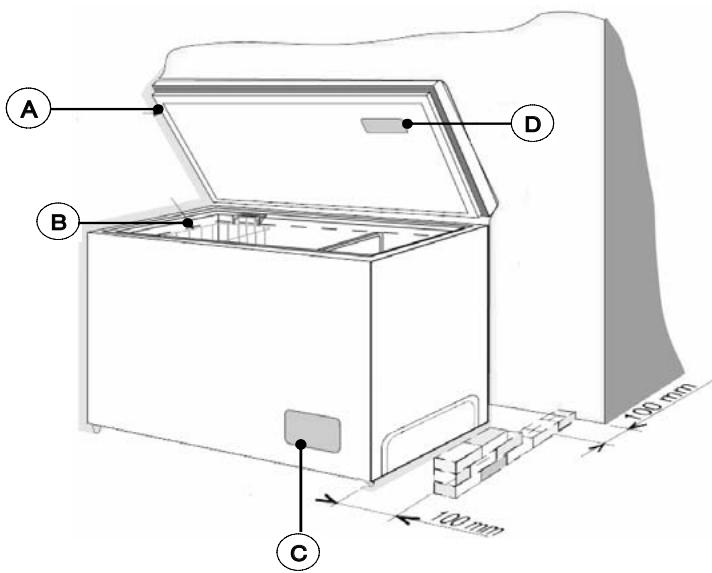
A Door
B Basket
C Control panel
D Internal light (varies with model)
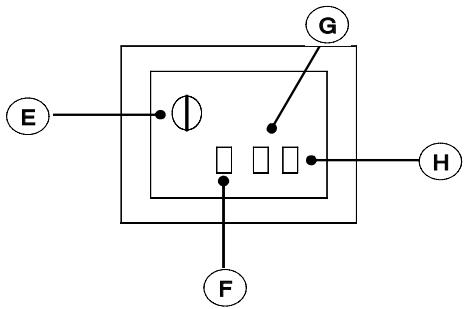
E Thermostat
F Operating indicator (Depending on the model)
G Alarm indicator
H "Super Freeze" button (Depending on the model)
STARTING YOUR APPLIANCE
- Plug the power cable into the socket. Depending on your appliance control panel, the green (voltage) and red (alarm) indicator lights illuminate.
- Set the thermostat to the middle position and leave the appliance to run for approximately 4 hours; the alarm light should go out.
After start-up, if the temperature inside your freezer should increase abnormally while conserving your frozen foodstuffs, the alarm light will illuminate.
CONSERVING
When your appliance thermostat is not set to the maximum or when the "Super Freeze" button (depending on your model) is not pressed, your appliance will operate in conservation mode. You must only introduce already frozen, pre-packed food.
The conservation time essentially depends on the type of foodstuff.
FREEZING
The refrigeration output is defined by the maximum amount of products that the appliance can freeze in 24 hours from ambient temperature down to -18^ . This amount is shown on the manufacturer's plate at the rear of the appliance. At least 24 hours before introducing the foodstuffs to be frozen, press your appliance's "Super Freeze" button (orange) or set the thermostat to the maximum (if your chest freezer does not have a "Super Freeze" button). Then introduce your fresh foodstuffs and keep the appliance in this mode for approximately 24 hours.
You can then either perform a new freezing operation or return your appliance to conservation mode.
Preferably place the foodstuffs to be frozen in contact with the back and the walls to ensure that they are frozen more quickly. Avoid placing fresh products in contact with products already frozen.
Warning: When you introduce products, the alarm light may come on for a few moments without this being any inconvenience for the appliance or the products.
| Foodstuffs | Conservation time in months |
| 1 | |
| 1 | |
| 2 | |
| 3 | |
| 4 | |
| 6 | |
| 8 | |
| 8 | |
| 10 | |
| 12 |
Only freeze fresh food that has been cleaned and sealed in appropriate packages.
Label each packet writing on it the date frozen, the weight or the number of items and the type of product.
Do not place bottles or cans of fizzy drinks in your freezer; they may burst.
Do not refreeze a product that has defrosted; it must be consumed without delay.
- Do not open the freezer's lid too often to avoid raising the temperature inside the compartment.
- Do not exceed the recommended expiry date for the frozen products, as indicated on the packaging.
SAVING ENERGY
- Let the food cool down before introducing it into the appliance.
- When your appliance is in "Conservation" mode, we recommend that you set the thermostat to maintain a temperature of -18^ inside the appliance.
- Setting the thermostat to position 3 enables you to reduce the consumption of electricity when the foodstuffs only occupy half of your appliance.
DEFROSTING
Your refrigerator has a manual defrosting system.
For your freezer to operate correctly, you must defrost it at least once a year or when the layer of ice is more than 10mm thick.
NEVER USE ANY METAL ITEM OR ELECTRICAL APPLIANCE TO DEFROST YOUR FREEZER.
- Select a period when your freezer is not heavily loaded.
- Press the "Super Freeze" button 24 hours in advance (or depending on your model, set the thermostat to the maximum) so that your frozen foodstuffs are at the lowest possible temperature.
- Remove the foodstuffs, wrap them carefully and place them in a refrigerator or a very cold place.
- Disconnect your freezer.
- Free the ice with a wooden or plastic scraper. Remove the sheets of ice and sponge away the melt water as it forms.
- Wash out the inside of the freezer with slightly soapy warm water. NEVER use scouring powder, abrasive sponges or aggressive products (alcohol, thinners, etc.).
- Rinse with clean water, dry carefully and leave the lid slightly open for a few minutes.
- Re-connect your appliance and activate the "Super Freeze" function (or set the thermostat to the maximum). Return your foodstuffs to the freezer.
- Defrosting must be done as quickly as possible to avoid already frozen food warming up significantly, which could reduce their conservation time.

MAINTENANCE
Advice:
In the event of a power failure: if the power failure is expected, activate "Super Freeze" mode (or set the thermostat to the maximum) 24 hours in advance as far as possible. Do not open the appliance at any time during the power failure.
Cold reserves: there are two possible cases:
Your freezer is 34 full. In this case, the cold reserve thereby created avoids any abnormal increase in temperature.
Your freezer contains very few products. In this case, we recommend that you place plastic containers filled with water in your freezer so that, once frozen, these will provide the essential cold reserves.
If your appliance will be unused for a long time, disconnect it. We recommend that you leave the lid ajar in order to air your freezer correctly.
OPERATING PROBLEMS
There are some noises that it is quite normal for a freezer to make:
- The refrigerant gas can produce a gurgling sound as it travels through the circuits.
- The compressor may produce a buzzing noise, which can be more noticeable during start-up.
- The "cracking" noise produced by expansion and contraction of the materials used.
| PROBLEM | SOLUTION |
| The appliance does not work. | Check that the plug is correctly connected, that the fuse hasn't blown or that the circuit-breaker has not jumped. |
| The freezer does not freeze well. | Check the thermostat and ensure that the door remains open for the shortest time possible. Also check that the door closes correctly. |
| The motor runs continuously. | Ensure that the freezer is correctly ventilated, leaving the gaps indicated in the “Installation” section. Also check that your appliance is not exposed to any heat source. |
If you have already performed the indicated checks and your problem still persists, DO NOT ATTEMPT TO MAKE ANY REPAIRS YOURSELF. Contact your nearest Technical Assistance Department.

THIS APPLIANCE COMPLIES WITH EEC DIRECTIVES 73/23, 93/68, 89/336, 96/57, 92/31, 94/62
Any work on your appliance must be performed by a Brand accredited qualified professional.
When you call, please mention the complete reference for your machine (model, type, serial number): this information is provided on your guarantee certificate and the information plate on your appliance.
ORIGINAL SPARE PARTS: when any maintenance work is being performed, ask that only certified original spare parts be used.
Gechte Klant,
1 / INSTALLATIE VAN HET APPARAAT
DIT APPARAAT VOLDOET AAN DE CEE RICHTLIJNEN 73/23, 93/68, 89/336, 96/57, 92/31, 94/62


