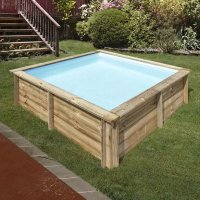
790000 - Above-ground pool GRE - Free user manual and instructions
Find the device manual for free 790000 GRE in PDF.



| Brand | Gre |
| Model | 790000 |
| Product type | Above-ground wooden pool |
| Structure material | Autoclave-treated Scots pine class IV |
| Liner material | PVC |
| Wood structure warranty | 10 years against rot and insect attacks |
| Liner warranty | 2 years on welds and sealing |
| Filtration unit warranty | 2 years (electrical issue) |
| Ladder warranty | 2 years (excluding salt electrolysis) |
| Assembly time | 2 days with 2 people (excluding earthworks and filling) |
| Required tools | Screwdriver (Torx T15, T20, T25 bits), drill, cutter, spirit level, tape measure, mallet, hammer, screwdriver, 19 mm wrench, hacksaw, handsaw, pen, PVC glue, Teflon roller, double-sided tape, gloves, clamps |
| Liner installation temperature | Outdoor minimum 15°C, liner preheated to 20°C for 24h |
| Ground preparation | Perfect leveling, concrete slab (10 cm min) or fine sand bed (max 1 cm) after excavation |
| Electrical safety distance | 220 V equipment at least 3.50 m from edge, grounded plug with earth and differential switch ≤30 mA |
| Routine maintenance | Chemical treatment (pH 7.2-7.4, chlorine 0.5-2 ppm), liner cleaning with non-abrasive products |
| Winterization | Lower water under skimmer or to 20 cm from edge, treat with winter product, disconnect filtration, cover with cover |
| Spare parts | Available 5 years after invoice date |
| Environmental standards | PEFC certified wood, packaging sorting and recycling |
| Wood storage before assembly | Flat, away from moisture and sun, remove protective film to let it breathe |
| Non-swimmer safety | Permanent adult supervision, child protective equipment, recommended safety barrier |
Frequently Asked Questions - 790000 GRE
User questions about 790000 GRE
0 question about this device. Answer the ones you know or ask your own.
Ask a new question about this device
Download the instructions for your Above-ground pool in PDF format for free! Find your manual 790000 - GRE and take your electronic device back in hand. On this page are published all the documents necessary for the use of your device. 790000 by GRE.
USER MANUAL 790000 GRE
natural_image
Line drawing of a rectangular wooden structure with slatted edges and a central opening (no text or symbols)EN SUMMARY
ES ÍNDICE
FR SOMMAIRE
DE INHALTSVERZEICHNIS
IT RIASSUNTO
NL SAMENVATTING
PT RESUMO
Important/ Importante/ Important/ Wichtig/ Importante/ Belangrijk/ Importante 4
Components/ Componentes/ Elements/ Bestandteile componenti/ Onderdelen/ Componentes 8
Guarantee/ Garantía/ Garantie/ Garantie/ Garanzia/ Garantie/ Garantia 12
Learn about the wood/ Conozca la madera/ Mieux connîatre le bois/ Das Holz besser kennen- 40 lernen/ Conosci il legno/ Wat u moet weten over hout/ Conheça a madeira
Installation drawing / Plano de instalación / Plan d'implantation / Aufstellplan / Piano di installazione / Installatieplan / Plano de instalação 42
Installation / Instalación / Implantation / Montage / Installazione / Installatie / Instalação 44
Preparing the land / Preparación del terreno / Terrassement / Geländevorbereitung / Preparazione del terreno / Voorbereiding van het terrein / Preparação do terreno 49
Boards / Tablas / Madriers / Holzbretter / Tavole / Planken / Tábuas 56
Protective ground blanket / Manta protectora de fondo / Feutre de fond / Bodenschutzvlies / 57 Copertura di protezione del fondo / Beschermdeken bodem / Manta protetora de fundo
Assembly of the structure / Montaje de la estructura / Assemblage de la structure / Zusammenbau des Tragwerks / Montaggio della struttura / Montage van de constructie / Montagem da estrutura 58
Filter / Filtración / Filtration / Filtration / Filtrazione / Filtering / Filtração 60
Installation of the liner hooking profile/ Colocación de los perfiles de enganche del liner/ Positionnement des baguettes d'accroche de liner/ Positionierung der Einhängeprofile der Poolfolie/ Posizionamento dei profili di aggancio del liner/ Plaatsing van de klemprofielen voor inhangen van de liner/ Coloção dos perfis de engate do liner 61
Installation of the liner / Colocación del liner / Mise en place du liner / Positionierung des Liners / Posizionamiento del liner / Plaatsing van de liner / Colocação do linerç 64
Land-filling / Terraplenado / Remblaiement / Erdaufschüttung / Terrapieno 68
/ Grond effenen / Aterro
EN Before screwing on the edges of the pool, the wood should be presented for its correct localization. Sitting on or walking on the beaches is strictly prohibited. Any breakage is not covered by the guarantee.
EN After a few months since assembling the pool we recommend using a water-based dye to hydrate the wood. Remember wood is a live being. This reduces the appearance of fissures. This dye is advisable on copping because being most exposed to sunlight and chemical products. If you decide to paint your pool, make sure the product you use is adequate for wood treated with Autoclave 4.
This pallet should be stored on a level floor, preferably concrete.
If the pool is going to be immediately assembled:
- Revise the content
- Assemble it as soon as possible to avoid deformation of the parts after having released the pallet straps.
If the pool is not going to be immediately assembled: - Do not remove the straps form the wooden pallet.
- In the case of having to undo the pallet and the pool is not going to be immediately assembled, the pallet should be rebuilt assuring good fixing to avoid deformation of the parts (using ropes, straps, etc).
In both cases, put weight on top to assure the parts remain flat. Store the pallet in an adequately ventilated place.

Carefully read this information and keep it for later consultations
Congratulations on your choice. The model you have chosen has been especially designed for simple and rapid installation, but some precaution is necessary for the good use of your pool. Before starting with the installation and assembly of your pool, consider the current local regulation about on ground and in ground pools.
The use of the pool kit includes respecting the safety instructions described in the maintenance manual and instructions for use. If the safety regulations are not respected serious damage for your health and specially for that of children may occur. Carefully read this manual and pay attention to the illustrations before starting to assemble the pool. In the case that the assembly does not follow this manual the guarantee may be rejected in the case of failure.
The information appearing in this installation manual shows exactly how it should be done. Nevertheless, the illustrations in the same are to explain the assembly process. Contractual elements will not be considered regarding the shape, the colours and the aspects shown in the illustrations. Manufacturas Gré in its commitment to ongoing improvement of their products, reserves the right to modify at any time and without previous warning the features, the technical details, the standardized equipment and the options of its products.
ES¡ATENCIÓN!
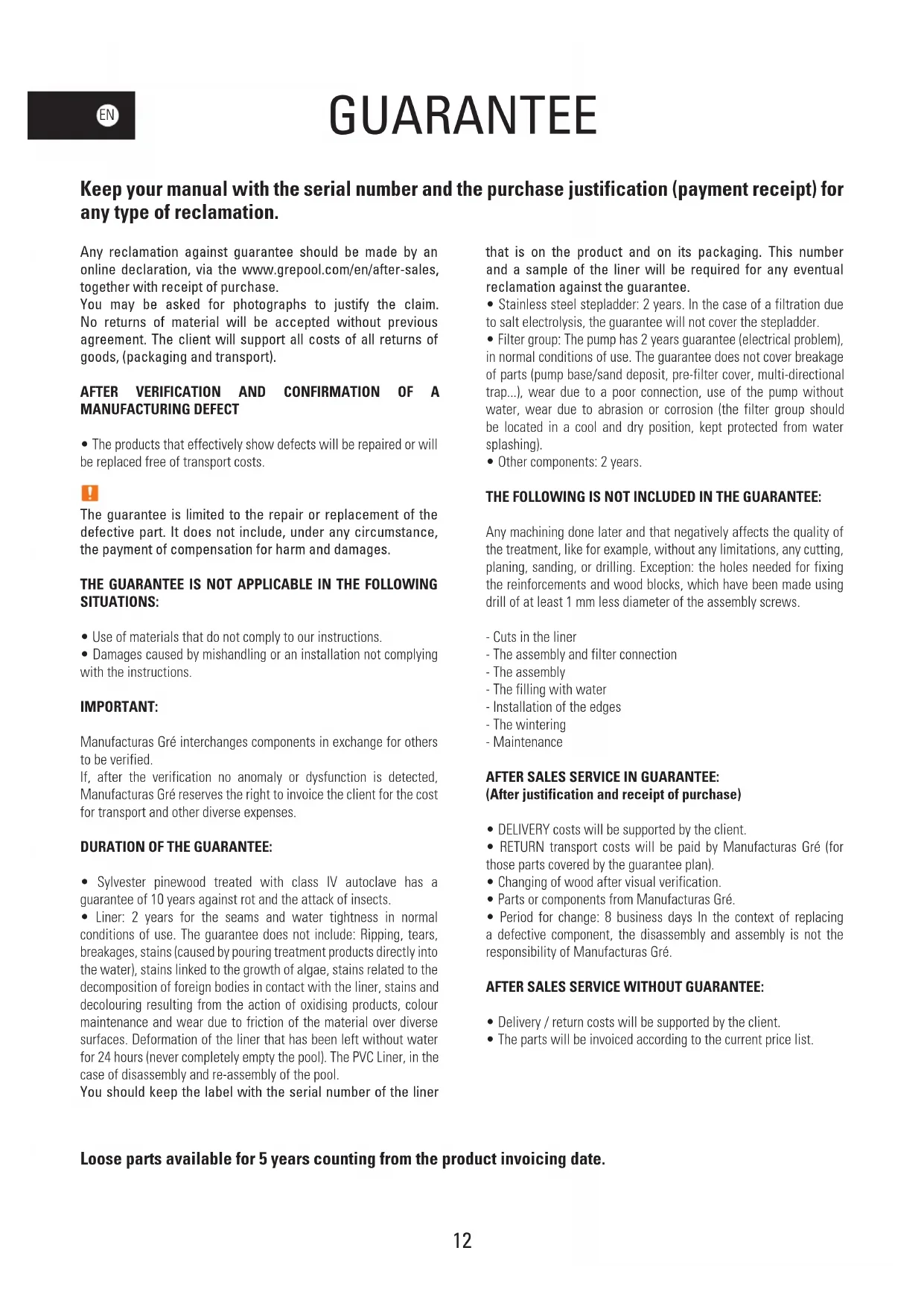
Keep your manual with the serial number and the purchase justification (payment receipt) for any type of reclamation.
Any reclamation against guarantee should be made by an online declaration, via the www.grepool.com/en/after-sales, together with receipt of purchase.
You may be asked for photographs to justify the claim. No returns of material will be accepted without previous agreement. The client will support all costs of all returns of goods, (packaging and transport).
AFTER VERIFICATION AND CONFIRMATION OF A MANUFACTURING DEFECT
- The products that effectively show defects will be repaired or will be replaced free of transport costs.
!
The guarantee is limited to the repair or replacement of the defective part. It does not include, under any circumstance, the payment of compensation for harm and damages.
THE GUARANTEE IS NOT APPLICABLE IN THE FOLLOWING SITUATIONS:
- Use of materials that do not comply to our instructions.
- Damages caused by mishandling or an installation not complying with the instructions.
IMPORTANT:
Manufacturas Gré interchanges components in exchange for others to be verified.
If, after the verification no anomaly or dysfunction is detected, Manufacturas Gré reserves the right to invoice the client for the cost for transport and other diverse expenses.
DURATION OF THE GUARANTEE:
- Sylvester pinewood treated with class IV autoclave has a guarantee of 10 years against rot and the attack of insects.
- Liner: 2 years for the seams and water tightness in normal conditions of use. The guarantee does not include: Ripping, tears, breakages, stains (caused by pouring treatment products directly into the water), stains linked to the growth of algae, stains related to the decomposition of foreign bodies in contact with the liner, stains and decolouring resulting from the action of oxidising products, colour maintenance and wear due to friction of the material over diverse surfaces. Deformation of the liner that has been left without water for 24 hours (never completely empty the pool). The PVC Liner, in the case of disassembly and re-assembly of the pool.
You should keep the label with the serial number of the liner
that is on the product and on its packaging. This number and a sample of the liner will be required for any eventual reclamation against the guarantee.
- Stainless steel stepladder: 2 years. In the case of a filtration due to salt electrolysis, the guarantee will not cover the stepladder.
- Filter group: The pump has 2 years guarantee (electrical problem), in normal conditions of use. The guarantee does not cover breakage of parts (pump base/sand deposit, pre-filter cover, multi-directional trap...), wear due to a poor connection, use of the pump without water, wear due to abrasion or corrosion (the filter group should be located in a cool and dry position, kept protected from water splashing).
- Other components: 2 years.
THE FOLLOWING IS NOT INCLUDED IN THE GUARANTEE:
Any machining done later and that negatively affects the quality of the treatment, like for example, without any limitations, any cutting, planing, sanding, or drilling. Exception: the holes needed for fixing the reinforcements and wood blocks, which have been made using drill of at least 1 mm less diameter of the assembly screws.
- Cuts in the liner
- The assembly and filter connection
- The assembly
- The filling with water
- Installation of the edges
- The wintering
- Maintenance
AFTER SALES SERVICE IN GUARANTEE: (After justification and receipt of purchase)
- DELIVERY costs will be supported by the client.
- RETURN transport costs will be paid by Manufacturas Gré (for those parts covered by the guarantee plan).
- Changing of wood after visual verification.
- Parts or components from Manufacturas Gré.
- Period for change: 8 business days In the context of replacing a defective component, the disassembly and assembly is not the responsibility of Manufacturas Gré.
AFTER SALES SERVICE WITHOUT GUARANTEE:
- Delivery / return costs will be supported by the client.
- The parts will be invoiced according to the current price list.
Loose parts available for 5 years counting from the product invoicing date.
PROLOGUE
STORAGE PRECAUTIONS
While the pool is disassembled, it is sensitive to variations of temperature and humidity. Therefore, certain precautions should be taken for storage.
When you receive the packets, store the pieces of wood in horizontal position on a flat surface, shielding them from humidity and sunlight to avoid any risk of deformation.
ESSENTIAL:
- Do not store the wood in sunlight, to avoid excessive sags or cracks in the wood.
- Do not store the pool outside protected by a watertight cover, because the condensation emanating from the wood will make it even more humid and will subject to changes of shape.
COMPULSORY:
- Assemble the structure only once.
- Store the wood of your pool on a flat surface, shielding it from humidity and sunlight.
- Remove the protective film so the wood can «breathe».
DURATION OF THE INSTALLATION
The installation of this pool needs the intervention of at least two persons and takes two days (besides the preparation of the land and the filling).
BEFORE BUILDING YOUR POOL MAKE SURE
- You have the assistance of a qualified person for the electrical connections.
- There is sufficient water supply to fill the pool.
- That you have carefully read the manual, step by step, to fully understand the installation of your pool.
IMPORTANT
Manufacturas Gre, S.A. will not be responsible for any fault due to poor quality in concrete.
The concrete slab must be made by a professional in accordance with the instructions given in this instruction manual. If there was any complaint, the invoice for the slab may be requested in order to examine the pool's warranty.
IN GROUND POOLS AND SPECIFIC REGULATIONS
For on ground pools, we recommend protecting access to the pool by one standardized protection element.
For semi in-ground and fully in ground pools, the French law no. 2003-9 of 3rd January 2003. related to pool safety, as well as French decree no. 2003-1398 of 31st December 2003, related to pool safety, require protecting the pool by at least one element of standardized protection, like:
- Protection fence
- Pool alarm
- Pool cover
- Pool hut

INSTALLATION SUGGESTION
The land should be prepared as indicated in the «installation» chapter of this manual.
DO NOT SITUATE YOUR POOL
• Under overhead electricity cables
• Under branches of trees
- On non-stable land
A good location allows you to save time and avoid limitations. The pool should be in a sunny spot and easily reached.
The location of the pool should be free of tubes or electrical connections.
Take into account that the best is to assemble the pool on a sunny day and avoid high winds.
PACKAGING, CLASSIFICATION AND RECYCLING
- Some pool components are packed in plastic bags. To avoid all risk of asphyxia, never allow babies or children to play with these.
- Thanks for respecting the European Union Laws and collaborating in protecting the environment.
When you have installed your pool and all the components are assembled, we thank you for classifying and recycling all the packaging.
PROLOGUE
SAFETY INSTRUCTIONS
The filter kit (filter + pump) should be installed at least 3.5 metres from the pool to avoid the risk of electrocution.
There should be a special differential electricity protection device for pools with electric filter pumps, according to the regulation.
Never leave children without surveillance near the pool.
After each bath, remove the external stepladder to avoid accidental falling into the pool of children or of pets (Regulation EN-P90-317).
This pool is exclusively designed for family use. Walking on the edges or diving or jumping from them is strictly forbidden.
SAFETY ADVICES
Carefully read, understand, and follow all information in this user manual before installing and using the swimming pool.
These warnings, instructions, and safety guidelines address some common risks of water recreation, but they cannot cover all risks and dangers in all cases. Always use caution, common sense, and good judgment when enjoying any water activity. Retain this information for future use.
Non Swimmers safety
Continuous, active, and vigilant supervision of weak swimmers and non-swimmers by a competent adult is required at all times (remembering that children under five are at the highest risk of drowning).
- Designate a competent adult to supervise the pool each time it is being used.
- Weak swimmers or non-swimmers should wear personal protection equipment when using the pool. - When the pool is not in use, or unsupervised, remove all toys from the swimming pool and its surrounding
to avoid attracting children to the pool.
Safety devices
- It is recommended to install a barrier (and secure all doors and windows, where applicable) to prevent unauthorized access to the swimming pool.
- Barriers, pool covers, pool alarms, or similar safety devices are helpful aids, but they are not substitutes for continuous and competent adult supervision.
Safety equipment - It is recommended to keep rescue equipment (e.g. a ring buoy) by the pool.
- Keep a working phone and a list of emergency phone numbers near the pool.
Safe use of the pool - Encourage all users especially children to learn how to swim
- Learn Basic Life Support (Cardiopulmonary Resuscitation - CPR) and refresh this knowledge regularly.
This can make a life-saving difference in the event of an emergency. - Instruct all pool users, including children, what to do in case of an emergency
- Never dive into any shallow body of water. This can lead to serious injury or death.
- Do not use the swimming pool when using alcohol or medication that may impair your ability to safely use the pool.
- When pool covers are used, remove them completely from the water surface before entering the pool.
- Protect pool occupants from water related illnesses by keeping the pool water treated and practicing good hygiene. Consult the water treatment guidelines in the user's manual.
- Store chemicals (e.g. water treatment, cleaning or disinfection products) out of the reach of children.
- Signage is to be displayed in a prominent position within 2 m of the pool.
- Removable ladders shall be placed on a horizontal surface.

Loose parts available for 5 years counting from the product invoicing date.

PEFC™
PEFC/14-38-00166



WARNING:
Every electrical appliance fed in 220 V, has to be located at least at 3,50 m from the edge of the pool. The equipment should be connected to a voltage, with earth connection, protected by a residual current device (RCD) having a rated residual operating current not exceeding 30 mA.
Read the instructions carefully and keep for future reference.
IF YOU HAVE ANY PROBLEM, ..; CONTACT US!
www.grepool.com
When you have installed your pool and all the components are assembled, we thank you for classifying and recycling all the packaging.

ATENCIÓN:

ATTENTION:

WICHTIGER HINWEIS

ATTENZIONE:
VOORSCHRIFTEN VOOR OPSLAG
VERPAKKING, AFVALSCHEIDING EN RECYCLING

BELANGRIJK:

ATENÇÃO:
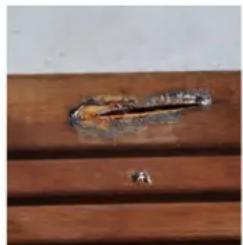
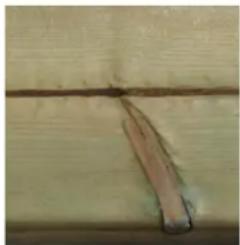
Wood is a natural product, the fissures visible on the edges of the wood are completely normal and do not modify the resistance characteristics of the same.
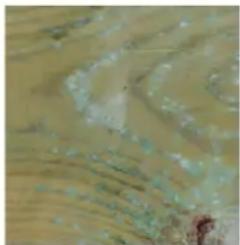
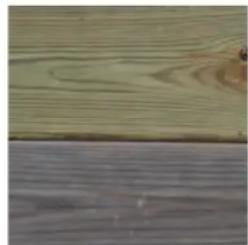
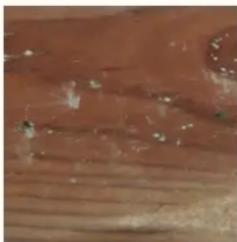
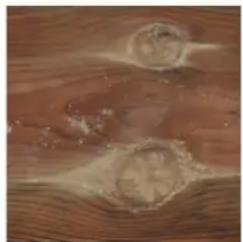
Wood is always a malleable material (from 3% to 4% of dimensional variations) with humidity and temperature oscillations. Therefore, small cracks can appear and in order to limit later deformations, the technical criteria have been respected regarding the design, the choice of sections, and of packaging and the fixing methods. Knots are natural elements of wood: their aspect and their size vary from one product to another. The secretion of resin is a natural phenomenon of resinous wood. Just as no tree is like another tree, the following photographed elements cannot be considered as defects:
ES LA MADERA: UN MATERIAL VIVO
natural_image
Close-up of a wooden plank with visible grain and a dark horizontal seam (no text or symbols)Cracks/Grietas/Fente/Risse/Crepe/Barsten/Fendas
natural_image
Close-up of a wooden surface with a damaged metal object and a small mark, no visible text or symbolsResin/Resina/Résine/Harz/Resina/Hars/Resinas
natural_image
Close-up of a wooden beam with a visible crack or knot, no text or symbols presentNerves and long knots Nervios y nudos alargados Nervures et noeuds longs Geäder und lange knoten Nervature e nodi ingranditi Houtnerf en verlengde kwasten Nervuras e nós alongados
natural_image
Close-up of a textured surface with yellow and green tones, no visible text or symbolsRetention of sterilization products Retención de productos de esterilización Rétention de produits détuve Rückstände von Sterilisationsprodukten Ritenzione di prodotti per la sterilizzazione Vasthouden van impregnatiemiddelen Retenção de produtos de esterilização
natural_image
Close-up of a wooden surface with grain patterns and a horizontal seam (no text or symbols)Differences in shades of colour Diferencias de tonalidad Différences de teinte Unterschiede im Farbton Differenze di tonalità Kleurverschillen Diferenças de tonalidade
natural_image
Close-up of a textured brown surface with scattered green specks (no text or symbols)Surface mould/Moho superficial/Moisissures superficielles/Oberflächlicher moder/Muf fa superficiale/Oppervlakte-schimmel/Bolor superficial
natural_image
Close-up of a wooden surface with visible grain and water droplets (no text or symbols)Round knots/Nudos redondos/ Noeuds ronds/Runde knaten / Nodi rotondi/ Ronde kwasten/ Nós redondos
EN Mould can appear on the surface of wood, although not penetrating into it and not degrading it. After being treated with UV radiation, wood turns greyish with time without this affecting its durability. Varnish can be applied to wood treated in autoclave. In addition to protection, varnish contributes to the beauty and long-life of wood. In this casej, wait for the wood to completely dry before applying the varnish.
SYLVESTER PINE TREATED IN AUTOCLAVE
The wood we use is select pine and dried to 25% before treatment in class IV autoclave. It has a 10-year guarantee against insect attack and against rot for the parts in the ground.
natural_image
Line drawing of a rectangular wooden structure with slatted edges and a central opening (no text or symbols)
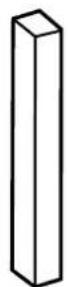
Post
Poste
Poteau
Pfosten
Pali
Staander
Poste
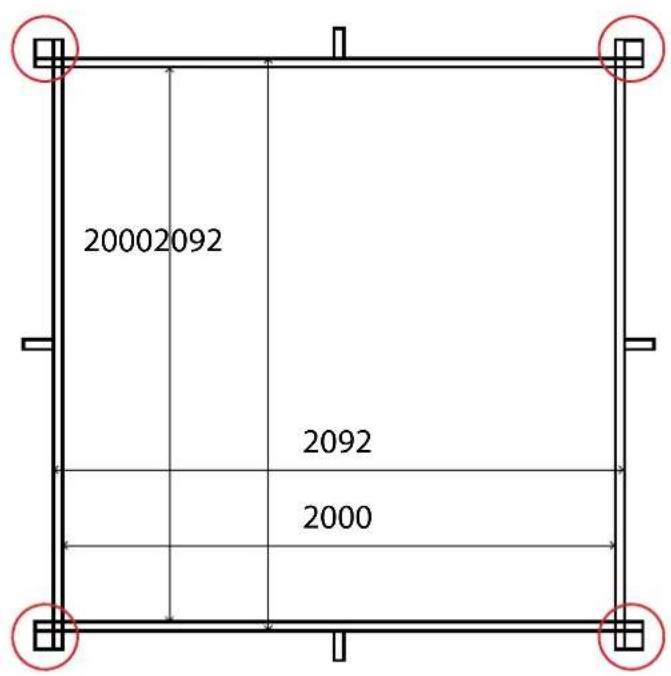


You should respect all these dimensions to perfectly adjust the liner and the edges. Approximate dimensions

This is a determining stage in the construction of your pool. Certain works performed in situ, like the preparation of the land, the concrete slab, the draining... can need the intervention of professionals that will propose the most adequate solutions.
Select the ideal location, in the sunniest spot possible, taking into account the local regulations (distance from the paths, public rights of way, networks...) and the landscaping after installing the pool. Decide the location by marking the ground, check the «Ground layout» section.
Your pool can be installed in these three ways
Try to not install your pool on recently filled land or unstable land, otherwise, you will need to make a concrete foundation slab. Whatever type of installation you choose, you should excavate and prepare the land for levelling.
Attention: in the case that the land is sloping, you need to excavate it for levelling. Do not add soil to level it.
In the case of assembling your pool above ground, you can use either a bed of sand or a concrete slab. If you choose the bed of sand, use fine and clean sand, otherwise you could stain the liner due to there being algae in the sand. In the case that the pool is semi in-ground or completely in-ground, the installation should be using a concrete foundation slab. If a foundation concrete slab is used this should be at least 10 centimetres thick. The pool is assembled after the concrete foundation slab has completely dried (3 weeks).

Take the reference number of your pool into account when you do the assembly
- 1 screwdriver (with Torx point No. T15, T20, T25) • 1 drill with bits for wood ∅4, ∅6 and ∅10, for concrete ∅10 and for metal ∅5
- 1 cutter • 1 spirit level • 1 decametre • 1 mallet • 1 hammer • 1 screwdriver • 1 No. 19 spanner • 1 hacksaw • 1 saw for wood • 1 ballpoint pen • PVC adhesive • Roll of Teflon • Two-faced adhesive tape or stapler • Gloves • Seal closer Assembly time (besides land preparation and filling) 1 day with at least 2 persons.
ES HERRAMIENTAS
INTERIOR DIMENSIONS:
Mark the shape of your pool on the ground using the previous dimensions. The marking can be done by using a cord.
If your pool is fully or partially in-ground, proved the excavation for an area of 50 cm additional to the perimeter to facilitate your movements during assembly.
If the installation is fully or partially in-ground, try to remove all the fragments of wood, branches or roots that could become degraded with time. Do not install any formwork around the pool or near it with wood that is not treated for installation in contact with the ground. Do not apply any additional treatment to the in-ground part, for example, applying tar or non-micro porous varnish is prohibited. Make sure that the wood can «breathe», check the «Preparing the land» chapter.
ES LOSA DE HORMIGÓN: ES FUNDAMENTAL CENTRAR LA PISCINA EN LA SOLERA DE HORMIGÓN, COMO SE INDICA EN LA IMAGEN. LAS MEDIDAS INCLUYEN EL ESPESOR DE LA PARED.
DIMENSIONES INTERIORES:
AFMETINGEN BINNENZIJDE:
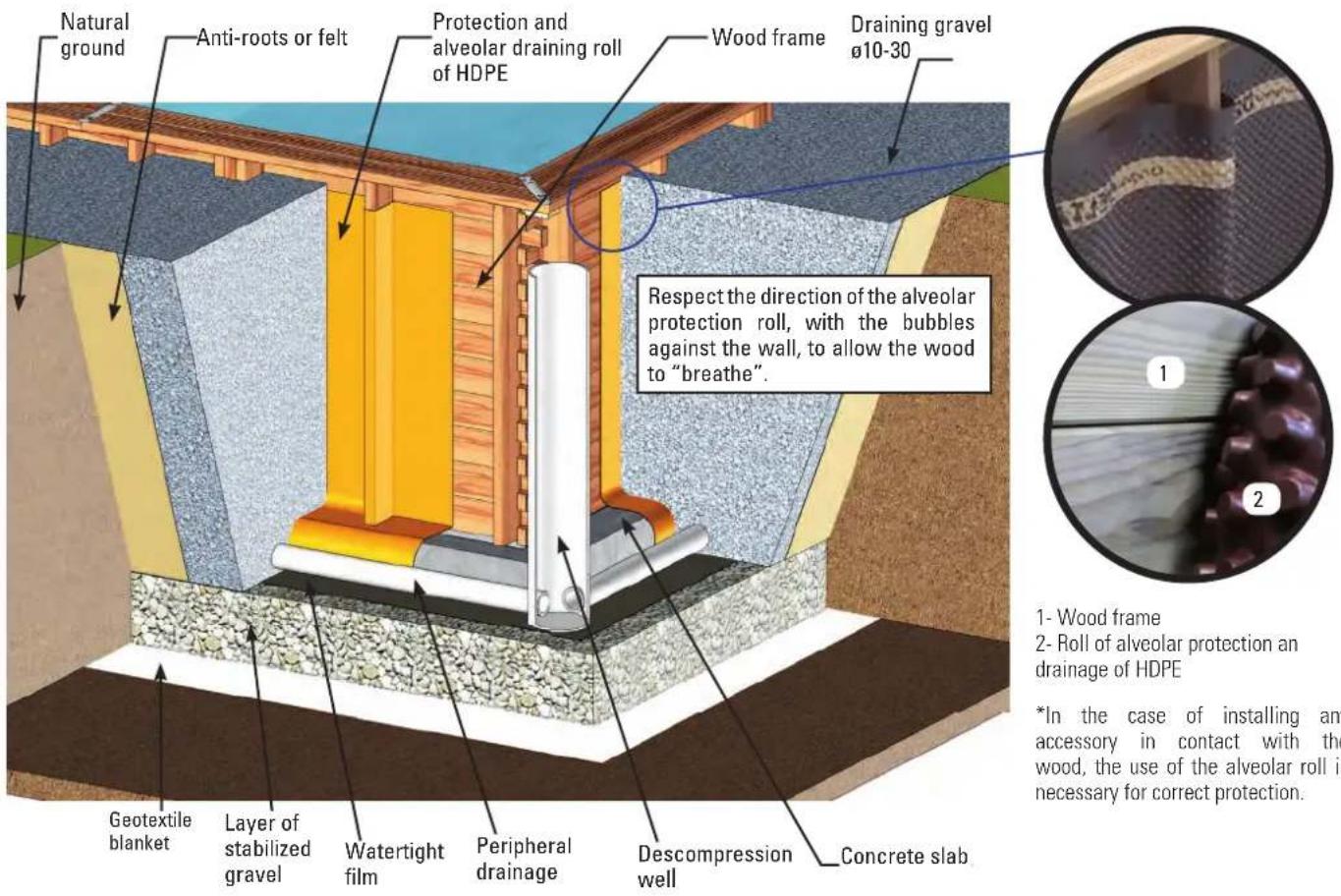
The recommendations about the construction for completely or partially in-ground pools are effective in the context of an installation in land which is not humid. You should conveniently adapt the basic instructions to avoid the restrictions related to the type of land (clay for example) or to the excessive presence of water in the ground, (sources, run-off rainwater...). In order to avoid any excess humidity in your land, you should install a draining system under the pool, and around it by building a decompression well. In all cases, an adapted draining system is necessary to avoid water stagnation with the possible consequences of ground contamination including the deterioration of the structure (rooting of the wood, deformation of the structure...) To guarantee quality planning, you can consider any information from a specialist as very important.
UNACCEPTABLE LOCATION: Sloping, uneven ground. Sandy, rocky or soggy ground.
MARK THE INSTALLATION AREA
Once the location area is chosen (which have to be perfectly levelled), we'll proceed at the marking. Mark the ground using wood pickets, screwdriver, funnel (or plastic bottle), flour or lime and a rope.
It is advisable to level the total surface area necessary before marking it (marking should be centered on the rectangle corresponding to the pool model) so that assembly work is more convenient and easy.
In order to avoid any excess humidity in your land, you should install a draining system under the pool, and around it by building a decompression well.
LEVELLING
When levelling the ground, always remove material from the top of the slope rather than filling in the bottom: this will ensure greater ground stability and firmness. Always remove all grass, roots, stones, etc. Levelling is extremely important: devoting the necessary time and effort to ensuring that your pool sits properly on the ground will avoid problems later.
How to level: thanks to a large mason rule (aluminium or wood) and a level, level out the ground forming rectangles (or squares), locating this rule in the selected and cleaned area. When all the areas are on level and when the excess of ground is removed, you may fill in the small areas which are left to level out (with clean ground or sand) but always compacting and levelling again afterwards. It is very important the installation area is well-compressed and firm in order the ground do not subside when the pool will be full of water. Please ask a professional: builder, gardener...
Finishing: On the cleaned and levelled ground, spread a light coat of sieved sand (max. 1cm).
Water and compact it (with a garden roller). Check that is well levelled.
Do not use the sand to level the ground. The finishing has to be perfect.
PARTIAL OR COMPLETELY IN-GROUND INSTALLATION
According to the nature of the land, you should install a peripheral drainage and connect it to a decompression well. The well will be excavated before the construction of the pool to avoid that the excavations fill with water during the works. It should be near the pool, a few centimetres lower than the deepest point of the same and reach up to the surface. The decompression well is located at the most humid point. It acts as an overflow in the case of water infiltrations or clay soil, starting from the fact that water rises quicker through a tube than through the soil.
natural_image
Two circular images showing fabric textures: top image with a textured surface and patterned band, bottom image with a textured surface and chocolate beads (no text or symbols)natural_image
Two circular images showing fabric textures: top image with textured surface and patterned band, bottom image with textured surface and segmented pattern (no text or symbols)natural_image
Two circular images showing fabric textures: top image with a textured surface and patterned texture, bottom image with a wooden surface and chocolate beads (no text or symbols)natural_image
Two circular images showing fabric textures: top image with textured surface and patterned band, bottom image with textured surface and mechanical components (no visible text or symbols)natural_image
Two circular images showing fabric textures: top image with patterned fabric, bottom image with chocolate beads (no text or symbols)natural_image
Isometric line drawing of a wooden fence with two vertical posts (no text or symbols)3
natural_image
Simple line drawing of a long rectangular object with parallel grooves, labeled with number 2 (no text or symbols on the object itself)| IDENTIFICATION IDENTIFICACIÓN REPÉRE KENNZEICHNUNG IDENTIFICAZIONE IDENTIFICATIE IDENTIFICAÇÃO | DENOMINATION/DENOMINACIÓN/DÉSIGNATION/BEZEICHNUNG / DENOMINAZIONE/BENAMING/DENOMINAÇÃO/ | CTD QTÉ ANZ AANT TD |
| 1 | Walls Paredes Parois Schwimmbeckenwände Pareti Wanden Paredes | 4 |
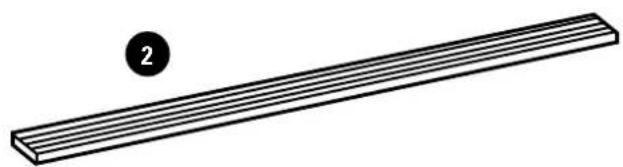
| 2 | Edge L2106 Playa L2106 Margelle L2106 Handlauf L2106Bordo L2106 Ränd L2106 Bordo L2106 | 4 |
| 3 | Vertical post Poste vertical Poteau vertical PfostenPalo verticale Verticale staander Poste vertical | 6 |
EN PROTECTIVE GROUND BLANKET
ES MANTA PROTECTORA DE FONDO
FR FEUTRE DE FOND
DE BODENSCHUTZVLIES
IT COPERTURA DI PROTEZIONE DEL FONDO
NL BESCHERMDEKEN BODEM
PT MANTA PROTETORA DE FUNDO
The Ground Cover or floor tapestry - Caution: Clean all dirt from the pool wall and bottom with a vacuum cleaner before placing the ground cover or floor tapestry in position. Fit the protective ground cover or floor tapestry in the interior of the pool and smooth out all the creases, adjusting and cutting away excess from the total surface area.
ES La Manta o Tapiz: Advertencia: se recomienda limpiar todas las suciedades de la pared y suelo de la piscina con ayuda de una aspiradora antes de colocar la manta o tapiz. Colocar la manta protectora o el tapiz en el interior de la piscina, eliminando todos los pliegues, ajustando y cortando el sobrante de la superficie total.
La Couverture ou tapis de sol: Avertissement : bien nettoyer la paroi et le sol de la piscine avec un aspirateur, pour la débarrasser de toutes les saletés, avant de poser la couverture ou tapis de sol. Poser la couverture ou tapis de sol protecteur à l'intérieur de la piscine ; éliminer tous les plis, ajuster et couper ce qui dépasse de la surface totale.
DE Decke bzw. Bodendecke - Zu Beachtung: Es wird dringend empfohlen, Wand und Boden des Schwimmbads mit einem Staubsauger von jeglichem Schmutz zu befreien, bevor die Decke bzw. Bodendecke verlegt wird.
natural_image
Line drawings of a wooden cabin and a closed book on a gray floor (no text or symbols)EN ASSEMBLY OF THE STRUCTURE
ES MONTAJE DE LA ESTRUCTURA
FR ASSEMBLAGE DE LA STRUCTURE
DE ZUSAMMENBAU DES TRAGWERKS
IT MONTAGGIO DELLA STRUTTURA
NL MONTAGE VAN DE CONSTRUCTIE
PT MONTAGEM DA ESTRUTURA
EN · Locate the 4 walls of your pool and the 4 vertical posts Present one wall and one post as shown in image (1).
natural_image
Technical line drawing showing structural components before and after assembly, with a magnified inset of a rocket (no text or symbols)- 3 screws 6x90
- 3 tornillos 6x90
- 3 vis 6x90
- 3 Schrauben 6x90
- 3 viti 6x90
- 3 6x90 schroeven
- 3 parafusos 6x90
Fig. 1 / Abb. 1 / Afb. 1
EN Screw the vertical post with 3 screws 6x90, equidistant along the same post. Then choose another wall and screw it the same way.
Continuously revise the interior dimensions and check they coincide with the drawing of page 43. Remember that the two diagonals of your pool must be the same dimension.
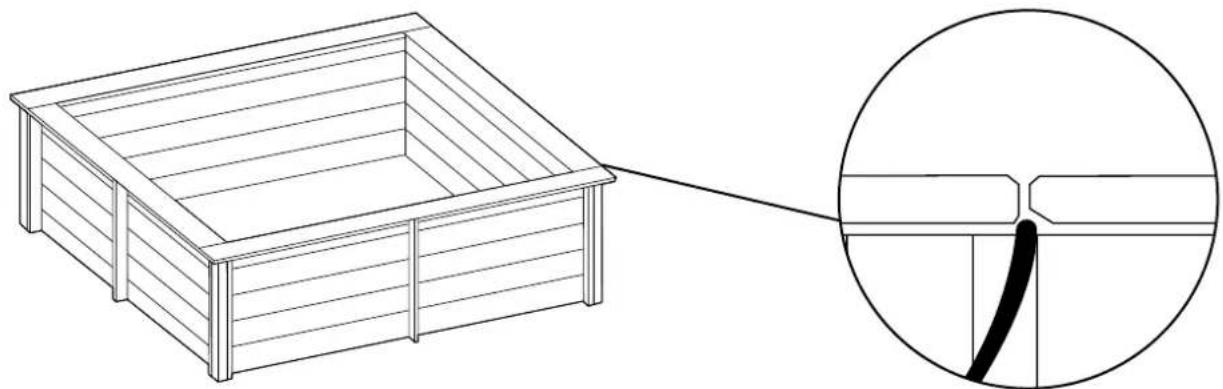
EN Check that the 4 pieces have a small rebate in one of their sides. This is important because the filtering equipment cable will pass through one of those 4 areas. Think of the cartridge filter location to locate the piece with the rebate in the appropriate position and that way hide the cable. The following image shows how the cable will pass between the wall and the piece.
ES Verifique que las 4 piezas tienen un pequeño rebaje en uno de sus laterales. Esto es importante ya que por una de esas 4 zonas pasará el cable de su equipo de filtración. Piense en la ubicación del filtro de cartucho para colocar la pieza con el rebaje en la posición apropiada y poder así ocultar el cable. Como puede ver en la siguiente imagen, el cable pasará entre la pared y la pieza.
Vérifiez que les 4 pièces présentent une légère feuillure sur les côtés. Cela est important parce que le câble de votre équipement de filtration passera par l'une de ces 4 zones. Réfléchissez à l'emplacement du filtre à cartouche pour placer la pièce avec la feuillure dans la position correcte et pouvoir ainsi cacher le câble. Dans l'image ci-dessous, le câble passera entre la paroi et la pièce.
DE Bei einer der vier Handlauf befindet sich seitlich ein kleiner Schlitz. Durch eine der vier Pfosten muss das Kabel Ihrer Filteranlage gezogen werden. Überlegen Sie sich zuvor, wo Sie den Filter anbringen möchten und bringen Sie die Pfosten mit dem Schlitz an einer Seite an, an der Sie das Kabel gut verstecken können. Wie Sie auf der Abbildung sehen, verläuft das Kabel zwischen Wand und Pfosten.
IT Verificare che i 4 bordi orizzontali abbiano una piccola scanalatura su uno dei loro lati. È importante perché per una di queste 4 zone passerà il cavo dell'apparecchiatura di filtraggio. Decidere dove posizionare il filtro a cartuccia per collocare il bordo con la scanalatura nella posizione adeguata e poter così nascondere il cavo. Come si può vedere nell'immagine seguente, il cavo passerà tra la parete e il bordo.
NL Controleer of de 4 delen een kleine uitsparing hebben in een van hun zijkanten. Dit is belangrijk omdat de bedrading voor uw filterinstallatie via één van deze 4 gebieden zal worden getrokken. Denk na over de locatie waar u het filterpatroon wilt plaatsen zodat u het deel met de uitsparing op de juiste plek zult plaatsen om zo de kabel te kunnen verbergen. Zoals u kunt zien in de volgende afbeelding, zal de kabel tussen de wand en het deel komen te lopen.
PT Verifique que as 4 peças tenham um pequeno recorte num dos lados, para a passagem do cabo do equipamento de filtragem. Escolha a localização do filtro de cartucho para colocar a peça com o recorte na posição apropriada, para poder ocultar o cabo. Como se pode ver na seguinte imagem, o cabo passará entre a parede e a peça.
natural_image
Technical line drawing of a square wooden enclosure with side supports, shown alongside an inset magnified view of the interior structure (no text or symbols)FILTER
FILTRACIÓN
FILTRATION
FILTRATION
FILTRAZIONE
FILTERING
FILTRAÇÃO
EN ASSEMBLY SUGGESTIONS: Check the manual that comes with the filter group for the assembly instructions.
ES CONSEJOS DE MONTAJE: Consulte el manual incluido con el grupo de filtración para realizar el montaje.
FR CONSEILS DE MÔNTAGE : Veuillez vous référer à la notice fournie avec le groupe de filtration pour en réaliser l'assemblage.
DE TIPPS FÜR DIE MONTAGE : Für den Einbau lesen Sie bitte das Handbuch, das dem Filtrationsaggregat beiliegt.
IT CONSIGLI PER IL MONTAGGIO: Consultare il manuale incluso con il sistema di filtrazione per effettuare il montaggio.
NL MONTAGEAANWIJZINGEN: Raadpleeg de handleiding die bij de filtergroep is meegeleverd om de montage uit te voeren.
PT CONSELHOS DE MONTAGEM: Consulte o manual incluído com o grupo de filtração para realizar a montagem.
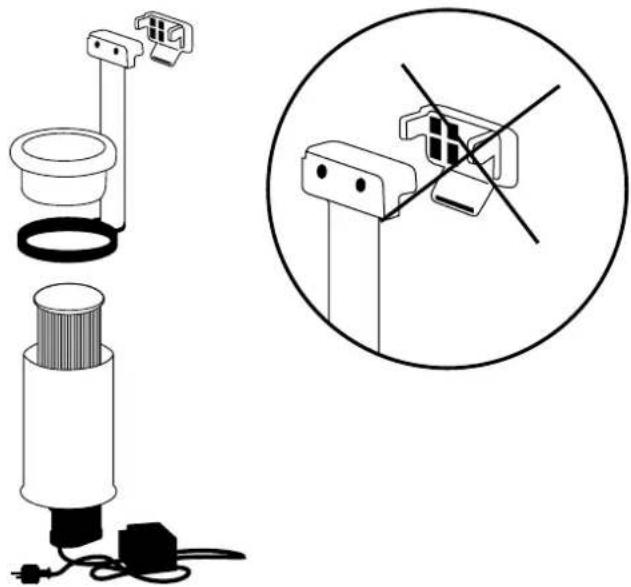
EN The following piece and screws included in the packet must be discarded to correctly fix the filter.
ES Para fijar el filtro correctamente, debe prescindir de la siguiente pieza y los tornillos incluidos en el paquete.
FR Pour fixer correctement le filtre, il ne faut pas employer la pièce suivante ni les vis incluses dans la pochette.
DE Zur Anbringung des Filters benötigen Sie nicht dieses Teil und die im Lieferumfang enthaltenen Schrauben.
IT Per fissare il filtro correttamente, non utilizzare la seguente parte e le viti incluse nella confezione.
NL Om het filter correct vast te zetten, moet u het volgende in het pakket zijn bijgevoegde onderdeel en de bijbehorende schroeven die achterwege laten.
PT Para fixar corretamente o filtro, deverá descartar a seguinte peça e os parafusos incluídos na embalagem.
natural_image
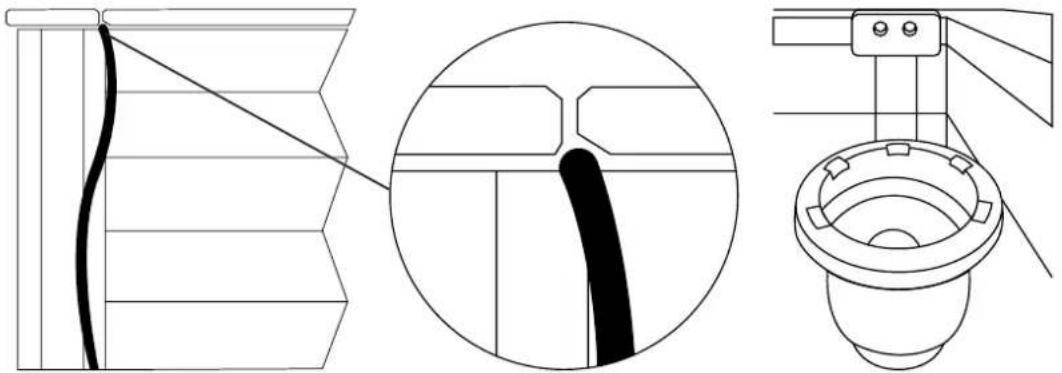
Technical diagram showing a device with internal components and an inset view of a mechanical component (no text or symbols present)EN Screw the filter from the interior of the pool to the beach. To do that, use the two screws 4x40 mm that are in the bag of screws. The result must be like the following image.
ES Atornille el filtro desde el interior de la piscina a la playa. Para ello utilice 2 tornillos 4x40mm que encontrará en la bolsa de tornillos. El resultado Debe ser similar a la siguiente imagen.
FR Vissez le filtre depuis l'intérieur de la piscine à la plage. Pour cela, utilisez 2 vis 4x40mm que vous trouverez dans la pochette des vis. Le résultat sera celui indiqué sur l'image suivante.
DE Schrauben Sie den Filter an der Innenwand des Schwimmbeckens fest. Dazu benötigen Sie zwei Schrauben 4x40 mm. Diese befinden sich im Beutel mit den Schrauben. Die folgende Abbildung zeigt, wie es aussehen muss.
IT Avvitare il filtro dall'interno della piscina verso la sponda. A tale scopo utilizzare 2 viti 4x40 mm che si trovano nel pacco delle viti. Il risultato deve essere simile alla seguente immagine.
NL Schroef het filter vanaf de binnenkant van het zwembad vast aan de bovenrand. Gebruik hiervoor 2 schroeven van 4x40mm die u in het zakje met schroeven kunt vinden. Het resultaat moet eruitzien als op de volgende afbeelding.
PT Aparafuse o filtro pela parte interior da piscina, fixando-o à borda da mesma com os 2 parafusos 4x40 mm incluídos. O resultado deverá ser idêntico ao da seguinte imagem.
natural_image
Technical line drawing of a mechanical component with three views: top view, side profile, and top-down view (no text or symbols)EN INSTALLATION OF THE LINER HOOKING PROFILE
natural_image
Line drawing of a mechanical bracket or housing component (no text or symbols)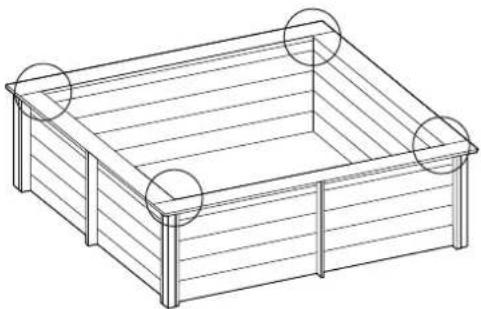
natural_image
Line drawing of a rectangular container with side supports and circular cutouts (no text or symbols)EN · Locate some white pieces in the bag. Present the piece in the joint of two boards as shown in the photograph and in the following photo.
- Screw in the piece using two screws 4x40 mm.
- Continue positioning the white profiles as indicated below. Part of the profile must be introduced into the part of the profile, until it reaches the limit.
natural_image
Close-up of a hand pointing at a white 3D-printed object on wooden beams (no text or symbols visible)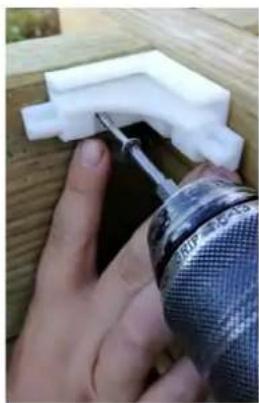
natural_image
Close-up of a hand using a tool to adjust or install a white plastic component on a wooden surface (no text or symbols visible)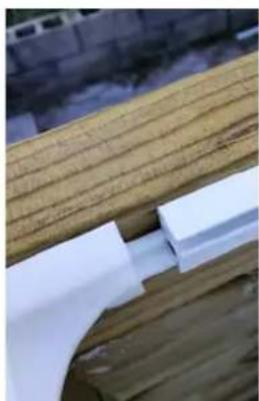
natural_image
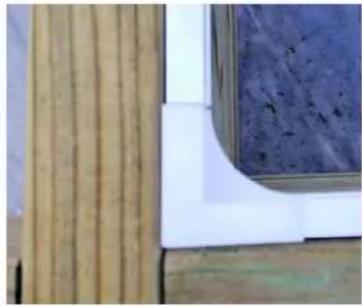
Close-up of a white plastic pipe attached to a wooden board, with a brick wall and window in the background (no text or symbols visible)- The piece should be fixed at both ends.
ES - La pieza debe quedar fijada por ambos extremos. - La pièce doit être correctement fixée par les deux extrémités.
- Das Teil muss später von beiden Seiten fixiert sein.
- Il pezzo deve essere fissato ad entrambe le estremità.
- Het stuk moet aan beide uiteinden worden vastgezet.
- A peça deve ficar corretamente fixada em ambos os extremos.
natural_image
Close-up of a wooden panel corner with visible grain and a dark rectangular object on the wall (no text or symbols)EN Note: these parts are for aesthetics. Probably not all the corners are perfectly fixed. It will depend on the temperature of the liner and your ability for its installation. If the liner is not perfectly distributed around the pool, not all the corners will be fixed. In that case, there is not any problem, you must not worry, because it is only an aesthetic part.
ES Nota: estas piezas tienen una función estética. Es probable que no todas las esquinas queden perfectamente fijadas. Dependerá de la temperatura del liner y de la habilidad para su colocación. Si el liner no está perfectamente distribuido por la piscina, no se fijará en todas las esquinas. En ese caso, no hay ningún problema, ni debe preocuparse, ya que es una pieza estética.
Note : ces pièces possèdent une fonction esthétique. Il est probable que tous les angles ne soient pas parfaitement fixés. Cela dépendra de la température du liner et de l'habileté pour sa mise en place. Si le liner n'est pas parfaitement distribué dans la piscine, il ne sera pas fixé à tous les angles. Dans ce cas, il n'y a pas de problème, ne vous inquiétez pas, il s'agit juste d'un élément esthétique.
DE Hinweis: Die Teile erfüllen eine rein dekorative Funktion. Es ist eher unwahrscheinlich, dass am Ende alle Ecken perfekt sitzen. Dies hängt von der Temperatur der Folie und den jeweiligen handwerklichen Fertigkeiten ab. Wenn die Folie nicht perfekt im Becken verteilt ist, lässt sie sich nicht in allen Ecken befestigen. Da es sich jedoch um rein dekorative Teile handelt, ist dies nicht weiter problematisch und kein Grund zur Sorge.
It Nota: questi pezzi hanno una funzione estetica. È probabile che non tutti gli angoli siano perfettamente fissati. Dipenderà dalla temperatura del liner e dalla capacità di posizionarlo. Se il liner non viene distribuito perfettamente nella piscina, non si fisserà in tutti gli angoli. Ciò non causa alcun problema dato che assolve una funzione puramente estetica.
Let op: Deze delen hebben een esthetische functie. Het is goed mogelijk dat niet alle hoeken even goed zullen aansluiten. Dit is afhankelijk van de temperatuur van de liner en het gemak om hem te kunnen plaatsen. Als de liner niet perfect wordt verdeeld over het zwembad, zal hij niet in alle hoeken even mooi strak zitten. In dat geval is dat geen enkel probleem, en ook hoeft u zich geen zorgen te maken, want het is een onderdeel dat slechts als versiering fungeert.
PT Nota: estas peças têm uma função estética. É provável que nem todas as esquinas fiquem perfeitamente fixadas, o que dependerá da temperatura do perfil e da habilidade na sua colocação. Se o perfil não estiver perfeitamente distribuído pela piscina, não se fixará em todas as esquinas. Isto não representa qualquer problema nem é motivo para preocupação, ao tratar-se de uma peça com uma função meramente estética.
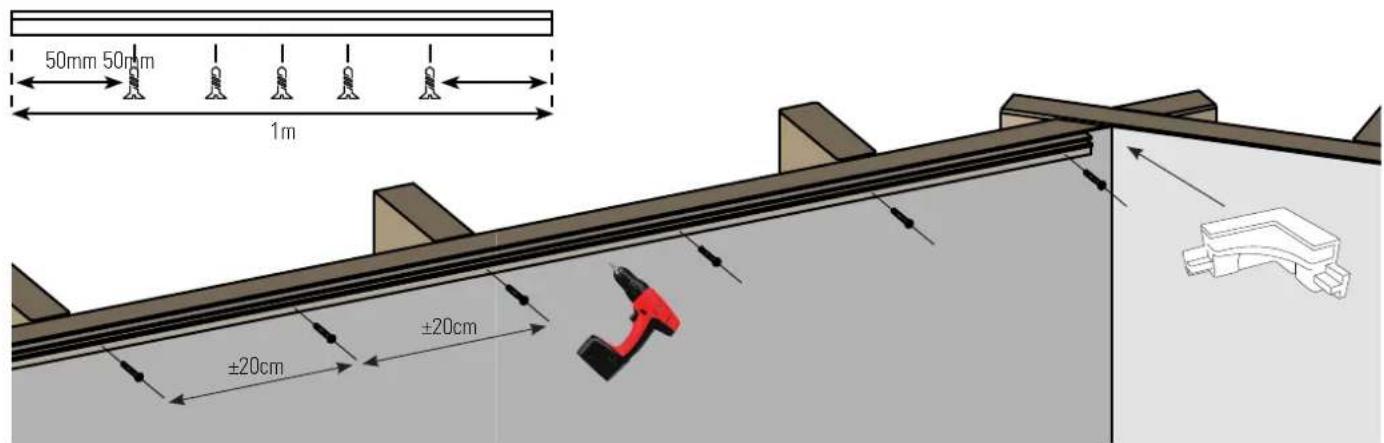
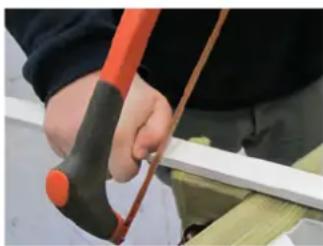
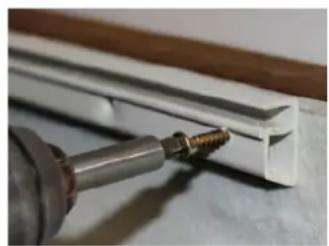
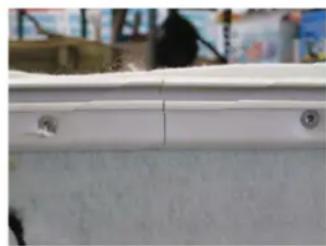
ADJUSTMENT AND FIXING OF THE PROFILES (4X40): Place the liner. Perforate the strip with a 4 mm ∅ drill bit, beginning 50 mm from the edge. Screw in the strip at the upper edge of the ledge using the screws (4 x 40). Distribute the screws evenly along the strip. Follow the same steps for the rest of short panels. Using a hacksaw, cut the excess off of the strip. As you cut the white profiles to the correct dimension to fix the liner, the excess will be needed to continue installing the other side of the pool.
ES Do not previously drill the boards.
• Take the measurement
- Tome la medida
- Prise de mesure
- Nehmen Sie Maß
- Prendere la misura
- Neem de maat
- Tome a medida
natural_image
Person holding a red-handled tool, no visible text or symbols• and cut the liner profile
- y corte el perfil del liner
• et découpe de la baguette de liner
- und schneiden Sie das Profil des Liners ab
• e tagliare il profilo del liner
- en zaag het klemprofiel van de liner op maat
- e corte o perfil do liner
natural_image
Close-up of a metal pipe fitting with a threaded connector, no visible text or symbols- Fixing the liner profile
- Fijación del perfil del liner
- Fixation de la baguette de liner
• Befestigung des Profils des Liners
• Fissaggio del profilo del liner - Bevestiging van het klem- profiel van de liner
- Fixação do perfil do liner
natural_image
Close-up of a white industrial component with a small circular mark and a number 2, no visible text or symbols.• Installation of the profiles in the same panel
- Colocación de los listones en un mismo panel
- Positionnement des baguettes sur un même pan
- Positionierung der Leisten an demselben Paneel
- Posizionamento dei profili su uno stesso pannello
- Plaatsing van de Klemprofie-
len in een enkel paneel
- Colocação dos perfis num mesmo painel
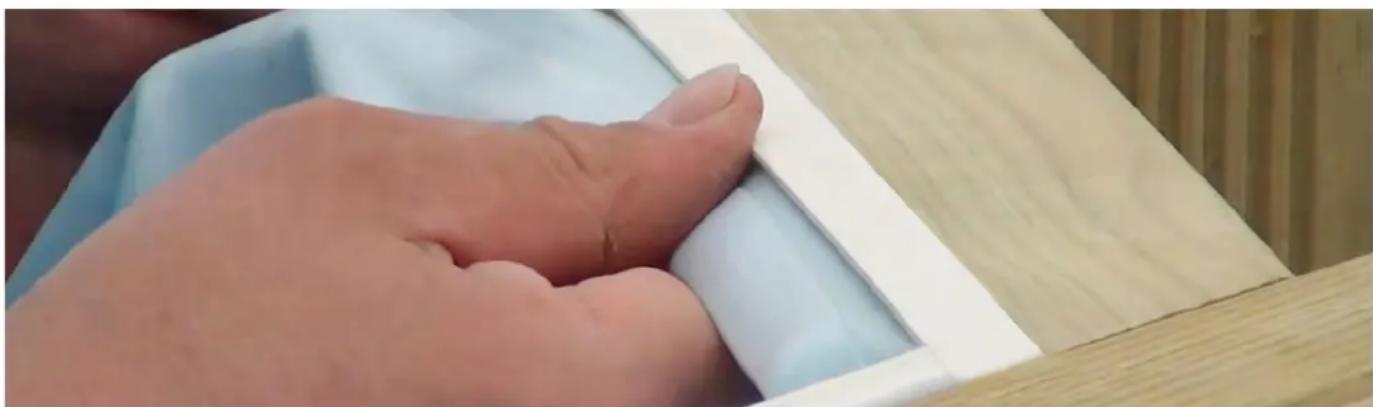
EN The liner should be introduced as shown in the following image.
ES Debe introducir el liner de tal manera que quede como en la siguiente imagen.
FR Vous devez introduire le liner de façon à ce qu'il reste sur la même position indiquée sur l'image ci-dessous.
DE Die Folie muss entsprechend der nachfolgenden Abbildung eingelegt werden.
IT Il liner deve essere introdotto come indicato nella seguente immagine.
NL U moet de liner zo plaatsen, dat hij komt te zitten zoals op de volgende foto te zien is.
PT Introduzir o perfil para que fique colocado como se observa na seguinte imagem.
natural_image
Close-up of a hand pressing down on a wooden surface with a white band (no text or symbols visible)EN INSTALLATION OF THE LINER
ES COLOCACIÓN DEL LINER
FR MISE EN PLACE DU LINER
DE POSITIONIERUNG DES LINERS
IT POSIZIONAMENTO DEL LINER
NL PLAATSING VAN DE LINER
PT COLOCAÇÃO DO LINER
EN The liner should have been at least 24 hours at a room temperature of at least 20^ before being installed. The dimension of the liner are a few centimetres shorter than the inside dimensions of the pool, so the liner is tensely installed. The liner should be installed at an external temperature of at least 15^ . We extremely recommend putting the liner in the sun a few hours before assembly, so it is flexible and easy to install. The sticker with the serial number of the liner should be kept for future reference. This number will be required for any eventual reclamation against the guarantee. INSTALLATION (It is mandatory to fill the pool with water before placing the edges)
To do this, you should take off your shoes to not damage the liner.
A Enter the pool, without wearing shoes.
B Place the liner in the centre of the pool (figure 2) and unfold it starting from there (figure 3) Uniformly distribute the space between the dimensions of the liner and those the structure all round.
Correctly align the lower angles of the liner (angles of the floor closures) with the corners of the pool (figure 4).
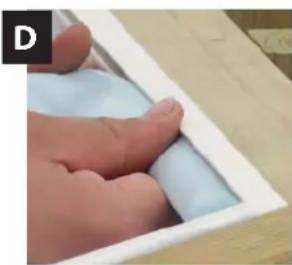
D Insert the hooking profile of the liner into the profile (figure 5).
The liner should have been at least 24 hours at a room temperature of at least 20^ before being installed. The liner should be installed at an external temperature of at least 15^ .
natural_image
Person in a blue shirt standing inside a large wooden boat, viewed from above (no visible text or symbols)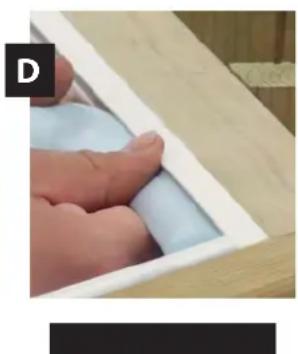
natural_image
Close-up of a hand holding a white cylindrical object inside a wooden frame (no text or symbols visible)
natural_image
Person in blue shirt standing inside a large blue container outdoors (no visible text or symbols)Abb. 5 / Afb. 5
natural_image
Close-up of a hand holding a white cylindrical object inside a white plastic box (no text or symbols visible)

E To move the already installed liner, slide it along the profile. If this is difficult the liner can be removed by lifting it not to damage it. Make sure that the liner is well positioned both on the floor as on the walls, uniformly adjust the tension of the same (with your foot, push the liner by its angles towards the corners of the walls) (figure 6).
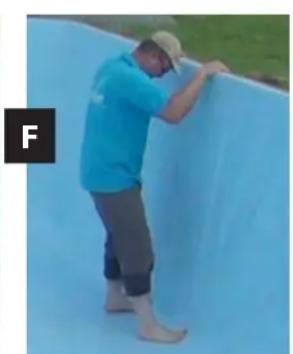
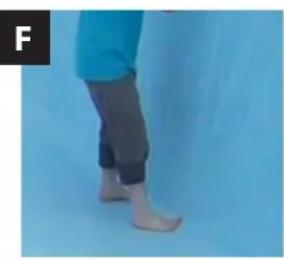
F Fit the pool with about two centimetres of water (figure 7). To facilitate installing the liner, this water should be very cold.
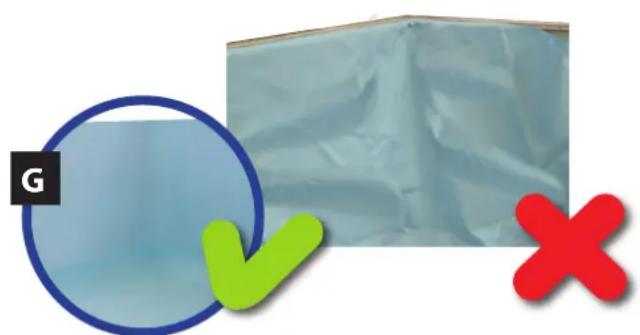
G Flattern the bottom of the liner to avoid folds starting from the centre towards the edges. Continue filling the pool. If there are still folds, correct the tension of the liner at the walls by sliding it along the hooking profile. (Oblique folds in the wall indicate incorrect positioning) (figure 8).
The angles of the liner should necessarily correspond to the corners of the pool structure.

Once the liner is installed, continue filling the pool up to 10 cm below the refilling fitting with key.

Some weeks after filling the pool, the liner will show a different colour between the submerged part and that in the air. This decolouration is normal and does not risk the sturdiness and/or characteristics of the liner. To avoid that a dark mark appears due to atmospheric contamination between the submerged part and the part of the liner in the air, (called water line), we recommend regularly cleaning the liner in this area with a specific cleaner.

natural_image
Person in a blue shirt and brown boots walking through a large light blue tarp outdoors (no visible text or symbols)Fig. 6 / Abb. 6 / Afb. 6 Fig
natural_image
Person in blue shirt and gray pants climbing a blue wall, no visible text or symbolsb. 7 / Afb. 7 Fig. 8 / Abb. 8 / A
natural_image
Illustration of a blue fabric patch with a green checkmark and red X mark, alongside a blue circular icon labeled 'G' (no text or symbols on the patch itself)
natural_image
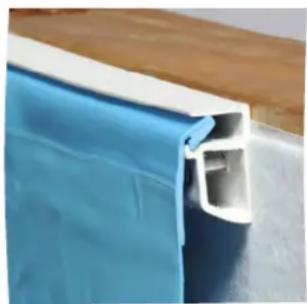
Close-up of a blue plastic panel with white cutouts, mounted on a wooden surface (no text or symbols visible)This transversal view shows the liner placed in the angle. Esta vista transversal muestra el liner colocado en el ángulo. Cette vue en coupe mante le liner en place dans la cornière
natural_image
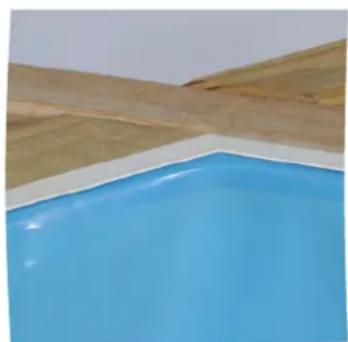
Blue water pool adjacent to a dry, hilly landscape under clear sky (no text or symbols)Tense the liner well at the corners
Tense bien el liner en las esquinas
Tendez bien le liner dans les angles

natural_image
Person walking on a blue fabric surface, wearing a light blue shirt and dark pants (no visible text or symbols)Fig. 6 / Abb. 6 / Afb. 6 Fig
natural_image
Person standing barefoot on blue background, wearing dark pants and blue shirt (no text or symbols visible)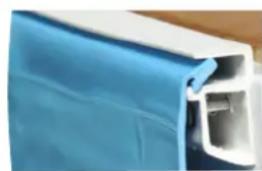
natural_image
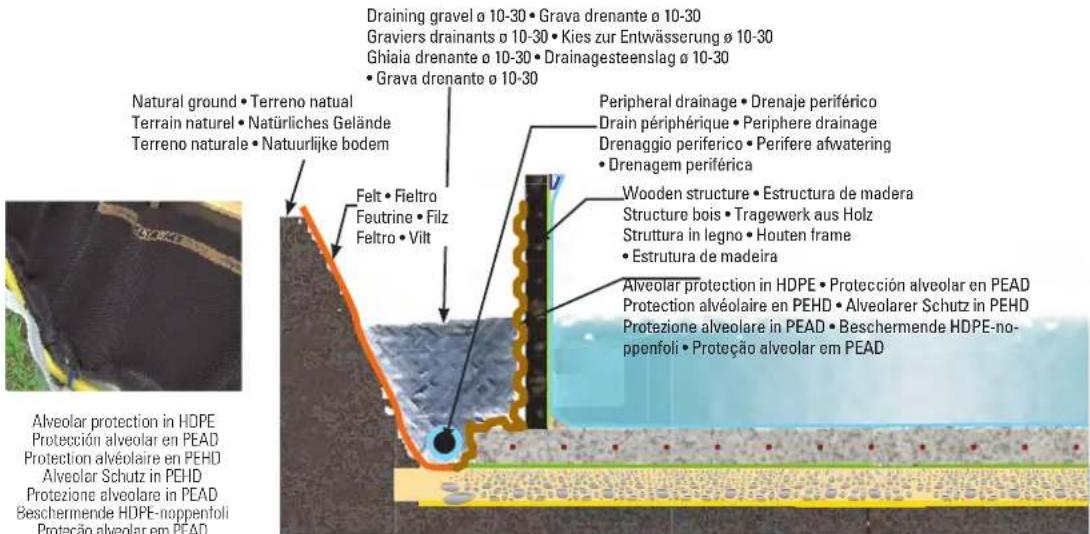
Close-up of a blue plastic component with white cutouts (no text or symbols visible)EN In fully or partially in-ground pools, a gravel landfill is necessary to favour perfect draining. The landfill of a pool can seem a mere formality, because a first sight there are no special technical difficulties. Nevertheless, it is a more delicate operation than what it seems, for which certain precautions are necessary. An incorrect landfill can give way to later deterioration of the pool and its surroundings. It is necessary to consider the type of material being used and to perform all the necessary verifications. Before performing the landfill, you should:
- Check that all the hydraulic and electrical equipment is well connected. - Check the water tightness of the connections of the channelling, especially regarding those sealed parts. - Protect, if applicable, the peripheral draining tube covering it with geotextile. It is important to fill the pool in parallel to the landfill in order to balance the
pressures and that way avoid deformations of the structure during the operation. We recommend following the landfill technique by thirds (1/3 of water and 1/3 of landfill). During the landfill, we recommend processing by successive layers around the entire perimeter of the pool to not run the risk of damaging the structure.
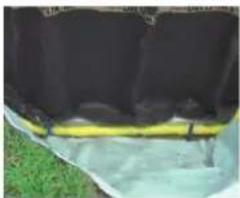
Position the alveolar HDPE protection (not included) around the pool.. The alveolar protection, should, likewise continue over the slab and all round the outside of the same.
- To avoid draining obstruction, you should place felt on the natural soil (not included) to retain the soil. Install the peripheral draining over the protection and connect it to the decompression well (if applicable). Otherwise, leave the draining extended over the land. Now, make the landfill against the walls with compacted gravel (10/30 calibre) that will facilitate drainage. This landfill should be done at the same time that you fill the pool. Land-filling with vegetable soil is prohibited.
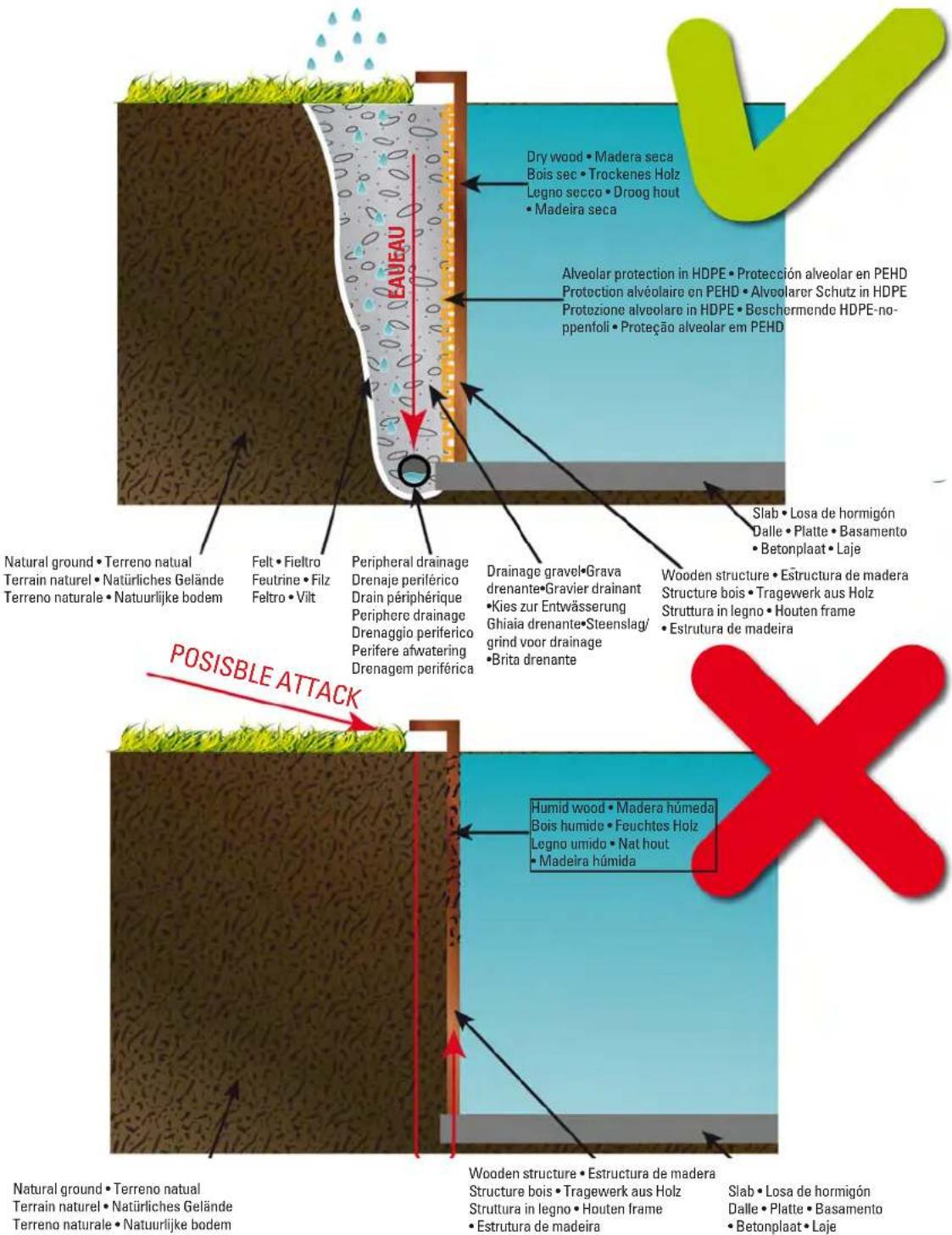
INFORMATION: The drainage allows the continuous evacuation of water, at the foot of the pool and, therefore limits the rising of water by capillary attraction towards the upper part of the works, where air and soil interact to produce fungi or rot (lower diagram). The absence of draining causes water to ascend by capillary action that can be important and permanent, which favours the attacks of air / water interaction (lower diagram). In the case of an attack and if no draining exists, the guarantee cannot be applied to the deterioration.
natural_image
Exterior view of a concrete retaining wall with gravel and concrete blocks (no signage or text visible)Drainage gravel
Grava drenante
Gravier drainant
Kies zur Entwässerung
Ghiaia drenante
Steenslag/grind voor drainage
Brita drenante
natural_image
Close-up of a yellow band partially embedded in a white plastic bag, with grass visible in the background (no text or symbols)Peripheral drainage
Drenaje periférico
Drain périphérique
Periphere Drainage
Drenaggio periferico
Perifere afwatering
Drenagem periférica

EDGES

PLAYAS

MARGELLES

RÄNDER

BORDI

RANDEN

BORDOS

EDGES: (It is mandatory to fill the pool with water before placing the edges. Sitting on or walking on the edges is strictly prohibited. Any breakage is not covered by the guarantee.)
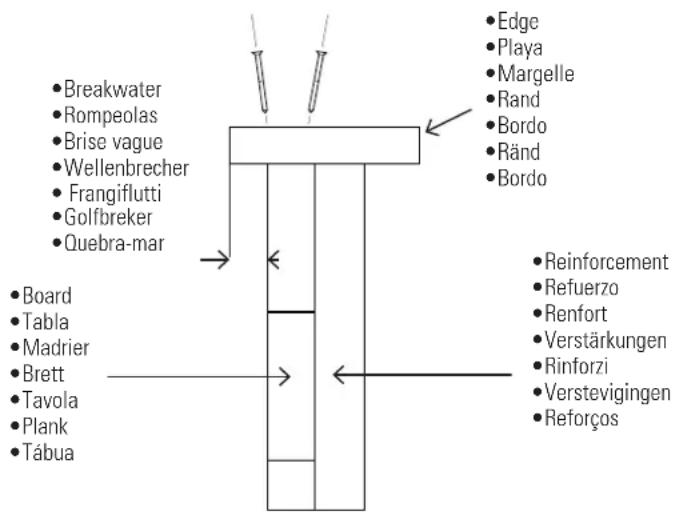
The ends of the ledge are cut at 90°. Check the drawings (4x60) (See page 42)
PREPARATION
- Before affixing the ledge, position all of the sheets as a test (without screwing them in).
- Allow the ledge to hang over to the inside (to create a «splash guard»). Pay attention to splinters which may appear between the cutting and affixing of the ledges. Eliminate these splinters with sandpaper (not included).
FIXING
- The ledges must be previously perforated with a 4mm wood drill in order to achieve a firm and lasting hold with the reinforcements. For setup, use 4 x 60mm stainless steel screws; these must screw in obliquely (for outer parts) at the bottom of the grooves.
- When all of the ledges have been tightened, continue with leveling, beginning from a single point at the center of the ledges.
- Finish leveling all ledges.

natural_image
Close-up of a hand using a Meade tool to drill on a wooden deck near a pool (no text or symbols visible)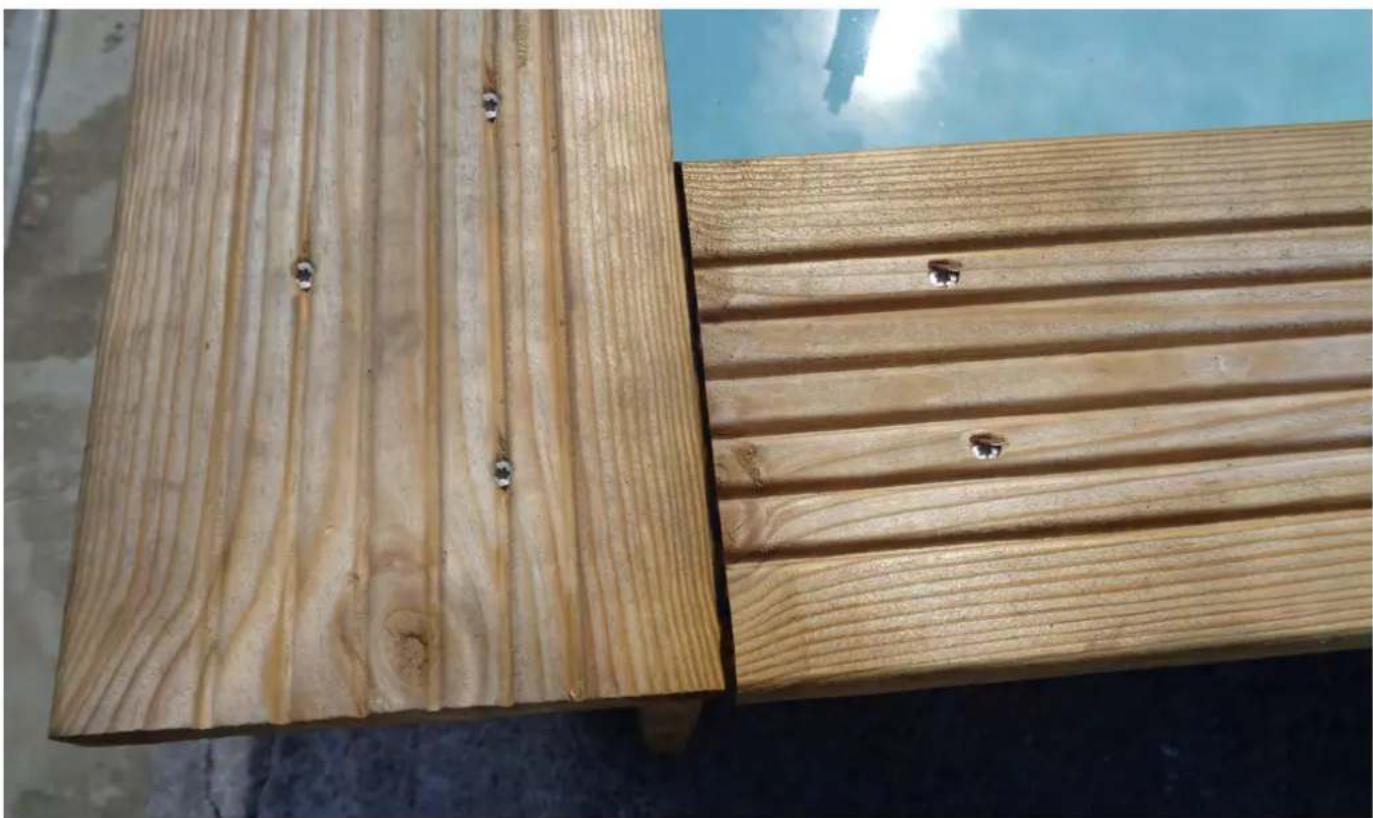
natural_image
Close-up of wooden deck and slatted wooden panel with rivets, against a clear blue sky (no text or symbols visible)PUTTING INTO SERVICE
During the first use, you should wash the filter (check the filer system maintenance). Filtering is a mechanical treatment that allows cleaning the pool water by means of eliminating the impurities and contaminating particles. The hydraulic circuit and water purifying group is an essential element for the optimal operation of the filtering system. The filtering system should be coherent: The filter dimensions should be proportionate to the volume of water in the pool and to the pump performance. The filtering is not anti-bacteria Therefore, you should add a product (or a system) for disinfection of the water.
FILTERING TIME:
During the period of use of the pool kit, the filtering system should be used every day, for sufficient time to guarantee a complete renovation of the entire volume of water. Theoretically, this the calculation:
(Water Temp / 2) = equals the filtering hours
Often, it is more practical to filter 4 hours before and 4 hours after use.
We do not recommend intermittent operation (stopping and starting every hour) because not all the water volume will be renovated.
| WATER TEMPERATURE FILTERING TIME FOR ONE DAY | |
| 15 to 18°C 8 hours | |
| 19 to 21°C 10 hours | |
| 22 to 25°C 12 hours | |
| 26 to 28°C 14 hours | |
| 28 to 30°C 19 hours | |
| + than 30°C 24 hours | |

natural_image
Close-up of wooden deck panels and a white frame with a blue rim, no visible text or symbols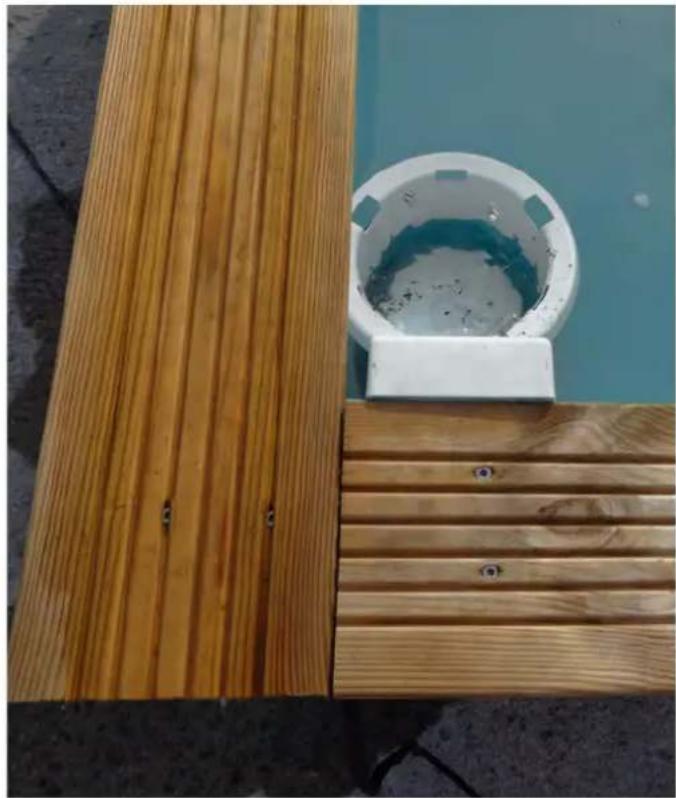
natural_image
Wooden deck and window with a circular vent installation, no visible text or symbolsWATER TREATMENT
Whichever is your filtering system, you will need to chemically treat the pool water to destroy the bacteria and the micro-bodies and to avoid development of algae.
Several sterilization products can be used, like chloride, bromine, oxygen, etc. Request the assessment of a pool treatment product sales person to take a decision.
First, you have to verify the pH level using an analysis kit. Pay attention that the test bottles are only valid for one year.
The ideal level is between 7.2 and 7.4 of pH and 1.5 regarding CHLORIDE. Rectify this level using pH correctors (increasers or reducers). The quantity of product is proportional to the cubic meters of your pools. To treat your pool, check the indications appearing on the product you have chosen for your pool.
pH (potential hydrogen) You should always maintain the water pH between 7.2 and 7.4 because below these values the water becomes corrosive (due to acidity) and rapidly deteriorates the metal parts of your pool. Above these values the water is basic and greatly reduces the action of treatment.

Never introduce chlorine tablets directly into the pool. The liner would be «burnt».
SAFETY SUGGESTIONS
Carefully read, understand, and follow all information in this user manual before installing and using the swimming pool.
These warnings, instructions, and safety guidelines address some common risks of water recreation, but they cannot cover all risks and dangers in all cases. Always use caution, common sense, and good judgment when enjoying any water activity. Retain this information for future use.
When your pool reaches the end of its useful life, it should be disassembled; the different materials (plastic and steel) should be separated and taken to the disposal point indicated by local authorities.
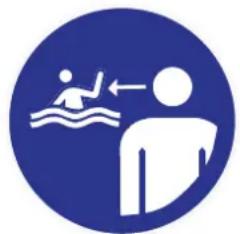
Non Swimmers safety
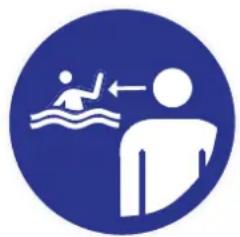
Continuous, active, and vigilant supervision of weak swimmers and non-swimmers by a competent adult is required at all times (remembering that children under five are at the highest risk of drowning).
- Designate a competent adult to supervise the pool each time it is being used.
- Weak swimmers or non-swimmers should wear personal protection equipment when using the pool.
- When the pool is not in use, or unsupervised, remove all toys from the swimming pool and its surrounding to avoid attracting children to the pool.
Safety devices
- It is recommended to install a barrier (and secure all doors and windows, where applicable) to prevent unauthorized access to the swimming pool.
- Barriers, pool covers, pool alarms, or similar safety devices are helpful aids, but they are not substitutes for continuous and competent adult supervision.
Safety equipment
- It is recommended to keep rescue equipment (e.g. a ring buoy) by the pool.
- Keep a working phone and a list of emergency phone numbers near the pool.
Safe use of the pool
- Encourage all users especially children to learn how to swim
- Learn Basic Life Support (Cardiopulmonary Resuscitation - CPR) and refresh this knowledge regularly.
This can make a life-saving difference in the event of an emergency. - Instruct all pool users, including children, what to do in case of an emergency
- Never dive into any shallow body of water. This can lead to serious injury or death.
- Do not use the swimming pool when using alcohol or medication that may impair your ability to safely use the pool.
- When pool covers are used, remove them completely from the water surface before entering the pool.
- Protect pool occupants from water related illnesses by keeping the pool water treated and practicing good hygiene. Consult the water treatment guidelines in the user's manual.
- Store chemicals (e.g. water treatment, cleaning or disinfection products) out of the reach of children.
- Signage is to be displayed in a prominent position within 2 m of the pool.
- Removable ladders shall be placed on a horizontal surface.
WARNING:
Every electrical appliance fed in 220 V, has to be located at least at 3,50 m from the edge of the pool.
The equipment should be connected to a voltage, with earth connection, protected by a residual current device (RCD) having a rated residual operating current not exceeding 30 mA.
Read the instructions carefully and keep for future reference.
IF YOU HAVE ANY PROBLEM, ..;CONTACT US!
CONTACT:
web: www.grepool.com/en/after-sales

natural_image
Blue circular icon showing a person swimming with an arrow indicating water movement (no text or symbols)
natural_image
Blue circular icon with a white human figure silhouette (no text or symbols)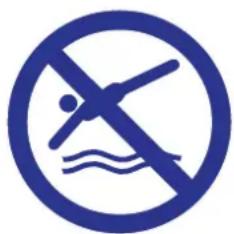
natural_image
Blue prohibition sign with crossed-out fish and wave symbols (no text)PUESTA EN SERVICIO
natural_image
Close-up of wooden deck panels and a white frame with blue interior (no text or symbols visible)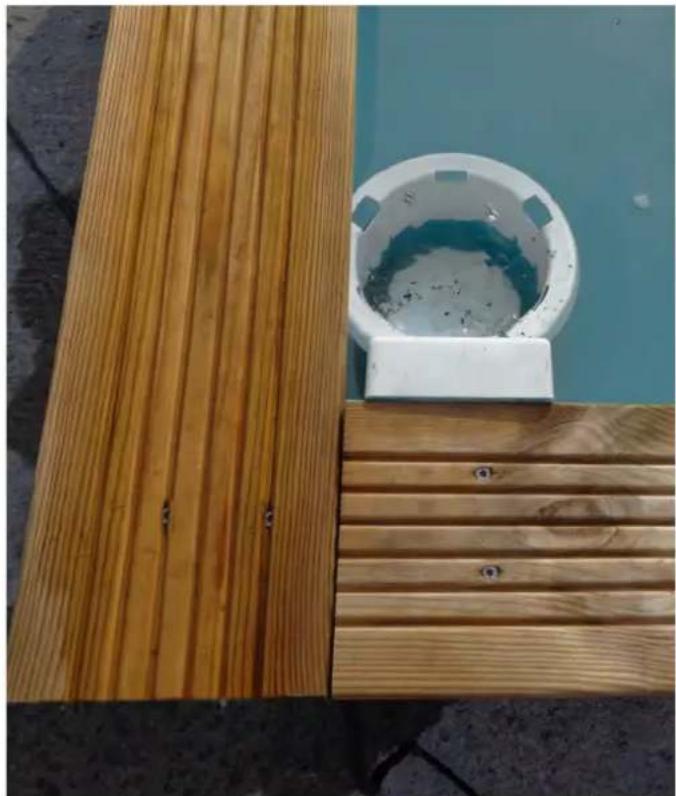
natural_image
Exterior view of a wooden deck and adjacent wall with a circular concrete structure (no text or symbols visible)web: www.grepool.com/post-venta

natural_image
Blue circular icon showing a person swimming and standing on water, with an arrow indicating direction (no text or symbols)
natural_image
Blue circular icon with a white human figure holding a rectangular object (no text or symbols)
natural_image
Blue circular sign with a crossed-out blue symbol and wave pattern below (no text)MISE EN SERVICE
natural_image
Close-up of wooden deck panels and a white plastic support structure against a blue background (no text or symbols visible)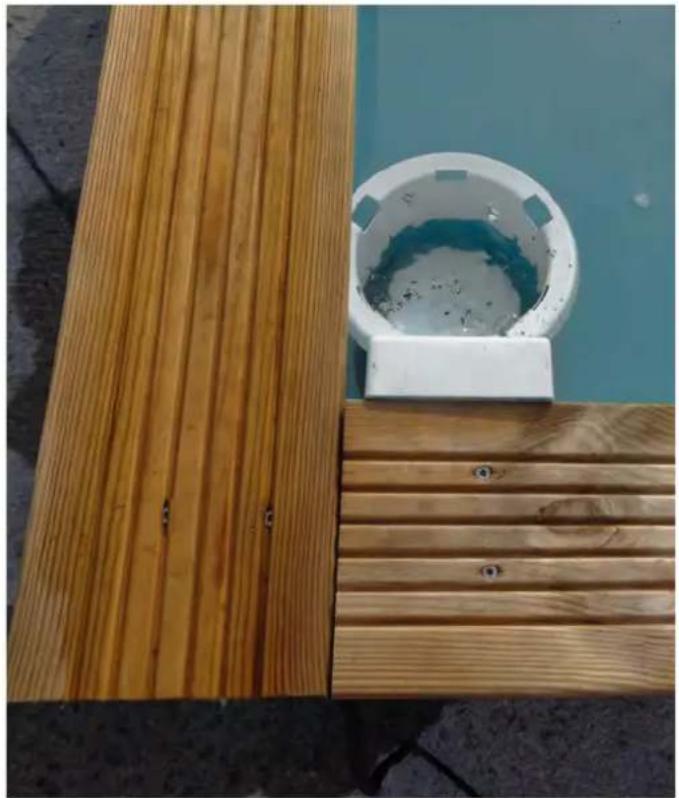
natural_image
Top-down view of a wooden deck with wooden slats and a circular water tank on a pool (no text or symbols visible)TRAITMENT DE L'EAU
natural_image
Blue circular icon showing a person swimming with an arrow indicating water movement (no text or symbols)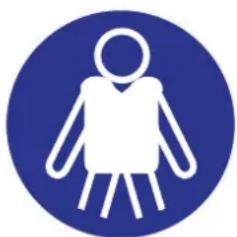
natural_image
Blue circular icon with a white human figure silhouette (no text or symbols)
natural_image
Blue circular sign with a diagonal line crossing over water and waves, indicating no text or symbols beyond the prohibition symbol.INBETRIEBNAHME
natural_image
Close-up of wooden deck and window frame with blue interior (no text or symbols visible)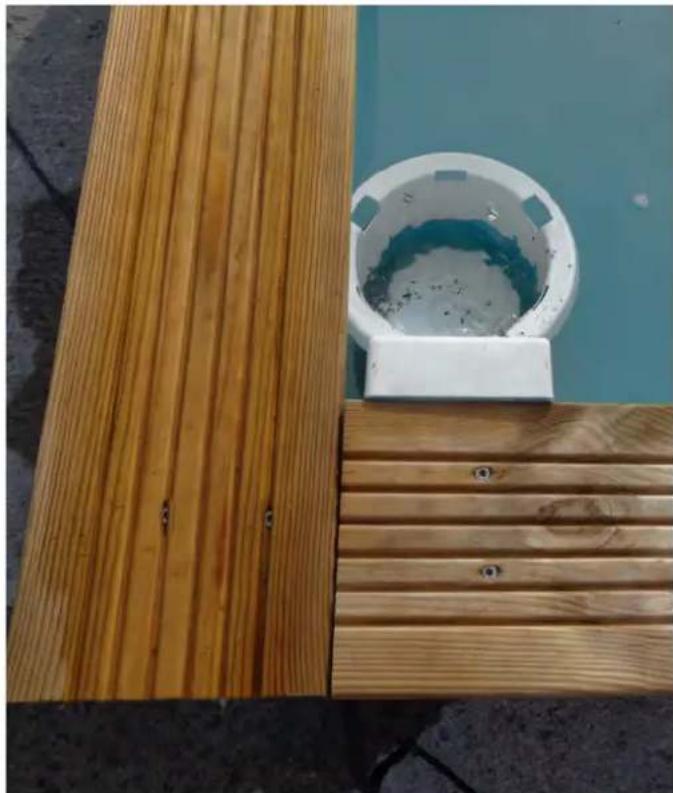
natural_image
Exterior view of a wooden deck and pool with a white circular basin containing greenish material (no text or symbols visible)WASSERAUFBEREITUNG
natural_image
Blue circular icon showing a person swimming with an arrow indicating water movement (no text or symbols)
natural_image
Blue circular icon with a white human figure silhouette (no text or symbols)
natural_image
Blue prohibition sign with crossed-out lines and wave pattern (no text)MESSA IN SERVIZIO
natural_image
Close-up of wooden deck panels and a white plastic support structure against a blue background (no text or symbols visible)
natural_image
Wooden deck and pool with wooden beams and a circular white basin containing greenish material (no text or symbols visible)web: www.grepool.com/it/post-vendita

natural_image
Blue circular icon showing a person swimming and standing on water, with an arrow indicating direction (no text or symbols)
natural_image
Blue circular icon with a white stylized human figure (no text or symbols)
natural_image
Blue prohibition sign with crossed-out fish and wave symbols (no text)INGEBRUIKNAME
natural_image
Close-up of wooden deck and window frame with blue and white panels, no visible text or symbols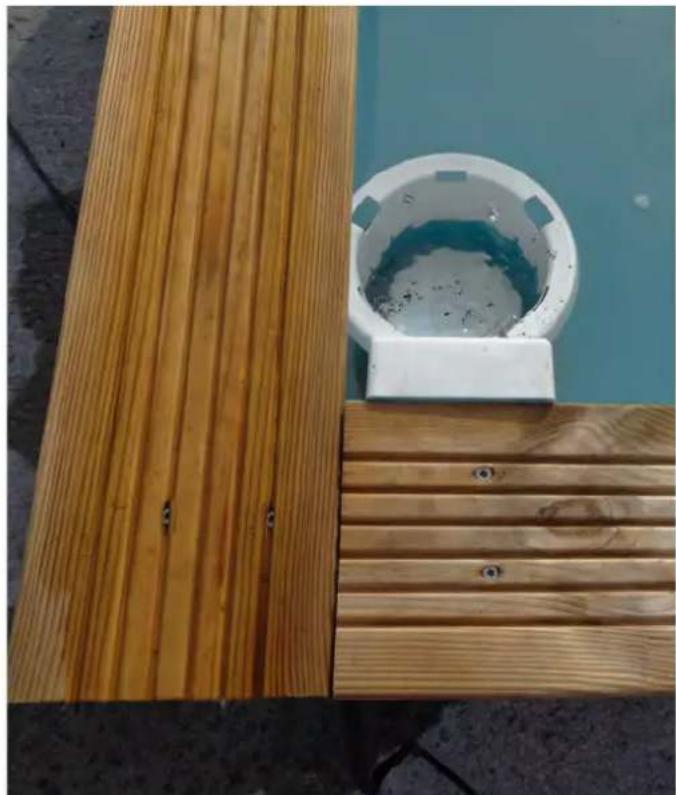
natural_image
Wooden deck with wooden panel and white circular component, no visible text or symbolsWATERBEHANDELING
natural_image
Blue circular icon showing a person swimming and standing on water, with an arrow indicating direction (no text or symbols)
natural_image
Blue circular icon with a white stylized human figure (no text or symbols)
natural_image
Blue prohibition sign with crossed-out pictogram and wave symbol (no text)web: www.grepool.com/post-venta

natural_image
Blue circular icon showing a person swimming and standing with an arrow indicating water movement (no text or symbols)
natural_image
Blue circular icon with a white stylized human figure (no text or symbols)
natural_image
Blue prohibition sign with crossed-out fish and wave symbols (no text)NORMAL MAINTENANCE
RESPECT THE ENVIRONMENT
DO NOT TAKE APART THE POOL UNLESS IT IS STRICTLY NECESSARY. IF YOU DO SO, PLEASE REUSE THE WATER. WATER IS A SCARCE GOOD.
MAINTENANCE AND USE:
- Switch on the filter system once a day in to insure a complete water volume renewal and never do it when somebody is in the pool (see filter manual).
- Check the filter's level of clogging regularly in summer when the pool kit is in use.
- Check screws, nuts and washers (for rust).
- The pool water level has always to be hold in a minimum of 15 cm from the pool superior edge.
- Never empty the pool completely. Low water levels may cause serious damage to the pool.
- Failure to comply with the maintenance instructions may lead to serious health risks, especially for children.
- The use of a swimming costume entails respect for the safety regulations set out in the maintenance and user guide.
- Never leave a pool kit empty on the ground, outdoors.
- Clean regularly the P.V.C liner and the water level mark with non-abrasive products. Regularly clean the fold joining the bottom to the side of the liner, as it is an area where
dirt accumulates. If you do by accident a small hole in the liner, you can repair it thanks to our rubber patches AR202 or V12.
- The isothermic covers (for the summer) protect your pool from insects, dust, leaves,... and avoid to loose the water temperature. Do always set it in order the bubbles are in contact with the water.
WINTER-SEASON:
1- Clean the liner bottom and sides with a non-abrasive product.
2- Treat the water with a chemical product for wintering. We recommend using LIQUID WINTERISER instead of floats with solid product to avoid discolouring the liner.
3- Leave the pool full of water considering:
a) For pools with skimmer and refulling pipe, reduce the water level 5 cm underneath the skimmer and close the refulling pipe with the screw tap which is included with the filter.
b) For pools with exhaustion and refulling pipes, reduce the water level 20 cm from the superior edge of the pool and close the pipes using the screw system incorporated.
4- Disconnect the pipes. Do not dismount the skimmer and the refulling and exhaustion pipes.
5- Protect the pool with a winter cover, and put a floating element between the cover and the water, in order to protect it from frost.
6- Filter: disconnect it from the pool. Clean it, empty the sand or remove the cartridge, dry it and keep it in a covered and sheltered from dampness place.
7- Accessories: remove every accessories (ladder, alarm, spotlight, pole...), rinse them with soft water and tidy them away.
TO RUN THE POOL AGAIN: Remove the winter cover, install the filter, change at least 1/3 of water and realize a chlorine treatment. Switch on the filter for at least 8
hours in an uninterrupted way, respecting the continuous working period indicated in the filter manuals.
CHIMICAL MEASURES:
Please read carefully the chemical product manufacturer instructions. WARNING: Keep chemical products in a clean, dry and out of children place. Important: Every products used have to be compatible with the P.V.C liner.
- First filling: Analyse the water pH and chlorine (Cl) and adjust them to the optimal levels: pH: 7,2–7,6; Chlorine: 0.5–2 ppm.
- Chlorine treatments: Consist in increasing the chlorine level until approximatively 20 ppm to eliminate germs and seaweeds. This process has to be done only when the pool water comes from rivers or ponds, ... or if it stayed a long time without any treatments.
- Checking: Check at least once a week the chlorine levels (use a chlorine and pH analyser). In the same way, we advise to add an algicid to prevent seaweeds appearance.
Never have a swim before the chlorine level stabilization. Do always use a floating dispenser for the chemical product (tablets) dissolution. The chemical product measuring out has to be done in accordance with: Your pool water volume, the bathe frequency, the climatic conditions, the water temperature and the location. Do always move the water and wait for the chemical product dissolution before adding another one. Wait approximatively 12 hours between any pH, chlorine or algicid adjustment using the filter system.
MECHANICAL MEASURES:
Check the filter, the skimmer, the valves and the pipes are well connected to the pool. Do consider high water temperature will involved more time for the filtering. Theoretic filtering time = Water volume / Filter system discharge (generally 8h/day with water temperature of 21°C), (Ideal: 2h in the morning – 4h around midday – 2h in the afternoon). PLEASE RESPECT THE CONTINUOUS WORKING PERIOD INDICATED IN THE FILTER MANUALS.
VACUUM CLEANER (MANUAL OR AUTOMATIC):
Only for pools with skimmer. Connect an hose extremity to the brush head and immerse it into the water to make it fill in. Connect the other pipe extremity to the exhaustion adapter (TA) and place it above the skimmer basket. Switch on the filter in the FILTER position and begin to clean the bottom. Pay special attention to areas with folds where dirt accumulates.
BOTTOM CLEANER VENTURY STYLE:
Connect a garden hose to the bottom cleaner join and introduce it into the pool. Open the tap until a normal pressure to make the water flow out against the bottom of the pool, producing in that way an ascendant stream which leave the dirt into the filter (bag) which is adjust on the bottom cleaner.
| EFFECTS CAUSES SOLUTIONS | ||
| Cloudy waterGreen coloured | Dirty filterpH incorrectFormation of algae | Washing the filter.Re-adjustmentShock treatment |
| The pump does not start • Breaker disconnected | Fuse burntTurbine blocked | Re-startReplace itCheck that the fan at the rear of the motor turns |
| The pump turns but does not discharge • Suction flaps closed• The skimmer sucks air• Pre-filter full• Air inlet in the cover• Defective turbine | Open them againRectify water levelClean itCheck the seal and change the pre-filter coverChange the turbine | |
| The skimmer does not suck • Basket full | Flap not closed wellWater level too low | Empty itOpen itRe-adjust it |
| Dirty water returned to pool • Filter obstructed • Wash it, rinse it | ||
| Pressure in pressure gauge too high • Filter washing badly done• Outlet flap closed | Repeat itOpen the trap, check condition of sand(change it every 3 or 4 years) | |
| The pool cleaner does not suck or does not suck enough | Pre filter obstructedCorresponding flap closedTube worn or perforatedAir in the tubesOther flaps openDirty filter | Clean itOpen itReplace itPurge and wait for primingClose themClean it |
| Corrosion marks • pH very low • Increase | pH to 7,2-7,4 | |
| Sand in the pool • Mesh broken | Manipulation of the multi-directional flap with the pump workingFilter inversely connected The tubes have been inverted during assembly. | Change the meshChange the multi-directional flapCorrectly connect the filter |
natural_image
Circular logo with stylized 'Gre' lettering and a running figure inside, set against a dark background (no text or symbols beyond the logo design)DISTRIBUIDO POR
MANUFACTURAS GRE S.A. | ARITZ BIDEA 57, BELAKO INDUSTRIALDEA | 48100 MUNGIA (VIZCAYA) ESPAÑA


- Carefully read this information and keep it for later consultations
- ES¡ATENCIÓN!
- Keep your manual with the serial number and the purchase justification (payment receipt) for any type of reclamation.
- AFTER VERIFICATION AND CONFIRMATION OF A MANUFACTURING DEFECT
- !
- THE GUARANTEE IS NOT APPLICABLE IN THE FOLLOWING SITUATIONS:
- IMPORTANT:
- DURATION OF THE GUARANTEE:
- THE FOLLOWING IS NOT INCLUDED IN THE GUARANTEE:
- AFTER SALES SERVICE IN GUARANTEE: (After justification and receipt of purchase)
- AFTER SALES SERVICE WITHOUT GUARANTEE:
- PROLOGUE
- STORAGE PRECAUTIONS
- ESSENTIAL:
- COMPULSORY:
- DURATION OF THE INSTALLATION
- BEFORE BUILDING YOUR POOL MAKE SURE
- IMPORTANT
- IN GROUND POOLS AND SPECIFIC REGULATIONS
- INSTALLATION SUGGESTION
- DO NOT SITUATE YOUR POOL
- PACKAGING, CLASSIFICATION AND RECYCLING
- SAFETY INSTRUCTIONS
- WARNING:
- ATENCIÓN:
- ATTENTION:
- WICHTIGER HINWEIS
- ATTENZIONE:
- VOORSCHRIFTEN VOOR OPSLAG
- VERPAKKING, AFVALSCHEIDING EN RECYCLING
- BELANGRIJK:
- ATENÇÃO:
- ES LA MADERA: UN MATERIAL VIVO
- SYLVESTER PINE TREATED IN AUTOCLAVE
- Your pool can be installed in these three ways
- ES HERRAMIENTAS
- UNACCEPTABLE LOCATION: Sloping, uneven ground. Sandy, rocky or soggy ground.
- MARK THE INSTALLATION AREA
- LEVELLING
- PARTIAL OR COMPLETELY IN-GROUND INSTALLATION
- PREPARATION
- FIXING
- PUTTING INTO SERVICE
- FILTERING TIME:
- (Water Temp / 2) = equals the filtering hours
- WATER TREATMENT
- First, you have to verify the pH level using an analysis kit. Pay attention that the test bottles are only valid for one year.
- SAFETY SUGGESTIONS
- Non Swimmers safety
- Safety devices
- Safety equipment
- Safe use of the pool
- PUESTA EN SERVICIO
- MISE EN SERVICE
- TRAITMENT DE L'EAU
- INBETRIEBNAHME
- WASSERAUFBEREITUNG
- MESSA IN SERVIZIO
- INGEBRUIKNAME
- WATERBEHANDELING
- NORMAL MAINTENANCE
- RESPECT THE ENVIRONMENT
- DO NOT TAKE APART THE POOL UNLESS IT IS STRICTLY NECESSARY. IF YOU DO SO, PLEASE REUSE THE WATER. WATER IS A SCARCE GOOD.
- MAINTENANCE AND USE:
- WINTER-SEASON:
- CHIMICAL MEASURES:
- MECHANICAL MEASURES:
- VACUUM CLEANER (MANUAL OR AUTOMATIC):
- BOTTOM CLEANER VENTURY STYLE:
Brand : GRE
Model : 790000
Category : Above-ground pool