
R860720 - Fan RIDGID - Free user manual and instructions
Find the device manual for free R860720 RIDGID in PDF.



| Product Type | Portable Fan |
| Brand | RIDGID |
| Model | R860720 |
| Power Source | 18 V battery pack (Ni-Cd or Li-ion) or 120 V, 60 Hz power cord |
| Variable Speed | Yes, via rotary control knob |
| Head Orientation | 240 degrees |
| Suspension Options | Hooks, keyhole slots, rod pockets, tripod mount, 2x4 cutout |
| Double Insulation | Yes (Class II) |
| Maintenance | Clean with a dry cloth; avoid solvents |
| Safety | Do not use near water, in explosive atmospheres, or on unstable surfaces |
| Warranty | 90-day satisfaction, 3-year limited |
| Replacement Parts | Use only genuine parts; contact an authorized repair center |
| Applications | General indoor and outdoor ventilation |
Frequently Asked Questions - R860720 RIDGID
User questions about R860720 RIDGID
0 question about this device. Answer the ones you know or ask your own.
Ask a new question about this device
Download the instructions for your Fan in PDF format for free! Find your manual R860720 - RIDGID and take your electronic device back in hand. On this page are published all the documents necessary for the use of your device. R860720 by RIDGID.
USER MANUAL R860720 RIDGID
OPERATOR'S MANUAL
MANUEL D'UTILISATION MANUAL DEL OPERADOR
18 V HYBRID PORTABLE FAN
VENTILATEUR PORTATIF
HYBRIDE DE 18 V
VENTILADOR PORTÁTIL DE
HÍBRIDA DE 18 V
R860720
To register your RIDGID product, please visit:
http://register.RIDGID.com
■ Important Safety Instructions......2
■ Portable Fan Safety Warnings .....3
■ Electrical 4
■ Symbols 5
■ Assembly 6
■ Operation....6-7
■ Maintenance ....7
■ Illustrations....8-9
■ Parts Ordering and Service ....Back page

WARNING:
To reduce the risk of injury, the user must read and understand the operator's manual before using this product.
SAVE THIS MANUAL FOR FUTURE REFERENCE
TABLE DES MATIÈRES
****************************************************************************************
Read and save these instructions. Failure to follow all instructions listed below, may result in electric shock, fire and/or serious personal injury.
SAVE THESE INSTRUCTIONS
WORK AREA
- Keep your work area clean and well lit. Cluttered benches and dark areas invite accidents.
■ Do not operate portable fans in explosive atmospheres, such as in the presence of flammable liquids, gases, or dust. Portable fans create sparks which may ignite the dust or fumes.
ELECTRICAL SAFETY
A battery operated portable fan with integral batteries or a separate battery pack must be recharged only with the specified charger for the battery. A charger that may be suitable for one type of battery may create a risk of fire when used with another battery.
■ Use battery operated portable fan only with specifically designated battery pack. Use of any other batteries may create a risk of fire.
■ Use battery only with charger listed. For use with 18V nickel-cadmium and 18V lithium-ion battery packs, see tool/appliance/battery pack/charger correlation supplement 988000-302.
- Do not defeat the safety purpose of the polarized or grounding-type plug. A polarized plug has two blades with one wider than the other. A grounding type plug has two blades and a third grounding prong. The wide blade or the third prong are provided for your safety. If the provided plug does not fit into your outlet, consult an electrician for replacement of the obsolete outlet.
■ Protect the power cord from being walked on or pinched particularly at plugs, convenience receptacles, and the point where they exit from the product.
■ Unplug this product during lightning storms or when when not in use.
PERSONAL SAFETY
■ Dress properly. Do not wear loose clothing or jewelry. Contain long hair. Keep your hair, clothing, and gloves away from moving parts. Loose clothes, jewelry, or long hair can be caught in moving parts.
■ Avoid accidental starting. Be sure switch is in the locked or off position before inserting battery pack or extension cord. Carrying portable fans with your finger on the switch or inserting the battery pack or
extension cord into a portable fan with the switch on invites accidents.
■ Do not overreach. Keep proper footing and balance at all times. Proper footing and balance enable better control of the portable fan in unexpected situations.
- Do not wear loose clothing or jewelry. Contain long hair. Loose clothes, jewelry, or long hair can be drawn into air vents.
■ Do not use on a ladder or unstable support. Stable footing on a solid surface enables better control of the portable fan in unexpected situations.
PORTABLE FAN USE AND CARE
- Do not use portable fan if switch does not turn it on or off. A portable fan that cannot be controlled with the switch is dangerous and must be repaired.
■ Disconnect battery pack or extension cord from portable fan or place the switch in the locked or off position before making any adjustments, changing accessories, or storing the portable fan. Such preventive safety measures reduce the risk of starting the portable fan accidentally. - When battery pack is not in use, keep it away from other metal objects like: paper clips, coins, keys, nails, screws, or other small metal objects that can make a connection from one terminal to another. Shorting the battery terminals together may cause sparks, burns, or a fire.
- Keep the portable fan and its handle dry, clean and free from oil and grease. Always use a clean cloth when cleaning. Never use brake fluids, gasoline, petroleum-based products, or any strong solvents to clean your portable fan. Following this rule will reduce the risk of loss of control and deterioration of the enclosure plastic.
■ To reduce the risk of electric shock, do not use this fan near water, especially when it is powered by the power cord.
■ Clean only with dry cloth.
■ Do not operate near any heat sources such as radiators, heat registers, stoves, or other apparatus (including amplifiers) that produce heat.
SERVICE
■ Portable fan service must be performed only by qualified repair personnel. Service or maintenance performed by unqualified personnel may result in a risk of injury.
■ When servicing a portable fan, use only identical replacement parts. Follow instructions in the Maintenance section of this manual. Use of unauthorized parts or failure to follow Maintenance Instructions may create a risk of shock or injury.
PORTABLE FAN SAFETY WARNINGS
- Know your portable fan. Read operator's manual carefully. Learn its applications and limitations, as well as the specific potential hazards related to this portable fan. Following this rule will reduce the risk of electric shock, fire, or serious injury.
■ Battery tools do not have to be plugged into an electrical outlet; therefore, they are always in operating condition. Be aware of possible hazards when not using your battery tool or when changing accessories. Following this rule will reduce the risk of electric shock, fire, or serious personal injury.
■ Do not place portable fans or their batteries near fire or heat. This will reduce the risk of explosion and possibly injury.
■ Do not crush, drop or damage battery pack. Do not use a battery pack or charger that has been dropped or received a sharp blow. A damaged battery is subject to explosion. Properly dispose of a dropped or damaged battery immediately.
■ Batteries can explode in the presence of a source of ignition, such as a pilot light. To reduce the risk of serious personal injury, never use any cordless product in the presence of open flame. An exploded battery can propel debris and chemicals. If exposed, flush with water immediately.
■ Do not charge portable fan battery in a damp or wet location. Following this rule will reduce the risk of electric shock.
For best results, your battery should be charged in a location where the temperature is more than 50° F but less than 100° F. Do not store outside or in vehicles.
■ Under extreme usage or temperature conditions, battery leakage may occur. If liquid comes in contact with your skin, wash immediately with soap and water,
then neutralize with lemon juice or vinegar. If liquid gets into your eyes, flush them with clean water for at least 10 minutes, then seek immediate medical attention. Following this rule will reduce the risk of serious personal injury.
■ Do not incinerate the battery even if it is severely damaged. The batteries can explode in a fire.
■ To reduce the risk of fire or electric shock, do not use this portable fan with any solid-state speed control device.
■ Not for use in kitchens, bathrooms or other places where water may be present.
■ For general ventilating use only. Do not use to exhaust hazardous or explosive materials and vapors.
■ Make sure your extension cord is in good condition. When using an extension cord, be sure to use one heavy enough to carry the current your product will draw. A wire gauge size (A.W.G.) of at least 16 is recommended for an extension cord 100 feet or less in length. A cord exceeding 100 feet is not recommended. If in doubt, use the next heavier gauge. The smaller the gauge number, the heavier the cord. An undersized cord will cause a drop in line voltage resulting in loss of power and overheating.
■ To reduce the risk of personal injury and electric shock, the portable fan should not be played with or placed where small children can reach it.
■ To reduce the risk of electric shock, do not expose to water or rain.
■ Never attempt to power the device with a battery pack and extension cord at the same time.
■ Save these instructions. Refer to them frequently and use them to instruct others who may use this tool. If you loan someone this tool, loan them these instructions also.
CALIFORNIA PROPOSITION 65

WARNING
This product may contain chemicals, including lead, known to the State of California to cause cancer, birth defects or other reproductive harm. Wash hands after handling.
DOUBLE INSULATION
Double insulation is a concept in safety in electric products, which eliminates the need for the usual three-wire grounded power cord. All exposed metal parts are isolated from the internal metal motor components with protecting insulation. Double insulated products do not need to be grounded.

WARNING:
The double insulated system is intended to protect the user from shock resulting from a break in the product's internal wiring. Observe all normal safety precautions to avoid electrical shock.
NOTE: Servicing of a product with double insulation requires extreme care and knowledge of the system and should be performed only by a qualified service technician. For service, we suggest you return the product to your nearest authorized service center for repair. Always use original factory replacement parts when servicing.
ELECTRICAL CONNECTION
This product should be connected to a power supply that is 120 volts, AC only (normal household current), 60 Hz. Do not operate this product on direct current (DC) through the power cord. A substantial voltage drop will cause a loss of power and the motor will overheat. If the product does not operate when plugged into an outlet, double-check the power supply.
EXTENSION CORDS
When using a product at a considerable distance from a power source, be sure to use an extension cord that has the capacity to handle the current the product will draw. An undersized cord will cause a drop in line voltage, resulting in overheating and loss of power. Use the chart to determine
the minimum wire size required in an extension cord. Only round jacketed cords listed by Underwriter's Laboratories (UL) should be used.
When using this product outdoors, use an extension cord that is designed for outside use. This type of cord is designated with "WA" or "W" on the cord's jacket.
Before using any extension cord, inspect it for loose or exposed wires and cut or worn insulation.
**Ampere rating (on product data plate)
0-2.0 2.1-3.4 3.5-5.0 5.1-7.0 7.1-12.0 12.1-16.0
Cord Length Wire Size (A.W.G.)
| 25' | 16 | 16 | 16 | 16 | 14 |
| 50' | 16 | 16 | 16 | 14 | 14 |
| 100' | 16 | 16 | 14 | 12 | 10 |
**Used on 12 gauge - 20 amp circuit
NOTE: AWG = American Wire Gauge

WARNING:
Keep the extension cord clear of the working area. Position the cord so that it will not get caught on lumber, tools, or other obstructions while you are working with this product. Failure to do so can result in serious personal injury.

WARNING:
Check extension cords before each use. If damaged replace immediately. Never use a product with a damaged cord since touching the damaged area could cause electrical shock resulting in serious injury.
| The following signal words and meanings are intended to explain the levels of risk associated with this product. | ||
| SYMBOL | SIGNAL | MEANING |
 | DANGER: | Indicates an imminently hazardous situation, which, if not avoided, will result in death or serious injury. |
 | WARNING: | Indicates a potentially hazardous situation, which, if not avoided, could result in death or serious injury. |
 | CAUTION: | Indicates a potentially hazardous situation, which, if not avoided, may result in minor or moderate injury. |
| NOTICE: | (Without Safety Alert Symbol) Indicates important information not related to an injury hazard, such as a situation that may result in property damage. | |
| Some of the following symbols may be used on this product. Please study them and learn their meaning. Proper interpretation of these symbols will allow you to operate the product better and safer. SYMBOL NAME DESIGNATION/EXPLANATION | ||
 | Safety Alert Indicates a potential personal injury hazard. | |
 | Read Operator's Manual | To reduce the risk of injury, user must read and understand operator's manual before using this product. |
 | Wet Conditions Alert Do not expose to rain or use in damp locations. | |
  | Recycle Symbols | This product uses nickel-cadmium (Ni-Cd) and lithium-ion (Li-ion) batteries. Local, state or federal laws may prohibit disposal of batteries in ordinary trash. Consult your local waste authority for information regarding available recycling and/or disposal options. |
| V Volts Voltage | ||
| A Amperes Current | ||
| Hz Hertz Frequency (cycles per second) | ||
| W Watt Power | ||
| min Minutes Time | ||
| == | Direct Current | Type or a characteristic of current |
| ~ | Alternating Current | Type of current |
| ☐ | Class II Tool | Double-insulated construction |

WARNING:
Do not use this product if it is not completely assembled or if any parts appear to be missing or damaged. Use of a product that is not properly and completely assembled or with damaged or missing parts could result in serious personal injury.

WARNING:
Do not attempt to modify this product or create accessories or attachments not recommended for use with this product. Any such alteration or modification is misuse and could result in a hazardous condition leading to possible serious personal injury.
If any parts are damaged or missing, please call 1-866-539-1710 for assistance.
OPERATION

WARNING:
Do not allow familiarity with tools to make you careless. Remember that a careless fraction of a second is sufficient to inflict serious injury.

WARNING:
Do not use any attachments or accessories not recommended by the manufacturer of this tool. The use of attachments or accessories not recommended can result in serious personal injury.
APPLICATIONS
You may use this tool for the purpose listed below:
■ General ventilation of most household and outdoor spaces
NOTICE:
This product is designed to be powered by either a RIDGID 18V battery pack (DC mode) or by electric power (AC mode). Either power source can be used by installing an approved battery pack or power cord into the product as described in this manual.
INSTALLING/REMOVING BATTERY PACK
See Figure 1, page 8.
■ Turn the control knob to the OFF (O) position.
■ Open the battery cover.
■ Insert the battery pack into the product as shown.
■ Make sure the latches on each side of the battery pack snap into place and the battery pack is secured before beginning operation.
■ Depress the latches to remove the battery pack.
■ Close the battery cover.

WARNING:
Always remove battery pack or unplug extension cord from your product when you are assembling parts, making adjustments, cleaning, or when not in use. Removing battery pack or unplugging extension cord will prevent accidental starting that could cause serious personal injury.
NOTE: The battery pack should be recharged after approximately 5 hours of use to reduce the possibility of damage. Repeated deep discharge of the battery may decrease storage capacity and battery life.
INSTALLING/REMOVING POWER CORD
See Figure 2, page 8.
■ Turn the control knob to the OFF (O) position.
■ Open the battery cover.
■ Insert the female end of the power cord into the product as shown.
■ Connect the male end of the power cord to the power source.
■ Make sure the power cord is secured before beginning operation.
STARTING/STOPPING THE PORTABLE FAN
See Figure 3, page 8.
■ Connect the portable fan to a power cord or approved battery pack.
■ Turn the control knob clockwise to turn the portable fan ON and to adjust fan speed.
■ To stop the portable fan, turn the control knob counterclockwise to the OFF (O) position.

WARNING:
Hybrid tools are always in operating condition. Therefore, the control knob should always be in the OFF (O) position when not in use and the power source is removed.
CHANGING PORTABLE FAN SPEED
See Figure 3, page 8.
■ For low speeds, rotate the control knob clockwise.
■ For high speeds, rotate the control knob counterclockwise.
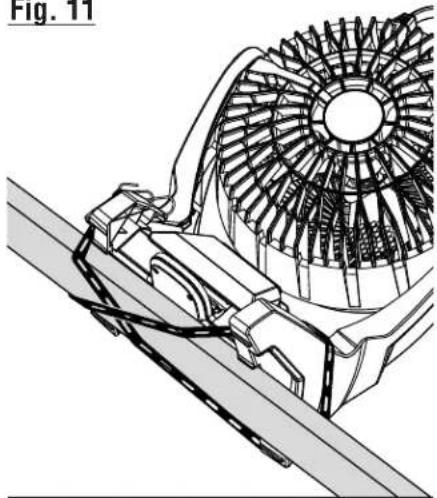
HANGING/MOUNTING PORTABLE FAN
See Figures 4 - 11, page 9.
Your portable fan has a variety of hanging options. Choose the option that is best suited for your location.
NOTE: The portable fan can be hung in a vertical or horizontal position. Be careful not to hang the fan in such a way that it prevents normal fan operation or damages the cord.
Hanging the fan using the key hole:
■ Place the wide portion of the key hole over the head of a screw.
■ Slide the portable fan down until the screw is inside the narrow portion of the key hole and the fan is secure.
Hanging the fan using the hooks:
■ Pull the hooks completely out of their slots and rotate them as needed.
NOTE: Hooks will not rotate until they are fully extended.
■ Hang the fan from a sturdy location.
Mounting the fan to 2x wood material using the hooks:
■ Pull the hooks completely out of their slots and rotate them upward 180 degrees.
NOTE: Hooks will not rotate until they are fully extended.
- Put the wider side of the 2x wood material on the clamping surface of the fan legs. The edge of the wood should rest against the front surface of the legs.
■ Rotate the hooks down 180 degrees to clamp the fan to the 2x wood material.
■ To remove the fan from the 2x wood material, rotate the hooks 180 degrees to the upward position.
Mounting the fan to rods using the rod pockets:
■ The fan can be mounted to rods, tubes, or rebar using the pockets on the base of the fan.
NOTE: The mounting posts must have a diameter between 0.5 and 0.9 inches.
Mounting the fan to a tripod using the tripod mounting hole:
■ Place the fan on the tripod mounting screw. Make sure the mounting hole, on the base of the fan, seats completely on the mounting screw.
■ Turn the fan clockwise to secure.
Mounting the fan to a 2x4 using the 2x4 recess:
■ Place the fan onto a 2x4. Make sure the wood is seated completely inside the 2x4 recess.
- Secure the fan to the wood using bungee cords or tie downs.
ADJUSTING THE HEAD
See Figure 4, page 9.
The portable fan head can be rotated 240 degrees. To switch head positions, adjust head to desired position.
MAINTENANCE

WARNING:
When servicing, use only identical replacement parts. Use of any other parts can create a hazard or cause product damage.

WARNING:
To avoid serious personal injury, always remove the battery pack or extension cords from the product when cleaning or performing any maintenance.
GENERAL MAINTENANCE
Avoid using solvents when cleaning plastic parts. Most plastics are susceptible to damage from various types of commercial solvents and may be damaged by their use. Use clean cloths to remove dirt, dust, oil, grease, etc.

WARNING:
Do not at any time let brake fluids, gasoline, petroleum-based products, penetrating oils, etc., come in contact with plastic parts. Chemicals can damage, weaken or destroy plastic which can result in serious personal injury.
NOTE: ILLUSTRATIONS START ON PAGE 8 AFTER FRENCH AND SPANISH LANGUAGE SECTIONS.
These products have a 90-Day Satisfaction Guarantee Policy, as well as a Three-year Limited Warranty.
For Warranty and Policy details, please go to www.RIDGID.com or call (toll free) 1-866-539-1710.
INSTRUCTIONS IMPORTANTES CONCERNANT LA SÉCURITÉ

AVERTISSEMENT
0-2,0 2,1-3,4 3,5-5,0 5,1-7,0 7,1-12,0 12,1-16,0
A - Receptacle (prise, receptáculo)
B - Power cord (cordon d'alimentation, cordón de corriente)
C - Battery cover (couvercle des piles, tapa de las baterías)
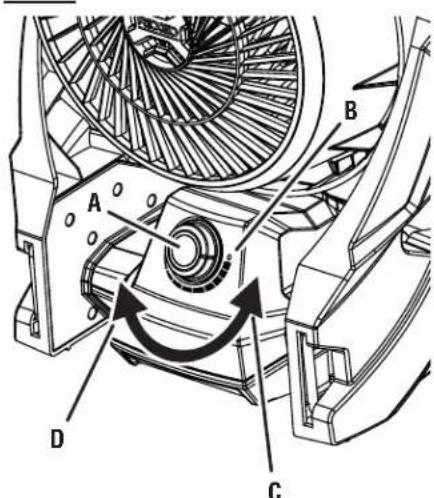
A - Control knob (bouton de commande, perilla de control)
B - Off (O) [arret (O), apagado (O)]
C - To decrease speed (pour réduire la vitesse, para disminuir la velocidad)
D - To increase speed (pour augmenter la vitesse, para aumentar la velocidad)
Fig. 4 Fig. 9
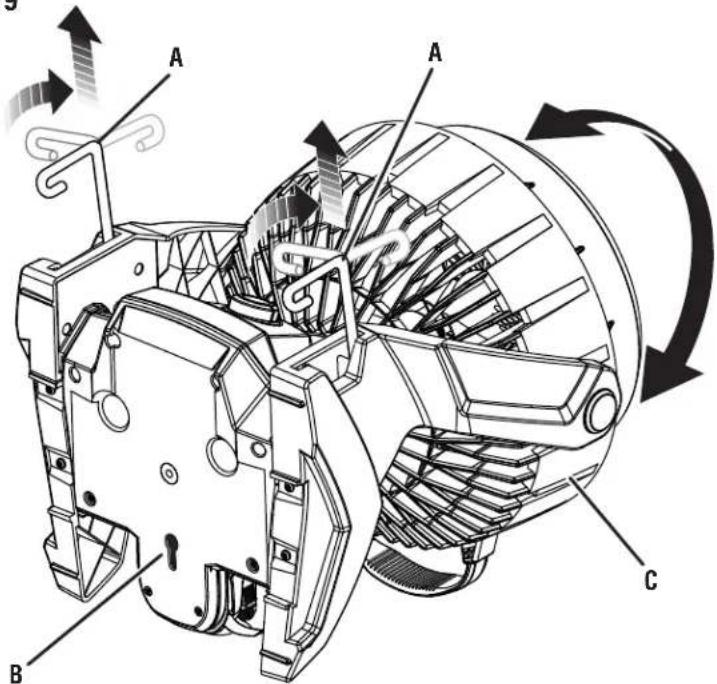
Fig. 6 Fig. 8
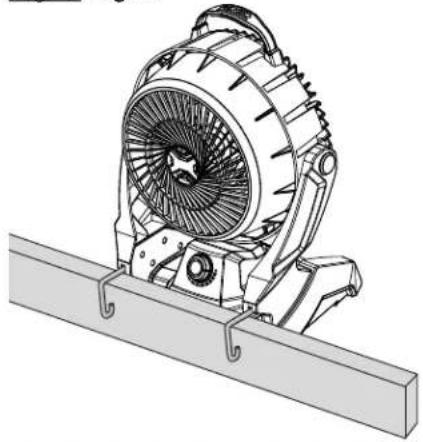
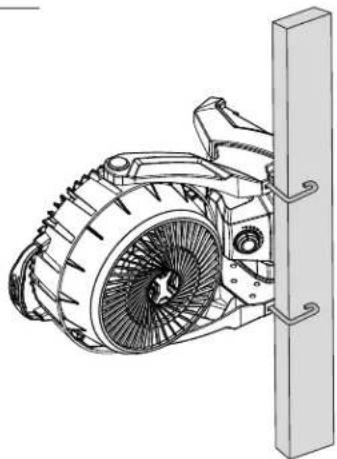
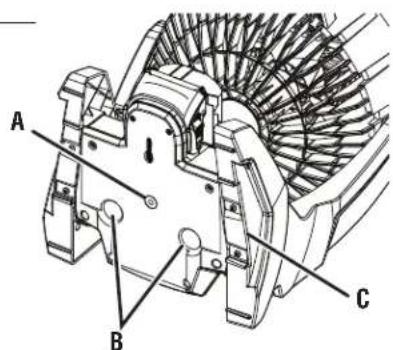
Fig. 10
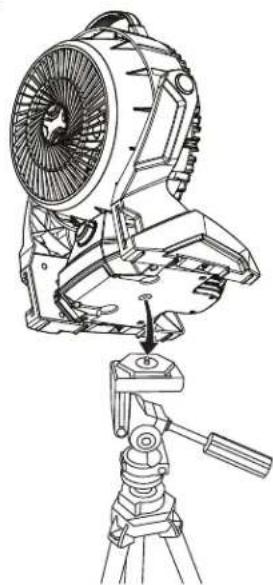
Fig. 11
NOTES / NOTAS
OPERATOR'S MANUAL
MANUEL D'UTILISATION
MANUAL DEL OPERADOR
18 V HYBRID PORTABLE FAN
VENTILATEUR PORTATIF HYBRIDE DE 18 V
VENTILADOR PORTÁTIL DE HÍBRIDA DE 18 V
R860720
DUBIR®
Customer Service Information:
For parts or service, do not return this product to the store. Contact your nearest RIDGID® authorized service center. Be sure to provide all relevant information when you call or visit. For the location of the authorized service center nearest you, please call 1-866-539-1710 or visit us online at www.RIDGID.com.
MODEL NO. ____ SERIAL NO. ____
RIDGID is a registered trademark of RIDGID, Inc., used under license.


- OPERATOR'S MANUAL
- MANUEL D'UTILISATION MANUAL DEL OPERADOR
- 18 V HYBRID PORTABLE FAN
- WARNING
- TABLE DES MATIÈRES
- SAVE THESE INSTRUCTIONS
- WORK AREA
- ELECTRICAL SAFETY
- PERSONAL SAFETY
- PORTABLE FAN USE AND CARE
- SERVICE
- PORTABLE FAN SAFETY WARNINGS
- CALIFORNIA PROPOSITION 65
- DOUBLE INSULATION
- ELECTRICAL CONNECTION
- EXTENSION CORDS
- OPERATION
- APPLICATIONS
- NOTICE
- INSTALLING/REMOVING BATTERY PACK
- INSTALLING/REMOVING POWER CORD
- STARTING/STOPPING THE PORTABLE FAN
- CHANGING PORTABLE FAN SPEED
- HANGING/MOUNTING PORTABLE FAN
- ADJUSTING THE HEAD
- MAINTENANCE
- GENERAL MAINTENANCE
- NOTE: ILLUSTRATIONS START ON PAGE 8 AFTER FRENCH AND SPANISH LANGUAGE SECTIONS
- INSTRUCTIONS IMPORTANTES CONCERNANT LA SÉCURITÉ
- AVERTISSEMENT
- NOTES / NOTAS
- MANUEL D'UTILISATION
- MANUAL DEL OPERADOR
- VENTILATEUR PORTATIF HYBRIDE DE 18 V
- VENTILADOR PORTÁTIL DE HÍBRIDA DE 18 V
- R860720
- DUBIR®
- CUSTOMER SERVICE INFORMATION
Brand : RIDGID
Model : R860720
Category : Fan