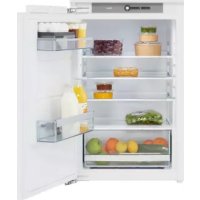
PKD35088 - Fridge Pelgrim - Free user manual and instructions
Find the device manual for free PKD35088 Pelgrim in PDF.


| Brand | Pelgrim |
| Model | PKD35088 |
| Product type | Built-in refrigerator |
| Climate class | SN (extended temperate), N (temperate), ST (subtropical), T (tropical) |
| Recommended ambient temperature | +10°C to +43°C depending on class |
| Refrigerant | R600a (flammable, quantity indicated on rating plate) |
| Power supply | Rated voltage and frequency indicated on rating plate |
| Energy consumption | Data available on energy label and in EPREL database |
| Lighting energy efficiency class | E |
| Main functions | Super Cooling, open door alarm, high temperature alarm, automatic defrost, fan (on some models), AdapTech (intelligent regulation) |
| Interior equipment | Adjustable glass shelves, vegetable drawer with humidity regulator, adjustable door balconies, bottle compartment, MultiBox, LED lighting |
| Storage capacity | Not specified in the manual |
| Temperature setting | By touch key, LED display, recommended setting at +4°C |
| Door opening direction reversal | Possible, separate manual provided |
| Cleaning and maintenance | Clean with warm water and mild detergent; do not use abrasive, acidic or solvent-based products; do not wash parts in dishwasher |
| Defrosting | Automatic for refrigerator; manual defrost if a 3-5 mm layer of frost forms |
| Open door alarm | Audible signal if door remains open too long, stops when door is closed |
| High temperature alarm | Audible signal and flashing icon if temperature too high, can be acknowledged by pressing key |
| Noise | Noise level depends on installation and use; temporarily louder in Super Cooling mode |
| LED lighting | In case of malfunction, contact after-sales service |
| Child safety | Use possible from 8 years of age under supervision; remove packaging and dispose leaving shelves to avoid risk of suffocation or entrapment |
| Environmental protection | Recyclable appliance; do not dispose with household waste; take to WEEE collection point |
| After-sales service | Contact approved after-sales service for repairs, especially for LED lighting |
| Warranty | Not specified in the manual |
Frequently Asked Questions - PKD35088 Pelgrim
User questions about PKD35088 Pelgrim
0 question about this device. Answer the ones you know or ask your own.
Ask a new question about this device
Download the instructions for your Fridge in PDF format for free! Find your manual PKD35088 - Pelgrim and take your electronic device back in hand. On this page are published all the documents necessary for the use of your device. PKD35088 by Pelgrim.
USER MANUAL PKD35088 Pelgrim
BESCHRIJVING VAN HET APPARAAT
Instructions for use
Built-in refrigerator
We thank you for the confidence you have shown by purchasing our appliance which is designed to simplify your life. To make the use of the product easier, we have supplied detailed instructions for use, and installation instructions supplied on a separate sheet. The instructions should allow you to learn about your new appliance as quickly as possible.
We wish you find a lot of pleasure in its use.
The appliance is intended solely for household use.
The refrigerator is intended for storing fresh food at temperatures above 0^ .
Please visit our website where you can enter your appliance model number, indicated on the rating plate or the warranty sheet, to find detailed description of your appliance, tips on use, troubleshooting, service information, instructions for use etc.

www.pelgrim.nl
Link to the EU EPREL database
The QR code on the energy label supplied with the appliance provides a web link to the registration of this appliance in the EU EPREL database. Keep the energy label for reference together with the user manual and all other documents provided with this appliance.
It is possible to find information related to the performance of the product in the EU EPREL database using the link https://eprel.ec.europa.eu and the model name and product number that you can find on the rating plate of the appliance.
For more detailed information about the energy label, visit www.theenergylabel.eu.

Important safety warning

General information and tips

Protecting the environment
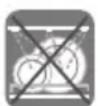
Do not wash in the dishwasher
CONTENTS
| 4 | IMPORTANT NOTES AND PRECAUTIONS | INTRODUCTION |
| 4 | BEFORE USING THE APPLIANCE FOR THE FIRST TIME | |
| 5 | IMPORTANT SAFETY INSTRUCTIONS | |
| 8 | IMPORTANT INFORMATION ON THE USE OF APPLIANCE | |
| 9 | ENVIRONMENT PROTECTION | |
| 10 | ADVICE FOR SAVING POWER WITH REFRIGERATION APPLIANCES | |
| 11 | INSTALLATION AND CONNECTION | APPLIANCE DESCRIPTION |
| 13 | APPLIANCE DESCRIPTION | |
| 14 | OPERATING THE APPLIANCE | |
| 18 | APPLIANCE INTERIOR EQUIPMENT | |
| 22 | STORING FOOD | STORING FOOD |
| 24 | DEFROSTING THE APPLIANCE | DEFROSTING AND CLEANING |
| 25 | CLEANING THE APPLIANCE | THE APPLIANCE |
| 26 | TROUBLESHOOTING | MISCELLANEOUS |

BEFORE USING THE APPLIANCE FOR THE FIRST TIME
Before connecting the appliance to the power mains, please read carefully the instructions for use which describe the appliance and its correct and safe use. The instructions apply to several appliance types/ models; thus, settings or equipment may be described herein which is not available in your appliance. We recommend saving this instruction manual for future reference and attach it to the appliance if it is sold in the future.
Check for any damage or irregularities on your appliance. If you find your appliance is damaged, notify the retailer from which you have purchased the appliance.
Before connecting the appliance to the power mains, let the appliance rest in a vertical position for a minimum of 2 hours. This will reduce the possibility of operation faults due to the effect of transport on the cooling system.
WARNING! Risk of fire/flammable materials.
The appliance must be connected to the power mains and grounded in compliance with the effective standards and regulations.
WARNING! Do not locate multiple portable socket-outlets or portable power supplies at the rear of the appliance.
Before cleaning the appliance, unplug it from the power mains (unplug the power cord from the wall outlet).
WARNING! If the supply cord is damaged, it must be replaced by the manufacturer, its service agent or similarly qualified persons in order to avoid a hazard.
WARNING! When positioning the appliance, ensure the supply cord is not trapped or damaged.
If LED lighting does not work, call a service technician. Do not attempt a repair of the LED lighting yourself, as there is danger of contact with high voltage!

WARNING! Do not use any electric devices inside the appliance, except for those allowed by the manufacturer of this refrigeration appliance.

WARNING! Do not use mechanical devices or other means to accelerate the defrosting process, other than those recommended by the manufacturer.

WARNING! To avoid any hazard resulting from poor stability of the appliance, make sure it is installed as instructed.
Danger of frostbite
Never put frozen food in your mouth and avoid touching frozen food as this may cause frostnip or frostbite.
Safety of children and vulnerable persons
The appliance is not intended for use by persons (including children) with reduced physical, sensory or mental capabilities, or lack of experience and knowledge, unless they have been given supervision or instruction concerning use of the appliance by a person responsible for their safety.
Children should be supervised to ensure that they do not play with the appliance.
Cleaning and user maintenance shall not be made by children without supervision.
Remove the packaging intended to protect the appliance or particular parts during transport and keep it outside the reach of children. It presents danger of injury or suffocation.
When removing a used appliance, disconnect the power cord, remove the door, and leave the shelves in the appliance. This will prevent children from locking themselves in the appliance.
For European markets only
This appliance can be used by children aged from 8 years and above and persons with reduced physical, sensory or mental capabilities or lack of experience and knowledge if they have been given supervision or
instruction concerning use of the appliance in a safe way and understand the hazards involved.
Children shall not play with the appliance.
Cleaning and user maintenance shall not be made by children without supervision.
Children aged from 3 to 8 years are allowed to load and unload refrigerating appliances.
Warning regarding the refrigerant
The appliance contains a small amount of an environmentally friendly yet flammable gas R600a. Make sure that no parts of the cooling system are damaged. A gas leak is not hazardous to the environment, but it could cause eye injury or fire. In case of a gas leak, ventilate the room thoroughly, disconnect the appliance from the power mains, and call a service technician.
IMPORTANT INFORMATION ON THE USE OF APPLIANCE
WARNING! This appliance is intended to be used in household and similar applications such as
- staff kitchen areas in shops, offices and other working environments;
- farm houses and by clients in hotels, motels and other residential type environments;
- bed and breakfast type environments;
- catering and similar non-retail applications.

WARNING! Keep ventilation openings, in the appliance enclosure or in the built-in structure, clear of obstruction.
The appliance may not be used outdoors and it may not be exposed to rain.
Do not store explosive substances such as aerosol cans with a flammable propellant in this appliance.
If the appliance will be out of use for an extended period of time, switch it off using the relevant button, and unplug it from the power mains. Empty the appliance, defrost it, clean it, and leave the door ajar.
In the event of a defect or power cut, do not open the freezer compartment unless the appliance has been out of operation for more than the hours indicated on the appliance's type plate (temperature rise time). After this time, you must either use the frozen food or make sure that it is properly cooled (for example, by transferring it to another appliance).
Technical information on the appliance
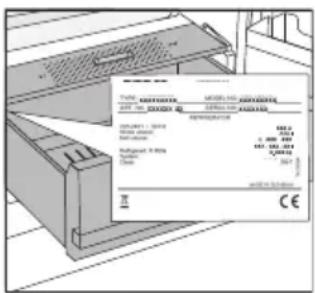
Rating plate can be found in the appliance interior (see figure). It indicates data on voltage, gross and net volume, type and amount of refrigerant, and information on the climate classes.

ENVIRONMENT PROTECTION
Packaging is made of environmentally friendly materials that can be recycled, disposed of, or destroyed without any hazard to the environment.

Removing an obsolete appliance
To protect the environment, take the obsolete appliance to an authorized home appliance collection centre.
Before doing so, do the following:
- disconnect the appliance from the power mains;
- do not allow children to play with the appliance.

WARNING! Do not damage the refrigerant circuit. This will also prevent pollution.
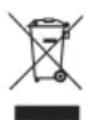
The symbol on the product or its packaging indicates that the product should not be treated as normal household waste. The product should be taken to an authorized collection centre for waste electric and electronic equipment processing. Correct disposal of the product will help prevent
any negative effects on the environment and health of people which could occur in case of incorrect product removal. For detailed information on removal and processing of the product, please contact the relevant municipal body in charge of waste management, your waste disposal service, or the store where you bought the product.

ADVICE FOR SAVING POWER WITH REFRIGERATION APPLIANCES
- Install the appliance as specified in the instruction manual.
- Do not open the door more often than necessary.
- Occasionally make sure air circulation underneath the appliance is unobstructed.
- If the gasket is damaged or does not provide a perfect seal for any reason, have it replaced as soon as possible.
- Store the food in tightly sealed containers or appropriate packaging.
- Before placing the food in the refrigerator, allow it to cool down to room temperature.
- Defrost frozen food in the refrigerator compartment.
- Make sure the layout of shelves in the compartment is uniform and that the food is placed so that the air can freely circulate in the appliance interior (observe the recommended placement of food as described in the instructions).
- Do not block the fan slots or vents.
- The lower the temperature is set the higher the energy consumption will be.
INSTALLATION AND CONNECTION
SELECTING THE ROOM
- Install the appliance in a dry and well ventilated room. The appliance will operate correctly if the environment temperature is in the interval specified in the table. The appliance class is indicated on the rating plate / label with the basic information on the appliance.
| Description Class Ambient temperature range °C | Relative humidity | ||
| Extended temperate $N +10 to +32 | ≤ 75% | ||
| Temperate N +16 to +32 | |||
| Subtropical ST +16 to +38 | |||
| Tropical T +16 to +43 | |||

-
Do not place an appliance in a room where temperature can drop to below 5^ as this may cause abnormal appliance operation or failure!
-
After the installation, the appliance mains plug should be accessible!
Note: Place the appliance in a sufficiently large room. There should be at least 1m^3 of space per 8 grams of refrigerant. Amount of refrigerant is indicated on the rating plate in the appliance interior.
- At the base of the kitchen unit intended for building in the integrated appliance, there should be at least 200~cm^2 free space, for adequate air circulation.
On the upper part of the appliance the air is coming out, so try not to cover the opening for the outflow air. Ignoring this caution may result in damage to the appliance.
Warning: when installing built-in appliances into a cupboard or cabinet in a side-by-side layout, the dew prevention installation kit should also be purchased and installed. For safety reasons, dew prevention kit may only be installed by an authorized service technician!
CONNECTING THE APPLIANCE
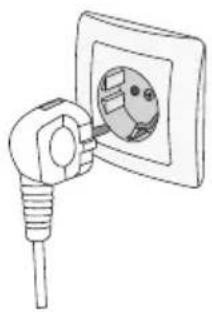
- Connect the appliance to the power mains using the power cord. The wall outlet should be fitted with a ground contact (safety socket). Nominal voltage and frequency are indicated on the rating plate/label with basic information on the appliance.
The appliance must be connected to the power mains and grounded in compliance with the effective standards and regulations. The appliance will withstand short-term deviations from the nominal voltage, but not more than + / - 6%
CHANGING THE DOOR OPENING DIRECTION AND INTEGRATING THE APPLIANCE INTO A CABINET
The process of changing the appliance door opening and integrating the appliance into a cabinet is described on the separate installation instructions supplied in the bag with the instruction manual.
Appliance interior equipment may change according to the appliance model.
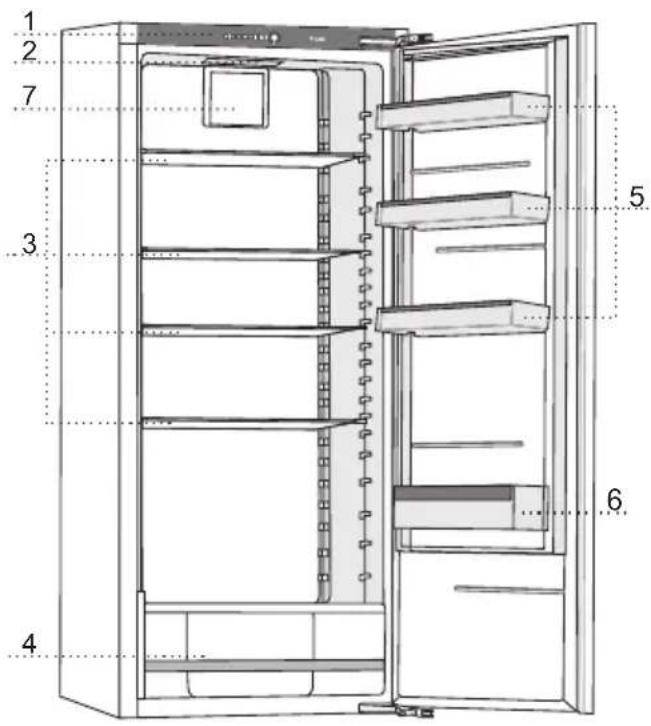
1 Control unit
2 LED lighting
3 Glass shelves
4 Fruit and vegetable drawer with humidity control
5 Door balconies
6 Bottle balcony
7 Fan*
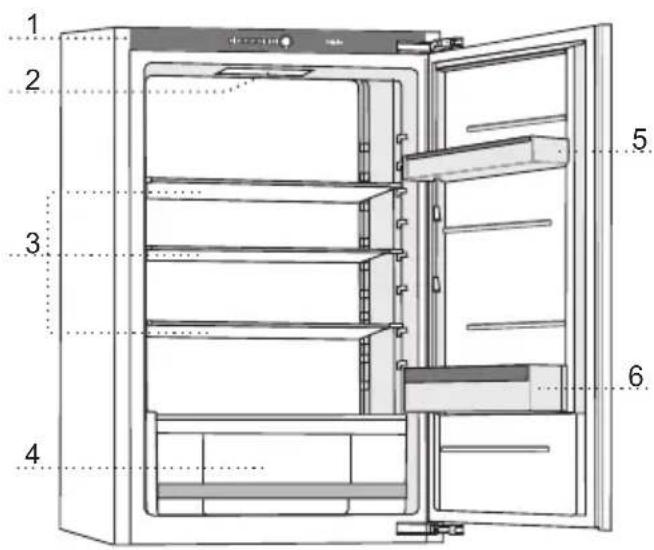
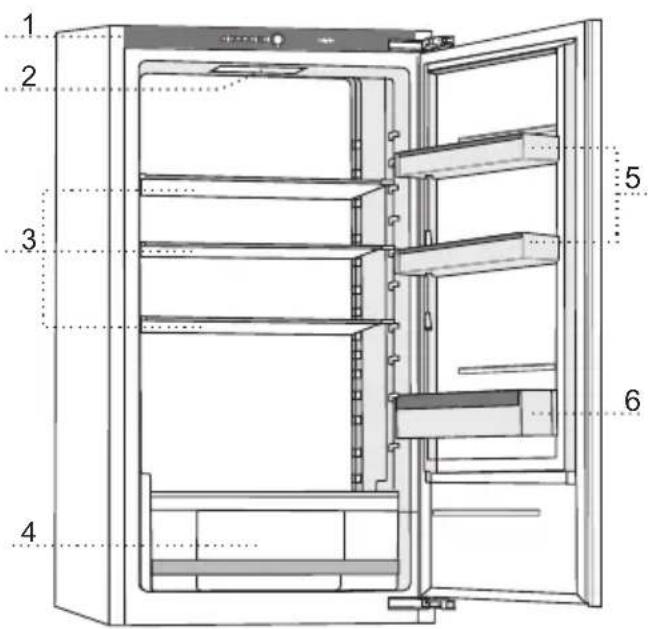
* Only in some models
OPERATING THE APPLIANCE

A Appliance on/off, temperature settings, and extra function key
B Refrigerator compartment temperature display
The indicator for the selected temperature will be lit.
C Intensive cooling (cooling boost) function indicator
The C symbol will be lit when the intensive cooling function is activated.
D High temperature indicator
To set the appliance temperature or activate extra functions, press the A key successively. When the key is first pressed, the currently set value or function will start to flash. With each successive press of the key, the indicator moves to the next setting. The indicator cycles through the settings in a circular manner, from right to left. While the settings are being adjusted, the display will flash. Three seconds after the key is released, the setting will be stored automatically and the relevant symbol will be lit.
SWITCHING THE APPLIANCE ON/OFF
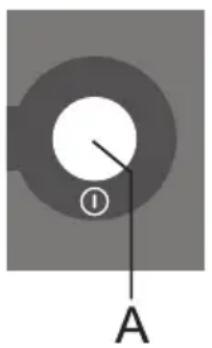
Switching the appliance on: Press the A key and hold it for 3 seconds.
Switching off the appliance: Again press the A key and hold it for 3 seconds. The appliance will be off, but there is still voltage in it as it is still connected to the power mains.
ADJUSTING THE TEMPERATURE IN THE APPLIANCE

- The factory default setting is the recommended temperature of 4^ .
- After the appliance is switched on, it may take several hours for the set temperature to be reached. Do not place any food into the refrigerator before the temperature drops to the selected setting.
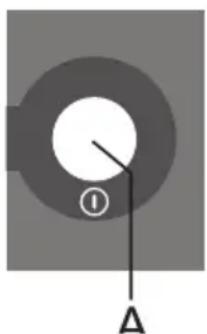
- Adjust the temperature as desired using the A key.
- Press the A key (several times) until the desired temperature indicator lights up.
- When the A key is pressed for the first time, the currently set value or function will start to flash. Every successive time you press the A key, the settings indicator will move to the next setting (from right to left, in a circular manner).
- After three seconds, the setting will stop flashing. Your setting will be stored and the corresponding indicator will be continuously lit.
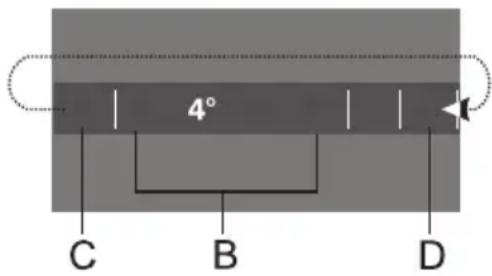
The numbers 2, 4, 6 and 8 indicate the degrees Celsius (^) in the appliance refrigerator compartment.
- The recommended temperature setting is +4^ . At this temperature, food quality and freshness are preserved longer.
- If the ambient temperature in the room where the appliance is installed is below 16^ , we recommend setting a temperature lower than 4^ .
INTENSIVE COOLING
This appliance has an intensive cooling function. This function decreases the temperatures in the refrigeration compartment as quickly as possible. This is ideal for cooling products that have just been put into the refrigerator. Use this function when you put a large quantity of food in the appliance.

When the intensive cooling function is selected, the appliance works at maximum capacity. It may then make more noise for a while.
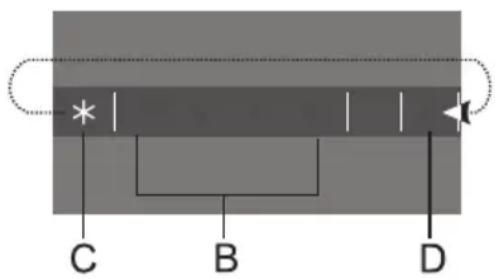
To activate the intensive cooling function, press the A key several times until symbol C lights up.
- To switch off the intensive cooling function, press the A key to select the desired temperature B.

Adjusting the temperature of the refrigeration compartment while the intensive cooling function is activated will immediately disable the intensive cooling function.

When the intensive cooling function is not manually disabled then the function will be automatically disabled after about six hours. The temperature then returns to the latest set temperature.

Should a power failure occur while the function is activated then the function will be activated again when the power is restored.
OPEN DOOR ALARM
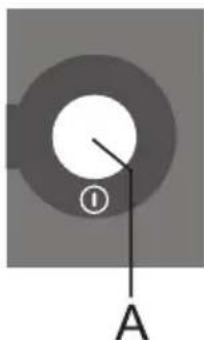
An alarm signal sounds when a door is open for too long.
Stopping the alarm
-
Close the door.
-
The alarm will stop sounding.

If you only switch off the alarm by touching the A key, the alarm will switch on again after some time because the door is still open.
HIGH TEMPERATURE ALARM
A signal will sound when the temperature in the appliance is too high.
Furthermore, symbol D shown in the display will flash. A high temperature can be caused for several reasons:
The door has been opened for too long or too frequently.
- The door does not seal properly.
- Too much fresh food has been put in at the same time.

Every time the appliance is switched on again, it takes a while until the correct temperature is reached. For this reason, the alarm is disabled for the first 24 hours after the appliance is switched on to prevent the unnecessary activation of the alarm.
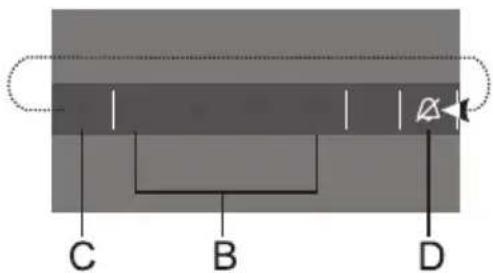
Stopping the alarm
-
Touch the A key to stop the alarm.
-
The alarm will stop sounding.
-
Symbol D shown in the display continues to flash while the temperature is still too high.

When you press the A key for the first time, the alarm will be acknowledged and turned off. When you press the A key again, it will already work as a settings adjustment key.

When the alarm is not stopped manually and the temperature remains too high, the signal will sound for the first minutes of every half hour and when the door is opened.
APPLIANCE INTERIOR EQUIPMENT
GLASS SHELVES

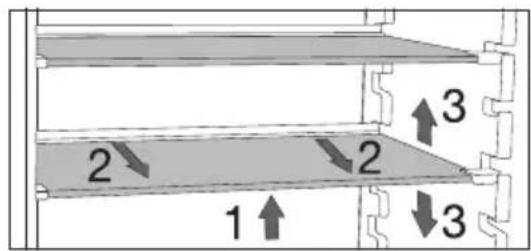
The shelves are made from safety glass. To change the height of a shelf, lift the front of the shelf (1). Take hold of the back and pull the shelf slightly forwards (2). Move the shelf to a higher or lower position (3).
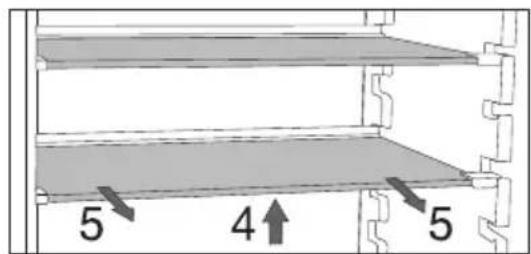
To remove a shelf from the refrigerator, lift the front of the shelf (4). Take hold of the back and pull the shelf out of the appliance (5).
VEGETABLE DRAWER WITH AUTOMATIC HUMIDITY CONTROL
The drawer at the bottom of the refrigerator is intended for storing fruit and vegetables. It provides humidity and prevents the food from drying out. The humidity in the drawer is regulated automatically, depending on the type and amount of inserted food.
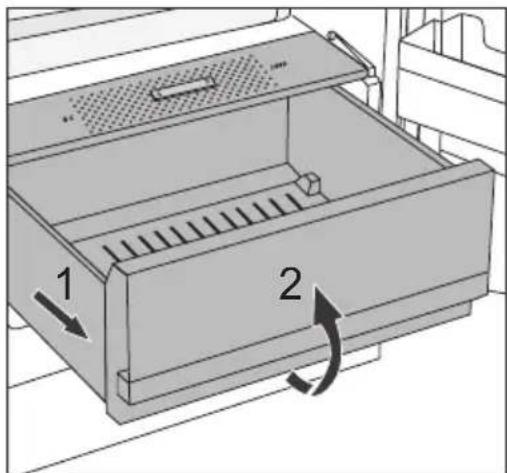
To remove a drawer, pull out the drawer as far as it will go (1). Then, lift the front part (2) and pull it out completely.
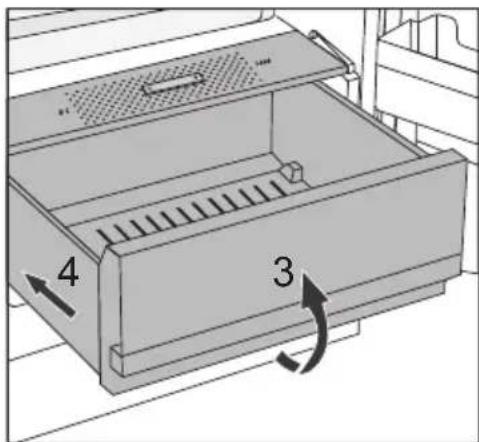
To insert a drawer, follow the reverse order (3 and 4).
DOOR COMPARTMENTS
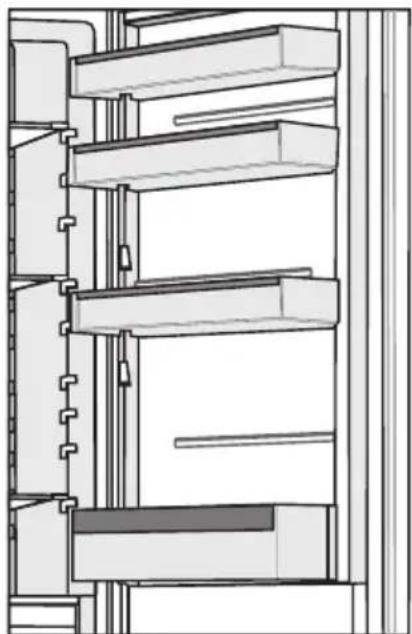
The height of the door compartments is adjustable. Lift the compartment out of the groove and fit it in the required position. Each compartment can carry a maximum weight of 5kg . The bottom door compartment is suitable for bottles.
MultiBox

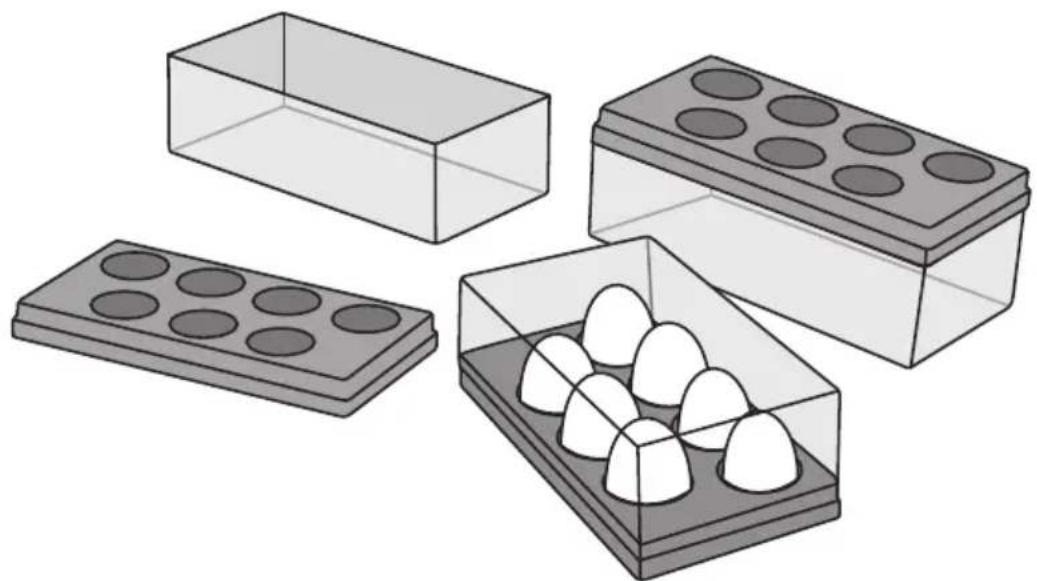
The MultiBox offers a handy option for storing foods with a strong odour, such as ripe or blue cheese, smoked sausages and onions. The lid can also be used as egg tray.
FAN (only in some models)
The fan contributes to more even temperature distribution and faster cooling, and reduces dew (or condensate) accumulation on the storage surfaces. It is activated automatically when there is need for more intensive cooling.
AdapTech
Innovative sensor technology allows adjusting appliance operation to the user's habits or behaviour. Adaptive intelligent system monitors, analyzes, and records on a daily and weekly basis the use of appliance and adapts appliance operation to the perceived patterns. If the appliance is able to anticipate increased frequency of door opening, the appliance will automatically lower the temperature before such time to prevent the increase of food temperature as the door is opened more often. The appliance will also anticipate adding larger amounts of food into the refrigerator or freezer and adapt by cooling or freezing more intensively.
RECOMMENDED DISTRIBUTION
Sections of the refrigeration compartment
- Upper section: canned food, bread, wine and pastas, etc.
- Middle section: dairy products, ready-to-cook meals, desserts, soft drinks, beer and cooked food, etc.
- Lower section: meat, meat produce, delicatessen.
- Vegetable drawer: vegetables and fresh fruit.

Store food that spoils rapidly at the back of a shelf or at the back of the drawer at the lowest temperature.

Do not store fruit (bananas, pineapples, papaya, citrus fruits) and vegetables (courgettes, tomatoes, aubergines, cucumber, sweet peppers and potatoes) that are sensitive to low temperatures in the refrigerator.
Sections of the door
- Top/middle door compartment: eggs, butter, cheese and sauscs, etc.
- Bottom door compartment: drinks, cans and bottles, etc.
AVOID CONTAMINATION OF FOOD
To avoid contamination of food, please respect the following instructions:
- Opening the door for long periods can cause a signifi cant increase of the temperature in the compartments of the appliance.
- Regularly clean surfaces that can come in contact with food and accessible drainage systems.
- Store raw meat and fish in suitable containers in the refrigerator, so that it is not in contact with or drip onto other food.
- If the refrigerating appliance is left empty for long periods, switch off, defrost, clean, dry, and leave the door open to prevent mould developing within the appliance.
STORING FRESH FOOD IN THE REFRIGERATOR
Important recommendations for storing fresh food
To ensure the quality of fresh food, it is important that:
- the food is well-packaged;
- the appliance is at the correct temperature;
- the appliance is clean.
Take good note of the use-by date stated on the food packaging.
- Put food in the refrigerator in sealed containers or in suitable packaging. This will prevent the food from picking up or spreading odours and will keep it dry.
- Do not store flammable, unstable or explosive materials in the refrigerator.
- Store bottles that have been opened upright and close them tightly.
- Some organic solutions, such as essential oils, in the skin of lemons and oranges, and butyric acid, that come into long-term contact with plastics can eat into the material and cause premature ageing.
- A disagreeable odour is an indication that the appliance is not clean or that it contains food that has spoiled (see the chapter 'Maintenance').
- Take perishable foods out of the refrigerator when you will be away from home for a longer time.
DEFROSTING THE APPLIANCE
AUTOMATIC REFRIGERATOR DEFROSTING
This refrigerator does not need defrosting because the ice on the back interior wall is thawed automatically.
Any accumulated ice will melt when the compressor unit is inactive. Drops will flow through an opening in the refrigerator rear wall into a tray fitted above the compressor, from where they will evaporate.
Make sure the opening in the back wall in the refrigerator interior is never blocked by food or any other object.
If an excessive layer of ice is formed on the rear wall of refrigerator interior (3-5 mm), switch off the appliance and defrost the appliance manually.
CLEANING THE APPLIANCE

Before cleaning, unplug the appliance from the power mains - switch off the appliance (see chapter Operating the Appliance) and unplug the power cord from the wall outlet.

Cleaners that contain abrasive substances, acids, or solvents are not suitable for cleaning as they may damage the surface.
Regularly clean the interior of the appliance with lukewarm water. If so required, add a neutral cleaning agent or special refrigerator cleaner to the water. Clean all surfaces with a soft cloth. Wipe the cleaned parts with a cloth with clean water and then dry them thoroughly.

- Do not wash the parts of appliance interior equipment in a dishwasher as they may be damaged.
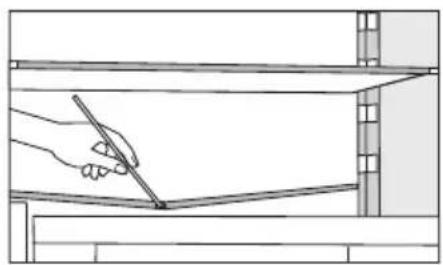
- A gutter and an opening for discharging the water from thawed frost deposits are located underneath the cooling panel that cools the refrigerator interior. The gutter and the opening may not be clogged. Inspect them often and clean if necessary (e.g. with a plastic straw).
After cleaning, switch the appliance back on and insert the food.
Problem: Cause or remedy:
Appliance is connected to the power mains but it does not work.
Cooling system operates continuously for a long period of time:
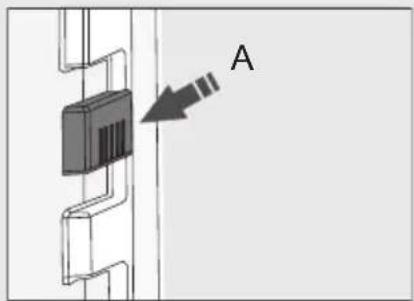
Excessive build-up of ice on the back wall of refrigerator interior can be a result of the following:
Condensate (dew) on the shelf above the drawers:
Water is dripping/ leaking from the refrigerator:
Indicator D flashes: • Door
- Make sure there is voltage in the power outlet and that the appliance is switched on.
- Too high ambient temperature.
- Door opened too frequently or too long.
- Door not closed correctly (possible impurities on the seal, misaligned door, damaged seal etc.).
- Too much fresh food inserted at once.
-
Sensor in the refrigerator (A) blocked by fresh food. Make sure the air can circulate around the sensor (only with some models).
Insufficient compressor and condenser unit cooling. Check for sufficient air circulation behind the appliance and clean the condenser unit. -
The door is not closed properly.
- Warm food placed in the refrigerator.
- Food or containers in contact with the back interior wall of the refrigerator.
-
The door does not seal properly (the seal is dirty, the door is misaligned or the seal is damaged, etc.).
-
This is transient phenomenon which cannot be entirely avoided in periods of high environment temperature and humidity. It subsides when temperature and humidity are normalized. We recommend cleaning the drawers more frequently and wiping the droplets occasionally.
-
Put food in bags or other packaging with a good seal.
-
Clogged water discharge opening or water dripping past the water gutter.
- Clean the blocked opening, e.g. using a plastic straw.
- If a thick layer of ice builds up, defrost the appliance manually (see Defrosting the Appliance).
opened too frequently or too long.
- Door not closed correctly (possible impurities on the seal, misaligned door, damaged seal etc.).
- An extended power failure.
- Too much fresh food inserted at once.
Problem: Cause or remedy:
Door is difficult to open:
- If you are trying to open the refrigerator door after just having closed it, this could be difficult to do. As you open the door, some cool air escapes from the appliance and it is replaced by warm air from the environment. When this air is cooled, negative pressure is generated which results in problems as you try to open the door. After a few minutes, the condition is normalized and the door can be easily opened again.
LED lighting does not work:
- Consult a service technician about LED lighting that is not working.
For safety reasons, you are not allowed to repair LED lighting yourself.
- This product contains a light source of energy efficiency class E.
Appliance makes a noise.
- The appliance is cooled by a refrigeration system with a compressor (and with some models, also a fan) that makes a noise. The noise level depends on the installation of the appliance, its correct use and its age.
- When you connect the appliance to the power supply the noise made by the compressor or flowing refrigerant may be slightly louder. This is not indicative of a defect, and has no effect on the service life of the appliance. The appliance will make less noise after a while.
- The appliance may be temporarily noisier after the door has been opened for too long or too frequently, a large quantity of fresh food has been put in the appliance or the intensive cooling function has been activated.
If the above tips do not resolve your problem, call the nearest authorized service centre and state the type, model, and serial number indicated on the appliance rating plate or label located in the appliance interior.
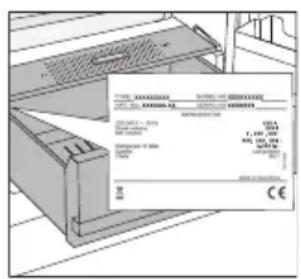
Rating plate can be found in the appliance interior (see figure).
WE RESERVE THE RIGHT TO CHANGES THAT DO NOT AFFECT THE APPLIANCE FUNCTIONALITY.
Pelgrim
COOLER B1540-F2 ADV PEL en
PKD25088
PKD25102
PKD25122
PKD35088
PKD35102
PKD35122
Bedienungsanleitung
Einbaukühlschrank