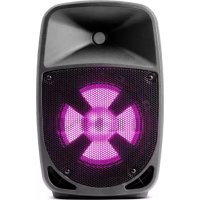
Pro Glow 8 - Loudspeaker ION - Free user manual and instructions
Find the device manual for free Pro Glow 8 ION in PDF.



| Product type | Powered speaker |
| Brand | ION |
| Model | Pro Glow 8 |
| Power supply | Mains (100-240 V AC, 50/60 Hz) via IEC cable with replaceable fuse |
| Microphone inputs | 2 inputs: XLR and 6.35 mm jack with independent volume and echo adjustment |
| Auxiliary inputs | 3.5 mm stereo input, 6.35 mm input, RCA inputs |
| Output | Mix output (6.35 mm jack) to connect another powered speaker |
| Media playback | USB, SD card, Bluetooth, FM radio (MP3, WAV, WMA supported) |
| Display | LCD display for USB, SD, FM, Bluetooth modes |
| LED lighting | 3 modes: Color Cycle (color scrolling), Beat Sync (synchronized to rhythm), Off |
| Equalization | Bass and treble adjustable from -12 dB to +12 dB |
| Microphone echo | Echo effect adjustment for microphone inputs |
| Remote control | Yes, with CR2032 battery included (remove before first use) |
| Fuse | Replaceable; fuse holder orientation determines voltage |
| Box contents | Pro Glow 8 speaker, microphone with cable, remote control, power cable, quick start guide, safety instructions |
| Care and cleaning | Wipe with a dry cloth; do not expose to water or weather |
| Safety | Do not expose to water or weather. Use the correct fuse rating. |
| Media panel | Controls: Mode, Play/Pause, Previous, Next, Repeat, and numeric keys via remote |
Frequently Asked Questions - Pro Glow 8 ION
User questions about Pro Glow 8 ION
0 question about this device. Answer the ones you know or ask your own.
Ask a new question about this device
Download the instructions for your Loudspeaker in PDF format for free! Find your manual Pro Glow 8 - ION and take your electronic device back in hand. On this page are published all the documents necessary for the use of your device. Pro Glow 8 by ION.
USER MANUAL Pro Glow 8 ION
Quickstart Guide English (3–9)
Appendix English (24 – 25)
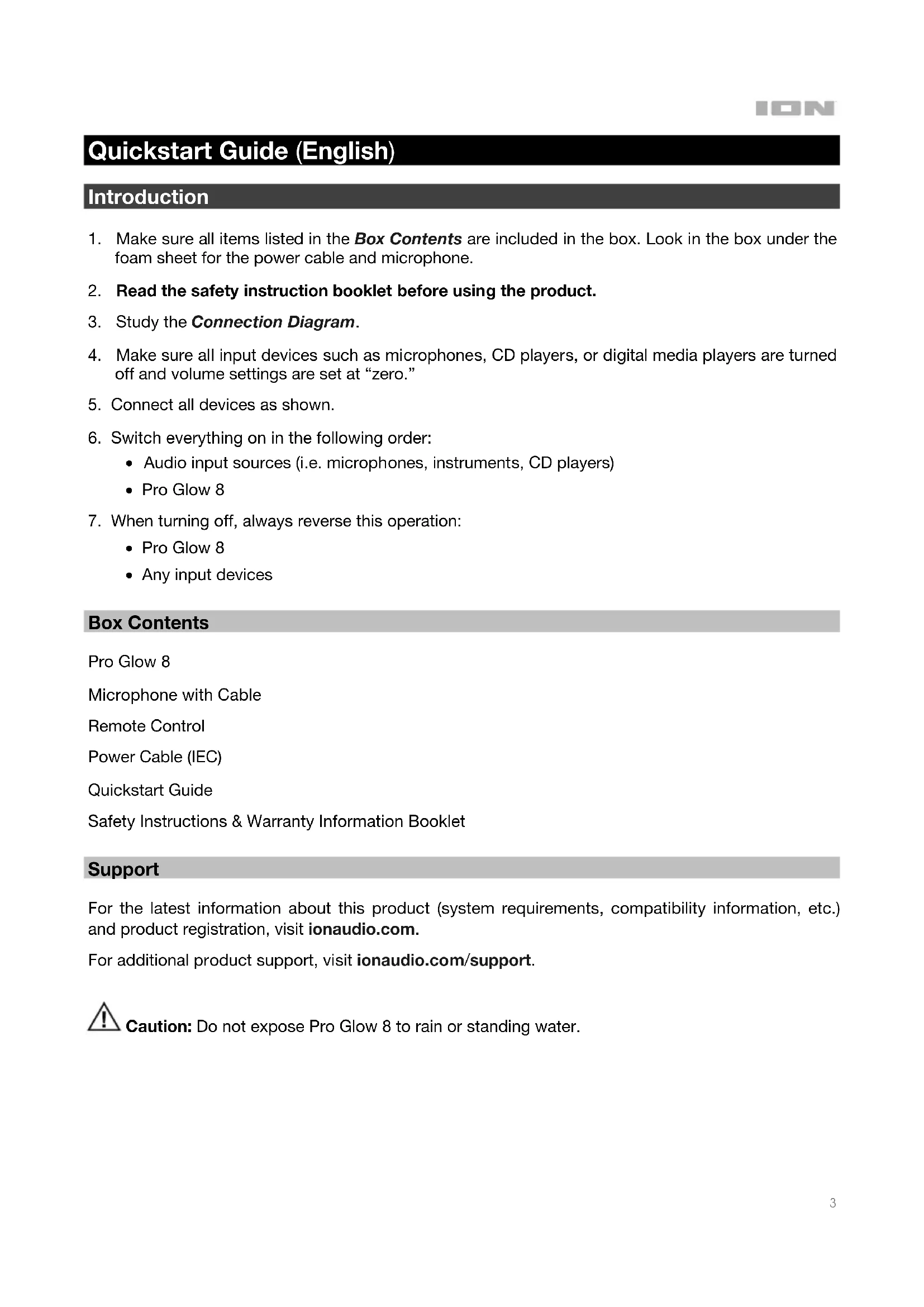
Quickstart Guide (English)
Introduction
- Make sure all items listed in the Box Contents are included in the box. Look in the box under the foam sheet for the power cable and microphone.
- Read the safety instruction booklet before using the product.
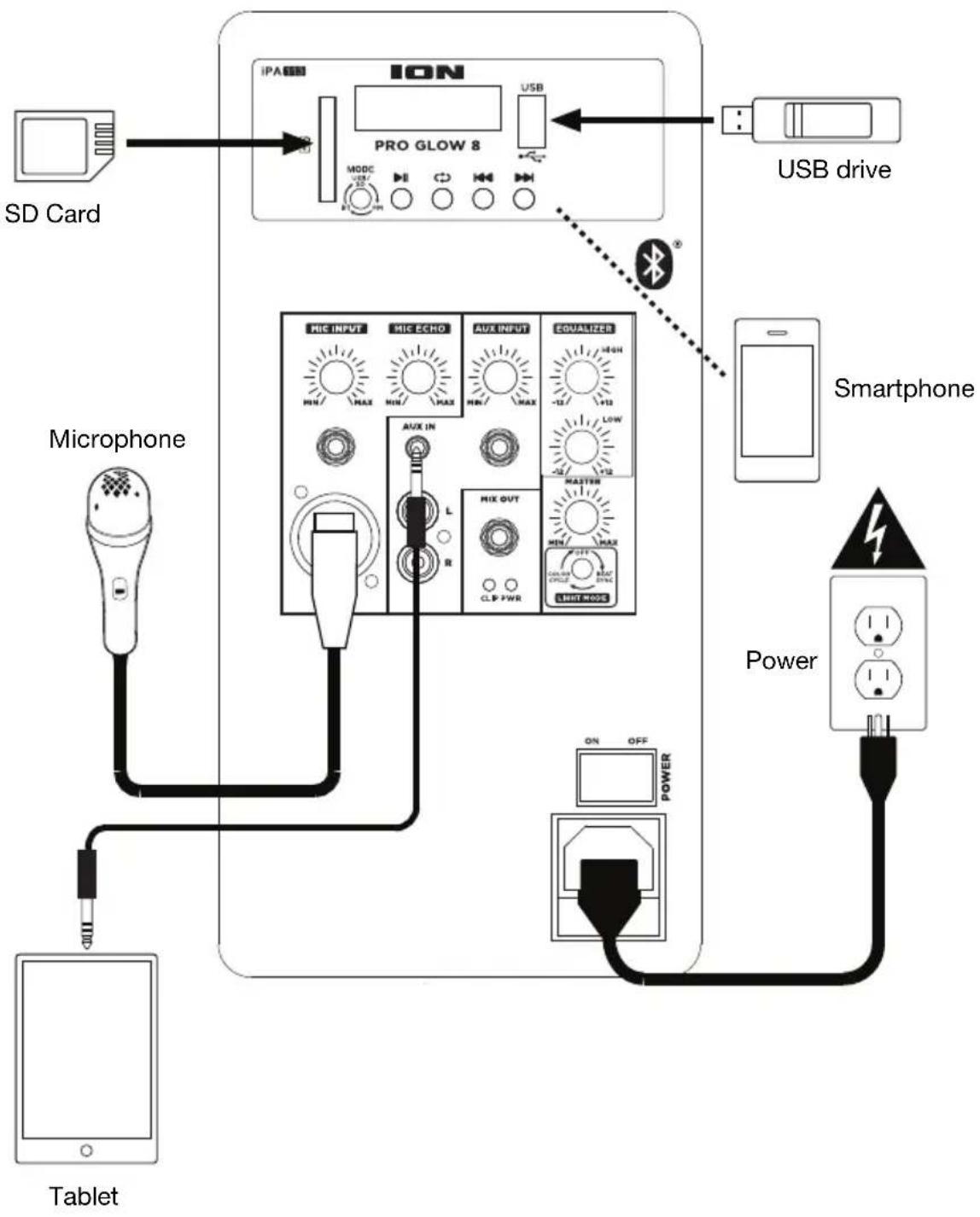
- Study the Connection Diagram.
- Make sure all input devices such as microphones, CD players, or digital media players are turned off and volume settings are set at "zero."
- Connect all devices as shown.
- Switch everything on in the following order:
• Audio input sources (i.e. microphones, instruments, CD players)
- Pro Glow 8
-
When turning off, always reverse this operation:
-
Pro Glow 8
- Any input devices
Box Contents
Pro Glow 8
Microphone with Cable
Remote Control
Power Cable (IEC)
Quickstart Guide
Safety Instructions & Warranty Information Booklet
Support
For the latest information about this product (system requirements, compatibility information, etc.) and product registration, visit ionaudio.com.
For additional product support, visit ionaudio.com/support.

Caution: Do not expose Pro Glow 8 to rain or standing water.
Quick Setup
Connection Diagram
Items not listed under
Introduction > Box Contents
are sold separately.
flowchart
graph TD
    A["SD Card"] --> B["PRO GLOW 8"]
    B --> C["USB drive"]
    D["Microphone"] --> E["IC INPUT"]
    D --> F["MIC ECHO"]
    D --> G["AUX INPUT"]
    D --> H["EQUANIZER"]
    D --> I["MIX INPUT"]
    D --> J["MIX ECHO"]
    D --> K["AUX INPUT"]
    D --> L["MIX ECHO"]
    D --> M["AUX INPUT"]
    D --> N["MIX ECHO"]
    D --> O["AUX INPUT"]
    D --> P["MIX ECHO"]
    D --> Q["AUX INPUT"]
    D --> R["MIX ECHO"]
    D --> S["AUX INPUT"]
    D --> T["MIX ECHO"]
    D --> U["AUX INPUT"]
    D --> V["MIX ECHO"]
    D --> W["AUX INPUT"]
    D --> X["MIX ECHO"]
    D --> Y["AUX INPUT"]
    D --> Z["MIX ECHO"]
    D --> AA["AUX INPUT"]
    D --> AB["MIX ECHO"]
    D --> AC["AUX INPUT"]
    D --> AD["MIX ECHO"]
    D --> AE["AUX INPUT"]
    D --> AF["MIX ECHO"]
    D --> AG["AUX INPUT"]
    D --> AH["MIX ECHO"]
    D --> AI["AUX INPUT"]
    D --> AJ["MIX ECHO"]
    D --> AK["AUX INPUT"]
    D --> AL["MIX ECHO"]
    D --> AM["AUX INPUT"]
    D --> AN["MIX ECHO"]
    D --> AO["AUX INPUT"]
    D --> AP["MIX ECHO"]
    D --> AQ["AUX INPUT"]
    D --> AR["MIX ECHO"]
    D --> AS["AUX INPUT"]
    D --> AT["MIX ECHO"]
    D --> AU["AUX INPUT"]
    D --> AV["MIX ECHO"]
    D --> AW["AUX INPUT"]
    D --> AX["MIX ECHO"]
    D --> AY["AUX INPUT"]
    D --> AZ["MIX ECHO"]
    D --> BA["AUX INPUT"]
    D --> BB["MIX ECHO"]
    D --> BC["AUX INPUT"]
    D --> BD["MIX ECHO"]
    D --> BE["AUX INPUT"]
    D --> BF["MIX ECHO"]
    D --> BG["AUX INPUT"]
    D --> BH["MIX ECHO"]
    D --> BI["AUX INPUT"]
    D --> BJ["MIX ECHO"]
    D --> BK["AUX INPUT"]
    D --> BL["MIX ECHO"]
    D --> BM["AUX INPUT"]
    D --> BN["MIX ECHO"]
    D --> BO["AUX INPUT"]
    D --> BP["MIX ECHO"]
    D --> BQ["AUX INPUT"]
    D --> BR["MIX ECHO"]
    D --> BS["AUX INPUT"]
    D --> BT["MIX ECHO"]
    D --> BU["AUX INPUT"]
    D --> BV["MIX ECHO"]
    D --> BW["AUX INPUT"]
    D --> BX["MIX ECHO"]
    D --> BY["AUX INPUT"]
    D --> BZ["MIX ECHO"]
    D --> CA["AUX INPUT"]
    D --> CB["MIX ECHO"]
    D --> CC["AUX INPUT"]
    D --> CD["MIX ECHO"]
    D --> CE["AUX INPUT"]
    D --> CF["MIX ECHO"]
    D --> CG["AUX INPUT"]
    D --> CH["MIX ECHO"]
    D --> CI["AUX INPUT"]
    D --> CJ["MIX ECHO"]
    D --> CK["AUX INPUT"]
    D --> CL["MIX ECHO"]
    D --> CM["AUX INPUT"]
    D --> CN["MIX ECHO"]
    D --> CO["AUX INPUT"]
    D --> CP["MIX ECHO"]
    D --> CQ["AUX INPUT"]
    D --> CR["MIX ECHO"]
    D --> CS["AUX INPUT"]
    D --> CT["MIX ECHO"]
    D --> CU["AUX INPUT"]
    D --> CV["MIX ECHO"]
    D --> CW["AUX INPUT"]
    D --> CX["MIX ECHO"]
    D --> CY["AUX INPUT"]
    D --> CZ["MIX ECHO"]
Features
Rear Panel
- Media Panel: Controls for the USB, SD, FM radio, and Bluetooth sources. The Media Panel Mode source symbol will illuminate when that source is playing.
Note: A USB drive or SD card must contain playable files in order for it to appear properly in the media panel's display. You can play MP3s, WAVs, and WMA files.
- USB Port: Connect your USB flash drive here to play music.
- SD Card Slot: Insert your SD card here to play music.
- Display: Displays the media panel modes for USB, SD, FM radio, and Bluetooth.
Note: The display comes with a plastic protector on it. Remove this for optimal viewing.
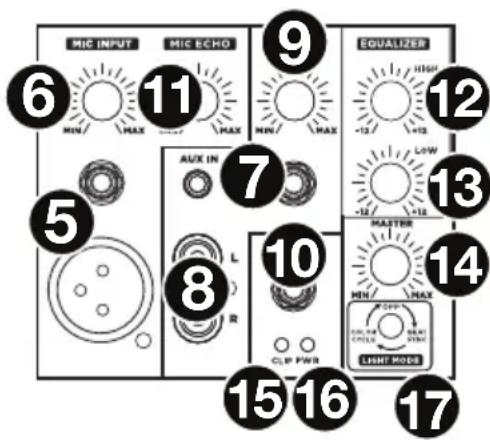
- Mic Inputs (1/4"/6.35 mm & XLR): Connect a dynamic microphone to the 1/4" (6.35 mm) or XLR inputs. Control the volume of the inputs using the Mic Input Volume knob.
- Mic Input Volume: Turn this knob to adjust the input volume of the Mic Input.
- Aux Inputs (1/8"/3.5 mm and 1/4"/6.35 mm): Connect a CD player, digital media player, or other audio source to the 1/8" (3.5 mm) and 1/4" (6.35 mm) stereo auxiliary inputs. Control the volume using the Aux Input Volume knob.
- RCA Inputs: Connect a CD player, digital media player, mixer, or other media source to these inputs. Control the volume using the Aux Input Volume knob.
- Aux Input Volume: Turn this knob to adjust the input volume of the Aux Input, XLR Input, and RCA Inputs.
- Mix Out (1/4" / 6.35 mm): Connect this output to another active (powered) speaker. The level of the output is controlled by the Mic Input Volume, Aux Input Volume, and Master Volume.
- Mic Echo: Use this knob to add or remove an echo effect to the Mic Inputs.
- High EQ: Increases or decreases the high (treble) frequencies for Mic Input, Line Input, and Media Panel sources at a range between -12 dB to +12 dB.
- Low EQ: Increases or decreases the low (bass) frequencies for Mic Input, Line Input, and Media Panel sources at a range between -12 dB to +12 dB.
- Master Volume: Turn this knob to adjust the overall output volume of the loudspeaker.
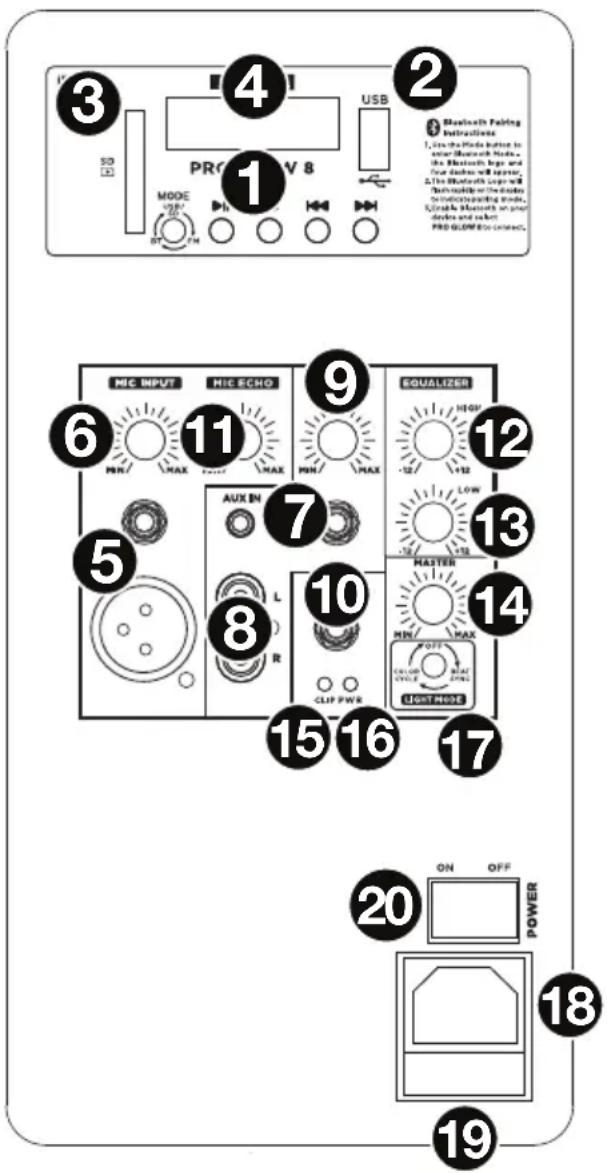
- Clip LED: This LED will flash red if the signal from the inputs or media panel source is clipping. If this happens, decrease the setting of the Mic Input Volume knob, Aux Input Volume knob, or Master Volume knob.
- Power LED: Indicates whether Pro Glow 8 is powered on or off.
-
Light Mode Button: Press this button to select how the lights on the front panel function:
-
Color Cycle: The lights slowly glow and cycle through colors. Press and hold the light mode button to freeze the lights on one color. This is the default mode when Pro Glow 8 is first powered on.
- Beat Sync: The lights react to the beat of the music.
-
Off: The lights turn off.
-
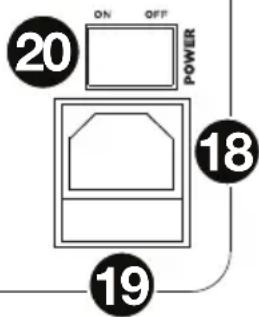
Power Cable Input (IEC): Insert the included power cable here to power the unit.
- Fuse: The orientation of the fuse holder determines the current voltage setting of Pro Glow 8. If the unit's fuse is broken, remove the fuse holder and replace the broken fuse with one with the same rating (printed on the fuse holder). Using a fuse with an incorrect rating can damage the unit and/or fuse.
- Power Switch: Turns Pro Glow 8 on or off.
Media Panel
Media Panel Functions:
MODE Mode: Switches modes from USB, SD, FM radio, or Bluetooth.
Note: A USB drive or SD card must contain playable files in order for it to appear properly in the media panel's display. You can play MP3s, WAVs, and WMA files.

Play/Pause: Play/pause the USB, SD, or Bluetooth source. Press and hold Play/Pause for 2 seconds to begin the preset auto-store function. This jumps to the lowest station (87.5) and then travels through the bandwidth to auto-store the strongest stations as presets.

Repeat: Repeat all of the tracks (ALL), repeat all of the tracks in the folder (FOLd), repeat the current playing USB or SD track (OnE), or shuffle the track order (rAn).

Previous: Plays the previous USB, SD, or Bluetooth track. When listening to the FM radio), press the button once to skip back through the FM stations and hold the button down to seek back through the channel presets.

Next: Plays the next USB, SD, or Bluetooth track. When listening to the FM radio, press the button once to tune the radio down one preset and hold the button down to seek forward through the channel presets.
Note: In some apps, pressing the Previous (◀◀) or Next (▶▶) buttons may go to another playlist or music genre.
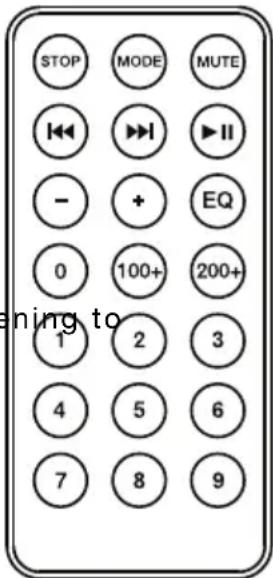
Media Panel Remote
Note: Aim the remote straight at the front of the speaker woofer. Room lighting and battery life can affect the operating range of the remote control.
Note: In order to use the remote control for the first time, first pull out the tab attached to the battery compartment. To change the remote battery, follow the diagram located on the back of the remote. Use a 3 V DC CR2032 lithium button cell battery for replacement.
- Stop: Stops the media panel source from playing.
- Mode: Selects the media panel source: USB, SD, FM radio, or Bluetooth.
Note: A USB drive or SD card must contain playable files in order for it to appear properly in the media panel's display. You can play MP3s, WAVs, and WMA files. - Mute: Silences the music playback on media panel sources.
- Prev (I◄◄): Goes to the previous USB or SD card track. When lists Bluetooth sources, pressing Prev in some apps may go to another playlist or music genre. When listening to the FM radio, press the Prev button once to skip back through the FM stations and hold the button down to seek back through the channel presets.
-
Next (▶▶I): Advances to the next USB or SD card track. When listening to Bluetooth sources, pressing Next in some apps may go to another playlist or music genre. When listening to the FM radio, press the Next button once to tune the radio down one preset and hold the button down to seek forward through the channel presets.
-
Play/Pause (▶II): Plays or pauses the USB, SD, or Bluetooth media panel source. Press and hold Play/Pause for 2 seconds to begin the preset auto-store function. This jumps to the lowest station (87.5) and then travels through the FM band to auto-store the strongest stations as presets.
Note: Files are played from the USB or SD source first by alphabetical order of what is on the root level, then alphabetical by folder, and then alphabetical by the track name.
-
Vol -: Decreases the media panel source volume.
-
Vol +: Increases the media panel source volume.
Note: The remote volume only affects the media panel source and works together with the physical media panel volume knob on the unit's rear panel.
- EQ: Selects one of the following digital EQ presets to use with a media panel source: Bass (BAS), Pop (POP), Rock (rOC), Jazz (JA2), Classical (CLA), Country (COU), No EQ (OFF, factory default setting).
Note: The digital EQ only works for Bluetooth, USB flash drive, and SD card sources.
- 100+: Jumps ahead by 100 tracks.
-
200+: Jumps ahead by 200 tracks.
-
Number Keys: Provides channel selection for FM radio stations, and track selection for USB and SD card sources.
Operation
Pairing a Bluetooth Device
- Turn on your Bluetooth device.
- Power on Pro Glow 8.
- Use the Mode button to select Bluetooth mode, which appears as "bt" in the display. Pro Glow 8 will automatically go into pairing mode to search for Bluetooth devices. You will know you are in pairing mode when the Bluetooth icon is flashing.
- Navigate to your Bluetooth device's setup screen, find PRO GLOW 8, and connect. The Bluetooth icon will remain solidly lit.
Note: Users should consider updating their device's OS if experiencing trouble with pairing or playing music. - To disconnect pairing, turn off Bluetooth on your device or select Forget this device from your device.
Connecting Two Speakers
To link two Pro Glow 8 speakers:
- Plug a 1/4" cable into the Mix Output located on the rear panel of one Pro Glow 8.
- Plug the other end of the 1/4" cable into the 1/4" input of another Pro Glow 8.
- Power on both speakers. Use the Aux Input Volume on the second speaker to adjust the input signal level.
Troubleshooting
If the sound is distorted: Try lowering the volume control of your sound source or musical instrument. Also, try to reduce the overall volume of Pro Glow 8.
If there is too much bass: Try adjusting the tone or EQ control from Pro Glow 8 or your sound source to lower the bass level. This will allow you to play the music louder before clipping (distortion) occurs.
If there is a high-pitched whistling noise when using a microphone: This is probably feedback. Point the microphone away from the speaker.
If you can't hear the microphone over the music volume: Turn down the music volume from your source.
When I press Previous (◀◀) or Next (▶▶▶), it doesn't increment to the next FM station: Short presses of the button will jump to presets. Hold the button down to seek to the next station.
If the radio station channel is flashing: The unit is currently muted. Unmute to stop the flashing and resume playback.
If the Bluetooth logo is flashing rapidly: The unit is currently in pairing mode.
If the Bluetooth logo is flashing slowly: A device is paired, but the music is muted. Unmute to stop the flashing and resume playback.
The USB track number (Example: 001) is flashing slowly: The USB drive music playback is muted. Unmute to stop the flashing and resume playback.
The LCD shows "NONE": If a USB drive or SD card is already properly inserted, make sure it contains playable files (MP3s, WAVs, and WMA files).
If you cannot connect your audio device to Pro Glow 8 via Bluetooth:
- Have your audio device (e.g., smartphone or tablet) and Pro Glow 8 as close together as possible while trying to connect. Make sure both the audio device and Pro Glow 8 are unobstructed by walls, furniture, etc.
- Reset the Bluetooth connection on Pro Glow 8 to disconnect Pro Glow 8 from any other audio device and restart the search process. If this does not work right away, power off Pro Glow 8 and then power it back on. See Operation > Pairing a Bluetooth Device for more information.
- Reset the Bluetooth connection on your audio device by turning Bluetooth off and back on. You can find this under the Bluetooth menu in the Settings for your phone or other audio device.
If this does not work, and you have connected to Pro Glow 8 before, find Pro Glow 8 in the list of available or previously connected devices in your audio device's Bluetooth menu, tap the "gear" or "i" icon located next to it and then select Unpair or Forget. Turn Pro Glow 8 off and back on and try pairing again once it reappears in your available devices list.
Note: If Pro Glow 8 has been paired to another audio device recently that is still within range, you may need to repeat this process with that audio device to fully disconnect.
Technical Specifications
| Output Power | 150 W (peak) |
| Max SPL (@ 1 m) | 103 dB (peak) |
| Low Frequency | 8.0" / 203 mm woofer; 1.5" / 38.1 mm voice coil |
| High Frequency | 0.98" / 25 mm Ti. Diap, 8Ω |
| Crossover | 3 kHz |
| Frequency Response | 50 Hz – 19 kHz |
| Frequency Range | 45 Hz – 19 kHz |
| Horn Coverage | 70/100° H x 50° V |
| Input | Gain Range: 500-600mVMax Input Level: 1VImpedance: 40 KΩ |
| External Controls | Channel volume, master volume, power on/off with LED, clip limiter with LED, echo, 2-band equalizer, mode, play/pause, repeat, previous track, next track |
| Connectors | (1) XLR input(1) 1/4" (6.35 mm) TRS input(1) 1/8" (3.5 mm) TRS input(1) stereo RCA input pair(1) 1/4" mix output(1) SD card slot(1) USB port (host)(1) IEC power connection |
| Bluetooth* | Profile: A2DPModule: AC690X, v4.2Speed: 3 MbpsRange: Up to 100 feet / 30.5 meters |
| USB/SD Card | Audio: Music playback from USB drive or SD cardSupported File System: FAT 32Supported File Types: MP3, WAV, WMAMaximum File Size: 16 GBMaximum USB Drive / SD Card Capacity: 16 GB |
| Power | Speaker: 100-120 V AC / 200-240 V AC, 50/60 HzRemote Control: 3V DC CR2032 lithium button cell battery |
| Weight | 13.0 lbs. / 5.9 kgs |
| Dimensions(width x depth x height) | 9.8" x 8.1" x 15.3 / 251 x 206 x 389 mm |
Specifications are subject to change without notice. Bluetooth and wireless reception and range are affected by walls, obstructions, and movement. For optimal performance, place the product in the center of the room so it is unobstructed by walls, furniture, etc. Battery life may vary based on temperature, age, and volume usage of product.
Trademarks & Licenses
ION Audio is a trademark of ION Audio, LLC, registered in the U.S. and other countries. The Bluetooth word mark and logos are owned by the Bluetooth SIG, Inc. and any use of such marks by ION Audio is under license. All other product names, company names, trademarks, or trade names are those of their respective owners.
ionaudio.com
- Quickstart Guide (English)
- Introduction
- Box Contents
- Support
- Quick Setup
- Connection Diagram
- Features
- Rear Panel
- Media Panel
- Media Panel Functions:
- Media Panel Remote
- Operation
- Pairing a Bluetooth Device
- Connecting Two Speakers
- Troubleshooting
- If you cannot connect your audio device to Pro Glow 8 via Bluetooth:
- Trademarks & Licenses
Brand : ION
Model : Pro Glow 8
Category : Loudspeaker