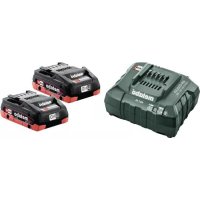
LiHD 18V - Battery METABO - Free user manual and instructions
Find the device manual for free LiHD 18V METABO in PDF.



| Product type | Lithium-ion rechargeable battery (LiHD) |
| Nominal voltage | 18 V |
| Capacity | 2.0 - 8.0 Ah (depending on model) |
| Technology | High-density Lithium-ion (LiHD) |
| Charger compatibility | ASC ultra, ASC 145, ASC 30-36, ASC 55, SC 60 Plus, SC 30 |
| Dimensions (L x W x H) | Approx. 120 x 80 x 60 mm |
| Weight | Approx. 0.6 kg |
| Recommended charging temperature | 0 °C to 50 °C |
| Charge status indicator | Button and LED on the battery |
| Protection | Deep discharge, overheating, overcurrent |
| Maintenance and cleaning | Clean contacts with a dry cloth; do not immerse |
| Safety | Do not open, do not expose to moisture, do not throw into fire |
| Spare parts and repairability | Battery not repairable; contact Metabo after-sales service |
| General information | Intended use: Metabo and CAS tools |
Frequently Asked Questions - LiHD 18V METABO
User questions about LiHD 18V METABO
0 question about this device. Answer the ones you know or ask your own.
Ask a new question about this device
Download the instructions for your Battery in PDF format for free! Find your manual LiHD 18V - METABO and take your electronic device back in hand. On this page are published all the documents necessary for the use of your device. LiHD 18V by METABO.
USER MANUAL LiHD 18V METABO
natural_image
Two Metabo miniators with ventilation grilles, one labeled 'AIR COOL EEO' and the other 'ASC 600s', shown in black (no additional text or symbols visible)
Original instructions
1. Declaration of Conformity
We, being solely responsible: Hereby declare that these chargers, identified by type and serial number *1), meet the requirements of all relevant directives *2) and standards *3). Technical documents for *4) - see page 3.
2. Specified Conditions of Use
Chargers are only suitable for charging Metabo and CAS (Cordless Alliance System) battery packs.
This device is not designed for use by persons (including children) with physical, sensory or mental disabilities, or with insufficient experience and/or knowledge, unless they are supervised by a person responsible for their safety, or have received instructions on how to use the device by this person.
ASC 30-36 is suitable for charging Li-ion battery packs (14.4 V - 36 V, 1.3 Ah - 8.0 Ah, 4-10 cells).
ASC 55 is suitable for charging Li-ion battery packs (12 V - 36 V, 1.3 Ah - 8.0 Ah, 3-10 cells).
ASC 145 is suitable for charging Li-ion battery packs (12 V - 36 V, 1.3 Ah - 8.0 Ah, 3-10 cells).
ASC ultra is suitable for charging Li-ion battery packs (corresponding to the print on the tool, either 14.4 V - 36 V, 1.3 Ah - 8.0 Ah, 4-10 cells, or 12 V - 36 V, 1.3 Ah - 8.0 Ah, 3-10 cells).
SC 60 Plus is suitable for charging Li-ion battery packs (14.4 V - 18 V, 1.3 Ah - 8.0 Ah, 4-10 cells).
SC 30 is suitable for charging Li-ion battery packs (12 V - 18 V, 1.3 Ah - 8.0 Ah, 3-10 cells).
ASC 55 is suited for charging NiCd battery packs (12V, 1.7Ah, 10cells).

Never attempt to charge batteries that are not rechargeable. Danger of explosion!
The user bears sole responsibility for any damage caused by inappropriate use.
Generally accepted accident-prevention regulations and accompanying safety instructions should be observed.
3. General Safety Information

WARNING – Read the operating instructions to reduce the risk of injury.

WARNING Read all safety warnings and instructions.
Failure to follow all safety warnings and instructions may result in electric shock, fire and/or serious injury.
Keep all safety instructions and information for future reference.

Before using the charger, carefully read through and familiarise yourself with all closed safety information e Operating Instructions.
Keep all enclosed documentation for future reference, and pass on your charger only together with this documentation.
4. Special Safety Instructions

For your own protection and for the protection of your power tool, pay attention to its of the text that are marked is symbol!
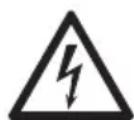
Danger - electrical voltage!

A slightly acidic, flammable fluid may leak from defective Li-ion battery packs!
If battery fluid leaks out and comes into contact with your skin, rinse immediately with plenty of water. If battery fluid leaks out and comes into contact with your eyes, wash them with clean water and seek medical attention immediately! Do not recharge a fully charged battery pack!

Only for use in indoor rooms.

Protect the charger from moisture.
Never allow children to use the device.
ENGLISHen
Children should be supervised to ensure that they do not play with the tool.
Keep children away from the battery charger and the working area!
Keep your battery charger out of reach of children!
Pull out the mains plug immediately if the battery charger starts to smoke or flames emerge!
Do not insert objects into the ventilation slots on the battery charger – there is a danger of electric shocks and short circuits!
Do not use faulty battery packs. In areas with high metal dust exposure do not charge any battery packs with AIR COOLED chargers.
5. Overview
See page 2. The illustrations are regarded as exemplary for all devices.
1 Battery pack (not in scope of delivery)
2 Sliding seat
3 Operation display
4 Warning display
6. Initial Operation

Before commissioning, check that the rated mains voltage and mains frequency stated on the type plate match your power supply.
Devices like these that generate direct current can influence simple earth leakage protection devices. Use a type F or better, with a release current of max. 30 mA.

Before commissioning the charger, ensure that the air slots are free. Minimum distance to other objects is 5 cm!
6.1 Self-test
Plug in.
The warning display (4) and the operating indicator (3) light up one after the other for approx. 1 second and the installed fan runs for approx. 5 seconds.
7. Use
7.1 Charging battery pack
Push the battery pack completely to the stop on the sliding seat (2).

The operating indicator (3) flashes.
Note: To have the charge level displayed on Li-ion battery packs, first take the battery pack out of the charger and then press the button on the battery pack.
7.2 Conservation charge
Once the charging process has finished, the battery charger automatically switches to conservation mode.
The battery pack can remain in the battery charger and is therefore always ready for use.

The operating display (3) lights up continuously.
8. Faults
8.1 Warning display (4) lights up continuously

Battery pack is not charged. Excessive/insufficient temperature. When the temperature of the battery pack is between 0 °C and 50 °C, the charging process begins automatically.
8.2 Warning display (4) flashes

- Battery pack is defective. Remove the battery pack immediately from the charger.
- The battery pack was not pushed correctly onto the sliding seat (2). See chapter 7.1.
9. Repairs
Repairs to the charger must only be carried out by qualified electricians.
If the mains connection cable of this device is damaged, it must be replaced by the manufacturer or the Customer Service department of the manufacturer or a similarly qualified person to prevent endangering personnel and property.
If you have Metabo charges that require repairs, please contact your Metabo service centre. See www.metabo.com for addresses.
10. Environmental Protection
Observe national regulations on environmentally compatible disposal and on the recycling of disused machines, packaging and accessories.

Only for EU countries: never dispose of power tools in your household waste! According to European Directive 2012/19/EU
on Waste from Electric and Electronic Equipment and implementation in national law, used power tools must be collected separately and recycled in an environmentally-friendly manner.
11. Technical Specifications
See page 3.
U = voltage ranges of the battery packs
C = battery pack capacity
I_C = charging current
t = charging time
^1) Depending on the residual capacity and the temperature of the battery pack, real charging times may deviate from the specifications.
Recommended ambient temperature when charging: 0 °C to 50 °C
Changes due to technological progress reserved.
Device of protection class II
\~ AC Power
Notice originale
C = accupack-capaciteit
I_C = laadstroom
t = laadtijd

- Original instructions
- Declaration of Conformity
- Specified Conditions of Use
- General Safety Information
- Keep all safety instructions and information for future reference.
- Special Safety Instructions
- ENGLISHen
- Overview
- Initial Operation
- Self-test
- Use
- Charging battery pack
- Conservation charge
- Faults
- Warning display (4) lights up continuously
- Warning display (4) flashes
- Repairs
- Environmental Protection
- Technical Specifications
- Notice originale
Brand : METABO
Model : LiHD 18V
Category : Battery