D505 - Cellphone LG - Free user manual and instructions
Find the device manual for free D505 LG in PDF.
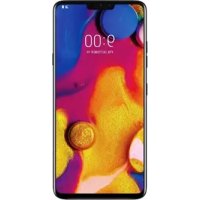


| Product Type | Mobile Phone |
| Brand | LG |
| Model | D505 |
| Operating System | Android (unspecified version) |
| Display | Capacitive Touchscreen |
| Expandable Storage | microSD card up to 32 GB |
| Network | GSM / 3G (depending on carrier) |
| Connectivity | Wi-Fi 802.11 b/g/n, Bluetooth 4.0, NFC, GPS |
| Rear Camera | Sensor (unspecified), LED flash, HD video recording |
| Front Camera | For selfies and video calls |
| Battery | Rechargeable Li-ion, removable, charging time 3 h |
| Power Supply | USB charger 5 V (included) |
| Main Features | Calls, SMS/MMS, email, Web browsing, camera, video, music, GPS, Bluetooth, Wi-Fi, NFC, SmartShare, QuickMemo, QuickRemote, VuTalk |
| Sensors | Proximity sensor, accelerometer |
| Care and Cleaning | Use a dry cloth; do not use solvents |
| Security | Pattern lock, PIN code, password, facial recognition |
| Spare Parts and Repairability | Removable battery, micro-SIM card, microSD card; repair by qualified technician |
| SAR (Head) | 0.558 W/kg (10 g) |
| SAR (Body) | 0.570 W/kg (10 g) |
| General Information | Manual in French, English, Dutch; 2-year warranty |
Frequently Asked Questions - D505 LG
User questions about D505 LG
0 question about this device. Answer the ones you know or ask your own.
Ask a new question about this device
Download the instructions for your Cellphone in PDF format for free! Find your manual D505 - LG and take your electronic device back in hand. On this page are published all the documents necessary for the use of your device. D505 by LG.
USER MANUAL D505 LG
Applications
Travel Adapter Stereo Headset
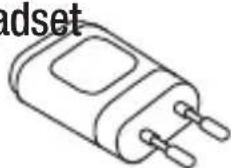
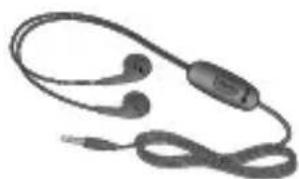
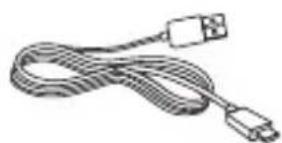
Quick Start Guide Data Cable
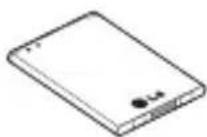
Battery
NOTE:
VuTalk registration. 74
- Screen displays and illustrations may differ from those you see on actual phone.
- Some of the contents of this guide may not apply to your phone, depending on the software and your service provider. All information in this document is subject to change without notice.
This handset is not suitable for people who have a visual impairment due to the touch screen keyboard.
Copyright ©2013 LG Electronics, Inc. All rights reserved. LG and the LG logo are registered trademarks of LG Group and its related entities. All other trademarks are the property of their respective owners.
- Google™, Google Maps™, Gmail™, YouTube™, Hangouts™ and Play Store™ are trademarks of Google, Inc.
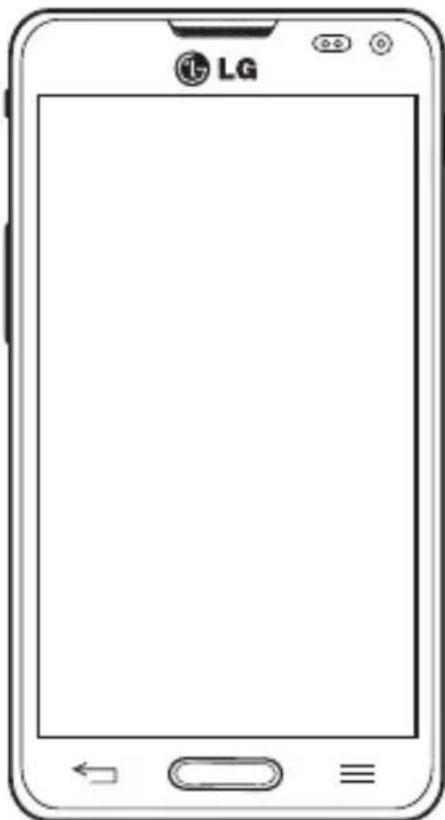
Table of contents
Guidelines for safe and efficient use.....5
Important notice 13
Getting to know your phone. 19
Phone overview 19
Installing the Micro SIM card and battery. 21
Charging your phone 23
Inserting a microSD card 24
Removing the microSD card 25
Formatting the microSD card. 25
Locking and unlocking the screen.....25
Your Home screen 27
Touch Screen tips 27
Home screen 28
Customizing the Home screen 28
Returning to recently-used applications.29
Notifications 29
Swipe down for notifications & settings
Quick Settings
Indicator icons on the Status Bar
On-screen keyboard
Entering accented letters
Google account setup
Connecting to Networks and Devices
Wi-Fi
Connecting to Wi-Fi networks
Turning Wi-Fi on and connecting to a Wi-Fi network
Bluetooth
Bluetooth tethering
Smartphone Mobile Hotspots
Enabling Wi-Fi Direct to share through SmartShare
SmartShare
NFC 41
Android Beam 42
File networking. 42
Calls 44
Making a call. 44
Calling your contacts 44
Answering and rejecting a call 44
Adjusting the in-call volume. 45
Making a second call. 45
Ending a Call 45
Ending a Call from the Status Bar 46
Viewing your call logs. 46
Call settings. 47
Contacts 48
Searching for a contact. 48
Adding a new contact
Favorite Contacts
Creating a group
Messaging
Conversation view
Sending a message
Using smileys
Changing your message settings
Managing an E-mail account
Working with account folders
Composing and sending E-mail
Camera
Getting to know the viewfinder
Using the advanced settings
Taking a quick photo 56
Once you've taken a photo. 56
Viewing your saved photos 58
Video camera 59
Getting to know the viewfinder 59
Using the advanced settings. 60
Recording a quick video. 60
After recording a video. 61
Watching your saved videos 61
Adjusting the volume when viewing a video 61
LG Unique Functions 62
QuickMemo 62
Using the QuickMemo options 63
Viewing the saved QuickMemo 63
QuickRemote 64
To open the QuickRemote application and set up your QuickRemote(s) 64
Using QuickRemote. 65
QuickRemote options 65
Live Zooming. 66
QSlide 67
QuickTranslator 68
VuTalk 69
Registering VuTalk 69
Using VuTalk. 70
Multimedia. 71
Gallery. 71
Viewing pictures 71
Zooming in and out. 71
Playing videos 71
Viewing photo and video options. 72
Deleting images and videos. 72
Setting as wallpaper 72
Videos 72
Playing a video 72
Music 73
Add music files to your phone. 73
Transfer music using Media sync (MTP) 74
Playing a song. 74
Utilities 76
Setting your alarm 76
Using your calculator 76
Adding an event to your calendar....76
File Manager. 77
Application Manager. 78
Voice Recorder 78
Recording a sound or voice 78
Sending the voice recording 78
Task Manager. 79
PolarisViewer4. 79
FileShare 79
Table of contents
LG Backup 80
About backing up and restoring
smartphone data 80
LG Backup your smart phone data......81
Scheduling automatic backups 81
Restoring smartphone data. 81
Google+ .82
Voice Search. 82
Downloads 83
The Web 84
Internet. 84
Using the Web toolbar 84
Viewing webpages 84
Opening a page 84
Searching the web by voice. 85
Bookmarks 85
History 85
Using QSlide. 85
Chrome 85
Viewing webpages 86
Opening a page 86
Searching the web by voice. 86
Syncing with other devices. 86
Settings. 87
Access the Settings menu 87
WIRELESS & NETWORKS 87
DEVICE 90
PERSONAL 93
SYSTEM. 94
PC software (LG PC Suite) 99
Phone software update 102
Phone software update 102
LG Mobile Phone Software update via
Over-the-Air (OTA) 102
About this user guide 104
About this user guide. 104
Trademarks 104
DivX HD 105
Accessories. 106
Troubleshooting 107
Guidelines for safe and efficient use
Please read these simple guidelines. Not following these guidelines may be dangerous or illegal.
Should a fault occur, a software tool is built into your device that will gather a fault log. This tool gathers only data specific to the fault, such as signal strength, cell ID position in sudden call drop and applications loaded. The log is used only to help determine the cause of the fault. These logs are encrypted and can only be accessed by an authorized LG Repair centre should you need to return your device for repair.
Exposure to radio frequency energy
Radio wave exposure and Specific Absorption Rate (SAR) information.
This mobile phone model LG-D505 has been designed to comply with applicable safety requirements for exposure to radio waves. These requirements are based on scientific guidelines that include safety margins designed to assure the safety of all persons, regardless of age and health.
- The radio wave exposure guidelines employ a unit of measurement known as the Specific Absorption Rate (SAR). Tests for SAR are conducted using standardised methods with the phone transmitting at its highest certified power level in all used frequency bands.
- While there may be differences between the SAR levels of various LG phone models, they are all designed to meet the relevant guidelines for exposure to radio waves.
- The SAR limit recommended by the International Commission on Non-Ionizing Radiation Protection (ICNIRP) is 2 W/kg averaged over 10g of tissue.
- The highest SAR value for this model phone tested for use at the ear is 0.558 W/kg (10g) and when worn on the body is 0.570 W/kg (10g).
- This device meets RF exposure guidelines when used either in the normal use position against the ear or when positioned at least 1.5 cm away from the body. When a carry case, belt clip or holder is used for body-worn operation, it should not contain metal and should position the product at least 1.5 cm away from your body.
Guidelines for safe and efficient use
In order to transmit data files or messages, this device requires a quality connection to the network. In some cases, transmission of data files or messages may be delayed until such a connection is available. Ensure the above separation distance instructions are followed until the transmission is completed.
Product care and maintenance

WARNING
Only use batteries, chargers and accessories approved for use with this particular phone model. The use of any other types may invalidate any approval or warranty applying to the phone and may be dangerous.
- Do not disassemble this unit. Take it to a qualified service technician when repair work is required.
- Repairs under warranty, at LG's discretion, may include replacement parts or boards that are either new or reconditioned, provided that they have functionality equal to that of the parts being replaced.
- Keep away from electrical appliances such as TVs, radios and personal computers.
- The unit should be kept away from heat sources such as radiators or cookers. Do not drop.
- Do not subject this unit to mechanical vibration or shock.
- Switch off the phone in any area where you are required to by special regulations. For example, do not use your phone in hospitals as it may affect sensitive medical equipment.
- Do not handle the phone with wet hands while it is being charged. It may cause an electric shock and can seriously damage your phone.
- Do not charge a handset near flammable material as the handset can become hot and create a fire hazard.
- Use a dry cloth to clean the exterior of the unit (do not use solvents such as benzene,
- Do not charge the phone when it is on soft furnishings.
- The phone should be charged in a well ventilated area.
- Do not subject this unit to excessive smoke or dust.
- Do not keep the phone next to credit cards or transport tickets; it can affect the information on the magnetic strips.
- Do not tap the screen with a sharp object as it may damage the phone.
- Do not expose the phone to liquid or moisture.
- Use accessories like earphones cautiously. Do not touch the antenna unnecessarily.
- Do not use, touch or attempt to remove or fix broken, chipped or cracked glass. Damage to the glass display due to abuse or misuse is not covered under the warranty.
- Your phone is an electronic device that generates heat during normal operation. Extremely prolonged, direct skin contact in the absence of adequate ventilation may result in discomfort or minor burns. Therefore, use care when handling your phone during or immediately after operation.
- If your phone gets wet, immediately unplug it to dry off completely. Do not attempt to accelerate the drying process with an external heating source, such as an oven, microwave or hair dryer.
- The liquid in your wet phone changes the color of the product label inside your phone. Damage to your device as a result of exposure to liquid is not covered under your warranty.
Efficient phone operation
Electronics devices
All mobile phones may receive interference, which could affect performance.
- Do not use your mobile phone near medical equipment without requesting permission. Avoid placing the phone over pacemakers, for example, in your breast
Guidelines for safe and efficient use
pocket.
- Some hearing aids might be disturbed by mobile phones. Minor interference may affect TVs, radios, PCs etc.
- Use your phone in temperatures between 0°C and 40°C, if possible. Exposing your phone to extremely low or high temperatures may result in damage, malfunction, or even explosion.
Road safety
Check the laws and regulations on the use of mobile phones in the area when you drive.
- Do not use a hand-held phone while driving.
- Give full attention to driving.
- Pull off the road and park before making or answering a call if driving conditions so require.
- RF energy may affect some electronic systems in your vehicle such as car stereos and safety equipment.
- When your vehicle is equipped with an air bag, do not obstruct with installed or portable wireless equipment. It can cause the air bag to fail or cause serious injury due to improper performance.
- If you are listening to music whilst out and about, please ensure that the volume is at a reasonable level so that you are aware of your surroundings. This is of particular importance when near roads.
Avoid damage to your hearing
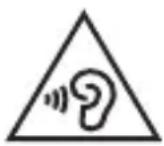
To prevent possible hearing damage, do not listen at high volume levels for long periods.
Damage to your hearing can occur if you are exposed to loud sound for long periods of time. We therefore recommend that you do not turn on or off the handset close to your ear. We also recommend that music and call volumes are set to a reasonable level.
- When using headphones, turn the volume down if you cannot hear the people speaking near you, or if the person sitting next to you can hear what you are listening to.
NOTE: Excessive sound pressure from earphones and headphones can cause hearing loss
Glass Parts
Some parts of your mobile device are made of glass. This glass could break if your mobile device is dropped on a hard surface or receives a substantial impact. If the glass breaks, do not touch or attempt to remove it. Stop using your mobile device until the glass is replaced by an authorised service provider.
Blasting area
Do not use the phone where blasting is in progress. Observe restrictions and follow any regulations or rules.
Potentially explosive atmospheres
- Do not use your phone at a refueling point.
- Do not use near fuel or chemicals.
- Do not transport or store flammable gas, liquid or explosives in the same compartment of your vehicle as your mobile phone or accessories.
Guidelines for safe and efficient use
In aircraft
Wireless devices can cause interference in aircraft.
- Turn your mobile phone off before boarding any aircraft.
- Do not use it on the ground without permission from the crew.
Children
Keep the phone in a safe place out of the reach of small children. It includes small parts which may cause a choking hazard if detached.
Emergency calls
Emergency calls may not be available on all mobile networks. Therefore you should never depend solely on your phone for emergency calls. Check with your local service provider.
Battery information and care
- You do not need to completely discharge the battery before recharging. Unlike other battery systems, there is no memory effect that could compromise the battery's performance.
- Use only LG batteries and chargers. LG chargers are designed to maximize battery life.
- Do not disassemble or short-circuit the battery.
- Replace the battery when it no longer provides acceptable performance. The battery pack may be recharged hundreds of times before it needs replacing.
- Recharge the battery if it has not been used for a long time to maximize usability.
- Do not expose the battery charger to direct sunlight or use it in high humidity, such as
in the bathroom.
- Do not leave the battery in hot or cold places, as this may deteriorate battery performance.
- There is risk of explosion if the battery is replaced with an incorrect type.
- Dispose of used batteries according to the manufacturer's instructions. Please recycle when possible. Do not dispose as household waste.
- If you need to replace the battery, take it to the nearest authorized LG Electronics service point or dealer for assistance.
- Always unplug the charger from the wall socket after the phone is fully charged to save unnecessary power consumption of the charger.
- Actual battery life will depend on network configuration, product settings, usage patterns, battery and environmental conditions.
- Make sure that no sharp-edged items such as animal's teeth or nails, come into contact with the battery. This could cause a fire.
DECLARATION OF CONFORMITY
Hereby, LG Electronics declares that this LG-D505 product is in compliance with the essential requirements and other relevant provisions of Directive 1999/5/EC. A copy of the Declaration of Conformity can be found at http://www.lg.com/global/declaration
Contact office for compliance of this product:
LG Electronics Inc.
EU Representative, Krijgsman 1,
1186 DM Amstelveen, The Netherlands
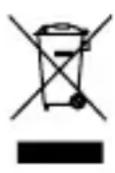
Disposal of your old appliance
1. All electrical and electronic products should be disposed of separately from the municipal waste stream via designated collection facilities appointed by the government or the local authorities. 2. The correct disposal of your old appliance will help prevent potential negative consequences for the environment and human health. 3. For more detailed information about disposal of your old appliance, please contact your city office, waste disposal service or the shop where you purchased the product.
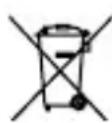
Disposal of waste batteries/accumulators
1. This symbol may be combined with chemical symbols for mercury (Hg), cadmium (Cd) or lead (Pb) if the battery contains more than 0.0005% of mercury, 0.002% of cadmium or 0.004% of lead. 2. All batteries/accumulators should be disposed separately from the municipal waste stream via designated collection facilities appointed by the government or the local authorities. 3. The correct disposal of your old batteries/accumulators will help to prevent potential negative consequences for the environment, animal and human health. 4. For more detailed information about disposal of your old batteries/accumulators, please contact your city office, waste disposal service or the shop where you purchased the product.
Important notice
Before you start using the phone, please read this!
Please check to see if any problems you have encountered with your phone are described in this section before taking the phone in for service or calling a service representative.
1. Phone Memory
In order to make more memory available, you will have to manage your applications and delete some data, such as applications or messages.
Managing applications
1 From the Home screen, tap Apps > Settings > Apps. 2 When the list of applications appears, scroll and tap the application you want to disable. 3 Tap Uninstall and then tap OK to confirm that you want to uninstall the desired application.
To stop applications
1 From the Home screen, tap Apps > Settings > Apps and select the RUNNING tab. 2 Scroll to the desired application and tap Stop to stop it.
Moving applications
To manage the internal storage efficiently, you can move applications from phone to the microSD card.
1 Touch > Settings >Apps. 2 Tap the downloaded application and then tap Move to SD card.
Important notice
2. Optimizing Battery Life
You can extend your battery's life between charges by turning off features that you don't need to run constantly in the background. You can also monitor how applications and system resources consume battery power.
To extend the life of your battery
- Turn off radio communications that you aren't using, such as Wi-Fi, Bluetooth, or GPS.
- Lower screen brightness and set a shorter screen timeout.
- Turn off automatic syncing for Gmail, Calendar, Contacts, and other applications.
- Some applications you have downloaded may cause your battery power to be reduced. While using downloaded applications, check the battery charged level.
To view the battery charge level
1 From the Home screen, tap Apps > Settings > About phone > Battery. 2 The battery status (charging or discharging) and level are displayed on the top menu of the screen.
To monitor and control what uses the battery
1 From the Home screen, tap Apps > Settings > About phone > Battery > Battery use. 2 The bottom of the screen displays battery usage time and also lists applications or services using battery power from greatest amount to least.
3. Installing an Open Source Operating System
Installing an open source operating system on your phone and not using the operating system provided by the manufacturer can cause your phone to malfunction.
Warning!
- If you install and use an OS other than the one provided by the manufacturer, your phone is no longer covered by the warranty.
- To protect your phone and personal data, download applications only from trusted sources, such as Play Store. If some applications are not properly installed on your phone, your phone may not work properly or serious errors may occur. You will need to uninstall those applications and all of their data and settings from the phone.
4. Using an unlock pattern
Set a screen lock to secure your phone from unauthorized use. To set the screen lock, follow the process below.
From the Home screen, tap Apps > Settings > Lock screen > Select screen lock and select from None, Swipe, Face Unlock, Pattern, PIN or Password.
NOTE: In case you have trouble with Face Unlock, you can unlock the screen with a pattern and/or PIN as a backup.
Warning! Take precautions when using an Unlock Pattern, PIN, or Password. It is very important that you remember the screen unlock information you set. You are allowed 5 attempts to enter your screen unlock information. If you used up all 5 opportunities, you will have to wait 30 seconds to attempt unlocking the phone again.
When you can't recall your Unlock Pattern, PIN, or Password:
If you logged into a Google account on the phone and failed to use the correct pattern 5 times, tap Forgot pattern? You will be required to sign in with your Google account and prompted to create a new unlock pattern.
If you have set a backup PIN, you can unlock the screen by entering the backup PIN. If you haven't created a Google account on the phone or you forgot your PIN or Password, you need to perform a hard reset.
Important notice
5. Using Hard Reset (Factory Reset)
If your phone needs to be restored to its original condition, use a Hard Reset to initialize your phone.
Warning! If you perform a Hard Reset, all user applications and user data will be deleted. Please remember to back up any important data before performing a Hard Reset.
1 Turn the phone off. 2 Press and hold the Power/Lock Key + Volume Down Key 3 LG Logo appears on the screen. And after a few seconds, FACTORY HARD RESET screen will appear, now release all keys. 4 The phone will allow you to select the factory reset function in the Android system recovery utility by pressing Power/Lock Key. 5 Press the Power/Lock Key again to confirm factory reset and your phone will be restored to its factory settings. To cancel, press any other key.
6. Using Safe Mode
To recover your phone when malfunctioning.
1 Turn off your phone and reboot. When you see the animation press and hold the Volume Down Key. Your main screen will then be displayed with the words "Safe mode" in the lower left corner. 2 From the Home screen, tap the Menu Key and tap System settings > Apps. 3 Tap one of the available tabs at the top of the screen and select the application you wish to uninstall. 4 Tap Uninstall and OK to confirm. 5 After uninstalling the application, turn off and reboot your phone.
7. Using a microSD Card
Pictures, Music and Video files, can be saved to external memory. Before saving these files to external memory, you need to insert a microSD card. If you have not inserted a microSD card, your items will be saved to internal memory.
Warning! Do not remove the microSD card without unmounting it first. Otherwise, it may damage the microSD card as well as your phone, and the data stored on the microSD card may be corrupted. To unmount the microSD card, from the Home screen, tap the Menu Key and tap System settings > Storage > Unmount SD card > OK.
8. Connecting Your Phone to a Computer via USB
1 Use the USB cable that was provided with your phone to connect the phone to a USB port on your computer. You'll receive a notification that the USB is connected and can see USB connection type pop-up.
2 Tap Media sync (MTP) to confirm that you want to transfer files between your phone's microSD card and the computer. When the phone is connected as USB storage, you receive a notification. Your phone's microSD card is installed as a drive on your computer. You can now copy files to and from the microSD card.
9. Opening and Switching Applications
Multi-tasking is easy with Android because you can keep more than one application running at the same time. There's no need to quit an application before opening another. Use and switch between several open applications. Android manages each application, stopping and starting them as needed to ensure that idle applications don't consume resources unnecessarily.
Important notice
TIP! To return to a recent application, press and hold the Home Key
The screen then displays a list of applications you have recently used.
10. Unlock Screen When Using Data Connection
Your screen will go dark if untouched for a period of time when using a data connection. To turn on your LCD screen, press the Power/Lock Key.
11. Hold the Phone Straight Up
Please hold the mobile phone straight up as a regular phone.
While making/receiving calls or sending/receiving data, try to avoid holding the lower part of the phone where the antenna is located. It may affect call quality.
12. When the Screen Freezes
If the phone does not respond to user input or the screen freezes:
Remove the battery, reinsert it, then turn the phone on.
OR
Press and hold the Power/Lock Key for 10 seconds to turn it off. If it still does not work, please contact the service center.
13. Do Not Connect Your Phone When You Power On/Off Your PC
Make sure to disconnect your phone from the PC when powering your PC on or off as it might result in PC errors.
Getting to know your phone
Phone overview
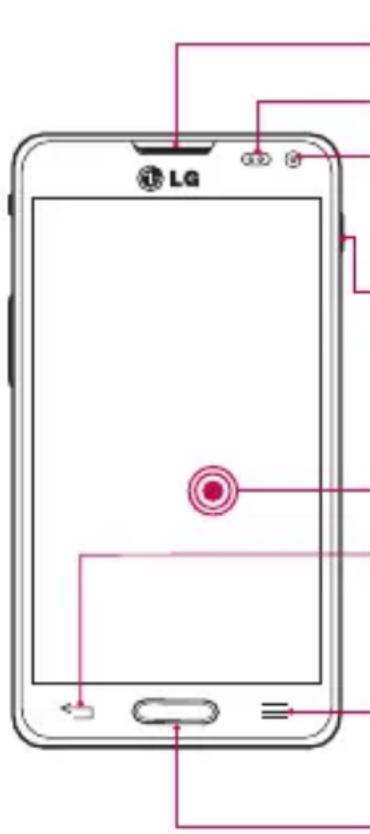
Earpiece
Proximity Sensor
Front-Facing Camera Lens
Use to take a picture of yourself or to video chat on supported applications.
Power/Lock Key
- Press and hold to power on and off, restart, or enable Airplane mode, or change the ringer type. Turns your screen on and off and locks it.
Touch screen
Back Key
- Returns to the previous screen.
- Closes pop-up menus and dialog boxes.
Menu Key
- Displays available options for the current screen or app.
Home Key
- Returns to the Home screen from any screen.
- Press and hold to view a list of the most recently used apps.
NOTE: Proximity sensor
When receiving and making calls, the proximity sensor automatically turns the backlight off and locks the touch screen by sensing when the phone is near your ear. This extends battery life and prevents you from unintentionally activating the touch screen during calls.

WARNING
Placing a heavy object on the phone or sitting on it can damage the LCD and touch screen functions. Do not cover the LCD proximity sensor with protective film. This could cause the sensor to malfunction.
Getting to know your phone
TIP!
- Tap the Menu Key whenever you open an application to check what options are available.
- If your phone has errors when you use it or you cannot turn it on, remove the battery, install it again and turn it on after 5 seconds.
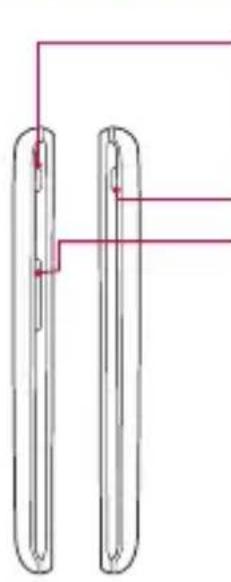
QuickButton Key (Customizable)
TIP! QuickButton
Press for quick access to your favorite app.
Power/Lock Key Volume keys
- On the Home screen: Controls ringer volume. During a call: Control your earpiece volume.
- When playing a track: Controls volume continuously.
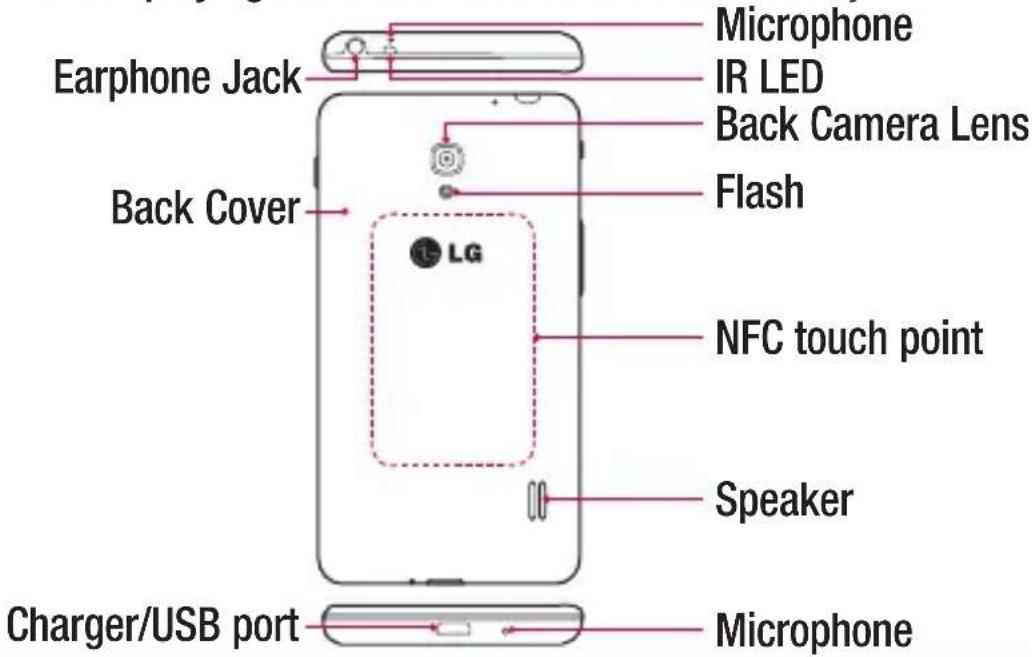

WARNING
- The NFC antenna for this model is on the back cover.
- Be careful not to damage the NFC touch point on the phone, which is part of the NFC antenna.
Installing the Micro SIM card and battery
Before you can start exploring your new phone, you'll need to set it up. To insert the Micro SIM card and battery:
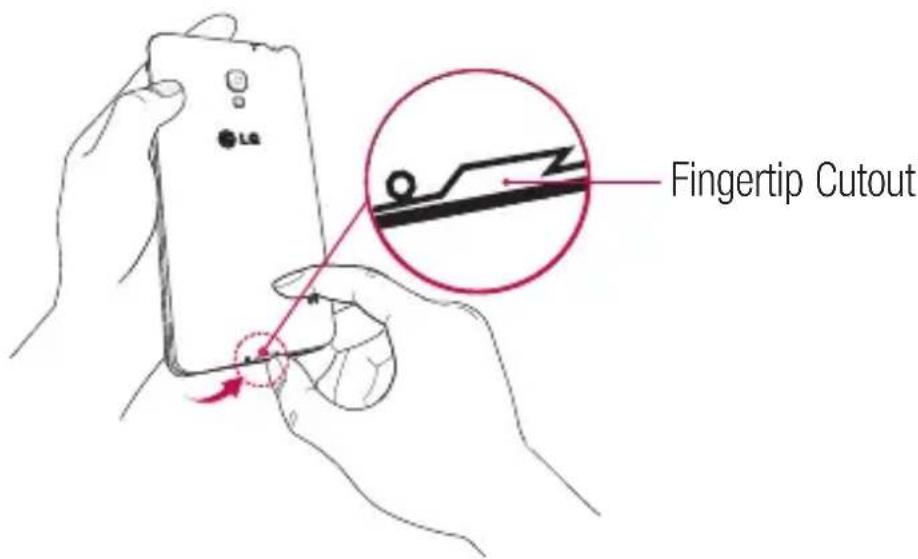
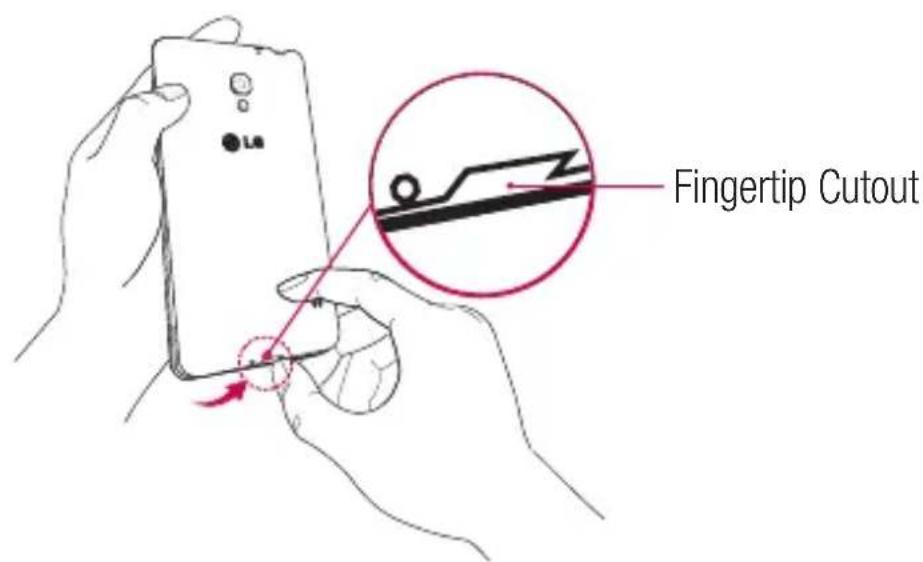
1. Hold the phone firmly in your hand. With the other hand, lift the battery cover using the fingertip cutout located on the bottom of the cover and pull it up to remove it.
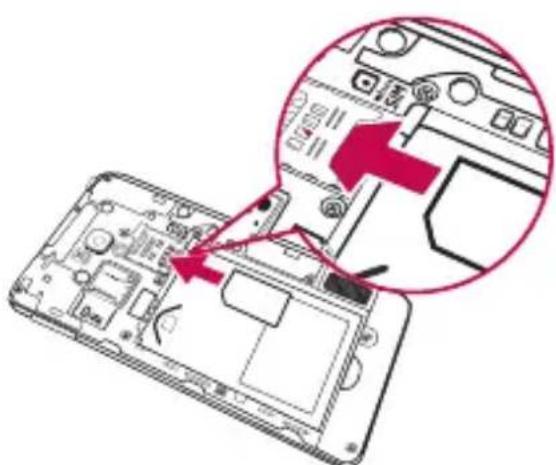
2. Slide the Micro SIM card into the Micro SIM card slot. Make sure the gold contact area on the card is facing downwards and the notched side is inserted first (see image below).
Getting to know your phone
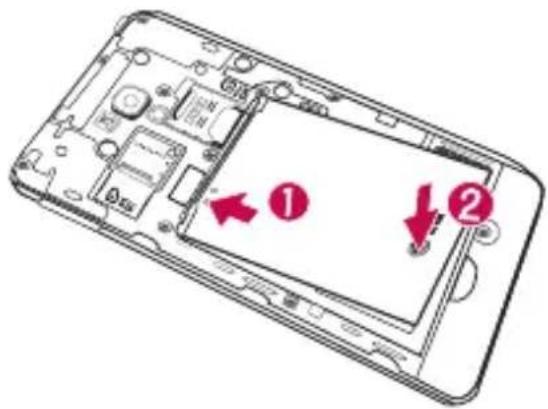
3. Insert the battery into place by aligning the gold contacts on the phone and the battery, and press the battery down until it clicks into place.
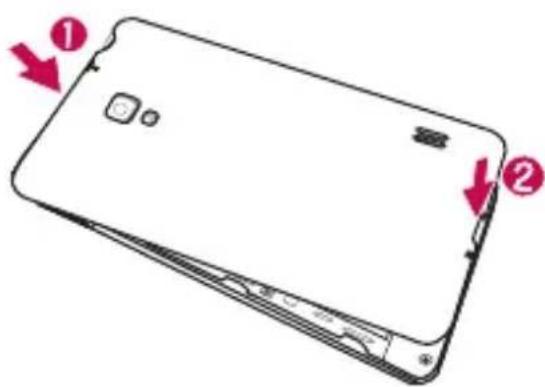
4. Align the battery cover over the battery compartment and press it down until it clicks into place.
Charging your phone
A rechargeable Li-ion battery is used to power your phone. A USB adapter, which is included with your phone, is used to charge the battery. Before using your phone for the first time, make sure the battery is fully charged. An uncharged battery will fully recharge after 3 hours.
NOTE: Make sure the battery is installed before connecting the USB adapter. If the battery is not installed and the USB adapter is connected, the phone will not operate properly due to prolonged power cycling. Also, removing the battery with the USB adapter connected may damage the device. Please unplug the USB adapter before removing the battery.
Warning! If the touch screen does not function while the phone is in the process of charging, this may be due to an unstable power supply. As a result, disconnect the USB cable from the device or unplug the USB adapter from the power outlet.
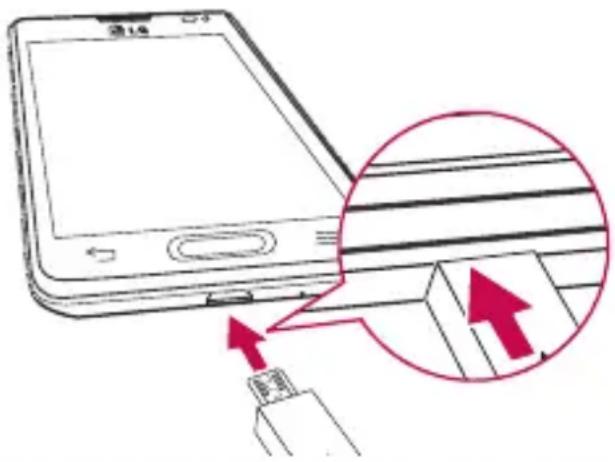
1. Connect the USB adapter and USB cable. 2. Plug the USB cable (as shown below) into the phone's Charger/USB port.
NOTE: The battery must be fully charged initially to improve battery lifetime.
Getting to know your phone
Inserting a microSD card
Insert a microSD™ card to use the camera and other multimedia features. Multimedia contents can be saved on the microSD card.
NOTE: This device supports up to a 32GB microSD card.
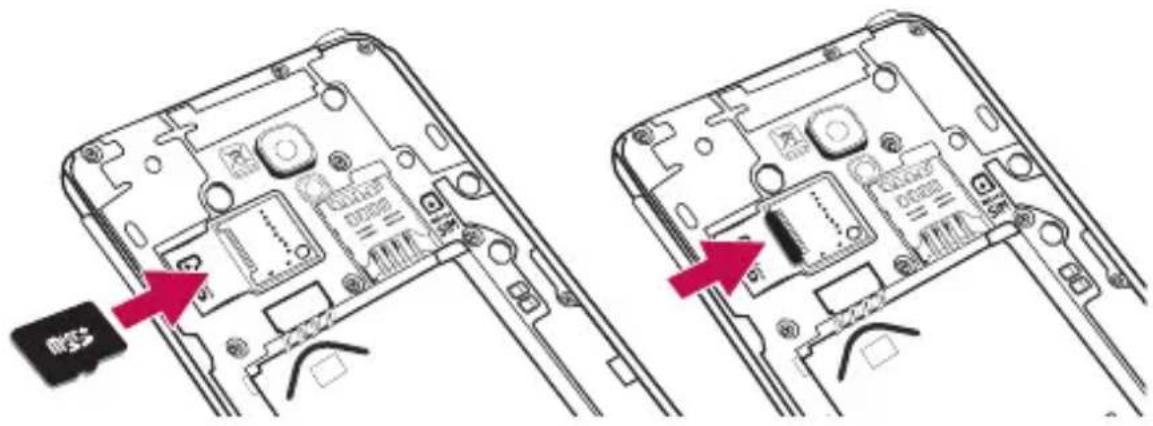
1. Turn the phone off before inserting or removing the microSD card. Remove the battery cover.
2. Then insert the microSD card into the slot. Make sure the gold contact area is facing upwards.
Removing the microSD card
To safely remove the microSD card from your phone, first you need to unmount it.
1. From the Home screen, tap Apps > Settings > Storage > Unmount SD card > OK. 2. Remove the battery cover and battery, then gently pull the microSD card from the slot.
Warning! Do not remove the microSD card without unmounting it first. Otherwise, it may damage the microSD card as well as your phone, and the data stored on the microSD card may be corrupted.
Formatting the microSD card
Warning! All files stored on your microSD card are deleted when you format the card.
1 From the Home screen, tap Apps > Settings > Storage. 2 Tap Erase SD card (twice). 3 If you set an unlock pattern, enter it and tap Erase everything. The card will then be formatted and ready to use.
NOTE: If there is content on your microSD card, the folder structure may be different after formatting since all the files will have been deleted.
Locking and unlocking the screen
If you do not use the phone for a while, the screen will be automatically turned off and locked. This helps to prevent accidental touches and saves battery power.
When you are not using the phone, press the Power/Lock Key to lock your phone.
Getting to know your phone
If there are any programs running when you lock your screen, they may be still running in Lock mode. It is recommended that you exit all programs before entering Lock mode to avoid unnecessary charges (e.g. phone calls, web access and data communications). To wake up your phone, press the Power/Lock Key. The Lock screen will appear. Touch and slide the Lock screen in any direction to unlock your Home screen. The last screen you viewed will open.
Your Home screen
Touch Screen tips
Here are some tips on how to navigate on your phone.
Tap or touch - A single finger tap selects items, links, shortcuts and letters on the on-screen keyboard.
Touch and hold - Touch and hold an item on the screen by touching it and not lifting your finger until an action occurs. For example, to open a contact's available options, touch and hold the contact in the Contacts list until the context menu opens.
Drag - Touch and hold an item for a moment and then, without lifting your finger, move your finger on the screen until you reach the target position. You can drag items on the Home screen to reposition them.
Swipe or slide - To swipe or slide, quickly move your finger across the surface of the screen, without pausing when you first touch it (so you don't drag an item instead). For example, you can slide the screen up or down to scroll through a list, or browse through the different Home screens by swiping from left to right (and vice versa).
Double-tap - Double-tap to zoom on a webpage or a map. For example, quickly double-tap a section of a webpage to adjust that section to fit the width of the screen. You can also double-tap to zoom in and out after taking a picture (using the Camera), and when using Maps.
Pinch-to-Zoom - Use your index finger and thumb in a pinching or spreading motion to zoom in or out when using the browser or Maps, or when browsing pictures.
Rotate the screen - From many applications and menus, the orientation of the screen adjusts to the device's physical orientation.
NOTE:
To select an item, touch the center of the icon. - Do not press too hard; the touch screen is sensitive enough to pick up a light, yet firm touch. - Use the tip of your finger to touch the option you want. Be careful not to touch any other keys.
Your Home screen
Home screen
Simply swipe your finger to the left or right to view the panels. You can customize each panel with apps, downloads, widgets and wallpapers.
NOTE: Some screen images may be different depending on your phone provider.
On your Home screen, you can view menu icons at the bottom of the screen. Menu icons provide easy, one-touch access to the functions you use the most.
Touch the Phone icon to bring up the touch screen dialpad to make a call. Touch the Contacts icon to open your contacts. Touch the Messaging icon to access the messaging menu and create a new message. Touch the Apps icon to display all of your installed applications. To open any application, simply touch the icon in the applications list.
Customizing the Home screen
You can customize your Home screen by adding apps, downloads, widgets or wallpapers. For more convenience using your phone, add your favorite apps and widgets to the Home screen.
To add items on your Home screen:
1 Touch and hold the empty part of the Home screen. 2 Tap the Apps, Downloads, Widgets or Wallpapers tab. 3 Drag the desired item to the desired location and lift your finger.
To remove an item from the Home screen:
Touch and hold the icon you want to remove, drag it to , and lift your finger.
TIP! To add an application icon to the Home screen from the Apps screen, touch and hold the application you want to add and drag it to the desired location.
TIP! Using folders
You can add several app icons in a folder. Drop one app icon over another one on a Home screen, and a folder will be created.
Returning to recently-used applications
1 Touch and hold the Home Key. The screen displays a pop-up containing the icons of applications you used recently. 2 Touch an icon to open the application. Or touch the Back Key ↔ to return to your previous screen.
Notifications
Notifications alert you to the arrival of new messages, calendar events, and alarms, as well as to ongoing events, such as video downloads.
From the Notifications Panel, you can view your phone's current status and pending notifications.
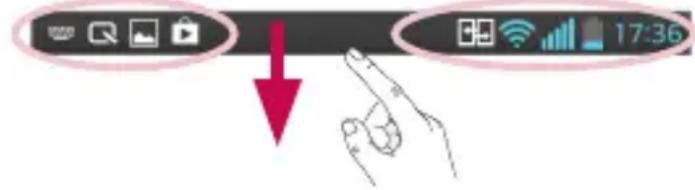
When a notification arrives, its icon appears at the top of the screen. Icons for pending notifications appear on the left, and system icons showing things like Wi-Fi or battery strength on the right.
NOTE: The available options may vary depending on the region or service provider.
Your Home screen
Pending notifications
System icons like Bluetooth, Wi-Fi & battery status
Swipe down for notifications & settings
Swipe the Status Bar down to open the Notifications Panel. To close the Notifications Panel, swipe the bar that is at the bottom of the screen upwards.
NOTE: Touch and hold an icon from the Quick Settings to view the function's settings menu.
Quick Settings
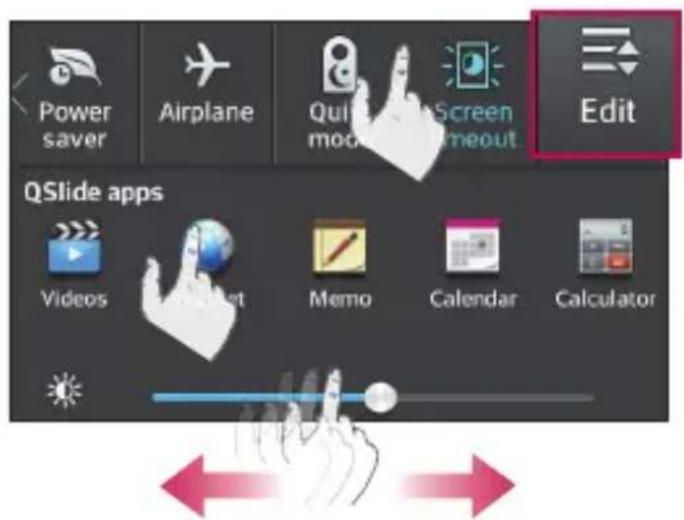
Use Quick Settings to easily toggle function settings like Wi-Fi, manage display brightness and more. The Quick Settings are located at the top of the Notifications Panel.
To rearrange Quick Setting items on the Notification Panel
Open the Notifications Panel and touch You can then view and rearrange the desired items on the Quick Settings menu. To set more items to be displayed on the Notifications panel, touch
Indicator icons on the Status Bar
Indicator icons appear on the Status Bar at the top of the screen to report missed calls, new messages, calendar events, device status and more.

The icons displayed at the top of the screen provide information about the status of the device. The icons listed in the table below are some of the most common ones.
| Icon Description Icon Description | ||
| No Micro SIM card Vibrate mode | ||
| No signal Battery fully charged | ||
| Airplane mode Battery is charging | ||
| Connected to a Wi-Fi network Downloading data | ||
| Wired headset Uploading data | ||
Your Home screen
| Call in progress SmartShare music play | ||
| Call hold GPS is acquiring | ||
| Missed call | Receiving location data from GPS | |
| Bluetooth is on Data isSyncing | ||
| NFC Card, Tag R/W. is available New | ||
| NFC Card, Tag R/W, P2P is available | New Hangouts message | |
| System warning New message | ||
| Alarm is set Song is playing | ||
| New voicemail | Phone is connected to PC via USB cable or USB tethering is active | |
| Ringer is silenced Wi-Fi Direct activated | ||
| Portable Wi-Fi hotspot is active SmartShare on | ||
NOTE: The icons location in the Status Bar may differ according to the function or service.
On-screen keyboard
You can enter text using the on-screen keyboard. The on-screen keyboard appears automatically on the screen when you need to enter text. To manually display the keyboard, simply touch a text field where you want to enter text.
Using the keypad & entering text
Tap once to capitalize the next letter you type. Double-tap for all caps.
Tap to switch to the numbers and symbols keyboard.
Tap to use the voice input function. You can also touch and hold this icon to select the handwriting and settings menu.
Tap to enter a space. Tap to create a new line in the message field. Tap to delete the previous character.
Entering accented letters
The on-screen keyboard allows you to enter special characters (e.g., "á").
For example, touch and hold the desired key (for example, the "a" key). After the desired character appears, slide your finger over it and lift it off to enter it.
Google account setup
When you first turn on your phone, you have the opportunity to activate the network, sign into your Google Account, and select how you want to use certain Google services.
To set up your Google account:
- Sign into a Google Account from the prompted set-up screen. OR
- From the Home screen, tap Apps > Apps tab > Settings > Accounts & sync > ADD ACCOUNT > Google.
If you have a Google account, touch Existing, enter your email address and password, then touch Otherwise, touch New and enter the necessary information to create a new Google Account.
Once you have set up your Google account on your phone, your phone automatically synchronizes with your Google account on the Web.
Your contacts, Gmail messages, Calendar events and other information from these applications and services on the Web are synchronized with your phone. (This will depend on your synchronization settings.)
After signing in, you can use Gmail™ and take advantage of Google services on your phone.
Connecting to Networks and Devices
Wi-Fi
With Wi-Fi, you can use high-speed Internet access within the coverage of the wireless access point (AP). Enjoy wireless Internet using Wi-Fi, without extra charges.
Connecting to Wi-Fi networks
To use Wi-Fi on your phone, you need to access a wireless access point or 'hotspot'. Some access points are open and you can simply connect to them. Others are hidden or use security features; you must configure your phone to be able to connect to them. Turn off Wi-Fi when you're not using it to extend the life of your battery.
NOTE: If you are out of the Wi-Fi zone or have set Wi-Fi to OFF, additional charges may be applied by your mobile operator for mobile data use.
Turning Wi-Fi on and connecting to a Wi-Fi network
1 From the Home screen, tap Apps > Apps tab > Settings > Wi-Fi from the WIRELESS & NETWORKS. 2 Tap to turn it on and start scanning for available Wi-Fi networks. 3 Tap SEARCH to see a list of active and in-range Wi-Fi networks.
- Secured networks are indicated by a lock icon.
4 Touch a network to connect to it. - If the network is secured, you are prompted to enter a password or other credentials. (Ask your network administrator for details) 5 The Status Bar displays icons that indicate Wi-Fi status.
Bluetooth
You can use Bluetooth to send data by running a corresponding application, but not from the Bluetooth menu as on most other mobile phones.
Connecting to Networks and Devices
NOTE:
- LG is not responsible for the loss, interception or misuse of data sent or received via the Bluetooth wireless feature.
- Always ensure that you share and receive data with devices that are trusted and properly secured. If there are obstacles between the devices, the operating distance may be reduced.
- Some devices, especially those that are not tested or approved by Bluetooth SIG, may be incompatible with your device.
Turning on Bluetooth and pairing up your phone with a Bluetooth device
You must pair your device with another device before you connect to it.
1 From the Home screen, tap Apps > Apps tab > Settings > Bluetooth from the WIRELESS & NETWORKS. 2 Tap to turn Bluetooth on. You will see the option to make your phone visible and option to search devices. Then tap Search for devices to view the devices in range. 3 Choose the device you want to pair with from the list. Once the pairing is successful, your device will connect to the device.
NOTE: Some devices, especially headsets or hands-free car kits, may have a fixed Bluetooth PIN, such as 0000. If the other device has a PIN, you will be asked to enter it.
Send data using the Bluetooth wireless feature
Open the item and tap OR Touch and hold the item and select Share. OR Open the item and tap the Menu Key > Share.
4 Tap Bluetooth to share via Bluetooth.
NOTE: The method for selecting an option may vary by data type.
3 Search for and pair with a Bluetooth-enabled device.
Receive data using the Bluetooth wireless feature
1 From the Home screen, tap Apps > Apps tab > Settings > Bluetooth. 2 Tap to turn Bluetooth on and mark the checkbox at the top of the screen to visible on other devices.
NOTE: To select the length of time that your device will be visible, tap the Menu Key ≡ Visibility timeout.
3 Pair the devices and tap Accept when you receive a Bluetooth Authorization Request to accept the file(s).
Bluetooth tethering
Bluetooth tethering allows you to use your smartphone to provide a mobile broadband connection.
To share your connection via Bluetooth tethering:
1 From the Home screen, tap the Menu Key ≡ > System settings > Tethering & networks. 2 Tap the Bluetooth tethering switch to turn the function on.
NOTE: Bluetooth tethering can be activated only when your smartphone is connected to a mobile network.
Connecting to Networks and Devices
Smartphone Mobile Hotspots
You can use your smartphone to provide a mobile broadband connection for up to 8 other devices. Create a hotspot and share your connection.
To create a portable hotspot:
1 From the Home screen, tap the Menu Key ≡ > System settings > Tethering & networks > Portable Wi-Fi hotspot. 2 Then tap the Portable Wi-Fi hotspot checkbox to activate the feature. A blue checkmark indicates that the feature is active. 3 Tap Set up Wi-Fi hotspot to change the SSID, password, security type, and other hotspot options.
NOTE: Portable Wi-Fi hotspot requires an appropriate DataPro data plan. Devices connected to your Portable Wi-Fi hotspot use data from your DataPro plan. Plans are not unlimited and significant charges may be incurred if the included data allowance is exceeded. Performance may vary depending on the number of devices connected and other factors. If you do not use a password, others will be able to use your Portable Wi-Fi hotspot connection.
Enabling Wi-Fi Direct to share through SmartShare
Wi-Fi Direct automatically scans nearby Wi-Fi Direct devices and the searched devices are listed as they are found. This allows you to select a specific device to share multimedia data with through SmartShare.
1 From the Home screen, tap Apps > Apps tab > Settings > Wi-Fi from the WIRELESS & NETWORKS. 2 Tap to turn it on and touch the Menu Key > Wi-Fi Direct. 3 Select a device to connect with from the scanned device list.
CREATE GROUP - Touch to activate group owner mode, which enables the legacy Wi-Fi devices to connect by scanning your phone.
NOTE: When your phone becomes a group owner it will consume more battery power than when it is a client. The Wi-Fi Direct connection does not provide Internet service. As a result, additional costs may be incurred when connecting and using online services. Check data charges with your network provider.
SmartShare
SmartShare uses DLNA (Digital Living Network Alliance) technology to share digital content through a wireless network. Both devices must be DLNA certified to support this feature.
To turn SmartShare on and allow sharing contents
1 From the Home screen, tap Apps > Apps tab > SmartShare 2 Touch the Menu Key > Settings. 3 Touch Contents share to allow your device to be detected by other devices. - Select Sharing requests if you would like to select how to accept sharing requests from other devices. Choose from Always accept, Always ask, and Always deny. - Touch Receive files if you would like to allow the other devices to upload media files to my phone.
NOTE: Make sure that the microSD card is correctly mounted and the Receive files option in the Settings menu is checked.
4 Touch Shared contents to checkmark the types of content you would like to share. Choose from Photos, Videos, and Music. 5 SmartShare is now activated and ready to share contents.
To control your renderer devices
Let your renderer device (e.g., TV) play multimedia contents from your remote content library (e.g., PC).
Connecting to Networks and Devices
NOTE: Make sure that the DLNA functionality of your devices is properly configured (e.g., for TV and PC).
1 From the Home screen, tap Apps > Apps tab > SmartShare 2 Touch the Player and select the device from the renderer device list. 3 Touch the Library and select the device for the remote content library. 4 You can browse the content library. 5 Touch and hold a content thumbnail and touch Play or touch the Menu Key > Play.
To share contents from your phone to your renderer device (e.g. TV)
NOTE: Make sure that your renderer device is properly configured.
1 While watching your pictures or videos using the Gallery application, touch / at the top of the screen.
Note: You need to be connected to a network. Select the device in the network. Currently, the content is being shared through SmartShare.
NOTE: Follow the same steps to use the Music, Videos, and Polaris Viewer 4 apps to share contents.
2 Select the device from the renderer device list to play the files.
NOTICE: Check that your device is connected to your home network using a Wi-Fi connection to use this application.
Some DLNA enabled devices (e.g., TV) support only the DMP feature of DLNA and will not appear in the renderer device list.
Your device might not be able to play some contents.
To download contents from the remote content library:
1 From the Home screen, tap Apps > Apps tab > SmartShare. 2 Touch the Library and select the device of the remote content library. 3 You can browse the content library. 4 Touch and hold a content thumbnail and then touch Download, or touch the Menu Key > Download.
NOTICE: Some contents are not supported.
To upload contents to the remote content library:
1 From the Home screen, tap Apps > Apps tab > SmartShare. 2 Touch the Library and select My phone. 3 You can browse the local content library to find the content(s) you want. 4 Touch and hold a content thumbnail and then touch Upload, or touch the Menu Key > Upload. 5 Select the device of the remote content library to be uploaded.
NOTICE: Some DLNA enabled devices do not support the DMS upload functionality and will not upload files. Some contents are not supported.
NFC
NFC (Near Field Communication) is a wireless technology that enables data transmission between two objects when they are brought within a few inches of each other. When you enable NFC on your phone, your phone can exchange data with other NFC-enabled devices or read information from smart tags embedded in posters, stickers, and other products.
To turn on NFC:
1. From the Home screen, tap the Menu Key ≡ > System settings. 2. Tap Share & Connect and tap the NFC switch.
Connecting to Networks and Devices
Android Beam
When this feature is turned on, you can beam app content to another NFC-capable device by holding the devices close together. For example, you can beam Browser pages, YouTube videos, contacts, Polaris Office 4 files, and more. Just bring the devices together (typically back to back) and then touch your screen. The app determines what gets beamed.
To activate Android Beam:
From the Home screen, tap the Menu Key ≡ > System settings > Share & Connect > Android Beam.
NOTE: You must enable NFC to activate Android Beam.
File networking
File Networking requires a wireless connection. Make sure that devices are using the same AP (Access Point). Network folder sharing may use more battery.
To share my folder:
1. From the Home screen, tap the Menu Key ≡ > System settings. 2. Tap Share & Connect > File networking. 3. Tap Share my folder to share your phone's folder with other devices. 4. Tap Shared folder to configure the folder to share. 5. Tap Set password to configure a password for security. 6. Access the phone's folder by typing "\\Device name" or "\\IP address" in the URL address field on a PC window.
To access another device's folder:
1. From the Home screen, tap the Menu Key ≡ > System settings. 2. Tap Share & Connect > File networking > Access other device folder.
3 Tap a device to connect with in the AVAILABLE DEVICES. If the device is secured with password, you should enter User name and password. You can access folder without User name or password if computer's shared folder is set as 'Everyone'. 4 Select the folders to access. This may take a few seconds depending on the size of shared folders. 5 After connecting devices, you can read or write shared file from other devices in phone's applications (such as Gallery, Music, File manager). 6 Check the following mount path:/sdcard/Network_folder_"Device Name".
TIP: To view help information about using this feature, tap the Menu Key ≡ >Help.
Calls
Making a call
1 From the Home screen, tap Phone to open the keypad. 2 Enter the number on the keypad. To delete a digit, tap Clear 3 Tap Call to make a call. 4 To end a call, tap End
TIP! To enter “+” to make international calls, touch and hold 0 +.
Calling your contacts
1 From the Home screen, tap Contacts to open your contacts. 2 Scroll through the contact list or tap the Search contacts box and enter the first letter(s) of the contact you want to call. You can also tap a letter along the right side of the screen to access names starting with the chosen letter. 3 In the list that is displayed, tap the contact you want to call. 4 In the Contact Info screen, tap the phone number you wish to call.
Answering and rejecting a call
Locked screen
To answer an incoming call when the screen is locked, swipe Answer in any direction. Swipe Decline in any direction to decline an incoming call.
Unlocked screen
To answer an incoming call when the screen is unlocked, tap Answer. To decline the call, tap Decline
TIP! Decline with message
You can send a message quickly using this function. This is useful if you need to reject a call with message during a meeting.
Adjusting the in-call volume
To adjust the in-call volume during a call, use the Volume Keys on the left side of the phone.
Making a second call
1. During your initial call, tap the Menu Key (≡) and select Add call. 2. Dial the number or search your contacts. 3. Tap Call to connect the call. 4. Both calls will be displayed on the call screen. Your initial call will be put on hold. 5. Tap the call entry on the screen to toggle between active calls or tap Merge calls to merge the calls. 6. To end active calls, tap End. If there is no active call, it will end the call on Hold.
Ending a Call
Tap End to end a call.
NOTE: To redial recent numbers, touch Redial at the end of the call or find the number within the Call logs and tap Call to the right of the entry.
Calls
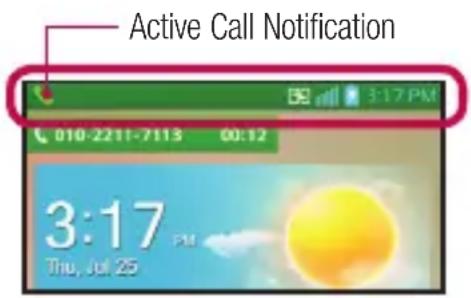
If you exit the current call screen and return to the Home screen, you will be notified that you are still on an active call by the green phone icon within the Status Bar.
Ending a Call from the Status Bar
1. Touch and drag the Status Bar down to open the Notifications Panel. 2. Tap End call to end the currently active call.
Viewing your call logs
From the Home screen, tap Phone, then tap the Call logs tab. View a complete list of all dialed, received, and missed voice calls.
TIP! Tap any single call log entry to view the date, time, and duration of the call.
TIP! Tap the Menu Key, then tap Delete to delete entries individually or Delete all to delete all.
Call settings
You can configure phone call settings, such as call forwarding, and other special features.
1 From the Home screen, tap Apps > Settings. 2 Tap Call and set any desired options.
Contacts
You can add contacts on your phone and synchronize them with the contacts in your Google Account or other accounts that support syncing contacts.
Searching for a contact
1 From the Home screen, tap Contacts to open your contacts. 2 Tap the Search contacts box and enter the contact name using the keypad. You can also tap a letter along the right side of the screen to access names starting with the chosen letter.
Adding a new contact
1 From the Home screen, tap Phone and enter the new contact's number. 2 Tap the Menu Key Add to Contacts > New contact. Select the desired account (if applicable). 3 If you want to add a picture to the new contact, tap. Choose from Take photo to take a picture using the camera or Select from Gallery. Then browse for an image and select it. 4 Tap to enter more specific name information. 5 Enter the details about your contact. 6 Tap Save to save the contact entry.
Favorite Contacts
You can classify frequently called contacts as favorites.
To add a contact to your favorites
1 From the Home screen, tap Contacts to open your contacts. 2 Tap a contact to view its details. 3 Tap the star to the right of the contact's name. The star turns gold and the contact
is added to your favorites.
To remove a contact from your favorites list
1 From the Home screen, tap Contacts to open your contacts. 2 Tap the Favorites tab to view your favorite contacts. 3 Tap a contact to view its details. 4 Tap the gold star to the right of the contact's name. The star turns grey and the contact is removed from your favorites.
Creating a group
1 From the Home screen, tap Contacts to open your contacts. 2 Touch the Groups tab, then touch the Menu Key ≡ and select New group. 3 Enter a name for the new group. You can also set a ringtone for the group. 4 Touch Save to save the group.
NOTE: If you delete a group, the contacts assigned to that group will not be lost. They will remain in your contacts.
Messaging
Your phone combines text and multimedia messages into one intuitive, easy-to-use menu.
Conversation view
Messages exchanged with another party are displayed in chronological order so that you can conveniently see an overview of your conversations.
Sending a message
1 From the Home screen, tap Messaging, then tap Compose to create a new message. 2 Enter a contact name or phone number in the To field. As you enter the contact name, matching contacts appear. You can tap a suggested recipient. You can also add multiple contacts. 3 Tap the text field to start entering your message. 4 Tap the Menu Key to open the options menu. Choose from any of the available options. 5 Tap Send to send your message.
Warning! The 160-character limit may vary from country to country depending on how the text message is coded and the language used in the message.
Warning! If an image, video, or audio file is added to a text message, it will be automatically converted into a multimedia message and your service plan will be decremented accordingly.
NOTE: When you get a text message during a call, there will be an audible notification.
Using smiles
Liven up your messages using smilies.
When writing a new message, tap the Menu Key (≡), then tap Insert smiley.
Changing your message settings
Your phone's message settings are predefined, so you can send messages immediately.
You can change the settings based on your preferences.
From the Home screen, tap Messaging > Menu Key (≡) > Settings.
You can use the E-mail application to read emails from services like Gmail. The E-mail application supports the following account types: POP3, IMAP and Exchange.
Your service provider or system administrator can provide you with the account settings you need.
Managing an E-mail account
The first time you open the E-mail application, a set-up wizard opens to help you to set up an E-mail account.
After the initial setup, E-mail displays the contents of your inbox. If you have added more than one account, you can switch among accounts.
To add another E-mail account:
- Open the E-mail application and tap the Menu Key (≡) > Settings >
To change an E-mail account's settings:
- Open the E-mail application and tap the Menu Key (≡) > Settings > General settings.
To delete an E-mail account:
- Open the E-mail application and tap the Menu Key ≡ > Settings > touch □ > touch an account you want to delete > Remove > select Yes.
Working with account folders
Open the E-mail application and tap the Menu Key ≡ and select Folders. Each account has an Inbox, Outbox, Sent and Drafts folder. Depending on the features supported by your account's service provider, you may have additional folders.
Composing and sending E-mail
To compose and send a message

1 While in the E-mail application, tap Write. 2 Enter an address for the message's intended recipient. As you enter text, matching addresses will be proposed from your Contacts. Separate multiple addresses using semicolons. 3 Tap Menu Key to add a Cc/Bcc and tap Attach to attach files, if required. 4 Enter the subject and your message. 5 Tap Send to send the message.
If you aren't connected to a network, for example, if you're working in airplane mode, the messages that you send will be stored in your Outbox folder until you connect to a network again. If it contains any pending messages, the Outbox will be displayed on the Accounts screen.
TIP! When a new E-mail arrives in your Inbox, you will be notified by a sound or vibration. Tap the E-mail notification to stop receiving notifications.
Camera
To open the Camera application, tap Camera on the Home screen.
Getting to know the viewfinder
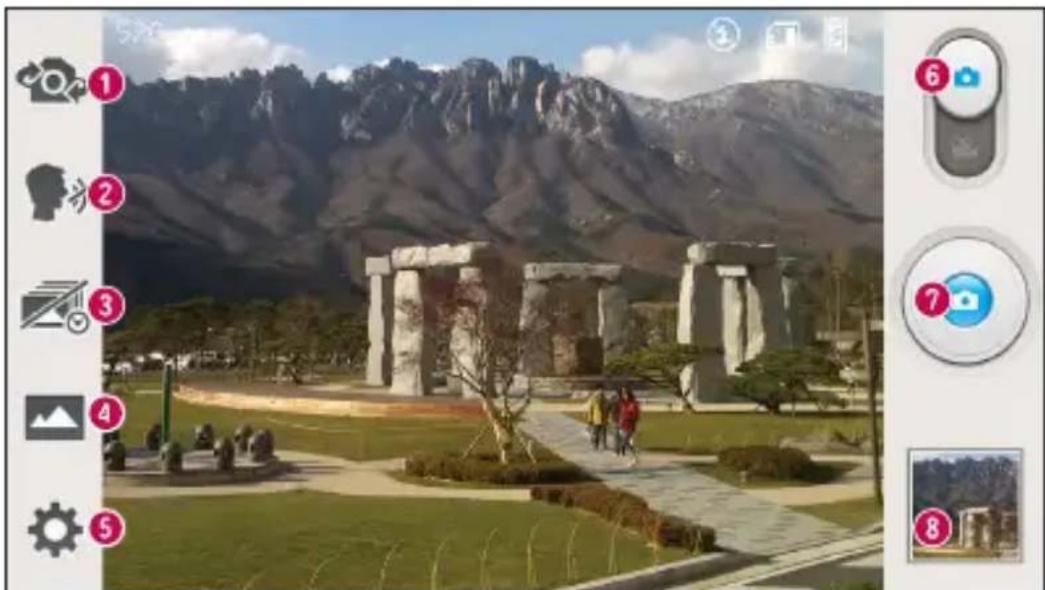
Swap camera - Switch between the rear-facing camera lens and the front-facing camera lens. • Cheese shutter - To take a photo, say one of the following words: Cheese, Smile, Whisky, Kimchi or LG. Time catch shot - Touch this icon to capture the missing moment before pressing the shutter. Shot mode - Choose from Normal, HDR, Panorama, Continuous shot or Beauty shot. Settings - Touch this icon to open the settings menu. See Using the advanced settings on the following page. Mode switch - Touch and slide down this icon to switch to video mode. Capture - Touch to capture a picture. • Gallery - Touch to view the last photo you captured. This enables you to access your Gallery and view saved photos while in camera mode.
NOTE: Please ensure the camera lens is clean before taking pictures.
Using the advanced settings
In the viewfinder, tap to open the advanced options. You can change the camera settings by scrolling through the list. After selecting the option, tap the Back Key.
| Touch if you want to change the viewfinder menu. | |
| Allows you to turn on the flash when taking a photo in dark conditions. | |
| Defines and controls the amount of sunlight entering the photo. | |
| Focuses on a specific spot. | |
| Selects photo resolution. If you choose high resolution, file size will increase, which means you will be able to store fewer photos in the memory. | |
| Finds the appropriate color and light settings for the current environment. | |
| The ISO rating determines the sensitivity of the camera's light sensor. The higher the ISO, the more sensitive the camera. This is useful in darker conditions when you cannot use the flash. | |
| Improves color quality in various lighting conditions. | |
| Applies artistic effects to your pictures. | |
| Sets a delay after the capture button is pressed. This is ideal if you want to be in the photo. | |
| Activate this to use your phone's location-based services. Take pictures wherever you are and tag them with the location. If you upload tagged pictures to a blog that supports geo tagging, you can see the pictures displayed on a map. | |
| NOTE: This function is only available when the GPS function is active. |
Camera

Selects a shutter sound.

Set the storage location for your pictures. Choose from Internal memory and SD card.
TIP!
- When you exit the camera, some settings return to their defaults, such as white balance, color effect, timer and scene mode. Check these before you take your next photo.
- The setting menu is superimposed over the viewfinder, so when you change photo color or quality elements, you will see a preview of the changed image behind the Settings menu.
Taking a quick photo
1. Open the Camera application. 2. Holding the phone horizontally, point the lens towards the subject you want to photograph. 3. A focus box will appear in the center of the viewfinder screen. You can also tap anywhere on the screen to focus on that spot. 4. When the focus box turns green, the camera has focused on your subject. 5. Touch to capture the photo.
Once you've taken a photo
Touch to view the last photo you took.

Touch to share your photo using the SmartShare function.

Touch to take another photo immediately.

Touch to send your photo to others or share it via social network services.

Touch to delete the photo.
TIP! If you have a social networking account and set it up on your phone, you can share your photo with your social networking community.
Touch the Menu Key to open all advanced options.
Set image as - Touch to use the photo as a Contact photo, Home screen wallpaper or Lock screen wallpaper.
Move - Touch to move the photo to another place.
Copy - Touch to copy the selected photo and save it to another album.
Rename - Touch to edit the name of the selected photo.
Rotate left/right - To rotate left or right.
Crop - Crop your photo. Move your finger across the screen to select the area to be cropped.
Edit - View and edit the photo.

Applies a brightness effect to your photo.

Applies artistic effects to your photos.

Applies color effects to your photos.

Applies additional options to your photos.
Slideshow - Automatically shows you the images in the current folder one after the other.
Details - Find out more information about the contents.
Camera
Viewing your saved photos
You can access your saved photos when in camera mode. Just tap the image preview at the bottom of the screen and your Gallery will be displayed.
- To view more photos, scroll left or right.
- To zoom in or out, double-tap the screen or place two fingers and spread them apart (move your fingers closer together to zoom out).
Video camera
Getting to know the viewfinder
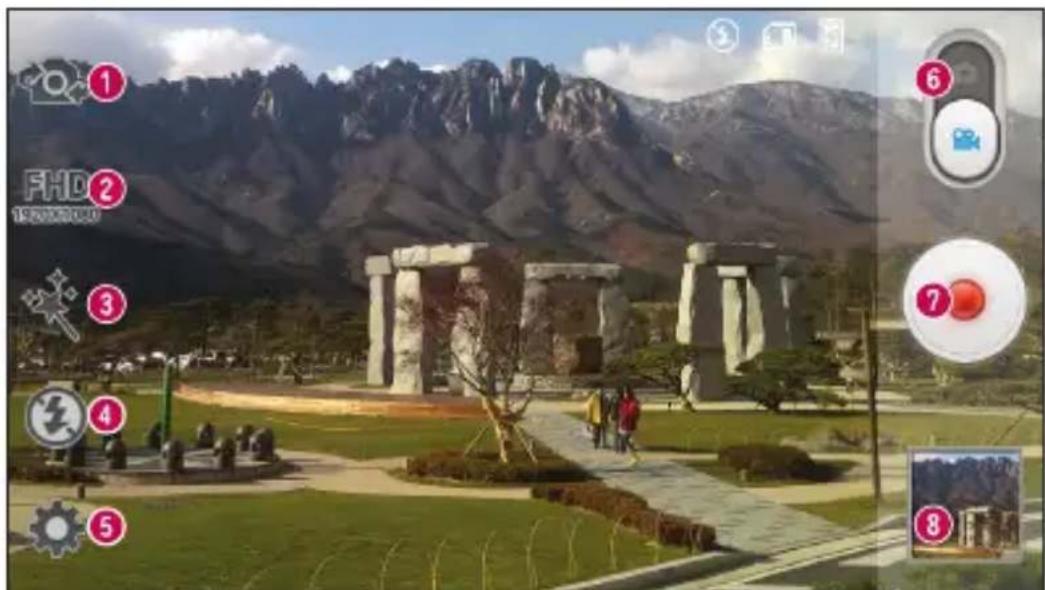
Swap camera - Switch between the rear-facing camera lens and the front-facing camera lens. Video size - Touch to set the size (in pixels) of the video you are recording. Live effect - Live effect provides various visual effects when recording a video. Flash - Allows you to turn on the flash when taking a video in dark conditions. Settings - Touch this icon to open the settings menu. See Using the advanced settings on the following page. Camera mode - Touch and slide up this icon to switch to camera mode. Record - Touch to start recording a video. Gallery - Touch to view the last video you recorded. This enables you to access your Gallery and view your saved videos while in video mode.
TIP! When recording a video, place two fingers on the screen and pinch to use the Zoom function.
Video camera
Using the advanced settings
Using the viewfinder, touch to open all the advanced options.
| Touch if you want to change the viewfinder menu. | |
| Defines and controls the amount of sunlight entering the video. | |
| Improves color quality in various lighting conditions. | |
| Choose a color tone to use for your new view. | |
| Activate this to use your phone's location-based services. | |
| Set the storage location for your pictures. Choose from Internal memory and SD card. |
Recording a quick video
1 Open the Camera application and touch the Video mode icon. 2 The video camera viewfinder appears on the screen. 3 Holding the phone, point the lens towards the subject you wish to capture in your video. 4 Touch once to start recording. 5 A timer showing the length of the video will appear. 6 Touch on the screen to stop recording.
NOTE: Touch on the screen to take a picture while you're recording.
After recording a video
Touch to view the last video you took.
| Touch to share your video using the SmartShare function. | |
| Touch to record another video immediately. | |
| Touch to send your video to others or share it via social network services. | |
| Touch to delete the video. |
Watching your saved videos
1 In the viewfinder, touch the image preview in the bottom of the screen. 2 Your Gallery will appear on the screen. 3 Tap a video to play it automatically.
Adjusting the volume when viewing a video
To adjust the volume of a video while it is playing, use the Volume Keys on the left side of the phone.
LG Unique Functions
QuickMemo
The QuickMemo feature allows you to create memos and capture screen shots. Capture screens, draw on them, and share them with family and friends with QuickMemo.
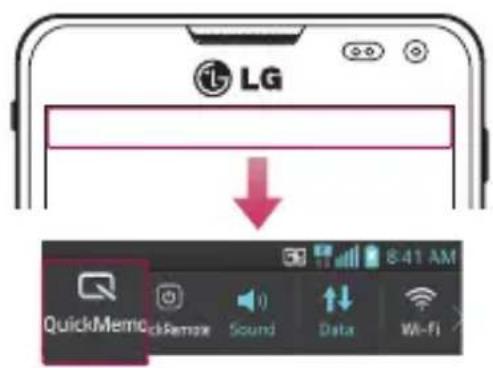
1 Access the QuickMemo feature, slide the Status Bar downwards and touch
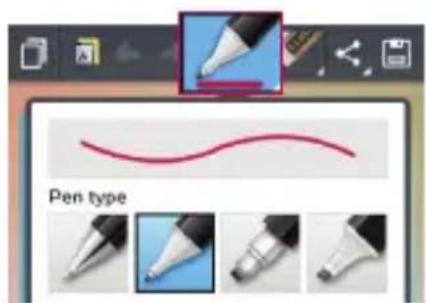
2 Select the desired menu option from Pen type, Colour, and Eraser. Then create a memo.
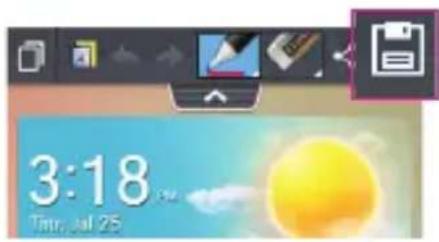
3 Tap in the Edit menu and select to save the memo. To exit QuickMemo at any time, tap the Back Key
NOTE:
- Please use a fingertip while using the QuickMemo. Do not use your fingernail.
- You can also access QuickMemo by quickly pressing the QuickButton Key. (When default app is QuickMemo.)
Using the QuickMemo options
You can easily use the QuickMenu options when using the QuickMemo.
| Touch to keep the current memo on the screen and use the phone simultaneously. | |
| Selects whether to use the background screen or not. | |
| Allows you to undo and redo previous actions. | |
| Selects the pen type and the color. | |
| Erases the memo that you created. | |
| Touch to send your memo to others or share it via social network services. | |
| Saves the memo in the Gallery. |
Viewing the saved QuickMemo
From the Home screen, tap Apps > Gallery and select the QuickMemo album.
LG Unique Functions
QuickRemote
QuickRemote turns your phone into a Universal Remote for your home TV, DVD, or Blu-ray.
NOTE: QuickRemote may not be available for some devices and areas.
To open the QuickRemote application and set up your QuickRemote(s)
1 From the Home screen, tap the Apps > QuickRemote 2 Touch to select a room type and touch to add the device.
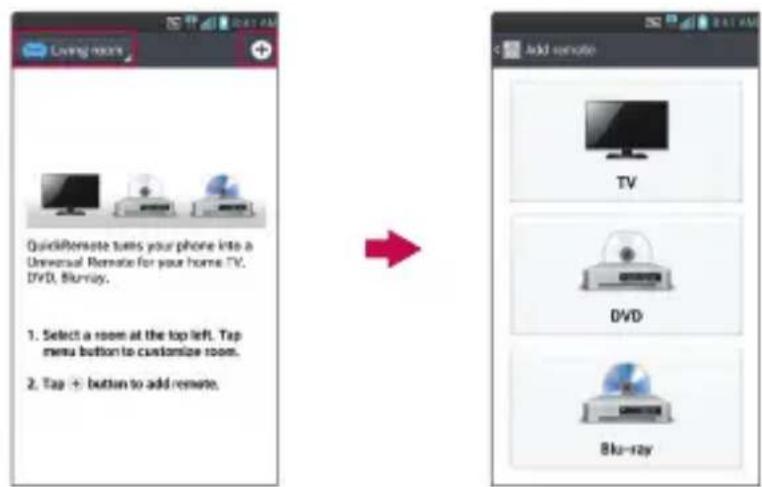
3 Select the type and brand of device, then follow the on-screen instructions to configure the device(s).
NOTE: The QuickRemote operates the same way as an ordinary remote control infrared (IR) signals. Be careful not to cover the infrared sensor at the top of the phone when you use the QuickRemote function. This function may not be supported depending on the model, the manufacturer or service company.
Using QuickRemote
1 From the Home screen, tap the Apps > QuickRemote to open a QuickRemote bar with all of the remotes you set up. 2 Select the remote you want by tapping its type/name at the top of the QuickRemote bar. 3 Tap the buttons on the displayed remote.
NOTE: When adding remote control of TV, QuickRemote could use the INPUT button to configure appropriate remote control. When configuring the INPUT button, input source of TV could be changed. To reset input source of your TV, tap the INPUT button on QuickRemote several times (depending on number of devices connected on TV).
QuickRemote options
To access the QuickRemote Options menu, tap the Menu Key (in the Front Touch Keys bar) to select the desired option.
NOTE: While playing music in the background, pressing any QuickRemote button will mute the sound for a second.
LG Unique Functions
Live Zooming
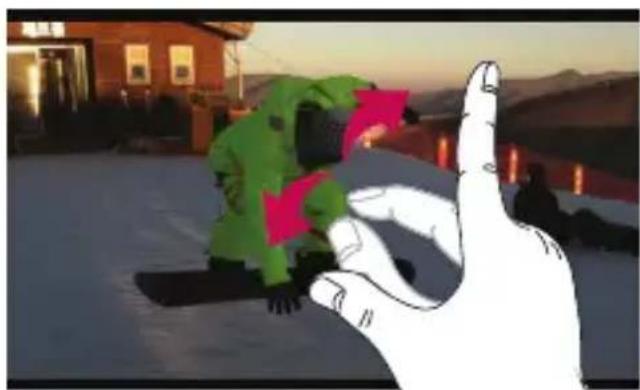
Live Zooming allows you to zoom in or zoom out on a portion of a video that is being played to make the desired scan appear larger or smaller.
When viewing the video, use your index finger and thumb in a pinching or spreading motion to zoom in or out.

NOTE:
- When in video playback mode, slide the screen up or down to adjust the screen brightness.
- When in video playback mode, slide the screen left or right to rewind or fast-forward.
NOTE: Do not press too hard; the touch screen is sensitive enough to pick up a light, but firm touch.
QSlide
The QSlide function enables an overlay on your phone's display for easy multi-tasking.
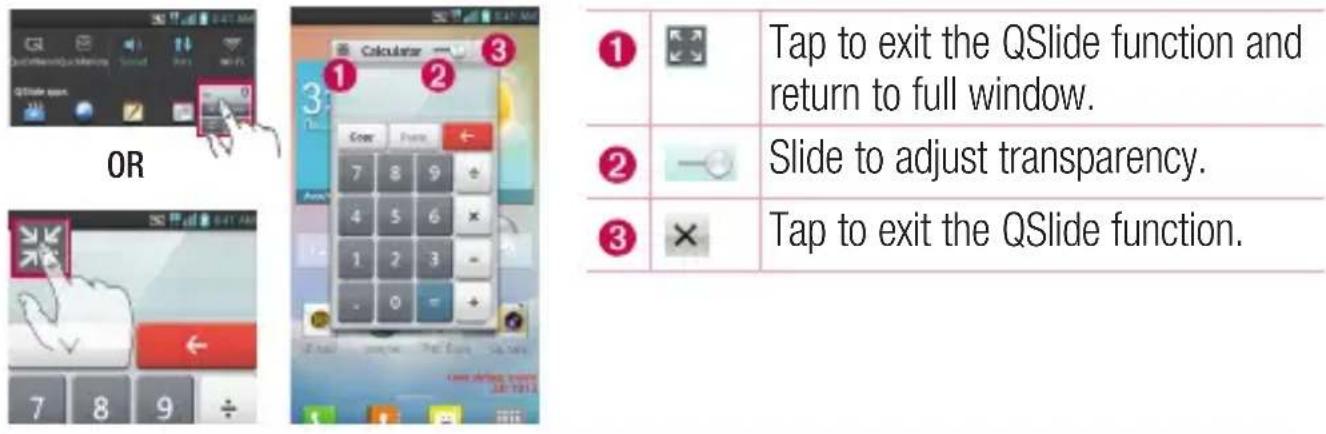
NOTE: The QSlide function can support up to two windows at the same time.
1 Open the Notifications Panel and tap the desired app from the QSlide apps section.
OR
While using an application that supports QSlide, tap the function to display it continuously as a small window on your screen.
2 Slide to adjust the transparency level.
LG Unique Functions
QuickTranslator
Simply aim the camera of your smartphone at the foreign sentence you want to understand. You can get real-time translation anywhere and anytime.
You can buy additional dictionaries for offline translation from the Google Play Store.
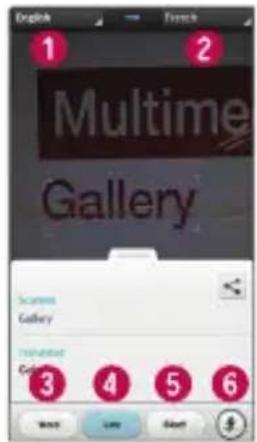
Home language Destination language Translation of word Translation of sentence Translation of block 6 Flash
1 Touch > Apps tab > QuickTranslator. 2 Touch Word, Line, or Block. 3 Touch and select the desired language. 4 Hold the phone toward the subject you want to translate for a few seconds.
NOTE: Only one dictionary is provided free of charge. Additional dictionaries must be purchased. Please select from the list below the dictionary you would like to install as your complimentary dictionary.
NOTE: There may be a difference in the rate of recognition depending on the size, font, color, brightness, and angle of the letters that need to be translated.
VuTalk
Use VuTalk to create notebook contents using real-time interactive handwriting and shared emotional conversations.
NOTE:
Additional charges may be applied for data services when using VuTalk. - Connect a device preloaded with the available VuTalk feature to use VuTalk. - You can use VuTalk only when connecting to a data network, furthermore during a call. - Please be careful that the screen may be locked if you input nothing for a period of time.
Registering VuTalk
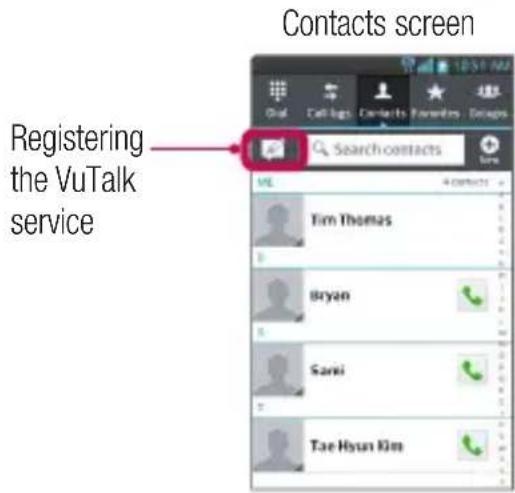
1 From the Home screen, tap Contacts

2 Tap to agree to terms and conditions. Once you register the VuTalk service, you can set up tapping - You can also register the VuTalk service by tapping during a call screen.
LG Unique Functions
Using VuTalk
1 Select a VuTalk user from the contacts.
If you tap, you can display only VuTalk users.
2 Tap from the detail contacts screen.
Detail contacts screen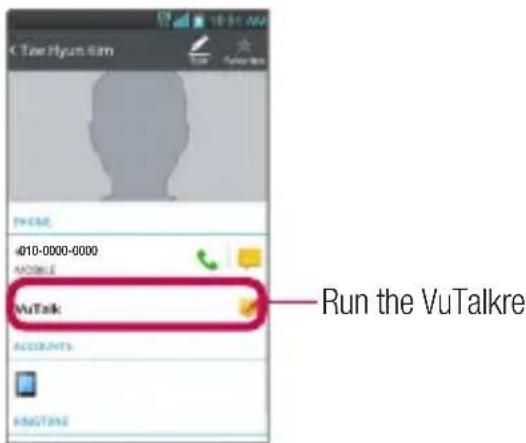
- Tap to attach image, photo, place, sticker.
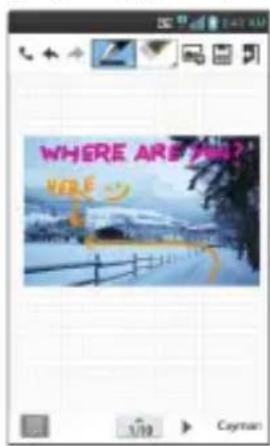
3 Tap or to end VuTalk feature.
- VuTalk saves Notebook contents when ending VuTalk feature.
- Tap to end VuTalk feature because VuTalk is still running when the screen is changed to the Home screen by tapping the Home key.
Multimedia
Gallery
You can store multimedia files in internal memory for easy access to all your multimedia files. Use this application to view multimedia files like pictures and videos.
1 From the Home screen, tap Apps > Apps tab > Gallery
You can manage and share all your image and video files with Gallery.
NOTE:
- Some file formats are not supported, depending on the software installed on the device.
- Some files may not play properly, depending on how they are encoded.
Viewing pictures
Launching Gallery displays your available folders. When another application, such as E-mail, saves a picture, the download folder is automatically created to contain the picture. Likewise, capturing a screenshot automatically creates the Screenshot folder. Tap a folder to open it.
Pictures are displayed by creation date in a folder. Select a picture to view it full screen. Scroll left or right to view the next or previous image.
Zooming in and out
Use one of the following methods to zoom in on an image:
- Double-tap anywhere to zoom in. Double-tap again to return to fullscreen view.
- Spread two fingers apart on any place to zoom in. Pinch in to zoom out.
Playing videos
Video files show the icon in the preview. Select a video and tap to play it.
Multimedia
Viewing photo and video options
When viewing a photo or video, tap the Menu Key ≡ and use the advanced editing options.
Deleting images and videos
Use one of the following methods:
- In a folder, tap and select the photos and videos you want to delete, then tap Delete.
- When viewing a photo or video, tap
Setting as wallpaper
When viewing a photo, touch the Menu Key ≡ > Set image as and select Contact photo, Home screen wallpaper or Lock screen wallpaper.
NOTE:
- Some file formats are not supported, depending on the device software.
- If the file size exceeds the available memory, an error can occur when you open files.
Videos
Your phone has a video player that lets you play all of your favorite videos. To access the video player, from the Home screen tap Apps > Apps tab > Videos
Playing a video
1 From the Home screen, tap Apps > Apps tab > Videos. 2 Select the video you want to play.
| II | Touch to pause video playback. |
| ▷ | Touch to resume video playback. |
| >> | Touch to go 10 seconds forward. |
| « | Touch to go 10 seconds backward. |
| ▲ | Touch to manage the video volume. |
| ■ | Touch to change the ratio of the video screen. |
| ■ | Touch access QSlide and display the video in small window. |
| ■ | Touch to share your video via the SmartShare function. |
| ■ | Touch to lock the window. |
To change the volume while watching a video, press the Volume Keys on the left side of the phone.
Touch and hold a video in the list to access the following options: Share, Trim, Delete, and Details.
Music
Your phone has a music player that lets you play all your favorite tracks. To access the music player, from the Home screen, tap Apps > Apps tab > Music.
Add music files to your phone
Start by transferring music files to your phone:
- Transfer music using Media sync (MTP).
Multimedia
Download from the wireless Web. - Synchronize your phone to a computer. Receive files via Bluetooth.
Transfer music using Media sync (MTP)
1 Connect the phone to your PC using the USB cable. 2 Select the Media sync (MTP) option. Your phone will appear as another hard drive on your computer. Click on the drive to view it. Copy the files from your PC to the drive folder. 3 When you're finished transferring files, swipe the Status Bar down and touch USB connected > Charge only. You may now safely unplug your device.
Playing a song
1 From the Home screen, tap Apps > Apps tab > Music. 2 Touch the Songs tab. 3 Select the song you want to play.
| Touch to find the files with YouTube | |
| Touch to share your music via SmartShare function. | |
| Touch to set shuffle mode | |
| Touch to set repeat mode | |
| Touch to manage the music volume | |
| Touch to pause playback | |
| Touch to resume playback | |
| Touch to skip to the next track on the album or in the playlist | |
| Touch to go back to the beginning of the song. Touch twice to return to the previous song | |
| Touch to set the current song as a favorite | |
| Touch to see the current playlist | |
| Touch to set the audio effect. |
To change the volume while listening to music, press the Volume Keys on the left side of the phone.
Touch and hold any song in the list to access the following options: Play, Add to playlist, Share, Set as ringtone, Delete, Details and Search.
NOTE:
- Some file formats are not supported, depending on the device software.
- If the file size exceeds the available memory, an error can occur when you open files.
NOTE: Music file copyrights may be protected by international treaties and national copyright laws.
Therefore, it may be necessary to obtain permission or a licence to reproduce or copy music.
In some countries, national laws prohibit private copying of copyrighted material. Before downloading or copying the file, check the national laws of the relevant country concerning the use of such material.
Utilities
Setting your alarm
1 From the Home screen, tap Apps > Apps tab > Alarm/Clock + > 2 Set the desired alarm time. 3 Set Repeat, Snooze duration, Vibration, Alarm sound, Alarm volume, Auto app starter, Puzzle lock and Memo. 4 Touch Save.
NOTE: To change alarm settings in the alarm list screen, touch the Menu Key and select Settings.
Using your calculator
1 From the Home screen, tap Apps > Apps tab > Calculator. 2 Touch the number keys to enter numbers. 3 For simple calculations, touch the function you want to perform (+, -, x or ÷) followed by the equals sign. 4 For more complex calculations, touch the Menu Key and select the Advanced panel, then choose the desired function. 5 To view the calculation history, tap the history icon.
Adding an event to your calendar
1 From the Home screen, tap Apps > Apps tab > Calendar. 2 Tap March 2013 to change the calendar view (Day, Week, Month, Agenda). 3 Tap on the date for which you wish to add an event and tap the add icon. 4 Touch the Event name field and enter the event name. 5 Touch the Location field and enter the location. Check the date and enter the time you wish your event to start and finish.
6 If you wish to add a note to your event, touch the Description field and enter the details. 7 If you wish to repeat the alarm, set REPEAT and set REMINDERS, if necessary. 8 Touch Save to save the event in the calendar.
File Manager
The File Manager application allows you to manage files in your internal/external storage.
To open the File Manager application
From the Home screen, tap Apps > File Manager
File Manager Options
- Allows you to create a new folder.
- Allows you to move files and folders to another folder.
- Allows you to delete files and folders.
- Allows you to search for files.
Tap the Menu Key to access the following options.
- Sort by: Allows you to sort files and folders by Name, Size, Date, and Type. View by: Allows you to change the view mode to List or Grid.
- Copy: Allows you to copy files and folders and paste them in another location.
- Share: Allows you to share files and folders with others.
- Upload: Allows you to upload files to online storage.
- Zip: Allows you to compress files and folders into a .zip file.
- Exit: Allows you to exit the application.
Utilities
Application Manager
You can manage your programs with Application Manager.
1. From the Home screen, tap Apps > Application Manager. 2. The Application Manager lists your installed apps along with their size and version. 3. Tap Uninstall to uninstall the app, then tap OK to confirm.
Application Manager Settings
To adjust the Application Manager settings, tap the Menu Key (≡) and select Settings. The following settings are available.
- Update notification cycle: Allows you to set the notification cycle for app updates.
- Auto app update: Automatically updates apps if available.
- Update over Wi-Fi only: Updates apps only via Wi-Fi.
Voice Recorder
Use the voice recorder to record voice memos or other audio files.
Recording a sound or voice
1. From the Home screen, tap Apps > Apps tab > Voice Recorder. 2. Touch to begin recording. 3. Touch to end the recording. 4. Touch to listen to the recording.
NOTE: Touch to access your list of recordings. You can listen to the saved recordings. The available recording time may differ from actual recording time.
Sending the voice recording
1 Once you have finished recording, you can send the audio clip by touching 2 Choose from any of the available methods for sharing.

Task Manager
You can manage your applications using Task Manager. You can easily check the number of applications that are currently running and shut down certain applications.
Task Manager Options
- Touch Stop to stop individual apps.
- Tap Stop all to stop all currently running apps.
- Tap the Menu Key to access Help, Sort by, and Settings.
Polaris Viewer 4
Polaris Viewer 4 is a professional mobile office solution that lets users conveniently view various types of office documents, including Word, Excel and PowerPoint files, anywhere or anytime, using their mobile devices.
From the Home screen, tap Apps >Apps tab > Polaris Viewer 4
Viewing files
Mobile users can now easily view a wide variety of file types, including Microsoft Office documents and Adobe PDF, right on their mobile devices. When viewing documents using Polaris Viewer 4, the objects and layout remain the same as in the original documents.
FileShare
This feature allows you to share files from your phone.
1 From the Home screen, tap Apps > Apps tab > FileShare. 2 Choose the types of content you would like to share. Choose from Images, Videos, Music, and Documents. 3 Tap Send file in the upper right corner of the screen, then checkmark the file(s) you want to share.
Utilities
4 Tap Send at the bottom of the screen to begin scanning for available devices, then select the device you want from the list. 5 Tap Send at the bottom of the screen to use the selected device to send your file(s).
LG Backup
About backing up and restoring smartphone data
It is recommended that you regularly create and save a backup file on the internal storage, especially before updating any software. Maintaining a current backup file in storage memory may allow you to recover smartphone data if your smartphone is lost, stolen, or corrupted by an unforeseen issue.
This LG Backup application is supported between LG smartphones, other S/W or OS versions. As a result, when you buy the new LG smartphone, you can backup the current phone data to your new phone.
If you have the Backup application preloaded on your smartphone, you can backup and restore most of your smart phone data, including downloaded and pre-installed applications, bookmarks, calendar entries, call logs, contacts, home screen settings, messages, and system settings. You may also:
- Perform a manual LG Backup of your smartphone data.
- Schedule automatic backups of your smartphone data.
- Restore your smartphone data.
NOTE: Please note that the Backup function does not support the backup of User data & Media data (Picture/Video/Music). Please backup those files using the Media sync (MTP). Connect your phone to your computer using a USB cable and touch Media sync (MTP).
Warning! To protect against unexpected shutdown during backup or restore operations, due to insufficient battery power, you should always keep your battery fully charged.
LG Backup your smart phone data
1 From the Home screen, tap Apps > Apps tab > LG Backup > Manual backup > Internal storage or SD card. 2 Touch New backup to enter a name for your backup file and select Next. 3 Select the check box next to the item you want to backup and select LG Backup to backup. 4 When all selected files have been backed up, you will see the message Backup complete.
Scheduling automatic backups
You can also program automatic backups for the data on your smartphone according to your schedule setting. To do this, complete the following steps:
1 From the Home screen, tap Apps > Apps tab > LG Backup > Auto-backup. 2 On the Backup Location screen, touch Internal storage or SD card. 3 Enter a name for your backup file and select Next. 4 Select the check box next to the data you want to backup, and select Next.
Restoring smartphone data
NOTE: All files that are stored on your smartphone are deleted before the backup file is restored.
1 From the Home screen, tap Apps > Apps tab > LG Backup > Restore. 2 On the Restore screen, select a backup file that contains the data you wish to restore.
Utilities
3 Select the check box next to the item you wish to restore and select Restore to restore it to your phone.
NOTE: Please note that your phone data will be overwritten with the content of your backup.
4 If the backup file is encrypted, type the password that you created to encrypt it. 5 When all selected files have been restored, the phone will automatically restart.
NOTE: You can set Enable encryption to encrypt your backup files for extra protection.
Touch from the LG Backup screen, and enter a password and hint in case you forgot your password. Once you have set up a password, you need to enter it every time you want to do backup/restore.
Google+
Use this application to stay connected with people via Google's social network service. From the Home screen, tap Apps > Apps tab > Google+
NOTE: This application may not be available depending on the region or service provider.
Voice Search
Use this application to search web pages using voice.
1. From the Home screen, tap Apps > Apps tab > Voice Search. 2. Say a keyword or phrase when "Speak now" appears on the screen. Select one of the suggested keywords that appear.
NOTE: This application may not be available depending on the region or service provider.
Downloads
Use this application to see what files have been downloaded.
From the Home screen, tap Apps > Apps tab > Downloads.
The Web
Internet
Use this application to browse the Internet. Browser gives you a fast, full-color world of games, music, news, sports, entertainment and much more, right on your mobile phone wherever you are and whatever you enjoy.
NOTE: Additional charges apply when connecting to these services and downloading content. Check data charges with your network provider.
From the Home screen, tap Apps > Apps tab > Internet.
Using the Web toolbar
Touch and hold the Web toolbar and slide it upwards with your finger to open.
| Touch to go back one page. | |
| Touch to go forward one page, to the page you connected to after the current one. This is the opposite of what happens when you touch the Back Key , which takes you to the previous page. | |
| Touch to go to the Home page. | |
| Touch to add a new window. | |
| Touch to access bookmarks. |
Viewing webpages
Tap the web address field, enter the web address and tap Go.
Opening a page
- To open a new page, tap on the Browser toolbar.
- To go to another webpage, tap 3 scroll up or down, and tap the page to view it.
Searching the web by voice
Tap the web address field, tap ↓speak a keyword, and then select one of the suggested keywords that appear.
NOTE: This feature may not be available depending on the region or service provider.
Bookmarks
- To bookmark the current webpage, tap the Menu Key Save to bookmarks. Enter the desired information and tap OK.
- To open a bookmarked webpage, tap on the Browser toolbar and select one.
History
Tap on the Browser toolbar and select the History tab to open a webpage from the list of recently-visited webpages. To clear the history, tap the Menu Key > Clear all history.
Using QSlide
Use this feature to access the Internet without closing the current application.
While viewing content on the Browser, tap ×. You can then browse other information on your phone. To view the browser in full screen, tap ××. To close the browser, tap
on your phone. To view the browser in full screen, tap the expand icon. To close the browser, tap the close icon.
Use Chrome to search for information and browse webpages.
Use Chrome to search for information and browse webpages.
NOTE: This application may not be available, depending on your region and service provider.
NOTE: This application may not be available, depending on your region and service provider.
Viewing webpages
Tap the web address field, and then enter a web address or search criteria.
Tap the web address field, and then enter a web address or search criteria.
To go to a new page, tap □ > New tab. - To go to another webpage, tap ②, scroll up or down and tap the page to select it.
To go to a new page, tap the boxed 0 icon > New tab. - To go to another webpage, tap the ② icon, scroll up or down, and tap the page to select it.
Tap the address field, tap ↓, speak a keyword and select one of the suggested keywords that appear.
Tap the address field, tap the down arrow, speak a keyword, and select one of the suggested keywords that appear.
Syncing with other devices
Sync open tabs and bookmarks to use with Chrome on another device when you are logged in with the same Google account.
To view open tabs on other devices, tap the Menu Key ≡ > Other devices. You must be signed in to the same Google account on all devices. Select a webpage to open.
Viewing bookmarks
To add bookmarks, tap the Menu Key ≡ > ☆.
Settings
Access the Settings menu
1 From the Home screen, tap Apps > Apps tab > Settings OR From the Home screen, tap the Menu Key ≡ > System settings. 2 Select a setting category and select an option.
WIRELESS & NETWORKS
Wi-Fi - Turns on Wi-Fi to connect to available Wi-Fi networks.
TIP! How to obtain the MAC address
To set up a connection in some wireless networks with MAC filters, you may need to enter the MAC address of your phone in the router. You can find the MAC address in the following user interface: From the Home screen, tap Apps > Settings > Wi-Fi > Menu Key > Advanced > MAC address.
Turn the Bluetooth wireless feature on or off to use Bluetooth.
Displays the data usage and set mobile data usage limit.
Configure phone call settings such as call forwarding and other special features offered by your carrier.
Fixed dialing numbers - Turn on and compile a list of numbers that can be called from your phone. You'll need your PIN2, which is available from your operator. Only numbers within the fixed dial list can be called from your phone.
Save unknown numbers - Add unknown numbers to contacts after a call.
Settings
Voicemail - Allows you to select your carrier's voicemail service.
Incoming call pop-up - Display incoming call popup when using camera and videos.
Call reject - Allows you to set the call reject function. Choose from Call reject mode or Reject calls from.
Decline with message - When you want to reject a call, you can send a quick message using this function. This is useful if you need to reject a call during a meeting.
Connection vibration - Vibrates your phone when the other party answers the call.
Privacy keeper - Hides the caller name and number for an incoming call.
Power button ends call - Allows you to end calls by pressing the Power/Lock Key instead of the End button on your screen.
Hearing aids - Checkmark enables hearing aid compatibility.
Call forwarding - Choose whether to divert all calls when the line is busy, when there is no answer or when you have no signal.
Call barring - Lock incoming, outgoing or international calls.
Call duration - View the duration of calls including Last call, All calls, Dialed calls and Received calls.
Voice clarity - Enhance voice sound quality in noisy environment.
Additional settings - Allows you to change the following settings:
CallerID: Choose whether to display your number in an outgoing call.
Call waiting: If call waiting is activated, the handset will notify you of an incoming call while you are on a call (depending on your network provider).
Allows you to share folders with other devices via wireless connection.
NFC - NFC (Near Field Communication) is a wireless technology that enables data transmission between two objects when they are brought within a few inches of each other. When you enable NFC on your phone, your phone can exchange data with other NFC-enabled devices or read information from smart tags embedded in posters, stickers, and other products.
Android Beam - When this feature is turned on, you can beam app content to another NFC-capable device by holding the devices close together. For example, you can beam Browser pages, YouTube videos, contacts, Polaris Viewer 4 files, and more. Just bring the devices together (typically back to back) and then touch your screen. The app determines what gets beamed.
NOTE: You must enable NFC to activate Android Beam.
File networking - File Networking requires wireless connection. Make sure that devices are using same AP (Access Point). Network folder sharing may use more battery.
Airplane mode - Tap the Airplane mode switch to toggle between On and Off. Activating Airplane mode disables all wireless connections.
Portable Wi-Fi hotspot - You can use your smartphone to provide a mobile broadband connection for up to 8 other devices. Create a hotspot and share your connection.
Bluetooth tethering - Bluetooth tethering allows you to use your smartphone to provide a mobile broadband connection.
Help - Tap to view help information on the Portable Wi-Fi hotspot and Bluetooth tethering functions.
VPN - Displays the list of Virtual Private Networks (VPNs) that you've previously configured. Allows you to add different types of VPNs.
NOTE: You must set a lock screen PIN or password before you can use credential storage.
Mobile networks - Set options for data roaming, network mode & operators, access point names (APNs) etc.
Settings
DEVICE
Quiet mode - Tap the Quiet mode switch to enable this function. Tap Quiet time to open a screen to set the days and times to automatically turn off all sounds except for alarms and media.
Sound profile - Choose the Sound, either Vibrate only or Silent.
Volumes - Manage the volume of Phone ringtone, Notification sound, Touch feedback & system, Music, video, games and other media.
Ringtone with vibration - Vibration feedback for calls and notifications.
Phone ringtone - Allows you to set your default incoming call ringtone.
Notification sound - Allows you to set your default notification ringtone.
Gentle vibration - Gradually increasing vibration up to current strength set.
Vibrate strength - Set vibrate strength for calls and notifications.
Incoming call vibration - Allows you to choose the type of vibration for incoming calls.
Dial pad touch tones - Allows you to set the phone to play tones when using the dialpad to dial numbers.
Touch sounds - Allows you to set your phone to play a sound when you touch buttons, icons and other onscreen items that react to your touch.
Screen lock sound - Allows you to set your phone to play a sound when locking and unlocking the screen.
Vibrate on touch - Allows you to set the vibration feedback when the phone screen is touched.
Brightness - Adjust the screen brightness.
Screen timeout - Set the time for screen timeout.
Auto-rotate screen - Set to switch orientation automatically when you rotate the phone.
Font type - Change the type of display font.
Font size - Change the size of the display font.
Smart screen - Keep screen on when device detects your eyes looking at the screen.
Front touch key light - Set the front key light duration.
Home button LED - LED light around the Home button is controlled by your selections.
Motion sensor calibration - Allows you to improve the accuracy of the tilt and speed of the sensor.
Theme - Sets the screen theme for your device.
Screen swipe effect - Sets the effect when you swipe to change screens.
Wallpaper - Sets the wallpaper to use on your Home screen.
Scroll screens circularly - Checkmark to set the Home screens to scroll continuously, eliminating the need to scroll back in the opposite direction when you reach one end.
Portrait view only - Checkmark to always display the Home screen in portrait view.
Home backup & restore - Allows you to backup and restore app and widget configurations and themes.
< Lock screen >
Select screen lock - Set a screen lock type to secure your phone. Choose from None, Swipe, Face Unlock, Pattern, PIN or Password.
Wallpaper - Select the wallpaper for your lock screen from Gallery or Wallpaper gallery.
Clocks & shortcuts - Customize clocks and shortcuts on the lock screen.
Screen effect - Select the screen effect.
Owner info - Show owner info on the lock screen.
Lock timer - Set the lock time after screen timeout.
Power button instantly locks - Set the screen lock when the power button is pressed.
Vibrate on touch - Allows you to set the vibration feedback for phone screen touch.
Settings
< Storage >
INTERNAL STORAGE - Displays the total amount of space in the phone's memory and lists what type of data is using up space.
SD CARD - Displays the total amount of memory space on the microSD card.
Mount/Unmount SD card - Mounts and unmounts the microSD card from your phone so that you can access the data stored in it, format the card, or safely remove it. This setting is dimmed if there's no microSD card installed, if you've already unmounted it, or if you've mounted the microSD card on your computer.
Erase SD card - Permanently erases everything on the microSD card and prepares it for use with your phone.
< Battery >
BATTERY INFORMATION
See how much battery power is used for device activities. The battery level displays in a percentage. The remaining time of use is also displayed.
Battery percentage: Displays the battery percentage on the Status Bar.
POWER Saver
Power saver Manage the battery for the power saving items. Tap the switch to turn this feature on. Tap Power saver for the following options.
TURN POWER Saver ON
Turn Power saver on - Select the level you want to turn on the Power saver.
POWER SAVING ITEMS
Checkmark each feature to turn off or adjust when battery is low.
- Auto-sync: Turns off Auto-sync. Wi-Fi: Turns off Wi-Fi if data is not in use.
- Bluetooth: Turns off Bluetooth if not connected.
- Vibrate on touch: Turns off touch feedback.
- Brightness: Adjust the brightness.
- Screen timeout: Adjust the screen timeout.
- Front touch key light: Adjust the front key light timeout. Home button LED: Turns off Home button LED if not connected.
Power saver tips - Touch to access some tips for Power saver.
View and manage your applications.
PERSONAL
< Accounts & sync >
Permits applications to synchronize data in the background, whether or not you are actively working in them. Deselecting this setting can save battery power and lower (but not eliminate) data usage.
< Location access >
Access to my location - Lets apps that have asked your permission use your location information.
GPS satellites - Lets apps use GPS satellites to determine your location to street-level accuracy.
Wi-Fi & mobile network location - Let apps use Google's location service to estimate your location faster. Anonymous location data will be collected and sent to Google.
Set up SIM card lock - Set up Micro SIM card lock or change the Micro SIM PIN.
Password typing visible - Show the last character of the hidden password as you type.
Phone administrators - View or deactivate phone administrators.
Unknown sources - Allows you to install non-Play Store applications.
Trusted credentials - Display trusted CA certificates.
Install from storage - Choose to install encrypted certificates.
Clear credentials - Remove all certificates.
Settings
Use the Language & input settings to select the language for the text on your phone and to configure the on-screen keyboard, including words you've added to its dictionary.
< Backup & reset >
Backup my data - Set to backup your settings and application data to the Google server.
Backup account - Set the account to which you want to backup data to.
Automatic restore - Set to restore your settings and application data when the applications are reinstalled on your device.
Factory data reset - Reset your settings to the factory default values and delete all your data. If you reset the phone this way, you are prompted to re-enter the same information as when you first started Android.
SYSTEM
QuickButton - Select apps you wish to get quick access to using QuickButton. Tap Shortcut and the desired app to change as the QuickButton.
< Date & time >
Use Date & time settings to set how dates will be displayed. You can also use these settings to set your own time and time zone rather than obtaining the current time from the mobile network.
< Accessibility >
Use the Accessibility settings to configure accessibility plug-ins you have installed on your phone.
NOTE: Requires additional plug-ins to become selectable.
SERVICES
- TalkBack: Allows you to set up the Talkback function which assists people with impaired vision by providing verbal feedback. Tap the TalkBack switch at the top right corner of the screen to turn it on. Tap SETTINGS at the bottom of the screen to adjust the TalkBack settings.
VISION
- Install web scripts: Allows you to enable (or disable) installation of web scripts. Large text: Checkmark to increase the size of the text.
- Invert color: Checkmark to invert color.
- Shades: Set the screen to be shade of black.
HEARING
- Mono audio: Checkmark to allow headset sound routed both right and left channel.
PHYSICAL AND MOTOR
- Touch & hold delay: Sets the touch and hold delay (short, medium, or long).
- Universal touch: Switch to toggle between on and off. Universal touch can replace all hardware buttons.
SYSTEM
- Auto-rotate screen: Checkmark to allow the device to rotate the screen depending on the device orientation (portrait or landscape).
- Speak passwords: Checkmark so that you can say your log in passwords (instead of typing your passwords).
- Power button ends call: Checkmark so that you can end voice calls by pressing the Power/Lock Key. When this option is enabled, pressing the Power/Lock Key during a call does not lock the screen.
- Easy access: Allows you to select easy access.
- Text-to-speech output: Text-to-speech output provides audible readout of text, for example, the contents of text messages, and the Caller ID for incoming calls.
Settings
USB connection type - Set the desired mode you want to use by default when connecting to a PC. Choose from Charge only, Media sync (MTP), USB tethering, LG software or Camera (PTP).
Ask on connection - Ask in USB connection mode when connecting to a computer. Help - Displays connection settings information.
PC Suite - Check this to use LG PC Suite with your Wi-Fi connection. Please note that Wi-Fi network should be connected to LG PC Suite via a Wi-Fi connection through WIRELESS & NETWORKS.
On-Screen Phone - Checkmark to receive Wi-Fi connection request from On-Screen Phone.
Help - Help for LG software.
< Developer options >
Keep in mind that turning on these developer settings may result in irregular device behavior. The developer options are recommended only for advanced users.
Take bug report - This will collect information about your current device state, to send as an E-mail message.
Desktop backup password - Sets a password to back up the desktop.
Stay awake - Checkmark to set the screen to never timeout while charging.
Protect SD card - Checkmark to protect the microSD card. When the microSD card is protected, applications must request permission to read data from external storage.
DEBUGGING
USB debugging - Checkmark to turn on debug mode when USB is connected.
Allow mock locations - Checkmark to set the device to a mock location.
Select debug app - Allows you to select the debugging application.
Wait for debugger - Checkmark to wait for debugger. Debugged application waits for debugger to attach before executing.
INPUT
Show touches - Checkmark to show visual feedback when the screen is tapped.
Show touch data - Checkmark to make tap data visible on the screen.
DRAWING
Show layout bounds - Checkmark to show clip bounds, margins, etc.
Show GPU view updates - Checkmark to flash views inside windows when drawn with the GPU.
Show screen updates - Checkmark to flash areas of the screen when they are updated.
Window animation scale - Allows you to set the window animation scale.
Transition animation scale - Allows you to set the transition animation scale.
Animator duration scale - Allows you to set the animator duration scale.
Disable HW overlays - Checkmark to use the GPU for screen compositing.
Force GPU rendering - Checkmark to use the 2D hardware acceleration in applications.
MONITORING
Enable strict mode - Checkmark to flash the screen when applications operate for a long period of time on the main thread.
Show CPU usage - Checkmark to overlay the current CPU usage on the screen.
Profile GPU rendering - Checkmark to measure rendering time in adb shell dumpsys gfxinfo.
Enable traces - Allows you to select enabled traces.
APPS
Don't keep activities - Checkmark to force stop every activity as soon as the user leaves it.
Background process limit - Allows you to set the background process limit.
Show all ANRs - Checkmark to show a dialog box when applications running in the background are not responding.
Settings
View legal information and check your phone status and software version.
System updates - Allows you to check for Android system software updates and other current information.
Network - Allows you to view your network, network type and strength, service state, roaming status, mobile network state, and IP address.
Phone identity - Allows you to view the model number, phone number, IMEI, IMEI SV, and Up time.
Battery - Allows you to view battery status, battery level, and battery use information.
Hardware information - Allows you to view Wi-Fi MAC address and Bluetooth address.
Software information - Allows you to view Android version, baseband version, kernel version, build number, and software version.
Legal information - Allows you to view open source licenses and Google legal information.
PC software (LG PC Suite)
"LG PC Suite" PC software is a program that helps you connect your device to a PC via a USB cable and Wi-Fi. Once connected, you can use the functions of your device from your PC.
With your "LG PC Suite" PC Software, You Can...
- Manage and play your media contents (music, movie, picture) on your PC.
- Send multimedia contents to your device.
- Synchronizes data (schedules, contacts, bookmarks) in your device and PC.
- Backup the applications in your device.
- Update the softwares in your device.
- Backup and restore the device data.
- Play multimedia contents of your PC from your device.
- Backup and create and edit the memos in your device.
NOTE: You can use the Help menu from the application to find out how to use your "LG PC Suite" PC software.
Installing "LG PC Suite" PC Software
"LG PC Suite" PC software can be downloaded from the webpage of LG.
1. Go to www.lg.com and select a country of your choice. 2. Go to Support > MOBILE SUPPORT > LG Mobile Phones > Select the Model or
Go to Support > Mobile > Select the Model.
3. Click PC SYNC from MANUALS & DOWNLOAD and click DOWNLOAD to download "LG PC Suite" PC software.
PC software (LG PC Suite)
System Requirements for "LG PC Suite" PC software
OS: Windows XP (Service Pack 3) 32-bit, Windows Vista, Windows 7, Windows 8. CPU: 1 GHz or higher processors. Memory: 512 MB or higher RAM. Graphic card: 1024 x 768 resolution, 32-bit color or higher. HDD: 500 MB or more free hard disk space (more free hard disk space may be needed depending on the volume of data stored). Required software: LG integrated drivers, Windows Media Player 10 or later.
NOTE: LG Integrated USB Driver
LG integrated USB driver is required to connect an LG device and PC and is installed automatically when you install "LG PC Suite" PC software application.
Synchronizing your Device to a PC
Data from your device and PC can be synchronized easily with "LG PC Suite" PC software for your convenience. Contacts, schedules and bookmarks can be synchronized.
The procedure is as follows:
1. Connect your device to PC. (Use a USB cable or Wi-Fi connection.) 2. The USB connection type will appear, then select LG software. 3. After connection, run the program and select the device section from the category on the left side of the screen. 4. Click Personal information to select. 5. Select the checkbox of contents to synchronize and click the Sync button.
NOTE: To synchronize your phone with your PC, you need to install LG PC Suite onto your PC. Please refer to previous pages to install LG PC Suite.
Moving contacts from your Old Device to your New Device
1. Export your contacts as a CSV file from your old device to your PC using a PC sync program. 2. Install "LG PC Suite" on the PC first. Run the program and connect your Android mobile phone to the PC using a USB cable. 3. On the top menu, select Device > Import to device > Import contacts. 4. A popup window to select the file type and a file to import will appear. 5. On the popup, click the Select a file and Windows Explorer will appear. 6. Select the contacts file to import in Windows Explorer and click the Open. 7. Click OK. 8. A Field mapping popup to link the contacts in your device and new contacts data will appear. 9. If there is a conflict between the data in your PC contacts and device contacts, make the necessary selections or modifications in LG PC Suite. 10. Click OK.
Phone software update
Phone software update
This feature allows you to update the firmware of your phone to the latest version conveniently from the internet without the need to visit a service center. For more information on how to use this function, please visit: http://www.lg.com
As the mobile phone firmware update requires the user's full attention for the duration of the update process, please make sure to check all instructions and notes that appear at each step before proceeding. Please note that removing the USB cable or battery during the upgrade may seriously damage your mobile phone.
LG Mobile Phone Software update via Over-the-Air (OTA)
This feature allows you to update the firmware of your phone to the newer version conveniently via OTA without connecting the USB data cable. This feature is only available if and when LG makes the newer version of the firmware available for your device. First, you can check the software version on your mobile phone:
From the Home screen, tap the Menu Key ≡ > System settings > About phone > Software information.
To perform the phone software update, from the Home screen, tap the Menu Key ≡ > System settings > About phone > Software Update > Check now for update.
NOTE: LG reserves the right to make firmware updates available only for selected models at its own discretion and does not guarantee the availability of the newer version of the firmware for all handset models.
NOTE: Your personal data—including information about your Google account and any other accounts, your system/application data and settings, any downloaded applications and your DRM licence—might be lost in the process of updating your phone's software. Therefore, LG recommends that you back up your personal data before updating your phone's software. LG does not take responsibility for any loss of personal data.
About this user guide
About this user guide
- Before using your device, please carefully read this manual. This will ensure that you use your phone safely and correctly.
- Some of the images and screenshots provided in this guide may appear differently on your phone.
- Your content may differ from the final product, or from software supplied by service providers or carriers. This content may be subject to change without prior notice. For the latest version of this manual, please visit the LG website at www.lg.com.
- Your phone's applications and their functions may vary by country, region, or hardware specifications. LG cannot be held liable for any performance issues resulting from the use of applications developed by providers other than LG.
- LG cannot be held liable for performance or incompatibility issues resulting from edited registry settings or modified operating system software. Any attempt to customize your operating system may cause the device or its applications to not work as they should.
- Software, audio, wallpaper, images, and other media supplied with your device are licensed for limited use. If you extract and use these materials for commercial or other purposes, you may be infringing copyright laws. As a user, you are fully and entirely responsible for the illegal use of media.
- Additional charges may be applied for data services, such as messaging, uploading and downloading, auto-syncing, or using location services. To avoid additional charges, select a data plan that is suitable for your needs. Contact your service provider to obtain additional details.
Trademarks
LG and the LG logo are registered trademarks of LG Electronics. All other trademarks and copyrights are the property of their respective owners.
DivX HD DivX
ABOUT DIVX VIDEO: DivX® is a digital video format created by DivX, LLC, a subsidiary of Rovi Corporation. This is an official DivX Certified® device that has passed rigorous testing to verify that it plays DivX video. Visit divx.com for more information and software tools to convert your files into DivX videos.
ABOUT DIVX VIDEO-ON-DEMAND: This DivX Certified® device must be registered in order to play purchased DivX Video-on-Demand (VOD) movies. To obtain your registration code, locate the DivX VOD section in your device setup menu. Go to vod.divx.com for more information on how to complete your registration.
DivX Certified® to play DivX® video up to HD 720p, including premium content. DivX®, DivX Certified® and associated logos are trademarks of Rovi Corporation or its subsidiaries and are used under license.
Notice: Open Source Software
To obtain the corresponding source code under GPL, LGPL, MPL and other open source licences, please visit http://opensource.lge.com/ All referred licence terms, disclaimers and notices are available for download with the source code.
Accessories
These accessories are available for use with your phone. (Items described below may be optional.)
Travel adaptor, Stereo headset
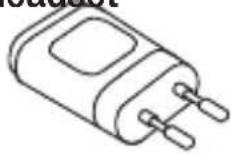
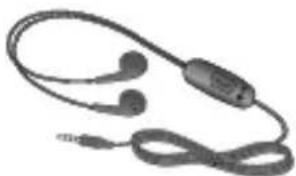
Quick Start Guide, Data cable
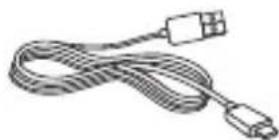
Battery
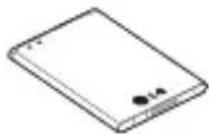
NOTE:
- Always use genuine LG accessories. Failure to do this may void your warranty.
- Accessories may vary in different regions.
Troubleshooting
This chapter lists some problems you might encounter when using your phone. Some problems require you to call your service provider, but most are easy to fix yourself.
| Message Possible causes Possible | corrective measures | |
| Micro SIM error | There is no Micro SIM card in the phone or it is inserted incorrectly. | Make sure that the Micro SIM card is correctly inserted. |
| No network connection/Dropped network | Signal is weak or you are outside the carrier network. | Move toward a window or into an open area. Check the network operator coverage map. |
| Operator applied new services. | Check whether the Micro SIM card is more than 6~12 months old. If so, change your Micro SIM at your network provider's nearest branch. Contact your service provider. | |
| Codes do not match | To change a security code, you will need to confirm the new code by re-entering it. | If you forget the code, contact your service provider. |
| The two codes you have entered do not match. | ||
Troubleshooting
| Message Possible causes Possible | corrective measures | |
| No applications can be set | Not supported by service provider or registration required. | Contact your service provider. |
| Calls not available | Dialling error New network not authorized. | |
| New Micro SIM card inserted. | Check for new restrictions. | |
| Pre-paid charge limit reached. | Contact service provider or reset limit with PIN2. | |
| Phone cannot be switched on | Power/Lock Key pressed too briefly. | Press the Power/Lock Key for at least two seconds. |
| Battery is not charged. | Charge battery. Check the charging indicator on the display. | |
| Message Possible causes Possible | corrective measures | |
| Charging error | Battery is not charged. | Charge battery. |
| Outside temperature is too hot or cold. | Make sure phone is charging at a normal temperature. | |
| Contact problem | Check the charger and its connection to the phone. | |
| No voltage | Plug the charger into a different socket. | |
| Charger defective Replace the charger. | ||
| Wrong charger Use only original LG accessories. | ||
| Number not allowed | The Fixed dialling number function is on. | Check the Settings menu and turn the function off. |
| Impossible to receive / send SMS & photos | Memory full | Delete some messages from your phone. |
| Files do not open | Unsupported file format | Check the supported file formats. |
Troubleshooting
| Message Possible causes Possible | correction measures | |
| The screen does not turn on when I receive a call. | Proximity sensor problem | If you use a protection tape or case, make sure it has not covered the area around the proximity sensor. Make sure that the area around the proximity sensor is clean. |
| No sound Vibration mode | Check the settings status in the sound menu to make sure you are not in vibration or silent mode. | |
| Hangs up or freezes | Intermittent software problem | Try to perform a software update via the website. |

LG
Life's Good
A QUESTION ABOUT YOUR MOBILE PHONE?
Our Customer Service is there to support you:

local tariff

015 - 200 255
local tariff


- APPLICATIONS
- NOTE
- TABLE OF CONTENTS
- GUIDELINES FOR SAFE AND EFFICIENT USE
- IMPORTANT NOTICE
- GETTING TO KNOW YOUR PHONE
- YOUR HOME SCREEN
- GOOGLE ACCOUNT SETUP
- CONNECTING TO NETWORKS AND DEVICES
- CALLS
- CONTACTS
- MESSAGING
- CAMERA
- VIDEO CAMERA
- LG UNIQUE FUNCTIONS
- MULTIMEDIA
- UTILITIES
- THE WEB
- SETTINGS
- PC SOFTWARE (LG PC SUITE)
- PHONE SOFTWARE UPDATE
- ABOUT THIS USER GUIDE
- ACCESSORIES
- TROUBLESHOOTING
- EXPOSURE TO RADIO FREQUENCY ENERGY
- PRODUCT CARE AND MAINTENANCE
- WARNING
- EFFICIENT PHONE OPERATION
- ELECTRONICS DEVICES
- ROAD SAFETY
- AVOID DAMAGE TO YOUR HEARING
- GLASS PARTS
- BLASTING AREA
- POTENTIALLY EXPLOSIVE ATMOSPHERES
- IN AIRCRAFT
- CHILDREN
- EMERGENCY CALLS
- BATTERY INFORMATION AND CARE
- DECLARATION OF CONFORMITY
- CONTACT OFFICE FOR COMPLIANCE OF THIS PRODUCT
- DISPOSAL OF YOUR OLD APPLIANCE
- DISPOSAL OF WASTE BATTERIES/ACCUMULATORS
- BEFORE YOU START USING THE PHONE, PLEASE READ THIS
- PHONE MEMORY
- MANAGING APPLICATIONS
- TO STOP APPLICATIONS
- MOVING APPLICATIONS
- OPTIMIZING BATTERY LIFE
- TO EXTEND THE LIFE OF YOUR BATTERY
- TO VIEW THE BATTERY CHARGE LEVEL
- TO MONITOR AND CONTROL WHAT USES THE BATTERY
- INSTALLING AN OPEN SOURCE OPERATING SYSTEM
- USING AN UNLOCK PATTERN
- WHEN YOU CAN'T RECALL YOUR UNLOCK PATTERN, PIN, OR PASSWORD
- USING HARD RESET (FACTORY RESET)
- USING SAFE MODE
- USING A MICROSD CARD
- CONNECTING YOUR PHONE TO A COMPUTER VIA USB
- OPENING AND SWITCHING APPLICATIONS
- UNLOCK SCREEN WHEN USING DATA CONNECTION
- HOLD THE PHONE STRAIGHT UP
- WHEN THE SCREEN FREEZES
- DO NOT CONNECT YOUR PHONE WHEN YOU POWER ON/OFF YOUR PC
- PHONE OVERVIEW
- EARPIECE
- PROXIMITY SENSOR
- FRONT-FACING CAMERA LENS
- POWER/LOCK KEY
- TOUCH SCREEN
- BACK KEY
- MENU KEY
- HOME KEY
- NOTE: PROXIMITY SENSOR
- TIP
- QUICKBUTTON KEY (CUSTOMIZABLE)
- POWER/LOCK KEY VOLUME KEYS
- INSTALLING THE MICRO SIM CARD AND BATTERY
- CHARGING YOUR PHONE
- INSERTING A MICROSD CARD
- REMOVING THE MICROSD CARD
- FORMATTING THE MICROSD CARD
- LOCKING AND UNLOCKING THE SCREEN
- TOUCH SCREEN TIPS
- HOME SCREEN
- CUSTOMIZING THE HOME SCREEN
- TO ADD ITEMS ON YOUR HOME SCREEN
- TO REMOVE AN ITEM FROM THE HOME SCREEN
- TIP! USING FOLDERS
- RETURNING TO RECENTLY-USED APPLICATIONS
- NOTIFICATIONS
- SWIPE DOWN FOR NOTIFICATIONS & SETTINGS
- QUICK SETTINGS
- TO REARRANGE QUICK SETTING ITEMS ON THE NOTIFICATION PANEL
- INDICATOR ICONS ON THE STATUS BAR
- ON-SCREEN KEYBOARD
- USING THE KEYPAD & ENTERING TEXT
- ENTERING ACCENTED LETTERS
- TO SET UP YOUR GOOGLE ACCOUNT
- WI-FI
- CONNECTING TO WI-FI NETWORKS
- TURNING WI-FI ON AND CONNECTING TO A WI-FI NETWORK
- BLUETOOTH
- TURNING ON BLUETOOTH AND PAIRING UP YOUR PHONE WITH A BLUETOOTH DEVICE
- SEND DATA USING THE BLUETOOTH WIRELESS FEATURE
- RECEIVE DATA USING THE BLUETOOTH WIRELESS FEATURE
- BLUETOOTH TETHERING
- TO SHARE YOUR CONNECTION VIA BLUETOOTH TETHERING
- SMARTPHONE MOBILE HOTSPOTS
- TO CREATE A PORTABLE HOTSPOT
- ENABLING WI-FI DIRECT TO SHARE THROUGH SMARTSHARE
- SMARTSHARE
- TO TURN SMARTSHARE ON AND ALLOW SHARING CONTENTS
- TO CONTROL YOUR RENDERER DEVICES
- TO DOWNLOAD CONTENTS FROM THE REMOTE CONTENT LIBRARY
- TO UPLOAD CONTENTS TO THE REMOTE CONTENT LIBRARY
- NFC
- TO TURN ON NFC
- ANDROID BEAM
- TO ACTIVATE ANDROID BEAM
- FILE NETWORKING
- TO SHARE MY FOLDER
- TO ACCESS ANOTHER DEVICE'S FOLDER
- MAKING A CALL
- CALLING YOUR CONTACTS
- ANSWERING AND REJECTING A CALL
- LOCKED SCREEN
- UNLOCKED SCREEN
- TIP! DECLINE WITH MESSAGE
- ADJUSTING THE IN-CALL VOLUME
- MAKING A SECOND CALL
- ENDING A CALL
- ENDING A CALL FROM THE STATUS BAR
- VIEWING YOUR CALL LOGS
- CALL SETTINGS
- SEARCHING FOR A CONTACT
- ADDING A NEW CONTACT
- FAVORITE CONTACTS
- TO ADD A CONTACT TO YOUR FAVORITES
- TO REMOVE A CONTACT FROM YOUR FAVORITES LIST
- CREATING A GROUP
- CONVERSATION VIEW
- SENDING A MESSAGE
- USING SMILES
- CHANGING YOUR MESSAGE SETTINGS
- MANAGING AN E-MAIL ACCOUNT
- TO ADD ANOTHER E-MAIL ACCOUNT
- WORKING WITH ACCOUNT FOLDERS
- COMPOSING AND SENDING E-MAIL
- TO COMPOSE AND SEND A MESSAGE
- GETTING TO KNOW THE VIEWFINDER
- USING THE ADVANCED SETTINGS
- TAKING A QUICK PHOTO
- ONCE YOU'VE TAKEN A PHOTO
- TOUCH THE MENU KEY TO OPEN ALL ADVANCED OPTIONS
- VIEWING YOUR SAVED PHOTOS
- RECORDING A QUICK VIDEO
- AFTER RECORDING A VIDEO
- WATCHING YOUR SAVED VIDEOS
- ADJUSTING THE VOLUME WHEN VIEWING A VIDEO
- QUICKMEMO
- USING THE QUICKMEMO OPTIONS
- VIEWING THE SAVED QUICKMEMO
- QUICKREMOTE
- TO OPEN THE QUICKREMOTE APPLICATION AND SET UP YOUR QUICKREMOTE(S)
- USING QUICKREMOTE
- QUICKREMOTE OPTIONS
- LIVE ZOOMING
- QSLIDE
- QUICKTRANSLATOR
- VUTALK
- REGISTERING VUTALK
- USING VUTALK
- GALLERY
- VIEWING PICTURES
- ZOOMING IN AND OUT
- PLAYING VIDEOS
- VIEWING PHOTO AND VIDEO OPTIONS
- DELETING IMAGES AND VIDEOS
- SETTING AS WALLPAPER
- VIDEOS
- PLAYING A VIDEO
- MUSIC
- ADD MUSIC FILES TO YOUR PHONE
- TRANSFER MUSIC USING MEDIA SYNC (MTP)
- PLAYING A SONG
- SETTING YOUR ALARM
- USING YOUR CALCULATOR
- ADDING AN EVENT TO YOUR CALENDAR
- FILE MANAGER
- TO OPEN THE FILE MANAGER APPLICATION
- FILE MANAGER OPTIONS
- APPLICATION MANAGER
- APPLICATION MANAGER SETTINGS
- VOICE RECORDER
- RECORDING A SOUND OR VOICE
- SENDING THE VOICE RECORDING
- TASK MANAGER
- TASK MANAGER OPTIONS
- POLARIS VIEWER
- VIEWING FILES
- FILESHARE
- LG BACKUP
- ABOUT BACKING UP AND RESTORING SMARTPHONE DATA
- LG BACKUP YOUR SMART PHONE DATA
- SCHEDULING AUTOMATIC BACKUPS
- RESTORING SMARTPHONE DATA
- VOICE SEARCH
- DOWNLOADS
- INTERNET
- USING THE WEB TOOLBAR
- VIEWING WEBPAGES
- OPENING A PAGE
- SEARCHING THE WEB BY VOICE
- BOOKMARKS
- HISTORY
- USING QSLIDE
- USE CHROME TO SEARCH FOR INFORMATION AND BROWSE WEBPAGES
- TAP THE WEB ADDRESS FIELD, AND THEN ENTER A WEB ADDRESS OR SEARCH CRITERIA
- TO GO TO A NEW PAGE, TAP □ > NEW TAB. - TO GO TO ANOTHER WEBPAGE, TAP ②, SCROLL UP OR DOWN AND TAP THE PAGE TO SELECT IT
- TAP THE ADDRESS FIELD, TAP ↓, SPEAK A KEYWORD AND SELECT ONE OF THE SUGGESTED KEYWORDS THAT APPEAR
- SYNCING WITH OTHER DEVICES
- VIEWING BOOKMARKS
- ACCESS THE SETTINGS MENU
- WIRELESS & NETWORKS
- TIP! HOW TO OBTAIN THE MAC ADDRESS
- DEVICE
- STORAGE
- BATTERY
- BATTERY INFORMATION
- POWER SAVER
- TURN POWER SAVER ON
- POWER SAVING ITEMS
- PERSONAL
- ACCOUNTS & SYNC
- LOCATION ACCESS
- BACKUP & RESET
- SYSTEM
- DATE & TIME
- ACCESSIBILITY
- SERVICES
- VISION
- HEARING
- PHYSICAL AND MOTOR
- DEVELOPER OPTIONS
- DEBUGGING
- INPUT
- DRAWING
- MONITORING
- APPS
- WITH YOUR "LG PC SUITE" PC SOFTWARE, YOU CAN
- INSTALLING "LG PC SUITE" PC SOFTWARE
- SYSTEM REQUIREMENTS FOR "LG PC SUITE" PC SOFTWARE
- NOTE: LG INTEGRATED USB DRIVER
- SYNCHRONIZING YOUR DEVICE TO A PC
- MOVING CONTACTS FROM YOUR OLD DEVICE TO YOUR NEW DEVICE
- LG MOBILE PHONE SOFTWARE UPDATE VIA OVER-THE-AIR (OTA)
- TRADEMARKS
- DIVX HD DIVX
- NOTICE: OPEN SOURCE SOFTWARE
- A QUESTION ABOUT YOUR MOBILE PHONE
Brand : LG
Model : D505
Category : Cellphone