EG311V5U - Range hood Atag - Free user manual and instructions
Find the device manual for free EG311V5U Atag in PDF.



| Product type | Range hood |
| Brand | Atag |
| Model | EG311V5U |
| Power supply | 230 V ~ 50 Hz |
| Connected power | See rating plate |
| Minimum distance between hood and hob | 65 cm |
| Exhaust duct diameter | 150 mm (reducible to 125 mm with supplied connector) |
| Lighting | Halogen lighting, 2 levels (max and soft), dedicated key |
| Fan | 4 speeds including an intensive position, touch controls |
| Automatic delayed shut-off | Programmed to stop after 10 minutes (button Ⓗ) |
| Filtration type | Grease filter (dishwasher safe) + charcoal filter (for recirculation, replace twice a year) |
| Grease filter saturation indicator | Indicator light on the hood; reset by long press (5 s) on dedicated button |
| Material | Stainless steel |
| Stainless steel care | Soapy water and soft cloth; avoid abrasive products |
| Bulb type | Halogen, 20 W (wall-mounted hood) or 10 W (island module) |
| Bulb replacement | Disconnect the appliance, pull the inner ring with a screwdriver, replace with a clean cloth |
| Safety | Transport safety device (screw to remove before installation); must be installed by a qualified professional |
| Mode of use | External extraction or recirculation (charcoal filter required) |
| Standards | EC directives, Kema mark |
Frequently Asked Questions - EG311V5U Atag
User questions about EG311V5U Atag
0 question about this device. Answer the ones you know or ask your own.
Ask a new question about this device
Download the instructions for your Range hood in PDF format for free! Find your manual EG311V5U - Atag and take your electronic device back in hand. On this page are published all the documents necessary for the use of your device. EG311V5U by Atag.
USER MANUAL EG311V5U Atag
natural_image
3D diagram of a mechanical component with a conical base and top assembly (no text or symbols)ATAG
instructions for use/installation instructions
WS90..MM - WS12..MM - ES12..MM Waal
WS90..NM - WS12..NM - ES12..NM Dinkel
afvoer
natural_image
Technical line drawing of a mechanical component with a 20-degree angle标注 (no text or symbols beyond the dimension)natural_image
Technical diagram showing a mechanical assembly with a magnified inset view of a bracket (no text or symbols present)kap ophangen
NL 12NL 12
montage (vervolg)
natural_image
Simple line drawing of a box with a hanging object and two diagonal lines above it (no text or symbols)The extractor hood has been designed for domestic use and for the purposes stated. Atag extractor hoods are available in many different models, which fit elegantly into all interiors. The Atag range offers various types of hoods, some with built-in motors and others suitable for recirculation.
When you have read this manual, you will quickly be aware of all the facilities the appliance can offer you. You can read about safety and how you should look after the appliance. In addition you will find environmental tips and instructions that can help to save energy.
Keep the manual. Any later user of this appliance could benefit from them.
table of contentsintroduction
general 1 - 2
introduction 1
for your safety 2
instructions for use 3 - 7
lighting 3
fan 3-4
faults 5
how to keep the appliance looking good 6 - 7
installation instructions 8 - 14
installation 8 – 9
assembly 10 – 13
technical data 14
disposal of packaging and appliances 14
Please note!
Separate installation instructions are supplied for the Island models.
for your safety
please note
This appliance should be connected by a registered fitter. Damage arising from incorrect connection or incorrect fitting is not covered by the guarantee.
Disconnect the appliance before starting with cleaning or reparation. It is recommended that you do this by removing the plug from the socket or by setting the isolation switch to zero.
Never flambe under an extractor. The high flames can cause fire. Even if the ventilator is switched off.
When deep-frying, always keep a close watch.
If the appliance is used together with equipment which uses gas or other fuels, then a sufficient supply of fresh air must be ensured.
Switch the extractor hood on before starting to cook. After cooking, allow the extractor hood to continue to run for approx. 10 minutes. This can also be done automatically (see 'automatic continued running').
Clean the appliance regularly, as shown in 'maintenance'. This minimises the chance of a fire starting.
Switch off the electricity before replacing the light bulbs! Only use the same sort of light bulbs with the same Wattage.
In view of possible sharp edges on the chimney we advise you to wear working gloves when fitting the chimney.
lighting
| 1 | 2 | 3 | 4 | ATAG |
switching lighting on and off
Press the lighting button
The lighting comes on at its highest setting.
Press the button again and the lighting is dimmed.
Press the button for a third time and the lighting goes out. The indicator light in the button also goes out.
fan
The extractor hood comes on at the setting selected. The figure in the button lights up.
adjusting the extractor capacity
Press a button with a higher or lower value.
The figure in the button lights up.
intensive setting
Press the button.
The figure in the button lights up.
fan (continued)
| 1 | 2 | 3 | 4 | ATAG |
Press the button with the illuminated symbol.
The extractor hood switches off and the light of the symbol in the button goes out.
automatic continued operation
Choose the fan setting desired and press the button.
The symbol in the button lights up.
After approximately 10 minutes, the extractor hood switches back automatically and finally switches off. If the lighting was switched on during the automatic continued running, it will remain switched on.
cleaning the grease filter
If the grease filter indicator light comes on, the filter should be cleaned immediately.
Replace the filter after cleaning and erase the electronic memory by pressing the button for approx. 5 seconds. The indicator light goes out.
faults
Please check the following points which may solve the problem, before calling the service department.
If the connection cable is damaged, it should be replaced by the service department of the manufacturer or similarly qualified persons in order to prevent dangerous situations from arising.
NB: Disconnect the appliance from the mains before starting any repairs, preferably by removing the plug from the socket or by setting the isolation switch to zero.
fault
Lighting does not work.
cause
Lamp defective.
solution
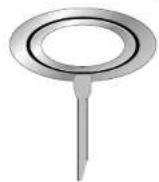
Pull the inner ring downwards using a screwdriver (see illustration).
NB:
Only use the same type of lamp with the wattage stated.
NB: the glass is loose! Pull the halogen lamp out of the fitting and replace it with a new 20 W halogen lamp (wall hoods) or 10 W halogen lamp (island hoods). Use a clean cloth to hold the new lamp.
Extractor hood makes a lot of noise.
Discharge duct too long or has too many bends.
Change the discharge duct (see installation instructions).
Motor defective.
Phone the Service department.
No extraction.
Motor or controls defective.
Phone the Service department.
Connection lead defective.
Phone the Service department.
maintenance
extractor hood
Clean the grease filters as soon as the grease filter indicator light comes on.
The stainless steel on the outside of the hood can be cleaned with soapy water and a damp cloth. The stainless steel will regain its shine if you occasionally use a stainless steel care product or polish. The polish imparts a dirt-resistant layer to the stainless steel. Always clean the stainless steel in the direction of polishing,
Never use abrasive cleaning agents (such as Vim, green scouring pads or other scourers) or polishing cleaning products (such as liquid scourers).
Never use caustic cleaning agents. These can cause stainless steel to discolour.
maintenance (continued)
removing/replacing grease filters
Remove the filters as follows: switch the fan and the lighting off.
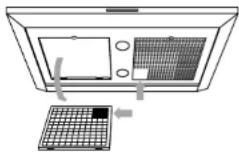
Push the filter at the edge of the niche to the back and pull the front end down. You can now remove the filter from the hood.
The filter can only be put back into place in one way. Take note of the correct position of the filter (see illustration). Hold the filter in such a way that the covered part of the underside is at the centre rear. This is recognizable on the outside by the pattern with the smaller holes.
Put the filter back into place by first pushing the rear side into the holder. Then push the front upwards until it cannot go any further and let the filter slide forwards. The filter is now once again in place. Erase the electronic memory by pressing the button for approx. 5 seconds.
cleaning the grease filters
You can clean the grease filters in the dishwasher. Allow the filter to drain well - through the slits in the side - before putting it back.
replacing the carbon filter
Replace the carbon filter twice a year. This only applies to recirculation hoods.
Put the carbon filter in the place intended for it above the filters.
installation
some preliminary remarks
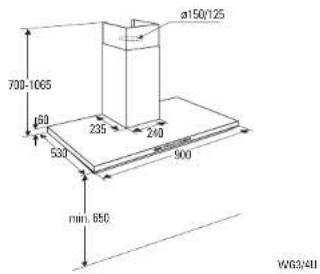
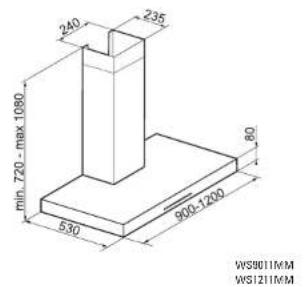
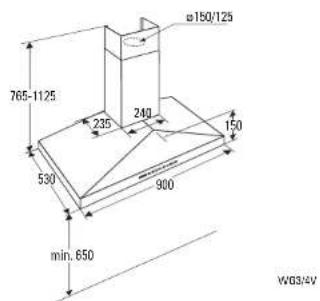
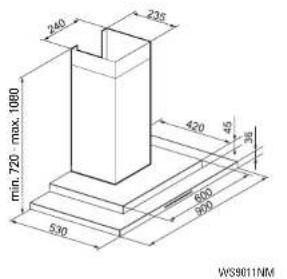
An extractor hood should be installed in accordance with national and local regulations. The minimum distance between the underside of the extractor hood and the hob should be 65 cm.
The appliance should be connected by a registered fitter. Damage arising from incorrect connection or incorrect fitting is not covered by the guarantee.
NB:
If an extractor hood and a heat source (for example, gas-, oil- or coal-fired cookers) which take air from the same room are in use at the same time, there is a possibility that the extractor hood will cause an underpressure in that room. The maximum permitted underpressure is 4 Pa, so that no combustion gases from the heat source can find their way back into the room. For this reason, an air supply is required - to provide a constant supply of fresh air to the room.
electrical connection
The extractor hood's plug should be accessible after fitting or the extractor hood should be isolated by a bipolar switch with 3 mm plug pins.
When making the electrical connections, make sure that the socket is earthed and that the voltage and frequency correspond to the values given on the data plate.
If the connection cable is damaged, it should be replaced by the service department of the manufacturer or similarly qualified persons in order to prevent dangerous situations from arising.
installation (continued)
discharge
The discharge should not be connected to a duct which is also used for other purposes under any circumstances.
Bear in mind any local regulations concerning the ventilation of gas appliances.
The discharge may pass straight through the wall to the outside, provided that the wall opening is protected - by means of a grating - against rain, leaves, and the like getting in. The passage of the discharge may not be restricted by the wall grating by more than 20%.
We advise the use of as large a discharge duct as possible. A duct with a smaller diameter will have a low extraction capacity and produce higher noise levels.
Bends produce resistance. Make sure that the duct has a smooth run and has as few bends as possible. Draw the flexible pipe out as far as possible.
Before starting to drill, check that there are no installed pipes present.
The discharge stump has a diameter of 150 mm. It is best if the discharge pipe also has this diameter.
A reducing piece (150 mm to 125 mm) is supplied with the appliance for connection to a 125 mm discharge pipe.
transport protection device
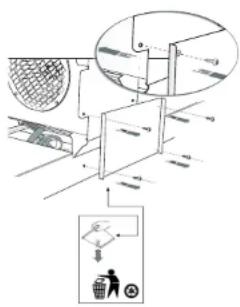
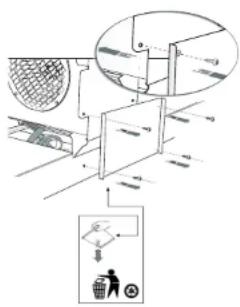
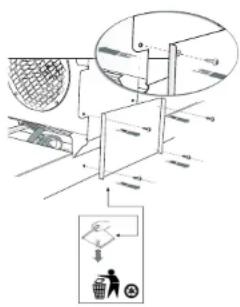
The cooker hood comes with a transport protection device that has to be removed before installation. Remove the 4 screws at the rear of the motor module (see fig.) and detach the motor module from the cooker hood. Observe the assembly instructions on the following pages.
assembly
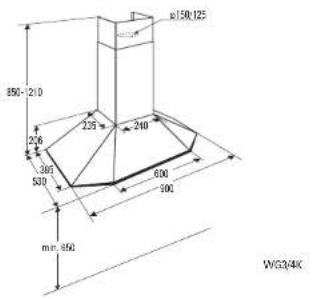
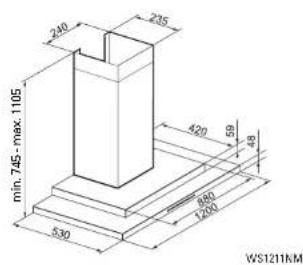
building-in dimensions wall hood
assembly (continued)
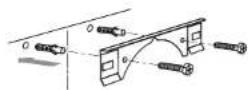
installation wall hood
The most important dimensions are shown on the previous page. You can set the height of the telescopic pipe. Take the allowable tolerances into account. Position the discharge and the electrical connection in such a way that it will be easy to hook up the hood.
Remove the transport safety device prior to assembly, see page 9.
marking out and fitting fixing materials
Draw a vertical centre line on the wall (centre of the extractor hood).
Place the fastening clip against the wall so that it rests against the ceiling. The arrow on the flanged rim indicates the middle of the cooker hood. Mark the attachment holes to be drilled. Drill the holes (ø 8 mm).
Put the plugs into the wall and fix the fixing bracket to the wall with the screws supplied (5 x 50 mm).
marking out and fitting motor module
Mark the position of the underside of the hood on the wall (bear in mind the minimum distance to the hob). Mark the (vertical) centre line.
Fold or cut the template depending on type and mark the upper fixing holes.
Drill the fixing holes (2 x ø 10 mm).
Fix the plugs. Screw two nuts onto the threaded ends in the opposite direction. Screw the threaded ends into the wall leaving 20 mm projecting (see illustration).
Remove the nuts.
assembly (continued)
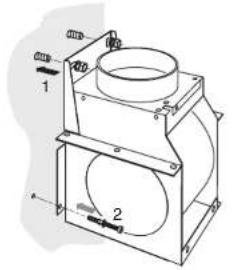
Suspend the motor module on the threaded ends (1). Screw the nuts on. Make sure that the motor module is exactly level.
Drill holes (2 x ø 6 mm) and secure the motor module with the fixing pins supplied (6 x 60) (2).
Fit the discharge duct.
Connect the motor module electrically.
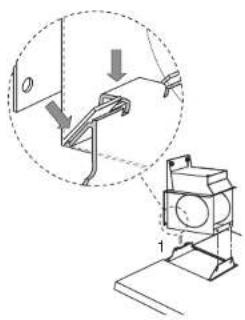
fitting the hood
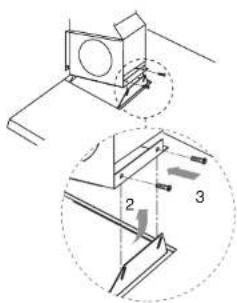
Fit the hood to the motor module. First hook the rear of the hood into the motor module at the bottom (1).
Then lift the front up (2) so that the two bolts supplied (M5 x 12) can be screwed in (3). Use these bolts to level the hood.
Use these screws to level the hood.
Make the plug connections in the hood.
GB 12GB 12
assembly (continued)
natural_image
Simple line drawing of a box with an upward arrow and two vertical lines above it (no text or symbols)fitting the telescopic pipe
NB: During recirculation, the ventilation slits must not be covered by the lower telescopic pipe.
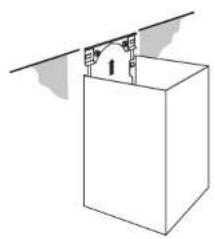
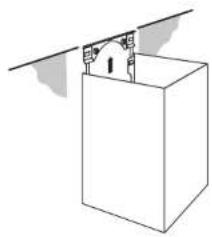
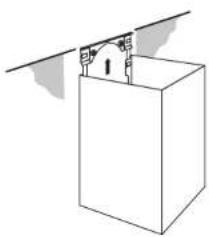
Slide the flanged end of the upper telescopic pipe upwards between the fixing bracket and the wall, and slide the telescopic pipe against the ceiling. The telescopic pipe locks into position.
Hook the lower telescopic pipe onto the upper part and allow the lower part to drop so that it slides into the edge of the hood.
Put the filters in place and test the extractor hood.
technical data
type number: see data plate in the hood
power supply: 230 V - 50 Hz
connected load: see data plate
dimensions (h x w x d): see "fitting dimensions"
approvals mark: Kema
This appliance complies with the CE directives.
external motors
NB: For appliances with an external motor, ATAG
recommends the use of the following types of external
motors:
WA111C5U WA300C5U
disposal of packaging and appliances
The packaging of the appliance is recyclable. It can be made up of:
-cardboard
- polyethylene
– CFC free polystyrene (PS rigid foam)
– polypropylene straps around the box
Please dispose of these materials in a responsible way in
accordance with the regulations of your local authority.
Your local authority will also be able to give you information about disposing disused household appliances in a responsible way.
préface
installation (suite)
évacuation
natural_image
Diagram showing a mechanical assembly with a magnified inset of a component being inserted (no text or symbols present)FR 12FR 12
montage (suite)
natural_image
Simple line drawing of a box with two vertical supports and a diagonal line above it (no text or symbols)Installation (Forts.)