ManualGo.com
GSM2200NBB - Dishwasher GE - Free user manual and instructions
Find the device manual for free GSM2200NBB GE in PDF.


Download the instructions for your Dishwasher in PDF format for free! Find your manual GSM2200NBB - GE and take your electronic device back in hand. On this page are published all the documents necessary for the use of your device. GSM2200NBB by GE.
USER MANUAL GSM2200NBB GE
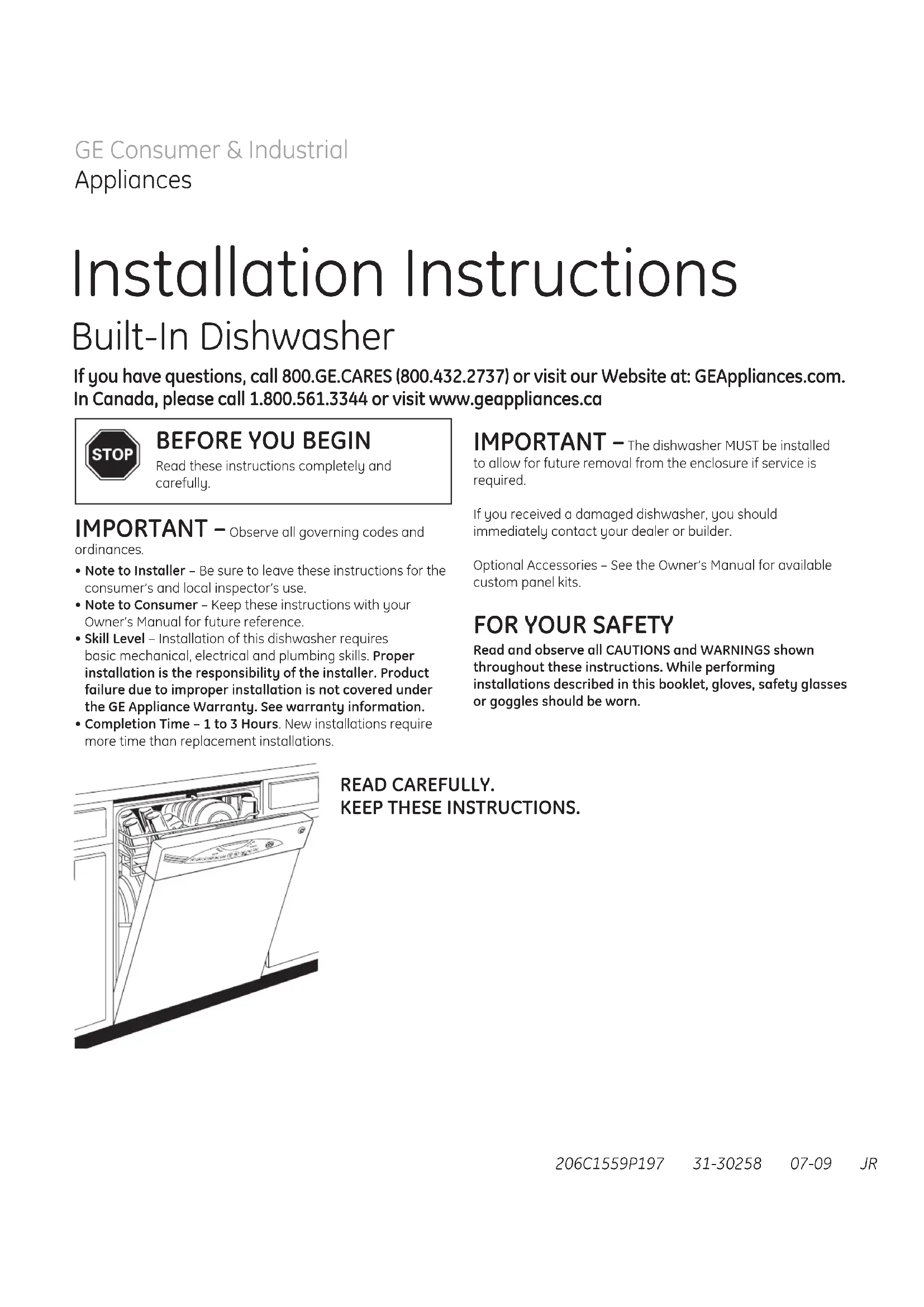
GE Consumer & Industrial Appliances Installation Instructions Built-In Dishwasher If you have questions, call 800.GE.CARES (800.432.2737) or visit our Website at: GEAppliances.com. In Canada, please call 1.800.561.3344 or visit www.geappliances.ca IMPORTANT – The dishwasher MUST be installed to allow for future removal from the enclosure if service is required.If you received a damaged dishwasher, you should immediately contact your dealer or builder.Optional Accessories – See the Owner’s Manual for available custom panel kits.
Read and observe all CAUTIONS and WARNINGS shown throughout these instructions. While performing installations described in this booklet, gloves, safety glasses or goggles should be worn. READ CAREFULLY. KEEP THESE INSTRUCTIONS. IMPORTANT – Observe all governing codes and ordinances.• Note to Installer – Be sure to leave these instructions for the consumer’s and local inspector’s use.• Note to Consumer – Keep these instructions with your Owner’s Manual for future reference.• Skill Level – Installation of this dishwasher requires basic mechanical, electrical and plumbing skills. Proper installation is the responsibility of the installer. Product failure due to improper installation is not covered under the GE Appliance Warranty. See warranty information.• Completion Time – 1 to 3 Hours. New installations require more time than replacement installations.
Read these instructions completely andcarefully. 206C1559P197 31-30258 07-09 JRTOOLS YOU WILL NEED:
■ Phillips-head screwdriver
■ 1/4" and 5/16" nutdriver
■ Bucket to catch water when fl ushing the line
■ Drill and appropriate bits
■ Hole saw set 90° Elbow,Ferrule and Compression NutHot Water Line Hand Shut-Off Valve Side and Top Trim Pieces on some modelsHole Saw SetLevelThreadSeal TapeAir GapStrain ReliefDrain HoseHose Clamp1/4" and 5/16" Nutdriver15/16" SocketBucket Tubing CutterDrill and BitsFlashlightGlovesPhillips-Head ScrewdriverCarpenter's Square6" AdjustableWrench Safety Glasses Installation Preparation
■ Two #8-18 x 5/8" Phillips special head screws, to secure dishwasher to underside of countertop
■ Junction box cover and #10 hex-head screw
■ Drain hose (approximately 78" long)
■ Side and top trim pieces (some models)
■ Literature, samples and/or coupons
■ 2 Side-mounting brackets with four #8 pan-head mounting screws for non-wood countertops (some models) MATERIALS YOU WILL NEED:
■ Ferrule, compression nut and 90° elbow (3/8"NPT external thread on one end, opposite end sized to fit water supply)
■ GPF65 side-mount kit if countertop is granite or similar material Materials Needed for New Installations:
■ Waste tee for house plumbing, if applicable
■ Screw-type hose clamps
■ Hand shut-off valve (recommended)
■ Water line–3/8" minimum copper tubing
■ GPF10L drain hose (10' long), if needed Junction Box CoverGPF65Side-Mount Bracket Kit#8 PhillipsSpecial Head Screws5/8" long Screw Kit #10 Hex-Head J-Box Screw1/2" longOptional 10' Drain HoseGPF10LZip TiesHose Clamps#8 Phillips Pan-head Screws 3/8" long for side-mounting Side-Mounting Brackets Side Mount Kit (some models) Waste TeeElectrical Cable (or Power Cord, if applicable)Wire Nuts (3)Method 1 – Air Gap with Waste Tee or Disposer An air gap must be used when required by local codes and ordi-nances. The air gap must be installed according to manufacturer’s instructions.
PREPARE DISHWASHER ENCLOSURE
- The rough cabinet opening must be at least 24" deep, 24" wide and approximately 34-1/2" high from floor to underside of the countertop. CLEARANCES: When installed into a corner, allow 2" min. clearance between dishwasher and adjacent cabinet, wall or other appliances. Allow 28-3/8" min. clear-ance from the front of the dishwasher for door opening. Figure B. DRAIN REQUIREMENTS
- Follow local codes and ordinances.
- Do not exceed 10' distance to drain. NOTE: Air gap must be used, if waste tee or disposer connection is less than 18" above floor to prevent siphoning.
DETERMINE DRAIN METHOD
The type of drain installation depends on the following questions.
■ Is waste tee less than 18" above floor? If the answer to either question is YES, Method 1 MUST be used.
- If the answers are NO, either method may be used. CABINET PREPARATION
- Drill a 1-1/2" diameter hole in the cabinet wall within the shaded areas shown in Figure A for the drain hose connection. The hole should be smooth with no sharp edges. IMPORTANT – When connecting drain line to disposer, check to be sure that drain plug has been removed. DISHWASHER WILL NOT DRAIN IF PLUG IS LEFT IN PLACE. Method 2 – “High Drain Loop” with Waste Tee or Disposer Tip: Avoid unnecessary service call charges. Always be sure disposer drain plug has been removed before attaching dishwasher drain hose to the disposer. Figure D
- The dishwasher must be installed so that drain hose is no more than 10' in length for proper drainage.
- The dishwasher must be fully enclosed on the top, sides and back, and must not support any part of the enclosure. 24" Min. This Wall Area must be Free of Pipes or wiresPlumbing and Electric Service Must Enter Inside This Area4"24" Min. 6"5"5"4"CabinetsSquare and PlumbFloor MUST be EvenWith Room Floor. 34-1/2" 1/4"Underside of Countertopto Floor 32" Min. 18" Min. Drain Hose Hanger Figure B Clearance for Door Opening 2" Minimum Countertop Dishwasher 28-3/8" Figure AFigure C Installation Preparation
- The wiring may enter the opening from either side, rear or the floor within the shaded area illustrated above in Figure E and defined in Figure A.
- Cut a 1-1/2" maximum diameter hole to admit the electrical cable. Permanent wiring connections may pass through the same hole as the drain hose and hot water line, if convenient. If cabinet wall is metal, the hole edge must be covered with a bushing. NOTE: Power cords with plug must pass through a separate hole. Electrical Connection to Dishwasher Electrical connection is on the right front of dishwasher.
- For permanent connections the cable must be routed as shown in Figure E. Cable must extend a minimum of 24" from the rear wall.
- For power cord connections, install a 3-prong grounding type receptacle in the sink cabinet rear wall, 6" min. or 18" maximum from the opening, 6" to 18" above the floor.
- This appliance must be supplied with 120V, 60 Hz., and connected to an individual properly grounded branch circuit, protected by a 15- or 20-ampere circuit breaker or time- delay fuse.
- Wiring must be 2 wire with ground and rated for 75°C (176°F).
- If the electrical supply does not meet the above requirements, call a licensed electrician before proceeding. Grounding Instructions–Permanent Connection This appliance must be connected to a grounded metal, permanent wiring system, or an equipment-grounding conductor must be run with the circuit conductors and be connected to the equipment-grounding terminal or lead on the appliance. Grounding Instructions–Power Cord Models This appliance must be grounded. In the event of a malfunction or breakdown, grounding will reduce the risk of electric shock by providing a path of least resistance for electric current. This appliance is equipped with a cord having an equipment- grounding conductor and a grounding plug. The plug must be plugged into an appropriate outlet that is installed and grounded in accordance with all local codes and ordinances. White 18"
from Cabinet Alternate Receptacle Location Ground Black 1-1/2" Dia. Hole (Max.) 18"
- The line may enter from either side, rear or floor within the shaded area shown in Figure F.
- The line may pass through the same hole as the electrical cable and drain hose. Or, cut an additional 1-1/2" diameter hole to accommodate the water line. If power cord with plug is used, water line must not pass through power cord hole. Figure F Water Line Connection
- Turn off the water supply.
- Install a hand shut-off valve in an accessible location, such as under the sink. (Optional, but strongly recommended and may be required by local codes.)
- Water connection is on the left side of the dishwasher. Install the hot water inlet line, using no less than 3/8" copper tubing. Route the line as shown in Figure F and extend forward at least 19" from rear wall.
- Adjust water heater for 120°F to 150°F temperature.
- Flush water line to clean out debris.
- The hot water supply line pressure must be 20-120 PSI. Turn page to begin dishwasher installation.
Cabinet Face Shut-offValve
2" From Floor 19" From Wall
From Cabinet 1-1/2" Dia. Hole Hot Installation Preparation 5Dishwasher Installation Figure G
- Screw leveling legs back into the dishwasher frame, approximately 1/8" from frame as shown. Approx.1/8" STEP 3: REMOVE WOOD BASE,
INSTALL LEVELING LEGS
IMPORTANT – Do not kick off wood base! Damage will occur.
- Move the dishwasher close to the installation location and lay it on its back.
- Remove the four leveling legs on the underside of the wood base with a 15/16" socket wrench.
- With dishwasher on the wood base, check the door balance by opening and closing the door.
- Door is properly balanced if it gently drops from a 1/2 open position and does not rise from the full open position.
- If necessary increase or decrease tension as shown. Latch door and adjust both springs to the same tension setting to correct balance. Tip: Make sure door opens and closes smoothly. Check door opening and closing. If door does not open easily or falls too quickly, check spring cable routing. The cable is held in place by “shoulders” on the pulley. Check to be sure cable has not slipped over the pulley shoulders. Increase Spring Tension Decrease Spring Tension Correct Incorrect Insert Hook Over Bracket STEP 1: PREPARATION Locate the items in the installation package and set aside for use in the listed steps:
- Screw kit – Steps 5 or 18 and 15
- Junction box cover – Step 5 or 18
- Drain hose and clamp – Step 7
- Drain hose hanger – Step 17
- Trim pieces (some models) – Step 11
- Owner's Manual - Steps 19 and 22
- Product Samples and/or coupons – Step 22
- Remove the 2 toekick screws and toekick. Set aside for use in Step 21. Figure I
CAUTION: Do not remove wood base until you are ready to install the dishwasher. The dishwasher will tip over when the door is opened if base is removed. PRECAUCIÓN: No quite la base de madera hasta que esté listo para instalar el lavaplatos. Si se quita la base, el lavaplatos se volcará cuando se abra la puerta.STEP 6: INSTALL 90° ELBOW
- Wrap a 90° elbow with thread seal tape.
- Thread 90° elbow onto the water valve.
- Do not overtighten elbow. Water valve bracket could bend or water valve fitting could break.
- Position the end of the elbow to face the rear of the dishwasher. Figure K Figure J Tip: Avoid unnecessary service charges. Make a leak free connection. Insert hose against stop on pump. Position clamp against front lip of drain hose with clamp screw on bottom side of hose. Tighten clamp to at least 15 inch-pounds of torque. Tip: Reduce drain pump noise. Position drain hose clamp so screw is on the bottom side of the hose. This will prevent noise caused by the clamp coming in contact with the tub bottom. Refer to Figure L. Dishwasher Installation Figure L FWXcT6a^d]S1[PRZ3^=^c DbT =^cT)2WTRZCWPc7Pa]Tbb;TPSb0aTCWaTPSTSCWadB\P[[7^[TX]1aPRZTc
STEP 5: INSTALL POWER CORD
Skip this step if dishwasher will be permanently connected to the house electrical system. In this step you will need the junction box cover and the #10 x 1/2" hex head screw from the screw kit set aside in Step 1. The power cord and connections must comply with the National Electrical Code, Section 422 and/or local codes and ordinances. Maximum power cord length is 6 feet. Power Cord Kit WX09X70910, available for purchase from an authorized GE Appliance Dealer, meets these requirements.
- Install strain relief in junction box bracket.
- Insert power cord through strain relief and tighten.
- Make sure black, white and green dishwasher wires are threaded through small hole in junction box bracket.
- Connect power cord white (or ribbed) to dishwasher white wire, black (or smooth) to dishwasher black wire and ground to dishwasher green wire. Use UL-listed wire nuts of appropriate size.
- Install junction box cover using #10 hex-head screw. Be sure wires are not pinched under the cover.
STEP 7: INSTALL DRAIN HOSE TO
PUMP OUTLET Skip this step if drain hose has been preinstalled. In this step you will need the drain hose and clamp set aside in Step 1.
- Stand dishwasher upright.
- Place drain hose clamp over 1-3/16" diameter end of drain hose. Position clamp so screw is on bottom side of hose. Refer to Figure L. IMPORTANT – Prevent drain hose damage and possible leaks. Be careful not to nick or cut the drain hose.
- Push the end of the drain hose over the drain pump outlet being careful not to disturb the check valve. Refer to Figure L.
- Seat the drain hose end against the hose stops on the pump outlet.
- Position hose clamp against the front lip of the drain hose and tighten clamp. NOTE: Drain hose supplied with dish washer is approximately 78" long. If a longer hose is needed, a 120" long hose (10 feet) may be purchased from an authorized GE appliance dealer. The 10' long hose is part number GPF10L. Hose Clamp Hose Stops Pump Outlet Check Valve Do Not Remove
- Position dishwasher in front of cabinet opening. Insert drain hose into the hole in cabinet side. If a power cord is used, guide the end through a separate hole.
- Position water supply line and house wiring on the floor of the opening to avoid interference with base of dishwasher and components under dishwasher.Figure M Water Line HouseWiring5"5"4"4"6"6"4" Tip: Prevent unnecessary service call charges for no fi ll, drain or noise concerns.Position utility lines so they do not interfere with anything under or behind the dishwasher. Dishwasher Installation
STEP 10: SLIDE DISHWASHER
THREE-FOURTHS OF THE WAY
INTO CABINET IMPORTANT – Do not push against front panel with knees. Damage will occur. • Grasp the sides of the front panel and slide dishwasher into the opening a few inches at a time.• As you proceed, pull the drain hose through the opening under the sink. Stop pushing when the dishwasher extends about 6 inches forward of adjacent cabinets.• Make sure drain hose is not kinked under or behind the dishwasher.• Make certain the house wiring, drain line and water line do not interfere with components under dishwasher.Figure OFigure P
STEP 11: INSTALL TRIM PIECES
(some models) Skip this step if trim is not supplied with the dishwasher.In this step you will need the trim pieces set aside in Step 1.• Position the trim pieces so the lips face toward the dishwasher door.• Select a long trim piece and press it onto the left side tub fl ange. Start with the top edge and press the trim piece completely onto the tub fl ange as you move towards the bottom. Repeat for the right side tub fl ange trim piece.• Install remaining trim piece on the top tub fl ange. Do not push against front door panel with knee. Damage to the door panel will occur. C^_EXTf CaX\BcaX_ CaX\ BcaX_ CaX\ BcaX_
8STEP 13: PUSH DISHWASHER INTO
- Check the tub insulation blanket, if equipped, to be sure it is smoothly wrapped around the tub. It should not be “bunched up” and it must not interfere with the door springs. If the insulation is “bunched up” or interfering with the springs, straighten and recenter the blanket prior to sliding the dishwasher into its final position.• Slide the dishwasher into the final position by pushing on the sides of the door panel. Do not use a knee or push on the center of the panel. If you do, damage to the panel will likely result.• The dishwasher is in the final position when the edges of the front panel are flush with the adjacent cabinets and the dishwasher is centered in the cabinet opening. IMPORTANT – Before opening the dishwasher door, be certain the edges of the dishwasher door panel are behind the face of the adjacent cabinet and not up against the cabinet face. Refer to Figure Q. If the dishwasher door is opened when the edge of the door is against the face of the cabinet, dishwasher door damage and cabinet damage will occur.• Open and close the dishwasher door to be sure it operates smoothly, and does not rub on the adjacent cabinet.Figure Q Dishwasher Installation
STEP 12: INSTALL GPF65 SIDE-MOUNT
BRACKETS Skip this step if underside of countertop is wood orwood-like material.In this step you will need the side-mount kit you set aside in Step 1.• Install side-mount brackets if underside of countertop is granite or similar material that will not accept wood screws.• Fasten the left-hand bracket to the left side of the dishwasher frame and the right-hand bracket to the right side of the dishwasher frame, using the #8 pan-head screws included with the kit. Refer to instructions included in kit for orientation and placement of the brackets.Optional Side-Mount Bracket Kit
Bracket Attachment Screws (2 Each Side) Side-Mounting Brackets Tub Frame Tip: Prevent unnecessary service charges for panel damage or wash performance.Check dishwasher alignment prior to opening dishwasher door to prevent panel damage. Make sure utility lines are not trapped or crushed behind dishwasher. Crushed lines will restrict water flow.Door Catcheson Cabinet FrameCorrectAlignment Door Fits andSwings Back BehindCabinetFrameIncorrect Alignmentwill result in door damageCountertop Brackets• If you are installing the dishwasher under a counter with a short overhang, the countertop brackets may extend beyond the edge of the counter. If this is the case, remove the excess length by repeatedly bending the brackets at the notches until they break off. Bend back and forth at notchDishwasher Installation Figure R
STEP 14: LEVEL DISHWASHER
IMPORTANT – Dishwasher must be level for proper dish rack operation, wash performance and door operation. The dishwasher must be leveled left to right and front to back. This ensures the dish racks will not roll in or out on their own, circulation water will fl ow to the pump inlet, and the door will close without hitting the side of the tub.
- Remove the lower dish rack and place a level on the door and lower rack track as shown in Figure R.
- Adjust the level of the dishwasher by individually turning the four legs on the bottom of the dishwasher as illustrated in Figure S.
- The dishwasher is properly leveled when the level indicator is centered left to right and front to back. Also, the dishwasher door should close without hitting the side of the tub.
- Replace the lower rack. Figure S Cda];TVb c^0SYdbc Tip: Prevent unnecessary service charges. Verify dishwasher is leveled. Pull the dish racks half way out. They should stay put. Open and close the door. The door should fi t in the tub opening without hitting the side of the tub. If the racks roll on their own, or the door hits the side of tub, relevel the dishwasher.
TO COUNTERTOP OR CABINET
In this step you will need the 2 Phillips special head screws from the screw kit set aside in Step 1. The dishwasher must be secured to the countertop or the cabinet sides. When the underside of the countertop is wood, use Method 1. Use Method 2 when the underside of the countertop is made of a material, such as granite, that will not accept wood screws. IMPORTANT – Prevent door panel and control panel damage. Dishwasher must be positioned so the front panel and control panel do not contact the adjacent cabinets or countertop. Mounting screws must be driven straight and flush. Protruding screw heads could scratch the door panel or control panel and interfere with door operation. Method 1 Secure dishwasher to underside of wood countertop.
- Recheck alignment of the dishwasher in the cabinet. Refer to Steps 13 and 14. Door panel and/or control panel must not hit cabinets or countertop.
- Fasten the dishwasher to the underside of the countertop with the 2 Phillips special head screws. Refer to Figure T. Make certain screws are driven straight and fl ush to prevent panel damage. Method 2 Secure dishwasher to cabinet sides. This method requires purchase of a GPF65 Side Mount Kit. Refer to Step 12.
- Recheck alignment of the dishwasher in the cabinet. Refer to Steps 13 and 14. Door panel and/or control panel must not hit cabinets or countertop.
- Fasten the dishwasher to the adjacent cabinets with the 2 Phillips special head screws provided. Refer to Figure U. Make certain screws are driven straight and fl ush to prevent panel damage. Figure U Figure T 1aPRZTcb F^^S2^d]cTac^_ 6aP]XcT2^d]cTac^_ BXST1aPRZTcb• Connect drain line to air gap, waste tee or disposer using the previously determined method. Secure hose with a screw-type clamp.Waste Tee InstallationMethod 1 – Air gap with waste tee or disposerDisposer InstallationWaste Tee InstallationMethod 2 – “High drain loop” with waste tee or disposerWith this method you will need the drain hose hanger set aside in Step 1. Fasten drain hose to underside of countertop with the provided hanger.Disposer InstallationFigure YFigure Z IMPORTANT – When connecting drain line to disposer, check to be sure that drain plug has been removed. DISHWASHER WILL NOT DRAIN IF PLUG IS LEFT IN PLACE. Dishwasher Installation
STEP 17: CONNECT DRAIN LINE
The molded end of the drain hose will fit 5/8" through 1" diameter inlet ports on the air gap, waste tee or disposer.• Determine size of inlet port.• Cut drain hose connector on the marked line, if required, to fi t the inlet port.• If a longer drain hose is required and you did not purchase drain hose GPF10L, add up to 42" length for a total of 120" (10 feet) to the factory-installed hose. Use 5/8" or 7/8" inside diameter hose and a coupler to connect the two hose ends. Secure the connection with hose clamps.Figure WFigure XNOTE: TOTAL DRAIN HOSE LENGTH MUST NOT EXCEED 10 FEET FOR PROPER DRAIN OPERATION. 7^bT2[P\_ 2^d_[Ta 7^bT2[P\_ RemoveDrain Plug Tip: Avoid unnecessary service call charges for a no drain complaint.Make sure excess drain hose has been pulled through the cabinet opening. This will prevent excess hose in the dishwasher cavity from becoming kinked or crushed by the dishwasher.
STEP 16: CONNECT WATER SUPPLY
Connect water supply line to 90° elbow. • Slide compression nut, then ferrule over end of water line.• Insert water line into 90° elbow.• Slide ferrule against elbow and secure with compression nut. IMPORTANT – Check to be sure that door spring and/or door spring cable do not rub or contact the fi ll hose or water supply line. Test by opening and closing the door. Reroute the water supply lines if a rubbing noise or interference occurs.Figure V 90° Elbow Ferrule 90° Elbow Door Spring Hot Water Supply Line Compression Nut Cutting Line 1"5/8" IMPORTANT: Do not cut corrugated portion of hose 18" Min. 32" Min. 32" Min. 18" Min. Drain Hose Hanger 11Dishwasher Installation Figure AA
STEP 18: CONNECT POWER SUPPLY
If a power cord with plug is already installed proceed to Step 19.
STEP 19: PRETEST CHECKLIST
Review this list after installing your dishwasher to avoid charges for a service call that is not covered by your warranty.
■ Check to be sure power is OFF.
■ Open door and remove all foam and paper packaging.
■ Read the Owner’s Manual for operating instructions.
■ Check door opening and closing. If door does not open and close freely, check for proper routing of spring cable over pulley. If door drops or closes when released, adjust spring tension. See Step 2,
■ Check to be sure that wiring is secure under the dishwasher, not pinched or in contact with door springs or other components. See Step 10.
■ Check door alignment with tub. If door hits tub, level dishwasher. See Steps 14 and 15.
■ Pull lower rack out, about halfway. Check to be sure it does not roll back or forward on the door. If the rack moves, adjust leveling legs. See Step 14.
■ Check that door spring does not contact water line, fill hose, wiring or other components. See Step 16.
■ Verify water supply and drain lines are not kinked or in contact with other components. Contact with motor or dishwasher frame could cause noise.
■ Turn on the sink hot water faucet and verify water temperature. Incoming water temperature must be between 120°F and 150°F. A minimum of 120°F temperature is required for best wash performance. See “Prepare Hot Water Line,” page 5.
■ Add 2 quarts of water to the bottom of the dishwasher to lubricate the pump seal.
■ Turn on water supply. Check for leaks. Tighten connections if needed.
■ Remove protective film if present from the control panel and door. White Ground Black Do Not Use Note: Check That Harness Leads Are Threaded Thru Small Hole in Bracket
In this step you will need the junction box cover and the #10 Hex head screw from the screw kit set aside in Step 1.
- Secure house wiring to the back of the junction box with a strain relief.
- Locate the three dishwasher wires, (white, black and green) with stripped ends. Insert dishwasher wires through the small hole in the junction box bracket. Use UL listed wire nuts of appropriate size to connect incoming ground to green, white to white and black to black.
- Install the junction box cover using #10 hex head screw. Check to be sure that wires are not pinched under the cover.
STEP 20: DISHWASHER WET TEST
■ Turn on power supply or plug power cord into outlet, if equipped.
■ Push Start/Reset pad one time. Dishwasher should start.
■ Check to be sure that water enters the dishwasher. If water does not enter the dishwasher, check to be sure that water and power are turned on.
■ Check for leaks under the dishwasher. If a leak is found, turn off power at the breaker, and then tighten water connections. Restore power after leak is corrected.
■ Check for leaks around the door. A leak around the door could be caused by door rubbing or hitting against adjacent cabinets. Reposition the dishwasher if necessary. See Step 15.
■ The dishwasher will drain and turn off about 5 minutes after it was started. Check drain lines. If leaks are found, turn off power at the breaker and correct plumbing as necessary. Restore power after corrections are made. See Steps 7 and 17.
■ Open dishwasher door and make sure most of the water has drained. If not, check that disposer plug has been removed and/or air gap is not plugged. Also check drain hose to be sure it is not kinked underneath or behind dishwasher. See Step 17.
■ Press Start/Reset pad once again and run dishwasher through another “Rinse Only” cycle. Check for leaks and correct if required. Figure CC
STEP 21: REPLACE TOEKICK
- Place toekick against the legs of the dishwasher. Attachment Screws Toekick
- Align the toekick with the bottom edge and make sure it is against the fl oor.
- Insert and tighten the two toekick attachment screws. The toekick should stay in contact with the fl oor. Tip: Reduce sound from under the dishwasher. Make sure toekick is against floor. STEP 22: LITERATURE