ManualGo.com
GLC4100NWW - Dishwasher GE - Free user manual and instructions
Find the device manual for free GLC4100NWW GE in PDF.


Download the instructions for your Dishwasher in PDF format for free! Find your manual GLC4100NWW - GE and take your electronic device back in hand. On this page are published all the documents necessary for the use of your device. GLC4100NWW by GE.
USER MANUAL GLC4100NWW GE
SAVE THESE INSTRUCTIONS
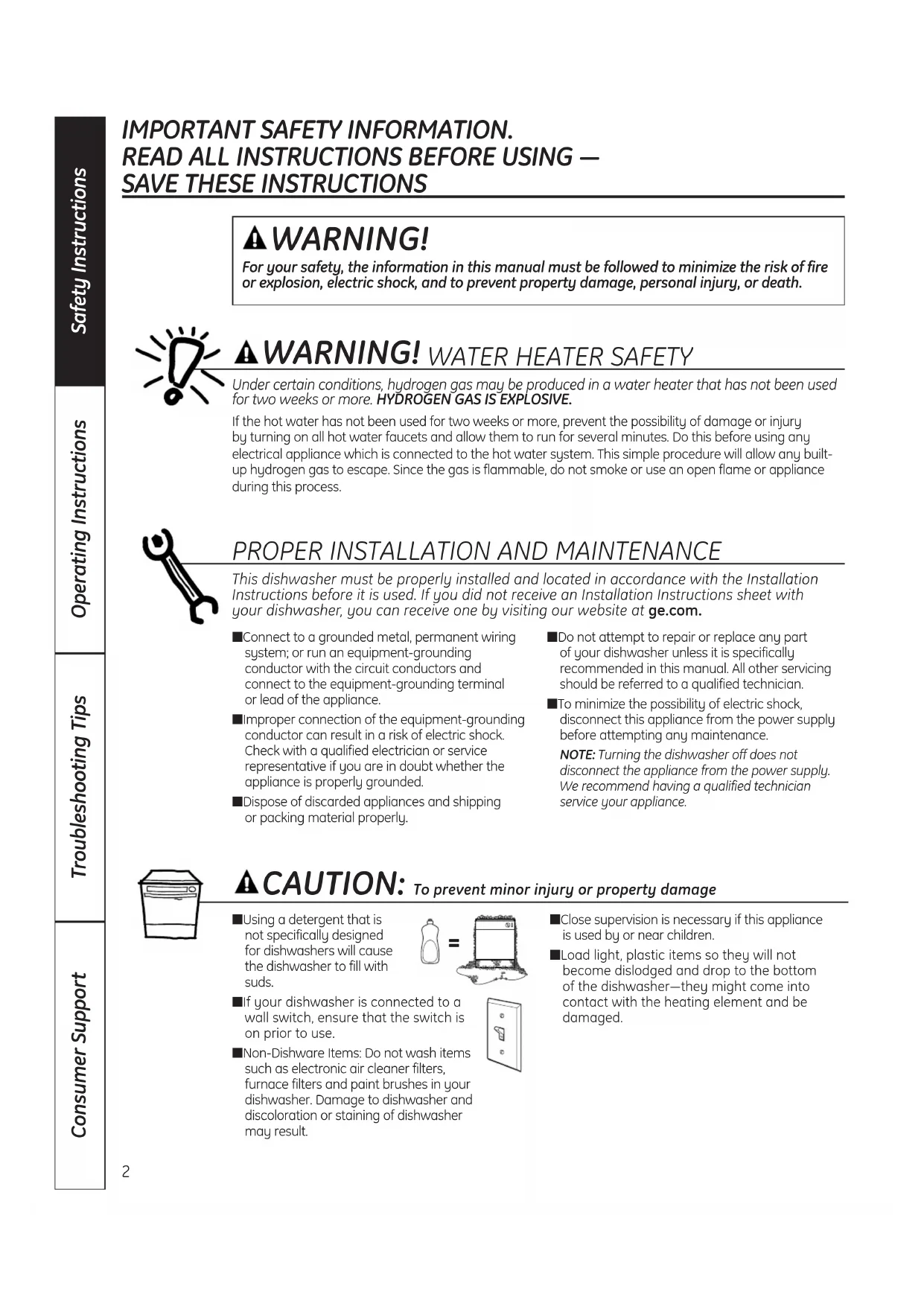
WARNING! For your safety, the information in this manual must be followed to minimize the risk of fire or explosion, electric shock, and to prevent property damage, personal injury, or death.
This dishwasher must be properly installed and located in accordance with the Installation Instructions before it is used. If you did not receive an Installation Instructions sheet with your dishwasher, you can receive one by visiting our website at ge.com. ■ Using a detergent that isnot specifically designedfor dishwashers will causethe dishwasher to fill withsuds.■ If your dishwasher is connected to awall switch, ensure that the switch ison prior to use.■ Non-Dishware Items: Do not wash itemssuch as electronic air cleaner filters,furnace filters and paint brushes in yourdishwasher. Damage to dishwasher anddiscoloration or staining of dishwasher may result.■ Close supervision is necessary if this appliance is used by or near children.■ Load light, plastic items so they will notbecome dislodged and drop to the bottom of the dishwasher—they might come intocontact with the heating element and bedamaged.■ Connect to a grounded metal, permanent wiringsystem; or run an equipment-groundingconductor with the circuit conductors andconnect to the equipment-grounding terminal or lead of the appliance.■ Improper connection of the equipment-groundingconductor can result in a risk of electric shock.Check with a qualified electrician or servicerepresentative if you are in doubt whether theappliance is properly grounded.■ Dispose of discarded appliances and shipping or packing material properly. ■ Do not attempt to repair or replace any part of your dishwasher unless it is specificallyrecommended in this manual. All other servicingshould be referred to a qualified technician.■ To minimize the possibility of electric shock,disconnect this appliance from the power supplybefore attempting any maintenance. NOTE: Turning the dishwasher off does notdisconnect the appliance from the power supply.We recommend having a qualified technicianservice your appliance. WARNING! CAUTION: To prevent minor injury or property damage Under certain conditions, hydrogen gas may be produced in a water heater that has not been used for two weeks or more. HYDROGEN GAS IS EXPLOSIVE. If the hot water has not been used for two weeks or more, prevent the possibility of damage or injury by turning on all hot water faucets and allow them to run for several minutes. Do this before using anyelectrical appliance which is connected to the hot water system. This simple procedure will allow any built-up hydrogen gas to escape. Since the gas is flammable, do not smoke or use an open flame or applianceduring this process.3 Consumer Support Troubleshooting TipsOperating InstructionsSafety Instructions ge.com CAUTION: For personal safety: DO NOT USE AN EXTENSION CORD OR AN ADAPTER PLUG WITH THIS APPLIANCE. DO NOT, UNDER ANY CIRCUMSTANCES, CUT OR REMOVE THE THIRD GROUNDING PRONG FROM THE POWER CORD. GROUNDING INSTRUCTIONS—This appliance must be grounded. In the event of a malfunction or breakdown, grounding will reduce the risk of electric shock by providing a path of least resistance for electric current. This dishwasher is equipped with a cord having a grounding conductor and a grounding plug. The plug must be plugged into an appropriate outlet that is installed and grounded in accordance with the NATIONAL ELECTRICAL CODE, ANSI/NPFA NO. 70. ELECTRICAL REQUIREMENTS ■ This appliance must besupplied with 120V, 60 Hz,and connected to anindividual, properlygrounded branch circuit,protected by a 15 or 20amp circuit breaker ortime-delay fuse.■ If the electric supplyprovided does not meetthe above specifications, it is recommended that alicensed electrician install an approved outlet.■ Your dishwasher circuit should not be used forany other appliance while the dishwasher is inoperation as the dishwasher requires the fullcapacity of the circuit.■ If the wall receptacle you plug the dishwasher’spower cord into is controlled by a switch, turn onthe switch. WARNING! Improper connection of the equipment/grounding conductor can result in a risk of electric shock. Check with a qualified electrician or serviceman if you are in doubt as to whether the dishwasher is properly grounded. Do not modify the plug provided with the appliance; if it will not fit the outlet, have a proper outlet installed by a qualified electrician. Ensure proper ground existsbefore use.4 Operating Instructions Safety Instructions Consumer Support Troubleshooting Tips
PROPER DISPOSAL OF THE DISHWASHER
Junked or abandoned dishwashers aredangerous…even if they will sit for “just a few days.” If you are getting rid of your olddishwasher, please follow the instructions below to help prevent accidents. Before You Throw Away Your Old Dishwasher: ■ Take off the door of the washing compartmentor remove the door latch keeper (as shown).
WARNING! RISK OF CHILD ENTRAPMENT
READ AND FOLLOW THIS SAFETY INFORMATION
SAVE THESE INSTRUCTIONS
■ Use this appliance only for its intended purpose as described in this Owner's Manual.■ Use only powder, tabs, liquid detergents or rinseagents recommended for use in a dishwasher andkeep them out of the reach of children. Cascade
and Cascade Crystal Clear rinse agents have beenapproved for use in all GE dishwashers.■ Locate sharp items so that they are not likely to damage the door seal.■ Load sharp knives with the handles up to reducethe risk of cut-type injuries.■ Do not wash plastic items unless markeddishwasher safe or the equivalent. For plastic items not so marked, check the manufacturer'srecommendations.■ Do not touch the heating element during orimmediately after use.■ Do not operate your dishwasher unless allenclosure panels are properly in place.■ Do not tamper with controls.■ Do not abuse, sit on or stand on the door or dishrack of the dishwasher.■ Do not allow children to play around dishwasherwhen opening or closing door due to the possibilityof small fingers being pinched in door.■ Do not discard a dishwasher without first removingthe door of the washing compartment.■ Do not store or use combustible materials, gasolineor other flammable vapors and liquids in thevicinity of this or any other appliance.■ Do not allow children to play with, on or inside thisappliance or any discarded appliance. WARNING! When using your dishwasher, follow basic precautions, including the following: IMPORTANT SAFETY INFORMATION.
READ ALL INSTRUCTIONS BEFORE USING —
SAVE THESE INSTRUCTIONSStatus Indicator Lights The Status display tells you what’s happening while the dishwasher is in operation and may flash, indicating a malfunction. The lights will come ON indicating the sequence of operation the dishwasher is in. CLEAN Displayed when a wash cycle is complete. The light stays ON as a reminder that the dishes are clean until the door is opened or until another cycle is selected. Cycles The light above the selected pad will be ON to indicate which cycle has been selected. HEAVY WASH 8.5 gal., 89 min.This cycle is meant for heavily soiled dishes or cookware with dried-on or baked-on soils. Everyday dishes are safe to be used in this cycle.NORMAL WASH 5.9 gal., 56 min.This cycle is for medium/heavily soiled dishes and glassware.LIGHT WASH 6.1 gal., 36 min.This cycle is for everyday dishes and glassware.CHINA CRYSTAL 6.1 gal., 39 min.This cycle is for lightly soiled china and crystal. RINSE ONLY 1.2 gal., 6 min.For rinsing partial loads that will be washed later. Do not use detergent with this cycle.
Consumer Support Troubleshooting TipsOperating InstructionsSafety Instructions About the dishwasher control panel. ge.com You can locate your model number on the tub wall just inside the door. Throughout this manual, features andappearance may vary from your model. Control Settings
Operating Instructions Safety Instructions Consumer Support Troubleshooting Tips Options The light above the selected pad will be ON to indicate which OPTION has been selected. HOT START For use with heavily soiled and/or dried-on, baked-on soils. This option MUST be (on some selected PRIOR to starting the cycle. This option will improve both wash and dry models) performance. This option adds 20 minutes to the cycle time. NOTE: Cannot be selected with RINSE ONLY cycle. HEATED DRY Shuts off the drying heat option. Dishes air dry naturally and energy is saved. Light OFF For faster air dry you can prop the door open after the CLEAN light illuminates. HEATED DRY Turns the heater on for fast drying. This will extend the total run time by 38 minutes. Light ON NOTE: Cannot be selected with RINSE ONLY cycle. LOCK You can lock the controls to prevent any selections from being made. Or you can lock the controls after you have started a cycle. (on some Children cannot accidentally start dishwasher by touching pads with this option models) selected. To LOCK the dishwasher control, touch and hold the HEATED DRY pad for 3 seconds. The light below the HEATED DRY pad will turn on. To UNLOCK the dishwasher control, touch and hold the HEATED DRY pad for 3 seconds. The LOCK light will turn off. HOT WASH When selected, the cycle will run longer with the heating element on to improve both wash and dry performance. NOTE: Cannot be selected with RINSE ONLY cycle. DELAY HOURS You can delay the start of a wash cycle for 2, 4 or 8 hours (delay time options may vary by model). Touch the DELAY HOURS pad to choose the number of hours you want to delay the start of the cycle; then touch START/RESET one time. The dishwasher will count down and start automatically at the correct time. Touching START/RESET a second time will cancel the DELAY START selection. RESET To change a cycle after washing starts, touch the START/RESET pad to cancel the cycle. The START/RESET light will flash while the water is pumped out if needed. This takes approximately 90 seconds. When the light stops flashing, the dishwasher can be reprogrammed and restarted. Start Close and latch the dishwasher door and select the cycle and desired enhancements. Touch the START/RESET pad once to begin the cycle. Water begins to fill the dishwasher, and approximately 60 seconds later the wash action begins. Touching the START/RESET pad a second time will cancel the cycle and cause the water to drain out. This will take approximately 90 seconds. NOTE: When the dishwasher door is fully closed, the control panel lights will display the last settings you selected. If you don’t want to change any of the settings, simply touch the START/RESET pad once to begin the cycle. If the door is closed, the indicator lights will turn off if the START/RESET pad is not pressed within two minutes. To activate the display, open and close the door or touch any pad. Also, if a power failure occurs or the unit is first plugged into the wall, NORMAL and HEATED DRY will automatically be programmed.
About the dishwasher control panel.
Consumer SupportTroubleshooting TipsOperating InstructionsSafety Instructions About the unicouple. ge.com Run the hot water faucet to purge coldwater from the hot water line. The hot watermust be between 120°F and 150°F for bestwash performance.Pull Unicouple and its hoses completely outfrom storage compartment located at rearof dishwasher.Attach the Unicouple connector to thefaucet adapter by depressing the collar atthe top of the connector. When Unicouple isall the way up onto the adapter, release thecollar. It will then snap into position to lockthe Unicouple in place.The Unicouple’s small hose carries waterfrom the faucet to the dishwasher. Its largehose carries drain water to the sink. Be sureUnicouple is pointing toward the sink bowldrain opening and the sink drain is open forwater that will drain from your dishwasher. If your dishwasher drains into a disposer,operate the disposer until it is completelyempty before starting the dishwasher.Turn hot water fully on before starting thedishwasher.Plug the dishwasher power cord into theoutlet. How to Connect the Unicouple Unplug the dishwasher.Push the cord back into its storage location.Turn off the hot water.Release the water pressure by depressingthe pressure release button. Release the Unicouple from the faucet by depressing the collar at the top of theUnicouple connector.Drain excess water from the unicouple hoses(see below). Push the hoses back into theirstorage location. CAUTION:To protect yourself and the room from severe splashing, relieve waterpressure prior to disconnecting the unicouple. How to Disconnect the Dishwasher How to Drain Excess Water From Unicouple Hoses If the sink is 34″ or higher from the floor, the excess water in Unicouple hoses cannot be drained directly into the sink. It will be necessary to drain excess water from hoses into a bowl or suitablecontainer that is held outside and lower than the sink. Before Operating the Dishwasher the First Time Attach the faucet adapter. The special faucet adapter supplied with your dishwasher must beassembled to the sink faucet before you can use your dishwasher. The faucet adapter is designed to fit standard spouts having internal or external threads. You will find the adapter and two washers in the faucet adapter packet in your dishwasher. To install faucet adapter, first remove the old aerator or trim ring on your faucet spout. If faucet has external threads: Insert the thinner of the two washers into the faucet adapter and attach it to the faucet spout. Tighten with pliers. If faucet has internal threads: Insert both of the washers into the faucet adapter and attach it to the faucet spout. Tighten with pliers.If the faucet adapter threads do not match your faucet spout, your local hardware or plumbingsupply store normally has additional fittings to adapt your faucet spout to the special faucetadapter. NOTE: A sink spray attachment hose can burst if it is installed on the same sink with your dishwasher. We suggest that you disconnect the sink spray attachment if your sink has one and plug the hole.
Pressure release button8 Operating Instructions Safety Instructions Consumer Support Troubleshooting Tips Dish Preparation Prior to Loading ■ No pre-rinsing of normal food soil is required. ■ Scrape off hard soils, including bones, toothpicks, skins and seeds. ■ Remove large quantities of any remaining food. ■ Remove leafy vegetables, meat trimmings and excessive amounts of grease or oil. ■ Remove acidic food soils that can discolor stainless steel. Using the dishwasher. Check the Water Temperature Use Jet-Dry
rinse agents remove spots and prevent new film buildup on your dishes, glasses, flatware, cookware and plastic. Filling the Dispenser The rinse agent dispenser holds 100 ml (3.5 fl. oz.) of rinse agent. Under normal conditions, this will last approximately one month. Try to keep it full, but do not overfill. Make sure the dishwasher door is fully open. Turn the dispenser cap to the left and lift it out. Add rinse agent until the indicator window looks full. Clean up any spilled rinse agent with a damp cloth. Replace the dispenser cap. Rinse Aid Setting The amount of rinse agent released into the final wash can be adjusted. The factory setting is at the midpoint. If there are rings of calcium (hard water) spots on dishes, try a higher setting. If you see foam in the dishwasher, move the indicator to a lower setting. To adjust the setting Remove the dispenser cap; then turn the adjuster counterclockwise to increase the amount of rinse agent, clockwise to reduce the amount of rinse agent.
The entering water should be at least 120°F and not more than 150°F, for effective cleaning and to prevent dish damage. Check the water temperature with a candy or meat thermometer. Turn on the hot water faucet nearest the dishwasher, place the thermometer in a glass and let the water run continuously into the glass until the temperature stops rising. IndicatorwindowDispenser capRinseagentadjuster Less MoreUse only detergent specifically made for use in dishwashers. Cascade and Electrasol Automatic Dishwashing Detergents have beenapproved for use in all GE dishwashers. Keepyour detergent fresh and dry. Don’t put powderdetergent into the dispenser until you’re ready to wash dishes. The amount of detergent to use depends on whether your water is hard or soft. With hard water, you need extra detergent. With soft water,you need less detergent.Protect your dishes and dishwasher bycontacting your water department and askinghow hard your water is. Twelve or more grains is extremely hard water. A water softener isrecommended. Without it, lime can build up in the water valve, which could stick while openand cause flooding. Too much detergent withsoft water can cause a permanent cloudiness of glassware, called etching.Use the information in the table below as aguideline to determine the amount of automaticdishwasher detergent to place in the dispenser.For heavily-soiled loads, use the Pots and Pans orHeavy Wash cycle and add a little extra detergent.
DO NOT USE HAND DISH DETERGENT
NOTE: Using a detergent that is not specificallydesigned for dishwashers will cause the dishwasherto fill with suds. During operation, these suds will spillout of the dishwasher vents, covering the kitchenfloor and making the floor wet.Because so many detergent containers look alike,store the dishwasher detergent in a separate spacefrom all other cleaners. Show anyone who may usethe dishwasher the correct detergent and where it is stored.While there will be no lasting damage to thedishwasher, your dishes will not get clean using adishwashing detergent that is not formulated towork with dishwashers. MAIN WASH PRE WASH Soft Medium SoftMedium HardExtremely HardA forgotten dish can be added any time beforethe main wash.Squeeze the door latch to release the door.Do not open the door until the water sprayaction stops. Steam may rise out of thedishwasher.Add forgotten dishes.Close the door.
Consumer Support Troubleshooting TipsOperating InstructionsSafety Instructions ge.com Proper Use of Detergent Forget to Add a Dish? Detergent Cups to FillFill cup to first lineFill cup to second lineFill main wash cupFill both Main Wash and Pre Wash cupNumberof GrainsLess than 44 to 88 to 12Greater than 1210 Operating Instructions Safety Instructions Consumer Support Troubleshooting Tips Loading the dishwasher racks. For best dishwashing results, follow these loading guidelines. Features and appearance of racks and silverware baskets may vary from your model. Upper Rack Although the upper rack is for glasses, cups and saucers, pots and pans can be placed in this rack for effective cleaning. Cups and glasses fit best along the sides. This is also a secure place for dishwasher-safe plastics. The utility shelf (on some models) may be placed in the up or down position to add flexibility. A wine glass holder (on some models) secures wine glasses for best washability. Because wine glasses come in various sizes, after loading, slowly push in the rack to make sure they will clear the top of the dishwasher. The upper rack is good for all kinds of odd-shaped utensils. Saucepans, mixing bowls and other items should be placed face down. Fold-down tines (on some models) provide flexibility for extra-large and hard-to-fit items. Secure larger dishwasher-safe plastics over 2 tines when possible. Make sure small plastic items are secure so they can’t fall onto the heater. Be sure that items do not protrude through the bottom of the rack and block rotation of the middle spray arm. This could result in poor wash performance for items in the upper rack. Check to make sure that no items will block rotation of the wash arms. Lower Rack The lower rack is best used for plates, saucers and cookware. Large items such as broiler pans and baking racks should go along the left-hand side. Load platters, pots and bowls along the sides, in corners or in the back. The soiled side of items should face the center of the rack. If necessary, oversized glasses and mugs can be placed in the lower rack to maximize loading flexibility. Also, be careful not to let a portion of an item such as a pot or dish handle extend through the bottom rack. This could block the wash arm and cause poor washing results. Fold-down tines (on some models) provide flexibility for extra-large and hard-to-fit items. The tines may be left in the up position or folded down to customize the lower rack. Do not let any item extend through the bottom of the silverware basket. Items that extend through the rack could prevent the spray arm from turning and cause poor wash performance. Silverware Basket To load flatware, simply push the adjustable handle to either side (on some models). Put flatware in the removable basket with fork and knife handles up to protect your hands. Place spoons in the basket with handles down. Mix knives, forks and spoons so they don’t nest together. Distribute evenly. Small plastic items, such as measuring spoons and lids from small containers, should go in the bottom of the silverware basket with the silverware on top. The one-piece silverware basket (on some models) can be placed in the front, right side or back of the lower rack. A variety of options is available regarding the three-piece silverware basket (on some models) in your dishwasher. The complete basket is designed to fit on the right side of the lower rack. Additionally, each end of the basket is removable to add loading flexibility to accommodate flatware and lower rack capacity needs. The lids of both end and middle baskets (on some models) can be closed to contain small items. Long items can be placed on the utility shelf in the upper rack. The accessory basket (on some models) can hold small items such as: baby bottle nipples, plastic lids, corn cob holders, etc. To remove end baskets, grasp the basket at opposite corners and slideapart.Three-piece basket (on some models)One-piece basket (on some models)Single basket (on some models)11 Consumer Support Troubleshooting TipsOperating InstructionsSafety Instructions Follow these guidelines for loading 10 place settings. Features and appearance of racks and silverware baskets may vary from your model. Upper Rack—10 place settings Lower Rack—10 place settings Lower Rack—10 place settings Follow these guidelines for loading 12 place settings. Features and appearance of racks and silverware baskets may vary from your model. Upper Rack—12 place settings Lower Rack—12 place settings Loading place settings… ge.com12 If your dishwasher is left in an unheated place during the winter, ask a service technician to: Unplug the dishwasher from the wall outlet. Remove the Unicouple from the faucet. Disconnect the hose from the water valve. Drain water from the water inlet line and water valve. (Use a pan to catch the water.) Reconnect the water inlet line to the water valve.
Caring for the dishwasher. Cleaning the Door Panel Before cleaning the front panel, make sure you know what type of panel you have. Refer to the last two letters of your model number. You can locate your model number on the left-hand tub wall just inside the door. If your model number ends with BB, WW, CC, SA, BG or GS, then you have a Painted Door panel. If your model number ends with SS, then you have a Stainless Steel Door panel. If your model number ends with CS, then you have a CleanSteel Door panel. Follow the instructions below for cleaning the door panel for your specific model. Painted Door Panel (model numbers ending in BB–black, WW–white, CC–bisque, SA–silver metallic, BG–graphite metallic or GS–silver) Use a clean, soft, lightly dampened cloth, then dry thoroughly. You may also use a good appliance wax or polish. Stainless Steel Door Panel (model numbers ending in SS) The stainless steel panels can be cleaned with Stainless Steel Magic or a similar product using a clean, soft cloth. Do not use appliance wax, polish, bleach or products containing chlorine on Stainless Steel doors. You can order Stainless Steel Magic #WX10X15 through GE Parts by calling
CleanSteel Door Panel (model numbers ending in CS) Use a clean, soft, lightly dampened cloth, then dry thoroughly. Do not use appliance wax, polish or any chemical agent on CleanSteel doors. Do not wipe the dishwasher with a soiled dish cloth or wet towel. These may leave a residue. Do not use scouring pads or powdered cleaners because these products can scratch the finish. Operating Instructions Safety Instructions Consumer Support Troubleshooting Tips Cleaning the Control Panel To clean the control panel, use a lightly dampened cloth. Then dry thoroughly. Protect Against FreezingProblem Possible Causes What To Do Dishes and flatware Low inlet water temperature • Make sure the inlet water temperature is at least 120°F. Remove the not clean Unicouple, if attached, and run the hot water faucet until the water temperature stops rising to purge cold water from the hot water line. Turn off the faucet. Reconnect the Unicouple and then turn the faucet back on. If the water temperature did not reach 120°F, consider increasing the water temperature at the water heater. Water temperature must not exceed 150°F. Water pressure is temporarily low • Turn on a faucet. Is water coming out more slowly than usual? If so, wait until pressure is normal before using your dishwasher. Improper rack loading • Make sure large dishware does not block the detergent dispenser or the wash arms. See the Loading the dishwasher racks section. Spots and filming • Use Jet-Dry
rinse agents to remove spots and on glasses and prevent new film buildup. flatware
- To remove stubborn spots and pre-existing film from glassware: 1 Remove all metal utensils from the dishwasher. 2 Do not add detergent. 3 Select the HEAVY WASH cycle. 4 Start the dishwasher and allow to run for 18 to 22 minutes. Dishwasher will now be in the main wash. 5 Open the door and pour 2 cups (500 ml) of white vinegar into the bottom of the dishwasher. 6 Close the door and allow to complete the cycle. If vinegar rinse doesn’t work: Repeat as above, except use 1/4 cup (60 ml) of citric acid crystals instead of vinegar. Cloudiness on Combination of soft water and • This is called etching and is permanent. To prevent this from happening, glassware too much detergent use less detergent if you have soft water. Wash glassware in the shortest cycle that will get them clean. Water temperature entering • This could be etching. Lower the water heater temperature. the dishwasher exceeds 150°F Suds in the tub Wrong detergent • Use only automatic dishwasher detergents to avoid sudsing. Cascade
Automatic Dishwashing Detergents have been approved for use in all GE dishwashers.
- To remove suds from the tub, open the dishwasher and let suds dissipate. Close and latch the dishwasher. Pump out water by touching the START/RESET pad once; then 30 seconds later, touch the START/RESET pad again. Repeat if necessary. Rinse agent was spilled • Always wipe up rinse agent spills immediately. Error Messages Possible Causes What To Do START/RESET status You have pressed the • Press the START/RESET pad one time to start the dishwasher. Press it a indicator light START/RESET pad while the second time only if you wish to cancel the cycle and start over with flashing dishwasher is running. This will a new cycle. cancel the cycle. The light will stop flashing after the dishwasher drains (about 90 seconds). Dishwasher BEEPS This is a reminder that your • Close and latch the door after opening it mid-cycle. once every dishwasher door has been left 30 seconds open during operation. It will continue beeping until you close the door. Consumer Support Troubleshooting TipsOperating InstructionsSafety Instructions Before you call for service… ge.com Troubleshooting Tips Save time and money! Review the charts on the following pages, or visit ge.com. You may not need to call for service. In Canada, visit geappliances.ca.
Extremely hard water Low inlet water temperature Overloading the dishwasher Improper loading Old or damp powder detergent Rinse agent dispenser empty Too little detergentOperating Instructions Safety Instructions Consumer Support Troubleshooting Tips Before you call for service…
Problem Possible Causes What To Do Detergent left in Dishes are blocking the • Reposition the dishes, so the water from the lower spray arm can dispenser cups detergent cup flush the detergent cup. See the Loading the dishwasher section. Black or gray Aluminum utensils have • Remove marks with a mild, abrasive cleaner. marks on dishes rubbed against dishes Dishes don’t dry Low inlet water temperature • Make sure inlet water temperature is at least 120°F.
- Use HOT START, HOT WASH or ADDED HEAT options.
- Select a higher cycle, such as HEAVY WASH. Rinse agent dispenser is empty • Check the rinse agent dispenser and fill as required. Control panel responded Door latch may not be properly • Make sure the door is firmly closed. to inputs but dishwasher seatednever filled with waterFaucet may be turned off • Make sure hot water faucet is turned on. Flood float may be stuck • Remove the lower rack and tap lightly on the flood float cover (dome located at the left front corner of the tub bottom). Stained tub interior Some tomato-based foods can • Use of the RINSE ONLY cycle after adding the dish to the load cause reddish stains can decrease the level of staining. GE recommends Cascade
Plastic Booster to help remove these types of stains. Tea or coffee stains • Remove the stain by hand, using a solution of 1/2 cup bleach and 3 cups warm water. WARNING Before cleaning interior, wait at least 20 minutes after a cycle for the heating elements to cool down. Failure to do so can result in burns.An overall yellow or brown film can• A special filter in the water supply line is the only way to correct be caused by iron deposits in waterthis problem. Contact a water softener company. White film on inside surface— • GE recommends Jet-Dry
or Cascade Crystal Clear to help hard water minerals prevent hard water mineral deposits from forming.
- Run dishwasher with citric acid to remove mineral deposits. Citric acid (Part number: WD35X151) can be ordered through GE Parts. See back cover for ordering information. Dishwasher won’t run Fuse is blown or circuit breaker • Replace fuse or reset circuit breaker. Remove any other appliances from is tripped the circuit. Power is turned off • In some installations, the power to the dishwasher is provided through a wall switch, often located next to the disposer switch. Make sure it is on.Control panel is locked • Unlock control panel. See page 6. Reboot your control • Unplug the dishwasher for 30 seconds; then plug back in. Control panel lights Time too long between • Each pad must be touched within 30 seconds of the others. go off when you’re touching of selected pads To relight, touch any pad again, or unlock and relatch door. setting controls Water standing in This is normal • A small amount of clean water around the outlet on the tub the bottom of the tub bottom at the back of the tub keeps the water seal lubricated. Steam This is normal • Warm, moist air comes through the vent by the door latch during drying and when water is being pumped out. This is necessary for drying. Noise Normal operating sounds • Detergent cup opening.
- Water entering dishwasher.• The motor stops and starts at various times during the cycle.• Drain pump sounds during the pump out. Rattling dishes when the spray • Make sure dishes are properly loaded. See the Loading the arm rotates dishwasher racks section.Warrantor: General Electric Company. Louisville, KY 40225 What GE Will Not Cover (for customers in the United States): For The Period Of: GE Will Replace: One Year Any part of the dishwasher which fails due to a defect in materials or workmanship. During this From the date of the limited one-year warranty, GE will also provide, free of charge, all labor and related service to original purchase replace the defective part.
GE Dishwasher Warranty. ■ Service trips to your home to teach you how to use the product. ■ Improper installation, delivery or maintenance. ■ Failure of the product if it is abused, misused, or used for other than the intended purpose or used commercially. ■ Replacement of house fuses or resetting of circuit breakers. ■ Damage to the product caused by accident, fire, floods or acts of God. ■ Incidental or consequential damage caused by possible defects with this appliance. ■ Cleaning or servicing of the air gap device in the drain line. ■ Damage caused after delivery. ■ Product not accessible to provide required service. This warranty is extended to the original purchaser and any succeeding owner for products purchased for home use within the USA. If the product is located in an area where service by a GE Authorized Servicer is not available, you may be responsible for a trip charge or you may be required to bring the product to an Authorized GE Service location for service. Proof of original purchase date is needed to obtain service under the warranty. In Alaska, the warranty excludes the cost of shipping or service calls to your home. Some states do not allow the exclusion or limitation of incidental or consequential damages. This warranty gives you specific legal rights, and you may also have other rights which vary from state to state. To know what your legal rights are, consult your local or state consumer affairs office or your state’s Attorney General. Consumer SupportTroubleshooting Tips Operating InstructionsSafety Instructions All warranty service provided by our Factory Service Centers, or an authorized Customer Care
technician. To schedule service, on-line, visit us at ge.com, or call 800.GE.CARES (800.432.2737). In Canada, call 1.800.561.3344. Please have serial number and model number available when calling for service. Staple your receipt here. Proof of the original purchase date is needed to obtain service under the warranty. EXCLUSION OF IMPLIED WARRANTIES—Your sole and exclusive remedy is product repair as provided in this LimitedWarranty. Any implied warranties, including the implied warranties of merchantability or fitness for a particularpurpose, are limited to one year or the shortest period allowed by law. What Is Not Covered (for customers in Canada): ■ Service trips to your home to teach you how to use the product. ■ Improper installation. If you have an installation problem, contact your dealer or installer. You are responsible for providing adequate electrical, exhausting and other connecting facilities. ■ Failure of the product if it is abused, misused, or used for other than the intended purpose or used commercially. ■ Replacement of house fuses or resetting of circuit breakers. ■ Damage to the product caused by accident, fire, floods or acts of God. ■ Damage caused after delivery. This warranty is extended to the original purchaser and any succeeding owner for products purchased in Canada for home use within Canada. In home warranty service will be provided in areas where it is available and deemed reasonable by Mabe to provide. WARRANTOR IS NOT RESPONSIBLE FOR CONSEQUENTIAL DAMAGES. Warrantor: MABE CANADA INC. EXCLUSION OF IMPLIED WARRANTIES—Your sole and exclusive remedy is product repair as provided in this LimitedWarranty. Any implied warranties, including the implied warranties of merchantability or fitness for a particularpurpose, are limited to one year or the shortest period allowed by law.Printed in the United States Printed on Recycled Paper Consumer Support. GE Appliances Website In the U.S.: ge.com Have a question or need assistance with your appliance? Try the GE Appliances Website 24 hours a day, any day of the year! For greater convenience and faster service, you can now download Owner’s Manuals, order parts or even schedule service on-line. In Canada: www.geappliances.ca Schedule Service In the U.S.: ge.com Expert GE repair service is only one step away from your door. Get on-line and schedule your service at your convenience 24 hours any day of the year! Or call 800.GE.CARES (800.432.2737) during normal business hours. In Canada, call 1.800.561.3344 Real Life Design Studio In the U.S.: ge.com GE supports the Universal Design concept—products, services and environments that can be used by people of all ages, sizes and capabilities. We recognize the need to design for a wide range of physical and mental abilities and impairments. For details of GE’s Universal Design applications, including kitchen design ideas for people with disabilities, check out our Website today. For the hearing impaired, please call 800.TDD.GEAC (800.833.4322). In Canada, contact: Manager, Consumer Relations, Mabe Canada Inc. Suite 310, 1 Factory Lane Moncton, N.B. E1C 9M3 Extended Warranties In the U.S.: ge.com Purchase a GE extended warranty and learn about special discounts that are available while your warranty is still in effect. You can purchase it on-line anytime, or call 800.626.2224 during normal business hours. GE Consumer Home Services will still be there after your warranty expires. In Canada, call 1.888.261.2133 Parts and Accessories In the U.S.: ge.com Individuals qualified to service their own appliances can have parts or accessories sent directly to their homes (VISA, MasterCard and Discover cards are accepted). Order on-line today, 24 hours every day or by phone at