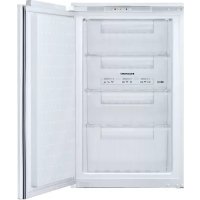
5FG220SE0 - Freezer BLAUPUNKT - Free user manual and instructions
Find the device manual for free 5FG220SE0 BLAUPUNKT in PDF.



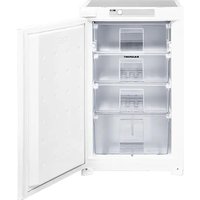
| Product type | Built-in freezer |
| Brand | Blaupunkt |
| Model | 5FG220SE0 |
| Climate class | SN, N, ST, T (10 °C to 43 °C) |
| Maximum weight | 40 kg |
| Power supply | 220-240 V ~, 50 Hz |
| Connection | Wall socket with grounding |
| Special functions | Super freeze, temperature alarm, adjustable thermostat |
| Defrosting | Manual |
| Included accessories | Frozen food container, ice cube tray, cold accumulator |
| Installation type | Built-in (niche width min. 560 mm, depth min. 550 mm) |
| Maintenance | Cleaning with warm water and mild dish soap |
| Safety | Use by children aged 8 and above under supervision |
| Manufacturer warranty | 2 years (local conditions) |
| Spare parts | Available for 10 years after market launch |
Frequently Asked Questions - 5FG220SE0 BLAUPUNKT
User questions about 5FG220SE0 BLAUPUNKT
0 question about this device. Answer the ones you know or ask your own.
Ask a new question about this device
Download the instructions for your Freezer in PDF format for free! Find your manual 5FG220SE0 - BLAUPUNKT and take your electronic device back in hand. On this page are published all the documents necessary for the use of your device. 5FG220SE0 by BLAUPUNKT.
USER MANUAL 5FG220SE0 BLAUPUNKT
natural_image
Technical line drawing of two rectangular electronic devices with internal slots and connectors (no text or symbols)3
text_image
Diagram showing a blue folder being inserted into a device, with numbered arrows indicating process steps.4
text_image
Diagram showing two blue envelope folders with arrows indicating direction of movement, labeled with numbers ① and ②.de
Inhaltsverzeichnis
1 Sicherheit 5
1.1 General information...... 23
1.2 Intended use.... 23
1.3 Restriction on user group...... 23
1.4 Safe transport.... 23
1.5 Safe installation 24
1.6 Safe use 25
1.7 Damaged appliance...... 26
2 Preventing material damage ..... 28
3 Environmental protection and saving energy.... 28
3.1 Disposing of packaging ..... 28
3.2 Saving energy...... 28
4 Installation and connection..... 28
4.1 Scope of delivery.... 28
4.2 Criteria for the installation location.... 29
4.3 Installing the appliance ..... 29
4.4 Preparing the appliance for the first time.... 29
4.5 Connecting the appliance to the electricity supply...... 30
5 Familiarising yourself with your appliance.... 30
5.1 Appliance 30
5.2 Control panel.... 30
6 Features.... 30
6.1 Accessories.... 30
7 Basic operation ...... 31
7.1 Switching on the appliance..... 31
7.2 Operating tips.... 31
7.3 Switching off the appliance ..... 31
7.4 Setting the temperature...... 31
8 Additional functions ...... 31
8.1 Super freezing 31
9 Alarm.... 32
9.1 Temperature alarm.... 32
10 Freezer compartment...... 32
10.1 Freezing capacity 32
10.2 Fully utilising the freezer compartment volume ...... 32
10.3 Tips for storing food in the freezer compartment ...... 33
10.4 Tips for freezing fresh food .... 33
10.5 Shelf life of frozen food at -18 °C.... 33
10.6 Defrosting methods for frozen food 33
11 Defrosting.... 34
11.1 Defrosting in the freezer compartment 34
12 Cleaning and servicing...... 34
12.1 Preparing the appliance for cleaning.... 34
12.2 Cleaning the appliance ..... 35
12.3 Removing the fittings...... 35
13 Troubleshooting.... 36
14 Storage and disposal...... 37
14.1 Switching off the appliance .... 37
14.2 Disposing of old appliance .... 37
15 Customer Service.... 38
15.1 Product number (E-Nr.) and production number (FD)...... 38
16 Technical data.... 38

1 Safety
Observe the following safety instructions.
1.1 General information
- Read this instruction manual carefully.
- Keep the instruction manual and the product information safe for future reference or for the next owner.
■ Do not connect the appliance if it has been damaged in transit.
1.2 Intended use
This appliance is only intended to be fully fitted in a kitchen.
Only use this appliance:
■ As specified in this instruction manual.
■ for freezing food and making ice cubes.
■ In private households and in enclosed spaces in a domestic environment.
■ Up to an altitude of max. 2000 m above sea level.
1.3 Restriction on user group
This appliance may be used by children aged 8 or over and by people who have reduced physical, sensory or mental abilities or inadequate experience and/or knowledge, provided that they are supervised or have been instructed on how to use the appliance safely and have understood the resulting dangers.
Children must not play with the appliance.
Cleaning and user maintenance must not be performed by children unless they are being supervised.
Children above the age of three years old and younger than eight years old may load and unload the the fridge-freezer.
1.4 Safe transport
⚠ WARNING – Risk of injury!
The high weight of the appliance may result in injury when lifted.
▶ Do not lift the appliance on your own.
1.5 Safe installation
⚠ WARNING – Risk of electric shock!
Improper installation is dangerous.
- Connect and operate the appliance only in accordance with the specifications on the rating plate.
- Connect the appliance to a power supply with alternating current only via a properly installed socket with earthing.
▶ The protective conductor system of the domestic electrical installation must be properly installed.
▶ Never equip the appliance with an external switching device, e.g. a timer or remote control. - When the appliance is installed, the mains plug of the power cord must be freely accessible. If free access is not possible, an all-pole isolating switch must be installed in the permanent electrical installation according to the installation regulations.
- When installing the appliance, check that the power cable is not trapped or damaged.
If the insulation of the power cord is damaged, this is dangerous.
▶ Never let the power cord come into contact with heat sources.
⚠ WARNING – Risk of explosion!
If the appliance's ventilation openings are sealed, a leak in the refrigeration circuit may result in a flammable mixture of gas and air.
- Keep ventilation openings, in the appliance enclosure or in the built-in structure, clear of obstruction.
⚠ WARNING – Risk of fire!
It is dangerous to use an extended power cord and non-approved adapters.
▶ Do not use extension cables or multiple socket strips.
▶ If the power cord is too short, contact Customer Service.
▶ Only use adapters approved by the manufacturer.
Portable multiple socket strips or portable power supply units may overheat and cause a fire.
- Do not place portable multiple socket strips or power supply units on the back of the appliance.
1.6 Safe use
⚠ WARNING – Risk of electric shock!
An ingress of moisture can cause an electric shock.
▶ Only use the appliance in enclosed spaces.
▶ Never expose the appliance to intense heat or humidity.
- Do not use steam- or high-pressure cleaners to clean the appliance.
⚠ WARNING – Risk of suffocation!
Children may put packaging material over their heads or wrap themselves up in it and suffocate.
- Keep packaging material away from children.
▶ Do not let children play with packaging material.
Children may breathe in or swallow small parts, causing them to suffocate. - Keep small parts away from children.
▶ Do not let children play with small parts.
⚠ WARNING – Risk of explosion!
Mechanical devices or other devices may damage the refrigeration circuit; flammable refrigerant may escape and explode.
▶ To accelerate the defrosting process, do not use any other mechanical devices or devices other than those recommended by the manufacturer.
Products which contain flammable propellants and explosive substances may explode, e.g. spray cans.
- Do not store products which contain flammable propellants (e.g. spray cans) or explosive substances in the appliance.
⚠ WARNING – Risk of fire!
Electrical devices within the appliance may cause a fire, e.g. heaters or electric ice makers.
▶ Do not operate electrical devices within the appliance.
⚠ WARNING – Risk of injury!
Containers that contain carbonated drinks may burst.
- Do not store containers that contain carbonated drinks in the freezer compartment.
Injury to the eyes caused by escaping flammable refrigerant and hazardous gases. - Do not damage the tubes of the refrigerant circuit or the insulation.
⚠ WARNING – Risk of cold burns!
Contact with frozen food and cold surfaces may cause burns by refrigeration.
▶ Never put frozen food straight from the freezer compartment into your mouth.
- Avoid prolonged contact of the skin with frozen food, ice and surfaces in the freezer compartment.
⚠️ CAUTION – Risk of harm to health!
To prevent food from being contaminated, you must observe the following instructions.
▶ If the door is open for an extended period of time, this may lead to a considerable temperature increase in the compartments of the appliance.
▶ Regularly clean the surfaces that may come into contact with food and accessible drain systems.
▶ If the fridge/freezer is empty for an extended period of time, switch off the appliance, defrost it, clean it and leave the door open to prevent the formation of mould.
1.7 Damaged appliance
⚠ WARNING – Risk of electric shock!
If the appliance or the power cord is damaged, this is dangerous.
▶ Never operate a damaged appliance.
▶ Never pull on the power cord to unplug the appliance. Always unplug the appliance at the mains.
▶ If the appliance or the power cord is damaged, immediately unplug the power cord or switch off the fuse in the fuse box.
▶ Call customer services. → Page 38
Incorrect repairs are dangerous.
▶ Repairs to the appliance should only be carried out by trained specialist staff.
▶ Only use genuine spare parts when repairing the appliance.
If the power cord of this appliance is damaged, it must be replaced by the manufacturer, the manufacturer's Customer Service or a similarly qualified person in order to prevent any risk.

WARNING – Risk of fire!
If the tubes are damaged, flammable refrigerant and harmful gases may escape and ignite.
- Keep naked flames and ignition sources away from the appliance.
▶ Ventilate the room.
▶ Switch off the appliance. → Page 31
▶ Unplug the appliance from the mains or switch off the circuit breaker in the fuse box.
▶ Call after-sales service. → Page 38
2 Preventing material damage
ATTENTION!
Using the base, runners or appliance doors as a seat surface or climbing surface may damage the appliance.
- Do not stand or support yourself on the base, runners or doors.
Contamination with oil or fat may cause plastic parts and door seals to become porous. - Keep plastic parts and door seals free of oil and grease.
3 Environmental protection and saving energy
3.1 Disposing of packaging
The packaging materials are environmentally compatible and can be recycled.
- Sort the individual components by type and dispose of them separately.
3.2 Saving energy
If you follow these instructions, your appliance will use less power.
Selecting the installation location
- Keep the appliance out of direct sunlight.
■ Install the appliance as far away as possible from heating elements, cookers and other heat sources: - Maintain a 30 mm clearance to electric or gas cookers.
- Maintain a 300 cm clearance to oil or solid-fuel cookers.
■ Never cover or block the exterior ventilation grilles.
Saving energy during use
Note: The arrangement of the fittings does not affect the energy consumption of the appliance.
■ Open the appliance only briefly.
■ Never cover or block the interior ventilation openings or the exterior ventilation grilles.
■ Transport purchased food in a cool bag and place in the appliance quickly.
■ Allow warm food and drinks to cool down before storing them.
■ Always leave some space between the food and to the back panel.
■ Pack the food airtight.
■ Defrost the freezer compartment regularly.
■ Open the freezer compartment door only briefly and then close it properly.
4 Installation and connection
You can find out where and how best to install your appliance here. You will also learn how to connect your appliance to the power supply.
4.1 Scope of delivery
After unpacking all parts, check for any transport damage and for completeness of delivery.
If you have any complaints, contact your dealer or our after-sales service → Page 38.
The delivery consists of the following:
■ Built-in appliance
■ Equipment and accessories ^1
■ Installation material
■ Installation instructions
■ User manual
■ Customer service directory
■ Warranty enclosure ^1
■ Energy label
■ Information on energy consumption and noises
4.2 Criteria for the installation location

WARNING
Risk of explosion!
If the appliance is in a space that is too small, a leak in the refrigeration circuit may result in a flammable mixture of gas and air.
▶ Only install the appliance in a space with a volume of at least 1 m^3 per 8 g refrigerant. The volume of refrigerant is indicated on the rating plate. → Fig. 1/4
The weight of the appliance ex works may be up to 40 kg depending on the model.
The subfloor must be sufficiently stable to bear the weight of the appliance.
Permitted room temperature
The permitted room temperature depends on the appliance's climate class.
The climate class can be found on the rating plate. → Fig. 1/4
| Climate class | Permitted room temperature |
| SN 10 °C to 32 °C | |
| N 16 °C to 32 °C | |
| ST 16 °C to 38 °C | |
| T 16 °C to 43 °C | |
The appliance is fully functional within the permitted room temperature.
If an appliance with climate class SN is operated at colder room temperatures, the appliance will not be damaged up to a room temperature of 5^ C.
Niche dimensions
Observe the niche dimensions if you install your appliance in the niche. If this is not the case, problems may occur when installing the appliance.
Niche depth
Install the appliance in the recommended niche depth of 560 mm. If the niche depth is smaller, the energy consumption increases slightly. The niche depth must be a minimum 550 mm.
Niche width
An inside niche width of at least 560 mm is required for the appliance.
4.3 Installing the appliance
- Install the appliance in accordance with the enclosed installation instructions.
4.4 Preparing the appliance for the first time
- Remove the informative material.
- Remove the protective foil and transit bolts, e.g. remove the adhesive strips and carton.
- Clean the appliance for the first time. → Page 35
4.5 Connecting the appliance to the electricity supply
- Insert the mains plug of the appliance's power cable in a socket nearby.
The connection data of the appliance can be found on the rating plate. → Fig. 1/4 - Check the mains plug is inserted properly.
√ The appliance is now ready for use.
5 Familiarising yourself with your appliance
5.1 Appliance
You can find an overview of the parts of your appliance here.
→Fig.1
| 1 | Controls |
| 2 | Freezer shelf |
| 3 | Frozen food container |
| 4 | Rating plate |
Note: Deviations between your appliance and the diagrams may differ with regard to their features and size.
5.2 Control panel
You can use the control panel to configure all functions of your appliance and to obtain information about the operating status.
→ Fig. 2
| 1 | The temperature controller sets the temperature of the freezer compartment. |
| 2 | 1 switches the appliance on or off. |
| 3 | S switches Super freezing on or off. |
| 4 | ✗ switches the warning signal off. |
6 Features
The features of your appliance depend on the model.
6.1 Accessories
Use original accessories. These have been made especially for your appliance.
The accessories for your appliance depend on the model.
Freezer tray
You can store the ice packs or freeze smaller quantities of food in the freezer drawer, e.g. berries, pieces of fruit, herbs and vegetables.
→ Fig. 3
Distribute the frozen food evenly in the frozen food tray and allow to freeze for approx. 10 to 12 hours.
Then place in a freezer bag or a freezer box.
Ice pack
Use the ice pack for temporarily keeping food cool, e.g. in a cool bag.
Tip: If a power failure or malfunction occurs, the ice pack can be used to slow down the thawing process for the stored frozen food.
Ice cube tray
Use the ice cube tray to make ice cubes.
Making ice cubes
- Fill the ice cube tray with water up to 34 and place in the freezer compartment.
If the ice cube tray is stuck to the freezer compartment, loosen it with a blunt implement only (e.g. spoon handle).
- To loosen the ice cubes, twist the ice cube tray slightly or hold it briefly under flowing water.
7 Basic operation
7.1 Switching on the appli- ance
- Press Ⓙ
√ The appliance begins to cool.
- Switch off the warning signal with 📄.
√ goes out as soon as the set temperature has been reached.
- Set the required temperature. → Page 31
7.2 Operating tips
■ Once you have switched on the appliance, the set temperature is only reached after several hours. Do not put any food in the appliance until the temperature has been reached.
■ The front panels of the housing are temporarily heated slightly. This prevents condensation in the area of the door seal.
■ When you close the door, a vacuum may be created. The door is then difficult to open again. Wait a moment until the vacuum is offset.
■ The refrigeration system may cause several areas of the freezer shelves to frost quickly. The frost
has no effect on the function or the energy consumption of the appliance. If frost or ice thicker than 5 mm has formed on the entire surface of the freezer shelf, the appliance must be defrosted.
7.3 Switching off the appliance
▶ Press ①
7.4 Setting the temperature
Setting the freezer compartment temperature
▶ Use a coin to set the temperature at the temperature controller.
The higher the number, the lower the temperature.
The middle setting is recommended by the factory.
8 Additional functions
8.1 Super freezing
With Super freezing, the freezer compartment cools so that it as cold as possible.
Switch on Super freezing four to six hours before placing food weighing 2 kg or more into the freezer compartment.
In order to utilise the freezer capacity, use Super freezing.
→ "Prerequisites for freezing capacity", Page 32
Note: When Super freezing is switched on, increased noise may occur.
Switching on Super freezing
▶ Press S
√ S lights up.
Note: After approx. 60 hours, the appliance switches to normal operation.
Switching off Super freezing
▶ Press S
9 Alarm
9.1 Temperature alarm
If the freezer compartment becomes too warm, the temperature alarm is switched on.
CAUTION
Risk of harm to health!
During the thawing process, bacteria may multiply and spoil the frozen food.
- Do not refreeze food after it has been defrosted or started to defrost.
▶ Refreeze food only after cooking. - These items should no longer be stored for the maximum storage period.
The temperature alarm can be switched on in the following cases:
■ The appliance is switched on. Do not store any food until the appliance has reached the set temperature.
■ Large quantities of fresh food are being placed inside.
Switch on Super freezing before placing large quantities of food in the appliance.
■ The freezer compartment door is open for too long.
Check whether the frozen food has defrosted or thawed.
Switching off the temperature alarm
▶ Press
√ The warning tone is switched off.
10 Freezer compartment
You can store frozen food, freeze food and make ice cubes in the freezer compartment.
The temperature can be set from level 1 to level 7.
Long-term storage of food should be at -18 ^ or lower.
The freezer compartment can be used to store perishable food long-term. The low temperatures slow down or stop the spoilage.
10.1 Freezing capacity
The maximum freezing capacity indicates the quantity of food that can be frozen right through to the centre within a specific period of time. Information on the maximum freezing capacity can be found on the rating plate. → Fig.1 / 4
Prerequisites for freezing capacity
- Approx. 24 hours before placing fresh food in the appliance, switch on Super freezing.
→ "Switching on Super freezing", Page31 - Fill the rear area of the top compartment with food first. This is where the food freezes most quickly.
- If the rear area of the top compartment does not have enough space, store the remaining quantity in the compartment below.
10.2 Fully utilising the freezer compartment volume
Learn how to store the maximum amount of frozen food in the freezer compartment.
-
Remove all fittings. → Page☐35
-
Store food directly on the shelves and on the floor of the freezer compartment.
10.3 Tips for storing food in the freezer compartment
■ To quickly and gently freeze larger quantities of fresh food, place this in the top frozen food container.
■ Place the food over the whole area of the compartments or the frozen food containers.
■ Do not bring food which is to be frozen into contact with frozen food.
■ To ensure that the air can circulate freely in the appliance, push the frozen food containers in as far as they will go.
10.4 Tips for freezing fresh food
■ Freeze fresh and undamaged food only.
■ Freeze food in portions.
■ Cooked food is more suitable than food that can be eaten raw.
■ Vegetables: Wash, chop up and blanch before freezing.
■ Fruit: Wash, pit and perhaps peel, possibly add sugar or ascorbic acid solution.
■ Food that is suitable for freezing includes baked items, fish and seafood, meat, game, poultry, eggs without shells, cheese, butter and quark, ready meals and leftovers.
- Food that is unsuitable for freezing includes lettuce, radishes, eggs in shells, grapes, raw apples and pears, yoghurt, sour cream, crème fraîche and mayonnaise.
Packing frozen food
If you select suitable packaging material and the correct type of packaging, you can determine the product quality and prevent freezer burn.
- Place the food in the packaging.
- Squeeze out the air.
- Pack food airtight to prevent it from losing flavour and drying out.
- Label the packaging with the contents and the date of freezing.
10.5 Shelf life of frozen food at -18 °C
| Food Storage time | |
| Fish, sausages, pre-pared meals and baked goods | up to 6 months |
| Poultry, meat up to | 8 months |
| Vegetables, fruit up to | 12 months |
The imprinted freezer calendar indicates the maximum storage duration in months at a constant temperature of -18 ^ .
10.6 Defrosting methods for frozen food
CAUTION
Risk of harm to health!
During the thawing process, bacteria may multiply and spoil the frozen food.
- Do not refreeze food after it has been defrosted or started to defrost.
▶ Refreeze food only after cooking. - These items should no longer be stored for the maximum storage period.
en Defrosting
■ Defrost animal-based food, such as fish, meat, cheese, quark, in the refrigerator compartment.
■ Defrost bread at room temperature.
■ Prepare food for immediate consumption in the microwave, in the oven or on the hob.
11 Defrosting
11.1 Defrosting in the freezer compartment
The freezer compartment does not defrost automatically. A layer of hoar-frost in the freezer compartment impairs refrigeration of the frozen food and increases power consumption.
Defrosting the freezer compartment
Regularly defrost the freezer compartment.
-
Switch on Super freezing approx. four hours before defrosting.
→ "Switching on Super freezing", Page 31
This means that the food reaches very low temperatures and it can be stored for longer at room temperature. -
Remove the frozen food container with the frozen food and temporarily place it in a cool location. Place ice packs (if available) on the frozen food.
-
Switch off the appliance. → Page 31
-
Disconnect the appliance from the power supply.
Unplug the appliance from the mains or switch off the circuit breaker in the fuse box.
- To accelerate the defrosting process, place a pan of hot water on a trivet in the freezer compartment.
- Wipe up the condensation water with a soft cloth or sponge.
- Rub the freezer compartment dry with a soft, dry cloth.
- Electrically connect the appliance.
- Switch on the appliance. → Page 31
- Reinsert the frozen food containers with the frozen food.
12 Cleaning and servicing
To keep your appliance working efficiently for a long time, it is important to clean and maintain it carefully. Customer Service must clean inaccessible points. Cleaning by customer service can give rise to costs.
12.1 Preparing the appliance for cleaning
- Switch off the appliance. → Page 31
- Disconnect the appliance from the power supply.
Unplug the appliance from the mains or switch off the circuit breaker in the fuse box. - Take out all of the food and store it in a cool place.
Place ice packs (if available) onto the food. - If there is a layer of hoarfrost, allow this to defrost.
- Remove all fittings from the appliance. → Page 35
12.2 Cleaning the appliance
WARNING
Risk of electric shock!
An ingress of moisture can cause an electric shock.
- Do not use steam- or high-pressure cleaners to clean the appliance.
Liquid in the lighting or in the controls can be dangerous.
- The rinsing water must not drip into the lighting or controls.
ATTENTION!
Unsuitable cleaning products may damage the surfaces of the appli-ance.
- Do not use hard scouring pads or cleaning sponges.
- Do not use harsh or abrasive detergents.
- Do not use cleaning products with a high alcohol content.
If you clean fittings and accessories in the dishwasher, this may cause them to become deformed or discol- our.
▶ Never clean fittings and accessory in the dishwasher.
-
Prepare the appliance for cleaning. → Page 34
-
Clean the appliance, the fittings and the door seals with a dish cloth, lukewarm water and a little pH-neutral washing-up liquid.
-
Dry thoroughly with a soft, dry cloth.
-
Insert the fittings.
-
Electrically connect the appliance.
-
Switch on the appliance.
→ Page 31
- Putting the food into the appliance.
12.3 Removing the fittings
If you want to clean the fittings thoroughly, remove these from your appliance.
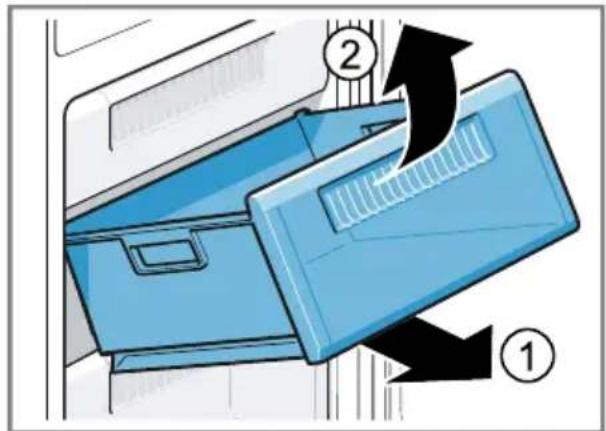
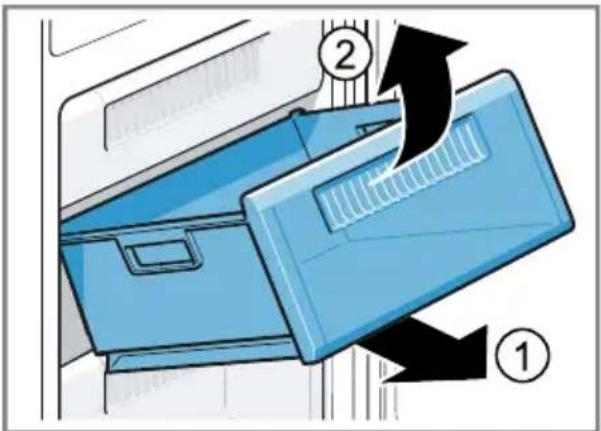
Removing the frozen food container
- Take out the frozen food container as far as it will go.
- Lift the frozen food container at the front ① and remove it .②
→ Fig. 4
13 Troubleshooting
You can rectify minor faults on your appliance yourself. Read the troubleshooting information before contacting after-sales service. This will avoid unnecessary costs.

WARNING
Risk of electric shock!
Incorrect repairs are dangerous.
- Repairs to the appliance should only be carried out by trained specialist staff.
▶ Only use genuine spare parts when repairing the appliance.
If the power cord of this appliance is damaged, it must be replaced by the manufacturer, the manufacturer's Customer Service or a similarly qualified person in order to prevent any risk.
Fault Cause and troubleshooting
| A warning signal sounds and lights up. | Different causes are possible.► Press ➕The alarm is switched off. |
| The exterior ventilation grilles are blocked.► Remove any obstructions from in front of the exterior ventilation grilles. | |
| Larger quantities of fresh food have been put in.► Do not exceed the max. freezing capacity.→ "Freezing capacity", Page 32 | |
| The appliance hums, bubbles, buzzes, gargles or clicks. | Not a fault. A motor is running, e.g. refrigerating unit, fan. Refrigerant flows through the pipes. The motor, switches or solenoid valves are switching on or off. No action required. |
| The appliance makes noises. | Fittings wobble or stick.► Check the removable fittings and, if required, replace these. |
| Containers are touching.► Move the containers apart. | |
| Super freezing is switched on. No action required. |
13.1 Power failure
During a power failure, the temperature in the appliance rises; this reduces the storage time and the quality of the frozen food.
The stored frozen food is cooled to the temperature increase time specified on the rating plate. → Fig. 1 / 4
Notes
■ Open the appliance as little as possible during a power failure and do not place any other food in the appliance.
■ Check the quality of the food immediately after a power failure.
- Dispose of any frozen food that has defrosted and is hotter than 5 °C.
- Cook or fry slightly thawed frozen food, and then either consume it or freeze it again.
14 Storage and disposal
You can find out here how to prepare your appliance for storage. You will also find out how to dispose of old appliances.
14.1 Switching off the appliance
- Switch off the appliance. → Page 31
- Disconnect the appliance from the power supply.
Unplug the appliance from the mains or switch off the circuit breaker in the fuse box. - Remove all of the food.
- Defrost the appliance. → Page 34
- Clean the appliance. → Page 35
- To ensure the ventilation inside the appliance, leave the appliance open.
14.2 Disposing of old appli- ance
Valuable raw materials can be re-used by recycling.

WARNING
Risk of harm to health!
Children can lock themselves in the appliance, thereby putting their lives at risk.
- Leave shelves and containers inside the appliance to prevent children from climbing in.
- Keep children away from the redundant appliance.

WARNING
Risk of fire!
If the tubes are damaged, flammable refrigerant and harmful gases may escape and ignite.
- Do not damage the tubes of the refrigerant circuit or the insulation.
- Unplug the appliance from the mains.
- Cut through the power cord.
- Dispose of the appliance in an environmentally friendly manner.
Information about current disposal methods are available from your specialist dealer or local authority.
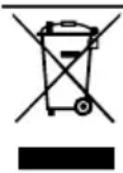
This appliance is labelled in accordance with European Directive 2012/19/EU concerning used electrical and electronic appliances (waste electrical and electronic equipment - WEEE). The guideline determines the framework for the return and recycling of used appliances as applicable throughout the EU.
15 Customer Service
If you have any queries, are unable to rectify faults on the appliance yourself or if your appliance needs to be repaired, contact Customer Service. Function-relevant genuine spare parts according to the corresponding Eco-design Order can be obtained from Customer Service for a period of at least 10 years from the date on which your appliance was placed on the market within the European Economic Area.
Note: Under the terms of the manufacturer's warranty applicable to the location, the use of Customer Service is free of charge. The minimum duration of the warranty (manufacturer's warranty for private consumers) in the European Economic Area is 2 years according to the terms of warranty applicable to the location. The terms of warranty do not affect other rights or claims held by yourself under local legislation.
Detailed information on the warranty period and terms of warranty in your country is available from our after-sales service, your retailer or on our website.
If you contact Customer Service, you will require the product number (E-Nr.) and the production number (FD) of your appliance.
The contact details for Customer Service can be found in the enclosed Customer Service directory or on our website.
15.1 Product number (E-Nr.) and production number (FD)
You can find the product number (E-Nr.) and the production number (FD) on the appliance's rating plate.
→ Fig. 1 / 4
Make a note of your appliance's details and the Customer Service telephone number to find them again quickly.
16 Technical data
Refrigerant, cubic capacity and further technical specifications can be found on the rating plate.
→ Fig. 1 / 4
Table des matières
1 Sécurité.... 40
10 Compartiment congélation..... 52
activer Super-congélation
désactiver Super-congélation
- Appuyer sur S
9 Alarme
fr Compartiment congélation
6 Uitrusting...... 68
6.1 Accessoires.... 68
7 De Bediening in essentie...... 69
⚠ WAARSCHUWING – Kans op letsel!
⚠ WAARSCHUWING – Kans op explosie!
⚠ WAARSCHUWING – Kans op brand!
⚠ WAARSCHUWING – Kans op verstikking!
⚠ WAARSCHUWING – Kans op explosie!
⚠ WAARSCHUWING – Kans op brand!
⚠ WAARSCHUWING – Kans op letsel!
WAARSCHUWING – Kans op brand!
7 De Bediening in essen- tie
7.1 Apparaat inschakelen
- indrukken.
text_image
BLAUPUNKT