ManualGo.com
AFD2535DEB - Fridge WHIRLPOOL - Free user manual and instructions
Find the device manual for free AFD2535DEB WHIRLPOOL in PDF.



Download the instructions for your Fridge in PDF format for free! Find your manual AFD2535DEB - WHIRLPOOL and take your electronic device back in hand. On this page are published all the documents necessary for the use of your device. AFD2535DEB by WHIRLPOOL.
USER MANUAL AFD2535DEB WHIRLPOOL
- Refrigerator Form No. B/05/04 Part No. 12828103 www.amana.com Litho U.S.A. Use & Care Guide Important Safety Instructions p. 1
- -2 Installation p. 3
- -9 Temperature Controls p. 10
- Fresh Food Features p. 11
- -12 Freezer Features p. 13
- Ice And Water p. 14
- Water Filter p. 15
- -16 Food Storage Tips p. 17
- -19 Care and Cleaning p. 20
- -23 Operating Sounds p. 24
- Troubleshooting p. 25
- -27 Warranty & Service p. 29
- Guide d’utilisation et d’entretien p. 30
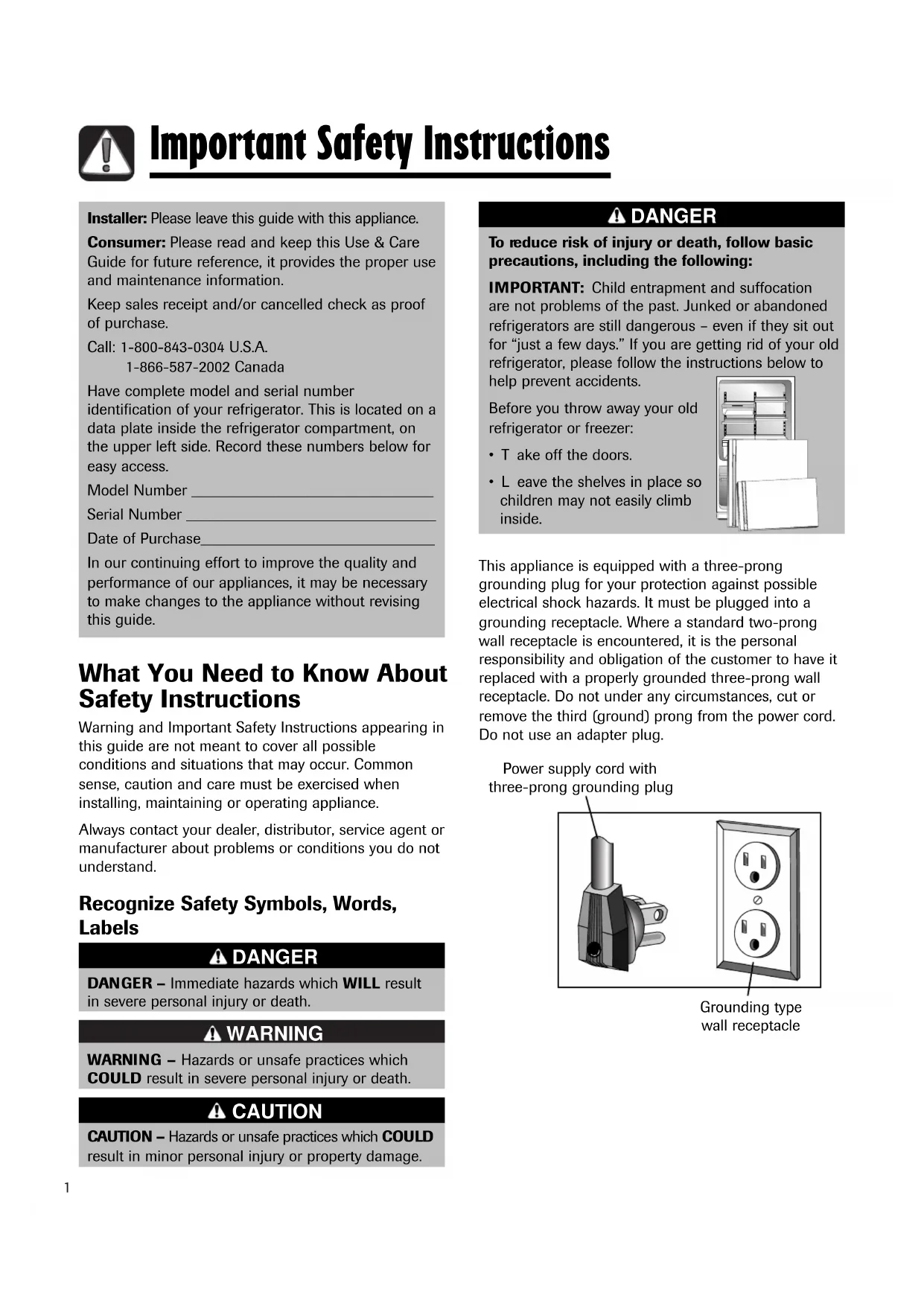
- Guía de uso y cuidado French Door1 Important Safety Instructions WARNING – Hazards or unsafe practices which COULD result in severe personal injury or death. WARNING DANGER – Immediate hazards which WILL result in severe personal injury or death. DANGER CAUTION – Hazards or unsafe practices which COULD result in minor personal injury or property damage. CAUTION What You Need to Know About Safety Instructions Warning and Important Safety Instructions appearing in this guide are not meant to cover all possible conditions and situations that may occur. Common sense, caution and care must be exercised when installing, maintaining or operating appliance. Always contact your dealer, distributor, service agent or manufacturer about problems or conditions you do not understand. Recognize Safety Symbols, Words, Labels This appliance is equipped with a three-prong grounding plug for your protection against possible electrical shock hazards. It must be plugged into a grounding receptacle. Where a standard two-prong wall receptacle is encountered, it is the personal responsibility and obligation of the customer to have it replaced with a properly grounded three-prong wall receptacle. Do not under any circumstances, cut or remove the third (ground) prong from the power cord. Do not use an adapter plug. Power supply cord with three-prong grounding plug Grounding type wall receptacle To reduce risk of injury or death, follow basic precautions, including the following: IMPORTANT: Child entrapment and suffocation are not problems of the past. Junked or abandoned refrigerators are still dangerous – even if they sit out for “just a few days.” If you are getting rid of your old refrigerator, please follow the instructions below to help prevent accidents. Before you throw away your old refrigerator or freezer: p. 59
- Leave the shelves in place so children may not easily climb inside. DANGER Installer: Please leave this guide with this appliance. Consumer: Please read and keep this Use & Care Guide for future reference, it provides the proper use and maintenance information. Keep sales receipt and/or cancelled check as proof of purchase. Call: 1-800-843-0304 U.S.A. 1-866-587-2002 Canada Have complete model and serial number identification of your refrigerator. This is located on a data plate inside the refrigerator compartment, on the upper left side. Record these numbers below for easy access. Model Number _______________________________ Serial Number ________________________________ Date of Purchase______________________________ In our continuing effort to improve the quality and performance of our appliances, it may be necessary to make changes to the appliance without revising this guide.To reduce risk of fire, electric shock, serious injury or death when using your refrigerator, follow these basic precautions, including the following:
1. Read all instructions before using the refrigerator.
2. Observe all local codes and ordinances.
3. Be sure to follow grounding instructions.
4. Check with a qualified electrician if you are not
sure this appliance is properly grounded.
5. Do not ground to a gas line.
6. Do not ground to a cold-water pipe.
7. Refrigerator is designed to operate on a separate
115 volt, 15 amp., 60 cycle line.
8. Do not modify plug on power cord. If plug does
not fit electrical outlet, have proper outlet installed by a qualified electrician.
9. Do not use a two-prong adapter, extension cord
11. Do not tamper with refrigerator controls.
12. Do not service or replace any part of refrigerator
unless specifically recommended in Use & Care Guide or published user-repair instructions. Do not attempt service if instructions are not under- stood or if they are beyond personal skill level.
13. Always disconnect refrigerator from electrical
supply before attempting any service. Disconnect power cord by grasping the plug, not the cord.
14. Install refrigerator according to Installation
Instructions. All connections for water, electrical power and grounding must comply with local codes and be made by licensed personnel when required.
15. Keep your refrigerator in good condition. Bumping
or dropping refrigerator can damage refrigerator or cause refrigerator to malfunction or leak. If damage occurs, have refrigerator checked by qualified service technician.
16. Replace worn power cords and/or loose plugs.
17. Always read and follow manufacturer’s storage
and ideal environment instructions for items being stored in refrigerator.
18. Your refrigerator should not be operated in the
presence of explosive fumes.
19. Children should not climb, hang or stand on any
part of the refrigerator.
20. Clean up spills or water leakage associated with
Important Safety Instructions
SAVE THESE INSTRUCTIONS
Installation Your refrigerator was packed carefully for shipment. Remove and discard shelf packaging and tape. Do not remove the serial plate. Location
- Do not install refrigerator near oven, radiator or other heat source. If not possible, shield refrigerator with cabinet material.
- Do not install where temperature falls below 55° F (13° C) or rises above 110° F (43° C). Malfunction may occur at this temperature.
- Refrigerator is designed for indoor household application only. Measuring the Opening When installing your refrigerator, measure carefully. Allow
⁄2" space at top and ⁄2" space behind the machine compartment cover (located in the rear) for proper air circulation. Subflooring or floor coverings (i.e. carpet, tile, wood floors, rugs) may make your opening smaller than anticipated. Some clearance may be gained by using the leveling procedure under Leveling. Important: If refrigerator is to be installed into a recess where the top of the refrigerator is completely covered, use distance from floor to top of hinge cap to verify proper clearance. Transporting Your Refrigerator
- NEVER transport refrigerator on its side. If an upright position is not possible, lay refrigerator on its back. Allow refrigerator to sit upright for approximately 30 minutes before plugging it in to assure oil returns to the compressor. Plugging the refrigerator in immediately may cause damage to internal parts.
- Use an appliance dolly when moving refrigerator. ALWAYS truck refrigerator from its side or back–NEVER from its front.
- Protect outside finish of refrigerator during transport by wrapping cabinet in blankets or inserting padding between the refrigerator and dolly.
- Secure refrigerator to dolly firmly with straps or bungee cords. Thread straps through handles when possible. Do not overtighten. Overtightening restraints may dent or damage outside finish.
- Use slight pressure to pry the cover loose.
- Continue to maintain downward pressure to the notched side of the cover while swinging it off. Leveling To protect property and refrigerator from damage, observe the following:
- Protect vinyl or other flooring with cardboard, rugs, or other protective material.
- Do not use power tools when performing leveling procedure. CAUTION To enhance the appearance and maintain performance, the refrigerator should be level. Note
- Complete any required door reversal, panel installation and/or a water supply connection, before leveling. Materials Needed
- Grasp firmly and pull outward to unclip.
2. Remove bottom hinge cover(s).
- Place the eraser end of a pencil or similar blunt tool in the cover notch. Notch Location
3. Using hex head driver, turn the front adjustment
screws (A) on each side to raise or lower the front of the refrigerator.4 Installation To avoid electrical shock which can cause severe personal injury or death, observe the following:
- Disconnect power to refrigerator before removing doors or drawer. Connect power only after replacing doors or drawer. WARNING To avoid damage to walls and flooring, protect vinyl or other flooring with cardboard, rugs or other protective material. CAUTION
1. Unplug power cord from power source.
3. Remove top hinge cover from
refrigerator door by removing Phillips screw and retain screw and cover for later use.
⁄16" hex head screws from top hinge to remove hinge and retain all screws for later use.
5. Lift right side refrigerator door from
center hinge pin. Remove door closure from center hinge pin on the right side and retain for later use.
6. Disconnect wire harness on top
of left side refrigerator door top hinge. Release two-pin connector by pressing junction point with a flat blade screwdriver or fingernail. Green ground wire remains attached to the hinge.
⁄16” hex head screws from top hinge to remove hinge and retain for later use. Lift left side refrigerator door, along with top hinge, from center hinge pin. Remove center hinge pin with a
⁄16” hex head driver and retain hinge pin for later use.
8. Remove Phillips screws to remove
right and left hinges and retain all screws for later use.
9. Remove both stabilizing brackets
8" hex head driver and retain screws for later use. Door and Drawer Removal Some installations require door/drawer removal to transport the refrigerator to its final location. right side door closure
4. Using the hex head driver, turn each of these
adjustment screws (B) to raise or lower the rear of the refrigerator.
5. Using the carpenter’s level, make sure front of
⁄4" (6 mm) or ⁄2 bubble higher than back of refrigerator and that the refrigerator is level from side to side.
6. Turn stabilizing legs (C) clockwise until firmly
7. Turn adjustment screws (A) counterclockwise to
allow the full weight of the refrigerator to rest on the stabilizing legs.
8. Replace hinge cover(s).
- Position cover into the outer edge of the hinge.
- Swing the cover toward the cabinet and snap it into place.
- For proper reinstallation, ensure the “top” marking on the interior of the toe grille is oriented correctly.
- Align the toe grille mounting clips with the lower cabinet slots.
- Push the toe grille firmly until it snaps into place.5 Installation Pullout Freezer Drawer To avoid electrical shock which can cause severe personal injury or death, disconnect power to refrigerator before removing doors. After replacing doors, connect power. WARNING To prevent accidental child entrapment or suffocation risk, do not remove the divider in the top freezer basket. DANGER To avoid possible injury, product, or property damage, you will need two people to perform the following instructions. CAUTION
2. While supporting door front,
hook supports into tabs located on inside of rail. To Install:
1. Pull both rails out to full
3. Lower door front into
4. Place the basket cradles back onto the side rails.
Align snaps with the slots on the side rails and press each snap towards the rail until it clicks.
5. With rails pulled out to full extension, set the
basket straight down into the basket cradles.
6. Slide upper basket into freezer. Make sure that rear
of basket hooks behind rail catch. Basket cradle snap attachments
5. Lift top of drawer front
to unhook supports from rail system. Lift door front out to remove. To Remove:
1. Pull drawer open to full extension.
2. Pull upper basket out to full extension and lift out
3. Lift lower basket straight up and out to remove.
4. On each side rail is a
basket cradle with two snap attachments. To release each cradle, unlatch the snaps by pushing them inward, away from the side rail system. Lift the cradles off of the rails.6 Installation Door Reinstallation
1. Install hinge assemblies:
- Install top hinge loosely with
⁄16 " hex head screws.
- Install center hinge with Phillips screws.
upright, tighten down top hinge with
⁄16" hex head driver.
4. Reconnect two-pin connector.
5. Replace top hinge covers.
6. Align bottom of handle with lower
door tab. Press upper handle end to door surface and firmly grasp lower end of handle. Gently slide handle upward until bottom of handle settles on door surface, then reverse direction, sliding downward to almost engaging tab with clip.
7. Grasp the handle firmly and slide
down until it clicks. The audible click indicates fastening clips are securely interlocked.
2. Grasp the lower part of the handle
firmly and lift to remove. To Remove:
1. Flex the handle away from the door
panel. Simultaneously place door handle removal card underneath the base of the lower handle. Insert the card to the line or until it stops. Handles If not installed, the handle is located in the interior of the fresh food section or attached to the back of your refrigerator. Remove and discard handle packaging and tape. Front Mount Handle Materials Needed
- Gloves to protect hands
- Phillips screwdriver
- Plastic door removal card (or
⁄32 " thick plastic card), retain the card To Install:
1. The handles are to be oriented
clip with the door tabs.
3. Ensure the handle clips are
positioned slightly above the door tabs.
5. Push the handle down against the
upper door tab just enough to allow it to hang unsupported.
4. Rotate the handle so that the
handle is flat against the door. Handle Clip Door Tab7 Installation Notes
- There is a slight curve to the freezer handle.
- For proper installation, be sure handle is oriented as shown. To Install:
1. Align door handle clips slightly to the left of the
tabs attached to the freezer door.
2. Rotate the handle so the left base is flat against
the door. Freezer Handle Materials Needed
- Gloves to protect hands.
- Phillips screwdriver.
- Plastic handle removal card (or
⁄32" thick plastic card). Retain the card.
4. While firmly supporting the left handle base against
the door, align the right base of the handle with the right tabs that are attached to the door.
5. Now, while firmly holding the handle at the left and
right bases, gently slide the handle towards the right until the right base settles in. The handle should now be flat against the face of the freezer door at both the left and right bases.
6. With hands still firmly keeping the handle flat
against the freezer door, you may have to reverse directions momentarily to assure clip/tab engagement. Then firmly slide the handle to the right until it clicks. The audible "click" indicates that the fastening clips are securely interlocked. To Remove:
1. At the right end, flex the handle base away from
the surface of the freezer drawer. Simultaneously slide the door handle removal card that came with your refrigerator under the right side base of the handle. Slide the card to the line indication or until it stops, which will be approximately 1
2. With both hands, firmly grasp the handle towards
3. Slide towards the left, lift and remove from the
base against the left door tab and slightly to the right, just enough to allow it to hang unsupported.5. Slide brass nut over sleeve and screw nut into inlet port. Tighten nut with wrench. IMPORTANT: Do not overtighten. Cross threading may occur.
6. Pull on tubing to confirm connection is
secure. Connect tubing to frame with water tubing clamp (C) and turn on water supply. Check for leaks and correct if necessary. Continue to observe the water supply connection for two to three hours prior to moving the refrigerator to its permanent location.
7. Monitor water connection for 24 hours. Correct
leaks, if necessary. Connecting the Water Supply To reduce the risk of injury or death, follow basic precautions, including the following:
- Read all instructions before installing ice maker.
- Do not attempt installation if instructions are not understood or if they are beyond personal skill level.
- Observe all local codes and ordinances.
- Do not service ice maker unless specifically recommended in Use & Care Guide or published user-repair instructions.
- Disconnect power to refrigerator before installing ice maker.
- Water damage due to an improper water connection may cause mold/mildew growth. Clean up spills or leakage immediately! WARNING To avoid property damage or possible injury, follow basic precautions, including the following:
- Consult a plumber to connect
⁄4" O.D. copper tubing to household plumbing to assure compliance with local codes and ordinances.
- Confirm water pressure to water valve is between 35 and 100 pounds per square inch, 20 pounds per square inch without filter.
- Do not use a self-piercing, or
⁄16" saddle valve. Both reduce water flow and can become clogged over time, and may cause leaks if repair is attempted.
- Tighten nuts by hand to prevent cross threading. Finish tightening nuts with pliers and wrenches. Do not overtighten.
- Wait two to three hours before placing refrigerator into final position to check and correct any water leaks. Recheck for leaks after 24 hours.
- Verify the copper tubing under the sleeve is smooth and free from defects. Do not reuse an old sleeve. CAUTION
⁄4" outer diameter flexible copper tubing
- Shut-off valve (requires a
⁄4" hole to be drilled into water supply line before valve attachment)
⁄4" hex nut driver Note
- You should only use copper tubing for installation. Plastic is less durable and can cause damage.
- Add 8' to tubing length needed to reach water supply for creation of service loop.
1. Create service loop with copper
tubing (minimum 2’ diameter). Avoid kinks in the copper tubing when bending it into a service loop. Do not use plastic tubing.
2. Remove plastic cap from water valve inlet
3. Place brass nut (A) and sleeve (B)
on copper tube end as illustrated. Reminder: Do not use an old sleeve. The nut and sleeve are provided in the use and care packet.
4. Place end of copper tubing into water
valve inlet port. Shape tubing slightly. Do not kink – so that tubing feeds straight into inlet port.
2’ diameter minimum9 Installation To avoid electrical shock which can cause severe personal injury or death, DO NOT attempt to remove the hinged section from the fresh food section. WARNING To avoid possible product damage, ALWAYS verify that the hinged section is folded against the edge of the door prior to closing. CAUTION hinged seal Opening and Closing Your Fresh Food Doors Your new refrigerator is uniquely designed with two fresh food doors. Either door can be opened or closed independently of one another. There is a vertically-hinged section on the left fresh food door. When the left door is closed, the hinged section automatically forms a seal between the two doors when both doors are closed. When the left door is opened, the hinged section automatically folds inward so that it is out of the way.Initial Control Settings After plugging the refrigerator in, set the controls.
- Pressing the or pads adjusts the controls to the desired setting.
- The temperature control range for both compartments is 1 through 7 (coldest).
- Initially set the refrigerator control on 4.
- Initially set the freezer control on 4.
- Let the refrigerator run at least 8 to 12 hours before adding food. Warm Cabinet Surfaces At times, the front of the refrigerator cabinet may be warm to the touch. This is a normal occurrence that helps prevent moisture from condensing on the cabinet. This condition will be more noticeable when you first start the refrigerator, during hot weather and after excessive or lengthy door openings. Temperature Control Guide Refrigerator too warm Refrigerator too cold Freezer too warm Freezer too cold Turn refrigerator OFF Set the refrigerator control to next higher number by pressing the pad. Set the refrigerator control to next lower number by pressing the pad. Set the freezer control to next higher number by pressing the pad. Set the freezer control to next lower number by pressing the pad. Press the refrigerator or freezer pad until a dash (–) appears in the display.
Temperature Controls Touch Temperature Controls The controls are located at the top front of the refrigerator compartment. Control Adjusting the Controls
- 24 hours after adding food, you may decide that one or both compartments should be colder or warmer. If so, adjust the control(s) as indicated in the Temperature Control Guide table below. See page 17 for instructions on checking compartment temperature.
- Except when starting the refrigerator, do not change either control more than one number at a time.
- Allow 24 hours for temperatures to stabilize.
- Changing either control will have some effect on the temperature of the other compartment. Energy Saver Switch (select models)
- Off - The refrigerator uses more energy when this switch is off, because a heater located in the hinged seal section of the door is running. This heater helps prevent condensation formation on the exterior of the hinged seal. Turn the energy saver switch OFF when the environment is warm and more humid or if moisture is noticed on the door exterior.
- On - This setting saves energy by not using the heater. Turn the energy saver switch ON when the environment is less humid.11 Fresh Food Features Shelves To avoid personal injury or property damage, observe the following:
- Never attempt to adjust a shelf that is loaded with food.
- Confirm shelf is secure before placing items on shelf.
- Handle tempered glass shelves carefully. Shelves may break suddenly if nicked, scratched, or exposed to sudden temperature change. CAUTION Door Storage Dairy Center The Dairy Center provides convenient door storage for spreadable items such as butter and margarine. This compartment can be moved to different locations to accommodate storage needs. To use the dairy center, raise the cover. To Remove:
- Raise the cover, pull upward and tilt out. To Install:
- Slide the Dairy Center in and down until firmly seated in the door liner. Door Buckets Door Buckets can be moved to meet storage needs. To Remove:
- Slide bucket up and pull straight out. To Install:
- Slide bucket in and down until firmly seated in the door liner. Your refrigerator has Spillsaver
Glass Shelves. The shelves have a spill retainer edge which allows for easier clean up and some are equipped with a slide out feature. To slide out, grasp the front of the shelf and pull forward. Push in the shelf to return to the original position. To Remove a Shelf:
- Slightly tilt up the front and lift up the rear of the shelf, then pull the shelf straight out. To Lock the Shelf Into Another Position:
- Tilt up the front edge of the shelf.
- Insert the hook into the desired frame openings and let the shelf settle into place.
- Be sure the shelf is securely locked at the rear. The Crisper Top serves as the lower fresh food shelf. To Remove the Crisper Top:
- Remove crisper drawers.
- Place hand under the frame to push up the glass. Lift glass out.
- Lift frame from refrigerator liner rails. To Install:
- Replace frame in refrigerator liner rails.
- Carefully replace glass into frame. Crisper Drawers The Crisper Drawers provide a higher humidity environment for fresh fruit and vegetable storage. Controls The Crisper Controls regulate the amount of humidity in the crisper drawer. Slide the control toward the Fruit setting for produce with outer skins. Slide the control toward the Vegetables setting for leafy produce. Full-width Door Shelf Full-width Door Shelf removes for easy cleaning. To Remove:
- Slide shelf up and pull straight out. To Install:
- Reverse above procedure.12 Note
- For best results, keep the crisper drawers tightly closed. To Remove:
- Pull drawer out to full extension. Tilt up front of drawer and pull straight out. To Install:
- Insert drawer into frame rails and push back into place. Temperature-Controlled Drawer The Chef’s Pantry
drawer is a full-width drawer with adjustable temperature control. This drawer can be used for large party trays, deli items, beverages or miscellaneous items and features a divider to organize the Chef’s Pantry into sections if desired. There is a temperature control which adjusts the amount of cold air allowed into the Chef’s Pantry drawer. The control is located on the right side of the drawer, under the lid. Set the control to the higher setting to provide a normal refrigerator temperature. Set the drawer on the lower setting when a temperature colder than the main refrigerator compartment is desired. Use the coldest setting when storing meats. Notes
- Cold air directed to the Chef’s Pantry can decrease refrigerator temperature. Refrigerator control may need to be adjusted.
- Do not place leafy vegetables in the Chef’s Pantry drawer. Colder temperatures could damage leafy produce. Fresh Food Features To Remove Drawer:
- Lift lid. Pull drawer out to full extension. Tilt up front of drawer and pull straight out. To Install Drawer:
- Push metal glide rails to the back of the refrigerator. Place drawer onto rails and slide drawer back until it falls into place. Beverage Organizer™ (select models) The Beverage Organizer™ slides out from underneath the Spillsaver™ stationary shelf. The Beverage Organizer™ holds up to twelve 12-ounce beverage cans. To Remove:
- Empty contents of can rack. Pull Beverage Organizer™ forward to full extension and lift front to release from shelf rail assembly. Pull straight out to remove. To Install:
- Insert drawer into frame rails and push back into place. Accessories Grip Pads (select models) The Grip Pads prevent objects from sliding in the door buckets. Grip Pads are removable and are top-rack dishwasher safe for easy cleaning. Wine Trivet/Can Rack (select models) The Wine Trivet/Can Rack accessory fits in the Chef’s Pantry™ or on a shelf. Bottles or cans can be laid crosswise, or a single bottle may be laid in the center depression. Covered Storage Bucket (select models) The Storage Bucket has a lid and removable egg tray. When tray is removed, bucket will accept items such as a standard egg carton, ice, etc. To Remove Divider:
- Pull drawer completely out and raise the front of the divider to unhook it from the rear wall of the drawer and lift it out. To Install Divider:
- Hook back of divider over rear wall of drawer and lower into place.13 Freezer Features To prevent accidental child entrapment or suffocation risk, do not remove the divider in the top freezer basket. DANGER Note
- Lower Freezer Drawer: See page 5 for lower basket and complete pullout drawer instructions. To Remove:
- Pull upper basket out to full extension and lift out to remove. To Install:
- Slide upper basket into freezer. Make sure that rear of basket hooks behind rail catch. Accessories Ice Bin The Ice Bin provides storage for ice. Upper Wire BasketWater Dispenser (select models) The Water Dispenser is located on the left side wall of the fresh food section. This design is for cold water dispensing only. Ice and Water
To avoid personal injury or property damage, observe the following:
- Do not place fingers or hands on the automatic ice making mechanism while the refrigerator is plugged in. This will help protect you from possible injury. It will also prevent interference with moving parts of the ejector mechanism and the heating element that releases the cubes.
- Under certain rare circumstances, ice cubes may be discolored, usually appearing with a green- bluish hue. The cause of this unusual discoloration can be a combination of factors such as certain characteristics of local waters, household plumbing and the accumulation of copper salts in an inactive water supply line which feeds the ice maker. Continued consumption of such discolored ice cubes may be injurious to health. If such discoloration is observed, discard the ice cubes and contact your dealer to purchase and install a water line filter.
- Water damage due to improper water connection may cause mold/mildew growth.
- Clean up water and ice spills to avoid personal injury and to prevent mold/mildew growth. WARNING Automatic Ice Maker Connect the ice maker to the water supply as instructed on page 8. Proper water flow and a level refrigerator are essential for optimal ice maker performance. Operating Instructions
- Confirm ice bin is in place and ice maker arm is down.
- After freezer section reaches between 0° to 2° F (-18° to -17° C), ice maker fills with water and begins operating. You will have a complete harvest of ice approximately every three hours.
- Allow approximately 24 hours after installation to receive first harvest of ice.
- Discard ice created within first 12 hours of operation to assure system is flushed of impurities.
- Stop ice production by raising ice maker arm until click is heard.
- Ice maker will remain in the off position until arm is pushed down.
- The first one or two batches will probably contain undersized and irregular cubes because of air in the supply line.
- When the ice cubes are ejected it is normal for several cubes to be joined together at the ends. They can easily be broken apart. The ice maker will continue to make ice until the supply of ice cubes raises the ice maker arm, shutting the ice maker off.
- Certain sounds may accompany the various cycles of the ice maker. The motor may have a slight hum, the cubes will rattle as they fall into an empty storage pan and the water valve may click or “buzz” occasionally.
- If the ice is not used frequently, the ice cubes will become cloudy, shrink, stick together and taste stale. Empty the ice storage bin periodically and wash it in lukewarm water. Be sure to dry the bin thoroughly before replacing it.
- Beverages and foods should not be placed in the ice storage bin for quick chilling. These items can block the ice maker arm, causing the ice maker to malfunction.
- Turn off (arm up) the ice maker when the water supply is to be shut off for several hours. To Remove the Ice Bin:
- Pull it forward, away from the ice maker. To avoid the ice maker dumping ice while the bin is removed, turn the ice maker off by raising the ice maker arm. To Install the Ice Bin:
- Reverse the above procedure. Turn the ice maker on by lowering the ice maker arm. To Dispense Water:
- Hold container under spout and press dispenser pad.State of California Department of Health Services Water Treatment Device Certificate Number
Date Issued: September 16, 2003 Date Revised: April 22, 2004 Trademark/Model Designation Replacement Elements UKF8001AXX750 UKF8001AXX469006-750 46 900667003523-750 67003523Manufacturer: PentaPure Inc.The water treatment device(s) listed on this certificate have met the testing requirementspursuant to Section 116830 of the Health and Safety Code for the following health relatedcontaminants: Microbiological Contaminants and Turbidity Inorganic/Radiological Contaminants Cysts AsbestosTurbidity LeadMercury ganic ContaminantsAtrazineLindaneBenzeneCarbofuranp-dichlorobenzeneToxaphene Rated Service Capacity: 750 gal. Rated Service Flow: 0.78 gpm Conditions of Certification:Do not use where water is microbiologically unsafe or with water of unknown quality, except thatsystems certified for cyst reduction may be used on disinfected waters that may contain filterablecysts.
Water Filter (select models) Water Filter Removal and Installation To avoid serious illness or death, do not use refrigerator where water is unsafe or of unknown quality without adequate disinfection before or after use of filter. WARNING After installing a new water filter, always dispense water for two minutes before removing the filter for any reason. Air trapped in system may cause water and cartridge to eject. Use caution when removing.
- The bypass cap does not filter water. Be sure to have replacement cartridge available when filter change is required.
- If water filtration system has been allowed to freeze, replace filter cartridge.
- If system has not been used for several months, or water has an unpleasant taste or odor, flush system by dispensing water for two to three minutes. If unpleasant taste or odor persists, change filter cartridge. CAUTION Initial Installation The water filter is located in the upper right-hand corner of the fresh food compartment.
1. Remove blue bypass cap and
retain for later use.
2. Remove sealing label from end of
filter and insert into filter head.
3. Rotate gently clockwise until filter stops. Snap filter
4. Reduce water spurts by flushing air from system.
Run water continuously for two minutes through dispenser until water runs steady. During initial use, allow about a one- to two-minute delay in water dispersal to allow internal water tank to fill.
- Additional flushing may be required in some households where water is of poor quality. Replacing Water Filter IMPORTANT: Air trapped in system may cause water and cartridge to eject. Always dispense water for at least two minutes before removing the filter for any reason. Use caution when removing.
1. Turn filter counterclockwise until it releases from
2. Drain water from filter into sink, and dispose in
normal household trash.
3. Wipe up excess water in filter cover and continue
- with Initial Installation, steps 2 through 4. The filter should be changed at least every 12 months. IMPORTANT: Condition of water and amount used determines life span of water filter cartridge. If water use is high, or if water is of poor quality, replacement may need to take place more often. To purchase a replacement water filter cartridge, contact your dealer or call 1-877-232-6771 U.S.A. or 1-800-688-8408 Canada. The dispenser feature may be used without a water filter cartridge. If you choose this option, replace filter with blue bypass cap.16 Water Filter (select models) System Specification and Performance Data Sheet Refrigerator Water Filter Cartridge Model UKF8001AXX Specifications Service Flow Rate (Maximum) p. 0
- .78 GPM (2.9 L/min) Rated Service Life UKF8001AXX-750 (Maximum) p. 750
- gallons /2838 liters Maximum Operating Temperature p. 100
- ° F / 38° C Minimum Pressure Requirement p. 35
- psi /241 kPA Minimum Operating Temperature p. 33
- ° F/1° C Maximum Operating Pressure psi /827 kPA Performance Data 1000 Apollo Road Eagan, Minnesota 55121-2240 p. 120
II retractable water filtration system uses a UKF8001AXX replacement cartridge. Timely replacement of filter cartridge is essential for performance satisfaction from this filtration system. Please refer to the applicable section of your Use & Care Guide for general operation, maintenance requirements and troubleshooting. Suggested retail price of replacement water filter is $39.99. This system has been tested according to ANSI/NSF 42 and 53 for reduction of the substance listed above. The concentration of the indicated substances in water entering the system was reduced to a concentration less than or equal to the permissible limit for water leaving the system, as specified in ANSI/NSF 42 and 53. General Use Conditions Read this Performance Data Sheet and compare the capabilities of this unit with your actual water treatment needs. DO NOT use this product where water is microbio- logically unsafe or of unknown quality without adequate disinfection before or after the system. System certified for cyst reduction may be used on disinfected water that may contain filterable cysts. USE ONLY WITH COLD WATER SUPPLY. CHECK FOR COMPLIANCE WITH THE STATE AND LOCAL LAWS AND REGULATIONS. *Tested using a flow rate of 0.78 gpm; pressure of 60 psig; pH of 7.5 + 0.5; temp. of 68° + 5° F (20° + 3° C) ** Measurement in Particles /ml. Particles used were 0.5 - 1 microns *** NTU - Nephelometric Turbidity Units Standard No. 42: Aesthetic Effects Taste and Odor Reduction Chlorine Taste & Odor Mechanical Filtration Unit Particulate Reduction Class 1 Standard No. 53: Health Effects Chemical Reduction Unit Lead, Atrazine, Lindane, Benzene, Carbofuran, p-Dichlorobenzene, Mercury & Toxaphene Reduction Mechanical Filtration Unit Cyst, Turbidity and Asbestos Reduction Tested and certified by NSF International against ANSI/NSF Standards 42 & 53 in models UKF8001AXX-750 for the reduction of: Parameter Chlorine T & O Particulate** USEPA MCL
at least 10,000 particles/ml Influent Average
69,000 #/ml Average >97.26%
99.52% Minimum 96.84%
98.94% Min. Required Reduction 50%
85% Effluent % Reduction USEPA MCL 1 NTU** 99.5% Reduction 99% Reduction
Standard No. 53: Health Effects Influent Challenge Concentration 11 ± 1 NTU*** Minimum 50,000/L
fibers/L; fibers >10 micrometers in length
166,500 #/L 155 MF/L
0.0011 mg/L <0.001 mg/L <0.0005 mg/L <0.0001 mg/L <0.001 mg/L Average 97.09% >99.99% >99.99% >99.35% >99.33% 95.70% 86.22% 76.99% 95.71% 98.74% 99.76% 98.72% 92.97% Minimum 95.20% >99.99% >99.99% >99.29% >99.29% 90.91% 75.93% 75.31% 92.14% 98.46% 99.74% 96.50% 91.67% Min. Required Reduction
- The fresh food compartment of a refrigerator should be kept between 34°- 40° F (1°- 4° C) with an optimum temperature of 37° F (3° C). To check the temperature, place an appliance thermometer in a glass of water and place in the center of the refrigerator. Check after 24 hours. If the temperature is above 40° F (4° C) adjust the controls as explained on page 10.
- Avoid overcrowding the refrigerator shelves. This reduces the circulation of air around the food and results in uneven cooling. Fruits and Vegetables
- Storage in the crisper drawers traps humidity to help preserve the fruit and vegetable quality for longer time periods (see page 11).
- Sort fruits and vegetables before storage and use bruised or soft items first. Discard those showing signs of decay.
- Always wrap odorous foods such as onions and cabbage so the odor does not transfer to other foods.
- While vegetables need a certain amount of humidity to remain fresh, too much humidity can shorten storage times (especially leafy vegetables). Drain vegetables well before storing.
- Wait to wash fresh produce until right before use. Meat and Cheese
- Raw meat and poultry should be wrapped securely so leakage and contamination of other foods or surfaces does not occur.
- Occasionally mold will develop on the surface of hard cheeses (Swiss, Cheddar, Parmesan). Cut off at least an inch around and below the moldy area. Keep your knife or instrument out of the mold itself. Do not try to save individual cheese slices, soft cheese, cottage cheese, cream, sour cream or yogurt when mold appears. Dairy Food
- Most dairy foods such as milk, yogurt, sour cream and cottage cheese have freshness dates on their cartons for appropriate length of storage. Store these foods in the original carton and refrigerate immediately after purchasing and after each use. Frozen Food Storage
- The freezer compartment of a refrigerator should be kept at approximately 0° F (-18° C). To check the temperature, place an appliance thermometer between the frozen packages and check after 24 hours. If the temperature is above 0° F (-18° C), adjust the control as described on page 10.
- A freezer operates more efficiently when it is at least two-thirds full. Packaging Foods for Freezing
- To minimize dehydration and quality deterioration use aluminum foil, freezer wrap, freezer bags or airtight containers. Force as much air out of the packages as possible and be sure they are tightly sealed. Trapped air can cause the food to dry out, change color and develop an off-flavor (freezer burn).
- Overwrap fresh meats and poultry with suitable freezer wrap prior to freezing.
- Do not refreeze meat that has completely thawed. Loading the Freezer
- Avoid adding too much warm food to the freezer at one time. This overloads the freezer, slows the rate of freezing and can raise the temperature of frozen foods.
- Leave space between the packages so cold air can circulate freely, allowing food to freeze as quickly as possible.
- Avoid storing hard-to-freeze foods such as ice cream and orange juice on the freezer door shelves. These foods are best stored in the freezer interior where the temperature varies less with door openings. Refer to the Food Storage Chart on pages 18 and 19 for approximate storage times.18 FOODS DAIRY PRODUCTS Butter Milk and cream Cream cheese, cheese spread and cheese food Cottage cheese Sour cream Hard cheese (Swiss, Cheddar and Parmesan) EGGS Eggs in the shell Leftover yolks or whites FRUITS Apples Bananas Pears, plums, avocados Berries, cherries, apricots Grapes Citrus fruits Pineapples, cut Food Storage Tips Food Storage Chart Storage times are approximate and may vary depending on type of packaging, storage temperature, and the quality of the food when purchased. REFRIGERATOR 1 month 1 week 1 to 2 weeks 3 to 5 days 10 days 1 to 2 months 3 weeks 2 to 4 days 1 month 2 to 4 days 3 to 4 days 2 to 3 days 3 to 5 days 1 to 2 weeks 2 to 3 days FREEZER 6 to 9 months Not recommended Not recommended Not recommended Not recommended 4 to 6 months May become crumbly Not recommended 9 to 12 months 8 months (cooked) 6 months (whole/peeled) Not recommended 6 months 1 month (whole) Not recommended 6 to 12 months STORAGE TIPS Wrap tightly or cover. Check carton date. Close tightly. Don’t return unused portions to original container. Don’t freeze cream unless whipped. Wrap tightly. Store in original carton. Check carton date. Store in original carton. Check carton date. Wrap tightly. Cut off any mold. Refrigerate small ends down. For each cup of yolks to be frozen, add 1 tsp. sugar for use in sweet, or 1 tsp. salt for non-sweet dishes. May also store unripe or hard apples at 60° to 70° F (16° to 21° C). Ripen at room temperature before refrigerating. Note: Bananas will darken when refrigerated. Ripen at room temperature before refrigerating. Note: Avocados will darken when refrigerated. Ripen at room temperature before refrigerating. Ripen at room temperature before refrigerating. May also store at 60° to 70° F (16° to 21° C). If refrigerated, store uncovered. Will not ripen after purchase. Use quickly.19 VEGETABLES Asparagus Brussels sprouts, broccoli, cauliflower, green peas, lima beans, onions, peppers Cabbage, celery Carrots, parsnips, beets and turnips Lettuce POULTRY and FISH Chicken and Turkey, whole Chicken and Turkey, pieces Fish MEATS Bacon Beef or lamb, ground Beef or lamb, roast and steak Ham, fully cooked, whole half slices Luncheon meat Pork, roast Pork, chops Sausage, ground Sausage, smoked Veal Frankfurters
Food Storage Tips Sources: United States Department of Agriculture; Food Marketing Institute; Cooperative Extension Service, Iowa State University REFRIGERATOR 1 to 2 days 3 to 5 days 1 to 2 weeks 7 to 10 days 7 to 10 days 1 to 2 days 1 to 2 days 1 to 2 days 7 days 1 to 2 days 3 to 5 days 7 days 5 days 3 days 3 to 5 days 3 to 5 days 3 to 5 days 1 to 2 days 7 days 3 to 5 days 7 days FREEZER 8 to 10 months 8 to 10 months Not recommended 8 to 10 months Not recommended 12 months 9 months 2 to 6 months 1 month 3 to 4 months 6 to 9 months 1 to 2 months 1 to 2 months 1 to 2 months 1 to 2 months 4 to 6 months 4 months 1 to 2 months 1 to 2 months 4 to 6 months 1 month Do not wash before refrigerating. Store in crisper. Wrap odorous foods. Leave peas in pods. Wrap odorous foods and refrigerate in crisper. Remove tops. Wrap odorous foods and refrigerate in the crisper. Keep in original packaging for refrigeration. Place in the meat and cheese drawer. When freezing longer than two weeks, overwrap with freezer wrap. Fresh meats can be kept in original packaging for refrigeration. Place in the meat and cheese drawer. When freezing longer than two weeks, overwrap with freezer wrap. Unopened, vacuum-packed luncheon meat may be kept up to two weeks in the meat and cheese drawer. Processed meats should be tightly wrapped and stored in the meat and cheese drawer.Care and Cleaning
To avoid electrical shock which can cause severe personal injury or death, disconnect power to refrigerator before cleaning. After cleaning, connect power. WARNING To avoid personal injury or property damage, observe the following:
- Read and follow manufacturer’s directions for all cleaning products.
- Do not place buckets, shelves or accessories in dishwasher. Cracking or warping of accessories may result. CAUTION *To order, call 1-877-232-6771 U.S.A. or 1-800-688-8408 Canada. Refrigerator Cleaning Chart PART Textured Doors and Exterior Cabinet Interior Stainless Steel Doors and Exterior (select models) IMPORTANT: Damage to stainless steel finish due to improper use of cleaning products or non-recommended products is not covered under this product’s warranty. Door Gaskets Condenser Coil Remove base grille to access. Condenser Fan Outlet Grille See back of refrigerator. Accessories Shelves, buckets, drawers, etc.
Abrasive or harsh cleaners Ammonia Chlorine bleach Concentrated detergents or solvents Metal or plastic-textured scouring pads Abrasive or harsh cleaners Ammonia Chlorine bleach Concentrated detergents or solvents Metal or plastic-textured scouring pads Vinegar-based products Citrus-based cleaners Abrasive or harsh cleaners Metal or plastic-textured scouring pads Anything other than a vacuum cleaner A dishwasher
Use 4 tablespoons of baking soda dissolved in 1 quart (1 liter) warm soapy water. Rinse surfaces with clean warm water and dry immediately to avoid water spots. Use warm, soapy water and a soft, clean cloth or sponge. Rinse surfaces with clean warm water and dry immediately to avoid water spots. To polish and help prevent finger prints, follow with Stainless Steel Magic Spray*. Use warm, soapy water and a soft, clean cloth or sponge. Use a vacuum cleaner hose nozzle. Use a vacuum cleaner hose nozzle with brush attachment. Follow removal and installation instructions from appropriate feature section. Allow accessories to adjust to room temperature. Dilute mild detergent and use a soft clean cloth or sponge for cleaning. Use a plastic bristle brush to get into crevices. Rinse surfaces with clean warm water. Dry glass and clear items immediately to avoid spots.21 Care and Cleaning Removing Odors From Refrigerator
1. Remove all food and turn the refrigerator OFF.
2. Disconnect power to the refrigerator.
3. Clean the walls, floor, ceiling of cabinet interior,
drawers, shelves and gaskets according to the instructions on page 20.
4. Dilute mild detergent and brush solution into
crevices using a plastic bristle brush. Let stand for 5 minutes. Rinse surfaces with warm water. Dry surfaces with a soft, clean cloth.
5. Wash and dry all bottles, containers and jars.
Discard spoiled or expired items.
6. Wrap or store odor-causing foods in tightly sealed
containers to prevent recurring odors.
7. Reconnect power to refrigerator and return food to
8. Allow the refrigerator to cool.
9. After 24 hours, check if odor has been eliminated.
If odor is still present:
1. Remove drawers and place on top shelf of
2. Pack refrigerator and freezer sections – including
doors – with crumpled sheets of black and white newspaper.
3. Place charcoal briquettes randomly on crumpled
newspaper in both freezer and refrigerator compartments.
4. Close doors and let stand 24 to 48 hours.
- Avoid overcrowding refrigerator shelves. Overcrowding reduces air circulation around food and causes refrigerator to run longer.
- Avoid adding too much warm food to refrigerator at one time. This overloads compartments and slows rate of cooling.
- Do not use aluminum foil, wax paper, or paper toweling as shelf liners. This decreases air flow and causes refrigerator to run less efficiently.
- A freezer that is two-thirds full runs most efficiently.
- Locate refrigerator in coolest part of room. Avoid areas of direct sunlight, or near heating ducts, registers or other heat producing appliances. If this is not possible, isolate exterior by using a section of cabinet or an added layer of insulation.
- Clean door gaskets every three months according to cleaning instructions. This will assure that door seals properly and refrigerator runs efficiently.
- Take time to organize items in refrigerator to reduce time that door is open.
- Be sure your doors are closing securely by leveling refrigerator as instructed in your installation instructions.
- Clean condenser coils as indicated in the cleaning instructions every three months. This will increase energy efficiency and cooling performance. To avoid electrical shock which can cause severe personal injury or death, disconnect power to refrigerator before cleaning. After cleaning, reconnect power. WARNING22 Care and Cleaning To avoid electrical shock which can cause severe personal injury or death, disconnect power to refrigerator before replacing light bulb. After replacing light bulb, reconnect power. WARNING To avoid personal injury or property damage, observe the following:
- Allow light bulb to cool.
- Wear gloves when replacing light bulb. CAUTION Replacing Light Bulbs Fresh Food Section (style of light shield varies)
1. Slide clear light shield
toward back of compartment to release from light assembly.
2. Remove light bulbs.
3. Replace with appliance
bulbs no greater than 40 watts.
4. Replace light bulb cover by inserting tabs on light
shield into liner holes on each side of light assembly. Slide shield toward front of refrigerator until it locks into place. Do not force shield beyond locking point. Doing so may damage light shield. Freezer (style of light shield varies)
1. Reach behind the light
2. With firm pressure, press
forward on the notches at the back of the cover and pull down. The cover will open from the back.
3. Remove the cover.
4. Remove light bulb.
5. Replace bulb with
appliance bulb no greater than 40 watts.
6. Insert front tabs of light
cover into slots in freezer liner and snap rear portion over light assembly until rear tab engages.23 Care and Cleaning If your refrigerator has a dispenser and if there is any possibility that the temperature can drop below freezing where the refrigerator is located, the water supply system (including the water tank and the water valve) must be drained by a qualified servicer. CAUTION Preparing for Vacation
8. Leave the doors open to prevent the formation of
mold and mildew. Upon your return: After a short vacation or absence: For models with automatic ice makers or dispensers:
- Reconnect the water supply and turn on supply valve (see page 8).
- Monitor water connection for 24 hours and correct leaks if necessary.
- Run 10-15 glasses of water from the dispenser to flush out the system.
- Restart the ice maker by lowering the ice maker arm.
- Discard at least the first three ice harvests. After a long vacation or absence:
- Reconnect the water supply and turn on supply valve (see page 8).
- Plug the refrigerator back in and reset controls (see page 10).
- Monitor water connection for 24 hours and correct leaks, if necessary. For dispenser models, run water through the dispenser for at least three minutes with the filter bypass in place, then install water filter (see page 15).
- After installing the water filter, run water through the dispenser continuously for at least two minutes, or until water runs steady. Initially you may notice a one to two minute delay in water dispersal as the internal tanks fills.
- Restart the ice maker by lowering the ice maker arm.
- Discard ice produced within the first 12 hours (at least the first three harvests). Preparing to move:
- Follow the above instructions for long vacations/absences, through step 7.
- Secure all loose items such as shelves and drawers by taping them securely in place to prevent damage.
- Tape the doors shut.
- Use an appliance dolly when moving the refrigerator. Always truck the refrigerator from its side or back - never from its front.
- Be sure the refrigerator stays in an upright position during moving. For short vacations or absences (three months or less):
during your absence, remove all frozen items also.
3. If your refrigerator has an automatic ice maker:
- Shut off the water supply to the ice maker at least one day ahead of time.
- After the last load of ice drops, raise the wire shut off arm to the OFF position.
(13° C), follow the instructions for longer absences. For long vacations, absences (more than three months) OR if the room temperature will drop below 55º F (13° C):
2. If your refrigerator has an automatic ice maker:
- Shut off the water supply to the ice maker at least one day ahead of time.
- After the last load of ice drops, raise the wire shut off arm to the OFF position.
3. If your refrigerator has a dispenser system with
water filter, remove the water filter cartridge and install the filter bypass. Dispose of the used cartridge.
4. Turn the freezer control to OFF.
5. Unplug the refrigerator.
6. Thoroughly clean the interior of both compartments
with a baking soda solution and a clean soft cloth (four tablespoons of baking soda in one quart of warm water).
7. Dry thoroughly.24
SOUND Clicking Air rushing or whirring Gurgling or boiling sound Thumping Vibrating noise Buzzing Humming Hissing or popping Operating Sounds Improvements in refrigeration design may produce sounds in your new refrigerator that are different or were not present in an older model. These improvements were made to create a refrigerator that is better at preserving food, is more energy efficient, and is quieter overall. Because new refrigerators run quieter, sounds may be detected that were present in older refrigerators, but were masked by higher sound levels. Many of these sounds are normal. Please note that the surfaces adjacent to a refrigerator, such as hard walls, floors and cabinetry may make these sounds seem even louder. The following are some of the normal sounds that may be noticed in a new refrigerator. POSSIBLE CAUSE
- Freezer control (A) clicks when starting or stopping compressor.
- Motorized device (B) sounds like an electric clock and snaps in and out.
- Freezer fan (C) and condenser fan (D) make this noise while operating.
- Evaporator (E) and heat exchanger (F) refrigerant makes this noise when flowing.
- Ice cubes from ice maker (select models) drop into ice bucket (G).
- Compressor (H) makes a pulsating sound while running.
- Refrigerator is not level.
- Ice maker water valve (I) hookup (select models) buzzes when ice maker fills with water.
- Ice maker (J) is in the ‘on’ position without water connection.
- Compressor (H) can make a high-pitched hum while operating.
- See page 3 for details on how to level your refrigerator.
- Stop sound by raising ice maker arm to OFF position (see page 14).
- Refrigerator is in defrost mode.
- Refrigerator control settings are too low.
- Refrigerator is not plugged in.
- Fuse is blown, or circuit breaker needs to be reset.
- Power outage has occurred.
- Refrigerator is malfunctioning.
- Condenser coils are dirty.
- Refrigerator or freezer controls are set too high.
- Door is not closing properly.
- Controls need to be adjusted.
- Condenser coils are dirty.
- Rear air grille is blocked.
- Door has been opened frequently, or has been opened for long periods of time.
- Food has recently been added.
- Compartment is dirty or has odor- causing food.
- Check gaskets for proper seal.
- Humidity levels are high.
- Controls require adjustment. PROBLEM Freezer control and lights are on, but compressor is not operating Crisper drawer temperature is too warm Refrigerator does not operate Refrigerator still won’t operate Food temperature is too cold Food temperature is too warm Refrigerator has an odor Water droplets form on outside of refrigerator
- Normal operation. Wait 40 minutes to see if refrigerator restarts.
- See page 10 to adjust controls.
- Plug in refrigerator.
- See page 10 to adjust your controls.
- Replace any blown fuses. Check circuit breaker and reset, if necessary.
- Call local power company listing to report outage.
- Unplug refrigerator and transfer food to another refrigerator. If another refrigerator is not available, place dry ice in freezer section to preserve food. Warranty does not cover food loss. Contact service for assistance.
- Clean according to the chart on page 20.
- See page 10 to adjust your controls.
- Refrigerator is not level. See page 3 for details on how to level your refrigerator.
- Check gaskets for proper seal. Clean, if necessary, according to the chart on page 20.
- Check for internal obstructions that are keeping door from closing properly (i.e. improperly closed drawers, ice buckets, oversized or improperly stored containers, etc.)
- See page 10 to adjust your controls.
- Clean according to the chart on page 20.
- Check the positioning of food items in refrigerator to make sure grille is not blocked. Rear air grilles are located under crisper drawers.
- Reduce time door is open. Organize food items efficiently to assure door is open for as short a time as possible.
- Allow time for recently added food to reach refrigerator or freezer temperature.
- Clean according to instructions on page 20.
- Clean according to the chart on page 20.
Hot, humid weather can increase condensation, turn ENERGY SAVER OFF to reduce moisture (select models).
- See page 10 to adjust your controls. Troubleshooting26 Water droplets form on inside of refrigerator Refrigerator or ice maker makes unfamiliar sounds or seems too loud Crisper drawers do not close freely Refrigerator runs too frequently Troubleshooting PROBLEM POSSIBLE CAUSES
- See page 10 to adjust your controls.
- Reduce time door is open. Organize food items efficiently to assure door is open for as short a time as possible.
- Clean, if necessary, according to the chart on page
- Reposition food items and containers to avoid interference with the drawers.
- See page 3 for details on how to level your refrigerator.
- Clean drawer channels with warm, soapy water. Rinse and dry thoroughly.
- Apply a thin layer of petroleum jelly to drawer channels.
- Reduce time door is open.
- Organize food items efficiently to assure door is open for as short a time as possible.
- Allow interior environment to adjust for period the door has been opened.
- Allow time for recently added food to reach refrigerator or freezer temperature.
- Evaluate your refrigerator’s environment. Refrigerator may need to be moved to run more efficiently.
- Clean, if necessary, according to the chart on page
- See page 10 to adjust your controls.
- Refrigerator is not level. See page 3 for details on how to level your refrigerator.
- Check gaskets for proper seal.
- Clean, if necessary, according to the chart on page
- Check for internal obstructions that are keeping door from closing properly (i.e. improperly closed drawers, ice buckets, oversized or improperly stored containers, etc.)
- Humidity levels are high or door has been been opened frequently.
- Contents of drawer, or positioning of items in the surrounding compartment could be obstructing drawer.
- Drawer is not in proper position.
- Refrigerator is not level.
- Drawer channels are dirty or need treatment.
- Doors have been opened frequently or for long periods of time.
- Humidity or heat in surrounding area is high.
- Food has recently been added.
Refrigerator is exposed to heat by environment or by appliances nearby.
- Condenser coils are dirty.
- Controls need to be adjusted.
- Door is not closing properly.
- Normal Operation27 Refrigerator is leaking water Ice forms in inlet tube to ice maker Water flow is slower than normal Troubleshooting Ice PROBLEM POSSIBLE CAUSES
- Plastic tubing was used to complete water connection.
- Improper water valve was installed.
- Water pressure is low.
- Freezer temperature is too high.
- Water pressure is low.
- Improper water valve was installed.
- Copper tubing has kinks.
- Water filter is clogged or needs to be changed.
- The manufacturer recommends using copper tubing for installation. Plastic is less durable and can cause leakage. The manufacturer is not responsible for property damage due to improper installation or water connection.
- Check water connection procedure (see page 8). Self-piercing and
⁄16" saddle valves cause low water pressure and may clog the line over time. The manufacturer is not responsible for property damage due to improper installation or water connection.
- Water pressure must be between 35 to 100 pounds per square inch to function properly. A minimum pressure of 35 pounds per square inch is recommended for refrigerators with water filters.
- Adjust freezer control (see page 10). Freezer is recommended to be approximately 0° F (-18° C).
- Water pressure must be between 35 to 100 pounds per square inch to function properly. A minimum pressure of 35 pounds per square inch is recommended for refrigerators with water filters.
- Check water connection procedure in your Installation Instructions. Self-piercing and
⁄16" saddle valves cause low water pressure and may clog the line over time. The manufacturer is not responsible for property damage due to improper installation or water connection. Open water valve completely and check for leaks.
- Turn off water supply and remove kinks. If kinks cannot be removed, replace tubing.
- Change water filter (see page 15).
Notes29 Warranty & Service What is Not Covered By These Warranties:
1. Conditions and damages resulting from any of the
following: a. Improper installation, delivery, or maintenance. b. Any repair, modification, alteration, or adjustment not authorized by the manufacturer or an authorized servicer. c. Misuse, abuse, accidents, or unreasonable use. d. Incorrect electric current, voltage, or supply. e. Improper setting of any control.
2. Warranties are void if the original serial numbers have
been removed, altered or cannot be readily determined.
4. Products purchased for commercial or industrial use.
5. The cost of service or service call to:
a. Correct installation errors. b. Instruct the user on the proper use of the product. c. Transport the appliance to the servicer.
6. Consequential or incidental damages sustained by any
person as a result of any breach of these warranties. Some states do not allow the exclusion or limitation of consequential or incidental damages, so the above exclusion may not apply. If You Need Service
- Call the dealer from whom your appliance was purchased or call Maytag Services
- Be sure to retain proof of purchase to verify warranty status. Refer to Warranty for further information on owner’s responsibilities for warranty service.
- If the dealer or service company cannot resolve the problem, write to Maytag Services
- User’s guides, service manuals and parts information are available from Maytag Services
, Amana Customer Assistance. Warranty Full One Year Warranty One (1) year - From the date of original retail purchase, any part that fails in normal home use will be repaired or replaced free of charge. Limited Warranty - Major Refrigeration Components Second Through Fifth Year - After the first year from the date of original purchase, through the fifth year, the manufacturer will repair or replace, at its option, free of charge for parts and labor only, any part of the sealed refrigeration system (consisting of the compressor, evaporator, condenser, drier and connecting tubing) and the cabinet liner (exclusive of the door liner) which fail in normal home use. All other costs, including mileage, transportation, trip charge and diagnostic charge, if required, shall be the responsibility of the owner. Limited Warranty - Water Filter 30 days - From the original retail purchase date, any part of the water filter cartridge which fails due to a defect in workmanship or materials will be replaced free of charge. Canadian Residents The above warranties only cover an appliance installed in Canada that has been certified or listed by appropriate test agencies for compliance to a National Standard of Canada unless the appliance was brought into Canada due to transfer of residence from the United States to Canada. Limitations of Liability The warrantor shall not be liable for any incidental or consequential damages, including food loss. Some states do not allow the exclusion or limitation of consequential damages, so the above limitation or exclusion may not apply to you. The specific warranties expressed above are the ONLY warranties provided by the manufacturer. These warranties give you specific legal rights, and you may also have other rights which vary from state to state. Note