
C902 - Mobile Phone SONY - Free user manual and instructions
Find the device manual for free C902 SONY in PDF.


| Product type | Mobile phone |
| Brand | SONY |
| Model | C902 |
| Dimensions (approx.) | 96 x 49 x 18 mm |
| Weight (approx.) | 107 g |
| Power | Rechargeable Li-ion battery BST-38, charges via USB cable or mains charger |
| Main functions | 5 MP camera with autofocus, MP3 player, FM radio, Bluetooth, 3G internet, camera with LED flash |
| Care and cleaning | Clean with a soft, dry cloth. Do not use abrasive products or solvents. |
| Safety | Do not expose to water or humidity. Use only original SONY accessories. Turn off the device in areas where phone use is prohibited. |
| Spare parts and repairability | Battery, screen and connectors available from authorized service centers. Repair recommended by a professional. |
| General information | Slider keyboard, 2-inch TFT screen 262k colors, internal memory 160 MB expandable via Memory Stick Micro (M2). Compliant with Canadian NMB-003 standard. |
Frequently Asked Questions - C902 SONY
User questions about C902 SONY
0 question about this device. Answer the ones you know or ask your own.
Ask a new question about this device
Download the instructions for your Mobile Phone in PDF format for free! Find your manual C902 - SONY and take your electronic device back in hand. On this page are published all the documents necessary for the use of your device. C902 by SONY.
USER MANUAL C902 SONY
Thank you for purchasing a Sony Ericsson C902 Cyber-shot™. For additional phone content, go to www.sonyericsson.com/fun.
Register now to get a suite of tools, free online storage, special offers, news and competitions at www.sonyericsson.com/myphone.
For product support, go to www.sonyericsson.com/support.
Accessories – More for your phone
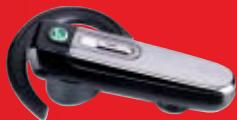
Bluetooth™ Headset
HBH-PV712
A powerful wireless handsfree with extra Style-up™ cover in lime green - choose colour to match your mood!
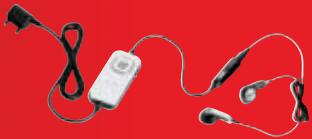
GPS-Enabler HGE-100
Get more from your phone - add GPS technology. Know where you are, where you're going and how to get there.
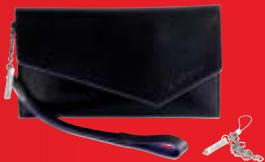
Design Collection IDC-23
Black leather with a vibrant purple lining, this phone case has a separate credit card compartment, matching hand strap and detachable jewellery.
These accessories can be purchased separately but may not be available in every market. To view the full range go to www.sonyericsson.com/accessories.
Contents
Getting started 6
Assembly 6
Turning on the phone 7
Help 8
Charging the battery 8
Phone overview 9
Navigation 13
Phone language 15
Entering text 15
Imaging 16
Camera and video recorder 16
Using the camera 17
Camera icons and settings 19
Getting more from the camera .... 20
Transferring pictures 20
Camera printing 21
Pictures 22
PhotoDJ™ and VideoDJ™ 23
Calling 24
Making and receiving calls 24
Contacts 25
Call list 29
Speed dial 29
Voicemail 29
Voice control 29
More than one call 31
Restricted dialling 32
Call time and cost 33
Showing or hiding your phone number 33
Messaging 33
Text messages 33
Picture messages 34
Message options 35
Voice messages 36
Email 36
My friends 37
Area and cell information 39
Media player and music ... 39
Transferring content to and from a computer 39
Stereo portable handsfree 40
Music player 40
PlayNowTM 42
TrackIDTM 42
Online music and video clips 42
Entertainment 43
Video player 43
Radio 43
Ringtones and melodies 44
MusicDJTM 44
Sound recorder 45
Games 45
Applications 45
Internet 46
Internet security and certificates 47
Webfeeds 48
Connectivity 49
Settings 49
Phone name 49
Bluetooth™ wireless technology ... 50
Using the USB cable 51
Synchronizing 52
Update service 55
More features 56
Flight mode 56
Location services 56
File manager 56
Alarms 57
Calendar 58
Notes 59
Tasks 60
Profiles 60
Time and date 60
Theme 61
Main menu layout 61
Locks 61
Troubleshooting 63
Common questions 63
Error messages 65
Important information... 66
Guidelines for Safe and
Efficient Use 68
Memory card 71
End User Licence Agreement 71
Limited Warranty 72
FCC Statement 74
Declaration of Conformity
for C902 75
Index 76
Sony Ericsson C902 Cyber-shotTM
UMTS HSDPA 2100 GSM EDGE 850/900/1800/1900
This User guide is published by Sony Ericsson Mobile Communications AB or its local affiliated company, without any warranty. Improvements and changes to this User guide necessitated by typographical errors, inaccuracies of current information, or improvements to programs and/or equipment, may be made by Sony Ericsson Mobile Communications AB at any time and without notice. Such changes will, however, be incorporated into new editions of this User guide.
All rights reserved.
©Sony Ericsson Mobile Communications AB, 2008
Publication number: 1205-6445.3
Please note:
Some of the services in this User guide are not supported by all networks. This also applies to the GSM International Emergency Number 112.
Please contact your network operator or service provider if you are in doubt whether you can use a particular service or not.
Please read the Important information before you use your mobile phone.
Your mobile phone has the capability to download, store and forward additional content, e.g. ringtones. The use of such content may be restricted or prohibited by rights of third parties, including but not limited to restriction under applicable copyright laws. You, and not Sony Ericsson, are entirely responsible for additional content that you download to or forward from your mobile phone. Prior to your use of any additional content, please verify that your intended use is properly licensed or is otherwise authorized. Sony Ericsson does not guarantee the accuracy, integrity or quality of any additional content or any other third party content.
Under no circumstances will Sony Ericsson be liable in any way for your improper use of additional content or other third party content.
Smart-Fit Rendering is a trademark or a registered trademark of ACCESS Co., Ltd.
Bluetooth is a trademark or a registered trademark of Bluetooth SIG Inc. and any use of such mark by Sony Ericsson is under license.
The Liquid Identity logo, BestPic, PlayNow, MusicDJ, PhotoDJ, TrackID and VideoDJ are trademarks or registered trademarks of Sony Ericsson Mobile Communications AB.
TrackIDTM is powered by Gracenote Mobile MusicIDTM. Gracenote and Gracenote Mobile MusicID are trademarks or registered trademarks of Gracenote, Inc.
Lotus Notes is a trademark or a registered trademark of International Business Machines Corporation.
Sony, Cyber-shot, Memory Stick Micro™ and M2™ are trademarks or registered trademarks of Sony Corporation.
Google™ and Google Maps™ are trademarks or registered trademarks of Google, Inc.
SyncML is a trademark or registered trademark of Open Mobile Alliance LTD.
Ericsson is a trademark or registered trademark of Telefonaktiebolaget LM Ericsson.
Adobe Photoshop Album Starter Edition is a trademark or registered trademark of Adobe Systems Incorporated in the United States and/or other countries.
Microsoft, ActiveSync, Windows, Outlook, and Vista are registered trademarks or trademarks of Microsoft Corporation in the United States and/or other countries.
T9TM Text Input is a trademark or a registered trademark of Tegic Communications. T9TM Text Input is licensed under one or more of the following: U.S. Pat. Nos. 5,818,437, 5,953,541, 5,187,480, 5,945,928, and 6,011,554; Canadian Pat. No. 1,331,057, United Kingdom Pat. No. 2238414B; Hong Kong Standard Pat. No. HK0940329; Republic of Singapore Pat. No. 51383; Euro.Pat. No. 0 842 463(96927260.8) DE/DK, FI, FR, IT, NL, PT, ES, SE, GB; and additional patents are pending worldwide.
Java and all Java based trademarks and logos are trademarks or registered trademarks of Sun Microsystems, Inc. in the U.S. and other countries. End-user license agreement for Sun™ Java™ J2METM.
Restrictions: Software is confidential copyrighted information of Sun and title to all copies is retained by Sun and/or its licensors. Customer shall not modify, decompile, disassemble, decrypt, extract, or otherwise reverse engineer Software. Software may not be leased, assigned, or licensed, in whole or in part.
Export Regulations: This product, including any software or technical data contained in or accompanying the product, may be subject to U.S. export control laws, including the U.S. Export Administration Act and its associated regulations and the U.S. sanctions programs administered by the U.S. Treasury Department's Office of Foreign Assets Control, and may be additionally subject to export or import regulations in other countries. The user and any possessor of the product agrees to comply strictly with all such regulations and acknowledges that it is their responsibility to obtain any required licenses to export, re-export, or import this product. Without limitation this product, including any software contained therein, may not be downloaded, or otherwise exported or reexported (i) into, or to a national or resident of, or an entity in, Cuba, Iraq, Iran, North Korea, Sudan, Syria (as such listing may be revised from time to time)
or any country to which the U.S. has embargoed goods; or (ii) to any person or entity on the U.S. Treasury Department's list of Specially Designated Nationals or (iii) any person or entity on any other export prohibition list that may be maintained from time to time by the United States Government, including but not limited to the U.S. Commerce Department's Denied Persons List or Entity List, or the U.S. State Department's Nonproliferation Sanctions List.
This product is protected by certain intellectual property rights of Microsoft. Use or distribution of such technology outside of this product is prohibited without a license from Microsoft.
Content owners use Windows Media digital rights management technology (WMDRM) to protect their intellectual property, including copyrights. This device uses WMDRM software to access WMDRM protected content. If the WMDRM software fails to protect the content, content owners may ask Microsoft to revoke the software's ability to use WMDRM to play or copy protected content.
Revocation does not affect unprotected content. When you download licenses for protected content, you agree that Microsoft may include a revocation list with the licenses. Content owners may require you to upgrade WMDRM to access their content. If you decline an upgrade, you will not be able to access content that requires the upgrade.
This product is licensed under the MPEG-4 visual and AVC patent portfolio licenses for the personal and non-commercial use of a consumer for (i) encoding video in compliance with the MPEG-4 visual standard ("MPEG-4 video") or the AVC standard ("AVC video") and/or (ii) decoding MPEG-4 or AVC video that was encoded by a consumer engaged in a personal and non-commercial activity and/or was obtained from a video provider licensed by MPEG LA to provide MPEG-4 and/or AVC video.
No license is granted or shall be implied for any other use. Additional information including that relating to promotional, internal and commercial uses and licensing may be obtained from MPEG LA, L.L.C. See http://www.mpegla.com. MPEG Layer-3 audio decoding technology licensed from Fraunhofer IIS and Thomson.
Restricted Rights: Use, duplication or disclosure by the United States government is subject to the restrictions as set forth in the Rights in Technical Data and Computer Software Clauses in DFARS 252.227-7013(c) (1) (ii) and FAR 52.227-19(c) (2) as applicable.
Other product and company names mentioned herein may be the trademarks of their respective owners.
Any rights not expressly granted herein are reserved. All illustrations are for illustration only and may not accurately depict the actual phone.
Instruction symbols
These symbols may appear in the User guide.




A service or function is networkor subscription-dependent. Contact your network operator for details.
Use a selection or navigation key to scroll and select. See Navigation on page 13.
Getting started
Assembly
Before you start using your phone, you need to insert a SIM card and the battery.
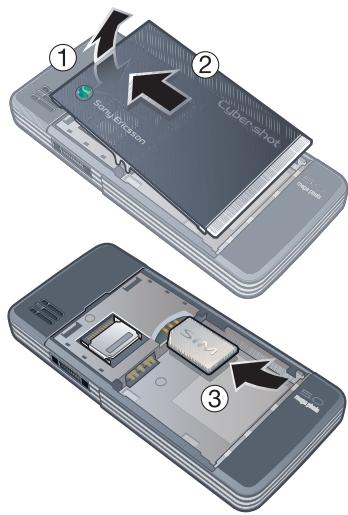
To insert the SIM card
1 Lift the battery cover slightly.
2 Slide the battery cover off.
3 Slide the SIM card into its holder with the gold-coloured contacts facing down.
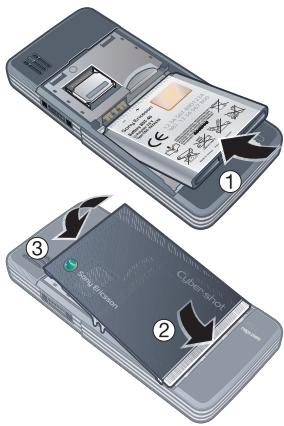
To insert the battery
1 Insert the battery with the label side up and the connectors facing each other.
2 Align the silvery edge of the battery cover properly.
3 Gently press battery cover into place.
Turning on the phone
To turn on the phone
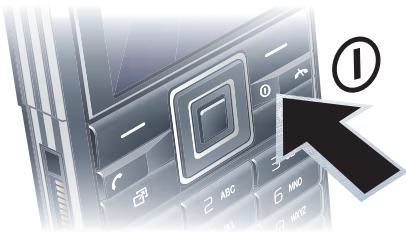
1 Press and hold down ①.
2 Enter your SIM card PIN, if requested and select OK.
3 Select a language.
4 Select Cont. to use the setup wizard while settings are downloaded.

If you want to correct a mistake when you enter your PIN, press C.

Before turning the phone off, you must return to standby.
SIM card
The SIM (Subscriber Identity Module) card, which you get from your network operator, contains information about your subscription.
Always turn off your phone and detach the charger before you insert or remove the SIM card.

You can save contacts on the SIM card before you remove it from your phone. See To copy names and numbers to the SIM card on page 27.
PIN
You may need a PIN (Personal Identification Number) to activate the services in your phone. Your PIN is supplied by your network operator. Each PIN digit appears as *, unless it starts with emergency number digits, for example, 112 or 911. You can see and call an emergency number without entering a PIN.

If you enter the wrong PIN three times in a row, the SIM card is blocked. See SIM card lock on page 61.

Startup screen
The startup screen appears when you turn your phone on. See Using pictures on page 23.
Standby
After you have turned your phone on and entered your PIN, the name of the network operator appears. This view is called standby.
Help
In addition to this User guide, Getting started guides and more information are available at www.sonyericsson.com/support.
Help in your phone
Help and information are available in your phone. See Navigation on page 13.
To view tips and tricks
1 From standby select Menu > Settings > the General tab > Setup wizard.
2 Select Tips and tricks.
To view information about functions
- Scroll to a function and select Info, if available. In some cases, Info appears under Options.
To view the phone demonstration
From standby select Menu > Entertainment > Demo tour.
To view status information
From standby press the volume key up.
Charging the battery
The phone battery is partly charged when you buy it.
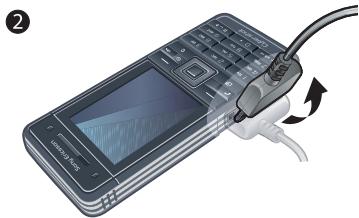
To charge the battery
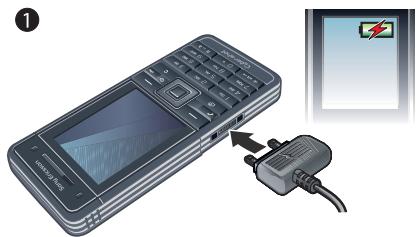
1 Connect the charger to the phone. It takes approximately 2.5 hours to fully charge the battery. Press a key to view the screen.
2 Remove the charger by tilting the plug upwards.
- You can use your phone while it is charging. You can charge the battery at any time and for more or less than 2.5 hours. You can interrupt the charging without damaging the battery.
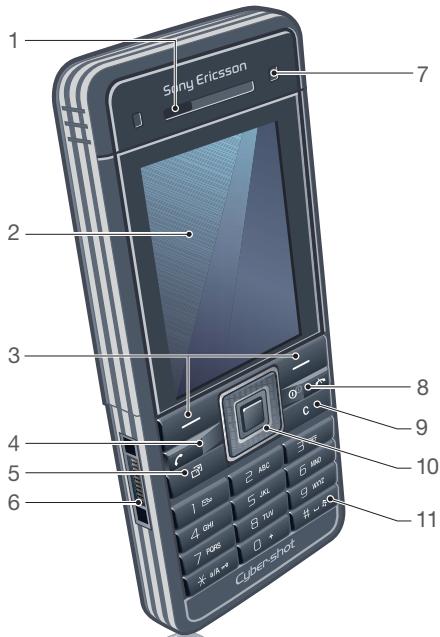
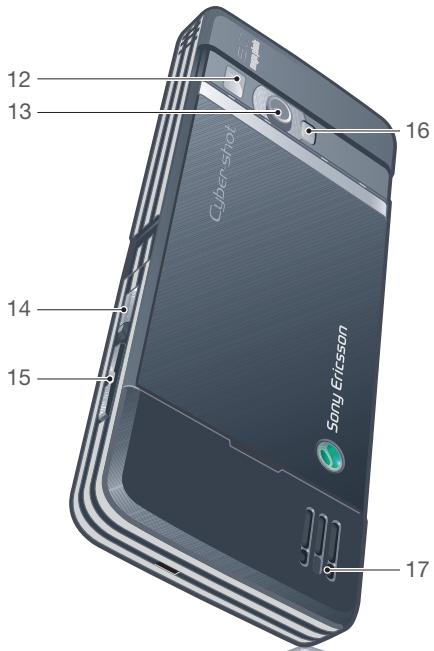
Phone overview
1 Ear speaker
2 Screen
3 Selection keys
4 Call key
5 Activity menu key
6 Connector for charger, handsfree and USB cable
7 Video call camera
8 End, on/off key
9 C key (Clear)
10 Navigation key
11 Silent key
12 Flash/Light
13 Camera lens
14 Camera key
15 Volume, digital zoom keys
16 Self-portrait mirror
17 Strap holder
Menu overview

PlayNowTM\*

Internet*

Entertainment
Online services*
TrackIDTM
Location services
Games
VideoDJTM
PhotoDJTM
MusicDJTM
Remote control
Record sound
Demo tour

Cyber-shotTM

Messaging

Media
Write new
Photo
Inbox
Music
Video
Drafts
Games
Outbox
TV*
Sent messages
Web feeds
Saved messages
Settings
My friends*
Call voicemail
Templates
Manage messages
Settings

Alarms

Contacts

Radio
Myself
New contact

All

Answered

Dialled

Missed

Organizer
File manager**
Applications
Video call
Calendar
Tasks
Notes
Synchronization
Timer
Stopwatch
Calculator
Code memo

Settings**

General
Profiles
Time & date
Language
Update service
Voice control
New events
Shortcuts
Flight mode
Security
Setup wizard
Accessibility*
Phone status
Master reset

Sounds & alerts
Ring volume
Ringtone
Silent mode
Increasing ring
Vibrating alert
Message alert
Key sound

Display
Wallpaper
Main menu layout
Theme
Startup screen
Screen saver
Clock size
Brightness
Edit line names*

Calls
Speed dial
Smart search
Divert calls
Switch to line 2^*
Manage calls
Time & cost*
Show/hide my no.
Handsfree

Connectivity
Bluetooth
USB
Phone name
Network sharing
Synchronization
Device management
Mobile networks
Data communication*
Internet settings
Streaming settings
Message settings*
SIP settings
Accessories
- Some menus are operator-, network- and subscription-dependent.
** You can use the navigation key to scroll between tabs in submenus. For more information, see Navigation on page 13.
Navigation
The main menus are shown as icons. Some submenus include tabs.
To navigate the phone menus
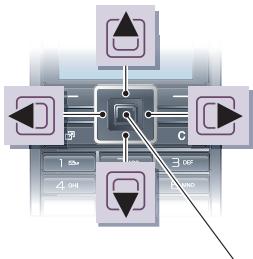
Centre navigation key
1 From standby select Menu.
2 Use the navigation key to move through the menus.
To select actions on the screen
- Press the left or right selection key, or the centre navigation key.
To view options for an item
- Select Options to, for example, edit.
To scroll between the tabs
- Scroll to a tab by pressing the navigation key left or right.
To return to standby
- Press
To end a function
- Press
To navigate your media
1 From standby select Menu > Media.
2 Scroll to a menu item and press the navigation key right.
3 To go back, press the navigation key left.
To delete items
- Press to delete items such as numbers, letters, pictures and sounds.
To send items
1 Scroll to an item such as a contact, a picture or a sound.
2 Select Options > Send.
3 Select a transfer method.
Make sure the receiving device supports the transfer method you select.
Shortcuts
You can use keypad shortcuts to go directly to a menu. Menu numbering starts from the top left icon and moves across and then down row by row.
To go directly to a main menu
From standby select Menu and press 1 -9, / A ,0+ or (#-3).
The Main menu layout must be set to Grid.
See To change the main menu layout on page 61.
To use navigation key shortcuts
From standby press , or to go directly to a function.
To edit a navigation key shortcut
1 From standby select Menu > Settings > the General tab > Shortcuts.
2 Scroll to an option and select Edit.
3 Scroll to a menu option and select Shortc.
Activity menu
The activity menu gives you quick access to certain functions.
To open the activity menu
- Press
Activity menu tabs
- New events - missed calls and new messages.
- Running apps - applications that are running in the background.
My shortcuts - add your favourite functions to access them quickly. - Internet - quick access to the Internet.
Memory card
You may have to purchase a memory card separately.
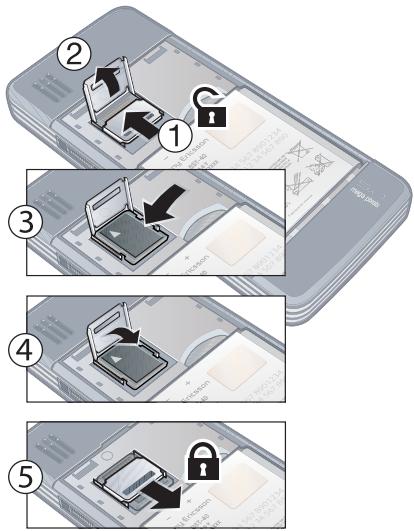
Your phone supports Memory Stick MicroTM (M2TM) memory card adding more storage space to your phone. It can also be used as a portable memory card with other compatible devices.
You can use the file manager to move files between the memory card and the phone memory. See To move a file in the file manager on page 57.
To insert a memory card

To view memory card options
1 From standby select Menu > Organizer > File manager > the On memory card tab.
2 Select Options.
Phone language
You can select a language to use in your phone.
To change the phone language
1 From standby select Menu > Settings > the General tab > Language > Phone language.
2 Select an option.
Entering text
You can use multitap text input or T9TM Text Input to enter text. The T9 Text Input method uses a built-in dictionary.
To change text input method
- When you enter text, press and hold down ( / b)
To shift between capitals and lower-case letters
- When you enter text, press a A
To enter numbers
- When you enter text, press and hold down (0 + ) - (9) .
To enter full stops and commas
- When you enter text, press 1 .
To enter a symbol
1 When you enter text, select Options > Add symbol.
2 Scroll to a symbol and select Insert.
To enter text using T9^TM Text Input
1 From standby select, for example, Menu > Messaging > Write new > Text message.
2 If T9 is not displayed, press and hold down (*a / A) to change to T9 Text Input.
3 Press each key only once, even if the letter you want is not the first letter on the key. For example, to write the word "Jane", press 5 , 2 , 6 , 3 . Write the whole word before looking at the suggestions.
4 Use or to view suggestions.
5 Press # - to accept a suggestion.
To enter text using multitap
1 From standby select, for example, Menu > Messaging > Write new > Text message.
2 If tg is displayed, press and hold down XaA to change to multitap text input.
3 Press 2 - 9 repeatedly until the desired letter appears.
4 When a word is written, press (# -) to add a space.
Imaging
Camera and video recorder
You can take pictures and record video clips to view, save or send. You find your saved pictures and video clips in Media > Photo > Camera album and Organizer > File manager.
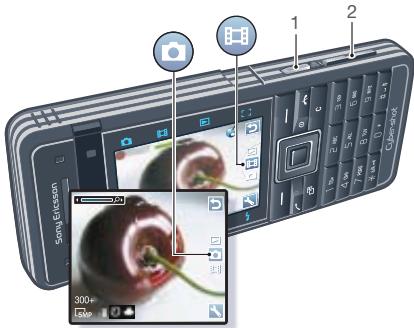
Viewfinder and camera keys
1 Take pictures/Record video
2 Zoom in or out
Using the camera
Your Cyber-shot™ camera has 5.0 MP with auto focus, face detection and photo flash. You can use the light when recording videos.
To activate the camera
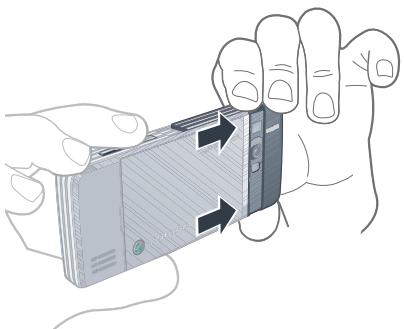
- Open the slide-out lens cover.
To take a picture
1 Activate the camera and press or to scroll to
2 Press 13 halfway down to use auto focus.
3 When the dot and focus frame are green, press fully down to take a picture. The picture is automatically saved on the memory card, if a memory card is inserted. If not, the picture is saved in the phone memory.
Do not record with a strong light source in the background. Use a support or the self-timer to avoid a blurred picture.
Face detection
You can use face detection to bring an off-centre face into focus. The camera automatically detects up to three faces, indicated by white frames. A green frame shows which face has been selected when auto focus is used. As a rule, focus is set to the face closest to the camera.
To set face detection
From standby select Menu > Cyber-shotTM > Focus > Face detection.
To record a video clip
1 Activate the camera and press or to scroll to
2 Press fully down to start recording. The video clip is automatically saved on the memory card, if a memory card is inserted. If not, the video clip is saved in the phone memory.
To stop recording
Press
To use zoom
- Press the volume keys up or down.
To adjust brightness
Press or
Camera touch keys
Above and below the camera viewfinder there are eight touch keys, acting as shortcuts to commonly used camera features.
| Touch key | Feature |
| Camera | |
| Video | |
| View mode | |
| Focus Video: Not available | |
| Shoot mode Video: Video length | |
| Scenes Video: Night mode | |
| Self-timer | |
| Flash Video: Light | |
Camera icons and settings
Icons on the screen inform what the current setting is. More camera settings are available in Settings.
| Icon | Description |
| Shoot mode | |
| Scenes. Predefined settings for common picture situations, including landscape, portrait and sport | |
| Picture size | |
| Focus/Face detection | |
| Metering mode | |
| White balance. To adjust colour tones to the lighting conditions | |
| Video length. For picture messages, the length is limited | |
| Microphone | |
| Night mode | |
| Video: recording | |
| Zoom | |
| Auto focus | |
| Focus frame | |
| 300+ | Camera: remaining pictures |
| Location data is turned on | |
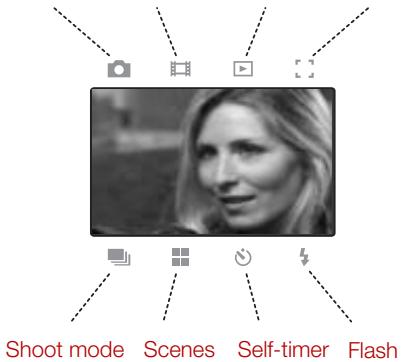
Camera Video View mode Focus
To change settings
Activate the camera and select
To view information about settings
- Scroll to a setting and select.
Getting more from the camera
BestPicTM helps you capture the precise moment. The light works automatically with BestPicTM when light conditions are poor. Use Photo mate to learn about camera functions. You can improve an underexposed picture with Photo fix.
To use BestPicTM
1 Activate the camera.
2 Select >Shoot mode > BestPicTM.
3 Press halfway down to use auto focus.
4 When the dot and focus frame are green, press fully down to complete the shot.
5 Select Options > Save all or press or to choose the best picture and select Save.
To improve a picture with Photo fix
1 Activate the camera and press or to scroll to.
2 Make sure Review is set to On. Select > Settings and scroll to Review > On.
3 Take a picture.
4 During review, select Options > Photo fix.
To use Photo mate
From standby select Menu > Organizer > Applications > Photo mate.
To view pictures and video clips
1 Activate the camera and press 口 or 口 to scroll to 口 .
2 Scroll to the item.
3 To view a video clip, press the centre navigation key.
Transferring pictures
Transfer to and from your computer
You can use Bluetooth™ wireless technology and the USB cable to transfer pictures and video clips between your computer and phone.
See Bluetooth™ wireless technology on page 50 and Transferring content to and from a computer on page 39 for more information.
You can view, enhance and organize your pictures and video clips on your computer by installing the AdobeTM PhotoshopTM Album Starter Edition. It is included on the CD that comes with your phone and is available for download at www.sonyericsson.com/support.
Picture and video blog
A blog is a personal Web page. If your subscription supports this service, you can send pictures or video clips to a blog.

Web services may require a separate license agreement between you and the service provider. Additional regulations and charges may apply. Contact your service provider.
To send camera pictures to a blog
1 From standby select Menu > Media and scroll to Photo > Camera album.
2 Scroll to a month and a picture. Select View.
3 Select Options > Send > To blog.
4 Enter a title and text and select OK.
5 Select Publish.

You can also send a picture to a blog just after you have taken it by selecting Send >To blog.
To send video clips to a blog
1 From standby select Menu > Media and scroll to Video.
2 Scroll to a video clip.
3 Select Options > Send > To blog.
4 Enter a title and text and select OK.
5 Select Publish.

You can also send a video clip to a blog just after you have recorded it by selecting Send > To blog.
To go to a blog address from contacts
1 From standby select Menu > Contacts.
2 Scroll to a contact and select a Web address.
3 Select Go to.
Camera printing
You can print camera pictures using the USB cable connected to a compatible printer.

You can also print using a Bluetooth compatible printer.
To print camera pictures using the USB cable
1 From standby select Menu > Media and scroll to Photo > Camera album.
2 Scroll to a month and a picture.
3 Select Options > Print.
4 Select an option.
5 Connect the USB cable to the phone.
6 Connect the USB cable to the printer.
7 Wait for feedback in the phone and select OK.
8 Enter printer settings, if required and select Print.

You should disconnect and re-connect the USB cable if there is a printer error.
Pictures
You can view and tag your pictures in Media.
To view pictures in a slide show
1 From standby select Menu > Media and scroll to Photo > Camera album.
2 Scroll to a month and a picture. Select View.
3 Select Options > Slide show.
4 Select a mood.
Viewing pictures on a map
Location data is included when you take pictures with the camera. This allows you to view the approximate location of where a picture was taken.
To view pictures on a map
1 From standby select Menu > Media and scroll to Photo > Camera album.
2 Scroll to a month and a picture. Select View.
3 Select Options > View on map.
To turn off location data for pictures
- From standby select Menu > Cyber-shot™ > Settings > Add position > Off.
Photo tags
You can tag pictures to categorize them. They are saved in Photo tags.
To tag pictures
1 From standby select Menu > Media and scroll to Photo > Camera album.
2 Scroll to a month and a picture. Select View.
3 Press and scroll to a tag.
4 Press the centre navigation key.
5 For each picture you want to tag, use or to scroll to the picture and press the centre navigation key.
To create a new photo tag
1 From standby select Menu > Media and scroll to Photo > Camera album.
2 Scroll to a month and a picture. Select View.
3 Press and select Options > New tag.
4 Enter a name and select OK.
5 Select an icon.
6 Press the centre navigation key to tag the picture.
Using pictures
You can add a picture to a contact, use it during phone startup, as a wallpaper in standby or as a screen saver.
To use pictures
1 From standby select Menu > Media and scroll to Photo > Camera album.
2 Scroll to a month and a picture. Select View.
3 Select Options > Use as.
4 Select an option.
PhotoDJ™ and VideoDJ™
You can edit pictures and video clips.
To edit and save a picture
1 From standby select Menu > Media and scroll to Photo > Camera album.
2 Scroll to a month and a picture. Select View.
3 Select Options > Edit in PhotoDJ™.
4 Edit the picture.
5 Select Options > Save picture.
To edit and save a video clip
1 From standby select Menu > Organizer > File manager > Videos.
2 Scroll to a video clip and select Options > Edit in VideoDJ™.
3 Edit the video clip.
4 Select Options > Save.
To trim a video clip
1 From standby select Menu > Organizer > File manager > Videos.
2 Scroll to a video clip and select Options > Edit in VideoDJ™ > Edit > Trim.
3 Select Set to set the starting point and select Start.
4 Select Set to set the ending point and select End.
5 Select Trim > Options > Save.
Calling
Making and receiving calls
You need to turn on your phone and be within range of a network.
To make a call
1 From standby enter a phone number (with international country code and area code, if applicable).
2 Press. See Video call on page 25.

You can call numbers from your contacts and call list. See Contacts on page 25, and Call list on page 29. You can also use your voice to make calls. See Voice control on page 29.
To end a call
- Press
To make international calls
1 From standby press and hold down ① + until a " + " sign appears.
2 Enter the country code, area code (without the first zero) and phone number.
3 Press
To re-dial a number
- When Retry? appears select Yes.

Do not hold your phone to your ear when waiting. When the call connects, your phone gives a loud signal.
To answer a call
Press
To reject a call
- Press
To change the ear speaker volume during a call
- Press the volume key up or down.
To mute the microphone during a call
1 Press and hold down C
2 Press and hold down C again to resume.
To turn the loudspeaker on during a call
- Select SpkrOn.

Do not hold your phone to your ear when using the loudspeaker. This could damage your hearing.
To view missed calls from standby
- Press to open the call list.
Networks
Your phone switches automatically between GSM and 3G (UMTS) networks depending on availability. Some network operators allow you to switch networks manually.
To switch networks manually
1 From standby select Menu > Settings > the Connectivity tab > Mobile networks > GSM/3G networks.
2 Select an option.
Emergency calls
Your phone supports international emergency numbers, for example, 112 and 911. These numbers can normally be used to make emergency calls in any country, with or without the SIM card inserted, if a 3G (UMTS) or GSM network is within range.
In some countries, other emergency numbers may also be promoted. Your network operator may therefore have saved additional local emergency numbers on the SIM card.
To make an emergency call
From standby enter 112 (the international emergency number) and press C.
To view your local emergency numbers
1 From standby select Menu > Contacts.
2 Scroll to New contact and select Options > Special numbers > Emergency nos.
Video call
See a person on the screen during calls. Both parties need a subscription that supports the 3G (UMTS) service, and you need to be within range of a 3G (UMTS) network. 3G (UMTS) service is available when 36 appears.
To make a video call
1 From standby enter a phone number (with international country code and area code if applicable).
2 Select Options > Make video call.
To use the zoom with an outgoing video call
Press or
To view video call options
During the call, select Options.
Contacts
You can save names, phone numbers and personal information in Contacts. Information can be saved in the phone memory or on the SIM card.
Default contacts
You can choose which contact information is shown as default. If Phone contacts is selected as default, your contacts show all the information saved in Contacts. If you select SIM contacts as default, your contacts show names and numbers saved on the SIM card.
To select default contacts
1 From standby select Menu > Contacts.
2 Scroll to New contact and select Options > Advanced > Default contacts.
3 Select an option.
Phone contacts
Phone contacts can contain names, phone numbers and personal information. They are saved in the phone memory.
To add a phone contact
1 From standby select Menu > Contacts.
2 Scroll to New contact and select Add.
3 Enter the name and select OK.
4 Scroll to New number: and select Add.
5 Enter the number and select OK.
6 Select a number type.
7 Scroll between tabs and select the fields to add information.
8 Select Save.
Calling contacts
To call a phone contact
1 From standby select Menu > Contacts.
2 Scroll to a contact and press
To go directly to the contacts list
From standby press and hold down 2-9.
To call with Smart search
1 From standby press (0 + ) - 9 to enter a contact name or a phone number. All entries which match the sequence of digits or letters are shown in a list.
2 Scroll to a contact or a phone number and press
To turn Smart search on or off
1 From standby select Menu > Settings > the Calls tab > Smart search.
2 Select an option.
Editing contacts
To add information to a phone contact
1 From standby select Menu > Contacts.
2 Scroll to a contact and select Options > Edit contact.
3 Scroll between the tabs and select Add or Edit.
4 Select an option and an item to add or edit.
5 Select Save.

If your subscription supports Calling Line Identification (CLI) service, you can assign personal ringtones and pictures to contacts.
To copy names and numbers to phone contacts
1 From standby select Menu > Contacts.
2 Scroll to New contact and select Options > Advanced > Copy from SIM.
3 Select an option.
To copy names and numbers to the SIM card
1 From standby select Menu > Contacts.
2 Scroll to New contact and select Options > Advanced > Copy to SIM.
3 Select an option.

When you copy all contacts from your phone to the SIM card, all existing SIM card information is replaced.
To automatically save names and phone numbers on the SIM card
1 From standby select Menu > Contacts.
2 Scroll to New contact and select Options > Advanced > Auto save on SIM.
3 Select an option.
To save contacts on a memory card
1 From standby select Menu > Contacts.
2 Scroll to New contact and select Options > Advanced > Back up to m. card.
SIM contacts
SIM contacts can contain names and numbers only. They are saved on the SIM card.

These SIM contacts instructions are only valid if you set SIM contacts as default contact.
To add a SIM contact
1 From standby select Menu > Contacts.
2 Scroll to New contact and select Add.
3 Enter the name and select OK.
4 Enter the number and select OK.
5 Select a number type and add more information, if available.
6 Select Save.
To call a SIM contact
1 From standby select Menu > Contacts.
2 Scroll to a contact and press
Deleting contacts
To delete all contacts
1 From standby select Menu > Contacts.
2 Scroll to New contact and select Options > Advanced > Delete all contacts.
3 Select an option.
Memory status
The number of contacts you can save in your phone or on the SIM card depends on available memory.
To view memory status
1 From standby select Menu > Contacts.
2 Scroll to New contact and select Options > Advanced > Memory status.
Synchronizing contacts
The Sony Ericsson PC Suite is designed to work with the following programs:
- Windows Contact (Vista Contacts Manager)
- Windows Calendar (Vista Calendar)
Microsoft Outlook 2007
Microsoft Outlook 2003
Microsoft Outlook 2002
Microsoft Outlook 2000 - Lotus Notes™ 7
- Lotus Notes 6.5
- Lotus Notes 6
- Lotus Notes 5
- Windows Address Book (Outlook Express)
- Sony Ericsson PC Suite proprietary contact & calendar manager For more information see Synchronizing on page 52.
To add your own business card
1 From standby select Menu > Contacts.
2 Scroll to Myself and select Open.
3 Scroll to My contact info and select Add > Create new.
4 Scroll between tabs and select the fields to add information.
5 Enter the information and select Save.
Groups
You can create a group of phone numbers and email addresses from Phone contacts to send messages to. See Messaging on page 33. You can also use groups (with phone numbers) when you create accepted callers lists.
To create a group of numbers and email addresses
1 From standby select Menu > Contacts.
2 Scroll to New contact and select Options > Groups.
3 Scroll to New group and select Add.
4 Enter a name for the group and select Continue.
5 Scroll to New and select Add.
6 For each contact phone number or email address you want to mark, scroll to it and select Mark.
7 Select Continue > Done.
Call list
You can view information about recent calls.
To call a number from the call list
1 From standby press and scroll to a tab.
2 Scroll to a name or a number and press
To add a call list number to contacts
1 From standby press and scroll to a tab.
2 Scroll to the number and select Save.
3 Select New contact to create a new contact or select an existing contact to add the number to.
Speed dial
Speed dialling lets you select nine contacts that you can dial quickly.
The contacts can be saved in positions 1-9.
To add contacts to speed dial numbers
1 From standby select Menu > Contacts.
2 Scroll to New contact and select Options > Speed dial.
3 Scroll to a position number and select Add.
4 Select a contact.
To speed dial
From standby enter the position number and press

Voicemail
If your subscription includes an answering service, callers can leave a voicemail message when you cannot answer a call.
To enter your voicemail number
1 From standby select Menu > Messaging > Settings > Voicemail number.
2 Enter the number and select OK.
To call your voicemail service
From standby press and hold down 1.
Voice control
By creating voice commands you can:
Voice dial - call someone by saying their name
- Answer and reject calls when you use a handsfree
To record a voice command using voice dialling
1 From standby select Menu > Settings > the General tab > Voice control > Voice dialling > Activate.
2 Select Yes > New voice command and select a contact. If the contact has more than one number, select the number to add the voice command to.
3 Record a voice command such as "John mobile".
4 Follow the instructions that appear. Wait for the tone and say the command to record. The voice command is played back to you.
5 If the recording sounds OK, select Yes.
If not, select No and repeat steps 3 and 4.
Voice commands are saved in the phone memory only. They cannot be used in another phone.
Voice dialling
You can hear your recorded contact name when you receive a call from that contact.
To voice dial
1 From standby press and hold down a volume key.
2 Wait for the tone and say a recorded name, for example "John mobile". The name is played back to you and the call is connected.
Voice answering
When you use a handsfree, you can answer or reject incoming calls with your voice.
To activate voice answering and record voice answer commands
1 From standby select Menu > Settings > the General tab > Voice control > Voice answer > Activate.
2 Follow the instructions that appear and select Cont. Wait for the tone and say "Answer", or another word.
3 Select Yes to accept or No for a new recording.
4 Follow the instructions that appear and select Cont. Wait for the tone and say "Busy", or another word.
5 Select Yes to accept or No for a new recording.
6 Follow the instructions that appear and select Cont.
7 Select where your voice answering is to be activated.
To answer a call using voice commands
- Say "Answer".
To reject a call using voice commands
- Say "Busy".

Diverting calls
You can divert calls, for example, to an answering service.

When Restrict calls is used, some divert call options are not available. See Restricted dialling on page 32.
To divert calls
1 From standby select Menu > Settings > the Calls tab > Divert calls.
2 Select a call type and a divert option.
3 Select Activate.
4 Enter the number to divert calls to and select OK.

More than one call
You can handle more than one call at a time. For example, you can put an ongoing call on hold, while you make or answer a second call. You can also switch between the two calls. You cannot answer a third call without ending one of the first two calls.
Call waiting
When call waiting is used, you hear continuous beep if you receive a second call.
To activate call waiting
From standby select Menu > Settings > the Calls tab > Manage calls > Call waiting > Activate.
To make a second call
1 During the call, select Options > Hold call. This puts the ongoing call on hold.
2 Select Options > Add call.
3 Enter the number to call and press
To answer a second call
During the call, press. This puts the ongoing call on hold.
To reject a second call
During the call, press and continue with the ongoing call.
To end an ongoing call and answer a second call
During the call, select Replace active call.
Handling two voice calls
You can have calls ongoing and on hold at the same time.
To switch between two calls
During the call, press
To join two calls
- During the call, select Options > Join calls.

To connect two calls
During the call, select Options > Transfer call. You are disconnected from both calls.
To end an ongoing call and return to the call on hold
- First press - and then

Conference calls
With a conference call, you can have a joint conversation with up to five people.
To add a new participant
1 During the call, select Options > Hold call. This puts the joined calls on hold.
2 Select Options > Add call.
3 Enter the number to call and press
4 Select Options > Join calls to add the new participant.
5 Repeat this task to add more participants.
To release a participant
1 Select Options > Release party.
2 Select the participant to release.
To have a private conversation
1 During the call, select Options > Talk to and select the participant to talk to.
2 To resume the conference call, select Options > Join calls.
My numbers
You can view, add and edit your own phone numbers.
To check your phone numbers
1 From standby select Menu > Contacts.
2 Scroll to New contact and select Options > Special numbers > My numbers.
3 Select an option.

Restricted dialling
You can restrict outgoing and incoming calls. A password from your service provider is required.

If you divert incoming calls, you cannot use some restrict calls options.
Restrict calls options
Standard options are:
- All outgoing - all outgoing calls
Outgoing intl - all outgoing international calls - OutgoingIntl roam. - all outgoing international calls except to your home country
- All incoming - all incoming calls
- Inc. when roaming - all incoming calls when you are abroad
To restrict calls
1 From standby select Menu > Settings > the Calls tab > Manage calls > Restrict calls.
2 Select an option.
3 Select Activate.
4 Enter your password and select OK.

Call time and cost
During a call, the duration of the call is shown. You can check the duration of your last call, outgoing calls and the total time of your calls.
To check the call time
From standby select Menu > Settings > the Calls tab > Time & cost > Call timers.

Showing or hiding your phone number
You can decide to show or hide your phone number when you make a call.
To hide your phone number
1 From standby select Menu > Settings > the Calls tab > Show/hide my no.
2 Select Hide number.
Messaging
Receiving and saving messages You are notified when you receive a message. Messages are automatically saved in the phone memory. When the phone memory is full, you can delete messages or save them on a memory card or on the SIM card.
To save a message on a memory card
- From standby select Menu > Messaging > Settings > General > Save to > Memory card.
To save a message on the SIM card
1 From standby select Menu > Messaging and select a folder.
2 Scroll to a message and select Options > Save message.
To view a message from the inbox
1 From standby select Menu > Messaging > Inbox.
2 Scroll to the message and select View.
Text messages
Text messages can contain simple pictures, sound effects, animations, and melodies.
Before you use messaging
You must have a service centre number. The number is supplied by your service provider and is usually saved on the SIM card. If the number to your service centre is not saved on your SIM card, you must enter the number yourself.
To enter a service centre number
1 From standby select Menu > Messaging > Settings > Text message and scroll to Service centre. The number is shown if it is saved on the SIM card.
2 If there is no number shown, select Edit.
3 Scroll to New ServiceCentre and select Add.
4 Enter the number, including the international "+" sign and country code.
5 Select Save.
To write and send a text message
1 From standby select Menu > Messaging > Write new > Text message.
2 Write the message and select Continue > Contacts look-up.
3 Select a recipient and select Send.
If you send a text message to a group, you will be charged for each member. See Groups on page 28.
To copy and paste text in a text message
1 When you write the message, select Options > Copy & paste.
2 Select Copy all or Mark & copy. Scroll to and mark text in the message.
3 Select Options > Copy & paste > Paste.
To add an item to a text message
1 When you write the message, select Options > Add item.
2 Select an option and then an item.
To call a number in a text message
- When you view the message, scroll to the phone number and press.
To turn long messages on
1 From standby select Menu > Messaging > Settings > Text message.
2 Select Max. msg length > Max. available.
Picture messages
Picture messages can contain text, pictures, slides, sound recordings, video clips, signatures and attachments. You can send picture messages to a mobile phone or an email address.
Before you use picture messaging
You must set an MMS profile and the address of your message server. If no MMS profile or message server exists, you can receive all the settings automatically from your network operator or at www.sonyericsson.com/support.
To select an MMS profile
1 From standby select Menu > Messaging > Settings > Picture message > MMS profile.
2 Select a profile.
To set the message server address
1 From standby select Menu > Messaging > Settings > Picture message.
2 Scroll to MMS profile and select Edit.
3 Select Options > Edit.
4 Scroll to Message server and select Edit.
5 Enter the address and select OK > Save.
To create and send a picture message
1 From standby select Menu > Messaging > Write new > Picture msg.
2 Enter text. To add items to the message, press , scroll and select an item.
3 Select Continue > Contacts look-up.
4 Select a recipient and select Send.
Receiving picture messages
You can select how to download your picture messages. Standard options when you download picture messages are:
Always - automatic download.
- Ask in roaming - ask to download when not in home network.
- Not in roaming - do not download when not in home network.
Always ask - ask to download.
- Off - new messages appear in the Inbox.
To set automatic download
1 From standby select Menu > Messaging > Settings > Picture message > Auto download.
2 Select an option.
Message options
You can set standard options for all messages or choose specific settings each time you send a message.
To set text message options
1 From standby select Menu > Messaging > Settings > Text message.
2 Scroll to an option and select Edit.
To set picture message options
1 From standby select Menu > Messaging > Settings > Picture message.
2 Scroll to an option and select Edit.
To set message options for a specific message
1 When the message is ready and a recipient is selected, select Options > Advanced.
2 Scroll to an option and select Edit.

Voice messages
You can send and receive a sound recording as a voice message.

The sender and recipient must have a subscription supporting picture messaging.
To record and send a voice message
1 From standby select Menu > Messaging > Write new > Voice message.
2 Record the message and select Stop > Send > Contacts look-up.
3 Select a recipient and select Send.

You can use standard email functions and your computer email address in your phone.
Before you use email
You can use the setup wizard to check if settings are available for your email account or you can enter them manually. You can also receive settings at www.sonyericsson.com/support.
To create an email account
1 From standby select Menu > Messaging > Email > Accounts.
2 Scroll to New account and select Add.
If you enter settings manually, you can contact your email provider for more information. An email provider could be the company that supplied your email address.
To write and send an email message
1 From standby select Menu > Messaging > Email > Write new.
2 Select Add > Enter email address. Enter the email address and select OK.
3 To add more recipients, scroll to To: and select Edit.
4 Scroll to an option and select Add > Enter email address. Enter the email address and select OK. When you are ready, select Done.
5 Select Edit and enter a subject. Select OK.
6 Select Edit and enter the text. Select OK.
7 Select Add and choose a file to attach.
8 Select Cont. > Send.
To receive and read an email message
1 From standby select Menu > Messaging > Email > Inbox > Options > Check new email.
2 Scroll to the message and select View.
To save an email message
1 From standby select Menu > Messaging > Email > Inbox.
2 Scroll to the message and select View > Options > Save message.
To reply to an email message
1 From standby select Menu > Messaging > Email > Inbox.
2 Scroll to the message and select Options > Reply.
3 Write the reply and select OK.
4 Select Continue > Send.
To view an attachment in an email message
- When you view the message, select Options > Attachments > Use > View.
To save an attachment in an email message
- When you view the message, select Options > Attachments > Use > Save.
Synchronizing email
Email can be synchronized with a Microsoft Exchange Server (Microsoft Outlook®). For more information see Synchronizing on page 52.
Active email account
If you have several email accounts, you can change which one is active.
To change the active email account
1 From standby select Menu > Messaging > Email > Accounts.
2 Select an account.
Push email
You can receive notification in your phone from your email server that you have new email messages.
To turn on push email notification
From standby select Menu > Messaging > Email > Settings > Push email.
My friends
You can connect and log in to the My friends server to communicate online with chat messages.
Before you use My friends
If no settings exist in your phone, you need to enter server settings. Your service provider can provide standard settings information such as:
-Username
- Password
Server address
Internet profile
To enter My friends server settings
1 From standby select Menu > Messaging > My friends > Configure.
2 Scroll to a setting and select Add.
To log in to the My friends server
- From standby select Menu > Messaging > My friends > Log in.
To log out of the My friends server
- Select Options > Log out.
To add a chat contact
1 From standby select Menu > Messaging > My friends > the Contacts tab.
2 Select Options > Add contact.
To send a chat message
1 From standby select Menu > Messaging > My friends > the Contacts tab.
2 Scroll to a contact and select Chat.
3 Write the message and select Send.
Status
You can show your status, for example, Happy or Busy, to your contacts only. You can also show your status to all users on the My friends server.
To show my status
1 From standby select Menu > Messaging > My friends > Options > Settings > Show my status.
2 Select an option.
To update your own status
1 From standby select Menu > Messaging > My friends > the My status tab.
2 Edit the information.
3 Select Options > Save.
Chat group
A chat group can be started by your service provider, by an individual My friends user or by yourself. You can save chat groups by saving a chat invitation or by searching for a specific chat group.
To create a chat group
1 From standby select Menu > Messaging > My friends > the Chat groups tab.
2 Select Options > Add chat group > New chat group.
3 Select who to invite from your contacts list and select Continue.
4 Enter a short invitation text and select Cont. > Send.
To add a chat group
1 From standby select Menu > Messaging > My friends > the Chat groups tab > Options > Add chat group.
2 Select an option.
Conversation history is saved between log out and when you log in again to let you return to chat messages from previous conversations.
To save a conversation
1 From standby select Menu > Messaging > My friends > the Conversations tab.
2 Enter a conversation.
3 Select Options > Advanced > Save conversation.

Area and cell information
Area and cell information are text messages, for example, local traffic reports that are sent to subscribers within a certain network area.
To turn area information on
1 From standby select Menu > Messaging > Settings > Area info.
2 Scroll to Reception and select Edit > On.
Media player and music
You can listen to music, audio books and podcasts. Use Sony Ericsson Media Manager to transfer content to your phone.
Sony Ericsson Media Manager software is included on the CD that comes with your phone and is available for download at www.sonyericsson.com/support.
Transferring content to and from a computer
Required operating systems
You need one of these operating systems to use the software included on the CD:
- Microsoft ®Windows Vista™ 32 bit or 64 bit versions of: Ultimate, Enterprise, Business, Home Premium, Home Basic)
- Microsoft ®Windows XP (Pro or Home), Service Pack 2 or higher
To install Media Manager
1 Turn on your computer and insert the CD. The CD starts automatically and the installation window opens.
2 Select a language and click OK.
3 Click Install Sony Ericsson Media Manager and follow the instructions.
To transfer content using Media Manager
1 Connect the phone to a computer with a USB cable supported by your phone.
2 Computer: Start/Programs/ Sony Ericsson/Media Manager.
3 Phone: Select Media transfer.
Do not remove the USB cable from your phone or computer during transfer, as this may corrupt the memory card or the phone memory.
4 Computer: Wait until the phone appears in Media Manager.
5 Move files between your phone and the computer in Media Manager.

For details on transferring music, refer to Media Manager Help. Click ② in the top right corner of the Media Manager window.
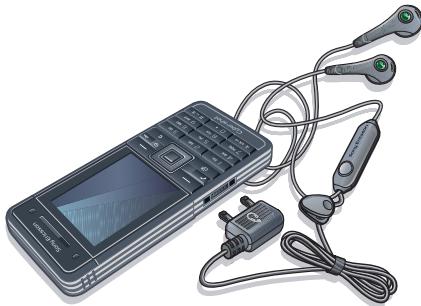
Stereo portable handsfree
To use the handsfree
- Connect the portable handsfree. Music stops when you receive a call and resumes when the call has ended.
Music player
To play music
1 From standby select Menu > Media > Music.
2 Scroll to a title and select Play.
To stop playing music
- Press the centre navigation key.
To fast forward and rewind
- Press and hold down l or l .
To move between tracks
Press or
To change the volume
- Press the volume keys up or down.
Browsing files
Music is saved and categorized.
- Artists - list music by artist.
- Albums - list music by album.
- Tracks - list all music tracks.
- Playlists - create own lists of tracks.
- Audio books - list audio books you have transferred from your computer.
- Podcasts - list all podcasts.
Playlists
You can create playlists to organize music files. Files can be added to more than one playlist.
Deleting a playlist, or a file from a playlist, does not delete the file from the memory, just the reference to the file.
To create a playlist
1 From standby select Menu > Media and scroll to Music > Playlists.
2 Scroll to New playlist and select Add.
3 Enter a name and select OK.
4 For each track you want to add, scroll to the track and select Mark.
5 Select Add to add the tracks to the playlist.
To add files to a playlist
1 From standby select Menu > Media and scroll to Music > Playlists.
2 Select a playlist.
3 Scroll to Add music and select Add.
4 For each track you want to add, scroll to the track and select Mark.
5 Select Add to add the tracks to the playlist.
To remove tracks from a playlist
1 From standby select Menu > Media and scroll to Music > Playlists.
2 Select a playlist.
3 Scroll to the track and press C.
To view information about a track
- Scroll to a track and select Options > Information.
Audio books
You can listen to audio books that you have transferred to your phone from a computer using Media Manager.
It may take a few minutes before a
- transferred audio book appears in the list of available audio books.
To play audio books
1 From standby select Menu > Media > Music > Audio books.
2 Select an audio book.
3 Scroll to a chapter and select Play.
Audio books in other formats than M4B or audio books that do not have ID3v2 chapter tags can be found in the Tracks folder.

PlayNowTM
You can connect to PlayNow™ to download ringtones, games, music, themes and wallpapers. You can preview or listen to content before you purchase and download it to your phone.

This service is not available in all countries.
Before you use PlayNowTM
You must have the required Internet connection settings in your phone. See Settings on page 49.
To use PlayNowTM
1 From standby select Menu > PlayNow™.
2 Scroll the PlayNow™ Web site and follow the instructions to preview and purchase content.
TrackID™
TrackID™ is a music recognition service. You can search for song titles, artists and album names.
For cost information contact your service provider.
To search for song information
- When you hear a song through a loudspeaker, from standby select Menu > Entertainment > TrackID™ > Start.
- When the radio is playing select Options > TrackID™.
For best results, use TrackID™ in a quiet environment.
Online music and video clips
You can view video clips and listen to music by streaming them to your phone from the Internet. If settings are not already in your phone, see Settings on page 49. For more information, contact your network operator or go to www.sonyericsson.com/support.
To select a data account for streaming
1 From standby select Menu > Settings > the Connectivity tab > Streaming settings > Connect using:.
2 Select the data account to use.
3 Select Save.
To stream music and video clips
1 From standby select Menu > Internet.
2 Select Options > Go to > Bookmarks.
3 Select a link to stream from.
Entertainment
Video player
To play videos
1 From standby select Menu > Media and scroll to Video.
2 Scroll to a title and select Play.
To stop playing videos
- Press the centre navigation key.
Radio
Do not use your phone as a radio in places where this is prohibited.
To listen to the radio
1 Connect the handsfree to the phone.
2 From standby select Menu > Radio.
To change the volume
- When the radio is playing, press the volume keys up or down.
To automatically search for channels
- When the radio is playing, select Search.
To manually search for channels
- When the radio is playing, press or.
Saving channels
You can save up to 20 preset channels.
To save channels
1 When you have found a radio channel select Options > Save.
2 Scroll to a position and select Insert.
To select saved channels
1 From standby select Menu > Radio > Options > Channels.
2 Select a radio channel.
To switch between saved channels
- When the radio is playing, press or
Ringtones and melodies
To set a ringtone
1 From standby select Menu > Settings > the Sounds & alerts tab > Ringtone.
2 Find and select a ringtone.
To set the ringtone volume
1 From standby select Menu > Settings > the Sounds & alerts tab > Ring volume.
2 Press or to change the volume.
3 Select Save.
To turn the ringtone off
From standby press and hold down
All signals except the alarm signal are affected.
To set the vibrating alert
1 From standby select Menu > Settings > the Sounds & alerts tab > Vibrating alert.
2 Select an option.
MusicDJTM
You can compose and edit your own melodies to use as ringtones. A melody consists of four types of tracks - Drums, Basses, Chords, and Accents. A track contains a number of music blocks. The blocks consist of pre-arranged sounds with different characteristics. The blocks are grouped into Intro, Verse, Chorus, and Break. You compose a melody by adding music blocks to the tracks.
To compose a melody
1 From standby select Menu > Entertainment > MusicDJ™.
2 Select to Insert, Copy or Paste blocks.
3 Use , , or to scroll between the blocks.
4 Select Options > Save melody.
Sound recorder
You can record a voice memo or a sound. Recorded sounds can also be set as ringtones.
To record a sound
- From standby select Menu > Entertainment > Record sound > Record.
To listen to a recording
1 From standby select Menu > Organizer > File manager.
2 Scroll to Music and select Open.
3 Scroll to a recording and select Play.
Games
Your phone contains preloaded games.
You can also download games. Help texts are available for most games.
To start a game
1 From standby select Menu > Media > Games.
2 Select a game.
To end a game
- Press
Applications
You can download and run Java applications. You can also view information or set different permissions.
Before you use J a v a^TM applications If Internet settings are not already entered in your phone, see Settings on page 49.
To select a Java application
1 From standby select Menu > Organizer > Applications.
2 Select an application.
To view information about a Java application
1 From standby select Menu > Organizer > Applications.
2 Scroll to an application and select Options > Information.
To set permissions for a Java application
1 From standby select Menu > Organizer > Applications.
2 Scroll to an application and select Options > Permissions.
3 Set permissions.
Java application screen size
Some Java applications are designed for a specific screen size. For more information, contact the application vendor.
To set the screen size for a Java application
1 From standby select Menu > Organizer > Applications.
2 Scroll to an application and select Options > Screen size.
3 Select an option.
Internet profiles for Java applications Some Java applications need to connect to the Internet to receive information. Most Java applications use the same Internet settings as your Web browser.
Internet
To start browsing
1 From standby select Menu > Internet.
2 Select Options > Go to.
3 Select an option.
If your connection to the Internet does not work, see Settings on page 49 or contact your operator.
To exit the browser
- When you browse the Internet, select Options > Exit browser.
Bookmarks
You can create and edit bookmarks as quick links to your favourite Web pages.
To create a bookmark
1 When you browse the Internet, select Options > Tools > Add bookmark.
2 Enter a title and an address. Select Save.
To select a bookmark
1 From standby select Menu > Internet.
2 Select Options > Go to > Bookmarks.
3 Scroll to a bookmark and select Go to.
History pages
You can view Web pages you have browsed.
To view history pages
- From standby select Menu > Internet > Options > Go to > History.
To use pan and zoom on a Web page
1 When you browse the Internet, press # - 2
2 Use the navigation key to move the frame.
3 Press Zoom.
4 To switch back to pan, press (# -#)
To use pan and zoom, you need to turn off Smart-fit: Options > Advanced > Smart-fit > Off.
InternetKeypadshortcuts
You can use the keypad to go directly to an Internet browser function.
To select Internet keypad shortcuts
1 From standby select Menu > Internet.
2 Select Options > Advanced > Keypad mode > Shortcuts.
| Key | Shortcut |
| 1 | Bookmarks |
| 2 - 9 | Enter text to Enter address, Search Internet or search in Bookmarks. |
| * a/b | Fullscreen or Landscape or Normal screen. |
| ○+ | Zoom |
| #→# | Pan & zoom (when Smart-fit is off). |
To make a call while browsing
- When you browse the Internet press
To save a picture from a Web page
1 When you browse the Internet, select Options > Tools > Save picture.
2 Select a picture.
To find text on a Web page
1 When you browse the Internet, select Options > Tools > Find on page.
2 Enter text and press Find.
To send a link
1 When you browse the Internet, select Options > Tools > Send link.
2 Select a transfer method.
Make sure the receiving device supports the transfer method you select.
Internet security and certificates
Your phone supports secure browsing. Certain Internet services, such as banking, require certificates in your phone. Your phone may already contain certificates when you buy it or you can download new certificates.
To view certificates in the phone
- From standby select Menu > Settings > the General tab > Security > Certificates.
Web feeds
You can subscribe to and download frequently updated content, such as news, podcasts or photos, using Web feeds.
To add new feeds for a Web page
1 When you browse a page on the Internet that has Web feeds, indicated by the icon, select Options > Web feeds.
2 For each feed you want to add, scroll to the feed and select Mark.
3 Select Options > Continue.
To download content via feeds
1 From standby select Menu > Media > Web feeds.
2 Scroll to a feed and select View or
3 Select a heading to expand.
4 Select an icon depending on content, to open a Web page, to download an audio podcast, to download a video podcast or to download a photo.
You can also subscribe to and download content to a computer via feeds using Sony Ericsson Media Manager. You can then transfer the content to your phone. See Transferring content to and from a computer on page 39.
Updating Web feeds
You can manually update your feeds, or schedule updates. When there are updates, appears on the screen.
To schedule Web feed updates
1 From standby select Menu > Media > Web feeds.
2 Scroll to a feed and select Options > Schedule update.
3 Select an option.
- Frequent updates may be costly.
To update Web feeds manually
1 From standby select Menu > Media > Web feeds.
2 Scroll to a feed and select Options > Update.
3 Select an option.
Web feeds in standby
You can show news updates on the standby screen.
To show Web feeds in standby
1 From standby select Menu > Media > Web feeds.
2 Scroll to a feed and select Options > Settings > Standby ticker > Show in standby.
To access Web feeds from standby
1 From standby select Ticker.
2 To read more about a feed, press or to scroll to a headline and select Go to.
Podcasts
Podcasts are files, for example, radio programs or video content, that you can download and play. You subscribe to and download podcasts using Web feeds.
To access audio podcasts
From standby select Menu > Media > Music > Podcasts.
To access video podcasts
From standby select Menu > Media > Video > Podcasts.
Photo feeds
You can subscribe to photo feeds and download photos. To start using photo feeds, see Web feeds on page 48.
To access photo feeds
From standby select Menu > Media > Photo > Photo feeds.
Connectivity
Settings
Before you synchronize with an Internet service, use the Internet, PlayNow™, My friends, Java, picture messaging, email and picture blog you need to have settings in your phone.
If settings are not already entered, you can download settings using the setup wizard or by going to www.sonyericsson.com/support.
To download settings using the Setup wizard
1 From standby select Menu > Settings > the General tab > Setup wizard > Settings download.
2 Follow the instructions that appear.
- Contact your network operator or service provider for more information.
To download settings using a computer
1 Go to www.sonyericsson.com/support.
2 Follow the instructions on the screen.
Phone name
You can enter a name for your phone that is shown to other devices when using, for example, Bluetooth™ wireless technology.
To enter a phone name
1 From standby select Menu > Settings > the Connectivity tab > Phone name.
2 Enter the phone name and select OK.
Bluetooth™ wireless technology
The Bluetooth function makes wireless connection to other Bluetooth devices possible. You can, for example:
- Connect to handsfree devices.
- Connect to several devices at the same time.
- Connect to computers and access the Internet.
- Exchange items and play multiplayer games.

We recommend a range within 10 metres (33 feet), with no solid objects in between, for Bluetooth communication.
Before you use Bluetooth wireless technology
You must turn on the Bluetooth function to communicate with other devices. You may also have to pair your phone with other Bluetooth devices.
To turn the Bluetooth function on
From standby select Menu > Settings > the Connectivity tab > Bluetooth > Turn on.
Make sure that the device you want to pair your phone with has the Bluetooth function activated and Bluetooth visibility set to on.
To receive an item
1 From standby select Menu > Settings > the Connectivity tab > Bluetooth > Turn on.
2 When you receive an item, follow the instructions that appear.
To pair the phone with a device
1 From standby select Menu > Settings > the Connectivity tab > Bluetooth > My devices.
2 Scroll to New device and select Add to search for available devices.
3 Select a device.
4 Enter a passcode, if required.
To allow connection to the phone
1 From standby select Menu > Settings > the Connectivity tab > Bluetooth > My devices.
2 Select a device from the list.
3 Select Options > Allow connection.
4 Select Always ask or Always allow.
This is only possible with devices that require access to a secure service.
To pair the phone with a Bluetooth handsfree for the first time
1 From standby select Menu > Settings > the Connectivity tab > Bluetooth > Handsfree.
2 Scroll to a device and select Yes.
3 Enter a passcode, if required.
To pair the phone with more than one Bluetooth handsfree
1 From standby select Menu > Settings > the Connectivity tab > Bluetooth > Handsfree > My handsfree > New handsfree.
2 Select a device from the list.
3 Enter a passcode, if required.
Power saving
You can save battery power with the Power save function. You can only connect with one Bluetooth device at a time when using Power save. You must turn this function off if you want to connect with more than one Bluetooth device at the same time.
To turn powersave on
- From standby select Menu > Settings > the Connectivity tab > Bluetooth > Powersave > On.
Transferring sound to and from a Bluetooth handsfree
You can transfer the sound to and from a Bluetooth handsfree using a phone key or the handsfree key.
To transfer sound
1 From standby select Menu > Settings > the Connectivity tab > Bluetooth > Handsfree > Incoming call.
2 Select an option. In phone transfers sound to the phone. In handsfree transfers sound to the handsfree.
To transfer sound during a call
1 During a call, select Sound.
2 Select from the list.
Using the USB cable
You can connect your phone to a computer with the USB cable to transfer files, synchronize and use your phone as a modem. For more information go to the Getting started section at www.sonyericsson.com/support.
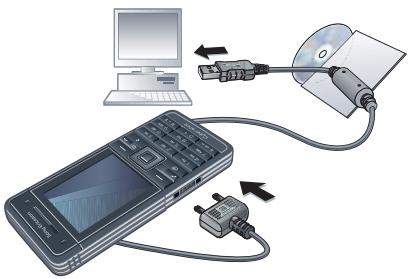
Before you use the USB cable
- See Required operating systems on page 39.
Only use a USB cable supported by your phone. Do not remove the USB cable from your phone or computer during file transfer as this may corrupt the phone memory or the memory card.
To disconnect the USB cable safely
1 Right-click the removable disk icon in Windows Explorer.
2 Select Eject.
3 Disconnect the USB cable when the following message is shown in the phone: Mass storage session ended. It is now safe to remove the USB cable.
Drag and drop content
You can drag and drop content between your phone or memory card and a computer in Microsoft Windows Explorer.
To drag and drop content
1 Connect your phone to a computer using the USB cable.
2 Phone: Select Media transfer. The phone will remain activated during file transfer.
3 Computer: Wait until an external device icon appears in My Computer and then double click to open. Phone memory and memory card appear as external disks in Windows Explorer.
4 Drag and drop selected files between the phone and the computer.
Synchronizing
You can synchronize in two different ways:
-
You can use the USB cable or Bluetooth wireless technology to synchronize phone contacts, appointments, bookmarks, tasks and notes with a computer program such as Microsoft Outlook.
-
You can synchronize with an Internet service using SyncML™ or a Microsoft® Exchange Server using Microsoft Exchange ActiveSync. For more information go to the Getting started section at www.sonyericsson.com/support.

Use only one of the synchronization methods at a time with your phone.
Synchronizing using a computer Before synchronizing you need to install the Sony Ericsson PC Suite.

Sony Ericsson PC Suite software is included on the CD with your phone and available for download at www.sonyericsson.com/support.
See Required operating systems on page 39.
To install the Sony Ericsson PC Suite
1 Turn on your computer and insert the CD. The CD starts automatically and the installation window opens.
2 Select a language and click OK.
3 Click Install Sony Ericsson PC suite and follow the instructions on the screen.
To synchronize using the PC Suite
1 Computer: Start PC Suite from Start/ Programs/Sony Ericsson/PC Suite.
2 Follow the instructions in the PC Suite for how to connect.
3 Phone: Select Phone mode.
4 Computer: When you are notified that the Sony Ericsson PC Suite has found your phone, you can start synchronizing.

For usage details, see the Sony Ericsson PC Suite Help section once the software has been installed on your computer.
Synchronizing using an Internet service
You can synchronize online using SyncML or Microsoft Exchange ActiveSync. If Internet settings are not in your phone, see Settings on page 49.
SyncML
You can synchronize remote data and personal information using SyncML.
Before you synchronize using SyncML
You must enter settings for SyncML synchronization and register a synchronization account online with a service provider. Settings that are required are:
- Server address - server URL
- Database name - database to synchronize with
To enter settings for SyncML
1 From standby select Menu > Organizer > Synchronization.
2 Scroll to New account and select Add > SyncML
3 Enter a name for the new account and select Cont.
4 Select Server address. Enter the required information and select OK.
5 EnterUsername and Password, if required.
6 Scroll to the Applications tab and mark applications to synchronize.
7 Scroll to the App. settings tab and select an application.
8 Select Database name and enter the required information.
9 Scroll to the Advanced tab to enter additional settings for synchronizing and select Save.
To synchronize using SyncML
1 From standby select Menu > Organizer > Synchronization.
2 Scroll to an account and select Start.
Microsoft® Exchange ActiveSync You can access and synchronize corporate exchange information such as email, contacts and calendar entries using Microsoft® Exchange Server with Microsoft® Exchange ActiveSync.
For more information on synchronization settings, contact your IT administrator.
Before you synchronize using Microsoft® Exchange ActiveSync
You must enter settings for Microsoft Exchange ActiveSync to access a Microsoft Exchange Server. Settings that are required are:
- Server address - server URL
- Domain - server domain
-Username - account username - Password - account password
Before you start to synchronize with Exchange ActiveSync you must enter the correct time zone in your phone.
To enter settings for Microsoft® Exchange ActiveSync
1 From standby select Menu > Organizer > Synchronization.
2 Scroll to New account and select Add > Exchange ActiveSync.
3 Enter a name for the new account and select Cont.
4 Enter the required settings.
5 Scroll between the tabs to enter additional settings.
6 Select Save.
To synchronize using Microsoft Exchange ActiveSync
1 From standby select Menu > Organizer > Synchronization.
2 Scroll to an account and select Start.

Update service
You can update your phone with the latest software. You do not lose personal or phone information.
There are two ways to update your phone:
Over the air using your phone
- Using the provided USB cable and an Internet-connected computer

Update service requires data access such as GPRS, 3G or HSDPA.
Before you use the Update service If Internet settings are not in your phone see Settings on page 49.
To change Internet settings
- From standby select Menu > Settings > the General tab > Update service > Settings > Internet settings.
To view the current software in the phone
1 From standby select Menu > Settings > the General tab > Update service.
2 Select Software version.
To use Update service using the phone
1 From standby select Menu > Settings > the General tab > Update service.
2 Select Search for update and follow the instructions that appear.
To use Update service using a USB cable
1 Go to www.sonyericsson.com/support or click the Sony Ericsson Update service in the PC Suite software if installed on your computer. See To install the Sony Ericsson PC Suite on page 53.
2 Select a region and country.
3 Follow the instructions on the screen.
To set a reminder to use Update service
1 From standby select Menu > Settings > the General tab > Update service > Settings > Reminder.
2 Select an option.
More features
Flight mode
In Flight mode the network and radio transceivers are turned off to prevent disturbance to sensitive equipment.
When the flight mode menu is activated you are asked to select a mode the next time you turn on your phone:
- Normal mode - full functionality
- Flight mode - limited functionality

You can use the BluetoothTM function in Flight mode.
To activate the flight mode menu
- From standby select Menu > Settings > the General tab > Flight mode > Show at startup.
To select flight mode
1 When the flight mode menu is activated, turn off your phone.
2 Turn on your phone and select Flight mode.
Location services
You can get help to find your way and save your favourite locations. With information from mobile towers near you, you may be able to view your approximate location on a map.
You can get more exact information about your location with a GPS accessory supported by your phone.
Some features of Location services use the Internet.
To use Google MapsTM for mobile
- From standby select Menu > Entertainment > Location services > Google Maps.
To view help about Google Maps
- When you use Google Maps, select Options > Help.
To view your approximate location
- When you use Google Maps, press ① .
To view a saved location
1 From standby select Menu > Entertainment > Location services > My favourites.
2 Scroll to a location and select Go to.
When you use Google Maps you can press 关 a | A to access your favourites.
File manager
You can use the file manager to handle files saved in the phone memory or on a memory card.
Handling files
You can move and copy files between your phone, a computer and a memory card. See Transferring content to and from a computer on page 39. Files are saved on the memory card first and then in the phone memory. Unrecognized files are saved in the Other folder.

You are not allowed to exchange some copyright-protected material. A protected file has a icon.
You can create sub folders to move or copy files to. You can select more than one or all the files in a folder at the same time for all folders except Games and Applications.
If the memory is full, delete some content to create space.
File manager tabs
The file manager is divided into three tabs, and icons indicate where the files are saved.
To move a file in the file manager
1 From standby select Menu > Organizer > File manager.
2 Find a file and select Options > Manage file > Move.
3 Select Memory card or Phone.
4 Open a folder.
5 Select Paste.
To select more than one file in a folder
1 From standby select Menu > Organizer > File manager.
2 Scroll to a folder and select Open.
3 Select Options > Mark > Mark several.
4 For each file you want to mark, scroll to the file and select Mark.
Alarms
You can set a sound or the radio as an alarm signal. The alarm sounds even if the phone is turned off. When the alarm sounds you can silence it or turn it off.
To set the alarm
1 From standby select Menu > Alarms.
2 Scroll to an alarm and select Edit.
3 Scroll to Time: and select Edit.
4 Enter a time and select OK > Save.
To set the recurrent alarm
1 From standby select Menu > Alarms.
2 Scroll to an alarm and select Edit.
3 Scroll to Recurrent: and select Edit.
4 Scroll to a day and select Mark.
5 To select another day, scroll to the day and select Mark.
6 Select Done > Save.
To set the alarm signal
1 From standby select Menu > Alarms.
2 Scroll to an alarm and select Edit.
3 Scroll to the tab.
4 Scroll to Alarm signal: and select Edit.
5 Find and select an alarm signal. Select Save.
To silence the alarm
- When the alarm sounds, press any key.
- To repeat the alarm, select Snooze.
To turn off the alarm
- When the alarm sounds, press any key and select Turn off.
To cancel the alarm
1 From standby select Menu > Alarms.
2 Scroll to an alarm and select Turn off.
The alarm in silent mode
You can set the alarm not to sound when the phone is in silent mode.
To set an alarm to sound or not in silent mode
1 From standby select Menu > Alarms.
2 Scroll to an alarm and select Edit.
3 Scroll to the tab.
4 Scroll to Silent mode: and select Edit.
5 Select an option.
Calendar
The calendar can be synchronized with a computer calendar, with a calendar on the Web or with a Microsoft Exchange Server (Microsoft Outlook).
For more information see Synchronizing on page 52.
Default view
You can choose whether month, week or day view will appear first when you open the calendar.
To set default view
1 From standby select Menu > Organizer > Calendar.
2 Select Options > Advanced > Default view.
3 Select an option.
Appointments
You can add new appointments or reuse existing appointments.
To add an appointment
1 From standby select Menu > Organizer > Calendar.
2 Select a date.
3 Scroll to New appointment and select Add.
4 Enter the information and confirm each entry.
5 Select Save.
To view an appointment
1 From standby select Menu > Organizer > Calendar.
2 Select a date.
3 Scroll to an appointment and select View.
To edit an appointment
1 From standby select Menu > Organizer > Calendar.
2 Select a date.
3 Scroll to an appointment and select View.
4 Select Options > Edit.
5 Edit the appointment and confirm each entry.
6 Select Save.
To view a calendar week
1 From standby select Menu > Organizer > Calendar.
2 Select a date.
3 Select Options > Change view to > Week.
To set when reminders should sound
1 From standby select Menu > Organizer > Calendar.
2 Select a date.
3 Select Options > Advanced > Reminders.
4 Select an option.
A reminders option set in calendar affects a reminders option set in tasks.
Notes
You can make notes and save them. You can also show a note in standby.
To add a note
1 From standby select Menu > Organizer > Notes.
2 Scroll to New note and select Add.
3 Write a note and select Save.
To show a note in standby
1 From standby select Menu > Organizer > Notes.
2 Scroll to a note and select Options > Show in standby.
To hide a note from standby
1 From standby select Menu > Organizer > Notes.
2 Scroll to a note and select Options > Hide in standby.
Tasks
You can add new tasks or reuse existing tasks.
To add a task
1 From standby select Menu > Organizer > Tasks.
2 Select New task and select Add.
3 Select an option.
4 Enter details and confirm each entry.
To view a task
1 From standby select Menu > Organizer > Tasks.
2 Scroll to a task and select View.
To set when reminders should sound
1 From standby select Menu > Organizer > Tasks.
2 Scroll to a task and select Options > Reminders.
3 Select an option.
A reminders option set in tasks affects a reminders option set in calendar.
Profiles
You can change settings such as the ring volume and vibrating alert to suit different locations. You can reset all profiles to the phone's original settings.
To select a profile
1 From standby select Menu > Settings > the General tab > Profiles.
2 Select a profile.
To view and edit a profile
1 From standby select Menu > Settings > the General tab > Profiles.
2 Scroll to a profile and select Options > View and edit.
You cannot rename the Normal profile.
Time and date
To set the time
1 From standby select Menu > Settings > the General tab > Time & date > Time.
2 Enter the time and select Save.
To set the date
1 From standby select Menu > Settings > the General tab > Time & date > Date.
2 Enter the date and select Save.
To set the time zone
1 From standby select Menu > Settings > the General tab > Time & date > My time zone.
2 Select the time zone you are in.
If you select a city, My time zone also updates the time when daylight saving time changes.
Theme
You can change the appearance of the screen through items such as colours and wallpaper. You can also create new themes and download them. For more information, go to www.sonyericsson.com/support.
To set a theme
1 From standby select Menu > Settings > the Display tab > Theme.
2 Scroll to a theme and select Set.
Main menu layout
You can change the layout of the icons in the main menu.
To change the main menu layout
1 From standby select Menu > Options > Main menu layout.
2 Select an option.
Locks
SIM card lock
This lock only protects your subscription. Your phone will work with a new SIM card. If the lock is on, you have to enter a PIN (Personal Identity Number).
If you enter your PIN incorrectly three times in a row, the SIM card is blocked and you need to enter your PUK (Personal Unblocking Key). Your PIN and PUK are supplied by your network operator.
To unblock the SIM card
1 When PIN blocked appears, enter your PUK and select OK.
2 Enter a new four-to-eight-digit PIN and select OK.
3 Re-enter the new PIN and select OK.
To edit the PIN
1 From standby select Menu > Settings > the General tab > Security > Locks > SIM protection > Change PIN.
2 Enter your PIN and select OK.
3 Enter a new four-to-eight-digit PIN and select OK.
4 Re-enter the new PIN and select OK.
If Codes do not match appears, you entered the new PIN incorrectly. If Wrong PIN appears, followed by Old PIN:, you entered your old PIN incorrectly.
To use the SIM card lock
1 From standby select Menu > Settings > the General tab > Security > Locks > SIM protection > Protection.
2 Select an option.
3 Enter your PIN and select OK.
Phone lock
You can stop unauthorized use of your phone. Change the phone lock code (0000) to any four-to-eight-digit personal code.
It is important that you remember your new code. If you forget it, you have to take your phone to your local Sony Ericsson retailer.
To use the phone lock
1 From standby select Menu > Settings > the General tab > Security > Locks > Phone protection > Protection.
2 Select an option.
3 Enter the phone lock code and select OK.
To unlock the phone
- Enter your code and select OK.
To change the phone lock code
1 From standby select Menu > Settings > the General tab > Security > Locks > Phone protection > Change code.
2 Enter the old code and select OK.
3 Enter the new code and select OK.
4 Repeat the code and select OK.
Keypad lock
You can set this lock to avoid accidental dialling. Incoming calls can be answered without unlocking the keypad.
Calls to the international emergency number 112 can still be made.
To use the automatic keylock
1 From standby select Menu > Settings > the General tab > Security > Automatic keylock.
2 Select an option.
To lock the keypad manually
From standby press / and select Lock.
To unlock the keypad manually
From standby press / and select Unlock.
IMEI number
Keep a copy of your IMEI (International Mobile Equipment Identity) number in case your phone is stolen.
To view your IMEI number
Fromstandbypress 水 / A , # -力 , 0 + 6, # -力
Troubleshooting
Some problems will require you to call your network operator.
For more support go to www.sonyericsson.com/support.
Common questions
I have problems with memory capacity or the phone is working slowly
Restart your phone every day to free memory or do a Master reset.
Master reset
If you select Reset settings, the changes that you have made to settings will be deleted.
If you select Reset all, in addition to your changes to settings, all contacts, messages, personal data, and content that you have downloaded, received or edited will also be deleted.
To reset the phone
1 From standby select Menu > Settings > the General tab > Master reset.
2 Select an option.
3 Follow the instructions that appear.
I cannot charge the phone or battery capacity is low
The charger is not properly connected or the battery connection is poor. Remove the battery and clean the connectors.
The battery is worn out and needs to be replaced. See Charging the battery on page 8.
No battery icon appears when I start charging the phone
It may take a few minutes before the battery icon appears on the screen.
Some menu options appear in grey
A service is not activated. Contact your network operator.
I cannot use SMS/text messages on my phone
Settings are missing or incorrect. Contact your network operator to find out the correct SMS service centre setting. See Text messages on page 33.
I cannot use picture messages on my phone
Your subscription does not include data capability. Settings are missing or incorrect. Please contact your network operator.
See Help in your phone on page 8 or go to www.sonyericsson.com/support to order settings and follow the instructions on the screen. See Settings on page 49.
I cannot use the Internet
Your subscription does not include data capability. Internet settings are missing or incorrect. Please contact your network operator.
See Help in your phone on page 8 or go to www.sonyericsson.com/support to order Internet settings, and follow the instructions on the screen. See Settings on page 49.
The phone does not ring or rings too softly
Make sure that Silent mode has not been set to On. See To turn the ringtone off on page 44.
Check the ringtone volume. See To set the ringtone volume on page 44.
Check the profile. See To select a profile on page 60.
Check the divert call options. See To divert calls on page 31.
The phone cannot be detected by other devices using Bluetooth wireless technology
You have not turned the Bluetooth function on. Make sure that the visibility is set to show phone. See To turn the Bluetooth function on on page 50.
I cannot synchronize or transfer data between my phone and my computer, when using the USB cable.
The cable or software that came with your phone has not been properly installed. Go to
www.sonyericsson.com/support to read Getting started guides which contain detailed installation instructions and troubleshooting guides.
I have forgotten my code memo passcode
If you forget your passcode, you must reset the code memo. This means that all entries in the code memo are deleted. The next time you enter the code memo, you must proceed as if you are opening it for the first time.
To reset code memo
1 From standby select Menu > Organizer > Code memo.
2 Enter any passcode to access the code memo. The checkword and codes that are then shown are incorrect.
3 Select Options > Reset.
4 Reset code memo? appears.
5 Select Yes.
Where can I find the regulatory information such as my IMEI number if I cannot turn on my phone?
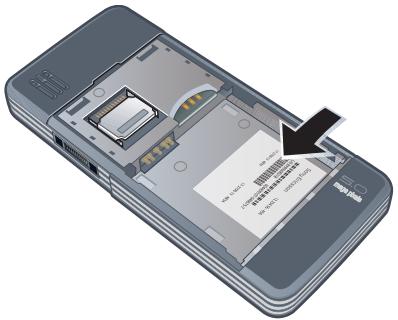
Error messages
Insert SIM
There is no SIM card in your phone or you may have inserted it incorrectly.
See To insert the SIM card on page 6.
The SIM card connectors need cleaning. If the card is damaged, contact your network operator.
Insert correct SIM card
Your phone is set to work only with certain SIM cards. Check if you are using the correct operator SIM card.
Wrong PIN/Wrong PIN2
You have entered your PIN or PIN2 incorrectly.
Enter the correct PIN or PIN2 and select Yes. See PIN on page 7.
PIN blocked/PIN2 blocked
You have entered your PIN or PIN2 code incorrectly three times in a row.
To unblock, see SIM card lock on page 61.
Codes do not match
Codes that you have entered do not match. When you want to change a security code, for example your PIN, you have to confirm the new code.
See SIM card lock on page 61.
No netw. coverage
Your phone is in flight mode. See Flight mode on page 56.
Your phone is not receiving any network signal, or the received signal is too weak. Contact your network operator and make sure that the network has coverage where you are.
The SIM card is not working properly. Insert your SIM card in another phone. If this works, it is probably your phone that is causing the problem. Please contact the nearest Sony Ericsson service location.
Emerg. calls only
You are within range of a network, but you are not allowed to use it. However, in an emergency, some network operators allow you to call the international emergency number 112. See Emergency calls on page 25.
PUK blocked. Contact operator.
You entered your personal unblocking key code (PUK) incorrectly 10 times in a row.
Support
| Argentina | 800-333-7427 |
| Australia | 1-300650-600 |
| Belgique/België | 02-7451611 |
| Brasil | 4001-04444 |
| Canada | 1-866-766-9374 |
| Central Africa | +27 112589023 |
Important information
Sony Ericsson Consumer Web site
On www.sonyericsson.com/support is a support section where help and tips are only a few clicks away. Here you will find the latest computer software updates and tips on how to use your product more efficiently.
Service and support
You have access to a portfolio of exclusive service advantages such as:
- Global and local Web sites providing support.
- A global network of Call Centers.
- An extensive network of Sony Ericsson service partners.
- A warranty period. Learn more about the warranty conditions in this User guide.
On www.sonyericsson.com, you will find the latest support tools and information. For operator-specific services and features, please contact your network operator.
You can also contact our Call Centers. If your country/ region is not represented in the list below, please contact your local dealer. (Calls are charged according to national rates, including local taxes, unless the phone number is a toll-free number.) If your product needs service, please contact the dealer from whom it was purchased, or one of our service partners. For warranty claims, save proof of purchase.
questions.AR@support.sonyericsson.com
questions.AU@support.sonyericsson.com
questions.BE@support.sonyericsson.com
questions.BR@support.sonyericsson.com
questions.CA@support.sonyericsson.com
questions.CF@support.sonyericsson.com
| Chile | 123-0020-0656 |
| Colombia | 18009122135 |
| Česka republika | 844550 055 |
| Danmark | 33 31 28 28 |
| Deutschland | 0180 534 2020 |
| Ελλάδα | 801-11-810-810 |
| 210-89 91 919 | |
| Espana | 902 180 576 |
| France | 0 825 383 383 |
| Hong Kong/香港 | 8203 8863 |
| Hrvatska | 062 000 000 |
| India/अन्दिला | 39011111 |
| Indonesia | 021-2701388 |
| Ireland | 1850 545 888 |
| Italia | 06 48895206 |
| Lietuva | 8 70055030 |
| Magyarország | +36 1 880 4747 |
| Malaysia | 1-800-889900 |
| México | 01 800 000 4722 |
| Nederland | 0900 899 8318 |
| New Zealand | 0800-100150 |
| Norge | 815 00 840 |
| Österreich | 0810 200245 |
| Pakistan | 111 22 55 73 |
| (92-21) 111 22 55 73 | |
| Philippines/Pilipinas | 02-6351860 |
| Polska | 0 (prefiks) 22 6916200 |
| Portugal | 808 204 466 |
| România | (+4021) 401 0401 |
| Poczna | 8 (495) 787 0986 |
| Schweiz/Suisse/Svizzera | 0848 824 040 |
| Singapore | 67440733 |
| Slovensko | 02-5443 6443 |
| South Africa | 0861 6322222 |
| Suomi | 09-299 2000 |
| Sverige | 013-24 45 00 |
| Türkiye | 0212 473 77 71 |
| questions.CL@support.SONyericsson.com |
| questions.CO@support.sonyericsson.com |
| questions.CZ@support.sonyericsson.com |
| questions.DK@support.sonyericsson.com |
| questions.DE@support.sonyericsson.com |
| questions.GR@support.sonyericsson.com |
| questions.ES@support.sonyericsson.com questions.FR@support.sonyericsson.com questions.HK@support.sonyericsson.com questions.HR@support.sonyericsson.com questions.IN@support.sonyericsson.com questions.ID@support.sonyericsson.com questions.IE@support.sonyericsson.com questions.IT@support.sonyericsson.com questions.LT@support.sonyericsson.com questions.HU@support.sonyericsson.com questions.MY@support.sonyericsson.com questions.MX@support.sonyericsson.com questions.NL@support.sonyericsson.com questions.NZ@support.sonyericsson.com questions.NO@support.sonyericsson.com questions.AT@support.sonyericsson.com questions.PK@support.sonyericsson.com |
| questions.PH@support.SONyericsson.com |
| questions.PL@support.sonyericsson.com |
| questions.PT@support.sonyericsson.com |
| questions.RO@support.sonyericsson.com |
| questions.RU@support.sonyericsson.com |
| questions.CH@support.sonyericsson.com |
| questions.SG@support.sonyericsson.com |
| questions.SK@support.sonyericsson.com |
| questions.ZA@support.sonyericsson.com |
| questions.FI@support.sonyericsson.com |
| questions.SE@support.sonyericsson.com |
| questions.TR@support.sonyericsson.com |
YkpaHa (+0380) 445901515
United Kingdom 08705237237
United States 1-866-7669347
Venezuela 0-800-100-2250
43 919880
中国 4008100000
台湾 02-25625511
m 02-2483030
Guidelines for Safe and Efficient Use
Please follow these guidelines.
Failure to do so might entail a potential health risk or product malfunction. If in doubt as to its proper function, have the product checked by a certified service partner before charging or using it.

Recommendations for care and safe use of our products
- Handle with care and keep in a clean and dust-free place.
- Warning! May explode if disposed of in fire.
- Do not expose your product to liquid or moisture or humidity.
- Do not expose your product to extreme high or low temperatures. Do not expose the battery to temperatures above +60^ (+140^) .
- Do not expose your product to open flames or lit tobacco products.
- Do not drop, throw or try to bend your product.
- Do not paint or attempt to disassemble or modify your product. Only Sony Ericsson authorized personnel should perform service.


questions-UA@support.sonyericsson.com
questions.GB@support.sonyericsson.com questions.US@support.sonyericsson.com questions.VE@support.sonyericsson.com questions.AE@support.sonyericsson.com questions.CN@support.sonyericsson.com questions.TW@support.sonyericsson.com questions.TH@support.sonyericsson.com
- Consult with authorized medical staff and the instructions of the medical device manufacturer before using your product near pacemakers or other medical devices or equipment.
- Discontinue use of electronic devices or disable the radio transmitting functionality of the device where required or requested to do so.
- Do not use where a potentially explosive atmosphere exists.
- Do not place your product or install wireless equipment in the area above an air bag in your car.
- Caution: Cracked or broken displays may create sharp edges or splinters that could be harmful upon contact.
- Do not use your Bluetooth Headset in positions where it is uncomfortable or will be subject to pressure.
Children
Warning! Keep out of the reach of children. Do not allow children to play with mobile phones or accessories.
They could hurt themselves or others.
Products may contain small parts that could become detached and create a choking hazard.


Power supply (Charger)
Connect the charger to power sources as marked on the product. Do not use outdoors or in damp areas. Do not alter or subject the cord to damage
or stress. Unplug the unit before cleaning it. Never alter the plug. If it does not fit into the outlet, have a proper outlet installed by an electrician. When power supply is connected there is a small drain of power. To avoid this small energy waste, disconnect the power supply when the product is fully charged. Use of charging devices that are not Sony Ericsson branded may impose increased safety risks.
Battery
New or idle batteries can have short-term reduced capacity. Fully charge the battery before initial use. Use for intended purpose only. Charge the battery in temperatures between +5^ (+41^) and +45^ (+113^) . Do not put the battery into your mouth. Do not let the battery contacts touch another metal object. Turn off the product before removing the battery. Performance depends on temperatures, signal strength, usage patterns, features selected and voice or data transmissions.
Only Sony Ericsson service partners should remove or replace built-in batteries. Use of batteries that are not Sony Ericsson branded may pose increased safety risks.
Personal medical devices
Mobile phones may affect implanted medical equipment. Reduce risk of interference by keeping a minimum distance of 15cm (6 inches) between the phone and the device. Use the phone at your right ear. Do not carry the phone in your breast pocket. Turn off the phone if you suspect interference. For all medical devices, consult a physician and the manufacturer.
Driving
Some vehicle manufacturers forbid the use of phones in their vehicles unless a handsfree kit with an external antenna supports the installation. Check with your vehicle manufacturer's representative to be sure that your mobile phone or Bluetooth handsfree will not
affect the electronic systems in your vehicle. Full attention should be given to driving at all times and local laws and regulations restricting the use of wireless devices while driving must be observed.
GPS/Location based functions
Some products provide GPS/Location based functions. Location determining functionality is provided "As is" and "With all faults".
Sony Ericsson does not make any representation or warranty as to the accuracy of such location information.
Use of location-based information by the device may not be uninterrupted or error free and may additionally be dependent on network service availability. Please note that functionality may be reduced or prevented in certain environments such as building interiors or areas adjacent to buildings.
Caution: Do not use GPS functionality in a manner which causes distraction from driving.
Emergency calls
Calls cannot be guaranteed under all conditions. Never rely solely upon mobile phones for essential communications. Calls may not be possible in all areas, on all networks, or when certain network services and/or phone features are used.
Antenna
Use of antenna devices not marketed by Sony Ericsson could damage your phone, reduce performance, and produce SAR levels above the established limits. Do not cover the antenna with your hand as this affects call quality, power levels and can shorten talk and standby times.
Radio frequency (RF) exposure and Specific Absorption Rate (SAR)
When your phone or Bluetooth handsfree is turned on, it emits low levels of radio frequency energy. International safety guidelines have been developed
through periodic and thorough evaluation of scientific studies. These guidelines establish permitted levels of radio wave exposure. The guidelines include a safety margin designed to assure the safety of all persons and to account for any variations in measurements.
Specific Absorption Rate (SAR) is used to measure radio frequency energy absorbed by the body when using a mobile phone. The SAR value is determined at the highest certified power level in laboratory conditions, but because the phone is designed to use the minimum power necessary to access the chosen network, the actual SAR level can be well below this value. There is no proof of difference in safety based on difference in SAR value.
Products with radio transmitters sold in the US must be certified by the Federal Communications Commission (FCC). When required, tests are performed when the phone is placed at the ear and when worn on the body. For body-worn operation, the phone has been tested when positioned a minimum of 15mm from the body without any metal parts in the vicinity of the phone or when properly used with an appropriate Sony Ericsson accessory and worn on the body.
For more information about SAR and radio frequency exposure go to: www.sonyericsson.com/health.
Malware
Malware (short for malicious software) is software that can harm your mobile phone or other computers. Malware or harmful applications can include viruses, worms, spyware, and other unwanted programs. While your device does employ security measures to resist such efforts, Sony Ericsson does not warrant or represent that your device will be impervious to introduction of malware. You can however reduce the risk of malware attacks by using care when downloading content or accepting applications, refraining from opening or responding to messages from unknown sources, using
trustworthy services to access the Internet, and only downloading content to your mobile phone from known, reliable sources.
Accessories
Use only Sony Ericsson branded original accessories and certified service partners. Sony Ericsson does not test third-party accessories. Accessories may influence RF Exposure, radio performance, sound loudness, electric safety and other areas. Third-party accessories and parts may pose a risk to your health or safety or decrease performance.
Accessible Solutions/Special Needs
In the US, compatible Sony Ericsson phones may offer compatibility with TTY terminals (with use of necessary accessory). For more information call the Sony Ericsson Special Needs Center on 877 878 1996 (TTY) or 877 207 2056 (voice), or go to www.sonyericsson-snc.com.
Disposal of old electrical and electronic equipment
Electronic equipment and batteries should not be included as household waste but should be left at an
appropriate collection point for recycling. This helps prevent potential negative consequences for the environment and human health. Check local regulations by contacting your local city office, your household waste disposal service, the shop where you purchased the product or calling a Sony Ericsson Call Center.

Disposing of the battery
Check local regulations or call a Sony Ericsson Call Center for information. Never use municipal waste.

Memory card
If your product comes complete with a removable memory card, it is generally compatible with the handset purchased but may not be compatible with other devices or the capabilities of their memory cards. Check other devices for compatibility before purchase or use. If your product is equipped with a memory card reader, check memory card compatibility before purchase or use.
The memory card is formatted prior to shipping. To reformat the memory card, use a compatible device. Do not use the standard operating system format when formatting the memory card on a PC. For details, refer to the operating instructions of the device or contact customer support.
Warning!
If your device requires an adapter for insertion into the handset or another device, do not insert the card directly without the required adapter.
Precautions on Memory Card Use
- Do not expose the memory card to moisture.
- Do not touch terminal connections with your hand or any metal object.
- Do not strike, bend, or drop the memory card.
- Do not attempt to disassemble or modify the memory card.
- Do not use or store the memory card in humid or corrosive locations or in excessive heat such as a closed car in summer, in direct sunlight or near a heater, etc.
- Do not press or bend the end of the memory card adapter with excessive force.
- Do not let dirt, dust, or foreign objects get into the insert port of any memory card adapter.
- Check you have inserted the memory card correctly.
-
Insert the memory card as far as it will go into any memory card adapter needed. The memory card may not operate properly unless fully inserted.
We recommend that you make a backup copy of important data. We are not responsible for any loss or damage to content you store on the memory card. -
Recorded data may be damaged or lost when you remove the memory card or memory card adapter, or turn off the power while formatting, reading or writing data, or when you use the memory card in locations subject to static electricity or high electrical field emissions.
Protection of personal information
Erase personal data before disposing of the product. To delete data, perform a master reset. Deleting data from the phone memory does not ensure that it cannot be recovered. Sony Ericsson does not warrant against recovery of information and does not assume responsibility for disclosure of any information even after a master reset.
Loudness warning!
Avoid volume levels that may be harmful to your hearing.
End User Licence Agreement
Software delivered with this device and its media is owned by Sony Ericsson Mobile Communications AB, and/or its affiliated companies and its suppliers and licensors.
Sony Ericsson grants you a non-exclusive limited license to use the Software solely in conjunction with the Device on which it is installed or delivered. Ownership of the Software is not sold, transferred or otherwise conveyed.
Do not use any means to discover the source code or any component of the Software, reproduce and distribute the Software, or modify the Software. You are entitled to transfer rights and obligations to the Software to a third party, solely together with the Device with which you received the Software, provided the third party agrees in writing to be bound by the terms of this License.
This license exists throughout the useful life of this Device. It can be terminated by transferring your rights to the Device to a third party in writing.
Failure to comply with any of these terms and conditions will terminate the license immediately. Sony Ericsson and its third party suppliers and licensors retain all rights, title and interest in and to the Software. Sony Ericsson, and, to the extent that the Software contains material or code of a third party, such third party, shall be entitled third party beneficiaries of these terms.
This license is governed by the laws of Sweden. When applicable, the foregoing applies to statutory consumer rights.
In the event Software accompanying or provided in conjunction with your device is provided with additional terms and conditions, such provisions shall also govern your possession and usage of the Software.
Limited Warranty
Sony Ericsson Mobile Communications AB, Nya Vattenornet, SE-221 88 Lund, Sweden, (Sony Ericsson) or its local affiliated company, provides this Limited Warranty for your mobile phone, original accessory delivered with your mobile phone, and/or your mobile computing product (hereinafter referred to as "Product"). Should your Product need warranty service, please return it to the dealer from whom it was purchased, or contact your local Sony Ericsson Call Center (national rates may apply) or visit www.SonyEricsson.com to get further information.
OUR WARRANTY
Subject to the conditions of this Limited Warranty, Sony Ericsson warrants this Product to be free from defects in design, material and workmanship at the time of its original purchase by a consumer. This Limited Warranty will last for a period of one (1) year as from the original date of purchase of the Product.
WHAT WE WILL DO
If, during the warranty period, this Product fails to operate under normal use and service, due to defects in design, materials or workmanship, Sony Ericsson authorized distributors or service partners, in the country* where you purchased the Product, will, at their option, either repair or replace the Product in accordance with the terms and conditions stipulated herein.
Sony Ericsson and its service partners reserve the right to charge a handling fee if a returned Product is found not to be under warranty according to the conditions below.
Please note that some of your personal settings, downloads and other information may be lost when your Sony Ericsson Product is repaired or replaced. At present Sony Ericsson may be prevented by applicable law, other regulation or technical restrictions from making a backup copy of certain downloads. Sony Ericsson does not take any responsibility for any lost information of any kind and will not reimburse you for any such loss. You should always make backup copies of all the information stored on your Sony Ericsson Product such as downloads, calendar and contacts before handing in your Sony Ericsson Product for repair or replacement.
CONDITIONS
1 This Limited Warranty is valid only if the original proof of purchase for this Product issued by a Sony Ericsson authorized dealer specifying the date of purchase and serial number**, is presented with the Product to be repaired or replaced. Sony Ericsson reserves the right to refuse warranty service if this information has been removed or changed after the original purchase of the Product from the dealer.
2 If Sony Ericsson repairs or replaces the Product, the repair for the defect concerned, or the replaced Product shall be warranted for the remaining time
of the original warranty period or for ninety (90) days from the date of repair, whichever is longer. Repair or replacement may involve the use of functionally equivalent reconditioned units. Replaced parts or components will become the property of Sony Ericsson.
3 This warranty does not cover any failure of the Product due to normal tear and wear, or due to misuse, including but not limited to use in other than the normal and customary manner, in accordance with the Sony Ericsson instructions for use and maintenance of the Product. Nor does this warranty cover any failure of the Product due to accident, software or hardware modification or adjustment, acts of God or damage resulting from liquid.
A rechargeable battery can be charged and discharged more than a hundred times. However, it will eventually wear out – this is not a defect and corresponds to normal wear and tear. When the talk-time or standby time is noticeably shorter, it is time to replace your battery. Sony Ericsson recommends that you use only batteries and chargers approved by Sony Ericsson.
Minor variations in display brightness and colour may occur between the phones. There may be tiny bright or dark dots on the display. These are called defective pixels and occur when individual dots have malfunctioned and can not be adjusted. Two defective pixels are deemed acceptable.
Minor variations in camera image appearance may occur between phones. This is nothing uncommon and is not regarded as a defective camera module.
4 Since the cellular system on which the Product is to operate is provided by a carrier independent from Sony Ericsson, Sony Ericsson will not be responsible for the operation, availability, coverage, services or range of that system.
5 This warranty does not cover Product failures caused by installations, modifications, or repair or opening of the Product performed by a non- Sony Ericsson authorised person.
6 The warranty does not cover Product failures which have been caused by use of accessories or other peripheral devices which are not Sony Ericsson branded original accessories intended for use with the Product.
7 Tampering with any of the seals on the Product will void the warranty.
8 THERE ARE NO EXPRESS WARRANTYES, WHETHER WRITTEN OR ORAL, OTHER THAN THIS PRINTED LIMITED WARRANTY. ALL IMPLIED WARRANTYES, INCLUDING WITHOUT LIMITATION THE IMPLIED WARRANTYES OF MERCHANTABILITY OR FITNESS FOR A PARTICULAR PURPOSE, ARE LIMITED TO THE DURATION OF THIS LIMITED WARRANTY. IN NO EVENT SHALL SONY ERICSSON OR ITS LICENSORS BE LIABLE FOR INCIDENTAL OR CONSEQUENTIAL DAMAGES OF ANY NATURE WHATSOEVER, INCLUDING BUT NOT LIMITED TO LOST PROFITS OR COMMERCIAL LOSS; TO THE FULL EXTENT THOSE DAMAGES CAN BE DISCLAIMED BY LAW.
Some countries/states do not allow the exclusion or limitation of incidental or consequential damages, or limitation of the duration of implied warranties, so the preceding limitations or exclusions may not apply to you.
The warranty provided does not affect the consumer's statutory rights under applicable legislation in force, nor the consumer's rights against the dealer arising from their sales / purchase contract.
*GEOGRAPHICAL SCOPE OF THE WARRANTY
If you have purchased your Product in a country member of the European Economic Area (EEA) or in Switzerland or the Republic of Turkey, and such Product was intended for sale in the EEA or in Switzerland or in Turkey, you can have your Product serviced in any EEA country or in
Switzerland or in Turkey, under the warranty conditions prevailing in the country in which you require servicing, provided that an identical Product is sold in such country by an authorised Sony Ericsson distributor. To find out if your Product is sold in the country you are in, please call the local Sony Ericsson Call Center. Please observe that certain services may not be possible elsewhere than in the country of original purchase, for example due to the fact that your Product may have an interior or exterior which is different from equivalent models sold in other countries. Please note in addition that it may sometimes not be possible to repair SIM-locked Products.
** In some countries/regions additional information (such as a valid warranty card) may be requested.
FCC Statement
This device complies with Part 15 of the FCC rules. Operation is subject to the following two conditions:

(1) This device may not cause harmful interference, and
(2) This device must accept any interference received, including interference that may cause undesired operation.
Any change or modification not expressly approved by Sony Ericsson may void the user's authority to operate the equipment.
This equipment has been tested and found to comply with the limits for a Class B digital device, pursuant to Part 15 of the FCC Rules. These limits are designed to provide reasonable protection against harmful interference in a residential installation. This equipment generates, uses and can radiate radio frequency energy and, if not installed and used in accordance with the instructions, may cause harmful interference to radio communications. However, there is no guarantee that interference will not occur in a particular installation.
If this equipment does cause harmful interference to radio or television reception, which can be determined by turning the equipment off and on, the user is encouraged to try to correct the interference by one or more of the following measures:
-- Reorient or relocate the receiving antenna.
-- Increase the separation between the equipment and receiver.
- Connect the equipment into an outlet on a circuit different from that to which the receiver is connected.
-- Consult the dealer or an experienced radio/TV technician for help.
Industry Canada Statement
This device complies with RSS-210 of Industry Canada.
Operation is subject to the following two conditions:
(1) this device may not cause interference, and
(2) this device must accept any interference, including
interference that may cause undesired operation of the device.
This Class B digital apparatus complies with
Canadian ICES-003.
Declaration of Conformity for C902
We, Sony Ericsson Mobile Communications AB of Nya Vattentornet
SE-221 88 Lund, Sweden
declare under our sole responsibility that our product
Sony Ericsson type AAD-3052101-BV
and in combination with our accessories, to which
This declaration relates is in conformity with
appropriate standards EN 301 511:V9.0.2,
EN 301 908-1:V2.2.1, EN 301 908-2:V2.2.1,
EN 300 328:V1.7.1, EN 301 489-7:V1.3.1,
EN301 489-17:V1.2.1, EN 301 489-24:V1.3.1,
EN 60 950-1:2006 following the provisions of,
Radio Equipment and Telecommunication Terminal
Equipment directive 1999/5/EC.
Lund, April 2008
C€0682

Shoji Nemoto,
Head of Product Business Group GSM/UMTS
We fulfil the requirements of the R&TTE Directive (1999/5/EC).
Index
A activity menu 14
adding notes 59
alarms 57
answering service 29
applications 45
appointments 58
assembly 6
audio book 41
B battery
charging 8
inserting 6
use and care 69
BestPicTM 20
blog 21
Bluetooth™ visibility 50
Bluetooth™ wireless technology 50
bookmarks
creating 46
select 46
brightness 18
business cards 28
C calendar 58-59
call divert 31
call list 29
call numbers in message 34
call time 33
caller-specific ringtones 26
calls answering and rejecting 24
emergency 25
handling two calls 31
international 24
making and receiving 24
putting on hold 31
recording 45
video 25
camera settings 19
code memo 64
conference calls 32
contacts adding phone contacts 26
default contacts 26
groups 28
synchronizing 52
D
date 60
declaration of conformity 75
default contacts 26
downloading music 42
E email 36 emergency numbers 25 entering text 15
F
face detection 17
file manager 56
flight mode 56
G
games 45
Google MapsTM 56
groups 28
H
handsfree 29,40
BluetoothTM technology 51
help 8
hiding number 33
history
Web pages 47
IMEI number 62
Internet
bookmarks 46
security and certificates 47
settings 49
J
JavaTM 45
K
keypad lock 62
automatic 62
manual 62
keys 9
L
language 15
location data 22
location services 56
lock
keypad 62
phone 62
M
master reset 63
Media Manager 39
media transfer 40,52
memory card 14
memory status 28
menu overview 11
menus 13
area and cell information 39
email 36
picture 34
text 33
voice 36
microphone 24
MMS See picture messages
music player 40
MusicDJTM 44
My friends 37
my numbers 32
N
navigating menus 13
notes 59
adding 59
showing in standby 59
P
pan and zoom
Web pages 47
PC Suite
synchronizing 53
phone mode 53
phone name 49
photofeeds 49
Photo fix 20
Photo mate 20
photo tags 22
PhotoDJTM 23
photos
improving 20
Photo fix 20
picture messages 34
pictures 22
editing 23
improving 20
Photo fix 20
PIN code
changing 61
unblocking 7
playlists 41
PlayNowTM 42
podcasts 41, 49
printing pictures 21
profiles 60
PUK 7,61
push email 37
R
ringtones 44
RSS feeds See Web feeds 48
s
safety guidelines 68
search
on Web pages 47
selection keys 13
settings
Internet 49
JavaTM 46
shortcuts 13
SIM card 61
copying to/from 27
locking 61
unblocking 61
SMS See text messages
SOS See emergency numbers
sound recorder 45
speed dialling 29
standby 7
notes 59
startup screen 7
submenus 13
synchronizing 52
T
T9TM Text Input 16
tasks 60
text messages 33
theme 61
time 60
time zone 60
touch keys 18
transfer method
Bluetooth™ technology 50
USB 51
transferring
camera pictures 20
files 51
music 40
sound 51
turning on/off
B luetoothTM function 50
keypad lock 62
phone lock 62
SIM lock protection 61
U
update
Webfeeds 48
Update service 55
V
video
blog 21
editing 23
video player 43
video recorder 16
VideoDJTM 23
visibility 50
voice answering 30
voice commands 29
voice control 29
voice messages 36
voicemail 29
volume
ear speaker 24
ringtone 44
W
warranty 72
Web
search 47
Webfeeds 48
showing in standby 49
update 48
Web pages
history 47
pan and zoom 47
Z
zoom 18