 ManualGo.com
HSE10WNAWW - Fridge HAIER - Free user manual and instructions
Find the device manual for free HSE10WNAWW HAIER in PDF.



Download the instructions for your Fridge in PDF format for free! Find your manual HSE10WNAWW - HAIER and take your electronic device back in hand. On this page are published all the documents necessary for the use of your device. HSE10WNAWW by HAIER.
USER MANUAL HSE10WNAWW HAIER
1) Use this appliance only for its intended purpose as described in this use
2) This refrigerator must be properly installed in accordance with the
installation instructions before it is used. See grounding instructions in the installation section.
3) Never unplug your refrigerator by pulling on the power cord. Always
grasp the plug firmly and pull straight out from the outlet.
4) Repair or replace immediately, all electric service cords that have become
frayed or otherwise damaged. Do not use a cord that shows cracks or abrasion damage along its length, the plug or the connector end.
5) Unplug your refrigerator before cleaning or before making any repairs.
Note: If for any reason this product requires service, we strongly recommend that a certified technician performs the service.
6) Do not use any electrical device or any sharp instrument in defrosting your
7) If your old refrigerator is not being used, we recommend that you remove
the doors. This will reduce the possibility of danger to children.
8) After your refrigerator is in operation, do not touch the cold surfaces in
the freezer compartment, particularly when hands are damp or wet. Skin may adhere to these extremely cold surfaces.
9) Do not refreeze foods, which have been thawed completely. The United
States Department of Agriculture in Home and Garden Bulletin No. 69 reads: "…You may safely refreeze frozen foods that have thawed if they still contain ice crystals or if they are still cold-below 40˚F". "…Thawed ground meats, poultry, or fish that have any off-odor or off-color should not be refrozen and should not be eaten. Thawed ice cream should be discarded. If the odor or color of any food is poor or questionable, discard it. The food may be dangerous to eat." "…Even partial thawing and re-freezing reduce the eating quality of foods, particularly fruits, vegetables, and prepared foods. The eating quality of red meats is affected less than that of many other foods. Use refrozen foods as soon as possible, to save as much of its eating quality as you can." English English
Thank you for using our Haier product. This easy-to-use manual will guide you in getting the best use of your refrigerator. Remember to record the model and serial number. They are on a label in back of the refrigerator. Model numberSerial number Date of purchase Staple your receipt to your manual. You will need it to obtain warranty service.
10) This refrigerator should not be recessed or built-in an enclosed cabinet. It
is designed for freestanding installation only.
11) Do not operate your refrigerator in the presence of explosive fumes.
For Future Reference Please
SAVE THESE INSTRUCTIONS
DANGER Risk of child entrapment. Before you throw away your old refrigerator or freezer, take off the doors. Leave the shelves in place so that children may not easily climb inside. As per UL 250 11.2.6
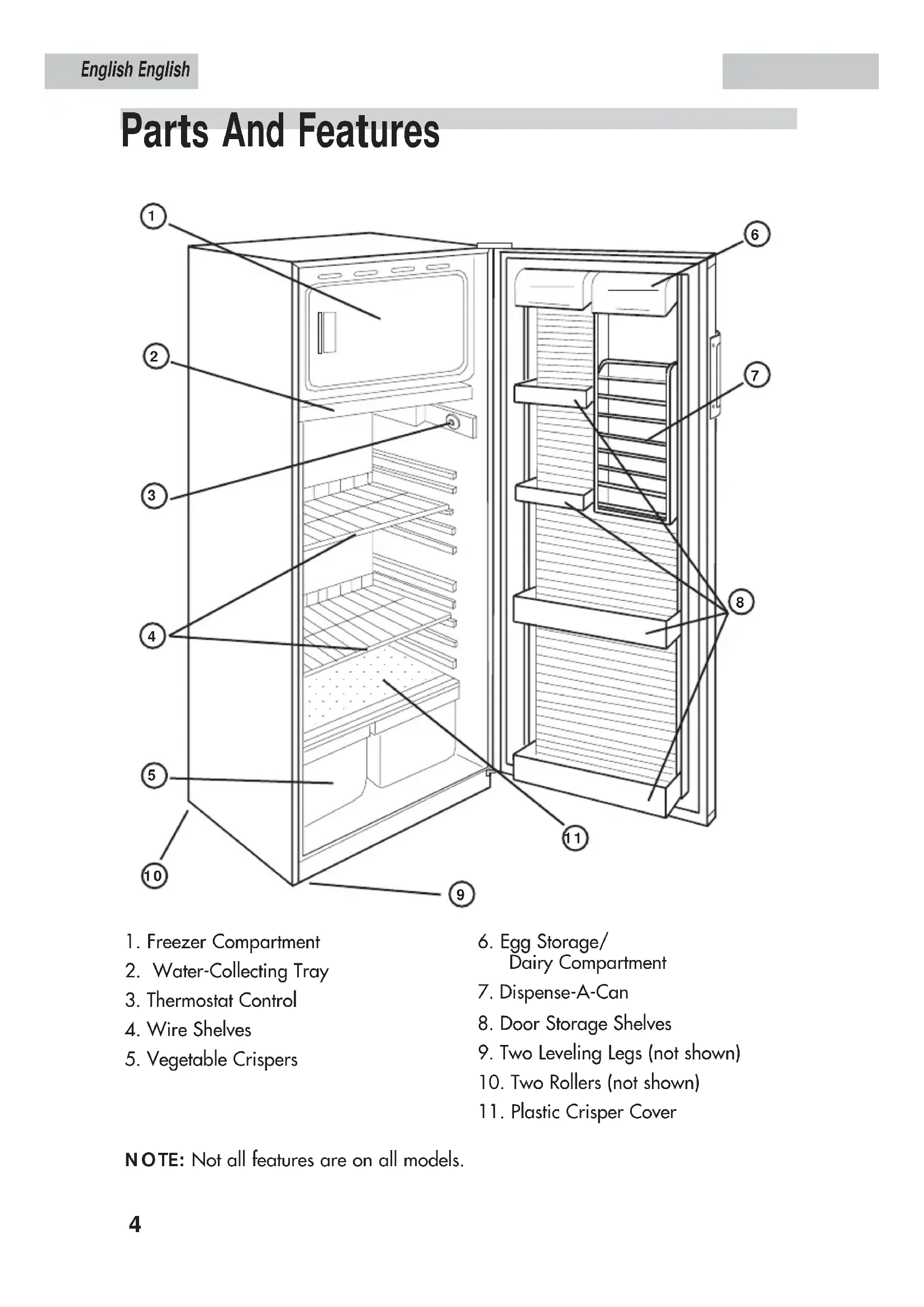
1. Freezer Compartment
5. Vegetable Crispers
11. Plastic Crisper Cover
NOTE: Not all features are on all models.
English English1. Remove all packaging material. This includes the foam base and alladhesive tape holding the refrigerator accessories inside andoutside. Slide out and remove plastic or foam guard used tosecure the compressor from shipping damage due to vibrationand shock.2. Inspect and remove any remains of packing, tape or printedmaterials before powering on the refrigerator. Leveling Your Refrigerator:
- Your refrigerator has two leveling legs which are located in thefront corners of your refrigerator. After properly placing yourrefrigerator in its final position, you can level your refrigerator.• Leveling legs can be adjusted by turning them clockwise to raise yourrefrigerator or by turning them counterclockwise to loweryour refrigerator. The refrigerator door will close easier when theleveling legs are raised.• To assure your refrigerator works at the maximum efficiency it was designed for, you should install it in a location where there is proper air circulation, plumbing and electrical connections.• The following are recommended clearances around the refrigerator:Sides……………3/4 "(19mm)Top....................2" (50mm)Back..................2" (50mm) Installing Your Refrigerator Unpacking Your Refrigerator Adjusting Your Refrigerator Proper Air Circulation
- Make sure there is a suitable power Outlet (115 volts, 15 amps outlet) with proper grounding to power the refrigerator.
- Avoid the use of three plug adapters or cutting off the third grounding in order to accommodate a two plug outlet. This is a dangerous practice since it provides no effective grounding for the refrigerator and may result in shock hazard.
- Do not install your refrigerator in any location not properly insulated or heated e.g. garage etc. Your refrigerator was not designed to operate in temperature settings below 55˚ Fahrenheit.
- Select a suitable location for the refrigerator on a hard even surface away from direct sunlight or heat source e.g. radiators, baseboard heaters, cooking appliances etc. Any floor unevenness should be corrected with the leveling legs located on the front bottom corners of the refrigerator. Install Limitations
- Avoid the use of an extension cord because of potential safety hazards under certain conditions. If it is necessary to use an extension cord, use only a 3-wire extension cord that has a 3-blade grounding plug and a 3-slot outlet that will accept the plug. The marked rating of the extension cord must be equal to or greater than the electrical rating of the appliance. Use of Extension Cords
English EnglishHandle installation of refrigerator door:
1. Take out door handle, screws and screw covers from refrigerator
2. Align the upper part of door handle with the screw hole of the upper
side of refrigerator door, and fix with screw.
3. Align the lower screw hole of the door handle with the hole in the
refrigerator door, fix with screw, and cover it with a screw cover.
1. Remove hinge cover screw.
4. Adjust the door or put a spacer in between and then tighten the screws.
English EnglishLeft/right door opening method: This product provides the reversing of the left/right door opening. You can select your preference of door opening by following the procedure to make the change. Dismantling: (see fig. # 2)
1. Fix refrigerator door by sticking adhesive tape on
both sides to hold door in place.
2. As shown in fig. 2, dismantle the hinge box cover on the
upper part of refrigerator door with a phillips head screwdriver. Then remove the screws from the hinge. Take out the hinge by pulling it vertically, and keep it in a safe place.
3. Remove the adhesive tape on refrigerator door,
lift and take down refrigerator door, and carefully put it aside. Reversing the Door Swing fig. # 2
English EnglishReinstallation: (see fig. # 3 and # 4)
1. As shown in fig. 3, dismantle the lower hinge and plastic pad from
right side and then install them on the left side.
2. As shown in fig. 4, install the top hinge and pad to the left side.
3. Install refrigerator door: make the left bottom hole of the refrigerator
compartment door fall over the lower hinge axle, move back and forward the door to make it straight and in alignment with top hinge. Install the top hinge again, turn the hinge axle until it completely enters the door body, then fix it with screws.
4. Replace the hinge cover as shown in Fig. 4.
English EnglishRefrigerator: (see fig. # 5)
1. Remove screw cover from the handle.
2. Using a phillips head screwdriver, remove both screws
from the side of the refrigerator door that holds the handle.
3. Install the handle on the opposite side.
4. Remove screw plugs.
5. Install the screws and screw covers to their corresponding position.
Reversing Freezer Door: (see fig. # 6)
1. Remove the water-collecting tray.
2. Using a narrow blunt object (e.g. Phillips head screwdriver) press the
hinge axle on the bottom of the hinged side of the freezer door.
3. This will remove the freezer door off its hinges
4. Turn the door around and install hinge on the opposite side.
5. Once the freezer door is installed insert the water-collecting tray.
English EnglishRefrigerator Features And Use The refrigerator shelves of your refrigerator were designed with you in mind. Their varied adjustability allows you to satisfy yourpersonal storage needs. Only your model purchase and your imagination limit the possibilities. To remove or adjust a full-width slide-out shelf: (see fig. # 7) 1. Gently tilt the shelf up and slide forward until the shelf has been completely removed.2. To replace the shelf, select the desired setting and gently slide theshelf back until it rests in the locking position. General Features Adjustable temperature dial: Your refrigerator will automaticallymaintain the temperature level youselect. The temperature control dial has7 settings plus off. 1 is the warmest. 7 isthe coldest. Turning the dial to OFF stopscooling in both the refrigeration andfreezer sections. At first, set the dial to 4and allow 24 hours to pass beforeadjusting the temperature to your needs.(Note: If the refrigerator hasbeen placed in a horizontal ortilted position for any periodof time wait 24 hours beforeplugging the unit in.) Refrigerator Section Interior Light: Your refrigerator is equipped with anautomatic interior light in the freshfood section for you to easily locateyour food. Refrigerator Interior Shelves fig. # 7
English EnglishTo remove and install the crisper: (see fig. # 8)
1. Grip the crisper firmly and slide out completely.
2. Replace the crisper by placing the crisper properly
and gently sliding it back into place. To remove the crisper cover: (see fig. # 9)
1. First remove both crispers
2. Carefully grasp the crisper cover and slide out to remove.
To replace the crisper cover:
1. Insert the rear of the crisper cover into the support bracket on the side
walls of the refrigerator.
2. Slide the crisper cover into place.
3. Replace the crispers as previously instructed.
Crisper and Crisper Cover fig. # 8 fig. # 9
1. Remove all items stored on the shelf.
2. Gently push up each side until the shelf is clear of the door shelf
brackets and then remove. To replace refrigerator door shelves: (see fig. # 10)
1. Align the ends of the shelves with the door shelf brackets.
2. Carefully push down on each end of the door shelf until it is locked in
place in the refrigerator door brackets. Refrigerator Door Shelves door shelves fig. # 10
English English 12To adjust the door shelf bottle huggers: (see fig #11)
1. Grasp the hugger firmly and slide right or left until it is snug against the
items stored on the shelf.
- For maximum energy efficiency, defrost freezer section whenever frost accumulates to a thickness of 1/4" or more on freezer walls. Note that frost tends to accumulate more during the summer months.
- To defrost freezer, remove food from the freezer section and push the defrost button which is located in the center of the temperature knob. This button deactivates the compressor and allows the ice to melt. Compressor will automatically turn back on after defrost cycle is complete.
- During the defrost cycle, water will accumulate in the water collecting tray. Drain the water into a bowl by removing the drain plug that is located on the bottom of the water-collecting tray. (see Fig. 12) You may find it easier to pull out the water-collecting tray from the refrigerator and remove the plug before you start the defrosting process. (see Fig. 13) fig. # 11 shelf bottle hugger Defrosting Your Refrigerator fig. # 12 fig. # 13 English English 14Fresh Food
- When storing fresh food, which is not prepackaged, be sure to wrap or store food in airtight and moisture proof material unless otherwise noted. This will ensure proper shelf life and prevent the transfer of odors and tastes.
- Wipe containers before storing to avoid needless spills.
- Eggs should be stored in an upright position in their original carton to maximize shelf life.
- Fruit should be washed and dried then stored in a crisper set for low humidity. If you do not have humidity controlled crispers place the items in sealed plastic bags before storing in the crisper.
- Vegetables with skins should be stored in plastic bags or containers and stored in crisper with low humidity setting.
- Leafy vegetables should be washed and drained and then stored in plastic bags or containers in crisper with high humidity setting.
- Hot food should be allowed to cool before storing in the refrigeration. This will prevent unnecessary energy use.
- Fresh seafood should be used the same day as purchased.
- When storing meats in the fresh food section, keep in the original packaging or rewrap as necessary. Follow the suggestions below for safe storage:
- Smoked/Cured Meats 7-10 Days
- All others 1-2 Days If longer periods of storage are required, store immediately in the freezer section. Food Storage Information
English EnglishFrozen Food
- Proper freezer storage requires correct packaging. All foods must be in packages, which do not allow the flow of air or moisture in, or out. Improper storage will result in odor and taste transfer and will result in the drying out of the improperly packaged food.
- Follow package or container instructions for proper storage.
- Packaging Recommendations: Plastic containers with air tight lids Heavy duty aluminum foil Plastic wrap made from saran film Self-sealing plastic bags
- Do not refreeze defrosted/thawed foods.
- It is recommended that the freezing date be marked on the packaging. English English 16• The fan circulating air inside the interior of your unit to maintain the temperature you have selected.
- Boiling water, gurgling sounds or slight vibrations that are the result of the refrigerant circulating through the cooling coils.
- Sizzling or popping sounds resulting from frost melting during the defrost cycle and dripping on the defrost heater.
- The sound of dripping water as ice melts from the evaporator and flows into the drip pan during the defrost cycle.
- Cracking or popping sound caused by the expansion and/or contraction of the cooling coils during the defrost cycle.
- The thermostat control will click when it cycles on and off. Normal Operating Sounds You May Hear
English EnglishWarning: To avoid electric shock always unplug your refrigerator before cleaning. Ignoring this warningmay result in death or injury. Caution: Before using cleaning products, always read and follow manufacturer’s instructions and warnings toavoid personal injury or product damage. General:
- Prepare a cleaning solution of 3-4 tablespoons ofbaking soda mixed with warm water. Use sponge orsoft cloth, dampened with the cleaning solution, towipe down your refrigerator.• Rinse with clean warm water and dry with a soft cloth.• Do not use harsh chemicals, abrasives, ammonia,chlorine bleach,concentrated detergents, solvents ormetal scouring pads. SOME of these chemicals maydissolve, damage and/or discolor your refrigerator.• Clean door gaskets every three months according togeneral instructions. Gaskets must be kept clean andpliable to assure a proper seal.• Petroleum jelly applied lightly on the hinge side of gas-kets will keep the gasket pliable and assure a goodseal. Proper Refrigerator Care and Cleaning Cleaning and Maintenance Door Gaskets: English English
181. Switch off power to refrigerator.
2. Allow light bulb to cool before removing.
3. Remove bulb by screwing it out counter-clockwise.
4 Always replace with appliance type light bulb rated at 40 watts or lesser wattage.
5. Do not exceed the 40 watts rating at any time.
- Occasionally there may be power interruptions due to thunderstorms or other causes. Remove the power cord from AC outlet when a power outage occurs. When power has been restored, replug power cord to AC outlet. If outage is for a prolonged period, inspect and discard spoiled or thawed food in freezer and refrigerator. Clean refrigerator before reusing.
- For long vacations or absences, empty food from refrigerator and freezer, move the temperature DIAL to the OFF position and clean the refrigerator and door gaskets according to "General cleaning" section. Prop doors open, so air can circulate inside.When moving always move the refrigerator vertically. Do not move with the unit lying down. Possible damage to the sealed system could occur. Light Bulb Replacement Power Interruptions Vacation and Moving Care
English EnglishRefrigerator Does Not Operate
- Check thermostat control is not in the “OFF” position.
- Check refrigerator is plugged in.
- Check there is power at the ac outlet, by checking the circuit breaker.
- Wait for 30-40 minutes to see whether refrigerator will start. It may be in "defrost" mode and must complete this cycle before Compressor starts to operate. Food temperature appears too warm
- Frequent door openings.
- Allow time for recently added warm food to reach fresh food or freezer temperature.
- Check gaskets for proper seal.
- Clean condenser coils (for models with exposed condenser coils).
- Adjust temperature control to colder setting.
- Check freezer compartment for air duct blockage from frozen food packages. Food temperature is too cold
- If temperature control setting is too cold, adjust to a warmer setting and allow several hours for temperature to adjust. Refrigerator runs too frequently
- This may be normal to maintain constant temperature during high temperature and humid days.
- Doors may have been opened frequently or for an extended period of time.
- Clean condenser coils.
- Check gasket for proper seal.
- Check to see if doors are completely closed. TroubleShooting English English 20Moisture build up on interior or exterior of the refrigerator:
- This is normal during high humidity periods.
- Prolonged or frequent door openings.
- Check door gaskets for proper seal. Refrigerator has an odor:
- Interior needs cleaning.
- Foods improperly wrapped or sealed are giving off odors. Refrigerator light does not work:
- Tighten bulb in socket.
- Replace burned out bulb. Refrigerator door does not shut properly:
- Level the refrigerator.
- Re-align refrigerator door.
- Check for blockages e.g. food containers, crisper cover, shelves, bins etc.
English English22 Limited Warranty What is covered and for how long? This warranty covers all defects in work- manship or materials for a period of: 12 months labor 12 months parts 5 years sealed system The warranty commences on the date the item was purchased and the original purchase receipt must be presented to the authorized service center before warranty repairs are rendered. EXCEPTIONS: Commercial or Rental Use warranty 90 days labor (carry-in only) 90 days parts No other warranty applies What is covered.
1. The mechanical and electrical parts,
which serve as a functional, purpose of this appliance for a period of 12 months. This includes all parts except finish, and trim.
2. The components of the sealed system
e.g. hermetic compressor, condenser and evaporator from manufacturing defects for a period of 5 years from the date of purchase. Any damages to such components caused by mechanical abuse or improper handling or shipping will not be covered. What will be done?
1. We will repair or replace, at our dis-
cretion any mechanical or electrical part which proves to be defective in normal usage during the warranty period so specified.
2. There will be no charge to the
purchaser for parts and labor on any covered items during the initial 12 month period. Beyond this period only parts are covered in the remain- ing warranty. Labor is not provided and must be paid by the customer.
3. Contact your nearest authorized
service center. For the name of the nearest service center please call 1-877-337-3639
THIS WARRANTY COVERS
APPLIANCES WITHIN THE
THE FOLLOWING: Damages from improper installation. Damages in shipping. Defects other than manufacturing. Damage from misuse, abuse, accident, alteration, lack of proper care and maintenance or incorrect current or voltage. Damage from other than household use. Damage from service by other than an authorized dealer or service center. Decorative trims or replaceable light bulbs. Transportation and shipping. Labor (after the initial 12 months).
PURPOSE The remedy provided in this warranty is exclusive and is granted in lieu of all other remedies. This warranty does not cover incidental or consequential damages, so the above limitations may not apply to you. Some States do not allow limitations on how long an implied warranty lasts, so the above limitations may not apply to you. This warranty gives you specific legal rights, and you may have other rights, which vary, from state to state. Haier America New York, NY, NY10018. English English