 ManualGo.com
ME6144ST - Microwave Oven SAMSUNG - Free user manual and instructions
Find the device manual for free ME6144ST SAMSUNG in PDF.


Download the instructions for your Microwave Oven in PDF format for free! Find your manual ME6144ST - SAMSUNG and take your electronic device back in hand. On this page are published all the documents necessary for the use of your device. ME6144ST by SAMSUNG.
USER MANUAL ME6144ST SAMSUNG
etting and Using the Custom Cook Button (ME6144W/ME6144ST Only) The Custom Cook button memeoizes the time and power setting for a particular food. Programming the Custom Cook button
Press the Custom Cook button. Press the button twice to delete the previous Custom setting. The display shows “ENTER” and “COOK”, “TIME” will flash.
Use the Number buttons to enter the amount of cooking time. The display will show the amount of time you have set.
Press Power Level and use the Number buttons to enter the power level. The display will show the power level you have set and The display will show “CUST”. You can set the power level from 0 to 9 1 = Warm 6 = Simmer 2 = Low 7 = Medium High 3 = Defrost 8 = Reheat 4 = Medium Low 9 = Sauté 5 = Medium 0 =High
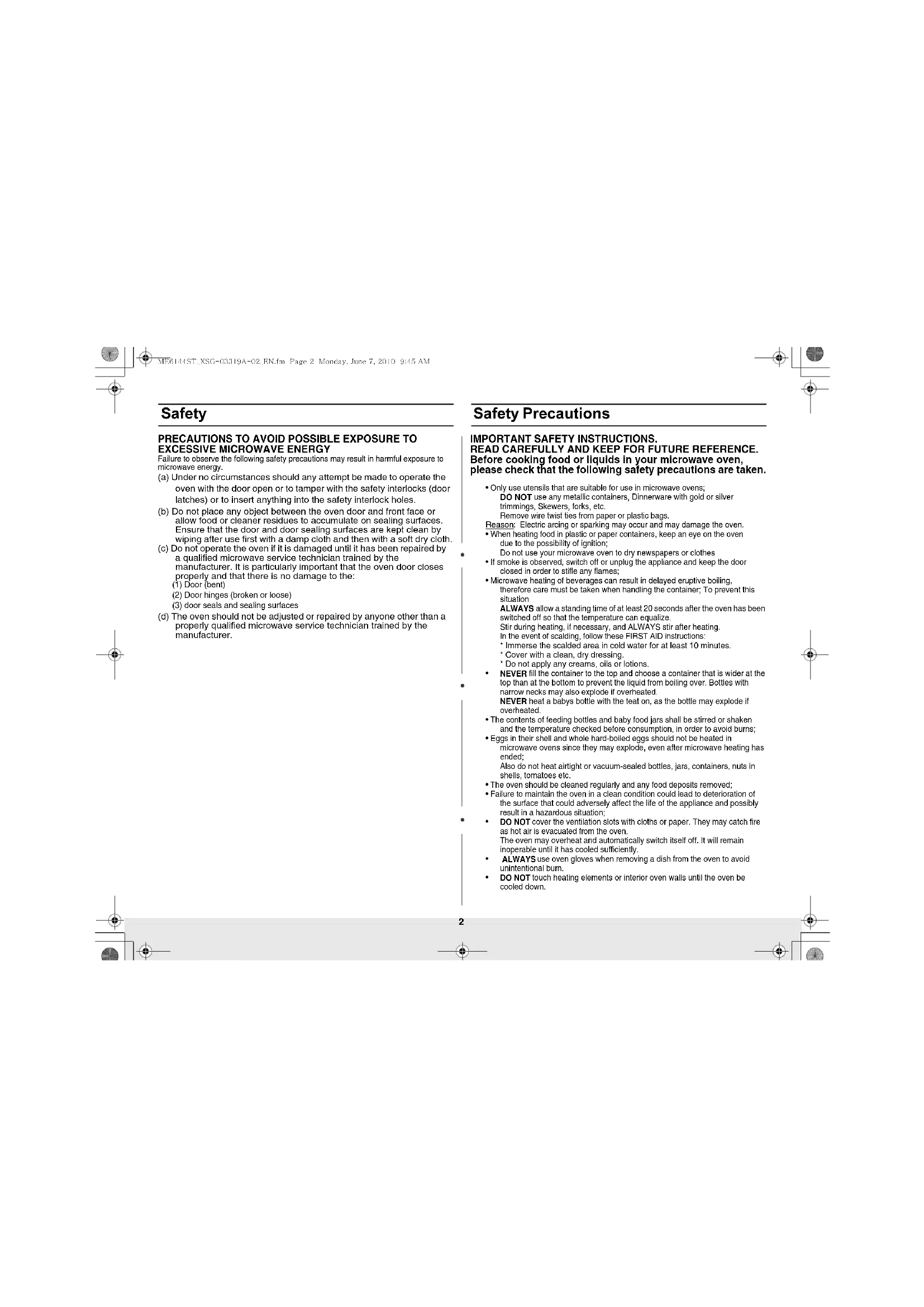
Failure to observe the following safety precautions may result in harmful exposure to microwave energy. (a) Under no circumstances should any attempt be made to operate the oven with the door open or to tamper with the safety interlocks (door latches) or to insert anything into the safety interlock holes. (b) Do not place any object between the oven door and front face or allow food or cleaner residues to accumulate on sealing surfaces. Ensure that the door and door sealing surfaces are kept clean by wiping after use first with a damp cloth and then with a soft dry cloth. (c) Do not operate the oven if it is damaged until it has been repaired by a qualified microwave service technician trained by the manufacturer. It is particularly important that the oven door closes properly and that there is no damage to the: (1) Door (bent) (2) Door hinges (broken or loose) (3) door seals and sealing surfaces (d) The oven should not be adjusted or repaired by anyone other than a properly qualified microwave service technician trained by the manufacturer. Safety Precautions IMPORTANT SAFETY INSTRUCTIONS. READ CAREFULLY AND KEEP FOR FUTURE REFERENCE. Before cooking food or liquids in your microwave oven, please check that the following safety precautions are taken.
- Only use utensils that are suitable for use in microwave ovens; DO NOT use any metallic containers, Dinnerware with gold or silver trimmings, Skewers, forks, etc. Remove wire twist ties from paper or plastic bags. Reason : Electric arcing or sparking may occur and may damage the oven.
- When heating food in plastic or paper containers, keep an eye on the oven due to the possibility of ignition; Do not use your microwave oven to dry newspapers or clothes
- If smoke is observed, switch off or unplug the appliance and keep the door closed in order to stifle any flames;
- Microwave heating of beverages can result in delayed eruptive boiling, therefore care must be taken when handling the container; To prevent this situation ALWAYS allow a standing time of at least 20 seconds after the oven has been switched off so that the temperature can equalize. Stir during heating, if necessary, and ALWAYS stir after heating. In the event of scalding, follow these FIRST AID instructions:
- Immerse the scalded area in cold water for at least 10 minutes.
- Cover with a clean, dry dressing.
- Do not apply any creams, oils or lotions.
NEVER fill the container to the top and choose a container that is wider at the top than at the bottom to prevent the liquid from boiling over. Bottles with narrow necks may also explode if overheated. NEVER heat a babys bottle with the teat on, as the bottle may explode if overheated.
- The contents of feeding bottles and baby food jars shall be stirred or shaken and the temperature checked before consumption, in order to avoid burns;
- Eggs in their shell and whole hard-boiled eggs should not be heated in microwave ovens since they may explode, even after microwave heating has ended; Also do not heat airtight or vacuum-sealed bottles, jars, containers, nuts in shells, tomatoes etc.
- The oven should be cleaned regularly and any food deposits removed;
- Failure to maintain the oven in a clean condition could lead to deterioration of the surface that could adversely affect the life of the appliance and possibly result in a hazardous situation;
DO NOT cover the ventilation slots with cloths or paper. They may catch fire as hot air is evacuated from the oven. The oven may overheat and automatically switch itself off. It will remain inoperable until it has cooled sufficiently.
ALWAYS use oven gloves when removing a dish from the oven to avoid unintentional burn.
- Do not immerse the power cable or plug in water and keep the power cable away from heated surfaces. Do not operate this appliance if it has a damaged power cable or plug.
- Stand at arms length from the oven when opening the door. Reason : The hot air or steam released may cause scalding.
- You may notice a Clicking sound during operation(especially when the oven is defrosting). Reason : This sound is normal when the electrical power output is changing.
DO NOT operate the microwave oven when it is empty. The power will be cut off automatically for safety. You can operate normally after letting it stand for over 30 minutes. It is best to leave a glass of water inside the oven at all times.The water will absorb the microwaves energy if the oven accidently started. IMPORTANT
- Young children should NEVER be allowed to use or play with the microwave oven. Nor should they be left unattended near the microwave oven when it is in use. Items of interest to children should not be stored or hidden just above the oven.
- This appliance is not intended for use by persons (including children) with reduced physical, sensory or mental capabilities, or lack of experience and knowledge, unless they have been given supervision or instruction concerning use of the appliance by a person responsible for their safety.
- Children should be supervised to ensure that they do not play with the appliance.
If the door or door seals are damaged, the oven must not be operated until it has been repaired by a competent person.
It is hazardous for anyone other than a comperent person to carry out any service or repair operation which involves the removal of a cover which gives protection against exposure to microwave energy.
Liquids and other foods must not be heated in sealed containers since they are liable to explode.
Only allow children to use the oven without supervision when adequate instructions have been given so that the child is able to use the oven in a safe way and understands the hazards of improper use.
- The microwave oven shall not be placed in a cabinet. Installing Your Microwave Oven Place the oven on a flat level surface 85cm above the floor. The surface should be strong enough to safety bear the weight of the oven.
If the supply cord is damaged, it must be replaced by a special cord or assembly available from the manufacturer or its service agent. For your personal safety, plug the cable into a 3-pin, 230 Volt, 50Hz, AC earthed socket. If the power cable of this appliance is damaged, it must be replaced by a special cable.
Do not install the microwave oven in hot or damp surroundings like next to a traditional oven or radiator. The power supply specifications of the oven must be respected and any extension cable used must be of the same standard as the power cable supplied with the oven. Wipe the interior and the door seal with a damp cloth before using your microwave oven for the first time.
When you install your oven, make sure there is adequate ventilation for your oven by leaving at least 10 cm (4 inches) of space behind and, on the sides of the oven and 20 cm (8 inches) of space above.
Remove all packing materials inside the oven. Install the roller ring and turntable. Check that the turntable rotates freely.
This microwave oven has to be positioned so that plug is accessible. 20cm above10cm behind 10cmon the side tl]X[[z{znTWZZX`hTWYluUGGwGZGGtSGqG^SGYWXWGG`a[\Ght4 How a Microwave Oven Works Cooking Principle
As the centre of the food is cooked by heat dissipation, cooking continues even when you have taken the food out of the oven. Standing times specified in recipes and in this booklet must therefore be respected to ensure:
- Even cooking of the food right to the centre
- The same temperature throughout the food Your New Microwave oven Checking Parts Unpack your microwave oven and check to make sure that you have all the parts shown here. If any part is missing or broken, call your dealer. Setting Up Your Microwave Oven
Place the oven on a flat, sturdy surface and plug the cord into a grounded outlet. once plugged in, the display on your oven will show: Make sure there is adequate ventilation for your oven by leaving at least four inches of space behind, above, and to the side of the oven.
Open the oven door by pulling on the handle.
Wipe the inside of the oven with a damp cloth.
Place the pre-assembled ring in the indentation in the center of the oven.
Place the glass tray on top of the ring so that the three glass tabs in the center of the tray fit securely into the tabs on the floor of the oven. )
The microwaves generated by the magnetron are distributed uniformly as the food rotates on the turntable. The food is thus cooked evenly.
The microwaves are absorbed by the food up to a depth of about 1 inch (2.5 cm). Cooking then continues as the heat is dissipated within the food.
Cooking times vary according to the container used and the properties of the food:
- Quantity and density
- Initial temperature (refrigerated or not) Microwave oven Glass tray Roller guide ring
Press the Clock button. The “ENTER” and “TIME” indicators flash.
Use the number buttons to enter the current time. You must press at least three numbers to set the clock. If the current time is 5:00 enter, 5,0,0.
When 5 seconds has elapsed, “ENTER” indicator flash and “Cloc” will be displayed.
Press Clock again. A colon will blink, indicating that the time is set. If there is a power interruption, you will need to reset the clock. You can check the current time while cooking is in progress by pressing the Clock button. Using the Pause/Cancel Button The Pause/Cancel button allows you to clear instructions you have entered. It also allows you to pause the oven’s cooking cycle, so that you can check the food.
- To pause the oven during cooking: press Pause/Cancel once. To restart, press Start
- To stop cooking, erase instructions, and return the oven display to the time of day: press Pause/Cancel twice.
- To correct a mistake you have just entered: press Pause/Cancel once, then re- enter the instructions. Using the One Minute + Button This button offers a convenient way to heat food in one minute increments at the High power level.
Press the One Minute+ button once for each minute you wish to cook the food. For example, press it twice for two minutes. The time will display, and the oven starts automatically. Add minutes to a program in progress by pressing the One Minute+ button for each minute you want to add. Using the Sensor Cook Buttons By actually sensing the steam that escapes as food heat, this feature automatically adjusts the oven’s heating time for various types and amounts of precooked food. All food should be precooked and at refrigerator temperature.
Press the Sensor Cook button corresponding to the food you are cooking
Popcorn , for example). The display shows “ ” and your microwave oven will begin cooking automatically. When cooking popcorn, wait at least five minutes between each bag to avoid overheating the glass tray. If you want to check the current time while cooking is in progress, press the Clock button. tl]X[[z{znTWZZX`hTWYluUGGwG]GGtSGqG^SGYWXWGG`a[\Ght Auto energy saving function If you do not select any function when appliance is in the middle of setting or operating with temporary stop condition, function is canceled and clock will be displayed after 25 minutes. Oven Lamp will be turned off after 5 minutes with door open condition.7 Operation Sensor Cooking Guide
- Follow the instructions below when sensor cooking different types of food. Using the Instant Cook Buttons
Press the Instant Cook button corresponding to the food you are cooking
Beverage , for example). The display shows the first serving size. (“ENTER” and “QTY.” will flash):
Press the button repeatedly to select the serving size you want. The display will cycle through all available serving sizes. Once you select the correct serving size, the microwave will begin cooking automatically. When the cooking time is over, the oven will beep. The oven will then beep every minute. Using the Rice/Pasta Buttons
Press the Rice/Pasta button corresponding to the food you are cooking. The display shows “A-1”(item code). Press the Rice/Pasta button repeatedly to select the item you want.(Refer to the Rice/Pasta Chart below)
Press Start button to begin cooking. Rice/Pasta Chart Food Amount Procedure Popcorn 85g - 100g 1 package Use only one microwave-only bag of popcorn at a time. Use caution when removing and opening hot bag from oven. Let oven cool for at least 5 minutes before using again. Potatoes 1 to 6 EA. Prick each potato several times with fork. Place on turntable in spoke-like fashion. Let stand 3-5 min. Let oven cool for at least 5 minutes before using again. Fresh Vegetables 1 to 4 cups Place fresh vegetables in microwave-safe dish and add 2 Tbsp of water. Cover with microwave safe plastic wrap or lid. (Using the glass cover gives the best results.) If using plastic wrap be sure to leave a small opening near the edge of dish for ventilation. Remove vegetable from oven let sit covered for 2 minutes, stir or serve. Let oven cool for at least 5 minutes before using again. Single Entrees 220g - 400g Remove food from outer wrapping and follow box instructions for covering and standing. Let oven cool for at least 5 minutes before using again. Item Weight Remarks Beverage ½ cup 1 cup 2 cups
- Use measuring cup or mug ; do not cover.
- Place the beverage in the oven.
- After heating, stir well. Pizza reheat 1 Slice 2 Slices 3 Slices 4 Slices
- Put the pizza on a microwave-safe plate with wide end of slice towards the outside edge of the plate.
- Do not let slices overlap. Do not cover.
- Before serving, let stand 1-2 min. Code Item WeightInitial TemperatureRemarksA-1 White Rice 1-2 servesRice:RoomWater:RoomWash rice with cold water until water runs clear. Place the rice and water in a microwave-safe rice cooker or round glass Pyrex dish with a lid and after cooking allow rice to stand without removing lid. Stand rice for 3-5 minutes and stir to separate grains. A-2 Dry Pasta 1-2 servesWater:boiling waterPlace dry pasta into microwave-safe rice coo-ker or bowl or round Glass Pyrex dish breaking if necessary to fit - without lids on and cook uncovered. After cooking put on lid, allow standing time of 2-5 minutes. Stir and serve.A-3 Frozen Pasta 1-2 servesWater:boiling waterPlace frozen pasta into microwave-safe rice cooker or bowl or round Glass Pyrex dish without lids on and cook uncovered. After cooking put on lid, allow standing time of 2-5 minutes. Stir and serve.A-4 Fresh Pasta 1-2 servesWater:boiling waterPlace fresh pasta into microwave-safe rice cooker or bowl or round Glass Pyrex dish without lids on and cook uncovered. After cooking put on lid, allow standing time of 2-5 minutes. Stir and serve.A-5 Spaghetti 1-2 servesWater:boiling waterPlace dry spaghetti into microwave-safe rice cooker or bowl or round Glass Pyrex dish breaking if necessary to fit - without lids on and cook uncovered. After cooking put on lid, allow standing time of 2-5 minutes. Stir and serve.A-6 2 Minute noodle 1-3 servesWater:boiling waterBreak noodle cake and place into a microwave-safe large bowl. Pour boiling water over noodles and cook uncovered. After oven beeps at half cooking time, stir well and press start to continue. After cooking and then standing time of two minutes, stir and serve. A-7 Porridge 1-2 servesPorridge oats: Room Water&milk: Cold Place dry porridge oats and water or milk in a microwave safe bowl and cook uncovered. After oven beeps, stir the oats well and press start to continue. After cooking, stir well and top with brown sugar or honey. 1Serv. 2Serv. Rice 100g 200gWater 250ml 375ml 1Serv. 2Serv. Pasta 100g 200g Wat er 3cu ps 5cup s 1Serv. 2Serv. Pasta 125g 250g Wat er 3cu ps 5cup s 1Serv. 2Serv. Pasta 125g 250g Water 3cups 5cups 1Serv. 2Serv. Sp agh etti100g 200g Water 3cups 5cups 1 Serv. 2 Serv. 3 serv. Noodle 1 packet 2 packets 3 packets Wa ter 500 ml 1000 ml 1500 ml 1Serv. 2Serv. Oats 35g 70g Wa ter & Mi lk 185 m l 375 ml tl]X[[z{znTWZZX`hTWYluUGGwG^GGtSGqG^SGYWXWGG`a[\Ght8 Operation Using the Meat/Fish Buttons
Press the Meat/Fish button corresponding to the food you are cooking. The display shows “A-1”(item code). Press the Meat/Fish button repeatedly to select the item you want.(Refer to the Meat/Fish Chart below)
Press Start button to begin cooking. Meat/Fish Chart Meat/Fish Chart Code Item Weight Initial Tempe- rature Remarks A-1 Chicken Breast
450g Refrige rated Select fresh chicken breasts, score, insert 3-4 cuts with a sharp knife along breast and cook plain or firstly marinate with you favo-rite flavor for two hours or overnight covered in the refrigerator. Or sprinkle breasts with soy sauce or lemon juice or your favorite shaker herbs salt or pepper. Then cover breasts with baking paper tucked in on plate or in Pyrex dish and cook. At half cooking time oven will beep turn breast(s) over and press start to continue. After cooking stand breast(s) for 3-5 minutes. Serve. A-2 Fish Fillet
400g Refrige rated Select fresh fish fillets and cook plain or marinate with you favorite seafood marin-ade for two hours or overnight covered in the refrigerator. Or sprinkle fillets with lemon juice or your favorite shaker herbs especially lemon pepper seasoning, salt or pepper. Then cover fillets with baking paper tucked in on plate or in Pyrex dish and cook. After cooking stand fillets(s) for 3 minutes. Serve. Code Item Weight Initial Tempe- rature Remarks A-3 Sea Food
400g Refrig- erated Select fresh seafood and set out on microw-avesafe plate or Pyrex dish. Sprinkle with lemon juice or salt if desired, cover seafood with baking paper eg. Glad Bake - tucked in around and cook. After cooking stand seafood for 3 minutes. Serve. A-4 Casserole 1 dish Refrig- erated Ingredients For casserole. 2 medium carrots (85g to 110g Before peeling), 2 medium onions( 110g to 140g. Before peeling), 2 medium potatoes(165g to 195g before peeling), 450 ground chuck beef, teaspoon salt, cup water, teaspoon pepper. Peel and slice vegetables into inch thick slices, Form beef into 12 small, flat pattie using the 2-inch Reynolds Brass Ring. Flattern patties. In 2-quart casserole, layer half of beef patties, half of carrots, half of onions, and half of potatoes. Springkle with salt and pepper. Repeat layers, making sure that top layer of beef patties is completely covered with vegetables. Add water. Press layer down into casserole. Cover. After cooking stand casserole for 5 minutes. Serve. A-5 Bacon
325g Refrig- erated Select fresh bacon rashers from your butcher, deli or supermarket. Place on the absorbent paper towel on microwavesafe plate or Pyrex dish and cover with another piece of paper towel and cook. Serve. A-6 Meatball 1 dish Refrig- erated Ingredients For Meat Balls. 450 g ground beef,cup chopped onion,1 egg beaten, 1 teaspoon salt, teaspoon pepper and 2 tabl- espoons water.Combine all ingredients and mix well. Shape into 20 x (25mm) meat balls. Place meat balls in utensil. Cover with microwave cling wrap turning back one corner of the wrap by about 50mm to vent. Cook. After cooking, stand meat balls for 5 minutes. Serve. A-7 Meat loaf 1 dish Refrig- erated Ingredients For meat loaf. 675g ground chuck beef, cup fine dry bread crumbles, cup chopped onion, cup chopped green pepper, 1 cup milk,1 egg, 2 tablespoons ketchup, teaspoon pepper, cup teaspoon salt. Combine all ingredients: mix well. Pack meat mixture firmly in loaf dish: smooth out top. Cover with plastic wrap, turning back one corner about 2 inch-es to vent. Place in oven parallel to front of oven. After cooking stand casserole for 5 minutes. Serve tl]X[[z{znTWZZX`hTWYluUGGwG_GGtSGqG^SGYWXWGG`a[\Ght9 Operation Using the Snack Bar Button
Press the Snack Bar button corresponding to the food you are cooking. The display shows “A-1”(item code). Press the Snack Bar button repeatedly to select the item you want.(Refer to the Snack Bar Chart below)
button to select the serving size you want. Only the 1 button(serving) is available for TORTILLA (Refer to the Snack Bar Chart below for the serving)
Press Start button to begin cooking. Snack Bar Chart Defrosting Automatically To thaw frozen food, set the weight of the food and the microwave automatically sets the defrosting time, power level and standing time.
To set the type of your food, press the Auto Defrost button repeatedly. You can also use the number buttons to enter the weight of the food directly. It is possible to set up to a maximum of 2 kg(except to bread).
Press the Start button. The display will show cooking time during defrosting, the oven will beep to let you know to turn the food over.
Open the oven door, and turn the food over.
Press the start button to resume defrosting.
- See page 13 for the Auto Defrosting Guide. Reheating Automatically To reheat food, select the type of dish and the number of servings you want to reheat, and the microwave automatically sets the reheating time.
Press the Auto Reheat button repeatedly to select the type of dish you wish to reheat. The initial serving size for each dish is one serving. You can select up to four cups for casseroles and pasta, Rice tinned reheat. Only one serving is available for a plate of food. The display shows the dish and quantity you have chosen.
Use the number buttons to increase the serving size. For example, for three servings, press the 3 button(Refer to the Auto Reheat Chart below for the servings). The display shows the number of servings you have selected:
Press the Start button. The display will show Cooking Time. Auto Reheat Chart Code Item Weight Initial Temperature Remarks A-1 Tortilla 400g Refrigerated Cut top off tortilla bag, remove moisture sachet and place bag of tortilla directly in center of microwave turntable. Heat. Use heated tortilla immediately as required. A-2 Chicken wings 4-5 PCS 8-10 PCS Refrigerated Place wings around plate, spoke-fashion. Cover with wax paper. A-3 Frozen Pie 50-60g 100-110g 150-160g Frozen Place frozen party pies into microwave oven on microwave-safe plate or Pyrex dish uncovered. Heat. After cooking stand pies for 1 minute. Serve. A-4 Baby Food 70g 110g 170g Room Remove metal top from room temperature jars of baby food. Remove plastic lid and metal lid from cups of baby food replace lid, discarding metal lid. Place jar cup in center of turntable and microwave on high power until temperature is reached. Stir well. Serve. The More/Less key cannot be used with the baby food key. A-5 Garlic Bread 200g 400g 600g Refrigerated Remove garlic bread sticks from packaging and place into microwave oven on microwave-safe plate or Pyres dish. Heat. After cooking stand garlic bread sticks for 3 minutes to melt butter in centre completely. Serve. A-6 Chicken Nuggets 4 PCS 8 PCS Refrigerated Put a paper on top of plate and arrange nuggets in spoke fashion on paper towel. Do not cover. Let stand 1 min. A-7 Potato Wedge 4 PCS 8 PCS Room Cut potato into 4 even wedges. scoop or out potato flesh, leaving about 1.4 inch of skin. Place skins in spoke fashion around plate, Sprinkle with bacon, onions and Cheese. Microwave on High power for until cheese is melted. Item Code Weight Remarks Plate of food A-1 1 serving • Use only pre-cooked, refrigerated foods.
- Cover plate with vented plastic wrap or wax paper.
- Contents - 85-110 g meat, poultry or fish ( up to 170 g with bone) - ½ cup starch (potatoes, pasta, rice, etc.) - ½ cup vegetables (about 85-110 g) Casserole A-2 1-4 Cups
- Use only refrigerated foods.
- Cover with lid or vented plastic wrap.
etting and Using the Custom Cook Button (ME6144W/ME6144ST Only) The Custom Cook button memeoizes the time and power setting for a particular food. Programming the Custom Cook button
Press the Custom Cook button. Press the button twice to delete the previous Custom setting. The display shows “ENTER” and “COOK”, “TIME” will flash.
Use the Number buttons to enter the amount of cooking time. The display will show the amount of time you have set.
Press Power Level and use the Number buttons to enter the power level. The display will show the power level you have set and The display will show “CUST”. You can set the power level from 0 to 9 1 = Warm 6 = Simmer 2 = Low 7 = Medium High 3 = Defrost 8 = Reheat 4 = Medium Low 9 = Sauté 5 = Medium 0 =High
Press the Custom Cook button again. The display will read you setting are now stored in the oven’s memory. Using the Custom Cook button Press the Custom button after memorizing a recipe, the press Start button. You can check the power level while cooking is in progress by pressing the Power Level button. Setting Cooking Times & Power Levels Your microwave allows you to set up to two different stages of cooking, each with its own time length and power level. The power level button lets you control the heating intensity from Warm (1) to High (0). One-stage Cooking For simple one-stage cooking, you only need to set a cooking time. The power level is auto- matically set to High. If you want to set the power to any other level, you must set it using the Power Level button.
Use the number buttons to set a cooking time. You can set a time from one second to 99 minutes, 99 seconds. To set a time over one minute, enter the seconds too. For example, to set 20 minutes, enter 2, 0, 0, 0 .
If you want to set the power level to something other than High, press the Power Level button, then use the number buttons to enter a power level. Power Levels: 1 = PL:10 (Warm) 6 = PL:60 (Simmer) 2 = PL:20 (Low) 7 = PL:70 (Medium High) 3 = PL:30 (Defrost) 8 = PL:80 (Reheat) 4 = PL:40 (Medium Low) 9 = PL:90 (Sauté) 5 = PL:50 (Medium) 0 = PL:Hi (High)
Press the Start button to begin cooking. If you want to change the power level, press Pause/Cancel before you press Start , and re-enter all of the instructions. Some recipes require different stages of cooking at different temperatures. You can set mul- tiple stages of cooking with your microwave. Multi-stage Cooking
Follow steps 1 and 2 in the “One-Stage Cooking” section on the previous page. When entering more than one cooking stage, the Power Level button must be pressed before the second cooking stage can be entered. To set the power level at High for a stage of cooking, press the Power Level button twice.
Use the number buttons to set a second cooking time.
Press the Power Level button, then use the number buttons to set the power level of the second stage of cooking.
Press Start to begin cooking. You can check the Power Level while cooking is in progress by pressing the Power Level button. Demonstration Mode You can use the Demonstration Mode to see how your microwave oven operates without the oven heating.
Press the 0 button and the 1 or 3 button almost at the same time. To turn demo mode off, repeat step 1 above. Using the More/Less Buttons The More/Less buttons allow you to adjust pre-set cooking times. They only work in the Rice/Pasta, Meat/Fish, Snack Bar, Auto Reheat, Pizza Reheat, Beverage or Time Cook, Kitchen Time modes . Use the More/Less but- ton only after you have already begun cooking with one of these procedures. The More/Less feature cannot be used with the Sensor Cook button. The More/Less key cannot be used with the Auto defrost key.
To ADD more time to an automatic cooking procedure: Press the More (9) button.
To REDUCE the time of an automatic cooking procedure: Press the Less (1) button. If you wish to increase/decrease in Time Cook, Kitchen Time mode by 10sec, press the More(9) or Less(1) button. Switching the Beeper On/Off You can switch the beeper off whenever you want.
Press the Sound button to turn the volume off. The display shows: “OFF”.(“START” will flash)
Press Start. The display returns to the time of day. Using the Kitchen Timer
Use the Number buttons to set the length of time you want the timer to run.
The display counts down and beeps when the time has elapsed. Note: The microwave does not turn on when the Kitchen timer is used. Setting the Child Protection Lock You can lock your microwave oven so it can’t be used by unsupervised children.
” button. The display shows “Loc”. At this point, the microwave oven cannot be used until it is unlocked. To unlock it, repeat step 1 above. tl]X[[z{znTWZZX`hTWYluUGGwGXWGGtSGqG^SGYWXWGG`a[\Ght11 Cooking Instructions Cooking Utensils Recommended Use
Glass and glass-ceramic bowls and dishes — Use for heating or cooking. Microwavable browning dish — Use to brown the exterior of small items such as steaks, chops, or pancakes. Follow the directions provided with your browning dish. Microwavable plastic wrap — Use to retain steam. Leave a small opening for some steam to escape and avoid placing it directly on the food. Wax paper — Use as a cover to prevent spattering. Paper towels and napkins — Use for short-term heating and covering; they absorb excess moisture and prevent spattering. Do not use recycled paper towels, which may contain metal and can catch fire. Paper plates and cups — Use for short-term heating at low temperatures. Do not use recycled paper, which may contain metal and can catch fire. Thermometers — Use only those labeled “Microwave Safe” and follow all directions. Check the food in several places. Conventional thermometers may be used once the food has been removed from the oven. Limited Use
Aluminum foil — Use narrow strips of foil to prevent overcooking of exposed areas. Using too much foil can damage your oven, so be careful. Ceramic, porcelain, and stoneware — Use these if they are labeled “Microwave Safe”. If they are not labeled, test them to make sure they can be used safely. Never use dishes with metallic trim. Plastic — Use only if labeled “Microwave Safe”. Other plastics can melt. Straw, wicker, and wood — Use only for short-term heating, as they can be flammable. Not Recommended
Glass jars and bottles — Regular glass is too thin to be used in a microwave, and can shatter. Paper bags — These are a fire hazard, except for popcorn bags that are designed for microwave use. Styrofoam plates and cups — These can melt and leave an unhealthy residue on food. Plastic storage and food containers — Containers such as margarine tubs can melt in the microwave.Metal utensils — These can damage your oven. Remove all metal before cooking. Testing Utensils If you are not sure whether a dish is microwave-safe or not, you can perform this test: Fill a 1 cup glass measuring cup with water and put it inside your oven, next to the dish you want to test. Press the One Minute + button once to heat them for one minute at High power.The water should be warm and the dish you are testing should be cool. If the dish is warm, then it is absorbing microwave energy and is not acceptable for use in the microwave. Cooking Techniques Stirring Stir foods such as casseroles and vegetables while cooking to distribute heat evenly. Food at the outside of the dish absorbs more energy and heats more quickly, so stir from the outside to the center. The oven will turn off when you open the door to stir your food. Arrangement Arrange unevenly shaped foods, such as chicken pieces or chops, with the thicker, meatier parts toward the outside of the turntable where they receive more microwave energy. To prevent overcooking, place thin or delicate parts toward the center of the turntable. Shielding Shield food with narrow strips of aluminum foil to prevent overcooking. Areas that need shielding include poultry wing-tips, the ends of poultry legs, and corners of square bak-ing dishes. Use only small amounts of aluminum foil. Larger amounts can damage your oven. Turning Turn foods over midway through cooking to expose all parts to microwave energy. This is especially important with large items such as roasts. Standing Foods cooked in the microwave build up internal heat and continue to cook for a few minutes after the oven stops. Let foods stand to complete cooking, especially foods such as roasts and whole vegetables. Roasts need this time to complete cooking in the center without overcooking the outer areas. All liquids, such as soup or hot chocolate, should be shaken or stirred when cooking is complete. Let liquids stand a moment before serving. When heating baby food, stir well and test the temperature before serv- ing. Adding Moisture Microwave energy is attracted to water molecules. Food that is uneven in moisture con-tent should be covered or allowed to stand so that the heat disperses evenly. Add a small amount of water to dry food to help it cook. General Tips
- Dense foods, such as potatoes, take longer to heat than lighter foods. Foods with a delicate texture should be heated at a low power level to avoid becoming tough.• Altitude and the type of cookware you are using can affect cooking time. When using a new recipe, use the minimum cooking time and check the food occasionally to prevent overcooking.• Foods with a non-porous skin such as potatoes or hot dogs, should be pierced to prevent bursting.• Frying with heating oil or fat is not recommended. Fat and oil can suddenly boil over and cause severe burns.• Some ingredients heat faster than others. For example, the jelly inside a jelly doughnut will be hotter than the dough. Keep this in mind to avoid burns.• Home canning in the microwave oven is not recommended because all harmful bacteria may not be destroyed by the microwave heating process.• Although microwaves do not heat the cookware, the heat from the food is often transferred to the cookware. Always use pot holders when removing food from the microwave and instruct children to do the same.• Making candy in the microwave is not recommended as candy can heat to very high temperatures. Keep this in mind to avoid injury.tl]X[[z{znTWZZX`hTWYluUGGwGXXGGtSGqG^SGYWXWGG`a[\Ght12 Cooking Instructions Auto Sensor Cook The Auto Sensor allows you to cook your food automatically by detecting the amount of moistures generated from the food while cooking.
- When cooking food, many kinds of moistures are generated. The Auto Sensor determines the proper time and power level by detecting these moistures from the food, eliminating the need to set the cooking time and power level.
- When you cover a container with its lid or plastic wrap during Sensor Cooking, the Auto Sensor will detect the moistures generated after the container has been saturated with steam.
- Shortly before cooking ends, the remaining cooking time will begin its count down. This will be a good time for you to rotate or stir the food for even cooking if it is necessary.
- Before auto sensor cooking food may be seasoned with herbs, spices or browning sauces. A word of caution though, salt or sugar may cause burn spots on food so these ingredients should be added after cooking.
- The More/Less function pad is used to increase or decrease cooking time. You should use this function to adjust the degree of cooking to suit your personal taste. Utensils & Cover For Sensor Cooking
- To obtain good cooking results with this function, follow the directions for selecting appropriate containers and covers in the charts in this book.
- Always use microwave-safe containers and cover them with their lids or with plastic wrap. When using plastic wrap, turn back one corner to allow steam to escape at the proper rate.
- Always cover with the lid intended for the utensil being used. If the utensil does not have its own lid, use plastic wrap.
- Fill containers at least half full.
- Foods that require stirring or rotating should be stirred or turned toward the end of the Sensor Cook cycle, after the time has started to count down on the display. Important
- It its not advisable to use the auto sensor cooking feature on a continuous cooking operation, i.e. one cooking operation immediately after another.
- Install the oven in a well ventilated location for proper cooling and airflow and to ensure the sensor will operate accurately.
- To avoid poor results, do not use the Auto sensor when the room ambient temperature is too high or too low.
- Do not use volatile detergent to clean your oven. Moisture resulting from this detergent may affect the sensor.
- Avoid placing the oven near high moisture or gas emitting appliances, since this will interfere with the proper performance of the Auto Sensor.
- Always keep the inside of the oven clean. Wipe all spills with a damp cloth.
- This oven is designed for household use only. Cooking Guide Guide for Cooking Meat in Your Microwave
- Place meat on a microwave-safe roasting rack in a microwave-safe dish.
- Start meat fat-side down. Use narrow strips of aluminum foil to shield any bone tips or thin meat areas.
- Check the temperature in several places before letting the meat stand the recommended time.
- The following temperatures are removal temperatures. The temperature of the food will rise during the standing time. Guide for Cooking Poultry in Your Microwave
- Place poultry on a microwave-safe roasting rack in a microwave-safe dish.
- Cover poultry with wax paper to prevent spattering.
- Use aluminum foil to shield bone tips, thin meat areas, or areas that start to overcook.
- Check the temperature in several places before letting the poultry stand the recommended time. Food Cook Time/Power Level Directions Roast Beef Boneless Up to 4 lbs. Cooking Time: 8-12 min. / 0.5 kg for 50°C - Rare 9-13 min. / 0.5 kg for 55°C - Medium 10-15 min. / 0.5 kg for 65°C - Well Done Power Level: High(0) for first 5 min., then Medium(5). Place roast fat-side down on roasting rack. Cover with wax paper. Turn over when cooking time is half up. Let stand 10 min. Pork Boneless or bone-in Up to 4 lbs. Cooking Time: 12-16 min. / 0.5 kg for 70°C Well Done Power Level: High(0) for first 5 min., then Medium(5). Place roast fat-side down on roasting rack. Cover with vented plastic wrap. Turn over when cooking time is half up. Let stand 10 min. Food Cook Time/Power Level Directions Whole Chicken Up to 4 lbs. Cooking Time: 7-10 min. / 0.5kg 80°C Power Level: Medium High(7). Place chicken breast-side down on roasting rack. Cover with wax paper. Turn over when the cooking time is half up. Cook until juices run clear and meat near the bone is no longer pink. Let stand 5-10 min. Chicken Pieces Up to 2 lbs. Cooking Time: 7-10 min. / 0.5kg 80°C dark meat 75°C light meat Power Level : Medium High(7). Place chicken bone-side down on dish, with the thickest portions towards the outside of the dish. Cover with wax paper. Turn over when the cooking time is half up. Cook until juices run clear and meat near the bone is no longer pink. Let stand 5-10 min. tl]X[[z{znTWZZX`hTWYluUGGwGXYGGtSGqG^SGYWXWGG`a[\Ght13 Cooking Instructions Guide for Cooking Seafood in Your Microwave
- Cook fish until it flakes easily with a fork.
- Place fish on a microwave-safe roasting rack in a microwave-safe dish.
- Use a tight cover to steam fish. A lighter cover of wax paper or paper towel provides less steaming.
- Do not overcook fish; check it at minimum cooking time.Guide for Cooking Eggs in Your Microwave
- Never cook eggs in the shell, and never warm hard-cooked eggs in the shell; they can explode.
- Always pierce whole eggs to keep them from bursting.
- Cook eggs just until set; they become tough if overcooked. Guide for Cooking Vegetables in Your Microwave
- Vegetables should be washed just before cooking. Often, no extra water is needed. If dense vegetables such as potatoes, carrots and green beans are being cooked, add about ¼ cup water.
- Small vegetables (sliced carrots, peas, lima beans, etc.) will cook faster than larger ones.
- Whole vegetables, such as potatoes, acorn squash or corn on the cob, should be arranged in a circle on the turntable before cooking. They will cook more evenly if turned over after half the cooking time.
- Always place vegetables like asparagus and broccoli with the stem ends pointing towards the edge of the dish and the tips toward the center.
- When cooking cut vegetables, always cover the dish with a lid or vented microwavable plastic wrap.
- Whole, unpeeled vegetables such as potatoes, squash, eggplant, etc., should have their skin pricked in several spots before cooking to prevent them from bursting.
- For more even cooking, stir or rearrange whole vegetables halfway through the cooking time.
- Generally, the denser the food, the longer the standing time. (Standing time refers to the time necessary for dense, large foods and vegetables to finish cooking after they come out of the oven.) A baked potato can stand on the counter for five minutes before cooking is completed, while a dish of peas can be served immediately. Auto Defrosting Guide
- Follow the instructions below when defrosting different types of food. Notes Check foods when the oven signals. After the final stage, small sections may still be icy; let them stand to continue thawing. Do not defrost until all ice crystals have thawed. Shielding roasts and steaks with small pieces of foil prevents the edges from cooking before the center of the food has defrosted. Use narrow, flat, smooth strips of aluminum foil to cover the edges and thinner sections of the food. Food Cook Time/Power Level Directions Steaks Up to 0.7 kg Cooking Time: 7-11 min. / 0.5 kg Power Level: Medium- High(7). Arrange steaks on roasting rack with meaty portions towards the outside of rack. Cover with wax paper. Turn over and rearrange when cooking time is half up. Cook until fish flakes easily with a fork. Let stand 3-5 min. Fillets Up to 0.7 kg Cooking Time: 4-8 min. / 0.5 kg Power Level : Medium- High(7). Arrange fillets in a baking dish, turning any thin pieces under Cover with wax paper. If over ½ inch thick, turn over and rearrange when cooking time is half up. Cook until fish flakes easily with a fork. Let stand 2-3 min. Shrimp Up to 0.7 kg Cooking Time: 4-6½ min. / 0.5 kg Power Level : Medium- High(7). Arrange shrimp in a baking dish without overlapping or layering. Cover with wax paper. Cook until firm and opaque, stirring 2 or 3 times. Let stand 5 min. Code Item Weight Initial Temperature Remarks
Meat 100-2000g 20-60 mins Shield the sdges with aluminium foil. Turn the meat over, when the over beeps. This programme is suitable for beef, lamb, pork, steaks, chops, minced meat.
Poultry 100-2000g 20-60 mins Shield the leg and wing tios with aluminium foil. Turn the poultry over, when the oven beeps. This programme is suitable for whole shicken as well as for chicken portions.
Fish 100-2000g 20-50 mins Shield the tail of a whole fish with aluminium foil. Turn the fish over, when the oven beeps. This programme is suitable for whole fishes as well as for fish fillets.
Sea Food 100-2000g 20-50 mins Shield the tail of a whole fish with aluminium foil. Turn the fish over, when the oven beeps. This programme is suitable for shrimp, prawn shell fish, clarn.
Bread Cake 100-700g 5-30 mins Put bread on a piece of kitchen paper and turn over, as soon as the oven beeps. Place cake on a ceramic plate and if possible, turn over, as soon as the oven beeps. (Oven keeps operating and is stoppde, when you open the door.) This programme is suitable for all kinds of bread, slicde or whole, as well as for bread rolls and baguettes. Arrange bread rolls in a circle. This programme is suitable for all kinds of yeast cake, biscuit, cheese cake and puff pastry. It is not suitable for short/crust pastry, fruit and cream cakes as well as for cake with chocolate topping. tl]X[[z{znTWZZX`hTWYluUGGwGXZGGtSGqG^SGYWXWGG`a[\Ght14 Cooking Instructions Recipes Beef and Barley Stew 675 g beef stew cubes, cut into ½-inch pieces ½ cup chopped onion 2 Tbs. all-purpose flour 1 Tbs Worcestershire sauce 1 can (380-405g) beef broth 2 medium carrots, cut into ½-inch slices (about 1 cup) ½ cup barley 1 bay leaf ¼ tsp. pepper 1 pkg. (250-280g) frozen peas, thawed
In a 2-quart casserole, combine beef, onion, flour, and Worcestershire; mix well. Cover with lid. Cook at High(0) for 6 to 8 minutes until beef is no longer pink, stirring once.
Stir in beef broth, carrots, barley, bay leaf, and pepper. Cover with lid. Cook at Medium for 1 to 1½ hours until carrots and beef are tender, stirring 2 to 3 times.
Stir in peas. Cover with lid. Cook at Medium for 10 minutes. Let stand for 10 minutes. Remove bay leaf before serving. Makes 6 servings. Broccoli and Cheese Casserole ¼ cup butter or margarine ¼ cup chopped onion 1½ Tbs. flour ½ tsp. salt ¼ tsp. dry mustard 1/8 tsp. pepper 1½ cups milk ¼ cup chopped red pepper 225g (2 cups) cheddar cheese, shredded 1 pkg. (250-280g) frozen chopped broccoli, thawed 4 cups cooked spiral shaped pasta (225g dry)
In a 2-quart casserole, cook butter and onion at High(0) for 1 to 2 minutes until onion is soft, stirring once.
Add flour, salt, mustard, and pepper; mix well. Cook at High(0) for 30 to 60 seconds until mixture boils. Stir in milk until smooth.
Stir in red pepper. Cook at High(0) for 2 to 3 minutes until mixture boils and thickens slightly, stirring twice. Stir in cheese until melted.
Add broccoli and pasta, mix well. Cover with lid. Cook at High(0) for 4 to 6 minutes until heated through, stirring once. Stir before serving. Makes 6 servings. Warm Potato Salad 900g small red potatoes, cut into ½-inch pieces 4 slices bacon (uncooked), cut into ½-inch pieces ¼ cup chopped onion 2 tsp. sugar 1 tsp. salt 1 tsp. flour ½ tsp. celery seed
tsp. pepper 2½ Tbs. apple cider vinegar
In a 2-quart casserole, combine potatoes and ¼ cup water. Cover with lid. Cook at High(0) until potatoes are tender (7-10 min.); stir twice. Drain and set aside to cool slightly.
In a medium bowl, cook bacon at High(0) until crisp (2½-3½ min.); stir once. Place bacon on a paper towel. Reserve 1 Tbs. drippings.
Combine drippings and onion. Cover with plastic wrap; turn back a corner to vent steam. Cook at High(0) until tender (1½-2½ min.); stir once.
Stir in sugar, salt, flour, celery seed, and pepper. Cook at High(0) until mixture boils (30-40 sec.). Stir in vinegar and ½ cup water. Cook at High(0) until liquid boils and thickens slightly (1-2 min.); stir once. Add bacon to dressing. Pour dressing over potatoes. Stir well. Makes 6 servings. Black Bean Soup 1 cup chopped onion 1 clove garlic, minced 2 cans (420g each) black beans, drained 1 can (390-450g) stewed tomatoes, chopped 1 can (385-405g) chicken broth 1 can (195-240g) corn 1 can (110g) chopped green chilies 1-2 tsp. ground cumin, or to taste
Place onion and garlic in a 3-quart casserole. Cover with lid. Cook at High(0) for 2 to 4 minutes until tender.
Add one can of beans, mash beans with a fork. Add remaining ingredients; mix well.
Cook uncovered, at High(0) for 10 minutes; stir. Reduce power to Medium and cook for 5 minutes. Stir before serving. Makes about 2 quarts. tl]X[[z{znTWZZX`hTWYluUGGwGX[GGtSGqG^SGYWXWGG`a[\Ght15 Appendix Troubleshooting Guide Before you call a repair person for your oven, check this list of possible problems and solutions. Neither the oven’s display nor the oven operate.
- Properly insert the plug into a grounded outlet.
- If the outlet is controlled by a wall switch, make sure the wall switch is turned on.
- Remove the plug from the outlet, wait ten seconds, then plug it in again.
- Reset the circuit breaker or replace any blown fuse.
- Plug another appliance into the outlet; if the other appliance doesn’t work, have a qualified electrician repair the outlet.
- Plug the oven into a different outlet. The oven’s display works, but the power won’t come on.
- Make sure the door is closed securely.
- Check to see if packing material or other material is stuck to the door seal.
- Check for door damage.
- Press Cancel twice and re-enter all cooking instructions. The power goes off before the set time has elapsed.
- If there has not been a power outage, remove the plug from the outlet, wait ten seconds, then plug it in again. If there was a power outage, the time indicator will display “ ” Reset the clock and any cooking instructions.
- Reset the circuit breaker or replace any blown fuse. The food is cooking too slowly.
- Make sure the oven is on its own 10A amp circuit line. Operating another appliance on the same circuit can cause a voltage drop. If necessary, move the oven to its own circuit. You see sparks or arcing.
- Remove any metallic utensils, cookware, or metal ties. If using foil, use only narrow strips and allow at least one inch between the foil and interior oven walls. The turntable makes noises or sticks.
- Clean the turntable, roller ring and oven floor.
- Make sure the turntable and roller ring are positioned correctly. Using your microwave causes TV or radio interference.
- This is similar to the interference caused by other small appliances, such as hair dryers. Move your microwave further away from other appliances, like your TV or radio. Care and Cleaning
- Follow these instructions to clean and care for your oven.
- Keep the inside of the oven clean. Food particles and spilled liquids can stick to the oven walls, causing the oven to work less efficiently.
- Wipe up spills immediately. Use a damp cloth and mild soap. Do not use harsh detergents or abrasives.
- To help loosen baked on food particles or liquids, heat two cups of water (add the juice of one lemon if you desire to keep the oven fresh) in a four-cup measuring glass at High power for five minutes or until boiling. Let stand in the oven for one or two minutes.
- Remove the glass tray from the oven when cleaning the oven or tray. To prevent the tray from breaking, handle it carefully and do not put it in water immediately after cooking. Wash the tray carefully in warm sudsy water or in the dishwasher.
- Clean the outside surface of the oven with soap and a damp cloth. Dry with a soft cloth. To prevent damage to the operating parts of the oven, don’t let water seep into the openings.
- Wash the door window with very mild soap and water. Be sure to use a soft cloth to avoid scratching.
- If steam accumulates inside or outside the oven door, wipe with a soft cloth. Steam can accumulate when operating the oven in high humidity and in no way indicates microwave leakage.
- Never operate the oven without food in it; this can damage the magnetron tube or glass tray. You may wish to leave a cup of water in the oven when it is not in use to prevent damage if the oven is accidentally turned on. Error Message
- If “Error1” and “Error3” are displayed, please let oven cool for at least 5 minutes. If these messages are displayed frequently, please call our service line.
- If you open the door on the way to sensing, “Error4” will be displayed.