
HG 16500 - Heat gun METABO - Free user manual and instructions
Find the device manual for free HG 16500 METABO in PDF.



| Product type | Heat gun |
| Brand | Metabo |
| Model | HG 16500 |
| Supply voltage | 120 V AC |
| Frequency | 50/60 Hz |
| Power | 1300 W |
| Weight | 740 g (26.1 oz) |
| Double insulation | Yes (class II) |
| Thermal protection | Thermal fuse |
| Temperature - Level 1 | 570 °F (299 °C) |
| Temperature - Level 2 | 930 °F (499 °C) |
| Air flow - Level 1 | 7.5 cf/min (212 L/min) |
| Air flow - Level 2 | 12.5 cf/min (354 L/min) |
| Main functions | Paint stripping, drying, thawing pipes, plastic forming, brazing, hot gluing, plastic welding |
| Maintenance and cleaning | Regularly clean the air intake grille (3) of impurities |
| Safety | Do not use near flammable liquids; wear safety goggles and gloves; do not leave unattended; allow to cool before storing |
| Spare parts and repairability | Use only original Metabo accessories; repairs must be carried out by a specialist |
| General information | 100% recyclable packaging; tool complies with safety standards |
Frequently Asked Questions - HG 16500 METABO
User questions about HG 16500 METABO
0 question about this device. Answer the ones you know or ask your own.
Ask a new question about this device
Download the instructions for your Heat gun in PDF format for free! Find your manual HG 16500 - METABO and take your electronic device back in hand. On this page are published all the documents necessary for the use of your device. HG 16500 by METABO.
USER MANUAL HG 16500 METABO

en Original instructions 3
fr Notice originale 7
es Manual original 12
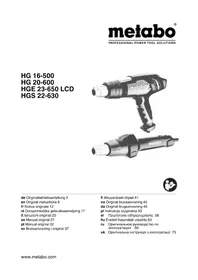
HG 16-500
HG 20-600
Original instructions
1. Specified Use
The heat gun is suitable for the following tasks: Removal of old paint coats, drying of freshly applied paint, thawing of frozen water lines, heating of plastics prior to forming, soldering (e.g. of copper lines), gluing and jointing with hot-melt-type adhesives, welding of plastics.
This tool is not designed for use by persons (including children) with physical, sensory or mental disabilities, or with insufficient experience and/or knowledge, unless they are supervised by a person responsible for their safety, or have received instructions on how to use the tool by this person.
The user bears sole responsibility for any damage caused by improper use. Generally accepted accident prevention regulations and the enclosed safety information must be observed.
2. General Safety Instructions
IMPORTANT SAFETY INSTRUCTIONS READ THESE INSTRUCTIONS
UL WARNING: Read this instruction book before using. To reduce risk of fire or electric shock, do not expose to rain or moisture. Store indoors. Double insulated. When servicing, use only identical replacement parts. When using electric tools, basic safety precautions should always be followed to reduce risk of fire, electric shock and personal injury. This hot air gun operates at 1200°F with no visual indication of temperature (no flame). Never leave device unattended. Otherwise risk of fire. The heat stream at the outlet nozzle will burn flesh. Do not turn on heat gun with hand in front of nozzle. DO NOT USE NEAR COMBUSTIBLE LIQUIDS. DO NOT USE FOR:
• Heating gas engines
• Heating car batteries
- Thawing refrigerator equipment.
alifornia Prop 65 08_2018
WARNING Some dust created by power sanding, sawing, grinding, drilling, and other construction activities contains chemicals known to cause cancer, birth defects or other reproductive harm. Some examples of these chemicals are:
- Lead from lead-based paints,
- Crystalline silica from bricks and cement and other masonry products, and
- Arsenic and chromium lumber.
Your risk from these exposures varies, depending on how often you do this type of work. To reduce your exposure to these chemicals: work in a well ventilated area, and work with approved safety equipment, such as those dust masks that are specially designed to filter out microscopic particles.
WARNING!
This tool is capable of producing temperatures up to 1200°F of flameless heat at the nozzle. ALWAYS:
- Direct the heat away from yourself and others.
- Prevent ignition of combustible materials on or near the workpiece.
- Prevent blockage of intake and nozzle openings.
- Keep a fully charged fire extinguisher on hand.
- Allow the nozzle and accessory tips to cool to room temperature before storage.
Cautions
-
WARNING: Hidden areas such as behind walls, ceilings, floors, soffit boards and other panels may contain flammable materials that could be ignited by the heat gun when working in these locations. The ignition of these materials may not be readily apparent and could result in property damage and injury to persons. Do not use if in doubt about this hazard. When working in these locations, keep the heat gun moving in a back-and-forth motion. Lingering or pausing in one spot could ignite the panel or the material behind it.
-
This heat gun can produce up to 1200° F of flameless heat at the nozzle. Do not direct airstream at clothing, hair or other body parts. Do not use as a hair dryer.
-
Do not use near flammable liquids or in an explosive environment (fumes, gases or dust). Remove materials or debris, that may become ignited, from work area.
-
Always hold tool by plastic enclosure. The metal nozzle requires approximately 20 minutes to cool to where it can be touched. Do not touch nozzle or accessory tips until cool.
-
Do not store tool until nozzle has cooled to room temperature. Place tool in a clear area away from combustible materials while cooling.
-
Do not cut off airflow by placing nozzle too close to workpiece. Keep intake vents clean and clear of obstructions.
-
Place tool on a level surface with the support rubber ring when tool is not hand held. Place cord in a position that won't cause tipping.
-
Do not leave tool unattended while running or cooling down. Otherwise risk of fire.
-
Keep a fully charged fire extinguisher nearby.
-
Do not direct airflow directly on glass.
-
Shield materials around the heated area to prevent damage or fire.
-
Use only with 120 V AC voltage.
-
Do not use in wet conditions.
-
Not to be used by children. This is not a toy and should be respected.
-
Do not use in bath or over water.
- Safety glasses should be worn when using this tool.
- It is recommended that leather gloves be worn when using a heat gun.
- Always unplug after use.
ENGLISHen
- WARNING: Extreme care should be taken when stripping paint. The peelings, residue and vapors of paint may contain lead, which is poisonous. Any pre-1977 paint may contain lead and paint applied to homes prior to 1950 is likely to contain lead. Once deposited on surfaces, hand to mouth contact can result in the ingestion of lead. Exposure to even low levels of lead can cause irreversible brain and nervous system damage; young and unborn children are particularly vulnerable. Before beginning any paint removal process you should determine whether the paint you are removing contains lead. This can be done by your local health department or by a professional who uses a paint analyzer to check the lead contact of the paint to be removed. LEAD-BASED PAINT SHOULD ONLY BE REMOVED BY A PROFESSIONAL AND SHOULD NOT BE REMOVED USING A HEAT GUN.
Persons removing paint should follow these guidelines.
- Move the work piece outdoors. If this is not possible, keep the work area well ventilated. Open the windows and put an exhaust fan in one of them. Be sure the fan is moving the air from inside to outside.
- Remove or cover any carpets, rugs, furniture, clothing, cooking utensils and air ducts.
- Place drop cloths in the work area to catch any residue. Wear protective clothing such as extra work shirts, overalls and hats.
- Work in one room at a time. Furnishings should be removed or placed in the center of the room and covered. Work areas should be sealed off from the rest of the dwelling by sealing doorways with drop cloths.
- Children, pregnant or potentially pregnant women and nursing mothers should not be present in the work area until the work is done and all clean up is complete.
- Wear a dust respirator mask or a dual filter (dust and fume) respirator mask which has been approved by the Occupational Safety and Health Administration (OSHA), the National Institute of Safety and Health (NIOSH), or the United States Bureau of Mines. These masks and replaceable filters are readily available at major hardware stores. Be sure the mask fits. Beards and facial hair may keep masks from sealing properly. Change filters often. DISPOSABLE PAPER MASKS ARE NOT ADEQUATE.
- Use caution when operating the heat gun. Keep the heat gun moving as excessive heat will generate fumes which can be inhaled by the operator.
- Keep food and drink out of the work area. Wash hands, arms and face and rinse mouth before eating or drinking. Do not smoke or chew gum or tobacco in the work area.
- Clean up all removed residue and dust by wet mopping the floors. Use a wet cloth to clean all walls, sills and any other surface where residue or dust is clinging. DO NOT SWEEP, DRY DUST OR VACUUM. Use a high phosphate detergent or
trisodium phosphate (TSP) to wash and mop areas.
- At the end of each work session put the residue and debris in a double plastic bag, close it with tape or twist ties, and dispose of properly.
- Remove protective clothing and work shoes in the work area to avoid carrying dust into the rest of the dwelling. Wash work clothes separately. Wipe shoes off with a wet rag that is then washed with the work clothes. Wash hair and body thoroughly with soap and water.
SAVE THESE INSTRUCTIONS
Double Insulated Tools
Tools marked with the words "Double Insulated" are equipped with a two prong plug. These tools have a special insulation system that complies with applicable UL standards. They do not require grounding. "Double Insulated" tools, like this one, have two prong cords and can use either a two or three prong extension cord.
"This appliance has a polarized plug (one blade is wider than the other). To reduce the risk of electric shock, this plug is intended to fit in a polarized outlet only one way. If the plug does not fit fully in the outlet, reverse the plug. If it still does not fit, contact a qualified electrician. Do not modify the plug in any way."
Extension Cords
As the distance from the supply outlet increases, heavier gauge extension cords are required. The use of extension cords of inadequate size wire causes a serious drop in voltage and loss of power. Protect the cord from damage. Keep cords away from excessive heat, sharp edges and damp or wet areas.
Don't use or repair damaged extension cords.
If the cord is installed in contact with the ground:
- It shall not be placed where exposed to foot traffic by persons (e.g. at gate openings),
- Where there is a risk of continuous immersion in water,
- Where its presence is likely to be concealed by combustible materials (e.g. loose hay), or
- Where machinery can roll over it.
If the cord or fittings are damaged or worn, do not try to repair them. Discontinue use and replace with a new cord.
Ext. Cord Length Wire Size
040 Ft. 16
085 Ft. 14
100 Ft. 12
170 Ft. 10
270 Ft. 8
400 Ft. 6
650 Ft. 4
3. Special Safety Instructions

For your own protection and for the protection of your power tool, pay attention to all parts of the text that are marked with this symbol!
Never look inside the outlet tube!
Never use the heat gun for drying your hair!
Always wear goggles and workgloves!
Take special care when using the heat gun near combustible materials or explosive gases.
Children should be supervised to ensure that they do not play with the tool.
Risk of burns: Never touch the hot outlet tube.
Never use power tools when damp, or in a damp or wet environment.
Take special care when using tools near combustible materials. Never direct at the same point for long periods.
Heat can be directed to concealed combustible materials.
Never direct the heat gun at highly flammable materials! Fires can be caused if the heat gun is not used with great care.
Never leave the tool unattended when it is running.
After long periods of use at maximum temperature, the temperature should be lowered before the tool is switched off. This lengthens the service life of the heater.
Place the tool on the bases provided following use and wait until it has cooled down before placing in storage!
Store your tools in a safe place.
Unused tools should be stored in a dry, locked room inaccessible to children.
Always take care where there are toxic gases and a risk of explosion.
Toxic can be created when working on plastics, paints and similar materials. Risk of fire and combustion!
Only use the heat gun in well-ventilated rooms!
Never inhale the vapours created!
For your own safety, only use accessories and auxiliary devices specified in the Operating Instructions or recommended or specified by the tool manufacturer. The use tools or accessories other than those recommended in the Operating Instructions or in the catalogue can result in a risk of injury.
Symbols on the tool:
☐ ......Class II Construction
V ...... volts
A ......amperes
W ......watts
Hz...... hertz
\~ ...... alternating current
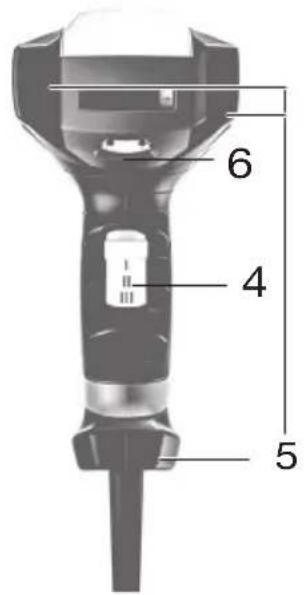
4. Overview
See page 2.
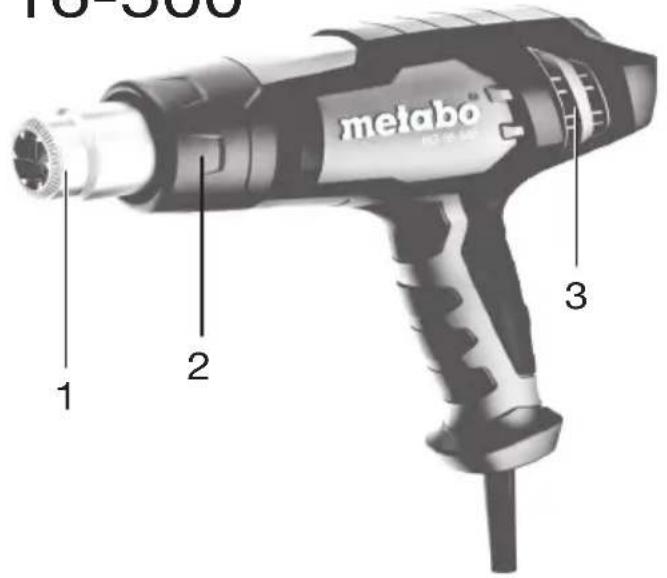
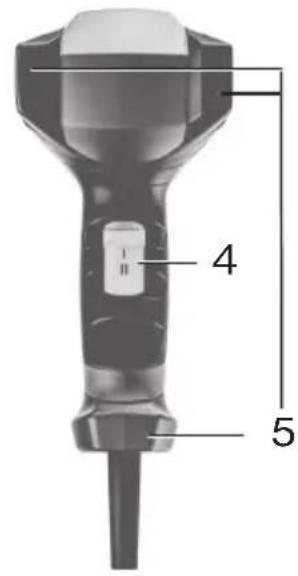
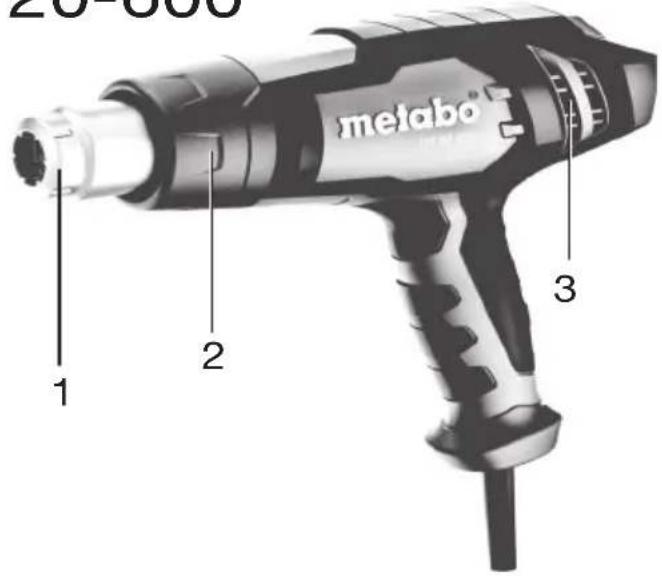
1 Stainless steel blow-out pipe
2 Detachable protective tube (for areas that are difficult to access)
3 Air inlet
4 Sliding switch (On-off switch/stepping switch)
5 Anti-slip bases (for non-tilting and anti-slip stationary work applications)
6 Adjusting wheel for setting the temperature*
* depending on the features / model
5. Use
Before commissioning, check that the rated mains voltage and mains frequency stated on the type plate match your power supply.
The distance to the object being processed depends on the material and intended processing type. Always first carry out an inspection of air volume and temperature! The attachable nozzles (see chapter 8.) available as accessories can be used for precise hot air control to a specific point or a surface.
Take care when changing hot nozzles! Danger of burns.
5.1 HG 16-500
The sliding switch (4) can be used to switch the tool on and off for selecting between 2 stages (for air volume and temperature).
Stage 1: 570 °F, 7.5 cf/min
Stage 2: 930 °F, 12.5 cf/min
5.2 HG 20-600
The sliding switch (4) can be used to switch the tool on and for selecting between 3 stages.
The air volume varies in the 3 stages (3,8/7,8/13,2 cf/min).
At stage 1 of the sliding switch (4) the temperature is always 120° F (cold-air stage). Use the cold-air stage to dry paint, cool workpieces or to cool down the nozzle before changing an accessory part.
At stage 2 and 3 of the sliding switch (4), the temperature can be set steplessly at the adjusting wheel (6).
The numbers 1 - 9 shown on the adjusting wheel are used for orientation. "1" means 120 °F."9" means 1100 °F (maximum temperature).
5.3 Stationary operation
If you wish to use the hot-air blower as a stationary tool, ensure that it is placed on a safe, anti-slip and clean base.
To use the hot air gun in stationary operation, place it on the anti-slip bases (5).
ENGLISHen
6. Servicing
The air inlet (3) with grid must be free of foreign bodies. Clean the air inlet (3) if necessary.
7. Troubleshooting
Thermal protection
The thermal fuse switches the tool off completely in the event of overloading.
Short-term voltage drops
Switching on the machine reduces the voltage briefly. Unfavourable mains power conditions may have a detrimental effect on other machines. Network impedances less than 0.4 ohms should not cause malfunctions.
8. Accessories
Use only genuine Metabo accessories.
If you need any accessories, check with your dealer.
For a complete range of accessories, see www.metabo.com or the catalogue.
9. Repairs

Repairs to electrical tools must be carried out by qualified electricians ONLY!
A defective mains cable must be replaced only with a special, original mains cable from Metabo available from the Metabo service.
If you have Metabo electrical tools that require repairs, please contact your Metabo service centre. For addresses see www.metabo.com.
You can download spare parts lists from www.metabo.com.
10. Environmental Protection
Metabo's packaging can be 100% recycled.
Scrap power tools and accessories contain large amounts of valuable resources and plastics that can be recycled.
These instructions are printed on chlorine-free bleached paper.
11. Technical Specifications
HG 16-500
Rated mains voltage: 120 V
Rated mains frequency:50/60 Hz
Output: 1300 W
Air temperature: Stage 1: 570 °F
Stage 2:930 °F
Air volume: Stage 0:Off
Stage 1:7,5 cf/min
Stage 2:12.5 cf/min
Thermal protection: thermal fuse
Weight: 26.1 oz (740 g)
HG 20-600:
Rated mains voltage: 120 V
Rated mains frequency:50/60 Hz
Output: 1500 W
Air temperature: Stage 1: 120 °F
Stage 2:120-1100 °F
Stage 3:120-1100 °F
Air volume: Stage 0:Off
Stage 1:3,8 cf/min
Stage 2:7.8 cf/min
Stage 3:13.2 cf/min
Temperature
adjustment: stepless in 9 stages per adjusting wheel Thermal protection: thermal fuse
Weight: 29.6 oz (840 g)
Changes due to technological progress reserved.
□ Machine in protection class II
The technical specifications quoted are subject to tolerances (in compliance with the relevant valid standards).
Notice originale


- ORIGINAL INSTRUCTIONS
- SPECIFIED USE
- GENERAL SAFETY INSTRUCTIONS
- IMPORTANT SAFETY INSTRUCTIONS READ THESE INSTRUCTIONS
- WARNING SOME DUST CREATED BY POWER SANDING, SAWING, GRINDING, DRILLING, AND OTHER CONSTRUCTION ACTIVITIES CONTAINS CHEMICALS KNOWN TO CAUSE CANCER, BIRTH DEFECTS OR OTHER REPRODUCTIVE HARM. SOME EXAMPLES OF THESE CHEMICALS ARE
- WARNING
- CAUTIONS
- ENGLISHEN
- SAVE THESE INSTRUCTIONS
- DOUBLE INSULATED TOOLS
- EXTENSION CORDS
- SPECIAL SAFETY INSTRUCTIONS
- OVERVIEW
- USE
- 5.1 HG 16-500
- 5.2 HG 20-600
- 5.3 STATIONARY OPERATION
- SERVICING
- TROUBLESHOOTING
- THERMAL PROTECTION
- SHORT-TERM VOLTAGE DROPS
- ACCESSORIES
- REPAIRS
- ENVIRONMENTAL PROTECTION
- TECHNICAL SPECIFICATIONS
- NOTICE ORIGINALE
Brand : METABO
Model : HG 16500
Category : Heat gun