HGL64SCF C - Cooker HOOVER - Free user manual and instructions
Find the device manual for free HGL64SCF C HOOVER in PDF.



| Product type | Gas cooker with electric hob |
| Brand | Hoover |
| Model | HGL64SCF C |
| Dimensions (W x D) | 585 x 510 mm |
| Electrical supply | 220-240 V ~ 50/60 Hz |
| Total electrical power | 1500 W |
| Total gas power | 5.4 kW (G20) or 393 g/h (G30) |
| Number of gas burners | 3 (1 auxiliary, 1 semi-rapid, 1 rapid) |
| Electric hob | 1 hob (plancha) of 1500 W |
| Ignition | Integrated electronic |
| Gas safety | Thermocouple on each burner |
| Installation class | 3 |
| Compatible gas types | Natural gas (G20) or butane/propane (G30) – adaptable |
| Material | Stainless steel (enamelled and chrome parts) |
| Maintenance and cleaning | Soapy hot water for burners; stainless steel cleaner for steel; do not use steam |
| Repairability | Injectors and spare parts available via approved service |
| General information | Domestic use; compliant with European directives |
Frequently Asked Questions - HGL64SCF C HOOVER
User questions about HGL64SCF C HOOVER
0 question about this device. Answer the ones you know or ask your own.
Ask a new question about this device
Download the instructions for your Cooker in PDF format for free! Find your manual HGL64SCF C - HOOVER and take your electronic device back in hand. On this page are published all the documents necessary for the use of your device. HGL64SCF C by HOOVER.
USER MANUAL HGL64SCF C HOOVER
BAPOUHbIE NOBEPXHOCTN
HCTPYKUNIPOJIb3OBATEJRA
NAVODILA ZA UPORABO
VGRADNJO IN PRIKLJUCITEV SL
PIANI COTTURA
ISTRUZIONI PER L'USO IT
PLACAS
INSTRUÇÉS DE UTILIZAZão PT
TÜZHELYLAPOK
- Instructions For The Installer 05
1.1. Building In .05
1.2. Suitable Location .05 - Electrical Connection (For U.K. Only) .05
2.1. Electrical Connection 05
2.2. Gas Connection (For U.K. Only). 05
2.3. Adapting The Hob To Different Types Of Gas 06
2.4.Regulating The Minimum Flame.. 06
3.Use Of Hob-User Instructions .06
3.1. Using The Gas Burner 06
3.2.Use Of Cooktop Electrical Plates .06 - Maintenance and Cleaning 07
- Aftercare 07
- Protection Of The Environment 07
OBSAH
CZ
- Pokyny pro instalatéra 11
1.1 Vestavba 11
1.2 Vhodné misto instalace 11
2.1. Pripojenik elektrické siti 11
2.2.Pripojenif plynu 11
2.3.Zmena varne desky na jiny druh plynu 12
2.4. Nastaveni minimálho plamene 12 - Použiti varné desky 12
3.1.Pouziti plynového hořaku 12
3.2.Pouziti Elektrickych Ploten 12 - Udžba a Čišěné
5.Servis. 13
6.Ochrana zivotniho prostefedi 13
CONTENIDO
ES
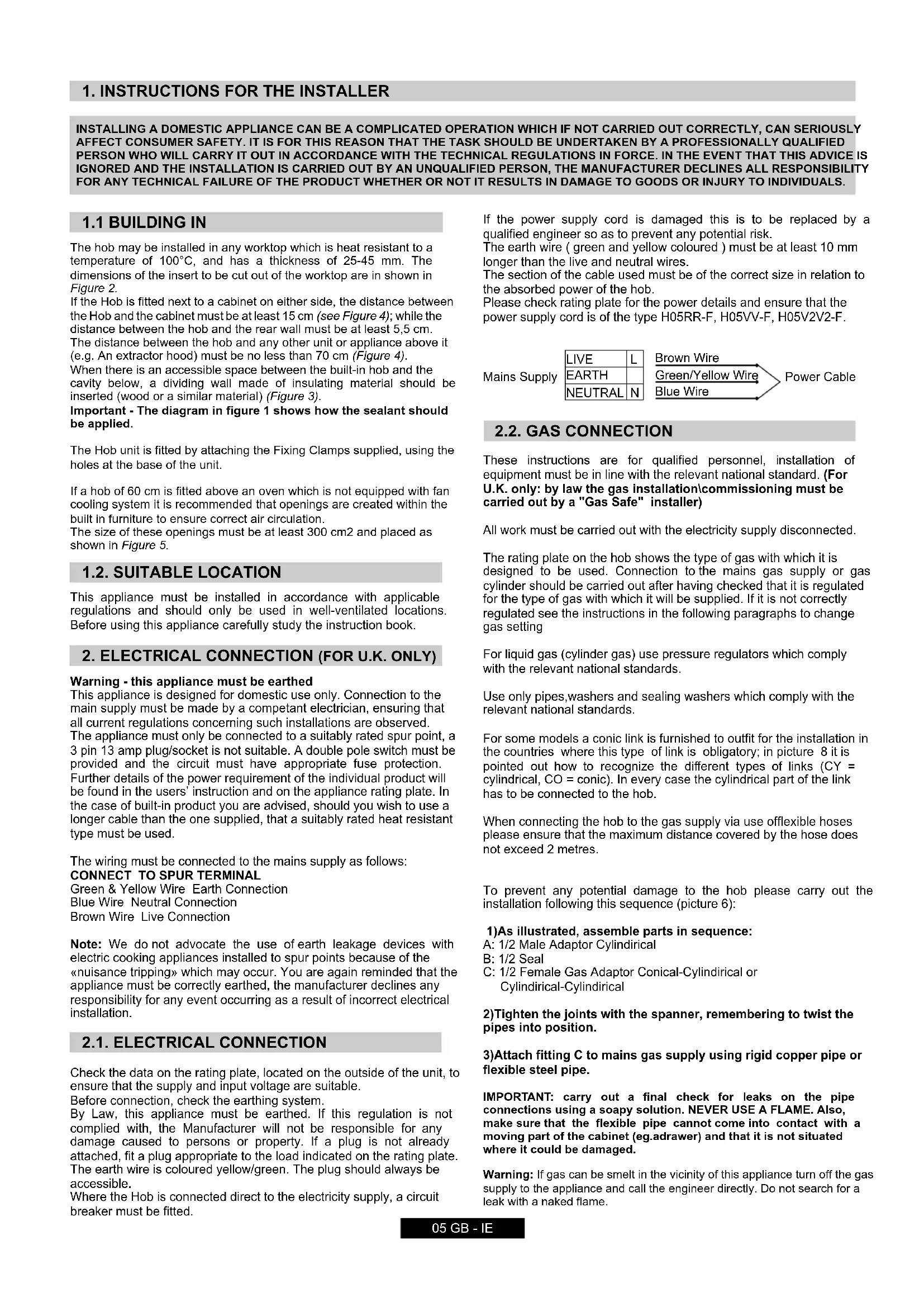
The hob may be installed in any worktop which is heat resistant to a temperature of 100^ and has a thickness of 25-45 mm. The dimensions of the insert to be cut out of the worktop are in shown in Figure 2.
If the Hob is fitted next to a cabinet on either side, the distance between the Hob and the cabinet must be at least 15cm (see Figure 4); while the distance between the hob and the rear wall must be at least 5,5cm . The distance between the hob and any other unit or appliance above it (e.g. An extractor hood) must be no less than 70cm (Figure 4). When there is an accessible space between the built-in hob and the cavity below, a dividing wall made of insulating material should be inserted (wood or a similar material) (Figure 3).
Important - The diagram in figure 1 shows how the sealant should be applied.
The Hob unit is fitted by attaching the Fixing Clamps supplied, using the holes at the base of the unit.
If a hob of 60~cm is fitted above an oven which is not equipped with fan cooling system it is recommended that openings are created within the built in furniture to ensure correct air circulation.
The size of these openings must be at least 300cm^2 and placed as shown in Figure 5.
1.2. SUITABLE LOCATION
This appliance must be installed in accordance with applicable regulations and should only be used in well-ventilated locations. Before using this appliance carefully study the instruction book.
2. ELECTRICAL CONNECTION (FOR U.K. ONLY)
Warning - this appliance must be earthed
This appliance is designed for domestic use only. Connection to the main supply must be made by a competent electrician, ensuring that all current regulations concerning such installations are observed. The appliance must only be connected to a suitably rated spur point, a 3 pin 13 amp plug/rod is not suitable. A double pole switch must be provided and the circuit must have appropriate fuse protection. Further details of the power requirement of the individual product will be found in the users' instruction and on the appliance rating plate. In the case of built-in product you are advised, should you wish to use a longer cable than the one supplied, that a suitably rated heat resistant type must be used.
The wiring must be connected to the mains supply as follows: CONNECT TO SPUR TERMINAL
Green & Yellow Wire Earth Connection
Blue Wire Neutral Connection
Brown Wire Live Connection
Note: We do not advocate the use of earth leakage devices with electric cooking appliances installed to spur points because of the «nuisance tripping» which may occur. You are again reminded that the appliance must be correctly earthed, the manufacturer declines any responsibility for any event occurring as a result of incorrect electrical installation.
2.1. ELECTRICAL CONNECTION
Check the data on the rating plate, located on the outside of the unit, to ensure that the supply and input voltage are suitable.
Before connection, check the earthing system.
By Law, this appliance must be earthed. If this regulation is not complied with, the Manufacturer will not be responsible for any damage caused to persons or property. If a plug is not already attached, fit a plug appropriate to the load indicated on the rating plate. The earth wire is coloured yellow/green. The plug should always be accessible.
Where the Hob is connected direct to the electricity supply, a circuit breaker must be fitted.
If the power supply cord is damaged this is to be replaced by a qualified engineer so as to prevent any potential risk.
The earth wire (green and yellow coloured) must be at least 10mm longer than the live and neutral wires.
The section of the cable used must be of the correct size in relation to the absorbed power of the hob.
Please check rating plate for the power details and ensure that the power supply cord is of the type H05RR-F, H05VV-F, H05V2V2-F.
| Mains Supply | LIVE | L | Brown Wire |
| EARTH | Green/Yellow Wire | ||
| NEUTRAL | N | Blue Wire |
2.2. GAS CONNECTION
These instructions are for qualified personnel, installation of equipment must be in line with the relevant national standard. (For U.K. only: by law the gas installation/commissioning must be carried out by a "Gas Safe" installer)
All work must be carried out with the electricity supply disconnected.
The rating plate on the hob shows the type of gas with which it is designed to be used. Connection to the mains gas supply or gas cylinder should be carried out after having checked that it is regulated for the type of gas with which it will be supplied. If it is not correctly regulated see the instructions in the following paragraphs to change gas setting
For liquid gas (cylinder gas) use pressure regulators which comply with the relevant national standards.
Use only pipes, washers and sealing washers which comply with the relevant national standards.
For some models a conic link is furnished to outfit for the installation in the countries where this type of link is obligatory; in picture 8 it is pointed out how to recognize the different types of links (CY = cylindrical, CO = conic). In every case the cylindrical part of the link has to be connected to the hob.
When connecting the hob to the gas supply via use of flexible hoses please ensure that the maximum distance covered by the hose does not exceed 2 metres.
To prevent any potential damage to the hob please carry out the installation following this sequence (picture 6):
1)As illustrated, assemble parts in sequence:
A: 1/2 Male Adaptor Cylindrical
B:1/2 Seal
C: 1/2 Female Gas Adaptor Conical-Cylindrical or Cylindrical-Cylindrical
2) Tighten the joints with the spanner, remembering to twist the pipes into position.
3)Attach fitting C to mains gas supply using rigid copper pipe or flexible steel pipe.
IMPORTANT: carry out a final check for leaks on the pipe connections using a soapy solution. NEVER USE A FLAME. Also, make sure that the flexible pipe cannot come into contact with a moving part of the cabinet (eg.adrawer) and that it is not situated where it could be damaged.
Warning: If gas can be smelt in the vicinity of this appliance turn off the gas supply to the appliance and call the engineer directly. Do not search for a leak with a naked flame.
2.3. ADAPTING THE HOB TO DIFFERENT TYPES OF GAS
To adapt the Hob for use with different types of gas, carry out the following instructions:
remove the grids and burners
- insert on hexagonal spanner (7 mm) into the burner support (Figure 7)
- Unscrew the injector and replace it with one suitable for the gas to be used (see gas type table)
2.4. REGULATING THE MINIMUM FLAME
After lighting the burners, turn the control knob to the minimum setting and then remove the knob (this can easily be removed by applying gentle pressure).
Using a small «Terminal» type screwdriver the regulating screw can be adjusted as in Figure 9. Turning the screw clockwise reduces the gas flow, whilst turning it anticlockwise increases the flow - Use this adjustment to obtain a flame of approximately 3 to 4mm in length and then replace the control knob.
When the gas supply available is LPG - the screw to set the idle flame must be turned (clockwise) to the end stop.
When you have carried out the new gas regulation, replace the old gas rating plate on your appliance with one (supplied with hob) suitable for the type of gas for which it has been regulated.
3. USE OF HOB - USER INSTRUCTIONS
This appliance must only be used for the purpose for which it is intended, domestic cooking, and any other use will be considered improper and could therefore be dangerous. The Manufacturer will not be responsible for any damage or loss resulting from improper use.
This appliance is not intended for use by persons (including children) with reduced physical, sensory or mental capabilities, or lack of experience and knowledge, unless they have been given supervision or instruction concerning use of the appliance by a person responsible for their safety.
Children should be supervised to ensure that they do not play with the appliance.
To ignite the burners, place a lighted taper close to the burner, press in and turn the control knob anti-clockwise.
If the burners have not been used for a couple of days, wait for a few seconds before lighting the burner, this will allow any air present in the pipes to escape.
For appliances fitted with electronic ignition carry out the following:
-
push in and turn the knob anticlockwise to the ignition symbol.
-
ignite the burner by pressing the sparker button.
For hobs fitted with automatic ignition simply push in and turn the knob to the ignition symbol.
The ignition system will continue to generate sparks as long as the control knob is being pressed.
If the burner has not ignited within 5 seconds, turn the knob to the 0 position and repeat the operation.
For models fitted with a safety tap (which cuts-off the flow of gas if the flame is accidentally extinguished) the burners are ignited and described above, but care must be taken.
Prior to switching on the gas hob ensure that the burners and burner caps are correctly placed within their position.
GENERAL ADVISE
For best results, use cooking vessels with a flat surface. The size of the surface should match the gas burner side as follows. Table A.
Table A
| Burner Type | Ø pan / pot (cm) | |
| AUX | Auxiliary Burner | 12 - 18 |
| SR | Semi Rapid Burner | 18 - 24 |
| R | Rapid Burner | 24 - 26 |
For smaller containers the gas burner should be regulated so that the flame does not overlap the base of the pan. Vessels with a concave or convex base should not be used.
WARNING: If a flame is accidentally extinguished, turn the knob to the off position and do not attempt to re-ignite if for at least 1 minute.
If over the years the gas taps become stiff to turn it is necessary to lubricate them.
Such operation must be carried out only by qualified Service Engineers.
3.2. USE OF COOKTOP ELECTRICAL PLATES
Turn the knob to the position for the required temperature of the hot plate. The indicator light of the hot plate will come on and the hot plate will start to heat.
When cooking is completed, turn the knob to the "O" position. (Figure 10). Do not leave the hot plate turned on without a pan on it. The diameter and the base of the pan you use is critical. The maximum diameter of the pan base is 14cm and the base should be flat.
Leave the hot plate to heat up for 5 minutes before placing a pan on it. The first time you use it. This will allow the heat resistant coating of the plate to harden due to burning.
Use a wet cloth and detergent for cleaning the hot plates. Do not remove food residues from the hot plates with a knife or any other hard, sharp object.
Turn on the hot plate for a few moments to dry it after cleaning. However, it must never be left on for more than a few moments without a pan on top.
| Position | Power (Watt) | Power (Watt) | Explanation |
| 0 | 0 | 0 | Off |
| 1 | 100 W | 135 W | Heating |
| 2 | 180 W | 220 W | Cooking at low temperature |
| 3 | 250 W | 300 W | Cooking at low temperature |
| 4 | 500 W | 850 W | Cooking, Roasting, Boiling |
| 5 | 750 W | 1150 W | Cooking, Roasting, Boiling |
| 6 | 1000 W | 1500 W | Cooking, Roasting, Boiling |
Suitability of Cooking Pans (Figure 11)
Keep in mind that larger pans have larger heating surfaces.
This will help them to cook the food faster than pans with smaller heating surfaces.
Always use pan sizes proportionate to the amount of the food to be cooked. In order to prevent splashing, do not use very small pans, especially for foods with excess liquid. If you use excessively large pans for quick cooked foods, sausages and liquids will stick and residues will remain attached to the pan after being emptied.
Closed pans and baking trays or moulds are suggested for cooking sweets. Splashed sugar and juices from an open pan may stick to the cooker surface and will be difficult to remove.
This is especially important for pans used for roasting or pressurized cooking at high temperature.
Do not leave burners unattended without a pan or with an empty pan on top.
Check the suitability of cooking pans with respect to the following criteria:
They should be heavy.
They should completely cover the burner surface; they may be a little bigger but no smaller.
Base surfaces should be completely flat and fit well on the cooking surface.
- For the best use of the electric hotplates and to minimize energy consumption, only pans with smooth flat bases should be used. The size of the pan should be as close as possible to the diameter of the hotplate, and never smaller. The base of the pan should be dry and spillage should be avoided. Empty pans must not be left on the plates, and the plates should not be left switched on without a pan.
4. MAINTENANCE AND CLEANING
Before cleaning the hob, ensure the appliance has cooled down. Remove the plug from the socket or (if connected directly) switch off the electricity supply.
Never use abrasives, corrosive detergents, bleaching agents or acids. Avoid any acid or alkaline substances (lemon, juice, vinegar etc.) on the enamelled, varnished or stainless steel sections.
"WARNING" - Do not use a steam cleaner to clean the hob.
When cleaning the enamelled, varnished or chrome sections, use warm soapy water or a non caustic detergent. For stainless steel use an appropriate cleaning solution.
The burners can be cleaned with soapy water. To restore their original shine, use a household stainless steel cleaner. After cleaning, dry the burners and replace.
It is important the Burners are replaced correctly.
5. AFTERCARE
Before calling out a Service Engineer please check the following:
- that the plug is correctly inserted and fused;
- that the gas supply is not faulty.
If the fault cannot be detected:
Switch off the appliance and call the After Service Centre. DO NOT TAMPER WITH THE APPLIANCE.
6. PROTECTION OF THE ENVIRONMENT
This appliance is marked according to the European directive 2002/96/EC on Waste Electrical and Electronic Equipment (WEEE). By ensuring this product is disposed of correctly, you will help prevent potential negative consequences for the environment and human health, which could otherwise be caused by inappropriate waste handling of this product.
The symbol on the product indicates that this product may not be treated as household waste. Instead it shall be handed over to the applicable collection point for the recycling of electrical and electronic equipment.
Disposal must be carried out in accordance with local environmental regulations for waste disposal.
For more detailed information about treatment, recovery and recycling of this product, please contact your local city office, your household waste disposal service or the shop where you purchased the product.
Declaration of compliance: This equipment, in the parts intended to come into contact with food, complies with the regulations laid down in EEC directives 89/109.
CE Appliance complies with European Directives 73/23/EEC and 89/336/EEC, replaced by 2006/95/EC and 2004/108/EC, and subsequent amendments.
The Manufacturer will not be responsible for any inaccuracy resulting from printing or transcript errors contained in this brochure. We reserve the right to carry out modifications to products as required, including the interests of consumption, without prejudice to the characteristics relating to safety or function.
Table 1
| BUILT IN HOBS | ||
| Burner | 1 | 2 |
| 4 gasR /2SR / AUX | 3 gasR / SR / AUX / E | |
| Type / reference | S60 / HBGS | S60 / HBGS |
| Flame failure device | YES | YES |
| Auxiliary burner ( AUX Ø 50 mm) | 1 | 1 |
| Electric Plate | - | 1 |
| Semirapid burner ( SR Ø 75 mm) | 2 | 1 |
| Rapid burner ( R Ø 100 mm) | 1 | 1 |
| Installed Gas Type / Power: | ||
| Gas Power | 7.1 kW | 5.4 kW |
| G 20/20 mbar (methane) | 676 l/h | 514 l/h |
| G 30/28-30 mbar (LPG) | 516 g/h | 393 g/h |
| Installation Class | 3 | 3 |
| Voltage / Frequency V / Hz | 220-240 V / 50-60 Hz | 220-240 V / 50-60 Hz |
| Electrical input power | 15 W | 1500 W |
| Electric ignition | YES | YES |
| Product dimension | 585 x 510 | 585 x 510 |
This appliance has been designed for non-professional, i.e. domestic, use.
1. INSTALLATION
LA MISE EN PLACE FONCTIONNELLE DES APPAREILS MENAGERS DANS LEUR ENVIRONNEMENT EST UNE OPÉRATION DÉLICATE QUI, SI ELLE N'EST PAS CORRECTEMENT EFFECTUÉE, PEUT AVOIR DE GRAVES CONSEQUENCES SUR LA SECURITE DES CONSOMMATEURS. DANS CES CONDITIONS, IL EST IMPÉRATIF DE CONFIER CETTE TACHER À UN PROFESSIONNEL QUI LA RÉALISERA CONFORMÉMENT AUX NORMES TECHNIQUES EN VIGUEUR. SI MALGRÉ CÉTTE RECOMMANDATION, LE CONSOMMATEUR RÉALISAIT LUI-MÉME L'INSTALLATION, LE CONSTRUCTEUR DÉCLINERAIT TOUTE RESPONSABILITÉ EN CAS DE DÉFAILLANCE TECHNIQUE DU PRODUIT ENTRAINANT OU NON DES DOMMAGESA UX BIENS ET/OUA UX PERSONNES.
1.1. ENCASTREMENT
1.2 VHODNÉ MISTO INSTALACE
Tento spotbrebi musi byt instalovan v souladu s platnymi predpisy a smi se pouzivat pouze v dobre vetranych mistrnostech. Pred pouzitim spotbrebi ci prostudujte navod k pouziti.
3eeneHO-KeJITbI npOBd
3emJra
CnHnnpOBoD
Heitpanb
KopuHHeBbI npoBOd
Φa3a
PnmeaHne: He noKnIOaHte BapOHyIO nobepxHocTb uepe3 yCTpOCTBO ObHApXeHnry YeUKN ToKa Ha 3emNIO, TAK KaK 3TO MoXeT npBecTN K "NoXhBM OTKNOueHnM". Eue pa3 HanOMnHaem, YTO 3NeKTponPi6Op DonKeH beBtI npABnHbHO 3aEMeH, N TO npOn3BOuNTeB He npINHMaeT HkAIX pNeTeH3N B cNyuae NobpeXdHn I HeCacTHbIX CNYaEB, BO3NHkUnx B peynbTaTE HnpabInbHOrO NOKnIOueHn HNEKTponPi6oPA K 3NeKTPOcETn.
2.1. NOДКЛIOUЧЕНЕ K 3JIΕΚΤΡΟСЕТИ
PpOBeBpTe DaHbIe, npBHeDHHbIe B NaCnOpTHo TaBmUKe, 3aKpenneHHo CHaPyKHaBaPOuHOH NOBepxHOCTN, DnA TORO, YTO6bly6bDnTcB A TOM, CTO BXoHoe HApPrKeHMe BAPoOH NoBepxHOCTN COOTBeTCTByeT HApPrKeHMo 3JIeKTPOCeTI.
Ipeep noKJIIOUeHEm BapOHn NOBepxHOCTN K 3JIeKTPocETn IPOBepBe CNTcEMy 3a3EMHeHr.
DAnHHb 3NeKtpnpn6p o8a3aTeNbHO DoJKeH 6bItb 3a3eMneH. B cnyae HecO6HIOEHNr 3TOr Tpe6oBHaNr PnO3BOIeNB ChMaet C c6b4 OTBeTcBeHHoCT 3a HaHeceHEn BPe DaIOPOBbIO IIODe N NOBpeXeHNE IMyueCTBa.ECN K Ka6eHIO NtAHNA He NOOcEOHnE HBNaKa, NOOcEOHnITe K Ka6eHIO NtAHNA BNJKy, HarpyOCHNA CNOco6HOCTb KOTOPONCOBTCTBYe Yka3aHHo B NaCnOpTHoT Ta6Nnue. PIOBOD 3a3eMNEHn IMMeET XeHTTo-3eHbI uEB. K 3NeKtpuueckoP03Etke DOnKeH BcERda OecneHnBaTbcB CBO6OHDh IOCTyn.
EcnnBapouhna NoBepxHocbI noKJIIOUaTeCk KJNEKTPOcEt HnPpMyIO,TO DOnKeH6blTbYCTaHOBHeAHTOMaTHeCKN BbIKIOuATenB.
IpynpoTbpaueHnOnachocte3aMeHaNoBpeJeHHoroKa6enPiTuHnI DOnKHa BbInonHbTaCToJbKO KBaHmФuPObaHHbIM CneuaHCTOM.
PpOBOd 3a3eMnEHn (XeITo-3eHbI)doJIKeH 6bIT npIbIINrTeBHO Ha 10 MM dIIHHee PpOBODΦa3b I HeItpaII.
CeueHne npoBOdHKnOB Ka6eIaNTaHnI DOJXHO COOTBeTCTByET MOUHOCTH, NOTpe6JIeMoB BapOHyNOBepxHOCTbHO.
IPOBepTe 3aHHeMe MOUHOCTN, NOTpe6JIeMoH 3NEKtPONPi6OpOM, YkaaHaHoE B NaCnOpTnO H TaJIKe IPOBepTe. 7TO IcNOnb3yeTCa KaebIbNTAHINrTHoHSR-F,H05VV-FInn HO5V2V-F.
He pa3pewaIte dETM irpaTb c 3neKtpnp6opom.
3.1.NCIOJb3OBAHNE FA3OBOKOHΦOPKN
YTo6b3aKeey KoHΦopky, NOHeNCHTe K HeI 3axKeeHHyIO CnUky, HaxMITE Ha pyKy peRynipOBKn BbICOTbI NJaMeHN, INOBepHNTe ee npTINB YacOBoi CTpeKN.
Ecnn KOHOpKn He nCNOB3OBAInCb B TeueHne DByx mN 60one dHei, To npExd YeM 3aKeHb KOHOpKpy NDOXknte HeCKoJbKO cekyHd Inra TOrO, YToBbI N3 Tpybok BblweB Bo3dyx.
YTo6b3aKeCy KOHOpKy BapOHyON NOBepXHOCTN, Ch6KeHHyU OyTpoiCBOM 3NeKTPoONJkra, BBINOHnTE CneDyIOUne Opeaun:
- HaxMnTe Ha pyuKy peryIynpOBKn BbICOTbl PnAmEH N NOBepHnTe ee npTtB YacOBoN CTpeKN B NoJIOXeHne, O6O3NaeHHoe NOxNtra.
3axrnte KOHOpky C nOMOsbHnKaTnKHOKNK3JKeTPONoKnra.
EcnBapOHHa NOBepxHocb ChAbXeHa ABTOMaTHHeCKM
3JKeTPONoKnrom, npocTo HAXMMTe Ha pykY peyIpyoBKn BbICOTb
PnAmEHn YcTaHOBnTE eB NoIOXeHNe, OOb0HaHeHHe 3HaKOM
NoJNIRa.CnCTema 3JKeTPONoKnRa 6yDet NoCToHHo
reHepnoBaTB NcKpbI, Do Tex nop, NOka pyuKa peyIpyoBKn PnAmEH
6yDet HaxoDnTBcB HaxaTOM NoIOXeHNH.
EcnKoHΦopKa He 3aropaetcB TeueHHe 5 cekyH, yCTaHOBtpepyky peYInpOBKn B NOLOXeHHe 0, nIOBTOpTe ONICAHHy BblIe onepauHIO.
B MoDJIaX, Ch6KeHHbIX 3aUHTHbIM KlaIaNOM, KOToPbI bA ToMaTtueckn NepeKpbIbAeT NoJaY r3a B CnYae BHe3aNHorO nOracAHN IPiameHn, KOHΦOpKn 3aXnIaOTcR, KAK OINCAHO BIIe, HO npr 3OTM NocJe 3aXnIaHn KOHΦOpKn HeoXoDNMO Co6JIHOaTb OCTOpOXHOCTb.
Ipeep BkIIOHHeHem ra3OBoB BapOCHoN IOBepXHOCTn IpOBepbTe, YTO KOHOpKn I KpbIiKn KOHOpOK npaBnIbHO yCTaHOBneHbHa BapOCHyIO NOBepxHOCTb.
NOJE3HbIE COBETbl
IJIIOJUyHnHaNluyuHxpe3yJbTaTOB NOJIb3yHTecbCKOBOpOaMn I KAcTPhIOJYMaC PINOCKM DHom,pa3MePbKOTOpBX COOTBeTCTBYOT pa3MePam Ra3OBbX KOHΦopOK (cm.Ta5n.A).
Icnonb3yTe BnaXHyTO TkaHb N MoOuCeE cpeCTBO Dn OocNtKn NOBepxHOCTN 3neKTPoPNTbl. He nCnonb3yTe HOxN ININ dpYrNE OCTpBe I TBePdIe PpeMeTb dnn ydaNeHn OCTaTKOB INUIN C NOBepxHOCTN 3neKTPoPNTbl.
Iocne OHCTKN NOBepxHOCTN, BKNIOHTe 3JNEKTPONNTy Ha HeCKOJIbKO CEkyND Do NOnHoro BBICbIXAHNY KOHΦpOK. Ondako, He cneDyET OCTaIBTb NyCTyo 3JNEKTPONNTy BKIOUeHHoB Gonee Yem Ha HeCKOJIbKO CEkyND.
Iyra BbIneKn CnaKoro CneJyET NcNoJIb3ObaT 3aKpbITyo nocydy, npOTNBHmNfOpMy. PpONITbI cok nnn caxap m3 He3aKpBToI NOcyDb MOYr npINmHyTB K NOBepXHOCTN 3NEKTPoPnNTbI INx 6yDet TpyHo ydaJIbTb.
3To 0oc6eHHo BaxHO IJNA NocdyI DnJ KApKN INN rTOBKn NOd
dabJIeHMeM npu BbICOKO Temepatype.
He octabJIte 6e3 npcMoTpa ncyTu KOHΦOpKy INN KOHΦOpKy C
nyctOn nocyDo.
PpOBeBte COOTBETCTBnE Nocybl CneDyUoUM KpTepnM: OHa DoJIkha 6bITb TjKeJoI.
OHa DOnJHnONHOIOKpBIBaTb NOBepXHOCTb KOHΦOpKN;MOKeT 6bIb HEMHOro 60JIbIe, HO HN B KOem CNYae He MeHbIe.
HNO DOnJXHO 6bITb a6COJIHO NIOCKM N I NIOTH OpiIeratb K NOBepxHOCTn KOHΦOpKn.
4. OBCJNYKUBAHNE IN YNCTKA
Ipeep Tem kak npncTyntb K BblnoHEnHIO uNCTKN BapOHOH NOBepxHocTN, npOBepbTe, yTO OHa oCTbJIa. Bblte BNIKy n3 po3eTKn, INI (ecnn BapOHNA NOBepxHocTb NODcoEINHeHa K 3NeKTPocETn HAnpMyIO), BblkIOHTe NITAOUoe HAnpXKeHne.
3anpeaetcnaonb3oBaTbabpa3nBhIeN Koppo3npyUoiue NCTraune cpeCTBa,OT6enBaOuIe BeueCtBA,NINKNCIObl.He nolbyHTecb dnnuCTKN 3MaInpoBaHbIX INaIKpOBaHbIX DeTaJIe,a TAKKe DeTaJIe m3 HEPKABeHOJ e CTaJI NkCNOTAMn NcELOJAmn (NMOHbIc COK,YKCyc nT.π.)
PENyPENJXDEHHe NoIb3yIteCb DnA uCTKn BapOuHoi NOBepxHOCTn NapooOHTeJIaMn.
OuHCTKa 3MaIINPOBaAHbIX,JaIKPOBaHHbIX IN XpOMIPoBaAHbIX NOBepXHOCTe D0JHXa BblIOJIHTbCn NOMUBoMbIbHOBNOBdI Nn HNeTpaJIbHorO MOUeero CpeCDtBA.ДЯ OUcNk NOBepxHOCTe N3 HEPXABHeOe CTAnI Heo6XoDmO NoIb3ObaTbcN IOXdOraMn MCHCTAUM pactBOPOM.
KoHOpKn MOxHO OMHaTb C NOMOsbIO MblbHO BODbl. JnBocCTAHOBNeHHI IN nepBOHauMbHorO 6Iecka IcNOJb3yIte 6blTOBoe uCTrIe epeCTBO dNn HepKaBaEoueI cTAnI. Pocne uCtTk rOpelok BByClyuNTe IN yUCTAOBInTe Ha MeToC.
PpocneHTE 3a TEM, yTo6b KoHΦOpiK 6bJIIN co6paHbI npaBnIbHo.
5. NOCJIENPOJAXHOE OBCJYKUBAHNE
Ipeep TEM KAK Bb3BaTb cneuaJIncTa NO TEXHnueckOMy 06cnyKBaHHIO IINBbIOJIHeHn peMOHTa BapOHn IOBepxHOCTN, BblIOJHNTe CJeDyIOUme npOBepK:
PpOBepeTe, yTo Bnka Ka6eJn NtAHaN npaBnIbHO BCTaBHeA B 3JeKtpnueckyIo po3eTky, uTO He nepeperen nlaBKn npedoxpaHnteb.
-Поверът,чTo ra3 noaetcra.
EcnBbHe MoKeTe caMoCToTeNbHO onpeDenHb npuHy HeucnpaBHOCTn:
BbKnIOUHTe BapOHyIO NOBepXHocTb N O6paNTecb B ceHTp nocnnpoJdKHO 06cnyxuBaHna. HE NbITaI NTecb OTPEMOHTNPOBAT3JIEKTPONPIN5OP CAMOCTOAREJBHO.
6.3AUNTA OKPYKAIOUEN CPEbl
Дан Нын ЗлЕ К ТрО П риб о р п м р кп р ован B COOTBEТСВИС TРБОВАНМИ, ИДLOXКЕНБIMN B DupeKTeBte 2002/96/EC OTHOCHTeNBHo yTINH3aUNI 3ЛЕКТПчECKORO ИЗLEKТрOHOrO obopydoBaHnA (WEEE).
PpABINBHO BbIOnJHRAyTmNlaaCnIO DaHHORO N3DeJIH, Bbl NMOKeTe PnpDoTbPaTNTb 3arpa3HeHHe OkyKaHOe CpeBb NHaHeCEHHe BpeDa 3doPoBbIO IIOe.
3TOT CMMBON yka3bIbaeH Ta To, YTO DaHHoe N3dJIne He DoJXHO Bbl6pacbIbATcBcR, KAK O6bUHbN 5bTTOBO MyCOp. BMecTo 3TORO OHO D0JHXo 6bITbOTnPABNEHO H NAHT c6bopa OCTnyKBWero CBOI cPOK 3JEKTPuueckORIO N3JEKTPOHORO 6OpyDObAHnI DA BInONHeHnI ERO NocJeNDyOeJyTNINaCnI INOBTOPHORIO NCNOb3OBaHNr MaTePnaIOB. YtININa3aUNDAHHO N3dJIINNA DOJTHKa BByINOHITcB B COOTBeCTBn C MeCTHBIMN 3aKOHAMN NO OXpAHe OKpyKaIOSe CpeDbI.
Дяп почесьбоггллгнлгнлгнлгнлгнлгнлгнлгнлгнлгнлгнлгнлгнлg Ббротк, ВССТАНБGEHNYI NOBTOHRO INCNOЛьЗВАHNYI MaTePnANoB DAHORO n3dEJIIN, CBRAKITcB C OРRAHAMM MecTHOH BnactN, CNYK60I BbIBO3a 6bIToBbIX TXOJOD, INI TPOROB OPRAHIN3aUeN, B KOTOPO Bbl Пибрелдднhoe ИЗDEЛNE.
DeknapauncooTBeCTBn:DaHHeO6OpyOBaHne,DeTAnKOTOPORO BCTyNAOT B KOHTAKTC NIIe,OTBeHaET Tpe6oBaHnM EbPoneckoI DnpeKtNBb89/109/EEC.
3TOT 3NEKTPONPbOp COOTBETCTByET Tpe6oBAHnM Ebponecknx DnpekTNB 73/23/EEC n 89/336/EEC, KOtOpbie 6blnn 3aMeHehbl DnpeKTHBaMn 2006/95/EC n 2004/108/EC, n NocJeDyUOxN NonpaBOK K HMM.
Pou3eodumel He Hecem oemeemcmeHHocm 3a oneamku u hemouhocmU, komopbie moaym ecmpemubc8 daHou uHcmpykuu. Mbl ocmaenlae 3a c6oB npaeo hocumb u3MeHeHue eKohcmpykuo 8bInyckaembIX Hamu u3denu ci bEny uyueHue kauecmba 6binyckaemou npodykuu. Ipu 3omO ochoe he yHKuu u3denu u e20 be3onachocmb dyym ocmaaambc Heu3MeHHbIMU.
Ta6nla 1
The manufacturer will not be responsible for any inaccuracy resulting from printing or transcript errors contained in this brochure. We reserve the right to carry out modifications to products as required, including the interests of consumption, without prejudice to the characterisms relating to safety or function.