ManualGo.com
YF21SDTW - Lawn mower Yard Force - Free user manual and instructions
Find the device manual for free YF21SDTW Yard Force in PDF.



Download the instructions for your Lawn mower in PDF format for free! Find your manual YF21SDTW - Yard Force and take your electronic device back in hand. On this page are published all the documents necessary for the use of your device. YF21SDTW by Yard Force.
USER MANUAL YF21SDTW Yard Force
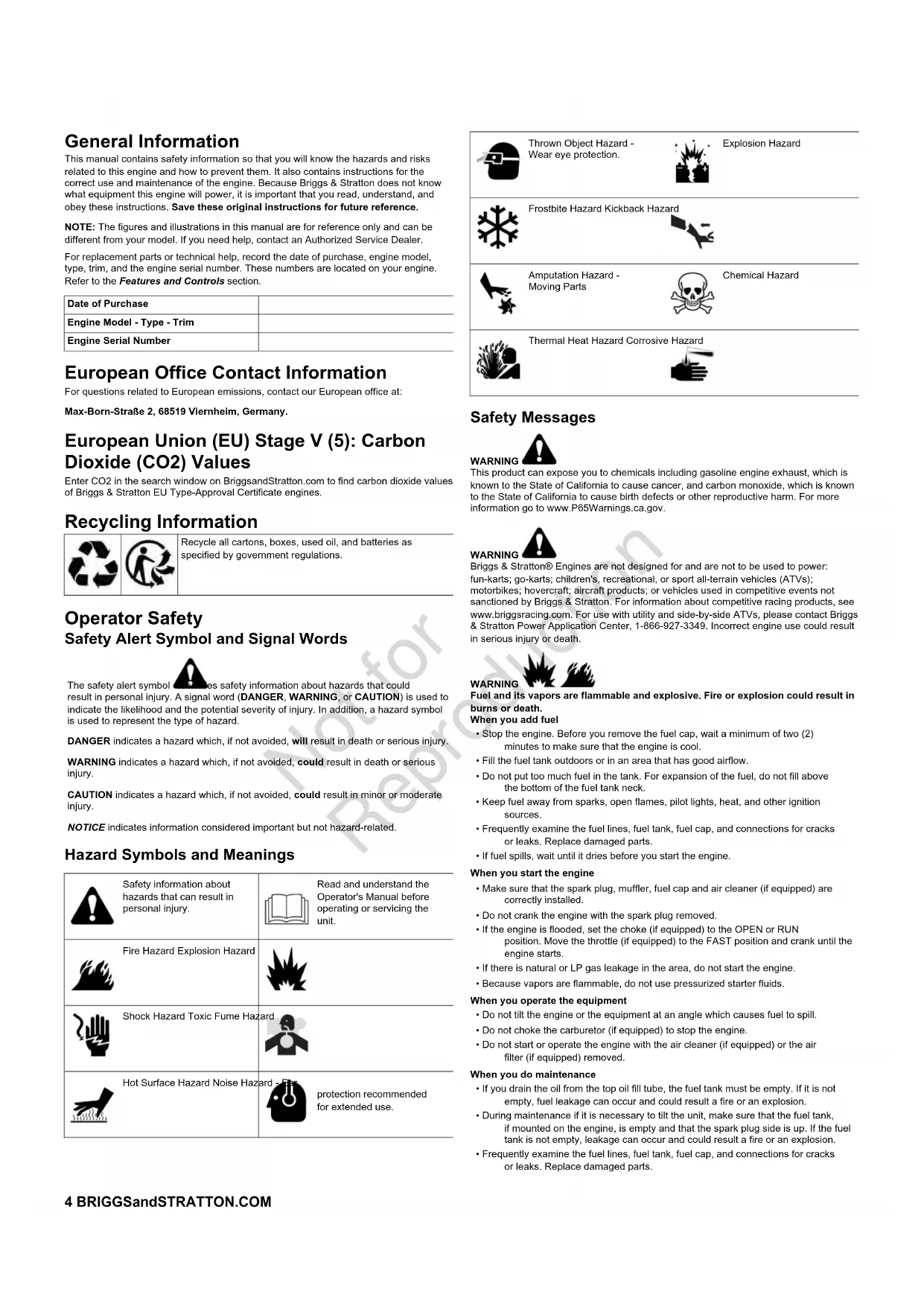
Not for ReproductionGeneral Information This manual contains safety information so that you will know the hazards and risks related to this engine and how to prevent them. It also contains instructions for the correct use and maintenance of the engine. Because Briggs & Stratton does not know what equipment this engine will power, it is important that you read, understand, and obey these instructions. Save these original instructions for future reference. NOTE:The figures and illustrations in this manual are for reference only and can be different from your model. If you need help, contact an Authorized Service Dealer. For replacement parts or technical help, record the date of purchase, engine model, type, trim, and the engine serial number. These numbers are located on your engine. Refer to the Features and Controls section. Date of Purchase Engine Model - Type - Trim Engine Serial Number European Office Contact Information For questions related to European emissions, contact our European office at: Max-Born-Straße 2, 68519 Viernheim, Germany. European Union (EU) Stage V (5): Carbon Dioxide (CO2) Values Enter CO2 in the search window on BriggsandStratton.com to find carbon dioxide values of Briggs & Stratton EU Type-Approval Certificate engines. Recycling Information Recycle all cartons, boxes, used oil, and batteries as specified by government regulations. Operator Safety Safety Alert Symbol and Signal Words The safety alert symbol identifies safety information about hazards that could result in personal injury. A signal word (DANGER, WARNING, or CAUTION) is used to indicate the likelihood and the potential severity of injury. In addition, a hazard symbol is used to represent the type of hazard. DANGER indicates a hazard which, if not avoided, will result in death or serious injury. WARNING indicates a hazard which, if not avoided, could result in death or serious injury. CAUTION indicates a hazard which, if not avoided, could result in minor or moderate injury. NOTICE indicates information considered important but not hazard-related. Hazard Symbols and Meanings Safety information about hazards that can result in personal injury. Read and understand the Operator's Manual before operating or servicing the unit. Fire Hazard Explosion Hazard Shock Hazard Toxic Fume Hazard Hot Surface Hazard Noise Hazard - Ear protection recommended for extended use. Thrown Object Hazard - Wear eye protection. Explosion Hazard Frostbite Hazard Kickback Hazard Amputation Hazard - Moving Parts Chemical Hazard Thermal Heat Hazard Corrosive Hazard Safety Messages WARNING This product can expose you to chemicals including gasoline engine exhaust, which is known to the State of California to cause cancer, and carbon monoxide, which is known to the State of California to cause birth defects or other reproductive harm. For more information go towww.P65Warnings.ca.gov. WARNING Briggs & Stratton® Engines are not designed for and are not to be used to power: fun-karts; go-karts; children's, recreational, or sport all-terrain vehicles (ATVs); motorbikes; hovercraft; aircraft products; or vehicles used in competitive events not sanctioned by Briggs & Stratton. For information about competitive racing products, see www.briggsracing.com. For use with utility and side-by-side ATVs, please contact Briggs & Stratton Power Application Center, 1-866-927-3349. Incorrect engine use could result in serious injury or death. WARNING Fuel and its vapors are flammable and explosive. Fire or explosion could result in burns or death. When you add fuel
- Stop the engine. Before you remove the fuel cap, wait a minimum of two (2) minutes to make sure that the engine is cool.
- Fill the fuel tank outdoors or in an area that has good airflow.
- Do not put too much fuel in the tank. For expansion of the fuel, do not fill above the bottom of the fuel tank neck.
- Keep fuel away from sparks, open flames, pilot lights, heat, and other ignition sources.
- Frequently examine the fuel lines, fuel tank, fuel cap, and connections for cracks or leaks. Replace damaged parts.
- If fuel spills, wait until it dries before you start the engine. When you start the engine
- Make sure that the spark plug, muffler, fuel cap and air cleaner (if equipped) are correctly installed.
- Do not crank the engine with the spark plug removed.
- If the engine is flooded, set the choke (if equipped) to the OPEN or RUN position. Move the throttle (if equipped) to the FAST position and crank until the engine starts.
- If there is natural or LP gas leakage in the area, do not start the engine.
- Because vapors are flammable, do not use pressurized starter fluids. When you operate the equipment
- Do not tilt the engine or the equipment at an angle which causes fuel to spill.
- Do not choke the carburetor (if equipped) to stop the engine.
- Do not start or operate the engine with the air cleaner (if equipped) or the air filter (if equipped) removed. When you do maintenance
- If you drain the oil from the top oil fill tube, the fuel tank must be empty. If it is not empty, fuel leakage can occurand could result a fire or an explosion.
- During maintenance if it is necessary to tilt the unit, make sure that the fuel tank, if mounted on the engine, is empty and that the spark plug side is up. If the fuel tank is not empty, leakage can occurand could result a fire or an explosion.
- Frequently examine the fuel lines, fuel tank, fuel cap, and connections for cracks or leaks. Replace damaged parts. 4 BRIGGSandSTRATTON.COM Not for Reproduction• Do not change the governor spring, links or other parts to increase engine speed.
- Do not hit the flywheel with a hammer or hard object. This could result in failure of the flywheel during operation.
- Replacement parts must be of the same design and installed in the same position as the original parts. Other parts could result in damage or an injury. When you move the location of equipment
- Make sure that the fuel tank is EMPTY or that the fuel shut-off valve is in the CLOSED position. When fuel or equipment is in storage with fuel in the fuel tank
- Because pilot lights or other ignition sources can cause explosions, keep fuel or equipment away from furnaces, stoves, water heaters or other appliances that have pilot lights. WARNING Fuel and its vapors are flammable and explosive. Fire or explosion could result in burns or death. Engine start-up causes spark that could result in a fire or explosion.
- If there is natural or LP gas leakage in the area, do not start the engine.
- Because vapors are flammable, do not use pressurized starter fluids. WARNING POISONOUS GAS HAZARD. Engine exhaust contains carbon monoxide, a poisonous gas that could kill you in minutes. Although you do not smell exhaust fumes, you could still be exposed to dangerous carbon monoxide gas. If you feel sick, dizzy, or weak while you use this product, get to fresh air RIGHT AWAY. See a doctor. You may have carbon monoxide poisoning.
- Carbon monoxide gas can collect in occupied spaces. To reduce the risk of carbon monoxide gas, ONLY operate this product outdoors and far away from windows, doors and vents.
- Install battery-operated carbon monoxide alarms or plug-in carbon monoxide alarms with battery back-up as specified by the manufacturer's instructions. Smoke alarms cannot sense carbon monoxide gas.
- DO NOT operate this product in homes, garages, basements, crawlspaces, sheds, or other closed spaces, even if you use fans or open doors and windows for ventilation. After the operation of this product, carbon monoxide can quickly collect in these spaces and stay for hours.
- ALWAYS put this product downwind and point the engine exhaust away from occupied spaces. WARNING Fast retraction of the starter cord (kickback) will pull your hand and arm to the engine faster than you can let go.Broken bones, fractures, bruises or sprains could result.
- To prevent kickback when you start the engine, pull the starter cord slowly until resistance is felt and then pull quickly.
- Before you start the engine, disconnect or remove all external equipment and engine loads.
- Make sure that direct-coupled equipment components, such as, but not limited to, blades, impellers, pulleys, and sprockets, are correctly attached. WARNING Rotating parts can entangle hands, feet, hair, clothing, or accessories and result in traumatic amputation or laceration.
- Operate equipment with the guards correctly installed.
- Keep hands and feet away from rotating parts.
- Remove jewelry and make sure that long hair is away from all rotating parts.
- Do not wear loose clothes or items that could become caught. WARNING During operation, the engine and muffler become hot. If you touch a hot engine, thermal burns can occur. Combustible materials, such as leaves, grass and brush, can catch fire.
- Before you touch the engine or muffler, stop the engine and wait two (2) minutes. Make sure that the engine and muffler are safe to touch.
- Remove debris from the muffler and engine. It is a violation of California Public Resource Code, Section 4442, to use or operate the engine on any forest-covered, brush-covered, or grass-covered land unless the exhaust system is equipped with a spark arrester, as defined in section 4442, maintained in effective working order. Other states or federal jurisdictions may have similar laws; reference Federal Regulation 36 CFR Part 261.52. Contact the original equipment manufacturer, retailer, or dealer to obtain a spark arrester designed for the exhaust system installed on this engine. WARNING Accidental engine spark can cause an electric shock or fire and could result in entanglement, traumatic amputation or laceration. Before you make adjustments or repairs:
- Disconnect the spark plug wire and keep it away from the spark plug.
- Disconnect the battery wire from the negative battery terminal (only engines with electric start.)
- Use only the correct tools. When you check for spark:
- Use an approved spark plug tester.
- Do not check for spark with the spark plug removed. WARNING Fuel vapors are flammable and explosive. Fire or explosion could result in burns or death. If you smell gas
- Do not start the engine.
- Do not switch on electrical switches.
- Do not use a phone in the vicinity.
- Contact the gas supplier or the fire department. Features and Controls Engine Controls Refer toFigures: 1, 2, 3, and 4 for the location of features and controls. A. Engine Identification Numbers Model - Type - Trim B. Spark Plug C. Fuel Tank and Cap D. Air Cleaner E. Starter Cord Handle F. Dipstick G. Muffler, Muffler Guard (if installed), Spark Arrester (if installed) H. Air Intake Grille
I. Throttle Control (if installed)
J. Choke (if installed) K. Fuel Shut-off (if installed) L. Stop Switch(if installed) M. Primer (if installed) Engine Control Symbols and Meanings Engine Speed - FAST Engine Speed - SLOW Engine Speed - STOP ON - OFF Engine Start Choke CLOSED Engine Start Choke OPEN Fuel Cap Fuel Shut-off OPEN Fuel Shut-off CLOSED
Not for ReproductionFuel Level - Maximum Do Not Overfill Operation Oil Recommendations Oil Capacity: See the Specifications section. NOTICE This engine was shipped from Briggs & Stratton without oil. Equipment manufacturers or dealers could have added oil to the engine. Before you start the engine for the first time, make sure that the oil is at the correct level. Add oil as specified by the instructions in this manual. If you start the engine without oil, damage will occur and the engine will not be repaired under warranty. We recommend the use of Briggs & Stratton
Warranty Certified oils for best performance. Other high-quality detergent oils are permitted if classified for service SF, SG, SH, SJ or higher. Do not use special additives. Use the chart to select the best viscosity for the outdoor temperature range expected. Engines on most outdoor power equipment operate well with 5W-30 Synthetic oil. For equipment operated in hot temperatures, Vanguard
15W-50 Synthetic oil gives the best protection. A SAE 30 - Below 40 °F (4 °C) the use of SAE 30 will result in hard starting. B 10W-30 - Above 80 °F (27 °C) the use of 10W-30 may cause increased oil consumption. Checkthe oil level frequently. C 5W-30 D Synthetic 5W-30
Synthetic 15W-50 Check the Oil Level Before you check or add oil
- Make sure the engine is level.
- Clean the oil fill area of debris.
- Refer to the Specifications section for oil capacity. NOTICE This engine was shipped from Briggs & Stratton without oil. Equipment manufacturers or dealers could have added oil to the engine. Before you start the engine for the first time, make sure that the oil is at the correct level. Add oil as specified by the instructions in this manual. If you start the engine without oil, damage will occur and the engine will not be repaired under warranty.
1. Remove the dipstick (A, Figure 5) and clean with a cloth.
2. Install and tighten the dipstick (A, Figure 5).
3. Remove the dipstick and check the oil level. Make sure that the oil level is at the
top of the full indicator (B, Figure 5) on the dipstick.
4. If the oil level is low, slowly add oil into the engine oil fill (C, Figure 5). Do not add
5. Wait one minute and check the oil level again. Make sure that the oil level is
6. Install and tighten the dipstick (A, Figure 5).
Low Oil Protection System (if installed) A low oil sensor is installed on some engines. If the oil is low, the sensor will show a warning light or stop the engine. Stop the engine and do the steps that follow before you start the engine.
- Make sure that the engine is level.
- Do an oil check. Refer to the Check Oil Level section.
- If the oil level is low, add the correct amount of oil. Start the engine and make sure that the warning light (if installed) does not come on.
- If the oil level is not low, do not start the engine. Contact a Briggs & Stratton Authorized Service Dealer to correct the oil problem. Fuel Recommendations Fuel must meet these requirements:
- Clean, fresh, unleaded gasoline.
- A minimum of 87 octane/87 AKI (91 RON). High altitude use, see below.
- Gasoline with up to 10% ethanol (gasohol) is permitted. NOTICE Do not use unapproved gasoline, such as E15 and E85. Do not mix oil in gasoline or change the engine to operate on alternate fuels. Use of unapproved fuels could result in damage to engine components, which will not be repaired under the warranty. To protect the fuel system from gum formation, and corrosion, mix analcohol-free fuel stabilizer and ethanol treatmentinto the fuel. Refer to the Storage section. All fuel is not the same. If start or performance problems occur, change fuel providers or brands. This engine is certified to operate on gasoline. The emissions control system for carbureted engines is EM (Engine Modifications). The emissions control systems for engines with electronic fuel injection are ECM (Engine Control Module), MPI (Multi Port Injection), and if equipped an O2S (Oxygen Sensor). High Altitude At altitudes over 5,000 feet (1524 meters), a minimum 85 octane/85 AKI (89 RON) gasoline is permitted. For carbureted engines, high altitude adjustment is required to maintain performance. Operation without this adjustment will cause decreased performance, increased fuel consumption, and increased emissions. Contact a Briggs & Stratton Authorized Service Dealer for high altitude adjustment information. Operation of the engine at altitudes below 2,500 feet (762 meters) with the high altitude adjustment is not recommended. For Electronic Fuel Injection (EFI) engines, no high altitude adjustment is necessary. Add Fuel WARNING Fuel and its vapors are flammable and explosive. Fire or explosion could result in burns or death. When you add fuel
- Stop the engine. Before you remove the fuel cap, wait a minimum of two (2) minutes to make sure that the engine is cool.
- Fill the fuel tank outdoors or in an area that has good airflow.
- Do not put too much fuel in the tank. For expansion of the fuel, do not fill above the bottom of the fuel tank neck.
- Keep fuel away from sparks, open flames, pilot lights, heat, and other ignition sources.
- Frequently examine the fuel lines, fuel tank, fuel cap, and connections for cracks or leaks. Replace damaged parts.
- If fuel spills, wait until it dries before you start the engine.
1. Clean the fuel cap area of dirt and debris. Remove the fuel cap.
2. Fill the fuel tank (A, Figure 6) with fuel. Because fuel will expand, do not fill above
the bottom of the fuel tank neck (B).
3. Install the fuel cap.
Start the Engine WARNING Fast retraction of the starter cord (kickback) will pull your hand and arm to the engine faster than you can let go.Broken bones, fractures, bruises or sprains could result.
- To prevent kickback when you start the engine, pull the starter cord slowly until resistance is felt and then pull quickly.
- Before you start the engine, disconnect or remove all external equipment and engine loads.
- Make sure that direct-coupled equipment components, such as, but not limited to, blades, impellers, pulleys, and sprockets, are correctly attached. 6 BRIGGSandSTRATTON.COM Not for ReproductionWARNING Fuel and its vapors are flammable and explosive. Fire or explosion could result in burns or death. When you start the engine
- Make sure that the spark plug, muffler, fuel cap and air cleaner (if equipped) are correctly installed.
- Do not crank the engine with the spark plug removed.
- If the engine is flooded, set the choke (if equipped) to the OPEN or RUN position. Move the throttle (if equipped) to the FAST position and crank until the engine starts.
- If there is natural or LP gas leakage in the area, do not start the engine.
- Because vapors are flammable, do not use pressurized starter fluids. WARNING POISONOUS GAS HAZARD. Engine exhaust contains carbon monoxide, a poisonous gas that could kill you in minutes. Although you do not smell exhaust fumes, you could still be exposed to dangerous carbon monoxide gas. If you feel sick, dizzy, or weak while you use this product, get to fresh air RIGHT AWAY. See a doctor. You may have carbon monoxide poisoning.
- Carbon monoxide gas can collect in occupied spaces. To reduce the risk of carbon monoxide gas, ONLY operate this product outdoors and far away from windows, doors and vents.
- Install battery-operated carbon monoxide alarms or plug-in carbon monoxide alarms with battery back-up as specified by the manufacturer's instructions. Smoke alarms cannot sense carbon monoxide gas.
- DO NOT operate this product in homes, garages, basements, crawlspaces, sheds, or other closed spaces, even if you use fans or open doors and windows for ventilation. After the operation of this product, carbon monoxide can quickly collect in these spaces and stay for hours.
- ALWAYS put this product downwind and point the engine exhaust away from occupied spaces. NOTICE This engine was shipped from Briggs & Stratton without oil. Equipment manufacturers or dealers could have added oil to the engine. Before you start the engine for the first time, make sure that the oil is at the correct level. Add oil as specified by the instructions in this manual. If you start the engine without oil, damage will occur and the engine will not be repaired under warranty. Types of Start Systems Before you start the engine, you must know the type of starting system on your engine. Your engine will have one of thestart systems that follows:
and 1-Step Start System: Thistype of start system has a temperature controlled automatic choke. It does not have a primer.
- Choke System: This type of system has a choke to be used in cool temperatures. Some models will have a separate choke control while others will have a combination choke and throttle choke. It does not have a primer.
- Primer System: This start system has a red primer to be used for starting in cool temperatures. It does not have a manual choke. NOTE:Your equipment could have remote controls. Refer to the equipment manual for location and operation of remote controls. ReadyStart
1. Check the engine oil. Refer to the Check Oil Level section.
2. Make sure the equipment drive controls, if installed, are disengaged.
3. Move the fuel shut-off (A, Figure 7), if installed, to the OPEN position
4. Move the throttle control (B, Figure 7), if installed, to the FAST position. Operate the
engine in the FAST position.
5. Push the stop switch (D, Figure 8), if installed, to the ON position.
6. Hold the engine stop lever (C, Figure 9), if installed, against the handle.
7. Tightly hold the starter cord handle (G, Figure 7), if installed. Pull the starter cord
handle (G) slowly until resistance is felt, and then, quickly pull the starter cord handle. WARNING Fast retraction of the starter cord (kickback) will pull your hand and arm to the engine faster than you can let go. Broken bones, fractures, bruises or sprains could result. To prevent kickback when you start the engine, pull the starter cord slowly until resistance is felt and then pull quickly.
8. Turn the electric start switch, if installed, to the ON / START position.
NOTICE To extend the life of the starter, use short start cycles (five seconds maximum). Wait one minute between start cycles. NOTE:If the engine will not start, contact your local dealer or go to BRIGGSandSTRATTON.COM or call 1-800-444-7774 (in USA). Choke System
1. Check the engine oil. See the Check the Oil Level section.
2. Make sure equipment drive controls, if installed, are disengaged.
3. Move the fuel shut-off (A, Figure 7), if installed, to the OPEN position.
4. Move the throttle control (B, Figure 7), if installed, to the FAST position. Operate the
engine in the FAST position.
5. Move the choke control (F, Figure 10) to the CLOSED position.
NOTE:The choke is usually not necessary when you start a warm engine.
6. Push the stop switch (D, Figure 10), if installed, to the ON position.
7. Hold the engine stop lever (C, Figure 9), if installed, against the handle.
8. Tightly hold the starter cord handle (G, Figure 7), if installed. Pull the starter cord
handle (G) slowly until resistance is felt, then pull it quickly. WARNING Fast retraction of the starter cord (kickback) will pull your hand and arm to the engine faster than you can let go. Broken bones, fractures, bruises or sprains could result. To prevent kickback when you start the engine, pull the starter cord slowly until resistance is felt and then pull quickly.
9. Turn the electric start switch, if installed, to the ON/START position.
NOTICETo extend the life of the starter, use short start cycles (five seconds maximum). Wait one minute between start cycles.
10. As the engine warms, move the choke control (F, Figure 10) to the OPEN position.
NOTE:If the engine will not start, contact your local dealer or go to BRIGGSandSTRATTON.COM or call 1-800-444-7774 (in USA). Primer System
1. Check the engine oil. See the Check the Oil Level section
2. Make sure equipment drive controls, if installed, are disengaged.
3. Push thestop switch (A, Figure 11), if installed, to the ON position.
4. Move the throttle control (B, Figure 11), if installed, to the FAST position. Operate
the engine in the FAST position.
5. Push the red primer button (F, Figure 11), three (3) times.
NOTE:Priming is usually not necessary when you start a warm engine. NOTE:If you push the primer button too much, the engine will flood and it will be hard to start.
6. Hold the engine stop lever (C, Figure 9), if installed, against the handle.
7. Tightly hold the starter cord handle (D, Figure 11). Pull the starter cord handle
slowly until resistance is felt, then pull rapidly. WARNING Fast retraction of the starter cord (kickback) will pull your hand and arm to the engine faster than you can let go. Broken bones, fractures, bruises or sprains could result. To prevent kickback when you start the engine, pull the starter cord slowly until resistance is felt and then pull quickly. Stop the Engine WARNING Fuel and its vapors are flammable and explosive. Fire or explosion could result in burns or death.
- Do not choke the carburetor (if equipped) to stop the engine.
1. Release the engine stop lever (E, Figure 9), if installed.
2. Move the stop switch (D, Figure 10), if installed, to the OFF position.
3. Move the throttle control (B, Figure 7), if installed, the STOP position.
Not for Reproduction4. Turn the electric start key, if installed, to the OFF/STOP position.5. Remove the key, and keep it in a safe area out of reach of children.6. After the engine stops,move the fuel shut-off (A, Figure 7), if installed, to theCLOSED position. Maintenance Maintenance Information WARNINGDuring maintenance if it is necessary to tilt the unit, make sure that the fuel tank, ifmounted on the engine, is empty and that the spark plug side is up. If the fuel tank is notempty, leakage can occur and could result in a fire or an explosion. If the engine is tiltedin a different direction, it will not easily start because of oil or fuel contamination of the airfilter or the spark plug.We recommend that you see a Briggs & Stratton Authorized Service Dealer for allmaintenance and servicing of the engine and engine parts.NOTICEAll the components used to build this engine must remain in place for correct operation.WARNING Accidental engine spark can cause an electric shock or fire and could result inentanglement, traumatic amputation or laceration.Before you make adjustments or repairs:• Disconnect the spark plug wire and keep it away from the spark plug.• Disconnect the battery wire from the negative battery terminal (only engines withelectric start.)• Use only the correct tools.When you check for spark:• Use an approved spark plug tester.• Do not check for spark with the spark plug removed. Emissions Control Service For maintenance, replacement, or repair of emissions control devices andsystems, contact a qualified off-road engine repair establishment or servicetechnician. However, for "no charge" emissions control service, the work must be doneby a factory authorized dealer. Refer to the Emissions Control Statements. Maintenance Schedule First 5 Hours Change the oil (not necessary on models labeled Just Check & Add and NoOil Changes).Every 8 Hoursor Daily• Check the engine oil level.• Clean the area around muffler and controls.• Clean the air intake grille.Every 25 Hours or Annually Clean the air filter
Clean the pre-cleaner (if installed)
Every 50 Hoursor Annually Change engine oil (not necessary on models labeled Just Check & Add
Check the valve clearance
Clean more frequently in dusty conditions or when many particles are in the air. Not necessary unless engine performance problems occur. Carburetor and Engine Speed Do not make adjustments to the carburetor or engine speed. The carburetor wasset at the factory to operate satisfactorilyinmost conditions. Do not change thegovernor spring, linkages, or other parts to adjust the engine speed. If adjustmentsarenecessary,contact a Briggs & Stratton Authorized Service Dealer forservicing.NOTICEThe equipment manufacturer specifies the maximum speed for the engine as installedon the equipment. Do not exceed this speed. If you are not sure what the equipmentmaximum speed is, or what the engine speed is set to from the factory, contact a Briggs& Stratton Authorized Service Dealer for assistance. For safe and correct operationof the equipment, the engine speed should only be adjusted by a qualified servicetechnician. Servicing theExhaust System WARNING During operation, the engine and muffler become hot. If you touch a hot engine,thermal burns can occur.Combustible materials, such as leaves, grass and brush, can catch fire.• Before you touch the engine or muffler, stop the engine and wait two (2)minutes. Make sure that the engine and muffler are safe to touch.• Remove debris from the muffler and engine.It is a violation of California Public Resource Code, Section 4442, to use or operate theengine on any forest-covered, brush-covered, or grass-covered land unless the exhaustsystem is equipped with a spark arrester, as defined in section 4442, maintained ineffective working order. Other states or federal jurisdictions may have similar laws;reference Federal Regulation 36 CFR Part 261.52. Contact the original equipmentmanufacturer, retailer, or dealer to obtain a spark arrester designed for the exhaustsystem installed on this engine.Remove debris from the muffler and cylinder area. Inspect the muffler for cracks,corrosion, or other damage. Remove the deflector or the spark arrester, if equipped, andinspect for damage or carbon blockage. If damage is found, install the replacement partsbefore you operate the equipment.WARNINGReplacement parts must be of the same design and installed in the same position as theoriginal parts. Other parts could result in damage or an injury. Servicing the Spark Plug Check the spark plug gap (A, Figure 12) with a wire gauge (B). If necessary, set thespark plug gap. Install and tighten the spark plug to the correct torque. For gapandtorque specifications, refer to the Specifications section.NOTE:In some areas, it is mandatory by local law that you use a resistor spark plugto decrease ignition signals.If a resistor spark plug was installed by the equipmentmanufacturer, use the same type for replacement. Change Engine Oil WARNING Fuel and its vapors are flammable and explosive. Fire or explosion could result inburns or death.During operation, the engine and muffler become hot. If you touch a hot engine,thermal burns can occur.• If you drain the oil from the top oil fill tube, the fuel tank must be empty. If it is notempty, fuel leakage can occur and cause a fire or an explosion.• Before you touch the engine or muffler, stop the engine and wait two (2)minutes. Make sure that the engine and muffler are safe to touch.Used oil is a hazardous waste product and must be discarded of correctly. Do notdiscard with household waste. Contact your local authorities, service center, or dealerfor safe disposal or recycling facilities.For Just Check & Add models, an oil change is not necessary. If an oil change isnecessary, refer to the procedure that follows. Remove Oil 1. With engine off but warm, disconnect the spark plug wire(s) (D, Figure 13) and keepit away from the spark plug(s) (E).2. Remove the dipstick (A, Figure 14). 8 BRIGGSandSTRATTON.COM Not for Reproduction3. When you drain the oil from the top oil fill tube (C, Figure 15), keep the spark plug(E) end of the engine up. Drain the oil into an approved container.WARNINGWhen you drain the oil from the top oil fill tube, the fuel tank must be empty. If it is notempty, fuel leakage can occur and could result in a fire or an explosion. Operate theengine until the fuel tank is empty. Add Oil
- Make sure the engine is level.• Clean the oil fill area of all debris.• Refer to the Specifications section for oil capacity.1. Remove the dipstick (A, Figure 5). Remove oil from the dipstick with a clean cloth.2. Slowly add oil into the engine oil fill (C, Figure 5). Do not overfill. Wait one minuteand then check the oil level.3. Install and tighten the dipstick (A, Figure 5).4. Remove the dipstick and check the oil level. The correct oil level is at the top of thefull indicator (B, Figure 5)on the dipstick.5. Install and tighten the dipstick (A, Figure 5).6. Connect the spark plug wire(s)to the spark plug(s). See Remove Oil section. Servicing the Air Filter WARNING Fuel vapors are flammable and explosive. Fire or explosion could result in burnsor death.• Do notstart and operate the engine with the air cleaner assembly (if equipped)or the air filter (if equipped) removed.NOTICEDo not use pressurized air or solvents to clean the filter. Pressurized air could result indamage to the filter and solvents will dissolve the filter.See the Maintenance Schedule for service requirements.Different models will use a foam or a paper filter. Some models could also have anoptional pre-cleaner that can be washed and used again. Compare the illustrations inthis manual with the type installed on your engine and service as follows. Foam Air Filter 1. Loosen or remove the fastener(s) (A, Figure 16), if installed.2. Open or remove the cover (B, Figure 16).3. Carefully remove the foam element (C, Figure 16) from the air filter base.4. Clean the foam element (C, Figure 16) in liquid detergent and water. Compress thefoam element with your hands in a clean cloth until dry.5. Soak the foam element (C, Figure 16) with clean engine oil. To remove unwantedengine oil from the foam element, compress it with your hands in a clean cloth.6. Install the foam element (C, Figure 16) onto the air filter base.7. Close or installthe cover (B, Figure 16) and attach with the fastener(s).Make surethat the fastener(s) is tight. Paper Air Filter 1. Remove the cover (B, Figure 17).2. Remove the filter (C, Figure 17).3. Remove the pre-cleaner (E, Figure 17), if installed, from the filter (C).4. Lightly tap the filter on a hard surface to remove unwanted material. If the filter isdirty replace it a new filter.5. Clean the pre-cleaner (E, Figure 17), if installed, in liquid detergent and water. Letthe pre-cleaner fully air dry. Do not add oil to the pre-cleaner.6. Assemble the dry pre-cleaner (E, Figure 17), if installed, to the filter (C).7. Install the filter (C, Figure 17).8. Install the cover (B, Figure 17). Servicing the Cooling System WARNING During operation, the engine and muffler become hot. If you touch a hot engine,thermal burns can occur.Combustible debris, such as leaves, grass, and brush can catch fire.• Before you touch the engine or muffler, stop the engine and wait two (2)minutes. Make sure that the engine and muffler are safe to touch.• Remove debris from the muffler and engine.NOTICEDo not use water to clean the engine. Water could cause contamination of the fuelsystem. Use a brush or dry cloth to clean the engine.This is an air cooled engine. Dirt or debris can prevent air flow and cause the engine tobecome too hot and result in unsatisfactory performance and decreased engine life.1. Use a brush or dry cloth to remove debris from the air intake grille.2. Keep linkage, springs, and controls clean.3. Keep the area around and behind the muffler, if equipped, free of combustibledebris.4. Make sure the oil cooler fins, if equipped, are clean.After a period of time, the cylinder cooling fins can collect debris and cause the engineto overheat. Thisunwanted materialcannot be removed without partial disassembly ofthe engine. Have a Briggs & Stratton Authorized Service Dealer inspect and clean theair cooling system as recommended in the Maintenance Schedule. Storage Fuel System WARNING Fuel and its vapors are flammable and explosive. Fire or explosion could result inburns or death.Fuel Storage• Because pilot lights or other ignition sources can cause explosions, keep fuel orequipment away from furnaces, stoves, water heaters or other appliances thathave pilot lights.NOTE:Some models have a fuel tank for vertical storage that will let the engine tilt formaintenance or storage (C, Figure 18). Do not keep in vertical position with the fuel tankfilled above the bottom of the fuel level indicator (D), if equipped. For more instructions,refer to the equipment manual.Keep the engine level (normal operating position). Fill the fuel tank (A, Figure 19) withfuel. For fuel expansion, do fill above the fuel tank neck (B).Fuel can become stale when kept in a storage container for more than 30 days.Theuse of an alcohol-free fuel stabilizer and ethanol treatment in the fuel storage containeris recommended. This keeps fuel fresh and decreases fuel-related problems orcontamination in the fuel system.When you fill the fuel container with fuel, add an alcohol-free fuel stabilizer as specifiedby the manufacturer’s instructions. If gasoline in the engine has not been treated with afuel stabilizer, it must be drained into an approved container. Operate the engine until itis out of fuel. Engine Oil While the engine is still warm, change the engine oil. Refer to Change the Engine Oilsection. Troubleshooting Assistance For assistance, contact your local dealer or go to BRIGGSandSTRATTON.COM or call 1-800-444-7774 (in USA). Specifications Specifications and Service Parts Model: 080000 Displacement 7.63 ci (125 cc)Bore 2.362 in (60 mm)Stroke 1.75 in (44,45 mm)Oil Capacity 15 oz (,44 L)Spark Plug Gap .020 in (,51 mm)Spark Plug Torque 180 lb-in (20 Nm)
Not for ReproductionModel: 080000 Armature Air Gap .006 - .014 in (,15 - ,36 mm)Intake Valve Clearance .004 - .008 in (,10 - ,20 mm)Exhaust Valve Clearance .004 - .008 in (,10 - ,20 mm) Model: 090000 Displacement 8.64 ci (140 cc)Bore 2.495 in (63,4 mm)Stroke 1.75 in (44,45 mm)Oil Capacity 15 oz (,44 L)Spark Plug Gap .020 in (,51 mm)Spark Plug Torque 180 lb-in (20 Nm)Armature Air Gap .006 - .014 in (,15 - ,36 mm)Intake Valve Clearance .004 - .008 in (,10 - ,20 mm)Exhaust Valve Clearance .004 - .008 in (,10 - ,20 mm) Model: 093J00 Displacement 9.15 ci (150 cc)Bore 2.583 in (65,60 mm)Stroke 1.75 in (44,45 mm)Oil Capacity 15 oz (,44 L)Spark Plug Gap .020 in (,51 mm)Spark Plug Torque 180 lb-in (20 Nm)Armature Air Gap .006 - .014 in (,15 - ,36 mm)Intake Valve Clearance .004 - .008 in (,10 - ,20 mm)Exhaust Valve Clearance .004 - .008 in (,10 - ,20 mm) Model: 100000 Displacement 9.93 ci (163 cc)Bore 2.688 in (68,28 mm)Stroke 1.75 in (44,45 mm)Oil Capacity 15 oz (,44 L)Spark Plug Gap .030 in (,76 mm)Spark Plug Torque 180 lb-in (20 Nm)Armature Air Gap .006 - .014 in (,15 - ,36 mm)Intake Valve Clearance .004 - .008 in (,10 - ,20 mm)Exhaust Valve Clearance .004 - .008 in (,10 - ,20 mm) Service Parts - Models: 080000, 090000, 093J00, 100000 Service Part Part NumberAir Filter, Foam 799579Air Filter, Paper 593260Oil - SAE 30 100113Resistor Spark Plug (Models: 080000,090000, 093J00)692051Resistor Spark Plug (Model: 100000) 594056Spark Plug Wrench 19576SSpark Tester 84003327 Power Ratings The gross power rating for individual gasoline engine models is labeled in accordancewith SAE (Society of Automotive Engineers) code J1940 Small Engine Power & TorqueRating Procedure, and is rated in accordance with SAE J1995. Torque values arederived at 2600 RPM for those engines with “rpm” called out on the label and 3060 RPMfor all others; horsepower values are derived at 3600 RPM. The gross power curvescan be viewed at www.BRIGGSandSTRATTON.COM. Net power values are taken withexhaust and air cleaner installed whereas gross power values are collected withoutthese attachments. Actual gross engine power will be higher than net engine power andis affected by, among other things, ambient operating conditions and engine-to-enginevariability. Given the wide array of products on which engines are placed, the gasolineengine may not develop the rated gross power when used in a given piece of powerequipment. This difference is due to a variety of factors including, but not limited to, thevariety of engine components (air cleaner, exhaust, charging, cooling, carburetor, fuelpump, etc.), application limitations, ambient operating conditions (temperature, humidity,altitude), and engine-to-engine variability. Due to manufacturing and capacity limitations,Briggs & Stratton may substitute an engine of higher rated power for this engine. Warranty Briggs & Stratton
Engine Warranty Effective August 2021Limited WarrantyBriggs & Stratton warrants that, during the warranty period specified below, it willrepair or replace, free of charge, with a new, reconditioned or re-manufactured part,at the sole discretion of Briggs & Stratton, any part that is defective in material orworkmanship or both. Transportation charges on product submitted for repair orreplacement under this warranty must be borne by purchaser. This warranty is effectivefor and is subject to the time periods and conditions stated below. For warrantyservice, find the nearest Authorized Service Dealer in our dealer locator map atBRIGGSandSTRATTON.COM. The purchaser must contact the Authorized ServiceDealer, and then make the product available to the Authorized Service Dealer forinspection and testing.There is no other express warranty. Implied warranties, including those ofmerchantability and fitness for a particular purpose, are limited to one yearfrom purchase, or to the extent permitted by law. All other implied warrantiesare excluded. Liability for incidental or consequential damages are excludedto the extent exclusion is permitted by law. Some states or countries do not allowlimitations on how long an implied warranty lasts, and some states or countries donotallow the exclusion or limitation of incidental or consequential damages, so the abovelimitation and exclusion may not apply to you. This warranty gives you specific legalrights and you may also have other rights which vary from state to state and country tocountry
Standard Warranty Terms 1, 2, 3Vanguard ; Commercial Series Consumer Use - 36 monthsCommercial Use - 36 monthsXR SeriesConsumer Use - 24 monthsCommercial Use - 24 monthsAll Other Engines Featuring Dura-Bore™ Cast Iron SleeveConsumer Use - 24 monthsCommercial Use - 12 monthsAll Other EnginesConsumer Use - 24 monthsCommercial Use - 3 months These are our standard warranty terms, but occasionally there may be additionalwarranty coverage that was not determined at time of publication. For a listing ofcurrent warranty terms for your engine, go to BRIGGSandSTRATTON.COM or contactyour Briggs & Stratton Authorized Service Dealer. There is no warranty for engines on equipment used for prime power in place of autility; standby generators used for commercial purposes, utility vehicles exceeding 25MPH, or engines used in competitive racing or on commercial or rental tracks. Vanguard installed on standby generators: 24 months consumer use, no warrantycommercial use. Commercial Series with manufacturing date before July 2017: 24months consumer use, 24 months commercial use. In Australia - Our goods come with guarantees that cannot be excluded under theAustralian Consumer Law. You are entitled to a replacement or refund for a majorfailure and for compensation for any other reasonably foreseeable loss or damage.You are also entitled to have the goods repaired or replaced if the goods fail to be ofacceptable quality and the failure does not amount to a major failure. For warrantyservice, find the nearest Authorized Service Dealer in our dealer locator map atBRIGGSandSTRATTON.COM, or by calling 1300 274 447, or by emailing or writingto salesenquiries@briggsandstratton.com.au, Briggs & Stratton Australia Pty Ltd, 1Moorebank Avenue, Moorebank, NSW, Australia, 2170.The warranty period begins on the date of purchase by the first retail consumer orcommercial end user, and continues for the period of time stated in the table above.“Consumer use” means personal residential household use by a retail consumer.“Commercial use” means all other uses, including use for commercial, incomeproducing or rental purposes. Once an engine has experienced commercial use,it shall thereafter be considered as a commercial use engine for purposes of thiswarranty.No warranty registration is necessary to obtain warranty on Briggs & Strattonproducts. Save your proof of purchase receipt. If you do not provide proof of the 10 BRIGGSandSTRATTON.COM Not for Reproductioninitial purchase date at the time warranty service is requested, the manufacturing date of the product will be used to determine the warranty period. About Your Warranty This limited warranty covers engine-related material and/or workmanship issues only, and not replacement or refund of the equipment to which the engine may be mounted. Routine maintenance, tune-ups, adjustments, or normal wear and tear are not covered under this warranty. Similarly, warranty is not applicable if the engine has been altered or modified or if the engine serial number has been defaced or removed. This warranty does not cover engine damage or performance problems caused by:
1. The use of parts that are not original Briggs & Stratton parts;
2. Operating the engine with insufficient, contaminated, or an incorrect grade of
3. The use of contaminated or stale fuel, gasoline formulated with ethanol greater
than 10%, or the use of alternative fuels such as liquefied petroleum or natural gas on engines not originally designed/manufactured by Briggs & Stratton to operate on such fuels;
4. Dirt which entered the engine because of improper air cleaner maintenance or
5. Striking an object with the cutter blade of a rotary lawn mower, loose or improperly
installed blade adapters, impellers, or other crankshaft coupled devices, or excessive v-belt tightness;
6. Associated parts or assemblies such as clutches, transmissions, equipment
controls, etc., which are not supplied by Briggs & Stratton;
7. Overheating due to grass clippings, dirt and debris, or rodent nests which plug or
clog the cooling fins or flywheel area, or by operating the engine without sufficient ventilation;
8. Excessive vibration due to over-speeding, loose engine mounting, loose or
unbalanced cutter blades or impellers, or improper coupling of equipment components to the crankshaft;
9. Misuse, lack of routine maintenance, shipping, handling, or warehousing of
equipment, or improper engine installation. Warranty service is available only through Briggs & Stratton Authorized Service Dealers. Locate your nearest Authorized Service Dealer in our dealer locator map at BRIGGSandSTRATTON.COM or by calling 1-800-444-7774 (in USA). 80004537(Revision G) Briggs & Stratton Emissions Warranty California, U.S. EPA, and Briggs & Stratton, LLC Emissions Control Warranty - Your Warranty Rights and Obligations For Briggs & Stratton Engine Models with "F" Trim Designation (Model-Type- Trim Representation xxxxxx xxxx Fx) The California Air Resources Board, U.S. EPA, and Briggs & Stratton (B&S) are pleased to explain the exhaust and evaporative emissions (“emissions”) control system warranty on your2021-2023engine. In California, new equipment that use small off- road engines must be designed, built, and equipped to meet the State's stringent anti- smog standards.B&S must warrant the emissions control system on your engine/ equipment for the periods of time listed below provided there has been no abuse, neglect or improper maintenance of your small off-road engine or equipment leading to the failure of the emissions control system. Your emissions control system may include parts such as the carburetor or fuel- injection system, the ignition system, catalytic converter, fuel tanks, fuel lines (for liquid fuel and fuel vapors), fuel caps, valves, canisters, filters, clamps and other associated components.Also included may be hoses, belts, connectors, and other emission- related assemblies. Where a warrantable condition exists, B&S will repair your engine/equipment at no cost to you including diagnosis, parts, and labor. Manufacturer's Warranty Coverage: The exhaust and evaporative emissions control system on your engine/equipment is warranted for two years. If any evaporative emission-related part on your engine/ equipment is defective, the part will be repaired or replaced by B&S. Owner’s Warranty Responsibilities:
- As the engine/equipment owner, you are responsible for the performance of the required maintenance listed in your owner’s manual. B&S recommends that you retain all receipts covering maintenance on your engine, but B&S cannot deny warranty coverage solely for the lack of receipts or for your failure to ensure the performance of all scheduled maintenance.
- As the engine/equipment owner, you should however be aware that B&S may deny you warranty coverage if your engine/equipment or a part has failed due to abuse, neglect, or improper maintenance or unapproved modifications.
- You are responsible for presenting your engine/equipment to a B&S distribution center or service center as soon as the problem exists. The warranty repairs shall be completed in a reasonable amount of time, not to exceed 30 days.If you have a question regarding your warranty rights and responsibilities, you should contact B&S at 1-800-444-7774 (in USA) or BRIGGSandSTRATTON.COM. Briggs & Stratton Emissions Control Warranty Provisions The following are specific provisions relative to your Emissions Control Warranty Coverage. It is in addition to the B&S engine warranty for non-regulated engines found in the Operator’s Manual.
1. Warranted Emissions Parts
Coverage under this warranty extends only to the parts listed below (the emissions control systems parts) to the extent these parts were present on the B&S engine and/or B&S supplied fuel system. a. Fuel Metering System
- Cold start enrichment system (soft choke)
- Carburetor or fuel injection system
- Fuel line (for liquid fuel and fuel vapors), fuel line fittings, clamps
- Fuel tank, cap and tether
- Carbon canister and mounting bracket
- Purge and vent line c. Ignition System
- Air injection system or pulse value e. Miscellaneous Items Used in Above Systems
- Vacuum, temperature, position, time sensitive valves and switches
- Connectors and assemblies
2. Length of Coverage
Coverage is for a period of two years from the date of delivery to an ultimate purchaser, or for the time period listed in the respective engine or product warranty statement, whichever is greater. B&S warrants to the original purchaser and each subsequent purchaser that the engine is designed, built, and equipped so as to conform with all applicable regulations adopted by the Air Resources Board; that it is free from defects in material and workmanship that could cause the failure of a warranted part; and that it is identical in all material respects to the engine described in the manufacturer’s application for certification. The warranty period begins on the date the engine or equipment is delivered to an ultimate purchaser. The warranty on emissions-related parts is as follows:
- Any warranted part that is not scheduled for replacement as required maintenance in the Operator’s Manual supplied, is warranted for the warranty period stated above. If any such part fails during the period of warranty coverage, the part will be repaired or replaced by B&S at no charge to the owner. Any such part repaired or replaced under the warranty will be warranted for the remaining warranty period.
- Any warranted part that is scheduled only for regular inspection in the Operator’s Manual supplied, is warranted for the warranty period stated above. Any such part repaired or replaced under warranty will be warranted for the remaining warranty period.
- Any warranted part that is scheduled for replacement as required maintenance in the Operator’s Manual supplied, is warranted for the period of time prior to the first scheduled replacement point for that part. If the part fails prior to the first scheduled replacement, the part will be repaired or replaced by B&S at no charge to the owner. Any such part repaired or replaced under warranty will be warranted for the remainder of the period prior to the first scheduled replacement point for the part.
- Add-on or modified parts that are not exempted by the Air Resources Board may not be used. The use of any non-exempted add-on or modified parts by the owner will be grounds for disallowing a warranty claim. The manufacturer will not be liable to warrant failures of warranted parts caused by the use of a non-exempted add-on or modified part.
Not for Reproduction3. Consequential Coverage Coverage shall extend to the failure of any engine components caused by the failure of any warranted emissions parts.
4. Claims and Coverage Exclusions
Warranty claims shall be filed according to the provisions of the B&S engine warranty policy. Warranty coverage does not apply to failures of emissions parts that are not original equipment B&S parts or to parts that fail due to abuse, neglect, or improper maintenance as set forth in the B&S engine warranty policy. B&S is not liable for warranty coverage of failures of emissions parts caused by the use of add-on or modified parts. Look For Relevant Emissions Durability Period and Air Index Information On Your Small Off-Road Engine Emissions Label Engines that are certified to meet the California Air Resources Board (CARB) small off- road Emissions Standard must display information regarding the Emissions Durability Period and the Air Index. Briggs & Stratton makes this information available to the consumer on our emissions labels. The engine emissions label will indicate certification information. The Emissions Durability Period describes the number of hours of actual running time for which the engine is certified to be emissions compliant, assuming proper maintenance in accordance with the Operator’s Manual. The following categories are used: Moderate: Engines at or less than 80 cc displacement are certified to be emissions compliant for 50 hours of actual engine running time. Engines greater than 80 cc displacement are certified to be emissions compliant for 125 hours of actual engine running time. Intermediate: Engines at or less than 80 cc displacement are certified to be emissions compliant for 125 hours of actual engine running time. Engines greater than 80 cc displacement are certified to be emissions compliant for 250 hours of actual engine running time. Extended: Engines at or less than 80 cc displacement are certified to be emissions compliant for 300 hours of actual engine running time. Engines greater than 80 cc displacement are certified to be emissions compliant for 500 hours of actual engine running time. For example, a typical walk-behind lawn mower is used 20 to 25 hours per year. Therefore, the Emissions Durability Period of an engine with an intermediate rating would equate to 10 to 12 years. Briggs & Stratton engines are certified to meet the United States Environmental Protection Agency (USEPA) Phase 2 or Phase 3 emissions standards. The Emissions Compliance Period referred to on the Emissions Compliance label indicates the number of operating hours for which the engine has been shown to meet Federal emissions requirements. For engines at or less than 80 cc displacement: Category C = 50 hours, Category B = 125 hours, Category A = 300 hours For engines greater than 80 cc displacement and less than 225 cc displacement: Category C = 125 hours, Category B = 250 hours, Category A = 500 hours For engines of 225 cc or more displacement: Category C = 250 hours, Category B = 500 hours, Category A = 1000 hours 80106346(Revision A) Briggs & Stratton Emissions Warranty California, U.S. EPA, and Briggs & Stratton, LLC Emissions Control Warranty - Your Warranty Rights and Obligations For Briggs & Stratton Engine Models with "B" or "G" Trim Designation (Model- Type-Trim Representation xxxxxx xxxx Bx or xxxxxx xxxx Gx) The California Air Resources Board, U.S. EPA, and Briggs & Stratton (B&S) are pleased to explain the exhaust emissions (“emissions”) control system warranty on your2021-2023engine. In California, new small off-road engines and large spark ignited engines less than or equal to 1.0 liter must be designed, built, and equipped to meet the State’s stringent anti-smog standards.B&S must warrant the emissions control system on your engine for the periods of time listed below provided there has been no abuse, neglect or improper maintenance of your small off-road engine or equipment leading to the failure of the emissions control system. Your emissions control system may include parts such as the carburetor or fuel- injection system, the ignition system, catalytic converter, fuel tanks, fuel lines (for liquid fuel and fuel vapors), fuel caps, valves, canisters, filters, clamps and other associated components.Also included may be hoses, belts, connectors, and other emission- related assemblies. Where a warrantable condition exists, B&S will repair your engine at no cost to you including diagnosis, parts, and labor. Manufacturer’s Warranty Coverage: The exhaust emissions control system on your engine is warranted for two years.If any emissions-related part on your engine is defective, the part will be repaired or replaced by B&S. Owner’s Warranty Responsibilities:
- As the engine owner, you are responsible for the performance of the required maintenance listed in your owner’s manual.B&S recommends that you retain all receipts covering maintenance on your engine, but B&S cannot deny warranty coverage solely for the lack of receipts or for your failure to ensure the performance of all scheduled maintenance.
- As the engine owner, you should however be aware that B&S may deny you warranty coverage if your engine or a part has failed due to abuse, neglect, or improper maintenance or unapproved modifications.
- You are responsible for presenting your engine to a B&S distribution center or service center as soon as the problem exists. The warranty repairs shall be completed in a reasonable amount of time, not to exceed 30 days.If you have a question regarding your warranty rights and responsibilities, you should contact B&S at 1-800-444-7774 (in USA) or BRIGGSandSTRATTON.COM. Briggs & Stratton Emissions Control Warranty Provisions The following are specific provisions relative to your Emissions Control Warranty Coverage. It is in addition to the B&S engine warranty for non-regulated engines found in the Operator’s Manual.
1. Warranted Emissions Parts
Coverage under this warranty extends only to the parts listed below (the emissions control systems parts) to the extent these parts were present on the B&S engine. a. Fuel Metering System
- Cold start enrichment system (soft choke)
- Carburetor or fuel injection system
- Intake manifold c. Ignition System
- Air injection system or pulse value e. Miscellaneous Items Used in Above Systems
- Vacuum, temperature, position, time sensitive valves and switches
- Connectors and assemblies
- Electronic controls 12 BRIGGSandSTRATTON.COM Not for Reproduction2. Length of Coverage Coverage is for a period of two years from the date of delivery to an ultimate purchaser, or for the time period listed in the respective engine or product warranty statement, whichever is greater. B&S warrants to the original purchaser and each subsequent purchaser that the engine is designed, built, and equipped so as to conform with all applicable regulations adopted by the Air Resources Board; that it is free from defects in material and workmanship that could cause the failure of a warranted part; and that it is identical in allmaterial respects to the engine described in the manufacturer’s application for certification. The warranty period begins on the date the engine or equipment is delivered to an ultimate purchaser. The warranty on emissions-related parts is as follows:
- Any warranted part that is not scheduled for replacement as required maintenance in the Operator’s Manual supplied, is warranted for the warranty period stated above. If any such part fails during the period of warranty coverage, the part will be repaired or replaced by B&S at no charge to the owner. Any such part repaired or replaced under the warranty will be warranted for the remaining warranty period.
- Any warranted part that is scheduled only for regular inspection in the Operator’s Manual supplied, is warranted for the warranty period stated above. Any such part repaired or replaced under warranty will be warranted for the remaining warranty period.
- Any warranted part that is scheduled for replacement as required maintenance in the Operator’s Manual supplied, is warranted for the period of time prior to the first scheduled replacement point for that part. If the part fails prior to the first scheduled replacement, the part will be repaired or replaced by B&S at no charge to the owner. Any such part repaired or replaced under warranty will be warranted for the remainder of the period prior to the first scheduled replacement point for the part.
- Add-on or modified parts that are not exempted by the Air Resources Board may not be used. The use of any non-exempted add-on or modified parts by the owner will be grounds for disallowing a warranty claim. The manufacturer will not be liable to warrant failures of warranted parts caused by the use of a non-exempted add-on or modified part.
3. Consequential Coverage
Coverage shall extend to the failure of any engine components caused by the failure of any warranted emissions parts.
4. Claims and Coverage Exclusions
Warranty claims shall be filed according to the provisions of the B&S engine warranty policy. Warranty coverage does not apply to failures of emissions parts that are not original equipment B&S parts or to parts that fail due to abuse, neglect, or improper maintenance as set forth in the B&S engine warranty policy. B&S is not liable for warranty coverage of failures of emissions parts caused by the use of add-on or modified parts. Look For Relevant Emissions Durability Period and Air Index Information On Your Small Off-Road Engine Emissions Label Engines that are certified to meet the California Air Resources Board (CARB) small off- road Emissions Standard must display information regarding the Emissions Durability Period and the Air Index. Briggs & Stratton makes this information available to the consumer on our emissions labels. The engine emissions label will indicate certification information. The Emissions Durability Period describes the number of hours of actual running time for which the engine is certified to be emissions compliant, assuming proper maintenance in accordance with the Operator’s Manual. The following categories are used: Moderate: Engines at or less than 80 cc displacement are certified to be emissions compliant for 50 hours of actual engine running time. Engines greater than 80 cc displacement are certified to be emissions compliant for 125 hours of actual engine running time. Intermediate: Engines at or less than 80 cc displacement are certified to be emissions compliant for 125 hours of actual engine running time. Engines greater than 80 cc displacement are certified to be emissions compliant for 250 hours of actual engine running time. Extended: Engines at or less than 80 cc displacement are certified to be emissions compliant for 300 hours of actual engine running time. Engines greater than 80 cc displacement are certified to be emissions compliant for 500 hours of actual engine running time. For example, a typical walk-behind lawn mower is used 20 to 25 hours per year. Therefore, the Emissions Durability Period of an engine with an intermediate rating would equate to 10 to 12 years. Briggs & Stratton engines are certified to meet the United States Environmental Protection Agency (USEPA) Phase 2 or Phase 3 emissions standards. The Emissions Compliance Period referred to on the Emissions Compliance label indicates the number of operating hours for which the engine has been shown to meet Federal emissions requirements. For engines at or less than 80 cc displacement: Category C = 50 hours, Category B = 125 hours, Category A = 300 hours For engines greater than 80 cc displacement and less than 225 cc displacement: Category C = 125 hours, Category B = 250 hours, Category A = 500 hours For engines of 225 cc or more displacement: Category C = 250 hours, Category B = 500 hours, Category A = 1000 hours 80106344 (Revision A)