RC249202 - Refrigerator GAGGENAU - Free user manual and instructions
Find the device manual for free RC249202 GAGGENAU in PDF.



| Product Type | Built-in Refrigerator |
| Brand | Gaggenau |
| Model | RC249202 |
| Climate Classes | SN, N, ST, T |
| Voltage | 220-240 V, 50 Hz |
| Required Fuse | 10 to 16 A |
| Refrigerator Temperature Range | +2°C to +8°C |
| Fresh Compartment Temperature | Approximately 0°C |
| Rapid Cooling | Yes, active for approximately 6 hours |
| Door Alarm | Yes, after 2 minutes |
| Interior Lighting | LED, not user-repairable |
| Defrost | Automatic (rear wall) |
| Refrigerant | R600a (flammable) |
| Protection Class | I |
| Installation | Built-in |
| Care | Clean with warm water and neutral dish soap; do not use steam cleaner |
| Included Accessories | Glass shelf, sliding shelf, serving tray, bottle shelf, bottle rack, gastronorm container, fresh boxes |
| Child Safety | Key lock (keep key out of reach of children) |
| Maximum Operating Altitude | Up to 2000 m |
Frequently Asked Questions - RC249202 GAGGENAU
User questions about RC249202 GAGGENAU
0 question about this device. Answer the ones you know or ask your own.
Ask a new question about this device
Download the instructions for your Refrigerator in PDF format for free! Find your manual RC249202 - GAGGENAU and take your electronic device back in hand. On this page are published all the documents necessary for the use of your device. RC249202 by GAGGENAU.
USER MANUAL RC249202 GAGGENAU
natural_image
Line drawing of a refrigerator shelf with three shelves and doors on top (no text or symbols)Schnell-Kühlen
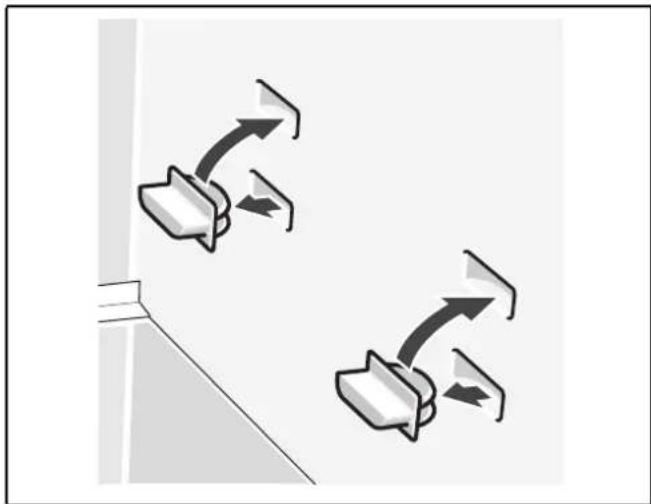
- Stopfen versetzen.
flowchart
graph TD
    A["Server Icon"] --> B["Data Flow Arrow"]
    C["Server Icon"] --> D["Data Flow Arrow"]
natural_image
Diagram of a hand placing a tray with an arrow, showing internal structure and shading (no text or symbols)Servierschale
natural_image
Interior view of a refrigerator with three shelves and one tray, showing a black arrow pointing to the tray (no text or symbols)natural_image
Two-panel diagram showing a container being inserted into a rack, with no visible text or symbols.Flaschenhalter
natural_image
Illustration showing a hand holding a U-shaped pipe clip attached to a wall, with an arrow indicating direction (no text or symbols present)Gastronorm-Behälter
natural_image
Diagram of a multi-tiered storage rack with downward arrows indicating flow or movement (no text or symbols)Stufenablage
Gerät reinigen

Achtung
Hinweis
natural_image
Illustration of a hand placing a component into a tray with a mesh drain (no text or symbols)natural_image
Diagram of two mechanical components with directional arrows indicating movement or force (no text or symbols)Gerüche
natural_image
Diagram of a medical device with a black arrow indicating force or movement (no text or symbols present)Beleuchtung (LED)
Safety and warning information 21
Before you switch ON the appliance 21
Technical safety 21
Important information when using the appliance 21
Children in the household 22
General regulations 22
Information concerning disposal 22
Disposal of packaging 22
Disposal of your old appliance 22
Scope of delivery 23
Observe ambient temperature and ventilation 23
Ambient temperature 23
Ventilation 23
Installation location 24
Connecting the appliance 24
Electrical connection 24
Getting to know your appliance 25
Controls 26
Switching the appliance on 26
Operating tips 26
Setting the temperature 27
Refrigerator compartment 27
Cool-fresh compartment 27
Alarm function 27
Door alarm 27
Switching off the alarm 27
Usable capacity 27
Refrigerator compartment 27
Storing food 27
Note the chill zones in the refrigerator
compartment 27
Fast cooling 28
Switching on and off 28
The "cool-fresh" compartment 28
"Cool-fresh" container 28
Humidity container 28
Foods suitable for "cool-fresh" container: 28
Storage times (at 0irc C) 28
Interior fittings 29
Glass shelf 29
Extendable glass shelf 29
Serving tray 29
Wine and champagne rack 30
Bottle holder 30
Gastronorm drawer 30
Multi-level shelf 30
Changing multi-level shelf 31
Switching off and disconnecting the appliance 31
Switching the appliance off 31
Disconnecting the appliance 31
Defrosting 31
Refrigerator and "cool-fresh" compartments 31
Cleaning the appliance 32
Interior fittings 32
Odours 34
Light (LED) 34
Tips for saving energy 34
Operating noises 34
Quite normal noises 34
Preventing noises 34
Eliminating minor faults yourself 35
Customer service 36
Repair order and advice on faults 36
Before you switch ON the appliance
Please read the operating and installation instructions carefully! They contain important information on how to install, use and maintain the appliance.
The manufacturer is not liable if you fail to comply with the instructions and warnings. Retain all documents for subsequent use or for the next owner.
Technical safety
The appliance contains a small quantity of environmentally friendly but flammable refrigerant R600a. Ensure that the tubing of the refrigerant circuit is not damaged during transportation and installation. Leaking refrigerant may cause eye injuries or ignite.
If damage has occurred
- Keep naked flames and/or ignition sources away from the appliance,
- thoroughly ventilate the room for several minutes,
- switch off the appliance and pull out the mains plug,
• inform customer service.
The more refrigerant an appliance contains, the larger the room must be in which the appliance is situated. Leaking refrigerant can form a flammable gas-air mixture in rooms which are too small.
The room must be at least 1 m3 per 8 g of refrigerant. The amount of refrigerant in your appliance is indicated on the rating plate inside the appliance.
If the power cord of this appliance is damaged, it must be replaced by the manufacturer, customer service or a similarly qualified person. Improper installations and repairs may put the user at considerable risk.
Repairs may be performed by the manufacturer, customer service or a similarly qualified person only.
Only original parts supplied by the manufacturer may be used. The manufacturer guarantees that only these parts satisfy the safety requirements.
A extension cable may be purchased from customer service only.
Important information when using the appliance
- Never use electrical appliances inside the appliance (e.g. heater, electric ice maker, etc.). Explosion hazard!
- Never defrost or clean the appliance with a steam cleaner! The steam may penetrate electrical parts and cause a short-circuit. Risk of electric shock!
- Do not use pointed or sharp-edged implements to remove frost or layers of ice. You could damage the refrigerant tubes. Leaking refrigerant may cause eye injuries or ignite.
- Do not store products which contain flammable propellants (e.g. spray cans) or explosive substances in the appliance. Explosion hazard!
- Do not stand on or lean heavily against base of appliance, drawers or doors, etc
- For defrosting and cleaning, pull the mains plug out or switch off the fuse. Do not pull out the mains plug by tugging on the power cord.
- Store high-percentage alcohol tightly closed and standing up.
- Keep plastic parts and the door seal free of oil and grease. Otherwise, parts and door seal will become porous.
- Never cover or block the ventilation openings of the appliance!
- Avoiding placing children and vulnerable people at risk:
At risk are children, people who have limited physical, mental or sensory abilities, as well as people who have inadequate knowledge concerning safe operation of the appliance.
Ensure that children and vulnerable people have understood the hazards.
A person responsible for safety must supervise or instruct children and vulnerable people who are using the appliance.
Only children from 8 years and above may use the appliance.
Supervise children who are cleaning and maintaining the appliance.
Never allow children to play with the appliance.
Children in the household
- Keep children away from packaging and its parts.
Danger of suffocation from folding cartons and plastic film! - Do not allow children to play with the appliance!
- If the appliance features a lock: keep the key out of the reach of children!
General regulations
The appliance is suitable for refrigerating food.
This appliance is intended for use in the home and the home environment.
The appliance is suppressed according to EU Directive 2004/108/EC.
The refrigeration circuit has been checked for leaks.
This product complies with the relevant safety regulations for electrical appliances (EN 60335-2-24).
This appliance is intended for use up to a maximum height of 2000 metres above sea level.
Information concerning disposal
Disposal of packaging
The packaging protects your appliance from damage during transit. All utilised materials are environmentally safe and recyclable. Please help us by disposing of the packaging in an environmentally friendly manner.
Please ask your dealer or inquire at your local authority about current means of disposal.
Disposal of your old appliance
Old appliances are not worthless rubbish! Valuable raw materials can be reclaimed by recycling old appliances.
This appliance is labelled in accordance with European Directive 2012/19/EU concerning used electrical and electronic appliances (waste electrical and electronic equipment - WEEE). The guideline determines the framework for the return and recycling of used appliances as applicable throughout the EU.
Warning
Redundant appliances
- Pull out the mains plug.
- Cut off the power cord and discard with the mains plug.
- Do not take out the trays and receptacles: children are therefore prevented from climbing in!
- Do not allow children to play with the appliance once it has spent its useful life. Danger of suffocation!
Refrigerators contain refrigerant and gases in the insulation. Refrigerant and gases must be disposed of professionally. Ensure that tubing of the refrigerant circuit is not damaged prior to proper disposal.
Scope of delivery
After unpacking all parts, check for any damage in transit.
If you have any complaints, please contact the dealer from whom you purchased the appliance or our customer service.
The delivery consists of the following parts:
Built-in appliance
• Interior fittings (depending on model)
- Bag containing installation materials
- Operating instructions
• Installation manual
- Customer service booklet
- Warranty enclosure
• Information on the energy consumption and noises
Observe ambient temperature and ventilation
Ambient temperature
The appliance is designed for a specific climate class. Depending on the climate class, the appliance can be operated at the following room temperatures.
| Climate class | Permitted ambient temperature |
| SN +10 °C to 32 °C | |
| N +16 °C to 32 °C | |
| ST +16 °C to 38 °C | |
| T +16 °C to 43 °C |
The climate class can be found on the rating plate.
Note
The appliance is fully functional within the room temperature limits of the indicated climatic class. If an appliance of climatic class SN is operated at colder room temperatures, the appliance will not be damaged up to a temperature of +5 °C.
Ventilation
The refrigeration unit is ventilated only via the ventilation grille in the base. Never cover the ventilation grille or place anything in front of it. Otherwise the refrigeration unit must work harder, increasing the power consumption.
Installation location
Install the appliance in a dry, well ventilated room. The installation location should neither be exposed to direct sunlight nor near a heat source, e.g. a cooker, radiator, etc. If installation next to a heat source is unavoidable, use a suitable insulating plate or observe the following minimum distances to a heat source:
3 cm to electric or gas cookers.
- 30 cm to an oil or coal-fired cooker.
Connecting the appliance
After installing the appliance, wait at least 1 hour until the appliance is switched on. During transportation the oil in the compressor may have flowed into the refrigeration system.
Before switching on the appliance for the first time, clean the interior of the appliance (see chapter "Cleaning the appliance").
Electrical connection
The socket must be near the appliance and also freely accessible following installation of the appliance.
The appliance complies with the protection class I. Connect the appliance to 220-240 V/50 Hz alternating current via a correctly installed socket with protective conductor. The socket must be fused with a 10 to 16 A fuse.
For appliances operated in non-European countries, check whether the stated voltage and current type match the values of your mains supply. These specifications can be found on the rating plate.
Warning
Never connect the appliance to electronic energy saver plugs. Our appliances can be used with mains and sine-controlled inverters. Mains-controlled inverters are used for photovoltaic systems which are connected directly to the national grid. Sine-controlled inverters must be used for isolated applications (e.g. on ships or in mountain lodges) which are not connected directly to the national grid.
Getting to know your appliance
These operating instructions refer to several models.
The features of the models may vary.
The diagrams may differ.
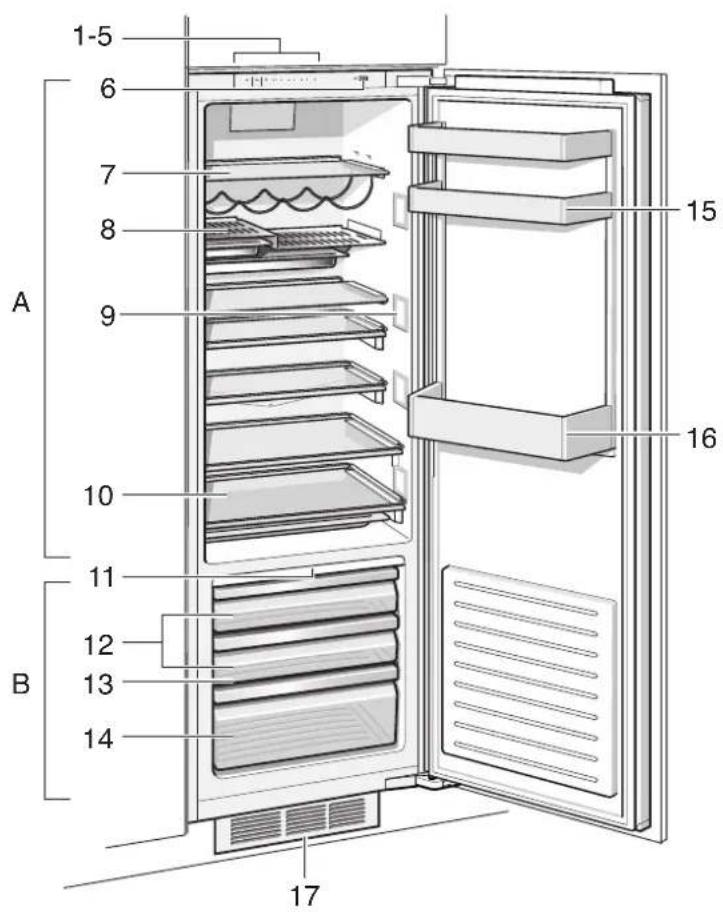
A Refrigerator compartment
16 Shelf for large bottles
B Cool-fresh compartment
17 Ventilation opening
1-5 Controls
6 On/Off button
7 Glass shelf
8 Multi-level shelf with Gastronorm drawer
9 Light, refrigerator compartment
10 Extendable glass shelf with serving tray
11 Light, cool-fresh compartment
12 "Cool-fresh" container
13 Humidity filter
14 Humidity container
15 Door shelf
Controls
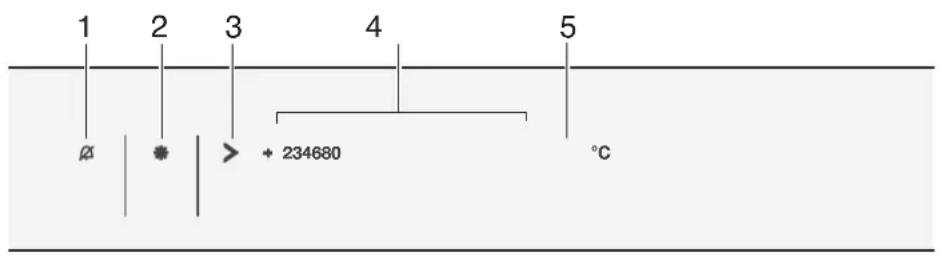
1 Alarm button
Used to switch off the warning signal, (see chapter "Alarm function").
2 Fast button refrigerator compartment \*
Switches fast cooling on and off (see chapter "Fast cooling").
3 Temperature setting button refrigerator compartment >
The button sets the temperature in the refrigerator compartment.
4 Temperature display refrigerator compartment
The numbers correspond to the set refrigerator compartment temperatures in °C.
5 ON/OFF display
The ON/OFF display is lit when the appliance is in operation.
Switching the appliance on
Switch on the appliance with the On/Off button ① (see appliance overview).
The temperature display for the refrigerator compartment flashes until the appliance has reached the set temperature.
The appliance begins to cool. Light is switched on when the door is open.
We recommend a factory setting of +4 °C in the refrigerator compartment.
Do not store perishable food warmer than +4 °C.
Operating tips
- After the appliance has been switched on, it may take several hours until the set temperature has been reached.
Do not put any food in the appliance beforehand. - The front sides of the housing are partly heated slightly. This prevents condensation in the area of the door seal.
Setting the temperature
Refrigerator compartment
The temperature can be set from +2 °C to +8 °C.
Keep pressing refrigerator compartment temperature selection button > until the required refrigerator compartment temperature is set.
The value last selected is saved. The set temperature is indicated on temperature display for the refrigerator compartment.
Cool-fresh compartment
The temperature in the “cool-fresh” compartment has been set to almost 0\ ircC at the factory and should not be changed if at all possible.
If frost forms on the refrigerated food, the temperature can be increased. (See chapter "Eliminating minor faults yourself".)
Alarm function
Door alarm
The door alarm (continuous sound) switches on if the appliance door is open for longer than two minutes. Close the door to switch off the warning signal.
Switching off the alarm
Press the alarm button ⚠ to switch off the warning signal.
Usable capacity
Information on the usable capacity can be found inside your appliance on the rating plate (see diagram at chapter "Customer service").
Refrigerator compartment
The refrigerator compartment is the ideal storage location for ready meals, cakes and pastries, preserved food, condensed milk and hard cheese.
Storing food
- Store fresh, undamaged food. The quality and freshness will then be retained for longer.
- In the case of ready-made products and bottled goods, observe the best-before date or use-by date specified by the manufacturer.
- To retain aroma, colour and freshness, pack or cover food well before placing in the appliance. This will prevent the transfer of flavours and the discolouration of plastic parts in the refrigerator compartment.
- Allow warm food and drinks to cool down before placing in the appliance.
Note
Avoid contact between food and rear panel. Otherwise the air circulation will be impaired. Food or packaging could freeze to the rear panel.
Note the chill zones in the refrigerator compartment
The air circulation in the refrigerator compartment creates different chill zones:
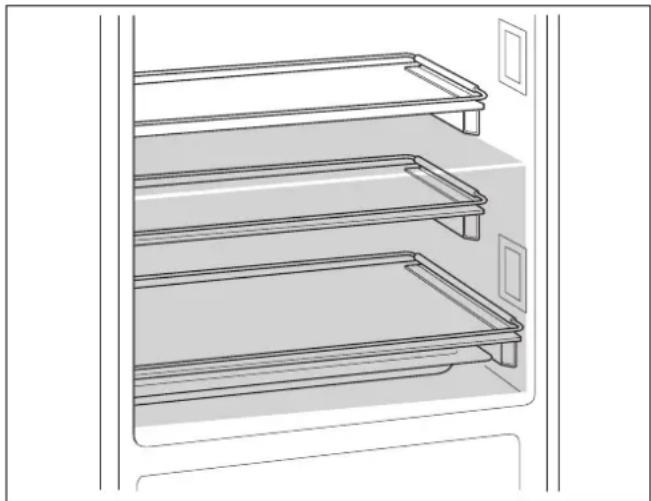
- The coldest zones are on the rear panel, on the extendable glass shelves and in the serving tray.
Store perishable food (e.g. fish, sausage, meat) in the coldest zones. - Warmest zone is at the very top of the door.
Store e.g. hard cheese and butter in the warmest zone. Cheese can then continue to release its flavour and the butter will still be easy to spread.
Note
Note
natural_image
Line drawing of a cabinet interior with three shelves and door covers (no text or symbols)Fast cooling
Fast cooling sets the refrigerator temperature to the coldest temperature setting for approx. 6 hours. Then the original temperature set before fast cooling mode is automatically restored.
Switch on fast cooling mode, e.g.:
- before placing large quantities of food in the refrigerator compartment.
• for fast cooling drinks.
Note
When fast cooling is switched on, increased operating noises may occur.
Switching on and off
Press "fast" button refrigerator compartment *.
The button is lit when fast cooling is switched on.
The "cool-fresh" compartment
The temperature in the fridge is about 0\ ircC . The low temperature and the optimum moisture provide ideal storage conditions for fresh food.
Food can be kept fresh up to three times longer in the "cool-fresh" compartment than in the normal cooling zone – for even longer freshness, nutrient retention and flavour.
"Cool-fresh" container
The storage climate in the "cool-fresh" container offers ideal conditions for the storage of fish, meat, sausage, cheese and milk.
Humidity container
The humidity container is covered with a special filter which optimises retention of the air humidity in the storage compartment. As a result, there is up to 95 % air humidity in the humidity container, depending on the amount of products put in. This storage climate offers ideal conditions for fresh fruit, salad greens, vegetables, herbs and mushrooms.
Notes
- Fruit sensitive to cold (e.g. pineapple, banana, papaya and citrus fruit) and vegetables sensitive to cold (e.g. aubergines, cucumbers, zucchini, peppers, tomatoes and potatoes) should be stored outside the refrigerator at temperatures of approx. 8 °C to 12 °C for optimum preservation of quality and flavour.
- Condensation may form in the humidity container depending on the type and quantity of products stored. Remove condensation with a dry cloth.
Foods suitable for "cool-fresh" container:
In the "cool-fresh" container:
Fish, seafood, meat, sausage, dairy products, ready meals.
In the humidity container:
- Vegetables (e.g. carrots, asparagus, celery, leeks, beetroot, mushrooms, brassicas such as broccoli, cauliflower, Brussels sprouts, kohlrabi)
- Salad greens (e.g. lamb's lettuce, iceberg lettuce, chicory, lettuce)
Herbs (e.g. dill, parsley, chives, basil) - Fruit (types insensitive to cold, e.g. apples, peaches, berries, grapes)
Storage times (at 0 °C)
| Depending on the initial quality | |
| Fresh fish, seafood up to 3 days | |
| Poultry, meat (boiled/fried) up to 5 days | |
| Beef, pork, lamb, sausage (cold meat) | up to 7 days |
| Smoked fish, broccoli up to 14 days | |
| Salad greens, fennel, apricots, plums | up to 21 days |
| Soft cheese, yoghurt, quark, buttermilk, cauliflower | up to 30 days |
Interior fittings
(not all models)
Glass shelf
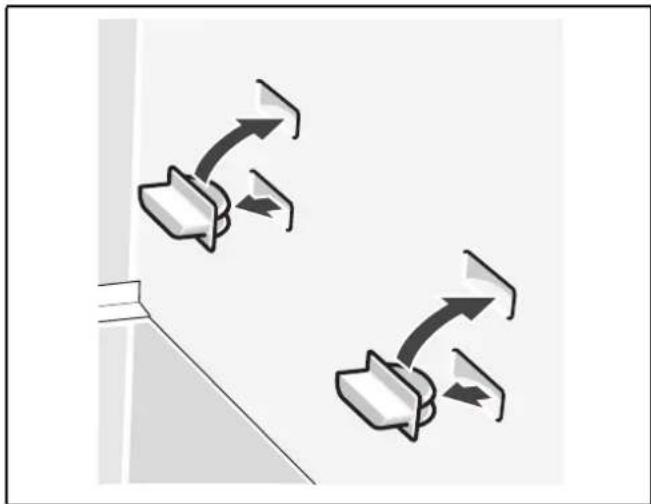
To store tall items, you can change the position of the glass shelf.
- To remove the glass shelf, pull up at an angle and take out.
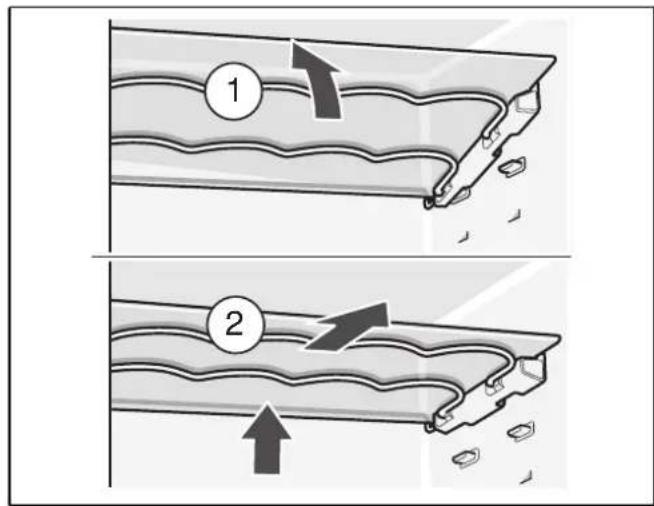
- Move stoppers.
flowchart
graph TD
    A["Process 1"] --> B["Process 2"]
    B --> C["Output"]
    style A fill:#f9f,stroke:#333
    style C fill:#bbf,stroke:#333
- To re-insert the glass shelf, first place it on the back stoppers and then engage at the front.
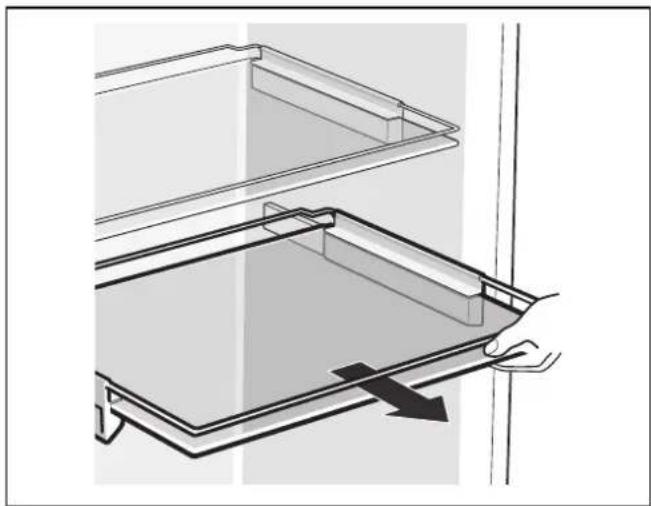
Extendable glass shelf
The extendable glass shelf can be pulled out for a better overview of the food.
natural_image
Diagram of a hand placing a tray with an arrow indicating direction (no text or symbols present)Serving tray
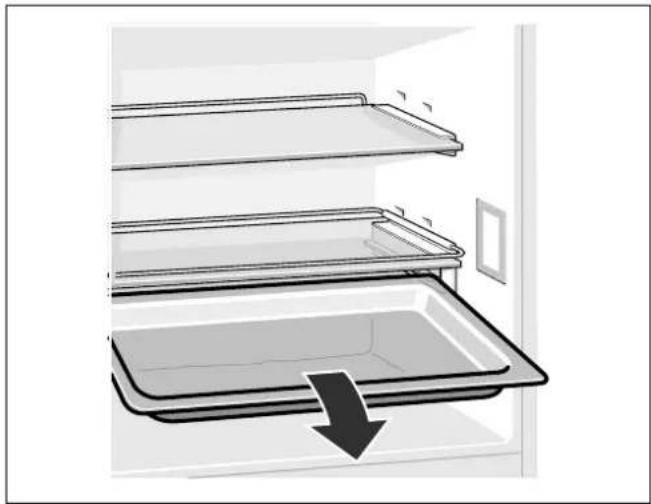
You can prepare food in the serving tray, e.g. sausage or cheese platters, keep food cool and serve food.
Note
To prevent the transfer of odours and flavours, cover food with foil.
natural_image
Illustration of a refrigerator interior showing three shelves and one tray with a downward arrow (no text or symbols)Wine and champagne rack
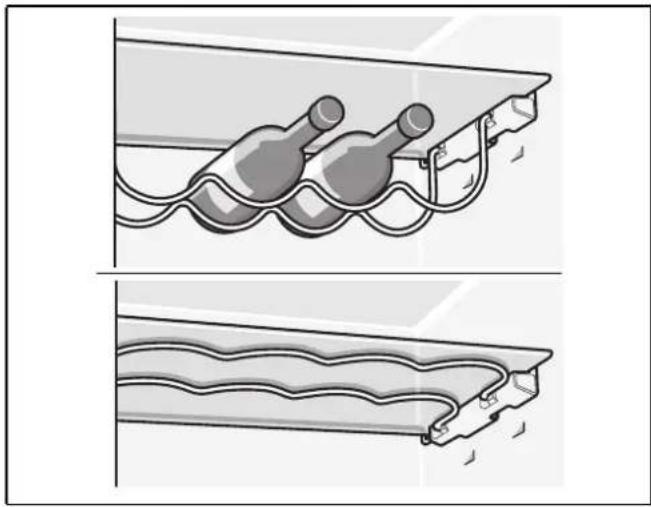
You can store bottles securely in the wine and champagne rack. If you require space for other food, you can fold the metal clips upwards.
natural_image
Two-panel diagram showing a container being inserted into a rack, with no visible text or symbols.Bottle holder
The bottle holder prevents bottles from falling over when the door is opened and closed.
natural_image
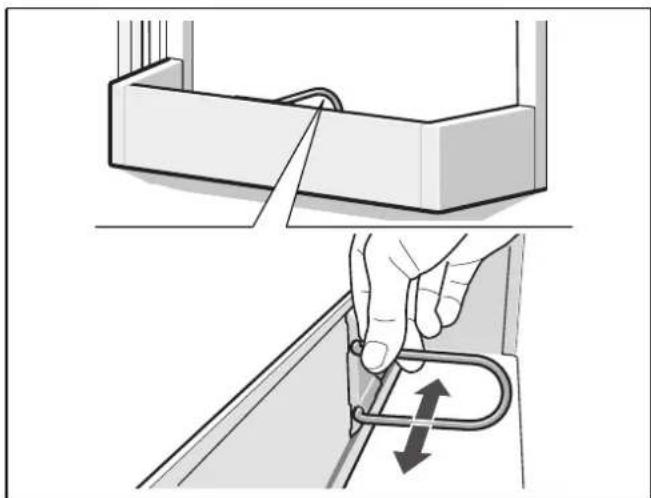
Illustration showing a hand holding a U-shaped pipe fitting with an arrow indicating direction (no text or symbols)Gastronorm drawer
Food can be stored in the Gastronorm drawer and placed in the refrigerator compartment with minimum space requirements.
natural_image
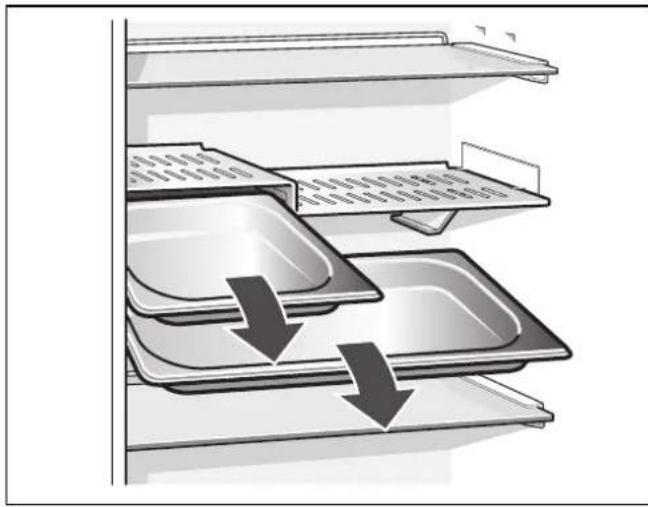
Illustration of a multi-tiered storage shelf with downward arrows indicating flow or movement (no text or symbols)Multi-level shelf
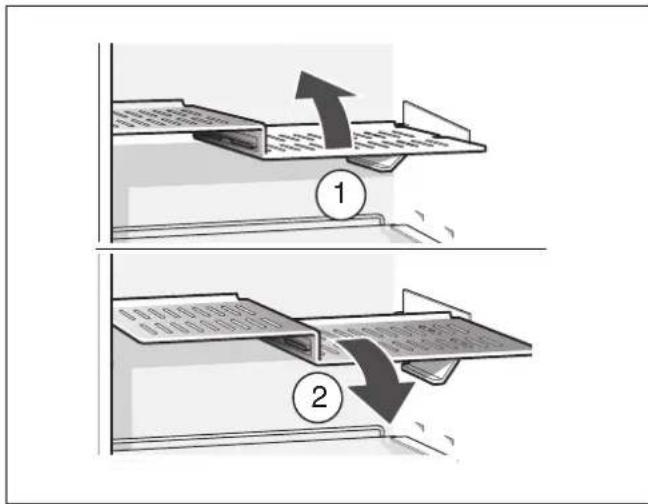
Before you can take out the multi-level shelf, you must remove the Gastronorm drawers.
Lift multi-level shelf at the front, pull out and swing out to the side.
Changing multi-level shelf
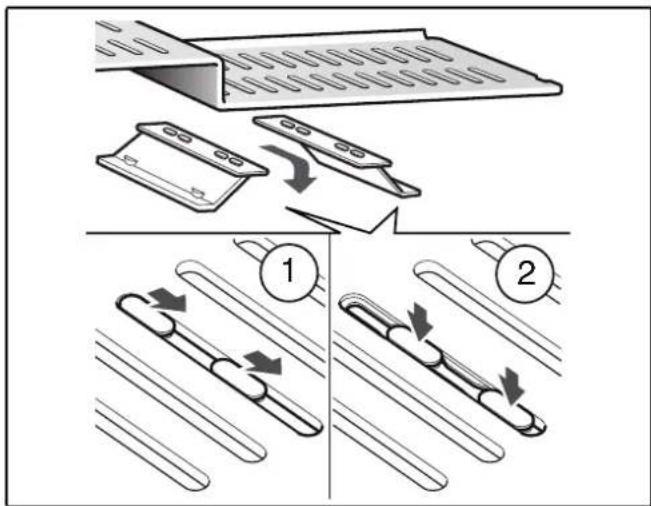
If you would like to use a different size of Gastronorm drawer, you can change the positions of the holders.
flowchart
graph TD
    A["Initial State"] --> B["Intermediate State"]
    B --> C["Final Step 1"]
    C --> D["Intermediate Step 2"]
Switching off and disconnecting the appliance
Switching the appliance off
Press the On/Off button ①.
Temperature display goes out, refrigeration unit switches off.
Disconnecting the appliance
If you do not use the appliance for a prolonged period:
- Switch off the appliance.
- Pull out mains plug or switch off fuse.
- Clean the appliance.
- Leave the appliance door open.
Defrosting
Refrigerator and "cool-fresh" compartments
While the appliance is running, condensation droplets or frost form on the rear panel of the refrigerator compartment. As the rear panel defrosts automatically, it is not necessary to remove the frost or the condensation droplets. The condensation runs through the condensation channel and the drainage hole to the evaporation pan where it evaporates.
Note
Keep the condensation channel and drainage hole clean, so the condensation can drain off.
Cleaning the appliance

Caution
- Do not use abrasive, chloride or acidic cleaning agents or solvents.
- Do not use scouring or abrasive sponges. The metallic surfaces could corrode.
- Never clean the shelves or containers in the dishwasher. The parts may become deformed!
Proceed as follows:
- Before cleaning: Switch off the appliance.
- Pull out mains plug or switch off fuse.
- Take out the food and store in a cool location. Place ice pack (if available) on the food.
- Wait until the layer of frost has thawed.
- Clean the appliance with a soft cloth, lukewarm water and a little pH neutral washing-up liquid. The rinsing water must not run into the light or through the drainage hole into the evaporation pan.
- Wipe the door seal with clear water only and then wipe dry thoroughly.
- After cleaning reconnect and switch the appliance back on.
- Put the food back into the appliance.
Notes
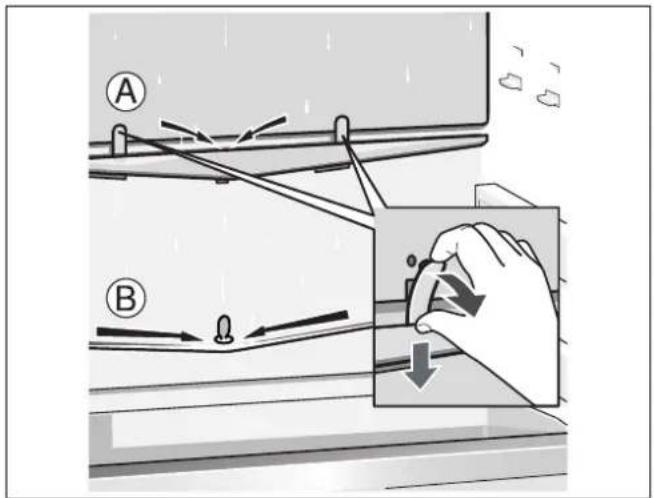
The water conduction channel A can be taken out for cleaning. Regularly clean the condensation channel and drainage hole B with a cotton bud to ensure that the condensation can drain.
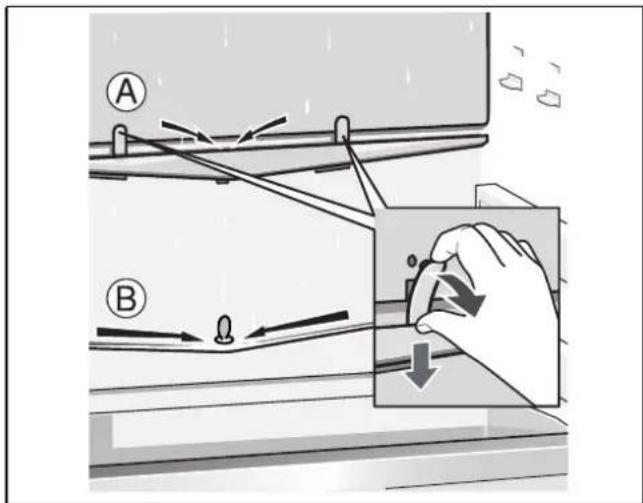
- After cleaning, the stopper must be re-inserted into the drainage hole of the refrigerator compartment for functional reasons.
Interior fittings
All variable parts of the appliance can be taken out for cleaning.
Extendable glass shelf
- Take out serving tray.
- Detach glass shelf at front by lifting it out of the rails.
- Lift glass shelf at rear and take out.
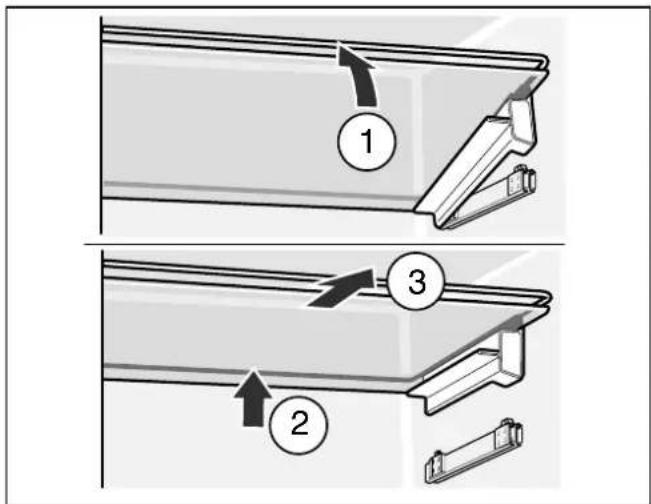
Note
To insert extendable glass shelf, first place the back of the shelf on the rails, feed it in and then engage at the front.
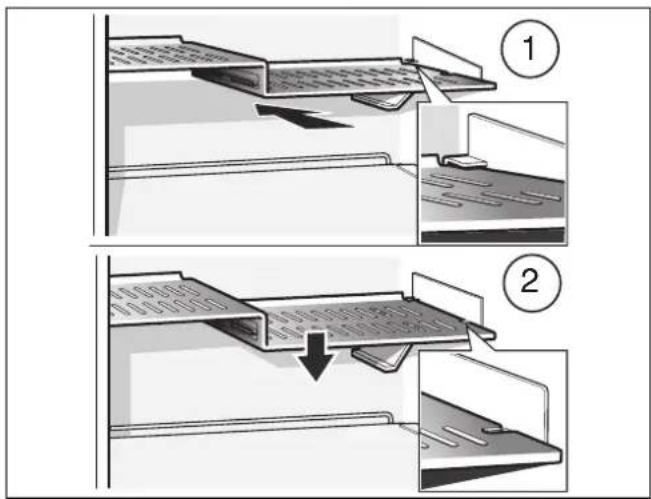
Multi-level shelf
To remove the multi-level shelf, lift at the front, pull forwards, lower and swing out to the side.
To insert multi-level shelf, first push into the rear holders and then press down.
"Cool-fresh" and humidity container
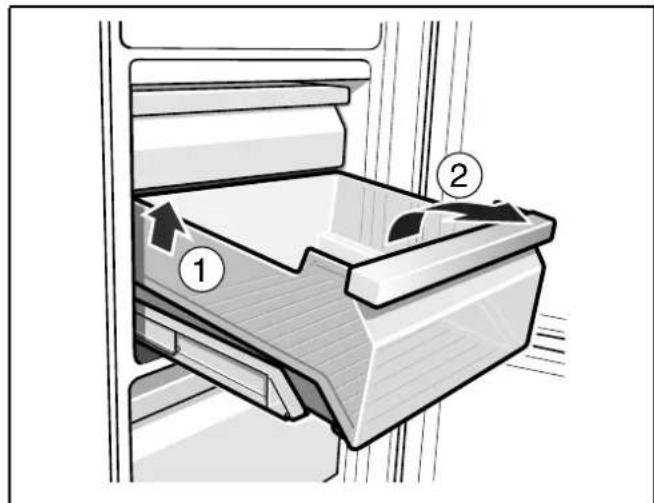
To remove the container, pull out, tilt forwards and lift.
To insert the container, place the front of the container on the telescopic rails and push into the appliance. The container engages when it is pushed into the appliance.
Taking out the humidity filter
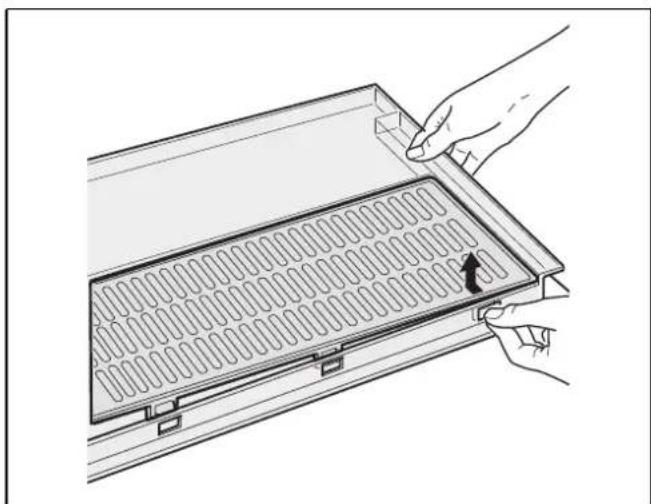
The humidity filter over the humidity container can be taken out for cleaning. To do this, first take out the humidity container and pull out the humidity filter. Lift off the filter cover and take out the filter. Clean in lukewarm water, leave to dry and re-assemble.
natural_image
Illustration of a hand placing a tray into a plastic container with a small object inside (no text or symbols)Remove telescopic rails
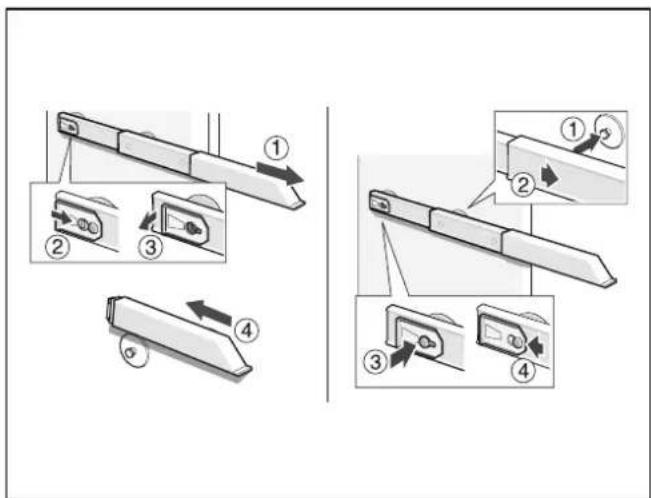
- Pull out extension rail.
- Push lock in the direction of the arrow.
- Detach telescopic rail from the rear pin.
- Push telescopic rail together, push backwards above the rear pin and disengage.
Installing telescopic rails
- Place the extended telescopic rail on the front pin.
- Pull the telescopic rail forwards slightly until it engages.
- Place telescopic rail on the rear pin.
- Push lock backwards.
Door shelf
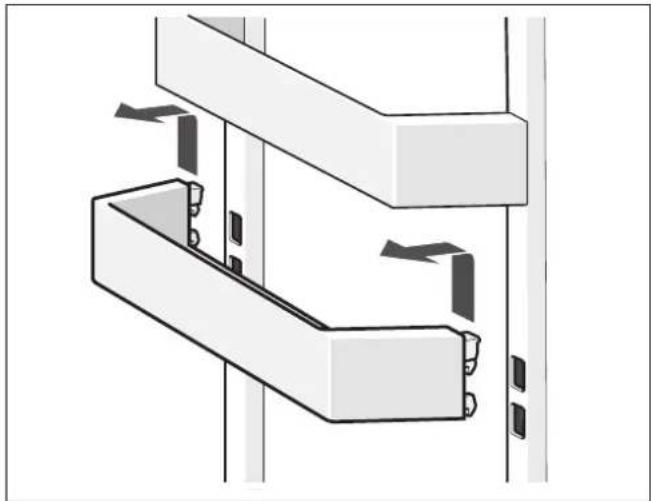
Raise the door shelf and remove.
natural_image
Technical diagram of a mechanical assembly with two components and directional arrows indicating movement (no text or symbols)Odours
If you experience unpleasant odours:
- Switch off the appliance with the On/Off button ①.
- Take all food out of the appliance.
- Clean interior (see chapter "Cleaning the appliance").
- Clean all packages.
- Seal strong smelling food in order to avoid odours from forming.
- Switch on appliance again.
- Store food in the appliance.
- Check whether the formation of odours is still occurring after 24 hours.
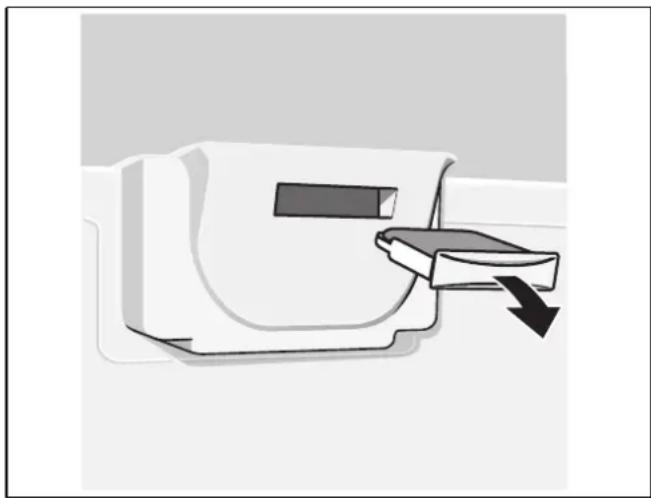
- Exchange the odour filter. The odour filter is located behind the "cool-fresh" container. Replacement filters are available from your customer service.
natural_image
Diagram of a medical device with a black arrow indicating force or movement (no text or symbols present)Light (LED)
Your appliance features a maintenance-free LED light.
These lights may be repaired by customer service or authorised technicians only.
Tips for saving energy
- Install the appliance in a dry, well ventilated room! The appliance should not be installed in direct sunlight or near a heat source (e.g. radiator, cooker). If required, use an insulating plate.
- Allow warm food and drinks to cool down before placing in the appliance.
- Thaw frozen food in the refrigerator compartment and use the low temperature of the frozen food to cool refrigerated food.
- Open the appliance as briefly as possible.
- To prevent increased power consumption, occasionally clean the ventilation opening with a paint brush or vacuum cleaner.
- The arrangement of the fittings does not affect the energy rating of the appliance.
Operating noises
Quite normal noises
Droning
Motors are running (e.g. refrigerating units, fan).
Bubbling, humming or gurgling noises
Refrigerant is flowing through the tubing.
Clicking
Motor, switches or solenoid valves are switching on/off.
Preventing noises
The appliance is not level
Please align the installation cavity with a spirit level. To do this, use the height-adjustable feet of the cavity or place something underneath.
Containers or storage areas wobble or stick
Please check the removable parts and re-insert them correctly if required.
Receptacles are touching each other
Move the receptacles slightly away from each other.
Eliminating minor faults yourself
Before you call customer service:
Please check whether you can eliminate the fault yourself based on the following information.
Customer service will charge you for advice – even if the appliance is still under guarantee!
| Fault Possible cause Remedial action | ||
| Temperature differs greatly from the set value. | In some cases it is adequate to switch off the appliance for 5 minutes.If the temperature is too high wait a few hours and check whether the temperature has approached the set value.If the temperature is too low check the temperature again the next day. | |
| Floor of the refrigerator compartment is wet. | The condensation channel or drainage hole are blocked. | Clean the condensation channel and the drainage hole. See chapter Cleaning the appliance. |
| The temperature in the refrigerator compartment is too cold. | Temperature has been set too low. Increase the temperature. | |
| The refrigerating unit is switching on more frequently and for longer. | Appliance opened frequently. Do not open the appliance unnecessarily. | |
| The ventilation openings have been covered. | Remove obstacles. | |
| There is no cooling output from the appliance. | Appliance is switched off. Press the On/Off button 1. | |
| Power failure Check whether the power is on. | ||
| The lighting does not work. | The fuse has been switched off. Check mains fuse. | |
| The display does not illuminate. | The mains plug has not been inserted properly. | Check whether the mains plug is secure. |
| Appliance is not cooling, temperature display and light are lit. | Showroom mode is switched on. Hold down alarm button for 10 seconds until an acknowledgement signal sounds.After a short time check whether your appliance is cooling. | |
| The light does not function. The LED light is defective. See chapter “Light (LED)” section. | ||
| Temperature display for the refrigerator compartment flashes. | Appliance opened frequently. Do not open the appliance unnecessarily. | |
| Too much food was placed in the compartment. | Before placing food in the compartment, press the Fast button *. | |
| The airing and ventilation openings are blocked. | Remove obstacles. | |
| The “cool-fresh” compartment is too warm or too cold. | The standard setting has been set too high or too low (e.g. if there is frost in the “cool-fresh” compartment). | The temperature in the “cool-fresh” compartment can be set to be 2 steps warmer and/or colder. If the refrigerator compartment temperature is set to 4, the “cool-fresh” compartment has a temperature of almost 0 °C.1. Press Fast button on refrigerator compartment for 3 seconds until a signal sounds.Temperature display on refrigerator compartment flickers.2. Change the setting using the temperature setting buttons < >.Setting 2 - coldest settingSetting 8 - warmest settingThe set temperature is saved after one minute. |
Customer service
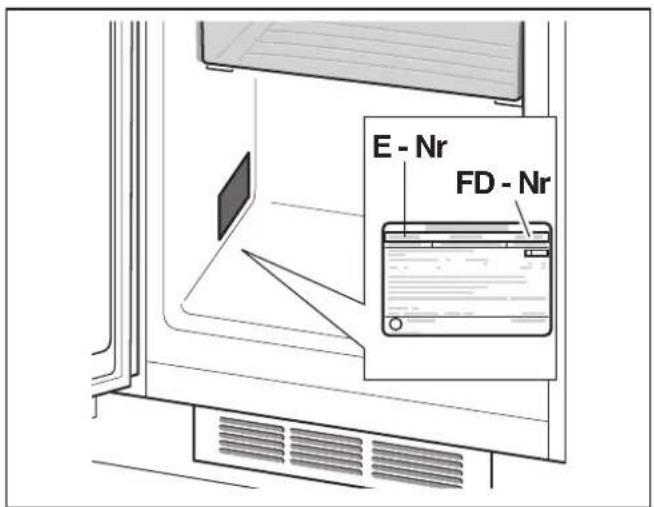
Your local customer service can be found in the telephone directory or in the customer-service index. Please provide customer service with the appliance product number (E-Nr.) and production number (FD-Nr.).
These specifications can be found on the rating plate.
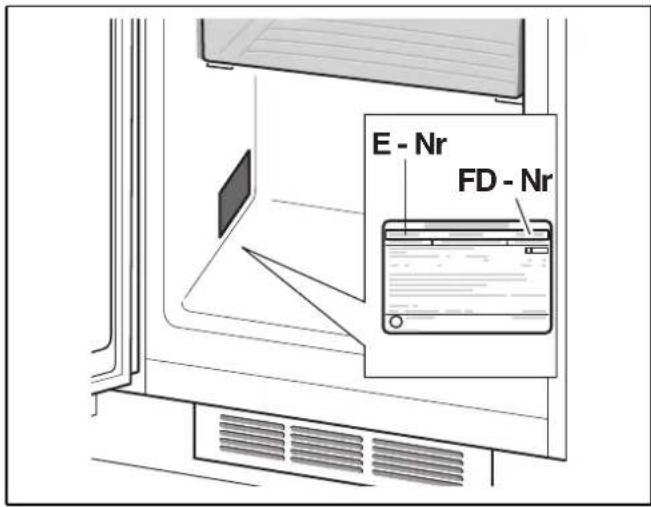
To prevent unnecessary call-outs, please assist customer service by quoting the product and production numbers. This will save you additional costs.
Repair order and advice on faults
Contact information for all countries can be found on the enclosed customer service list.
GB 0344 892 8988 Calls charged at local or mobile rate.
IE 01450 2655 0.03 € per minute at peak. Off peak 0.0088 € per minute.
US 877 442 4436 toll-free
natural_image
Line drawing of a refrigerator shelf with three horizontal trays (no text or symbols)natural_image
Diagram showing two computer monitors with bidirectional arrows indicating data flow (no text or symbols)natural_image
Diagram of a hand placing a tray with an arrow indicating direction (no text or symbols present)Plat de service
natural_image
Interior view of a refrigerator showing three shelves with one tray and a downward arrow indicating storage (no text or symbols)natural_image
Two-panel diagram showing a container being inserted into a rack, with no visible text or symbols.Porte-bouteilles
natural_image
Illustration showing a hand holding a U-shaped pipe clip attached to a wall, with an arrow indicating direction (no text or symbols present)Bac gastronorme
natural_image
Diagram of a multi-level storage rack with downward arrows indicating flow or movement (no text or symbols)Clayette étagée
Nettoyer l'appareil

Attention
Remarque
natural_image
Illustration of a hand placing a tray into a plastic container with internal compartments (no text or symbols)natural_image
Diagram of two mechanical components with directional arrows indicating movement or force (no text or symbols)Odeurs
natural_image
Diagram of a toilet with a downward arrow indicating airflow or movement (no text or symbols)Éclairage (LED)
natural_image
Line drawing of a refrigerator shelf with three shelves and doors on top (no text or symbols)natural_image
Diagram of a hand placing a tray into a multi-tiered storage unit (no text or symbols present)Vassoio
natural_image
Interior view of a refrigerator showing three shelves with one tray open and a downward arrow indicating storage or cleaning (no text or symbols)natural_image
Two-panel diagram showing a container with two bottles and coiled tubing, above and below (no text or symbols)Fermabottiglie
natural_image
Illustration showing a hand holding a U-shaped pipe clip attached to a wall, with an arrow indicating direction (no text or symbols present)Contenitore Gastronorm
natural_image
Diagram of a multi-level kitchen or storage rack with downward arrows indicating flow or movement (no text or symbols)Ripiano a gradini
flowchart
graph TD
    A["Initial State"] --> B["Step 1: Assembly"]
    B --> C["Step 2: Rotation of Component"]
    C --> D["Final State with Arrow Direction"]
Avvertenza
natural_image
Line drawing of a hand placing a tray into a plastic container with a handle (no text or symbols)Smontare le guide estraibili
Montare le guide telescopiche
natural_image
Diagram of a mechanical assembly with two blocks and directional arrows indicating movement (no text or symbols)Odori
natural_image
Diagram of a medical device with a downward arrow indicating force or movement (no text or symbols present)Illuminazione (LED)
Gastronorm-schaal 85
Getrapt legplateau 85
Getrapte legplateau veranderen 85
natural_image
Line drawing of a refrigerator shelf with multiple shelves (no text or symbols)Snelkoelen
natural_image
Diagram of a hand placing a tray into a multi-tiered storage unit (no text or symbols present)Serveerschaal
natural_image
Interior view of a refrigerator with three shelves and a tray, showing a black arrow pointing to one (no text or symbols)Wijn- en champagnerek
natural_image
Two-panel diagram showing a container with two bottles and tubing, above and below (no text or symbols)Flessenhouder
natural_image
Illustration showing a hand holding a U-shaped pipe clip attached to a wall, with an arrow indicating direction (no text or symbols present)Gastronorm-schaal
natural_image
Diagram of a multi-tiered storage rack with downward arrows indicating flow or movement (no text or symbols)Getrapt legplateau
Getrapte legplateau veranderen
Apparaat reinigen
Attentie
Aanwijzing
Verskoel- en vochtlade
Vochtfilter eruit halen
natural_image
Illustration of a hand placing a grid-like object into a tray (no text or symbols visible)Uittrekbare rails demonteren
natural_image
Diagram of two mechanical components with directional arrows indicating movement or force (no text or symbols)Luchtjes
natural_image
Diagram of a medical device with a black arrow indicating force or movement (no text or symbols present)Verlichting (LED)


- Schnell-Kühlen
- Servierschale
- Flaschenhalter
- Gastronorm-Behälter
- Stufenablage
- Gerät reinigen
- Achtung
- Hinweis
- Gerüche
- Beleuchtung (LED)
- Safety and warning information 21
- Information concerning disposal 22
- Scope of delivery 23
- Observe ambient temperature and ventilation 23
- Installation location 24
- Connecting the appliance 24
- Getting to know your appliance 25
- Switching the appliance on 26
- Setting the temperature 27
- Alarm function 27
- Usable capacity 27
- Refrigerator compartment 27
- Fast cooling 28
- The "cool-fresh" compartment 28
- Interior fittings 29
- Switching off and disconnecting the appliance 31
- Defrosting 31
- Cleaning the appliance 32
- Odours 34
- Light (LED) 34
- Tips for saving energy 34
- Operating noises 34
- Eliminating minor faults yourself 35
- Customer service 36
- Before you switch ON the appliance
- Technical safety
- If damage has occurred
- Important information when using the appliance
- Children in the household
- General regulations
- Information concerning disposal
- Disposal of packaging
- Disposal of your old appliance
- Warning
- Scope of delivery
- The delivery consists of the following parts:
- Observe ambient temperature and ventilation
- Ambient temperature
- Note
- Ventilation
- Installation location
- Connecting the appliance
- Electrical connection
- Getting to know your appliance
- Controls
- Alarm button
- Fast button refrigerator compartment \*
- Temperature setting button refrigerator compartment >
- Temperature display refrigerator compartment
- ON/OFF display
- Switching the appliance on
- Operating tips
- Setting the temperature
- Refrigerator compartment
- Cool-fresh compartment
- Alarm function
- Door alarm
- Switching off the alarm
- Usable capacity
- Storing food
- Note the chill zones in the refrigerator compartment
- Fast cooling
- Switching on and off
- The "cool-fresh" compartment
- "Cool-fresh" container
- Humidity container
- Notes
- Foods suitable for "cool-fresh" container:
- In the humidity container:
- Interior fittings
- Glass shelf
- Extendable glass shelf
- Serving tray
- Wine and champagne rack
- Bottle holder
- Gastronorm drawer
- Multi-level shelf
- Changing multi-level shelf
- Switching off and disconnecting the appliance
- Switching the appliance off
- Disconnecting the appliance
- Defrosting
- Refrigerator and "cool-fresh" compartments
- Cleaning the appliance
- Caution
- "Cool-fresh" and humidity container
- Taking out the humidity filter
- Remove telescopic rails
- Installing telescopic rails
- Door shelf
- Odours
- Light (LED)
- Tips for saving energy
- Operating noises
- Quite normal noises
- Preventing noises
- Eliminating minor faults yourself
- Customer service
- Repair order and advice on faults
- Plat de service
- Porte-bouteilles
- Bac gastronorme
- Clayette étagée
- Nettoyer l'appareil
- Attention
- Remarque
- Odeurs
- Éclairage (LED)
- Vassoio
- Fermabottiglie
- Contenitore Gastronorm
- Ripiano a gradini
- Avvertenza
- Smontare le guide estraibili
- Montare le guide telescopiche
- Odori
- Illuminazione (LED)
- Snelkoelen
- Serveerschaal
- Wijn- en champagnerek
- Flessenhouder
- Gastronorm-schaal
- Getrapt legplateau
- Getrapte legplateau veranderen
- Apparaat reinigen
- Attentie
- Aanwijzing
- Verskoel- en vochtlade
- Vochtfilter eruit halen
- Uittrekbare rails demonteren
- Luchtjes
- Verlichting (LED)
Brand : GAGGENAU
Model : RC249202
Category : Refrigerator