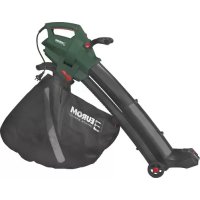
EBR3000 - Blower Eurom - Free user manual and instructions
Find the device manual for free EBR3000 Eurom in PDF.


| Product Type | Leaf Blower / Vacuum |
| Brand | Eurom |
| Model | EBR3000 |
| Power | 3000 W |
| Connection Voltage | 230-240 V / 50 Hz |
| Motor Speed | 10,000 - 16,500 rpm |
| Max Air Speed | 300 km/h |
| Max Suction Flow | 16 m³/min |
| Bag Capacity | 45 liters |
| Shredding Function | Yes (impeller wheel + metal blades) |
| Retractable Metal Rake | Yes |
| Telescopic Tube | Yes (10 cm extension, continuously adjustable) |
| Adjustable Front Handle | Yes (knurled red buttons) |
| Carrying Strap | Yes (included) |
| Extension Cord Hook | Yes (retractable) |
| Number of Wheels | 2 |
| Housing Material | Plastic |
| Dimensions (L x W x H) | 90.8 x 21 x 30.5 cm |
| Net Weight | 5.50 kg |
| Power Levels | 6 (positions 1 to 6) |
| Suction/Blow Selector | Yes |
| Impeller Access Cover | Yes (for easy cleaning) |
| Maintenance and Cleaning | Unplug before cleaning, empty bag, brush off residue, do not use cleaners on plastic |
| Safety | 30 mA residual current device recommended, use with closed shoes, long trousers, gloves, safety goggles, dust mask advised |
| Warranty and Repairability | Warranty voided if instructions not followed; repair only by certified electrician, original parts mandatory |
Frequently Asked Questions - EBR3000 Eurom
User questions about EBR3000 Eurom
0 question about this device. Answer the ones you know or ask your own.
Ask a new question about this device
Download the instructions for your Blower in PDF format for free! Find your manual EBR3000 - Eurom and take your electronic device back in hand. On this page are published all the documents necessary for the use of your device. EBR3000 by Eurom.
USER MANUAL EBR3000 Eurom
Thank you for choosing this EUROM leaf blower: you have made an excellent choice! To ensure that you enjoy your leaf blower without problem and for an extended period of time it is important that you and any other users are aware of how it works. Before use, please read the instruction manual and labels on the device: they will teach you how the leaf blower should be used (the options for use and limitations), as well as its potential dangers. If you do not understand something, please consult your dealer.
The manual forms part of the device and should be kept with it for consultation by future users.
We wish you many hours of problem-free user pleasure!
GENERAL SAFETY RULES
- Before using your leaf blower, check for visible damage (including the cable and plug). Never use a damaged device and return it to your supplier for replacement.
- This device is intended for use by private individuals only. It should not be used for commercial purposes.
- The electrical voltage and frequency, as indicated on the device, must agree with the power socket to be used. The electrical installation must be secured with an earth leakage switch (max. 30 mAmp).
- Only use an undamaged, approved and waterproof extension cord with a minimum diameter of 2 × 1.5 ~mm^2 (up to 15 metres) or 2 × 2.5 ~mm^2 (from 15 to 40 metres) and an approved minimum capacity of 3000 Watts. Avoid using an extension cord longer than 40 metres. Always unfurl the cord completely to prevent overheating! Always lead the electrical cable to the rear, away from the device. Make sure that there are no kinks or unusual twists in the cable and that it is not stepped on and no objects are placed on it. Keep the electrical cable away from heat, oil, solvents and so forth. Never lead the cable around sharp corners; do not coil to tightly after use and make sure that it is not trapped.
- If the electrical cable or extension cord is damaged, immediately remove the plug from the power socket. Do not touch the cable before you have removed the plug from the power socket! A damaged electrical cable or plug must be replaced by an approved electrician. You should never replace these yourself!
-
Always check the device for damage or wear and tear before using. Also check whether the electrical cable and extension cord has the correct insulation, any cuts or worn areas and the condition of the connectors. Do not use the device if you notice any damage/wear and tear/deficiencies to the device, electrical cable or plug, or when it works poorly, has fallen or shows any other signs of malfunction. Return the entire device to your supplier or an approved electrician to be checked and repaired. Always ask for original parts.
-
In order to avoid overloading and blown fuses, never plug any other device into the same power socket or the same electrical group to which the leaf blower is connected.
-
Use your common sense and always pay close attention to what you are doing during your activities. Never use the device when you are tired, using medication that causes drowsiness or if you have used alcohol or drugs.
-
When using the device, always wear strong, closed shoes with a good tread profile, long trousers and gloves. Do not wear any loose hanging clothing of jewellery that might be sucked into the air inlet. Tie back long hair and keep it away from the air inlet. During use wear protective dust goggles. In order to prevent irritation from dust, it is advisable to wear a dust mask, certainly when dust can potentially be released from concrete, MDF, fibre plates and so forth! Ear protection is recommended for long-term use. If you are working in an area where there is a possibility of being struck by falling objects, wear a helmet.
-
During work, make sure that you always stand firmly and stably, for example if you are working on an incline. Do not stretch to far from the device, to ensure that you do not lose your balance. Make sure that you have sufficient light while working. Always walk slowly with the device and do not run. A messy work area is an open invitation for accidents. The work area should be clean and tidy and free of surplus objects and rubbish. Be extra careful if the ground is slippery due to dampness, grease, sand, gravel or other materials.
-
Keep the ventilation openings and the fan (EBR3000: and the blade) free of dirt. Prevent foreign objects from penetrating the heater through the ventilation or exhaust openings. This can cause an electric shock, fire or damage. Never touch the fan (EBR3000: or the blade) with your hand.
-
Keep the handle dry and free of oil or grease.
-
Always put the plug into the power socket first before turning on the device by squeezing the squeeze handle. If the squeeze handle wavers or becomes stuck, do not use the device until after it has been taken to a qualified electrician first for repair.
-
Always turn off the device and remove the plug from the power socket:
if you want to clean the device
o if you want to carry out a check or maintenance to the device
if the device begins to vibrate abnormally
o if you interrupt activities for a shorter or longer period
if you finish the activities.
Always turn off (i.e. release the squeeze handle) before unplugging from the power socket. Hold the plug in your hand when unplugging; never pull the cord! Never lift the device by the electrical cable.
- Never use the device when protective parts or safety provisions are broken.
- Never use the device without the correctly attached collection bag.
- Never expose the device to damp or rain and do not use it in damp or wet conditions.
- Do not use the device in an area where a danger of fire or explosion exists due to the use or storage of flammable or light inflammable liquids and gases such as paint, lacquer, petrol and so forth.
- Ensure that there is careful supervision when this device is used in the presence of children, incapable individuals or pets. Keep them away from the device! This device is
not suitable for use by individuals (including children) with a physical, sensory or mental handicap, or lack of experience and knowledge, irrespective of whether there is supervision or instruction has been given regarding the use of the device by an individual who is responsible for their safety. Measures should be taken to ensure that children do not play with the device.
- Do not make any changes or modifications to the device. The device (including the electrical cable and plug) may only be opened and repaired by authorized and qualified individuals.
- This device may not be used by children or individuals who are not familiar with its operation and who have not read the instruction manual. The user is responsible for any accidents that occur with other individuals or objects!
- Use the device for the purpose for which it is designed only and in the manner described in this instruction manual. Do not overload the device and do not use it for long consecutive periods, as this will reduce its useful life.
Deviations from 20, 21 and 22 can cause damage, fire or personal injury. They will void the warranty and the supplier, importer or manufacturer will not accept any responsibility for the consequences!
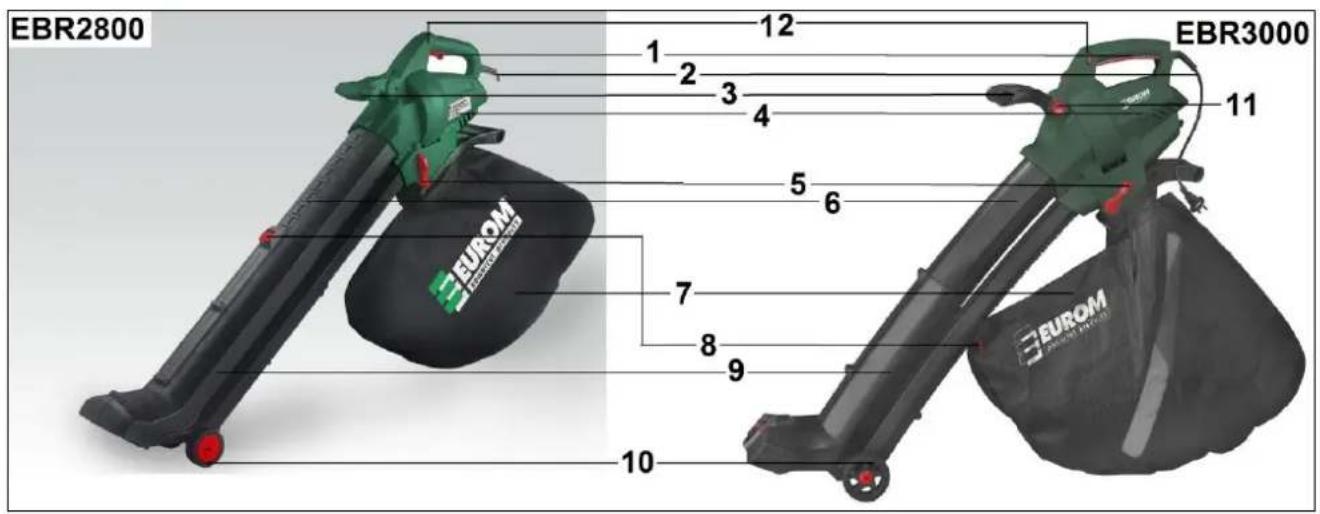
DESCRIPTION and ASSEMBLY
- Squeeze handle ON / OFF
- Electrical cable with plug
- Front handle
- Leaf blower body
- Option switch sucking/blowing
-
Extension piece suction/blowing tube
-
Collection bag
- Extension tube button
- Suction/blowing tube and wheel set
10.Wheels - Fan cover button (EBR3000 only)
- Capacity button
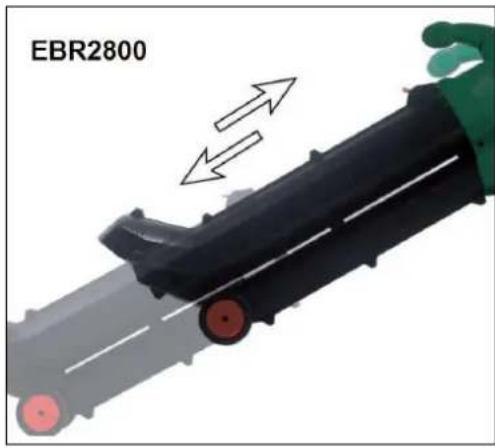
By pressing down the extension tube button you can extend the suction/blowing tube by 10 × 3 cm , until it reaches a length that is comfortable for you. Always work with the opening close to the ground!
Before use always click the collection bag (A) correctly in place by fitting the edge around the
suction/blowing opening, pressing down the flap (B) and clicking firmly
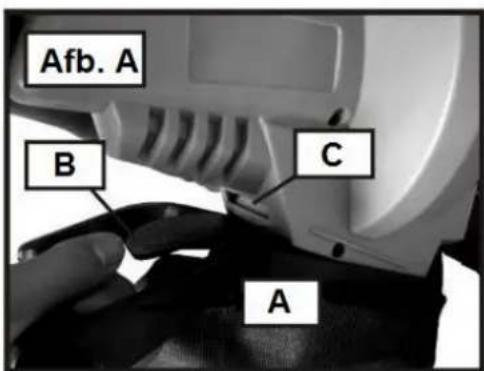
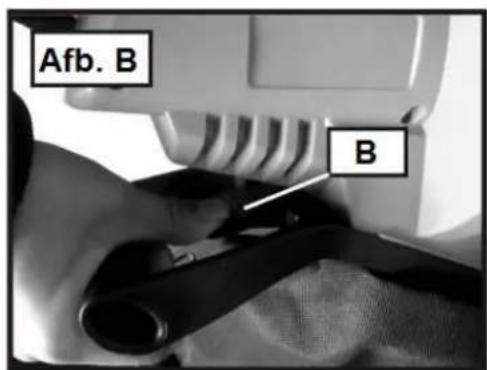
to the edge (C), see images A and B.
Before you do this make sure that the sucking/blowing option switch is working smoothly and is not obstructed by accumulated dirt or other substances. Carry out this check and attach the collection bag before you turn on the power! If you want to remove the collection bag then press on the flap again to release the lock.
Never use the leaf blower without the collection bag.
The front handle can be folded away.
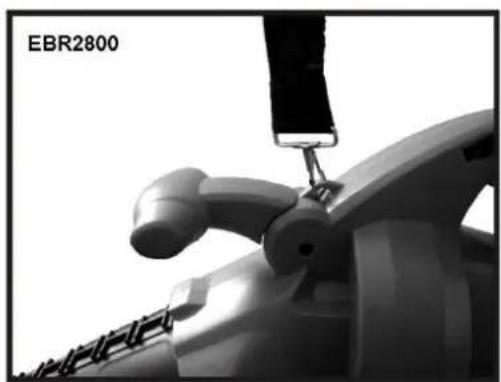
EBR2800: the handle can be folded in and out without obstructions.
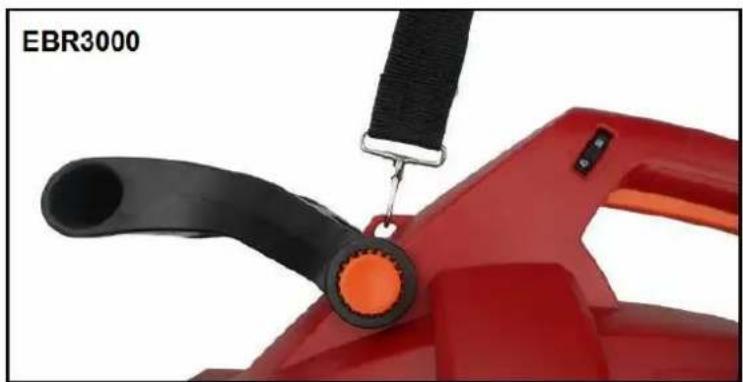
EBR3000: by pressing both red serrated buttons to the side of the front handle you can turn the handle continuously to set it to your desired position. When you release the buttons, the handle will remain locked in this position.
Before using, attach the shoulder strap to your leaf blower with the snap hook, see image. Using the shoulder strap prevents tiredness by distributing the weight and gives the user more freedom to move while working.
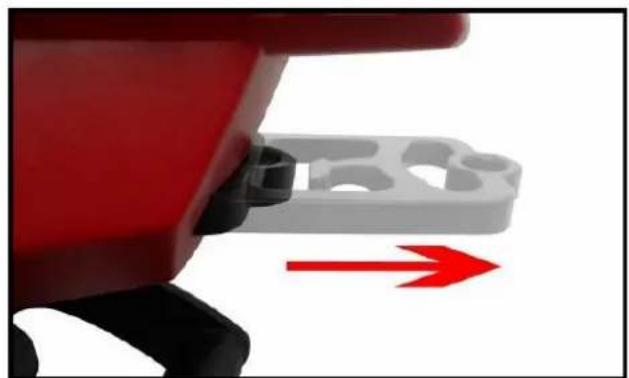
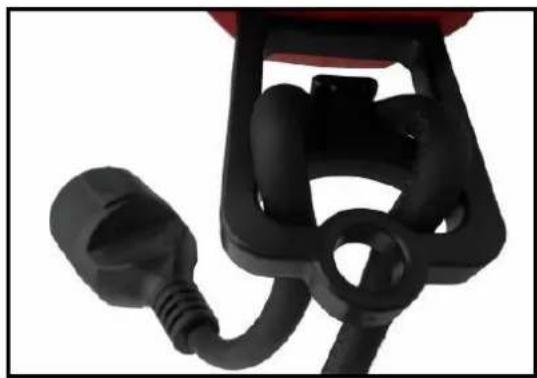
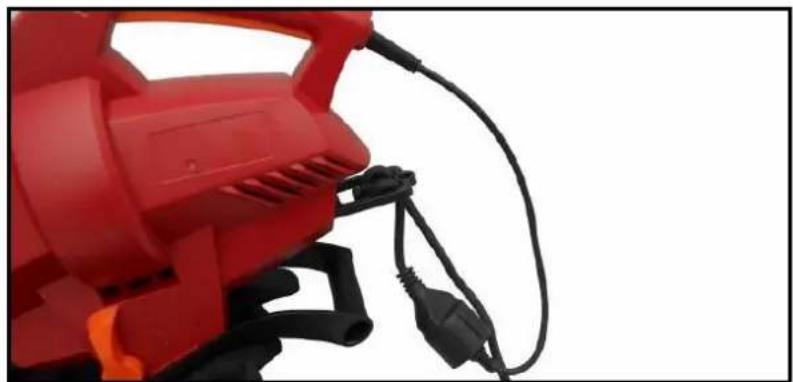
The EBR3000 is also fitted with an extendible hook, along which the extension cord should be guided (before turning on the electricity!), see image. This will prevent any damage to the electrical connection.
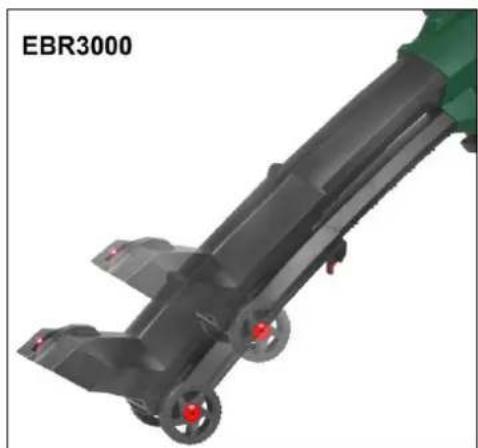
The blowing/suction opening of the EBR3000 is fitted with an extendible rake. In order to extend the rake the red button on the blowing/suction opening should be turned 90^ : this will unlock the rake, the button will move forwards and the rake will extend. To lock in the extended position the button should be turned 90^ again, see image.
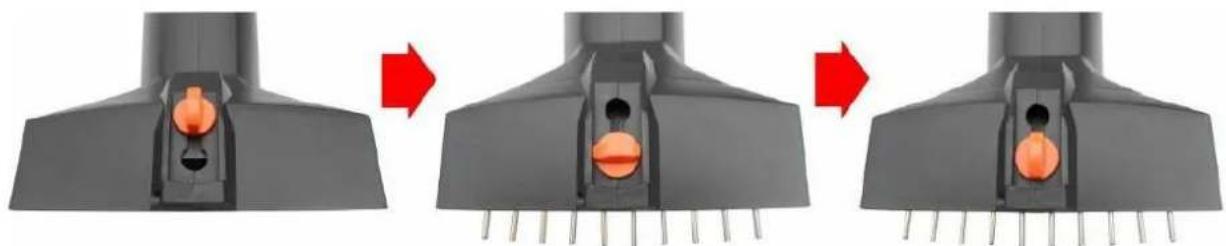
To retract the rake follow the steps in the opposite order, see image.
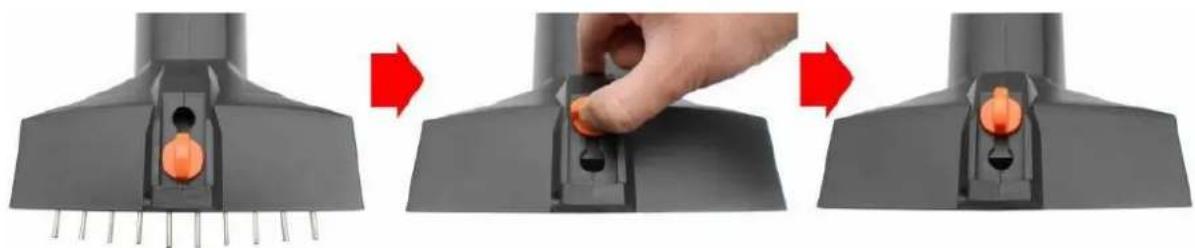
The rake can be used to separate leaves from other waste or soil, or to remove any gaps before sucking them up.
BEFORE USE
Preparations (for further information please read the General Safety Rules)
- Check that the device does not have any damage, that no modifications have been made and that there are no parts missing. If this is the case do not use the device!
- Check that all nuts and screws are firmly in place.
- Check that the collection bag is correctly attached.
- Check that the power socket you intend to use has the correct voltage, does not show any damage and is in correct working order.
- Check that the earth switch is in correct working order.
- Check that the extension cord that you intend to use meets all the requirements.
- Make sure that the user satisfies the clothing, hair and safety rules.
- Adjust the suction/blowing tube to a length that is comfortable for the user and check that it is correctly attached.
- Check that the sucking/blowing option switch works smoothly.
- Check that there are no materials remaining in your leaf blower; they may cause a hazard!
- Be aware of how to stop the device immediately in the event of danger.
Work area
- Check the area where the work will be carried out for wires and other refuse that may cause damage to the device or injury. If necessary, use a rake or broom first to remove undesirable objects before you begin blowing or sucking.
- Make sure that no hard objects such as stones, bottles, metal pieces and so forth can enter the leaf blower. This could damage the device and cause injury to the user or bystanders.
- Dampen dusty surfaces first if necessary.
- Keep bystanders (particularly children) and animals at a distance. The leaf blower may eject tiny stones or other objects that could cause injury.
- Try to avoid working in damp conditions; do not use the device in the rain!
USE
If you have found everything to be in working order then put the plug in the power socket.
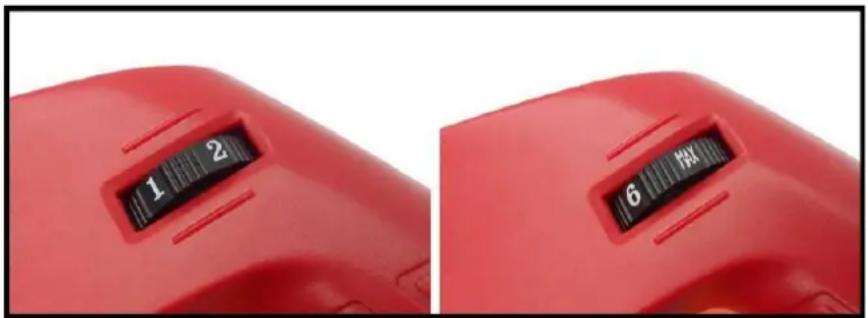
Turn the capacity button to setting 1.
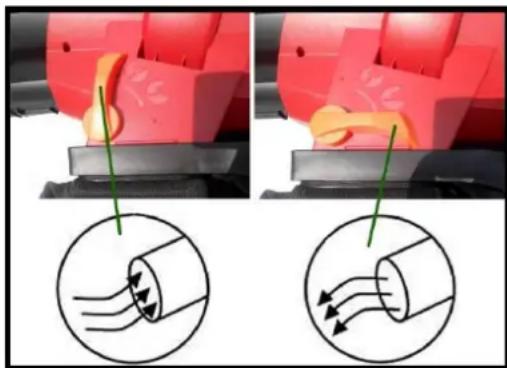
Next, select a function: sucking or blowing and turn the option switch to the desired setting, see image.
When you squeeze the squeeze handle (also the ON/OFF switch) the device will now start working.
If you require more capacity, turn the capacity button higher; you can choose a setting from 1 to 6 or maximum.
To turn off the device release the squeeze handle. If you are stopping work for a shorter or longer period, always remove the plug from the power socket.
Always ensure that you adopt a stable position when working. Work with the blowing tube extended as far out as possible, so that you work close to the ground. Never blow dirt in the direction of bystanders and work at times when you are least likely to cause a disturbance.
- If a foreign object is accidentally sucked into the leaf blower, turn off the device immediately and remove the plug from the power socket. Remove the object and give the device a complete and thorough check and do not use unless you are certain that everything is in order.
- If the device makes an unusual sound or vibrates abnormally, turn it off immediately and remove the plug from the power socket. Try to ascertain the cause and to remedy it. If this proves unsuccessful, contact a qualified service engineer. Extreme vibration can cause damage to the device and injure the user.
- Do not attempt to suck up wet rubbish or water, but instead wait until the leaves have dried.
- The leaf blower can be used to blow waste off of terraces, paths and lawns, and from borders and bushes. It can suck up leaves, papers, thin twigs and wood shavings.
When you suck up waste it passes a fan before entering the collection bag.
EBR2800: this is a plastic fan that breaks and crushes leaves and twigs and chops them roughly due to its speed.
EBR3000: In addition to a plastic fan this leaf blower also has metal blades that chop up waste.
The crushed or chopped waste can be used for compost or around plants in the garden.
Caution: All hard objects such as stones, cans, glass and so forth can cause damage to the fan!
Blowing
After inspecting the area, turn the option switch on the leaf blower to the 'Blow' setting. Press down the squeeze handle: the device will start working. Move the leaf blower forward on its wheels, pointing the blowing opening at the waste to be removed. You can also lift the leaf blower and, keeping the blowing opening close above the ground, move it back and forth while you slowly walk forward. In that case, remove the shoulder strap and keep the blowing opening pointed at the waste to be removed.
In this way, blow the leaves into a pile and switch to 'Suction' in order to suck the leaves into the collection bag.
Sucking
Inspect the area you intend to work on and remove all objects that might cause damage during sucking. Use the option switch to turn the leaf blower to 'Suction' and press down the handle: the device will start working. Move the leaf blower forward on its wheels, pointing the suction opening at the waste to be removed. You can also lift the leaf blower and, keeping the suction opening close above the ground, move it back and forth while you slowly walk forward. In that case, remove the shoulder strap and keep the suction opening pointed at the waste to be removed, but do not place it in a pile of waste: this will block the suction tube and reduce the effectiveness of the device.
Organic waste such as leaves and so forth generally has a high water content, which may cause it to stick to the inside of the suction tube. For this reason, it is better to wait several days for leaves to dry out.
Cleaning, Maintenance and Storage
- Turn off the device first and remove the plug from the power socket before carrying out any maintenance or cleaning.
- After each use, clean your leaf blower and empty the collection bag fully.
- Remove any remaining material from your leaf blower. Remaining materials can cause damage when you use the leaf blower the next time.
- Remove remaining dirt from the suction/blowing tube with a brush.
- Check that the option switch works smoothly and is not blocked by any waste.
- Remove the waste bag and turn the option switch to 'Suction' (the plug should not be in the power socket!) You can now remove any remaining dirt from the fan using a small brush or similar item. Never touch the fan with your hand!
- Do not use any cleaning agents on the plastic parts of the leaf blower!
- Ensure safe operation by always checking in advance that all screws, bolts and nuts are properly secure.
- Check the device regularly for wear and tear and damage; replace worn or damaged parts. Use original parts and accessories only.
- Always store the device in a dry area.
EBR3000: The EBR3000 has an option to open a side flap,
which makes the fan and blade more accessible for cleaning. Before cleaning, remove the plug from the power source, unscrew the red 'fan cover button' completely and fold away
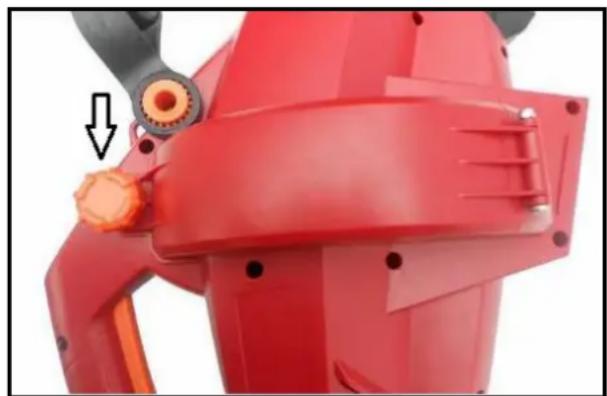
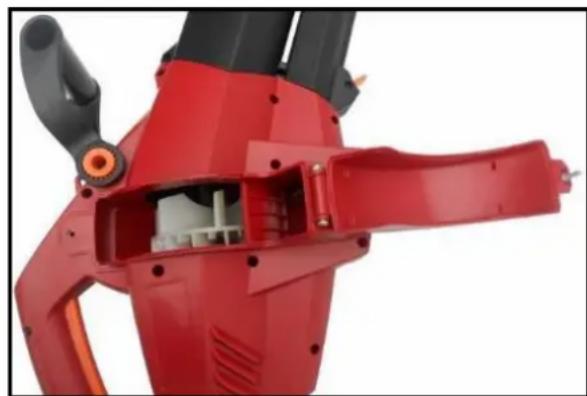
the cover, see image. Now carefully clean the fan and blade with a small brush or similar item. Never touch the fan with your hand! Replace the flap. The device will not work until the button has been fully turned.
TECHNICAL SPECIFICATIONS
| Leaf blower type | EBR2800 | EBR3000 | |
| Capacity | W | 2800 | 3000 |
| Voltage | V/Hz | 230-240 / 50 | 230-240 / 50 |
| Revolutions | rpm | 8000 - 14000 | 10,000 - 16,500 |
| Blowing capacity | km/h | 165 - 275 | 100 - 300 |
| Suction capacity | m³/min | 10 - 13,5 | 10 - 16 |
| Capacity collection bag | litres | 45 | 45 |
| Extendible suction tube | + | + | |
| Shredder function | + | + | |
| Steel rake | - | + | |
| Housing | Plastic | Plastic | |
| Wheels | 2 | 2 | |
| Dimensions | cm | 81 x 19 x 30 | 90.8 x 21 x 30.5 |
| Weight | kg | 3,50 | 5,50 |
CE STATEMENT
Euromac bv., Kokosstraat 20 of Genemuiden-NLhereby declares that the leaf blower product, types EBR2800 & EBR3000 complies with the following standards:
EN 60335-1:2012
IEC 60335-2-100:2002
EN 62233:2008
ZEK01.4-08
Genemuiden, 01-09-2014
W.J. Bakker, Managing Director

MERCI!
Travailiez always have a lot of time to get used to the new equipment.
Brand : Eurom
Model : EBR3000
Category : Blower