 ManualGo.com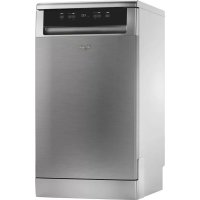
ADP 301 IX - Dishwasher WHIRLPOOL - Free user manual and instructions
Find the device manual for free ADP 301 IX WHIRLPOOL in PDF.



| Features | Details |
|---|---|
| Device type | Built-in dishwasher |
| Capacity | 13 place settings |
| Energy class | A++ |
| Noise level | 46 dB |
| Washing programs | 6 programs, including eco, quick, intensive |
| Washing options | Delayed start, half load |
| Safety system | Overflow protection |
| Dimensions (HxWxD) | 82 cm x 60 cm x 55 cm |
| Control panel | Electronic with LED display |
| Water consumption | 9.5 L per cycle |
| Weight | 45 kg |
| Warranty | 2 years |
Frequently Asked Questions - ADP 301 IX WHIRLPOOL
Download the instructions for your Dishwasher in PDF format for free! Find your manual ADP 301 IX - WHIRLPOOL and take your electronic device back in hand. On this page are published all the documents necessary for the use of your device. ADP 301 IX by WHIRLPOOL.
USER MANUAL ADP 301 IX WHIRLPOOL
English Operating instructions DISHWASHER - Contents Operating instructions,1 Important Safety Instructions, 3-4-5Assistance, 13Product Data, 14Installation, 28-29Description of the appliance, 30Refined salt and rinse aid, 31Loading the racks, 32-33Detergent and dishwasher use, 34Wash cycles, 35Special wash cycles and options, 36Care and maintenance, 37Troubleshooting, 38
IMPORTANT SAFETY INSTRUCTIONS Read the instructions carefully before using, as they include important information on safe installation, use and maintenance. Keep this instruction manual in a safe place for future reference. If the appliance is sold, given away or moved, make sure the manual is kept with the machine.4 Remove the appliance from all packaging and make sure it was not damaged during transportation, if it was damaged contact the retailer and do not proceed any further with the installation process. When using your dishwasher, follow the precautions listed below:
- The appliance must be used to wash domestic crockery in accordance with the instructions in this manual.
- This appliance can be used by children aged from 8 years and above and persons with reduced physical, sensory or mental capabilities or lack of experience and knowledge if they have been given supervision or instruction concerning use of the appliance in a safe way and understand the hazards involved. Children shall not play with the appliance.
- Cleaning and user maintenance shall not be made by children without supervision.
- The appliance must not be installed outdoors, even in covered areas. It is extremely dangerous to leave the machine exposed to rain and storms.
- Do not store flammable materials in close proximity to the appliance.
- The water in the appliance is not potable.
- Do not use solvents inside the appliance: risk of explosion!
- The door should not be left in the open position since this could present a tripping hazard.
- Do not rest objects on the open door or sit or stand on it since the appliance could trip forward.
- The open appliance door can only support the weight of the loaded rack when pulled out.
- The water supply tap must be shut off and the plug should be removed from the electrical socket at the end of every cycle and before cleaning the appliance for carrying out any maintenance work also disconnect in the event of any malfunction.
- Repairs and technical modifications must be carried out exclusively by a qualified technician.
- When unplugging the appliance always pull the plug from the mains socket. Do not pull on the cable.
- In order to avoid laceration hazard, usage of special gloves is needed during the assembling of the appliance.
- During use, the access to the rear wall should be limited in a sustainable manner such as approaching the device to the wall or furniture board.
- Keep packaging materials out of the reach of Children, packaging materials should not be used as a toy.
- Children must not be allowed to play with the appliance.
- Store the detergent, rinse aid and salt out of the reach of children.
- Appliance is dedicated only for household use.
- Appliance can not be operated until installation process is complete. GROUNDING INSTRUCTIONS
- This appliance must be grounded. In the event of a malfunction or breakdown, grounding will reduce the risk of an electric shock by providing a path of least resistance of electric current. This appliance is equipped with a cord having an equipment- grounding conductor and a grounding plug.
- The plug must be plugged into an appropriate outlet that is installed and grounded in accordance with all local codes and ordinances.
- Extension cord, adapters and conversion plugs must not be used to connect the appliance to the outlet.
- Improper connection of the equipment- grounding conductor can result in the risk of an electric shock.
- Check with a qualified electrician or service representative if you are in doubt whether the appliance is properly grounded. Do not modify the plug provided with the appliance; If it does not fit the outlet. Have a proper outlet installed by a qualified electrician. PROPER USE
- Access to disconnection of the appliance (main plug) shall be ensured after installation.
- When loading items to be washed:
1 - Locate sharp items so that they are not
likely to damage the door seal;
2 - WARNING: Knives and other utensils with
sharp points must be loaded in the cutlery basket with their points/blades down or placed in a horizontal position with the sharp end facing away from the front of the appliance.5
- Use only detergent and rinse additives designed for an automatic dishwasher.
- WARNING: Some dishwasher detergents are strongly alkaline. They can be extremely dangerous if swallowed. Avoid contact with the skin and eyes and keep children away from the dishwasher when the door is open. Check that the detergent receptacle is empty after completion of the wash cycle.
- If the supply cord is damaged, it must be replaced by the manufacturer or its service agent or a similarly qualified person in order to avoid a hazard.
- During installation, the power supply must not be excessively or dangerously bent or flattened. Do not tamper with controls.
- To dispose of any packaging materials, follow local legislation so that the packagings may be reused.
- Use the dishwasher only for its intended function.
- The appliance is to be connected to the water mains using new hose sets. The old hose-sets should not be reused.
- The maximum number of place settings is shown in the product sheet.
SAFEGUARDING THE ENVIRONMENT
- This appliance has been made of recyclable or re-usable material. Scrapping must be carried out in compliance with local waste disposal regulations. Before scrapping it, make sure to cut off the mains cord so that the appliance cannot be re-used.
- For more detailed information on handling and recycling of this product, contact your local authorities who deal with the separate collection of rubbish or the shop where you bought the appliance.
SCRAPPING OF PACKAGING
- The packaging can be 100% recycled as confirmed by the recycling symbol . The various parts of the packaging must not be dispersed in the environment, but must be scrapped in line with local authority regulations.
- The European Directive 2012/19/EU relating to Waste Electrical and Electronic Equipment (WEEE) states that household appliances should not be disposed of using the normal solid urban waste cycle. Exhausted appliances should be collected separately in order to optimise the cost of reusing and recycling the materials inside the machine, while preventing potential damage to the atmosphere and public health. The crossed-out dustbin symbol shown on all products reminds the owners of their obligations regarding separated waste collection. For further information relating to the correct disposal of household appliances, owners may contact the relevant public authority or the local appliance dealer.
Assistance Before contacting Assistance:
- Check whether the problem can be resolved using the Troubleshooting guide (see Troubleshooting).• Restart the programme to check whether the problem has ceased to exist.• If the problem persists, contact the Authorised Technical Assistance Service.Never use the services of unauthorised technicians.Please have the following information to hand:• The type of malfunction.• The appliance model (Mod.).• The serial number (S/N).This information can be found on the appliance data plate (see Description of the appliance)
Energy efciency class on a scale from A+++ (low consumption) to D (high consumption)
Energy consumption per year in kWh (2)
Energy consumption of the standard cleaning cycle in kWh
Power consumption of the off-mode in W
Power consumption of the left-on mode in W
Water consumption per year in litres (3)
Drying efcacy class on a scale from G (low efcacy) to A (high efcacy)
Programme time for standard cleaning cycle in minutes
The duration of the left-on mode in minutes
NOTES 1) The information on the label and che relates to the standard cleaning cycle, this programme is suitable to clean normally soiled tableware and it is the most efcient programme in terms of combined energy and water consumption. The standard cleaning cycle corresponds to the Eco cycle. 2) Based on 280 standard cleaning cycles using cold water ll and the consumption of the low power modes. Actual energy consumption depends on how the appliance is used.
3) Based on 280 standard cleaning cycles. Actual water consumption depends on how the appliance is used.
Rumore in dB(A) re 1 pW
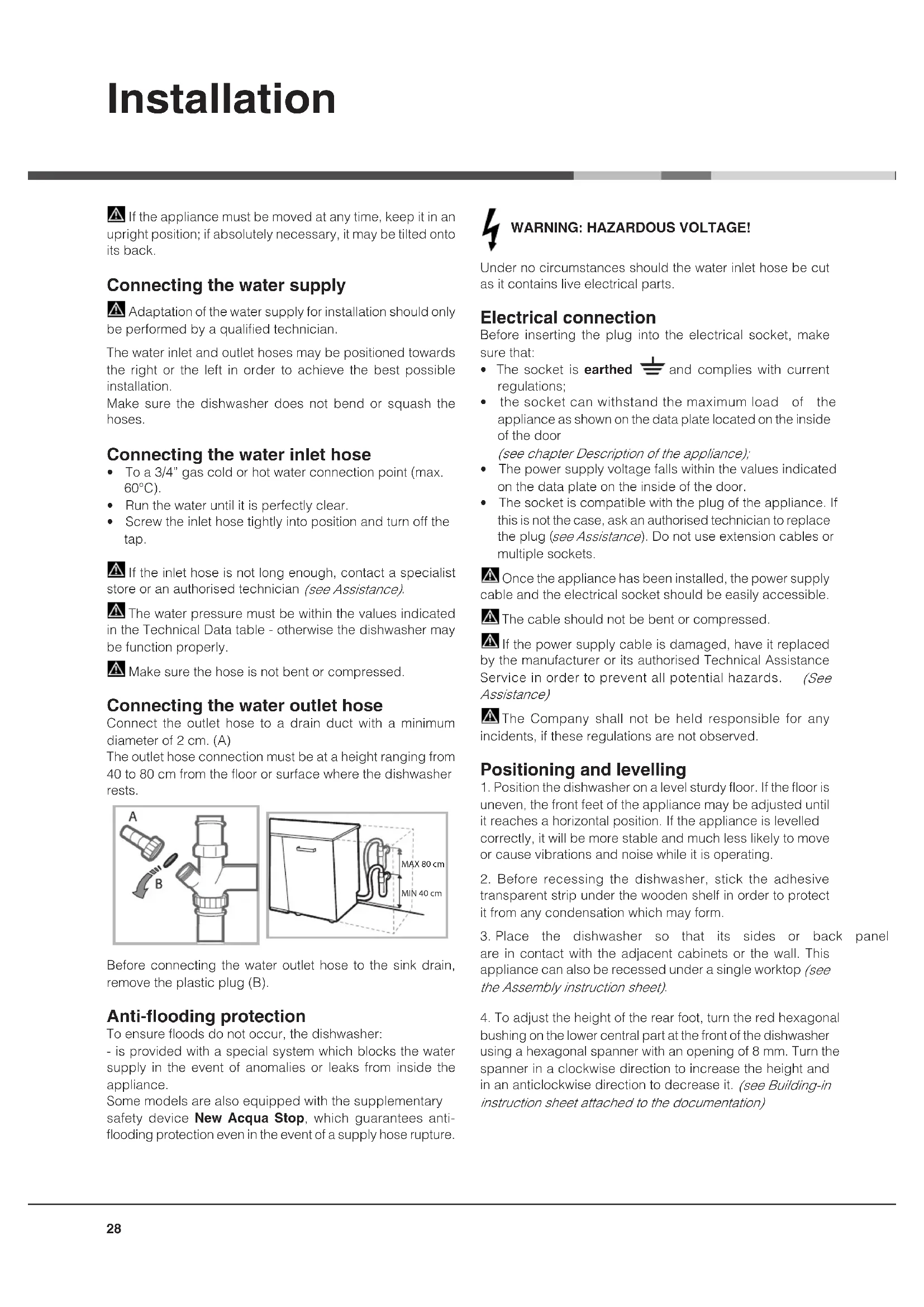
- Se il probblema persiste, chiudere il rubinetto dell’acqua, staccare la spina e contattare il centro assistenza.28 If the appliance must be moved at any time, keep it in an upright position; if absolutely necessary, it may be tilted onto its back. Connecting the water supply Adaptation of the water supply for installation should only be performed by a qualified technician. The water inlet and outlet hoses may be positioned towards the right or the left in order to achieve the best possible installation. Make sure the dishwasher does not bend or squash the hoses. Connecting the water inlet hose
- Screwtheinlethosetightlyintopositionandturnoffthe tap. If the inlet hose is not long enough, contact a specialist store or an authorised technician (seeAssistance)
The water pressure must be within the values indicated in the Technical Data table - otherwise the dishwasher may be function properly. Make sure the hose is not bent or compressed. Connecting the water outlet hose Connect the outlet hose to a drain duct with a minimum diameterof2cm.(A) The outlet hose connection must be at a height ranging from 40to80cmfromthefloororsurfacewherethedishwasher rests. Before connecting the water outlet hose to the sink drain, removetheplasticplug(B). Anti-flooding protection To ensure floods do not occur, the dishwasher: - is provided with a special system which blocks the water supply in the event of anomalies or leaks from inside the appliance. Somemodelsarealsoequippedwiththesupplementary safety device New Acqua Stop, which guarantees anti- flooding protection even in the event of a supply hose rupture.
WARNING: HAZARDOUS VOLTAGE!
Under no circumstances should the water inlet hose be cut as it contains live electrical parts. Electrical connection Before inserting the plug into the electrical socket, make sure that:
- Thesocket is earthed and complies with current regulations;
- thesocketcanwithstandthemaximumload of the appliance as shown on the data plate located on the inside of the door (seechapterDescriptionoftheappliance);
- Thepowersupplyvoltagefallswithinthevaluesindicated on the data plate on the inside of the door.
- Thesocketiscompatiblewiththeplugoftheappliance.If this is not the case, ask an authorised technician to replace theplug( see Assistance ).Donotuseextensioncablesor multiple sockets. Once the appliance has been installed, the power supply cable and the electrical socket should be easily accessible. The cable should not be bent or compressed. If the power supply cable is damaged, have it replaced by the manufacturer or its authorised Technical Assistance Serviceinordertopreventallpotentialhazards. (See Assistance) The Company shall not be held responsible for any incidents, if these regulations are not observed. Positioning and levelling
1. Position the dishwasher on a level sturdy floor. If the floor is
uneven, the front feet of the appliance may be adjusted until itreachesahorizontalposition.Iftheapplianceislevelled correctly, it will be more stable and much less likely to move or cause vibrations and noise while it is operating.
2. Before recessing the dishwasher, stick the adhesive
transparent strip under the wooden shelf in order to protect it from any condensation which may form. 3.Place the dishwasher so that its sides or back panel are in contact with the adjacent cabinets or the wall. This appliance can also be recessed under a single worktop (see the Assembly instruction sheet)
4.Toadjusttheheightoftherearfoot,turntheredhexagonal bushing on the lower central part at the front of the dishwasher usingahexagonalspannerwithanopeningof8mm.Turnthe spanner in a clockwise direction to increase the height and in an anticlockwise direction to decrease it. (seeBuilding-in instruction sheet attached to the documentation) Installation MIN 40 cmMAX 80 cm29 Advice regarding the first wash cycle After the installation, remove the stoppers from the racks and the retaining elastic elements from the upper rack (ifany). Water softener settings Before starting the first wash cycle, set the hardness lev- el of the water from the mains supply. (seechapterRinse aid and refined salt). First load the softener tank with water, then introduce about 1 kg of salt. It is perfectly normal for water to flow out. As soon as this procedure is complete, run a wash cycle. Only use salt that has been specifically designed for dish- washers. After the salt has been poured into the machine, the LOW SALTindicatorlightswitchesoff. If the salt container is not filled, the water softener and the heating element may be damaged as a result. Technical data Dimensions width 45 cm height 85 cm depth 60 cm Capacity 10 standard place-settings Water supply pressure 0,05 ÷ 1MPa (0.5 ÷ 10 bar) 7,25 psi – 145 psi Power supply voltage See appliance data plate Total absorbed power See appliance data plate Fuse See appliance data plate This dishwasher conforms to the following European Community Directives: -93/68/EEC (CE Marking) -2006/95/EC (Low Voltage) -2004/108/EC (Electromagnetic Compatibility) -2009/125/EC (Comm. Reg. 1016/2010) (Ecodesign) -2010/30/EC (Energy Labelling) -2011/65/EC (RoHS) -2012/19/CE Waste Electrical and Electronic Equipment (WEEE) The machine has a buzzer/set of tones to inform the user that a command has been implemented: power on, cycle end etc. The symbols/indicator lights/LEDs on the control panel/ display may vary in colour and may have a flashing or fixed light. The display provides useful information concerning the type of wash cycle, drying/wash-cycle phase, remaining time, temperature etc.30 Overall view Description of the appliance
3. Tip-up compartments
button and indicator light Half Load Option button and indicator light/ Child lock Display Eco cycle indicator light Child lock indicator light Wash-Cycle number and Remaining Time indicator Tablet indicator light (Tab) Salt indicator light Rinse Aid indicator light Closed water tap indicator light Start/Pause button and indicator light / Drain out31 Refined Salt and Rinse Aid (°dH=hardnessmeasuredinGermandegrees-°f=hardnessmeasuredinFrenchdegrees–mmol/l=millimolesperlitre) Measuring out the rinse aid RinseaidmakesdishDRYINGeasier.Therinseaiddispensershould be filled:• WhentheLOWRINSEAIDindicatorlightonthepanel/displayis lit;• Whenthedarkopticalindicatoronthedispenserdoor“E” becomes transparent.1. Open the dispenser by turning the cap "G" in an anticlockwise direction.2. Pour in the rinse aid, making sure it does not overflow from the dispenser. If this happens, clean the spill immediately with a dry cloth.3.Screwthecapbackon.NEVER pour the rinse aid directly into the tub. Adjusting the amount of rinse aid If you are not completely satisfied with the drying results, you can adjust the quantity of rinse aid used. Turn the adjuster “F”. Amaximumof4levelscanbesetaccordingtothedishwashermodel. The factory setting is for a medium level. • Ifyouseebluishstreaksonthedishes,setalownumber(1-2).• Iftherearedropsofwaterorlimescalemarksonthedishes,setahighnumber(3-4).Only use products which have been specifically designed for dishwashers. Do not use table salt or industrial salt.Follow the instructions given on the packaging.If you are using a multi-function product, we recommend that you add salt in any case, especially if the water is hard or very hard. (Followtheinstructionsgivenonthepackaging.)If you do not add salt or rinse aid, the LOW SALT and LOW RINSE AID indicator lights will remain lit. Measuring out the refined salt Theuse ofsalt preventsthe formationof LIMESCALEon thedishes and on the machine's functional components. •Itisimportantthatthesaltdispenserbeneverempty.•Itisimportanttosetthewaterhardness.The salt dispenser is located in the lower part of the dishwasher (seeDescription) and should be filled:• WhentheLOWRINSEAIDindicatorlightinthecontrolpanelis lit;• Seeautonomyinthewaterhardnesstable.1.Remove thelower rackand unscrewthe containercap(anticlockwise).2. Only the first time you do this: fill the water dispenser up to the edge.3.Position the funnel (see figure) and fill the salt container right up to its edge (approximately1kg);itisnotunusualforalittle water to leak out.4.Removethefunnelandwipeanysaltresidueawayfromtheopening; rinse the cap under running water and then screw it on.It is advisable to perform this procedure every time you add salt to the container. Make sure the cap is screwed on tightly, so that no detergent can getintothecontainerduringthewashcycle(thiscoulddamagethe water softener beyond repair).Whenever you need to add salt, we recommend carrying out the procedure before the washing cycle is started. Setting the water hardness For perfect water softener operation, it is essential that the adjustment be based on the water hardness in your house. Ask your local water supplier for this information. The factory setting is for medium water hardness. •SwitchthedishwasheronusingtheOn/Offbutton. •SwitchitoffusingtheOn/Offbutton
- HolddowntheSTART/PAUSE button for 5 seconds until you hear a beep.•SwitchitonusingtheOn/Offbutton•Thedisplayshowsthecurrentselectionlevelnumberandthesalt indicator light.•Press buttonP to select the desired hardness level(seeHardnessTable).•SwitchitoffusingtheOn/Offbutton•Settingiscomplete!Water Hardness TableAverage autonomysalt dispenser with 1 wash cycle per daylevel °dH °fH mmol/l months1 0 - 6 0 - 10 0 - 1 7 months2 6 - 11 11 - 20 1.1 - 2 5 months 3 12 - 17 21 - 30 2.1 - 3 3 months 4 17 - 34 31 - 60 3.1 - 6 2 months 5 34 - 50 61 - 90 6.1 - 9 2/3 weeks For values between 0°f and 10°f, we do not recommend the use of salt. A setting of 5 may increase cycle duration.32 Loading the racks Cutlery basket The basket is equipped with top grilles for improved cutlery ar- rangement. The cutlery basket should be positioned only at the front of the lower rack. Upper rack Load this rack with delicate and lightweight crockery such as glasses, cups, saucers and shallow salad bowls. Tips Before loading the racks, remove all food residues from the crockery and empty liquids from glasses and containers. No preventive rinsing is needed under running water. Arrange the crockery so that it is held in place firmly and does not tip over; and arrange the containers with the openings facing downwardsandtheconcave/convexpartsplacedobliquely, thus allowing the water to reach every surface and flow freely. Make sure that the lids, handles, trays and frying pans do not prevent the spray arms from rotating. Place any small items in the cutlery basket. Sinceplasticdishesandnon-stickfryingpansusuallyretainmore water drops, their drying will be not so good as that of ceramic or stainless-steel dishes. Lightweight items such as plastic containers should be placed in the upper rack and arranged so that they cannot move. After loading the appliance, make sure that the spray arms can rotate freely. Lower rack The lower rack can hold pans, lids, dishes, salad bowls, cutlery etc. Large plates and lids should ideally be placed at the sides. Very soiled dishes and pans should be placed in the lower rack because in this sector the water sprays are stronger and allow a higher washing performance. Adjustable position tip-up compartments The side tip-up compartments can be positioned at three different heightstooptimizethearrangementofthecrockeryinsidethe rack. Wine glasses can be placed safely in the tip-up compartments by inserting the stem of each glass into the corresponding slot. For optimum drying results incline the tip-up compartments more. To change the inclination, pull up the tip- up compartment, slide it slightly and position it as you wish.33 Adjusting the height of the upper rack The height of the upper rack can be adjusted: high position to place bulky crockery in the lower rack and low position to make the most of the tip-up compartments by creating more space upwards. It is strongly recommended to never adjust height position when the rack is loaded. NEVER raise or lower the rack on one side only. If the rack is equipped with a Lift-Up device (seefigure) , lift it up by holding its sides. To restore the lower position, press the levers(A) at the sides of the rack and follow the rack down. Unsuitable crockery
- Woodencrockeryandcutlery.
- Delicatedecoratedglasses,artistichandicraftandantique crockery. Their decorations are not resistant.
- Crockerysoiledwithash,wax,lubricatinggreaseorink. Thecoloursof glassdecorationsand aluminium/silver pieces canchangeandfadeduringthewashingprocess.Sometypes ofglass(e.g.crystalobjects)canbecomeopaqueafteranumber of wash cycles too. Damage to glass and crockery Caused by:
- Onlyuse glassesand porcelainguaranteed by the manufacturer as dishwasher safe.
- Useadelicatedetergentsuitableforcrockery.
- Collectglassesandcutleryfromthedishwasherassoonas the wash cycle is over.34 Detergent and dishwasher use Measuring out the detergent Good washing results also depend on the correct amount of detergent being used. Exceeding the stated amount does not result in a more effective wash and increases environmental pollution.The amount can be adjusted to the soil level.In the case of normally soiled items, use approximately either 25g (powder detergent) or 25ml (liquid detergent). If tablets are used, one tablet will be enough.If the crockery is only lightly soiled or if it has been rinsed with water before being placed in the dishwasher, reduce the amount of detergent used accordingly. For good washing results also follow the instructions shown on the detergent box.For further questions please ask the detergent producers.Open the detergent dispenser using button D and measure out the detergent according to the Table of wash cycles:•powderorliquid:compartmentsA(washdetergent)andB(pre-wash detergent) •tablet:whenthecyclerequires1 tablet, place it in compartment A and close cover C; when it requires 2 tablets, place the second tablet on the bottom of the appliance.Removedetergentresiduesfromtheedgesofthecompartmentand close cover C until it clicks. The detergent dispenser automatically opens up at the right time according to the wash cycle. If all-in-one detergents are used, we recommend using the TAB option, because it adjusts the cycle so that the best washing and drying results are always achieved.Only use detergent which has been specifically designed for dishwashers.DO NOT USE washing up liquid.Using excessive detergent may result in foam residues remaining in the machine after the cycle has ended. To achieve the best washing and drying results, the combined use of detergent, rinse aid liquid and refined salt is required.We recommend using detergents that do not contain phosphates or chlorine, as these products are harmful to the environment. Starting the dishwasher 1.PresstheON-OFFbutton.2. Open the door and measure out the detergent. (seedetergent information). 3.Loadtheracks (seeLoadingtheracks) and shut the door.4.Selectthewashcycleinaccordancewiththetypeofcrockeryand its soil level (seetableofwashcycles) by pressing the P button.5.Selectthewashoptions (seeSpecialwashcyclesandoptions)
6.StartthewashcyclebypressingtheSTART/PAUSEbutton.7. The end of the wash cycle is indicated by beeps and the display shows END.SwitchofftheappliancebypressingtheON/OFFbutton.8.Waitforafewminutesbeforeremovingthecrockery,inorderto avoid burns. Unload the racks, beginning with the lower level.The machine will switch off automatically during certain extended periods of inactivity, in order to minimise electricity consumption. If the crockery is only lightly soiled or if it has been rinsedwith water before being placed in the dishwasher, reduce theamount of detergent used accordingly. Modifying a wash cycle in progress If a mistake was made during the wash cycle selection process, it is possible to change the cycle, provided that it has only just begun:bypressingandholdingtheON/OFFbutton,themachinewillswitchoff.SwitchthemachinebackonusingtheON/OFFbutton and select the new wash cycle and any options desired; startthecyclebypressingtheSTART/PAUSEbutton. Adding extra crockery Without switching off the machine, open the door, taking care to avoid the escaping steam, and place the crockery inside the dishwasher.ShutthedoorandpresstheSTART/PAUSEbuttonthe cycle will begin from the point at which it was interrupted. Accidental interruptions If the door is opened during the wash cycle, or if there is a power cut, the cycle stops. once the door has been shut or the electricity supply is restored, to start again the cycle from where it was interrupted,presstheSTART/PAUSEbutton.35 Wash-cycledataismeasuredunderlaboratoryconditionsaccordingtoEuropeanStandardEN50242. Based on the different conditions of use, the wash-cycle duration and data can change. Wash cycles Instructions on wash-cycle selection and detergent dosage
6. Crockery to be washed later.Nodetergent
Standbyconsumption:Left-onmodeconsumption:5W-Offmodeconsumption:0.5W. Wash cycle Wash cycle which include drying Options Approximate duration of wash cycles h:min. Water consumption (l/cycle) Energy consumption (kWh/cycle)
Notes: Optimumperformancelevelswhenusingthe“1 Hour” and“Rapid”cyclescanbe achieved by respecting the specifiednumber of place settings.To reduce consumption even further, only run the dishwasher when it is full.Note for Test Laboratories: forinformationoncomparativeENtesting conditions, please send an email to the following address: contact@whirlpool.com Special wash cycles and Options Half Load option If there are not many dishes to be washed, a half load cycle may be used in order to save water, electricity and detergent.SelectthewashcycleandpresstheHALFLOAD button: the indicator light will illuminate. PresstheHALFLOADbuttontodeselectthisoption. Remember to halve the amount of detergent. Sani Rinse Option This option allows higher temperatures to be used. Selectthewashingprogram,presstheSaniRinsebuttonandthe indicator light will switch on. To deselect the option, press the same button again. Ideal to clean crockery and feeding bottles. Warning:thecrockeryandplatescouldbeextremelyhotatthe end of the cycle. TheSani Rinse option results in lengthening of the wash cycle. Drain out To stop and cancel the active cycle, the Drain Out function can be used.AlongpressofSTART/PAUSEbutton,willactivatetheDRAINOUT function. The active cycle will be stopped and the water in the dishwasher will be drained out. Child safety lock AlongpressofHALFLOADbutton,willactivatetheSAFETYLOCKfunction.TheSAFETYLOCKfunctionwillblockthecontrolpanel.TodeactivatetheSAFETYLOCK,longpressagain. Tablet option (Tab) AlongpressoftheSaniRinsebutton,willactivatetheTABLET function. This option optimises washing and drying results. To deactivate the TABLET, long press again.The “Tablet” option results in a longer wash cycle. Wash options The OPTIONS may only be set, changed or reset after the wash cycle has been selected and before the Start/Pause button has been pressed. Only the options which are compatible with the type of wash cycle set may be selected. If an option is not compatible with the selected wash cycle (seeTableofwashcycles) , the correspondingled/symbolflashesrapidly3times. If an option is selected which is not compatible with another (previouslyselected)option,itwillflash3timesandswitch off, while the most recently selected option will remain active. To deselect an option which has been set by mistake, press the corresponding button again. Delayed start The start of the program may be delayed for a period of time between 0:30 and 24 hours. 1.Selecttheprogram and anydesiredoptions.Pressthe DELAYEDSTART button (repeatedly) todelay the start of theprogram.Adjustablefrom0:30to24hours. With each press of the button, the delay start increases by: 0:30 if selection below 4 hours, 1:00 if selection is below 12hours,4hoursifselectionisabove12hours.If24hours reached, and the button is pressed, the delayed start is deactivated.
2. Press the START/PAUSE button: the timer will begin
counting down; 3.Oncethistimehaselapsed,theindicatorlightswitches off and the program begins automatically. If at the time of thecountdowntheSTART/PAUSEbuttonispressedagain the DELAYEDSTART option is cancelled and the selected program starts automatically. The Start Delay function cannot be set once a wash cycle has started.37 Care and maintenance Shutting off the water and electricity supplies
- Turnoffthewatertapaftereverywashcycletoavoidleaks.
- Alwaysunplugthe appliance when cleaning it and when performing maintenance work. Cleaning the dishwasher
- Theexternalsurfacesofthemachineandthecontrolpanel can be cleaned using a non-abrasive cloth which has been dampened with water. Do not use solvents or abrasive products.
- Anymarksontheinsideoftheappliancemayberemoved using a cloth dampened with water and a little vinegar. Preventing unpleasant odours
- Alwayskeepthedooroftheapplianceajarinordertoavoid moisture from forming and being trapped inside the machine.
- Cleanthesealsaroundthedooranddetergentdispensers regularly using a damp sponge. This will avoid food becoming trapped in the seals, which is the main cause behind the formation of unpleasant odours. Cleaning the spray arms Food residue may become encrusted onto the spray arms and block the holes used to spray the water. It is therefore recommended that you check the arms from time to time and clean them with a small non-metallic brush. The two spray arms may both be removed. To remove the upper spray arm, turn the plastic locking ring in an anti-clockwise direction. The upper spray arm should be replaced so that the side with the greater number of holes is facing upwards. The lower spray arm can be removed by pressing on the side tabs and pulling it upwards. Cleaning the water inlet hose Ifthewaterhosesareneworhavenotbeenusedforanextended period of time, let the water run to make sure it is clear and free of impurities before performing the necessary connections. If this precaution is not taken, the water inlet could become blocked and damage the dishwasher. Clean the water inlet filter at the tap outlet regularly. - Turn off the water tap. - Unscrew the end of the water inlet hose, remove the filter and clean it carefully under running water. -Re-placethefilterandscrewthewaterhosebackintoposition. Cleaning the filters The filter assembly consists of three filters which remove food residues from the washing water and then recirculate the water. They must be cleaned if you wish to achieve the best results in every wash. Clean the filters regularly. The dishwasher must not be used without filters or if the filter is loose.
- Afterseveralwashes,checkthefilterassemblyandifnecessary clean it thoroughly under running water, using a non-metallic brush and following the instructions below:
1. Turn the cylindrical filter C in an anti-clockwise direction and
REMOVE the wash-cycle pump protection (blackdetail)(fig.4). Aftercleaningthefilters,re-placethefilterassemblyandfixit in position correctly; this is essential for maintaining the efficient operation of the dishwasher. Leaving the machine unused for extended periods
- Whenyoureturn,runawashcyclewhenthedishwasheris empty.38 Troubleshooting Whenever the appliance fails to work, check for a solution from the following list before calling for Assistance. Problem: Possible causes / Solutions: The dishwasher does not start or cannot be controlled.
- The water supply tap is not turned on.
- Switch off the appliance by pressing the ON/OFF button, switch it back on after approximately one minute and reset the wash cycle.
- The appliance has not been plugged in properly or another electricity socket should be used.
- The dishwasher door has not been closed properly. The door won’t close.
- Make sure that the racks were inserted all the way.
- The lock was released. Strongly push the door until a “clacking” noise is heard. No water drain out of the dishwasher.
- The wash cycle has not nished yet.
- The water drain hose is bent (see Installation).
- The drain duct is clogged up.
- The lter is clogged up with food residues.
- Check the height of the drain hose. The dishwasher makes excessive noise.
- The dishes are rattling against each other or against the spray arms. Place the dishes properly and make sure the spray arms can rotate freely.
- Too much foam: the detergent has not been measured out correctly or it is not suitable for use in dishwashers. (See Detergent and dishwasher use.) Do not prewash the dishes by hand. The dishes and glasses are covered in a white lm or limescale deposits.
- Water hardness adjustment is not suitable: increase the relevant values. (See Rened Salt and Rinse Aid.)
- The salt and rinse-aid dispenser cap has not been closed properly.
- The rinse aid has been used up or the dosage is too low. The dishes and glasses are streaked or have a bluish tinge.
- The rinse aid dosage is too high. The crockery has not been dried properly.
- A wash cycle without a drying programme has been selected.
- The rinse aid has been used up. (See Rened Salt and Rinse Aid.)
- The rinse aid dispenser setting is not suitable.
- The crockery is made from non-stick material or plastic; the presence of water drops is normal. The dishes are not clean. • The crockery has not been arranged properly.
- The spray arms cannot rotate freely, being hindered by the dishes.
- The wash cycle is too gentle (see Wash Cycles).
- Too much foam: the detergent has not been measured out correctly or it is not suitable for use in dishwashers. (See Detergent and dishwasher use.)
- The lid on the rinse aid compartment has not been closed correctly.
- The lter is dirty or clogged up (see Care and maintenance.)
- The rened salt level is low (See Rened Salt and Rinse Aid.)
- Make sure that the height of the dishes is compatible with the rack adjustment.
- The holes in the spray arms are clogged up. (See Care and maintenance.) The dishwasher won’t load any water. It is blocked with ashing lights.
- There is no water in the mains supply or the tap is shut off.
- The water inlet hose is bent (see Installation).
- The lters are clogged up: they need cleaning. (See Care and maintenance.)
- The drain duct is clogged up: it needs cleaning.
- After checking and cleaning, switch the dishwasher on and off and start a new wash cycle.
- If the problem persists, turn off the water tap, remove the plug and call the Service Centre.FR