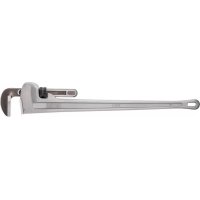
810 - Adjustable wrench RIDGID - Free user manual and instructions
Find the device manual for free 810 RIDGID in PDF.



| Product Type | Adjustable Pipe Wrench |
| Brand | RIDGID |
| Model | 810 |
| Overall Length | 10 inches (254 mm) |
| Weight | 1.8 lbs (0.82 kg) |
| Handle Material | Ductile Iron |
| Jaw Material | Alloy Steel with Heat-Treated Teeth |
| Suggested Pipe Size Range | 1/4" to 1" (6-25 mm) |
| Maximum Pipe Size | 1-1/4" (32 mm) |
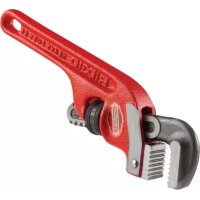
| Type | Heavy-Duty Straight Pipe Wrench |
| Adjustment Mechanism | Rotating Nut for Hook Jaw Positioning |
| Gripping Action | Two-point grip using heel jaw and hook jaw teeth |
| Replaceable Jaws | Yes, genuine RIDGID Service Parts |
| Power Source | Manual |
| Safety Features | WARNING: Do not use handle extensions; wear eye protection; maintain proper footing |
| Maintenance | Clean jaws with wire brush; lubricate moving parts; inspect for bending, cracks, or wear |
| Recommended Use | Turning pipe and threaded fittings only; not for hard (over 325 BHN) or non-round materials |
| Warranty | Limited Lifetime Warranty |
| Standards | ASME B107.10 (assumed) |
| Country of Origin | USA (typical) |
Frequently Asked Questions - 810 RIDGID
User questions about 810 RIDGID
0 question about this device. Answer the ones you know or ask your own.
Ask a new question about this device
Download the instructions for your Adjustable wrench in PDF format for free! Find your manual 810 - RIDGID and take your electronic device back in hand. On this page are published all the documents necessary for the use of your device. 810 by RIDGID.
USER MANUAL 810 RIDGID
Pipe Wrench Use Guide
WARNING


Read the warnings and instructions for all equipment and material being used before operating this tool to reduce the risk of serious personal injury or death.
- Use personal protective equipment. Always wear eye protection. Protective equipment such as non-skid safety shoes, hard hat, etc. used for appropriate conditions will reduce the risk of personal injury.
- Do not use handle extensions (“cheaters”). Handle extensions may damage the wrench or slip and cause serious injury.
- Do not use with a threading machine to install or remove (make or break) fittings. This can cause striking or crushing injuries.
- Do not use come-a-longs, chain hoists, handle extensions, backhoes, threading machines, drill rigs or other mechanical, hydraulic or powered devices to activate pipe wrenches to install or remove (make or break) fittings. Do not use excessive force. Pipe wrenches are hand tools designed to be used by hand. Use of these types of devices with pipe wrenches can result in wrench and equipment damage and failure from overload and increases the risk of striking, crushing or other serious injuries or death.
- Do not use a wrench with a bent or twisted handle. A bent handle indicates the wrench has been overloaded and is damaged. A bent handle should never be straightened. Remove bent or twisted wrenches from service.
- Do not modify or alter a pipe wrench. Modifying a pipe wrench may result in wrench failure and serious injury.
- Do not overreach. Keep proper footing and balance at all times. This enables better control of the tool in unexpected situations.
- Do not hit a wrench with a hammer to break loose a fitting. Impact loading may damage the wrench, chip wrench teeth or cause serious injury.
- Do not misuse pipe wrenches. Misuse increases the risk of serious injury.
Do not use as a hammer.
Do not apply a side load to the handle.
Do not use as a lever, lifting device or bender.
Do not use the wrench on hard, square, hexagonal or other non-round material.
Pipe wrenches are designed to turn pipe. Improper use may result in damage or injury.
- Do not use near flame or high heat. Teeth on the hook or heel jaw could become soft. This may result in chipping or flattening of the teeth. This reduces its strength which may result in failure.
- Properly support the work piece. Failure to properly support the work piece can cause falling or shifting pipe and equipment and increases the risk of injury.
- When using pipe wrenches with other RIDGID products, follow the instructions supplied with that product.
- Stay alert, watch what you are doing and use common sense when using tools. Do not use when you are tired or under the influence of drugs, alcohol or medication. A moment of inattention while operating tools may result in serious personal injury.
- Do not let familiarity gained from frequent use of tools allow you to become complacent and ignore tool safety principles. A careless action can cause severe injury in a fraction of a second.
- Pipe wrenches are general use tools that can be used in a variety of situations. Ridge Tool cannot provide guidance on all possible use situations. Users must evaluate the specific work scenario and apply training, good work practices and methods to reduce risk.
NOTICE Selection of appropriate materials and installation, joining and forming methods is the responsibility of the system designer and/or installer. Selection of improper materials and methods could cause system failure.
Stainless steel and other corrosion resistant materials can be contaminated during installation, joining and forming. This contamination could cause corrosion and premature failure. Careful evaluation of materials and methods for the specific service conditions, including chemical and temperature, should be completed before any installation is attempted.
If you have any questions concerning this RIDGID® product:
- Contact your local RIDGID distributor.
- Visit RIDGID.com to find your local RIDGID contact point.
- Contact Ridge Tool Technical Service Department at rttechservices@emerson.com or in the U.S. and Canada call (800) 519-3456.
- Contact your local RIDGID distributor. - Visit RIDGID.com to find your local RIDGID contact point. - Contact Ridge Tool Technical Service Department at rttechservices@emerson.com or in the U.S. and Canada call (800) 519-3456.
EN 1
FR 5
ES 9
Description
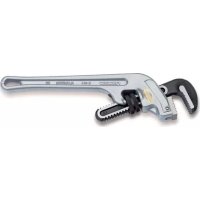
RIDGID ^® Pipe Wrenches are hand tools designed to turn pipe and tighten and loosen threaded pipe connections with round threaded fittings. RIDGID Pipe wrenches are available in a variety of configurations, including ductile iron or aluminum handle versions. Consult the RIDGID catalog for more information on available units.
Heavy-Duty Straight Pipe Wrenches: suitable for all forms of pipe work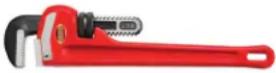 | RapidGrip® Pipe Wrenches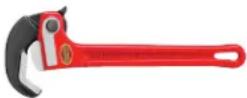 |
End Pipe Wrenches: easy grip for close to wall and parallel work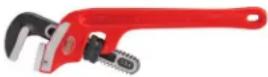 | Offset Pipe Wrenches: easy entry to tight spots and awkward angles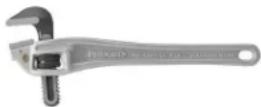 |
| Raprench® Wrenches: ideal for occasional use as a hammer[IMAGE] | Compound Leverage Wrenches: multiplies leverage, used for seized joints[IMAGE] |
Figure 1 – RIDGID Pipe Wrenches
See the product markings for specifications or consult the RIDGID catalog.
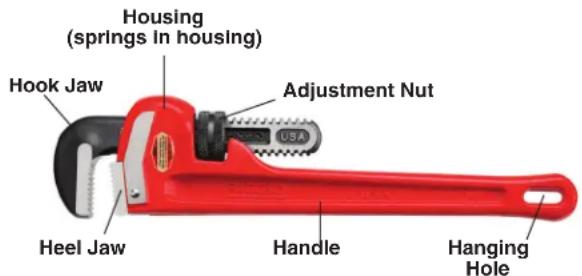
Figure 2 – Wrench Parts
Inspection/Maintenance
Daily before use, clean the wrench to aid inspection and improve control. Handles and gripping surfaces should be clean, dry and free of oil and grease. Inspect the wrench for:
• Proper assembly and completeness.
- Wear. Clean the jaws with a wire brush. Teeth should be clean and sharp. Replace jaws if teeth are worn to reduce the risk of slippage.
- Damage such as cracks, cuts, nicks, deformation.
- Bent or twisted handles. Do not straighten handles. Wrenches with bent handles have been overloaded. Remove bent wrenches from service.
- Modification of any kind, including grinding or welding. Modification can weaken a wrench.
- Discoloration or other indications of heat damage.
- Proper operation. Hook jaw should move smoothly when the nut is turned. Springs in housing should allow hook jaw to pivot slightly. This allows proper gripping and ratcheting action of the wrench.
- Other issues that could affect safe use.
If any problems are found, do not use until corrected. Remove worn, bent or otherwise damaged wrenches from service. Only use genuine RIDGID® Service Parts.
Inspect chains for any separation of links or other damage. Link separation indicates the chain has been overloaded and must be replaced.
Lubricate all moving parts/joints as needed with light lubricating oil. Wipe off excess oil. Keep non painted parts well lubricated with oil and store in a dry place.
Set-Up
Inspect the material to be worked with. Pipe wrenches are designed for use on round pipe and threaded fittings, or soft round stock. Do not use on hard (325 BHN maximum), square, hexagonal or other non-round material. The jaw teeth penetrate the stock to properly grip. Wrench may slip on hardened material or the teeth may chip when used on hex or square stock.
Pipe wrenches can apply high forces to pipe that can crush or oval the pipe, especially thinner wall pipe. Pipe wrench jaw teeth grip by digging into the material of the pipe. This will mar the surface finish of the pipe and could create sharp edges and cut hazards.
Choose a proper size and type of pipe wrench for the job. Do not use on pipe larger than the pipe wrench is rated for. (See Chart 1)
| Pipe Wrench Size | Suggested Pipe Size Range | Maximum Pipe Size |
| 6" | 18'' - 12'' | 34'' |
| 8" | 14'' - 34'' 1'' | |
| 10" | 14'' - 1'' 1 | 12'' |
| 12" | 12'' - 114'' 2'' | |
| 14" | 12'' - 112'' 2'' | |
| 18" 1"-2" 2 | 12'' | |
| 24" 1 | 12'' - 212'' 3'' | |
| 36" 2"-3 | 12'' 5'' | |
| 48" 3"-5" 6" | ||
| 60" 3"-6" 8" |
Chart 1 - Suggested Pipe Size Range
Make sure the work piece is stable and well supported to prevent tipping and falling during use.
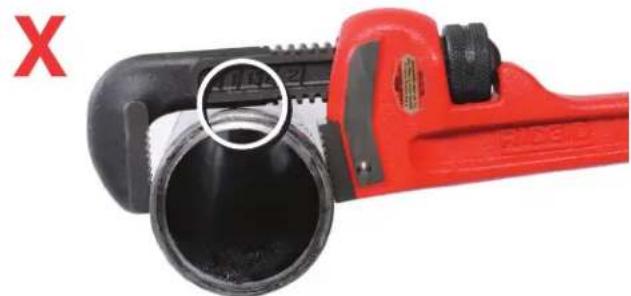
When using a pipe wrench of any size, a gap must be maintained between the shank of the hook jaw and the work piece. (Figure 3) This permits the two gripping points (heel jaw teeth and hook jaw teeth) to produce the gripping action of the wrench. Allowing the shank of the hook jaw to contact the work piece greatly reduces the gripping action and can cause slippage. It may also result in the failure of the hook jaw. (Figure 4)
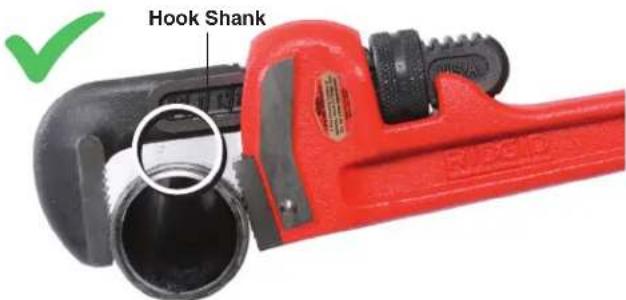
Figure 3 – Maintain Gap Between Hook Shank and Work Piece
Adjust the hook position by rotating the nut as needed. Wrench should be square to the pipe. Do not use with the wrench at an angle to the pipe.
natural_image
Close-up of a red and black adjustable wrench gripping a black cylindrical pipe (no text or symbols visible)Figure 4 – Wrench Too Small For Work Piece, Hook Shank Touching Work Piece.
RapidGrip® Wrench
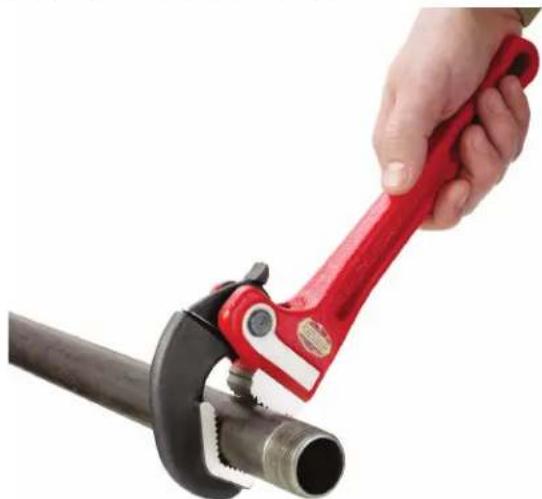
When using a RapidGrip wrench, be sure to center the work piece in the "v" of the hook. If the work piece is not in contact with both sides of the "v", it can reduce wrench gripping action and may result in failure of the hook.
natural_image
Hand using a red adjustable wrench to lift a pipe fitting (no text or symbols visible)Figure 5 – Using a RapidGrip Wrench
Compound Leverage Wrenches
Mount trunnion on pipe close to threads, with shank of trunnion pointing towards the threads as shown in Figure 6A. Run chain over pipe, hook into ears of trunnion and securely tighten with chain screw handle. With wrench head properly adjusted for work piece size (maintain gap between hook jaw shank and work piece), place the end of the wrench handle over the shank of the trunnion. Place the wrench head on the work piece. Secure the wrench handle to the trunnion shank with the cotter pin. (Figure 6B)
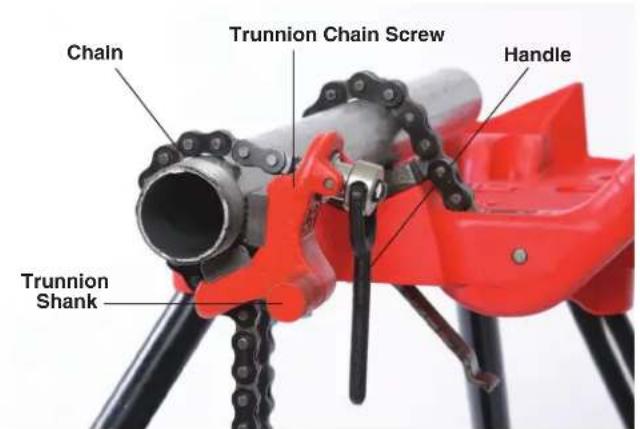
Figure 6A – Mounting Compound Leverage Wrench Trunnion On Pipe
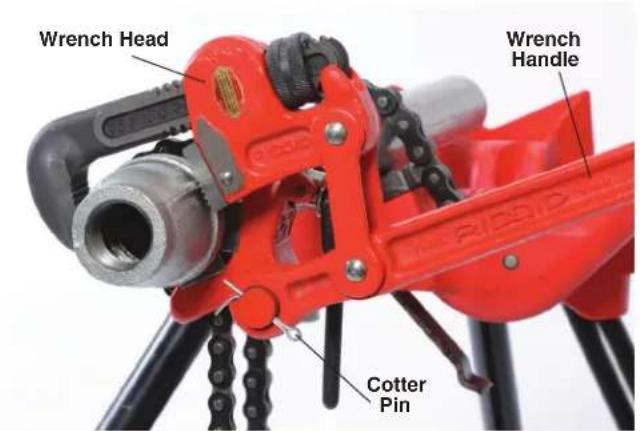
Figure 6B – Securing Handle to Trunnion
Operation
Once the pipe wrench is securely placed on the work piece, assume a proper operating position. Do not overreach. Keep proper footing and balance at all times. Do not hang on the pipe wrench. A proper operating position enables better control of the tool in unexpected situations. When working at height (on ladders, scaffolding, etc.) use appropriate work methods and equipment to ensure stability and safety.
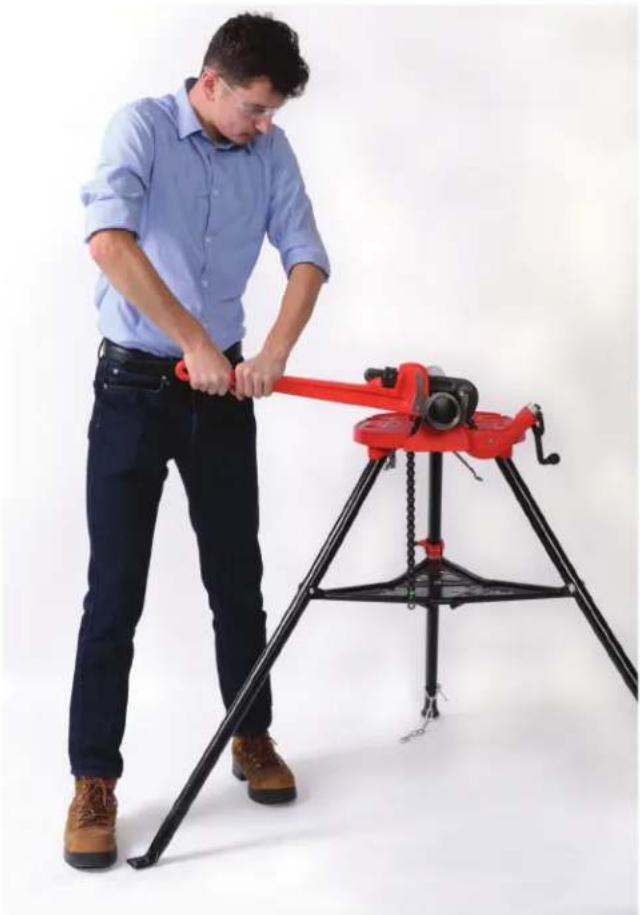
When working on horizontal pipe such as in a pipe vise at waist height, it is often most effective to use your body weight to tighten and loosen fittings (Figure 7). Do not lift your feet off the ground. Keep your feet firmly on the ground to maintain control of the wrench.
Pulling a wrench typically allows better control in unexpected circumstances than pushing the wrench.
Only apply force in the direction of rotation. Excessive side loading of the wrench can cause the wrench to slip or be damaged.
Do not hang wrench on pipe – always keep a hand on the wrench. Uncontrolled tools can fall and cause injury. Fittings can come loose, wrenches can slip – be prepared.
If greater torque is required, do not use handle extensions or other mechanical, hydraulic or powered devices with the pipe wrench. Use a larger wrench or a compound leverage wrench. Other methods may be needed to break connections loose, such as heat or hammering on the joint (do not hit the wrench). In some cases, it may be possible to disassemble the system at the next connection and break the connection loose in a vise or at a bench.
natural_image
Man operating a red manual pump on a black tripod against a plain white background (no text or symbols visible)Figure 7 – A Proper Operating Position
natural_image
Close-up of a red and black adjustable wrench gripping a black cylindrical pipe fitting, with a magnified inset showing the pipe's center (no text or symbols visible)natural_image
Hand using a red wrench to lift a pipe fitting (no text or symbols visible)natural_image
Man operating a red manual pump on a black tripod against a plain white background (no text or symbols visible)natural_image
Close-up of a red and black adjustable wrench tool with a black cylindrical component inserted, labeled 'X' in red (no text or symbols on the tool itself)natural_image
Hand using a red wrench to lift a black pipe fitting (no text or symbols visible)natural_image
Man operating a red manual pump on a black tripod against a plain white background (no text or symbols visible)
Brand : RIDGID
Model : 810
Category : Adjustable wrench