
Peca - Fireplace FABER - Free user manual and instructions
Find the device manual for free Peca FABER in PDF.



| Product Type | Decorative fireplace |
| Brand | Faber |
| Model | Peca |
| Material | Natural stone (marble or limestone) |
| Use | Indoor, stove surround |
| Dimensions | Variable depending on model (e.g., Peca large) |
| Weight | Variable depending on elements (heavy natural stone) |
| Power Supply | None (decorative element) |
| Package Contents | Top plate, upper part, side parts, base plate, filler pieces, special natural stone adhesive or silicone sealant |
| Assembly | Dry fit first, then glue with special marble adhesive or non-acid silicone sealant |
| Maintenance | Clean with a dry cloth or vacuum cleaner; avoid liquid products that may stain the stone |
| Safety | Do not modify the construction; check the flatness and stability of the installation surface; use white cement to avoid stains |
| Spare Parts | Assembly pieces (1000x90x30) available in stock in all shades; large items on order |
| Repairability | Removable if glued in spots; otherwise disassemble with a rubber mallet |
| Warranty | Keep proof of purchase and warranty; any defect reported after assembly is not covered |
| Manufacturer | Faber, Saturnus 8, NL-8448 CC Heerenveen, Netherlands |
| Manual available in | French, German, English, Dutch |
Frequently Asked Questions - Peca FABER
User questions about Peca FABER
0 question about this device. Answer the ones you know or ask your own.
Ask a new question about this device
Download the instructions for your Fireplace in PDF format for free! Find your manual Peca - FABER and take your electronic device back in hand. On this page are published all the documents necessary for the use of your device. Peca by FABER.
USER MANUAL Peca FABER
INSTALLATIONSVORSCHRIFT
LUD

MANUAL D'INSTALLATION
BEF
Schouw - Surround - Fassade - Cadres
NL
2.1 Introduction 7
2.2 SAFETY PRECAUTIONS 7
2.3 PREPARATION. 8
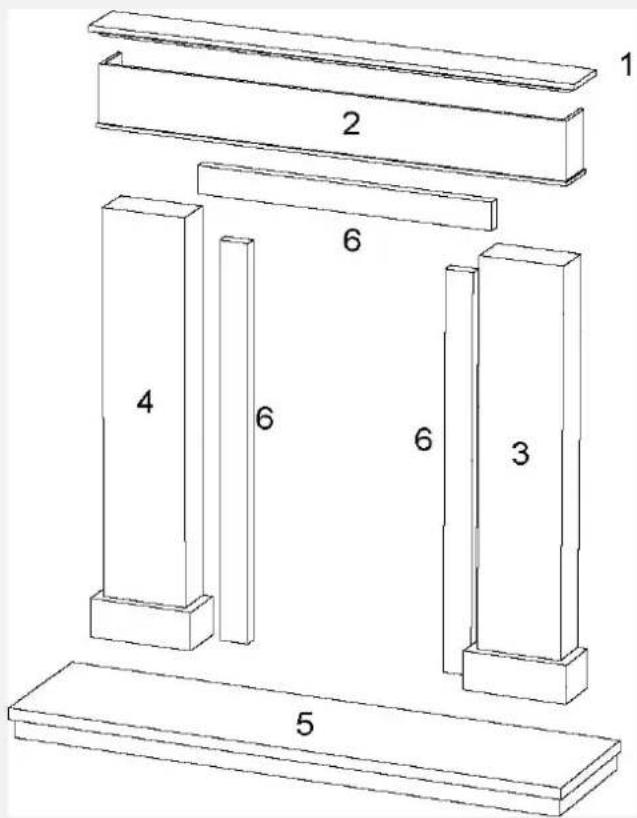
2.4 Assembly of the Surround 9
2.5 Cleaning and maintenance 9
Your fireplace is made of marble or limestone, a natural material. So it is quite normal that there may be variations in colour and structure from one piece to another and from one product to another. Guarantee: keep the guarantee certificate in a safe place, together with your proof of purchase.
Despite our rigorous quality control, there is still a small chance that your fireplace may have been damaged in transit.
Check all parts for damage before commencing installation. Damages and/or discolours have to be reported before installing the surround otherwise the guarantee will be void "an installed surround means an accepted surround".
Filler pieces (1000 × 90 × 30 mm) are available from stock in all colours. Larger fireplace parts usually have to be ordered.
2.1 Introduction
These installation instructions contain information about the assembly and maintenance of your ambience fireplace, and also advice about safety during installation.
If you read this instruction manual carefully, you will soon find out how to install your fireplace properly.
2.2 SAFETY PRECAUTIONS
- The appliance must not be altered in any way
- Make sure that there is sufficient insulation between the appliance and the natural stone fireplace
- When installing the natural stone fireplace, always make sure that the base is level (preferably, perfectly horizontal), clean and, above all, stable
- Before starting on the installation, check that the supplied materials are complete and undamaged
- It is strongly recommended that, if possible, you first conduct a 'dry run' of the fireplace assembly. Among other things, this will allow you to see how the various parts fit together
- The fireplace components may be glued together using marble adhesive or acid-free silicone paste. The latter has the advantage that it allows for later dismantling (as long as it is only applied at certain points)
2.3 PREPARATION
The heater can be installed in a range of positions in relation to the fireplace:
- The heater can be installed immediately behind the fireplace. In this case, the back of the fireplace is the front of the heater
- The heater can be installed further behind the fireplace. For example, 8cm if the mantle or column is made of Durox blocks or stones. The rear of the fireplace is 8cm from the front of the heater. This means that you must order wider filler pieces in order to bring the rear of the fireplace or uprights flush with the heater
- The heater can be installed in the fireplace. In this case, it is important to know how far inside the fireplace the heater is installed, since different filler pieces will be needed. The location of the heater is in turn dependent upon the location of this heater's smoke outlet or flue and the thickness of the mantle.
- When installing the natural stone fireplace, always make sure that the base is level (preferably, perfectly horizontal), clean and, above all, stable.
- Carefully remove the fireplace from the wooden crate in which it is delivered.
- Check that all the parts supplied in the crate are complete and undamaged. Lay them out in a safe place, so that you have a clear idea of what the various parts are.
- As far as possible, measure the dimensions using the drawing of the fireplace (see Appendices).
- Smooth the floor using a suitable screed. Be careful with limestone fireplaces, you may have to seal the hearth or lay plastic sheet underneath to reduce the risk of staining. Grey cement will stain the natural stone, use only white cement. When using Knauff (for example, to insert a plate), blistering may occur in some dark types of natural stone. An alternative is to apply a decelerator to the plaster.
- With a parquet floor, it is advisable to cut away the parquet to the size of the hearth, less 2 cm (left, right and front). If the parquet has not yet been fitted, you can place the hearth above it, so that the parquet can be fitted approximately 2 cm underneath.
- We recommend that you first conduct a 'dry run' of the fireplace assembly. Among other things, this will allow you to see how the various parts fit together.
It is also recommended that you fit the fireplace first and then, if necessary, plaster around it.
If necessary, you can smooth out the fireplace components using stainless steel rings.
2.4 Assembly of the Surround
- Establish the central point of the fireplace and mark this on the backing wall.
- Establish the distance between the heater and the backing wall.
- If the backing wall is not level, you can fill it later.
- Lay the hearth so that it is level in all directions (from front to rear and left to right).
- Install the heater in terms of its heating function (see instructions supplied with the appliance).
- Put the left- and right-hand uprights/sidepieces in position. These have already been glued together. They should fit on the left- and right-hand side of the hearth. The heater must be clear of the fireplace to allow for expansion and contraction with heat. Any gaps can be sealed with a ceramic rope or similar.
- Fill the space between the uprights and the backing wall with brickwork or Promatec, to allow further assembly. The uprights may be attached to this structure. The structure must also be able to absorb pressure at right angles onto the backing wall. We therefore recommend a brickwork structure.
- Saw the filler pieces to the right size. The size depends upon the way in which the hearth is fitted in relation to the fireplace.
- The components may be fastened together using acid-free silicone paste or two-component marble adhesive. Silicone paste takes longer to set, and so gives you more time to match the pieces exactly. It is also easier to remove (for example, using fishing line), if the pieces need to be disassembled.
After this, you can fill the seams with the special coloured fitting kit. - Left-over filler pieces can be stored in the upper section.
- Check that all the connections are gas-tight and test the operation of the appliance.
- Add the finishing touches to the fireplace.
2.5 Cleaning and maintenance
Clean the fireplace using a dry non-scratch cloth or a vacuum cleaner. Do not use cleaning agents.
Be careful! The use of cleaning agents may cause discoloration of the stone. Also be careful when placing vases or flower pots on the fireplace.
If you do wish to use a cleaning agent, consult your retailer first. Your retailer can advise about special cleaners for natural stone.



Brand : FABER
Model : Peca
Category : Fireplace