
JV966DSS Profile - Range hood GE - Free user manual and instructions
Find the device manual for free JV966DSS Profile GE in PDF.


| Brand | GE |
| Model | JV966DSS Profile |
| Category | Kitchen exhaust hood |
| Width | 91.4 cm (36 in) |
| Recommended installation height | 60.9 to 91.4 cm (24 to 36 in) above cooking surface |
| Power supply | 120 V, 60 Hz, dedicated 15 or 20 A circuit |
| Number of fan speeds | 4 (LO, MED LO, MED HI, HI) |
| Lighting | 2-position control (HI and NITE) |
| Bulb type | Halogen 12 V, 20 W max, G-4 base |
| Grease filters | 2 reusable metal filters |
| Material | Stainless steel |
| Exhaust duct diameter | 17.8 cm (7 in) round or 8.2 cm x 30.4 cm (3 1/4 in x 12 in) rectangular |
| Maximum duct length | 30.4 m (100 ft) equivalent |
| Grounding | Required |
| Filter cleaning | Monthly, soak in hot water and detergent |
| Surface cleaning | Warm soapy water or stainless steel cleaner |
| Bulb replacement | User-replaceable, hood unplugged |
| Warranty | 1 year parts and labor |
| Maximum weight supported by mounting | 45.3 kg (100 lb) |
Frequently Asked Questions - JV966DSS Profile GE
User questions about JV966DSS Profile GE
0 question about this device. Answer the ones you know or ask your own.
Ask a new question about this device
Download the instructions for your Range hood in PDF format for free! Find your manual JV966DSS Profile - GE and take your electronic device back in hand. On this page are published all the documents necessary for the use of your device. JV966DSS Profile by GE.
USER MANUAL JV966DSS Profile GE
Safety Instructions 2
Operating Instructions
Fan Control 3
Light Control 4
Care and Cleaning
Grease Filters 5
Hood Lights 6
Stainless Steel Surfaces 5
Installation Instructions..6-17
Troubleshooting Tips 18
Consumer Support
Consumer Support 22
Owner Registration 19, 20
Warranty 21
Owner's Manual and Installation Instructions
JV936
JV966
CV936
CV966
Write the model and serial numbers here:
Model#
Serial #
You can find them on a label on the inside of the hood.
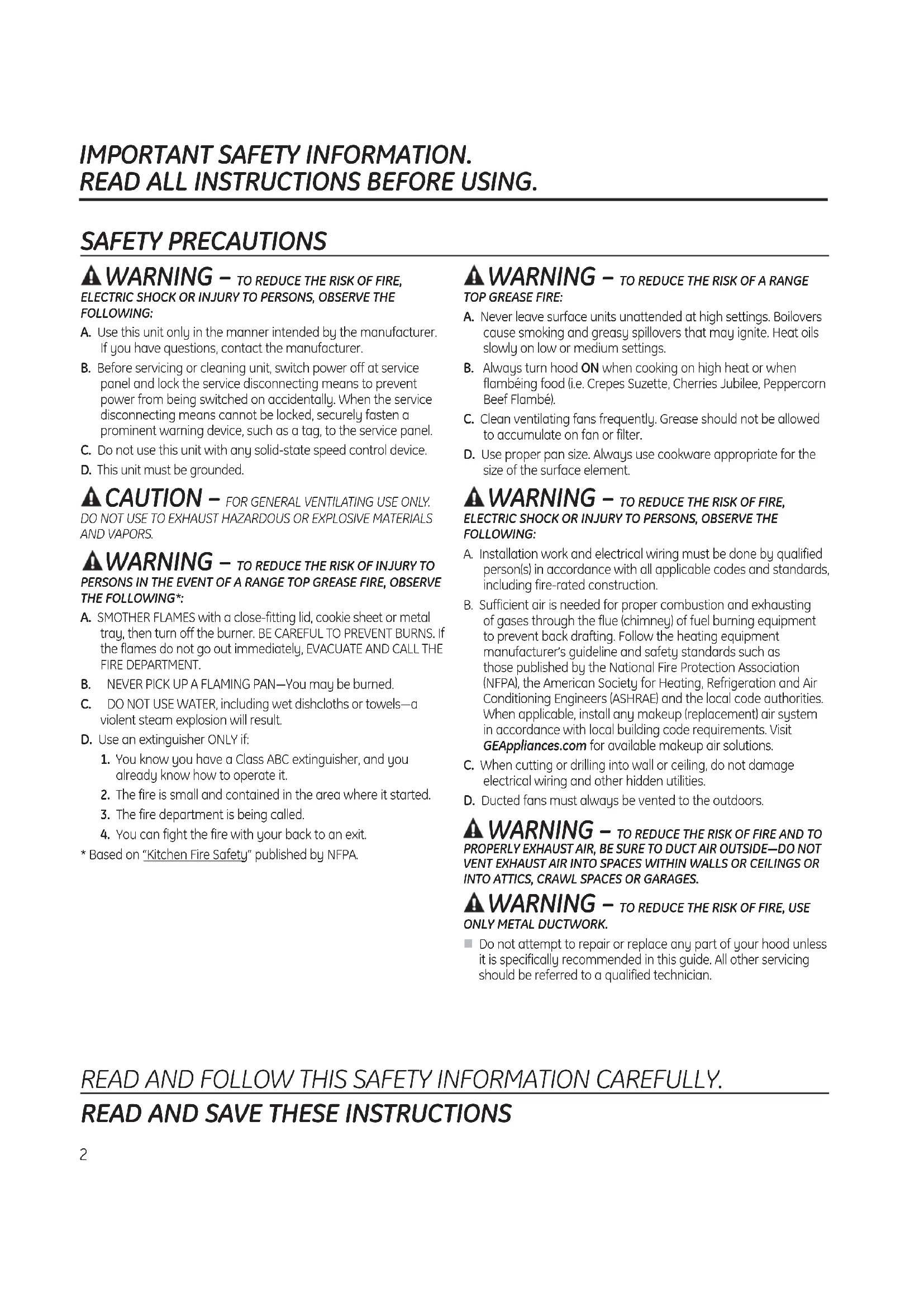
SAFETY PRECAUTIONS
WARNING - TO REDUCE THE RISK OF FIRE, ELECTRIC SHOCK OR INJURY TO PERSONS, OBSERVE THE FOLLOWING:
A. Use this unit only in the manner intended by the manufacturer. If you have questions, contact the manufacturer.
B. Before servicing or cleaning unit, switch power off at service panel and lock the service disconnecting means to prevent power from being switched on accidentally. When the service disconnecting means cannot be locked, securely fasten a prominent warning device, such as a tag, to the service panel.
C. Do not use this unit with any solid-state speed control device.
D. This unit must be grounded.
CAUTION FOR GENERAL VENTILATING USE ONLY. DO NOT USE TO EXHAUST HAZARDOUS OR EXPLOSIVE MATERIALS AND VAPORS.
WARNING - TO REDUCE THE RISK OF INJURY TO PERSONS IN THE EVENT OF A RANGE TOP GREASE FIRE, OBSERVE THE FOLLOWING*:
A. SMOTHER FLAMES with a close-fitting lid, cookie sheet or metal tray, then turn off the burner. BE CAREFUL TO PREVENT BURNS. If the flames do not go out immediately, EVACUATE AND CALL THE FIRE DEPARTMENT.
B. NEVER PICK UP A FLAMING PAN-You may be burned.
C. DO NOT USE WATER, including wet dishcloths or towels—a violent steam explosion will result.
D. Use an extinguisher ONLY if:
- You know you have a Class ABC extinguisher, and you already know how to operate it.
- The fire is small and contained in the area where it started.
- The fire department is being called.
-
You can fight the fire with your back to an exit.
-
Based on "Kitchen Fire Safety" published by NFPA.
WARNING - TO REDUCE THE RISK OF A RANGE TOP GREASE FIRE:
A. Never leave surface units unattended at high settings. Boilovers cause smoking and greasy spillovers that may ignite. Heat oils slowly on low or medium settings.
B. Always turn hood ON when cooking on high heat or when flambéing food (i.e. Crepes Suzette, Cherries Jubilee, Peppercorn Beef Flambé).
C. Clean ventilating fans frequently. Grease should not be allowed to accumulate on fan or filter.
D. Use proper pan size. Always use cookware appropriate for the size of the surface element.
WARNING - TO REDUCE THE RISK OF FIRE, ELECTRIC SHOCK OR INJURY TO PERSONS, OBSERVE THE FOLLOWING:
A. Installation work and electrical wiring must be done by qualified person(s) in accordance with all applicable codes and standards, including fire-rated construction.
B. Sufficient air is needed for proper combustion and exhausting of gases through the flue (chimney) of fuel burning equipment to prevent back drafting. Follow the heating equipment manufacturer's guideline and safety standards such as those published by the National Fire Protection Association (NFPA), the American Society for Heating, Refrigeration and Air Conditioning Engineers (ASHRAE) and the local code authorities. When applicable, install any makeup (replacement) air system in accordance with local building code requirements. Visit GEAppliances.com for available makeup air solutions.
C. When cutting or drilling into wall or ceiling, do not damage electrical wiring and other hidden utilities.
D. Ducted fans must always be vented to the outdoors.
WARNING - TO REDUCE THE RISK OF FIRE AND TO PROPERLY EXHAUST AIR, BE SURE TO DUCT AIR OUTSIDE-DO NOT VENT EXHAUST AIR INTO SPACES WITHIN WALLS OR CEILINGS OR INTO ATTICS, CRAWL SPACES OR GARAGES.
WARNING TO REDUCE THE RISK OF FIRE, USE ONLY METAL DUCTWORK.
- Do not attempt to repair or replace any part of your hood unless it is specifically recommended in this guide. All other servicing should be referred to a qualified technician.
READ AND FOLLOW THIS SAFETY INFORMATION CAREFULLY.
READ AND SAVE THESE INSTRUCTIONS
Throughout this manual, features and appearance may vary from your model.


FAN Control
Turn the FAN speed control to LO, MED LO, MED HI or HI, as needed.
Continuous use of the fan system while cooking helps keep the kitchen comfortable and less humid. It also reduces cooking odors and soiling moisture that create a frequent need for cleaning.
NOTE: When the fan is operating on the LO setting, it will be very quiet. Always make sure that the fan is turned OFF when you are finished in the kitchen.

LIGHT Control
Turn the LIGHT control to HI for bright light while cooking. Turn to NITE for use as a night light.
Care and cleaning of the vent hood.
Be sure electrical power is off and all surfaces are cool before cleaning or servicing any part of the vent hood.

Reusable Metal Grease Filters
The hood has 2 metal reusable grease filters.
The metal filters trap grease released by foods on the cooktop. They also help prevent flaming foods on the cooktop from damaging the inside of the hood.
For this reason, the filters must ALWAYS be in place when the hood is used. The grease filters should be cleaned once a month, or as needed.
To clean the grease filters, soak them and then swish them around in hot water and detergent. Don't use ammonia or ammonia products because they will darken the metal. Do not use abrasives or oven cleaners. Light brushing can be used to remove embedded dirt. Rinse, shake and let them dry before replacing.
To remove:
Grasp the filter handle and pull it up, forward and out.
To replace:
Hold the filter at the bottom with the handle.
Place the top end of the filter against the inside front of the hood.
3 Slide it up until it stops and push the bottom end back until it snaps into place.
Stainless Steel Surfaces
Do not use a steel wool pad; it will scratch the surface.
To clean the stainless steel surface, use warm sudy water or a stainless steel cleaner or polish. Always wipe the surface in the direction of the grain. Follow the cleaner instructions for cleaning the stainless steel surface.
To inquire about purchasing stainless steel appliance cleaner or polish, or to find the location of a dealer nearest you, please call our toll-free number:
National Parts Center 800.626.2002
GEAppliances.com
Be sure electrical power is off and all surfaces are cool before cleaning or servicing any part of the vent hood.

Hood Lights
NOTE: The glass cover should be removed only when cold. Wearing latex gloves may offer a better grip.
CAUTION: Before replacing your light bulb, disconnect the electrical power to the hood at the main fuse or circuit breaker panel.
Be sure to let the light cover and bulb cool completely.
For your safety, do not touch a hot bulb with bare hands or a damp cloth.
To remove:
Turn the glass cover counterclockwise until the glass cover clears the socket.
Using gloves or a dry cloth, remove the bulb by pulling it straight out.
To replace:
Use a new 12-volt, 20-watt (maximum) Halogen bulb for a G-4 base.
Using gloves or a dry cloth, remove the new bulb from its packaging.
NOTE: Do not touch the new halogen bulb with bare fingers. Touching the bulb with bare fingers will significantly reduce the life of the bulb.

Push the bulb straight into the receptacle all the way.
Place the glass cover onto the socket and turn clockwise until secure.
For improved lighting, clean the glass cover frequently using a damp cloth. This should be done when the hood is completely cool.
5 Reconnect electrical power to the hood.
Installation Instructions
Range Hoods
Questions? Call 800.GE.CARES (800.432.2737) or visit our Website at: www.GEApliances.com.
BEFORE YOU BEGIN
Read these Instrucitons completely and carfully.
-IMPORTANT - Save these instructions for local inspector's use.
-IMPORTANT - Observe all governing codes and ordinances.
Note to Installer - Be sure to leave these instructions with the Consumer.
Note to Consumer - Keep these instrucitons for future reference.
- Skill Level - Installation of this vent hood requires basic mechanical and electrical skills.
Completion time - 1 to 3 hours.
- Proper installation is the responsibility of the installer.
Product failure due to improper installation is not covered under the Warranty.
CAUTION:
Due to the weight and size of these vent hoods and to reduce the risk of personal injury or damage to the product, TWO PEOPLE ARE REQUIRED FOR PROPER INSTALLATION.
FOR YOUR SAFETY :
Before beginning the installation, switch power off at service panel and lock the service disconnecting means to prevent power from being switched on accidentally. When the service disconnecting means cannot be locked, securely fasten a prominent warning device, such as a tag to the service panel.
PRODUCT DIMENSIONS

30" Models
Requires a 30" opening.

36"Models
Requires a 36" opening.
INSTALLATION CLEARANCES
These vent hoods are designed to be installed onto a wall. They may be installed beneath a soffit or cabinet.
- Install these hoods 24" Min. to 36" Max. above the cooking space.

SOFFIT INSTALLATION
In this installation, the ductwork running from the top of the hood will be concealed in the soffit or upper cabinetry.

WALL MOUNT INSTALLATION
For this installment, a decorative duct cover is available to conceal the ductwork running from the top of the hood. Use of the duct cover requires special consideration to the installation height above the countertop. See page 12 for details.
OPTIONAL ACCESSORIES
Duct Cover
A decorative duct cover is available to accommodate 8 to 10 ft. ceiling heights. The duct cover will expand from 12" Min. or 24" to 36" Max. height.
- The duct cover conceals the ductwork running from the top of the hood to the ceiling.
- The duct cover accessory fits both 30^ and 36^ wide models. Order the duct cover accessory at the same time as the vent hood. All accessories should be on site at the time of hood installation.
Order JXCHSS

Cover with Ceiling Bracket

4 Phillipsead Screws

2 Phillips Head Decorative Scews
ADVANCE PLANNING
Ductwork Planning
- This hood may be vented vertically through upper cabinets, soffit or ceiling. A duct transition piece is supplied for vertical exhaust. Use locally supplied elbows to vent horizontally through the rear wall. See page 13.
- Determine the exact location of the vent hood.
- Plan the route for venting exhaust to the outdoors.
- Use the shortest and straightest duct route possible. FFor satisfactory performance, duct run should not exceed 100 equivalent length for any duct configurations.
- Use metal ductwork only.
- A transition piece for 7^ round duct is supplied. Use 7^ round duct or you may use 3 - 1 / 4^ × 12^ rectangular.
- Install a wall cap or roof cap with damper at the exterior opening. Order the wall or roof cap and any transition needed in advance.
- When applicable, install any makeup (replacement) air system in accordance with local building code requirements. Visit GEAppliances.com for available makeup air solutions.
Kit-JXDW1
Order kit JXDW1 if your installation requires horizontal ducting from the top of the hood through the back wall and:
- You have an 8 ft. ceiling and need to use a JXCH Series Chimney Cover, or
- You have a 12^ cabinet or 12^ soffit that the hood is to be mounted beneath.
This kit provides a duct transition from 7^ round to 3 - 1 / 4^ × 10^ rectangular for through-the-wall venting.
Wall Framing for Adequate Support
- This vent hood is heavy. Adequate structural support must be provided. The hood must be secured to vertical studs in the wall. See page 14.
- We strongly recommend that the vent hood with duct cover be on site before final framing and wall finishing. This will also help to accurately locate the ductwork and electrical service.
DECORATIVE DUCT COVERS
A decorative duct cover is available to fit both model widths. The duct cover conceals the ductwork running from the top of the hood to the ceiling or soffit. The duct cover will fit 8 ft. to 10 ft. ceiling heights. See page 12 for details.
POWER SUPPLY
IMPORTANT - (Please read carefully)
WARNING:
FOR PERSONAL SAFETY, THIS APPLIANCE MUST BE PROPERLY GROUNDED.
Remove house fuse or open circuit breaker before beginning installation.
Do not use an extension cord or adapter plug with this appliance. Follow National electrical codes or prevailing local codes and ordinances.
Electrical supply
This vent hood must be supplied with 120V, 60 Hz, and connected to an individual, properly grounded branch circuit, and protected by a 15 or 20 amp circuit breaker or time delay fuse.
- Wiring must be 2 wire with ground.
- If the electrical supply does not meet the above requirements, call a licensed electrician before proceeding.
- Route house wiring as close to the installment location as possible in the ceiling, soffit or wall. See page 13 for details.
- Connect the wiring to the house wiring in accordance with local codes.
Grounding instructions
The grounding conductor must be connected to a ground metal, permanent wiring system, or an equipment-grounding terminal or lead on the hood.
WARNING: The improper connection of the equipment-grounding conductor can result in a risk of electric shock. Check with a qualified electrician or service representative if you are in doubt whether the appliance is properly grounded.
Installation Instructions
| DUCT FITTINGS Use this chart to compute maximum permissible lengths for duct runs to outdoors. Note: Do not exceed maximum permissible equivalent lengths! Maximum duct length: 100 foot for vent hoods. Flexible ducting: If flexible metal ducting is used, all the equivalent feet values in the table should be doubled. The flexible metal duct should be straight and smoo and extended as much as possible. Do NOT use flexible plastic ducting. Note: Any home ventilation system, such as a ventilation hood, may interrupt the proper flow of combustion air and exhaust required by fireplaces, gas furnaces, gas water heaters and other naturally vented systems. To minimize the chance of interruption of such naturally vented systems, follow the heating equipment manufacturer's guidelines and safety standards such as those published by NFPA and ASHRAE. When applicable, install any makeup (replacement) air system in accordance with local building code requirements. Visit GEAppliances.com for available makeup air solutions. This Hood Must Use 7" Round Duct. It Can Transition To 3-1/4" x 12" Duct. Kit - JXDW1 Order kit JXDW1 if your installation requires horizontal ducting from the top of the hood through the back wall and: • You have an 8 ft. ceiling and need to use a JXCH Series Chimney Cover, or • You have a 12" cabinet or 12" soffit that the hood is to be mounted beneath. This kit provides a duct transition from 7" round to 3-1/4" x 10" rectangular for through-the-wall venting. Using a smaller diameter duct size will reduce performance. | Duct Piece Dimensions Length* Used Length 7" Round ft. straight 3-1/4" x 12" 1 ft. straight 7" 90" elbow 14 ft. 7" 45" elbow 9 ft. 3-1/4" x 12" 15 ft. 90° elbow 3-1/4" x 12" 9 ft. 45° elbow 3-1/4" x 12" 36 ft. 7" round to 1/4" 1 ft. transition 3-1/4" x 12" to 7" round transition 90° elbow 7" round wall cap with damper 3-1/4" x 12" wall cap with damper 7" round roof Round roof *Actual length of straight duct plus duct fitting equivalent. Equivalent length of duct pieces are based on actual tests conducted by GE Evaluation Engineering and reflect requirements for good venting performance with any ventilation hood. | Equivalent | Quantity |
| (per length) | foot | ||
| (per length) | foot | ||
| (per length) | foot | ||
| (per length) | foot | ||
| (per length) | foot | ||
| (per length) | foot | ||
| (per length) | foot | ||
| (per length) | foot | ||
| (per length) | foot | ||
| (per length) | foot | ||
| (per length) | feet | ||
| Total Duct Run |
Total
TOOLS AND MATERIALS REQUIRED
(NOT SUPPLIED)

Pencil and tape measure

Phillips and Flat blade screwdrivers

Duct tape

Electric drill with 1/8 and 3/8 bits

Spirit level

Flashlight

Pliers

Wire Cutter/ Stripper

Ladder

1/4" pivoting hex socket

Safety glasses

UL Listed Wire nuts

Hammer

Tin Snips


Saber saw or Key Hole Saw

Allen Wrench
Additional Materials:
- 120V 60Hz, 15 or 20 Amp, 2 wire with ground. Properly grounded branch circuit.
- Strain relief for junction box.
- 7" round metal duct, 3 - 1 / 4'' × 10'' rectangular duct or 3 - 1 / 4'' × 12'' rectangular duct length to suit installment.
REMOVE THE PACKAGING
- Remove the small box housing the motor.
- Lift the hood out of the box.

- Remove shipping screws holding the wood mounting piece to the back side of the hood. Set aside wood mounting piece and screws for later installation. Do not discard.
- Remove the "V" shaped carton insert.
- Remove parts package from the "V" shaped cardboard insert.
- Remove junction box cover and knockout.
Install strain relief onto back or top of hood. - Remove all tape and packing material from the hood, duct transition and motor.
PARTS PROVIDED
Locate the hardware accessory box packed with the hood and check contents.

2 Aluminum Grease Filters


Screws, wall fasteners, washers

Duct Transition with Damper

DUCT COVER REQUIREMENTS
We recommend that the vent hood and decorative duct cover (if used) be on site before final framing and wall finishing. This will help to accurately locate studs, ductwork, and electrical service. Read these instructions to determine if the duct cover accessory can be used for your installation situation.
Duct Cover Accessory:
- Use the decorative duct cover to conceal ductwork running from the top of the hood to the ceiling.
- The duct cover accessory consists of 2 pieces. The outside piece is 12^ high, the inside piece is 22^ . Nested together they are 24^ min. expanding to a total maximum height of 34^ .
The outside piece can be used alone to fill a 12" height. - For heights over 12^ , the ceiling bracket must be installed to secure the cover at the top.

To avoid unsightly gaps, plan the hood installation height for duct cover use.
- The cover will fit a 12'' min. height from the top of the hood to the ceiling or 24'' min. and expanding up to 34'' from the top of the hood to the ceiling.
THE DUCT COVER CANNOT BE USED WHEN THE DISTANCE ABOVE THE TOP OF THE HOOD IS BETWEEN 12^ AND 24^ .
Review the following examples to ensure a trouble free installation using the duct cover accessory. 8 ft. Ceiling
8ft. Ceilings:
The hood must be installed at 30^ above the cooking surface (or 66^ above the floor). The duct cover will not fit if the hood is installed at a lower or higher height. Use the outside 12^ section, discard the inside section.


9 ft. Ceiling

9 ft Ceiling: Install the hood 24^ min. and up to a maximum of 30^ above the cooking surface. The duct cover will expand to reach ceiling height.


10 ft. Ceiling: Install the hood 32^ min to 36^ max. above the cooking surface. The duct cover will expand to a maximum of 34^ above the top of the hood to meet the ceiling.
DETERMINE HOOD, DUCTWORK AND WIRING LOCATIONS
- Keep the wood support piece and its screws for later installment. Do not discard.
Measure desired distance from the bottom of the hood to the cooking surface, 24^ min. to 36^ max. Refer to the previous page if the accessory duct cover will be used. - Use a level to draw a horizontal line indicating the bottom of the hood.
- Use a level to draw the cooktop centerline location.
Measure 15 - 3 / 8" up from the horizontal line for the bottom of the hood. Draw another horizontal line.
Measure 18^ up from the line for the bottom of the hood, draw another horizontal line to indicate the top of the hood.
FOR VERTICAL (Straight Up) DUCTING:
-
If venting out the ceiling, extend the centerline forward on the ceiling.
-
Measure 6-7/8" from drywall to mark centerline for a 7-1/2" dia. duct hole on the ceiling.
- If drywall is not present, add drywall thickness to the 6 - 7 / 8'' dimension.
Venting through a soffit or upper cabinet:
- Follow the same procedure for ceiling ducting to cut the 7-1/2" dia. hole through the top of the cabinet or soffit.
See Step 4, page 15 for details to cut opening for duct transition.

FOR DUCTING THROUGH REAR WALL:
Measure the supplied duct transition with any straight run length of duct used, plus 90^ elbow height. Draw a horizontal line on the wall intersecting the centerline.
House Wiring Location:
- The junction box is fastenend to the back of the hood on the right side. See illustrations for hood knockout locations.
Note:The junction box can be relocated to the inside top of the hood.
House wiring may enter the junction box from the rear or the top of the hood at the right side.
To route house wiring through the ceiling or soffit:
Cut a hole approximately 1" dia., 5-7/8" forward on the ceiling; 11-1/8" to the right of the centerline for 30" models or 14-1/8" to the right of the centerline for 36" models.
To route house wiring through the wall:
- Cut a hole approximately 1^ dia. 10-1/16" down from the top of the hood, 11-1/8" to the right of the centerline for 30^ models or 14-1/8" to the right of the centerline for 36^ models..
- Remove top or rear knockout depending on your installation.
Install strain relief onto back or top of hood.

1 INSTALL HOOD SUPPORT
IMPORTANT: Framing must be capable of supporting 100 lbs.
- Locate at least 2 vertical studs at the wood mounting location by tapping drywall with a hammer or use a stud finder.
- Center the supplied wood horizontal support, left to right, and below the marked line.

- Drill 1/8'' pilot holes through the support, drywall and into the studs. Secure the support to 2 or more vertical studs with supplied wood screws.
IMPORTANT : Screws must penetrate at least 1- 1/2" into vertical studs. Countersink screws into support.

- Install mounting screws in the center of the wood supper, 13 - 1 / 6'' from the centerline. The screws should protrude forward 1 / 4'' . This 1 / 4'' gap will provide clearance to hang the hood.
2 INSTALL TRANSITION
IMPORTANT: Remove shipping tape from damper and check that damper moves freely.

- Place the transition piece over the hood exhaust. Secure transition to hood with 4 screws provided.
- Use duct tape to seal the connection.
3 INSTALL HOOD ONTO WALL
- Lift the hood and place over the wood support. The top keyhole slots in the hood should engage the protruding mounting screws. Allow the hood to slide down into position.
Pull house wiring through knockout at the rear or top of the hood. - Check to be sure the hood is level and centered. The arrow shaped cutout in the back of the hood allows viewing the marked centerline.
- Remove cover from junction box.

Drill Bottom Mounting Hole Locations
- Drill 1/8 pilot holes into the two lower mounting holes. Enlarge the holes if they do not enter studs to 3/8 . Tap anchors for wall fasteners into bottom holes. Install screws by hand into the fasteners to allow anchors to expand against the wall. Remove screws.
- Using two large flat washers (supplied), install wood screws or wall fastener screws, loosely, into lower mounting holes. Do not tighten.
- Check hood level. Tighten upper screws. Tighten lower mounting screws..
- For additional security, drive screws through the original wood support screw holes in the back of the hood.
Alternate Mounting Method INSTALL HOOD TO SOFFIT OR BENEATH CABINETS
SKIP THIS STEP IF USING WALL MOUNTING METHOD
IMPORTANT: Soffit framing must be capable of supporting 100 lbs.
When necessary the hood may be installed so that it is supported by the soffit.
The soffit should be constructed with 2 × 4 s.
- Determine the installation location.
- Continue the centerline forward on the bottom of the cabinet or soffit.

| “A” Centerline to Center of Stud | “B” Opening for Ductwork | |
| 30" Models 14 | 1/2" 10-3/4"W x 8-7/16 D | |
| 36" Nideks 17- | 1/2" 10-3/4"W x 8-7/16 D |
- Mounting screws must be secured to 2 × 4 studs (Dim. "A") at locations shown in the above chart.
- Allow minimum opening (Dim. "B") to accommodate the duct transition in the soffit

Cut a 10 - 3 / 4''× 8 - 7 / 16'' hole through bottom of soffit or cabinet for duct transition as shown.
IMPORTANT: For additional support and to minimize vibration during operation, we strongly recommend that the hood also be secured to the back wall with wall fastners.


- Drill four 1/8 pilot holes in locations show.
- If mounting to the underside of a cabinet with a recessed bottom, install shims to fill the gap.

- Drive mounting screws int the studs until they protrude 1/4'' . This 1/4'' gap will provide clearance to engage the keyhole slots in the top of the hood.
- Lift hood onto mounting screws. slide back against the rear wall.
- Pull house wiring through the knockout at the rear or top of the hood.
- Tighten mounting screws.
5 INSTALL CEILING BRACKET
The ceiling bracket must be installed when the duct cover is used to span 24^ or more height above the hood. The bracket will hold the decorative duct cover in place at the top.
Note: The ceiling bracket is not required when using only the 12" section of the duct cover.
- Install the 2 small screws into the sides of the duct bracket. remove the screws. Pre-tapping the holes will insue ease of final installation.
- Match center notch on the bracket to the centerline on the wall and flush against the ceiling.
- Mark the 2 screw hole locations.
- Drill 2/8 pilot holes in marked bracket location.
- If pilot holes do not enter studs, enlarge the holes to 3/8 and install wall fastener anchors.
- Secure the bracket to the rear wall with wood screws and washers. Use wall anchors if needed.

Note: Bracket has 2 sets of holes. Use larger holes for wall fasheners or wood screws with washers. Use smaller holes for wood screws with washers.
6 CONNECT DUCTWORK
- Push duct over the end of the transition until it reaches the stop tabs.
- Install ductwork, making connections in direction of airflow as illustrated.
- Secure joints in ductwork with sheetmetal screws.
- Wrap all duct joints with duct tape for an airlight seal.
- Use duct tape to seal the flange connection

CAUTION: Do not use sheet metal screws at the transition to ductwork connection. Doing se will prevent proper damper operations. Seal connection with tape only.
7 INSTALL MOTOR
- Align and engage the slots in the blower assembly to the 3 hooks at the rear of the exhaust opening.
- Rotate motor uplands until it aligns with the attachment screw location.
- Secure the motor to attachment bracket at the front of the opening with washer and screw provided.
Plug the motor connector into the mating hood connector. Seethe illustration for the hood connector location. Touch the hood to locate and make the connection.
IMPORTANT: Hold the connector so the two square corner terminals are at the top as you position the connector to plug it in.
Motor Attachment Bracket


8 CONNECT ELECTRICAL
Verify that power is turned off at the source.
WARNING: If house wiring is not 2-wire with a ground wire, a ground must be provided by the installer. When house wiring is aluminum, be sure to use UL approved anti-oxidant compound and aluminum-to-copper connectors.

D Use UL Listed Wire Nuts
- Use wire nuts to connect incoming ground to green, white to white, and black to black.
- Push wires into junction box and replace cover. Be sure wires are not pinched.
9 INSTALL DUCT COVERS
To install the 12^ duct cover alone:
- Place the 12^ section of the decorative duct cover on top of the hood.
- Secure the cover on the top of the hood with 4 screws provided.
To install the 2-piece duct cover:
- Place the 2-piece duct cover on the top of the hood.
- Secure the bottom cover to the top of the hood with 4 screws provided. See illustration, page 16.
- Extend the inside section upwards to meet the ceiling and ceiling bracket
- Secure the duct cover to the bracket with the 2 small Phillips screws provided.
10 INSTALL FILTER SUPPORT
- Tip filter support into the rear of the hood.
- Insert support tabs into the slots at the rear of the hood.


- Secure the support to the hood with screws as shown..
11 INSTALL FILTERS
- Remove protective film covering the filters.
- Insert the filter into the "C" clips mounted to the top of the vertical front panel.
- Tap the filter against one side to align with outside opening.
- Pull the filter down into the lower slots at the bottom of the filter support.


- To remove the filters, grasp the handle, push the filter up, and pull forward.
12 FINALIZE INSTALLATION
Refer to the operating instructions to test all controls.
Before you call for service...

Troubleshooting Tips Save time and money! Review the chart below first and you may not need to call for service.
Problem Possible Causes What To Do
| Fan does not operate when the switch is on | A fuse may be blown or a circuit breaker tripped. | Replace fuse or reset circuit breaker. |
| The blower connector is | loose • Disconnect power to the unit. Remove the filters or not plugged into its mating | and look up at the blower. If the blower connector |
| connector. plug is loose or you see the connector dangling, the installer failed to plug it in securely. Although it is a blind connection, it is easy to plug in. See the Installation Instructions in this manual for the plug location and how to plug the connector in. | ||
| Fan fails to circulate air or moves air slower than normal | Excessively soiled filters. correct the problem, call for service. | Remove the filters, clean if necessary and replace them. If cleaning and replacing the filters does not |
| • Sufficient makeup (replacement) air is required for exhausting appliances to operate to rating. Check with local building codes, which may require or strongly advise | the use of makeup air. Visit GEAppliances.com for available makeup air solutions. | |
Please place in envelope and mail to:
For Canadian Customers

CUT ALONG THIS LINE AND RETURN CARD—THANKS
| OWNERSHIP REGISTRATION CERTIFICATE - FICHE D'INSCRIPION DU PROPRIÉTAIRE | |||||
| Please register your product to enable us to contact you in the remote event a safety notice is issued for this product and to allow for efficient communication under the terms of your warranty, should the need arise. | Veuiliez enregistrer votre produit afin de nous permettre de communiquer avec vous si jamais un avis de sécurité concernant ce produit était émis et de communiquer facilement avec vous en vertu de votre garantie, si le besoin s'en fait sentir. | ||||
| REGISTER ON-LINE: www.geappliances.ca ENREGISTREMENT SUR INTERNETÀ: www.electromenagersge.ca | MAIL TO: P.O. BOX 1780, MISSISSAUGA ONTARIO, L4Y 4G1 | ||||
| □ MR./M □ MRS./MME. □ MISS/MLLE. □ MS. | FIRST NAME/PRENOM | LAST NAME/NOM | |||
| STREET NO/N° RUE | STREET NAME/RUE | APT. NO./APP./RR# | |||
| CITY/VILLE | PROVINCE | POSTAL CODE/POSTAL | |||
| AREA CODE/IND. RÉG. | TELEPHONE | ||||
| DID YOU PURCHASE A SERVICE CONTRACT FOR THIS APPLIANCE? YES/oui □ IF YES/SI OUI:EXPIRATION AVEZ-VOUS ACHETE UN CONTRAT DE SERVICE POUR CET APPAREIL? NO/NON □ Y/A M D/J | |||||
| NAME OF SELLING DEALER/NOM DU MARCHAND | MODEL/MODELE | ||||
| INSTALLATION DATE/DATE D'INSTALLATION Y/A M D/J | CORRESPONDENCE □ ENGLISH CORRESPONDANCE □ FRANÇAIS SERIAL/SÉRIE | ||||
| □ I do not wish to receive any promotional offers regarding this product. □ Je ne désire pas recevoir d'affres promotionnelles concernant ce produit. | |||||
GE Range Hood Warranty.

All warranty service provided by our Factory Service Centers, or an authorized Customer Care technician. To schedule service on-line, visit us at GEAppliances.com, or call 800. GE.CARES (800.432.2737). Please have serial number and model number availa ble when calling for service.
Staple your receipt here. Proof of the original purchase date is needed to obtain service under the warranty.
For The Period Of: GE Will Replace:
One Year
From the date of the During this limited one-year warranty, GE will also provide, free of charge, all labor and original purchase in-home service to replace the defective part.
What GE Will Not Cover:
Service trips to your home to teach you how to use the product.
Improper installation, delivery or maintenance.
Product damage or failure of the product if it is abused, misused, modified, used for other than the intended purpose, or used commercially.
Replacement of house fuses or resetting of circuit breakers.
Damage to the product caused by accident, fire, floods or acts of God.
Incidental or consequential damage caused by possible defects with this appliance.
Damage caused after delivery.
Product not accessible to provide required service.
Installation or service for a makeup (replacement) air system.
EXCLUSION OF IMPLIED WARRANTY--Your sole and exclusive remedy is product repair as provided in this Limited Warranty. Any implied warranties, including the implied warranties of merchantability or fitness for a particular purpose, are limited to one year or the shortest period allowed by law.
This warranty is extended to the original purchaser and any succeeding owner for products purchased for home use within the USA. If the product is located in an area where service by a GE Authorized Servicer is not available, you may be responsible for a trip charge or you may be required to bring the product to an Authorized GE Service Location for service. In Alaska, the warranty excludes the cost of shipping or service calls to your home.
Some states do not allow the exclusion or limitation of incidental or consequential damages. This warranty gives you specific legal rights, and you may also have other rights which vary from state to state. To know what your legal rights are, consult your local or state consumer affairs office or your state's Attorney General.

GE Appliances Website
GEAppliances.com
Have a question or need assistance with your appliance? Try the GE Appliances Website 24 hours a day, any day of the year! For greater convenience and faster service, you can now download Owner's Manuals, order parts or even schedule service on-line.

Schedule Service GEAppliances.com
Expert GE repair service is only one step away from your door. Get on-line and schedule your service at your convenience any day of the year! Or call 800.GE.CARES (800.432.2737) during normal business hours.

Real Life Design Studio GEAppliances.com
GE supports the Universal Design concept—products, services and environments that can be used by people of all ages, sizes and capabilities. We recognize the need to design for a wide range of physical and mental abilities and impairments. For details of GE's Universal Design applications, including kitchen design ideas for people with disabilities, check out our Website today. For the hearing impaired, please call 800.TDD.GEAC (800.833.4322).

Extended Warranties GEAppliances.com
Purchase a GE extended warranty and learn about special discounts that are available while your warranty is still in effect. You can purchase it on-line anytime, or call 800.626.2224 during normal business hours. GE Consumer Home Services will still be there after your warranty expires.

Parts and Accessories GEApplianceParts.com
Individuals qualified to service their own appliances can have parts or accessories sent directly to their homes (VISA, MasterCard and Discover cards are accepted). Order on-line today, 24 hours every day or by phone at 800.626.2002 during normal business hours.
Instructions contained in this manual cover procedures to be performed by any user. Other servicing generally should be referred to qualified service personnel. Caution must be exercised, since improper servicing may cause unsafe operation.

Contact Us GEAppliances.com
If you are not satisfied with the service you receive from GE, contact us on our Website with all the details including your phone number, or write to: General Manager, Customer Relations
GE Appliances, Appliance Park
Louisville, KY 40225

Register Your Appliance GEAppliances.com
Register your new appliance on-line-at your convenience! Timely product registration will allow for enhanced communication and prompt service under the terms of your warranty, should the need arise.
You may also mail in the pre-printed registration card included in the packing material.
Centre national de pieces 800.661.1616
www.electromenagersge.ca
DIMENSIONS DU PRODUIT

ACCESSIONS FACULTATIFS
Couvre-conduit

Commandez la piece: JXCHSS
PREPARATIFS
COUVRE-CONDUIT DÉCORATIF
9 INSTALLATION DU COUVRE-CONDUIT
Garant: Mabe Canada Inc.,
Burlington, Ontario

Site Web apparcils electromenagers GE www.electromenagersge.ca
- Operating Instructions
- Care and Cleaning
- Consumer Support
- SAFETY PRECAUTIONS
- WARNING - TO REDUCE THE RISK OF FIRE, ELECTRIC SHOCK OR INJURY TO PERSONS, OBSERVE THE FOLLOWING:
- CAUTION FOR GENERAL VENTILATING USE ONLY. DO NOT USE TO EXHAUST HAZARDOUS OR EXPLOSIVE MATERIALS AND VAPORS.
- WARNING - TO REDUCE THE RISK OF INJURY TO PERSONS IN THE EVENT OF A RANGE TOP GREASE FIRE, OBSERVE THE FOLLOWING*:
- WARNING - TO REDUCE THE RISK OF A RANGE TOP GREASE FIRE:
- WARNING - TO REDUCE THE RISK OF FIRE AND TO PROPERLY EXHAUST AIR, BE SURE TO DUCT AIR OUTSIDE-DO NOT VENT EXHAUST AIR INTO SPACES WITHIN WALLS OR CEILINGS OR INTO ATTICS, CRAWL SPACES OR GARAGES.
- WARNING TO REDUCE THE RISK OF FIRE, USE ONLY METAL DUCTWORK.
- READ AND SAVE THESE INSTRUCTIONS
- FAN Control
- LIGHT Control
- Care and cleaning of the vent hood.
- Reusable Metal Grease Filters
- Stainless Steel Surfaces
- Hood Lights
- To remove:
- To replace:
- Installation Instructions
- Range Hoods
- BEFORE YOU BEGIN
- CAUTION:
- FOR YOUR SAFETY :
- PRODUCT DIMENSIONS
- INSTALLATION CLEARANCES
- OPTIONAL ACCESSORIES
- Duct Cover
- ADVANCE PLANNING
- Ductwork Planning
- Kit-JXDW1
- Wall Framing for Adequate Support
- DECORATIVE DUCT COVERS
- POWER SUPPLY
- WARNING:
- Electrical supply
- Grounding instructions
- TOOLS AND MATERIALS REQUIRED
- Additional Materials:
- REMOVE THE PACKAGING
- PARTS PROVIDED
- DUCT COVER REQUIREMENTS
- Duct Cover Accessory:
- To avoid unsightly gaps, plan the hood installation height for duct cover use.
- 8ft. Ceilings:
- DETERMINE HOOD, DUCTWORK AND WIRING LOCATIONS
- FOR VERTICAL (Straight Up) DUCTING:
- Venting through a soffit or upper cabinet:
- FOR DUCTING THROUGH REAR WALL:
- House Wiring Location:
- To route house wiring through the ceiling or soffit:
- To route house wiring through the wall:
- INSTALL HOOD SUPPORT
- IMPORTANT: Framing must be capable of supporting 100 lbs.
- INSTALL TRANSITION
- INSTALL HOOD ONTO WALL
- Drill Bottom Mounting Hole Locations
- Alternate Mounting Method INSTALL HOOD TO SOFFIT OR BENEATH CABINETS
- INSTALL CEILING BRACKET
- CONNECT DUCTWORK
- INSTALL MOTOR
- CONNECT ELECTRICAL
- INSTALL DUCT COVERS
- To install the 2-piece duct cover:
- INSTALL FILTER SUPPORT
- INSTALL FILTERS
- FINALIZE INSTALLATION
- Before you call for service...
- Problem Possible Causes What To Do
- GE Range Hood Warranty.
- For The Period Of: GE Will Replace:
- One Year
- What GE Will Not Cover:
- GE Appliances Website
- GEAppliances.com
- Schedule Service GEAppliances.com
- Real Life Design Studio GEAppliances.com
- Extended Warranties GEAppliances.com
- Parts and Accessories GEApplianceParts.com
- Contact Us GEAppliances.com
- Register Your Appliance GEAppliances.com
- DIMENSIONS DU PRODUIT
- ACCESSIONS FACULTATIFS
- Couvre-conduit
- PREPARATIFS
- COUVRE-CONDUIT DÉCORATIF
- INSTALLATION DU COUVRE-CONDUIT
- Site Web apparcils electromenagers GE www.electromenagersge.ca
Brand : GE
Model : JV966DSS Profile
Category : Range hood