
WGD70HEBW - INSTALLATION GUIDE - Washer dryer WHIRLPOOL - Free user manual and instructions
Find the device manual for free WGD70HEBW - INSTALLATION GUIDE WHIRLPOOL in PDF.


| Brand | Whirlpool |
| Model | WGD70HEBW |
| Product Type | Gas or electric dryer (depending on version) |
| Power Type | Natural gas or propane (convertible) / Electric 120/240 V, 30 A, single-phase |
| Dimensions (approx.) | Height: 99 cm (39 in), Width: 68.6 cm (27 in), Depth: 71.1 cm (28 in) |
| Weight | 90.7 kg (200 lb) |
| Capacity | Not specified in the manual; typical capacity approximately 220 L (7.8 ft³) |
| Drying Programs | Automatic with moisture detection, programmed, timed |
| Steam Function | Yes (on equipped models) |
| Door Reversal | Possible (models with curved or square door) |
| Exhaust System | Outdoor exhaust mandatory, rigid or flexible metal duct 102 mm (4 in) |
| Gas Connection | 3/8 in stainless steel flexible, manual shut-off valve |
| Electrical Connection | 14-30R receptacle (electric) or 3-prong grounded receptacle (gas) |
| Leveling Feet | 4 adjustable feet (do not use on pedestal) |
| Routine Maintenance | Cleaning lint filter, inspecting exhaust duct, replacing water hoses every 5 years |
| Safety | Grounding, gas leak detection, overheat shutdown |
| Parts Provided | Leveling feet, Y-connector (steam models), water hoses (2 ft and 5 ft) |
| Optional Accessories | Pedestal, mobile home installation kit, gas/propane conversion kit |
| Standards | CSA, ANSI Z21.24, CSA 6.10, NFPA 54, Canadian Electrical Code |
| Clearance Distances | 0 in on sides (recessed), 5 in minimum at rear for duct |
Frequently Asked Questions - WGD70HEBW - INSTALLATION GUIDE WHIRLPOOL
User questions about WGD70HEBW - INSTALLATION GUIDE WHIRLPOOL
0 question about this device. Answer the ones you know or ask your own.
Ask a new question about this device
Download the instructions for your Washer dryer in PDF format for free! Find your manual WGD70HEBW - INSTALLATION GUIDE - WHIRLPOOL and take your electronic device back in hand. On this page are published all the documents necessary for the use of your device. WGD70HEBW - INSTALLATION GUIDE by WHIRLPOOL.
USER MANUAL WGD70HEBW - INSTALLATION GUIDE WHIRLPOOL
GAS DRYER INSTALLATION INSTRUCTIONS CANADIAN ELECTRIC DRYER INSTRUCTIONS
INSTRUCTIONS POUR L'INSTALLATION DE LA SECHEUSE À GAZ (É.-U. ET CANADA)
ÉLECTRIQUE (CANADA UNIQUEMENT)
Table of Contents
DRYER SAFETY 2
INSTALLATION REQUIREMENTS 4
Tools and Parts 4
LOCATION REQUIREMENTS 5
ELECTRIC DRYER POWER HOOKUP- CANADA ONLY 6
Venting Requirements 10
Plan Vent System 11
Install Vent System 12
CONNECT INLET HOSE (STEAM MODEL ONLY) 12
CONNECT VENT 14
LEVEL DRYER 14
COMPLETE INSTALLATION CHECKLIST 15
DOOR REVERSAL (OPTIONAL) 15
Table of Contents
DRYER SAFETY 23
INSTALLATION REQUIREMENTS 25
GAS CONNECTION 30
EXHAUST 31
Exhaust Requirements 31
CONNECTING THE EXHAUST DUCT 36
LEVELING THE DRYER 36
COMPLETE INSTALLATION CHECKLIST 37
DOOR REVERSAL (OPTIONAL) 37
Date of installation:
Installer:
Model number:
Serial number:
INSTALLATION NOTES
Date of purchase:
Your safety and the safety of others are very important.
We have provided many important safety messages in this manual and on your appliance. Always read and obey all safety messages.

This is the safety alert symbol.
This symbol alerts you to potential hazards that can kill or hurt you and others.
All safety messages will follow the safety alert symbol and either the word "DANGER" or "WARNING."
These words mean:
DANGER
You can be killed or seriously injured if you don't immediately follow instructions.
WARNING
You can be killed or seriously injured if you don't follow instructions.
All safety messages will tell you what the potential hazard is, tell you how to reduce the chance of injury, and tell you what can happen if the instructions are not followed.

WARNING - "Risk of Fire"
- Clothes dryer installation must be performed by a qualified installer.
- Install the clothes dryer according to the manufacturer's instructions and local codes.
- Do not install a clothes dryer with flexible plastic venting materials or flexible metal (foil type) duct. If flexible metal duct is installed, it must be of a specific type identified by the appliance manufacturer as suitable for use with clothes dryers. Flexible venting materials are known to collapse, be easily crushed, and trap lint. These conditions will obstruct clothes dryer airflow and increase the risk of fire.
- To reduce the risk of severe injury or death, follow all installation instructions.
- Save these instructions.
WARNING: For your safety, the information in this manual must be followed to minimize the risk of fire or explosion, or to prevent property damage, personal injury, or death.
- Do not store or use gasoline or other flammable vapors and liquids in the vicinity of this or any other appliance.
- WHAT TO DO IF YOU SMELL GAS:
- Do not try to light any appliance.
- Do not touch any electrical switch; do not use any phone in your building.
- Clear the room, building, or area of all occupants.
- Immediately call your gas supplier from a neighbor's phone. Follow the gas supplier's instructions.
- If you cannot reach your gas supplier, call the fire department.
- Installation and service must be performed by a qualified installer, service agency, or the gas supplier.
WARNING: Gas leaks cannot always be detected by smell.
Gas suppliers recommend that you use a gas detector approved by UL or CSA.
For more information, contact your gas supplier.
If a gas leak is detected, follow the "What to do if you smell gas" instructions.
IMPORTANT: The gas installation must conform with local codes, or in the absence of local codes, with the National Fuel Gas Code, ANSI Z223.1/NFPA 54 or the Canadian Natural Gas and Propane Installation Code, CSA B149.1.
The dryer must be electrically grounded in accordance with local codes, or in the absence of local codes, with the National Electrical Code, ANSI/NFPA 70 or Canadian Electrical Code, CSA C22.1.
In the State of Massachusetts, the following installation instructions apply:
Installations and repairs must be performed by a qualified or licensed contractor, plumber, or gasfitter qualified or licensed by the State of Massachusetts. If using a ball valve, it shall be a T-handle type. A flexible gas connector, when used, must not exceed 3 feet.
IMPORTANT: When discarding or storing your old clothes dryer, remove the door.
INSTALLATION REQUIREMENTS
TOOLS AND PARTS
Gather the required tools and parts before starting installation.
Tools needed for all installations: Flat-blade screwdriver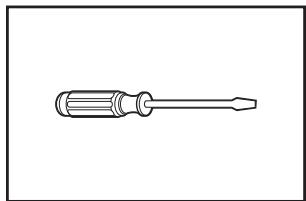
2 Phillips screwdriver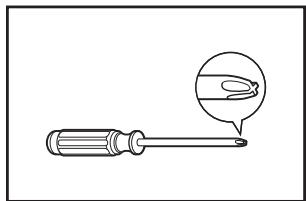
1/4" and 5/16" nut driver (recommended)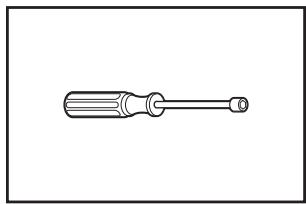
Level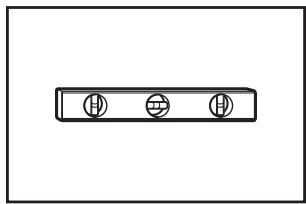
Tape measure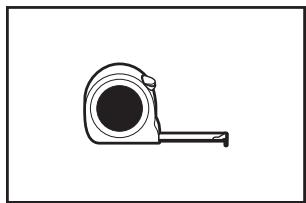
Pliers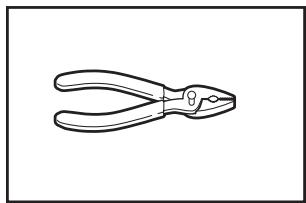
Utility knife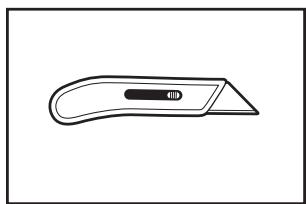
Tin snips (new vent installations)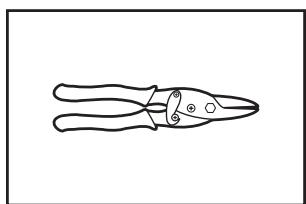
Caulking gun and compound (new vent installations)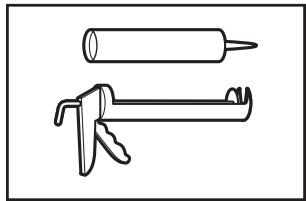
Adjustable wrench that opens to 1" (25 mm) or hex-head socket wrench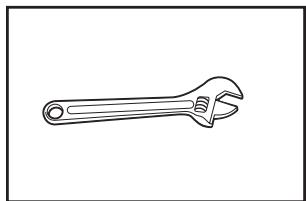
Tools needed for gas installations: 8" or 10" pipe wrench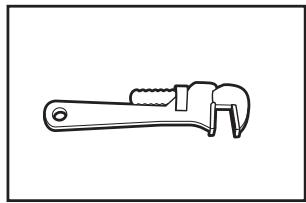
8" or 10" adjustable wrench (for gas connections)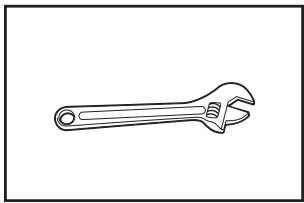
Pipe-joint compound resistant to LP gas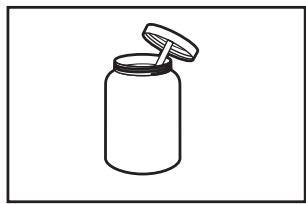
Parts supplied (all models): Leveling legs (4)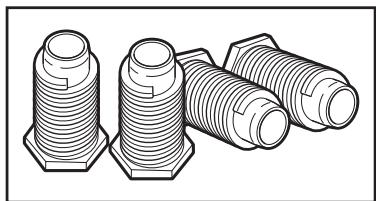
Parts supplied (steam models): "Y" connector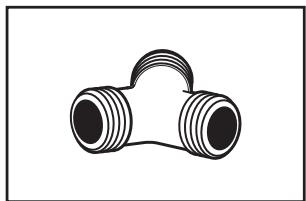
Parts package is located in dryer drum. Check that all parts are included.
NOTE: Do not use leveling legs supplied with dryer if installing with a pedestal or a stack kit.
Parts needed: (Not supplied with dryer)
Vent clamps
Vent elbows and vent work
Parts needed (steam models): 2' (0.6 m) inlet hose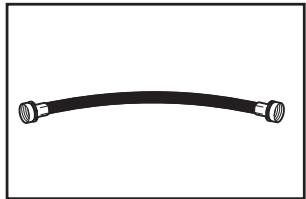
5' (1.52 m) inlet hose and rubber washer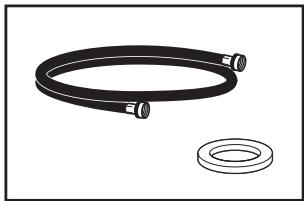
Additional parts may be required, depending on your installation. Check local codes. Check existing electrical supply and venting. Read "Electrical Requirements" and "Venting Requirements" before purchasing parts.
Optional Equipment: (Not supplied with dryer)
Refer to your Use and Care Guide for information about accessories available for your dryer.
WARNING
Explosion Hazard
Keep flammable materials and vapors, such as gasoline, away from dryer.
Place dryer at least 18 inches (460 mm) above the floor for a garage installation.
Failure to do so can result in death, explosion, or fire.
You will need:
A location allowing for proper exhaust installation. See "Venting Requirements." A separate 15 or 20 amp circuit for a gas dryer or 30 amp circuit for an electric dryer. If using power supply cord, a grounded electrical outlet located within 2 ft. (610 mm) of either side of dryer. See "Electrical Requirements." Floor must support dryer weight of 200 lbs. (90.7 kg). Also consider weight of companion appliance. Cold water faucets located within 4 ft. (1.2 m) of the water fill valves, and water pressure of 20 - 120 psi (138 - 827 kPa). You may use the water supply for your washer using the supplied "Y" connector and a short hose (which you will need to purchase). Level floor with maximum slope of 1" (25 mm) under entire dryer. If slope is greater than 1" (25 mm), install Extended Dryer Feet Kit, Part Number 279810. If not level, clothes may not tumble properly and automatic sensor cycles may not operate correctly. For garage installation, place dryer at least 18" (460 mm) above floor. If using a pedestal, you will need 18" (460 mm) to bottom of dryer. The dryer must not be installed or stored in an area where it will be exposed to water and/or weather.
IMPORTANT: Do not operate, install, or store dryer where it will be exposed to water, weather, or at temperatures below 40°F (4°C). Lower temperatures may cause dryer not to shut off at end of automatic sensor cycles, resulting in longer drying times.
DRYER DIMENSIONS
Front view:
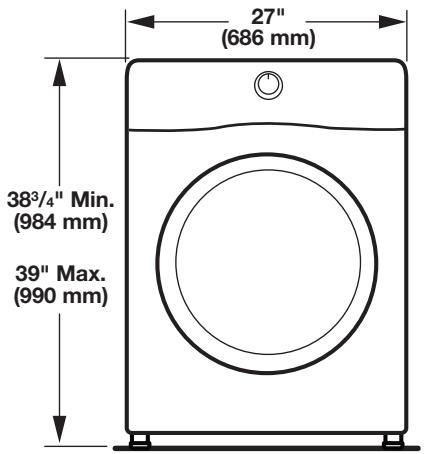
* Approx. measurement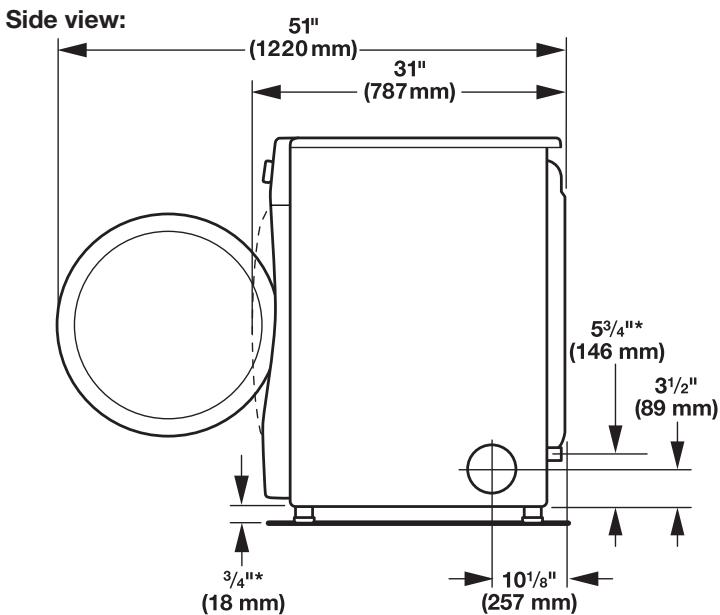
Back view: * Approx. measurement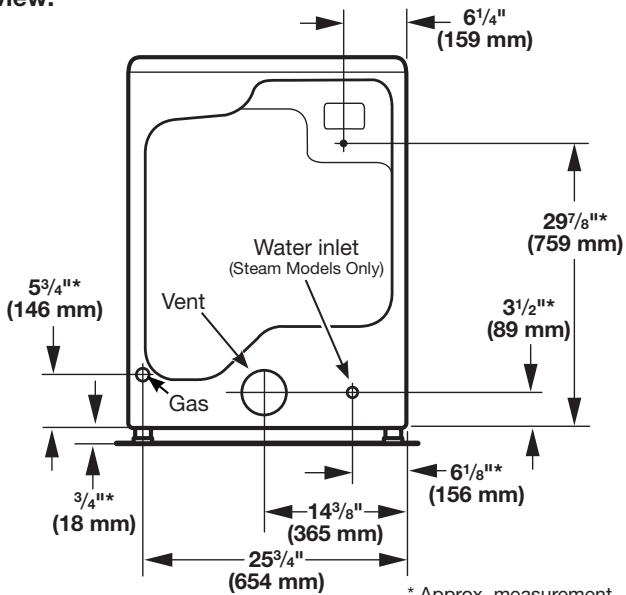
NOTE: Most installations require a minimum of 5" (127 mm) clearance behind dryer for exhaust vent with elbow. See "Venting Requirements."
Installation Clearances
For each arrangement, consider allowing more space for ease of installation and servicing; spacing for companion appliances and clearances for walls, doors, and floor moldings. Space must be large enough to allow door to fully open. Add spacing on all sides of dryer to reduce noise transfer. If a closet door or louvered door is installed, top and bottom air openings in door are required.
Check code requirements. Some codes limit, or do not permit, installation of the dryer in garages, closets, mobile homes, or sleeping quarters. Contact your local building inspector.
NOTE: No other fuel-burning appliance can be installed in the same closet as a dryer.
Installation spacing for recessed area or closet installation
All dimensions show recommended and minimum spacing allowed.
Additional spacing should be considered for ease of installation and servicing. Additional clearances might be required for wall, door, floor moldings, dryer venting, and gas line. Additional spacing should be considered on all sides of the dryer to reduce noise transfer. - For closet installation, with a door, minimum ventilation openings in the top and bottom of the door are required. Louvered doors with equivalent ventilation openings are acceptable. - Companion appliance spacing should also be considered.
Recommended installation clearances (dryer only): * 0" (0 mm) spacing is allowed.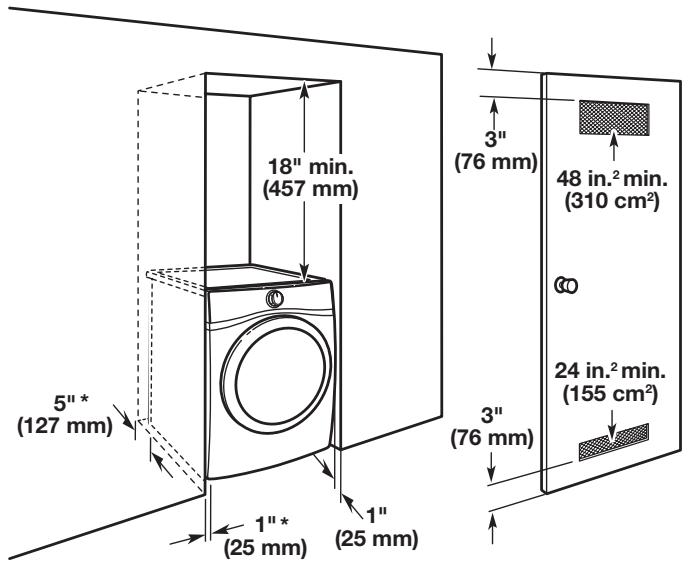
Mobile home - Additional installation requirements:
This dryer is suitable for mobile home installations. The installation must conform to the Manufactured Home Construction and Safety Standard, Title 24 CFR, Part 3280 (formerly the Federal Standard for Mobile home construction and Safety, Title 24, HUD Part 280) or Standard CAN/CSA-Z240 MH.
Mobile home installations require:
Metal exhaust system hardware, available for purchase from your dealer. For further information, see "Assistance or Service" section in your Use and Care Guide. Special provisions must be made in mobile homes to introduce outside air into dryer. Openings (such as a nearby window) should be at least twice as large as dryer exhaust opening.
For mobile home installation of gas dryers:
■ Mobile Home Installation Hold-down Kit Part Number 346764 is available to order. For further information, see "Assistance or Service" section in your Use and Care Guide.
ELECTRIC DRYER POWER HOOKUP - CANADA ONLY
ELECTRICAL REQUIREMENTS
WARNING
Electrical Shock Hazard
Plug into a grounded 4 prong outlet.
Failure to do so can result in death or electrical shock.
It is your responsibility:
To contact a qualified electrical installer. To be sure that the electrical connection is adequate and in conformance with Canadian Electrical Code, C22.1 – latest edition and all local codes. A copy of above codes standard may be obtained from: Canadian Standards Association, 178 Rexdale Blvd., Toronto, ON M9W 1R3 CANADA. - To supply the required 4 wire, single phase, 120/240 volt, 60 Hz, AC only electrical supply on a separate 30-amp circuit, fused on both sides of the line. A time-delay fuse or circuit breaker is recommended. Connect to an individual branch circuit. This dryer is equipped with a CSA International Certified Power Cord intended to be plugged into a standard 14-30R wall receptacle. The cord is 5 ft. (1.52 m) long. Be sure wall receptacle is within reach of dryer's final location.
4-wire receptacle (14-30R)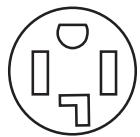
If using a replacement power supply cord, it is recommended that you use Power Supply Cord Replacement Part Number 8529008.
For further information, please reference service numbers located in "Assistance or Service" section of your Use and Care Guide.
GROUNDING INSTRUCTIONS
For a grounded, cord-connected dryer:
This dryer must be grounded. In the event of malfunction or breakdown, grounding will reduce the risk of electric shock by providing a path of least resistance for electric current.
This dryer is equipped with a cord having an equipment-grounding conductor and a grounding plug. The plug must be plugged into an appropriate outlet that is properly installed and grounded in accordance with all local codes and ordinances.
WARNING: Improper connection of the equipment-grounding conductor can result in a risk of electric shock. Check with a qualified electrician or service representative or personnel if you are in doubt as to whether the dryer is properly grounded. Do not modify the plug provided with the dryer: if it will not fit the outlet, have a proper outlet installed by a qualified electrician.
SAVE THESE INSTRUCTIONS
Electrical Shock Hazard
Plug into a grounded 3 prong outlet.
Do not remove ground prong.
Do not use an adapter.
Do not use an extension cord.
Failure to follow these instructions can result in death, fire, or electrical shock.
120 Volt, 60 Hz, AC only, 15- or 20- amp fused electrical supply is required. A time-delay fuse or circuit breaker is recommended. It is also recommended that a separate circuit serving only this dryer be provided.
GROUNDING INSTRUCTIONS
For a grounded, cord-connected dryer:
This dryer must be grounded. In the event of malfunction or breakdown, grounding will reduce the risk of electric shock by providing a path of least resistance for electric current.
This dryer is equipped with a cord having an equipment-grounding conductor and a grounding plug. The plug must be plugged into an appropriate outlet that is properly installed and grounded in accordance with all local codes and ordinances.
WARNING: Improper connection of the equipment-grounding conductor can result in a risk of electric shock.
Check with a qualified electrician or service representative or personnel if you are in doubt as to whether the dryer is properly grounded. Do not modify the plug provided with the dryer: if it will not fit the outlet, have a proper outlet installed by a qualified electrician.
SAVE THESE INSTRUCTIONS
GAS SUPPLY REQUIREMENTS
WARNING

Explosion Hazard
Use a new CSA International approved gas supply line.
Install a shut-off valve.
Securely tighten all gas connections.
If connected to LP, have a qualified person make sure gas pressure does not exceed 13" (330 mm) water column.
Examples of a qualified person include:
licensed heating personnel,
authorized gas company personnel, and authorized service personnel.
Failure to do so can result in death, explosion, or fire.
GAS TYPE
Natural Gas:
This dryer is equipped for use with Natural gas. It is design-certified by CSA International for LP (propane or butane) gases with appropriate conversion.
- Your dryer must have the correct burner for the type of gas in your home. Burner information is located on the rating plate in the door well of your dryer. If this information does not agree with the type of gas available, contact your dealer or call the phone numbers referenced in the "Assistance or Service" section of your Use and Care Guide.
LP Gas Conversion:
IMPORTANT: Conversion must be made by a qualified technician.
No attempt shall be made to convert the appliance from the gas specified on the model/serial rating plate for use with a different gas without consulting your gas company.
GAS SUPPLY LINE
Option 1 (Recommended Method)
Flexible stainless steel gas connector:
If local codes permit, use a new flexible stainless steel gas connector (Design Certified by the American Gas Association or CSA International) to connect your dryer to the rigid gas supply line. Use an elbow and a 3/8" flare x 3/8" NPT adapter fitting between the stainless steel gas connector and the dryer gas pipe, as needed to prevent kinking.
Option 2 (Alternate Method)
Approved aluminum or copper tubing:
- Must include 1/8" NPT minimum plugged tapping accessible for test gauge connection, immediately upstream of the gas connection to the dryer. See illustration. 1/2" IPS pipe is recommended. 3/8" approved aluminum or copper tubing is acceptable for lengths under 20 ft. (6.1 m) if local codes and gas supplier permit. If you are using Natural gas, do not use copper tubing. Lengths over 20 ft. (6.1 m) should use larger tubing and a different size adapter fitting. If your dryer has been converted to use LP gas, 3/8" LP compatible copper tubing can be used. If the total length of the supply line is more than 20 ft. (6.1 m), use larger pipe.
NOTE: Pipe-joint compounds that resist the action of LP gas must be used. Do not use TEFLON®† tape.
Must include shut-off valve
In the U.S.A.:
An individual manual shut-off valve must be installed within six (6) ft. (1.8 m) of the dryer in accordance with the National Fuel Gas Code, ANSI Z223.1. The location should be easy to reach for opening and closing.
In Canada:
An individual manual shut-off valve must be installed in accordance with the B149.1, Natural Gas and Propane Installation Code. It is recommended that an individual manual shut-off valve be installed within six (6) ft. (1.8 m) of the dryer. The location should be easy to reach for opening and closing.
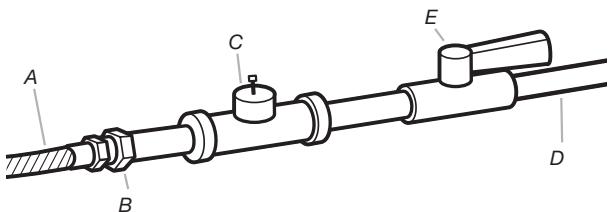
A. 3/8" flexible gas connector B. 3/8" pipe to flare adapter fitting C. 1/8" NPT minimum plugged tapping D. 1/2" NPT gas supply line E. Gas shut-off valve.
GAS SUPPLY CONNECTION REQUIREMENTS
- Use an elbow and a 3/8" flare x 3/8" NPT adapter fitting between the flexible gas connector and the dryer gas pipe, as needed to avoid kinking. ■ Use only pipe-joint compound. Do not use TEFLON® tape. This dryer must be connected to the gas supply line with a listed flexible gas connector that complies with the standard for connectors for gas appliances, ANSI Z21.24 or CSA 6.10.
BURNER INPUT REQUIREMENTS
Elevations above 2,000 ft. (610 m):
When installed above 2,000 ft. (610 m), a 4% reduction of the burner Btu rating shown on the model/serial number plate is required for each 1,000 ft. (305 m) increase in elevation.
Gas supply pressure testing
- The dryer must be disconnected from the gas supply piping system during pressure testing at pressures greater than 1/2 psi.
DRYER GAS PIPE
The gas pipe that comes out through the rear of your dryer has a 3/8" male pipe thread.
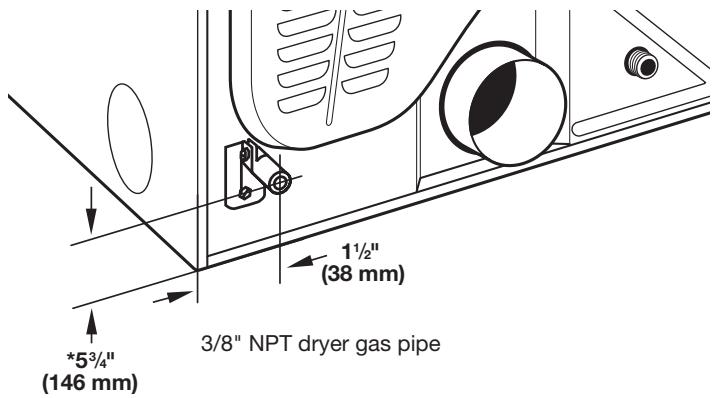
- NOTE: If the dryer is mounted on a pedestal, the gas pipe height must be an additional 10" (254 mm) or 15.5" (394 mm) from the floor, depending on the pedestal model. For a garage installation, the gas pipe height must be an additional 18" (460 mm) from the floor.

WARNING
Excessive Weight Hazard
Use two or more people to move and install dryer.
Failure to do so can result in back or other injury.
1. Prepare dryer for leveling legs
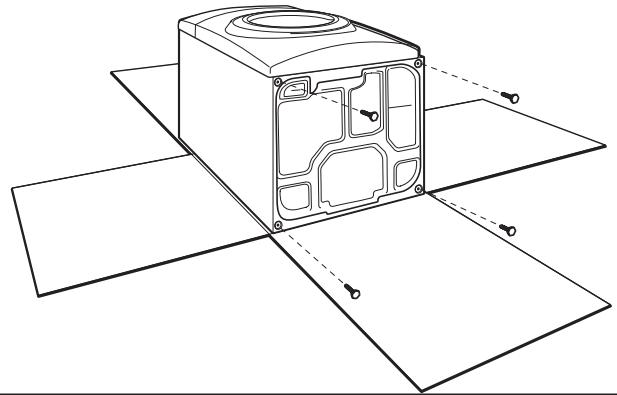
To avoid damaging floor, use a large flat piece of cardboard from dryer carton; place under entire back edge of dryer. Firmly grasp dryer body (not console panel) and gently lay dryer down on cardboard.
2. Screw in leveling legs
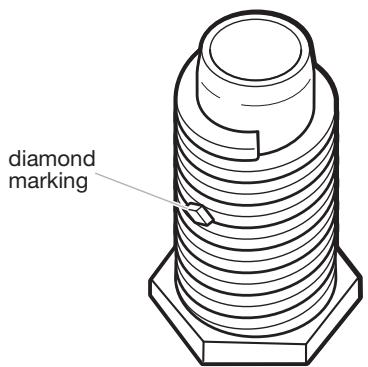
Examine leveling legs, find diamond marking. Screw legs into leg holes by hand – use a wrench to finish turning legs until diamond marking is no longer visible.
Place a carton corner post from dryer packaging under each of the 2 dryer back corners. Stand the dryer up. Slide the dryer on the corner posts until it is close to its final location. Leave enough room to connect the exhaust vent.
MAKE GAS CONNECTION (gas models only)
1. Connect gas supply to dryer
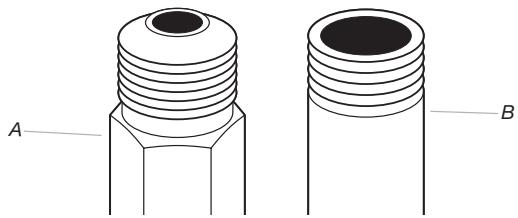
A. Flared male fitting B. Non-flared male fitting
Remove red cap from gas pipe. Using a wrench to tighten, connect gas supply to dryer. Use pipe-joint compound on threads of all non-flared male fittings. If flexible metal tubing is used, be sure there are no kinks.
NOTE: For LP gas connections, you must use pipe-joint compound resistant to action of LP gas. Do not use TEFLON® tape.
2. Plan pipe fitting connection (option 1)
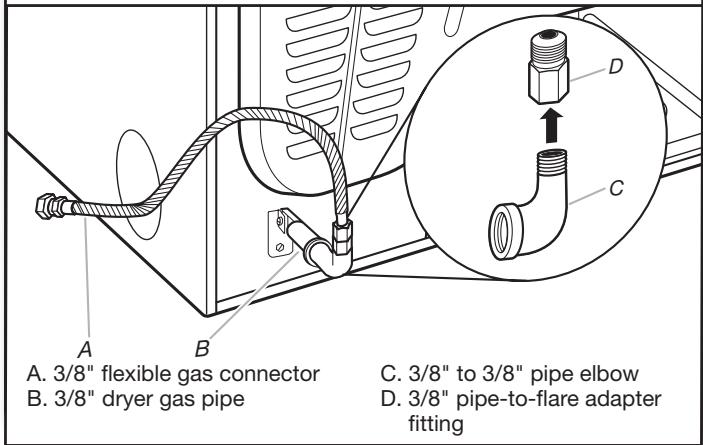
A combination of pipe fittings must be used to connect dryer to existing gas line. A recommended connection is shown. Your connection may be different, according to supply line type, size, and location.
3. Open shut-off valve
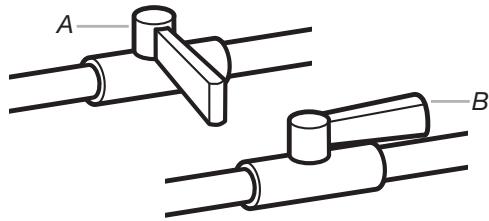
A. Closed valve B. Open valve
Open shut-off valve in supply line; valve is open when handle is parallel to gas pipe. Then, test all connections by brushing on an approved noncorrosive leak-detection solution. Bubbles will show a leak. Correct any leak found.
VENTING
Venting Requirements
WARNING

Fire Hazard
Use a heavy metal vent.
Do not use a plastic vent.
Do not use a metal foil vent.
Failure to follow these instructions can result in death or fire.
WARNING: To reduce the risk of fire, this dryer MUST BE EXHAUSTED OUTDOORS.
IMPORTANT: Observe all governing codes and ordinances. Dryer exhaust must not be connected into any gas vent, chimney, wall, ceiling, attic, crawlspace, or a concealed space of a building. Only rigid or flexible metal vent shall be used for exhausting.
4" (102 mm) heavy metal exhaust vent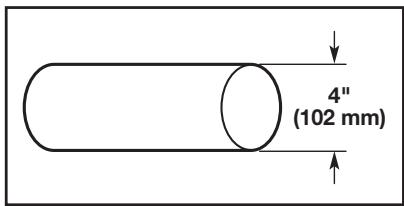
Only a 4" (102 mm) heavy metal exhaust vent and clamps may be used. Do not use plastic or metal foil vent.
Rigid metal vent:
Recommended for best drying performance and to avoid crushing and kinking.
Flexible metal vent: (Acceptable only if accessible to clean)
Must be fully extended and supported in final dryer location. - Remove excess to avoid sagging and kinking that may result in reduced airflow and poor performance. - Do not install in enclosed walls, ceilings, or floors. The total length should not exceed 7 3/4 ft. (2.4 m). The length of flexible metal vent used must be included in the overall vent system design as shown in the "Vent System Charts."
NOTE: If using an existing vent system, clean lint from entire length of the system and make sure exhaust hood is not plugged with lint. Replace plastic or metal foil vents with rigid metal or flexible metal vents. Review "Vent System Charts" and if necessary, modify existing vent system to achieve best drying performance.
Exhaust hoods:
An exhaust hood should cap the vent to keep rodents and insects from entering the home. - Must be at least 12" (305 mm) from ground or any object that may obstruct exhaust (such as flowers, rocks, bushes, or snow). - Do not use an exhaust hood with a magnetic latch.
Recommended Styles:
Louvered Hood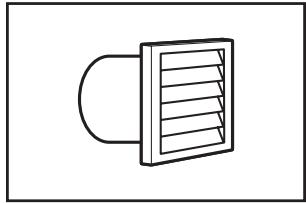
Box Hood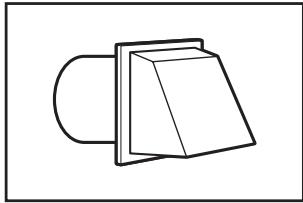
Acceptable Style:
Angled Hood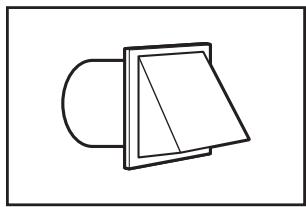
Elbows:
45° elbows provide better airflow than 90° elbows.
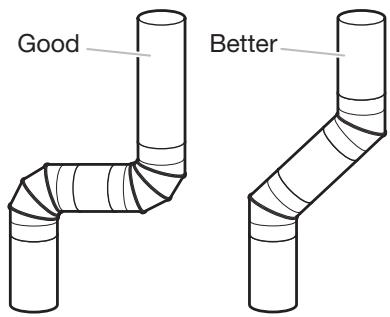
Clamps:
Use clamps to seal all joints. Exhaust vent must not be connected or secured with screws or other fastening devices that extend into interior of duct and catch lint. Do not use duct tape.
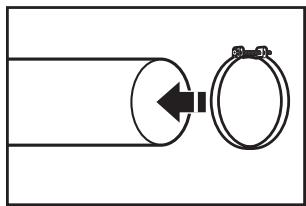
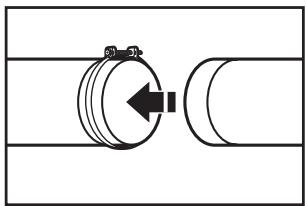
Improper venting can cause moisture and lint to collect indoors, which may result in:
- Moisture damage to woodwork, furniture, paint, wallpaper, carpets, etc. Housecleaning problems and health problems.
Plan Vent System
Choose your exhaust installation type
Recommended exhaust installation:
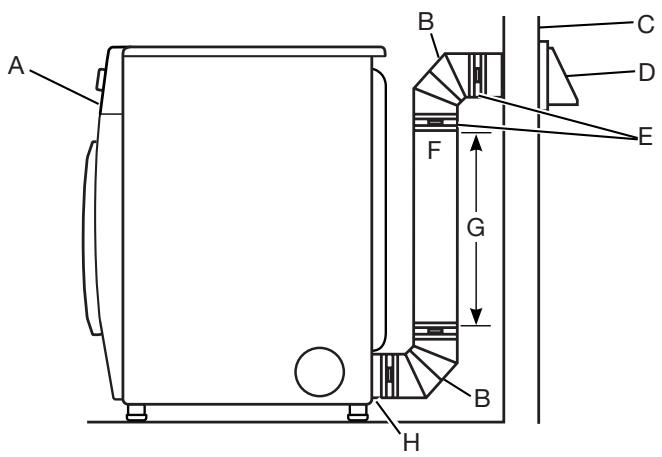
A. Dryer B. Elbow C. Wall D. Exhaust hood E. Clamps
F. Rigid metal or flexible metal vent G. Vent length necessary to connect elbows H. Exhaust outlet
WARNING
Fire Hazard
Cover unused exhaust holes with a manufacturer's exhaust cover kit.
Contact your local dealer.
Failure to follow these instructions can result in death, fire, electrical shock, or serious injury.
Optional exhaust installations:
This dryer can be converted to exhaust out the right side, left side (all models except WGD71HEW), or through the bottom. If you prefer, you may contact your local dealer to have the dryer converted.
A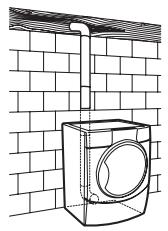
B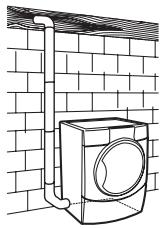
C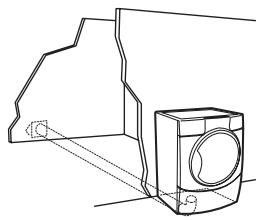
A. Standard rear offset exhaust installation B. Left- or right-side exhaust installation C. Bottom exhaust installation
Special provisions for mobile homes:
Exhaust vent must be securely fastened to a noncombustible portion of mobile home and must not terminate beneath the mobile home. Terminate exhaust vent outside.
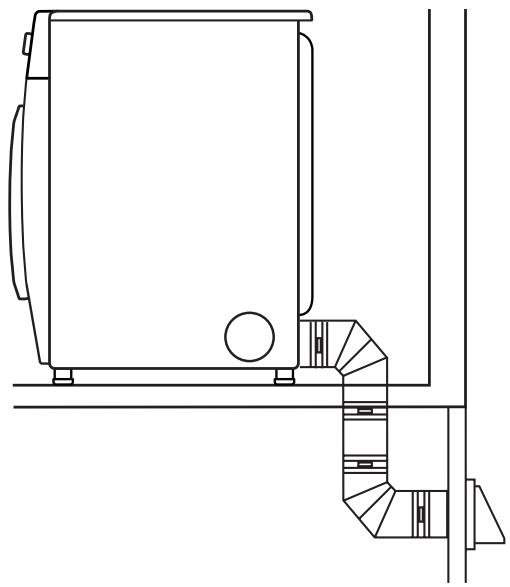
Determine vent path:
- Select route that will provide straightest and most direct path outdoors. Plan installation to use fewest number of elbows and turns.
- When using elbows or making turns, allow as much room as possible. Bend vent gradually to avoid kinking. Use as few 90° turns as possible.
Determine vent length and elbows needed for best drying performance:
- Use the "Vent System Charts" on the next page to determine type of vent material and hood combinations acceptable to use.
NOTE: Do not use vent runs longer than those specified in "Vent System Charts."
Exhaust systems longer than those specified will:
Shorten life of dryer. - Reduce performance, resulting in longer drying times and increased energy usage.
The "Vent System Charts" provide venting requirements that will help achieve best drying performance.
| Standard Vent System Chart | ||
| Number of 90° elbows | Type of vent | Angled hoods |
| 0 | Rigid metal | 64 ft. (20 m) |
| 1 | Rigid metal | 54 ft. (16.5 m) |
| 2 | Rigid metal | 44 ft. (13.4 m) |
| 3 | Rigid metal | 35 ft. (10.7 m) |
| 4 | Rigid metal | 27 ft. (8.2 m) |
| Long Vent System Chart* | ||
| Number of 90° elbows | Type of vent | Angled hoods |
| 0 | Rigid metal | 160 ft. (48.8 m) |
| 1 | Rigid metal | 150 ft. (45.7 m) |
| 2 | Rigid metal | 140 ft. (42.7 m) |
| 3 | Rigid metal | 130 ft. (39.6 m) |
| 4 | Rigid metal | 120 ft. (36.6 m) |
*For Model WGD71HEW only; for all other models, refer to the Standard Vent System Chart above. To find your model number, refer to the model and serial number plate in the inner door well.
NOTE: For long vent systems, use of box/louvered hoods will improve venting regardless of length.
Install Vent System
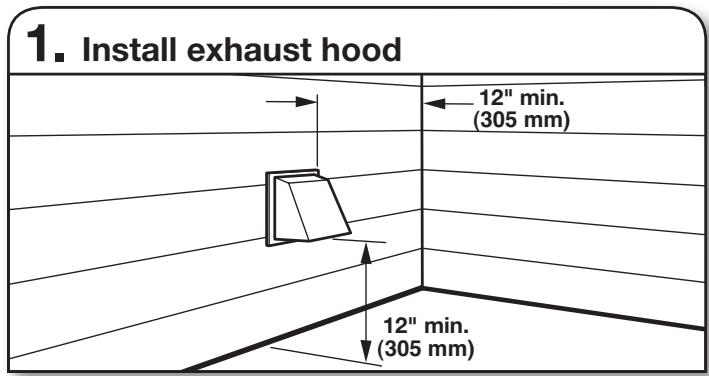
Install exhaust hood and use caulking compound to seal exterior wall opening around exhaust hood.
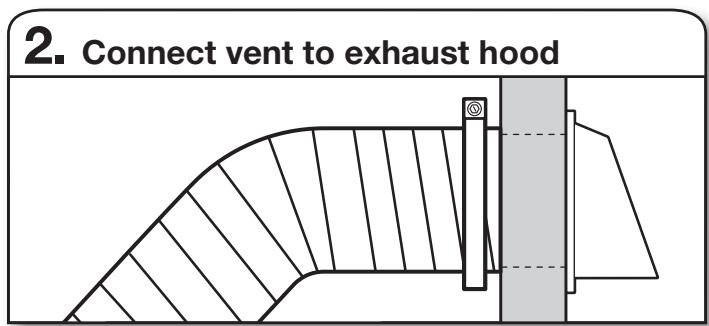
Vent must fit over the exhaust hood. Secure vent to exhaust hood with 4" (102 mm) clamp. Run vent to dryer location using straightest path possible. Avoid 90° turns. Use clamps to seal all joints. Do not use duct tape, screws, or other fastening devices that extend into interior of vent to secure vent, because they can catch lint.
CONNECT INLET HOSE (STEAM MODEL ONLY)
For non-steam models, skip to "Connect Vent."
The dryer must be connected to the cold water faucet using the new inlet hoses (not supplied). Do not use old hoses.
NOTE: Replace inlet hoses after 5 years of use to reduce the risk of hose failure. Record hose installation or replacement dates on the hoses for future reference.
Periodically inspect and replace hoses if bulges, kinks, cuts, wear, or leaks are found.
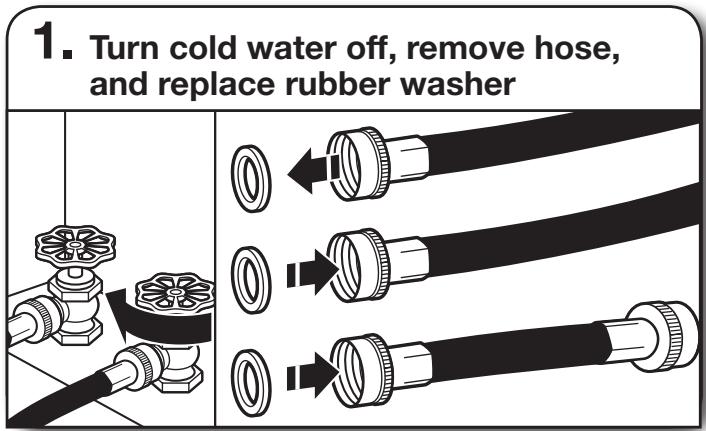
Turn cold water faucet off and remove washer inlet hose.
Remove old rubber washer from inlet hose and replace with new rubber washer.
2. Attach short hose and "Y" connector
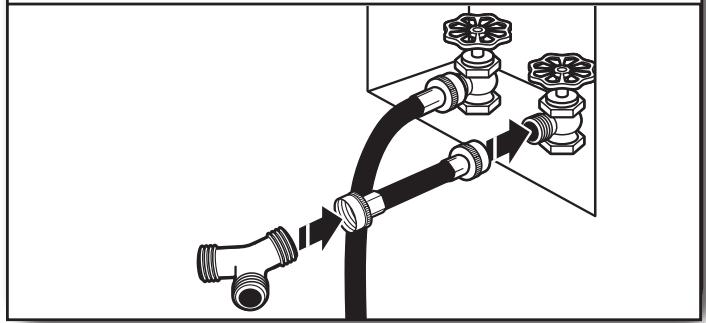
Attach 2 ft (0.6 m) inlet hose to cold water faucet. Screw on coupling by hand until it is seated on faucet. Then attach "Y" connector to male end of the 2 ft (0.6 m) inlet hose. Screw on coupling by hand until it is seated on connector.
3. Tighten couplings
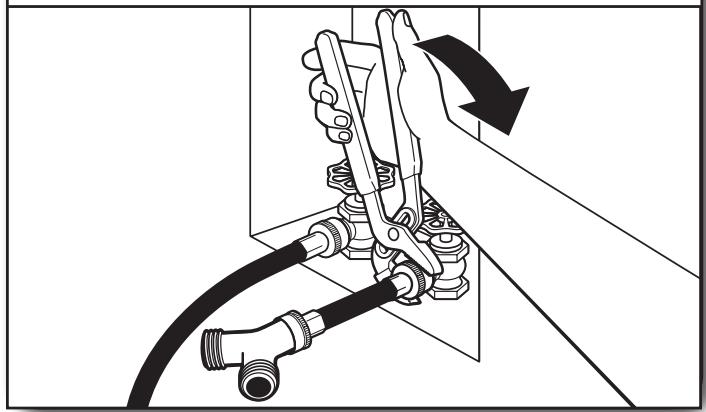
Using pliers, tighten the couplings with additional two-thirds turn.
NOTE: Do not overtighten. Damage to the coupling can result.
4. Attach long hose to "Y" connector and tighten couplings
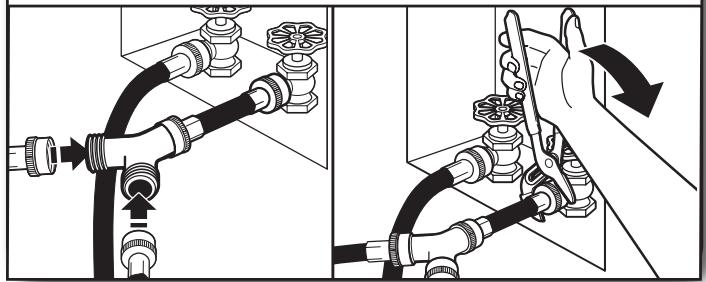
Attach one of the 5 ft (1.5 m) inlet hose ends to the "Y" connector. Attach washer cold inlet hose to other side of "Y" connector. Screw on coupling by hand until it is seated on connector. Using pliers, tighten the couplings an additional two-thirds turn.
NOTE: Do not overtighten. Damage to the coupling can result.
5. Attach long hose to dryer fill valve and tighten coupling
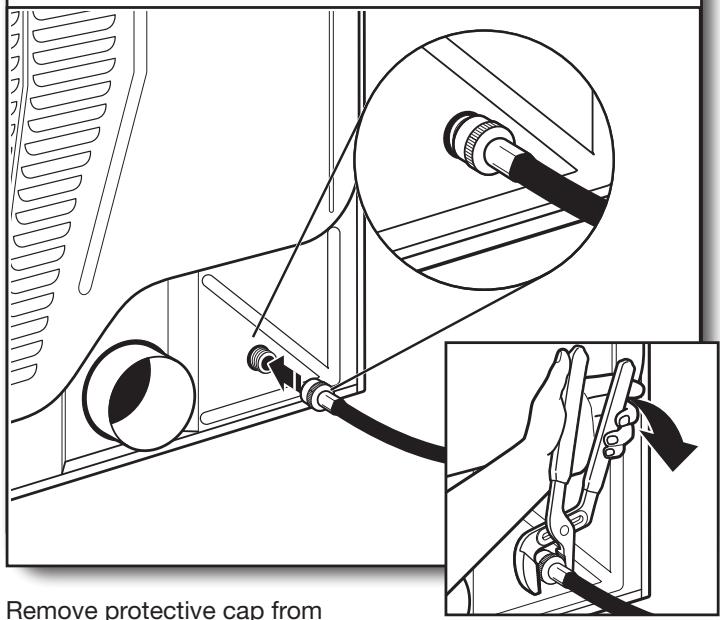
Remove protective cap from water inlet valve. Attach other end of long hose to fill valve at bottom of dryer back panel. Screw on coupling by hand until it is seated on fill valve connector. Using pliers, tighten the couplings an additional two-thirds turn.
NOTE: Do not overtighten. Damage to the coupling can result.
6. Turn on cold water faucet
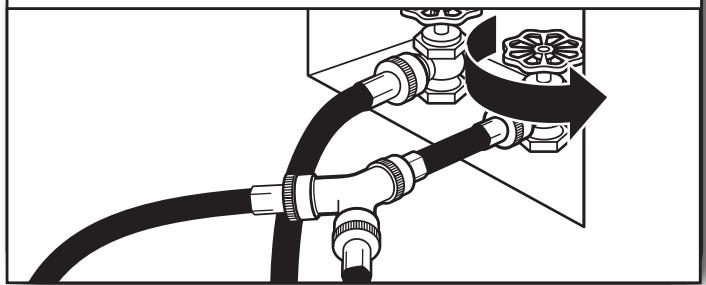
Check that the water faucets are turned on.
7. Check for leaks
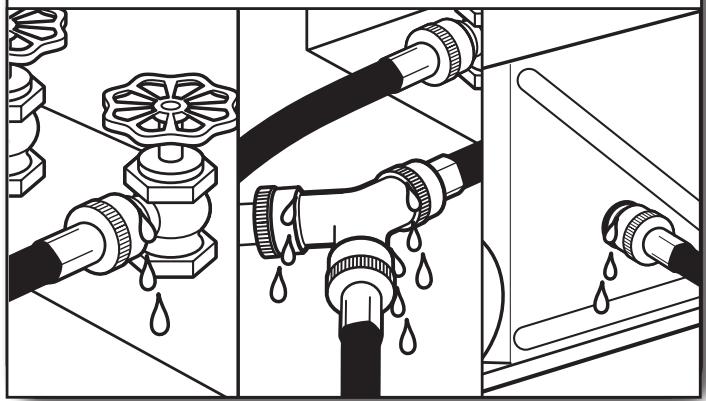
Check for leaks around "Y" connector, faucet, and hoses.
CONNECT VENT
1. Connect vent to exhaust outlet
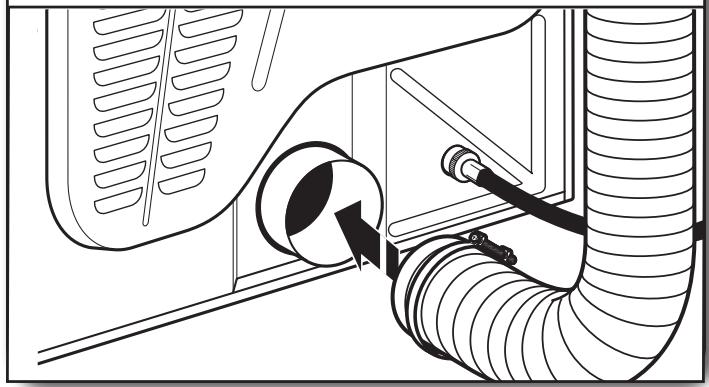
Using a 4" (102 mm) clamp, connect vent to exhaust outlet in dryer. If connecting to existing vent, make sure vent is clean. Dryer vent must fit over dryer exhaust outlet and inside exhaust hood. Check that vent is secured to exhaust hood with a 4" (102 mm) clamp.
2. Move dryer to final location
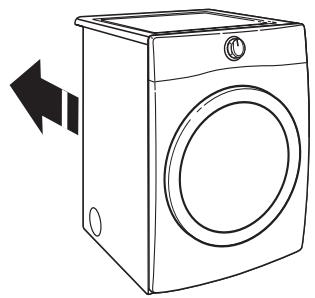
Move dryer to final location, taking care not to crush or kink vent or flexible gas line.
After dryer is in place, remove corner posts and cardboard from under dryer.
LEVEL DRYER
1. Level dryer
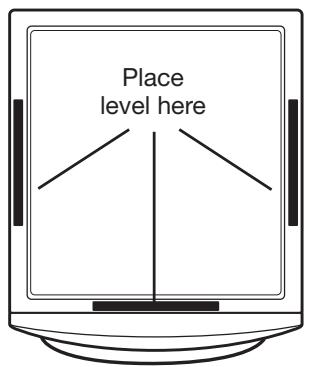
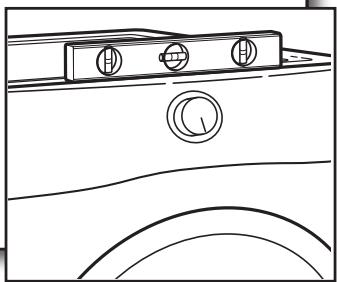
Check levelness of dryer from side to side. Repeat from front to back.
NOTE: The dryer must be level for the moisture sensing system to operate correctly
Not Level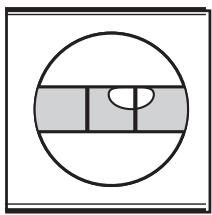
LEVEL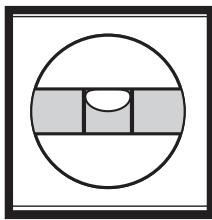
Not Level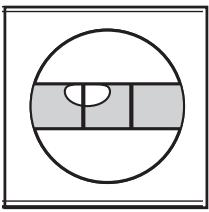
2. Adjust leveling legs
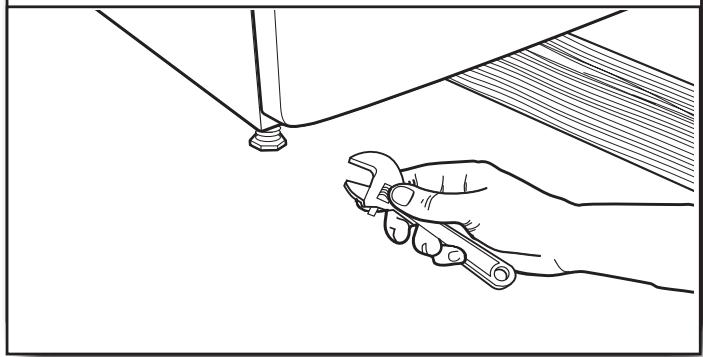
If dryer is not level, prop up using a wood block, use wrench to adjust legs up or down, and check again for levelness. Once dryer is level, make sure all four legs are snug against the floor and the dryer does not rock.
COMPLETE INSTALLATION CHECKLIST
Check that all parts are now installed. If there is an extra part, go back through steps to see what was skipped. Check that you have all of your tools. Dispose of/recycle all packaging materials. Be sure the water faucets are on. Check for leaks around "Y" connector, faucet, and hoses. Check dryer's final location. Be sure vent is not crushed or kinked. Check that dryer is level. See "Level Dryer." Remove film on console and any tape remaining on dryer. Wipe dryer drum interior thoroughly with a damp cloth to remove any dust. Read "Dryer Use" in your Use and Care Guide. If you live in a hard water area, use of a water softener is recommended to control the buildup of scale through the water system in the dryer. Over time, the buildup of lime scale may clog different parts of the water system, which will reduce product performance. Excessive scale buildup may lead to the need for certain part replacement or repair.
Electric Models
Plug into a grounded outlet.
Gas Models
Plug into a grounded outlet. Check that gas supply is on. Check for leaks. Check to be sure that the flexible gas line is not crushed or kinked.
All Models:
Select a Timed Dry heated cycle, and start dryer. Do not select Air Only Temperature setting.
If dryer will not start, check the following:
- Start button has been pressed firmly.
- Dryer is plugged into an outlet and/or electrical supply is connected.
- Household fuse is intact and tight, or circuit breaker has not tripped.
- Dryer door is closed.
This dryer automatically runs an installation diagnostic routine at the start of its first cycle.
NOTE: You may notice an odor when dryer is first heated. This odor is common when heating element is first used. The odor will go away.
DOOR REVERSAL (OPTIONAL)
The following instructions are for models with a round and square-shaped doors.
Tools needed: Min. 8" long TORX T25®† screwdriver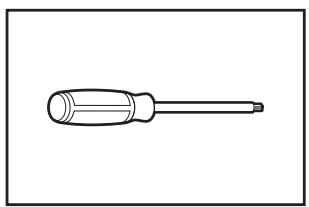
2 Phillips screwdriver Reverse door swing round-shaped door – single handle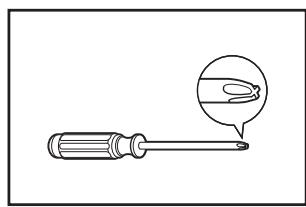
1. Remove door from dryer
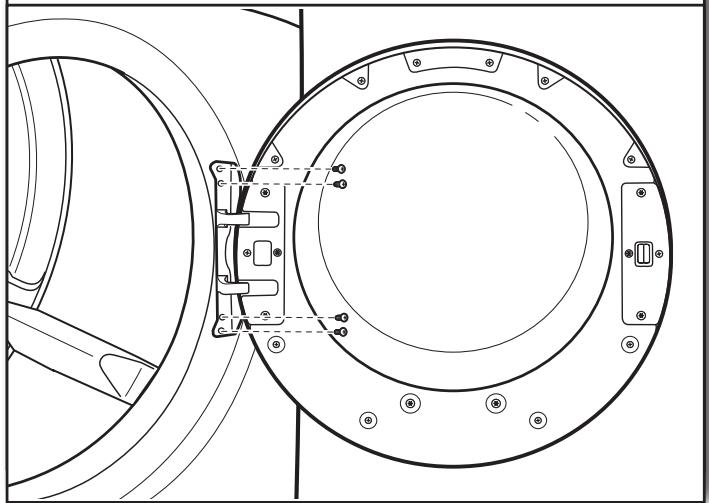
IMPORTANT: If the protective film has not yet been removed from the dryer, peel the film from the dryer door before proceeding.
Using a TORX® T25® screwdriver, remove the 4 screws securing the door hinge to the dryer and lift up and out to remove the door. Place the door on a soft towel or other non-scratch surface. Reinstall the 4 screws in the holes.
2. Move the door strike
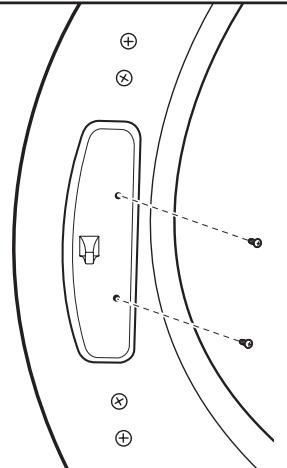
Using a TORX® T25® screwdriver, remove the 2 screws securing the door strike to the door frame of the dryer. Rotate the strike 180° and attach to the opposite side of dryer door frame, as shown.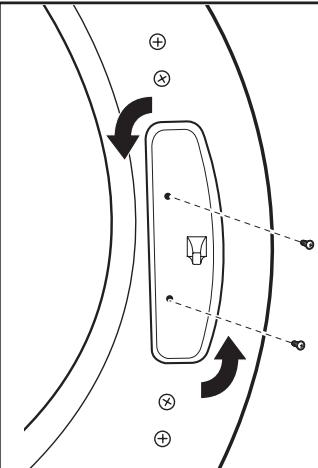
3. Remove inner door from outer door
Position the door with the inside of the door facing up. Using a Phillips screwdriver, remove the 10 screws securing the inner door to the outer door. Lift off the inner door and set aside.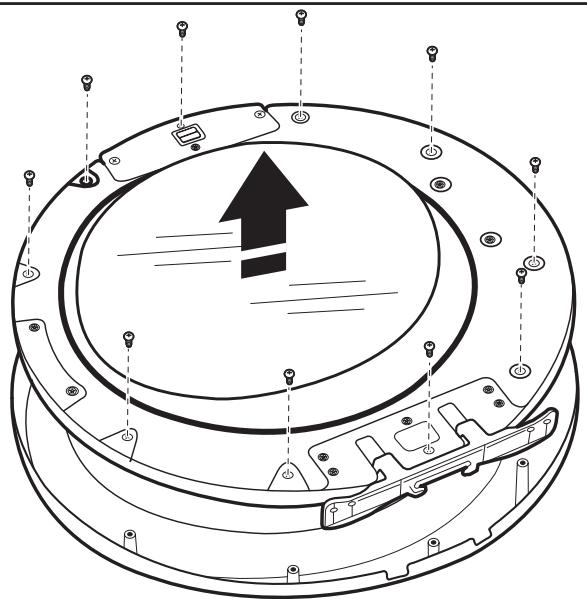
4. Remove outer window assembly from trim ring
Fig. A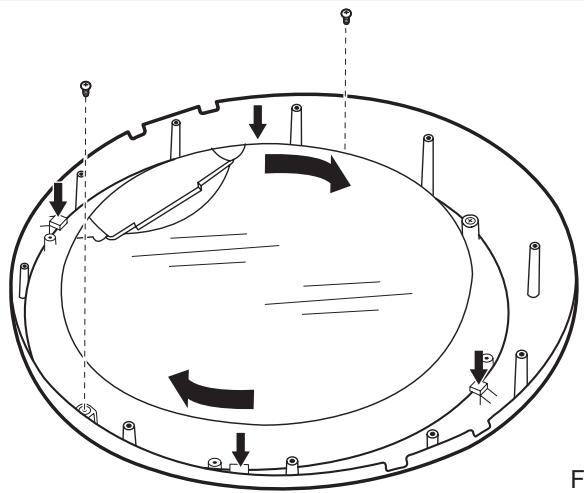
Fig. B Using a Phillips screwdriver, remove the 2 screws from the outer window retainer and rotate the outer window assembly clockwise until the square notches line up with the 4 tabs on the trim ring indicated with arrows in figure A above. Then lift out the outer window and retainer up and off the trim ring and set aside (B).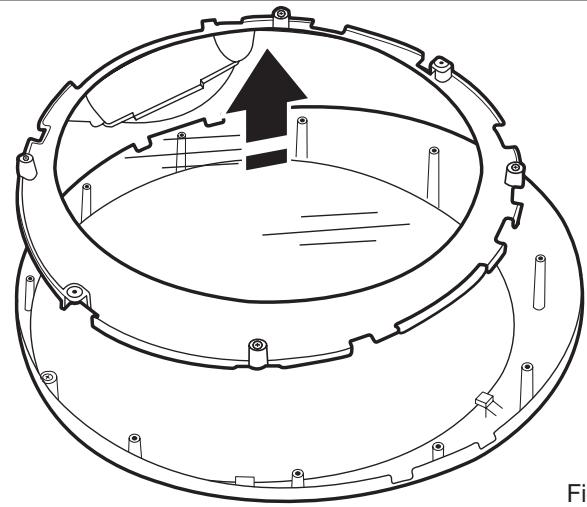
5. Reverse outer window assembly
Fig. A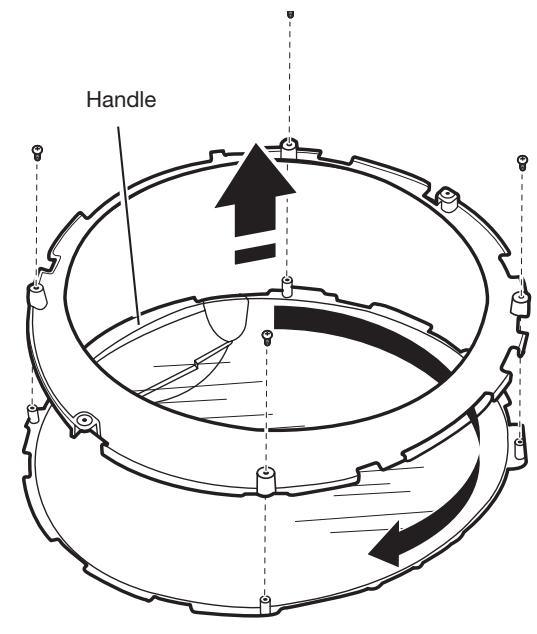
Using a Phillips screwdriver, remove the 4 screws from the outer window retainer and lift off the trim ring off the window (A). Rotate trim ring 180° and secure with the 4 screws removed earlier (B).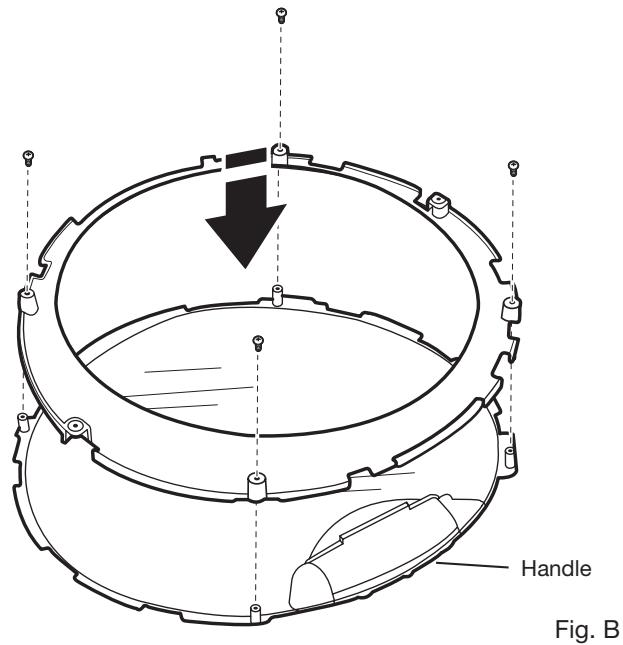
6. Rotate and reassemble outer window assembly to trim ring
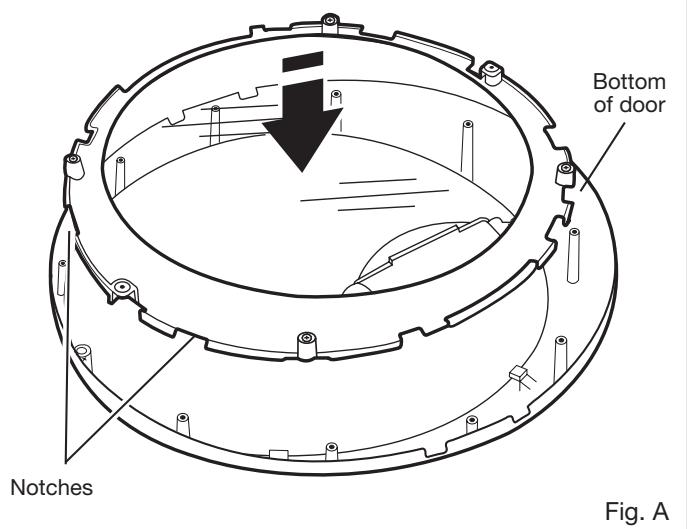
With the edge with 2 notches at the top, align the notches on the outer window assembly with the tabs on the trim ring and lower into place as shown in figure A. Rotate the outer window assembly counterclockwise to lock tabs into place (figure B). Using a Phillips screwdriver, secure with 2 screws removed earlier. IMPORTANT: Do not overtighten.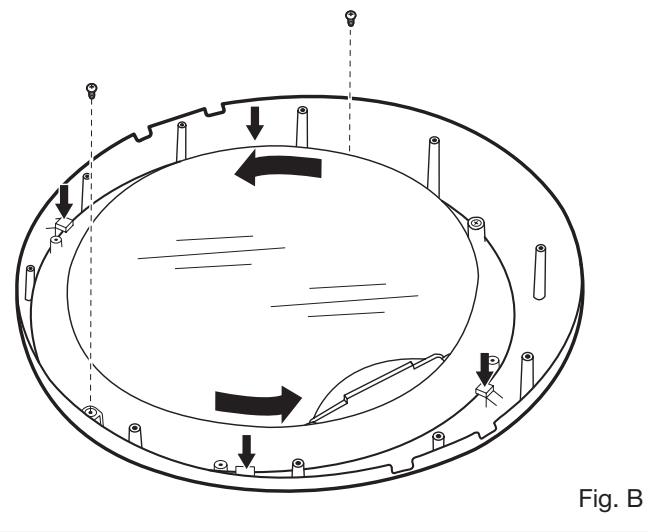
7. Remove hinge and latch
Using a TORX® T25® screwdriver, remove the 3 TORX® screws securing the latch plate and latch backing plate and the 5 screws holding the hinge assembly in place.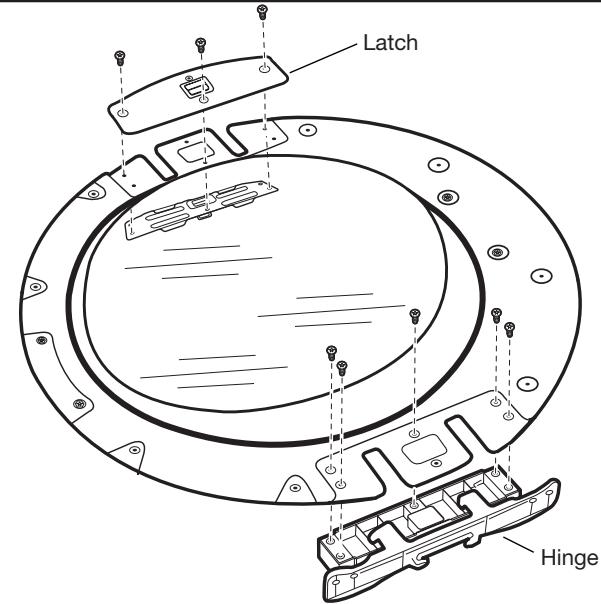
9. Reinstall inner door assembly
Position the door with the inside of the door facing up. Reinstall the 10 screws securing the inner door to the outer door.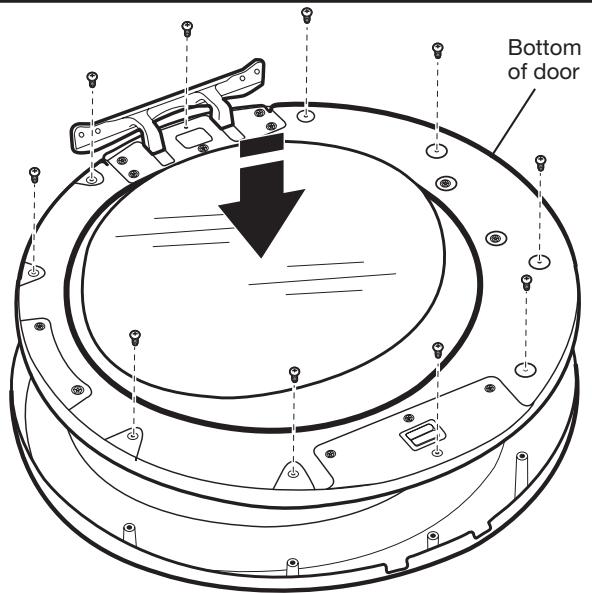
8. Reinstall hinge and latch on opposite sides
Using a TORX® T25® screwdriver, reinstall the latch plate, latch backing plate, and hinge assembly on the opposite sides from which they were removed.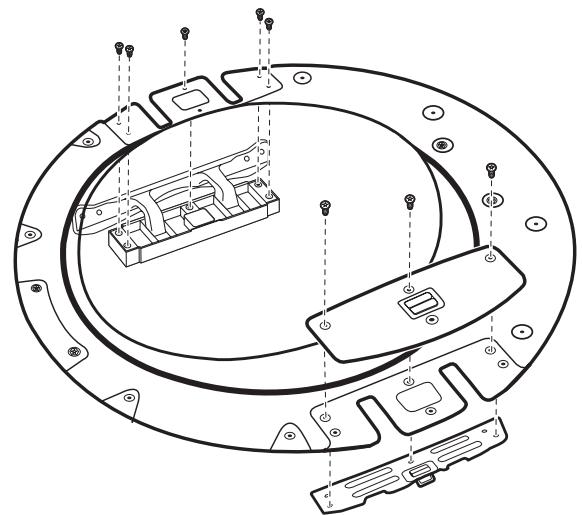
10. Reinstall door on dryer
Using a TORX® T25® screwdriver, remove the 4 screws on the dryer. Insert the tabs on the hinge into the mounting slot and slide down to engage the top tab. Secure in place with the 4 TORX® T25® screws removed earlier.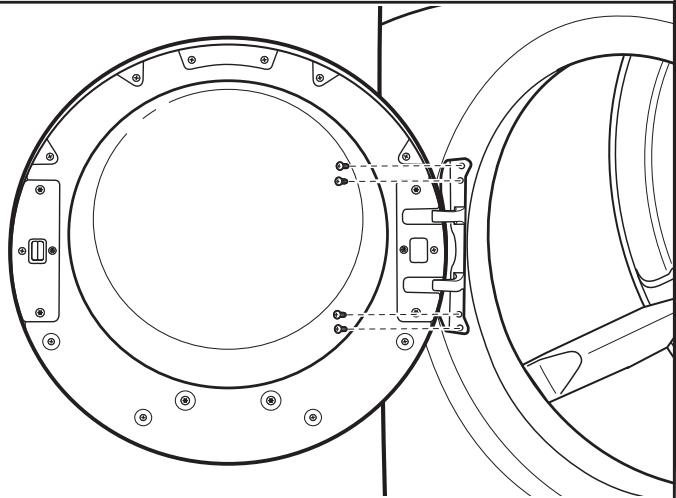
Reverse door swing round-shaped door – double handle
1. Remove door from dryer
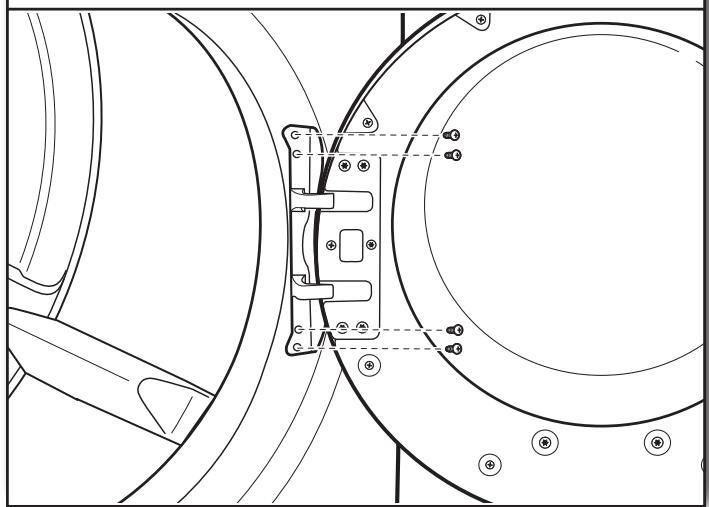
IMPORTANT: If the protective film has not yet been removed from the dryer, peel the film from the dryer door before proceeding.
Using a TORX® T25® screwdriver, remove the 4 screws securing the door hinge to the dryer and lift up and out to remove the door. Place the door on a soft towel or other non-scratch surface. Reinstall the 4 screws in the holes.
3. Remove inner door from outer door
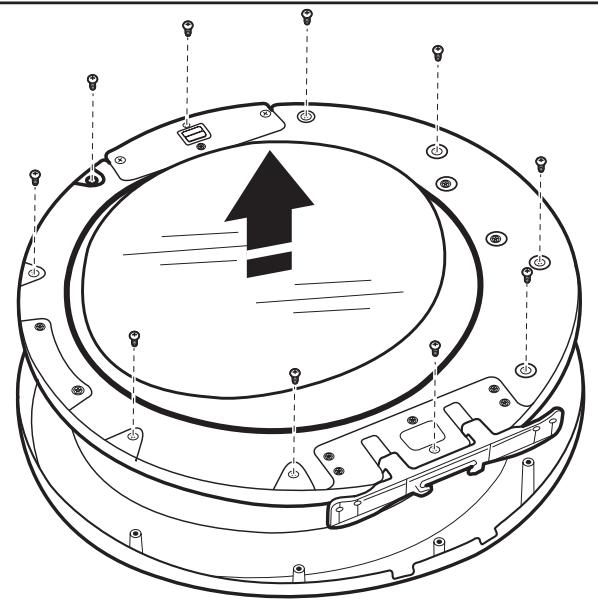
Position the door with the inside of the door facing up. Using a Phillips screwdriver, remove the 10 screws securing the inner door to the outer door. Lift off the inner door and set aside.
2. Move the door strike
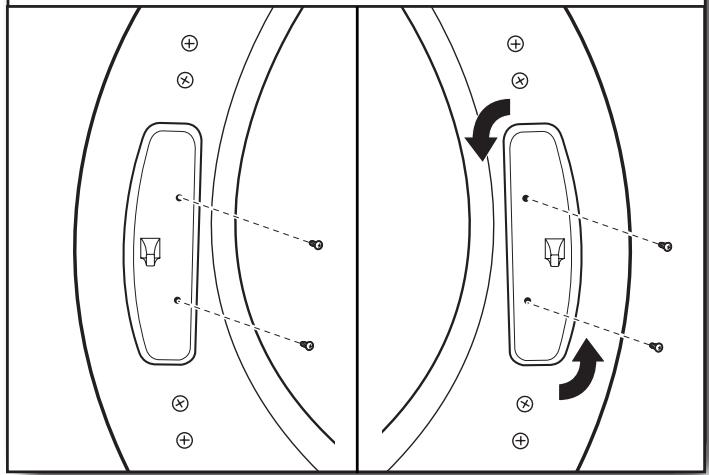
Using a TORX® T25® screwdriver, remove the 2 screws securing the door strike to the door frame of the dryer. Rotate the strike 180° and attach to the opposite side of dryer door frame, as shown.
4. Remove hinge and latch
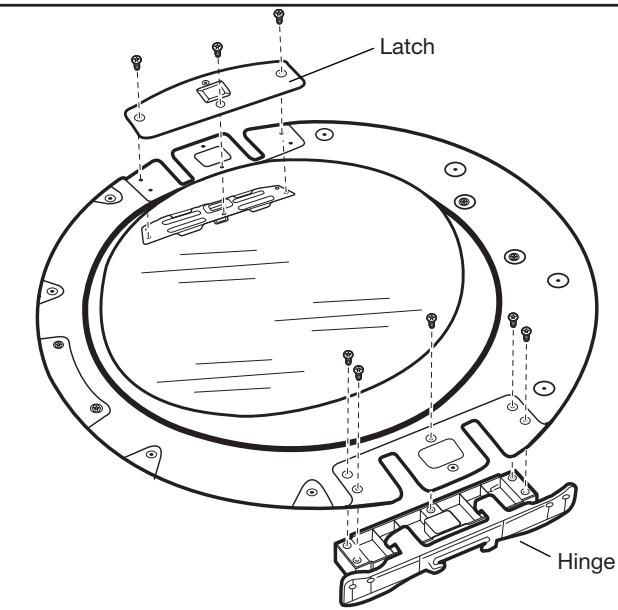
Using a TORX® T25® screwdriver, remove the 3 TORX® screws securing the latch plate and latch backing plate and the 5 screws holding the hinge assembly in place.
5. Reinstall hinge and latch on opposite sides
Using a TORX® T25® screwdriver, reinstall the latch plate and latch backing plate with the 3 TORX® screws removed earlier and the hinge assembly with the 5 screws on the opposite sides from which they were removed.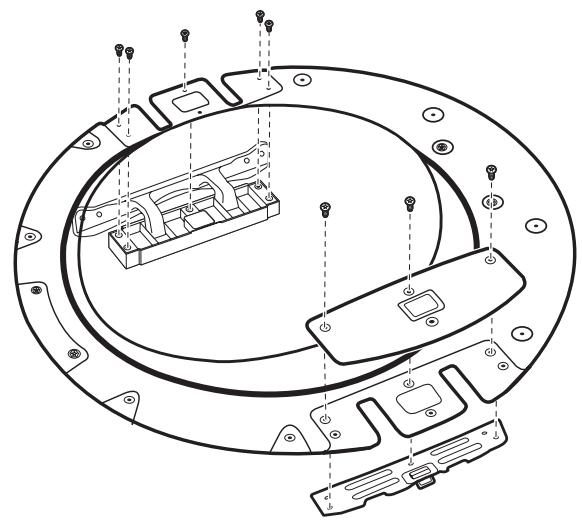
7. Reinstall door on dryer
Using a TORX® T25® screwdriver, remove the 4 screws on the dryer. Insert the tabs on the hinge into the mounting slot and slide down to engage the top tab. Secure in place with the 4 TORX® T25® screws removed earlier.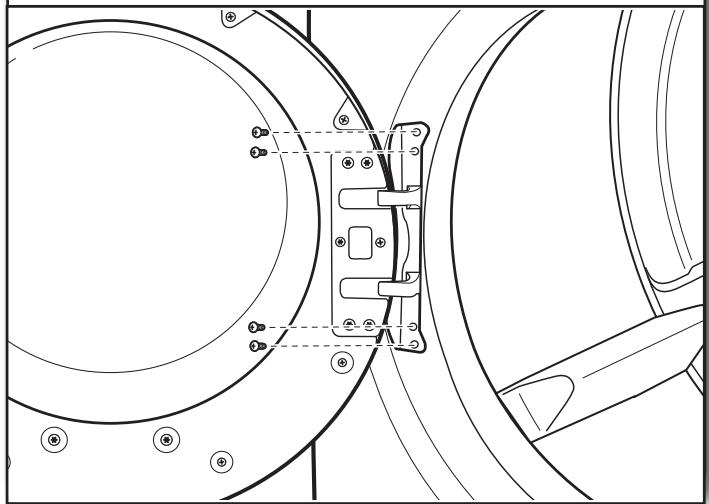
6. Reinstall inner door assembly
Position the door with the inside facing up. Reinstall the 10 screws securing the inner door to the outer door.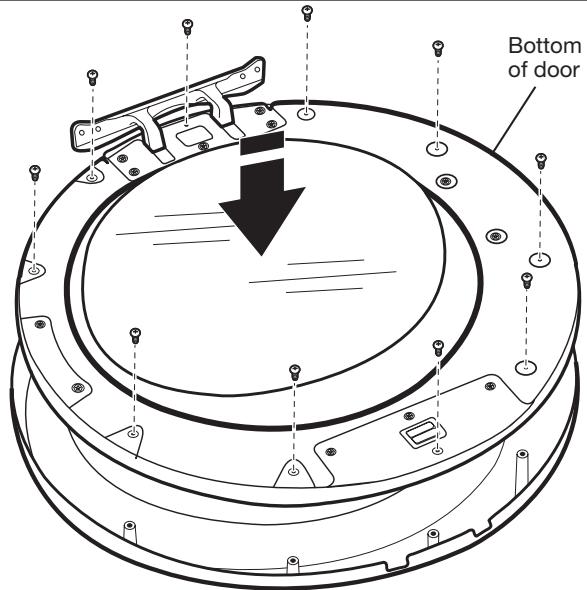
Reverse door swing square-shaped door
1. Remove door from dryer
Using a TORX® T25® screwdriver, remove the 4 screws securing the door hinge to the dryer and lift up and out to remove the door. Place the door on a soft towel or other non-scratch surface. Retain or set aside the 4 screws.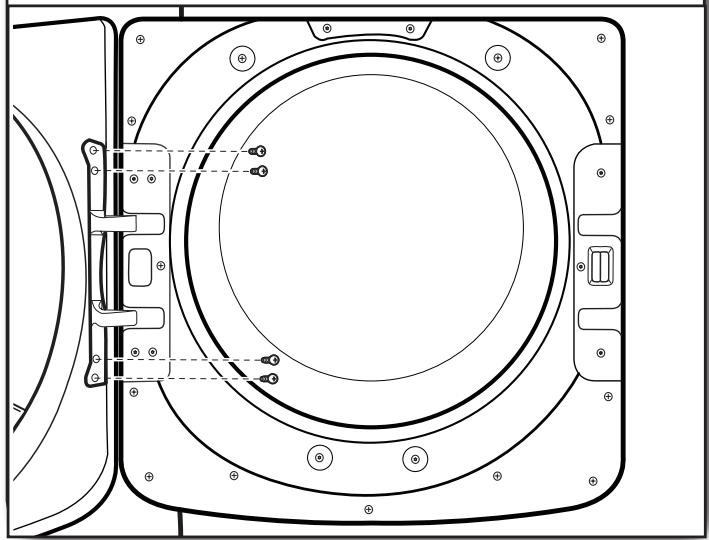
2. Move the door strike
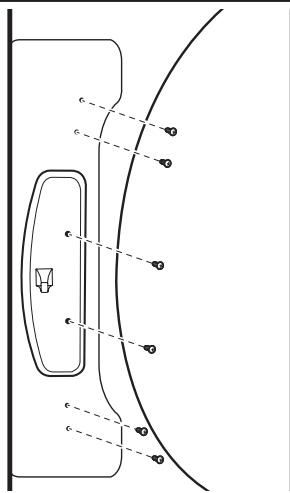
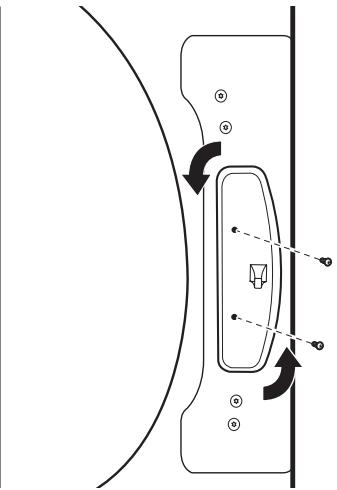
Using a TORX® T25® screwdriver, remove the 2 screws securing the door strike to the door frame of the dryer. Remove the 4 screws above and below the door strike and set aside for later use. Rotate the strike 180° and attach to the opposite side of dryer door frame, as shown.
3. Remove inner door from outer door
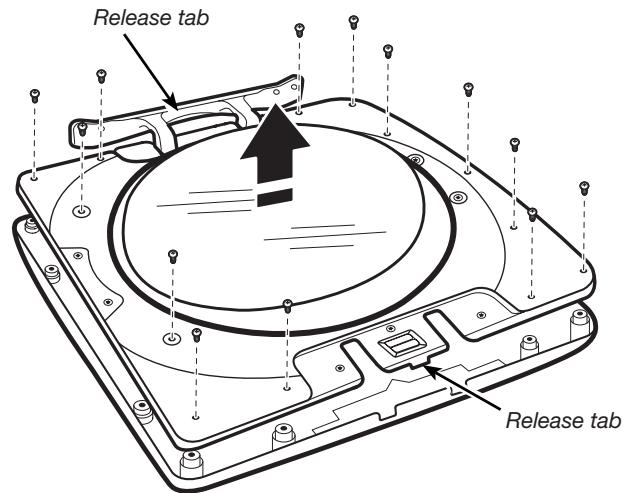
Position the door with the inside facing up. Using a Phillips screwdriver, remove the 13 screws securing the inner door to the outer door. Lift off the inner door and set aside.
NOTE: There is a small release tab on each side of the door. If the inner and outer door do not separate easily, slide a credit card, putty knife, or similar flat object between the inner and outer doors at the locations shown to release the tab.
4. Remove hinge and latch from inner door
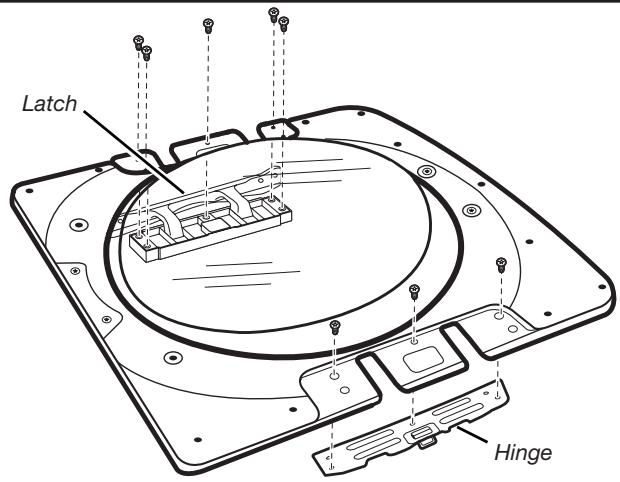
Using a TORX® T25® screwdriver, remove the 3 TORX® screws securing the latch plate and the 5 screws holding the hinge assembly in place.
5. Reinstall hinge and latch on opposite sides
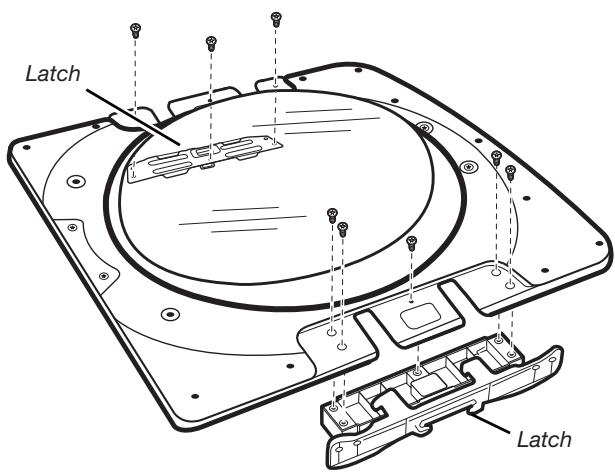
Using a TORX® T25® screwdriver, reinstall the latch plate and hinge assembly on the opposite sides from which they were removed.
6. Reattach inner door to outer door
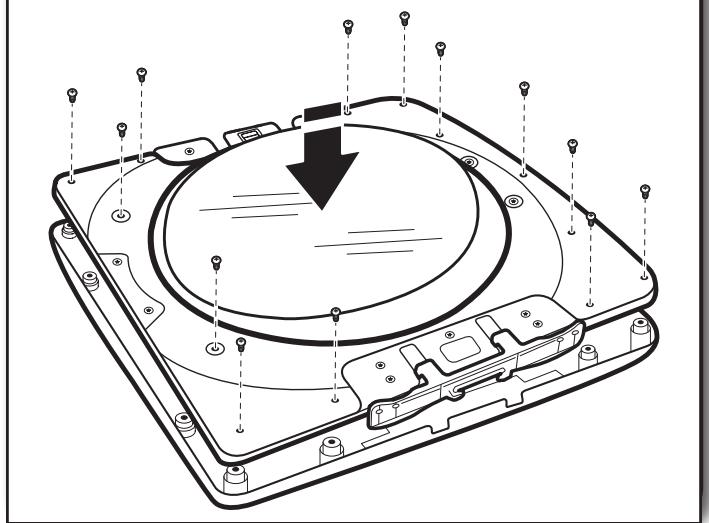
Position the inner door on the outer door assembly. Using a Phillips screwdriver, secure with the 13 screws removed earlier.
7. Reattach door to dryer
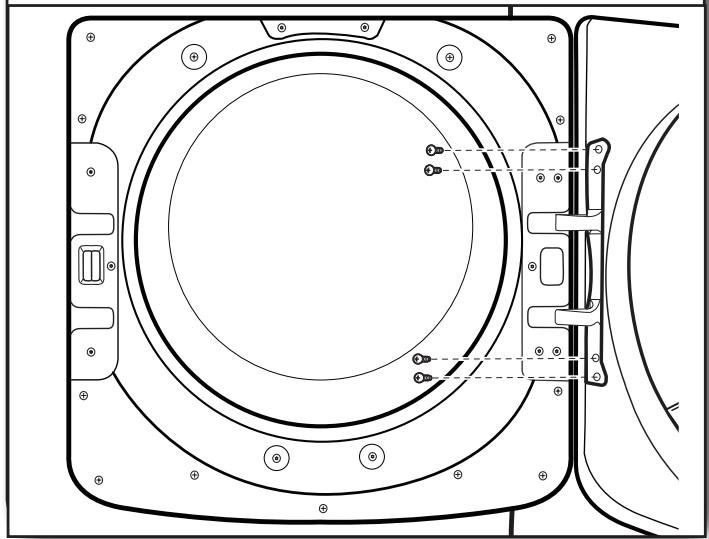
Using a TORX® T25® screwdriver, reinstall the 4 screws securing the door hinge to the dryer.
Optional exhaust installations:
CONNECTING THE EXHAUST DUCT


- GAS DRYER INSTALLATION INSTRUCTIONS CANADIAN ELECTRIC DRYER INSTRUCTIONS
- INSTRUCTIONS POUR L'INSTALLATION DE LA SECHEUSE À GAZ (É.-U. ET CANADA)
- ÉLECTRIQUE (CANADA UNIQUEMENT)
- TABLE OF CONTENTS
- INSTALLATION NOTES
- YOUR SAFETY AND THE SAFETY OF OTHERS ARE VERY IMPORTANT
- DANGER
- WARNING
- WARNING - "RISK OF FIRE
- INSTALLATION REQUIREMENTS
- TOOLS AND PARTS
- EXPLOSION HAZARD
- YOU WILL NEED
- DRYER DIMENSIONS
- INSTALLATION CLEARANCES
- INSTALLATION SPACING FOR RECESSED AREA OR CLOSET INSTALLATION
- MOBILE HOME - ADDITIONAL INSTALLATION REQUIREMENTS
- MOBILE HOME INSTALLATIONS REQUIRE
- FOR MOBILE HOME INSTALLATION OF GAS DRYERS
- ELECTRIC DRYER POWER HOOKUP - CANADA ONLY
- ELECTRICAL REQUIREMENTS
- IT IS YOUR RESPONSIBILITY
- GROUNDING INSTRUCTIONS
- ELECTRICAL SHOCK HAZARD
- SAVE THESE INSTRUCTIONS
- GAS SUPPLY REQUIREMENTS
- GAS TYPE
- NATURAL GAS
- LP GAS CONVERSION
- GAS SUPPLY LINE
- OPTION 1 (RECOMMENDED METHOD)
- OPTION 2 (ALTERNATE METHOD)
- IN THE U.S.A
- IN CANADA
- GAS SUPPLY CONNECTION REQUIREMENTS
- BURNER INPUT REQUIREMENTS
- ELEVATIONS ABOVE 2,000 FT. (610 M)
- GAS SUPPLY PRESSURE TESTING
- DRYER GAS PIPE
- PREPARE DRYER FOR LEVELING LEGS
- SCREW IN LEVELING LEGS
- MAKE GAS CONNECTION (GAS MODELS ONLY)
- CONNECT GAS SUPPLY TO DRYER
- PLAN PIPE FITTING CONNECTION (OPTION 1)
- OPEN SHUT-OFF VALVE
- VENTING
- VENTING REQUIREMENTS
- FIRE HAZARD
- RIGID METAL VENT
- EXHAUST HOODS
- RECOMMENDED STYLES
- ACCEPTABLE STYLE
- ELBOWS
- CLAMPS
- IMPROPER VENTING CAN CAUSE MOISTURE AND LINT TO COLLECT INDOORS, WHICH MAY RESULT IN
- PLAN VENT SYSTEM
- CHOOSE YOUR EXHAUST INSTALLATION TYPE
- OPTIONAL EXHAUST INSTALLATIONS
- SPECIAL PROVISIONS FOR MOBILE HOMES
- DETERMINE VENT PATH
- DETERMINE VENT LENGTH AND ELBOWS NEEDED FOR BEST DRYING PERFORMANCE
- INSTALL VENT SYSTEM
- CONNECT INLET HOSE (STEAM MODEL ONLY)
- ATTACH SHORT HOSE AND "Y" CONNECTOR
- TIGHTEN COUPLINGS
- ATTACH LONG HOSE TO "Y" CONNECTOR AND TIGHTEN COUPLINGS
- ATTACH LONG HOSE TO DRYER FILL VALVE AND TIGHTEN COUPLING
- TURN ON COLD WATER FAUCET
- CHECK FOR LEAKS
- CONNECT VENT
- CONNECT VENT TO EXHAUST OUTLET
- MOVE DRYER TO FINAL LOCATION
- LEVEL DRYER
- ADJUST LEVELING LEGS
- COMPLETE INSTALLATION CHECKLIST
- ELECTRIC MODELS
- GAS MODELS
- ALL MODELS
- IF DRYER WILL NOT START, CHECK THE FOLLOWING
- DOOR REVERSAL (OPTIONAL)
- REMOVE DOOR FROM DRYER
- MOVE THE DOOR STRIKE
- REMOVE INNER DOOR FROM OUTER DOOR
- REMOVE OUTER WINDOW ASSEMBLY FROM TRIM RING
- REVERSE OUTER WINDOW ASSEMBLY
- ROTATE AND REASSEMBLE OUTER WINDOW ASSEMBLY TO TRIM RING
- REMOVE HINGE AND LATCH
- REINSTALL INNER DOOR ASSEMBLY
- REINSTALL HINGE AND LATCH ON OPPOSITE SIDES
- REINSTALL DOOR ON DRYER
- REVERSE DOOR SWING ROUND-SHAPED DOOR – DOUBLE HANDLE
- REVERSE DOOR SWING SQUARE-SHAPED DOOR
- REMOVE HINGE AND LATCH FROM INNER DOOR
- REATTACH INNER DOOR TO OUTER DOOR
- REATTACH DOOR TO DRYER
- CONNECTING THE EXHAUST DUCT
Brand : WHIRLPOOL
Model : WGD70HEBW - INSTALLATION GUIDE
Category : Washer dryer