ManualGo.com
KCGS356ESS - Cooker KITCHENAID - Free user manual and instructions
Find the device manual for free KCGS356ESS KITCHENAID in PDF.


Download the instructions for your Cooker in PDF format for free! Find your manual KCGS356ESS - KITCHENAID and take your electronic device back in hand. On this page are published all the documents necessary for the use of your device. KCGS356ESS by KITCHENAID.
USER MANUAL KCGS356ESS KITCHENAID
For WCG, MGC, KCGS and ICS5/6 Model Series
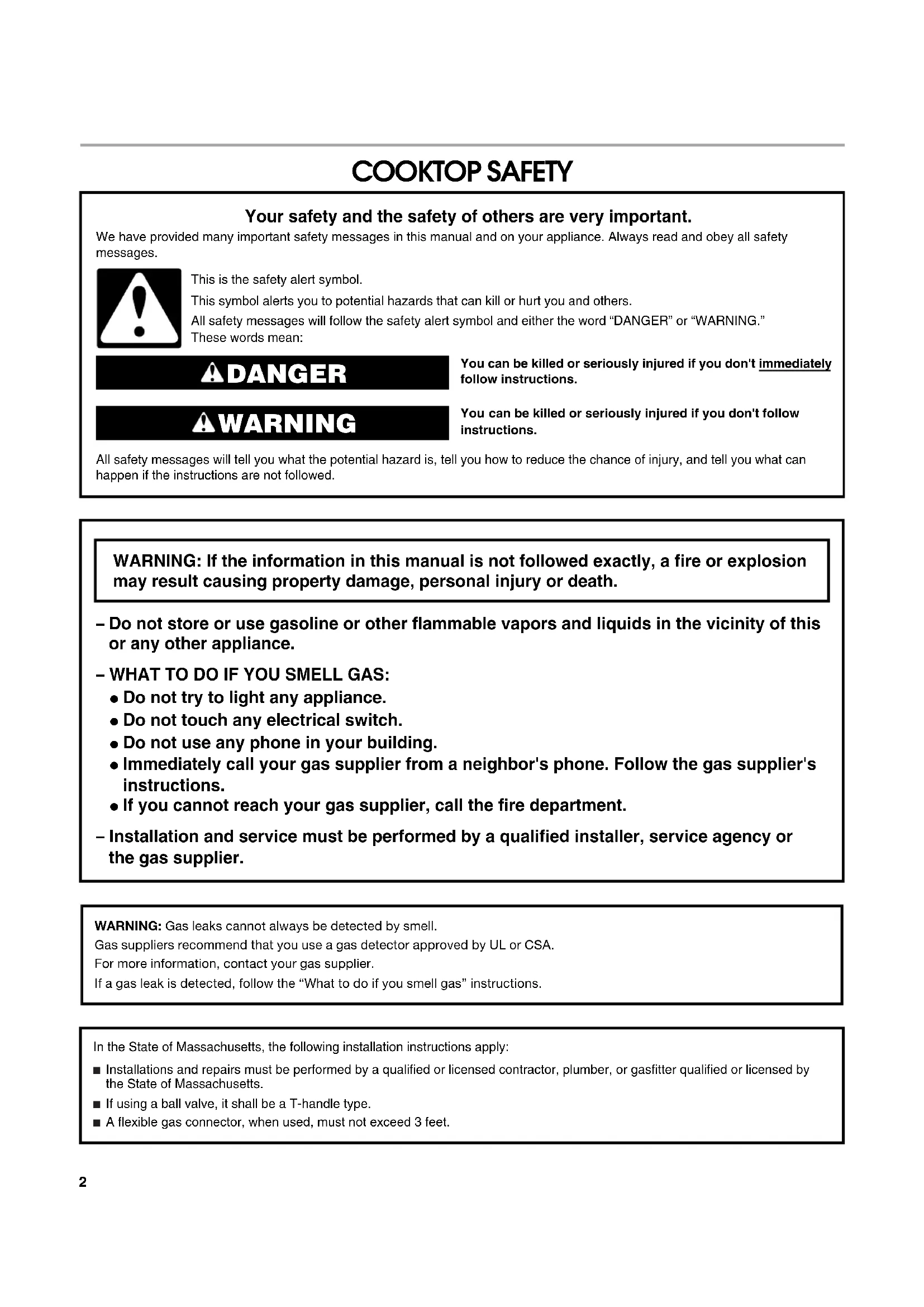
WARNING: If the information in this manual is not followed exactly, a fire or explosion
may result causing property damage, personal injury or death. – Do not store or use gasoline or other flammable vapors and liquids in the vicinity of this or any other appliance. – WHAT TO DO IF YOU SMELL GAS:
Do not try to light any appliance.
Do not touch any electrical switch.
Do not use any phone in your building.
Immediately call your gas supplier from a neighbor's phone. Follow the gas supplier's instructions.
If you cannot reach your gas supplier, call the fire department. – Installation and service must be performed by a qualified installer, service agency or the gas supplier. WARNING: Gas leaks cannot always be detected by smell.Gas suppliers recommend that you use a gas detector approved by UL or CSA.For more information, contact your gas supplier.If a gas leak is detected, follow the “What to do if you smell gas” instructions. In the State of Massachusetts, the following installation instructions apply:
Installations and repairs must be performed by a qualified or licensed contractor, plumber, or gasfitter qualified or licensed by the State of Massachusetts. If using a ball valve, it shall be a T-handle type. A flexible gas connector, when used, must not exceed 3 feet.3 Tools and Parts Gather the required tools and parts necessary for correct LP gas conversion. Tools needed ■ Flat-blade screwdriver ■ ³⁄₃₂" (#0 [2.0 mm]) flat-blade screwdriver (screwdriver shaft must be a minimum of 2" [5.1 cm] long)■ Adjustable wrench■ 7.0 mm nut driver■ 7.0 mm wrench■ T10 Torx adapter Parts needed For models KCGS550ESS, KCGS556ESS, KCGS950ESS and KCGS956ESS use the following parts:■ LP orifice package (W10676662)■ Conversion instructions (W10597146A)For all other models use the following parts:■ LP orifice package (W10676661)■ Conversion instructions (W10597146A) High Altitude Conversion To convert the cooktop for elevations above 6,560 ft (1999.5 m), order a High Altitude Conversion Kit.For models KCGS550ESS, KCGS556ESS, KCGS950ESS and KCGS956ESS use the following parts:■ Part Number W10679116 - LP high altitude■ Part Number W10679118 - Natural gas high altitudeFor all other models use the following parts:■ Part Number W10679114 - LP high altitude■ Part Number W10679113 - Natural gas high altitudeTo order, see the “Assistance or Service” section of the User Guide.IMPORTANT: Gas conversions from Natural gas to LP gas must be done by a qualified installer. Before proceeding with conversion, shut off the gas supply to the cooktop prior to disconnecting the electrical power. Convert from Natural Gas to LP Gas
1. Turn manual shutoff valve to the closed position.2. Unplug cooktop or disconnect power.
To Convert Gas Pressure Regulator 3. Determine the type of regulator you have:Style 1: The cap has a slot and “NAT” printed on it.Remove access cap by using a flat-blade screwdriver or coin, turning the access cap counterclockwise. †®TORX is a registered trademark of Acument Intellectual Properties, LLC. WARNING This conversion kit shall be installed by a qualified service agency in accordance with the manufacturer's instructions and all applicable codes and requirements of the authority having jurisdiction. If the information in these instructions is not followed exactly, a fire, explosion or production of carbon monoxide may result causing property damage, personal injury or loss of life. The qualified service agency is responsible for the proper installation of this kit. The installation is not proper and complete until the operation of the converted appliance is checked as specified in the manufacturer's instructions supplied with this kit. A. To cooktopB. Shutoff valve (closed position)C. Gas supply lineA. Access capB. Rear of cooktopC. Gas pressure regulatorD. Gas flow WARNING Explosion HazardUse a new CSA International approved gas supply line.Install a shut-off valve.Securely tighten all gas connections.If connected to LP, have a qualified person make sure gas pressure does not exceed 14" (36 cm) water column. Examples of a qualified person include: licensed heating personnel, authorized gas company personnel, andauthorized service personnel.Failure to do so can result in death, explosion, or fire.
The gas pressure regulator has 2 settings that are stamped on either side of the cap. Turn the cap and reinstall into regulator with the stamp “LP” visible from the outside of the regulator. Style 2: The cap does not have a slot and requires a wrench to be removed. Remove the access cap by using a wrench, turning the access cap counterclockwise. Remove spring retainer from the cap by pushing against the flat side of the spring retainer. Look at the spring retainer to locate the “NAT” or “LP” position. Turn over the spring retainer so the “LP” is showing on the bottom. Snap the spring retainer back into the cap. Reinstall the cap onto the regulator.
4. Test the gas pressure regulator and gas supply line.
The regulator must be checked at a minimum 1" (2.5 cm) water column above the set pressure. The inlet pressure to the regulator should be as follows for operation and checking the regulator setting: LP Gas: Minimum pressure 10" (25.4 cm) W.C.P. Supply pressure 14" (35.5 cm) W.C.P. Gas Supply Pressure Testing Line pressure testing above ½ psi gauge (14" WCP) The cooktop and its individual shutoff valve must be disconnected from the gas supply piping system during any pressure testing of that system at test pressures in excess of ½ psi (3.5 kPa). Line pressure testing at ½ psi gauge (14" WCP) or lower The cooktop must be isolated from the gas supply piping system by closing its individual manual shutoff valve during any pressure testing of the gas supply piping system at test pressures equal to or less than ½ psi (3.5 kPa).
5. If the burner grates are installed, remove them.
Use the following charts to match the correct gas orifice spud with the burner location and model being converted. LP Gas Orifice Spud Chart for Kit W10676661 Burner Models for Kit W10676661 LP Gas Orifice Spud Chart for Kit W10676662 A. Access cap B. Gasket C. Gas pressure regulator D. LP position E. NAT position
A. Size stamp Model No. Left Front Left Rear Center Inner Center Outer Right Rear Right Front
Yellow N/A N/A 97 Red
14,000 BTU Inner Outer Blue Yellow
Burner Models for Kit W10676662 Burner locations
6. Remove all burner caps and burner bases (see the User
T10 driver to remove the screw.
■ Use 7.0 mm wrench to loosen and remove the inner orifice spud (A) and the outer orifice spud (B). ■ Set gas orifice spuds aside.■ Replace with correct LP gas orifice spuds. See the LP gas orifice spud charts. Model No. Left Front Left Rear Center Inner Center Outer Right Rear Right Front Inner Right Front Outer KCGS550E
Pink A. Left front B. Left rear C. Center D. Right rear E. Right front Dual Tier Ultra Burner A. Inner burner cap B. Outer burner cap C. Gas tube opening D. Burner base Standard and Dual Flame A. Burner cap B. Igniter electrode C. Burner base D. Gas tube opening
9. To Convert Torch Burner
Remove the spring that is shown in the following illustration (C).■ Use 7.0 mm wrench to loosen and remove the inner orifice spud (A) and the outer orifice spud (B). ■ Set gas orifice spuds aside.■ Replace with correct LP gas orifice spud. See the LP gas orifice spud charts.■ Return the spring to its original location.IMPORTANT: Place Natural gas orifice spuds in plastic parts bag for future use and keep with package containing literature.10. Replace sheet of insulation. 11. Replace burner bases and burner caps.The igniter electrode is ceramic and could break during conversion. Be sure that the electrode comes through the hole in the burner smoothly while you are replacing the burner base.
12. Open shutoff valve in the gas supply line. The valve is open
when the handle is parallel to the gas pipe.13. Plug in cooktop or reconnect power.REMEMBER: Once you have completed converting all of the cooktop burners, test the cooktop for leaks by brushing on an approved noncorrosive leak-detection solution. If bubbles appear, a leak is indicated. Correct any leaks found.14. To adjust single and dual valves, see the “Flame Height Adjustment” section. Convert from LP Gas to Natural Gas
1. Turn manual shutoff valve to the closed position.2. Unplug cooktop or disconnect power.
To Convert Gas Pressure Regulator 3. Determine the type of regulator you have:Style 1: The cap has a slot and “LP” printed on it.Remove access cap by using a flat-blade screwdriver or coin, turning the access cap counterclockwise.The gas pressure regulator has 2 settings that are stamped on either side of the cap. Turn the cap and reinstall into regulator with the stamp “NAT” visible from the outside of the regulator.Style 2: The cap does not have a slot and requires a wrench to be removed.Remove the access cap by using a wrench, turning the access cap counterclockwise.A. Inner orifice spudB. Outer orifice spudC. SpringA. Burner capB. ElectrodeC. Burner base
A. To cooktopB. Shutoff valve (closed position)C.Gas supply lineA. Access capB. Rear of cooktopC. Gas pressure regulatorD. Gas flow
NAT7 Remove spring retainer from the cap by pushing against the flat side of the spring retainer. Look at the spring retainer to locate the “NAT” or “LP” position. Turn over the spring retainer so the “NAT” is showing on the bottom. Snap the spring retainer back into the cap. Reinstall the cap onto the regulator.
4. If the burner grates are installed, remove them.
Use the following charts to match the correct gas orifice spud with the burner location and model being converted. Natural Gas Orifice Spud Chart for Kit W10676661 Burner Models for Kit W10676661 Natural Gas Orifice Spud Chart for Kit W10676662 Burner Models for Kit W10676662 Burner locations
5. Remove all burner caps and burner bases (see the User
19,000 BTU Inner Outer White White
Model No. Left Front Left Rear Center Inner Center Outer Right Rear Right Front Inner Right Front Outer
Yellow N/A N/A 150 Red
18,000 Inner Outer Blue Blue
10,000 BTU Inner Outer Pink Pink
Model No. Left Front Left Rear Center Inner Center Outer Right Rear Right Front Inner Right Front Outer KCGS550E
Pink A. Left front B. Left rear C. Center D. Right rear E. Right front
To remove the burner base for the Dual Flame and Dual Tier Ultra Torch burners use a Torx
T10 driver to remove the screw.
Remove the spring that is shown in the following illustration (C). ■ Use 7.0 mm wrench to loosen and remove the inner orifice spud (A) and the outer orifice spud (B). ■ Set gas orifice spuds aside.■ Replace with correct Natural gas orifice spud. See the Natural gas orifice spud charts. ■ Return the spring to its original location. IMPORTANT: Place Natural gas orifice spuds in plastic parts bag for future use and keep with package containing literature.
9. Replace sheet of insulation.
10. Replace burner bases and burner caps.
The igniter electrode is ceramic and could break during conversion. Be sure that the electrode comes through the hole in the burner smoothly while you are replacing the burner base.
11. Open shutoff valve in the gas supply line. The valve is open
when the handle is parallel to the gas pipe.
12. Plug in cooktop or reconnect power.
REMEMBER: Once you have completed converting all of the cooktop burners, test the cooktop for leaks by brushing on an approved noncorrosive leak-detection solution. If bubbles appear, a leak is indicated. Correct any leaks found.
13. To adjust single and dual valves, see the “Flame Height
Adjustment” section. Dual Tier Ultra Burner A. Inner burner cap B. Outer burner cap C. Gas tube opening D. Burner base Standard and Dual Flame A. Burner cap B. Igniter electrode C. Burner base D. Gas tube opening Torch Burner A. Inner burner cap B. Inner burner base C. Outer burner base D. Burner support E. Gas tube opening A. Orifice spud
Lighting the Electronic Igniters The cooktop burners use electronic igniters in place of standing pilots. When the cooktop control knob is pushed in, the system creates a spark to light the burner. This sparking continues until the control knob is turned to the desired setting. To Check Operation of the Cooktop Burners:
1. Push in and turn knobs to the ignition position (see the User
Guide for additional information). The cooktop burner flame should light within 4 seconds. The first time a burner is lit, it may take longer than 4 seconds to light because of air in the gas line. Do not leave the knob in the ignition position after the burner lights.
2. If burners do not light properly, turn the control knob to the
Off position. Make sure the burner caps are in the proper position.
3. Check that the power supply cord is plugged in. Check that
the circuit breaker has not tripped or the household fuse has not blown.
4. Check that the shutoff valve is in the open position.
5. Check burner operation again.
If one or all of the burners do not light at this point, see “Assistance or Service” section in the User Guide. Flame Height Adjustment Each burner flame has been factory set to the lowest position available to provide reliable and constant reignition of the burner. However, each burner can be adjusted. NOTE: If your model number begins with KGCS5 or KGCS9, call service, as this operation will require opening the unit. To Adjust: The flame can be adjusted using the adjustment screws underneath the control knob. NOTE: Check the Use and Care Guide for information on each burner to determine whether they are single or dual flame. Adjust the valves accordingly. Adjustment for Single Valve
1. Set the burner flame to LO.
2. Remove the control knob.
3. Hold knob stem with a pair of pliers. Use a ³⁄₃₂" (#0 [2.0 mm])
flat-blade screwdriver to turn the screw located within the shaft of the control knob stem until the flame is the proper size.
4. For LP gas conversion:
Completely tighten screw “C” to set the minimum flame height. For Natural gas conversion: Tighten screw “C” to reduce flame height. Loosen screw to increase flame height. See “Complete Burner Adjustment” section.
5. Replace the control knob.
6. Test the flame by turning the control from LO to HI, checking
the flame at each setting. Adjustment for Dual Valve To Adjust Inner Crown Flame:
1. Set the inner crown flame to LO.
burner valve opening.
" (#0 [2.0 mm]) flat-blade screwdriver(screwdriver shaft must be a minimum of 2" [5.1 cm] long)B. Control knob stem openingC. Adjustment screw locationA. Inner crownB. Outer crownA. Control knobB. Black rubber grommetC. Gray shield
5. For LP gas conversion:
Completely tighten screw “A” to set the minimum flame height. For Natural gas conversion: Tighten screw “A” to reduce flame height. Loosen screw to increase flame height. See “Complete Burner Adjustment” section.
6. Replace the control knob.
To Adjust Outer Crown Flame:
1. Set the outer crown flame to LO.
2. Remove the control knob.
3. For LP gas conversion:
Completely tighten screw “B” to set the minimum flame height. For Natural gas conversion: Tighten screw “B” to reduce flame height. Loosen screw to increase flame height. See “Complete Burner Adjustment” section.
4. Replace the gray shield. Use a screwdriver to help push the
7. Test the flame by turning the control from LO to HI, checking
the flame at each setting. Complete Burner Adjustment
1. Check burner flame(s) for a proper size and shape. The
cooktop low burner flame should be a steady blue flame approximately ¹⁄₄" (0.64 cm) high.
2. Completely fill out the conversion label and attach label to
bottom of the cooktop next to the rating tag. Do not cover the rating tag with the conversion label. IMPORTANT: Place gas orifice spuds in plastic parts bag for future use and keep with package containing literature. Read “Sealed Surface Burners” section in the Use and Care Guide supplied with your cooktop. A. Inner crown adjustment screw B. Outer crown adjustment screw
A. Low flame B. High flame
Rose N/A N/A 97 Rouge
Rose N/A N/A 150 Rouge