LM101LD - Smoke detector Renkforce - Free user manual and instructions
Find the device manual for free LM101LD Renkforce in PDF.



| Product type | Wireless smoke detector |
| Brand | Renkforce |
| Model | LM101LD |
| Category | Smoke detector |
| Dimensions (diameter x height) | 125 x 48 mm |
| Weight (without batteries) | 340 g |
| Power supply | 1 9 V block battery + 3 AA batteries |
| Transmission/reception frequency | 433.92 MHz |
| Range (free field) | Up to 60 m |
| Alarm sound volume | ≥ 85 dB at 3 m |
| Ambient conditions | Temperature: -10 °C to +40 °C; humidity: 0 to 95% non-condensing |
| Detection principle | Photoelectric (scattered light) |
| Use | Early smoke detection in living rooms and bedrooms |
| Wireless network functionality | Up to several identical detectors (master/slave) |
| Recommended mounting | On the ceiling, at least 50 cm from walls and 60 cm from corners |
| Function test | Press the TEST button for 3 seconds; to be carried out every week |
| Maintenance and cleaning | Soft dry cloth and vacuum cleaner; at least once a year |
| Battery replacement | Replace all 4 batteries when beeping every 60 seconds |
| Lifespan | 8 years, then replace the device |
| Package contents | Detector, 1 9 V block battery, 3 AA batteries, instruction manual |
| Safety instructions | Do not use rechargeable batteries; do not paint; avoid kitchens and bathrooms |
Frequently Asked Questions - LM101LD Renkforce
User questions about LM101LD Renkforce
0 question about this device. Answer the ones you know or ask your own.
Ask a new question about this device
Download the instructions for your Smoke detector in PDF format for free! Find your manual LM101LD - Renkforce and take your electronic device back in hand. On this page are published all the documents necessary for the use of your device. LM101LD by Renkforce.
USER MANUAL LM101LD Renkforce
Intended for Fire Safety and installed in buildings
Essential characteristic 1: Pass
Essential characteristic 2: Pass
Essential characteristic 3: Pass Essential characteristic 4: Pass
Essential characteristic 4: Pass Essential characteristic 5: Pass
Essential characteristic 6: Pass
Essential characteristic 7: Pass
Essential characteristic 8: Pass
Operating instructions
Wireless Smoke Detector "LM-101LD"
Item no. 1274868
Intended use
The wireless smoke detector uses the scattered light principle and detects the smallest amounts of smoke particles already that penetrate into its housing. Installation and operation must be carried out in dry and dust-free interiors, where under normal use no steam or smoke development occurs (e.g. kitchens, open fires).
The wireless smoke detector is used for the early detection of smoke formation in private living rooms and bedrooms, and as soon as smoke is detected it emits a loud alert warning the residents early on.
Several wireless smoke detectors of the same type can be interlinked via the built-in radio transmitter/receiver. If one of the wireless smoke detectors sets off the alarm due to smoke development, all other wireless smoke detectors will give alarm.
The wireless smoke detector is powered by a 9 V block battery and via 3 batteries of type AA/ Mignon.
Safety instructions must be followed by all means! Please read the operating instructions carefully and do not discard them. If you pass the product on to a third party, please hand over these operating instructions as well.
Any use other than that described above will lead to damage to the product and will expose you to additional risks, such as short-circuiting, fire, etc. No part of the product may be modified or converted!
This product complies with the applicable national and European requirements. All names of companies and products are the trademarks of the respective owners. All rights reserved.
Package contents
Wireless smoke detector
- 1x9V block battery
- 3x battery of type AA/Mignon
- Operating instructions
Explanation of symbols, labels

This symbol indicates specific risks associated with handling, operation or use.
The "arrow" symbol indicates special tips and operating information.
Safety instructions
Damage following the failure to observe these operating instructions will void the warranty! We do not assume any liability for any resulting damage! We do not assume any liability for material and personal damage caused by improper use or non-compliance with the safety instructions! In such cases, the warranty will be null and void!
-
The unauthorised conversion and/or modification of the product is not permitted for safety and approval reasons (CE).
The product is not a toy and should be kept out of the reach of children! -
Do not use this product in hospitals or medical institutions. Although the product only emits relatively weak radio signals, these may lead to the malfunction of life-support systems. The same may also apply to other areas.
The product must not get damp or wet!
- Do not stick anything over the product (e.g. wallpaper); do not varnish/paint!
- Do not use the product in rooms with adverse environmental conditions, where combustible gases, vapours or dust are or may be present! There is a risk of explosion!
The product must not be exposed to extreme temperatures, strong vibrations or heavy mechanical stress.
- Do not carelessly leave the packaging material lying around since this may become a dangerous toy for children.
- Handle the product with care; it may be damaged by impacts, blows, or accidental falls, even from a low height.
Battery notes

Do not put rechargeable batteries into the wireless smoke detector.
y non-rechargeable batteries to ensure a safe and the longest possible operation.
- Batteries should be kept out of the reach of children.
- Do not leave batteries lying around in the open; there is a risk of them being swallowed by children or pets. If they are swallowed, consult a doctor immediately.
Leaking or damaged batteries can cause burns if they come into contact with the skin. You should therefore wear suitable protective gloves. - Batteries must not be short-circuited, opened or thrown into a fire. There is a risk of explosion!
- Do not recharge normal, non-rechargeable batteries; there is a risk of explosion!
- Please pay attention to the correct polarity (plus/+ and minus/-) when inserting the batteries.
Selecting the installation location
General Information
A fire is not necessarily dangerous because of the flame, but due to the toxic smoke produced during combustion. A few breaths, especially while asleep, can already lead to unconsciousness. This is why the site of the installation must be chosen carefully.
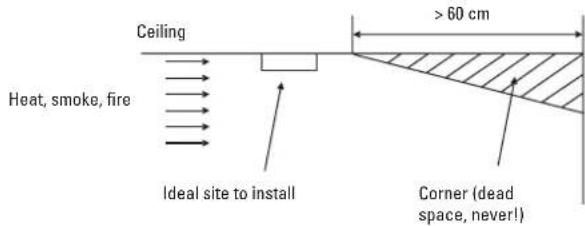
Recommended installation sites for smoke detectors
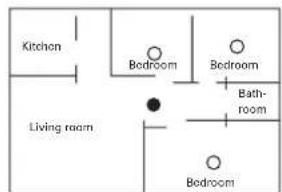
Individual storey
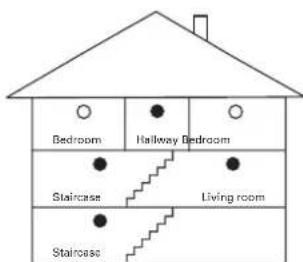
Building with several floors
Smoke detector for minimum protection
Smoke detector for maximum protection
- Install smoke detectors in close proximity of the bedrooms. Also plan for escape routes from bedrooms; those rooms are usually the farthest from the exit. If there is more than bedroom, install additionally a smoke detector in every bedroom.
This also extends to other rooms providing sleeping facilities (such as children's room, guest room, etc.). - Install smoke detectors in order to safeguard stairways; stairways act easily like chimneys for smoke and fire, and may contribute to further fire spread.
Make sure to install at least one smoke detector on each floor. - Locate a smoke detector in every room where electrical appliances are present (e.g. TV in the living room). Often those devices in particular pose a risk of heavy, toxic smoke formation.
- It is recommended to install more than one smoke detector, if the rooms are larger.
- Smoke and other combustion residues rise upwards to the ceiling and spread horizontally. Mount smoke detectors on the ceiling in the centre of the room, this paces it closest to all other points in the room.
Ceiling mounting is recommended in conventional residential buildings. In caravans or motorhomes mounting on a vertical wall is required instead, in order to prevent a thermal barrier that may form at the ceiling.
- If you are installing the smoke detector on the ceiling, ensure locating it at a minimum distance of 50 cm from the side wall and 60 cm to each corner.
The smoke detector should be attached to a brace suspending from the ceiling or similar spots. Make sure that you maintain the minimum distances to corners and walls.
For rooms with sloped ceilings (attic), it is recommended to mount a smoke detector on each slope.
Unfavourable installation sites for smoke detectors
The following installation sites should be avoided:
- Kitchen/bathroom and toilet: The cooking fumes or water vapours present in these rooms may trigger a false alarm.
- Garages: A vehicle's exhaust fumes may trigger a false alarm in garages.
Near heaters or air conditioners
Rooms where the temperature falls below +5^ or rises above +38^ - Gable roof: Hot air (e.g. in summer or when heating the room) may accumulate here, which would prevent the fumes of a dangerous smouldering fire from reaching the smoke detector.
- Coilings in caravans or similar: The sun heats up the room ceiling and hence the air in the upper part of the caravan. The hot air keeps the fumes of a dangerous smouldering fire from reaching the smoke detector.
- Stationary walls in residential buildings: Here the smoke is detected very late, so that the warning is delayed.
- Corners in buildings: Here the smoke is detected very late, so that the warning is delayed.
Installation & inserting batteries

The wireless smoke detector cannot work without batteries or when the batteries are dead.
When the "low battery" alert beeps (one short beep every 60 seconds), the batteries must be replaced with new ones. Replace always all of the wireless smoke detector's batteries.
Test the wireless smoke detector once a week and after each battery change by holding down the "TEST" button for about 3 seconds. The wireless smoke detector will then emit a beep and the LEDs will flash. Also see chapter "Functional test".
For operational safety reasons do not use rechargeable batteries; use only non-rechargeable batteries.
Due to safety reasons the wireless smoke detector cannot be fastened to the mounting plate, if the batteries are not loaded.
- Remove the mounting plate by turning the wireless smoke detector and take it off (turn the upper part counter-clockwise to the left, see marking "TWIST TO REMOVE").
- Use the mounting plate as a template and draw bores on the two outer recessed openings.
- Fasten the mounting plate with suitable screws; use wall plugs, if necessary.
Take care that you do not damage any wires or pipes during the process of fastening or drilling.

Because of its heavy weight, we advise against using adhesive pads or magnetic disk for the installation out of safety concerns.
- Insert the 9 V block battery with the correct polarity. Note the polarity markings inside the battery compartment.
- Insert three batteries type AA/Mignon with the correct polarity into the battery compartment. Also note the relevant markings inside the battery compartment. The red lever at the edge of the battery compartment along with the battery must be swivelled inwardly.

The 9 V block battery is used for the electronics of the smoke detector (not for the wireless transmission); the three batteries of type AA/Mignon are required for the wireless transmission to function.
Therefore always insert a 9 V block battery and three batteries type AA/Mignon.
Due to safety reasons the wireless smoke detector cannot be fastened to the mounting plate, if the batteries are not loaded.
- Put the wireless smoke detector on the mounting plate and lock it by turning it to the right (turn the upper part clockwise to the right, see marking "TWIST TO TIGHTEN").
Replacing the batteries
Once the batteries are empty, the wireless smoke detector will beep every 60 seconds. In that case, replace the flat batteries with new ones.
Proceed as follows:
- Remove the mounting plate by turning the wireless smoke detector and take it off (turn the upper part counter-clockwise to the left, see marking "TWIST TO REMOVE").
- Replace the 9 V block battery. Insert a new battery with the correct polarity. Note the polarity markings inside the battery compartment.
- Change the three batteries of type AA/Mignon. Insert the three new batteries into the battery compartment with the correct polarity. Also note the relevant markings inside the battery compartment. The red lever at the edge of the battery compartment along with the battery must be swivelled inwardly.
- Put the wireless smoke detector on the mounting plate and lock it by turning it to the right (turn the upper part clockwise to the right, see marking "TWIST TO TIGHTEN").

Due to safety reasons the wireless smoke detector cannot be fastened to the mounting plate, if the batteries are not loaded.
Programming more smoke detectors
It is possible to "teach" several wireless smoke detectors. When later on one of the wireless smoke detectors sets off an alarm, all other wireless smoke detectors will do so soon after (if they are in range).
That way smoke in the living room will trigger the smoke detector in the living room and also all wireless smoke detectors in the home (if those are programmed to do so).
Determine one of the wireless smoke as the "Master". Only that wireless smoke detector is used to programme other wireless smoke detectors called "Slave".
It is also possible to run multiple groups of wireless smoke detector independently from one another in larger apartments or houses (example: A group on the ground floor, a group on the 1st floor, etc.).
Regardless of whether a "Master" or a "Slave" detects smoke, all wireless smoke detectors of that group will set off an alarm. The other groups, however, will not trigger an alarm (example: If the group on the ground floor has set off the alarm, the group on the 1st floor will not be affected and therefore will not set off an alarm).
Regardless of whether the function of one of a group's wireless smoke detectors is impaired, the remaining wireless smoke detectors of that group, if in range, will set off an alarm.
Proceed as follows:
- To start the registration procedure, remove the wireless smoke detector "Master" from the ceiling, if already mounted there. Put the wireless smoke detector "Master" next to the wireless smoke detector "Slaves" that need to be newly registered.
- Press the "LEARN" button on the wireless smoke detector "Master" several times in quick succession until the LED light next to it turns green (based on normal operating conditions: Press the "LEARN" button 2x briefly).
The registration is possible within the next 20 seconds.
- On the wireless smoke detector "Slave" to be registered press the "LEARN" button repeatedly until the LED next to it lights up red (based on normal operating conditions: Press the "LEARN" button 1x briefly).
- On the wireless smoke detector "Master" hold down now the "TEST" button for 5 seconds so that in the course of the programming process the radio signal is sent out to the wireless smoke detector "Slave". Then release the button.
Both LEDs are flashing and the wireless smoke detector "Master" emits an alerting sound. The wireless smoke detector "Slave" which has received the radio signal also sends out a beep.
- Press now also the "TEST" button on the wireless smoke detector "Slave" for about 5 seconds (both LEDs blink and a beep is audible) to send the radio signal back to the wireless smoke detector "Master", so that the "Master" can complete the registration process. Release the button.
When the wireless smoke detector "Master" has received the radio signal it will emit a beep, too. - After a few seconds, the beep of both wireless smoke detectors will be disabled and the LEDs will turn off.
The wireless smoke detector "Slave" is programmed on the wireless smoke detector "Master".
Deleting a wireless smoke detector "Slave"; Reset to default
If one of the registered wireless smoke detector "Slaves" needs to be deleted on the wireless smoke detector "Master" from the group proceed as follows:
- On the wireless smoke detector "Slave" press the "LEARN" button in quick succession until the LED next to it turns green (based on normal operating conditions: Press the "LEARN" button 2x briefly).
- Now on the wireless smoke detector "Slave" hold down the "TEST" button for about 5 seconds. Both LEDs are flashing and the wireless smoke detector "Master" emits an alerting sound.
- Release the button.
The wireless smoke detector "slave" has been deleted and no longer responds to the signals of the wireless smoke detector "Master".
The wireless smoke detector is now back to its default settings.
The wireless smoke detector can be programmed in on a wireless smoke detector "Master".
Naturally you may also use the wireless smoke detector "Master" to "teach" another group of wireless smoke detectors.
As already described, a group of wireless smoke detectors consists of a single "master" and one or more wireless smoke detector "Slaves". The groups operate independent of one another.
If from a wireless smoke detector "Master" all wireless smoke detector "Slaves" have been deleted, it can now be registered as a "Slave" within another group.
Functional test
During normal operation the red LED next to the "TEST" button flashes briefly every 40 seconds.
- To test the alert tone, hold down the "TEST" button for a couple of seconds. The wireless smoke detector emits a short beep and both LEDs flash. This indicates that the smoke detector and the batteries are functioning correctly.
If no alarm is audible, or if the LEDs do not flash, the batteries may be dead. Replace the batteries and perform a new functional test. If this does not help, replace the wireless smoke detector.

It is strongly recommended that the wireless smoke detector is tested weekly to ensure proper operation.
A functional test of the radio transmission is made by blowing cigarette smoke, for example, into the wireless smoke detector. Accessory retailers offer special test sprays for smoke detectors. Here are all wireless smoke detectors of the group (the single "Master" wireless smoke detector and all of the programmed wireless smoke detector "Slaves") must set off an alarm.
Establishing an escape plan and practising for an emergency
- Create a plan of your apartment or your house that shows all the doors and windows, and allocate two escape routes for each room, if feasible. A rope ladder may be necessary for windows on the second-floor.
- Call a family meeting in order to discuss the escape plan and explain to each person what to do in case of fire/smoke.
- Arrange for a meeting place outside of your home.
- Familiarize everyone with the alarm of the wireless smoke detector; everyone must know that when this sound is heard, everyone must leave the house immediately.
- Practice a smoke/fire drill at least every 6 months. Exercises will help you to put your escape plan to the test before an actual emergency situation may arise. It may happen that you cannot reach your children in a case of fire. It is important that they know too, what to do and how to behave.
What to do in case of an alarm?
- When one of the wireless smoke detectors of a group (the single wireless smoke detector "Master" and all programmed wireless smoke detector "Slaves") detects smoke, all wireless smoke detectors of that group will set off a loud alarm.
The alarm stops when the air is free again from smoke. - In case of an alarm leave the home or the house immediately following the escape plan you have created. Every second counts; do not waste time by getting dressed or trying to take your valuables with you.
- Do not open any door without first touching the surface. If the door is hot, or if you see smoke coming in from under the door, do not open the door! Use the alternative escape route instead. If the surface of the door is cool, press your shoulder against it, open the door slightly and be ready to slam it back again, if heat and smoke penetrate from the room behind it.
- If the air is filled with smoke, stay close to the floor. Breathe through a cloth (if possible) moistened with water.
- When you have left the apartment or the house, go to the agreed meeting place and make sure everyone is there.
- Call the fire department from the house of your neighbour, do not call from your own!
- Do not go back into the apartment or the house until the fire brigade consents.
Nuisance alarm
Cigarette smoke or steam produced while cooking can active the wireless smoke detector. Nuisance alarms are also possible in case of exposure to dust when grinding (e.g. when renovating a room) and if too much hair spray/deodorant is sprayed in a room, or similar.
Smoking in a room will not set off the wireless smoke detector in general; only if the smoke is blown directly towards the smoke detector it will trigger an alarm.
If the wireless smoke detector gives an alarm, check first whether the fire is real. If fire or smoke is discovered, alert your family, and everyone must leave the building. Call the fire department. If there is no fire or smoke, check whether the above-mentioned reasons could have triggered the alarm.
Maintenance and cleaning
Apart from the occasional battery change, the product is maintenance-free.
Clean the product with a soft, clean, dry cloth.
Dust on the wireless smoke detector can be easily removed with a soft, clean, long-haired brush or a vacuum cleaner; this should be done in rooms with a high dust load (e.g. in a bedroom) at least once a year.
Do not use abrasive cleaning agents or solvents; this may damage the housing or may be impair operation.
For security reasons, after an operating period of 8 years the smoke detector must be replaced with a new one.
Declaration of conformity (DOC)
We, Conrad Electronic SE, Klaus-Conrad Straße 1, D-92240 Hirschau (Germany), hereby declare that this product conforms to the fundamental requirements and other relevant regulations of the 1999/5/EC directive.
The declaration of conformity for this product is available at: www.conrad.com
Range
The radio signal transmission range between two wireless smoke detectors is up to 60 m under optimum conditions.
This value, however, is the so-called "open space range" (the range when transmitter and receiver are in line of sight, without any interference).
In practice, however, there may be walls, room ceilings, etc. between the transmitter and the receiver which will reduce the range accordingly.
Due to the different influences on the radio transmission, no specific range can be guaranteed. However, trouble-free operation is usually possible in a single family house.
Sometimes the range can be considerably reduced due to:
- Walls, reinforced concrete floors, drywall walls with metal frame construction
- Coated/metallised insulated glass
- Proximity to metallic & conductive objects (e.g. heating elements)
- Proximity to human bodies
- Other devices on the same frequency (e.g. wireless headphones, wireless speakers)
- Proximity to electric motors/appliances, transformers, power supplies, computers
Disposal
a) General

Please dispose of the product at the end of its service life according to the relevant statutory requirements.
be any batteries inserted and dispose of them separately from the product.
b) Disposal of used batteries
As a consumer you are legally bound (battery ordinance) to return all used batteries; disposal in the household waste is prohibited!

Batteries containing hazardous substances are labelled with the symbol opposite indicating that disposal in the domestic waste is forbidden. The symbols of the critical heavy metals are: Cd = Cadmium, Hg = Mercury, Pb = Lead.
You can return your used batteries at collection points of your community at no cost or wherever batteries are sold!
That way you fulfil your statutory obligations and contribute to the protection of the environment!
Technical data
Power supply. 1x 9 V block battery and 3 batteries type AA/Mignon
Sending/reception frequency 433.92 MHz
Range .up to 60 m (see chapter "Range")
Alarm volume. > = 85dB / 3m
Ambient conditions Temperature -10^ to +40^ , air humidity 0% to 95% relative, not condensing
Dimensions (0× H) 125x48mm
Weight 340 g (without batteries)
Manufacturer's service address:
Conrad Electronic SE, Klaus-Conrad-Straße 1, D-92240 Hirschau/Germany.
Intended for Fire Safety and installed in buildings
Essential characteristic 1: Pass
Essential characteristic 2: Pass
Essential characteristic 3: Pass
Essential characteristic 3: Pass Essential characteristic 4: Pass
Essential characteristic 5: Pass
Essential characteristic 6: Pass
Essential characteristic 7: Pass
Essential characteristic 8: Pass
Mode d'emploi
Indications relatives aux piles

Intended for Fire Safety and installed in buildings
Essential characteristic 1: Pass
Essential characteristic 2: Pass
Essential characteristic 3: Pass Essential characteristic 4: Pass
Essential characteristic 4: Pass Essential characteristic 5: Pass
Essential characteristic 9: Pass Essential characteristic 6: Pass
Essential characteristic 7: Pass
Essential characteristic 8: Pass
Gebruiksaanwijzig
Draadloze rookmelder "LM-101LD"
Bestelnr. 1274868
Beoogd gebruik
Intended for Fire Safety and installed in buildings
Essential characteristic 1: Pass
Essential characteristic 2: Pass
Essential characteristic 3: Pass
Essential characteristic 4: Pass
Essential characteristic 5: Pass
Essential characteristic 6: Pass
Essential characteristic: Pass Essential characteristic: Pass



- Operating instructions
- Wireless Smoke Detector "LM-101LD"
- Intended use
- Package contents
- Explanation of symbols, labels
- Safety instructions
- Battery notes
- Selecting the installation location
- General Information
- Recommended installation sites for smoke detectors
- Unfavourable installation sites for smoke detectors
- Installation & inserting batteries
- Replacing the batteries
- Programming more smoke detectors
- Proceed as follows:
- Deleting a wireless smoke detector "Slave"; Reset to default
- Functional test
- Establishing an escape plan and practising for an emergency
- What to do in case of an alarm?
- Nuisance alarm
- Maintenance and cleaning
- Declaration of conformity (DOC)
- Range
- Sometimes the range can be considerably reduced due to:
- Disposal
- a) General
- b) Disposal of used batteries
- Technical data
- Manufacturer's service address:
- Mode d'emploi
- Indications relatives aux piles
- Gebruiksaanwijzig
- Draadloze rookmelder "LM-101LD"
- Beoogd gebruik
Brand : Renkforce
Model : LM101LD
Category : Smoke detector