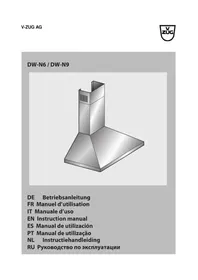
DW N - Basket V-ZUG - Free user manual and instructions
Find the device manual for free DW N V-ZUG in PDF.


| Brand | V-ZUG |
| Model | DW N |
| Product type | Extractor hood or recirculation hood |
| Minimum distance between hood and cooking surface | 65 cm |
| Recommended exhaust duct diameter | 150 mm |
| Electrical class | Class II (ungrounded) |
| Electrical connection | Brown L, Blue N |
| Control type | Mechanical (3 speeds + lighting) |
| Lighting | Halogen bulbs |
| Filter types | Metal grease filter, activated carbon filter (regenerable or not) |
| Cleaning the grease filter | Every 2 months by hand or in dishwasher (short cycle, low temperature) |
| Replacement of non-regenerable carbon filter | Every 4 months maximum |
| Cleaning the regenerable carbon filter | Every 2 months (wash and dry in oven at 100°C for 15 min) |
| Replacement of regenerable carbon filter | Every 3 years maximum or if damaged |
| Recommended use | Turn on a few minutes before cooking and turn off 15 minutes after |
| Safety | Do not flambé under the hood; monitor frying; turn off power before maintenance |
Frequently Asked Questions - DW N V-ZUG
User questions about DW N V-ZUG
0 question about this device. Answer the ones you know or ask your own.
Ask a new question about this device
Download the instructions for your Basket in PDF format for free! Find your manual DW N - V-ZUG and take your electronic device back in hand. On this page are published all the documents necessary for the use of your device. DW N by V-ZUG.
USER MANUAL DW N V-ZUG
Thank you for choosing to buy one of our products. Your appliance is made to high standards and is easy to use. Nevertheless, please take the time to read these instruction manual in order to familiarize yourself with the appliance and get the best use out of it.
Please follow the safety precautions.
Modifications
Text, diagrams and data correspond to the technical standard of the appliance at the time these operating instructions went to press. The right to make technical modifications for the purpose of the further development of the appliance is reserved.
ES
Observe as indications de seguranca.
Alteracoes
Carefully read the following important information regarding installation safety and maintenance. Keep this information booklet accessible for further consultations.
The appliance has been designed for use in the ducting version (air exhaust to the outside - Fig.1B) or filtering version (air circulation on the inside - Fig.1A).
SAFETY PRECAUTION
- Take care when the cooker hood is operating simultaneously with an open fireplace or burner that depend on the air in the environment and are supplied by other than electrical energy, as the cooker hood removes the air from the environment which a burner or fireplace need for combustion. The negative pressure in the environment must not exceed 4Pa (4× 10^5 bar). Provide adequate ventilation in the environment for a safe operation of the cooker hood. Follow the local laws applicable for external air evacuation.
Before connecting the model to the electricity network:
- Control the data plate (positioned inside the appliance) to ascertain that the voltage and power correspond to the network and the socket is suitable. If in doubt ask a qualified electrician.
- If the power supply cable is damaged, it must be replaced with another cable or a special assembly, which may be obtained direct from the manufacturer or from the Technical Assistance Centre.
2. Warning!
In certain circumstances electrical appliances may be a danger hazard.
A) Do not check the status of the filters while the cooker hood is operating.
B) Do not touch bulbs or adjacent areas, during or straight after prolonged use of the lighting installation.
C) Flambé cooking is prohibited underneath the cooker hood.
D) Avoid free flame, as it is damaging for the filters and a fire hazard.
E) Constantly check food frying to avoid that the overheated oil may become a fire hazard.
F) Disconnect the electrical plug prior to any maintenance.
G) This appliance is not intended for use by young children or infirm persons without supervision.
H) Young children should be supervised to ensure they do not play with the appliance.
I) There shall be adequate ventilation of the room when the rangehood is used at the same time as appliances burning gas or other fuels.
L) There is a risk of fire if cleaning is not carried out in accordance with the instructions.
This appliance conforms to the European Directive EC/2002/96, Waste Electrical and Electronic Equipment (WEEE).
By making sure that this appliance is disposed of in a suitable manner, the user is helping to prevent potential damage to the environment or to public health.
The symbol on the product or on the accompanying paperwork indicates that the appliance should not be treated as domestic waste, but should be delivered to a suitable electric and electronic appliance recycling collection point. Follow local guidelines when disposing of waste. For more information on the treatment, re-use and recycling of this product, please contact your local authority, domestic waste collection service or the shop where the appliance was purchased.
INSTALLATION INSTRUCTIONS
Assembly and electrical connections must be carried out by specialised personnel.
Electric Connection
The appliance has been manufactured as a class II, therefore no earth cable is necessary.
The connection to the mains is carried out as follows:
BROWN = L line
BLUE = N neutral
If not provided, connect a plug for the electrical load indicated on the description label. Where a plug is provided, the cooker hood must be installed in order that the plug is easily accessible.
An omnipolar switch with a minimum opening of 3mm between contacts, in line with the electrical load and local standards, must be placed between the appliance and the network in the case of direct connection to the electrical network.
Warning:
When connecting the appliance to the electricity supply, make sure that the mains socket has an earth connection.
After fitting the ducted cooker hood, make sure that the electrical plug is in a position where it can be accessed easily.
If the appliance is connected directly to the electricity supply, an omnipolar switch with a minimum contact opening of 3mm must be placed in between the two; its size must be suitable for the load required and it must comply with current legislation.
- The minimum distance between the support surfaces of the cooking pots on the cooker top and the lowest part of the cooker hood must be at least 65~cm . If a connection tube composed of two parts is used, the upper part must be placed outside the lower part. Do not connect the cooker hood exhaust to the same conductor used to circulate hot air or for evacuating fumes from other appliances generated by other than an electrical source.
Before proceeding with the assembly operations, remove the anti-grease filter(s) (Fig.6) so that the unit is easier to handle. In the case of assembly of the appliance in the suction version prepare the hole for evacuation of the air.
- We recommend the use of an air exhaust pipe with a diameter of 150. If a pipe with a smaller diameter is used, the efficiency of the product may be reduced and its operation may become noisier.
Fixing to the wall
Drill the holes A respecting the distances indicated (Fig.2). Fix the appliance to the wall and align it in horizontal position to the wall units. When the appliance has been adjusted, definitely fix the hood using the screws A (Fig.4). For the various installations use screws and screw anchors suited to the type of wall (e.g. reinforced concrete, plasterboard, etc.). If the screws and screw anchors are provided with the product, check that they are suitable for the type of wall on which the hood is to be fixed.
Fixing the decorative telescopic flue
Arrange the electrical power supply within the dimensions of the decorative flue. If your appliance is to be installed in the ducting version or in the version with external motor, prepare the air exhaust opening. Adjust the width of the support bracket of the upper flue (Fig.3). Then fix it to the ceiling using the screws A (Fig.3) in such a way that it is in line with your hood and respecting the distance from the ceiling indicated in Fig.2. Connect the flange C to the air exhaust hole using a connection pipe (Fig.4). Insert the upper flue into the lower flue and rest above the frame. Extract the upper flue up to the bracket and fix it with the screws B (Fig.3).
To transform the hood from a ducting version into a filtering version, ask your dealer for the charcoal filters and follow the installation instructions.
- Filtering version
Install the hood and the two flues as described in the paragraph for installation of the hood in ducting version. To assemble the filtering flue refer to the instructions contained in the kit. If the kit is not provided, order it from your dealer as accessory.
The filters must be applied to the suction unit positioned inside the hood. They must be centred by turning them 90 degrees until the stop catch is tripped (Fig.7).
USE AND MAINTENANCE
- We recommend that the cooker hood is switched on before any food is cooked. We also recommend that the appliance is left running for 15 minutes after the food is cooked, in order to thoroughly eliminate all contaminated air.
The effective performance of the cooker hood depends on constant maintenance; the anti-grease filter and the active carbon filter both require special attention. - The anti-grease filter is responsible retaining the grease particles suspended in the air, therefore it is subject to clogging with variable frequency according to the use of the appliance.
- To prevent the danger of possible fires, at least every 2 months one must wash the anti-grease filters by hand using non-abrasive neutral liquid detergents or in the dishwasher at low temperatures and on short cycles.
- After a few washes, colour alterations may occur. This does not give the right to claim their replacement.
- The active carbon filters are used to purify the air that is sent back into the room and its function s to mitigate the unpleasant odours produced by cooking.
- The non-regenerable active carbon filters must be replaced at least every 4 months. The saturation of the active charcoal depends on the more or less prolonged use of the appliance, on the type of kitchen and on the frequency with which anti-grease filter is cleaned.
- Regenerable active charcoal filters must be washed by hand,
with non-abrasive neutral detergents, or in the dishwasher at a maximum temperature of 65^ (the washing cycle must be complete without dishware). Remove excess water without damaging the filter, remove the plastic parts, and let the mat dry in the oven for at least 15 minutes approximately at a maximum temperature of 100^ . To keep the regenerable charcoal filter functioning efficient this operation must be repeated every 2 months. These must be replaced at least every 3 years or when the mat is damaged.
- Before remounting the anti-grease filters and the regenerable active charcoal filters it is important that they are completely dry.
- Clean the hood frequently, both internally and externally, using a cloth dampened with denatured alcohol or neutral liquid detergents that are non abrasive.
- The lighting system is designed for use during cooking and not for the prolonged general lighting of the room. The prolonged use of the lighting system significantly decreases the average duration of the bulbs.
- Attention: The non compliance with the hood cleaning warnings and with the replacement and cleaning of the filters entails risk of fires. One therefore recommends keeping to the suggested instructions.
- Replacing halogen light bulbs (Fig. 8).
To replace the halogen light bulbs B, remove the glass pane
C using a lever action on the relevant cracks.
Replace the bulbs with new ones of the same type.
Caution: do not touch the light bulb with bare hands.
-Commands: (fig.5) mechanical the key symbols are explained below:
$$ \begin{array}{l} \mathbf {A} = \text {L I G H T} \ \mathbf {B} = \text {O F F} \ C = S P E E D I \ \mathbf {D} = \text {S P E E D I I} \ \mathbf {E} = \text {S P E E D I I I} \ \end{array} $$
THE MANUFACTURER DECLINES ALL RESPONSIBILITY FOR EVENTUAL DAMAGES CAUSED BY BREACHING THE ABOVE WARNINGS.
GENERALIDADES
- We recommend that the cooker hood is switched on before any food is cooked. We also recommend that the appliance is left running for 15 minutes after the food is cooked, in order to thoroughly eliminate all contaminated air.
The effective performance of the cooker hood depends on constant maintenance; the anti-grease filter and the active carbon filter both require special attention.
-
The anti-grease filter is responsible retaining the grease particles suspended in the air, therefore it is subject to clogging with variable frequency according to the use of the appliance.
-
To prevent the danger of possible fires, at least every 2 months one must wash the anti-grease filters by hand using non-abrasive neutral liquid detergents or in the dishwasher at low temperatures and on short cycles.
-
After a few washes, colour alterations may occur. This does not give the right to claim their replacement.
-
The active carbon filters are used to purify the air that is sent back into the room and its function s to mitigate the unpleasant odours produced by cooking.
-
The non-regenerable active carbon filters must be replaced at least every 4 months. The saturation of the active charcoal depends on the more or less prolonged use of the appliance, on the type of kitchen and on the frequency with which anti-grease filter is cleaned.
-
Regenerable active charcoal filters must be washed by hand, with non-abrasive neutral detergents, or in the dishwasher at a maximum temperature of 65^ (the washing cycle must be complete without dishware). Remove excess water without damaging the filter, remove the plastic parts, and let the mat dry in the oven for at least 15 minutes approximately at a maximum temperature of 100^ . To keep the regenerable charcoal filter functioning efficient this operation must be
repeated every 2 months. These must be replaced at least every 3 years or when the mat is damaged.
- Before remounting the anti-grease filters and the regenerable active charcoal filters it is important that they are completely dry.
- Clean the hood frequently, both internally and externally, using a cloth dampened with denatured alcohol or neutral liquid detergents that are non abrasive.
- The lighting system is designed for use during cooking and not for the prolonged general lighting of the room. The prolonged use of the lighting system significantly decreases the average duration of the bulbs.
- Attention: The non compliance with the hood cleaning warnings and with the replacement and cleaning of the filters entails risk of fires. One therefore recommends keeping to the suggested instructions.
INSTALLATIE INSTRUCTIES
C = knop EERSTE SNELHEID
D = knopTWEEDW DERDE SNELHEID
E = knop DERDE SNELHEID
DE FABRIKANT IS NIET AANSPRAKELIJK VOOR SCHADE DIE VOORTVLOEIT UIT HET NIET IN ACHT NEMEN VAN DE BOVENSTAANDE VOORSCHRIFTEN.
OBUIECBUDEHNA
BhImaTeIbHo npOHTaIte coOpJxHne daHHo IHCTpyKUIN, NockoJIbKy coOpJXNT BaxHbIe yka3aHnE,OTHOcIuNEcK 6e3OnaHocHTyCTaHOBKn,3KcNlyaTaUN INTexO6CnyKINBaHN. CoXpaHnte HnCTpyKUIO dnn IIO60d aNbHeWey KOHCylbTaUIN. YcTPOINCTBO pa3pa6OtaHO B cIeDyUOxN BapnaHTax nCnonHeHn: BBITJXHoe ycTPOINCTBO (ydaIeHne BO3dyxa n3 NOMEuHn - pnc.1B),ΦnIbTpyUOee yCTPOINCTBO (peunPKyIaYn BO3dyxa BHytpn NOMEuHn - pnc.1A).
MEPbI PPEOCTOPOXOCTN
- 5bItb BHNMaTeIbHbIM, ecn OndHOBpeMeHH pa6oTaET BbITXKKa I rOpeJIka nIIN OuaR, HxJdIOUeNcB OKpyKaIOuE M BO3DyXe N 3aNNtBbIAOuNecC INHO JHeprnE, KpOME 3JeKtpueeckO.B TAKOM Cnyae BbITXKa ydaJIaT E N3 NOMEeHnB O3DyX, HxKbI dIg npouceCa cropAHnB R opelke nIIN ouare. OTpuCAIbHoe daBneHne B NOMEeHn He DonxHo npeBbIwAtb 4Pa (4x10⁻⁵bar).
Hn HaeKHO 6eONacOH pa6oTb CneyET oecneuNb BeHTnlaunIO NomeueHn. Jn HApXhBx BbIbPocOB co6nOaTb npabnA, neCTByUoNe B Baew cTpaHe.
Ipeep noqknoueHnem n3dennK cetn 3neKtponntaHn:
-
npoBepbTe, TTo6bl HanpJxHHe N MoUHocTb, yKa3aHHbIe Ha 3aBOJcKO Ta6nUyKe (pacnoJoxHe BAHTPN u3JeNIA) COOTBeCTBOBaII NaHHbIM CeTN 3NeKTPoNTaHINu 3NeKTPnuCeCKO po3eTK. B Cnyae comHeHn O6paTntEcB K KBaIIuΦnupOBaHHOMy 3NeKTPnky.
-
Ecn npobod 3neKtponntaHn NOBpeJdeH, 3ameHnte ero nn Becb CneuaNBHy y3eN y npou3BODNTeN nIN B yNOHOMOueHHOM ueHTpe TexHueCKOrO 6cnykBaHn.
2. Bhumane!
B HeKOTOpbIX CnyaX 3JIeKTPnueckne npu6Opbl MoryT 6bITb ONaChbIMN.
A) He npoBepaTe coCTOHNHe anbTpoB npu pa6oTaUoSe BbITAAKKe
B) He npikacaiTecb K lamnoykaM Nn K npineraioum 30HAM B npocece pa60tbi cnCTembl OcBeueHnN nnpca3y Je nocle ee BvIKIOUeHn
C) 3anpeaetcra roTOBHTb 6nOda Ha oTKpbITOM nIaMeHn NOK KyXOHHO BbITAKKO
D)I36eraeTeOTKpbITOROIIaMeHH,TAKKaHOHOOBpeXdaet HnbltpbIMoKeT pNBECTK BO3ROPaHIO
E) B npouecce xapkn BO φpntlope HnpepbIBHO Cneinte 3a npoueccom BO n36exKaHne Bo3ropaHne Knnaeero Macna
F) OToeHnHrTe WtencBHyIO BuNky OT cTeBOI po3ETK neped Hauanom TexHnueckoro 06cnynBaHn
G) N3dennHe pacHTaHo Ha 3KcIpyaTuHIO DeTbMn HnneDeecnoc6hBMn muaAMn 6e KOHTpOra.
H) He pa3pewaIte TeTm UrpTaB c N3dennem
I) ECIN BBITXKKa NcNoJIb3yeTcOdHOBpeMeHHo C dpyrMM np6opamn, B KOTOpBIX NcNoJIb3yeTc TOnJIuBHyI ra3 IIN dpyrme BNDbl TOnJIuBa, B NOMEeHNm DOJXHa 6blb 0ecneueHa HAdIeXaAae BeHTNIaIy
L) B cnyuae BbInonHeHn Onpaun no nCtke 6e3 co6nOeHn HNCTpyKcun cyueCTByet onacHOctb BO3ropaHn
DahHoe n3dennne HmeeT MapKnOpBky COOTBeCTBnE Ebponei
ckomy HopMaTbBy 2002/96/EC,ytunin3aunna 3neKtpuuecknx n 3neKtpoHHbIXn3deNn (WEEE).PoBepbTe,tyo6bl no OKOHauHnn erO cpoKa cnJx6bl daHHO n3deJe 6blIO CdaHO BytINb. 3TNMBbl NOMKeTe coXpaHHTb OkpykaIoUyO cpey.
CnMBOH Ha n3dennn nn B npnnaraoue cK Hemy DOKyMeHTaunn O3Haayet, YTO daHHoe n3dene He DoJHKHO paccMaTpNBaTbCn KaK 6bITOBBe OTXOdbI, a DOJHKHO 6bITb CdaHO B CneuaNbHbI NcHTp yTNn3aUNn, 3aHnmaIOuINcYHnUToXeHNEM 3JeKTpuYeCKNX u3JeKTPoHHbIX np6OpOB. I3dENe DoJHKHO 6bITb CdaHO B yTNb B COOTBcTbn C MeCTHBIMn HopMaTnBaAMn NO yTNn3aUNn OTXoOB. 3a DOJONIHNTeNbHbIMn CBeDEHnA Mn KacaTeNbHO 6pa6oTKn, yTNn3aUNn N yHnUToxeHn DaHHoro n3dEINr O6paauTecB B MeCTHO OTdEHNHe c6opa DomAuHNx 6bITOBbIX np6OpOB INN B MaRa3INH, B KOTOPOM 6bINO Kynneno n3dEIne.
MHCTPYKUINIOYCTAHOBKE
MoHTax n 3JIeKTpnuYeCKoe NOJKNIOUyeHne DOJXHbI BbIINHrTbCkBAaIIHcNUPOBaHHbIM TEXHNKOM.
3neKtpnueckoe noKnIOueHne
Pnp6op Imeet KnaCC II, NO3ToMg K 3a3eMneHnIO He HAno IOndcoeHNHTb HnKaKoI npBOd, NpOcEINHeHne K 3JIeKTPocEtN BblONHReTc CNeDyUOUM 6pa3OM:
KOpHHeBbI-L-JINHm
CNHIN-N-HeITpAnHbI
Ecnn Ha Ka6ene Het wTeNCen, yCTaHOBntb wTeNceIb, paccuTaHnblHa pa6Ory cHarpy3KoYkazAHHOHaTa6nUKe xapaKTepeNTK. Ecnn BbTTKa OChauEHa wTeCenEM, OHa yCTaHaBnBaetc, npu ycIOBnX, YTO wTeNceIb 6yET DoCTynHbIM. B Cnyae nprMoro noCoeHNHeH N K 3JIeKTPOCeTn HyxHO pa3MeCTNb MeJy np6Opom n CeTbMOHorONIOCHb BBKlIOUaTeJIb C 3a3OpOM KOHTaKTOB MmHMMyM 3 MM, paccuTaHnbl Ha HyxHy IO Harpy3Ky n OTBeaIOUm DeiCTByIOUM HopMaM.
MHHMaJIbHaI NCTaHcNMeKdy ONOpHO HarpeBaIOueCn PIIOCKOCTbU HIXHHe YAcTbU KXYOHOro DbIMOCocA DoJXHa 6bITb He MeHee 65 cm. Ecn npImeHaeTc CoeINHTeBHa Tpy6a n3 DByX n 60lee qacte, To BepHra YacTb DoJXHa paONarTaBC CHAPyKn HIXHHe YAcTn. He CoeINrTa Bbl6poc n3 BBtAAKKn C KaHAlOM LIPKByLAnr Tropyeo BO3DyXa NIn C KaHAlOM, INcNoB3yEmbIM dny OTBDA bIMa OT yCTpoiCTB, 3aNbITbIAeMbIX HNOH 3Heprne Kpome 3NeKtpuYecko. IpePe TEM KAK pNCTUYNTb K c6OpKe yCTpoiCTBa, dny O6JIerueHna erO MOHTaKa OTcoEHNHTe FNBTP/KNIpOyNAbIBaIOuNn FNIbTp (Pnc.6).
B TOM CNYUae, ecnn npn6op MOHTnpyeTcC BbITXHbIM yCTpOINCTBOM, peKOMEHNyETcN OecneuNTb NOMEeHNE BBIOHbIM OTBepCTnEM.
- PekomeHnyetc nCnoB3OBA Tb Tpy6 yDbIMoxoJa DnAmEtPOM 150. NcNoB3OBAHne cyKeHHo Tpy6bl MoKet cokpaTntb KND BbITJIKN yBeINuHTb ee UyMOBo IyPOBeHb
PpKppeHne KcTeHe
BbINONHInTe OTBepCTnA,Co6NIOaJyKa3aHHbIe paCCToHHa (pnc.2).PpIKpeNTe yCTpoiCTBO K CTHe npN NOMOuN peryNpyemoro KPOHHTeHa,BbIPOBHnTe yCTpoiCTBO B rOpN3oHTaNbHOM NOJXeHN. PpIKpeNTe OKOHaTeNbHO KOJINaK DByMa BNHTaMn A (pnc.4).B 3abNCmOcTn OT
BapnAHTa MOHTaxa IcNOnb3yIte BnHTbI (WypynI) nIIO6eIIN, COOTBeTCTByUOuIe TnY CTeHb (HaNPmep, XeJeE3o6eToH, RnCOKAPTOH nT. ). EcnBnBHTbI nIIO6eIIN BXOaRt B KOMnJIeKT NOCTaBKN, CNeDyET yIOCTOBepNTbCR B TOM, YTO OHN IOxOaRr Dnra TORO TnPa CTehb, Ha KOTOpONJKeH 6bITb CMOHTnpOBaH KOJInak.
MOHTAX DeKopatNBbIX TeneckOnuYeCKNX c6OpOHybIX 3JIeMeHToB
PpeBapnteBHO BbIOnHInTe NoBDky 3neKtponpOBOOB HByTpN DeKopatNBHoro C6OpOHoro 3JeMeHa. EcnBaWe yCTpoCTBO yCTaHabBnBaETcKa KAc BblTJHXoe nnC HApXhbIM 3NeKTPoDgBnATeNeM, PpeBapnteBHO CdenaHTe OTBepCTne dIg OTBoa BO3dyxa. OPeryunpyte WnpHy NODepxnbAoUeRO KPOHSTeHa BepxHero C6OpOHoro 3JeMeHa (pnc.3). PpiKpeNTe erO K NotOKy BNHTAmA Tak, UTO6bl ObecneHTb erO COOCHOCTc CBaUM KOJINaKOM (pnc.3), Co6IIOda paCCToHHe ot NtOKka, Yka3aHHoe Ha pnc.2. CoeINHtE PhaHeC C cOTBepCTnEM dIg BBBeDeHn BO3dyxa NocpeCTBOM CoeINHtEhBOH Tpy6bl (pnc.4).
BctaBbTe BepxHn c6opOHy bIeMeHT B HxKHi N NOCTaBtB Ha Ky3OB.
CmeCTte BepxHn C6bOpOHybe 3JeMeHT Do KPOHHTeHa n npKpeNt eero BNHTaMn B (pnc.3). DnI npEpaUeHHa KOnnaka N3 BbITJXHO R OfNbTpYIOuN IObPaNTecb K CBOeMy dInepy dnnonLyuHn HnBTOB CaKTNBpOBaHHbIM yTneM n CnEduTe IHCTpyKUnm No yCTaHOBKe.
KoNNaB BapMaHTe ΦNbTpUoJero yCtpoiCTBa
yCTaHOBnTe KONNAK IN DBA c6OpOuHbIX 3JemeHTa KaK yKa3aHO B pa3dene NO c6OpKe KONNAKA B BapnaHTe BbITXHHORO ycTPOINCTBa.ДЯ c6OpKN ΦINbTpPyUoIero 3JemeHTa CNEdyIte INHcTpyKUINM, COpePkaUINMCB KOMNKeTE npHaJIeXHOCTeE. Ecn N KOMNLeKT OTCYCTByET, 3aKaXnTe erO DonONHInTeBHO Y CBOEROnepa.ΦINbTpblDOnXHbl6bITb NOMeHbI Ha BCabIBaIOUee yCTpoINCTBO, pACNOLOXeHHOE BO BHyTPenHeN qACTn DbIMOCocA. YCTaHOBnTBΦINbTpbl CTporo NO CEHTpy IN 3aTEM NOBepHyTB Ha 90 rpaDycob Do UeUka(Pnc.7).
3KCNJYATAUINI TEXXOJ
- PeKOMeHnyem BBeCTn annapat B kCknnyaTaunio, npexJe yem npictyntb K Bapke kaKoro-lin6o 3JemeHTa. PeKOMeHnyem octabntb pa6otatb annapat Ha 15 MNHyT, nocIe 3aBepweHna npiroTOBHeHnI NnIu, YTO6bl NOINHOCTbO BbInyCTNTb TAgKebl BO3dyx. XopoOee fHKUOnHPOBaHne KOJINaKa O6cNcOBHeNo npABNJbHbIM I NOCTOARHHbIM TexHNueCKM O6ClyXKBaHneM; OC6ObE BHMaHHe CNeDyeT yDeiNTb FInbTpY Knpa N aKTUBPobAHHOrO yrJa.
KnpoydannouuHnBtp DOnJKeH yepKnBaTb KnpHbB3BeWeHHbIe YactuB B Bo3DyXe, CneIOBaTeJbHO, ero 3a-rp3HeHHe 3aBNCIT OT BpeMeHN pa60Tb np60pa.
-Bo n36exaHne pncKa noXapa,He pexe Dbyx pa3 B MecaH He06xoIMMO npombIbTa JnpooydAJIIOUme fNlTpblBpyHyIO UcNOlb3OBaHMeJHKINX HeITpAlbHbIX MOUIX CpeiCTB 6e3 a6pa3INBbIX Do6aBOK, INM MbITB NOCyDOMOeHOr MaunHKe npu Hn3KoT TempeaType N B KOPOTKne cNKbl. - LCBET MOKET N3MeHHTbcra, NOcNE HeCKOJIbKINx NPOMBIBOK. 3TOT aKT He daET npBa Ha XaNo6y 3aMeHy Detanin.
-ФильТьс calTbBpoBaHbIM yIeM Heo6xOДmbl IЯ OuICTKn BO3dya B NOMEseHn UyaJIaIOT HepPraTHbIe 3a-naxn npnpiroTOBLeHn nIu. - He pereheepnpyembe nIbTpblcakTNBnpoBaHbIM yIeM He06xOJIMO 3aMeHnTbHepeXe1pa3aB4MecaHa.HacbiueHne aKTHBnPOBaHHOro yrrAByNCNTOTTO,CACTO NCNoJIb3OBaJIcR
np6op,OT Bua KxHn n OT peryIaPHOCTN OOcTKn KInpoyDaJIIOUeO fINbTpA.
-
Perheepuymbte nIbTpblcakTnBupoBaHHbIM yIeM HeOxOJIMMOMbITb BpyHUY, CNCIOJIb3OBaHNMe HeITpaJIbHbIX MOIOUX CpeCTB 6e3 a6pa3INBbIX DoabOK, INN B NOcyDOMoeHoi MaunHe npu TemnepaType He BbIwe 65^ (pnp 3Tom B MaunHe He OJIKHO HaxOJITbc Nocybl). YdaJIbTb IINHIOBOy, He NOBpeKdA nIbTp, CHrTB NlaCTMaCCOBbie DeTaIn N BbICyWHTb KOBpIK B neu, He Mehee Yem 15 MmHT npu TemnepaType He Bblwe 100^. YTO6blnoDpeXNBaTb nIbTp C aKTNBUPoBAHHbIM yIeM B eOfKeTNBHom COCTOHN, 3TO onepaNIO Heo6xOJIMNO pOBoDITb KaKdbie 2 Meca. He Mehee Yem pa3 B 3 rOda nIbTp TbeO6xOJIMO 3aMeHrtb, INN KOrDa Ha KOBpKe 6hApuyKeHbl NobpeKdEHN.
-
IpeaTtem, kac yctahOBnTB jNPOydaIauOuue fHbTpbl n hlbtpbl cakTNBnPOBaHHbIM yrlem, Heo6xOUMOnNX TuaTeNbHO BbCyuNTb.
- Acto npOBoiHTb BHyTpeHHIO IN BHeIHIIO ONUCTKY BbITKKN, INcNoJIb3OBAtB TKaHb, HAMOeHHyIO B DeHaTpyuPObAHOM CnIPTe ININ B XIKNkOM HeITpaJIbHOM MOUJem CpeIcTBe 6e3 a6pa3nBBhIX Do6abOK.
CnCTema ocBeueHna pa3pa6oTaHa IJN uCNOJb3OBaHn BO Bpem nprirotobHeHn PnIu, a He JnIe TbeHOr npimeHeHn IJr OCBeueHn NOMEeHn. DInTeJbHOe pImeHeHne CnCTeMbIOcBeueHn 3NaHTeNbHOe cOKpauaet CpeHn pa6oHn cPok lamNoyeK.
BHHMaHHe: HecO6NIODeHne peKOMeHdaqun no ouNCtke BbITJAKKe n 3aMeHe n OUcNTKn fNbTpOB, pnpBOuNT K onacHOCTn NOkapa. PeKOMeHdyetc rceIOBaT bpNBBeEHHbIM HHCTpyKlIaM.
3aMeHa ranoreHHbIX lamn (Cxema 8).
Ia3amehblraonereHHbIX lamnB cHMMnte cTeKJIHHyIO KpbliKy C, noDBe ee OTBePTKO B cNeuaJIbHbIX na3ax.
3aMeHnte lamnbHa lamnbTaKOrO Xe Tuna.
BHMMaHHe: He npKacaiTecb K lamnam roIbIMn pyKaMn. OpraHbI ynpaBHeHn: (pnc.5) MexaHneckne
A=KHONKaOCBWeHn
B=KHOIIKa HnyeBOI
C=KHOHnKa nepBOeCKOpOCTN
D=KHONKa BTOPOI CKOPOCTN
E=KNHONKa TpeTei CKOpOCTN
ФИРMA HE HECET HUKAKOJ OTBETCTBEHHOCTN 3A UWEP6, Bbl3BAHHbI HECOBJIIODEHNEM BblJEINPUBE- DEHHbIX PPEDyIPEXKDEHNI.
V-ZUG AG
Industriestrasse 66, CH-6301 Zug

- Modifications
- ES
- Alteracoes
- SAFETY PRECAUTION
- Before connecting the model to the electricity network:
- Warning!
- INSTALLATION INSTRUCTIONS
- Electric Connection
- Warning:
- Fixing to the wall
- Fixing the decorative telescopic flue
- - Filtering version
- USE AND MAINTENANCE
- - Replacing halogen light bulbs (Fig. 8).
- THE MANUFACTURER DECLINES ALL RESPONSIBILITY FOR EVENTUAL DAMAGES CAUSED BY BREACHING THE ABOVE WARNINGS.
- GENERALIDADES
- INSTALLATIE INSTRUCTIES
- OBUIECBUDEHNA
- MEPbI PPEOCTOPOXOCTN
- Ipeep noqknoueHnem n3dennK cetn 3neKtponntaHn:
- Bhumane!
- MHCTPYKUINIOYCTAHOBKE
- 3neKtpnueckoe noKnIOueHne
- PpKppeHne KcTeHe
- MOHTAX DeKopatNBbIX TeneckOnuYeCKNX c6OpOHybIX 3JIeMeHToB
- KoNNaB BapMaHTe ΦNbTpUoJero yCtpoiCTBa
- 3KCNJYATAUINI TEXXOJ
- 3aMeHa ranoreHHbIX lamn (Cxema 8).
- V-ZUG AG
Brand : V-ZUG
Model : DW N
Category : Basket