
DDW621WDB - Dishwasher DANBY - Free user manual and instructions
Find the device manual for free DDW621WDB DANBY in PDF.
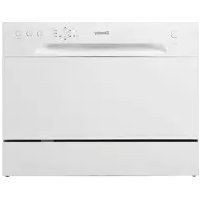


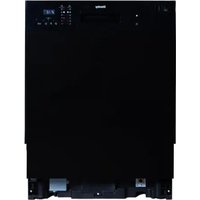
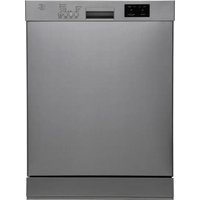
| Product Type | Countertop Dishwasher (Compact) |
| Brand | Danby |
| Model | DDW621WDB |
| Capacity | 6 Place Settings |
| Wash Programs | 6 Programs: Heavy, Normal (AHAM), Light, Glass, Speed, Soak |
| Voltage / Frequency | 120 V / 60 Hz |
| Maximum Power | 1200 W (estimated) |
| Water Consumption | 5 to 14.5 liters depending on program |
| Energy Consumption | 0.02 to 0.47 kWh depending on program |
| Inlet Water Pressure | 25 to 85 PSI |
| Dimensions (W × H × D) | 45 × 48 × 45 cm (estimated) |
| Net Weight | 20 kg (estimated) |
| Tub Material | Stainless Steel |
| Filtration System | 3 stages: coarse filter, fine filter, main filter |
| Wash Arm | 2 rotating spray arms |
| Installation Type | Countertop, quick-connect to faucet |
| Water Supply | Hot water only via included faucet adapter |
| Drainage | Quick-connect drain hose, gravity drain |
| Noise Level | 52 dB (estimated) |
| Safety | Grounded, child lock (supervision required) |
| Warranty | 1 year parts (excluding plastics: 30 days) |
| Included Accessories | Faucet adapter, inlet and drain hoses, utensil basket |
Frequently Asked Questions - DDW621WDB DANBY
User questions about DDW621WDB DANBY
0 question about this device. Answer the ones you know or ask your own.
Ask a new question about this device
Download the instructions for your Dishwasher in PDF format for free! Find your manual DDW621WDB - DANBY and take your electronic device back in hand. On this page are published all the documents necessary for the use of your device. DDW621WDB by DANBY.
USER MANUAL DDW621WDB DANBY

1-800-263-2629
(1-800-26-DANBY)
DO NOT RETURN THIS UNIT TO THE RETAILER WITHOUT FURTHER INSTRUCTIONS
Dear valued customer, we hope your Danby product purchase fulfills all your requirements. Your satisfaction is our priority!
Please contact us at our toll free consumer service number for any inquiries you may have about your new unit.
DO NOT RETURN THIS DEVICE TO THE RETAILER WITHOUT FURTHER INSTRUCTIONS
Owner's Use and Care Guide 2-21
- Welcome • Important Safety Information
- Features • Installation Instructions • Operation Instructions • Care and Maintenance
- Troubleshooting
- Warranty
DISHWASHER
Read and follow all safety rules and operating instructions before first use of this product.
Never operate the appliance unattended!

PRECAUTION:
Thank you for choosing Danby
We know you're excited. We are too! However, the more familiar you are with your new appliance, the better experience you will have. We therefore strongly suggest that you read this Owner's Manual before plugging in your new appliance. It contains important operational information that will help you make full use of the technical features available in your Danby appliance. The manual also contains information designed to enhance operating reliability and safety, as well as tips to maintaining your new appliance so that it brings you happiness for years to come.
Please visit www.danby.com to access self-service tools, FAQs and more. Should you need additional assistance, please call 1-800-26-DANBY (1-800-263-2629).
Note: You will need the below information to obtain service under warranty. To receive service, you must provide the original receipt.
Model Number:
Serial Number:
Date of Purchase:
NEED HELP?
Before you call for service, here are a few things you can do to help us serve you better:
Read this Owner's Manual:
It contains instructions to help you use and maintain your appliance properly.
If you received a damaged appliance:
Immediately contact the retailer (or builder) that sold you the appliance.
Save time and money:
Check the Troubleshooting section at the end of the guide before calling. This section helps you solve common problems that may occur.
If you do need service, you can relax, knowing help is only a phone call away.

1-800-26-Danby
(1-800-263-2629)
When using your dishwasher, follow the precautions listed below:
GROUNDING INSTRUCTIONS
This appliance must be grounded. In the event of a malfunction or breakdown, grounding will reduce the risk of electric shock by providing a path of least resistance for electric current. This appliance is equipped with a cord having an equipment grounding conductor and a grounding plug.
The plug must be plugged into an appropriate outlet that is installed and grounded in accordance with all local codes and ordinances.
WARNING
- Improper connection of the equipment-grounding conductor can result in a risk of electric shock.
- Check with a qualified electrician or service representative if you are not sure if the appliance is properly grounded. Do not modify the plug provided with the appliance; if it does not fit into the outlet, have a proper outlet installed by a qualified electrician.
SAFETY PRECAUTIONS
- Do not abuse, sit on, or stand on the door or dish rack of the dishwasher.
- Do not touch the heating element during or immediately after use. (These instructions are only applicable to machines with a visible heating element).
- Do not operate your dishwasher unless all enclosure panels are properly in place.
- Do not place any heavy objects on the door when it is open. The appliance could tip forward.
- When loading items to be washed:
1) Locate sharp items so that they are not likely to damage the door seal; 2) Warning: Knives and other utensils with sharp points must be loaded in the basket with their points down or placed in a horizontal position.
- When using your dishwasher, you should prevent plastic items from coming into contact with a heating element. (These instructions are only applicable to machines with a visual heating element).
- Check that the detergent receptacle is empty after completion of the wash cycle.
- Do not wash plastic items unless they are marked dishwasher safe or equivalent. For plastic items not marked, check the manufacturer's recommendations.
- Use only detergent and rinse additives designed for an automatic dishwasher.
- Never use soap, laundry detergent, or hand washing detergent in your dishwasher. Keep these products out of the reach of children.
- Keep children away from detergent and rinse aid and keep children away from the open door of the dishwasher. There could still be some detergent left inside.
- This appliance is not intended for use by people (including children) with reduced physical, sensory or mental capabilities, or lack of experience and knowledge, unless they have been given supervision or instructions concerning the use of the appliance by a person responsible for their safety.
- Children should be supervised to ensure that they do not play with the appliance.
- Dishwasher detergents are strongly alkaline, they can be extremely dangerous if swallowed. Avoid contact with skin and eyes and keep children away from the dishwasher when the door is open.
- The door should not be left in the open position since this could present a tipping hazard.
- If the supply cord is damaged, it must be replaced by a qualified person in order to avoid a hazard.
- Remove the door of the dishwasher when discarding it.
- Please dispose of packing materials properly.
- Use the dishwasher only for its intended function.
- During installation, the power supply must not be excessively or dangerously bent or flattened. Do not tamper with controls.
- The appliance is to be connected to the water tap using new hose sets and the old hose-sets should not be reused.
- The maximum number of place settings to be washed is 6.
- The maximum permissible inlet water pressure is 85 PSI.
- The minimum permissible inlet water pressure is 25 PSI.
SAVE THESE INSTRUCTIONS
To get the best performance from your dishwasher, read all operating instructions before using it for the first time.
CONTROL PANEL
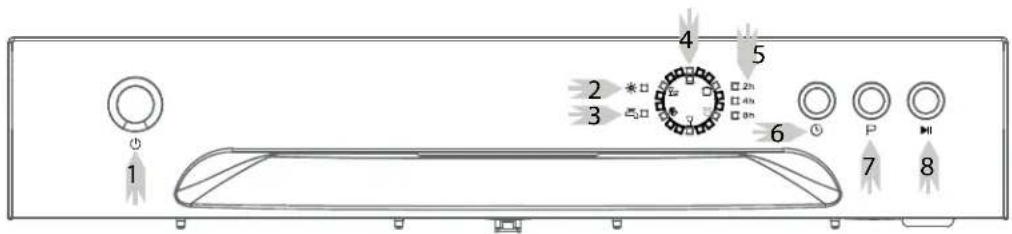
1) Power Button: To turn on/off the power supply. 2) Rinse Aid Warning Light: To be on when the rinse aid dispenser needs to be refilled. 3) Water Faucet Light: Illuminated when the water faucet has not been turned on. 4) Program indicator light: Displays which washing program has been selected. 5) Delay time: Indicates the delay time of either 2, 4, 6 or 8 hours. For 6 hours, the 2 hour and 4 hour lights will illuminate at the same time. 6) Delay Button: Press this button to set a delayed start time.
7) Washing Program Selector: Press this button to select wash cycles. 8) Start/Reset Button: Press this button to start or pause the dishwasher.
DISHWASHER FEATURES
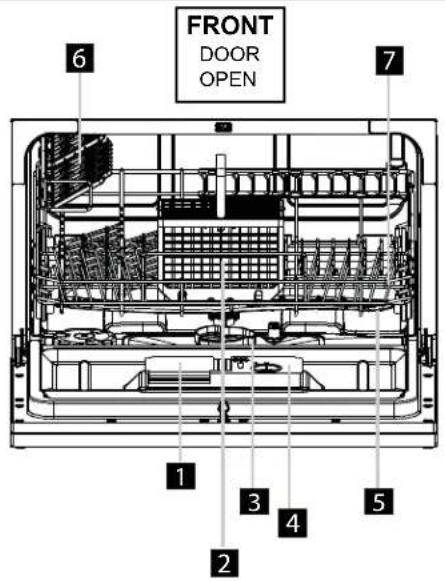
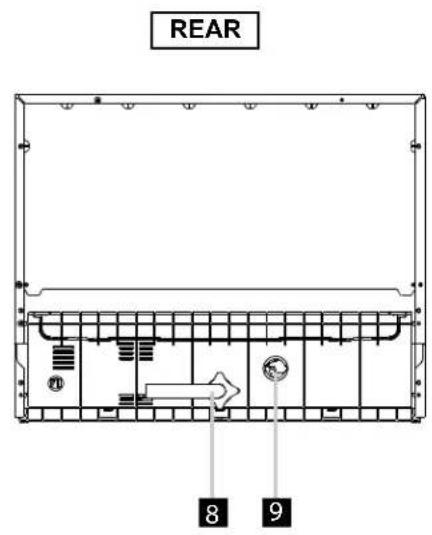
1 Detergent Dispenser 2 Cutlery Basket 3 Filter assembly 4 Rinse Aid Dispenser 5 Spray Arms 6 Cup Shelf 7 Basket 8 Inlet pipe connector 9 Drain pipe connector
A. FILL THE RINSE AID DISPENSER
RINSE AID DISPENSER
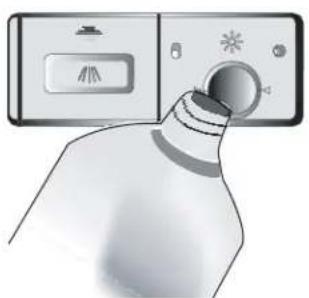
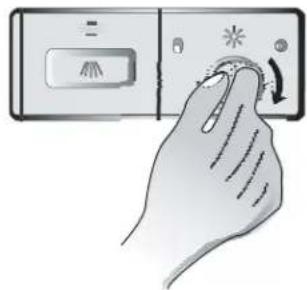
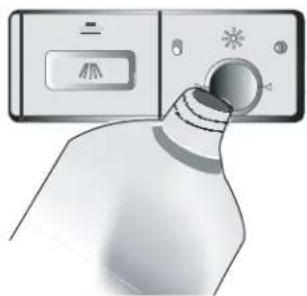
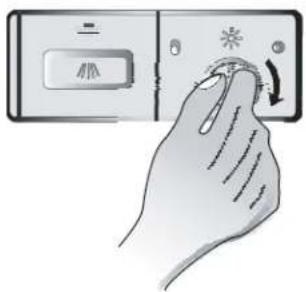
The rinse aid is released during the final rinse to prevent water from forming droplets on your dishes that can leave spots and streaks. It also improves drying by allowing water to sheet off the dishes. Your dishwasher is designed to use liquid rinse aids. The rinse aid dispenser is located inside the door next to the detergent dispenser. To fill the dispenser, open the cap and pour the rinse aid into the dispenser until the level indicator turns completely black. The volume of the rinse aid container is about 110ml.
FUNCTION OF RINSE AID
Rinse aid is automatically added during the last rinse, ensuring thorough rinsing, and spot and streak free drying.
ATTENTION
Never fill the rinse aid dispenser with any other substances (e.g. dishwasher cleaning agent, liquid detergent). This would damage the appliance.
WHEN TO REFILL THE RINSE DISPENSER
The amount of rinse aid can be judged by the color of the optical level indicator "C" located next to the cap. When the rinse aid container is full, the whole indicator will be black. As the rinse-aid diminishes, the size of the dark dot decreases. You should never let the rinse aid get below 1 / 4 full.
As the rinse aid diminishes, the size of the black dot on the rinse aid level indicator changes, as illustrated below.

Full

3/4 full

1/2 full

1/4 full should refill to eliminate spotting

Empty
C (Rinse-Aid Indicator)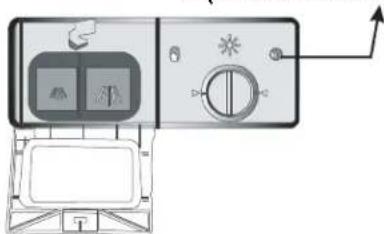
OPENING THE DISPENSER
1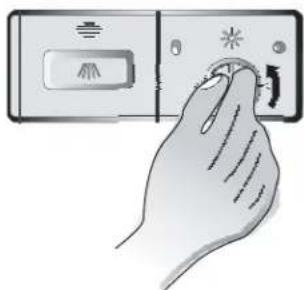
2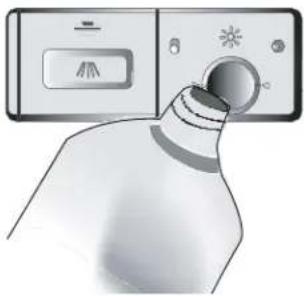
3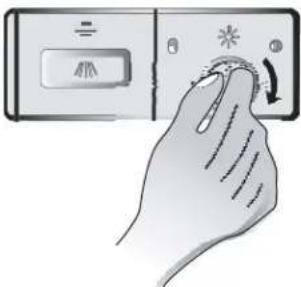
ATTENTION
Clean up any rinse aid spills during filling with an absorbent cloth to avoid excessive foaming during the next wash. Don't forget to replace the cap before you close dishwasher door.
1 To open the dispenser, turn the cap to the "open" (left) arrow and lift it out. 2 Pour the rinse aid into the dispenser, being careful not to overfill. 3 Replace the cap by inserting it aligned with "open" arrow and turning it to the closed (right) arrow.
Operating Instructions
PRIOR USING FOR THE FIRST TIME
A. FILL THE RINSE AID DISPENSER (cont.)
ADJUSTING RINSE AID DISPENSER
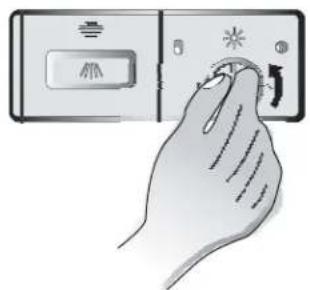
The rinse aid dispenser has four settings. The recommended setting is on "3". If the dishes still are not drying properly or are spotted, adjust the dial to the next higher number on "4".
NOTE: Increase the dose if there are drops of water or lime spots on the dishes after washing. Reduce it if there are sticky white stains on your dishes or a blue tinged film on glassware or knife blades.
Adjust lever (Rinse)
MAX
1 4 2 3
B. FUNCTION OF DETERGENT
PROPER USE OF DETERGENT
- Detergents with chemical ingredients are necessary to clean dirt from kitchenware and remove it from the dishwasher.
- Use only detergent specifically made for use in dishwashers. Keep your detergent fresh and dry.
- Don't put powder detergent into the dispenser until you're ready to begin a new cycle.
DETERGENTS
There are 3 types of detergents.
- With phosphate and with chlorine
- With phosphate and without chlorine
- Without phosphate and without chlorine
CONCENTRATED DETERGENT
Based on their chemical composition, the detergents can be split in two basic types:
- conventional, alkaline detergents with caustic components.
- low alkaline concentrated detergents with natural enzymes.
The use of “normal” washing programs in conjunction with concentrated detergents reduces pollution and is good for your dishes; these wash programs are specially matched to the dirt-dissolving properties of the enzymes of the concentrated detergent. For this reason normal wash programs in which concentrated detergents are used can achieve the same results that can otherwise only be achieved using “intensive” programs.
B. FUNCTION OF DETERGENT (cont.)
DETERGENT DISPENSER
The dispenser must be refilled before the start of each wash cycle following the instructions provided in the Wash Cycle Table. Your dishwasher uses less detergent and rinse aid than a conventional dishwasher.
Generally, only one tablespoon of detergent is needed for a normal wash load. Also, more heavily soiled items need more detergent. Always add the detergent just before starting the dishwasher, otherwise it could get damp and will not dissolve properly.
AMOUNT OF DETERGENT TO USE
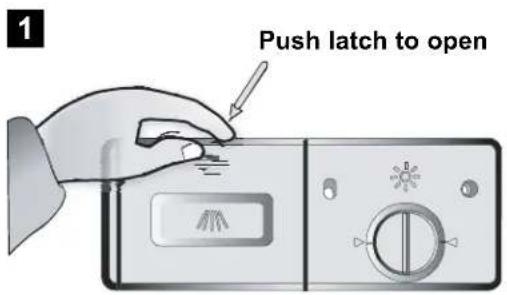
2 Detergent Powder
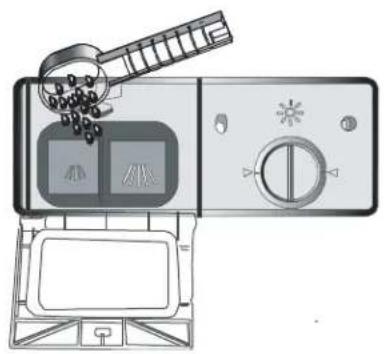
NOTE: • If the lid is closed: press release button. The lid springs open.
• Always add the detergent just before starting each wash cycle. - Only use brand name detergents for the dishwasher.
WARNING
Dishwasher detergent is corrosive! Take care to keep it out of reach of children.
B. FUNCTION OF DETERGENT (cont.)
ADD DETERGENT
Fill the detergent dispenser with detergent. The marking indicates the dosing levels, as illustrated below:
A Can hold 15g of detergent. B Can hold 25g of detergent.
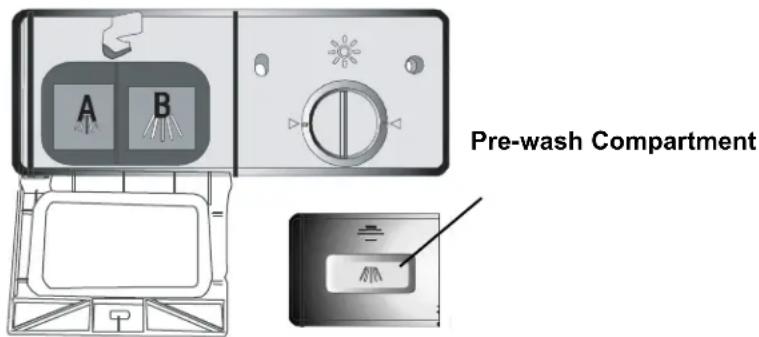
Please see the manufacturers recommendations for the amount of detergent to use as stated on the detergent packaging.
Close the lid and press until it locks in place.
If the dishes are heavily soiled, place an additional detergent dose in the pre-wash detergent chamber. This detergent will take effect during the pre-wash phase.
NOTE:
- Please be aware, that according to the level of soiling and the specific hardness of water differences are possible.
- Please read the manufacturer's recommendations on the detergent packaging.
RECOMMENDATION
- Consider buying utensils which are identified as dishwasher-proof.
- For particular items, select a program with a low temperature.
- Do not take glass and cutlery out of the dishwasher immediately after the program (wash cycle) has ended as they may be hot.
WASHING CUTLERY/ DISHES
ARE NOT SUITABLE
- Cutlery with wooden, horn china or mother-of-pearl handles.
- Plastic items that are not heat resistant.
- Older cutlery with glued parts that are not temperature resistant. • Bonded cutlery items or dishes.
- Pewter or copper items.
- Crystal glass • Steel items prone to rusting.
- Wooden platters
- Items made from synthetic fibres.
ARE OF LIMITED SUITABILITY
- Some types of glasses can become dull after a large number of washes. • Silver and aluminum parts have a tendency to discolour during/after washing.
- Glazed patterns may fade if machine washed frequently.
BEFORE/AFTER LOADING THE DISH- WASHER BASKETS
(For best performance of the dishwasher, follow these loading guidelines. Features and appearance of baskets and cutlery baskets may vary from your model).
Scrape off any large amounts of leftover food. Soften remnants of burnt food in pans. It is not necessary to rinse the dishes under running water.
Place objects in the dishwasher the following way:
- Items such as cups, glasses, pots/pans, etc. are face down.
- Curved items, or those with recesses, should be loaded at a slant so the water can run off.
- All utensils are loaded securely and cannot tip over.
- All utensils are placed in the way that the spray arms can freely rotate during washing.
NOTE: Very small items should not be washed in the dishwasher as they could easily fall out of the basket.
- Dishes and cutlery must not lie inside one another or cover each other.
- To avoid damage to glasses, they must not touch.
- Load large items which are most difficult to clean into the basket.
- Long bladed knives stored in an upright position are a potential hazard!
- Long and/or sharp items of cutlery such as carving knives must be positioned horizontally in the rack (basket).
- Please do not overload your dishwasher. This is important for good results and for reasonable energy consumption.
LOADING THE BASKET
Position the dishes and cookware so that they will not get moved by the spraying water.
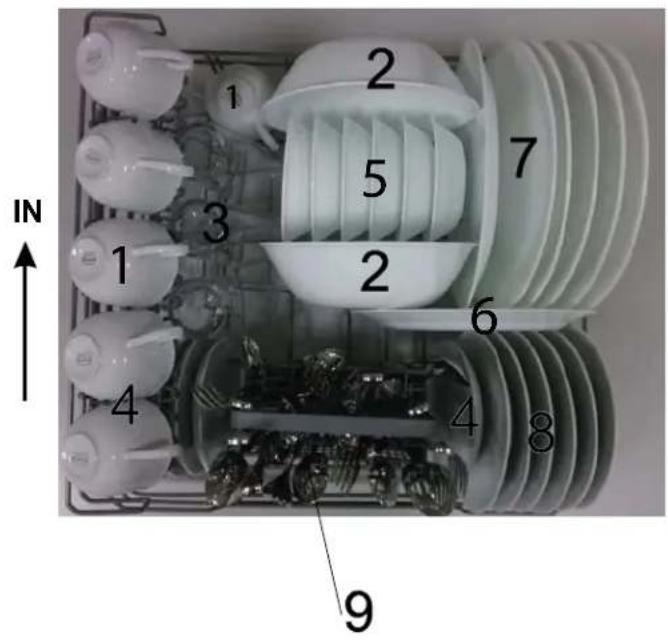
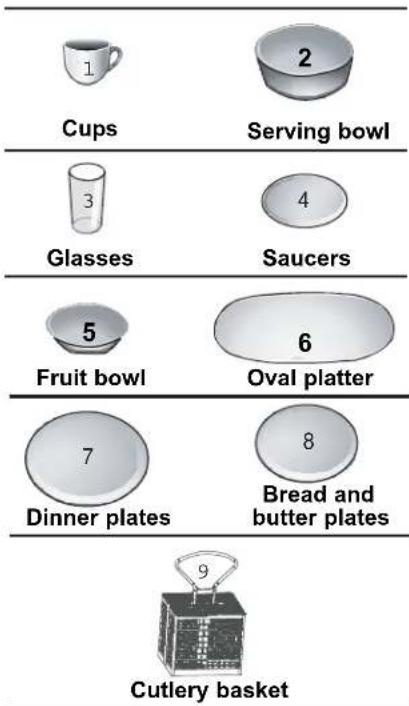
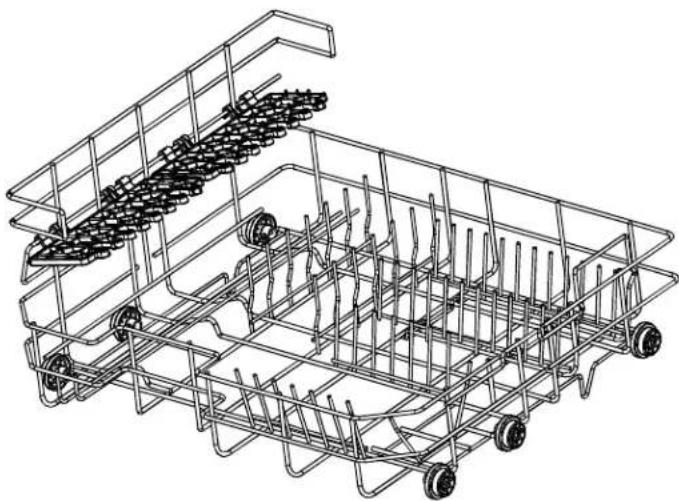
Plate racks in basket
The basket is fitted with plate racks which can be stowed horizontal if required.
CUTLERY BASKET
Cutlery should be placed in the cutlery basket with handles at the bottom. If the rack has side baskets, spoons should be loaded individually into the appropriate slots, especially long utensils should be placed in the horizontal position at the front of the upper basket as shown.
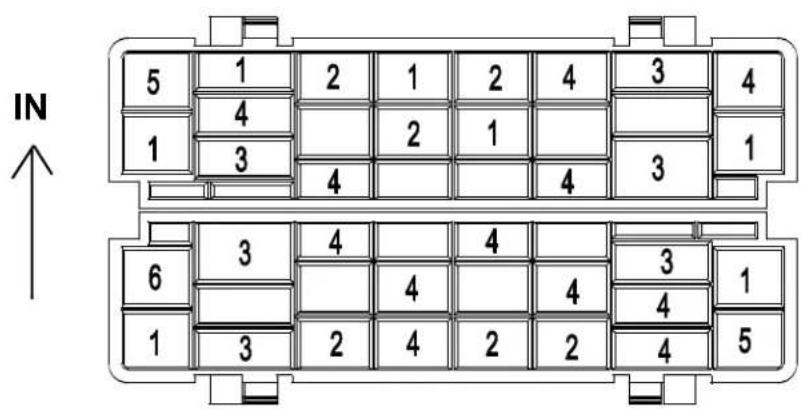
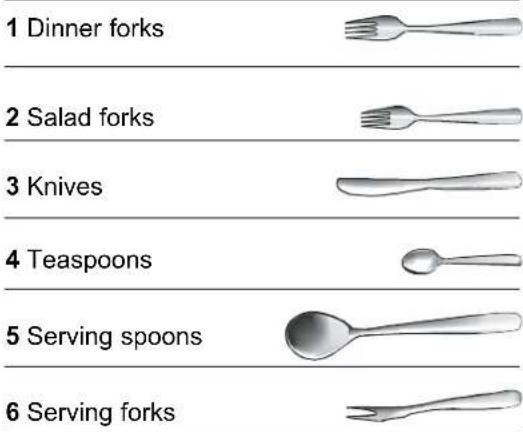
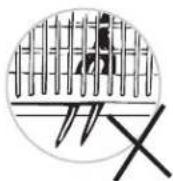
WARNING
- Do not let any item extend through the bottom. • Always load sharp utensils with the sharp end down!
For personal safety and a top quality clean, place your cutlery in the basket:
• Make sure they do not nest together - Place silverware with handles-down. - Place knives and other potentially dangerous utensils handles-up.
WASH CYCLE TABLE
• (*) Means: Need to fill rinse in the Rinse-Aid Dispenser. - AHAM DW-1-2005: This program is the test cycle. The rinse aid dispenser position 6 is recommended.
| Program | Cycle selection Information | Description of cycle | Detergent pre/main | Running time(min) | Energy (Kwh) | Water (L) | Rinse Aid |
| [10DC]Heavy | For the heaviest soiled loads, such as pots, pans, casserole dishes and dishes that have been sitting with dried food on them for a while. | Pre-washPre-wash (50°C)Wash (55°C)Wash (50°C)RinseRinse (68°C)Drying | 3/25g | 100 | 0.47 | 14.5 | * |
 NormalAHAM DW-1-2005 NormalAHAM DW-1-2005 | For normally soiled loads, such as pots, plates,glasses and lightly soiled pans.standard daily cycle. | Pre-washPre-washWash (52°C)RinseRinse (65°C)Drying | 3/25g | 110 | 0.38 | 10.8 | * |
| [8DOX]Light | For lightly soiled loads,such as plates,glasses,bowls and lightly soiled pans. | Pre-washPre-wash (50°C)Wash (50°C)RinseRinse (60°C)Drying | 3/25g | 75 | 0.32 | 12 | * |
| [200]Glass | For lightly soiled loads, such as glasses, crystal and fine china. | Wash (45°C)RinseRinse (50°C) | 15g | 20 | 0.22 | 7 | * |
| [200]Speed | A shorter wash for lightly soiled loads that do not need drying. | Pre-washPre-wash (50°C)Wash (50°C)RinseRinse (55°C) | 15g | 45 | 0.29 | 12 | |
| [200]Rinse | Use for rinsing dishes, glasses and silverware that will not be washed right away. | Pre-washMain-wash | / | 24 | 0.02 | 5 | * |
TURNING ON THE APPLIANCE
Starting a wash cycle...
Draw out the basket (see the section entitled Loading the Dishwasher).
Pour in the detergent and insert the plug into the socket. The power supply is 120V/60 Hz.
Make sure that the water supply is turned on to full pressure.
- Press the program button to select the program you need.
- Normal-> Light-> Glass-> Rinse-> Speed-> Heavy
- Then, press the Start/Reset button to start the dishwasher.
NOTE: When you press the Start/Reset button to pause a wash cycle, the display time will stop blinking and the program will pause. It remains in this stage of the cycle until you restart it again.
CHANGING THE PROGRAM
You can modify the washing program when the dishwasher just runs for a short time. Otherwise, the detergent may have already been released, and the appliance may have already drained the wash water. If this is the case, the detergent dispenser must be refilled.
To change the washing program, press the Start/Reset button to pause the working program, and then press and hold the program button for at least 3 seconds before choosing a different program and resuming the wash cycle.
NOTE: If you open the door during washing, the machine will pause. When you close the door and press the Start/Reset button the washing resumes 10 seconds after you close the door.
The lights show the state of the dishwasher:
a) All phase lights off----On stand by b) The display has no blinking----Being paused c) The display is blinking----Running
FORGOT TO ADD A DISH?
A forgotten dish can be added any time before the detergent cup opens.
1 Press the Start/Reset button to pause the cycle. 2 Open the door a little to stop the washing. 3 After the spray arms stop working, you can open the door completely 4 Add forgotten dishes. 5 Close the door 6 Press the Start/Reset button, the dishwasher will run after 10 seconds.
AT THE END OF THE WASH CYCLE
When the working cycle has finished, the buzzer will sound for 8 seconds, then stop. Turn off the appliance using the ON/OFF button, shut off the water supply and open the door of the dishwasher. Wait a few minutes before unloading the dishwasher to avoid handling the dishes and utensils while they are still hot and more susceptible to breakage. They will also dry better.
- Turn off the dishwasher
All the phase lights are off!
- Switch off the dishwasher by pressing the ON/OFF button.
- Turn off the water tap!
- Open the door carefully
Hot dishes are sensitive to impact. The dishes should therefore be allowed to cool down around 15 minutes before being removed from the appliance. Open the dishwasher's door, leave it ajar and wait a few minutes before removing the dishes. This way they will be cooler and the drying will be improved.
- Unloading the dishwasher
It is normal that the dishwasher is wet inside.
WARNING
It is dangerous to open the door during operation because the hot water may scald you.
INSTALLATION PREPARATION
The installation position of the dishwasher should be near the existing inlet and drain hoses and power cord. One side of the cabinet sink should be chosen to facilitate the connection of drain hoses to the dishwasher.
POSITIONING THE APPLIANCE
Position the appliance in the desired location on the countertop. Make sure the unit is level and is close enough to electrical and water supplies.
ABOUT POWER CONNECTION
WARNING
For personal safety:
• DO NOT USE AN EXTENSION CORD OR AN ADAPTER PLUG WITH THIS APPLIANCE. • DO NOT, UNDER ANY CIRCUMSTANCES, CUT OR REMOVE THE GROUNDING CONNECTION FROM THE POWER CORD.
ELECTRICAL REQUIREMENTS
Please look at the rating label to know the voltage rating and connect the dishwasher to the appropriate power supply. Use the required 15 amp fuse, time delay fuse or circuit breaker recommended and provide separate circuit serving only for this appliance.
ELECTRICAL CONNECTION
Ensure that the voltage and frequency of the power being used corresponds to those on the rating plate. Only insert the plug into an electrical socket which is grounded properly. If the electrical socket to which the appliance must be connected is not appropriate for the plug:
- Have the socket replaced by a qualified professional.
- Avoid using adaptors because they could cause overheating and burns.
WARNING
Ensure appliance is properly grounded before use.
GROUNDING INSTRUCTIONS
This appliance must be grounded. In the event of a malfunction or breakdown, grounding will reduce the risk of electric shock by providing a path of least resistant electric current. This appliance is equipped with a cord that has an equipment-grounding conductor and a grounding plug. The plug must be plugged into an appropriate outlet that is installed and grounded in accordance with all local standards and requirements.
WARNING
- Improper connection of the equipment grounding conductor can result in the risk of an electric shock.
- Check with a qualified electrician or service representative if you are in doubt as to whether the appliance is properly grounded.
- Do not modify the plug provided with the appliance. If the plug does not fit properly in the outlet, please have a qualified electrician install a proper outlet.
WATER CONNECTION
Rear of dishwasher:
- Drain Port
- Power Cord
- Inlet Port
Back View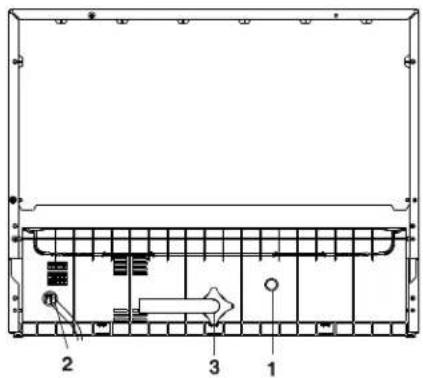
Your dishwasher comes equipped with a 'quick connect' assembly (includes inlet and drain hose). The faucet adapter must be installed on the faucet before you can connect the dishwasher. This adapter is included inside your dishwasher. The faucet adapter is compatible with faucets inclusive of either male (outside) or female (inside) threaded faucet connections.
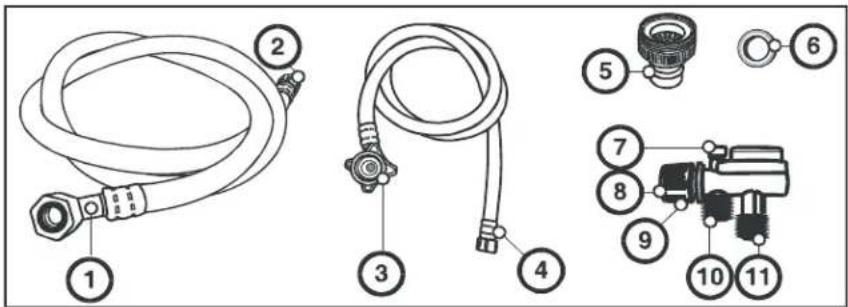
QUICK CONNECT ASSEMBLY
Drain Hose
- Drain port connection
- Quick connect connection
- Inlet port connection
- Quick connect connection
Inlet Hose
Faucet Adapter
- Faucet adapter
- Faucet washer
Quick Connect
- Pressure relief valve
- Faucet adapter connection
- Locking collar
- Inlet hose connection
- Drain hose connection
WARNING
In order to avoid water staying in the inlet hose, please turn off the faucet after using.
WATER CONNECTION (cont.)
- Screw the faucet adapter onto (or into) the faucet tap. Check for leaks (use Teflon tape to eliminate if necessary).
- Connect the six-sided connection of the drain hose to the drain port connection on the back of the dishwasher cabinet. Do not over-tighten (to avoid damage to threads).
- Connect the star-shaped connection of the inlet hose to the inlet port on the back of the dishwasher cabinet. Do not over-tighten (to avoid damage to threads).
- Connect the circular connection of the drain hose onto the longer (bottom) male connection on the quick connect.
- Connect the circular connection of the inlet hose onto the shorter (top) male connection on the quick connect.
- Attach the quick connect onto the faucet adapter, by pulling down the outer locking collar on the quick connect, while pushing the quick connect upward onto the faucet adapter.
- When the quick connect snaps onto the faucet adapter, release the locking collar. Verify the connection is secure.
- Slowly open the hot water line and check for any sign of water leaks at all hose connections. If leaks are located, immediately turn off the water supply and repair the hose connections.
IMPORTANT
- Once you open the water supply line, (even if it is closed immediately thereafter), the inlet hose will be pressurized.
- To relieve water pressure from inside the inlet hose, first make sure the water line (faucet) is closed, then press and hold the red pressure relief button on the quick connect until the flow of water stops.
WARNING
Failure to relieve water pressure before disconnecting the quick connect from the faucet will result in back pressure over-spray. The temperature of the incoming water can be very hot and can cause severe burns and/or scalding.
! DANGER
Do not let children disconnect the dishwasher. Close supervision of children is always important around appliances.
NOTE: Hard water conditions will adversely affect the washing performance of your dishwasher. Hard water conditions will also contribute to 'lime' (white film substance) deposits and/or 'scaling' on the stainless steel surface of the dishwasher tub and heater element, located in the sump underneath the removable filter screen. To minimize these conditions, it is recommended to operate/rinse the inside of the dishwasher (empty) using 1 cup of white vinegar once a week.
DISCONNECTING YOUR DISHWASHER
- Shut off the water supply at the faucet.
- Disconnect the power supply cord
- Relieve water pressure
- Pull down on the quick connect collar
STARTING THE DISHWASHER
The following things should be checked before starting the dishwasher:
1. The dishwasher is level and fixed properly. 2. There is no leakage at the connections of the conducts. 3. The wires are tightly connected. 4. The power is turned on. 5. Make sure the inlet and drain hoses are not twisted. 6. All packing materials and removable printings should be taken out from the dishwasher.

Care and maintenance
FILTERING SYSTEM
The filter prevents larger remnants of food or other objects from getting inside the pump.
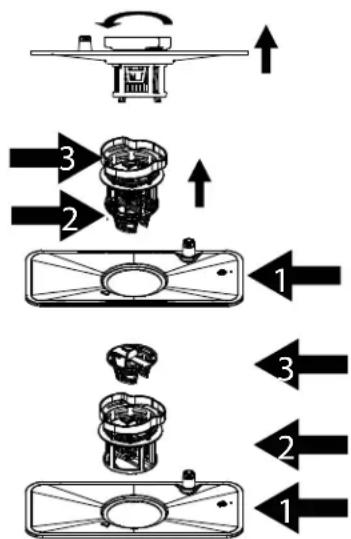
The filter system consists of a coarse filter, a flat (main filter) and a micro filter (fine filter).
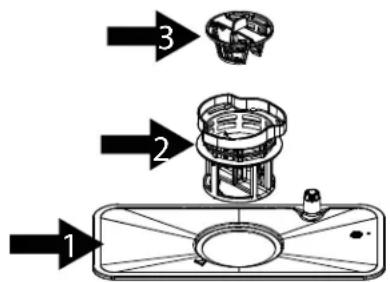
Main filter 1
Food and soil particles trapped by this filter are pulverized by a special jet on the spray arm and washed down to drain.
Fine filter 2
This filter holds soil and food residue in the sump area and prevents it from being deposited on the dishes during a wash cycle.
Coarse filter 3
Larger items, such as pieces of bone or glass, that could block the drain are trapped in the coarse filter. To remove the items caught by the filter, gently squeeze the tap on the top of this filter and lift it out.
FILTER ASSEMBLY
The filter efficiently removes food particles from the wash water, allowing it to be recycled throughout a cycle. For best performance and results, the filter assembly must be regularly cleaned. For this reason, it is a good idea to remove the larger food particles trapped in the filter after each wash cycle by rinsing the filter and cup under running water. To remove the filter assembly, pull upward on the cup handle in the upward direction.
Note: It is recommended that you remove and rinse the filters after each wash cycle.
FILTERING SYSTEM (cont)
CARING FOR THE DISHWASHER
WARNING
- Never run the dishwasher without the filters in place.
- The dishwasher must never be used without the filters.
- Improper replacement of the filter may reduce the performance level of the appliance and damage dishes and utensils.
Step 1. Rotate the fine filter counterclockwise
Step 2. Lift it up.
Step 3. Lift the main filter up.
NOTE: If you follow the steps from Step 1 to Step 3, the filter system will be removed; if you follow the steps from Step 3 to Step 1, the filter system will be installed.
- Inspect the filters for blockage every time the dishwasher is used.
- By unscrewing the coarse filter you can remove the filter system. Remove any food remnants and clean the filters under running water.
- The entire filter assembly should be cleaned once a week.
CLEANING THE FILTER
To clean the coarse filter and the fine filter, use a cleaning brush. Reassemble the filter parts and reinsert the entire assembly in the dishwasher, positioning it in the proper location and pressing downward.
WARNING
When cleaning the filters, handle with care. Otherwise, the filters could be damaged and the performance of the dishwasher could be reduced.
The control panel can be cleaned using a lightly dampened cloth and dried thoroughly. For the exterior, use a good quality appliance polish wax. Never use sharp objects, scouring pads, or harsh cleaners on any part of the dishwasher.
CLEANING THE DOOR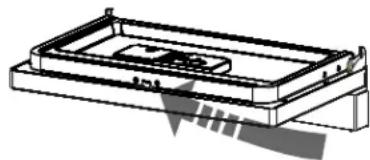
To clean the edge around the door, use only a soft damp cloth. To avoid penetration of water into the door lock and electrical components, do not use a spray cleaner of any kind.
WARNING
- Never use a spray cleaner to clean the door panel as it may damage the door lock and electrical components.
- Abrasive agents or some paper towels should not be used because of the risk of scratching or leaving spots on the stainless steel surface.
CARING FOR THE DISHWASHER (cont.)
CLEANING THE SPRAY ARMS
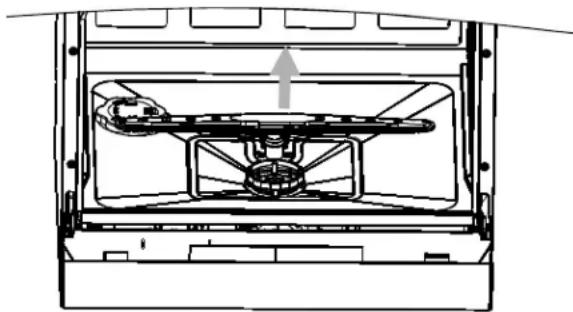
The spray arms can be easily removed for periodic cleaning of the nozzles to prevent possible clogging. Wash them under running water and carefully replace them in their proper position, checking that their rotary movement is in no way impeded.
Grasp the middle of the spray arm, pull it upwards to remove it. Wash the arms under a jet of running water and return them carefully to their position. After reassembly, check that the spray arms turn freely.
HOW TO MAINTAIN YOUR DISHWASHER
• After Every Wash
Turn off the water supply to the appliance and leave the door slightly open so that moisture and odours are not trapped inside.
- Remove the Plug
Before cleaning or performing maintenance, always remove the plug from the socket.
• No Solvents or Abrasive Cleaning
To clean the exterior and rubber parts of the dishwasher, do not use solvents or abrasive cleaning products. Only use a cloth with warm soapy water. To remove spots or stains from the surface of the interior, use a cloth dampened with water with a little vinegar, or a cleaning product made specifically for dishwashers.
- When it is Not in Use
It is recommended that you run a wash cycle with the dishwasher empty and then remove the plug from the socket, turn off the water supply and leave the door of the appliance slightly open. This will help the door seals last longer and prevent odours from forming within the appliance.
- Seals
One of the factors that cause odours to form in the dishwasher is food that remains trapped in the seals. Periodic cleaning with a damp sponge will prevent this from occurring.
Error Codes:
Speed Cycle Light is Flashing: The water faucet may not be turned on, the water intake is obstructed or the water pressure is too low.
Glass Cycle Light is Flashing: An area of the unit may be leaking. Turn off the water supply and call for service.
Occasionally a problem may arise that is minor in nature, and a service call may not be necessary. Use this troubleshooting guide for a possible solution. If the unit continues to operate improperly, call an authorized service depot or Danby's Toll Free Number 1-800-263-2629 for assistance.
| PROBLEM | POSSIBLE CAUSE | SOLUTION |
| Dishwasher doesn’t run | Fuse blown or circuit breaker tripped.Power supply is not turned on.Water pressure is low. | Replace fuse or reset circuit breaker.Make sure dishwasher is turned on and door is closed. Plug in cord securely.Check that water supply is connected and the water is turned on. |
| Noise • Some audible | sounds are normalUtensils are not secure in basket / something small dropped into basket.Motor hums. | Sound from soft food shredding action and detergent cup opening.Ensure everything is secured in the dishwasher.If you do not use often, dishwasher may hum- remember to fill and pump out appliance every week to keep the seal moist. |
| Suds in the tub • Improper detergent / too much soapSpilled rinse agent. | Use only dishwasher detergent to avoid suds. If suds are present, open the door and let suds evaporate.Always wipe rinse agent spills immediately. | |
| Dishes are not dry • Rinse agent dispenser is empty. • Make sure that the rinse agent dis-pener is filled. | ||
| Dishes and flatware are not clean (spots filming) | Improper program selected/run.Improper rack loading.Extremely hard water / rinse agent is empty | Select a stronger program.Make sure that the detergent dis-penser and spray arms are not blocked by large dishware.Remove all metal utensils from dish-washer |
| Detergent left in dis-penser cups | Dishes blocking detergent cupsNot enough water | Re-load the dishes properly.Check water supply |
| Water standing in the bottom of the tub | This is normal. • A small amount of clean water around the outlet on the tub button at the back of the tub keeps the water seal lubricated. | |
| Water doesn’t pump out of the tub | Drain is clogged.Hose is kinkedPump motor faulty. | Make sure the kitchen sink is draining well. If the dishwasher drains into a disposer, run it clear.Have it checked by a qualified technician. |
| Dishwasher leaks / steams | Overfill dispenser or rinse aid spills.Dishwasher isn’t level.Steam is normal. | Be careful not to overfill the rinse aid dispenser. Spilled rinse aid could cause oversuding and lead to overflowing. Wipe away any spills with a damp cloth.Make sure the dishwasher is level.Steam coming through the vent by the door latch is normal during drying and water draining. |
LIMITED APPLIANCE WARRANTY
This quality product is warranted to be free from manufacturer's defects in material and workmanship, provided that the unit is used under the normal operating conditions intended by the manufacturer.
This warranty is available only to the person to whom the unit was originally sold by Danby Products Limited (Canada) or Danby Products Inc. (U.S.A.) (hereafter "Danby") or by an authorized distributor of Danby, and is non-transferable.
TERMS OF WARRANTY
Plastic parts are warranted for thirty (30) days only from the purchase date, with no extensions provided.
First Year
During the first twelve (12) months, any functional parts of this product found to be defective will be repaired or replaced, at the warrantor's option, at no charge to the ORIGINAL purchaser.
To obtain service
It will be the consumer's responsibility to transport the appliance (at their own expense) to the original retailer (point of purchase) or a service depot for repair. Contact your dealer from whom your unit was purchased, or contact your nearest authorized Danby service depot, where service must be performed by a qualified service technician. If service is performed on the unit by anyone other than an authorized service depot, or the unit is used for commercial application, all obligations of Danby under this warranty shall be void.
Nothing within this warranty shall imply that Danby will be responsible or liable for any spoilage or damage to food or other contents of this appliance, whether due to any defect of the appliance, or its use, whether proper or improper.
EXCLUSIONS
Save as herein provided, by Danby, there are no other warranties, conditions, representations or guarantees, express or implied, made or intended by Danby or its authorized distributors and all other warranties, conditions, representations or guarantees, including any warranties, conditions, representations or guarantees under any Sale of Goods Act or like legislation or statute is hereby expressly excluded. Save as herein provided, Danby shall not be responsible for any damages to persons or property, including the unit itself, howsoever caused or any consequential damages arising from the malfunction of the unit and by the purchase of the unit, the purchaser does hereby agree to indemnify and hold harmless Danby from any claim for damages to persons or property caused by the unit.
GENERAL PROVISIONS
No warranty or insurance herein contained or set out shall apply when damage or repair is caused by any of the following:
1) Power failure. 2) Damage in transit or when moving the appliance. 3) Improper power supply such as low voltage, defective house wiring or inadequate fuses. 4) Accident, alteration, abuse or misuse of the appliance such as inadequate air circulation in the room or abnormal operating conditions (extremely high or low room temperature). 5) Use for commercial or industrial purposes (i.e., if the appliance is not installed in a domestic residence). 6) Fire, water damage, theft, war, riot, hostility, acts of God such as hurricanes, floods, etc. 7) Service calls resulting in customer education. 8) Improper installation (i.e., building-in of a free standing appliance or using an appliance outdoors that is not approved for outdoor application).
Proof of purchase date will be required for warranty claims; so, please retain bill of sale. In the event warranty service is required, present this document to our AUTHORIZED SERVICE DEPOT.
Warranty Service
Carry-In
Danby Products Limited
PO Box 1778, Guelph, Ontario, Canada N1H 6Z9
Telephone: (519) 837-0920 FAX: (519) 837-0449
1-800-263-2629
07/13
Danby Products Inc.
PO Box 669, Findlay, Ohio, U.S.A. 45840
Telephone: (419) 425-8627 FAX: (419) 425-8629
DEALER OPENING
1
2
3
WARNING
DID YOU FORGET AN ITEM?
QUICK CONNECT FITTING
Drain hose
Main filter 1
DOOR CLEANING
HOW TO MAINTAIN YOUR DISHWASHER
Danby Products Limited
PO Box 1778, Guelph, Ontario, Canada N1H 6Z9
Telephone: (519) 837-0920 Fax: (519) 837-0449
1-800-263-2629
03/14
Danby Products Inc.
PO Box 669, Findlay, Ohio, U.S.A. 45840
Telephone: (419) 425-8627 Fax: (419) 425-8629



WARNING
CORRECT USE OF DETERGENT
Dish rack basket
main filter 1
WARNING
HOW TO MAINTAIN THE DISHWASHER
Danby Products Limited
PO Box 1778, Guelph, Ontario, Canada N1H 6Z9
Telephone: (519) 837-0920 FAX: (519) 837-0449
1-800-263-2629
07/13
Danby Products Inc.
PO Box 669, Findlay, Ohio, U.S.A. 45840
Telephone: (419) 425-8627 FAX: (419) 425-8629
DISHWASHER
All repair parts are available for purchase or special order when you visit your nearest service depot. To request service and/or the location of the service depot nearest you, call the TOLL FREE number.
When requesting service or ordering parts, always provide the following information:
- Product Type
- Model Number
- Part Number
- Part Description
LAVAPLATOS


- DO NOT RETURN THIS UNIT TO THE RETAILER WITHOUT FURTHER INSTRUCTIONS
- DO NOT RETURN THIS DEVICE TO THE RETAILER WITHOUT FURTHER INSTRUCTIONS
- DISHWASHER
- PRECAUTION
- THANK YOU FOR CHOOSING DANBY
- NEED HELP
- GROUNDING INSTRUCTIONS
- WARNING
- SAFETY PRECAUTIONS
- WHEN LOADING ITEMS TO BE WASHED
- SAVE THESE INSTRUCTIONS
- CONTROL PANEL
- DISHWASHER FEATURES
- FILL THE RINSE AID DISPENSER
- RINSE AID DISPENSER
- FUNCTION OF RINSE AID
- ATTENTION
- WHEN TO REFILL THE RINSE DISPENSER
- OPENING THE DISPENSER
- OPERATING INSTRUCTIONS
- FILL THE RINSE AID DISPENSER (CONT.)
- ADJUSTING RINSE AID DISPENSER
- FUNCTION OF DETERGENT
- PROPER USE OF DETERGENT
- DETERGENTS
- CONCENTRATED DETERGENT
- FUNCTION OF DETERGENT (CONT.)
- DETERGENT DISPENSER
- AMOUNT OF DETERGENT TO USE
- ADD DETERGENT
- NOTE
- RECOMMENDATION
- WASHING CUTLERY/ DISHES
- ARE NOT SUITABLE
- ARE OF LIMITED SUITABILITY
- BEFORE/AFTER LOADING THE DISH- WASHER BASKETS
- PLACE OBJECTS IN THE DISHWASHER THE FOLLOWING WAY
- LOADING THE BASKET
- PLATE RACKS IN BASKET
- CUTLERY BASKET
- WASH CYCLE TABLE
- TURNING ON THE APPLIANCE
- STARTING A WASH CYCLE
- CHANGING THE PROGRAM
- FORGOT TO ADD A DISH
- A FORGOTTEN DISH CAN BE ADDED ANY TIME BEFORE THE DETERGENT CUP OPENS
- AT THE END OF THE WASH CYCLE
- TURN OFF THE DISHWASHER
- OPEN THE DOOR CAREFULLY
- UNLOADING THE DISHWASHER
- INSTALLATION PREPARATION
- POSITIONING THE APPLIANCE
- ABOUT POWER CONNECTION
- FOR PERSONAL SAFETY
- ELECTRICAL REQUIREMENTS
- ELECTRICAL CONNECTION
- WATER CONNECTION
- REAR OF DISHWASHER
- QUICK CONNECT ASSEMBLY
- DRAIN HOSE
- INLET HOSE
- FAUCET ADAPTER
- QUICK CONNECT
- WATER CONNECTION (CONT.)
- IMPORTANT
- DANGER
- DISCONNECTING YOUR DISHWASHER
- STARTING THE DISHWASHER
- CARE AND MAINTENANCE
- FILTERING SYSTEM
- MAIN FILTER
- FINE FILTER
- COARSE FILTER
- FILTER ASSEMBLY
- FILTERING SYSTEM (CONT)
- CARING FOR THE DISHWASHER
- CLEANING THE FILTER
- CARING FOR THE DISHWASHER (CONT.)
- CLEANING THE SPRAY ARMS
- HOW TO MAINTAIN YOUR DISHWASHER
- ERROR CODES
- LIMITED APPLIANCE WARRANTY
- TERMS OF WARRANTY
- EXCLUSIONS
- GENERAL PROVISIONS
- WARRANTY SERVICE
- CARRY-IN
- DEALER OPENING
- DID YOU FORGET AN ITEM
- QUICK CONNECT FITTING
- DOOR CLEANING
- CORRECT USE OF DETERGENT
- DISH RACK BASKET
- HOW TO MAINTAIN THE DISHWASHER
- LAVAPLATOS
Brand : DANBY
Model : DDW621WDB
Category : Dishwasher