LI1315X - Dishwasher Leonard - Free user manual and instructions
Find the device manual for free LI1315X Leonard in PDF.



| Brand | Leonard |
| Model | LI1315X |
| Product type | Built-in dishwasher |
| Dimensions (W x H x D) | 596 x 818-898 x 575 mm |
| Capacity | 12 place settings |
| Water pressure | 0.5 - 8 bar (0.05 - 0.8 MPa) |
| Electrical connection | 220-240 V ~50 Hz |
| Wash programs | Normal (65°C), Quick (65°C), Eco (50°C) |
| Water consumption | 9 - 21 liters per cycle |
| Energy consumption | 0.9 - 1.6 kWh per cycle |
| Program duration | 30 - 140 minutes |
| Water softener | Adjustable manually and electronically |
| Indicators | Salt, rinse aid, running and end indicator lights |
| Baskets | Upper basket height adjustable (2 positions), lower basket with cutlery separator |
| Safety | Anti-overflow system, child lock (supervision recommended) |
| Maintenance and cleaning | Filters (coarse, micro, flat) and spray arms cleanable |
| Spare parts | Use only original parts |
| Repairability | Service by a qualified professional; contact customer service |
| General information | User manual available in multiple languages; domestic use |
Frequently Asked Questions - LI1315X Leonard
User questions about LI1315X Leonard
0 question about this device. Answer the ones you know or ask your own.
Ask a new question about this device
Download the instructions for your Dishwasher in PDF format for free! Find your manual LI1315X - Leonard and take your electronic device back in hand. On this page are published all the documents necessary for the use of your device. LI1315X by Leonard.
USER MANUAL LI1315X Leonard
text_image
Safety warning symbol and diagram showing a faucet with a downward lightning bolt, indicating hazard or caution.text_image
Labeled diagram of a refrigerator interior showing numbered components for identification1 Oberkorb
natural_image
Diagram of two mechanical components with directional arrows indicating motion or rotation (no text or symbols)natural_image
Technical line drawing of a mechanical component with coiled springs and internal channels (no text or symbols)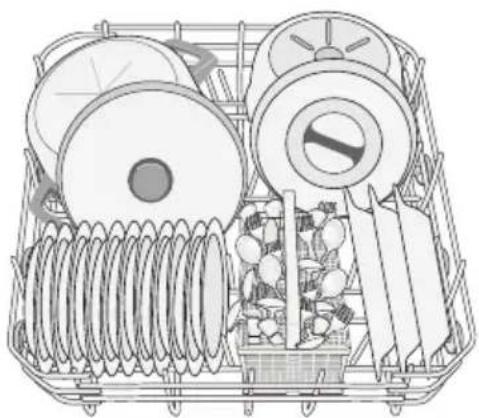
natural_image
Illustration of a basket containing various mechanical components including spools, gears, and a handle (no text or symbols present)Besteckkorb
text_image
Warning symbol illustration showing a cutlery box with cutlery, crossed tools, and a warning sign.natural_image
Line drawing of a multi-tiered kitchen appliance basket with various kitchenware and dish items (no text or symbols)natural_image
Line drawing of a rack with multiple plates and metal fixtures (no text or symbols)text_image
Diagram illustrating a mechanical assembly process with labeled components and directional arrows, showing two stages of assembly steps.text_image
Diagram illustrating a mechanical or biological process with labeled components and directional arrows indicating sequence or movement.natural_image
Illustration of a hand pressing a padlock on a device with ovals and a labeled 'D' (no text or symbols on the diagram itself)Use of the appliance 21
Setting the water softener 21
Use of dishwasher salt 22
Use of detergent and rinse aid 22
Loading cutlery and dishes 23
Setting and starting a washing programme
25
Washing programmes 25
Care and cleaning 26
What to do if... 27
Technical data 29
Environment concerns 29
Subject to change without notice

SAFETY INFORMATION
Before the installation and use, read this manual carefully:
- For your safety and the safety of your property.
- To help the environment.
- For the correct operation of the appliance.
Always keep these instructions with the appliance also if you move or give it to a different person.
The manufacturer is not responsible if an incorrect installation and use causes damage.
Children and vulnerable persons safety
- Do not let persons, children included, with reduced physical sensory, reduced mental functions or lack of experience and knowledge to use the appliance.
They must have supervision or instruction for the operation of the appliance by a person who is responsible for their safety. - Children must get supervision to make sure that they do not play with the appliance.
- Keep all packaging away from children. There is the risk of suffocation or injury.
- Keep all detergents in a safe area. Do not let the children touch the detergents.
- Keep children and pets away from the appliance when the door is open.
General safety
- Do not change the specifications of this appliance. There is the risk of injury and damage to the appliance.
-
Obey the safety instructions from the detergent manufacturer to prevent burns to eyes, mouth and throat.
-
Do not drink the water from the appliance. Particles of detergent can stay in your appliance.
- Do not keep the appliance door open without supervision. This to prevent injury and to fall on an open door.
- Do not sit or stand on the open door.
Use
- The appliance is only for domestic use. Do not use the appliance for other uses to prevent injury to persons and damage to property.
- Only use the appliance to clean accessories that are applicable for dishwashers.
- Do not put flammable products or items that are wet with flammable products in, near or on the appliance. Risk of explosion or fire.
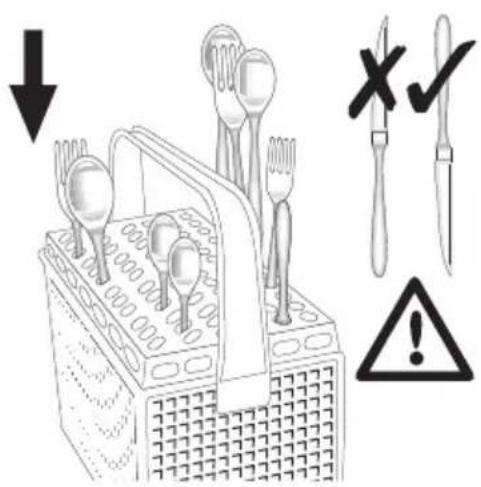
- Put the knives and all items with sharp points in the cutlery basket with their points down. If not, put in a horizontal position in the upper basket or in the knife basket. (Not all models have the knife basket).
- Use only specified products for dishwashers (detergent, salt, rinse aid).
- Types of salt that are not specified for dishwashers can cause damage to the water softener.
- Fill the appliance with salt before you start a washing programme. Remaining salt in the appliance can cause corrosion or make a hole in the bottom of the appliance.
-
Do not fill the rinse aid dispenser with other products than the rinse aid, (dish-washer cleaning agent, liquid detergent). This can cause damage to the appliance.
-
Make sure that the spray arms can move freely before you start a washing programme.
- The appliance can release hot steam if you open the door while a washing programme operates. There is a risk of skin burns.
- Do not remove the dishes once until the washing programme is completed.
Care and cleaning
- Before you clean the appliance, deactivate it and disconnect the mains plug from the mains socket.
- Do not use flammable products or products that can cause corrosion.
- Do not use the appliance without the filters. Make sure that the installation of the filters is correct. An incorrect installation causes unsatisfactory washing results and damage to the appliance.
- Do not use spray water or steam to clean the appliance. Risk of electrical shock and damage to the appliance.
Installation
- Make sure that the appliance is not damaged. Do not install or connect a damaged appliance, contact the supplier.
- Remove all packaging before you install and use the appliance.
- Only a qualified person must do the electrical connection, the plumbing and the installation of the appliance. This to prevent the risks of structural damage or injury.
- Make sure that the mains plug is disconnected from the mains socket during installation.
- Do not drill into the sides of the appliance to prevent damage to hydraulic components and electrical components.
- Important! Obey the instructions in the template supplied with the appliance:
- To install the appliance.
- To assemble the door panel.
- To connect to the water supply and drain.
- Make sure that the appliance is installed below and adjacent to safe structures.
Frost precautions
- Do not install the appliance where the temperature is less than 0 °C.
- The manufacturer is not responsible for frost damage.
Water connection
- Use new hoses to connect the appliance to the water supply. Do not use used hoses.
- Do not connect the appliance to new pipes or pipes not used for a long time. Let the water flow for some minutes, then connect the inlet hose.
- Make sure not to squash or cause damage to the water hoses when you install the appliance.
- Make sure that the water couplings are tight to prevent a water leakage.
- The first time you use the appliance, make sure that the hoses do not have water leaks.
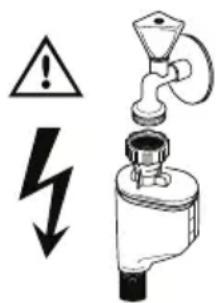
- The water inlet hose has a safety valve and a double sheath with an inner mains cable. There is pressure in the water inlet hose only when the water flows. If there is a leak in the water inlet hose, the safety valve interrupts the flow of water.
- Be careful when you connect the water inlet hose:
- Do not put the water inlet hose or the safety valve in water.
- If the water inlet hose or the safety valve are damaged, immediately disconnect the mains plug from the mains socket.
- Contact the service centre to replace the water inlet hose with safety valve.

Warning! Dangerous voltage.
text_image
Safety warning symbol and diagram showing a faucet with warning sign and lightning bolt, indicating hazard or hazard.Electrical connection
- The appliance must be earthed.
- Make sure that the electrical information on the rating plate agrees with the power supply.
-
Always use a correctly installed shock-proof socket.
-
Do not use multiple plugs and extension cables. There is a risk of fire.
- Do not replace or change the mains cable. Contact the service centre.
- Make sure not to squash or cause damage to the mains plug and cable behind the appliance.
- Make sure that there is access to the mains plug after the installation.
- Do not pull the mains cable to disconnect the appliance. Always pull the mains plug.
Service centre
- Only a qualified person can repair or work on the appliance. Contact the service centre.
- Use only original spare parts.
To discard the appliance
• To prevent the risk of injury or damage:
- Disconnect the mains plug from the mains socket.
-
Cut off the mains cable and discard it.
-
Remove the door catch. This prevents children or pets to be closed in the appliance. There is a risk of suffocation.
- Discard the appliance at the local waste disposal centre.
Warning! The dishwasher detergents are dangerous and can cause corrosion!
- If an accident occurs with these detergents, contact immediately a physician.
- If the detergent gets into the mouth, contact immediately a physician.
- If the detergent gets into the eyes, contact immediately a physician and clean the eyes with water.
- Keep dishwasher detergents in a safe area and out of children touch.
- Do not keep the appliance door open when there is detergent in the detergent dispenser.
- Fill the detergent dispenser only before you start a washing programme.
PRODUCT DESCRIPTION
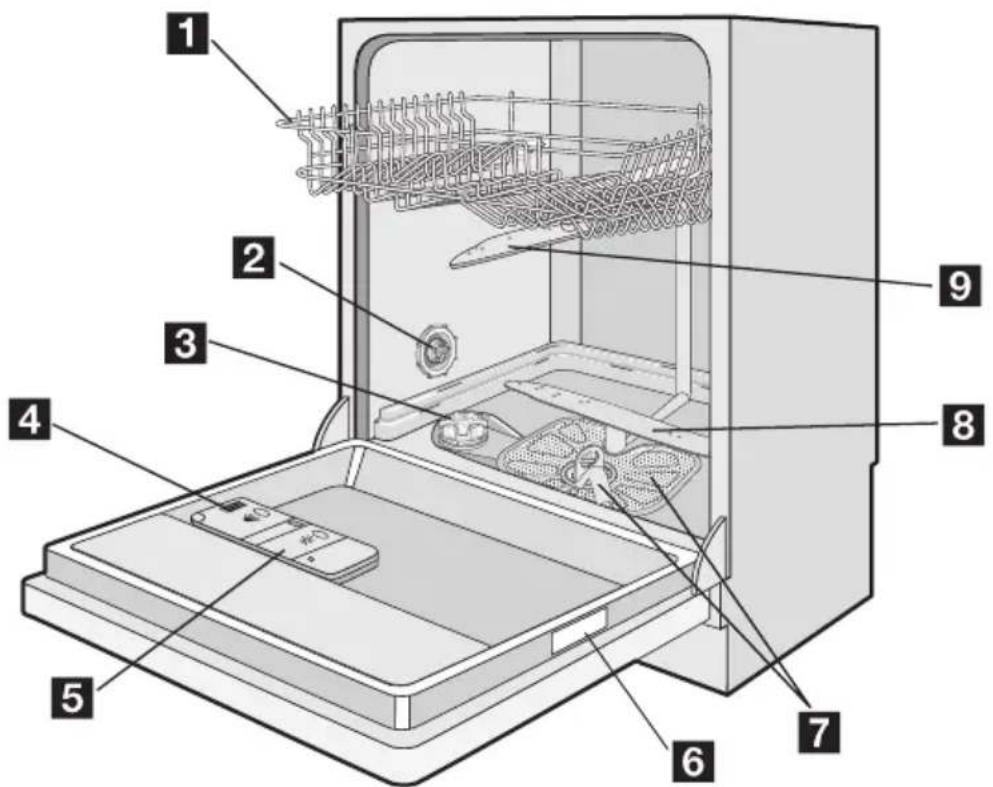
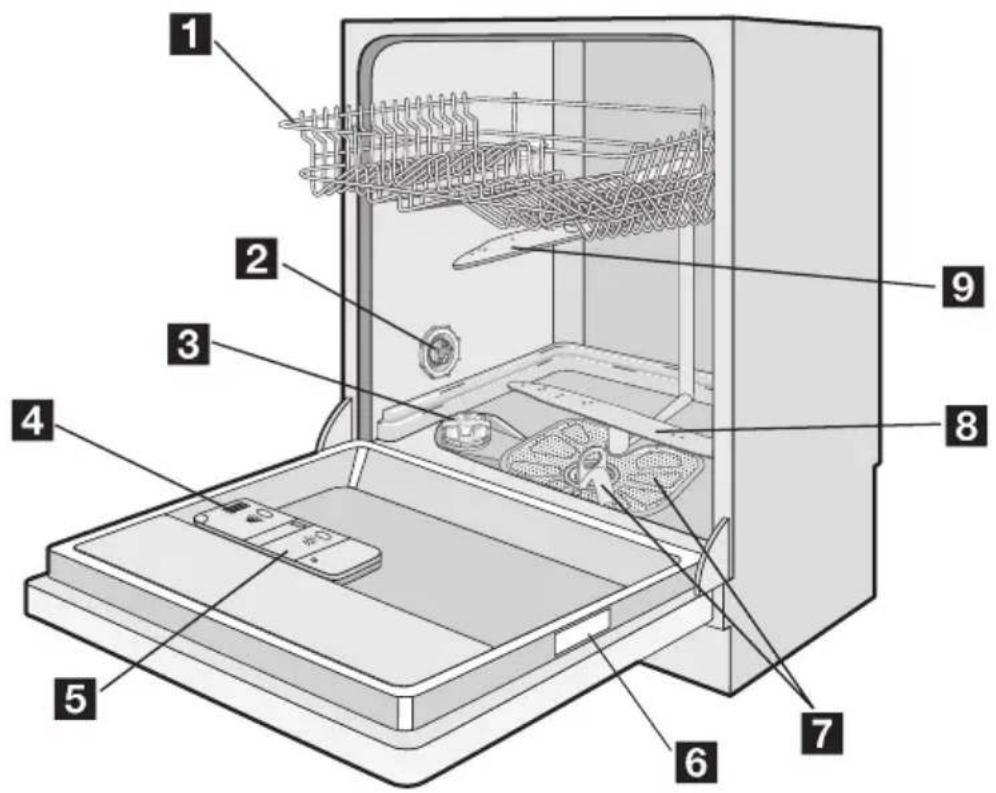
text_image
Labeled diagram of a refrigerator interior showing numbered components for identification1 Upper basket
2 Water hardness dial
3 Salt container
4 Detergent dispenser
5 Rinse aid dispenser
6 Rating plate
7 Filters
8 lower spray arm
9 Upper spray arm
CONTROL PANEL
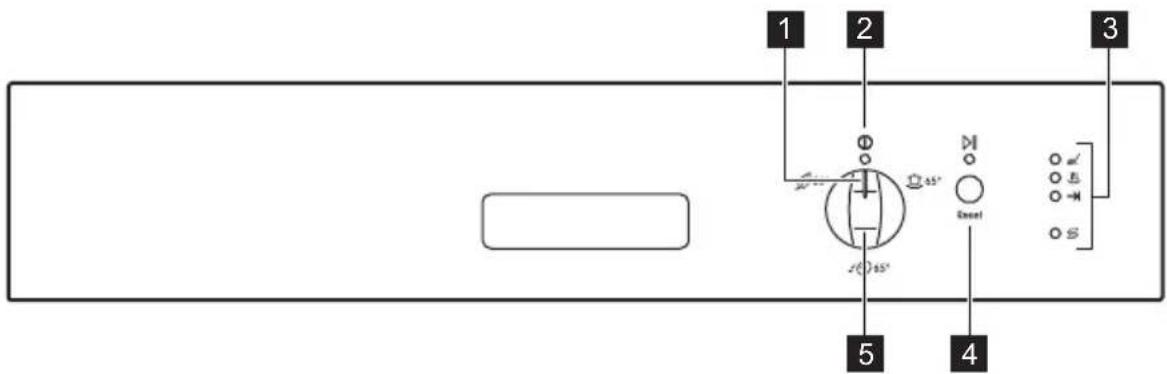
text_image
1 2 3 5 41 Programme marker
2 On/off indicator light
3 indicator lights
4 Start/cancel button
5 Programme knob
| Indicators | |
| Washing phase indicator. It comes on when the washing phase or the rinsing phases operate. | |
| Drying phase indicator. It comes on when the drying phase operates. | |
| →I | End indicator. It comes on in these conditions:When the washing programme is completed.When you adjust the level of the water softener.When there is a malfunction of the appliance. |
| S | Salt indicator. It comes on when it is necessary to fill the salt container.1)After you fill the container, the salt indicator can stay on for some hours. This does not have an unwanted effect on the operation of the appliance. |
1) When the salt container is empty, the related indicator does not come on while a washing programme operates.
Programme knob and on/off indicator
To activate the appliance and set a washing programme
- Align the programme marker that is on the knob with a washing programme. Refer to 'Washing programmes'. The on/off indicator comes on.
To deactivate the appliance
- Align the programme marker with the on/off indicator. The on/off indicator goes off.
Start/cancel button
Use this button for these operations:
- To start a washing programme. Refer to 'Setting and starting a washing programme'.
- To cancel a washing programme in progress. Refer to 'Setting and starting a washing programme'.
- To adjust electronically the level of the water softener. Refer to 'Setting the water softener'.
USE OF THE APPLIANCE
-
Be sure that the set level of the water softener agrees with the water hardness in your area. If not, adjust the water softener.
-
Fill the salt container with dishwasher salt.
-
Fill the rinse aid dispenser with rinse aid.
-
Load cutlery and dishes into the appliance.
-
Set the correct washing programme for the type of load and soil.
-
Fill the detergent dispenser with the correct quantity of detergent.
-
Start the washing programme.
SETTING THE WATER SOFTENER
The water softener removes minerals and salts from the water supply. These minerals and salts can cause damage to the appliance.
Adjust the level of the water softener if this does not agree with the water hardness in your area.
Contact your local water authority to know the water hardness in your area.
| German degrees (°dH) | Water hardness | Water hardness adjustment | |||
| French degrees (TH°) | mmol/l Clarke de-grees | manually elec-troni-cally | |||
| 51 - 70 | 91 - 125 | 9,1 - 12,5 | 64 - 88 | 21) | 10 |
| 43 - 50 | 76 - 90 | 7,6 - 9,0 | 53 - 63 | 21) | 9 |
| 37 - 42 | 65 - 75 | 6,5 - 7,5 | 46 - 52 | 21) | 8 |
| 29 - 36 | 51 - 64 | 5,1 - 6,4 | 36 - 45 | 21) | 7 |
| 23 - 28 | 40 - 50 | 4,0 - 5,0 | 28 - 35 | 21) | 6 |
| 19 - 22 | 33 - 39 | 3,3 - 3,9 | 23 - 27 | 21) | 51) |
| 15 - 18 | 26 - 32 | 2,6 - 3,2 | 18 - 22 | 1 | 4 |
| 11 - 14 | 19 - 25 | 1,9 - 2,5 | 13 - 17 | 1 | 3 |
| 4 - 10 7 - 18 | 0,7 - 1,8 5 - 12 1 2 | ||||
| < 4 | < 7 | < 0,7 | < 5 | 12) | 12) |
1) Factory position.
2) Do not use salt at this level.
You must adjust the water softener manually and electronically.
Manual adjustment
Turn the water hardness dial to the position 1 or 2 (refer to the table).
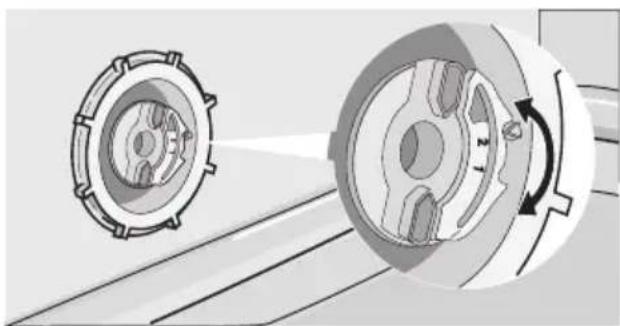
natural_image
Diagram of a mechanical component with two circular parts, one showing internal gear and the other showing a rotating shaft (no text or symbols)Electronic adjustment
-
Press and hold the start/cancel button.
-
Turn the programme knob clockwise until the programme marker is aligned with the first washing programme.
-
Release the start/cancel button when the on/off indicator and the start/cancel indicator start to flash.
- At the same time, the end indicator flashes intermittently. The number of flashes shows the setting of the water softener (example: 5 flashes / pause / 5 flashes = level 5).
-
Press the start/cancel button again and again to change the setting. Each time you press the start/cancel button, the adjustment increases by 1 level.
-
Deactivate the appliance to confirm.
If the water softener is set electronically to the level 1, the salt indicator light stays off.
USE OF DISHWASHER SALT
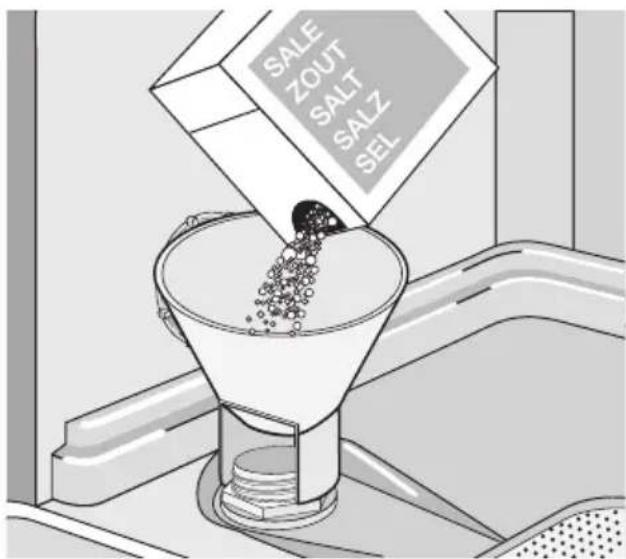
How to fill the salt container:
-
Turn the cap counterclockwise and open the salt container.
-
Fill the salt container with 1 litre of water (only for the first time you fill with salt).
-
Use the funnel to fill the salt container with salt.
-
Remove the salt around the opening of the salt container.
-
Turn the cap clockwise to close the salt container.
It is correct that water comes out from the salt container when you fill it with salt.
text_image
SALE ZOUT SALT SALZ SELUSE OF DETERGENT AND RINSE AID
text_image
Diagram of a device's internal components with numbered labels pointing to different parts of the device.Use of detergent
To help the environment, do not use more than the correct quantity of detergent.
Follow the detergent manufacturer recommendations on the detergent packaging.
Do these steps to fill the detergent dispenser:
-
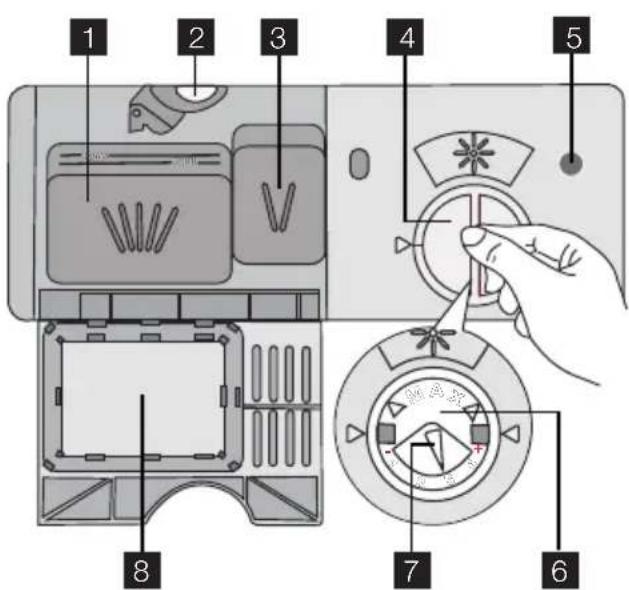
Press the release button 2 to open the lid 8 of the detergent dispenser.
-
Put the detergent in the dispenser 1.
-
If the washing programme has a pre-wash phase, put a small quantity of detergent in the prewash detergent compartment 3.
-
If you use the detergent tablets, put the tablet in the detergent dispenser 1.
-
Close the detergent dispenser. Press the lid until it locks into position.
i Different brands of detergent dissolve in different times. Some detergent tablets do not have the best cleaning results during short washing programmes. Use long washing programmes when you use the detergent tablets to fully remove the detergent.
Use of rinse aid
i Rinse aid makes it possible to dry the dishes without streaks and stains. The rinse aid dispenser automatically adds rinse aid during the last rinsing phase.
Do these steps to fill the rinse aid dispenser:
- To open the rinse aid dispenser, turn the cap 4 counterclockwise
- Fill the rinse aid dispenser 6 with rinse aid. The mark 'max' shows the maximum level.
- Remove the spilled rinse aid with an absorbent cloth to prevent too much foam during the washing programme.
- To close the rinse aid dispenser, put the cap in position and turn it clockwise.
i Fill the rinse aid dispenser when the indicator 5 becomes clear.
Adjust the rinse aid dosage
Factory set: position 3.
You can set the rinse aid dosage between position 1 (lowest dosage) and position 4 (highest dosage).
LOADING CUTLERY AND DISHES
Hints and tips
- Do not put in the appliance items that can absorb water (sponges, household cloths).
- Remove the remaining food from the items.
- Make soft the remaining burned food on the items.
- Put hollow items (cups, glasses and pans) with the opening down.
- Make sure that water does not collect in containers or in bowls.
Turn the rinse aid selector 7 to increase or decrease the dosage.
Using combi detergent tablets
These tablets contain agents as detergent, rinse aid and dishwasher salt. Some types of tablets can contain other agents.
When you use tablets, that contain salt and rinse aid, do not fill the salt container and rinse aid dispenser.
Be sure that these tablets are applicable for the water hardness in your area (refer to the instructions on the packaging of the products).
- Adjust the water hardness to the lowest level. Refer to 'Setting the water softener'.
- Set the rinse aid dosage to the lowest position. Refer to 'Use of detergent and rinse aid'.
Using again separately detergent, salt and rinse aid
- Fill the salt container and the rinse aid dispenser.
- Adjust the water hardness to the highest level.
- Start a washing programme without dishes.
- When the washing programme is completed, adjust the water softener to the water hardness in your area.
-
Adjust the quantity of rinse aid.
-
Make sure that cutlery and dishes do not bond together.
- Make sure that the glasses do not touch other glasses.
- Put small items in the cutlery basket.
- Mix the spoons with other cutlery to prevent them to bond together.
- When you put the items in the baskets, make sure that the water can touch all surfaces.
- Put light items in the upper basket. Make sure that the items do not move.
- Water droplets can collect on plastic items and non-stick pans.
Lower basket
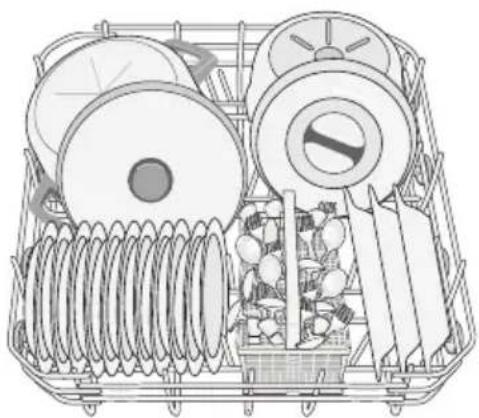
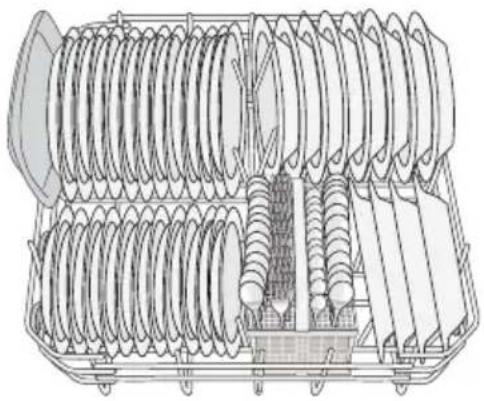
Put the saucepans, lids, plates, salad bowls and cutlery in the lower basket. Arrange the service dishes and large lids around the edge of the basket.
natural_image
Technical line drawing of a mechanical assembly with coiled components and housing (no text or symbols)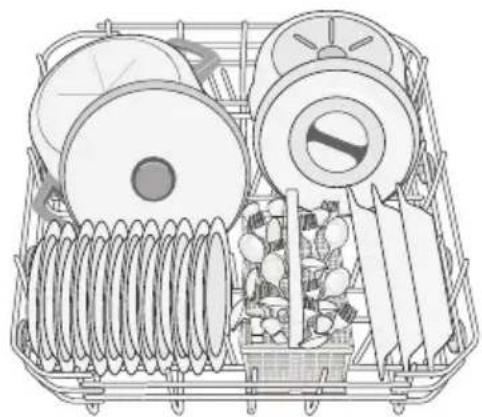
natural_image
Illustration of a basket containing various mechanical components including spools, gears, and a basket filled with items (no text or symbols)The cutlery basket
Put the forks and spoons with the handles down.
Put the knives with the handles up.
text_image
Illustration of a battery tray with cutlery and tools, including a downward arrow and warning symbols like 'X', '✓', and an exclamation mark.Mix the spoons with other cutlery to prevent them to bond together.
Use the cutlery grid. If the dimensions of the cutlery prevent use of the cutlery grid, you can easily remove it.
Upper basket
The upper basket is for plates (maximum 24 cm in diameter), saucers, salad bowls, cups, glasses, pots and lids. Arrange the items to let water touch all surfaces.
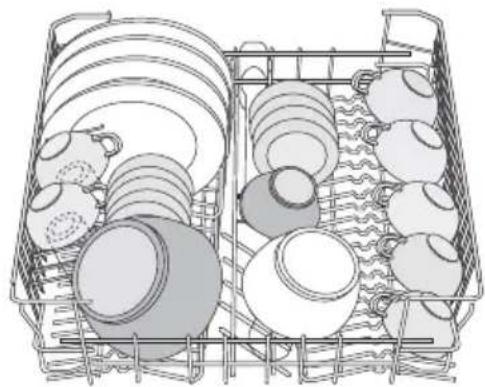
natural_image
Line drawing of a multi-tiered kitchen appliance basket with plates, cups, and wavy legs (no text or symbols)Put the glasses with long stems in the cup racks with the stems up. For longer items, fold the cup racks up.
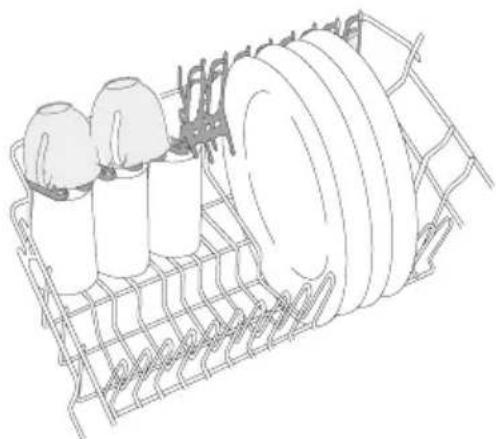
natural_image
Line drawing of a rack with three cylindrical containers and a coiled roller (no text or symbols)Adjustment of the height of the upper basket
You can put the upper basket in two positions to increase the load flexibility.

Caution! Adjust the height before you load the upper basket.
| Maximum height of the dishes in: | ||
| the upper | basket | the lower basket |
| Higher position 20 cm | 31 cm | |
| Lower position 24 cm | 27 cm | |
Do these steps to move the upper basket to the higher position:
-
Move the front runner stops (A) out.
-
Pull the basket out. 3. Put the basket in the upper position.
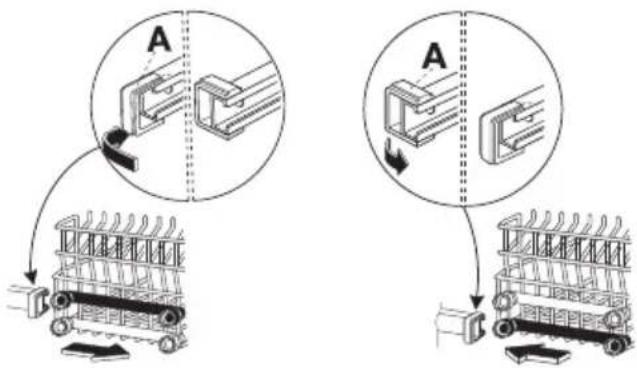
text_image
Diagram illustrating two mechanical assembly steps (A) showing a cart being loaded with rollers, with arrows indicating motion direction.- Put back the front runner stops (A) in their initial position.
Caution! If the basket is in the upper position, do not put cups on the cup racks.
SETTING AND STARTING A WASHING PROGRAMME
Select and start a washing programme
- Close the door.
- Select a washing programme. Refer to 'Washing programmes'.
-
The on/off indicator light comes on.
-
Press the start/cancel button. The washing programme starts automatically.
- The start/cancel indicator light comes on.
Interruption of a washing programme
- Open the appliance door.
- The washing programme stops.
- Close the appliance door.
– The washing programme continues from the point of interruption.
Cancelling the washing programme
If the washing programme has not started, you can change the selection.
To change the selection while the washing programme operates, it is necessary to cancel the programme.
- Press and hold the start/cancel but until the start/cancel indicator goes off.
i Make sure that there is detergent in the detergent dispenser before you start a new washing programme.
End of the washing programme
When the washing programme is completed, the end indicator comes on.
Deactivate the appliance and open the appliance door.
Remove the items from the baskets
- Let the dishes become cold before you remove them from the appliance. Hot dishes can be easily damaged.
- First remove the items from the lower basket, then from the upper basket.
- There can be water on the sides and on the door of the appliance. Stainless steel becomes cool more quickly than the dishes.
WASHING PROGRAMMES
| Programme | Type of soil | Type of load | Programme description |
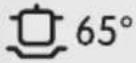 | Normal soil Crockery and cutlery Prewash | Wash 65 °CRinsesDry | |
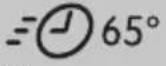 1) 1) | Fresh soil Crockery and cutlery Wash 65 °C | Rinse | |
| 50°2) | Normal soil Crockery and cutlery Prewash | Wash 50 °CRinsesDry | |
1) With this programme you can wash a load with fresh soil. It gives good washing results in a short time.
2) This is the standard programme for test institutes. With this programme you have the most efficient use of water and energy consumption for crockery and cutlery with normal soil. Refer to the supplied leaflet for test information.
Consumption values
| Programme Programme time (minute) | Energy (kWh) Water (litre) | ||
| 100-110 1,4-1,6 19-21 | |||
| 30 0,9 9 | |||
| 130-140 1,0-1,2 14-16 | |||
The water pressure and temperature, the variations of the mains supply and
the quantity of dishes can change the consumption values.
CARE AND CLEANING
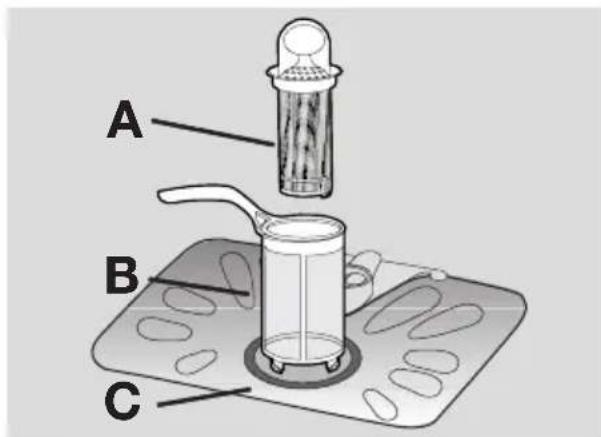
To remove and clean the filters
Dirty filters decrease the washing results. The appliance has three filters:
- coarse filter (A)
- microfilter (B)
- flat filter (C)
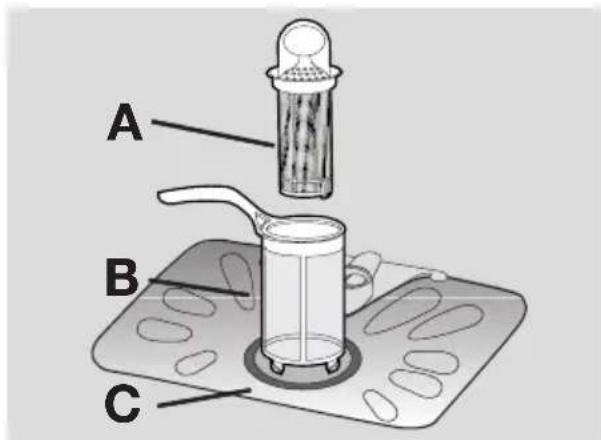
text_image
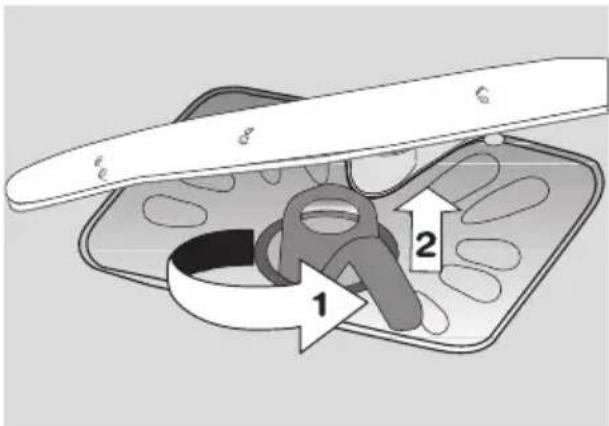
A B C- To unlock the filter system, turn the handle on the microfilter (B) approximately 1/4 counterclockwise.
text_image
Diagram illustrating a mechanical or electrical component with labeled parts and directional arrows indicating motion or assembly.- Remove the filter system.
- Hold the coarse filter (A) by the handle with the hole.
-
Remove the coarse filter (A) from the microfilter (B).
-
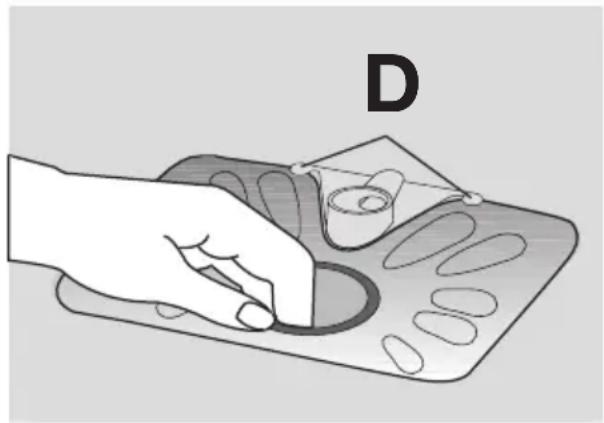
Remove the flat filter (C) from the bottom of the appliance.
natural_image
Illustration of a hand pressing a small object on a surface with ovals and a labeled point D (no text or symbols on the object itself)- Clean the filters below running water.
-
Put the flat filter (C) to its initial position. Make sure that it assembles correctly under the two guides (D).
-
Put the coarse filter (A) in the microfilter (B) and push the filters together.
- Put the filter system in position.
- To lock the filter system, turn the handle on the microfilter (B) clockwise until it locks in position.
To clean the spray arms
Do not remove the spray arms.
If the holes in the spray arms become clogged, remove remaining parts of soil with a thin pointed object.
To clean the external surfaces
Clean the external surfaces of the appliance and control panel with a moist soft cloth.
Only use neutral detergents.
Do not use abrasive products, abrasive cleaning pads or solvents (acetone).
WHAT TO DO IF...
The start of the appliance does not occur or it stops during operation.
First try to find a solution to the problem (refer to the table). If not, contact the service centre.
With some malfunctions the indicators flash to show an alarm code.
| Alarm code Malfunction | |
| The start/cancel indicator flashes continuously.The end indicator flashes one time intermittently. | The appliance does not fill with water. |
| The start/cancel indicator flashes continuously.The end indicator flashes two times intermittently. | The appliance does not drain the water. |
| The start/cancel indicator flashes continuously.The end indicator flashes three times intermittently. | The anti-flood device is on. |

Warning! Deactivate the appliance before you do the checks.
| Malfunction Possible cause Possible solution | ||
| The appliance does not fill with water. | The water tap is blocked or there is limescale on it. | Clean the water tap. |
| The water pressure is too low. | Contact your local water authority. | |
| The water tap is closed. Open the water tap. | ||
| The filter in the water inlet hose is blocked. | Clean the filter. | |
| The connection of the water inlet hose is not correct. | Make sure that the connection is correct. | |
| The water inlet hose is damaged. | Make sure that the water inlet hose has no damages. | |
| The appliance does not drain the water. | There is a blockage in the sink spigot. | Clean the sink spigot. |
| Malfunction Possible cause Possible solution | ||
| The connection of the water | drain hose is not correct. | Make sure that the connection is correct. |
| The water drain hose is dam- aged. | Make sure that the water drain hose has no damages. | |
| The anti-flood device is on. Close the water tap and con- tact the service centre. | ||
| The start of the washing pro- gramme does not occur. | The appliance door is open. Close the appliance door. | |
| You did not press the start/ cancel button. | Press the start/cancel button. | |
| The mains plug is not connec- ted in the mains socket. | Connect the mains plug. | |
| The fuse in the fuse box is damaged. | Replace the fuse. | |
After the check, turn the programme knob on the same washing programme before the malfunction occurred. The programme continues from the point of interruption.
If the malfunction occurs again, contact the service centre.
If the different alarm codes show, contact the service centre.
The necessary information for the service centre is on the rating plate.
Record this information:
The washing results and drying results are not satisfactory
| Problem Possible cause Possible solution | ||
| The dishes are not clean. The selected washing programme was not applicable for the type of load and soil. | Make sure that the washing programme is applicable for the type of load and soil. | |
| The baskets were not loaded | correctly, water did not touch all surfaces. | Load the baskets correctly. |
| The spray arms could not turn | freely because of incorrect arrangement of the load. | Make sure that an incorrect arrangement of the load does not cause a blockage of the spray arms. |
| The filters are dirty or not as- | sembled and installed correctly. | Make sure that the filters are clean and correctly assembled and installed. |
| The quantity of detergent was | not sufficient or missing. | Make sure that the quantity of detergent is sufficient. |
| Limescale particles on the dishes. | The salt container is empty. Fill the salt container with dishwasher salt. | |
| Incorrect water softener adjust-ment | Adjust the water softener. | |
| The salt container cap is not closed correctly. | Make sure that the salt container cap is closed correctly. | |
| Problem Possible cause Possible solution | ||
| There are streaks, milky stains, or a bluish layer on glasses and dishes. | Rinse aid dosage is too high. Decrease the rinse aid dosage. | |
| Dry water drop stains on glasses and dishes. | Rinse aid dosage is too low. Increase the rinse aid dosage. | |
| The detergent can be the cause. | Use a different brand of detergent. | |
| The dishes are wet. You have set a washing programme without drying phase or with a decreased drying phase. | Let the door stay ajar for some minutes before you remove the dishes. | |
| The dishes are wet and dull. The rinse aid dispenser is empty. | Fill the rinse aid dispenser with rinse aid. | |
TECHNICAL DATA
| Dimensions Width 596 mm | ||
| Height 818-898 mm | ||
| Depth 575 mm | ||
| Water supply pressure Minimum 0.5 bar (0.05 MPa) | ||
| Maximum | 8 bar (0.8 MPa) | |
| Water supply 1) | Cold water or hot water | maximum 60 °C |
| Capacity | Place settings | 12 |
1) Connect the water inlet hose to a water tap with a 3/4" thread.
The rating plate on the inner edge of the appliance door shows the electrical connection data.
photovoltaic panels and aeolian), use a hot water supply to decrease energy consumption.
i If the hot water comes from alternative sources of energy, (e.g. solar panels,
ENVIRONMENT CONCERNS
The symbol 📄 on the product or on its packaging indicates that this product may not be treated as household waste. Instead it should be taken to the appropriate collection point for the recycling of electrical and electronic equipment. By ensuring this product is disposed of correctly, you will help prevent potential negative consequences for the environment and human health, which could otherwise be
caused by inappropriate waste handling of this product. For more detailed information about recycling of this product, please contact your local council, your household waste disposal service or the shop where you purchased the product.
Recycle the materials with the symbol 📋. Put the packaging in applicable containers to recycle it.
INHOUD
text_image
Safety warning symbol and diagram showing a faucet with a funnel, indicating high risk or hazard.BESCHRIJVING VAN HET PRODUCT
text_image
Labeled diagram of a refrigerator interior showing numbered components for identificationnatural_image
Diagram of a mechanical component with two circular parts and a rotating shaft, showing motion direction (no text or symbols)text_image
Diagram of a device's front panel with numbered parts and a close-up view showing the dial indicator.natural_image
Technical line drawing of a mechanical component with coiled spring and housing (no text or symbols)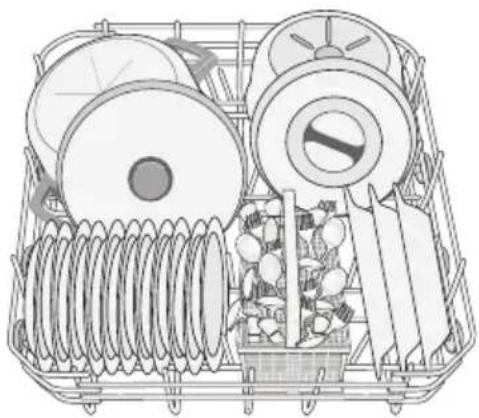
natural_image
Line drawing of a basket containing various spools and circular objects, no text or symbols presentDe bestekmand
text_image
Diagram illustrating food safety symbols including fork, knife, and knife with warning signsnatural_image
Line drawing of a multi-tiered kitchen appliance basket with various kitchenware (no text or symbols)natural_image
Line drawing of a multi-tiered rack with cylindrical components and metal grating (no text or symbols)text_image
Diagram illustrating two mechanical assembly steps (A) showing a cart being loaded with pulleys, with arrows indicating motion direction.- grove filter (A)
- microfilter (B)
- platte filter (C)
text_image
A B Ctext_image
Diagram illustrating a mechanical or biological process with labeled components 1, 2, and directional arrows indicating flow or movement.natural_image
Illustration of a hand pressing a small object on a surface with ovals and a labeled point D (no text or symbols on the object itself)text_image
Safety warning symbol and diagram showing a faucet with a downward lightning bolt, indicating hazard or caution.text_image
Labeled diagram of a refrigerator interior showing numbered components for identification1 Panier supérieur
natural_image
Diagram of two mechanical components with directional arrows indicating motion or flow (no text or symbols)text_image
Diagram of a device's front panel with numbered parts and a hand operating the dial, labeled 1 through 8.natural_image
Technical line drawing of a mechanical component with coiled springs and housing (no text or symbols)