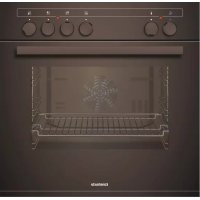
CX31124 - Other kitchen appliances CONSTRUCTA - Free user manual and instructions
Find the device manual for free CX31124 CONSTRUCTA in PDF.



| Product type | Ceramic hob |
| Brand | Constructa |
| Model | CX31124 |
| Burner type | Radiant burners |
| Number of burners | 4 burners (including 1 two-zone burner and 1 fish kettle zone) |
| Special cooking zones | Two-zone burner, fish kettle zone |
| Control | Rotary knobs |
| Power levels | 9 positions (1 to 9) |
| Display | Burner and residual heat display |
| Surface material | Ceramic glass |
| Power supply | 220-240 V ~ 50/60 Hz |
| Cleaning | Ceramic glass: glass scraper and special cleaner; frame: warm water and dish soap |
| Safety | Safety instructions: avoid flammable objects, mandatory supervision, repairs by approved expert |
| Energy consumption | Saving tips: lids, appropriate diameter, residual heat |
| After-sales service | Available by phone: B 070 222 145 (France), CH 0848 840 040 (Switzerland) |
Frequently Asked Questions - CX31124 CONSTRUCTA
User questions about CX31124 CONSTRUCTA
0 question about this device. Answer the ones you know or ask your own.
Ask a new question about this device
Download the instructions for your Other kitchen appliances in PDF format for free! Find your manual CX31124 - CONSTRUCTA and take your electronic device back in hand. On this page are published all the documents necessary for the use of your device. CX31124 by CONSTRUCTA.
USER MANUAL CX31124 CONSTRUCTA
CM31054, CM321052, CM323052, CM3305.
Kochfeld
Table de cuisson
Hob
Kookplaat
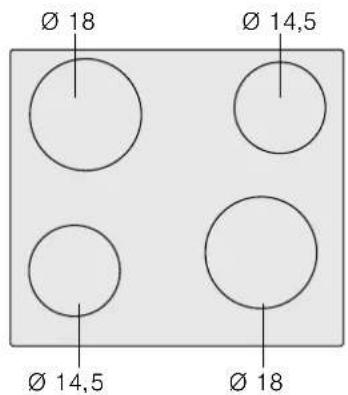
CM31054
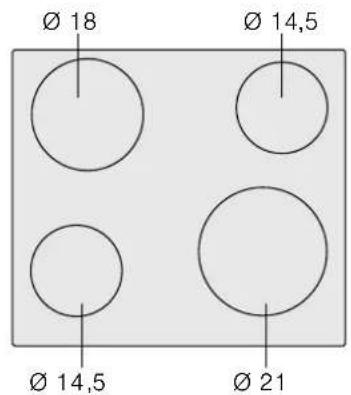
CM321052
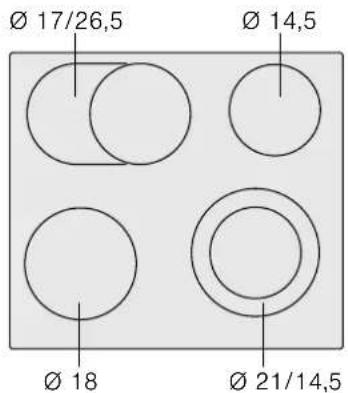
CM323052
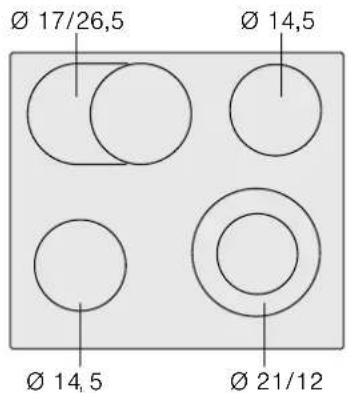
CM3305.
de
Inhaltsverzeichnis
Environmental protection. 14
Environmentally-friendly disposal. 14
Energy-saving tips. 14
Getting to know your appliance. 15
The hotplates 15
Hotplate and residual heat indicators. 15
Setting the hob 15
Switching the hob on and off 15
Setting a hotplate. 15
Table of cooking times 15
Cleaning and care 16
Ceramic 16
Hob surround. 16
After-sales service 16
Additional information on products, accessories, replacement parts and services can be found at www.constructa.de and in the online shop www.constructa-eshop.com

Safety precautions
Please read this manual carefully. Please keep the instruction and installation manual as well as the appliance certificate in a safe place for later use or for subsequent owners.
Check the appliance for damage after unpacking it. Do not connect the appliance if it has been damaged in transport.
Only a licensed professional may connect appliances without plugs. Damage caused by incorrect connection is not covered under warranty.
This appliance is intended for domestic use only. The appliance must only be used for the preparation of food and drink. The appliance must be supervised during operation. Only use this appliance indoors.
This appliance is intended for use up to a maximum height of 2000 metres above sea level.
This appliance is not intended for operation with an external clock timer or a remote control.
Do not use covers. These can cause accidents, due to overheating, catching fire or materials shattering, for example.
Do not use inappropriate child safety shields or hob guards. These can cause accidents.
This appliance may be used by children over the age of 8 years old and by persons with reduced physical, sensory or mental capabilities or by persons with a lack of experience or knowledge if they are supervised or are instructed by a person responsible for their safety how to use the appliance safely and have understood the associated hazards.
Children must not play with, on, or around the appliance. Children must not clean the appliance or carry out general maintenance unless they are at least 8 years old and are being supervised.
Keep children below the age of 8 years old at a safe distance from the appliance and power cable.
Risk of fire!
- Hot oil and fat can ignite very quickly. Never leave hot fat or oil unattended. Never use water to put out burning oil or fat. Switch off the hotplate. Extinguish flames carefully using a lid, fire blanket or something similar.
The hotplates become very hot. Never place combustible items on the hob. Never place objects on the hob.
The appliance gets hot. Do not keep combustible objects or aerosol cans in drawers directly underneath the hob.
Risk of burns!
The hotplates and surrounding area (particularly the hob surround, if fitted) become very hot. Never touch the hot surfaces. Keep children at a safe distance.
Risk of electric shock!
Incorrect repairs are dangerous. Repairs may only be carried out by one of our trained after-sales engineers. If the appliance is faulty, unplug the mains plug or switch off the fuse in the fuse box. Contact the after-sales service.
- Do not use any high-pressure cleaners or steam cleaners, which can result in an electric shock.
-
A defective appliance may cause electric shock. Never switch on a defective appliance. Unplug the appliance from the mains or switch off the circuit breaker in the fuse box. Contact the after-sales service.
-
Cracks or fractures in the glass ceramic may cause electric shocks. Switch off the circuit breaker in the fuse box. Contact the after-sales service.
Risk of injury!
Saucepans may suddenly jump due to liquid between the pan base and the hotplate. Always keep the hotplate and saucepan bases dry.
Causes of damage
Caution!
- Rough pot and pan bases scratch the ceramic.
- Avoid boiling pots dry. This may cause damage.
- Never place hot pots or pans on the control panel, the display area or the surround. This may cause damage.
Overview
The following table provides an overview of the most frequent kinds of damage:
- Damage can occur if hard or pointed objects fall on the hob.
Aluminium foil and plastic containers melt on hot hotplates. Oven protective foil is not suitable for your hob.
Damage Cause Action
| Stains Food spills Remove spills immediately with a glass scraper. |
| Unsuitable cleaning agents Only use cleaning agents which are suitable for ceramic |
| Scratches Salt, sugar and sand Do not use the hob as a work surface or storage space. |
| Rough pot and pan bases scratch the Check your cookware. ceramic. |
| Discolouration Unsuitable cleaning agents Only use cleaning agents which are suitable for ceramic |
| Pan abrasion (e.g. aluminium) Lift the pots and pans when moving them. |
| Blisters Sugar, food with a high sugar content Remove spills immediately with a glass scraper. |
Environmental protection
Environmentally-friendly disposal
Dispose of packaging in an environmentally-friendly manner.
This appliance is labelled in accordance with European Directive 2012/19/EU concerning used electrical and electronic appliances (waste electrical and electronic equipment - WEEE). The guideline determines the framework for the return and recycling of used appliances as applicable throughout the EU.
Energy-saving tips
Always place suitable lids on saucepans. When cooking without a lid, considerably more energy is required. A glass lid means that you can see inside without having to lift the lid.
Use pots and pans with even bases. Uneven bases increase energy consumption.
The diameter of pot and pan bases should be the same size as the hotplate. In particular, small saucepans on the hotplate cause energy losses. Please note: cookware manufacturers often indicate the upper diameter of the saucepan. This is usually bigger than the diameter of the base of the pan.
Use a small saucepan for small quantities. A larger, less full saucepan requires a lot of energy.
Cook with only a little water. This will save energy. Vitamins and minerals in vegetables are preserved.
Always cover as large an area of the hotplate as possible with your saucepan.
Switch to a lower heat setting in good time.
- Select a suitable ongoing cooking setting. You will waste energy by using an ongoing cooking setting which is too high.
Use the residual heat of the hob. For longer cooking times, you can switch the hotplate off 5-10 minutes before the end of the cooking time.
Getting to know your appliance
The instruction manual is the same for various different hobs. An overview of the models with their dimensions is given on page 2.
The hotplates
| Hotplate Activating and deactivating | |
| ○ Single-circuit hotplate | |
| ◎ Dual-circuit hotplate | To activate: turn the hotplate control clockwise to ⊙. Set the heat setting. To deactivate: turn the hotplate control to 0 and reset. Never turn the hotplate control beyond the ⊙ symbol to 0. |
| ∞ Extended cooking zone | To activate: Turn the hotplate control clockwise to ⊙. Set the heat setting. To deactivate: turn the hotplate control to 0 and reset. Never turn the hotplate control beyond the ⊙ symbol to 0. |
Hotplate and residual heat indicators
The hotplate and residual heat indicators light up when a hotplate is warm:
Hotplate indicator - during operation, shortly after you have switched on a hotplate.
Residual heat indicator - after cooking, when the hotplate is still warm.
You can use the residual heat to save energy, e.g. to keep a small dish warm or to melt chocolate.
Setting the hob
This section informs you how to set the hotplates. The table shows heat settings and cooking times for various meals.
Switching the hob on and off
You can switch the hob on and off with the hotplate controls.
Table of cooking times
The following table provides some examples.
Cooking times and heat settings may vary depending on the type of food, its weight and quality. Deviations are therefore possible.
Setting a hotplate
Adjust the heat setting of the hotplates using the hotplate controls.
Heat setting 1 = lowest setting
Heat setting 9 - highest setting
Note: Hotplate temperature is regulated by the heat switching on and off. The heat may also switch on and off at the highest setting.
For bringing liquids to the boil, use heat setting 9. Stir thick liquids occasionally.
| Ongoing cooking setting | Ongoing cooking time in minutes | |
| Melting | ||
| Butter, gelatine 1 | - | |
| Heating and keeping warm | ||
| Stew (e.g. lentil stew) | 1 | - |
| Milk** | 1-2 | - |
| Poaching, simmering | ||
| Dumplings | 3-4* | 20-30 min |
| Fish | 3* | 10-15 min |
| White sauces, e.g. béchamel sauce | 1 | 3-6 min |
- Ongoing cooking without lid
** Without lid
| Ongoing cooking setting | Ongoing cooking time in minutes | |
| Boiling, steaming, braising | ||
| Rice (with double the quantity of water) | 3 | 15-30 min |
| Unpeeled boiled potatoes | 3-4 | 25-30 min |
| Boiled potatoes | 3-4 | 15-25 min |
| Pasta, noodles | 5* | 6-10 min |
| Stew, soups | 3-4 | 15-60 min |
| Vegetables and frozen vegetables | 3-4 | 10-20 min |
| Cooking in a pressure cooker | 3-4 | - |
| Braising | ||
| Roulades | 3-4 | 50-60 min |
| Pot roasts | 3-4 | 60-100 min |
| Goulash | 3-4 | 50-60 min |
| Frying** | ||
| Escalope, plain or breaded | 6-7 | 6-10 min |
| Chop, plain or breaded | 6-7 | 8-12 min |
| Steak (3 cm thick) | 7-8 | 8-12 min |
| Fish and fish fillet, plain or breaded | 4-5 | 8-20 min |
| Fish and fish fillet, breaded and frozen, e.g. fish fingers | 6-7 | 8-12 min |
| Stir fry, frozen | 6-7 | 6-10 min |
| Pancakes | 5-6 | consecutively |
- Ongoing cooking without lid
** Without lid
Cleaning and care
The information in this section provides help on how best to care for your hob.
Suitable maintenance and cleaning products can be purchased from the after-sales service or in our e-Shop.
Ceramic
Clean the hob after each use. This will prevent spills from burning onto the ceramic.
Only clean the hob when it has cooled down sufficiently.
Use only cleaning agents which are suitable for glass ceramic. Follow the cleaning instructions on the packaging.
Never use:
Undiluted washing-up liquid
Detergent intended for dishwashers
Scouring agents
Harsh cleaning agents such as oven spray or stain remover
Abrasive sponges
High-pressure cleaners or steam jet cleaners
Ground-in dirt can be best removed with a glass scraper, available from retailers. Please note the manufacturer's instructions.
You can also obtain a suitable glass scraper from our after-sales service or from the e-Shop.
Using special sponges to clean glass ceramic achieves great cleaning results.
Hob surround
To prevent damage to the hob surround, observe the following instructions:
Use only hot soapy water.
- Wash new sponge cloths thoroughly before use.
- Do not use any sharp or abrasive agents.
Do not use the glass scraper.
After-sales service
Our after-sales service is there for you if your appliance should need to be repaired. We are committed to find the best solution also in order to avoid an unnecessary call-out.
E number and FD number:
Please quote the E number (product number) and the FD number (production number) of your appliance when contacting the after-sales service. The rating plate bearing these numbers can be found on the appliance certificate.
Please note that a visit from an after-sales service engineer is not free of charge, even during the warranty period.
Please find the contact data of all countries in the enclosed customer service list.
Rely on the professionalism of the manufacturer. You can therefore be sure that the repair is carried out by trained service technicians who carry original spare parts for your appliances.
nI
Inhoudsopgave

- de
- Inhaltsverzeichnis
- Safety precautions
- Risk of fire!
- Risk of burns!
- Risk of electric shock!
- Risk of injury!
- Causes of damage
- Caution!
- Overview
- Environmental protection
- Environmentally-friendly disposal
- Energy-saving tips
- Getting to know your appliance
- Hotplate and residual heat indicators
- Setting the hob
- Switching the hob on and off
- Table of cooking times
- Setting a hotplate
- Cleaning and care
- Ceramic
- Hob surround
- After-sales service
- E number and FD number:
- nI
- Inhoudsopgave
Brand : CONSTRUCTA
Model : CX31124
Category : Other kitchen appliances