USER MANUAL B 450 VL Ariston Thermo
natural_image
Diagram of a mechanical device with a dial and adjustment knob (no text or symbols)

(Ariston Integrated Refrigeration)

natural_image
Illustration of a hand placing a tray with arrows indicating direction (no text or symbols)
Fig. 1
natural_image
Simple line drawing of a rectangular box with a lid, labeled 'A' (no text or symbols on the box itself)
natural_image
Simple line drawing of a rectangular container with a lid and side supports (no text or symbols)
Per congelare bene
natural_image
Line drawing of a hand holding a small object near a window (no text or symbols)
Fig. 2
natural_image
Hand holding a rotary knob on a shelf, no text or symbols visible
Fig. 3
Safety - a good habit to get into.
ATTENTION
Read your manual carefully since it contains instructions which will ensure safe installation, use and maintenance of your appliance.
Your Refrigerator is built to International safety standards (EN60) ans has been awarded the European approval mark (IMQ) for compliance with UK electrical safety requirements. It also meets the EC standards on the prevention and elimination of radio interference (EC directive 87/308 - 02.06.89).
- This appliance must not be installed outdoors - not even in an area protected by a roof. It is extremely dangerous to leave it exposed to rain or storms.
- It must only be used by adults and exclusively to refrigerate and freeze foodstuffs, following the instructions for use contained in this manual.
- Do not ever touch or handle the appliance with bare feet or with wet hands or feet.
- It is highly recommended that you do not use extension cords or multiple socket adapters. If the refrigerator is installed between cabinets, make sure that the cord is not bent or dangerously pinched or compressed.
- Never pull on the cord or the refrigerator to remove the
plug from the wall socket - this is very dangerous.
-
Never touch the cooling components within the appliance, especially with wet hands because this could result in injury. Never put ice cubes just removed from the freezer into your mouth because they could stick to your mouth and cause burns.
-
Never clean or perform maintenance on the appliance without first removing the plug from the socket; in fact, turning the knob for adjusting the temperature to the ●setting is not sufficient to eliminate all electrical contact with the mains.
-
Before having your old refrigerator picked up for disposal, remove or make inoperable any locking devices to prevent children who might play in or around the appliance from being locked inside.
-
Before calling for service/assistance in the case of malfunction, consult the chapter entitled "Is There a Problem? to determine whether it is possible to eliminate the problem. do not try to repair the problem by trying to access the internal components of the appliance.
-
If the power supply cord must be replaced, please contact one of our Customer Service Centers. In some cases, the connections are made using special terminals and in others a special tool must be used to access the connections.
Installation
To ensure that the appliance operates properly and to reduce energy consumption, it is important that the appliance is installed correctly.
Ventilation
The compressor and condenser generate heat and, therefore, need to be ventilated properly. Rooms with less than perfect ventilation are not very suited for installation of the appliance. Therefore, it should be installed in a room with an opening (window or French window) that provide the appropriate amount of air re-circulation. It is also important that the room not be too humid.
During installation, make sure not to cover or obstruct the grates that allow for proper ventilation of the appliance. For proper ventilation of the appliance, you must leave:
- a space of at least 10 cm between the top part and any cabinets above it;
- a space of at least 5 cm between the sides of the appliance and any adjacent cabinets/walls.
Away from Heat
Avoid positioning the appliance in a place where it is directly exposed to sunlight or near an oven, cook top or the like.
Level
The appliance must be level. If the floor is not level, the adjustable feet located in front can be used to level the appliance.
Electrical Connection and Earthing
Before proceeding with the electrical connection, make sure that the voltage indicated on the rating plate, located at the bottom left near the vegetable crisper, corresponds to the mains voltage in your home and that the socket is fitted with a standard earthing wire in accordance with safety standards for 46/90 systems. If the socket is not fitted with an earthing wire, the manufacturer will not be held liability for any damages and or injuries arising out of the use of the appliance. Do not use multiple sockets or adapters.
Insufficient power?
The electrical socket must be able to handle the maximum power load of the appliance, which is indicated on the rating plate located at the bottom left next to the vegetable crisper.
Before making the electrical connection ...
After the appliance has been delivered, place it in the vertical upright position and wait at least 3 hours before inserting the plug into the socket in order to ensure that it functions properly.
For English Market only
The appliance is fitted with a continental 2-èin plug for factory testing. Before installation the plug should be cut off. The appliance is designed to be installed in a switched spur outlet fused at 13 Ampere. If the installation requires a 13 Ampere plug type to be fitted it should be conform to BSI 1363.
A closer look

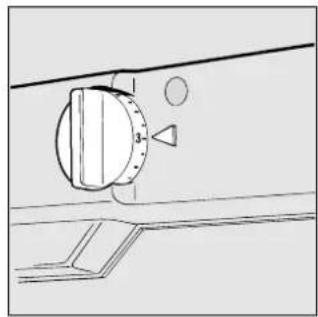
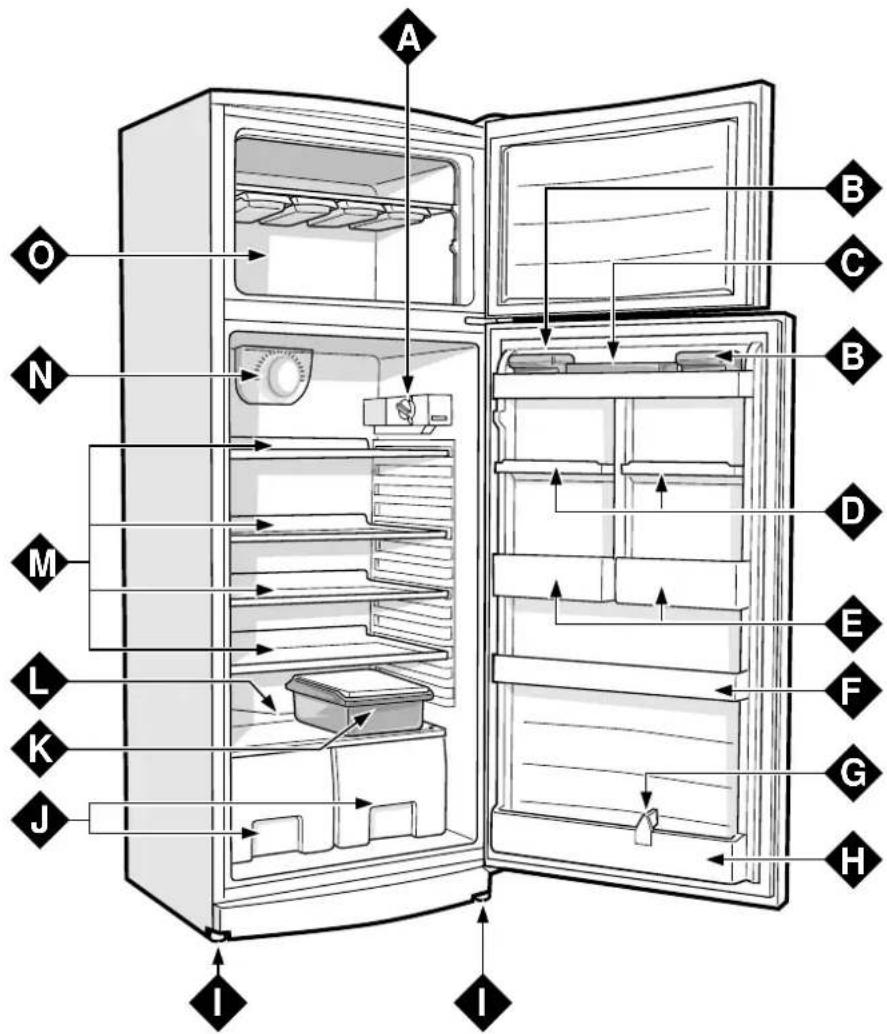
Temperature regulation knob
This knob is used to regulate the temperature in the two compartments with the following settings:
natural_image
Diagram of a mechanical device with a dial and adjustment knob (no text or symbols)
● The refrigerator is off;
1 less cold;
5 colder

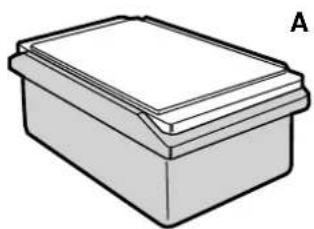
Aroma saving storage box (only a few models)

Removable door shelf with egg tray

Removable door shelves forsmall food products amd bottles

Removable door dhelf for small
food products

Sliding divider for bottles

Compartment for bottlrs

Adjustable feet

Fruit and vegetable drawers

Meat/Cheese container

Defrosting water conveyor

Removable height adjustable shelves

"A.I.R. System"
(Ariston Integrated Refrigeration)

Compartment for storing frozen foods, freezing fresh foods and making ice
How to Start the Appliance
NOTICE
After the appliance has been delivered, stand it in the upright position and wait approximately 3 hours before connecting it to the electrical outlet to guarantee that it operates properly.
Before placing foodstuffs in the refrigerator or freezer, clean the interior well with warm water and baking soda.
After putting the plug in the socket, make sure that the light is on inside the appliance and then turn the thermostat knob (A) to the "3" setting. After a few hours have passed, you can place fresh food in the refrigerator compartment and frozen foods into the freezer.
How to use the refrigerator compartment...
The thermostat automatically regulates the temperature inside the appliance
1 = less cold
5 = colder
It is recommended that a medium setting be used.
To increase the amount of space, optimize arrangement and improve appearance, this appliance has a “cooling area” located within the back panel of the refrigerator compartment. When the appliance is operating, this panel may be covered with frost or droplets of water depending on whether the compressor is operating or not at a given time. Do not be concerned about this! The refrigerator is operating normally. If the thermostat knob is positioned on higher settings while the refrigerator is heavily filled and the ambient temperature high, the appliance may run continuously, resulting in the formation of frost on the back cooling area. This will lead to an increase in energy consumption.
To avoid this situation, just turn the thermostat knob to a lower setting so that the appliance defrosts automatically.
The refrigerator compartment of your appliance is equipped with
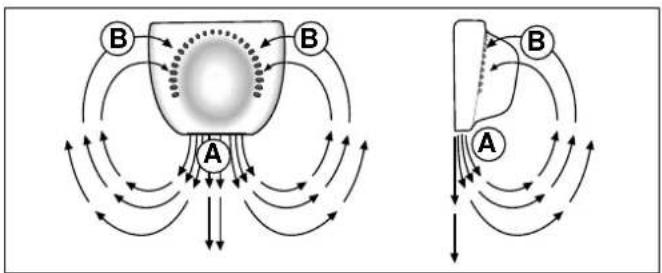
"A.I.R. System" (Ariston Integrated Refrigeration) which makes it possible to achieve optimal food storage while simplifying the use of the refrigerator thanks to the following features:
- Fast temperature reset: after the doors have been opened, the internal temperatures return to optimal values faster, improving food storage.
- More uniform temperature distribution: this makes it possible to place any type of food on any shelf.
- Higher humidity level: this allows you to store food longer.
flowchart
graph TD
    A["Central Object"] --> B1["Point A"]
    A --> B2["Point B"]
    A --> B3["Point B"]
    A --> B4["Point A"]
    A --> B5["Point B"]
    style A fill:#f9f,stroke:#333
    style B fill:#ccf,stroke:#333
    style B2 fill:#cfc,stroke:#333
    style B3 fill:#fcc,stroke:#333
    style B4 fill:#cff,stroke:#333
    style B5 fill:#ffc,stroke:#333
A - Blown air which is cooled when it comes into contact with the refrigeration panel
B - Hotter air is drawn in
Remember to follow our instructions on the storage life of foods: If not stored correctly, even the freshest food will deteriorate quite quickly.
Contrary to popular belief, cooked foods do not keep longer than fresh food.
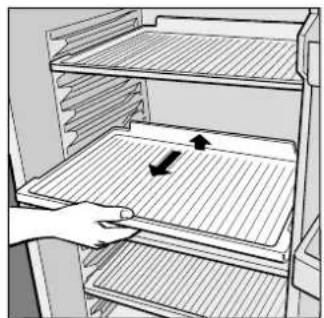
The refrigerator compartment is equipped with practical slide-out shelves (Fig. 1) which can be adjusted for height using the appropriate guides. This feature allows you to store large containers and food products.
Do not store liquids in unsealed containers since this will increase the humidity and lead to the formation of frost in the refrigerator.
natural_image
Illustration of a hand placing a tray with arrows indicating direction (no text or symbols)
Fig. 1
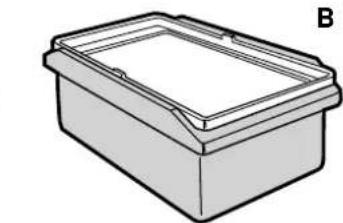
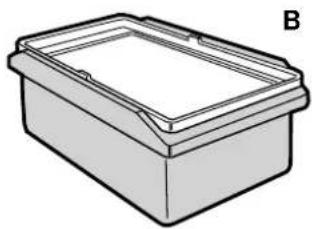
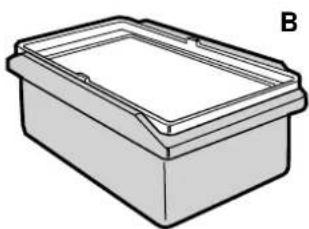
To preserve meat, place the cover as indicated in Fig. A. To preserve cheese, overturn the cover and place it as indicated in Fig. B.
This box is not supplied with some models.
natural_image
Simple line drawing of a rectangular box with a lid, labeled 'A' in the top right corner (no text or symbols on the box itself)
natural_image
Simple line drawing of a rectangular container with a lid and side tabs, labeled B (no text or symbols on the container itself)
Freezing
- For the packaging of foods to be frozen consult a specialized manual.
- Remember that you should never re-freeze products you have allowed to thaw, even if only partially: cook the food, then either eat (within 24 hours) or re-freeze it.
- When freezing fresh foods, remember that they should not touch other previously frozen or deep frozen foods. Place the food that you wish to freeze in the top compartment where the temperature will fall below -18°C, ideal for freezing food properly. Remember that proper conservation depends on the speed of freezing.
- Do not open the freezer door during freezing.
- Freeze only the quantities (in kg) shown on the data plate on the left of the crisper.
-
When using the refrigerator for the first time, or after it has not been turned off, you can place food into it only after is has been run for 6-8 hours. Then, insert the fresh food to be frozen into the appropriate compartment freezer and turn the knob A to setting 3. After approximately 24 hours, the freezing process is complete.
-
For the best conservation and defrosting, remember to freeze small portions; this will ensure rapid and uniform freezing. Mark the freezing date and description of the contents on the package.
- In the case of power failure or breakdown, do not open the freezer door. This will help maintain the temperature inside the freezer ensuring that foods are conserved for at least 9-14 hours.
- Do not store full bottles in the freezer since they could explode when they freeze. (Remember that liquids increase in volume when frozen).
- Fill the ice trays so that they are no more than 3/4 full.
- If the room temperature remains below 14^ C for a long period of time the freezer will not reach the temperatures required for storage and the storage life will be shorter. In this case frozen foodstuffs should be used within a relatively short period of time.
Energy Saving Tips
- Install the Appliance Correctly
This means that the appliance should be installed away from heat sources or direct sunlight in a well ventilated room.
- Correct Temperature Settings
Set the refrigerator temperature knob to one of the middle settings. Very cold temperature settings will not only consume a great deal of energy but will neither improve nor lengthen the storage life of the food. Excessively cold temperatures may ruin vegetables, cold cuts and cheese.
- Do Not Overfill Your Appliance
Remember that proper storage of food requires good air circulation. Overfilling your appliance will hamper proper air circulation and overwork the compressor.
- Keep the Door Closed
Open the refrigerator only when necessary; remember that
every time you open the door most of the cold air will be lost. To bring the temperature back to the proper level, the motor must run for a considerable amount of time, consuming a substantial amount of energy.
- Check the Seal on the Door
Keep the seal clean and soft so that it fits tightly against the door to ensure that no cold air is lost.
- Never Put Food in the Refrigeror while Still Hot
A container of hot food in the refrigerator will increase the temperature significantly; allow food to cool to room temperature before storing.
- Check your appliance for build up of ice
Remember to check the walls of the freezer for ice; when the layer becomes too thick, defrost the freezer immediately (See "Maintenance instructions").
Guide to Using the Freezer
Meat and Fish
| Food Wrapping | | Tenderising(days) | Storage(months) | Thawing Time |
| Beef Roast | Tin foil | 2/3 | 9/10 | Not required |
| Lamb Tin foil 1 /2 6 Not required | | | |
| Pork Roast Tin foil 1 6 Not required | | | |
| Veal Roast Tin foil 1 8 Not required | | | |
| Veal/Pork Chops | Each piece wrapped in qing wrap and then in tin foil (4 to 6 slices) | | 6 Not required | |
| Veal/Lamb Cutlets | Each piece wrapped in qing wrap and then in tin foil (4 to 6 slices) | | 6 Not required | |
| Minced Meat | In aluminium containers covered with qing wrap | Freshly minced 2 | Slowly in refrigerator | |
| Heart and Liver Plastic Baggies 3 Not required | | | |
| Sausages Cling Wrap or Tin foil 2 As necessary | | | |
| Chicken and Turkey | Tin foil | 1/3 | 9 | Very slowly in refrigerator |
| Duck and Goose | Tin foil | 1/4 | 6 | Very slowly in refrigerator |
| Pheasant' partrige and Wild Duck | Tin foil 1 /3 9 very slowly in refrigerator | | | |
| Hare and Rabbit | Tin foil | 3/4 | 6 | Very slowly in refrigerator |
| Venison | Tin foil or Cling Wrap | 5/6 | 9 | Very slowly in refrigerator |
| Large Fish | Tin foil or Cling Wrap | | 4/6 | Very slowly in refrigerator |
| Small Fish | Plastic Baggies | | 2/3 | Not required |
| Crustaceans | Plastic Baggies | | 3/6 | Not required |
| Shellfish | Store in salted water in aluminium containers or plastic containers | | 3 Very slowly in refrigerator | |
| Boiled Fish | Tin foil or Cling Wrap | | 12 | In hot water |
| Fried Fish | Plastic Baggies | | 4/6 | Directly in pan |
Guide to Using the Freezer
Fruits and Vegetables
| Food preparation | | Blanching Time | Wrapping | Storage (months) | Thawing Time |
| Apples and pears peel and cut into slices 2 | | | In Containers (cover with syrup) | 12In refrigerator very slowly | |
| Apricots' peaches' Cherries and plums | Peel and pit 1'/2' | | In Containers (cover with syrup) | 12In refrigerator very slowly | |
| Strawberries Blackberries and Raspberries | Rinse and fry | | In Containers (cover with sugar) | 10/12In refrigerator very slowly | |
| Cooked Fruit Cut cook and strain | | | In Containers (add 10% sugar) | 12In refrigerator very slowly | |
| Fruit Juice Wash' cut and crush | | | In Containers (sugar to taste) | 10/12In refrigerator very slowly | |
| Cauliflower | Remove leaves' cut head into small pieces and blanch in water and a little lemon juice | 2' | Plastic Baggies | 12 | Not required' |
| Cabbage and Brussel sprouts | Wash and cut into small pieces | 1'/2' | Plastic Baggies | 10/12 | At room temperature' |
| Peas | Shell and wash | 2' | Plastic Baggies | 12 | Not required' |
| French Beans | Wash and slice if required | 2 | Plastic Baggies | 10/12 | Not required' |
| Carrots' peppers and turnips | peel' wash and slice if necessary | 3'/4' | Plastic Baggies | 12 | Not required' |
| Mushrooms and Asparagus | Wash' peel and cut up | 3'/4 | Plastic Baggies or Containers | 6 At room temperature' | |
| Spinach | Wash and mince | 2' | Plastic Baggies | 12 | At room temperature' |
| Vegetable for soups | Wash and cut up in small pieces | 3' | Plastic Baggies or Containers | 6/7 | Not required' |
| Various Foods | preparation | Blanching Time | Wrapping | Storage (months) | Thawing time |
| Bread | | | Plastic Baggies | 4 | At room temperature and in the oven' |
| Cakes | | | Plastic Baggies | 6 | About 10 minutes at room temperature' cook at 100/200°C |
| Cream | | | Plastic Containers | 6 | At room temperature or in refrigerator' |
| Butter | | | In original wrapping or in foil | 6 | In refrigerator |
| Boiled Food or vegetable soup | | | Plastic or Glass Containers | 3/6 | At room temperature or in hot water' |
| Eggs | | | Freeze without shells in small containers | 10 | At room temperature or in refrigerator' |
Caring for Your Appliance
Defrosting
Do not use mechanical devices or other tools to speed up the defrosting process, unless they have been recommended by the manufacturer.
How to defrost the refrigerator compartment.
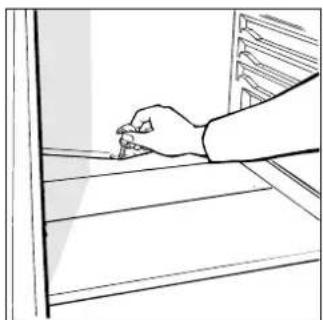
This appliance features automatic defrosting; condensed water flows to the back of the appliance through a drain (see fig. 2) where the heat produced by the compressor causes it to evaporate to the exterior. The only precaution you need take, is to ensure the drain hole behind the crisper is cleaned regularly, so that the water can drain freely.
How to defrost the freezer compartment.
- Remember to regularly remove ice with the scraper provided (never use a knife).
- When the layer of frost is more than 5 mm you should defrost the appliance.
Follow these steps: set knob A to ● wrap deep frozen and frozen foods in newspaper and place them in the refrigerator or in a cool place. Leave the freezer door open so that the ice thaws completely, placing basins of warm water in the freezer to speed up defrosting.
natural_image
Line drawing of a hand holding a small object near a window (no text or symbols)
Fig. 2
Cleaning and maintenance
Always unplug the appliance from the mains before cleaning.
- Your appliance is manufactured with hygienic odourless materials. To preserve these characteristics, always use sealed containers for strong smelling foods to avoid the formation of odours that are difficult to remove.
- Use only a water and bicarbonate solution: Clean the internal and exterior of your appliance with a sponge soaked with a warm water and sodium bicarbonate solution, which is also a good disinfectant. If you do not have any sodium bicarbonate at home, use neutral detergent.
- What not to use: Do not use abrasive detergents, bleach or detergents containing ammonia. Never use solvent based products.
- Dishwashable: All the removable parts can be cleaned by soaking in hot soapy water or detergent. If you own a dishwasher, you may wash these parts in the dishwasher. Remember to dry thoroughly before replacing them.
- What about the back panel? Dust may deposit on the back panel and affect the proper running of the appliance. To remove dust, vacuum away the dust very carefully using the appropriate vacuum cleaner accessory.
- Discontinued use of the appliance: If the appliance is not in use for any length of time, remember to clean the interior and dry thoroughly, leaving the doors open to prevent the formation of bad odours and mould.
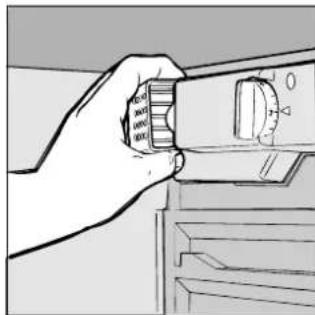
- Replacing the light bulb. The bulb for lighting the interior of the appliance is located at the back of the thermostat box. Unscrew the burnt bulb and replace it with another bulb of no more than 15 Watt, follow the instructions illustrated in fig. 3.
natural_image
Hand holding a mechanical knob or dial, no visible text or symbols
Fig. 3
Is There a Problem?
The refrigerator does not function.
Have you checked whether:
- The main switch for the electricity to the apartment or home has been turned off;
- The plug is properly inserted in the outlet;
- The outlet is adequate; try inserting the plug into another outlet in the room.
The refrigerator and the freezer do not cool properly.
Have you checked whether:
- The doors do not close well or the seals are faulty;
• The doors are left open too long;
- The thermostat knob is not on the proper setting;
- The refrigerator or freezer is overfilled.
The food in the refrigerator becomes too cold.
Have you checked whether:
- The thermostat knob is on the proper setting;
- The food is in contact with the back wall - which is the coldest part.
The motor runs continuously.
Have you checked whether
- The doors are not closed well or have remained open too long;
• The ambient temperature is too high;
- The thermostat knob is not on the proper setting.
The appliance makes too much noise.
The gas refrigerant produces a slight noise even when the compressor is not running (this is not a defect).
Have you checked whether:
• The refrigerator is level.
- The appliance was installed between cabinets or objects that vibrate and make noise.
There is water on the bottom of the refrigerator.
Have you checked whether:
- The hole for draining the water from the frost is clogged (see fig. 2).
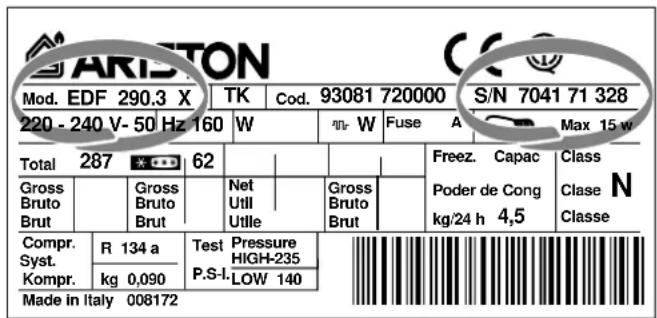
If after all the checks, the appliance still does not operate or the problem persists, call the nearest Service Centre and inform them of: the type of problem, the abbreviation of the model name (Mod.) and the relative numbers (S/N) written on the rating plate located at the bottom left next to the vegetable crisper (see examples in the figures below).
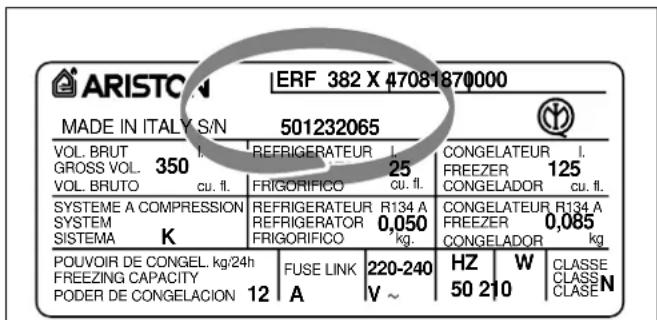
Never call on unauthorized technicians and always refuse spare parts which are not originals.
natural_image
Diagram of a mechanical knob with a triangular pointer and circular motion indicators (no text or symbols)
(Ariston Integrated Refrigeration)

natural_image
Illustration of a hand placing a tray with arrows indicating direction (no text or symbols)
Fig. 1
natural_image
Simple line drawing of a rectangular box with a lid, labeled 'A' in the corner (no text or symbols on the box itself)
natural_image
Simple line drawing of a rectangular container with a lid and side gap, labeled B (no text or symbols on the object itself)
Pour bien congeler
natural_image
Line drawing of a hand holding a small object near a window (no text or symbols)
Fig. 2
natural_image
Hand holding a hand tool with a dial and control knob, no visible text or symbols
Fig. 3
natural_image
Simple line drawing of a mechanical component with no text or symbols

"A.I.R. System" (Ariston Integrated Refrigeration)

natural_image
Illustration of a hand placing a tray with arrows indicating direction (no text or symbols)
Abb. 1
natural_image
Two 3D diagrams of rectangular containers labeled A and B, showing different interior designs (no text or symbols present)
natural_image
Line drawing of a hand holding a small object near a window (no text or symbols)
Abb. 4
natural_image
Hand holding a hand valve on a cabinet rack (no text or symbols visible)
Abb. 5
Gibt's ein Problem?
natural_image
Diagram of a mechanical component with a knob and adjustment knob (no text or symbols)

"A.I.R. System" (Ariston Integrated Refrigeration)

natural_image
Illustration of a hand placing a tray with arrows indicating direction (no text or symbols)
Afb. 1
natural_image
Two 3D diagrams of rectangular containers labeled A and B, showing different interior designs (no text or symbols present)
Invriezen
natural_image
Line drawing of a hand holding a small object near a window (no text or symbols)
Afb. 4
natural_image
Hand holding a rotary knob with a dial, no text or symbols visible
Afb. 5
Er is een probleem
natural_image
Diagram of a mechanical knob or dial mechanism with no visible text or symbols

(Ariston Integrated Refrigeration)

ATENCIÓN
natural_image
Illustration of a hand placing a tray with arrows on the lid (no text or symbols)
Fig. 1
natural_image
Two 3D diagrams of rectangular containers labeled A and B, showing different interior designs (no text or symbols present)
Para congelar bien
natural_image
Line drawing of a hand holding a small object near a window (no text or symbols)
Fig. 2
natural_image
Hand holding a rotary knob with a dial and adjustment knob (no text or symbols visible)
Fig. 3
Algunos problemas
IEI refrigerador no funciona.
Controlar si:
natural_image
Diagram of a mechanical knob or dial mechanism with no visible text or symbols

Caixa carne/queijo

(Ariston Integrated Refrigeration)

natural_image
Illustration of a hand placing a tray with arrows indicating direction (no text or symbols)
Fig. 1
natural_image
Two identical 3D diagrams of rectangular containers labeled A and B, showing different interior layouts (no text or symbols on the containers themselves)
Para congelar bem
natural_image
Line drawing of a hand holding a tool near a window (no text or symbols)
Fig. 2
natural_image
Hand holding a hand valve on a control panel (no text or symbols visible)
Fig. 3