NSXMT75 - Cd player/recorder AIWA - Free user manual and instructions
Find the device manual for free NSXMT75 AIWA in PDF.



| Product type | CD/cassette player/recorder, radio receiver with amplifier |
| Brand and model | Aiwa NSX-MT75 (main unit CX-NMT70) |
| Dimensions (W×H×D) of main unit | 260 × 309 × 363 mm |
| Weight of main unit | 10 kg |
| Dimensions of front speakers (SX-NA74) | 243 × 304 × 227 mm |
| Weight of front speakers | 3.6 kg |
| Power supply | 120 V, 60 Hz |
| Power consumption | 140 W |
| Amplifier output power | Front: 100 W + 100 W (6 ohms), Rear (Surround): 10 W + 10 W (16 ohms), Center: 20 W (8 ohms) |
| Playback formats | Audio CD, cassette (type I, II, IV), FM/AM radio |
| Main functions | Dolby Pro Logic, BBE, T-BASS, graphic equalizer (ROCK/POP/CLASSIC), Surround DSP (DISCO/LIVE/HALL), Karaoke (Vocal Fader, Multiplex), timer, random/repeat playback, programming |
| Inputs | VIDEO/AUX (RCA), MD (RCA), MIC 1/2 (3.5 mm mini-jack) |
| Outputs | LINE OUT (RCA), SUPER WOOFER, front speakers (6 ohms), surround (16 ohms), center (8 ohms), headphones (32 ohms) |
| Maintenance and cleaning | Clean the cabinet with a soft, dry cloth. Clean the cassette heads every 10 hours of use with a cleaning cassette or a cotton swab soaked in denatured alcohol. Demagnetize the heads every 20 to 30 hours. Clean discs from the center outward. |
| Safety | Do not expose to water or heat. Leave 10 cm space behind and above, 5 cm on sides. Unplug if not used for long periods. Do not attempt repairs yourself. |
| Spare parts and repairability | Contact a qualified technician for any repairs. No spare parts are listed in the manual. Use recommended accessories (unidirectional microphones, cleaning cassettes). |
| General information | Manual available in French, English, Spanish. Operating temperature: 5°C to 35°C. Remote control batteries: 2× R6 (AA). |
Frequently Asked Questions - NSXMT75 AIWA
User questions about NSXMT75 AIWA
0 question about this device. Answer the ones you know or ask your own.
Ask a new question about this device
Download the instructions for your Cd player/recorder in PDF format for free! Find your manual NSXMT75 - AIWA and take your electronic device back in hand. On this page are published all the documents necessary for the use of your device. NSXMT75 by AIWA.
USER MANUAL NSXMT75 AIWA
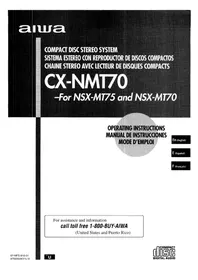
COMPACT DISC STEREO SYSTEM SISTEMA ESTEREO CON REPRODUCTOR DE DISCOS COMPACTOS CHAINE STEREO AVEC LECTEUR DE DISQUES COMPACTS
CX-NMT70
-For NSX-MT75 and NSX-MT70
OPERATING INSTRUCTIONS MANUAL DE INSTRUCCIONES MODE D'EMPLOI
En (English)
E (Español)
F (Français)
For assistance and information call toll free 1-800-BUY-AIWA (United States and Puerto Rico)
WARNING
TO REDUCE THE RISK OF FIRE OR ELECTRIC SHOCK, DO NOT EXPOSE THIS APPLIANCE TO RAIN OR MOISTURE.
CAUTION
RISK OF ELECTRIC SHOCK DO NOT OPEN

"CAUTION: TO REDUCE THE RISK OF ELECTRIC SHOCK,
DO NOT REMOVE COVER (OR BACK). NO USER-SERVICEABLE PARTS INSIDE. REFER SERVICING TO QUALIFIED SERVICE PERSONNEL."
Explanation of Graphical Symbols:
The lightning flash with arrowhead symbol, within an equilateral triangle, is intended to alert the user to the presence of uninsulated "dangerous voltage" within the product's enclosure that may be of sufficient magnitude to constitute a risk of electric shock to persons.
The exclamation point within an equilateral triangle is intended to alert the user to the presence of important operating and maintenance (servicing) instructions in the literature accompanying the appliance.
NOTE
This equipment has been tested and found to comply with the limits for a Class B digital device, pursuant to Part 15 of the FCC Rules. These limits are designed to provide reasonable protection against harmful interference in a residential installation.
This equipment generates, uses, and can radiate radio frequency energy and, if not installed and used in accordance with the instructions, may cause harmful interference to radio communications. However, there is no guarantee that interference will not occur in a particular installation. If this equipment does cause harmful interference to radio or television reception, which can be determined by turning the equipment off and on, the user is encouraged to try to correct the interference by one or more of the following measures:
- Reorient or relocate the receiving antenna.
- Increase the separation between the equipment and receiver.
- Connect the equipment into an outlet on circuit different from that to which the receiver is connected.
- Consult the dealer or an experienced radio/TV technician for help.
CAUTION
Modifications or adjustments to this product, which are not expressly approved by the manufacturer, may void the user's right or authority to operate this product.
PRECAUTIONS
Read the Operating Instructions carefully and completely before operating the unit. Be sure to keep the Operating Instructions for future reference. All warnings and cautions in the Operating Instructions and on the unit should be strictly followed, as well as the safety suggestions below.
Installation
1 Water and moisture — Do not use this unit near water, such as near a bathtub, washbowl, swimming pool, or the like.
2 Heat — Do not use this unit near sources of heat, including heating vents, stoves, or other appliances that generate heat. It also should not be placed in temperatures less than 5°C (41°F) or greater than 35°C (95°F).
3 Mounting surface — Place the unit on a flat, even surface.
4 Ventilation — The unit should be situated with adequate space around it so that proper heat ventilation is assured. Allow 10 cm (4 in.) clearance from the rear and the top of the unit, and 5 cm (2 in.) from each side.
- Do not place the unit on a bed, rug, or similar surface that may block the ventilation openings.
- Do not install the unit in a bookcase, cabinet, or airtight rack where ventilation may be impeded.
5 Objects and liquid entry — Take care that objects or liquids do not get inside the unit through the ventilation openings.
6 Carts and stands — When placed or mounted on a stand or cart, the unit should be moved with care.
Quick stops, excessive force, and uneven surfaces may cause the unit or cart to overturn or fall.

7 Condensation — Moisture may form on the CD pickup lens when:
- The unit is moved from a cold spot to a warm spot
- The heating system has just been turned on
- The unit is used in a very humid room
- The unit is cooled by an air conditioner
When this unit has condensation inside, it may not function normally. Should this occur, leave the unit for a few hours, then try to operate again.
8 Wall or ceiling mounting — The unit should not be mounted on a wall or ceiling, unless specified in the Operating Instructions.
Electric Power
1 Power sources — Connect this unit only to power sources specified in the Operating Instructions, and as marked on the unit.
2 Polarization — As a safety feature, some units are equipped with polarized AC power plugs which can only be inserted one way into a power outlet. If it is difficult or impossible to insert the AC power plug into an outlet, turn the plug over and try again. If it still does not easily insert into the outlet, please call a qualified service technician to service or replace the outlet. To avoid defeating the safety feature of the polarized plug, do not force it into a power outlet.
3 AC power cord
- When disconnecting the AC power cord, pull it out by the AC power plug. Do not pull the cord itself.
- Never handle the AC power plug with wet hands, as this could result in fire or shock.
- Power cords should be firmly secured to avoid being severely bent, pinched, or walked upon. Pay particular attention to the cord from the unit to the power socket.
- Avoid overloading AC power plugs and extension cords beyond their capacity, as this could result in fire or shock.
4 Extension cord — To help prevent electric shock, do not use a polarized AC power plug with an extension cord, receptacle, or other outlet unless the polarized plug can be completely inserted to prevent exposure of the blades of the plug.
5 When not in use — Unplug the AC power cord from the AC power plug if the unit will not be used for several months or more. When the cord is plugged in, a small amount of current continues to flow to the unit, even when the power is turned off.
Outdoor Antenna
1 Power lines — When connecting an outdoor antenna, make sure it is located away from power lines.
2 Outdoor antenna grounding — Be sure the antenna system is properly grounded to provide protection against unexpected voltage surges or static electricity build-up. Article 810 of the National Electrical Code, ANSI/NFPA 70, provides information on proper grounding of the mast, supporting structure, and the lead-in wire to the antenna discharge unit, as well as the size of the grounding unit, connection to grounding terminals, and requirements for grounding terminals themselves.
Antenna Grounding According to the National Electrical Code
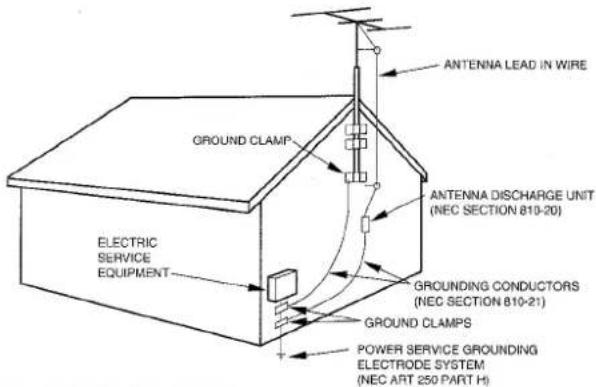
NEC-NATIONAL ELECTRICAL CODE
Maintenance
Clean the unit only as recommended in the Operating Instructions.
Damage Requiring Service
Have the units serviced by a qualified service technician if:
- The AC power cord or plug has been damaged
- Foreign objects or liquid have gotten inside the unit
- The unit has been exposed to rain or water
- The unit does not seem to operate normally
- The unit exhibits a marked change in performance
- The unit has been dropped, or the cabinet has been damaged DO NOT ATTEMPT TO SERVICE THE UNIT YOURSELF.
TABLE OF CONTENTS
PRECAUTIONS....1
PREPARATIONS
SETTING UP 3
REMOTE CONTROL 5
BEFORE OPERATION....6
SOUND
MANUAL TUNING....8
PRESETTING STATIONS 8
CD PLAYING
BASIC OPERATIONS 9
PROGRAMMED PLAY 10
TAPE PLAYBACK
BASIC OPERATIONS .... 11
CONTINUOUS PLAY 12
RECORDING
BASIC RECORDING.... 13
DUBBING A TAPE MANUALLY 14
DUBBING THE WHOLE TAPE 14
AI EDIT RECORDING 15
PROGRAMMED EDIT RECORDING.... 16
DOLBY PRO LOGIC
PARTS INDEX ...... Back cover
SETTING UP
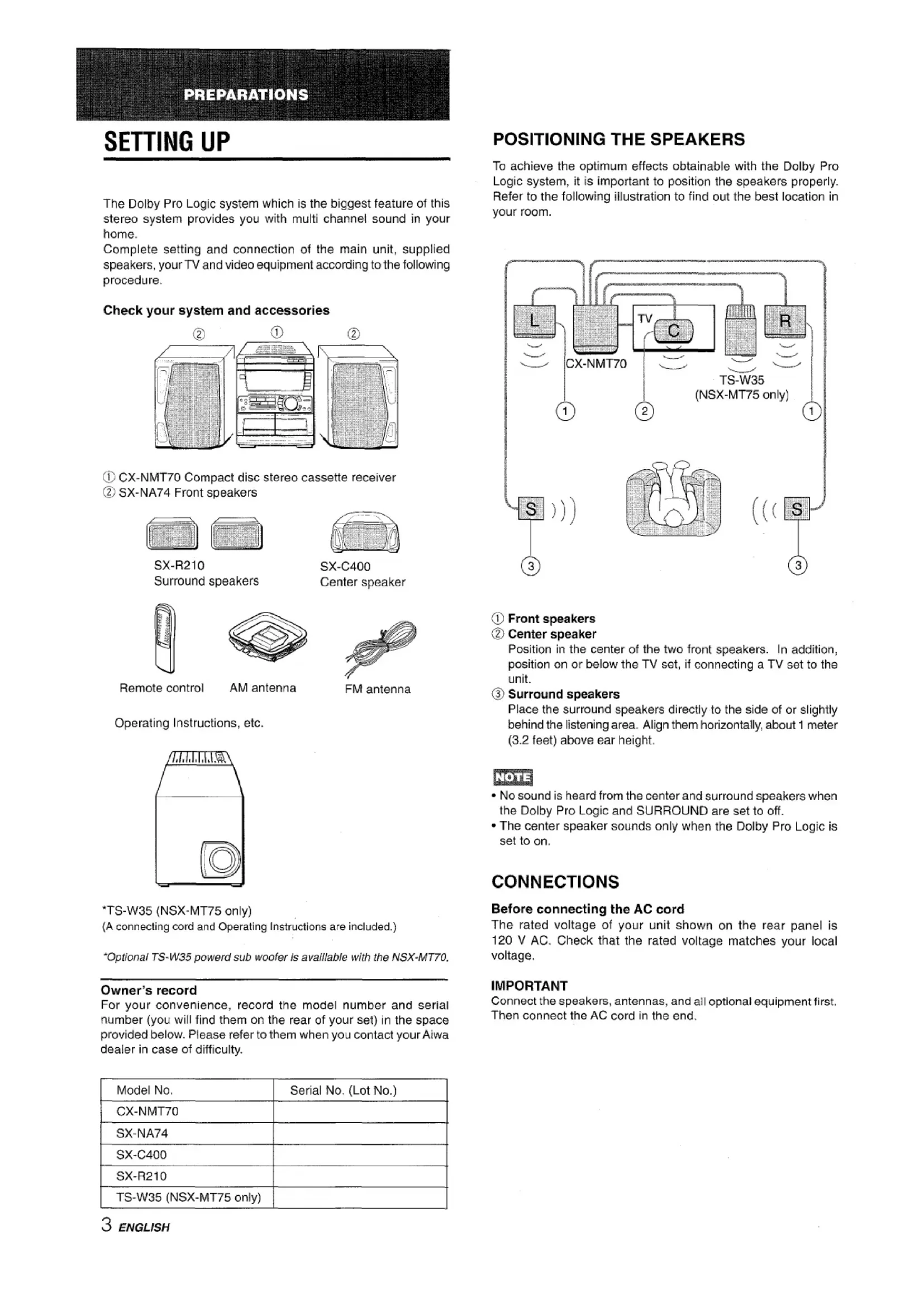
The Dolby Pro Logic system which is the biggest feature of this stereo system provides you with multi channel sound in your home.
Complete setting and connection of the main unit, supplied speakers, your TV and video equipment according to the following procedure.
Check your system and accessories
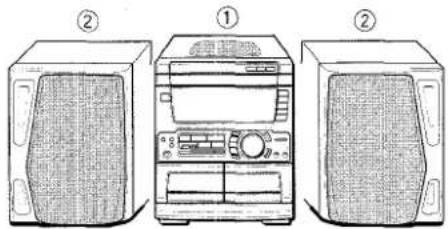
① CX-NMT70 Compact disc stereo cassette receiver
② SX-NA74 Front speakers
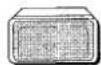
SX-R210
Surround speakers

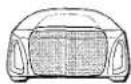
SX-C400
Center speaker
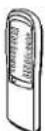
Remote control
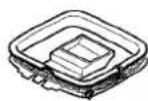
AM antenna

FM antenna
Operating Instructions, etc.

natural_image
Line drawing of a portable toaster with front grille and side button (no text or symbols)*TS-W35 (NSX-MT75 only)
(A connecting cord and Operating Instructions are included.)
*Optional TS-W35 powerd sub woofer is available with the NSX-MT70.
Owner's record
For your convenience, record the model number and serial number (you will find them on the rear of your set) in the space provided below. Please refer to them when you contact your Aiwa dealer in case of difficulty.
| Model No. | Serial No. (Lot No.) |
| CX-NMT70 | |
| SX-NA74 | |
| SX-C400 | |
| SX-R210 | |
| TS-W35 (NSX-MT75 only) |
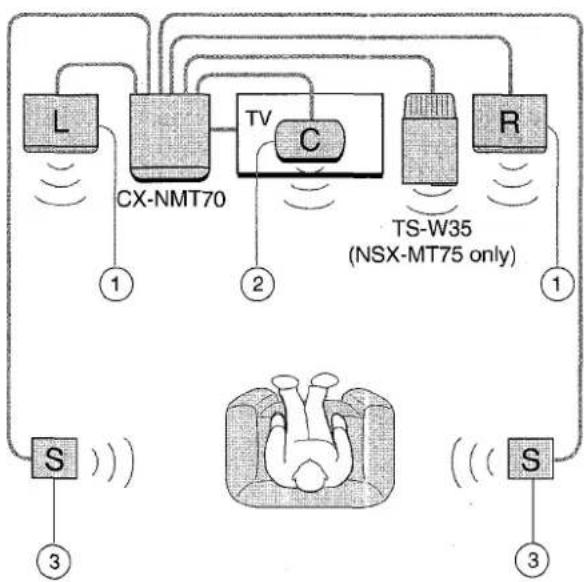
To achieve the optimum effects obtainable with the Dolby Pro Logic system, it is important to position the speakers properly. Refer to the following illustration to find out the best location in your room.
flowchart
graph TD
    L["Device L"] -->|1| CX-NMT70["Device CX-NMT70"]
    CX-NMT70 -->|2| TV["TV"]
    TV --> C["Device C"]
    C --> R["Device R"]
    R -->|1| TS-W35["TS-W35 (NSX-MT75 only)"]
    S["S"] -->|3| S
    S -->|3| S
    style TSW35 fill:#f9f,stroke:#333,stroke-width:2px
① Front speakers
② Center speaker
Position in the center of the two front speakers. In addition, position on or below the TV set, if connecting a TV set to the unit.
③ Surround speakers
Place the surround speakers directly to the side of or slightly behind the listening area. Align them horizontally, about 1 meter (3.2 feet) above ear height.
NOTE
- No sound is heard from the center and surround speakers when the Dolby Pro Logic and SURROUND are set to off.
- The center speaker sounds only when the Dolby Pro Logic is set to on.
CONNECTIONS
Before connecting the AC cord
The rated voltage of your unit shown on the rear panel is 120 V AC. Check that the rated voltage matches your local voltage.
IMPORTANT
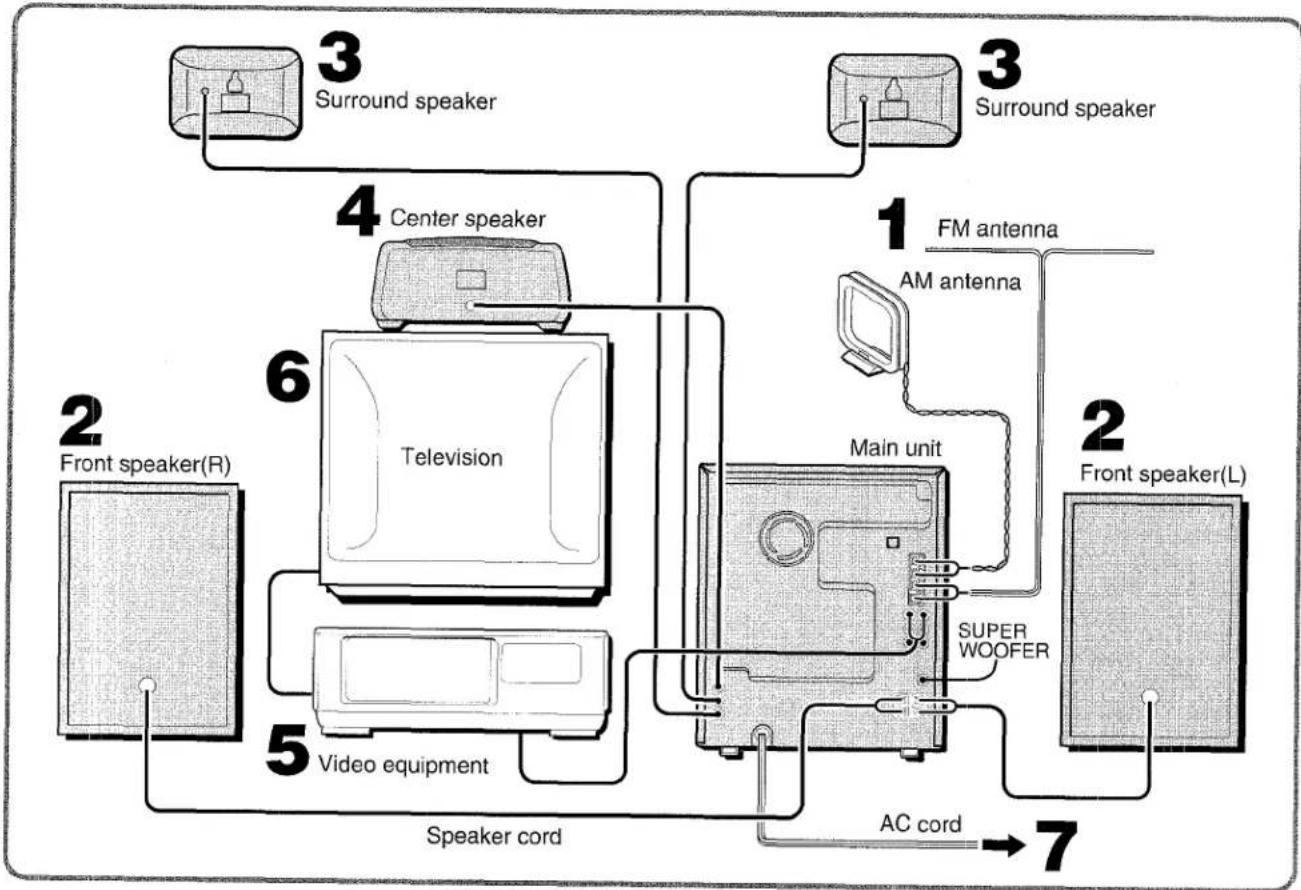
Connect the speakers, antennas, and all optional equipment first. Then connect the AC cord in the end.
flowchart
graph TD
    A["2 Front speaker(R)"] --> B["3 Surround speaker"]
    B --> C["4 Center speaker"]
    C --> D["5 Video equipment"]
    D --> E["6 Television"]
    E --> F["1 FM antenna"]
    F --> G["2 Front speaker(L)"]
    G --> H["3 Surround speaker"]
    H --> I["4 Super WOOFER"]
    I --> J["Main unit"]
    J --> K["AC cord"]
    K --> L["7"]
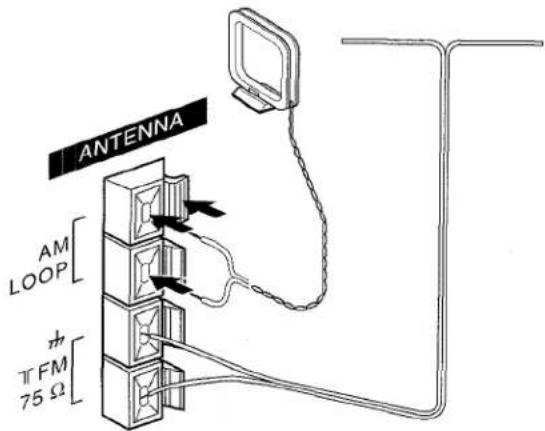
1 Connect the supplied antennas.
Connect the FM antenna to the FM 75 Ω terminals and the AM antenna to the AM LOOP terminal.
2 Connect the front speakers.
Connect the speaker with R mark to SPEAKERS R terminals, and the speaker with L mark to SPEAKERS L terminals.

The cords with white stripes should be connected to the + terminals and the other cords to the - terminals.
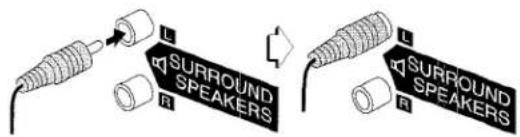
3 Connect the surround speakers.
Connect the surround speaker cords to the SURROUND SPEAKERS ▶ terminals.
There is no difference between the surround speakers. Both speakers can be connected as R (right) or L (left).
4 Connect the center speaker.
Connect the center speaker cord to the CENTER SPEAKER ▶ terminal.

5 Connect the video equipment.
Connect the VIDEO/AUX jack of this unit to the audio output jack of the video equipment with an optional audio connecting cord.
6 Connect the Television to the video equipment.
Refer to the Operating Instructions of the connected equipment for details.
7 Connect the AC cord to an AC outlet.
To stand the AM antenna on a surface
Fix the claw to the slot.

flowchart
graph TD
    A["Top Down"] --> B["Down Left"]
    B --> C["Down Right"]
    C --> D["Down Bottom"]
To position the antennas
FM feeder antenna:
Extend this antenna horizontally in a T-shape and fix its ends to the wall.
AM loop antenna:
Position for the best reception.
NOTE
- Be sure to connect the speaker cords correctly. Improper connections can cause short circuits in the SPEAKERS terminals.
- Do not leave objects generating magnetism near the speakers.
- Do not bring the FM antenna near metal objects or curtain rails.
- Do not bring the AM antenna near other optional equipment, the stereo system itself, the AC cord or speaker cords, since noise will be picked up.
- Do not unwind the AM antenna wire.
To mount the surround speakers on the wall
Mount each speaker on a spot that can hold its weight.

natural_image
Simple line drawing of a tool interacting with a device, showing a tool tip and directional arrow (no text or symbols)NOTE
Sound is not heard from the surround speakers when the SURROUND is set to off.
To connect the supplied TS-W35 (only for NSX-MT75)
Connect the SUPER WOOFER jack on the main unit to the INPUT jack on the TS-W35 with the supplied connecting cord.
Refer to the Operating Instructions in detail.
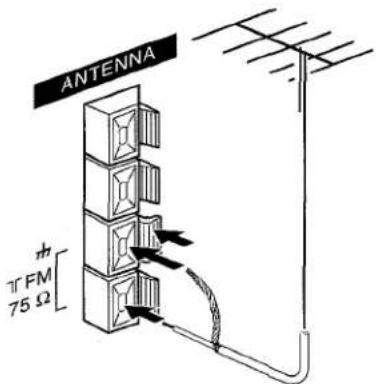
CONNECTING AN OUTDOOR ANTENNA
For better FM reception, use of an outdoor antenna is recommended.
Connect the outdoor antenna to the FM 75 Ω terminals.
To connect other optional equipment → page 23.
REMOTE CONTROL
Inserting batteries
Detach the battery cover on the rear of the remote control and insert two R6 (size AA) batteries.

When to replace the batteries
The maximum operational distance between the remote control and the sensor on the main unit should be approximately 5 meters (16 feet). When this distance decreases, replace the batteries with new ones.
Using the remote control
The instructions in this manual refer mainly to the buttons on the main unit. Buttons on the remote control with the same names as those on the main unit can be used as well.
NOTE
- If the unit is not going to be used for an extended period of time, remove the batteries to prevent possible electrolyte leakage.
• The remote control may not operate correctly when:
- The line of sight between the remote control and the remote sensor inside the display window is exposed to intense light, such as direct sunlight
- Other remote controls are used nearby (those of a television, etc.)
BEFORE OPERATION
To turn the unit on
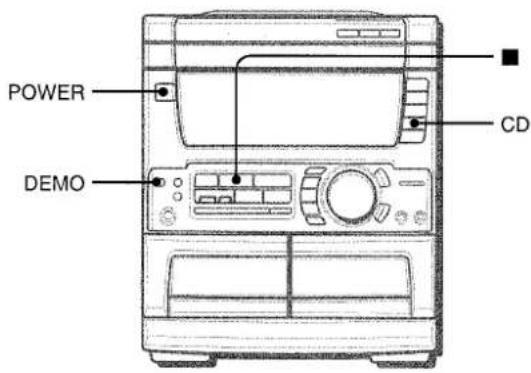
Press one of the function buttons (TAPE, TUNER, VIDEO/AUX, CD, MD).
Playback of the inserted disc or tape begins, or the previously tuned station is received (Direct Play Function).
The POWER button is also available.
When the unit is turned on, the disc compartment may open and close to reset the unit.
DEMO (Demonstration) mode
When the AC cord is connected, the display window demonstrates the functions of the unit. When the power is turned on, the DEMO display is overridden by the operation display. When the power is turned off, the DEMO mode is restored.
To cancel DEMO mode
Press the DEMO button. The clock display appears. (To set the current time, see "SETTING THE CLOCK" on page 21.) To re-activate the DEMO mode, press the DEMO button again.
Illumination guides
Whenever the AC cord is connected or one of the function buttons is pressed, the buttons for that operation light up or flash.
Example: When the AC cord is connected, the Ⅱ SET button flashes as a guide to setting the current time.
Flash window
The window on the top of the unit lights up or flashes while the unit is being powered on.
To turn off the light of the top window, press the ■ button while pressing the CD button. To turn back on, repeat the above.
To turn the unit off
Press the POWER button.
AUDIO ADJUSTMENTS
VOLUME
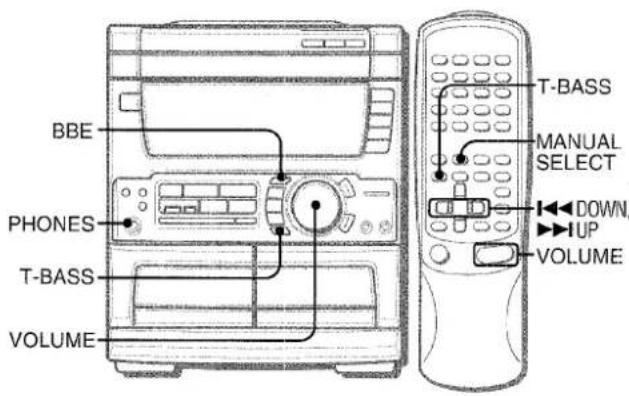
Turn the VOLUME control on the main unit, or press the VOLUME buttons on the remote control.
The volume level is displayed as a number from 0 to MAX (31). The volume level is automatically set to 16 when the power is turned off with the volume level set to 17 or more.
To change the left/right balance
Press the MANUAL SELECT button on the remote control. L/R is displayed for 2 seconds. Press the ◄◄◄ DOWN or ►►◆ UP button on the remote control within these 2 seconds.
- The DOLBY PRO LOGIC front speakers level is also changed. (See page 17)
BBE SYSTEM
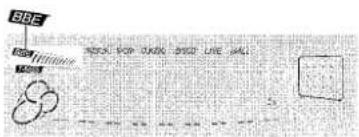
The BBE system enhances the clarity of high-frequency sound. It also enriches the Karaoke function to make your voice sound clear and pleasant.
Press the BBE button.
Each time it is pressed, the level changes. Select one of the three levels, or the off position to suit your preference.
SUPER T-BASS SYSTEM
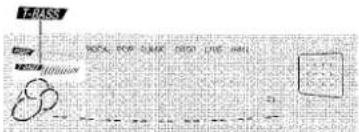
The T-BASS system enhances the realism of low-frequency sound.
Press the T-BASS button.
Each time it is pressed, the level changes. Select one of the three levels, or the off position to suit your preference.
NOTE
Low frequency sound may be distorted when the T-BASS system is used for a disc or tape in which low frequency sound is originally emphasized. In this case, cancel the T-BASS system.
GRAPHIC EQUALIZER

This unit provides the following three different equalization curves.
ROCK: Powerful sound emphasizing treble and bass
POP: More presence in the vocals and midrange
CLASSIC: Enriched sound with heavy bass and fine treble
Press the GEQ button repeatedly until the desired equalization curve is displayed.
ROCK /POP / CLASSIC
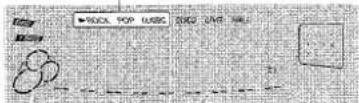
To cancel the selected mode
Press the GEQ button repeatedly so that GEQ OFF appears on the display.
Using the headphones
Connect headphones to the PHONES jack with a stereo standard plug (ø6.3 mm, 14 inch).
No sound is output from the speakers while the headphones are plugged in.
- When the headphones are plugged in, the SURROUND system and the DOLBY PRO LOGIC are canceled.
Sound adjustment during recording
The output volume and tone (except BBE) of the speakers or headphones may be freely varied without affecting the level of the recording.
NOTE
When playing back a tape recorded with BBE, it is recommended that BBE be set to off to avoid distorted high frequency sound.
7 ENGLISH
DSP SURROUND SYSTEM
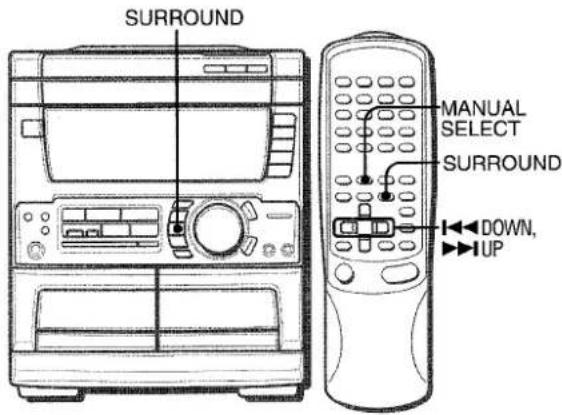
The DSP (Digital Signal Processor) surround system can recreate the effect of sounds reflected from walls or ceilings. This system enhances 3 types of sound presence.
DISCO: Sound presence of a disco
LIVE: Sound presence of a live music performance
HALL: Sound presence of a concert hall
Press the SURROUND button repeatedly until the desired SURROUND mode is displayed.
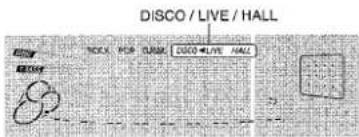
Equalization curves are selected automatically to match the SURROUND modes and can also be selected or turned off to suit your preference.
When the music source is monaural
Select LIVE to obtain a simulated stereo effect. When DISCO or HALL is selected, no sound will be heard from the surround speakers.
To cancel the selected mode
Press the SURROUND button repeatedly so that SUR OFF appears on the display.
While SURROUND mode is off, no sound is heard from the surround speakers.
To adjust the volume of the surround speakers
Press the MANUAL SELECT button twice on the remote control. "SUR" is displayed for 2 seconds. Press the ◀◀◀ DOWN or UP
▶▶I button on the remote control within these 2 seconds.
- The Dolby Pro Logic surround speakers level is also changed. (See page 17.)
NOTE
The SURROUND mode is canceled when:
- the MIC or ECHO level is changed.
- the DOLBY PRO LOGIC is turned on.
MANUAL TUNING
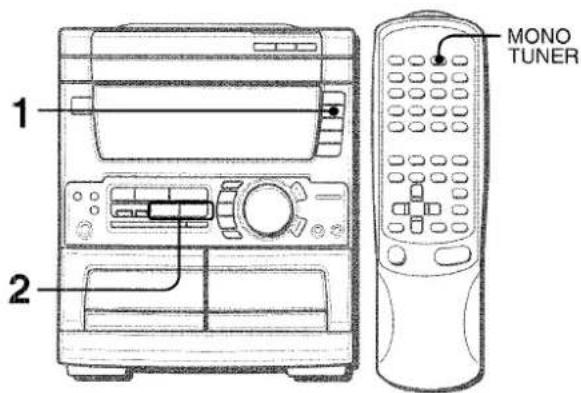
1 Press the TUNER/BAND button repeatedly to select the desired band.
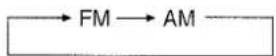
When the TUNER/BAND button is pressed while the power is off, the power is turned on directly.
2 Press the ◀◀◀ DOWN or ▶▶▶ UP button to select a station.
Each time the button is pressed, the frequency changes. When a station is received, "TUNE" is displayed for 2 seconds. During FM stereo reception, (10) is displayed.
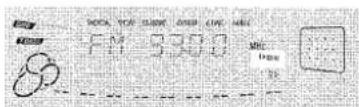
To search for a station quickly (Auto Search)
Keep the ◄◄◄ DOWN or ►►◆ UP button pressed until the tuner starts searching for a station. After tuning in to a station, the search stops.
To stop the Auto Search manually, press the ◀◀◀ DOWN or ▶▶▶ UP button.
- The Auto Search may not stop at stations with very weak signals.
When an FM stereo broadcast contains noise
Press the MONO button on the remote control so that "MONO" appears on the display.
Noise is reduced, although reception is monaural.
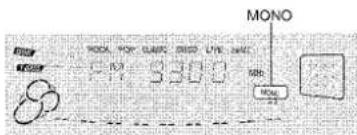
To restore stereo reception, press the MONO TUNER button so that MONO disappears.
To change the AM tuning interval
The default setting of the AM tuning interval is 10 kHz/step. If you use this unit in an area where the frequency allocation system is 9 kHz/step, change the tuning interval.
Press the POWER button while pressing the TUNER/BAND button.
To reset the interval, repeat this procedure.
NOTE
When the AM tuning interval is changed, all preset stations are cleared. The preset stations have to be set again.
PRESETTING STATIONS
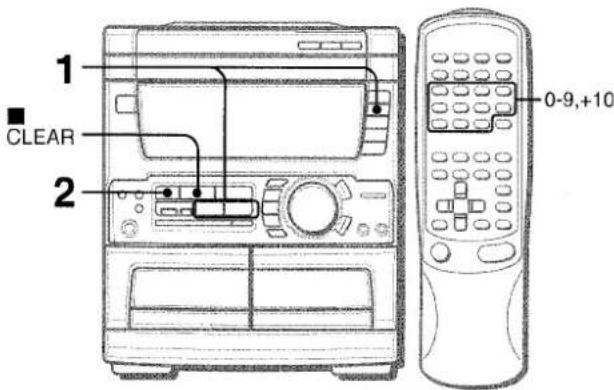
The unit can store a total of 32 preset stations. (Each band has a maximum of 20 available preset stations.) When a station is stored, a preset number is assigned to the station. Use the preset number to tune in to a preset station directly.
1 Press the TUNER/BAND button to select a band, and press the ◀◀◀ DOWN or ▶▶▶ UP button to select a station.
2 Press the II SET button to store the station.
A station is assigned a preset number, beginning from 1 in consecutive order for each band.

Preset number
3 Repeat steps 1 and 2.
The next station will not be stored if a total of 32 preset stations for all the bands or a total of 20 preset stations for one band have already been stored.
PRESET NUMBER TUNING
Use the remote control to select the preset number directly.
1 Press the TUNER/BAND button to select a band.
2 Press the numbered buttons to select a preset number.
Example:
To select preset number 20, press the +10, +10 and 0 buttons.
To select preset number 15, press the +10 and 5 buttons.
Selecting a preset number on the main unit
Press the TUNER/BAND button to select a band. Then, press the ◀► DIRECTION/PRESET button repeatedly.
Each time the button is pressed, the next highest number is selected.
To clear a preset station
Select the preset number of the station to be cleared. Then, press the ■ CLEAR button, and press the ■ SET button within 4 seconds.
The preset numbers of all other stations in the band with higher numbers are also decreased by one.
BASIC OPERATIONS
LOADING DISCS

Press the CD button, then press the ▲ OPEN/CLOSE button to open the disc compartment. Load disc(s) with the label side up.
To play one or two discs, place the discs on tray 1 and 2. To play three discs, press the DISC CHANGE button to rotate the trays after placing two discs. Place the third disc on tray 3. Close the disc compartment by pressing the ▲ OPEN/CLOSE button.

PLAYING DISCS
Load discs.
To play all discs in the disc compartment, press the ◀▶ button.
Play begins with the disc on tray 1.
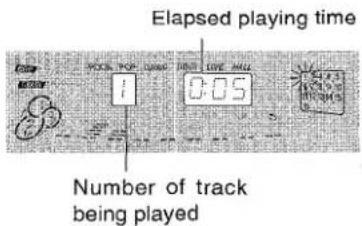
To play one disc only, press one of the DISC DIRECT PLAY buttons.
The selected disc is played once.
To play with the remote control
Press the DISC DIRECT PLAY button, then press one of the numbered buttons 1 to 3 within 3 seconds to select a disc.
To stop play, press the ■ button.
To pause play, press the ▪ button. To resume play, press again. To search for a particular point during playback, keep the ◀◀ or ▶▶ button pressed and release the button at the desired point.
To skip to the beginning of a track during playback, press the ◀◀ or ▶▶ button repeatedly.
To remove discs, press the ▲ OPEN/CLOSE button.
To start play when the power is off (Direct Play Function) Press the CD button. The power is turned on and play of the loaded disc(s) begins.
When the ▲ OPEN/CLOSE button is pressed, the power is also turned on.
To check the remaining time
Press the CD EDIT/CHECK button during play. The amount of time remaining until all tracks finish playing is displayed. To restore the playing time display, repeat the above.
Selecting a track with the remote control
1 Press the DISC DIRECT PLAY button, then press one of the numbered buttons 1 to 3 within 3 seconds to select a disc.
2 Press the numbered buttons and the +10 button to select a track.
Example:
To select the 25th track, press the +10, +10 and 5 buttons.
To select the 10th track, press the +10 and 0 buttons.
The selected track starts to play and continues to the end of that disc.
Replacing discs during play
While one disc is playing, the other discs can be replaced without interrupting play.
1 Press the DISC CHANGE button.
2 Remove the discs and replace with other discs.
3 Press the ▲ OPEN/CLOSE button to close the disc compartment.
NOTE
- When loading an 8-cm (3-inch) disc, put it onto the inner circle of the tray.
- Do not place more than one compact disc on one disc tray.
- Do not tilt the unit with discs loaded. Doing so may cause malfunctions.
RANDOM /REPEAT PLAY
Use the remote control.
RANDOM play
All the tracks on the selected disc or on all the discs can be played randomly.
REPEAT play
A single disc or all the discs can be played repeatedly.
Press the RANDOM/REPEAT button.
Each time it is pressed, the function can be selected cyclically.
RANDOM play — RANDOM lights up on the display.
REPEAT play — lights up on the display.
RANDOM/REPEAT play — RANDOM and light up on the display.
Cancel — RANDOM and → go out from the display.
To play the programmed tracks repeatedly
After programming the tracks, press the RANDOM/REPEAT button repeatedly until ↩ appears on the display.
NOTE
During random play following operations are not possible: -to select the tracks directly with the numbered buttons.
-to skip to the previously played track with the ◀◀ button.
PROGRAMMED PLAY
Up to 30 tracks can be programmed from any of the inserted discs.

Use the remote control.
1 Press the PRGM button twice in stop mode.
The PRGM indicator lights up on the display.

- When the PRGM button is pressed once in step 1, the unit enters the KARAOKE PROGRAM (see page 20).
2 Press the DISC DIRECT PLAY button, then press one of the numbered buttons 1 to 3 within 3 seconds to select a disc.
The selected disc is indicated in red on the display.
Go to the next step when the tray stops rotating.
3 Press the numbered buttons and the +10 button to program a track.
Example:
To select the 25th track, press the +10, +10 and 5 buttons.
To select the 10th track, press the +10 and 0 buttons.
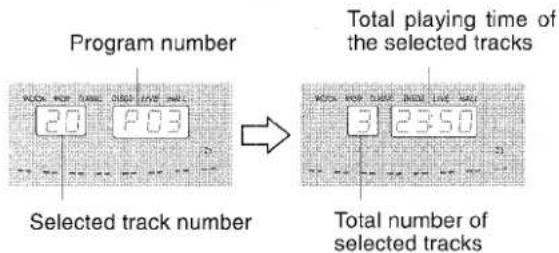
4 Repeat steps 2 and 3 to program other tracks.
5 Press the ◀▶ button to start play.
To check the program
Each time the ◀◀ or ▶▶ button is pressed in stop mode, a disc number, track number, and program number will be displayed.
To clear the program
Press the ■ CLEAR button in stop mode.
To add tracks to the program
Repeat steps 2 and 3 in stop mode. The track will be programmed after the last track.
To change the programmed tracks
Clear the program and repeat all the steps again.
To play all discs, press the ◀ button to start play.
To play a single disc, press the DISC DIRECT PLAY button, then press one of the numbered buttons (1-3) within 3 seconds to start play.
NOTE
During programmed play, you cannot perform random play, check the remaining time, and select a disc or track.
BASIC OPERATIONS
INSERTING TAPES
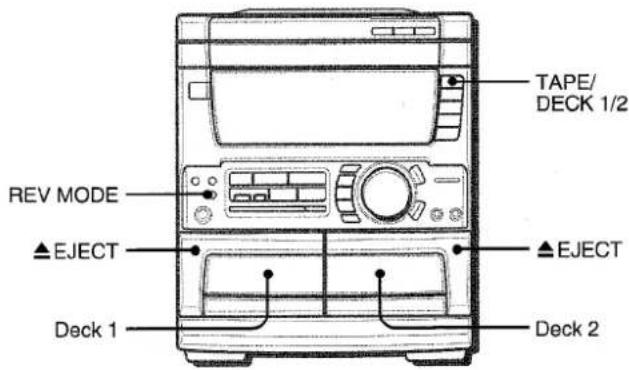
- On deck 1, tapes are always played back on both sides. On deck 2, you can select a reverse mode to play back one or both sides.
- Use Type I (normal), Type II (high/ CrO2 ) or Type IV (metal) tapes for playback.
Press the TAPE button and press the ▲ EJECT mark to open the cassette holder.

Insert a tape with the exposed side down. Push the cassette holder to close.
To select a reverse mode (deck 2 only)
Each time the REV MODE button is pressed, the reverse mode changes.

flowchart
graph TD
    A["Input"] --> B{Decision}
    B -->|Yes| C["Output"]
    B -->|No| D["Feedback Loop"]
    D --> E["End"]
To play one side only, select Z.
To play from front side to reverse side once only, select ☐.
To play both sides repeatedly, select (二).
- When tapes are loaded in both decks, ☐ on the display indicates Continuous Play.
PLAYING BACK A TAPE
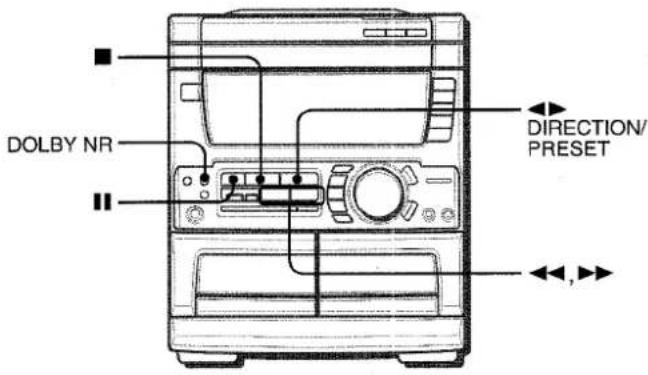
Insert a tape.
1 Press the DOLBY NR button and turn Dolby NR on or off to match the playback tape.
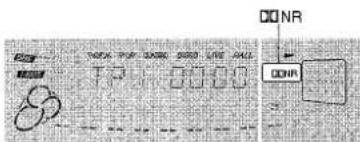
For tapes recorded with DOLBY NR, turn on ☐☐ NR. For tapes recorded without DOLBY NR, turn off ☐☐ NR.
2 Press the ◀▶ button to start play.
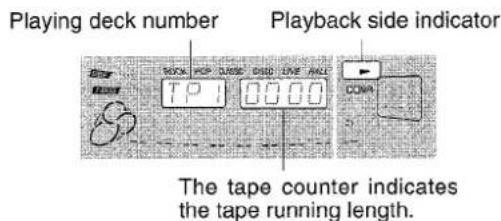
▶: The front side is being played (forward).
◀: The back side is being played (reverse).
When tapes are loaded in both decks
Press the TAPE button first to select a deck.
The selected deck number is displayed.
To stop play, press the ■ button.
To pause play (deck 2 only), press the II button. To resume play, press again.
To change the playback side, press the ◀► DIRECTION/PRESET button in play or pause mode.
To fast forward or rewind, press the ◀◀ or ▶▶ button. Then press the ■ button to stop the tape.
To start play when the power is off (Direct Play Function) Press the TAPE button. The power is turned on and play of the inserted tape begins.
To set the tape counter to 0000
Press the ■ CLEAR button in stop mode.
The counter is also set to 0000 when the cassette holder is opened.
NOTE
If a television is used near this unit during tape playback, noise may be heard from the speakers. In this case, turn the television off.
MUSIC SENSOR
If there is a 4-second or longer blank between each track, a search for the beginning of the current or next track during playback can be done easily.
Press the ◀◀ or ▶▶ button during playback referring to the playback side indicator (◀ or ▶) on the display.
For example, when the ▶ button is pressed while ▶ is displayed, playback of the next track starts.
Music sensor function may not be able to detect tracks under the following conditions:
- Blanks of less than 4 seconds between tracks
- Noisy blanks
- Long passages of low-end sound
- Low overall recording levels
CONTINUOUS PLAY
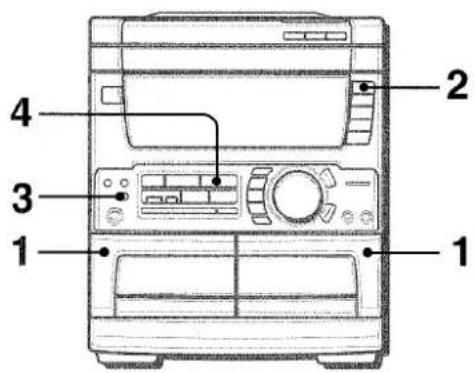
After playback on one deck finishes, the tape in the other deck will start to play without interruption.
1 Insert tapes into deck 1 and deck 2.
2 Press the TAPE/DECK1/2 button to select the deck to be played back first.
3 Press the REV MODE button to select ☐.
4 Press the ◀▶ button to start playback.
Playback continues until the ■ button is pressed.
About cassette tapes
- To prevent accidental erasure, break off the plastic tabs on the cassette tape after recording with a screwdriver or other pointed tool.
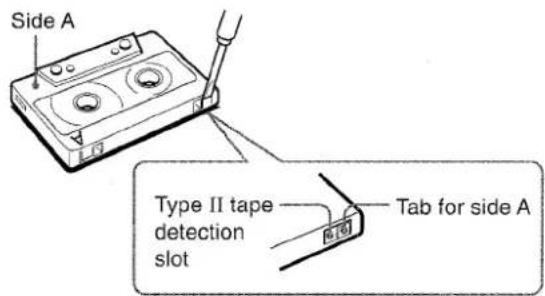
To record on the tape again, cover the tab openings with adhesive tape, etc. (On Type II tapes, take care not to cover the Type II tape detection slot.)
- 120-minute or longer tapes are extremely thin and easily deformed or damaged. They are not recommended.
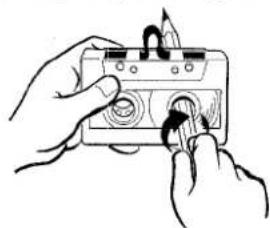
• Take up any slack in the tape with a pencil or similar tool before use. Slack tape may break or jam in the mechanism.
natural_image
Illustration of hands using a power tool to switch a component (no text or symbols visible)DOLBY NR system
The Dolby Noise Reduction system reduces tape hiss noise. For optimum performance when playing back a tape recorded with the DOLBY NR system, turn on the DOLBY NR system.
BASIC RECORDING
This section explains how to record from the tuner, CD player, or external equipment.

Preparation
- Set the tape to the point where recording will start.
- Use Type I (normal) and Type II (high/ CrO2 ) tapes for recording.
1 Insert the tape to be recorded on into deck 2. Insert the tape with the side to be recorded on first facing out from the unit.

2 Press the REV MODE button to select the reverse mode.
To record on one side only, select 2.
To record on both sides, select ⊗ or (⊥).
3 Press the DOLBY NR button to turn Dolby NR on or off.
To record with DOLBY NR, turn on ☐☐ NR.
To record without DOLBY NR, turn off ☐ ☐ NR.
4 Press one of the function buttons and prepare the source to be recorded.
To record from a CD, press the CD button and load the disc(s).
To record from a radio broadcast, press the TUNER button and tune in to a station.
To record from a connected source, press the VIDEO/AUX or MD button and play.
5 Press the ● REC/REC MUTE button to start recording.

When the selected function is CD, playback and recording start simultaneously.
To stop recording, press the ■ button.
To pause recording, press the Ⅲ button. (Applicable when the source is TUNER, VIDEO/AUX or MD.) To resume recording, press again.
INSERTING BLANK SPACES
Insertion of 4-second blank spaces enables you to activate the Music Sensor function. (Applicable when the source is TUNER, VIDEO/AUX or MD.)
1 Press the ● REC/REC MUTE button during recording or while in recording pause mode.
REC on the display flashes for 4 seconds and the tape runs without recording. After 4 seconds, the deck enters the recording pause mode.
2 Press the II button to resume recording.
To insert a blank space of less than 4 seconds, press the ● REC/REC MUTE button again while REC is flashing.
To insert blank spaces of more than 4 seconds, after the deck enters recording pause mode, press the ● REC/REC MUTE button again. Each time the button is pressed, a 4-second blank space is added.
To erase a recording
Make sure the microphone is not connected to this unit.
1 Insert the tape to be erased into deck 2 and press the TAPE/DECK 1/2 button to display "TP 2".
2 Set the tape to the point where the erasure is to be started.
3 Set the reverse mode by pressing the REV MODE button.
4 Press the ● REC/REC MUTE button to start the erasure.
DUBBING A TAPE MANUALLY

NOTE
- Set the tape to the point where recording will start.
• The reverse mode is automatically set to 2.
Note that recording will be done on one side of the tape only.
1 Press the TAPE button.
2 Insert the original tape into deck 1 and the tape to be recorded on into deck 2.
Insert the tapes with the sides to be played back or recorded on facing out from the unit.
3 Press the DOLBY NR button to turn off the Dolby NR.
☐☐ NR on the display goes out.
4 Press the TAPE/DECK 1/2 button to select deck 1.
"TP 1" is displayed.
5 Press the ● REC/REC MUTE button to start recording.
Playing and recording start simultaneously.
To stop dubbing
Press the ■ button.
To set the Dolby NR when playing back the dubbed tape Press the DOLBY NR button and turn Dolby NR on or off to match the original tape.
DUBBING THE WHOLE TAPE
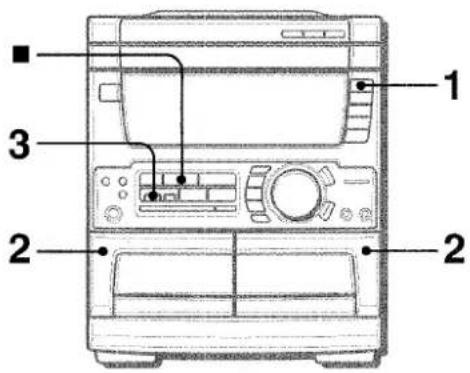
This function allows you to make exact copies of both sides of the original tape. The reverse side of both tapes will start simultaneously as soon as the longer tape has been reversed.
NOTE
- Dubbing does not start from a point halfway in the tape.
- The reverse mode is automatically set to 二).
• The Dolby NR does not affect recording.
1 Press the TAPE button.
2 Insert the original tape into deck 1 and the tape to be recorded on into deck 2.
Insert each tape with the side to be played back or recorded on first facing out from the unit.
3 Press the SYNC DUB button once or twice to start recording.
① For recording at normal speed, press it once to display NORM-DUB.
② For recording at high speed, press it twice to display HIGH-DUB.
①
②

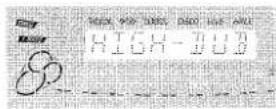
The tapes are rewound to the beginning of the front sides, and recording starts.
To stop dubbing
Press the ■ button.
To set the Dolby NR when playing back the dubbed tape Press the DOLBY NR button and turn Dolby NR on or off to match the original tape.
NOTE
Recording does not start, if the erasure prevention tab on either side of the tape is broken off.
AI EDIT RECORDING

The AI edit function enables CD recording without worrying about tape length and track length. When a CD is inserted, the unit automatically calculates the total track length. If necessary, the order of tracks is rearranged so that no track is cut short. (Al: Artificial Intelligence)
NOTE
AI edit recording will not start from a point halfway into the tape. The tape must be recorded from the beginning of either side.
1 Insert the tape into deck 2, and press the DOLBY NR button to turn Dolby NR on or off.
Insert the tape with the side to be recorded on first facing out from the unit.
2 Press the CD button and load the disc(s).
3 Press the CD EDIT/CHECK button once.
"EDIT" and "AI" light up on the display.
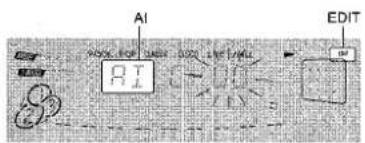
When "PRGM" is displayed, press the CD EDIT/CHECK button again.
4 Press one of the DISC DIRECT PLAY buttons to select a disc.
5 Press the ◀◀ or ▶▶ button to designate the tape length.
10 to 99 minutes can be specified. In a few seconds, the microcomputer determines the tracks to be recorded on each side of the tape.
- The numbered buttons on the remote control are also available to designate the tape length.
Example: When using a 60-minute tape, press the 6 and 0 buttons.

6 Press the ● REC/REC MUTE button to start recording.
The tape is rewound to the beginning of the front side, the lead segment is played through for 10 seconds, and recording starts. When recording on the front (side A) ends, recording on the back (side B) starts.
To stop recording
Press the ■ button. Recording and CD play stop simultaneously.
To clear the edit program
Press the ■ CLEAR button twice so that "EDIT" disappears on the display.
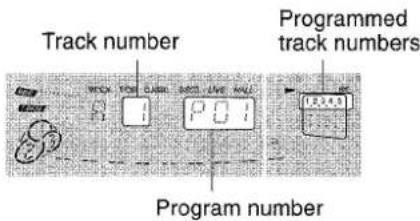
To check the order of the programmed track numbers
Before recording, press the CD EDIT/CHECK button to select side A or B, and press the ◀◀ or ▶▶ button repeatedly.
To add tracks from other discs to the edit program
If there is any time remaining on the tape after step 5, you can add tracks from other discs in the CD compartment.
1 Press the CD EDIT/CHECK button to select side A or B.
2 Press one of the DISC DIRECT PLAY buttons to select a disc.
3 Press the numbered buttons on the remote control to select tracks. PRGM appears on the display.
A track whose playing time is longer than the remaining time cannot be programmed.
4 Repeat steps 2 and 3 to add more tracks.
Time on cassette tapes and editing time
The actual cassette recording time is usually a little longer than the specified recording time printed on the label. This unit can program tracks to use the extra time. When the total recording time is a little longer than the tape's specified recording time after editing, the display shows the extra time (without a minus mark), instead of the time remaining on the tape (with the minus mark).
NOTE
- Recording is inhibited if the erasure prevention tab on either side of the tape is broken off.
- The AI edit function cannot be used with discs containing 31 tracks or more.
PROGRAMMED EDIT RECORDING

Programmed edit function enables CD recording while checking the remaining time on each side of the tape as the tracks are programmed.
NOTE
The programmed edit recording will not start from a point halfway in the tape. The tape must be recorded from the beginning of either side.
1 Insert the tape into deck 2, and press the DOLBY NR button to turn Dolby NR on or off.
Insert the tape with the side to be recorded on fir™st facing out from the unit.
2 Press the CD button and load the disc(s).
3 Press the CD EDIT/CHECK button twice.
"EDIT" and "PRGM" light up on the display.

When "AI" is displayed, press the CD EDIT/CHECK button again.
4 Press the ◀◀ or ▶▶ button to designate the tape length.
10 to 99 minutes can be specified.
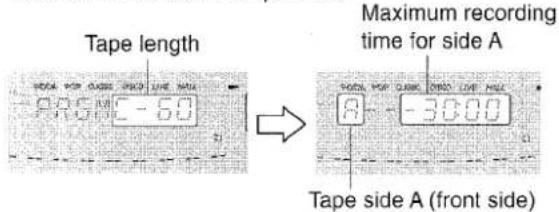
5 Press the DISC DIRECT PLAY button, then press one of the numbered buttons 1 to 3 within 3 seconds on the remote control.
Then, press the numbered buttons and the +10 button on the remote control to program a track.
Example: To select the 10th track of disc 2, press the DISC DIRECT PLAY and 2 buttons, then press the +10 and 0 buttons.
6 Repeat step 5 for the rest of the tracks for side A. A track whose playing time is longer than the remaining time cannot be programmed.
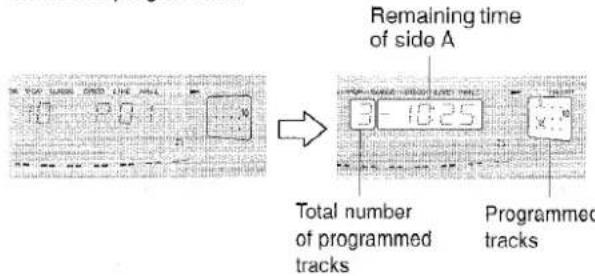
7 Press the CD EDIT/CHECK button to select side B and program the tracks for side B.
After confirming B on the display, repeat step 5.
Tape side B (reverse side)

8 Press the ● REC/REC MUTE button to start recording.
The tape is rewound to the beginning of the front side, the lead segment is played through for 10 seconds, and recording starts. When recording on the front side (A) ends, recording on the back side (B) starts.
To stop recording
Press the ■ button. Recording and CD play stop simultaneously.
To check the order of the programmed track numbers
Before recording, press the CD EDIT/CHECK button to select side A or B, and press the ◀◀ or ▶▶ button repeatedly.

To change the program of each side
Press the CD EDIT/CHECK button to select side A or B, and press the ■ CLEAR button to clear the program of the selected side. Then program tracks again.
To clear the edit program
Press the ■ button twice so that "EDIT" disappears on the display.
NOTE
Recording is inhibited if the erasure prevention tab on either side of the tape is broken off.
DOLBY PRO LOGIC
The Dolby Pro Logic feature and the center and rear speakers (standard) assure full-scale home theater sound. When playing back laser discs or video software that have been recorded in Dolby Surround, astonishingly realistic sound surrounds the listener to create a new level of audio/visual entertainment. Independent control of the four sound channels allows the listener to enjoy the same type of sound reproduction experienced in movie theaters. Voices are reproduced in the front and center sound field, while ambient sounds like cars and crowds are reproduced on all sides of the listener for an incredibly lifelike audio/video experience. Please read the following carefully to "tune" the system's output to match the characteristics of your listening space.
Check the following:
- Before using the DOLBY PRO LOGIC, adjust the proper balance of speaker sound levels.
- Make sure the supplied speakers are properly connected and positioned. (See page 3)
• Make sure the TV set and video unit are properly connected. (See page 4) - Make sure the laser disc, video tape, etc., support DOBY SURROUND.
The unit is equipped with a built-in test signal generator called a noise sequencer for easy balance adjustment of all four channels. The sequencer outputs a noise signal that "travels" from channel to channel, enabling the simple adjustment of sound level to achieve, at the listening position, the same apparent loudness from each channel.
Use the remote control.
1 Press the DOLBY PRO LOGIC button to select NORMAL.
NORMAL lights up in red. If PHANTOM or 3CH - LOGIC lights up in red, press the DOLBY PRO LOGIC button repeatedly until NORMAL is selected.
2 Press the MANUAL SELECT (TEST) button and hold it down for about four seconds until "L" flashes.
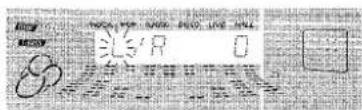
A noise signal is sent to each channel in turn in the following sequence.

3 Adjust the sound level of the center and the surround speakers.
While "CEN" or "SUR" is displayed, press the DOWN ◀◀◀ or UP ▶▶◀ button to adjust the volume of the center or surround speakers to match the level of the left and right speakers.
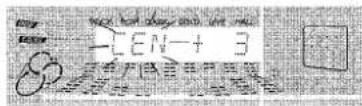
To adjust the balance between the left and right speakers, see page 6. At this time, the DOLBY PRO LOGIC mode should be canceled by pressing the DOLBY PRO LOGIC button until the "P-OFF" is displayed.
4 Press the MANUAL SELECT (TEST) button again to stop the noise signal.
NOTE
If the surround speakers level of the SURROUND is changed (see page 7), that of the DOLBY PRO LOGIC is also changed.
About the channels
The left and right speakers create the stereo effect.
The center speaker helps achieve precise sound positioning over a broad sound field.
The rear-mounted surround speakers enhance the "depth" of the sound field.
To change the delay time
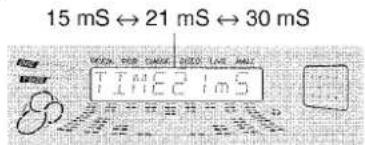
The surround speakers reproduce sounds a split second after the front speakers. The delay is initially set to 21 ms (milliseconds).
To change this standard delay time, press the MANUAL SELECT (TEST) button on the remote control repeatedly until "TIME" is displayed. Then, press the DOWN ◀◀◀ or UP ▶▶▶ button. Each time one of the buttons is pressed, the delay time changes as shown below.
PLAY WITH DOLBY PRO LOGIC

1 Press the VIDEO/AUX button and start playback of the video source.
2 Press the DOLBY PRO LOGIC button.
NORMAL is selected, and the playback sound has the DOLBY PRO LOGIC effect.
To cancel Dolby Pro Logic mode
Press the DOLBY PRO LOGIC button repeatedly until P-OFF is displayed.
To change the sound levels during playback
After adjusting the balance with the noise sequencer, the sound levels of the center or surround speakers can be adjusted during playback of laser discs or video software.
1 Press the MANUAL SELECT (TEST) button on the remote control repeatedly to select "CEN" (center) or "SUR" (surround).
2 While the "CEN" or "SUR" is displayed, press the DOWN ◄◀◀ or UP ▶▶▶ button on the remote control to adjust the volume.
ADDITIONAL DOLBY PRO LOGIC MODES
In addition to the NORMAL mode, this unit is also equipped with the PHANTOM and the 3 CH LOGIC modes.
PHANTOM mode: Use this mode when no center speaker is connected. The center channel signals are output through the left and right speakers.
3 CH LOGIC mode: Use this mode when no surround speakers are connected. This mode reproduces rear sounds through the front speakers.
To select PHANTOM or 3 CH LOGIC
Press the DOLBY PRO LOGIC button repeatedly until the desired Dolby Pro Logic mode is displayed. The Dolby Pro Logic mode is displayed cyclically as follows.

To adjust the balance of connected speaker sound levels
Carry out steps 2 to 4 on page 17.
NOTE
- Depending on the sound source and/or listening conditions, a surround effect may not be obtained even when the DOLBY PRO LOGIC is on.
- The full DOLBY PRO LOGIC effect cannot be obtained when using software without ☐☐ DOLEY SURROUND mark. In this case, use the SURROUND system instead. (See page 7.)
MICROPHONE MIXING

Two microphones (not supplied) can be connected to this unit, allowing you to sing along to music sources. Use microphones with mini plugs (ø3.5 mm, 18 inch).
1 Connect your microphones to the MIC 1 and MIC 2 jacks.

2 Press one of the function buttons to select the source to be mixed, and play the source.
3 Adjust the volume and tone of the source.
4 Press the MIC button and turn the VOLUME control within 4 seconds to adjust the microphone volume.
The microphone volume can be selected from 1 to MAX (7) or OFF (cancel).
The volume of both microphones is adjusted simultaneously.
5 Press the ECHO button and turn the VOLUME control within 4 seconds to adjust the echo level.
The echo level can be selected from 1 to MAX (7) or OFF (cancel).
To change the delay time of echo
Hold down the ECHO button while the echo is on.
"L" (Long) and "M" (Medium) are displayed alternately. At the desired position, release the button.
To record microphone sound mixed with source sound Follow the procedure for recording from the sound source (see page 13).
The SYNC DUB button cannot be used for mixing recording.
When not using the microphones
Set the microphone volume and echo level to OFF and remove the microphones from the MIC jacks.
NOTE
- When the MIC or ECHO level is changed, the SURROUND mode and the DOLBY PRO LOGIC are automatically canceled.
- If a microphone is held too near the speakers, a howling sound may be produced. In this case, hold the microphone away from the speakers, or decrease the microphone volume.
- If sound through the microphone is extremely loud, it may be distorted. In this case, decrease the microphone volume.
- When the function is changed, the microphone volume and the echo volume are set to off.
Recommended microphones
The use of unidirectional type microphones is recommended to prevent howling. Contact your local Aiwa dealer for details.
VOCAL FADER/MULTIPLEX FUNCTIONS
This unit can use discs or tapes as Karaoke sources.
Use the vocal fader function for ordinary discs or tapes.
Use the multiplex function for multi audio discs or tapes.
Press the KARAOKE button repeatedly to select the vocal fader or multiplex function.
Each time the KARAOKE button is pressed, one of these functions is selected cyclically.

flowchart
graph TD
    A["①"] --> B["②"]
    B --> C["③"]
    C --> D["④"]
    D --> E["⑤"]

    subgraph Step 1
        F["输入 V'F"]
        G["输出 R-V'F"]
    end

    subgraph Step 2
        H["输入 M'Q'V - L"]
        I["输出 R-M'Q'V"]
    end

    subgraph Step 3
        J["输入 M'Q'V - L"]
        K["输出 R-M'Q'V"]
    end

    subgraph Step 4
        L["输入 V'F OFF"]
        M["输出 R-M'Q'W"]
    end
① Vocal Fader
The singer's voice becomes softer than the accompaniment.
② Auto Vocal Fader
The singer's voice becomes softer only while there is audio input through microphones.
③ Multiplex
The sound on the left channel is heard from both speakers, and the sound on the right channel is muted.
To hear the sound on the right channel, see below.
④ Auto Multiplex
The sound on the left channel is heard from both speakers, and the sound on the right channel is muted only while there is audio input through microphones.
To hear the sound on the right channel, see below.
⑤ Cancel
To change the audible channel in Multiplex function
When Multiplex is selected, "MPX-L" is displayed for 3 seconds and changes to the selected function name. After the selected function name is displayed, keep pressing the KARAOKE button until "MPX-R" is displayed.
To return to the initial setting, select MPX-L.
When the power is turned off, MPX-L is restored.
To change the time lag setting in Auto Vocal Fader or Auto Multiplex function
The muted original singer's voice can be turned faster to the normal level.
When Auto Vocal Fader or Auto Multiplex is selected, "A-VF" or "A-MPX" is displayed for 3 seconds and changes to the selected function name. After the selected function name is displayed, keep pressing the KARAOKE button until "FAST" is displayed.
To return to the initial setting, select SLOW.
When the power is turned off, SLOW is restored.
NOTE
- The Karaoke functions may not operate correctly with the following kinds of CDs or tapes.
- Those with monaural sound
- Those recorded with strong echoes
- Those with the vocal part recorded on the right or left side of the sound width
- While the Karaoke function is on, the sound is output as monaural.
- When the function is changed, the Karaoke function is canceled.
KARAOKE PROGRAM
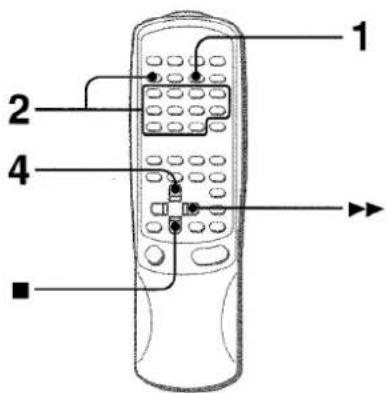
Before or during CD play, you can reserve up to 15 tracks to be played after the current track. Each reservation is cleared when it finishes playing.
Use the remote control.
1 Press the PRGM button once.
2 Press the DISC DIRECT PLAY button, then press one of the numbered buttons 1 to 3 within 3 seconds to select a disc.
Then, press the numbered buttons and the +10 button to program a track.
Reserved disc number Reserved track number
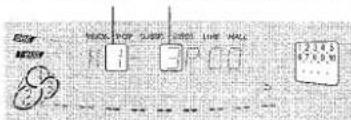
3 Repeat step 2 to reserve other tracks.
4 Press the ◀▶ button to start play.
After a track is played, it is cleared from the program.

To add a reservation during play
Repeat step 2.
To check the reserved tracks
Press the CD EDIT/CHECK button repeatedly. Each time it is pressed, the disc number and track number are displayed in the reserved order.
To stop play
Press the ■ button. When the ◀▶ button is pressed, the play starts from the last track again.
To skip a current track
Press the ▶ button. The skipped track is cleared from the program.
To clear all the reservations
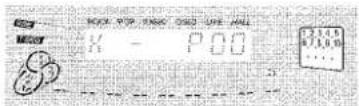
Press the ▶ button repeatedly until "K - P00" is displayed.
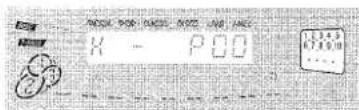
Press it once more to cancel the Karaoke programs. The display returns to that of CD play.
NOTE
- If the reserved track number does not exist on the selected disc, the unit stops playing and the display flashes.
In this case, press the ▶▶ button to skip the error track. Then press the ◀▶ button to start play with the next reserved track.
- When the PRGM button is pressed repeatedly in step 1, PRGM is displayed and the unit enters CD program play mode (page 10).
To cancel program play, press the ■ CLEAR button.
SETTING THE CLOCK
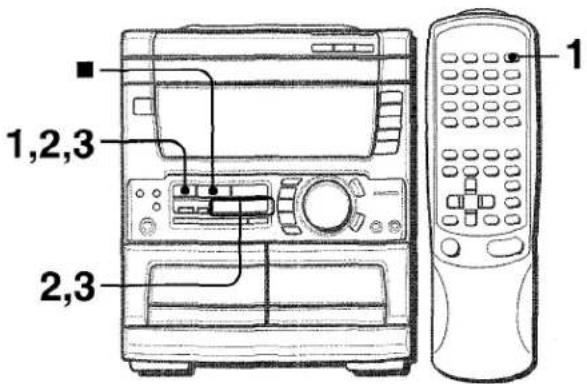
1 Press the CLOCK button on the remote control, and press the II SET button within 4 seconds.

2 Press the ◀◀ DOWN or ▶▶ UP button to designate the hour, and press the Ⅱ SET button.
The hour stops flashing and the minute starts flashing.
3 Press the ◀◀ DOWN or ▶▶ UP button to designate the minute, and press the II SET button.
The minute stops flashing on the display and the clock starts from 00 seconds.
To display the current time
Press the CLOCK button on the remote control. The time is displayed for 4 seconds.
However, the time cannot be displayed during recording.
To switch to the 24-hour standard
Press the CLOCK button on the remote control and then press the ■ button within 4 seconds.
Repeat the same procedure to restore the 12-hour standard.
If the clock display flashes
This is caused by a power interruption. The current time needs to be reset.
If power is interrupted for more than approximately 24 hours, all settings stored in memory after purchase need to be reset.
SETTING THE TIMER
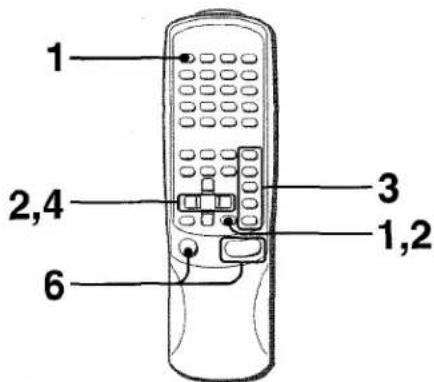
The unit can be turned on at a specified time every day with the built-in timer.
Preparation
Make sure the clock is set correctly.
Use the remote control.
1 Press the TIMER button repeatedly until ④ appears on the display, and press the Ⅱ SET button within 4 seconds.
Ⓐ is displayed, and the hour flashes.
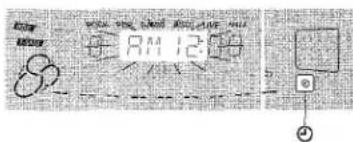
NOTE
If you press the II SET button after 4 seconds, another operation may start.
2 Designate the hour of the timer-on time by pressing the ◀◀◀ DOWN or ▶▶▶ UP button, and press the ■ SET button. Repeat to designate the minute of the timer-on time.

After you designate the timer-on time, one of the source name flashes on the display for 4 seconds.
3 Within 4 seconds, press one of the function buttons to select a source.
The selected source name flashes for 4 seconds. At this time, the selected function button does not light up.
- If this step is not completed within 4 seconds, repeat from step 1.
- If the TUNER button is pressed, the band cannot be selected in this step.
4 Within 4 seconds, select the duration for the timer-activated period with the I◀◀ DOWN or ▶▶UP button.
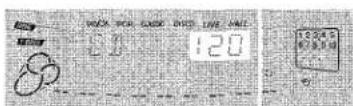
The duration for the timer-activated period can be set between 5 and 240 minutes in 5-minute steps.
- If this step is not completed within 4 seconds, repeat from step 1.
5 Prepare the source.
To listen to a CD, load the disc to be played first on tray 1.
To listen to a tape, insert the tape into deck 1 or 2.
To listen to the radio, tune in to a station.
6 Press the POWER button to turn the unit off after adjusting the volume and tone.
② remains on the display after the power is turned off (timer standby mode).
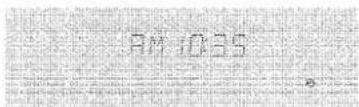
When the timer-on time is reached, the unit turns on and begins play with the selected source.
- The volume level is automatically set to 16 when the power is turned off with the volume level set to 17 or more.
To check the specified time and source
Press the TIMER button. The timer-on time, the selected source name and the duration for the timer-activated period are displayed for 4 seconds.
To cancel timer standby mode temporarily
Press the TIMER button repeatedly so that ⏻ or ⏻REC disappears on the display.
To restore the timer standby mode, press again to display ⏻ or ⏱REC.
Using the unit while the timer is set
You can use the unit normally after setting the timer.
Before turning off the power, repeat step 5 to prepare the source, and adjust the volume and tone.
NOTE
- Timer playback and timer recording will not begin unless the power is turned off.
- Connected equipment cannot be turned on and off by the built-in timer of this unit. Use an external timer.
TIMER RECORDING
Timer recording is applicable for TUNER and VIDEO/AUX (with an external timer) sources only.
Press the TIMER button repeatedly until ⏻ REC appears on the display, and press the ⬆ SET button within 4 seconds.
Carry out the steps of "SETTING THE TIMER" from step 2 and insert the tape to be recorded into deck 2 after step 5.
SETTING THE SLEEP TIMER
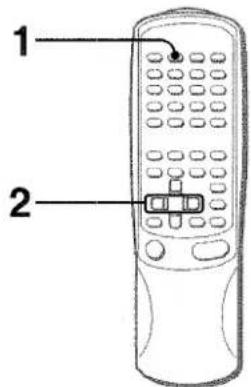
The unit can be turned off automatically at a specified time.
Use the remote control.
1 Press the SLEEP button.

2 Within 4 seconds, press the ◀◀ or ▶▶ button to specify the time until the power is turned off.
Each time the button is pressed, the time changes between 5 and 240 minutes in 5-minute steps.
Specified time

To check the time remaining until the power is turned off
Press the SLEEP button once. The remaining time is displayed for 4 seconds.
To cancel the sleep timer
Press the SLEEP button twice so that "SLEEP" on the display disappears.
CONNECTING OPTIONAL EQUIPMENT
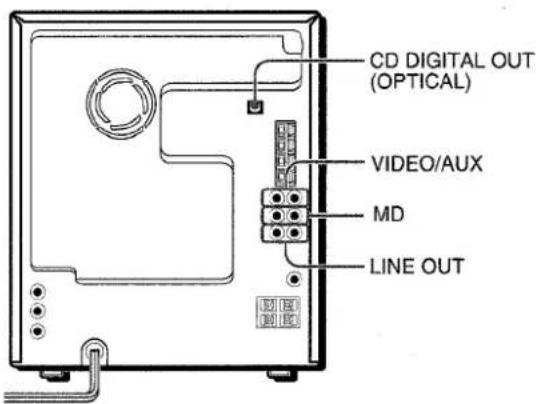
Refer to the operating instructions of the connected equipment for details.
- The connecting cords are not supplied. Obtain the necessary connecting cords.
- Consult your local Aiwa dealer for optional equipment.
VIDEO/AUX, MD JACKS
This unit can input analog sound signals through these jacks. Use a cable with RCA phono plugs to connect audio equipment (turntables, LD players, MD players, VCRs, TV, etc.).
Connect the red plug to the R jack, and the white plug to the L jack.
When connecting a turntable
Use an Aiwa turntable equipped with a built-in equalizer amplifier.
LINE OUT JACKS
This unit can output analog sound signal through these jacks. Use a cable with RCA phono plugs to connect audio equipment with LINE IN (analog input) jacks.
NOTE
Do not connect an equipment to the LINE OUT terminals and VIDEO/AUX terminals simultaneously. Otherwise, noise is generated and malfunction occurs.
CD DIGITAL OUT (OPTICAL) JACK
This unit can output CD digital sound signals through this jack. Use an optical cable to connect digital audio equipment (digital amplifier, DAT deck, MD recorder, etc.).
Remove the dust cap ⓐ from the CD DIGITAL OUT (OPTICAL) jack. Then, connect an optical cable plug to the CD DIGITAL OUT (OPTICAL) jack.
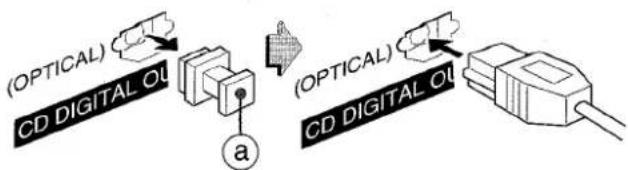
When the CD DIGITAL OUT (OPTICAL) jack is not being used
Attach the supplied dust cap.
LISTENING TO EXTERNAL SOURCES

To play equipment connected to the VIDEO/AUX jacks or MD jacks, proceed as follows.
1 Press the VIDEO/AUX or MD button.
When a equipment connected to the VIDEO/AUX jacks is played: press the VIDEO/AUX button.
When a equipment connected to the MD jacks is played: press the MD button.
2 Play the connected equipment.
To change a source name in the display
When the VIDEO/AUX button is pressed, VIDEO is displayed initially. It can be changed to AUX or TV.
With the power on, press the POWER button while pressing the VIDEO/AUX button.
Repeat the procedure to select one of the names.
To adjust the sound level of the external source
When the sound level of the external source is much higher or much lower than that of other function sources, adjust it as follows.
1 Press the VIDEO/AUX or MD button and play the equipment.
2 Press the ◀◀ or ▶▶ button so that the sound level becomes the same as that of other function sources.
NOTE
During recording, the sound level can not be adjusted.
CARE AND MAINTENANCE
Occasional care and maintenance of the unit and the software are needed to optimize the performance of your unit.
To clean the cabinet
Use a soft and dry cloth.
If the surfaces are extremely dirty, use a soft cloth lightly moistened with mild detergent solution. Do not use strong solvents, such as alcohol, benzine or thinner as these could damage the finish of the unit.
To clean the heads and tape paths
After every 10 hours of use, clean the heads and tape paths with a head cleaning cassette or cotton swab moistened with cleaning fluid or denatured alcohol. (These cleaning kits are commercially available.)
When cleaning with a cotton swab, wipe the recording/playback head, erasure head (deck 2 only), capstans, and pinchrollers.

After cleaning the heads and tape paths with a liquid head cleaning cassette or a moistened swab, wait until the cleaned parts are completely dry before inserting the tapes.
To demagnetize the heads
The heads may become magnetized after long-term use. This may narrow the output range of recorded tapes and increase noise. After 20 to 30 hours use, demagnetize the heads with any commercially available demagnetizer.
Care of discs
- When a disc becomes dirty, wipe the disc from the center out with a cleaning cloth.
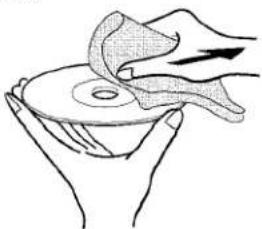
natural_image
Illustration of hands holding a disc with a cloth or tape, no text or symbols present• After playing a disc, store the disc in its case. Do not leave the disc in places that are hot or humid.
Care of tapes
- Store tapes in their cases after use.
- Do not leave tapes near magnets, motors, television sets, or any source of magnetism. This will downgrade the sound quality and cause noise.
- Do not expose tapes to direct sunlight, or leave them in a car parked in direct sunlight.
TROUBLESHOOTING GUIDE
If the unit fails to perform as described in these Operating Instructions, check the following guide.
GENERAL
There is no sound.
• Is the AC cord connected properly?
• Is there a bad connection? (→ page 3)
• There may be a short circuit in the speaker terminals.
→ Disconnect the AC cord, then correct the speaker connections.
- Was an incorrect function button pressed?
Sound is emitted from one speaker only.
• Is the other speaker disconnected?
The output sound is not stereo.
- Is the Karaoke function turned on? (→ page 19)
An erroneous display or a malfunction occurs.
→ Reset the unit as stated below.
TUNER SECTION
There is constant, wave-like static.
- Is the antenna connected properly? (→ page 3)
• Is the signal weak?
→ Connect an outdoor antenna.
The reception contains noise interferences or the sound is distorted.
- Is the system picking up external noise or multipath distortion?
→ Change the orientation of the antenna.
→ Move the unit away from other electrical appliances.
CASSETTE DECK SECTION
The tape does not run.
• Is deck 2 in pause mode? (→ page 11)
The sound is off-balance or not adequately high.
• Is the playback head dirty? (→ page 24)
Recording is not possible.
- Is the erasure prevention tab on the tape broken off? (→ page 12)
- Is the recording head dirty? (→ page 24)
Erasure is not possible.
• Is the erasure head dirty? (→ page 24)
• Is a metal tape being used?
High frequency sound is not emitted.
- Is a tape recorded without Dolby NR played back with the Dolby NR system operating? (→ page 11)
- Is the recording/playback head dirty? (→ page 24)
CD PLAYER SECTION
The CD player does not play.
• Is the disc correctly inserted? (→ page 9)
• Is the disc dirty? (→ page 24)
• Is the lens affected by condensation?
→ Wait approximately one hour and try again.
To reset
If an unusual condition occurs in the display window or the cassette decks, reset the unit as follows.
1 Press the POWER button to turn off the power.
2 Press the POWER button to turn the power back on while pressing the ■ CLEAR button. Everything stored in memory after purchase is canceled.
If the power cannot be turned off in step 1 because of a malfunction, reset by disconnecting the AC cord, and connect it again. Then carry out step 2.
SPECIFICATIONS
| Main unit CX-NMT70 | |
| FM tuner section | |
| Tuning range | 87.5 MHz to 108 MHz |
| Usable sensitivity (IHF) | 13.2 dBf |
| Antenna terminals | 75 ohms (unbalanced) |
| AM tuner section | |
| Tuning range | 530 kHz to 1710 kHz (10 kHz step) |
| 531 kHz to 1602 kHz (9 kHz step) | |
| Usable sensitivity | 350 μV/m |
| Antenna | Loop antenna |
| Amplifier section | |
| Power output | Front |
| 100 W + 100 W (50 Hz - 20 kHz, THD less than 1%, 6 ohms) | |
| Rear (Surround) | |
| 10 W + 10 W (1 kHz, THD less than 1%, 16 ohms) | |
| Center | |
| 20 W (1 kHz, THD less than 1%, 8 ohms) | |
| Total harmonic distortion | 0.05% (90 W, 1 kHz, 6 ohms, DIN AUDIO) |
| Inputs | VIDEO/AUX: 210 mV (adjustable) |
| MD: 210 mV (adjustable) | |
| MIC 1, MIC 2: 1.4 mV (10 kohms) | |
| Outputs | LINE OUT: 200 mV |
| SUPER WOOFER: 2.4 V | |
| SPEAKERS: accept speakers of 6 ohms or more | |
| SURROUND SPEAKERS: accept speakers of 16 ohms or more | |
| CENTER SPEAKER: accept speakers of 8 ohms or more | |
| PHONES (stereo jack): accepts headphones of 32 ohms or more | |
| Cassette deck section | |
| Track format | 4 tracks, 2 channels stereo |
| Frequency response | CrO2 tape: 50 Hz - 16000 Hz |
| Normal tape: 50 Hz - 15000 Hz | |
| Signal-to-noise ratio | 60 dB (Dolby B NR ON, CrO2 tape peak level) |
| Recording system | AC bias |
| Heads | Deck 1: Playback head × 1 |
| Deck 2: Recording/playback/ erase head × 1 | |
| Compact disc player section | |
| Laser | Semiconductor laser (λ = 780 nm) |
| D-A converter | 1 bit dual |
| Signal-to-noise ratio | 90 dB (1 kHz, 0 dB) |
| Harmonic distortion | 0.03% (1 kHz, 0 dB) |
| Wow and flutter | Unmeasurable |
| General | |
| Power requirements | 120 V AC, 60 Hz |
| Power consumption | 140 W |
| Dimensions of main unit | 260 × 309 × 363 mm |
| (W × H × D) | (101/4 × 121/4 × 143/8 in.) |
| Weight of main unit | 10 kg (22 lbs 1 oz.) |
Speaker system SX-NA74
| Cabinet type | 3 way, bass reflex (magnetic shielded type) |
| Speakers | Woofer:160 mm ( 63/8 in.) cone typeTweeter:80 mm ( 31/4 in.) cone typeSuper tweeter:20 mm ( 13/16 in.) ceramic type |
| Impedance | 6 ohms |
| Output sound pressure level | 87 dB/W/m |
| Dimensions (W × H × D) | 243 × 304 × 227 mm ( 95/8 × 12 × 9 in.) |
| Weight | 3.6 kg (7 lbs 15 oz.) |
Specifications and external appearance are subject to change without notice.
BBE SYSTEM
The word "BBE" and the "BBE symbol" are trademarks of BBE Sound, Inc. Under license from BBE Sound, Inc.
Manufactured under license from Dolby Laboratories Licensing Corporation. "DOLBY", the double-D symbol ☐ and "PRO LOGIC" are trademarks of Dolby Laboratories Licensing Corporation.
COPYRIGHT
Please check the laws on copyright relating to recordings from discs, radio or external tape for the country in which the machine is being used.
ADVERTENCIA
PARA REDUCIR EL RIESGO DE INCENDIOS O SACUDIDAS ELECTRICAS, NO EXPONGA ESTE APARATO A LA LLUVIA NI A LA HUMEDAD.
CAUTION
RISK OF ELECTRIC SHOCK DO NOT OPEN
"CAUTION: TO REDUCE THE RISK OF ELECTRIC SHOCK,
DO NOT REMOVE COVER (OR BACK). NO USER-SERVICEABLE PARTS INSIDE. REFER SERVICING TO QUALIFIED SERVICE PERSONNEL."
natural_image
Line drawing of a portable toaster with front grille and side button (no text or symbols)flowchart
graph TD
    A["Rectangular Component"] --> B["Internal Components"]
    B --> C["Computer with Mechanic Component"]
natural_image
Simple line drawing of a tool interacting with a device, showing a tool tip and directional arrow (no text or symbols)NOTA
CONTROL DE VOLUMEN
SISTEMA SUPER T-BASS
natural_image
Illustration of hands using a handheld device to adjust a component (no text or symbols visible)Sistema DOLBY NR
TOMA CD DIGITAL OUT (OPTICAL)
natural_image
Illustration of hands holding a CD or DVD with a ribbon and arrow indicating motion (no text or symbols)"CAUTION: TO REDUCE THE RISK OF ELECTRIC SHOCK,
DO NOT REMOVE COVER (OR BACK). NO USER-SERVICEABLE PARTS INSIDE. REFER SERVICING TO QUALIFIED SERVICE PERSONNEL."
natural_image
Three line drawings of a desktop kitchen unit with front, top, and side views (no text or symbols)natural_image
Line drawing of a kitchen appliance with a button and lid (no text or symbols)natural_image
Simple line drawing of a screw being inserted into a device (no text or symbols)REMARQUE
VOLUME
natural_image
Illustration of hands using a handheld device to interact with a cassette tape (no text or symbols visible)REMARQUE
PRISE CD DIGITAL OUT (OPTICAL)
natural_image
Illustration of a hand holding a disc with a cloth-like object, no text or symbols presentInstructions about each part on the main unit or remote control are indicated on the right side. The parts are listed in alphabetical order.
INDICE DE LAS PARTES
CD EDIT/CHECK (EDIT/CHECK) 9, 15, 16
■ CLEAR 8,9,11
CLOCK 21
DEMO 6
◀▶ DIRECTION/PRESET 8, 9, 11
DISC CHANGE 9
DISC DIRECT PLAY 9
DOLBY NR 11, 13
DOLBY PRO LOGIC 17
◀◀, ◀◀ DOWN 8, 9, 11
ECHO 19
EDIT/CHECK (CD EDIT/CHECK) 9, 15, 16
GEQ 7
KARAOKE 19
MANUAL SELECT (TEST) 7, 17
MD 23
MIC 1, MIC 2....19
MIC 19
MONO TUNER 8
▲ OPEN/CLOSE 9
PHONES 7
POWER 6
PRGM 10,20
RANDOM/REPEAT 10
● REC/REC MUTE 13
REV MODE (DECK 2) 11
II SET 8,9,11
SLEEP 22
SURROUND 7
SYNC DUB 14
TAPE/DECK 1/2....11,13
T-BASS 6
TIMER 21
TUNER/BAND 8
▶▶I, ▶▶ UP 8, 9, 11
VIDEO/AUX 23
VOLUME 6
0-9,+10....8,9,15,16,20
For assistance and information
call toll free 1-800-BUY-AIWA (United States and Puerto Rico)

- CX-NMT70
- WARNING
- Explanation of Graphical Symbols:
- NOTE
- CAUTION
- PRECAUTIONS
- Installation
- Electric Power
- AC power cord
- Outdoor Antenna
- Maintenance
- Damage Requiring Service
- TABLE OF CONTENTS
- PREPARATIONS
- SOUND
- CD PLAYING
- TAPE PLAYBACK
- RECORDING
- DOLBY PRO LOGIC
- SETTING UP
- Owner's record
- ① Front speakers
- ② Center speaker
- ③ Surround speakers
- CONNECTIONS
- Before connecting the AC cord
- IMPORTANT
- Connect the supplied antennas.
- Connect the front speakers.
- Connect the surround speakers.
- Connect the center speaker.
- Connect the video equipment.
- Connect the Television to the video equipment.
- Connect the AC cord to an AC outlet.
- To stand the AM antenna on a surface
- To position the antennas
- FM feeder antenna:
- AM loop antenna:
- To mount the surround speakers on the wall
- To connect the supplied TS-W35 (only for NSX-MT75)
- CONNECTING AN OUTDOOR ANTENNA
- REMOTE CONTROL
- Inserting batteries
- When to replace the batteries
- Using the remote control
- BEFORE OPERATION
- To turn the unit on
- DEMO (Demonstration) mode
- To cancel DEMO mode
- Illumination guides
- Flash window
- To turn the unit off
- AUDIO ADJUSTMENTS
- VOLUME
- To change the left/right balance
- BBE SYSTEM
- Press the BBE button.
- SUPER T-BASS SYSTEM
- Press the T-BASS button.
- GRAPHIC EQUALIZER
- Press the GEQ button repeatedly until the desired equalization curve is displayed.
- To cancel the selected mode
- Using the headphones
- Sound adjustment during recording
- ENGLISH
- DSP SURROUND SYSTEM
- Press the SURROUND button repeatedly until the desired SURROUND mode is displayed.
- When the music source is monaural
- To adjust the volume of the surround speakers
- MANUAL TUNING
- PRESETTING STATIONS
- PRESET NUMBER TUNING
- BASIC OPERATIONS
- Press the CD button, then press the ▲ OPEN/CLOSE button to open the disc compartment. Load disc(s) with the label side up.
- PLAYING DISCS
- To play one disc only, press one of the DISC DIRECT PLAY buttons.
- To play with the remote control
- To start play when the power is off (Direct Play Function) Press the CD button. The power is turned on and play of the loaded disc(s) begins.
- To check the remaining time
- Selecting a track with the remote control
- Replacing discs during play
- RANDOM /REPEAT PLAY
- RANDOM play
- REPEAT play
- Press the RANDOM/REPEAT button.
- To play the programmed tracks repeatedly
- PROGRAMMED PLAY
- Press the PRGM button twice in stop mode.
- Press the DISC DIRECT PLAY button, then press one of the numbered buttons 1 to 3 within 3 seconds to select a disc.
- Press the numbered buttons and the +10 button to program a track.
- Example:
- Repeat steps 2 and 3 to program other tracks.
- Press the ◀▶ button to start play.
- To check the program
- To clear the program
- To add tracks to the program
- To change the programmed tracks
- To select a reverse mode (deck 2 only)
- When tapes are loaded in both decks
- To set the tape counter to 0000
- MUSIC SENSOR
- CONTINUOUS PLAY
- About cassette tapes
- DOLBY NR system
- BASIC RECORDING
- Preparation
- INSERTING BLANK SPACES
- To erase a recording
- DUBBING A TAPE MANUALLY
- DUBBING THE WHOLE TAPE
- AI EDIT RECORDING
- PROGRAMMED EDIT RECORDING
- Check the following:
- Press the DOLBY PRO LOGIC button to select NORMAL.
- Press the MANUAL SELECT (TEST) button and hold it down for about four seconds until "L" flashes.
- Adjust the sound level of the center and the surround speakers.
- Press the MANUAL SELECT (TEST) button again to stop the noise signal.
- About the channels
- To change the delay time
- PLAY WITH DOLBY PRO LOGIC
- To cancel Dolby Pro Logic mode
- To change the sound levels during playback
- ADDITIONAL DOLBY PRO LOGIC MODES
- To select PHANTOM or 3 CH LOGIC
- To adjust the balance of connected speaker sound levels
- MICROPHONE MIXING
- To change the delay time of echo
- When not using the microphones
- Recommended microphones
- VOCAL FADER/MULTIPLEX FUNCTIONS
- To change the audible channel in Multiplex function
- To change the time lag setting in Auto Vocal Fader or Auto Multiplex function
- KARAOKE PROGRAM
- Press the PRGM button once.
- Repeat step 2 to reserve other tracks.
- Press the ◀▶ button to start play.
- To add a reservation during play
- To check the reserved tracks
- To stop play
- To skip a current track
- To clear all the reservations
- SETTING THE CLOCK
- To display the current time
- To switch to the 24-hour standard
- If the clock display flashes
- SETTING THE TIMER
- Prepare the source.
- Press the POWER button to turn the unit off after adjusting the volume and tone.
- To check the specified time and source
- To cancel timer standby mode temporarily
- Using the unit while the timer is set
- TIMER RECORDING
- Press the TIMER button repeatedly until ⏻ REC appears on the display, and press the ⬆ SET button within 4 seconds.
- SETTING THE SLEEP TIMER
- Within 4 seconds, press the ◀◀ or ▶▶ button to specify the time until the power is turned off.
- To check the time remaining until the power is turned off
- To cancel the sleep timer
- CONNECTING OPTIONAL EQUIPMENT
- VIDEO/AUX, MD JACKS
- When connecting a turntable
- LINE OUT JACKS
- CD DIGITAL OUT (OPTICAL) JACK
- LISTENING TO EXTERNAL SOURCES
- Press the VIDEO/AUX or MD button.
- Play the connected equipment.
- To change a source name in the display
- To adjust the sound level of the external source
- CARE AND MAINTENANCE
- To clean the cabinet
- To clean the heads and tape paths
- To demagnetize the heads
- Care of discs
- Care of tapes
- TROUBLESHOOTING GUIDE
- GENERAL
- TUNER SECTION
- CASSETTE DECK SECTION
- CD PLAYER SECTION
- To reset
- COPYRIGHT
- ADVERTENCIA
- NOTA
- CONTROL DE VOLUMEN
- SISTEMA SUPER T-BASS
- Sistema DOLBY NR
- TOMA CD DIGITAL OUT (OPTICAL)
- REMARQUE
- PRISE CD DIGITAL OUT (OPTICAL)
- INDICE DE LAS PARTES
Brand : AIWA
Model : NSXMT75
Category : Cd player/recorder