Traveller 1561 - Laptop TARGA - Free user manual and instructions
Find the device manual for free Traveller 1561 TARGA in PDF.



| Product type | Laptop |
| Brand | TARGA |
| Model | Traveller 1561 |
| Dimensions (L x D x H) | 358 x 259 x 27–33 mm |
| Weight (with 6-cell battery) | 2.6 kg |
| Processor | AMD Turion 64-bit dual core (max. 1.8 GHz) |
| RAM (Memory) | Up to 2 GB DDRII 533/667 (2 x SO-DIMM) |
| Storage | 2.5" SATA hard drive 120 or 160 GB (5400 rpm) |
| Display | 15.4" WXGA (1280 x 800) LCD |
| Power adapter | 65 W, 19 V (model KSAFI1900342T1M2) |
| Battery | 6-cell Li-ion, 4800 mAh |
| Wireless connectivity | Wi-Fi 802.11 b/g (MS-6833B) |
| Wired network | Ethernet 10/100, 56K V.90 modem |
| USB ports | 4 x USB 2.0 |
| Video output | 1 x VGA, 1 x S-Video (TV-Out) |
| Other ports | 1 x IEEE 1394, 1 x ExpressCard, 4-in-1 card reader (SD/MMC/MS/MS Pro), headphone/microphone/line-in jack |
| Operating system | Windows Vista™ / Windows XP Home Edition |
| Multimedia functions | Windows Media Center, built-in stereo speakers, optical drive (DVD±RW / CD-RW depending on model) |
| Security | Kensington lock slot, BIOS password |
| Maintenance and cleaning | Clean the screen with a soft cloth and glass cleaner (without excess liquid). Use a dry cloth for the casing. |
| Spare parts and repairability | Contact Targa after-sales service (toll-free number +49 2921 / 99-3030) or visit service.targa.co.uk for parts and accessories. |
Frequently Asked Questions - Traveller 1561 TARGA
User questions about Traveller 1561 TARGA
0 question about this device. Answer the ones you know or ask your own.
Ask a new question about this device
Download the instructions for your Laptop in PDF format for free! Find your manual Traveller 1561 - TARGA and take your electronic device back in hand. On this page are published all the documents necessary for the use of your device. Traveller 1561 by TARGA.
USER MANUAL Traveller 1561 TARGA
General Introductions
Chapter 2
Getting Started
Chapter 3
Customizing this Notebook
Chapter 4
BIOS Setup
Chapter 5
Troubleshooting, First Aid and FAQ
Chapter 6
Mandatory Activation
Chapter 7
Windows Media Center – Initial Setup
Chapter 8
System Recovery
General
Before using the appliance for the first time, please carefully read through the following instructions and note all warnings, even if you are familiar with handling electronic equipment. Store this manual in a safe place for future reference. If you sell or give away the appliance, please ensure you handover this manual too.
Operating Environment
Place the unit on a firm, level surface, and do not place any objects on the unit. The appliance is not designed for use in rooms with a high temperature or air humidity (e.g. bathrooms) or excessive dust.
Please ensure that:
- no direct heat sources (e.g. heaters) act on the appliance
- the appliance is not exposed to direct sunlight or strong artificial light
- you avoid contact with splashing and dripping water and aggressive liquids
- the appliance is not exposed to large temperature fluctuations, as otherwise air humidity can condense
- the appliance is not exposed to excessive impacts and vibrations
- Do not place any fire (e.g. candlelights) onto or next to the device.
The unit must on be connected to a suitable mains power supply using the mains power lead provided
The device will store your data on a media with a magnetic surface. For
this reason, keep the device away from sources that generate magnetic and electromagnetic fields.
Power Supply
The unit still uses electricity in standby operation. In order to disconnect the unit completely from the power supply, the plug must be removed from the power supply socket. The unit should therefore be set up so that direct and unimpeded access to the power supply socket is possible at all times, and the plug can be removed immediately in the event of an emergency. In order to prevent the risk of fire, the plug should always be removed from the power supply socket during longer periods of non-use, e.g. during holidays. Please disconnect the unit from the power supply before storms and/or severe weather with the risk of lightning strikes and disconnect the antenna plug. Use only the power supply unit provided “KSAFK1900342T1M2” in order to prevent the risk of overheating, housing deformation, fire, electric shocks, explosions and other dangers. Never connect the power supply unit to other devices.
Warning: The battery may explode if handled incorrectly! Do not attempt to dismantle the battery, change the polarity, and under no circumstances dispose of the battery in the fire! Keep the battery away from children and dispose of it properly!
Incorrect replacement of the battery may create the risk of explosion. Replace the battery only with an identical type or type recommended by the manufacturer.
Keep environmental protection in mind! Used batteries must not be disposed of as household waste! Used batteries must be disposed of at an old battery collection point.
Caution! Risk of fire / explosion
This unit works with a high-quality Li-Ion rechargeable battery. Under very unfavourable conditions, contact sparks may be generated, which can ignite explosive or combustible vapours.
We therefore strongly recommend that the unit is not used in dangerous areas such as filling stations, where the unit should be switched off.
Cables
Always hold cables by the plug, and do not pull on the cable itself. Never touch the power supply cable with wet hands, since this may cause a short-circuit or electric shock. Never place the unit itself, items of furniture or other heavy objects on cables, and ensure that these do not become kinked, especially at the plug and the connection sockets. Never tie a knot in a cable, and do not tie it together with other cables. All cables should be laid where they will not be trodden on or present an obstacle. A damaged power supply cable can cause a fire or electric shock. Check the power supply cable from time to time. Do not use any adapter plugs or extension cables which do not comply with the applicable safety standards, and do not make any modifications to the power supply cables!
Maintenance and Care
Maintenance work is required if the unit has been damaged, e.g. if the plug, power supply cable or housing have been damaged, liquids or foreign objects have got into the unit, if it has been exposed to rain or damp, or if it does not work properly or has been dropped. If you notice any smoke, unusual noises or smells, switch the unit off immediately, and remove the plug from the power supply socket. In such cases, the unit should not be used until it has been checked by a specialist. Maintenance work should be carried out only by qualified specialist personnel. Never open the housing of the unit, the power supply adapter or the accessories. With the housing open, there is a risk of possibly fatal injury from electric shock. Clean the unit only with a clean, dry cloth, and never use any aggressive fluids. Do not open your notebook! Hardware modifications and repairs should be carried out only by qualified specialist, service or maintenance personnel! The CD drive of this unit is classified as a “Class 1 Laser Product”, and designated accordingly by a sticker on the housing. Never open the device, and do not attempt to carry out repairs yourself. Invisible laser radiation is present inside the device. Do not expose yourself to the laser beam. Do not attempt to open the housing of the device. Otherwise you will lose your warranty.
Disposal of Old Devices
- If the symbol of a crossed-through waste bin is applied to the product, this means that this product is subject to European Directive 2002/96/EC
- All old electrical and electronic devices must be disposed of separately from household waste at special approved disposal points.
- The proper disposal of old devices will avoid environmental damage and dangers to personal health.
- Further information on proper disposal of the old device can be obtained from your local municipal offices or the shop in which you bought the product.
Children
Never allow children to use electrical appliances without supervision. Children are not always able to recognize the potential dangers. Small parts may cause suffocation if swallowed! Keep the packaging film out of the reach of children. Danger of suffocation.
Intended Use
This unit is an electronic entertainment device. It may be used only for private purposes, and not for industrial or commercial purposes. This product is not intended for use in medical, life-saving or life-preserving applications. It may be used for
domestic, office or small business applications (to EN 61000-6-1/EN 61000-6-3). This includes games, communications and office applications amongst others. The unit should also not be used outside closed rooms or in tropical climatic regions. The unit should only be used in combination with connection cables and external devices which conform to the unit with regard to safety, electromagnetic compatibility and screening quality. This unit complies with all relevant norms and standards in connection with CE conformity. In the event of modifications to the unit not approved by the manufacturer, compliance with these standards is no longer guaranteed. Use only the accessories specified by the manufacturer. If using the unit outside the Federal Republic of Germany, the national regulations and laws of the country of use must be observed. Our notebooks comply with the safety standard EN60950 for IT products. For ergonomic reasons, and to prevent overheating of the unit due to blockage of the ventilation slots, the notebook should not be placed on the knees during use. Ensure when connecting peripheral devices that the cables are not too short, and that no mechanical stress is placed on the connection plugs! When connecting the unit to an antenna system, adequate protection against over-voltage and static discharge must be ensured by proper earthing. Only use the unit with the trolley, stand, holder or cable specified by the manufacturer or supplied with the unit. If placing the unit on a trolley, take care to prevent
the unit tipping over. Take care in the use of your hard disk. Observe the specified precautionary measures, so that your hard disk is not damaged and your guarantee invalidated. Damage to the hard disk can lead to the loss of data.
Noise Abatement
- Legal regulations specify a maximum noise limit of 100 dB.
(France only: Articles 44.5 and 44.6 of public health regulations, amended by Article 2 of the law of 28th May 1996 specify a maximum noise limit of 100 dB.) When using other headphones, hearing damage may be caused by increased noise levels. - Using the loudspeakers/headphones at higher volume may damage your hearing and cause noise pollution.
- In dangerous situations, the noise may impair your attention or mean that you are no longer aware of what is going on around you.
RF Interface
-
Switch the unit off when you are in an aeroplane, when driving a car, or when in a hospital, operating room or in the vicinity of any medical electronic systems. The radio waves transmitted can impair the function of sensitive devices.
• Always keep the unit at least 20 cm away from a heart pacemaker, since the proper function of the heart pacemaker could be impaired by radio waves. -
The transmitted radio waves can cause interference to hearing aids.
- Never bring the unit into close proximity with inflammable gases or explosive atmospheres (e.g. a paint shop) with the radio components switched on, since the transmitted radio waves can cause explosion or fire.
- The range of the radio connection depends on environmental and ambient conditions.
- In case of data transfer via a wireless connection, it may also be possible for unauthorised third parties to receive data.
TARGA GmbH is not responsible for radio or television interference caused by unauthorised modifications to this unit.
TARGA further accepts no responsibility for the replacement or exchange of connection cables and devices not specified by TARGA GmbH. The user alone is solely responsible for the rectification of faults and replacement or exchange of the unit caused by such unauthorised modifications.
CE Declaration of Conformity
This unit has been tested and approved with regard to conformity with the basic requirements and other relevant regulations of the EMC Directive 89/336/EEC, the Directive on low-voltage devices 73/23/EEC and the R&TTE Directive 99/5/EC.
Safety Guideline for Using Lithium Battery
| (Danish) ADVARSEL! Lithiumbatteri --- Eksplosionsfare ved fejlagtighändtering. Udskiftning må kun ske med batteri af same fabrikat og type.Levé det brugte batteri tilbage til leverandøren. |
| (Deutsch) VORSICHT: Explosionsgefahr bei unsachgemäßem Austausch derBatterie. Ersatz nur durch denselben oder einen vom Hersteller empfohlenengleich-wertigen Typ. Entsorgung gebrauchter Batterien nach Angaben desHerstellers. |
| (English) CAUTION: Danger of explosion if battery is incorrectly replaced.Replace only with the same or equivalent type recommended by the equipmentmanufacturer. Discard used batteries according to manufacturer's instructions. |
| (Finnish) VAROITUS: Paristo voi räjähtää, jos se on virheellisesti asennettu.Vaihda paristo ainoastaan valmistajan suosittelemaan tyyppiin. Hävitä käytettyparisto valmistajan ohjeiden mukaisesti. |
| (French) ATTENTION: Il y a danger d'explosion s'il y a remplacement incorrectde la batterie. Remplacer uniquement avec une batterie du meme type ou d'untype équivalent recommandé par le constructeur. Mettre au rebut les batteriesusages conformément aux instructions du fabricant. |
| (Norwegian) ADVARSEL: Eksplosjonsfare ved feilaktig skifte av batteri. Benyttsame batteritype eller en tilsvarende type anbefalt av apparatfabrikanten.Brukte batterier kasseres I henhold til fabrikantens instruksjoner. |
| (Swedish) WARNING: Explosionsfara vid felaktigt batteribyte. Använd sammabatterityp eller en ekvivalent typ som rekommenderas av apparattillverkaren.Kassera använt batteri enligt fabrikantens instruction. |
Macrovision Notice
This product incorporates copyright protection technology that is protected by U.S. patents and other intellectual property rights. Use of this copyright protection technology must be authorized by Macrovision, and is intended for home and other limited viewing uses only unless otherwise authorized by Macrovision. Reverse engineering or disassembly is prohibited.
WEEE Statement
(English) Under the European Union ("EU") Directive on Waste Electrical and Electronic Equipment, Directive 2002/96/EC, which takes effect on August 13, 2005, products of "electrical and electronic equipment" cannot be discarded as municipal waste anymore and manufacturers of covered electronic equipment will be obligated to take back such products at the end of their useful life.
All trademarks are the properties of their respective owners.
- Microsoft is a registered trademark of Microsoft Corporation. Windows® 2000/ XP/ Vista are registered trademarks of Microsoft Corporation.
♦ AMI® is a registered trademark of American Megatrends Inc. - PCMCIA and CardBus are registered trademarks of the Personal Notebook Memory Card International Association.
Release History
| Version | Revision | Note | Date |
| 1.0 First Release | 08, 2007 |
Logitech Europe S:A.
West Point Business Park, Link Road
Ballincollig Co.Cork, Ireland
Table of Content
Preface
General....II
Operating Environment......II
Power Supply ....III
Cables......IV
Maintenance and Care V
Disposal of Old Devices......VI
Children......VI
Intended Use......VI
Noise Abatement......VIII
RF Interface ......VIII
CE Declaration of Conformity .....IX
Safety Guideline for Using Lithium Battery ....X
Macrovision Notice ....XI
WEEE Statement ......XI
Trademarks ...... XIV
Release History ...... XIV
Introductions
How to Use This Manual 1-2
Unpacking 1-4
Getting Started
Specification....2-2
Product Overview 2-5
Top-open View 2-5
Front View....2-8
Right-side View....2-9
Left-side View 2-11
Rear View 2-12
Bottom View....2-13
Power Management 2-14
AC Adapter....2-14
Battery Pack 2-15
Using the Battery Pack....2-18
Charging the Battery Pack Properly 2-19
Basic Operations 2-21
Safety and Comfort Tips....2-21
Have a Good Work Habit 2-22
Knowing the Keyboard 2-23
Knowing the Touchpad 2-28
About Hard Disk Drive....2-32
Using the Optical Storage 2-33
Customizing this Notebook
Connecting the External Devices ....3-2
Connecting the Peripheral Devices 3-3
Connecting the Communication Devices....3-6
Express Card Installation 3-7
Installing the Express card ....3-7
Removing the Express card....3-8
Safely Remove Hardware....3-9
BIOS Setup
About BIOS Setup....4-2
When to Use BIOS Setup 4-2
How to Run BIOS Setup....4-2
Control Keys 4-3
BIOS Setup Menu....4-4
Main menu 4-5
Advanced menu....4-7
Security menu....4-9
Boot menu....4-11
Exit menu 4-12
Troubleshooting, First Aid and FAQ
Troubleshooting, First Aid and FAQ....5-2
Troubleshooting 5-3
FAQ – Frequently Asked Questions....5-6
Mandatory Activation
Mandatory Activation 6-2
Windows Media Center – Initial Setup
Windows Media Center – Initial Setup....7-2
General Settings....7-2
Optimizing the Screen Display....7-5
Setting Up Loudspeakers 7-6
System Recovery
Restoring the System by Using the System Recovery Software....8-2
Preface
Chapter 1
General Introductions
Chapter 2
Getting Started
Chapter 3
Customizing this Notebook
Chapter 4
BIOS Setup
Chapter 5
Troubleshooting, First Aid and FAQ
Chapter 6
Mandatory Activation
Chapter 7
Windows Media Center – Initial Setup
Chapter 8
System Recovery
Congratulations on becoming a new user of this notebook, the finely designed notebook. This brand-new exquisite notebook will give you a delightful and professional experience in using notebook. We are proud to tell our users that this notebook is thoroughly tested and certified by our reputation for unsurpassed dependability and customer satisfaction.
How to Use This Manual
This User's Manual provides instructions and illustrations on how to operate this notebook. It is recommended to read this manual carefully before using this notebook.
Chapter 1. General Introductions, includes the descriptions of all the accessories of this notebook. It is recommended to check out that if you have all the accessories included when you open the packing box. If any item is damaged or missing, please contact the vendor where you purchased this notebook.
Chapter 2. Getting Started, provides the specification of this notebook, and introduces the function buttons, quick launch buttons, connectors, LEDs and externals of this notebook. Also, this chapter instructs the correct procedure of installing or uninstalling the battery pack, and the brief ideas on how to use this notebook.
Chapter 3. Customizing this Notebook, gives instructions not only in connecting the mouse, keyboard, webcam, printer, external monitor, IEEE 1394 devices, and communication devices, but also in installing and removing the PC card.
Chapter 4, BIOS setup, provides information on BIOS Setup program and allows you to configure the system for optimum use.
Unpacking
First, unpack the shipping carton and check all items carefully. If any item contained is damaged or missing, please contact your local dealer immediately. Also, keep the box and packing materials in case you need to ship the unit in the future.
Preface
Chapter 1
General Introductions
Chapter 2
Getting Started
Chapter 3
Customizing this Notebook
Chapter 4
BIOS Setup
Chapter 5
Troubleshooting, First Aid and FAQ
Chapter 6
Mandatory Activation
Chapter 7
Windows Media Center – Initial Setup
Chapter 8
System Recovery
Specification
| Physical Characteristic | |
| Dimension 358 (W) x 259 (D) | x 27~33 (H) mm |
| Weight 2.6 kg (with 6 cell battery) | |
| CPU | |
| Processor Type Socket S1 | (638-pin, μPGA) |
| Support Processor | Turion 64 bit Taylor Processor, dual core 35W (version F/G) |
| L1 Cache 64KB | |
| L2 Cache 512k/1M | |
| FSB Speed 800MHz | |
| Core Chips | |
| North Bridge nVidia C51MV | (GeForce Go 6100) |
| South Bridge nVidia MCP51M | (nForce Go 430) |
| Memory | |
| Technology DDRII 533/ 667 | |
| Memory | DDRII SO-DIMM X 2 slots256/512/1024MB DDRII SDRAM |
| Maximum 2GB (1024MB DDRII SO-DIMM X 2) | |
| Power | |
| AC Adapter 65 W, 19 Volt (KSAFI1900342T1M2) | |
| Battery Type 6 cellen (Li-ion) | (4800 mAh) |
| RTC Battery | Yes |
| Storage | |
| HDD form factor 2.5" 9.5mm | High, 120/160 GB, (5400rpm) |
| Optical Device | COMBO/DVD dual/Super Multi/DVD Dual layer |
| I/O Port | |
| Monitor x 1 VGA | |
| USB x 4 (USB version 2.0) | |
| Headphone Out x 1 (shared with SPDIF) | |
| Mic-in | x 1 |
| Line-in | x 1 |
| RJ11 | x 1 |
| RJ45 | x 1 |
| IEEE1394 | x 1 |
| TV-Out x 1 (S-Video) | |
| Card Reader | x 1(4-in-1 card reader -SD/ MMC/ MS/ MS Pro) |
| Communication Port | |
| 56K Fax/MODEM Support | |
| LAN | 10/100 Ethernet |
| Wake on LAN | Yes |
| LAN Boot | Yes |
| Wireless Lan | Yes (MS-6833B 802.11 b/g) |
| Express Card | |
| Slot | Express Card Slot x 1 |
| Display | |
| LCD Type 15.4" WXGA non-glare | |
| Brightness Brightness controlled by K/B hot-keys | |
| Video | |
| LCD 1280 x 800 WXGA | |
| Dual View Function | LCD or CRT will be auto detected when connected. |
| CRT | 640 x 480, max. 32bit color800 x 600, max. 32bit color1024 x 768, max. 32bit color1152 x 768, max. 32bit color1400 x 1050, max. 32bit color1600 x 1200, max. 32bit color1800 x 1440, max. 32bit color |
| Audio | |
| Sound Codec chip HD audio support | |
| Internal Speaker 2 Speakers with housing | |
| Sound Volume Adjust by volume button, K/B hot-key & SW | |
| Software & BIOS | |
| USB Flash Boot Yes, USB floppy boot up DOS only | |
| BIOS Fast Boot Support --- Yes | |
| Others | |
| Kensington Lock Yes | |
| Compliance | WHQL |
Product Overview
This section provides the description of basic aspects of your notebook. It will help you to know more about the appearance of this notebook before using it. Note: The notebook shown here may vary from the actual one.
Top-open View
Press the Cover Latch to open the top cover (LCD Panel). The figure of top-open view and description showing below will lead you to browse the main operating area of your notebook.
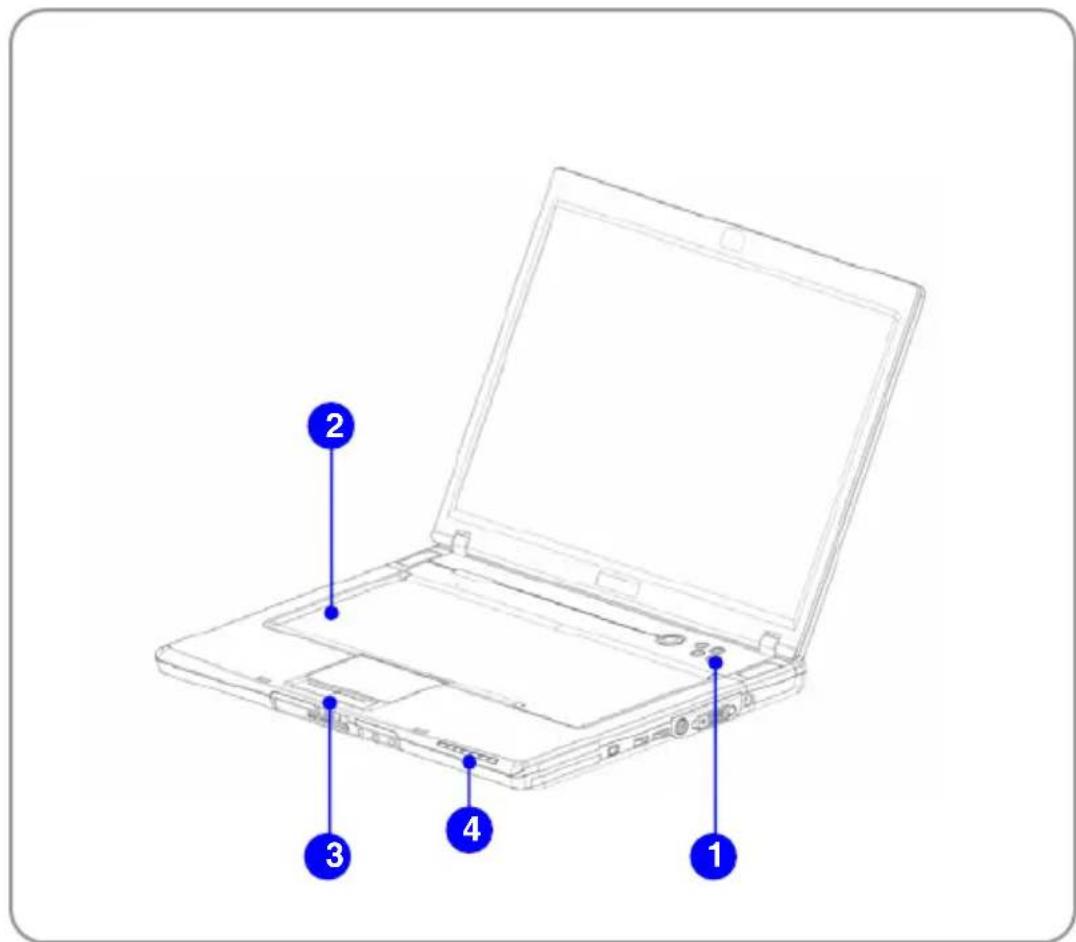
- Quick Launch Buttons and Power Button
 | Power Button:Turn the notebook power ON and OFF. |
| Quick Launch Buttons:Simply click the quick launch buttons to speed up the starting of the programs in common use. It helps you to do works more efficiently.Note:These Quick Launch Buttons will only work when the supplied preload disk is installed. | |
 WI-FI WI-FI | Press the WI-FI Quick Launch Button to enable/disable the WI-FI application. |
 IE Explorer IE Explorer | Press the Internet Quick Launch Button to activate the IE Explorer browser. |
 E-mail E-mail | Press the E-mail Quick Launch Button to launch the E-mail application. |
 Search Search | Press search Button to search files. |
2. Keyboard
The built-in keyboard provides all the functions of a full-sized (US-defined) keyboard.
3. Touchpad
Pointing device with scroll function of the computer.
- Status LED
 | Hard Disk In-use: Blinking Blue when the notebook is accessing the hard disk drive. |
 | Num Lock: Glowing Blue when the Num Lock function is activated. |
 | Caps Lock: Glowing Blue when the Caps Lock function is activated. |
 | Scroll Lock: Glowing Blue when the Scroll Lock function is activated. |
 | Power On / OFF / StandbyBlinking Blue when the system is in suspend mode.Glowing Blue when the system is activated.LED goes out when the system is turned off. |
 | Battery StatusGlowing Blue when the battery is being charged.Glowing Orange when the battery is in low battery status.Blinking Orange if the battery fails and it is recommended to replace a new battery. |
 | Wireless LANGlowing Green when wireless LAN function is enabled. |
Front View
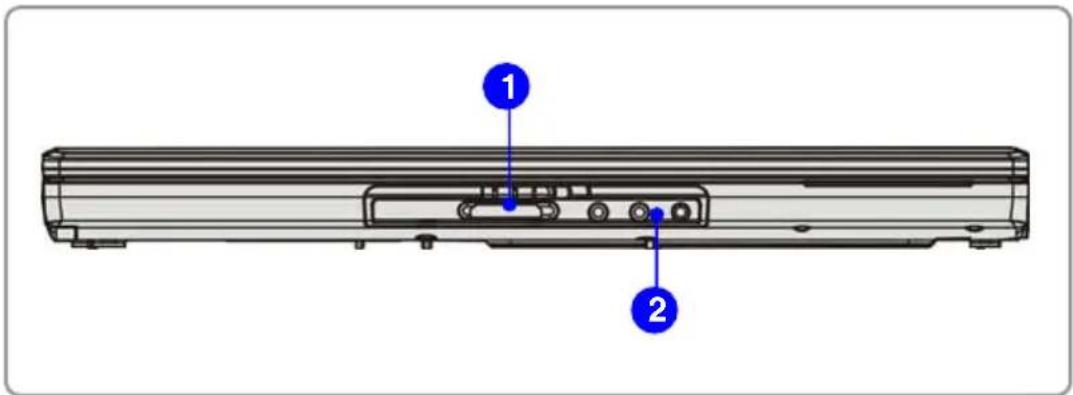
1. Card Reader
The built-in card reader supports MMC (multi-media card), SD (secure digital), MS (memory stick) and MS pro (memory stick pro) cards.
2. Audio Port Connectors
Make high quality sound blaster with stereo system and Hi-Fi function supported.
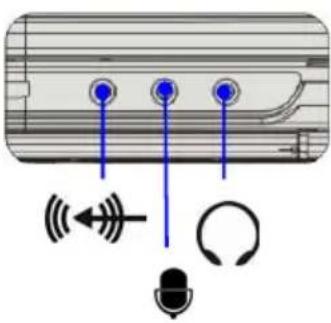 |  | Headphone: A connector for speakers or headphones.5.1: Front |
 | Line In: Used for an external audio device.5.1: Rear | |
 | Microphone: Used for an external microphone.5.1: Central/Subwoofer |
Right-side View
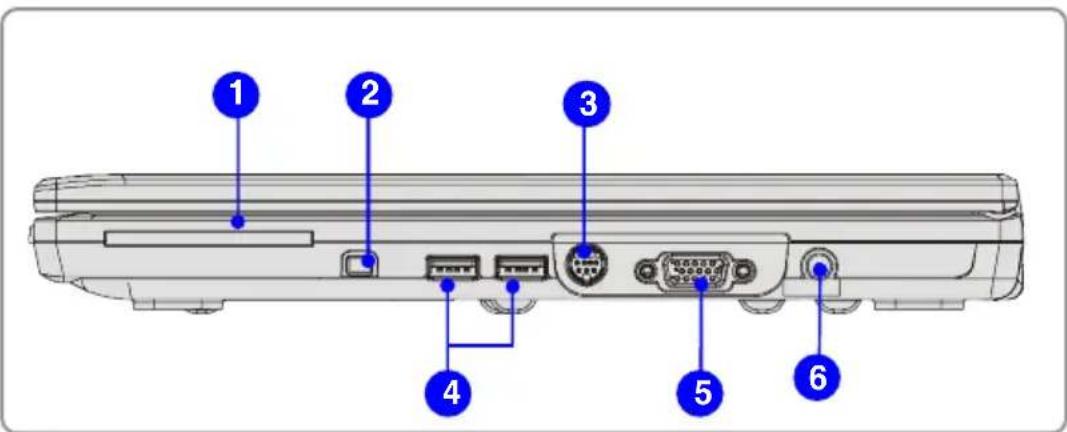
1. Express Card Slot
The computer provides an Express Card slot. The new Express Card interface is smaller and faster than PC Card interface. The Express Card technology takes advantage of the scalable, high-bandwidth serial PCI Express and USB 2.0 interfaces.
2. IEEE 1394
The IEEE 1394 port is a high-speed bus that allows you to connect high-end digital devices such as the DV (digital video camera).
3. S-Video Connector
By using a S-Video cable, this connector allows you to connect a television (NTSC/PAL system) to use as a computer display.
4. USB Port
The USB 2.0 port allows you to connect USB-interface peripheral devices, such as the mouse, keyboard, modem, portable hard disk module, printer and more.
5. VGA Port
The 15-pin-D-sub VGA port allows you to connect an external monitor or other standard VGA-compatible device (such as a projector) for a great view of the computer display.
6. Power Connector
To connect the AC adapter and supply power for the notebook.
Left-side View
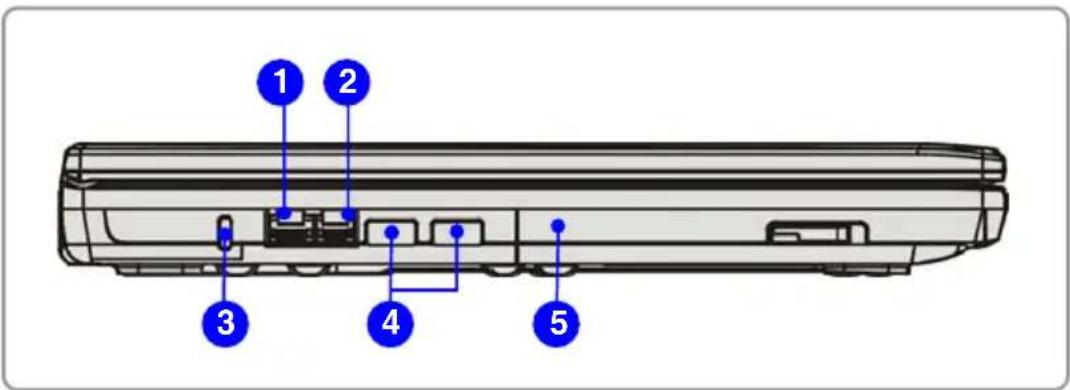
1. RJ-45 Connector
The 10/100 Ethernet connector is used to connect a LAN cable for network connection.
2. RJ-11 Connector
The computer provides a built-in modem that allows you to connect an FJ-11 telephone line through this connector. With the 56K V.90 modem, you can make a dial-up connection.
3. Kensington Lock
This port is used to lock the computer to location for security.
4. USB Port
The USB 2.0 port allows you to connect USB-interface peripheral devices, such as the mouse, keyboard, modem, portable hard disk module, printer and more.
5. Optical Device Drive
A slim CD-ROM/DVD-ROM/CD-RW/DVD Combo/DVD Dual drive is available in the computer, depending on the model you purchased. The optical device allows you to use the CD/DVD disc for installing software,
accessing data and playing music/movie on the computer.
Rear View
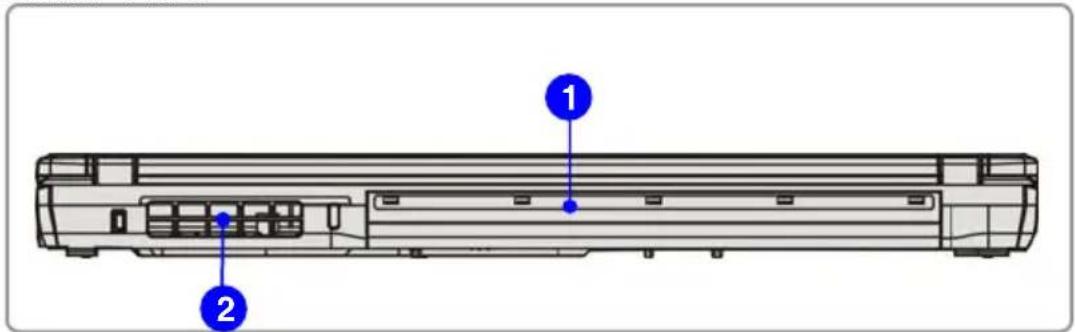
1. Battery Pack (Rear View)
This notebook will be powered by the battery pack when the AC adapter is disconnected.
2. Ventilator
The ventilator is designed to cool the system. DO NOT block the ventilator for air circulation.
Bottom View
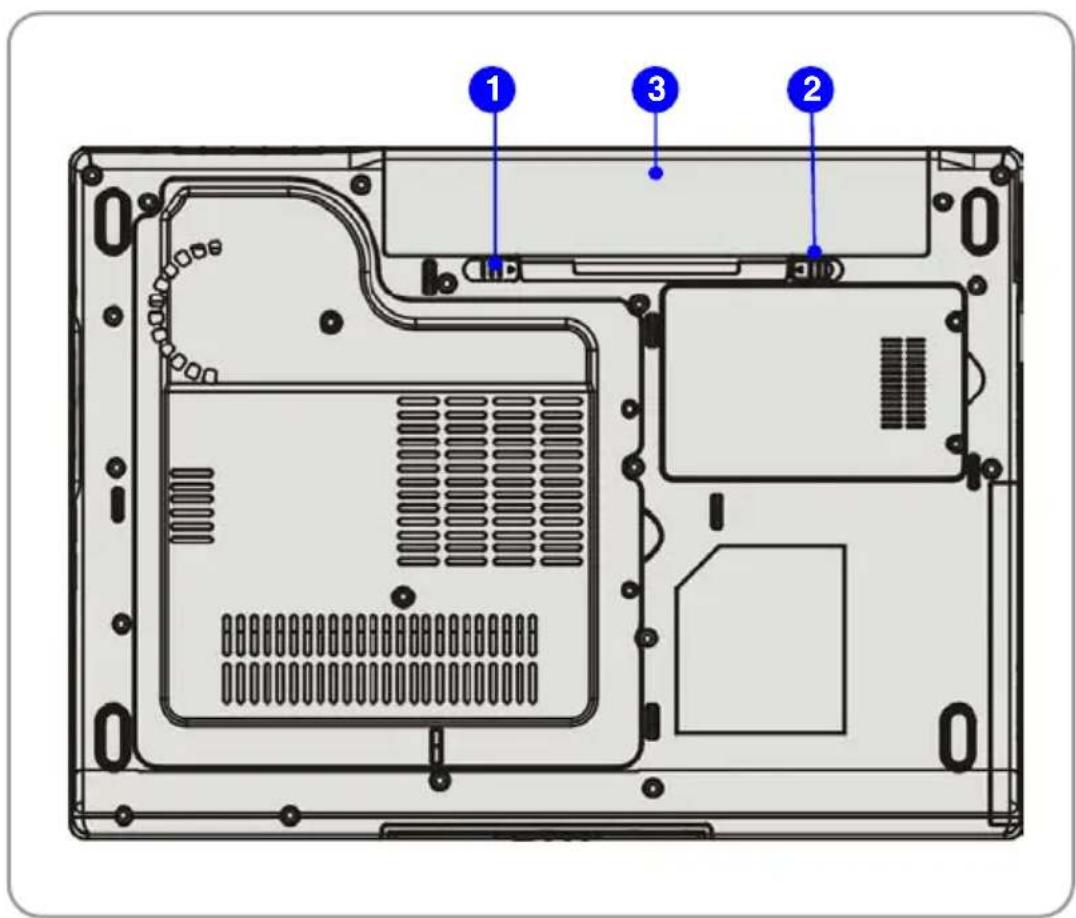
1. Battery Lock/Unlock Button
Battery cannot be moved when the button is positioned on lock status.
Once the button is pushed to unlock position, the battery is removable.
2. Battery Release Button
It is a bounce-back device as a preparation for releasing the battery pack.
Press it with one hand and pull the battery pack carefully with the other.
3. Battery Pack
This notebook will be powered by the battery pack when the AC adapter is disconnected.
Power Management
AC Adapter
Please be noted that it is strongly recommended to connect the AC adapter and use the AC power while using this notebook for the first time. When the AC adapter is connected, the battery is being charged immediately.
NOTE that the AC adapter included in the package is approved for your notebook; using other adapter model may damage the notebook or other devices on the notebook.
Connecting the AC Power
- Unpack the package to find the AC adapter and power cord.
- Attach the power cord to the connector of the AC adapter.
- Plug the DC end of the adapter to the notebook, and the male end of the power cord to the electrical outlet.
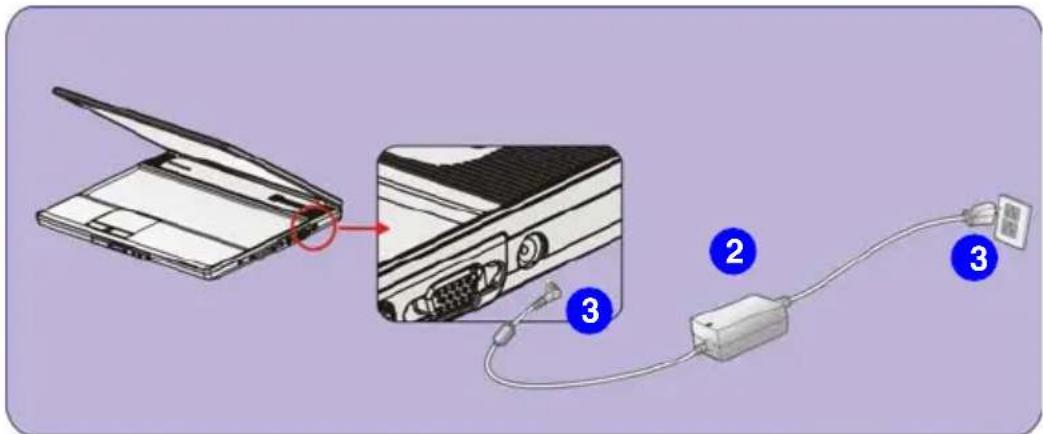
Disconnecting the AC Power
When you disconnect the AC adapter, you should:
- Unplug the power cord from the electrical outlet first.
- Unplug the connector from the notebook.
- Disconnect the power cord and the connector of AC adapter.
- When unplugging the power cord, always hold the connector part of the cord. Never pull the cord directly!
Battery Pack
This notebook is equipped with a high-capacity Li-ion Battery pack. The rechargeable Li-ion battery pack is an internal power source of the notebook.
Releasing the Battery Pack
It is recommended to have an extra battery in reserve to avoid this notebook from lacking of power supply. Please contact your local dealer for standard battery pack.
To remove the battery pack:
- Make sure the Notebook is turned off.
- Check the Lock/Unlock button is in unlocked status.
- Locate the Battery Release Button on the bottom side.
- Push the Release Button to the direction of arrow showing below the button.
- Slide the left side of the battery pack first out of the compartment and then pull the right side of the battery pack.
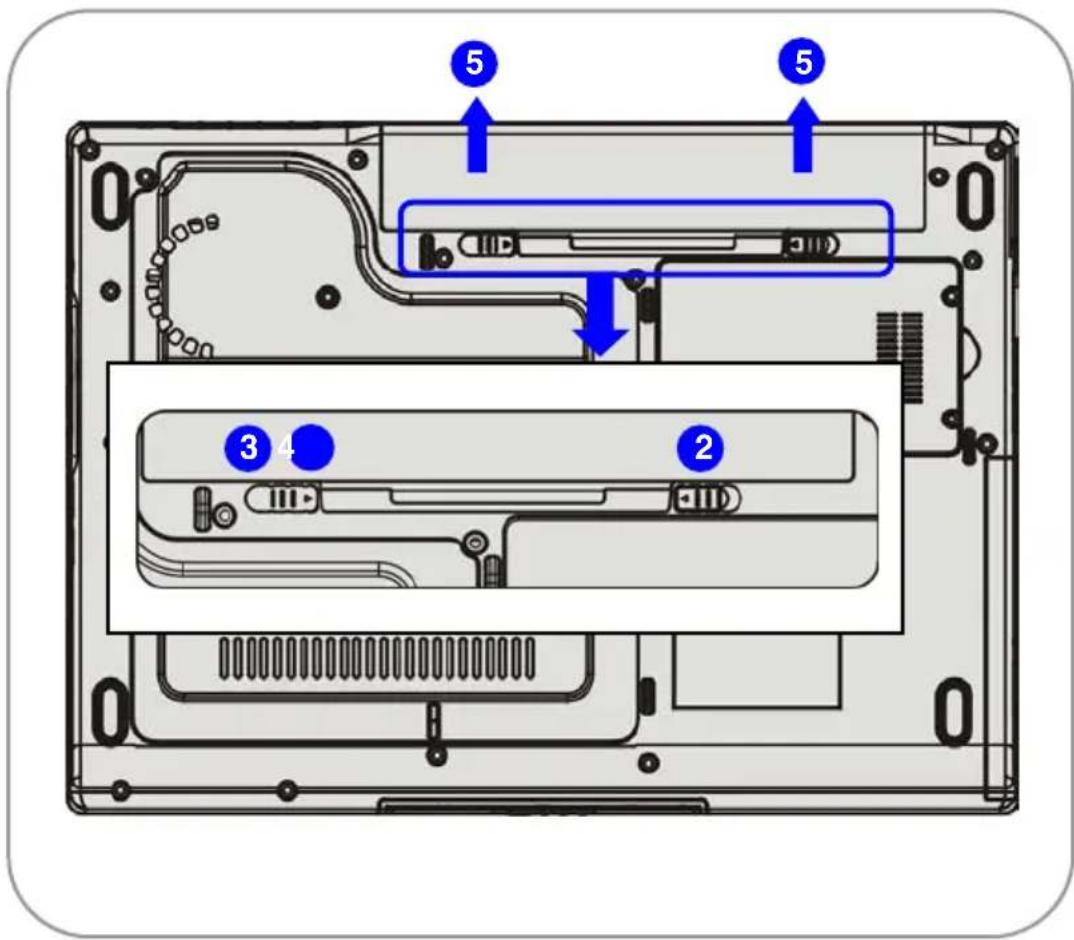
Replacing the Battery Pack
- Insert the right side of battery pack into the compartment.
- Slightly slide and press the battery pack into the right place.
- After the right side of the battery pack fitting the right track, then slightly press the left side of battery pack into the battery chamber.
- Make sure the Lock/Unlock Button is in lock position.
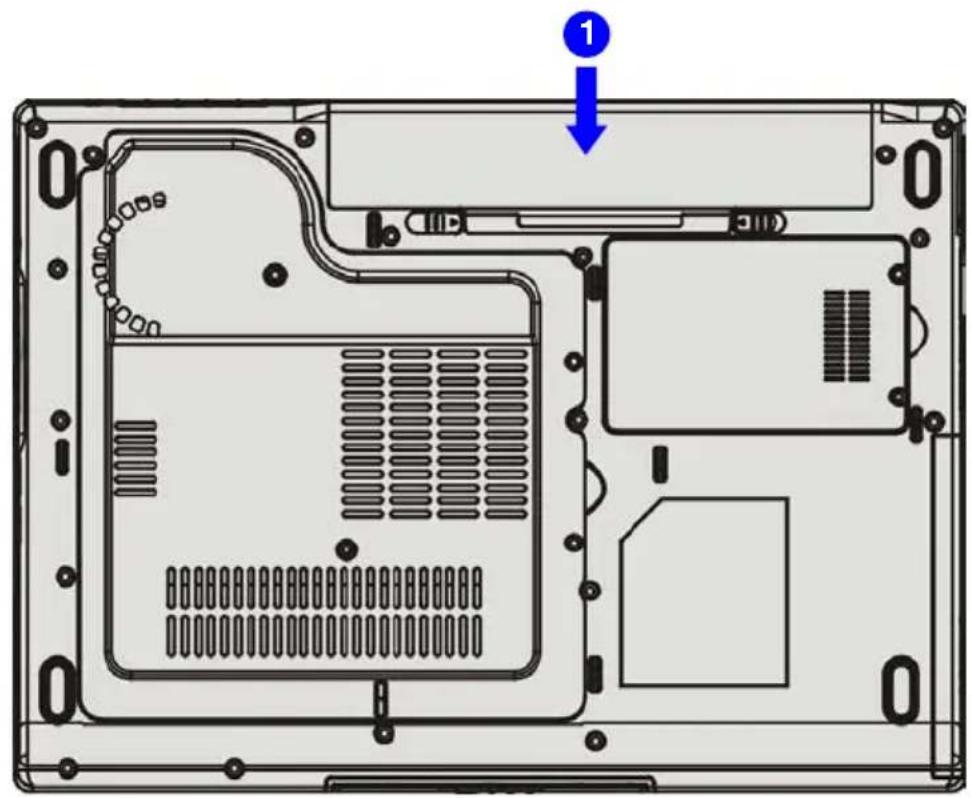
natural_image
Top-down schematic of a computer chassis showing internal components and ventilation slots (no text or labels)info
Warning
- Do not try to disassemble THE BATTERY PACK.
- Please follow your local laws and regulations to recycle the unused battery pack.
Using the Battery Pack
Battery Safety Tips
Replacing or handling the battery incorrectly may present a risk of fire or explosion, which could cause serious injury.
- Only replace the main battery pack with the same or equivalent type of battery.
- Do not disassemble, short-circuit or incinerate batteries or store them to temperatures above +60°C (+140°F).
- Do not temper with batteries. Keep them away from children.
- Do not use rusty or damaged batteries.
- Dispose of batteries according to local regulations. Check with your local solid waste officials for details about recycling options or for proper disposal in your area.
Conserving Battery Power
Efficient battery power is critical to maintain a normal operation. If the battery power is not managed well, the saved data and customized settings may be lost.
Follow these tips to help optimizing battery life and avoid a sudden power loss.
- Suspend system operation if the system will be idle for a while or shorten the Suspend Timer's time period.
- Turn off the system if you won't be using it for a period of time.
- Disable unneeded settings or remove idle peripherals to conserve power.
- Connect an AC adapter to the system whenever possible.
Charging the Battery Pack Properly
Your notebook computer features a powerful, rechargeable Li-Ion battery pack. Normally, a fully charged battery delivers approx. 2 to 3 hours of battery operation for your notebook. It is very important that you enable the Power Management features under Windows XP for careful management of power consumption. The endurance will vary depending on the different notebook configurations as well as work habits. A very bright display, lots of hard disk access using the DVD drive as well as an extensive use of the WLAN adapter will increase power consumption and therefore reduce battery endurance.
- To charge the battery, connect the power adapter to the notebook and to a wall outlet.
During the charging process, the battery indicator (LED) located next to the status indicators (LEDs) will light up. If the notebook is turned off, an empty battery will take approx. 3 hours to become fully charged. The charging time will be longer if the notebook is turned on and being used. It is normal that the battery becomes warm during the charging process.
-
The battery will develop its full capacity after completing 20 charging and discharging cycles without performing any quick charging.
-
In order to maintain its full capacity, it is recommended that you fully discharge the battery from time to time. To do so, disconnect the power adapter and keep
your notebook turned on until it automatically toggles to the Standby mode. Then reconnect the power adapter in order to recharge the battery.
-
As a rule the battery capacity will reduce to approx. 85 % after performing 500 charging cycles.
-
Never leave the battery unused for a long period of time. All batteries are subject to self-discharge. Storing the battery for a long time may cause a low discharge status that could damage the battery. Make sure that you charge the battery from time to time (approx. every 4 weeks).
-
While charging, never exposure the battery to high temperatures (higher than 45 °C or 113 °F).
Basic Operations
If you are a beginner to the Notebook, please read the following tips to make yourself safe and comfortable during the operations.
Safety and Comfort Tips
The Notebook is a portable platform that allows you to work anywhere. However, choosing a good workspace is important if you have to work with your Notebook for long periods of time.
- Your work area should have enough illumination.
- Choose the proper desk and chair and adjust their height to fit your posture when operating.
- When sitting on the chair and adjust the chair's back (if available) to support your back comfortably.
- Place you feet flat and naturally on the floor, so that your knees and elbows have the proper position (about 90-degree) when operating.
- Put your hands on the desk naturally to support your wrists.
- Adjust the angle/position of the LCD panel, so that you can have the optimal view.
- Avoid using your Notebook in the space where may cause your discomfort (such as on the bed).
- The Notebook is an electrical device, please treat it with great care to avoid personal injury.
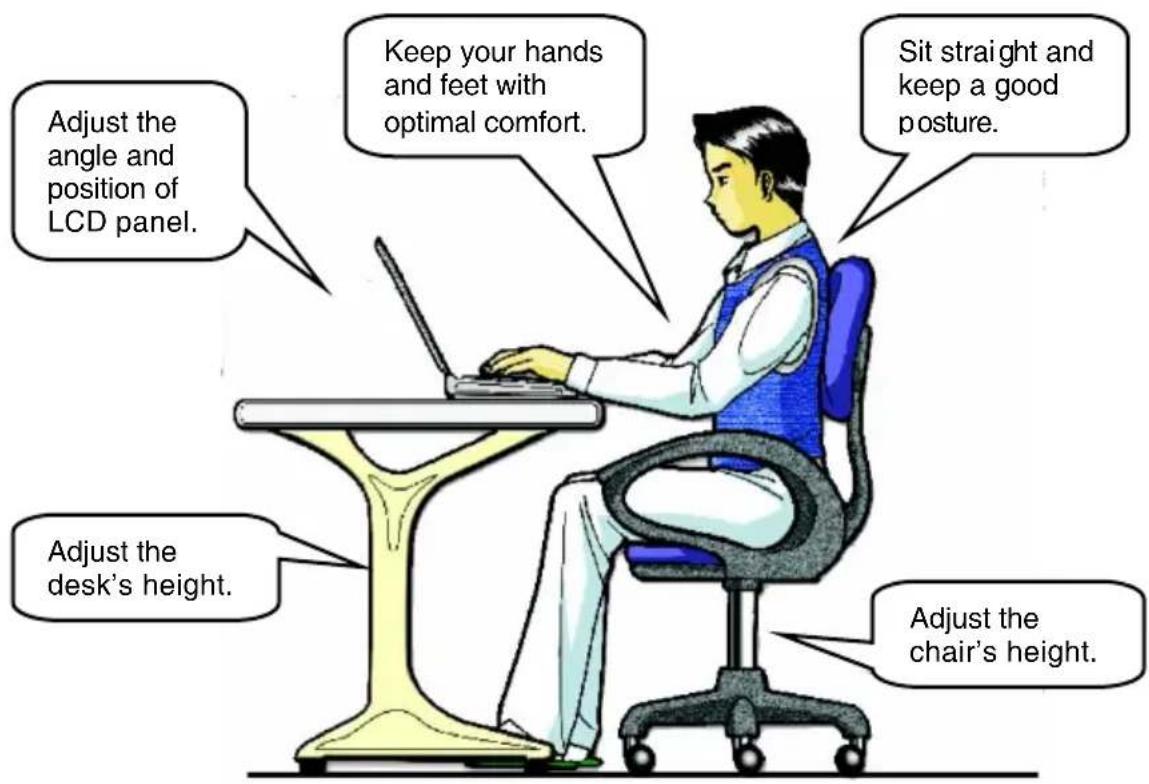
Have a Good Work Habit
Have a good work habit is important if you have to work with your Notebook for long periods of time; otherwise, it may cause discomfort or injury to you. Please keep the following tips in mind when operating.
- Change your posture frequently.
♦ Stretch and exercise you body regularly. - Remember to take breaks after working for a period of time.
Knowing the Keyboard
The Notebook's keyboard provides all the functions of a full-sized 86-key keyboard and an additional [Fn] key for specific functions on the Notebook. The keyboard can be divided into four categories: Typewriter keys, Cursor keys, Numeric keys and Function keys.
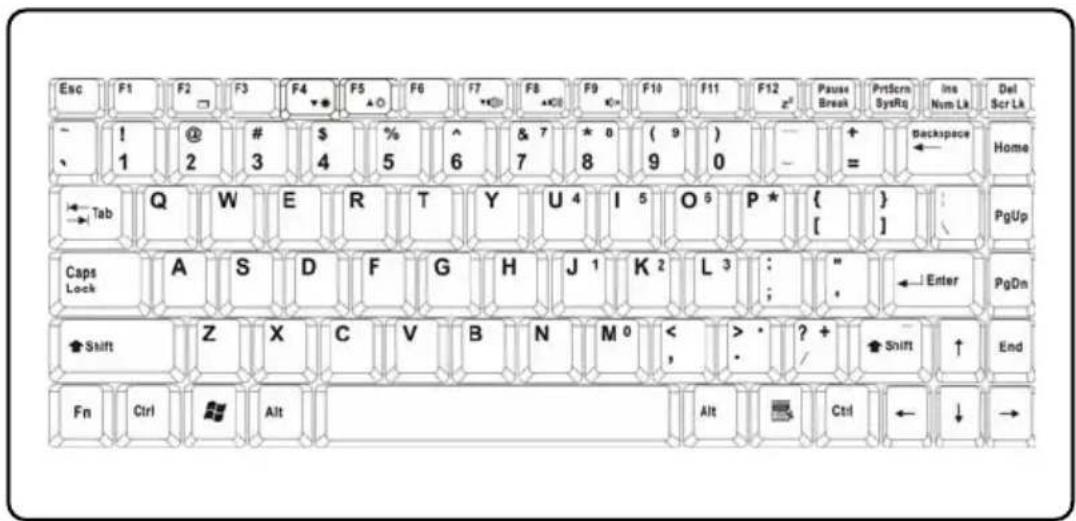
Typewriter Keys
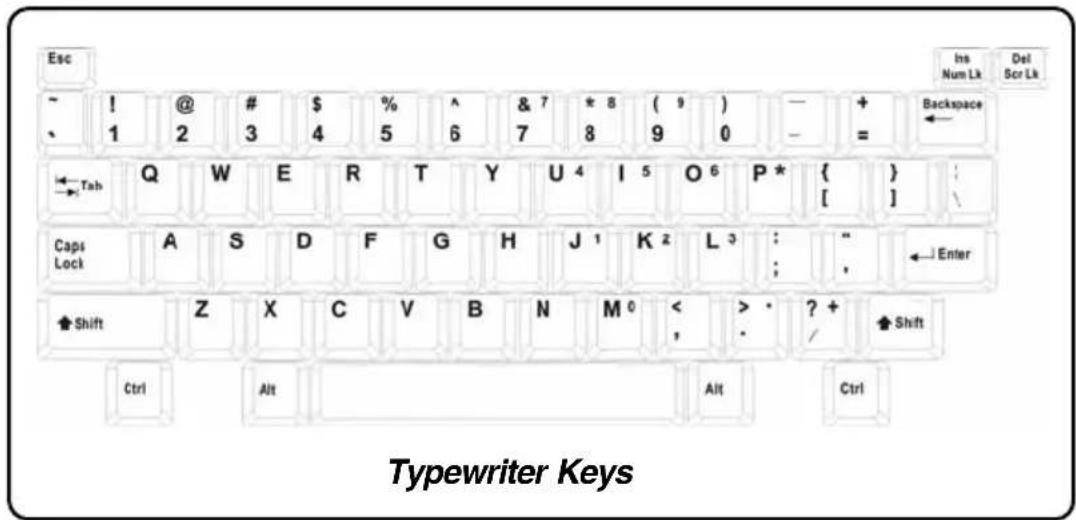
The function of these Typewriter keys is the major function of the keyboard, which is similar to the keys on a typewriter. It also provides several keys for special purposes, such as the [Ctrl], [Alt] and [Esc] key.
When the lock keys are pressed, the corresponding LEDs will light up to indicate their status:
■ Num Lock: Press and hold the [Fn] key and press this key to toggle the Num Lock on and off. When this function is activated, you can use the numeric keys that are embedded in the typewriter keys.
■ Caps Lock: Press this key to toggle the Caps Lock on and off. When this function is activated, the letters you type are kept in uppercase.
■ Scroll Lock: Press and hold the [Fn] key and press this key to toggle the Scroll Lock on and off. This function is defined by individual programs, and it is usually used under DOS.
Cursor Keys
The keyboard provides four cursor
(arrow) keys and [Home], [PgUp], [PgDn],
[End] keys at the lower right corner,
which are used to control the cursor
movement.
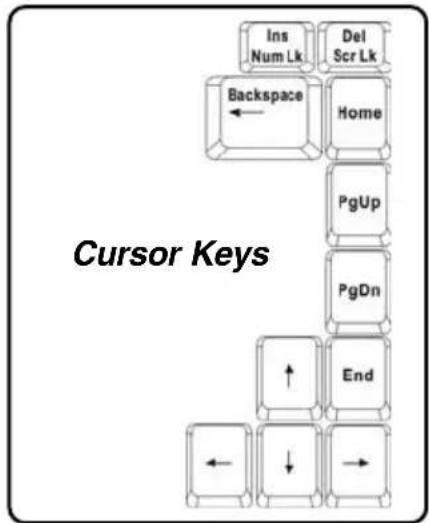
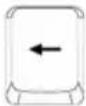 | Move the cursor left for one space. |
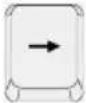 | Move the cursor right for one space. |
 | Move the cursor up for one line. |
 | Move the cursor down for one line. |
 | Move to the previous page. |
 | Move to the next page. |
 | Move to the beginning of the line (or document). |
 | Move to the end of the line (or document). |
The Backspace key, [Ins] and [Del] keys at upper right corner are use for editing purpose.
 | This key is used to switch the typing mode between “insert” and “overtype” modes. |
 | Press this key to delete one character to the right of the cursor and move the following text left for one space. |
 | Press this key to delete one character to the left of the cursor and move the following text left for one space. |
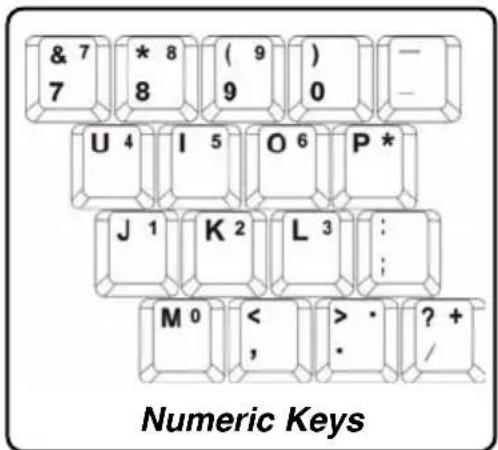
Numeric Keys
The keyboard provides a set of numeric keypad, which is embedded in the typewriter keys. When the Num Lock is activated, you can use these numeric keys to enter numbers and calculations.
Function Keys
■ Windows Keys
You can find the Windows Logo key ( ) and one Application Logo key ( ) on the keyboard, which are used to perform Windows-specific functions, such as opening the Start menu and launching the shortcut menu. For more information of the two keys, please refer to your Windows manual or online help.
■ [Fn] Key
![TARGA Traveller 1561 - ■ [Fn] Key - 1](/content/2026/02/379737/images/6ec900672355f1a00bb446389783455128b8f25fe3912d4a3598a63ba8d25ffa.jpg) | Switch the display output mode between the LCD, external monitor and Both. |
![TARGA Traveller 1561 - ■ [Fn] Key - 2](/content/2026/02/379737/images/9c4989244a76931de2c40f56c680530ea0adea5662a424f5034bd15fd0e52be5.jpg) | Increase the LCD brightness. |
![TARGA Traveller 1561 - ■ [Fn] Key - 3](/content/2026/02/379737/images/bad5d7057fc52d8414ad0a3f9477596e18220e248257986a3af4a86459dd42e4.jpg) | Decrease the LCD brightness. |
![TARGA Traveller 1561 - ■ [Fn] Key - 4](/content/2026/02/379737/images/3d792b4cfa9e49f20f4dd7c1f06446a21cc9aa02a7f8750934708cdb0f3f9206.jpg) | Decrease the built-in speaker's volume. |
![TARGA Traveller 1561 - ■ [Fn] Key - 5](/content/2026/02/379737/images/a8dc94c0801e2a2a3b601f59b4001b966979d576d21234ad86fe5a8830519a9d.jpg) | Increase the built-in speaker's volume. |
![TARGA Traveller 1561 - ■ [Fn] Key - 6](/content/2026/02/379737/images/6670d7970d27cde5e9c60b1d8b5f311f8cfdf5530284a6146f2d62ffb8d886b4.jpg) | Disable the Notebook's audio function. |
![TARGA Traveller 1561 - ■ [Fn] Key - 7](/content/2026/02/379737/images/c034d24c9a498d1ccc047ae1f9583bfd29f1ad9ff6d56736da0fc908495647ad.jpg) | Force the Notebook into suspend mode (depending on the system configuration). |
Knowing the Touchpad
The touchpad integrated in your Notebook is a pointing device that is compatible with standard mouse, allowing you to control the Notebook by pointing the location of the cursor on the screen and making selection with its two buttons.

1. Cursor Movement Area
This pressure-sensitive area of the touchpad, allows you to place your finger on it and control the cursor on the screen by moving your finger.
2. Right Button
Acts as the mouse's right button.
3. Left Button
Acts as the mouse's left button.
Using the Touchpad
Read the following description to learn how to use the touchpad:
■ Positioning and Moving
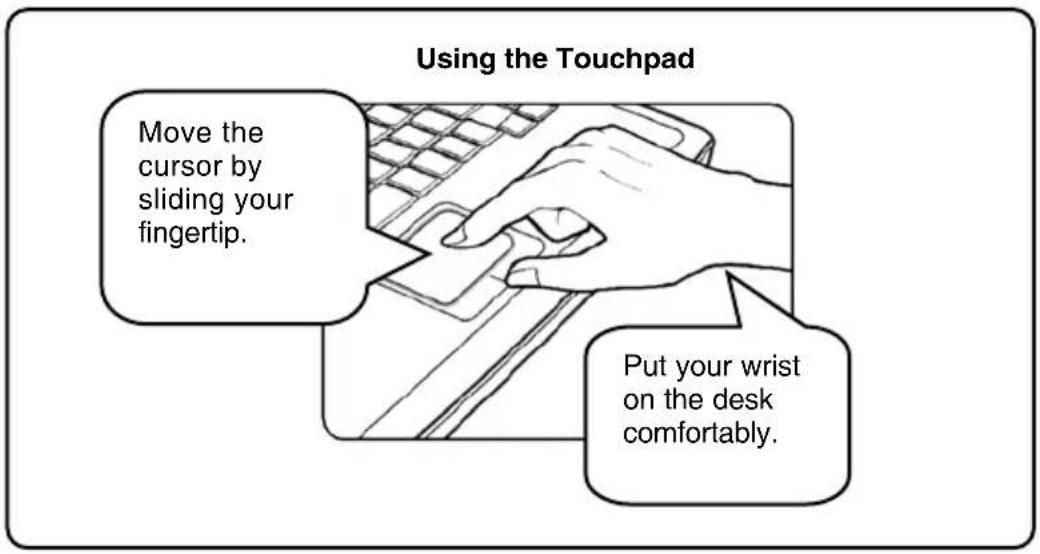
Place your finger on the touchpad (usually using the forefinger), and the rectangular pad will act as a miniature duplicate of your display. When you move your fingertip across the pad, the cursor on the screen will move simultaneously in the same direction. When your finger reaches the edge of the pad, lift your finger and replace it on a proper location of the touchpad.
■ Point and Click
When you have moved and placed the cursor over an icon, a menu item or a command that you want to execute, simply tap slightly on the touchpad or press the left button to select. This procedure, called as point and click is the basics of operating your Notebook. Unlike the traditional pointing device such as the mouse, the whole touchpad can act as a left button, so that your each tap on the touchpad is equivalent to pressing the left button. Tapping twice more rapidly on the touchpad is to execute a double-click.
■ Drag and Drop
You can move files or objects in your Notebook by using drag-and-drop. To do so, place the cursor on the desired item and slightly tap twice on the touchpad, and then keep your fingertip in contact with the touchpad on the second tap. Now, you can drag the selected item to the desired location by moving your finger on the touchpad, and then lift your finger from the touchpad to drop the item into place. Alternately, you can press and hold the left button when you select an item, and then move your finger to the
desired location; finally, release the left button to finish the drag-and-drop operation.
■ Configuring the Touchpad
You can customize the pointing device to meet your personal needs. For example, if you are a left-hand user, you may want to swap the functions of the two buttons. In addition, you can change the size, shape, moving speed and other advanced features of the cursor on the screen.
To configure the touchpad, you can use the standard Microsoft or IBM PS/2 driver in your Windows operating system. The Mouse Properties in Control Panel allows you to change the configuration.
■ Configuring the Touchpad
You can customize the pointing device to meet your personal needs. For example, if you are a left-hand user, you may want to swap the functions of the two buttons. In addition, you can change the size, shape, moving speed and other advanced features of the cursor on the screen.
To configure the touchpad, you can use the standard Microsoft or IBM PS/2 driver in your Windows operating system. The Mouse Properties in Control Panel allows you to change the configuration.
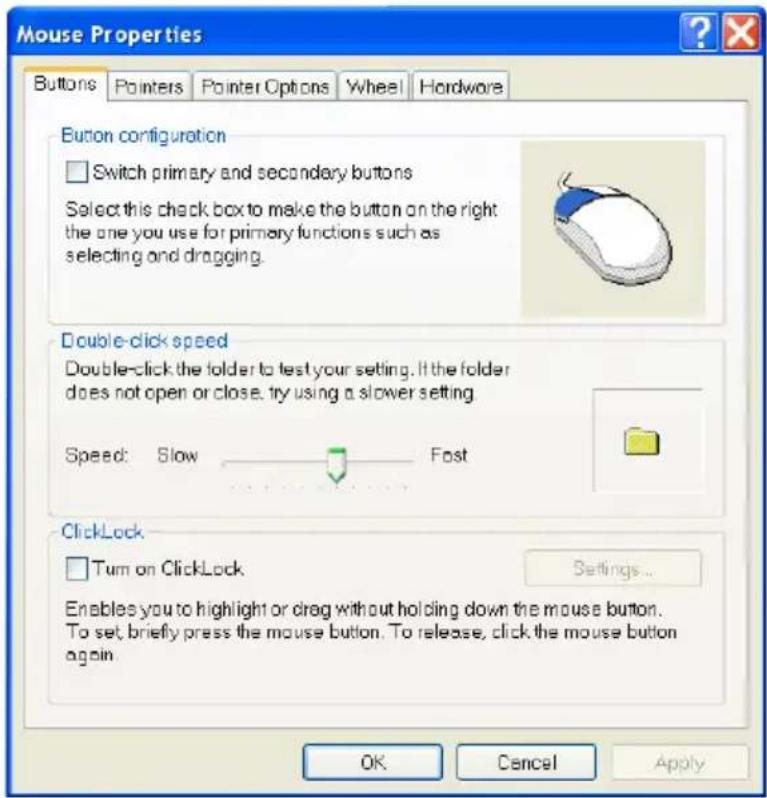
Mouse Properties Window
About Hard Disk Drive
Your Notebook is equipped with a 2.5-inch hard disk drive. The hard disk drive is a storage device with much higher speed and larger capacity than other storage devices, such as the floppy disk drive and optical storage devices. Therefore, it is usually used to install the operating system and software applications.
info
-
To avoid unexpected data loss in your system, please backup your critical files regularly.
-
Do not turn off the Notebook when the Hard Disk In-use LED is on.
-
Do not remove or install the hard disk drive when the Notebook is turned on. The replacement of hard disk drive should be done by an authorized retailer or service representative.
Using the Optical Device
Your Notebook is equipped with an optical storage device. The actual device installed in your Notebook depends on the model you purchased.
■ DVD Combo Drive: This device allows you to read DVD and CD, and record CD format.
■ DVD Dual Drive: In addition to read DVD and CD, this device allows you to record CD format and both the -R/RW and +R/RW DVD formats.
■ DVD Multi: Works as a multi-functional DVD Dual Drive and a DVD RAM Drive.
■ Lightscribe: Allows users to have brief texts curved on the obverse side of the disks with the laser read/write head of the Optical Device Drive.
■ HD DVD: HD DVD (or High-Definition DVD) is a high-density optical disc format designed for the storage of data and high-definition video.
info
-
The optical storage devices are classified as a Class 1 Laser products. Use of controls or adjustments or performance of procedures other than those specified here in may result in hazardous radiation exposure.
-
Do not touch the lens inside the drive.
Inserting the Disk
The following instruction describes the general procedure when operating the optical storage device.
- Confirm that the Notebook is turned on.
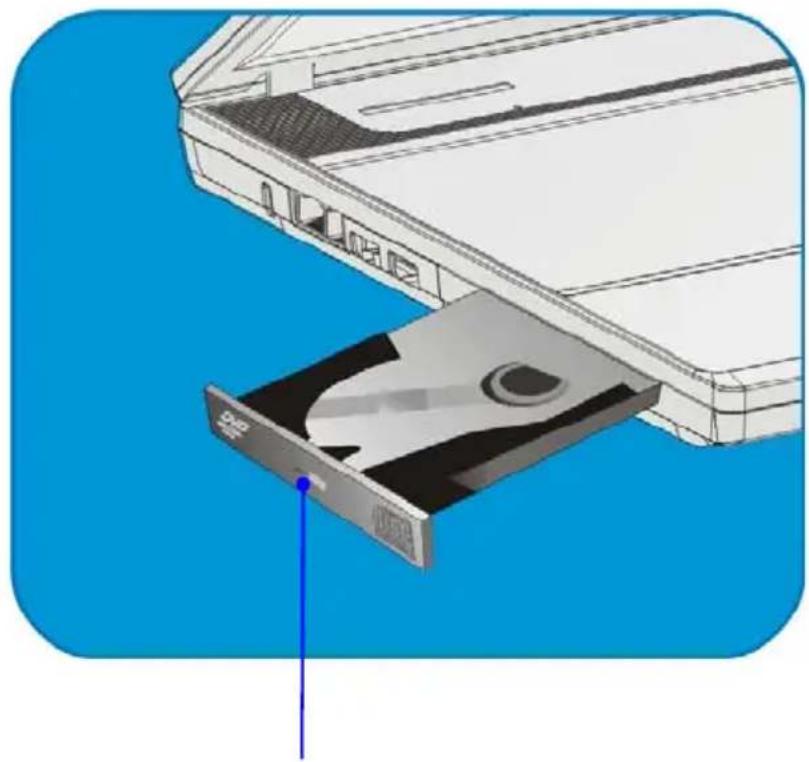
- Press the Eject Button on the drive's panel and the disk tray will slide out partially. Then, gently pull the tray out until fully extended.
- Place your disk in the tray with its label facing up. Slightly press the center of the disk to secure it into place.
- Push the tray back into the drive.
natural_image
Illustration of a CD inside a device with an open disc and cable, against a blue background (no text or symbols)Eject Button
Removing the Disk
-
Press the Eject Button on the drive's panel and the disk tray will slide out partially. Then, gently pull the tray out until fully extended.
-
Hold the disk by its edge with your fingers and lift it up from the tray.
-
Push the tray back into the drive.
info
- Confirm that the disk is placed correctly and securely in the tray before closing the tray.
- Do not leave the disk tray open.
Getting Started
Preface
Chapter 1
General Introductions
Chapter 2
Getting Started
Chapter 3
Customizing this Notebook
Chapter 4
BIOS Setup
Chapter 5
Troubleshooting, First Aid and FAQ
Chapter 6
Mandatory Activation
Chapter 7
Windows Media Center – Initial Setup
Chapter 8
System Recovery
Connecting the External Devices
The I/O (input/output) ports on the Notebook allow you to connect peripheral devices.
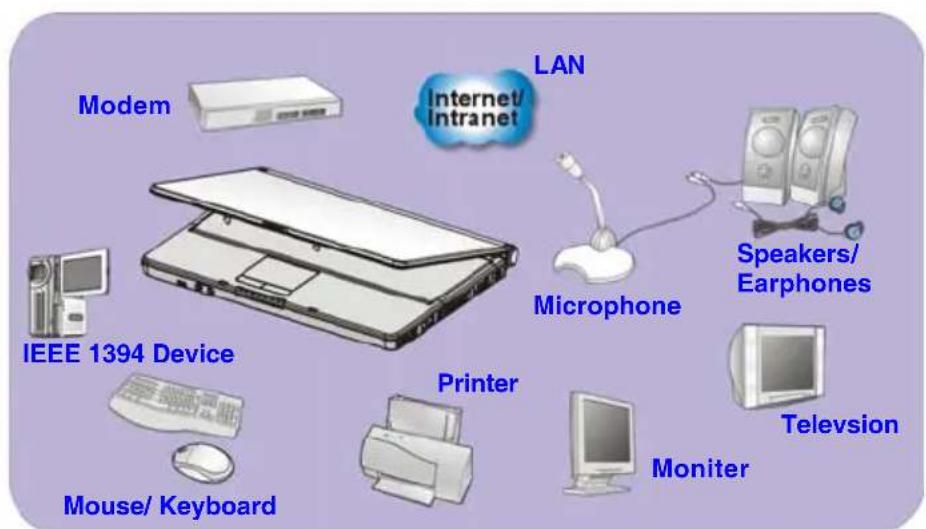
Connecting the Peripheral Devices
Connecting the Mouse
You can connect a mouse to your Notebook through the USB port. To connect the mouse:
- Turn on the Notebook and install the mouse driver.
- Connect your mouse to the Notebook.
- The Notebook may auto detect your mouse driver and enable the mouse function. If there is no detection of you mouse you can manually enable the mouse by going to Start Menu → Control Panel → Add Hardware to add the new device.
Connecting the Keyboard
You can connect a keyboard to your Notebook through the USB port. To connect the keyboard:
- Turn on the Notebook and install the keyboard driver.
- Connect your keyboard to the Notebook.
- The Notebook may auto detect your keyboard driver and enable the keyboard function. If there is no detection of you keyboard you can manually enable the keyboard by going to Start Menu → Control Panel → Add Hardware to add the new device.
Connecting the Printer
If your printer has a USB interface, you can then use the USB port on the Notebook to connect the printer. The following instruction describes the general procedure to connect a printer:
- Turn off the Notebook.
- Connect one end of the printer cable to the Notebook's USB port and the other end to the printer.
- Connect the power cord and turn on the printer.
- Turn on the Notebook and the system will detect a new device. Install the required driver.
For further instructions, please refer to your printer's manual.
Connecting the External Monitor
You can connect an external monitor to your Notebook through the VGA port for a larger view with higher resolution. To connect the monitor:
- Make sure that the Notebook is turned off.
- Plug the monitor's D-type connector into the Notebook's VGA port.
- Connect the monitor's power cord and turn on the monitor.
- Turn on the Notebook and the monitor should respond by default. If not, you can switch the display mode by pressing [Fn]+[F2]. Alternately, you can change the display mode by configuring the settings in Display Properties of Windows operating system.
Connecting the IEEE 1394 devices
The IEEE 1394 port of your Notebook is a next-generation serial bus that features a high-speed transfer rate and the connection of up to 63 devices, allowing you to connect many high-end peripheral devices and consumer electronic appliances, such as the DV (digital video camera). The IEEE 1394 standard interface supports “plug-and-play” technology, so that you can connect and remove the IEEE 1394 devices without turning off the Notebook. To connect the IEEE 1394 device, simply connect the cable of the device to the IEEE 1394 port of your Notebook.
Connecting the Communication Devices
Using the LAN
The RJ-45 connector of the Notebook allows you to connect the LAN (local area network) devices, such as a hub, switch and gateway, to build a network connection. This built-in 10/100 Base-T LAN module supports data transfer rate up to 100Mbps.
For more instructions or detailed steps on connecting to the LAN, please ask your MIS staff or network manager for help.
Using the Modem
The built-in 56Kbps fax/data modem allows you to use a telephone line to communicate with others or to dial-up to connect the Internet.
For more instructions or detailed steps on dialing-up through the modem, please consult your MIS staff or Internet service provider (ISP) for help.
info
-
To reduce the risk of fire, use only No. 26 AWG or larger telecommunication lone cord.
-
You are strongly recommended to install the modem driver included in the software CD of your Notebook to take full advantage of the modem feature.
PC Card Installation
The PC card slot of your Notebook allows you to install comprehensive Type-II PC cards that support various functions for your necessary, including the LAN/WLAN card, modem card and memory card.
The following instruction provides you with a basic installation for the PC card, including how to install and remove it. For more information, please refer to the manual of your PC card.
Installing the PC card
- Locate the PC card slot on your notebook Notebook. If there is the dummy card in the slot, remove it first.
- Insert the PC card into the slot (usually with its label facing up) and push it until it is firmly seated.
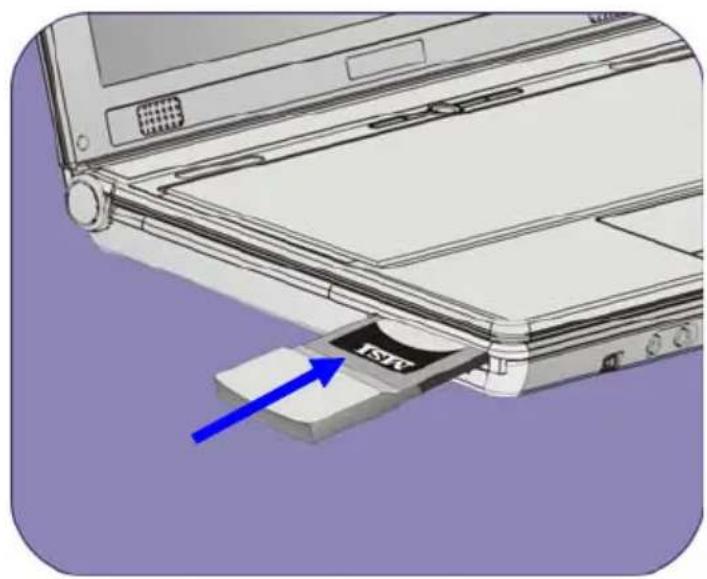
natural_image
Illustration of a laptop with an ISRG card inserted, showing the device's internal structure and blue arrow indicating insertion (no text or symbols on the device itself)Removing the PC card
- Press the Eject Button to make it stretch out.
- Push the Eject Button and the PC card will slide out. Pull it out of the slot.
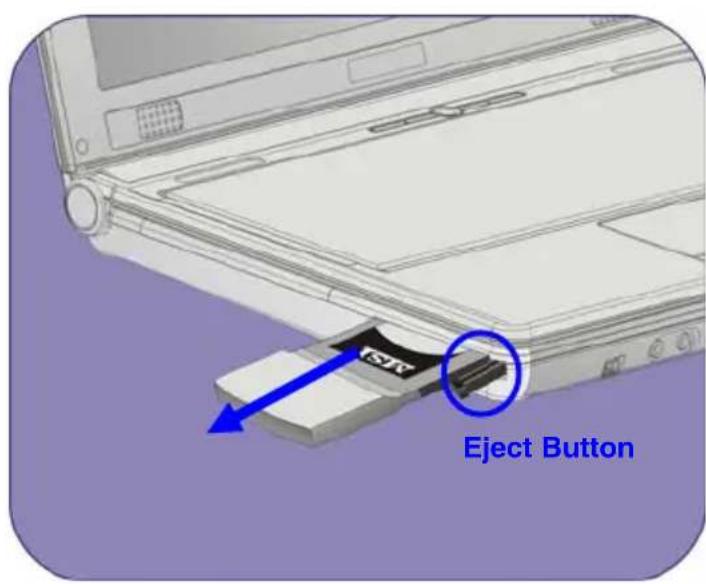
info
- Do not hold the "golden finger" when installing the PC card; otherwise, it may cause interference or damage to the PC card.
- Before removing the PC card, you should stop the device in Windows operating system.
Safely Remove Hardware
If you connect any peripheral device to your system, the Safely Remove Hardware icon ( ) will appear on the taskbar. Double-click the icon to bring up the Safely Remove Hardware dialog box. You can see all connected peripheral devices here. If you want to remove any of the devices, move the cursor to the device and click Stop.
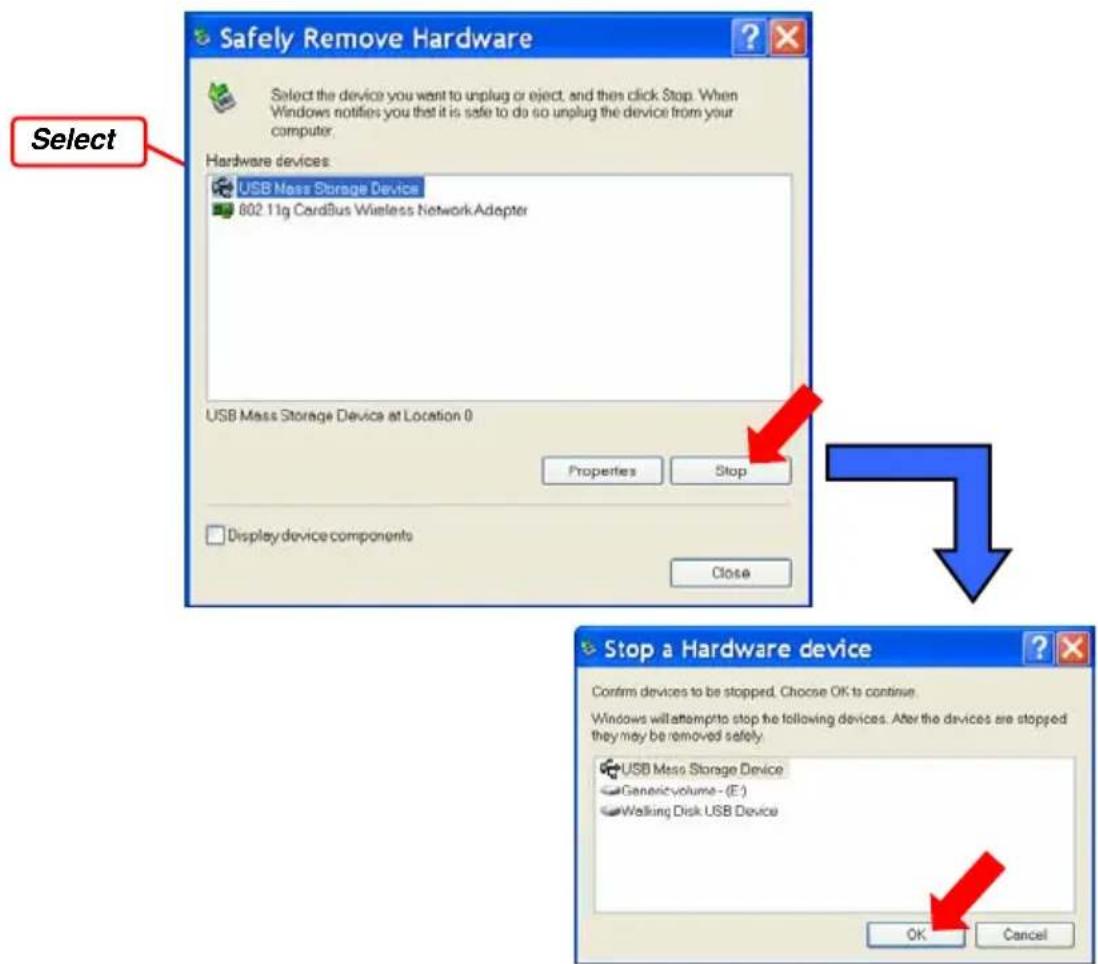
Preface
Chapter 1
General Introductions
Chapter 2
Getting Started
Chapter 3
Customizing this Notebook
Chapter 4
BIOS Setup
Chapter 5
Troubleshooting, First Aid and FAQ
Chapter 6
Mandatory Activation
Chapter 7
Windows Media Center – Initial Setup
Chapter 8
System Recovery
About BIOS Setup
When to Use BIOS Setup?
You may need to run the BIOS Setup when:
- An error message appears on the screen during the system booting up and requests you to run SETUP.
- You want to change the default settings for customized features.
- You want to reload the default BIOS settings.
How to Run BIOS Setup?
To run the BIOS Setup Utility, turn on the Notebook and press the [Del] key during the POST procedure.
If the message disappears before you respond and you still wish to enter Setup, restart the system by turning it OFF and ON, or simultaneously pressing [Ctrl]+[Alt]+[Delete] keys to restart.
info
The screen snaps and setting options in this chapter are for your references only. The actual setting screens and options on your Notebook may be different because of BIOS update.
Control Keys
You can use only the keyboard to control the cursor in the BIOS Setup Utility.
 | Press left arrow to select one menu title. |
 | Press right arrow to select one menu title. |
 | Press up arrow to select one item under the menu title. |
 | Press down arrow to select one item under the menu title. |
 | Increase the setting value or make changes. |
 | Decrease the setting value or make changes. |
 | 1) Open the selected item to change setting options.2) Bring up a sub-menu when available. |
 | In some items, press this key to change setting field. |
 | Bring up help screen providing the information of control keys. |
 | 1) Exit the BIOS Setup Utility.2) Return to the previous screen in a sub-menu. |
BIOS Setup Menu
Once you enter the BIOS Setup Utility, the Main menu will appear on the screen.
The Main menu displays the system information, including the basic configuration. The pictures shown in this chapter are for reference only, and may vary from the actual ones.
![BIOS SETUP UTILITY Main Advanced Security Boot Exit Market Name Model Name System Time [11:08:53] System Date [Wed 05/16/2007] Serial ATA [Not Detected] Primary IDE Master [ATAPICDROM] System Infomation Use [ENTER] to select a field. Use [+], [-] to configure system Date. ←→ Select Screen ↓↑ Select Item ←- Change Field Tab Select Field F1 General Help FIO Save and Exit ESC Exit V02.59 (C) Copyright 1985-2005, American Megatrends, Inc.](/content/2026/02/379737/images/a804a4f6160ea62ee76134c2de718572e273385bac5da1685d0f3aaeaa974c7d.jpg)
Main menu
Show System Overview information about firmware version, CPU features, Memory size and setting of System Time and Date.
Advanced menu
Configure IDE and USB settings.
Security menu
Install or clear Supervisor's and User's Password settings.
Boot menu
Set up Boot Type and Boot Sequence.
Exit menu
Choose decided status before leaving the BIOS menu.
Main menu
| BIOS SETUP UTILITY | |||
| Main Advanced Security Boot Exit | |||
| Market Name Model Name System Time [18:08:53] System Date [Wed 05/16/2007] ► Serial ATA [Not Detected] ► Primary IDE Master [ATAPICDROM] ► System Infomation | Use [ENTER] to select a field. Use [+], [-] to configure system Date. ++ Select Screen ↓↑ Select Item +- Change Field Tab Select Field F1 General Help F10 Save and Exit ESC Exit | ||
| V02.59 (C) Copyright 1985-2005, American Megatrends, Inc. | |||
- System Time
This item allows you to set the system time. The system clock will go on no matter you shut down the PC or get into sleep mode. The set format is [hour:minute:second].
- System Date
This item allows you to set the system date. The date format is [day:month:date:year].
Day Day of the week, from Sun to Sat, which is determined by BIOS (read-only).
Month The month from 01 (January) to 12 (December).
Date The date from 01 to 31.
Year The year can be adjusted by users.
♦ Serial ATA / Primary IDE Master
These items display the types of the primary IDE devices installed in the Notebook. Press [Enter] to bring up a sub-window showing the detailed information of the device, including the device name, vendor, LBA mode, PIO mode and more.
- System Information
This item provides the information about the firmware, processor, and system memory.
Advanced menu
![BIOS SETUP UTILITY Main Advanced Security Boot Exit ▶ Chipset Configuration PowerNow [Enabled] C1F Support [Disable] Legacy USB Support [Auto] PCI Legacy Timer [64] ↔ Select Screen ↓↑ Select Item +- Change Field Tab Select Field F1 General Help F10 Save and Exit ESC Exit V02.59 (C) Copyright 1985-2005, American Megatrends, Inc.](/content/2026/02/379737/images/6b5c976c743b438f491a8ed2207da0ea2313f6e653036598ca657a3af15e65d0.jpg)
PowerNow
This item allows you to enable or disable PowerNow function. When set to Enabled, the system always operates in a conserve power mode. If you want optimize the processor, set this item to Disabled, so that the processor's speed will vary depending on the use of your operating system and applications. Default setting is set to Enabled.
♦ Legacy USB Support
Selecting Enabled allows you to use USB devices, such as mouse, keyboard, or portable disk, in DOS system; or allows you to boot your system by USB device. Setting options: Enabled, and Disabled.
- PCI Latency Timer
This item controls how long each PCI device can hold the bus before another takes over. When set to higher values, every PCI device can conduct transactions for a longer time and thus improve the effective PCI bandwidth. For better PCI performance, you should set the item to higher values. Setting options: 32, 64, 96, 128, 160, 192, 224, and 248.
Security menu
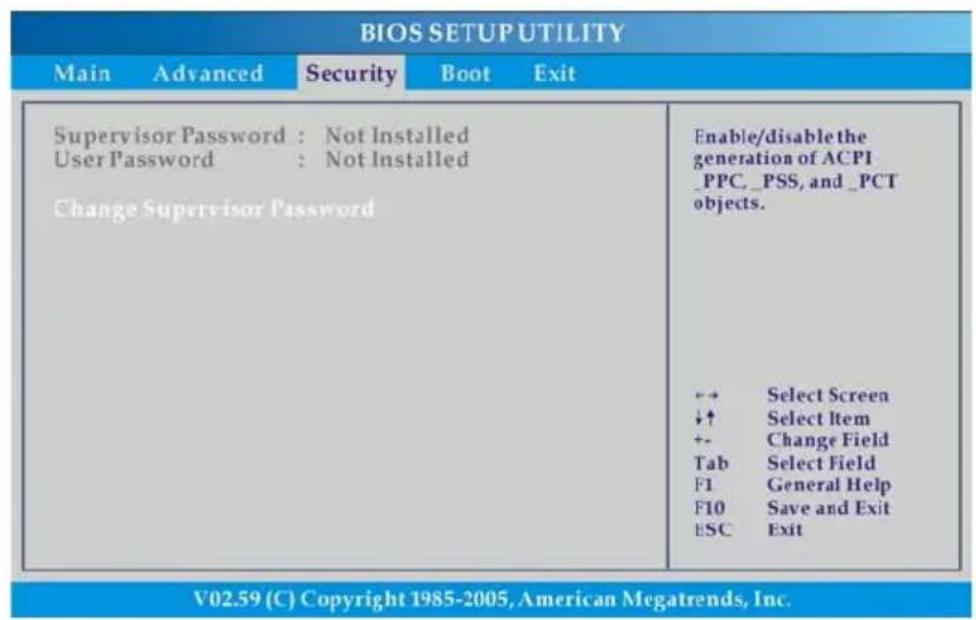
- Change Supervisor/User Password
When you select the function, a message box will appear on the screen as below:
Enter New Password
Type the password you want, up to six characters in length and press [Enter]. The password typed now will replace any previously set password from CMOS memory. You may also press [ESC] to abort the selection and not enter a password.
When the Supervisor Password is set, the new item User Access Level and Password Check will be added in the menu. You can make further settings of access right in the User Access Level item. Setting options: No Access, View Only, Limited and Full Access. The Password Check item is used to specify the type of BIOS password protection that is implemented. Settings are described below:
Setup The password prompt appears only when end users try to run Setup.
Always A password prompt appears every time when the Notebook is powered on or when end users try to run Setup.
To clear a set password, just press [Enter] when you are prompted to enter the password. A message box will show up confirming the password will be disabled. Once the password is disabled, the system will boot and you can enter Setup without entering any password.
info
About Supervisor Password and User Password
Supervisor Password allows the user to enter and change the settings of the setup menu; User Password only allows the user to enter the setup menu, but do not have the right to make changes.
Boot menu
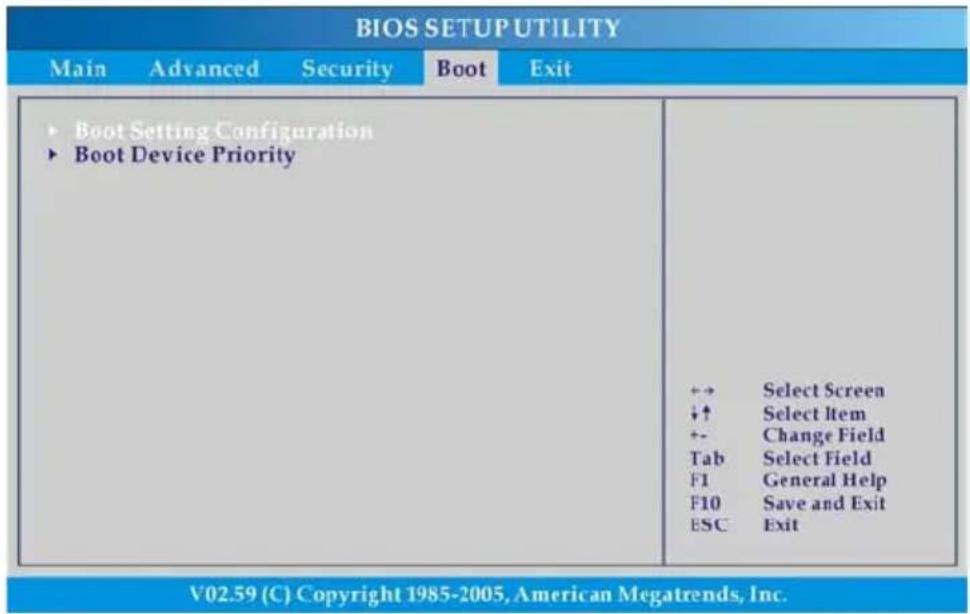
- Boot Settings Configuration
Configure settings during system boot.
- Boot Device Priority
Press [Enter] to bring up a sub-window showing the sequence of boot devices where BIOS attempts to load the disk operating system.
Exit menu
| Main Advanced Security Boot Exit | |
| Exit & Save Changes Exit & Discard Changes Discard Changes Load Setup Defaults | Exit System setup after saving the changes. F10 key can be used for this operation. ↔ Select Screen ↓↑ Select Item +- Change Field Tab Select Field F1 General Help F10 Save and Exit ESC Exit |
| V02.59 (C)Copyright 1985-2005, American Megatrends, Inc. | |
- Exit & Save Changes
Save the changes you have made and exit the utility.
- Exit & Discard Changes
Exit the utility without saving the changes you have made.
♦ Discard Changes
Abandon your changes and reload the previous configuration before running the utility.
- Load Setup Defaults
Select this item to load the default settings for optimal system performance.
Preface
Chapter 1
General Introductions
Chapter 2
Getting Started
Chapter 3
Customizing this Notebook
Chapter 4
BIOS Setup
Chapter 5
Troubleshooting, First Aid and FAQ
Chapter 6
Mandatory Activation
Chapter 7
Windows Media Center – Initial Setup
Chapter 8
System Recovery
Notebook
Troubleshooting, First Aid and FAQ
This notebook computer is a carefully tested, high-quality computer system offering the latest technology. However, problems and malfunction can never be totally avoided. In order to help you restore a fully-functional system we have collected together some detailed information about identifying and resolving the most common problems. If you have any problem, proceed as follows:
- Read the "Troubleshooting" section.
- Try to find the solution to your problem in the Chapter "FAQ".
NOTE
You'll find the latest FAQ on your desktop under Manufacturer Information and also on the Internet.
Go to http://www.service.targa.co.uk/to search for the latest FAQ and drivers.
- Read the corresponding chapter in this manual.
- Make use of the Windows System Recovery.
- If the notebook does not boot or there are errors during the booting up process, use the Recovery Software found on the EasyInstall CD. This software will help you restore the Windows boot and system files, and also reset your notebook to the factory default configuration if necessary.
- Call our hotline.
- If none of the above has helped you solve the problem, you can use our Pickup Service.
Notebook
Troubleshooting
If your notebook hangs while running or booting this can be due to a recently installed software. This can be solved as follows:
- Power your notebook on. First of all you'll see the usual BIOS messages. As soon as they have finished, press the [F8] key. This will display the Windows XP boot menu. Select the Safe Mode command. Windows will now boot in a special "emergency mode".
- Click Start/All Programs/Accessories/System Tools/System Restore to restore it to an earlier time when it worked. If this does not succeed, please also try all the other restore options.
- Uninstall the recently installed software via the Add or Remove Programs option from the Control Panel (this also works in Safe Mode).
- Start your notebook with the Windows XP Home Edition CD inserted into the drive and hold any letter key (e.g. . [H]) until the Windows Setup is launched. Wait until all files have been loaded. In the Windows Welcome screen, press [Enter], confirm the End User License Agreement by pressing [F8] and press [R] to repair an installation. (You only need to reinstall the drivers from the supplied EasyInstall CD once Windows has been repaired.)
- Contact the manufacturer of the third-party software.
Notebook
If you do not hear any sound, there are several possible reasons for hardware or software malfunction. In order to locate them better, proceed as follows:
- Make sure that the sound card driver has been installed and that you have selected the sound card as default audio device. To do so, open the Control Panel and double-click on Sounds and Audio Devices, click the Audio tab and check that Realtek Audio is selected as the default recording and playback device.
- For the standard playback device, click the Volume button and make sure that there is no check mark on any Mute option. Drag all the volume rulers to a medium volume level.
- Re-install the sound driver form the EasyInstall CD.
- Contact our Hotline.
If you cannot connect to the Internet via a modem, there are several possible reasons. Follow these steps to locate the problem:
- Uninstall the modem by opening the Device Manager found in Control Panel/System/Hardware. Click the plus sign next to Modems and right-click on the modem to choose the Uninstall command. The modem will be removed from the list. Now you can reinstall it automatically from the Device Manager by clicking on the Action/Scan for hardware changes.
- You can also perform a diagnostics from the Device Manager. Double-click on the modem, open the Diagnostics tab and click the Query Modem button. The list that pops up should contain a first entry Succeeded for a modem that
Notebook
is working properly.
- Try a different modem cable.
- Make sure that the modem cable has been properly inserted into the modem port.
- Try a different telephone wall socket (easy when using a notebook).
- Try connecting to a different ISP to get Internet access.
- Establish a test connection to a normal telephone number (e.g. your mobile
phone)
by
clicking
Start/All
Programs/Accessories/Communications/HyperTerminal.
FAQ – Frequently Asked Questions
Where Can I Find Spare Parts and Accessories?
Targa offers a wide range of spare parts and accessories for your PC.
+49 2921 / 99-3030 only English
Information About Drivers, FAQs and Manual
In order to have all components of your Targa computer optimally tuned, you should regularly install the latest drivers. You can download them free from the Targa Service site on the Internet. There you'll also find additional FAQs plus this manual as a PDF document for opening in Adobe Reader. Adobe Reader offers a comfortable search function that you can access via Edit/Search, so that you can easily find the desired information and help texts. You'll find the Targa Service portal on the Internet at: http://www.service.targa.co.uk
Java applets do not execute.
Solution: Download the current version of Java Virtual Machine from java.sun.com.
Notebook
Why does My Computer Show a Smaller Hard Disk Size than the Advertised Size, e.g. 112GB Instead of the Advertised 120GB?
Solution: The reason is the different units used for calculating this value. All manufacturer documents use units referring to base 10 digits. Therefore, 120 GB correspond to 120 billion bytes (this is a 120 followed by 9 zeros). However, the computer calculates using units based on 1024. 1 GB is equal to 1024 * 1024 * 1024 bytes = 1 073 741 824 bytes. Thus, for the computer 1 GB is a little more than 1 billion bytes. The conversion of the (decimal) 120 GB is: (120 billion) divided by (1073741824) = approx. 112 GB in units of 1024 for the computer.
How can I determine the exact capacity of the hard disk?
Solution: Open the Control Panel, followed by the Administrative Tools folder. All system programs of this folder are displayed. Open Computer Management. Computer Management is a general program that includes an area with the name Storage. Click on the + symbol in front of this area and select the suboption Disk Management. On the right of the window, all the existing data media are displayed. Disk 0 represents the system hard disk. The list also displays the total size and the partitions on each medium, along with the size of each partition. Please note: currently there is more than one partition because of the Recovery and Driver partitions. These partitions total the following size of the hard disk.
Notebook
How Can I Enable/Disable the Autorun of CD-ROMs in Windows?
Solution: Click Start/Run and enter "regedit". Search for the key HKEY_LOCAL_MACHINE\System\CurrentControlSet \Services\Cdrom and then the entry Autorun. Double-click on the entry to edit the value: 1 = enabled 0 = disabled. After changing this value you must restart your computer.
The e-mail hotkey always launches Microsoft Outlook, but I want to use a different mail program. Is this possible?
Solution: Yes. In Control Panel, select the Internet options and then select the Programs tab. Under E-Mail, select the program you want to launch by pressing the hotkey.
The Internet browser hotkey always launches Microsoft Internet Explorer, but I want to use a different browser. Is this possible?
Solution: Yes. Click on Start/All Programs/Program Access and Defaults. Select User-defined. Next, click the down arrow. Here you can select a different browser to become your default browser. As an alternative, during the installation of the browser there should be an option to select whether to use it as your default browser.
Notebook
Are you receiving undesired messages (spam) via Windows Messaging Service?
This is a new form of “Internet spam”. The Windows Messaging Service normally used for sending messages in a local network is misused to spread undesired or sometimes dangerous publicity mail to Internet users. In order to block these messages under Windows XP proceed as follows:
Click the Start button in the lower-left corner.
Next click Control Panel, then on Performance and Maintenance.
In Control Panel, click on Administrative Tools.
Double-click on Services.
In the list of services, select Messaging Service.
Double-click on it.
Under Startup Type select Stop.
Under Service Status, click Stop.
Next click Apply and then OK.
The service has been stopped, you will not receive any further messages.
How do I clean my notebook TFT display?
Solution: To clean a TFT display you can use normal brand glass detergent.
However, be careful that you don't apply too much detergent and that the liquid enters the display. Use a dry cotton cloth to dry the unit and avoid scratching the surface. It's best to use cleaning sets made especially for notebooks and TFT displays.
Notebook
Pixel errors on LCDs (notebook computers + monitors)
Active Matrix LCDs (TFT) with a resolution of 1280 x 800 pixels (XGA) rendered by three sub-pixels each (red, green, blue), a total of almost 3 million control transistors are used. Due to this high amount of transistors and the corresponding complex manufacturing process, in some cases faulty or the wrong driving of pixels and/or sub-pixels can occur. In the past there have been different attempts to define the number of permitted pixel errors. Normally, these were very complicated and completely different from manufacturer to manufacturer. Therefore, for manufacturing and guarantee repairs, Targa follows the strict and transparent definition of the ISO 13406-2, Class II standard that will be summarized in the following. Among others, ISO Standard 13406-2 defines universal specifications regarding pixel errors. The pixel errors are categorized into four error classes and three error types. And each pixel is composed of three sub-pixels with one primary color (red, green, blue) each.
Notebook
Types of pixel errors
Type 1: pixel always lights (bright, white dot)
Type 2: pixel never lights (dark, black dot)
Type 3: abnormal or defective sub-pixel of the colors red, green or blue (lighting continuously, not lighting or blinking)
Classes of pixel errors
The number of errors for the above mentioned types in each error class refers to one million pixels and must be converted according to the physical display resolution. For example, for Active Matrix LCDs (TFT) with a resolution of 1280 x 800 pixels (WXGA) rendered by three sub-pixels each (red, green, blue), a total of almost 3 million control transistors are used. for example, consider a 15-inch WXGA display with 1280 horizontal and 800 vertical dots (pixels). This is
Notebook
1,024,000 pixels in total. Referring this figure to 1 million pixels, a factor of approx. 1.0 is obtained. Therefore, error class II permits three errors of type 1 or type 2 and seven errors of type 3.
Error class 1 only applies for special applications (e.g. medical) and implies higher costs. Error class II has become a standard for quality-orientated manufacturers with very good displays.
BIOS updates for your notebook
Only use official BIOS versions from our service site on the Internet. Never install any third-party or modified BIOS versions as this can void the warranty. Start downloading the proper BIOS Update from our service site http://www.service.targa.co.uk. You can find the proper update by entering the serial number or searching by model. Only use the BIOS that has been approved for your device. Open the Downloads tab and download the ZIP file containing the latest BIOS version. Extract the ZIP file and follow the instructions of the supplied readme.txt file.
Preface
Chapter 1
General Introductions
Chapter 2
Getting Started
Chapter 3
Customizing this Notebook
Chapter 4
BIOS Setup
Chapter 5
Troubleshooting, First Aid and FAQ
Chapter 6
Mandatory Activation
Chapter 7
Windows Media Center – Initial Setup
Chapter 8
System Recovery
Notebook
MANDATORY ACTIVATION
Activation associates the use of the software with a specific device. During activation, the software will send information about the software and the device to Microsoft. This information includes the version, language and product key of the software, the Internet protocol address of the device, and information derived from the hardware configuration of the device. For more information, see http://go.microsoft.com/fwlink/?linkid=69497. By using the software, you consent to the transmission of this information. Before you activate, you have the right to use the version of the software installed during the installation process. Your right to use the software after the time specified in the installation process is limited unless it is activated. This is to prevent its unlicensed use. You will not be able to continue using the software after that time if you do not activate it. If the device is connected to the Internet, the software may automatically connect to Microsoft for activation. You can also activate the software manually by Internet or telephone. If you do so, Internet and telephone service charges may apply. Some changes to your computer components or the software may require you to reactivate the software. The software will remind you to activate it until you do.
Preface
Chapter 1
General Introductions
Chapter 2
Getting Started
Chapter 3
Customizing this Notebook
Chapter 4
BIOS Setup
Chapter 5
Troubleshooting, First Aid and FAQ
Chapter 6
Mandatory Activation
Chapter 7
Windows Media Center – Initial Setup
Chapter 8
System Recovery
Windows Media Center – Initial Setup
The Windows Media Center features the central components to manage all multimedia contents on your computer. This fully-integrated with Windows XP media console allows you to watch video DVDs, listen to music from audio CDs or files on your hard disk, watch and record TV programmes, listen to radio and much more. The Media Center substitutes many individual programs and brings them all together in one user interface. In order for the Media Center to be fully operational, it must be configured only once upon its initial use. In this way, for example, your Internet connection can be verified and the available TV channels set up. This whole process only lasts a few minutes and is carried out with the help of a Wizard.
General Settings
A Invoke the Media Center with the Media Center icon in the
Main menu. The first time you start, the Setup Wizard will automatically show on screen. If the Media Center has already previously been invoked or the previous configuration has been cancelled, you may also start the initial configuration manually. To do this, in the Start-up screen of the Media Center select the option Settings, choose General from the list and select Media
Notebook
Center Setup. You can now start the initial setup process again by clicking Run Media Center Setup again.
B The Setup Wizard welcomes you. Click Next to proceed to the next window. This contains some general information. Click Next to continue. Next you will be notified of the personal data protection policy. If you wish you can display these by clicking Media Center Privacy Policy. Click Next to proceed to the next step. The Media Center periodically sends information to Microsoft in order to improve the program according to user requirements. If you would like to take part in this anonymous reporting, select the option Yes, I want to participate. If you do not wish reports to be sent to Microsoft, select No, I do not want to participate. Click Next to proceed to the next configuration.
C The Media Center can do more than merely playback CDs and DVDs. It also offers you the possibility to obtain additional information on each album or film. This could be, for example, a CD cover, background information of a film or a current TV programme. For this the Media Center needs an Internet connection. Your existing connection will be used for this – eg. by modem, DSL or router. You can enable or disable the requesting of this additional information with the Yes or No options.
Notebook
D If your computer is connected to a network via WLAN you can configure this connection in the next step. If you do not have a WLAN connection, you can simply skip this step. Even if you work with a WLAN you should select the option No. You can find detailed step-by-step instructions on how to configure a WLAN in the Network chapter of this manual. The Media Center can use this connection automatically. If you start the WLAN configuration at this point, the Media Center will overwrite the entire network configuration.
E This is especially useful when you want a permanent Internet connection. You can do this, for example, via a DSL modem with a flat rate connected to the computer or via a DSL router connection. If this is your case, select the option Yes in the following step. The Media Center will then regularly search the Internet for new additional information. If you work with a modem or ISDN connection you should select the option No. The regular use of dial-up Internet connection through the Media Center can incur high costs if you don't work with a flat rate. Next, you can verify your Internet connection by clicking the Test button. Click Next to proceed to the next window.
Optimizing the Screen Display
F After the channels have been found and saved, you are
automatically taken back to the configuration page. Here you can make further settings, such as optimizing the screen display or configuring the connected loudspeakers. Select Optimize Media Center display and click on the Next button. Click Watch Video to view a test film to verify the current settings. Click Next to proceed directly to the configuration.
Now select your monitor type – eg. normal CRT monitor, flat-screen or if necessary, TV or projector output. Now enter how this device is connected to the computer: eg., via VGA or DVI cable, or via the traditional video or S-Video cable.
G In the following step select the screen format. You can
choose between 16:9 and 4:3 screen formats. If your screen has another format, choose the most similar one. If your flat-screen works with the popular 16:10 format, for example, select the 16:9 option. The Media Center usually retains the currently selected resolution. You can though, if you prefer, select your own resolution for TV and film output. By clicking Yes you can keep the current resolution and by clicking No you can assign your own resolution. And finally you can now customize the picture display. Here you can adjust the brightness, contrast or RGB
Notebook
color balance. The screen configuration closes and you are taken back to the Main configuration page.
Setting Up Loudspeakers
H As a final step you can configure the loudspeakers of your computer. This is especially important if you are working with more than two stereo loudspeakers, i.e., a Surround Sound system. Select the option Speaker Setup on the Setup page. The first window contains only a little explanatory information. In the second window you must enter the number of loudspeakers you have. You can select between 2 Speakers and 5.1 Surround. In the next step, test your loudspeakers by clicking Test. If everything has worked well, you can continue by clicking the I have heard sound from all of my speakers option. If the loudspeakers have emitted no sound or you have not heard the test signal from each one, check the connectors and continue the test by clicking I haven't heard sound through all speakers. Click Finish to close the loudspeaker setup.
You have now completed all the steps in the initial
configuration of the Windows Media Center. The program is now fully configured and can be used directly. Click Done to confirm again and click Finish to close the Wizard. You will automatically be taken to the Main page of the Media Center.
Preface
Chapter 1
General Introductions
Chapter 2
Getting Started
Chapter 3
Customizing this Notebook
Chapter 4
BIOS Setup
Chapter 5
Troubleshooting, First Aid and FAQ
Chapter 6
Mandatory Activation
Chapter 7
Windows Media Center – Initial Setup
Chapter 8
System Recovery
Notebook
Restoring the System by Using the System Recovery Software
The EasyInstall CD/DVD supplied with your Targa PC contains a completely new Recovery software that lets you restore your PC gradually into a normal operating status. It offers four options:
- Restore Boot Files Only
- Restore System Files
- Restore All Files (Leaves User Files Unchanged)
• Complete Restore (All Files will be Deleted)
If your PC does not boot or only boots giving trouble, insert the EasyInstall DVD-ROM into your CD/DVD drive and restart your computer.
- A message warning of a possible loss of data will appear. Click the button Run program.
SystemRecovery
powered by HTRONIC
Information for Recovery-Process
With this program you can set back the software installation of your system step-by-step into the delivery state. It is precondition that the Factory-Prepared-Recovery data is remaining on your hard disk.
Please consider that the data of the system partition (Drive C:) can be deleted by the restore-process.
If you don't want this, please exit this program now. Save your user data on a suitable media e.g. CD-ROM. After this start the process once more to put your system back into the delivery state.
There are four different methods of system-restore. These methods are explained in the following menu. You can phase the individual methods top down. After each step you
Run Program
Exit Program
- In the next step you can choose between the four options mentioned above.
SystemRecovery
powered by HTRONIC
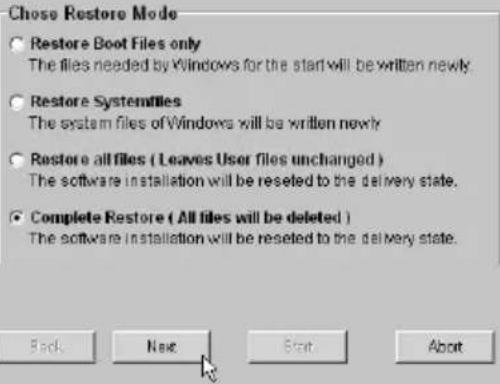
- If you have trouble starting Windows, first try the option Restore Boot Files Only.
- If you have problems with Windows system files that cannot be solved after executing the Windows System Restore, try the second option Restore System Files.
- If the computer still does not start after applying these procedures, try the third option Restore All Files (Leaves User Files Unchanged). Any user files will be kept as long as they have been saved into the pre-defined user folders.
- Only if this option also fails should you select the last item Complete Restore (All Files will be Deleted). Please note that this procedure will completely erase any data from your PC. Use this option to restore the factory-default software configuration.
Notebook
Important!
Please remember that launching this process will restore the factory default configuration of your computer. This will erase any data from your hard disk (under Windows labeled drive C:). If you don't want this, exit the Recovery software and backup your personal data first (e.g. on a CD-ROM or on the second partition (Install) of your hard disk).
- Launch the recovery process by clicking the Start button.
SystemRecovery powered by HDTRONIC
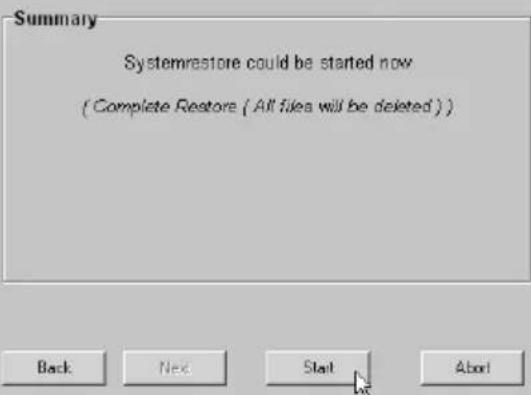
Notebook
- Click the OK button to confirm the warning message in the next window.
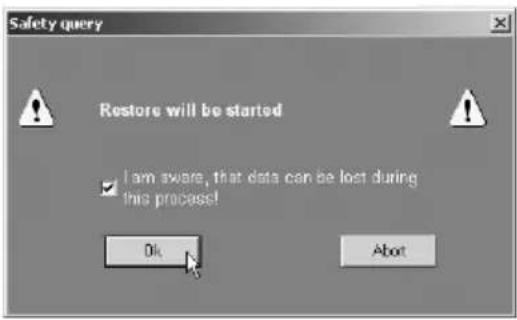
- The system recovery process starts. This process may take a while. You can monitor the completion status of the recovery in the progress bar.
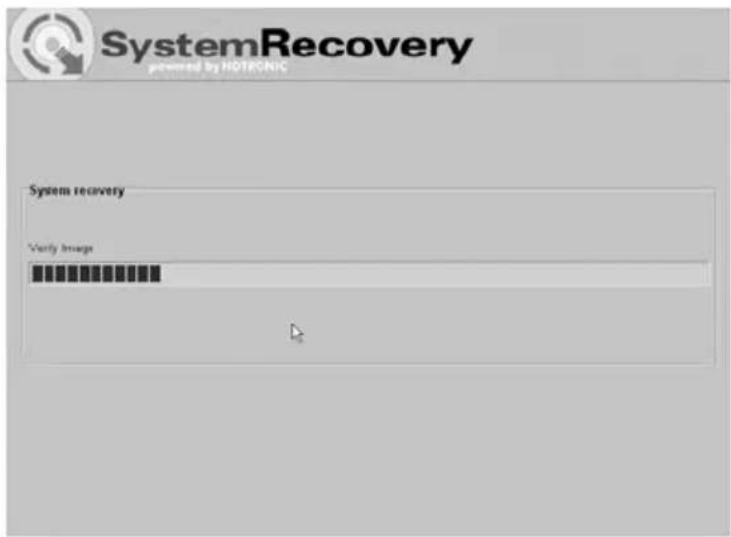
Important!
You must never turn off your computer while the recovery process is running. You must not interrupt the recovery process!
Notebook
- After the
recovery has
finished click
Restart Computer
to restart your
computer.
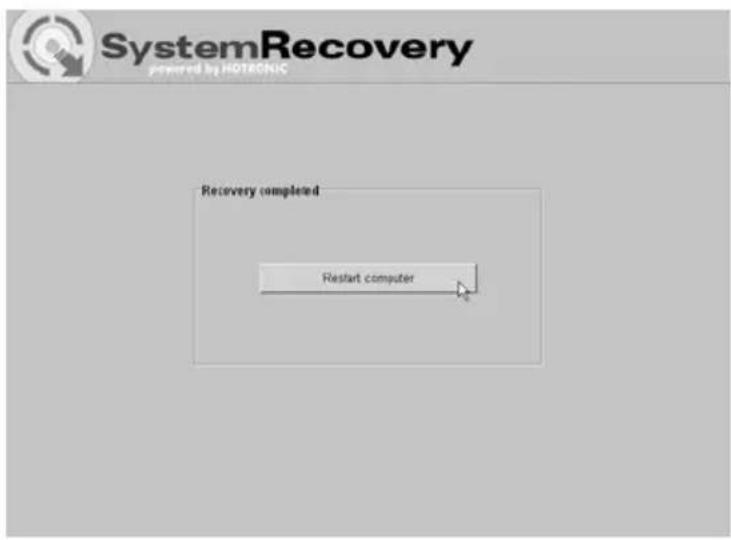
Notebook
Préface
Chapitre 1
West Point Business Park, Link Road
Ballincollig Co.Cork, Ireland
Table des matières
Préface
1. Lecteur de carte
1. Interface Carte Express
natural_image
Top-down schematic of a computer chassis showing internal components and ventilation slots (no text or labels)info
Attention
You can customize the pointing device to meet your personal needs. For example, if you are a left-hand user, you may want to swap the functions of the two buttons. In addition, you can change the size, shape, moving speed and other advanced features of the cursor on the screen.
To configure the touchpad, you can use the standard Microsoft or IBM PS/2 driver in your Windows operating system. The Mouse Properties in Control Panel allows you to change the configuration.
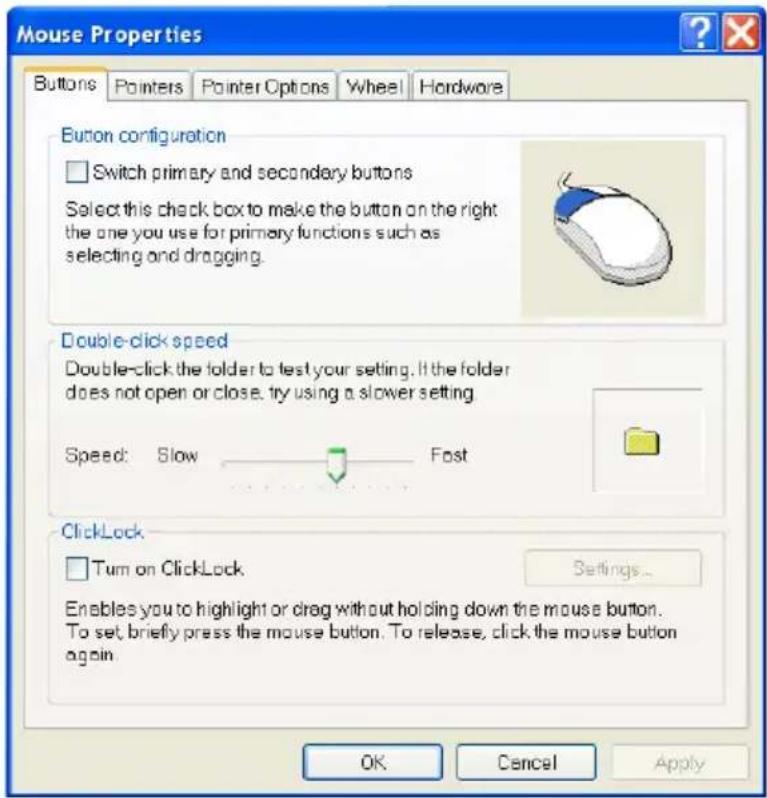
natural_image
Diagram of a CD drive with an open rear CD and a blue cable inserted into it, against a blue background (no text or symbols)Bouton Ouvrir
Retirer le disque
natural_image
Diagram of a printer or printer with a blue arrow pointing to its side panel (no text or symbols present)Retirer la carte PC
| BIOS SETUP UTILITY | ||||
| Main | Advanced | Boot | Security | Exit |
| Advanced Settings | ||||
| Primary IDE Master Secondary IDE Master USB Keyboard Legacy Support AMD PowerNow technology Legacy USB Support RTC Alarm Date (Days) RTC Alarm Time (HH:MM:SS) | [Hard Disk] [ATAPI CDROM] [Enabled] [Enabled] [Every Day] [22:25:00] | While entering setup. BIOS auto detects the presence of IDE devices. This displays the status of auto detection of IDE devices. ←→ Select Screen ↑↓ Select Item Enter Go to Sub Screen F1 General Help F10 Save and Exit ESC Exit | ||
| v02.58 (C) Copyright 1985-2004, American Megatrends, Inc. | ||||
Double-cliquez dessus.
(English) Under the European Union ("EU") Directive on Waste Electrical and Electronic Equipment, Directive 2002/96/EC, which takes effect on August 13, 2005, products of "electrical and electronic equipment" cannot be discarded as municipal waste anymore and manufacturers of covered electronic equipment will be obligated to take back such products at the end of their useful life.
West Point Business Park, Link Road
Ballincollig Co.Cork, Ireland
Inhoudsopgave
Voorwoord
Algemeen ....II
Accu correct laden....2-22
Basisbediening 2-24
Tips i.v.m veiligheid en comfort 2-24
1. Cardreader
1. Express Card-sleuf
1. Accu-grendelknop
Stroom afkoppelen
Accu vervangen
natural_image
Top-down schematic of a computer chassis showing internal components and ventilation slots (no text or labels)info
Waarschuwing
1. Cursorbewegingszone
Muiseigenschappen
natural_image
Diagram of a CD or DVD disc being inserted into a device, showing internal components and a blue pointer (no text or symbols)Eject-knop
Disk verwijderen
natural_image
Illustration of a device being inserted into a laptop, showing a blue arrow pointing to the internal component (no text or symbols present)Notebook
Dit notebook personaliseren
Voorwoord
Hoofdstuk 1
Inleiding
Hoofdstuk 2
De eerste stappen
Hoofdstuk 3
Dit notebook personaliseren
Hoofdstuk 4
BIOS-Setup
Hoofdstuk 5
Hoofdmenu
| BIOS SETUP UTILITY | |||
| Main Advanced Security Boot Exit | |||
| Market Name Model Name | Use [ENTER] to select a field. | ||
| System Time System Date | [18:08:53] [Wed 05/16/2007] | Use [+], [-] to configure system Date. | |
| Serial ATA Primary IDE Master | [Not Detected] [ATAPICDROM] | ||
| System Infomation | ←→ Select Screen ↓↑ Select Item +- Change Field Tab Select Field FI General Help F10 Save and Exit ESC Exit | ||
V02.59 (C) Copyright 1985-2005, American Megatrends, Inc.
♦ Systeemtijd
♦ Serial ATA / Primary IDE Master
PowerNow
♦ Legacy USB Support
♦ Configuratie bootinstellingen
| Main Advanced Security Boot Exit | |
| Exit & Save Changes Exit & Discard Changes Discard Changes Load Setup Defaults | Exit System setup after saving the changes. F10 key can be used for this operation. ↔ Select Screen ↓↑ Select Item +- Change Field Tab Select Field F1 General Help F10 Save and Exit ESC Exit |
| V02.59 (C)Copyright 1985-2005, American Megatrends, Inc. | |
SystemRecovery powered by HDTRONIC
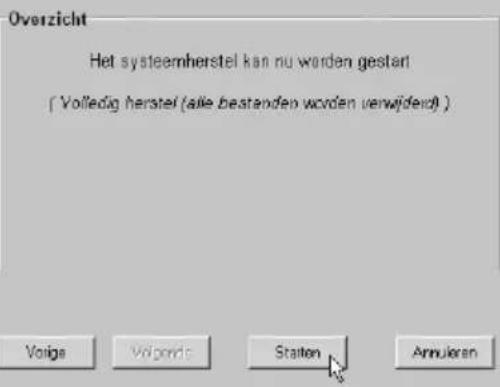
Belangrijk:
West Point Business Park, Link Road
Ballincollig Co.Cork, Ireland
Innhold
Forord
Generelt....II
Driftsforhold....II
Strømforsyning ....III
Kabler IV
Power management....2-13
AC adapter....2-13
Batteripakke....2-14
Main (Hovedmeny) 4-5
Advanced (Avansert meny)....4-7
Security (Sikkerhetsmeny) 4-9
Boot (Oppstartsmeny) 4-11
Exit-meny 4-12
1. Kortleser
Den innebygde kortleseren støtter MMC (Multi-media Card), SD (Secure Digital), MS (Memory Stick) og MS Pro (Memory Stick Pro) kort.
2. Audio portkonnektorer
1. Ekspresskort slisse
1. Batteripakke (visning bak)
Avbryte AC strøm
Skifte ut batteripakken
natural_image
Diagram of a computer chassis showing internal components and a blue arrow pointing to component 1 (no text or symbols present)info
Advarsel
1. Markørflyttingsområde
Musevirkninasvindu
Om harddiskdriveren
Den bærbare datamaskinen din har en 2.5-tommers harddiskdriver.
natural_image
Diagram of a computer drive with a CD inside, showing internal components and a blue cable (no text or symbols)Eject tast
Fjerne disken
natural_image
Illustration of a computer monitor with an open port and a blue arrow indicating action (no text or symbols)Ta ut PC-kortet
Forord
Kapittel 1
Introduksjon
Kapittel 2
Komme i gang
Kapittel 3
Tilpasse datamaskinen
Kapittel 4
BIOS setup
Kapittel 5
The screen snaps and setting options in this chapter are for your references only. The actual setting screens and options on your Notebook may be different because of BIOS update.
Kontrolltaster
Hovedmeny
| BIOS SETUP UTILITY | |||
| Main Advanced Security Boot Exit | |||
| Market Name Model Name System Time [18:08:53] System Date [Wed 05/16/2007] ► Serial ATA [Not Detected] ► Primary IDE Master [ATAPICDROM] ► System Infomation | Use [ENTER] to select a field. Use [+], [-] to configure system Date. ++ Select Screen ↓↑ Select Item +- Change Field Tab Select Field F1 General Help F10 Save and Exit ESC Exit | ||
| V02.59 (C) Copyright 1985-2005, American Megatrends, Inc. | |||
- Systemtid
PowerNow
About Supervisor Password and User Password
Supervisor Password allows the user to enter and change the settings of the setup menu; User Password only allows the user to enter the setup menu, but do not have the right to make changes.
Oppstartmeny
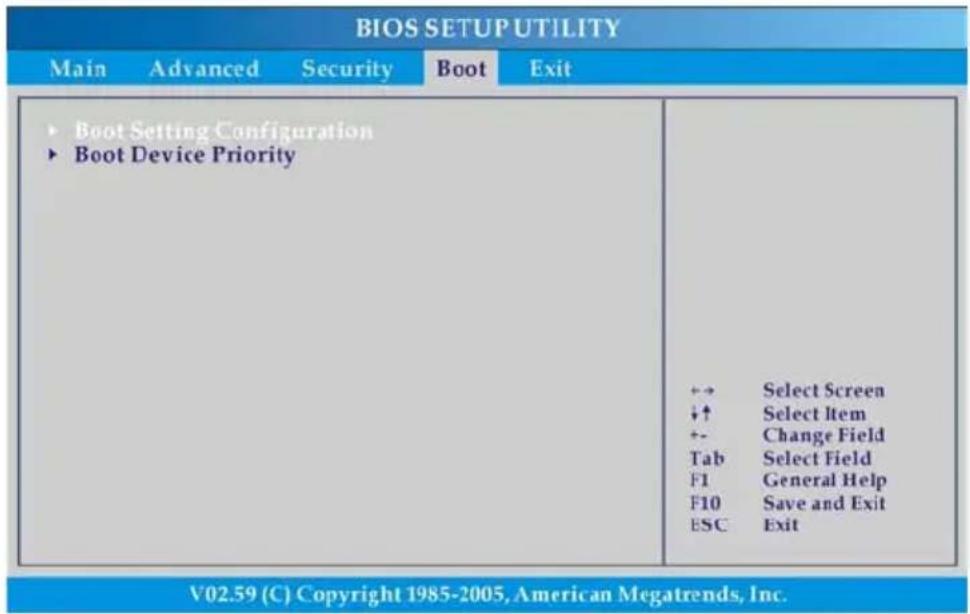
| Main Advanced Security Boot Exit | |
| Exit & Save Changes Exit & Discard Changes Discard Changes Load Setup Defaults | Exit System setup after saving the changes. F10 key can be used for this operation. ↔ Select Screen ↓↑ Select Item +- Change Field Tab Select Field F1 General Help F10 Save and Exit ESC Exit |
| V02.59 (C)Copyright 1985-2005, American Megatrends, Inc. | |
- Exit & lagre endringer
- Last setup standard
With this program you can set back the software installation of your system step-by-step into the delivery state. It is precondition that the Factory-Prepared-Recovery data is remaining on your hard disk.
Please consider that the data of the system partition (Drive C:) can be deleted by the restore-process.
If you don't want this, please exit this program now. Save your user data on a suitable media e.g. CD-ROM. After this start the process once more to put your system back into the delivery state.
There are four different methods of system-restore. These methods are explained in the following menu. You can phase the individual methods top down. After each step you

- Restore Boot Files only
The files needed by Windows for the start will be written newly.
Restore Systemfiles The system files of Windows will be written newly - Restore all files ( Leaves User files unchanged ) The software installation will be reseted to the delivery state.
- Complete Restore (All files will be deleted) The software installation will be reseted to the delivery state.

Notebook
Systemrestore could be started now
(Complete Restore (All files will be deleted))


- General Introductions
- Chapter 2
- Getting Started
- Chapter 3
- Customizing this Notebook
- Chapter 4
- BIOS Setup
- Chapter 5
- Troubleshooting, First Aid and FAQ
- Chapter 6
- Mandatory Activation
- Chapter 7
- Windows Media Center – Initial Setup
- Chapter 8
- System Recovery
- General
- Operating Environment
- Please ensure that:
- Power Supply
- Cables
- Maintenance and Care
- Disposal of Old Devices
- Children
- Intended Use
- Noise Abatement
- RF Interface
- CE Declaration of Conformity
- Safety Guideline for Using Lithium Battery
- Macrovision Notice
- WEEE Statement
- Table of Content
- Preface
- Introductions
- Connecting the External Devices ....3-2
- Express Card Installation 3-7
- Safely Remove Hardware....3-9
- About BIOS Setup....4-2
- BIOS Setup Menu....4-4
- Chapter 1
- How to Use This Manual
- Unpacking
- Product Overview
- Top-open View
- Keyboard
- Touchpad
- Card Reader
- Audio Port Connectors
- Right-side View
- Express Card Slot
- IEEE 1394
- S-Video Connector
- USB Port
- VGA Port
- Power Connector
- Left-side View
- RJ-45 Connector
- RJ-11 Connector
- Kensington Lock
- Optical Device Drive
- Rear View
- Battery Pack (Rear View)
- Ventilator
- Bottom View
- Battery Lock/Unlock Button
- Battery Release Button
- Battery Pack
- Power Management
- AC Adapter
- Connecting the AC Power
- Disconnecting the AC Power
- Battery Pack
- Releasing the Battery Pack
- Replacing the Battery Pack
- info
- Warning
- Using the Battery Pack
- Battery Safety Tips
- Conserving Battery Power
- Charging the Battery Pack Properly
- Basic Operations
- Safety and Comfort Tips
- Have a Good Work Habit
- Knowing the Keyboard
- Typewriter Keys
- Cursor Keys
- Numeric Keys
- Function Keys
- ■ Windows Keys
- ■ [Fn] Key
- Knowing the Touchpad
- Cursor Movement Area
- Right Button
- Left Button
- Using the Touchpad
- ■ Positioning and Moving
- ■ Point and Click
- ■ Drag and Drop
- ■ Configuring the Touchpad
- About Hard Disk Drive
- Using the Optical Device
- Inserting the Disk
- Removing the Disk
- Connecting the External Devices
- Connecting the Peripheral Devices
- Connecting the Mouse
- Connecting the Keyboard
- Connecting the Printer
- Connecting the External Monitor
- Connecting the IEEE 1394 devices
- Connecting the Communication Devices
- Using the LAN
- Using the Modem
- PC Card Installation
- Installing the PC card
- Removing the PC card
- Safely Remove Hardware
- About BIOS Setup
- When to Use BIOS Setup?
- How to Run BIOS Setup?
- Control Keys
- BIOS Setup Menu
- Main menu
- Advanced menu
- Security menu
- Boot menu
- Exit menu
- - System Time
- - System Date
- ♦ Serial ATA / Primary IDE Master
- - System Information
- PowerNow
- ♦ Legacy USB Support
- - PCI Latency Timer
- - Change Supervisor/User Password
- Enter New Password
- About Supervisor Password and User Password
- Notebook
- NOTE
- Troubleshooting
- FAQ – Frequently Asked Questions
- Where Can I Find Spare Parts and Accessories?
- Information About Drivers, FAQs and Manual
- How can I determine the exact capacity of the hard disk?
- Pixel errors on LCDs (notebook computers + monitors)
- BIOS updates for your notebook
- General Settings
- Optimizing the Screen Display
- Setting Up Loudspeakers
- Restoring the System by Using the System Recovery Software
- SystemRecovery
- Information for Recovery-Process
- Important!
- SystemRecovery powered by HDTRONIC
- Préface
- Chapitre 1
- Table des matières
- Lecteur de carte
- Interface Carte Express
- Attention
- Retirer le disque
- Retirer la carte PC
- Inhoudsopgave
- Voorwoord
- Basisbediening 2-24
- Cardreader
- Express Card-sleuf
- Accu-grendelknop
- Stroom afkoppelen
- Accu vervangen
- Waarschuwing
- Cursorbewegingszone
- Disk verwijderen
- Hoofdmenu
- ♦ Systeemtijd
- Belangrijk:
- Innhold
- Forord
- Power management....2-13
- Kortleser
- Audio portkonnektorer
- Ekspresskort slisse
- Batteripakke (visning bak)
- Avbryte AC strøm
- Skifte ut batteripakken
- Advarsel
- Markørflyttingsområde
- Om harddiskdriveren
- Fjerne disken
- Ta ut PC-kortet
- Kapittel 1
- Introduksjon
- Kapittel 2
- Komme i gang
- Kapittel 3
- Tilpasse datamaskinen
- Kapittel 4
- Kapittel 5
- Kontrolltaster
- Hovedmeny
- - Systemtid
- Oppstartmeny
Brand : TARGA
Model : Traveller 1561
Category : Laptop