MAG527 - Microwave Oven Pelgrim - Free user manual and instructions
Find the device manual for free MAG527 Pelgrim in PDF.


| Product type | Microwave oven |
| Brand | Pelgrim |
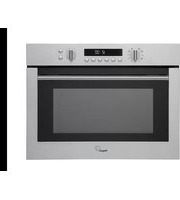
| Model | MAG527 (MAG527RVS) |
| Dimensions (W x D x H) | 595 x 345 x 388 mm (with frame) |
| Capacity | 20 liters |
| Turntable diameter | 245 mm |
| Power supply | 230 V~50 Hz |
| Connection power | 1250 W |
| Microwave power | 800 W (5 levels: 800, 620, 440, 260, 140 W) |
| Main functions | Microwave, automatic defrost, cooking (automatic programs) |
| Maintenance and cleaning | Clean the interior with a damp cloth after use; do not use abrasive products or metal scrapers; clean the door seals regularly |
| Safety | Door lock, child safety lock, mandatory grounding, anti-tip device |
| Compatible materials | Glass, Pyrex, heat-resistant ceramic, heat-resistant plastic, paper, cling film, cooking bags; no metal, aluminum trays, mercury thermometer, etc. |
| Spare parts available | Glass turntable, roller ring |
| General information | After-sales service via warranty card; manual available in several languages (FR, DE, EN, NL) |
Frequently Asked Questions - MAG527 Pelgrim
User questions about MAG527 Pelgrim
0 question about this device. Answer the ones you know or ask your own.
Ask a new question about this device
Download the instructions for your Microwave Oven in PDF format for free! Find your manual MAG527 - Pelgrim and take your electronic device back in hand. On this page are published all the documents necessary for the use of your device. MAG527 by Pelgrim.
USER MANUAL MAG527 Pelgrim
Instructions for use microwave
Pelgrim
70005937000
NL
Specifications techniques 16
Installation
| Your microwave | ||
| Introduction | 4 | |
| Description | 5 | |
| Safety | ||
| Materials | 6 | |
| Use | ||
| Before first use | 7 | |
| Operation | ||
| How does the microwave work 8 | ||
| Cooking | 9 | |
| Defrosting 10 | ||
| Cooking tips 10 | ||
| Maintenance | ||
| Cleaning | 14 | |
| Faults 15 | ||
| Technical data 16 | ||
| Installation | ||
| Electrical connection 17 | ||
| Installation dimensions 17 | ||
| Installing the anti-tilt bracket 18 | ||
| Installing the microwave 19 | ||
| Environmental aspects | ||
| Disposal of the appliance and packaging 20 | ||
Introduction
Cooking in your new microwave is safe and comfortable. It takes just a few moments to create the most delicious dishes. The automatic cooking and defrost programs help make the appliance simple to operate.
This manual contains information about your microwave's installation, safety, operation and maintenance.
First read the user instructions carefully and completely before starting to use the appliance, and keep them safely for future reference.
The manual also serves as reference material for service technicians. That is why you should stick the appliance identification card supplied in the space provided at the back of the manual. The appliance identification card contains all the information the service technician will need in order to respond appropriately to your needs and questions.
Happy cooking!
Description
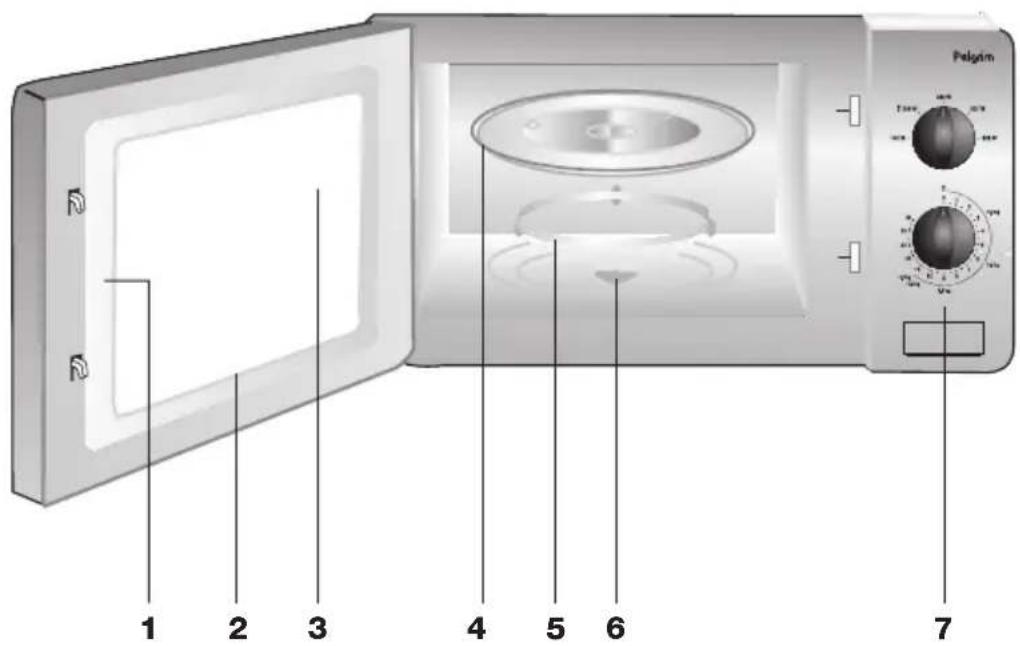

- Door lock
- Door
- Window
- Glass turntable
- Guiding ring
- Drive shaft
- Control panel
- Power settings button
- Timer/weight settings button
- Door release
The microwave may not be used without the guiding ring and turntable. The turntable should be fitted with the opening for the drive shaft facing downwards.

Read the separate safety instructions before use.
If the safety instructions and warnings are not followed, the manufacturer cannot be held responsible for any resulting damage.

If you decide to discontinue using the appliance because of a fault, we recommend you cut off the cable after removing the plug from the plug socket. Take the appliance to your municipality's waste disposal site.
Materials
Not all materials can be used in the microwave. The table below indicates which materials you can and cannot use.
| Material Microwave | |
| Paper yes* | |
| Aluminium foil yes** | |
| Cling film yes | |
| Aluminium trays no | |
| Heat-resistant plastic yes | |
| Unglazed pottery no | |
| Metal cooking utensils no | |
| Normal glass yes | |
| Pyrex, other oven-safe glass and ceramics yes | |
| Plates with metallic decorative edging no | |
| Metal closing strips no | |
| Mercury thermometer no | |
| Closed pot | no |
| Bottle with a narrow neck | no |
| Roasting bags | yes |
- Use non-decorated kitchen paper to cover a dish or place under bread during defrosting.
** By covering thinner areas of food (such as chicken legs) you prevent them from cooking too quickly.
Before first use
Never place cold (frozen) dishes directly on the glass turning plate. The difference in temperature could cause it to shatter!
- Open the door, remove the packaging and check the microwave for damage. Don't install the microwave if it is damaged, contact your supplier.
- Remove the protective film from the casing.
- Clean the oven interior and accessories with a damp cloth. Do not use any abrasive cleaner or strong-smelling cleaning products.
- Place the guiding ring in the middle of the oven interior. Place the turntable on the guiding ring with the opening for the drive shaft facing downwards. The microwave may not be used without the guiding ring and turntable.

Please note
The microwave may not be used without the guiding ring and turntable.
- Test whether the microwave is working correctly. Put a glass of water in the oven interior. Switch on the microwave to the highest setting for one minute (set to 800 Watts with the power settings button and 1 minute cooking time with the timer/weight settings button). Afterwards the water should be hot.
How does the microwave work
- A microwave is a cooking appliance that uses microwaves to heat foot. Microwaves are electromagnetic waves, just like radio and TV waves. A radio converts these waves to sound. In a microwave the waves are converted to heat.
- Heat is generated because the microwaves causes water and fat molecules, which are always present in food, to move rapidly. As a result the molecules rapidly rub against each other and cause friction. This friction causes heat (as also happens when you rub your hands together quickly).
- The microwave heats food very intensively, as the waves penetrate the food directly. Therefore, the waves do not only heat the outside of the food - as is the case with the traditional way of cooking - but penetrate to the core. Compared to the traditional way of cooking, the cooking time for small quantities of food is much shorter.
Microwave power
- This microwave has five power settings, the maximum power is 800 W. The power settings are listed in the table below:
| Setting Power Dish | |
| High 800 - Boiling water, warming up | - Cooking chicken, fish and vegetables |
| Medium high | 620 - Warming up - Cooking mushrooms and seafood - Cooking dishes containing egg and cheese |
| Medium 440 - Cooking rice and soup | |
| Medium low | 260 - Defrosting - Melting chocolate and butter |
| Low 140 - Defrosting delicate dishes | - Defrosting irregularly-formed dishes - Making ice-cream softer - Allowing dough to rise |
Cooking
- Warning! Heating liquids in the microwave can result in delayed boiling. This means that the liquid may start to boil furiously after it is removed from the microwave, with the risk of scalding. You can offset the delayed boiling effect by placing a plastic or glass spoon in the liquid prior to heating it in the microwave.
-
Warning! Take care with baby food:
-
Please note! Shake or stir the content of babies' bottles or pots of baby food after heating.
-
Please note! Check the temperature of the food carefully prior to consumption to prevent scalding injuries.
-
Warning! Cutlery and tableware may become hot after using the microwave.
-
Open the door. Then place the dish on the turntable. Close the door.
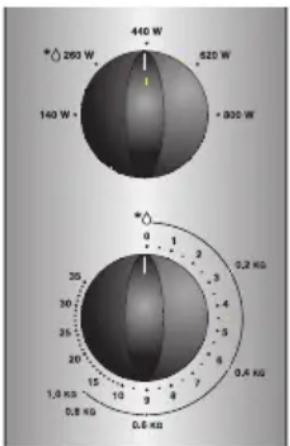
- Use the power settings button to set the desired power. Depending on the kind of food, choose a higher or lower power (see the microwave power table).
- Set the desired cooking time using the timer/weight settings button.
The microwave switches on. At the end of the cooking time a signal will sound and the oven light switches off. The microwave switches off.
Please note: The appliance switches on as soon as you turn the timer/weight setting button beyond the 0-position.
Tips
- First turn the timer/weight settings button a little further than the desired cooking time and then back to the correct cooking time for accurate setting.
- Check the food during the cooking time. Press the release button to open the door. The microwave switches off. The settings and the remaining cooking time are saved. If you close the door, the microwave switches on again.
Defrosting
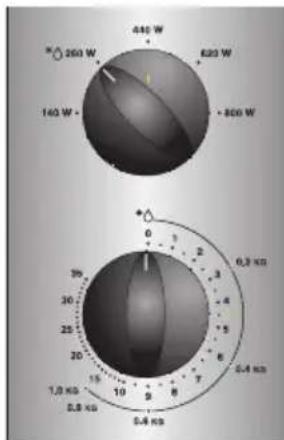
You can easily and safely defrost food in the microwave. Defrosting in the microwaves takes more time compared to cooking. Check the food during defrosting. Turn it at least once and remove (if possible) food that is already defrosted.
- Set the power settings button to defrost.
- Set the timer/weight settings button to the correct weight. At the end of defrosting a signal will sound and the oven light switches off.
Please note: The appliance switches on as soon as you turn the timer/weight setting button beyond the 0-position.
Cooking tips
Warming up and cooking
- The microwave always heats with the same intensity. The more you place in the microwave, the longer the cooking time.
- Flat, level dishes heat up more quickly than narrow, tall dishes.
-
Covering dishes with microwave film or a fitting lid prevents spattering, reduces cooking time and helps retain moisture levels. After cooking remove the foil or lid carefully.
-
Please note! The steam released can be extremely hot!
-
Dishes that dry out quickly can be moistened. Place potatoes and vegetables in cold water briefly before you place them in the microwave. This prevents a skin forming.
- For an even result it is best to stir or turn a dish a few times.
- For warming up dishes which have already been cooked, always use the highest microwave setting.
- You don't need much water, salt or herbs for the cooking. Salt is best added after cooking. This prevents moisture from being withdrawn from the food.
After the microwave is switched off, the dish continues cooking for a short time. Take this into account and don't heat up the dish for too long. - Please note! When heating small quantities of powdery products (such as when drying herbs), always place a small cup of water in the microwave. Self-combustion is possible if small quantities are heated.
Defrosting
- Always use the defrost program to defrost large compact items. Because the dish is defrosted gradually and evenly, you don't run the risk that the outside dries out while the core is still frozen.
- To accelerate the defrosting process, it is advised to separate the item into sections after a certain amount of time.
- For large pieces of meat and compact dishes, have two breaks in the process.
- When defrosting an irregularly-formed dish you can cover thin areas halfway through the defrosting process or wrap them with aluminium foil.
Factors that influence the cooking process
- The temperature of the ingredients influences the cooking time. A cold meal needs more cooking time than a meal at room temperature.
Lighter, porous dishes cook faster than heavier and solid dishes, such as stews or rolled meats. Take care in cooking light, porous dishes.
The edges will quickly become dry and tough.
- Smaller dishes are warmed more evenly if you place them in the microwave separate from each other, preferably in a circle.
- Bones and fat conduct heat better than meat. Aluminium foil blocks the microwaves. By covering thinner areas of dishes (such as chicken legs and wings) you prevent them from cooking too quickly.
- Microwaves penetrate approximately 3cm into the food. The core of denser dishes will be heated when the heat of the heated section (the outside) spreads to the inside.
- Meat and poultry that are cooked for longer than around 15 minutes in the microwave, will become slightly brown. If dishes are to be cooked for a shorter period of time, first rub in a 'browning' sauce, such as Worcestershire sauce, soy sauce or barbecue sauce.
- Grease-proof paper prevents spattering and helps retain the heat.
Basic techniques
Positioning
Place thicker pieces on the outside of the turntable. Dishes placed on the outside of the turntable receive the most microwaves.
Stirring
Stirring dishes regularly distributes the stored heat. Always stir from the outside in, since the outside of the dish always heats up first.
Turning over
Large, thick dishes should be turned over regularly. They then cook more evenly and quickly.
Piercing
Food with a skin or shell bursts open in the microwave, such as egg yolks, seafood and fruit. Prevent this by pricking it before cooking a few times with a fork or satay stick.
Checking
Dishes cook quickly. That's why you should check them regularly. Take them out of the microwave just before they're ready.
Continued cooking
In general, allow dishes to stand covered for 3 to 10 minutes after removing them from the microwave. The dishes continue to cook. Don't cover dishes with a dry crust, such as cake.
Freezing
When freezing food you should take defrosting in the microwave into account, by not using aluminium foil or trays and by freezing in flat portions.
Cooking vegetables
- If possible, always use fresh vegetables. If vegetables have become a little limp because they've been left for too long, you can place them in cold water for a while so that they absorb moisture.
- Use a large dish to cook vegetables, so that the layer covering the dish base is not too thick.
- Do not add any more water to vegetables than that remaining after rinsing.
Always cover the dish with a lid or microwave film.
-
Do not add salt. The salts present naturally in the vegetables should give sufficient flavour. If you still wish to add salt, you can do this after cooking.
-
Cook vegetables for the shortest time possible. Take into account the fact that the vegetables will continue to cook.
-
Check with a satay stick or fork whether the vegetables are ready.
Cooking fish
Fish needs to cook gradually. For thin fish, oily fish or small portions set the power to 260 Watts. In other cases you can set the power somewhat higher. Take continued cooking into account. Fish is ready when the flesh becomes opaque.
Cleaning

- DO NOT USE any abrasive cleaners or metal scrapers to clean the glass door. This will scratch the surface which may cause the glass to break.
- DO NOT USE high pressure cleaners or steam cleaners to clean the microwave.
- Clean the interior directly after use. Use a damp cloth to remove condensation, boiled over liquid and food remnants. Remnants of crumbs and moisture absorb microwave energy and increase cooking time.
- Clean the interior and outer casing regularly; use some washing-up liquid and water and dry the microwave well with a dry cloth.
- Ensure that the cover of the microwave distributor is clean. Dirt in the cover can lead to spark formation.
- Clean the accessories regularly; use some washing-up liquid and water with a brush and dry the accessories well with a dry cloth. The accessories may also be washed in the dishwasher.
- Smells will disappear if you place a glass of vinegar or water with lemon in the microwave area. Switch the microwave on at full power for two minutes. Then rub down with a damp cloth.
- Check the door closure and the door rubber regularly for damage. Do not use the microwave if the door or door closure is damaged.
- If the seal of the microwave is very dirty, the door won't close properly. The front of adjacent furniture can become damaged. Keep the seal clean.
- Salt is extremely aggressive. When this is deposited in the oven interior, rust patches can be created.
- Spicy sauces such as ketchup and mustard or salty dishes such as salted meat contain ingredients that can erode the surface. After use, you should always clean the oven interior.
If you are uncertain about whether your appliance is functioning properly, this does not automatically mean there is a defect. Try to deal with the problem yourself first by checking the points mentioned below: If the recommendations below do not solve your problem, call our service department.
Is the plug in the socket?
Is the door closed properly?
- Is the fuse in the fuse box faulty?
- Are the power settings and times set properly?
- Are there objects in the microwave that shouldn't be there?
- Did you use the correct kitchen utensils?
- Are the ventilation openings blocked?
- Has the food been defrosted sufficiently?
- Did you turn over or stir the food during preparation?
Is the child lock activated?
Sparks in the microwave
If you see sparks in the microwave, turn the microwave off immediately. Sparks can be caused by:
- metal or aluminium foil that touches the interior of the microwave;
- aluminium foil that is not correctly covering the food (points that stick up act as an antenna);
- metal from a closing strip or tableware with metallic edges;
recycled paper that contains small metal particles.
The data plate indicates the total nominal load, the required voltage and the frequency.
This appliance meets all relevant CE guidelines.
| Type MAG527RVS | |
| Appliance dimensions (w x d x h) | 595 x 345 x 388 (incl. frame) |
| Connection 230V~50Hz | |
| Connected load | 1250 W |
| Microwave power 800 W | |
| Volume 20 litres | |
| Diameter of turntable | 245 mm |
Electrical connection

For this appliance a mains supply of 230V, 50 Hz AC is needed. The appliance has a mains lead with an earthed plug.
Please note! For safe use it is necessary that the appliance is correctly earthed. Never connect the appliance to DC. Incorrect use can cause electric shocks.
Installation dimensions
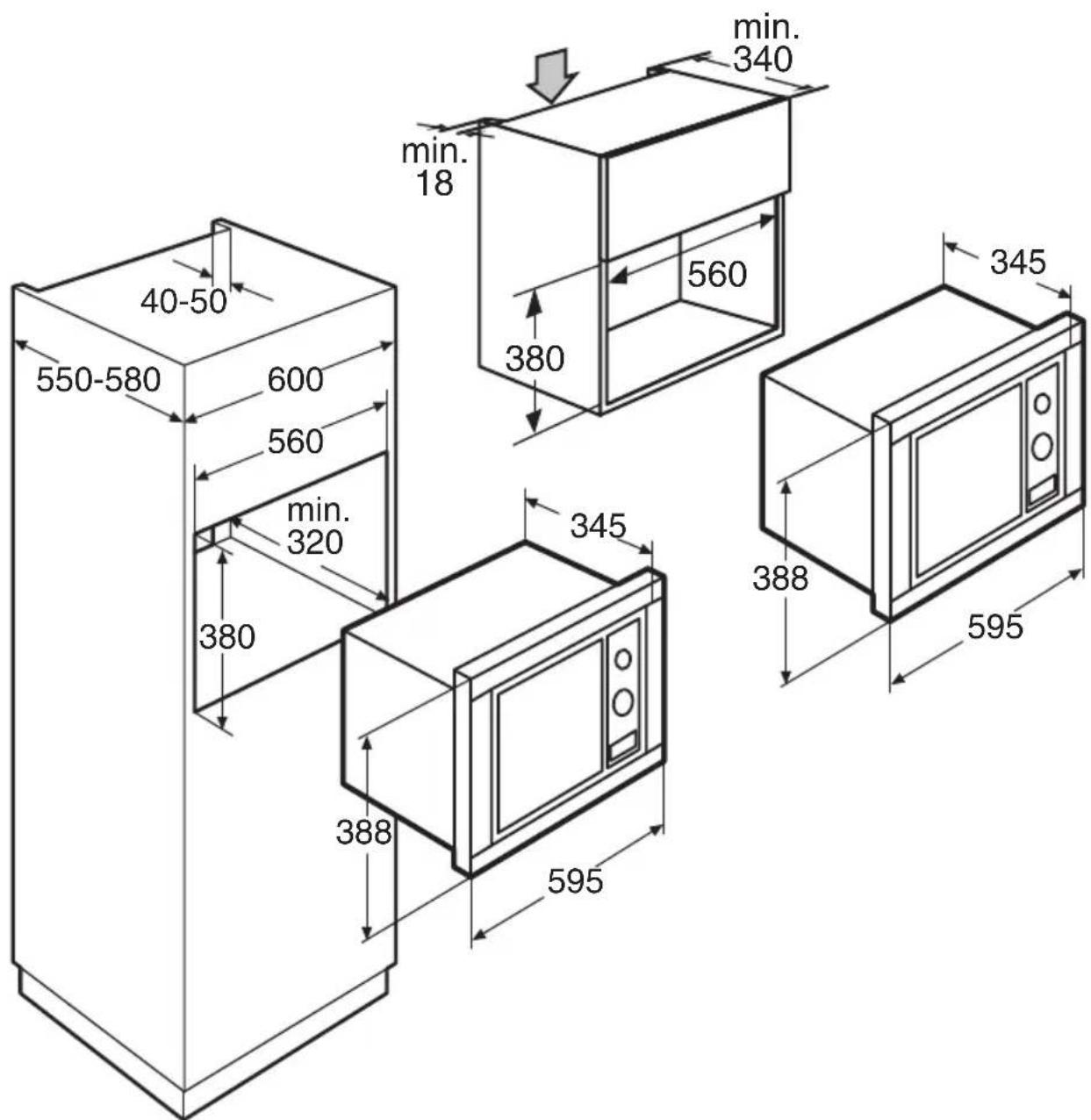
Installing the anti-tilt bracket
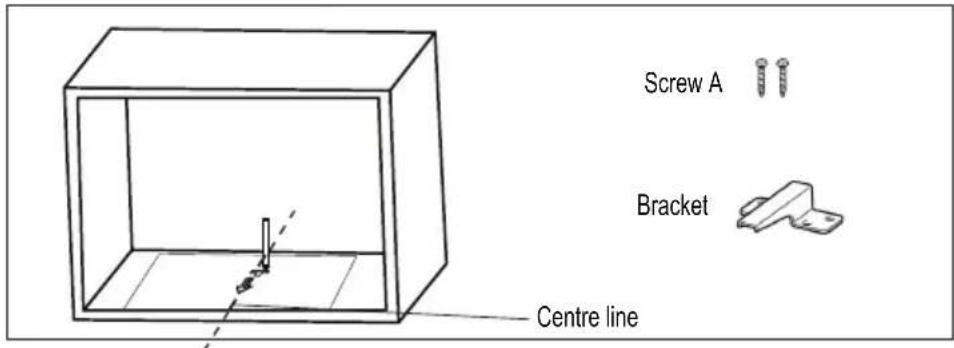
Please note: first install the anti-tilt bracket at the back of the cupboard (see drawing). This bracket prevents the microwave from tilting forwards.
- Please note: read the instructions on the supplied template.
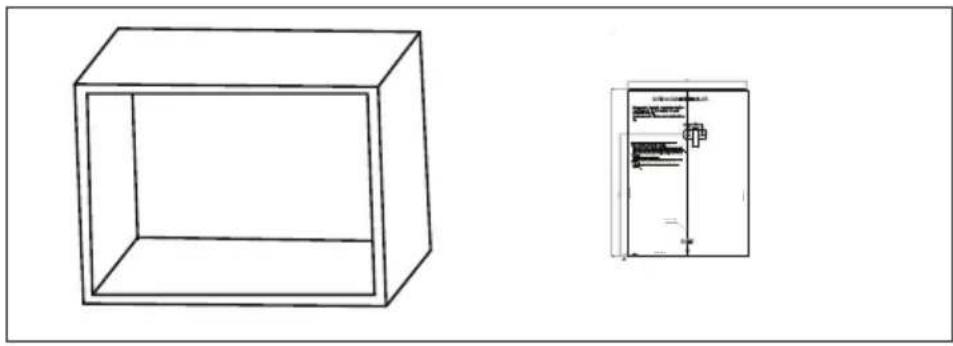
- Use the template to determine the position of the bracket.
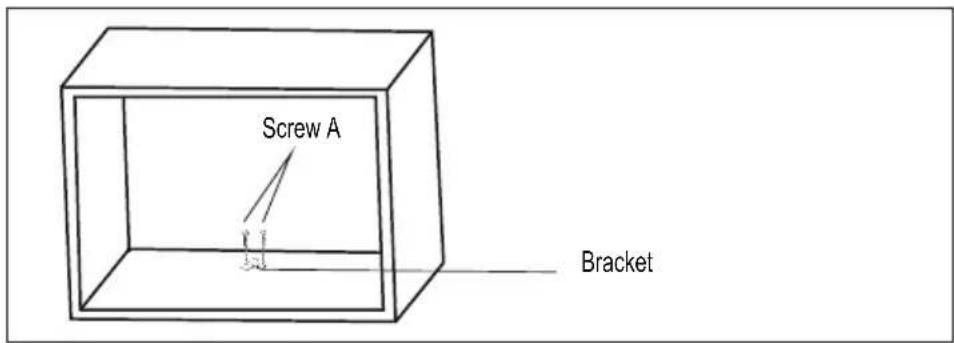
- Screw the bracket in the cupboard.
Installing the microwave
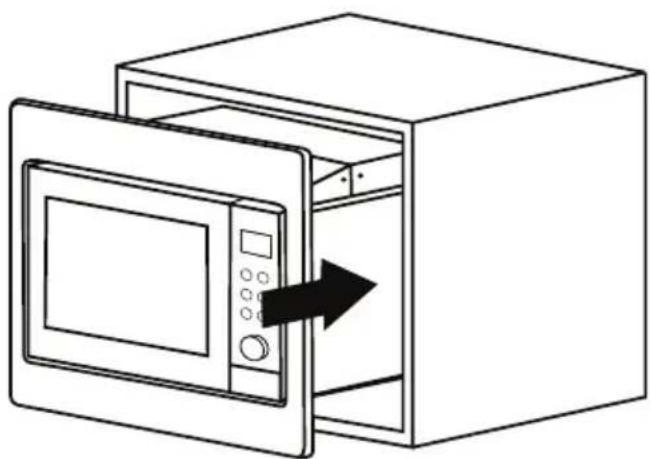
- Push the microwave all the way into the cupboard and ensure the microwave is positioned in the centre.
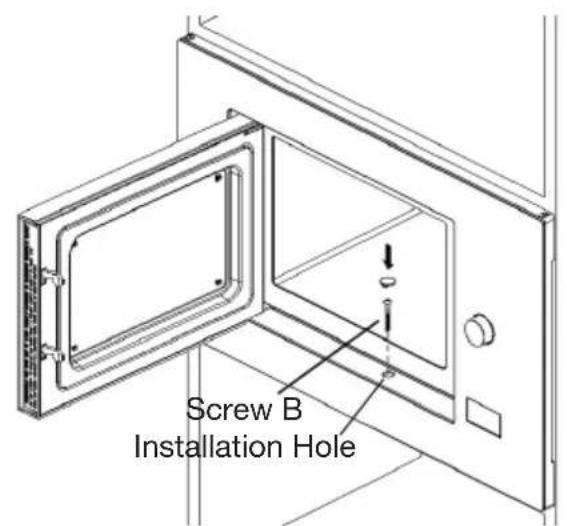
- Open the door and attach the microwave (with the supplied screw). Finally, place the cover cap over the screw.
Disposal of the appliance and packaging
Sustainable materials have been used during manufacture of this appliance. This appliance must be disposed of responsibly at the end of its service life. The government can provide you with information about this.
The appliance packaging is recyclable. The following materials may have been used:
cardboard;
polyethylene film (PE);
CFC-free polystyrene (PS hard foam).
You should dispose of these materials responsibly and in accordance with government regulations.
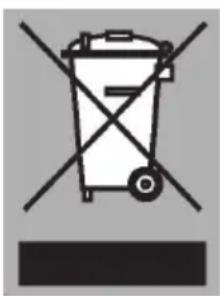
The product has been marked with a crossed-out dustbin symbol to remind you of the obligation to dispose of electrical household appliances separately. This means that the appliance may not be included with normal domestic refuse at the end of its service life. The appliance must be taken to a special municipal centre for separated waste collection or to a dealer providing this service.
Separate processing of household appliances helps to prevent any potential negative impact on the environment and on health caused by improper disposal. It ensures that the materials of which the appliance is composed can be recovered to obtain significant savings in energy and raw materials.
Declaration of Conformity
We hereby declare that our products satisfy the applicable European Directives, Orders and Regulations, as well as the requirements stated in the referenced standards.


- Specifications techniques 16
- Installation
- Introduction
- Description
- Read the separate safety instructions before use.
- Materials
- Before first use
- Never place cold (frozen) dishes directly on the glass turning plate. The difference in temperature could cause it to shatter!
- Please note
- How does the microwave work
- Microwave power
- Cooking
- Tips
- Defrosting
- Cooking tips
- Warming up and cooking
- Factors that influence the cooking process
- Basic techniques
- Positioning
- Stirring
- Turning over
- Piercing
- Checking
- Continued cooking
- Freezing
- Cooking vegetables
- Cooking fish
- Cleaning
- Sparks in the microwave
- Electrical connection
- Installation dimensions
- Installing the anti-tilt bracket
- Installing the microwave
- Disposal of the appliance and packaging
- Declaration of Conformity
Brand : Pelgrim
Model : MAG527
Category : Microwave Oven