ManualGo.com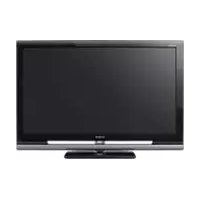
Bravia KDL42V4100 - Téléviseur SONY - Free user manual and instructions
Find the device manual for free Bravia KDL42V4100 SONY in PDF.


Download the instructions for your Téléviseur in PDF format for free! Find your manual Bravia KDL42V4100 - SONY and take your electronic device back in hand. On this page are published all the documents necessary for the use of your device. Bravia KDL42V4100 by SONY.
USER MANUAL Bravia KDL42V4100 SONY
Safety and Regulatory Booklet
Safety and Regulatory Booklet _____________________
Read and understand the contents of this booklet before operating
© 2010 Sony Corporation
US Safety and Regulatory Booklet
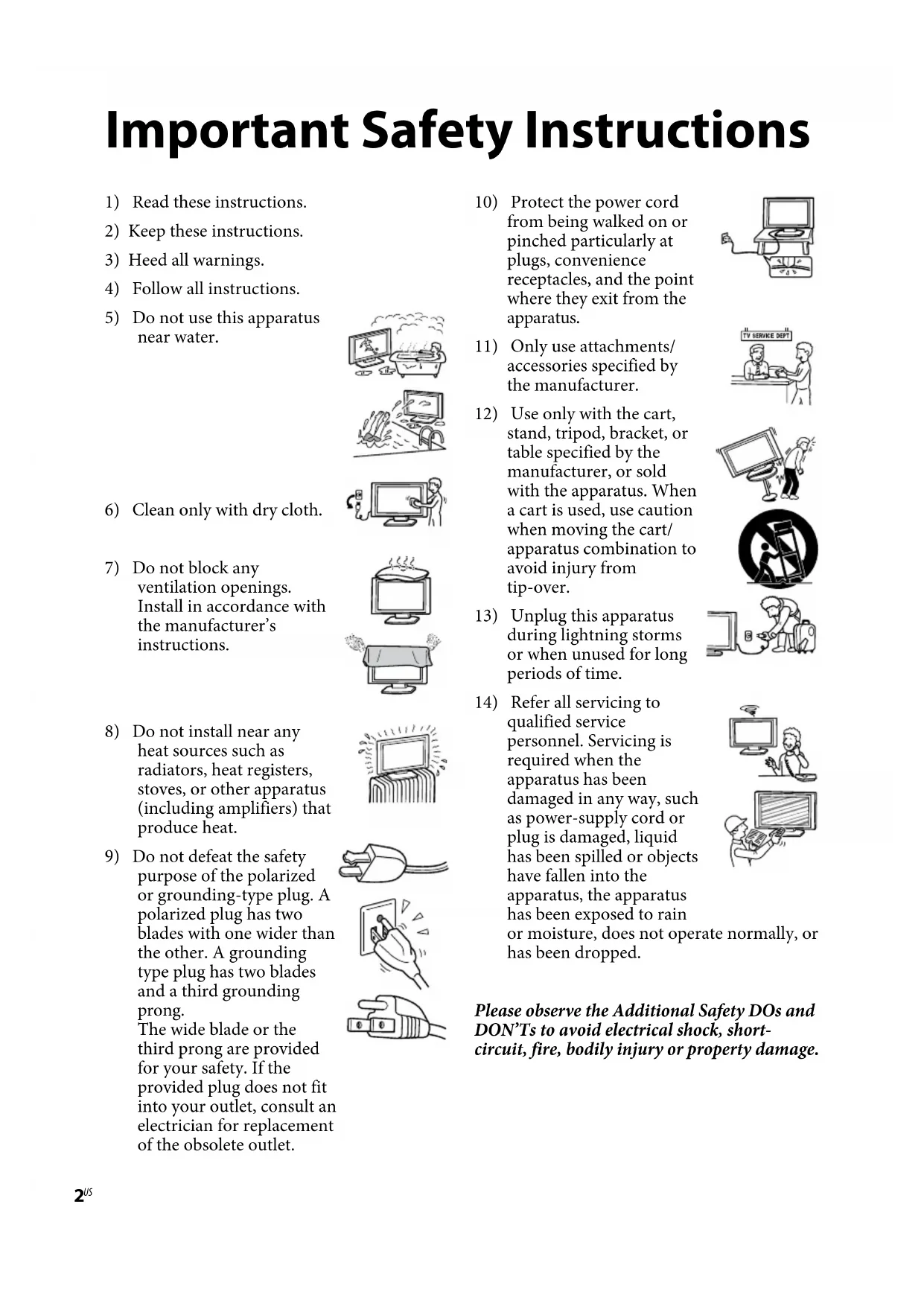
Important Safety Instructions
1) Read these instructions.
2) Keep these instructions.
3) Heed all warnings.
4) Follow all instructions.
5) Do not use this apparatus
6) Clean only with dry cloth.
ventilation openings.
Install in accordance with
8) Do not install near any
heat sources such as
radiators, heat registers,
stoves, or other apparatus
(including amplifiers) that
9) Do not defeat the safety
purpose of the polarized
or grounding-type plug. A
polarized plug has two
blades with one wider than
the other. A grounding
type plug has two blades
and a third grounding
The wide blade or the
third prong are provided
for your safety. If the
provided plug does not fit
into your outlet, consult an
electrician for replacement
of the obsolete outlet.
10) Protect the power cord
from being walked on or
pinched particularly at
receptacles, and the point
where they exit from the
11) Only use attachments/
accessories specified by
12) Use only with the cart,
stand, tripod, bracket, or
table specified by the
manufacturer, or sold
with the apparatus. When
a cart is used, use caution
when moving the cart/
apparatus combination to
during lightning storms
or when unused for long
14) Refer all servicing to
personnel. Servicing is
damaged in any way, such
as power-supply cord or
plug is damaged, liquid
has been spilled or objects
have fallen into the
apparatus, the apparatus
has been exposed to rain
or moisture, does not operate normally, or
Please observe the Additional Safety DOs and
DON’Ts to avoid electrical shock, short-
circuit, fire, bodily injury or property damage.3
US Safety and Regulatory Booklet4-191-241-05(1)
WARNING To reduce the risk of fire or electric shock, do
not expose this product to rain or moisture.
The product must never be exposed to
dripping, splashing, or spilling liquids of any
CAUTION RISK OF ELECTRIC SHOCKDO NOT OPEN ATTENTION RISQUE DE CHOC ÉLECTRIQUE,NE PAS OUVRIR PRECAUCION RIESGO DE CHOQUE ELECTRICONO ABRIR This symbol is intended to alert
the user to the presence of
uninsulated “dangerous voltage”
within the product enclosure that
may be of sufficient magnitude to
constitute a risk of electric shock
This symbol is intended to alert
the user to the presence of
important operating and
maintenance (servicing)
instructions in the literature
accompanying the product.
Danger of explosion if battery is
incorrectly replaced. Replace only
with the same or equivalent type.
Outdoor Antenna Grounding Antenna lead-in wireAntenna discharge unit (NEC Section 810-20)Grounding conductors (NEC section 810-21)Ground clampsPower service grounding electrode system (NEC Art 250 Part H)NEC: National Electrical Code Ground clampsElectrical service equipment Additional Safety DOs
☐ Do not place liquid filled objects such as a
vase or potted plant on the TV.
☐ Do not use a power line
operated TV set near water;
for example, near a bathtub,
washbowl, kitchen sink,
laundry tub, wet basement or
near a swimming pool, etc.
☐ Do not install the TV in a
location where sulfur is
present (e.g., hot springs).
This may cause a fire, electric shock or
CLEANING When cleaning, be sure to unplug the power
cord to avoid any chance of electric shock.
☐ Clean the cabinet of the TV with
☐ Wipe the LCD screen gently
☐ Stubborn stains may be removed with a
cloth slightly moistened with a solution of
mild soap and warm water.
☐ Do not spray water or detergent directly on
the TV set. It may drip to the bottom of the
screen or exterior parts, and may cause a
☐ If using a chemically pretreated cloth, please
follow the instruction provided on the
☐ Never use strong solvents such as a thinner,
alcohol or benzine for cleaning.
☐ Periodic vacuuming of the ventilation
openings is recommended to ensure to
VENTILATION The ventilation openings in the TV are
necessary to ensure reliable operation of the
TV and to protect it from overheating.
☐ Do not block or cover the
ventilation openings with
cloth or other materials.
☐ Never place the TV on a bed,
sofa, rug or other similar
surface where ventilation
openings may be blocked.
US Safety and Regulatory Booklet
☐ Unless proper ventilation is provided, the
TV may accumulate dust and cause damage.
☐ Never allow liquid or solid
objects to fall into the
ventilation openings.
☐ If any liquid or solid object falls
inside the TV, unplug the TV
immediately and have it
checked by qualified service personnel
before operating it further.
☐ Never push objects of any kind into the TV
through the ventilation openings as they
may come in contact with dangerous voltage
points or short out parts that could result in
a fire or an electric shock.
Allow adequate space around the TV set to
ensure proper air circulation.
☐ Never place the TV in a
confined space, such as a
bookcase or built-in cabinet,
unless proper ventilation is
☐ There should be a clearance of at least 11
7/8 inches (30 cm) above the TV set and 4
inches (10 cm) on each side. If mounted on
the wall, allow at least 4 inches (10 cm) of
clearance at the bottom of the screen. (See
additional information provided in the
Operating Instructions manual.)
INSTALLATION The TV should be installed near an easily
accessible AC power outlet.
☐ Do not install the TV face up or down,
upside down or on its side.
☐ Do not install the TV in hot,
humid, excessively dusty
places or in areas with oily
smoke or steam (e.g., near a
stove or humidifier). Fire, electric shock, or
☐ Do not install the TV in places
subject to extreme temperature,
such as in direct sunlight, near
a radiator or a heating vent.
The TV may overheat in such
conditions which can cause
deformation of the enclosure
and/or TV malfunction.
☐ Do not install the TV in a place
exposed to direct air
conditioning; moisture may
condense inside and may cause
☐ Do not install the TV where it may be
exposed to mechanical vibration.
☐ Do not install the TV where insects may
☐ Do not install the TV so that
it protrudes into an open
space. Injury or damage may
result from a person or object
bumping into the TV.
☐ To prevent fire keep
flammable objects or open flame (e.g.
candles) away from the TV.
☐ Do not place optional equipment on top of
Prevent the TV from toppling over
Take measures to prevent the TV
from toppling over and causing
injury or damage to the TV and
☐ Secure the TV to a wall and/or stand.
☐ Never install the TV on unstable and/or
☐ Do not allow children to climb on or play
with furniture and TV sets.
☐ Do not install the TV on furniture that can
easily be used as steps, such as a chest of
☐ Care should be taken to install the TV
where it cannot be pushed, pulled over, or
☐ Care should be taken to route all AC power
cords and connecting cables so that they
cannot be pulled or grabbed by curious
Medical institutions
Do not place this TV in a place
where medical equipment is in
use. It may cause a medical
equipment malfunction.
Do not install this TV outdoors. The TV
should not be exposed to rain or direct
sunlight in order to avoid damage and possible
fire or electric shock.
Do not install this TV in a vehicle, ship
☐ Excessive bumping motion of
continuous swaying motion on
a boat may cause the TV to fall
down and cause injury.
☐ Exposing the TV to seawater
may cause a fire, electric shock
or damage to your TV.5
US Safety and Regulatory Booklet
☐ This TV contains a strong magnet in the
speaker unit that generates a magnetic field.
Keep any items susceptible to magnetic
fields away from the speaker.
☐ Electro-magnetic radiation emitted from
optional equipment installed too close to
the TV may cause picture distortion and/or
☐ Wall-mount installation
requires the use of a
Wall-Mount Bracket. When
installing or removing the TV
and the Wall-Mount Bracket, be sure to use
qualified contractors. If not properly
secured during installation or removal from
the Wall-Mount Bracket, the TV may fall
and cause serious injury.
☐ Be sure to follow the installation guide
supplied with the Wall-Mount Bracket when
☐ Be sure to attach the brackets with the
specified parts supplied with the
☐ Do not hang the TV from the ceiling. It may
fall and cause serious injury.
☐ Do not hang anything on the TV.
☐ Do not allow children to climb
☐ Do not touch the AC power cord
and its plug with wet hands as it
may cause electric shock.
☐ When disconnecting the AC
power cord, grasp the plug and
disconnect from the wall outlet
first. Do not pull by the cord.
☐ Keep the power cord away from
A TV set with a three-wire grounding type AC
power cord plug must be connected to an AC
power outlet with a protective earthing
connection (only applicable for Class I
☐ Do not convert or damage the AC power
☐ Consult your electrician to have the outlet
changed to suit your TV.
Subjecting the AC power cord to wear and/or
abuse can damage the AC power cord and
☐ Do not place the TV where the power cord
can be easily pinched, bent, twisted, or catch
☐ Do not allow anything to rest on or roll over
☐ Before connecting cables, be sure to unplug
the AC power cord for your safety.
☐ Do not move the TV with the AC power
cord (or other cables such as audio and
☐ Use only an original Sony AC power cord
with your TV; no brand substitution is
☐ Do not use AC power cord supplied with
the TV with any other equipment.
☐ Never use a damaged AC
power cord. A damaged AC
power cord can cause a
short-circuit, which may result
in a fire or electric shock.
Do not use a damaged or poorly
fitting AC power outlet as your
☐ Insert the plug fully into the
outlet. If it is loose, it may cause
arcing and result in a fire.
☐ Do not overload the same AC
Unplugging the AC power cord from the wall
outlet will completely remove power from the
☐ During lightning storms or
unattended and unused for
extended periods of time,
the AC power cord should
be unplugged from the wall
outlet. This will avoid
possible damage to your TV.
Also unplug the antenna to prevent damage
☐ For energy conservation and safety reasons,
practice unplugging the AC power cord
from the AC power outlet.6
US Safety and Regulatory Booklet
Clean the AC power plug
Unplug the AC power plug
and clean it occasionally to
avoid dust from accumulating.
While cleaning, look for signs
of damage. A damaged AC power cord should
ACCESSORIES Keep small accessories out of children’s reach.
Use only the specified accessories with this TV.
☐ When using headphones,
adjust the volume to avoid
excessive audio levels from
causing possible hearing loss.
BATTERIES Your remote control batteries are consumables.
☐ Dispose of batteries in an environmentally
friendly way. Certain regions may regulate
the disposal of batteries. Please consult your
☐ Do not dispose of batteries in a fire.
☐ Do not short-circuit, disassemble or
overheat the batteries.
☐ Batteries must not be exposed to excessive
heat such as sunshine, fire or the like.
☐ Although the LCD screen is made with
high-precision technology and has effective
pixels of 99.99% or more, black dots or
bright points of light (red, blue, or green)
may appear constantly on the LCD screen.
This is a structural property of the LCD
panel and is not a malfunction.
☐ The LCD screen is made with
high-precision technology and to achieve a
high level of performance and picture
quality, this TV’s backlight setting is set to
maximize the brightness of the TV.
However, uneven brightness may be
observed when the LCD TV is viewed in a
dark ambient without an input source or
with a blank screen. This condition is
normal and not a malfunction of the TV.
Changing the Picture mode, Backlight
setting, enabling the Light Sensor (if
applicable), or turning on the Power
Management will improve this condition.
☐ To avoid damaging the LCD panel, do not
expose the LCD screen to direct sunlight.
☐ Do not push or scratch the LCD screen, or
place objects on top of the TV. The images
may be uneven or the LCD panel may be
☐ If the TV is used in a cold place, the picture
may smear or become dark. This does not
indicate a failure. These phenomena
improve as the temperature rises.
☐ Ghosting may occur when still pictures are
displayed continuously. It should disappear
after a few moments.
☐ The LCD screen and enclosure get warm
when the TV is in use. This is not a
☐ Avoid spraying insect repellent with volatile
material on the LCD screen.
☐ Avoid prolonged contact with rubber or
plastic material to the LCD screen.
Do not throw anything at the
LCD screen and its edges as the
impact can cause the LCD screen
glass to crack, break or shatter.
☐ If damage occurs to the LCD
panel, small traces of liquid crystal
sandwiched between the glass may be found
on scattered broken glass.
☐ Do not touch the broken glass with bare
hands. As with any broken glass pieces,
avoid skin contact and exposure to your
eyes or mouth. Avoid direct contact with
liquid or damp surfaces of the glass as these
may have an adverse effect on some people.
The contacted area should be rinsed
thoroughly with water. If conditions persist,
☐ If the surface of the TV cracks, do not touch
the TV until you have unplugged the AC
power cord. Otherwise electric shock may
US Safety and Regulatory Booklet
SERVICING Do not use the TV if you
suspect the TV is damaged
or if the TV is damaged.
☐ Do not attempt to service
the TV yourself since
opening the cabinet may
expose you to dangerous
voltage levels or other
servicing to qualified service personnel.
☐ If replacement parts are
required, acquire a written
certification from the service
technician which states that
adequate replacement parts with
the same or similar characteristics as the
original parts have been used. Unauthorized
substitutions may result in a fire, an electric
shock or other hazards.
☐ Upon completion of any TV
servicing or repair, ask the
service technician to perform
routine safety checks as
specified by Sony and to
certify that the TV is safe to operate. Have a
qualified service technician dispose of the
TV if it is not safe to operate.
☐ Some people may experience discomfort
(such as eye strain, fatigue, or nausea) while
watching 3D video images or playing
stereoscopic 3D games. Sony recommends
that all viewers take regular breaks while
watching 3D video images or playing
stereoscopic 3D games. The length and
frequency of necessary breaks will vary
from person to person. You must decide
what works best. If you experience any
discomfort, you should stop watching the
3D video images or playing stereoscopic 3D
games until the discomfort ends; consult a
doctor if you believe necessary. The vision
of young children (especially those under
six years old) is still under development.
Consult your doctor (such as a pediatrician
or eye doctor) before allowing young
children to watch 3D video images or play
stereoscopic 3D games. Adults should
supervise young children to ensure they
follow the recommendations listed above.2
FR Safety and Regulatory Booklet
FR Safety and Regulatory Booklet4-191-241-05(1)
FR Safety and Regulatory Booklet
FR Safety and Regulatory Booklet
FR Safety and Regulatory Booklet
FR Safety and Regulatory Booklet
ES Safety and Regulatory Booklet
ES Safety and Regulatory Booklet4-191-241-05(1)
ES Safety and Regulatory Booklet
ES Safety and Regulatory Booklet
ES Safety and Regulatory Booklet
ES Safety and Regulatory Booklet