 ManualGo.com
 ED-G712 - Front-load washer SAN GIORGIO - Free user manual and instructions
Find the device manual for free ED-G712 SAN GIORGIO in PDF.



Download the instructions for your Front-load washer in PDF format for free! Find your manual ED-G712 - SAN GIORGIO and take your electronic device back in hand. On this page are published all the documents necessary for the use of your device. ED-G712 by SAN GIORGIO.
USER MANUAL ED-G712 SAN GIORGIO
4- Cotone Pre- 5x9 5 25
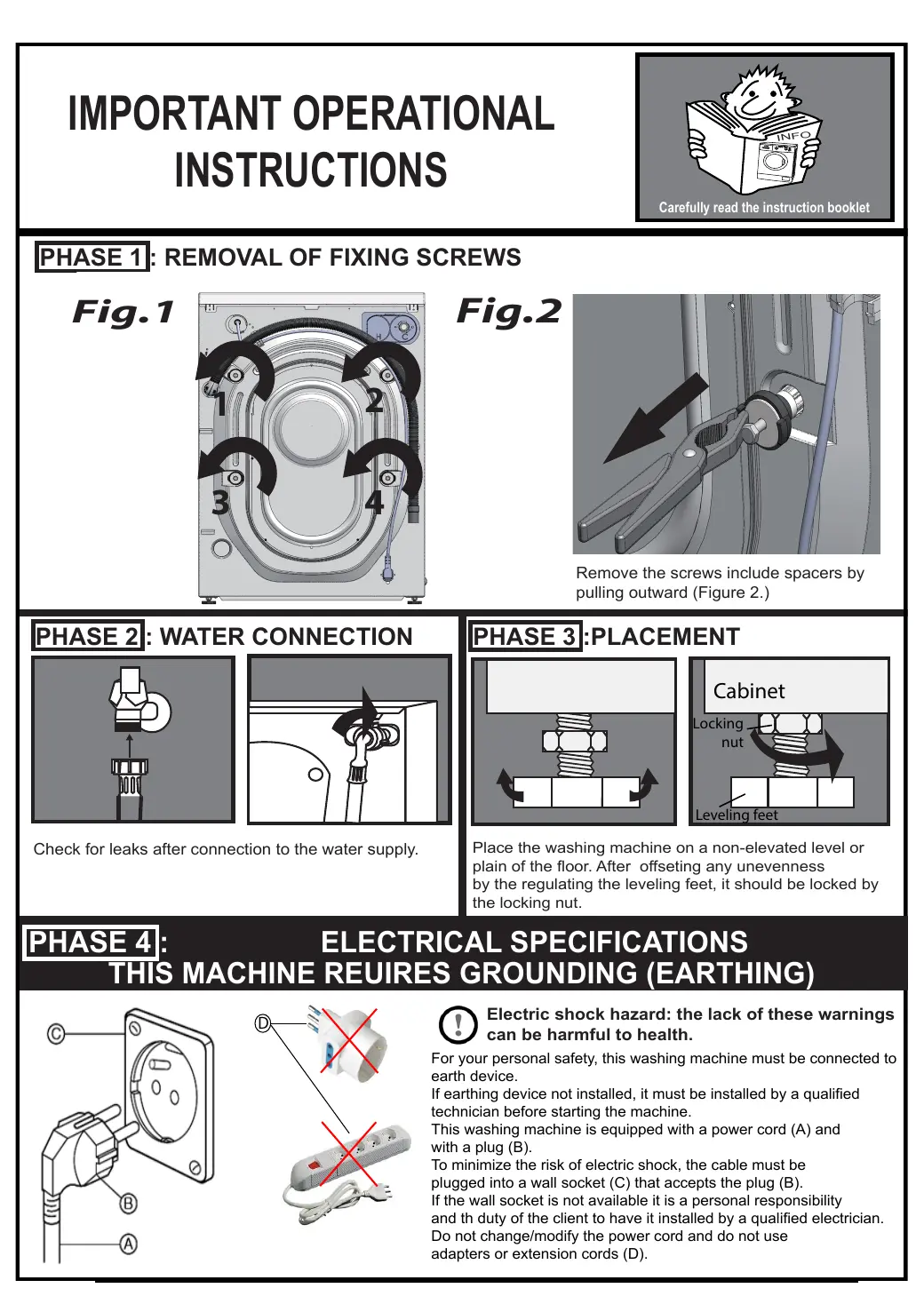
PHASE 1}: REMOVAL OF FIXING SCREWS
Fig.2 Carefully read the instruction booklet Remove the screws include spacers by pulling outward (Figure 2.) [PHASE 3]:PLACEMENT | | Cabinet Check for leaks after connection to the water supply. Place the washing machine on a non-elevated level or plain of the floor. After offseting any unevenness by the regulating the leveling feet, it should be locked by the locking nut.
PHASE 4}: ELECTRICAL SPECIFICATIONS
THIS MACHINE REUIRES GROUNDING (EARTHING) Electric shock hazard: the lack of these warnings can be harmful to health. For your personal safety, this washing machine must be connected to earth device. If earthing device not installed, it must be installed by a qualified technician before starting the machine. This washing machine is equipped with a power cord (A) and with a plug (B). To minimize the risk of electric shock, the cable must be plugged into a wall socket (C) that accepts the plug (B). If the wall socket is not available it is a personal responsibility and th duty of the client to have it installed by a qualified electrician. Do not change/modify the power cord and do not use adapters or extension cords (D).
Dear Customer, First of all we would like to thank you for choosing us and purchasing an original Italian product. This product has been fully manufactured in ITALY with the best materials, in ac- cordance to RoHs and Reach regulations with special attention to human health and environment. Key issues like quality and safety are supported by strict controls on our prod- EI ucts, which have been certified according to inter-national regulations such as EN 60456:2016, EN 62233:2010, EN 61770:2009, EN IS03741:2010, EN 60456:2016, EN 60335:2014, EN 61770:2009, EN ISO 3741:2010, EN 60704:2012, EN 6100:2014, EN 55019:2015 through certifications issued by VDE and IMQ, the latter being certifying bodies of excellence. This manual contains instructions for the use, maintenance and warranty. Before using the machine for the first time, please carefully read this user manual and the warranty certificate placed at the end of this manual. There you can find important instructions for the safety, use and maintenance of the washing ma- chine. This is to protect yourself from any possible injury and to avoid damages to the appliance. Always keep your purchase receipt with you which will be useful to activate the warranty. To be valid for warranty, the receipt must show the date of purchase, type of the appliance and model.
The packaging has the purpose of protecting the good from any possible damage which could occur during transport operations. AIl materials used for the packaging are reusable and selected according to eco friendly stand- ards so that they can be easily recycled in order to be reused into the production process. On the one hand, this mechanism allows to reduce waste and on the other, it makes possible a more rational use of non-renewable resources.
WASTE ELECTRIC AND ELECTRONIC
EQUIPMENT (RAEE) In accordance with Directive on waste electric and electronic equipment, the symbol of the crossed-out wheeled bin means that the end- of-life product must be disposed separately from domestic household waste. (CA The user should, therefore, take the product to an appropriate recycling centre for waste elec- trical and electronic equipment or give it back to the retailer at the time of purchasing new similar equipment, on a one for one basis. The proper separate disposal of the decom- missioned product and its eco-compatible recycling, treatment and scrapping contribute to avoid possible negative effects on the en- vironment and human health, and encourage the recycling of the materials comprising the product. The manufacturer has always been focused on developing products and technologies that make as little impact on the environment as possible and has been continuously engaged in high R&D investments which are required in the fields of ecology. For the waste management and disposal of the household appliances, the manufacturer registered with the consortium ERP Italia. The illegal disposal of the product by the user leads to the application of administrative sanctions in accordance with current laws and regulations.
Table of content. Safety instructions and warnings... intended use... Definitions of children Electrical safety... Water safety. Positioning, Correct us. Installation... General informatio: Fixing screws removal... Positioning of appliance Installation under worktop. Water supply inlet hose. Water drainage. Electrical connection Control panel Command description... Programme knob. Start/Pause…. Washing phases Child lock Product data sheet... Laundry symbols for washing machine.....21 Instructions and warnings. Washinginstruction Laundry selection Loading laundry. Detergent dosage. Liquid detergent bulkhead insert. Starting washing. Starting washing cycle Pause washing.. Detergent drawe Maintenance. Cabinet... Detergent drawe Drain pump filter cleanin: Emptying procedure... Cleaning of electro-valvale and water supply hose filters……..................... Water loading test. Possible remedies... After sales service... Warranty certificate
SAFETY INSTRUCTIONS AND WARNINGS
This washing machine complies With current safety norms and regulations. If improperly used, it can provoke damage to people and/or goods around you. Before using the washing machine for the first time, please read this user guide carefully. lt contains important instructions for the safety, use and maintenance of the washing machine. This will prevent any possible danger for yourself and damage to the appliance. Please keep the user guide with you and give it to other users, if necessary. INTENDED USE Please, note that this washing machine is only for domestic use and only to wash clothes which have been indicated by the manufacturer as suitable for washing in water on the label. Any other use can turn dangerous. The manufacturer cannot be held liable for damages caused by an improper and/or incorrect use of the household appliance. In other cases, the washing machine must not exceed one
washing cycle a day. Some example are: *__ staff kitchen areas in shops, offices and other working environments; + _ farm houses; + _ by clients in hotels, motels and other residential type environments; *_ bed and breakfast type environments; *_areas for communal use in blocks of flats or in launderettes.
USE BY CHILDREN OR VERY
VULNERABLE PEOPLE This appliance can be used by children of at least 8 years and by people with limited physical, sensorial or mental ability or with no required knowledge, as long as they are kept under surveillance or they have been instructed about safety norms to apply for the use of the appliance and possible risks. Children shall not play with the appliance. Cleaning and maintenance operations must not be made by children without supervision.
Children under the age of 3 must be supervised while the appliance is in function. CAUTION! When washing at high temperature, be aware that the door glass could become very hot (about 90°C). Prevent children from touching it.
DEFINITIONS OF CHILDREN
Very young children Up to 3 years old. Young children Between 3 and 8 years old. Older children Between 8 and i 14 years old. Vulnerable people People with limited physical, sensorial or mental ability (i.e. partially disabled, adults with limited physical and mental ability), or without the required knowledge (ie. older children). ELECTRICAL SAFETY Before plugging the washing machine into the electrical socket, be sure that the power supply is in line with the data (power, frequency) indicated in the technical data label. If any doubt, consult a qualified electrician. The electrical safety of the appliance can only be guaranteed when it is connected to an electrical system which is compliant With all legal standards and equipped with a separate magneto thermal differential switch (circuit breaker) and earthed. Do not use extension leads or adapters. This is a key safety requirement. Verify this condition and in case of any doubt, it is advised to call a qualified electrician who shall check the electrical system. N.B. The manufacturer should not be held liable for damages resulting from an electrical system compliant with all legal standards. The appliance can only be repaired by an Authorized Technician. If it is not the case, the manufacturer cannot be held liable for any
possible damage that could arise. If not properly repaired, the user may be exposed to serious danger, for which the manufacturer cannot be held liable. If the power supply cable is damaged, it must be replaced by an authorized technician in order to avoid any possible danger. In the event of faults, prolonged absences or to clean the appliance, disconnect it from the electrical mains. The appliance is considered to be disconnected from the mains when: + The power cable is unplugged from the socket. + The central switch has been turned off. WATER SAFETY To connect the appliance to the water supply, use only new hoses. Do not use old hoses. Be sure that during the washing cycle, the detergent drawer is always closed and turn off the water tap at the end of each washing cycle. It is not possible to make modifications to the appliance
without a prior authorization by the manufacturer. Before connecting the draining hose to the sink, make sure that the water is easily drained. Secure the draining hose so that it cannot move because the strong flow of water could push it out of the sink. POSITIONING The appliance must not be installed on roofs, balconies, under canopies or in places where it may be exposed to atmospheric agents. CORRECT USE Before using the appliance for the first time, remove the transport securing screws from the rear (see installation chapter). If those screws are not removed, it will damage the appliance or adjacent furniture or other appliances during the spinning. Make sure garments are not washed together with foreign objects (i.e. nails, needles, coins, paper clips). These foreign objects may damage the appliance (i.e. the drum or the tub) and, in turn,
the damaged parts may damage the garments. Garments that have been pre-treated with solvents or products containing solvents, have to be carefully rinsed with clean water before washing in the appliance. Never use detergents with solvents (i.e. petrol, trichloroethylene). These products may damage some components of the appliance and produce toxic vapors which could potentially provoke fires, blasts or damaged surfaces. NB. The manufacturer cannot be held liable for damages| caused as a result of not following the instructions in the manual.
GENERAL INFORMATION The assembled group of the appliance is secured by 4 fixing screws (which protect it during handling and transport operations), figure 1. Figure 1
FIXING SCREWS REMOVAL
Before using the appliance, it is necessary to remove the fixing screws by turning counter clockwise. N.B. If the fixing screws are not removed, this will cause strong vibrations and irregular movements during the washing cycle with subsequent damages. Once unscrewed, pull them out with spacer bushes as shown in figure 2. Figure 2 Seal the holes with the appropriate caps provided as shown in figure 3. Figure 3
POSITIONING OF APPLIANCE
In order to avoid damages or malfunctions, the appliance must not be installed on roofs, bal- conies, under canopies or in places where it may be exposed to atmospheric agents. Make sure the electrical cable and hoses (wa- ter inlet and drain hoses) on the rear of the appliance are not pressed. To ensure the stability of the appliance, avoid- ing strong vibrations during washing and Spinning cycles, it is necessary to put the ap- pliance on a levelled, smooth, dry, solid sur- face not raised from the floor level. In order to balance any difference in levels of the floor, it is possible to intervene on the feet modify- ing the height by screwing and unscrewing in accordance with the necessities as shown in figure 4. Figure 4 Cabinet 7 Foot
After regulating the feet, since vibration may modify its level, it is advisable to tighten the docking nut on the feet until it is blocked as shown by the figure below. Figure 5 It is recommended to avoid putting cardboard, pieces of wood or similar material upon or around the appliance since it may obstruct the air flow.
INSTALLATION UNDER WORKTOP
Itis possible to position the appliance under a worktop only if there is place of minimum 38cm on the upper side, 8cm on the sides and 8cm on the back side. An example of a typical installation is represented in figure 6. The top table of the appliance (TOP) cannot be removed for electric and mechanical safety reasons. Figure 6
WATER SUPPLY INLET HOSE
The water supply inlet hose has to be connected to a cold water tap with threaded hole of 3/4” and to the appliance. Only use the hose supplied with the appliance and make sure that the rubber gaskets are properly placed on the ends of the hose. Figure 7 IR N If the water supply system is new or it has not been used for a long time, before connecting the hose it is necessary to let the water run until it is clear. Figure 8 shows the connection to hot water. This option is available only on demand. Figure 8 Be sure the hot water temperature does not exceed 55°C in order to avoid damages to the clothing and to the washing machine. Use only the water supply inlet hose which is supplied With the appliance.
WATER DRAINAGE The water drain hose can be positioned in three different ways (Figure 9):
1. On the edge of a sink, using a U-hook
plastic (NOT SUPPLIED) Make sure the hose is well fixed on the sink.
2. Into a drainage line placed at a minimum
height of 60cm and not exceeding 90cm.
3. Direct drain into the siphon of the sink.
It is advisable to use a hose clamp (NOT INCLUDED) Example of installation Figure 9 N.B. It is not advisable to use hose extensions for the water drainage hose. BEFORE USE
TO DO A WASHING CYCLE
(PROGRAM COTTON) WITH
DETERGENT AND WITHOUT
LAUNDRY, SETTING THE
ELECTRICAL CONNECTION The appliance is supplied with a power cable and a schuko plug for the connection to the - 230V 50Hz AC grid . Make sure the schuko plug is always accessible so that washing machine can be disconnected from the mains if necessary. The electrical system must meet the provisions VDE 0100. The maximum consumption of the washing machine is 10 Ampere. Itis strongly recommended never to connect the appliance using extension cables, multiple sockets or similar devices in order to avoid overheating and a potential fire hazard. The manufacturer accepts no liability for damages resulting from lack or interruption of the protective earth conductor. With the purpose of increasing the safety level, VDE institute, by Directive DIN VDE 0100
part 739, recommends to equip the
appliance with an automatic differential switch (circuit breaker) with trip off current of 30mA (DIN VDE 0664). If an automatic differential switch is used, make sure it is of type À, in accordance with DIN VDE 0664 and sensitive to pulsating currents. The identification plate provides information about the nominal power consumption and its appropriate protection. Please compare these data with the data of the electrical mains.
THIS APPLIANCE REQUIRES AN
EARTH WIRING. For individual personal safety and of the environment, this appliance must be connected to the mains with an earth- ing which provides a direct path to the ground, correcily verified and in compli- ance with current laws and regulations. It installation must be equipped with a magneto thermal differential switch (cir- cuit breaker). This appliance is supplied with a type (A) power cord and a type (B) plug. In order to avoid risks of electrical shocks/fires, the cable must be connect- ed to a wall sucket (C) suitable for the type of plug (B). Do not modify the connection cable nor use adaptors or extension leads (D). If the wall sucket is not available, it is the customer’s responsibility and obligation to install it by a qualified electrician. Do not change/modify the electrical power cord and do not use adaptors or extension leads (D)
The programme knob is used to select the desired programme and to turn off the machine. lt can be rotated clockwise and counterclockwise for easy and fast selection of programmes. The programmes have preset temperature.
This button allows for the reduction or exclusion of spin. When one of the 15 available programmes is selected, the preset value lights up. To change this value press repeatedly the spin key until the desired value is reached. The corresponding LED lamp will be illuminated to identify the selected spin value.
This button allows for the selection of the available options of the selected washing programme. The options available are two - rinse hold and extra-rinse. The selection is signalled by the illumination of a LED. Depending on the selection, the LED may be: + fixed when extra-rinse is selected + flashing when rinse hold is selected; + off when no option is selected.
This key allows for the starting or pausing the washing programme momentarily.
During washing operations, a LED would indicates the washing status. The possible status are three: + washing; + +rinsing; + + spinning.
The function activates the lock of all buttons on the control panel. The activation is achieved by pressing buttons 3 and 4 simultaneously for 15 seconds. Its activation is marked by the flashing of the spin LED. To deactivate the function, press buttons 3 and 4 simultaneously for 10 seconds. Upon the deactivation spin LED will stop flashing.
PROGRAMMES, DURATION AND OPTIONS
The programmes intensive 60°C and 40°C are test programmes (cotton standard 60°C) and (cotton standard 40°C) used to evaluate the efficiency of the appliance. These programmes are the most efficient in terms of combined consumption {energy-water) and are indicated for washing coton laundry which is normally soiled. The real water temperature may be slightiy different from the one indicated. The duration of a programme may be different from the time indicated depending on variations of water pressure, tem- perature, hardness:; type, quantity and way laundry is loaded (knotted laundry increases the step of machine balancing); stability and quality of power voltage and wash options selected. Programme Londing espacty | | CMAXINUN Tenparaure aloed Jerperaus Giessconcen. | und | MVMUWund | programme durations 1) Wash options pr, fl panel rend (9) Tres mr 5 m Ambient tonperaure An 50 min
Programme Loading capacity | CMAXIMUM Temperature allowed u Son speed indicated on con- laundry Mae (a Programme durations (*) Wash options Type of laundry trol panel load (kg) ù
1. Energy class A+++ indicates more efficiency, while energy class D indicates lower efficiency.
2. The annual energy consumption in KWh is based on 220 standard cotton washes cycles at 60°C and
of full and half load. The real consumption depends on how the washing machine is effectively used.
3. The annual water consumption in litre is based on 220 standard cotton washes cycles at 60°C and of
full and half load. The real consumption depends on how the washing machine is effectively used.
4. Spin efficiency “A” indicates less quantity of water left on laundry, while spin efficiency “D” indicates
more quantity of water on laundry.
5. The programme intensive 60°C and 40°C is the standard wash programme. This programme is
used to wash cotton garments with a regular stain and it is the more efficient programme in terms of combined consumption of water and energy. The distributed product complies with the most recent European regulations and directives: Low Voltage Directive (LVD) 2014/35/EC Electro-magnetic Compatibility (EMC) Laws and Directive 2014/30/EU Eco design requirements for household washing machines Directive 1015/2010/EU
- Extra rinse is selectable.
The number inside the basket indicates the maximum temperature at which laundry can be washed. Icon Description Icon Description Normal wash Delicate wash max 90° - 95° C max 60° C EI Normal wash Delicate wash max 60° C max 40° C Normal wash Delicate wash max 40° C max 30° C Normal wash Do not spin max 30° C P
MACHINE (F) Geo A Dry-cleaning with s. Delicate dry Rydrocarbon about 200°C Bleaching allowed No heat (P) ee VAN Dry-cleaning with s. Delicate dry perchloroethÿiene about 150°C Only use oxygen bleach] Low heat Dry-cleaning with all . Delicate dry sohents about 110° C Do not bleach Medium heat Do not dry clean Do not Do not iron: Low heat dry dry clean Do not tumble dry No steam added to iron
WASHING INSTRUCTIONS The appliance shall not be used by children or vulnerable persons without appropriate supervision. Children shall not be allowed to play with the appliance. For each garment, follow the washing instructions written on the clothing labels Make sure there are no coins, pins etc. into the pockets of the garments to be washed. Figure 10 Do not use gasoline, alcohol, trychlorethylene etc. on garments destined to be washed into the appliance. It is advisable to put small size pieces of laundry like socks, belts etc. into a mesh laundry bag before washing them; thus preventing them from getting caught and snag into the drum. Use the softener within the maximum recommended dose, since an excessive quantity may damage the garments. When the appliance is switched off, let the door half-opened, thus better preserving the gasket and avoiding musty odours. Before opening the door, always make sure that the water has been drained. Always turn off the water tap at the end of every washing cycle. Unplug the appliance if it is not used for long periods of time.
LAUNDRY SELECTION To ensure you are getting the best from your washing machine, clothing shall belong to one of the following types: + White clothes + Coloured + Synthetics + Delicates + _ Wool More specifically, it is important to consider that: + White clothes will lose their “whiteness” if washed together with coloured clothes; + New coloured clothes may stain the first washing. Therefore it is advisable to always wash them separately. Moreover, it is important to follow the washing instructions of the fabric labels and make sure that there are no metallic objects (such as clips, needles, screws, coins, curtain hooks etc.) in tje laundry. Before washing, it may be needed to previously remove stains from particularly dirty clothing with a special detergent. Carpets, damaged clothes, hair, threads, dirty substances in general may clog up the drainage system.
SERT To get the best washing results, it is necessary to place the laundry in the drum, one item To use the liquid detergent, it is necessary to at a time thus preventing it from knotting put the bulkhead insert provided in the kit with and twisting. Efficiency results are strongly the appliance (figure 12): affected by quantity and by the way garments are loaded into the appliance, An excessive Figure 12 load or lower than half the rated load capacity may undermine the reliability of the washing machine and it makes the appliance more noisy. In case of excessive load or lower than half the rated load capacity, it is recommended to reduce to a minimum the spin speed in order to avoid strong vibrations during the spinning cycle. Before closing the door, make sure that no garment has been left on the edge of the gasket. This is to prevent any damage to the gasket. the asket. Raise the bulkhead insert to use powder deter- Please close the door with a slight gent (figure 13). push. Figure 13 Figure 11 DETERGENT DOSAGE
STARTING WASHING PROGRAMME
For each washing cycle, the correct amount of detergent has to be decided depending 1. To start the wash programme, turn the on the soil intensity of the laundry, as well as programme knob onto programme a considering the load size and water hardness. desired programme. Anyway, for each washing cycle, both 2. Consider the opportunity to personalize detergent and softener have to be put before the wash programme by regulating the starting to wash. temperature and/or spinning and the selection of one or more special options
After achieving all above mentioned operations, it is possible to start washing pressing the Start/Pause button. PAUSE WASHING It is possible to stop the washing cycle by pressing the button Start/Pause. This way, the appliance switches to pause mode. To turn off the machine in order to change programme, turn the knob n° 1 to the OFF position and then select the new programme. At the end of the washing cycle, the red light turns off and the door can be opened only after checking the water level thus avoiding water leakages. DETERGENT DRAWER I - Detergent compartment to be used during pre-wash and soak cycle. IL - Detergent compartiment for powder and liquid detergent for main wash. LIL - Compartment for liquid additives (softener, starch).
WARNING: Do not exceed the indicated MAX level.
CABINET Itis recommended to clean the cabinet of the appliance with lukewarm water thus preserving its original brightness for a long time. DETERGENT DRAWER To remove detergent deposits, it is recommended to pull out the detergent drawer by pressing the rounded area as shown in figure 14. Figure 14
CLEANING DETERGENT DRAWER
Once pulled the drawer out, remove the steam absorber divider as shown in the picture below. Figure 15 Figure 16 In case the draining hole of the drawer is obstructed by detergent deposits or foreign objects, it is recommended to remove the obstacle making sure not to push it to the bottom because it may clog up the internal circuit. We remind you that the detergent can be easily removed with hot water.
DRAIN PUMP FILTER CLEANING
It is recommended to periodically clean the drain pump filter. To clean the filter, follow instructions below: + Drain out the remaining water by selecting the “Drain” programme; + Turn off the washing machine; + Geta coin. Insert the coin into the slot on the side in order to open the cover Figure 17 N.B If the drain circuit is clogged, there could be consistent quantity of water in the appliance (max. 25l).
1) Place a tray between the cabinet and the
end of the filter. Figure 18 Reinsert the drain filter and tighten it firmly until it locks. Warning! After a wash cycle with high temperature, wait until it is cooled down. Danger of burning. Warning}! lf you do not rein- sert the filter or you do not screw it until itis blocked, the water will come
2) Loosen the filter using the appropriate out of the machine.
holder in order to let the water flow.
| CLEANING OF ELECTRO-VALVE AND
Figure 19 WATER SUPPLY HOSE FILTERS To clean the filters follow the instructions below: + Turn off the washing machine and disconnect the power cable. +_ Close the water and disconnect the water supply inlet hose from the water tap and from the washing machine. + Get pair of tweezers and a tooth brush. + Remove the filters from their place (figure 21) + _ Clean the filters with running water making use of the tooth brush.
When there is no more water coming out, unscrew the filter completely and clean it Get a stopwatch: carefully. Remove any foreign objects from the 2. Turn the programme knob to drain and filter. let it run for about two minutes;
3. Turn the programme knob to cotton
programme simultaneously start the programme and the stopwatch;
4. From the moment the washing machine
drum starts turning, make sure the stopwatch does not exceed 80-90 seconds; If that value exceeds, it is necessary to ensure the right grid pressure and check that the water supply hose filter and/or solenoid valve hose filter are not obstructed. Figure 21 Water inlet hose filter Electro-valve filter
POSSIBLE SOLUTIONS Most part of malfunctions which occur during the daily use of your appliance can be solved by yourself within a few minutes. In many cases, it is possible to save time and money without necessarily calling the authorized after-sale service. The following table is a valuable help to identify and possibly eliminate malfunctions, in any other case please call the after-sale service. What to do if... The washing machine is noisy
1. Make the detergent is the standard detergent for washing machine and it is overdosed.
2. Make sure the laundry is not amassed or knotted.
3. Make sure the drain pump filter is clean and make sure drain hose is not squashed and
that the machine drains properly.
4. Perform water loading test as explained in chapter “Maintenance”.
The washing machine does not spin Carry out a test without laundries by placing the knob on “Spin” and press “Start”. If the it spins with empty drum, check above mentioned points (1-2-3-4). O the contrary, contact the technical service. The machine moves
1. Make sure the transport screws have
been removed during installation (see installation chapter). Foot OK KO foot
2. Make sure that the feet of the appliance
rest on a smooth, rigid, dry floor/surface free of all traces of detergent and that it is well levelled on the floor in order to avoid vibrations (see installation chapter).
3. Check that the feet are intact as shown in
the figure. The laundry is ruined/torn In some cases, foreign bodies may be present in the clothes to be washed (e.g. hooks, undervwires, pins) that can ruin/tear fabrics during washing. In thi case, it is necessary to insert the hand in the drum holding a woman'’s stocking in order to see if there are protrusions in relief of these items or similar things from the drum, which could hook to laundries. Laundry stained by other clothes In this case, it is recommended to clean the drum and tub of the washing machine fol- lowing the instructions below: - Put into the drum: 1 kg coarse salt, 100 g coastic soda and 250 cc white vinegar - Start programme cotton 60°
POSSIBLE REMEDIES Problem Diagnosis Possible Solution + Check whether the plug is properly inserted into the power socket. THE WASHING MACHINE DOES ge whether there is power at the NOT STAR + Verify the selector knob is not positioned on OFF. THE WASHING ® ® ® MACHINE DOES NOT START THE Le) - Reopen the door and close it with a PROGRAMME slight push. (lights N. 1-2 Spin Options Start/Pause #7 | 00 © LE o Q © THE WASHING 02 + Make sure the water tap is open and MACHINE DOES ©! o that there is water available from the NOT TAKE mains. WATER Spin Options Start/Pause + Make sure the water inlet hose is not (lights N. 1-3 kinked. flashing) - Execute a water load test. LE o o Q THE WASHING ©2 MACHINE DOES o1 o - Turn off the washing machine and NOT HEAT restart the wash programme. (lights N. 2-3 Spin Options Start/Pause "00 © + Remove the drain hose from the 03 Le} Le] Le] THE WASHINQ dec crains It a contanersink MACHINE DOES o then select the drain programme. NOT DRAIN lights N. 1-4 + Make sure the drain pump filter is not {l 4 H - Spin Options Start/Pause obstructed. sing) + Make sure the drain hose is not squashed or kinked.
00 © Problem Diagnosis Possible Solution o o ] (Lights N. 2-4 o + Switch off the washing machine and flashing) switch it back on. Spin Options Star/Pause (Lights N. 1-2-4 flashing) o o o Spin Options Start/Pause 00 © + Switch off the washing machine and switch it back on. The door does not open + Make sure the red light is off + Make sure the appliance is not in soak mode or rinse hold special option. - Press on the door from the closing side or give a slight push while trying to open at the same time. There is water on the floor + Make sure the water supply hose and the drain hose are not damaged and that there are no water leakages. -+ Make sure that there is no foam/ water coming out from the detergent drawer. + Reduce the detergent dose. is off The washing machine take in water continuously even when it - Turn off the water tap at the end of every wash cycle. + Reduce the water pressure or check the autoclave.
REPAIR If any repairs are required, contact an authorised after sales service calling the number indicated. Always specify the model of the appliance and its serial number as reported on the rating plate on the cabinet visible on the upper side of the door when it is opened and/or on the back side of the washing machine.
Due to the continuous technological evolution of the products, the data contained in this manual may undergo slight variations without the manufacturer’s prior notice.