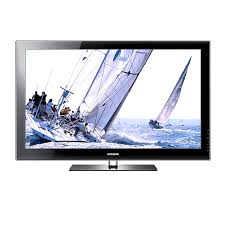
PN63B550T2F - TV SAMSUNG - Free user manual and instructions
Find the device manual for free PN63B550T2F SAMSUNG in PDF.


| Brand | SAMSUNG |
| Model | PN63B550T2F |
| Product type | Plasma TV |
| Screen size (diagonal) | 63 inches (160 cm) |
| Screen resolution | 1920 x 1080 pixels (Full HD) |
| Audio power | 2 x 15 W |
| Audio technology | SRS TruSurround HD |
| HDMI inputs | 4 (including 1 DVI-compatible) |
| Component inputs | 2 (Y, Pb, Pr) |
| USB port | 1 (photo and music playback) |
| Built-in tuner | HD digital tuner (ATSC) |
| Anynet+ (HDMI-CEC) | Yes |
| Dimensions with stand (L x H x D) | 1531 x 992.5 x 390 mm |
| Dimensions without stand (L x H x D) | 1531 x 932 x 74 mm |
| Weight with stand | 60.6 kg |
| Weight without stand | 52.9 kg |
| Operating temperature | 10 °C to 40 °C |
| Operating humidity | 10% to 80% non-condensing |
| VESA wall mount standard | 600 x 400 mm |
| Included accessories | Remote control, batteries, stand, screws, power cord, cleaning cloth, quick start guide |
| Cleaning | Use a soft dry cloth. Do not use chemical or abrasive products. |
Frequently Asked Questions - PN63B550T2F SAMSUNG
User questions about PN63B550T2F SAMSUNG
0 question about this device. Answer the ones you know or ask your own.
Ask a new question about this device
Download the instructions for your TV in PDF format for free! Find your manual PN63B550T2F - SAMSUNG and take your electronic device back in hand. On this page are published all the documents necessary for the use of your device. PN63B550T2F by SAMSUNG.
USER MANUAL PN63B550T2F SAMSUNG
If you have any questions or comments relating to Samsung products, please contact the SAMSUNG customer care center.
Important Warranty Information Regarding Television Format Viewing
Wide screen format PDP Displays (16:9, the aspect ratio of the screen width to height) are primarily designed to view wide screen format full-motion video. The images displayed on them should primarily be in the wide screen 16:9 ratio format, or expanded to fill the screen if your model offers this feature and the images are constantly moving. Displaying stationary graphics and images on screen, such as the dark side-bars on nonexpanded standard format television video and programming, should be limited to no more than 5% of the total television viewing per week.
Additionally, viewing other stationary images and text such as stock market reports, video game displays, station logos, web sites or computer graphics and patterns, should be limited as described above for all televisions. Displaying stationary images that exceed the above guidelines can cause uneven aging of PDP Displays that leave subtle, but permanent burned-in ghost images in the PDP picture. To avoid this, vary the programming and images, and primarily display full screen moving images, not stationary patterns or dark bars.
On PDP models that offer picture sizing features, use these controls to view different formats as a full screen picture. Be careful in the selection and duration of television formats used for viewing. Uneven PDP aging as a result of format selection and use, as well as burned-in images, are not covered by your Samsung limited warranty.
U.S.A Only
The product unit accompanying this user manual is licensed under certain intellectual property rights of certain third parties. In particular, this product is licensed under the following US patents: 5,991,715, 5,740,317, 4,972,484, 5,214,678, 5,323,396, 5,539,829, 5,606,618, 5,530,655, 5,777,992, 6,289,308, 5,610,985, 5,481,643, 5,544,247, 5,960,037, 6,023,490, 5,878,080, and under US Published Patent Application No. 2001-44713-A1.
This license is limited to private non-commercial use by end-user consumers for licensed contents. No rights are granted for commercial use. The license does not cover any product unit other than this product unit and the license does not extend to any unlicensed product unit or process conforming to ISO/IEC 11172-3 or ISO/IEC 13818-3 used or sold in combination with this product unit. The license only covers the use of this product unit to encode and/or decode audio files conforming to the ISO/IEC 11172-3 or ISO/IEC 13818-3. No rights are granted under this license for product features or functions that do not conform to the ISO/IEC 11172-3 or ISO/IEC 13818-3.
Other countries
The product unit accompanying this user manual is licensed under certain intellectual property rights of certain third parties. This license is limited to private non-commercial use by end-user consumers for licensed contents. No rights are granted for commercial use. The license does not cover any product unit other than this product unit and the license does not extend to any unlicensed product unit or process conforming to ISO/IEC 11172-3 or ISO/IEC 13818-3 used or sold in combination with this product unit. The license only covers the use of this product unit to encode and/or decode audio files conforming to the ISO/IEC 11172-3 or ISO/IEC 13818-3. No rights are granted under this license for product features or functions that do not conform to the ISO/IEC 11172-3 or ISO/IEC 13818-3.
User Instructions
Screen Image retention
Do not display a still image (such as on a video game) on the plasma display panel for more than several minutes as it can cause screen image retention. This image retention is also known as "screen burn". To avoid such image retention, refer to page 25 of this manual to reduce the degree of brightness and contrast of the screen when displaying a still image.
Altitude
The PDP can only operate normally at heights under 6500ft.
Heat on the top of the Plasma TV
The top side of the product may be hot after long periods of use as heat dissipates from the panel through the vent hole in the upper part of the product.
This is normal and does not indicate any defect or operation failure of the product.
However, children should be prevented from touching the upper part of the product.
The product is making a 'cracking' noise.
A 'cracking' noise may occur when the product contracts or expands due to a change in the surrounding environment such as temperature or humidity. This is normal and not a defect of the unit.
Cell Defects
The PDP uses a panel consisting of 2,360,000(HD-level) to 6,221,000(FHD-level) pixels which require sophisticated technology to produce. However, there may be a few bright or dark pixels on the screen. These pixels will have no impact on the performance of the product.
Avoid operating the TV at temperatures below 41^ (5^)
A still image displayed too long may cause permanent damage to the PDP Panel.
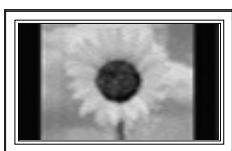
Watching the Plasma TV in 4:3 format for a long period of time may leave traces of borders displayed on the left, right and center of the screen caused by the difference of light emission on the screen.
Playing a DVD or a game console may cause similar effects to the screen.
Damages caused by the above effect are not covered by the Warranty.
After-images on the Screen.
Displaying still images from Video games and PC for longer than a certain period of time may produce partial after-images. To prevent this effect, reduce the 'brightness' and 'contrast' when displaying still images for a long time.
Warranty
Warranty does not cover any damage caused by image retention.
Burn-in is not covered by the warranty.
Contents
Connecting and Preparing Your TV
List of Features. 5
- Checking Parts 5
Assembling the Cables. 5
Viewing the Control Panel 6
Viewing the Connection Panel. 8
Remote Control 9
Connections
- Connecting VHF and UHF Antennas. 10
- Connecting Cable TV 10
- Connecting a DVD / Blu-Ray Player or Cable Box / Satellite receiver (Set-Top Box) via HDMI 12
- Connecting a DVD /Blu-Ray Player or Cable Box / Satellite receiver (Set-Top Box) via DVI 12
- Connecting a DVD / Blu-Ray Player or Cable Box / Satellite receiver (Set-Top Box) via Component cables. 13
- Connecting a Camcorder 13
- Connecting a VCR 14
- Connecting a Digital Audio System 15
- Connecting an Amplifier / DVD Home Theater 15
- Connecting a PC 16
Operation
- Turning the TV On and Off 17
Changing Channels 17
Adjusting the Volume. 17
Using the TOOLS Button. 18
Using the Remote Control Backlight Buttons 18
Viewing the Display 18
Viewing the Menus 19
Plug & Play Feature 20
Channel Control
Storing Channels 21
■ Managing Channels 21
Picture Control
Changing the Picture Settings 23
PC Display
Using Your TV as a Computer (PC) Display 27
■ Display Modes. 27
Setting up the TV with your PC 28
Sound Control
Changing the Sound Settings 29
Function Description
- Configuring the Setup Menu 30
Setting the Time 34
Source List/Edit Name. 35
Support. 35
Media Play
Using the Media Play Function 37
Using the PHOTO (JPEG) List 38
Using the MP3 List 41
Using the Setup Menu 42
Anynet+
- Connecting Anynet+ Devices 43
Troubleshooting for Anynet+ 46
Appendix
Troubleshooting 47
Preparation before installing the Wall-Mount. 48
■ How to attach the Stand-Base. 48
Securing the TV to the Wall 49
■ Wall Mount Kit Specifications (VESA) 50
■ Specifications 51
Dimensions (PN50B550T2F/PN50B560T5F) 52
Dimensions (PN58B550T2F/PN58B560T5F) 53
Dimensions (PN63B550T2F/PN63B590T5F) 54
Symbol

Press

Note

One-Touch Button

TOOLS
Connecting and Preparing Your TV
List of Features
- Adjustable picture settings that can be stored in the TV's memory.
Automatic timer to turn the TV on and off. - A special sleep timer.
V-Chip function. - Excellent Digital Interface & Networking : With a built-in HD digital tuner, non-subscription HD broadcasts can be viewed with no Cable Box/Satellite receiver (Set-Top Box) needed.
- You can listen to music files and view pictures on USB Mass Storage Class (MSC) devices.
- HDMI/DVI connection of your PC to this TV.
- SRS TruSurround HD provides a virtual surround system.
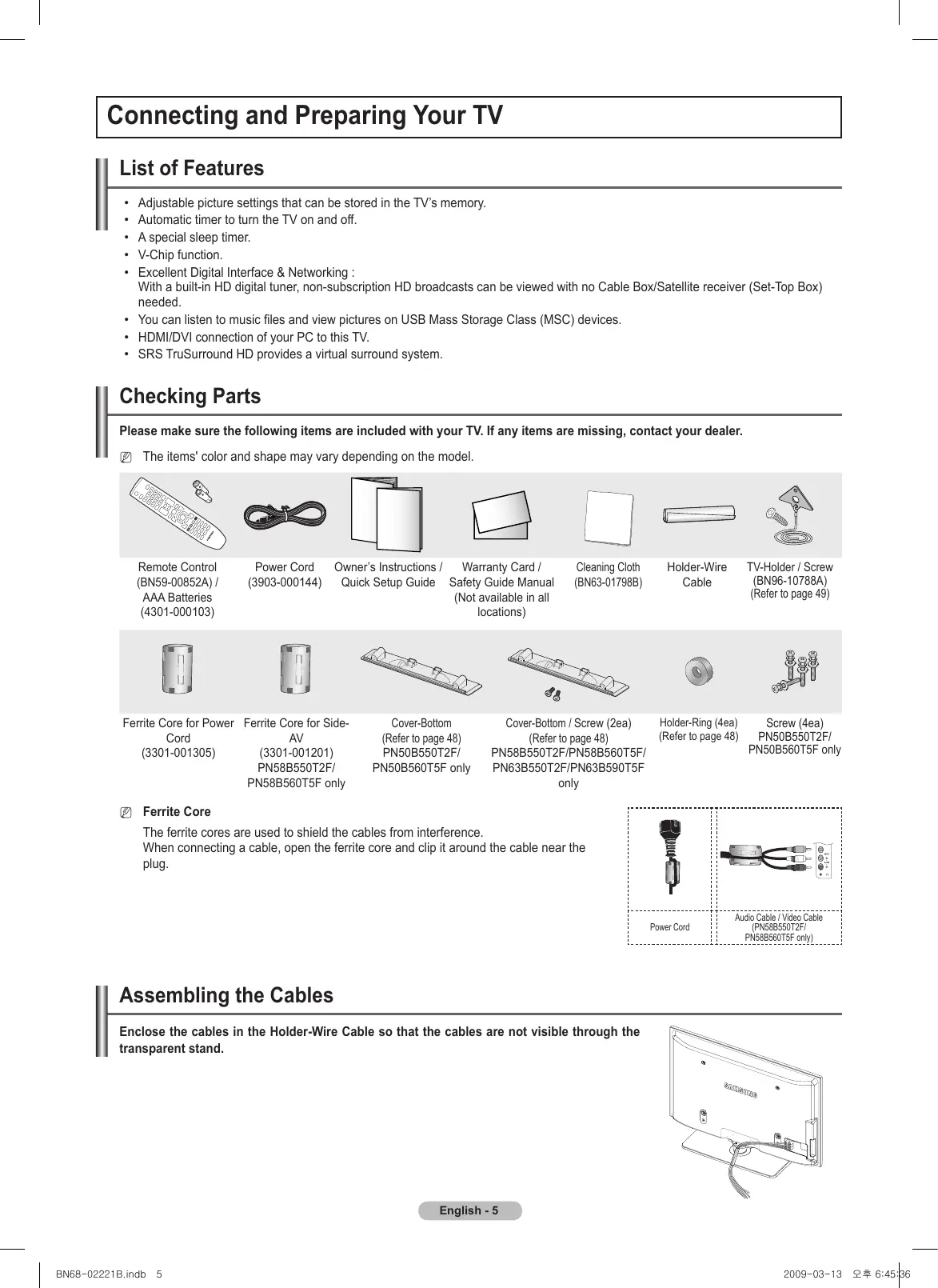
Checking Parts
Please make sure the following items are included with your TV. If any items are missing, contact your dealer.
The items' color and shape may vary depending on the model.
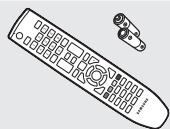
Remote Control (BN59-00852A)/ AAA Batteries (4301-000103)

Power Cord (3903-000144)
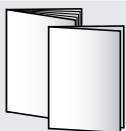
Owner's Instructions / Quick Setup Guide

Warranty Card / Safety Guide Manual (Not available in all locations)

Cleaning Cloth (BN63-01798B)
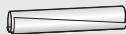
Holder-Wire Cable

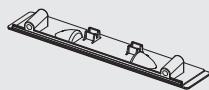
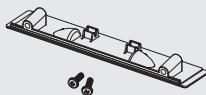
TV-Holder / Screw (BN96-10788A) (Refer to page 49)




Ferrite Core for Power Cord (3301-001305)
Ferrite Core for SideAV (3301-001201) PN58B550T2F/ PN58B560T5F only
Cover-Bottom
(Refer to page 48) PN50B550T2F/
PN50B560T5F only
Cover-Bottom / Screw (2ea)
(Refer to page 48)
PN58B550T2F/PN58B560T5F/
PN63B550T2F/PN63B590T5F only
Holder-Ring (4ea) (Refer to page 48)
Screw (4ea)
PN50B550T2F/N50B560T5F only
Ferrite Core
The ferrite cores are used to shield the cables from interference.
When connecting a cable, open the ferrite core and clip it around the cable near the plug.

Power Cord
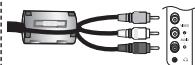
Audio Cable / Video Cable
(PN58B550T2F/
PN58B560T5F only)
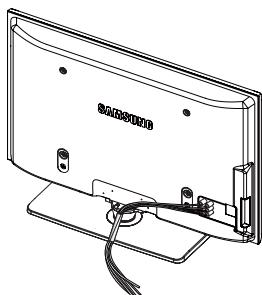
Assembling the Cables
Enclose the cables in the Holder-Wire Cable so that the cables are not visible through the transparent stand.
The buttons on the lower-right panel control your TV's basic features, including the on-screen menu. To use the more advanced features, you must use the remote control.
The product color and shape may vary depending on the model.
If you touch the front panel button, the each button will be operated.
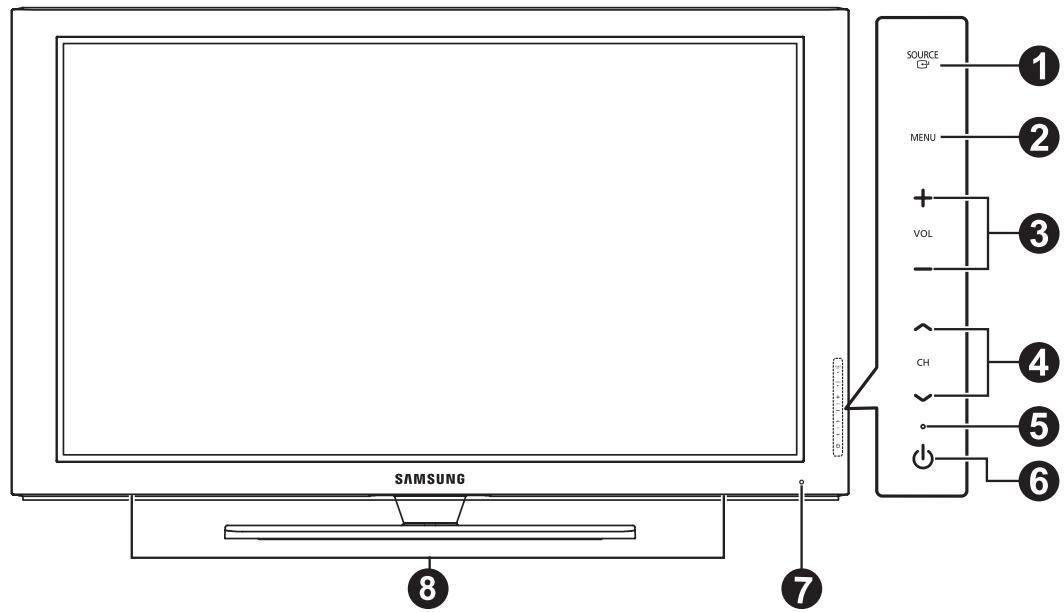
PN50B550T2F/PN58B550T2F/PN63B550T2F
SOURCE
Toggles between all the available input sources
(TV, AV1, AV2, Component1, Component2, PC, HDMI1, HDMI2/DVI, HDMI3, HDMI4).
In the on-screen menu, use this button as you use the ENTER button on the remote control.
2 MENU
Press to see an on-screen menu of your TV's features.
3 +VOL-
Press to increase or decrease the volume. In the on-screen menu, use the + VOL - buttons as you would use the and buttons on the remote control.
CHV
Press to change channels. In the on-screen menu, use the CH buttons as you would use the and buttons on the remote control.
5 POWER INDICATOR
Blinks and turns off when the power is on and lights up in stand-by mode.
6 (POWER)
Press to turn the TV on and off.
7 REMOTE CONTROL SENSOR
Aim the remote control towards this spot on the TV.
SPEAKERS
PN50B560T5F/PN58B560T5F/PN63B590T5F
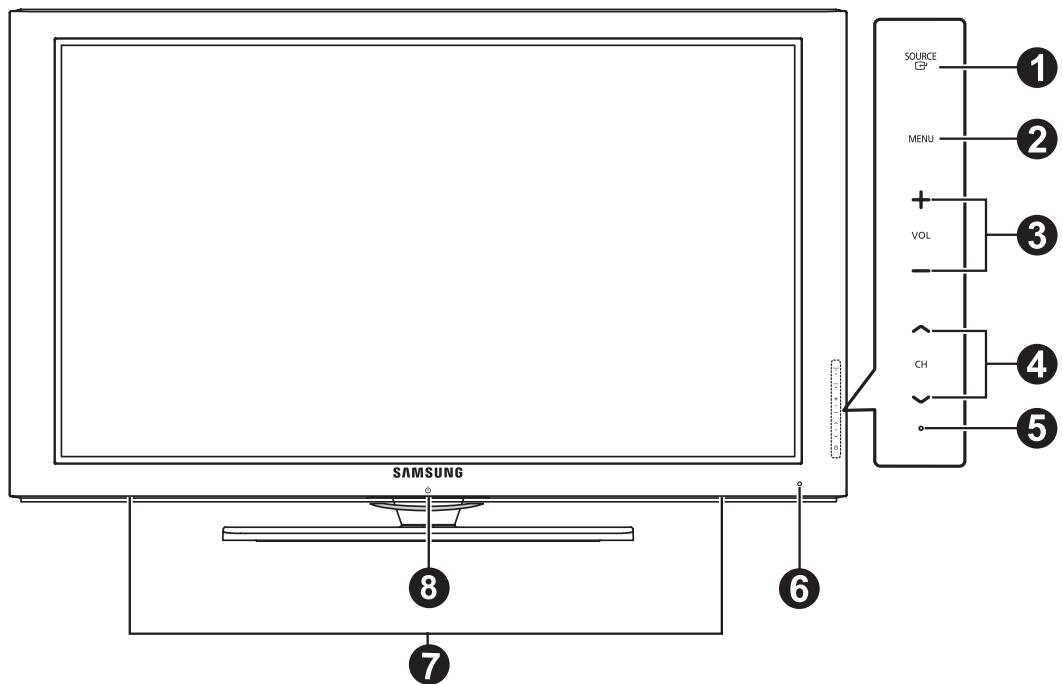
1 SOURCE
Toggles between all the available input sources
(TV, AV1, AV2, Component1, Component2, PC, HDMI1, HDMI2/DVI, HDMI3, HDMI4).
In the on-screen menu, use this button as you use the ENTER button on the remote control.
2 MENU
Press to see an on-screen menu of your TV's features.
3 +VOL-
Press to increase or decrease the volume. In the on-screen menu, use the + VOL - buttons as you would use the and buttons on the remote control.
4 CHV
Press to change channels. In the on-screen menu, use the CH buttons as you would use the and buttons on the remote control.
5 POWER INDICATOR
Blinks and turns off when the power is on and lights up in stand-by mode.
6 REMOTE CONTROL SENSOR
Aim the remote control towards this spot on the TV.
SPEAKERS
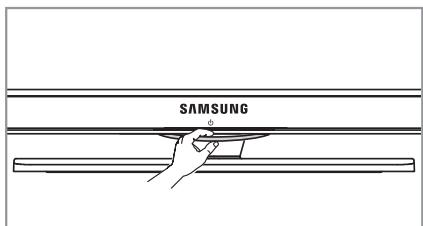
8 POWER
Touch the silver sensor below the () mark to turn the TV on and off.
Use the connection panel jacks to connect A/V components that will be connected continuously, such as Blu-Ray/DVD players or a VCR.
The product color and shape may vary depending on the model.
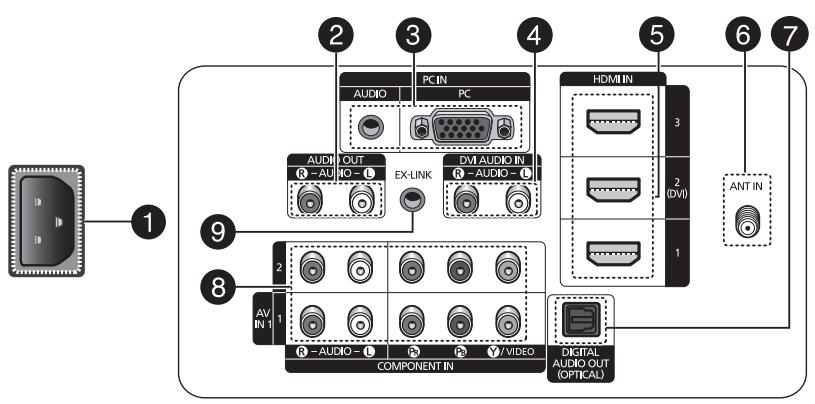
TV Rear Panel
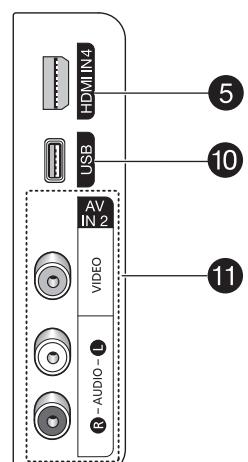
TV Side Panel
1 POWER IN
Connects the supplied power cord.
2 AUDIO OUT
Connect to a Digital Audio component.
PC IN [PC] / [AUDIO]
Connects to the video and audio output jacks on your PC.
4 DVI AUDIO IN (AUDIO-R/L)
Connect to the DVI audio output jack of an external device.
HDMI IN 1,2(DVI),3,4
Connect to the HDMI jack of a device with an HDMI output. (HDMI 2 supports HDMI-DVI IN and connection from a PC.)
-
HDMI 2 can also be used as a DVI connection with separate analog audio inputs. An optional HDMI/DVI cable will be necessary to make this connection.
-
When using an optional HDMI/DVI adapter, the DVI analog audio inputs on your TV allow you to receive left and right audio from your DVI device.
6 ANT IN
Uses a 75 Coaxial connector for an Air/Cable Network.
7 DIGITAL AUDIO OUT (OPTICAL)
Connects to a Digital Audio component.
3 COMPONENT IN 1,2/AVIN1
Connects Component video / audio. The COMPONENT IN 1 jack is also used as the AV IN 1 jack.
Connect the video cable to the COMPONENT IN 1 [Y/VIDEO] jack and the audio cable to the COMPONENT IN 1 [R-AUDIO-L] jacks.
EX-LINK
Used for service only.
USB
Connect a USB mass storage device to view photo files and play audio files.
1 AV IN 2
Video and audio inputs for external devices.
You can use the remote control up to a distance of about 23 feet from the TV.
The product color and shape may vary depending on the model.
The performance of the remote control may be affected by bright light.
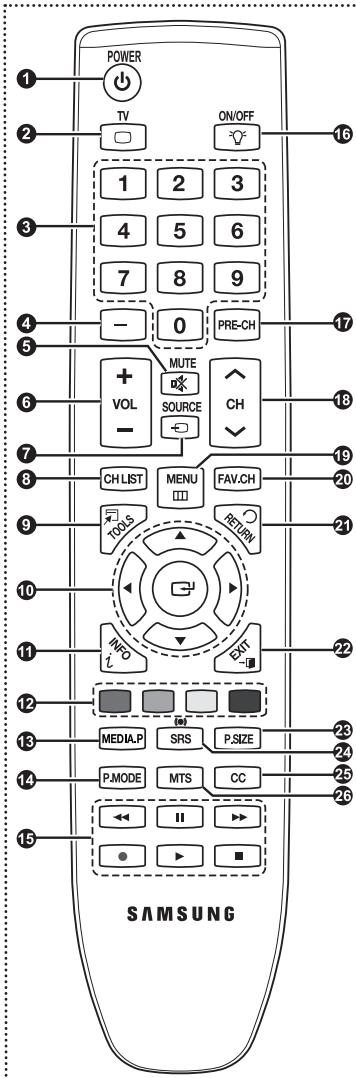
1 POWER
Turns the TV on and off.
2 TV
Selects the TV mode directly.
3 NUMERIC BUTTONS
Press to change the channel.
4
Press to select additional channels (digital and analog) being broadcast by the same station. For example, to select channel "54-3", press "54", then press " - " and "3".
MUTE
Press to temporarily cut off the sound.
6 +
Press to increase or decrease the volume.
SOURCE
Press to display and select the available video sources.
CH LIST
Used to display Channel Lists on the screen.
9 TOOLS
Use to quickly select frequently used functions.
10 UP▲
Use to select on-screen menu items and change menu values.
1 INFO
Press to display information on the TV screen.
12 COLOR BUTTONS
Use these buttons in the Channel list and Media Play function.
13 MEDIA.P (Media play)
This function enables you to view and play photo and music files from an external device. (Refer to pages 38 (Photo) and 41 (Music))
14 P.MODE
Press to select the picture mode.
Use these buttons in the DMA, Media Play and Anynet+ modes.
( : This remote can be used to control recording on Samsung recorders with the Anynet+ feature)
16 ON/OFF
Press to backlight the buttons on the remote. This function is convenient for using at night or when the room is dark. (Using the remote control with the light button set to On will reduce the battery usage time.)
PRE-CH
Tunes to the previous channel.
18 CH
Press to change channels.
19 MENU
Displays the on-screen menu.
20 FAV.CH
Press to switch to your favorite channels.
2 RETURN
Returns to the previous menu.
2 EXIT
Press to exit the menu.
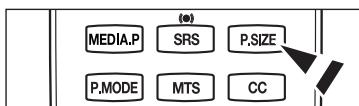
23 P.SIZE
Picture size selection.
24 SRS
Selects SRS TruSurround HD mode.
CC
Controls the caption decoder.
26MTS
Press to choose stereo, mono or Separate Audio Program (SAP broadcast).
□ Installing Batteries in the Remote Control
-
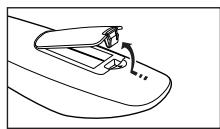
Lift the cover at the back of the remote control upward as shown in the figure.
-
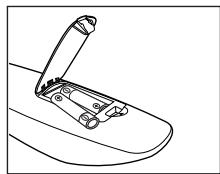
Install two AAA size batteries.
Make sure to match the ^+ and - ends of the batteries with the diagram inside the compartment.
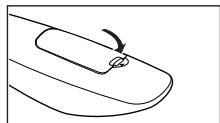
- Close the cover as shown in the figure.
Remove the batteries and store them in a cool, dry place if you won't be using the remote control for a long time. (Assuming typical TV usage, the batteries should last for about one year.)
Using the remote control with the ON/OFF() light button set to On will reduce the battery usage time.
If the remote control doesn't work, check the following
- Is the TV power on?
- Are the plus and minus ends of the batteries reversed?
- Are the batteries drained?
- Is there a power outage or is the power cord unplugged?
- Is there a special fluorescent light or neon sign nearby?
Connections
Connecting VHF and UHF Antennas
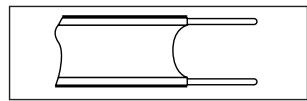
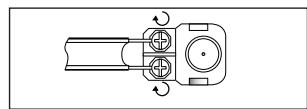
If your antenna has a set of leads that look like this, see "Antennas with 300 Ω Flat Twin Leads" below.
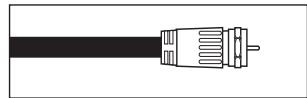
If your antenna has one lead that looks like this, see "Antennas with 75 Round Leads". If you have two antennas, see "Separate VHF and UHF Antennas".
Antennas with 300 Ω Flat Twin Leads
If you are using an off-air antenna (such as a roof antenna or rabbit ears) that has 300 twin flat leads, follow the directions below.
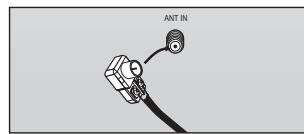
- Place the wires from the twin leads under the screws on a 300-75 adapter (not supplied). Use a screwdriver to tighten the screws.
- Plug the adaptor into the ANT IN terminal on the back of the TV.
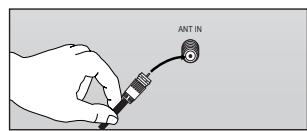
Antennas with 75 Round Leads
Plug the antenna lead into the ANT IN terminal on the back of the TV.
Separate VHF and UHF Antennas
If you have two separate antennas for your TV (one VHF and one UHF), you must combine the two antenna signals before connecting the antennas to the TV. This procedure requires an optional combiner-adaptor (available at most electronics shops).
- Connect both antenna leads to the combiner.
- Plug the combiner into the ANT IN terminal on the bottom of the back panel.
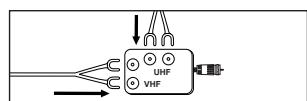
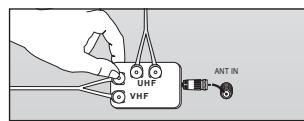
Connecting Cable TV
To connect to a cable TV system, follow the instructions below.
Cable without a Cable Box
Plug the incoming cable into the ANT IN terminal on the back of the TV.
Because this TV is cable-ready, you do not need a cable box to view unscrambled cable channels.
- Connecting to a Cable Box that Descrambles All Channels
- Find the cable that is connected to the ANT OUT terminal on your cable box.
This terminal might be labeled "ANT OUT", "VHF OUT" or simply, "OUT".
- Connect the other end of this cable to the ANT IN terminal on the back of the TV.
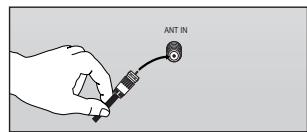
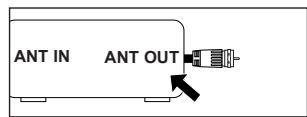
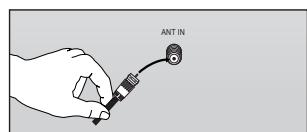
- Connecting to a Cable Box that Descrambles Some Channels
If your cable box descrambles only some channels (such as premium channels), follow the instructions below. You will need a two-way splitter, an RF (A/B) switch, and four lengths of Antenna cable. (These items are available at most electronics stores.)
- Find and disconnect the cable that is connected to the ANT IN terminal on your cable box.
This terminal might be labeled "ANT IN", "VHF IN" or simply, "IN".
- Connect this cable to a two-way splitter.


- Connect an Antenna cable between the OUTPUT terminal on the splitter and the IN terminal on the cable box.

- Connect an Antenna cable between the ANT OUT terminal on the cable box and the B-IN terminal on the RF(A/B) switch.
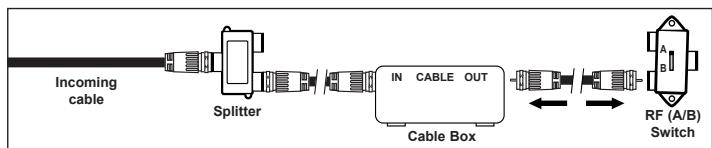
- Connect another cable between the other OUT terminal on the splitter and the A-IN terminal on the RF (A/B) switch.
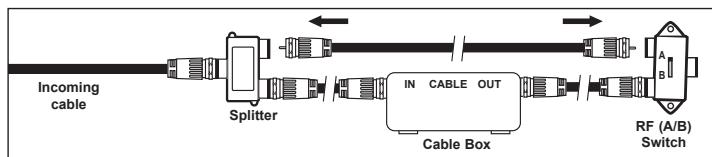
- Connect the last Antenna cable between the OUT terminal on the RF (A/B) switch and the ANT IN terminal on the rear of the TV.
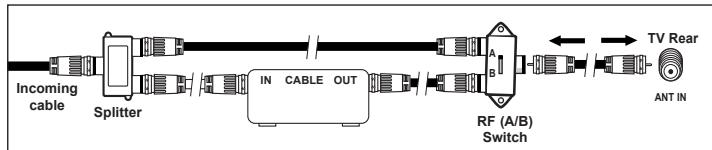
After you have made this connection, set the A/B switch to the "A" position for normal viewing. Set the A/B switch to the "B" position to view scrambled channels. (When you set the A/B switch to "B", you will need to tune your TV to the cable box's output channel, which is usually channel 3 or 4.)
Connecting a DVD / Blu-Ray Player or Cable Box / Satellite receiver (Set-Top Box) via HDMI
This connection can only be made if there is an HDMI Output jack on the external device. This connection will provide the highest quality picture.
- Connect an HDMI Cable between the HDMI IN (1, 2(DVI), 3, or 4) jack on the TV and the HDMI jack on the DVD / Blu-Ray Player or Cable Box / Satellite receiver (Set-Top Box).
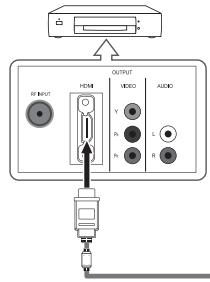
DVD/Blu-Ray Player or Cable Box / Satellite receiver

HDMI Cable (Not supplied)
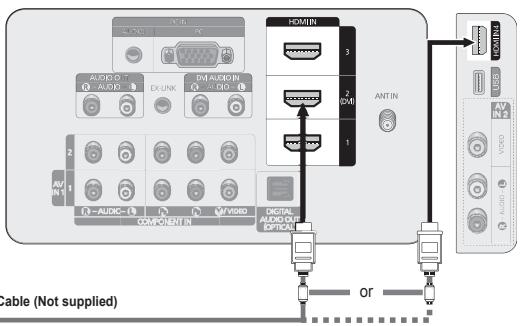
TV Rear Panel
What is HDMI?
- HDMI, or high-definition multimedia interface, is an interface that enables the transmission of digital audio and video signals using a single cable.
- The difference between HDMI and DVI is that the HDMI device is smaller in size and has the HDCP (High Bandwidth Digital Copy Protection) coding feature installed.
Each DVD Player or Cable Box / Satellite receiver (Set-Top Box) has a different back panel configuration.
The TV may not output sound and pictures may be displayed with abnormal color when DVD / Blu-Ray Player or Cable Box / Satellite receiver supporting HDMI versions older than 1.3 are connected. When connecting an older HDMI cable and there is no sound, connect the HDMI cable to the HDMI IN 2(DVI) jack and the audio cables to the DVI AUDIO IN [R-AUDIO-L] jacks on the back of the TV. If this happens, contact the company that provided the DVD / Blu-Ray Player or Cable Box / Satellite receiver to confirm the HDMI version, then request an upgrade.
HDMI cables that are not 1.3 may cause annoying flicker or no screen display.
Connecting a DVD /Blu-Ray Player or Cable Box / Satellite receiver (Set-Top Box) via DVI
This connection can only be made if there is a DVI Output jack on the external device.
- Connect a HDMI/DVI Cable or DVI-HDMI Adapter between the HDMI IN 2(DVI) jack on the TV and the DVI jack on the DVD / Blu-Ray Player or Cable Box/Satellite receiver (Set-Top Box).
- Connect Audio Cables between the DVI AUDIO IN [R-AUDIO-L] jack on the TV and the DVD/Blu-Ray Player or Cable Box / Satellite receiver.
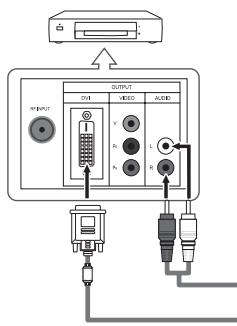
DVD/Blu-Ray Player or Cable Box /
Satellite receiver
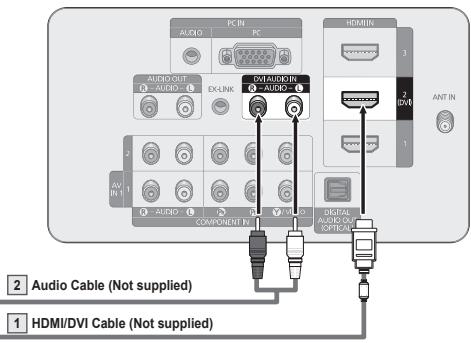
TV Rear Panel
Each DVD / Blu-Ray Player or Cable Box / Satellite receiver (Set-Top Box) has a different back panel configuration.
When connecting a DVD Player or Cable Box / Satellite receiver (Set-Top Box), match the color of the connection terminal to the cable.
When using an HDMI / DVI cable connection, you must use the HDMI IN 2(DVI) jack.
Connecting a DVD / Blu-Ray Player or Cable Box / Satellite receiver (Set-Top Box) via Component cables
The rear panel jacks on your TV make it easy to connect a DVD/Blu-Ray Player or Cable Box / Satellite receiver (Set-Top Box) to your TV.
- Connect Component Cable between the COMPONENT IN (1 or 2) [Y, PB, PR] jacks on the TV and the COMPONENT [Y, PB, PR] jacks on the DVD / Blu-Ray Player or Cable Box / Satellite receiver(Set-Top Box).
- Connect Audio Cables between the COMPONENT IN (1 or 2) [R-AUDIO-L] jacks on the TV and the AUDIO OUT jacks on the DVD / Blu-Ray Player or Cable Box / Satellite receiver (Set-Top Box).
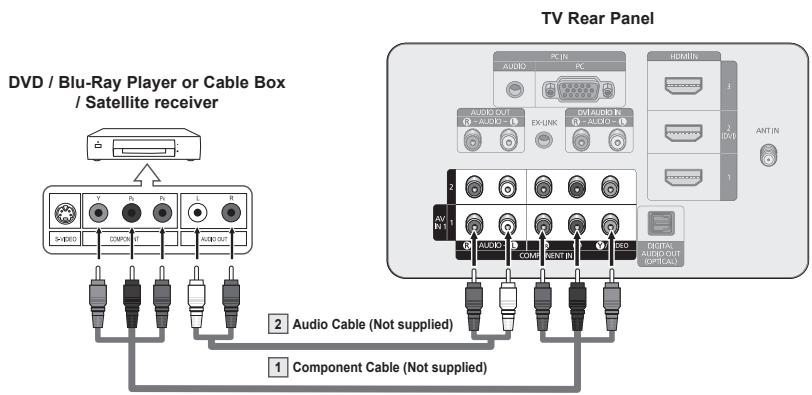
Component video separates the video into Y (Luminance (brightness)), P_B (Blue) and P_R (Red) for enhanced video quality. Be sure to match the component video and audio connections. For example, if connecting the video cable to COMPONENT IN 1, connect the audio cable to COMPONENT IN 1 also.
Each DVD / Blu-Ray Player or Cable Box / Satellite receiver (Set-Top Box) has a different back panel configuration.
When connecting a DVD / Blu-Ray Player or Cable Box / Satellite receiver (Set-Top Box), match the color of the connection terminal to the cable.
Connecting a Camcorder
The side and rear panel jacks on your TV make it easy to connect a camcorder to your TV.
□ Using an Video / Audio Cable
- Connect a Video Cable between the AV IN 2 [VIDEO] jack on the TV and the VIDEO OUT jack on the camcorder.
- Connect Audio Cables between the AV IN 2 [L-AUDIO-R] jacks on the TV and the AUDIO OUT jacks on the Camcorder.
Each Camcorder has a different back panel configuration.
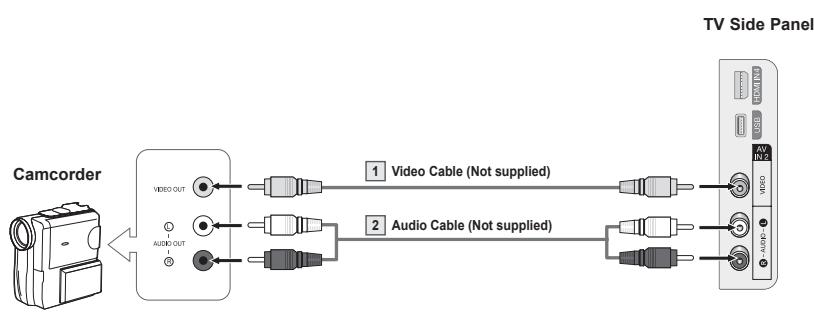
When connecting a Camcorder, match the color of the connection terminal to the cable.
Using an HDMI Cable
- Connect an HDMI Cable between the HDMI IN (1, 2(DVI), 3, or 4) jack on the TV and the HDMI jack on the camcorder.
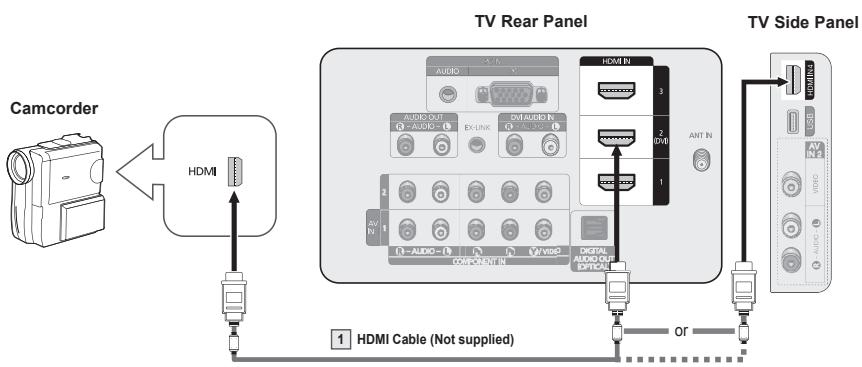
Each Camcorder has a different back panel configuration.
Connecting a VCR
Video Connection
These instructions assume that you have already connected your TV to an antenna or a cable TV system (according to the instructions on pages 10~11). Skip step 1 if you have not yet connected to an antenna or a cable system.
- Unplug the cable or antenna from the back of the TV.
- Connect the cable or antenna to the ANT IN terminal on the back of the VCR.
- Connect an Antenna Cable between the ANT OUT terminal on the VCR and the ANT IN terminal on the TV.
- Connect a Video Cable between the AV IN 1 [Y/VIDEO] or AV IN 2 [VIDEO] jack on the TV and the VIDEO OUT jack on the VCR.
- Connect Audio Cables between the AV IN 1 (or AV IN 2) [R-AUDIO-L] jacks on the TV and the AUDIO OUT jacks on the VCR
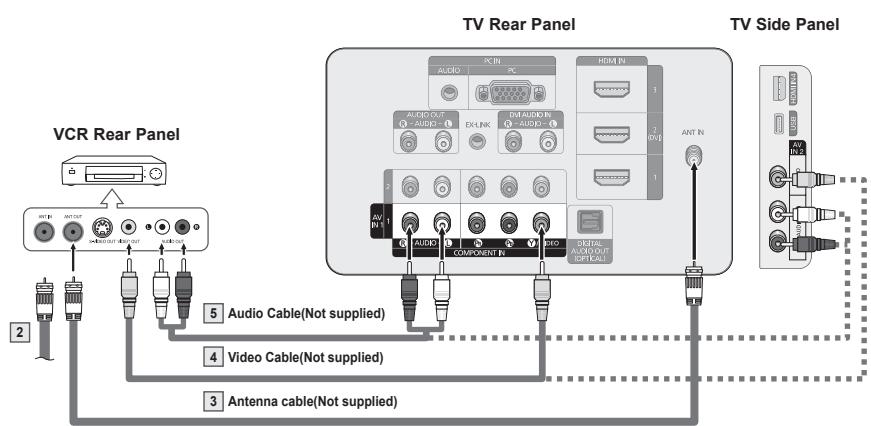
If you have a "mono" (non-stereo) VCR, use a Y-connector (not supplied) to connect to the right and left audio input jacks of the TV. Alternatively, connect the cable to the "R" jack. If your VCR is stereo, you must connect two cables.
Each VCR has a different back panel configuration.
When connecting a VCR, match the color of the connection terminal to the cable.
When connecting to AV IN 1, the color of the AV IN 1 [Y/VIDEO] jack (Green) does not match the color of the video cable (Yellow).
The rear panel jacks on your TV make it easy to connect a Digital Audio System(Home theater/Receiver) to your TV.
- Connect an Optical Cable between the DIGITAL AUDIO OUT (OPTICAL) jacks on the TV and the Digital Audio Input (OPTICAL) jacks on the Digital Audio System.
When a Digital Audio System is connected to the DIGITAL AUDIO OUT (OPTICAL) jack : Decrease the volume of the TV, and adjust the volume level with the system's volume control.
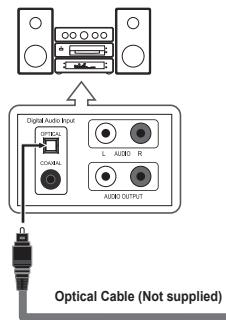
Digital Audio System
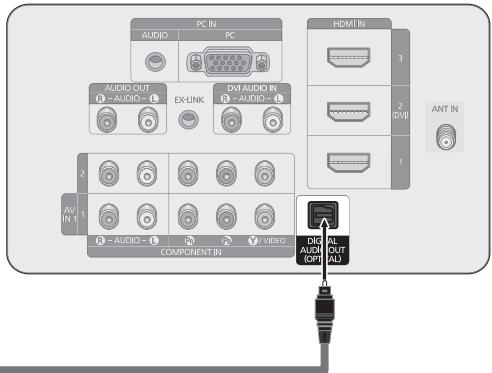
TV Rear Panel
5.1CH audio is possible when the TV is connected to an external device supporting 5.1CH.
Each Digital Audio System has a different back panel configuration.
When the receiver (home theater) is set to On, you can hear sound output from the TV's Optical jack. When the TV is displaying a DTV(air) signal, the TV will send out 5.1 channel sound to the Home theater receiver. When the source is a digital component such as a DVD and is connected to the TV via HDMI, only 2 channel sound will be heard from the Home Theater receiver.
If you want to hear 5.1 channel audio, connect the DIGITAL AUDIO OUT (OPTICAL) jack on the DVD / Blu-Ray player or Cable/ Satellite Box directly to an Amplifier or Home Theater, not the TV.
Connecting an Amplifier / DVD Home Theater
- Connect Audio Cables between the AUDIO OUT [R-AUDIO-L] jacks on the TV and AUDIO IN [L-AUDIO-R] jacks on the Amplifier/ DVD Home Theater.
When an audio amplifier is connected to the AUDIO OUT [R-AUDIO-L] jacks terminals : Decrease the volume of the TV, and adjust the volume level with the Amplifier's volume control.
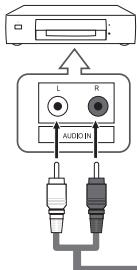
Amplifier / DVD Home Theater
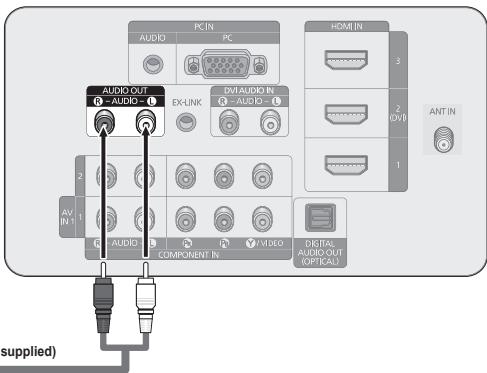
Audio Cable (Not supplied)
TV Rear Panel
Each Amplifier / DVD Home Theater has a different back panel configuration.
When connecting an Amplifier / DVD Home Theater, match the color of the connection terminal to the cable.
Using a D-Sub Cable
- Connect a D-Sub Cable between PC IN [PC] jack on the TV and the PC output jack on your computer.
- Connect a PC Audio Cable between the PC IN [AUDIO] jack on the TV and the Audio Out jack of the sound card on your computer.
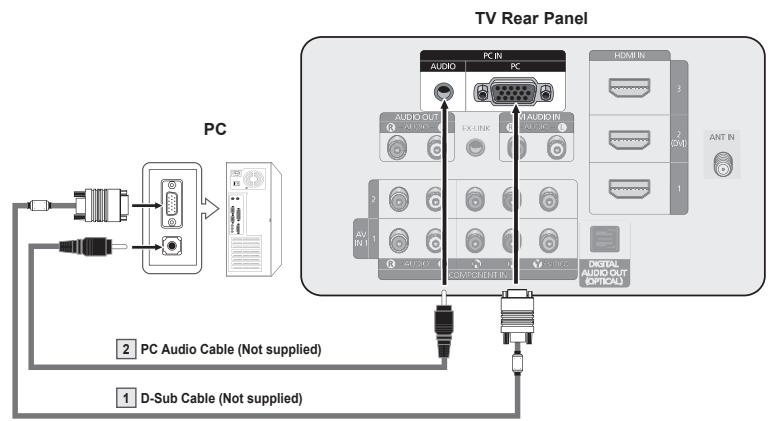
Using an HDMI/DVI Cable
- Connect an HDMI/DVI cable between the HDMI IN 2(DVI) jack on the TV and the PC output jack on your computer.
- Connect a 3.5 mm Stereo plug to 2RCA cable between the DVI AUDIO IN [R-AUDIO-L] jack on the TV and the Audio Out jack of the sound card on your computer.
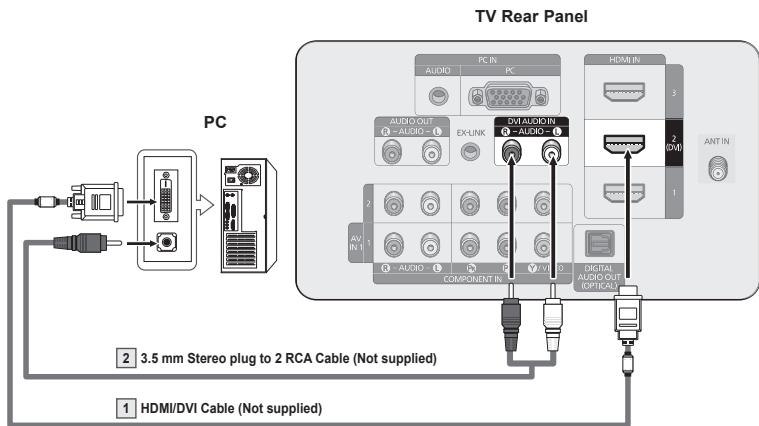
Each PC has a different back panel configuration.
When connecting a PC, match the color of the connection terminal to the cable.
When using an HDMI/DVI cable connection, you must use the HDMI IN 2(DVI) terminal.
Turning the TV On and Off
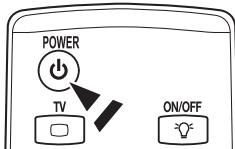
Press the POWER button on the remote control. You can also use the POWER button on the TV.
It may take a while for your TV to power on.
Changing Channels
Using the Channel Buttons
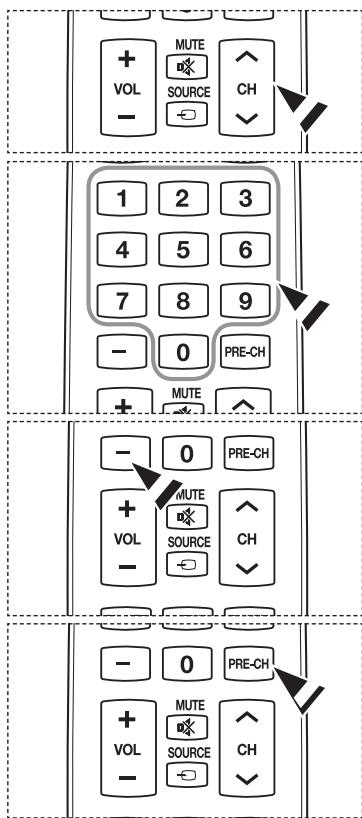
Press the CH or CH button to change channels.
When you press the CH or CH button, the TV changes channels in sequence. You will see all the channels that the TV has memorized. (The TV must have memorized at least three channels). You will not see channels that were either erased or not memorized. See page 21 to memorize channels.
Using the Number Buttons
Press the number buttons to go directly to a channel. For example, to select channel "27", press "2", then "7".
For quick channel change, press the number buttons, then press the ENTER button.
Using the [] Button
The " l button is used to select stations that broadcast a digital signal.
- For example, for Channel "7-1", press "7", then "□", then "1".
HD indicates the TV is receiving a Digital High Definition signal. SD indicates the TV is receiving a Standard Definition signal.
For quick channel change, press the number buttons, then press the ENTER button.
Using the PRE-CH Button to select the Previous Channel
- Press the PRE-CH button. The TV will switch to the last channel viewed.
To quickly switch between two channels that are far apart, tune to one channel, then use the number button to select the second channel. Then use the PRE-CH button to quickly alternate between them.
Adjusting the Volume
Using the Volume Buttons
- Press the VOL + or VOL = button to increase or decrease the volume.
Using the MUTE Button
- Press MUTE button and the sound cuts off. The will displayed on the screen.
- To turn mute off, press the MUTE button again, or simply press the VOL + or VOL - button.
At any time, you can cut off the sound using the MUTE button.
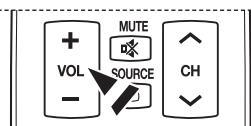
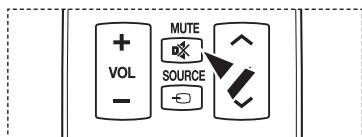
Using the TOOLS Button
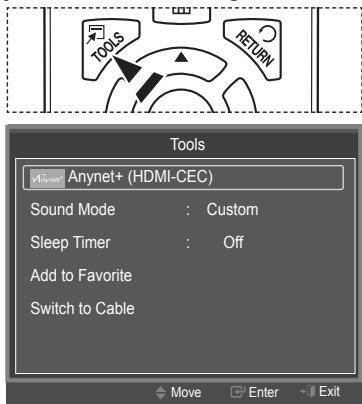
You can use the TOOLS button to select your frequently used functions quickly and easily. The Tools menu changes depending on which external input mode you are viewing.
- Press the TOOLS button. The Tools menu will appear.
- Press the / button to select a menu, then press the ENTER button.
-
Press the / / / buttons to display, change, or use the selected items. For a more detailed description of each function, refer to the corresponding page.
-
Anynet+ (HDMI-CEC), see page 44
Sound Mode, see page 29 - Sleep Timer, see page 34
- Add to Favorite (or Delete from Favorite), see page 20
- Switch to Cable (or Air), see page 21
- Auto Adjustment, see page 28
Using the Remote Control Backlight Buttons
Use this feature in dark surroundings and when you are unable to see the remote control buttons clearly.
- Press the ON/OFF light button
When ON, the button backlight is turned on for a moment.
Pressing a remote control button when the remote control is on turns the button backlight on for a moment.
If you touch or move the remote control and the motion is detected by the sensor of the remote control, the button backlight will be turned on for a moment.
The button backlight will not be turned on when the remote control is turned off.
Viewing the Display
The display identifies the current channel and the status of certain audio-video settings.
- Press the INFO button on the remote control. The TV will display the channel, the type of sound, and the status of certain picture and sound settings.
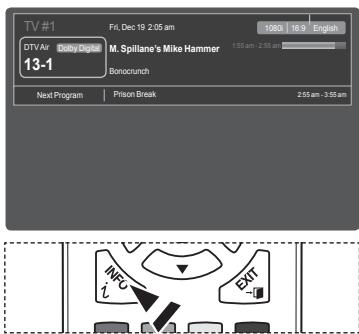
Press the INFO button once more or wait approximately 10 seconds and it disappears automatically.
Before using the TV, follow the steps below to learn how to navigate the menu in order to select and adjust different functions.
- Press the MENU button.
The main menu is displayed on the screen. Its left side has the following icons: Picture, Sound, Channel, Setup, Input, Application, Support. - Press the or button to select one of the icons.
Press the or button to access the icon's sub-menu. - Press the or button to move to items in the menu.
Press the ENTER button to enter items in the menu. - Press the / / button to change the selected items.
Press the RETURN button to return to the previous menu. - Press the EXIT button to exit from the menu.
Using the remote control buttons
| Button | Operations | Button | Operations |
| MENU | Display the main on-screen menu. | ▲/▼/▲/▲/▲/▲/▲/▲/▲/▲/▲/▲/▲/▲/▲/▲/▲/▲/▲/▲/▲/▲/▲/▲/▲/▲/▲/▲/▲/▲/▲/▲/▲/▲/▲/▲/▲/▲/▲/▲/▲/▲/▲/▲/▲/▲/▲/▲/▲/▲/▲/▲/ | Move the cursor and select an item. Select the currently selected item. Confirm the setting. |
| RETURN | Return to the previous menu. | ||
| EXIT | Exit the on-screen menu. |
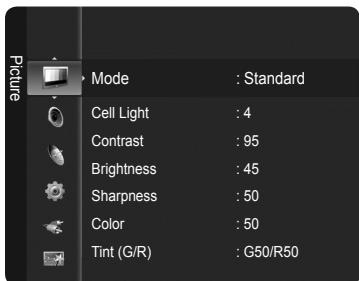
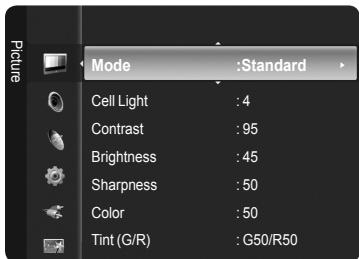
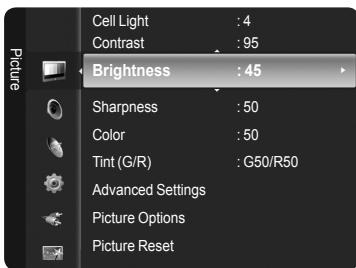
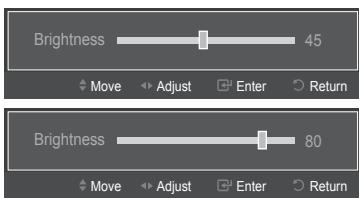
Example: Setting the TV's Brightness in the Picture Menu
Adjusting the Brightness to 80
-
Press the MENU button to display the menu.
-
Press the ENTER button to select Picture.
-
Press the or button to select Brightness.
-
Press the ENTER button.
-
Press the or button until the Brightness changes to 80.
-
Press the ENTER button.
Press the EXIT button to exit from the menu.
When the TV is initially powered on, basic settings proceed automatically and subsequently.
The Screen Saver is activated if there is no remote control key input for longer than 1 minute while Plug & Play is running.
The Screen Saver is activated if there is no operating signal for longer than 15 minutes.
- Press the POWER button on the remote control.
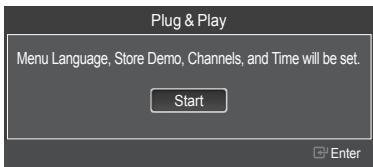
The message Menu Language, Store Demo, Channels, and Time will be set. is displayed.
- Press the ENTER button, then Sets the menu language. menu is automatically displayed.
Press the ENTER button.
Press the or button to select language, then press the ENTER按钮. The message Select 'Home Use' when installing this TV in your home is displayed.
- Press the or button to select Store Demo or Home Use, then press the ENTER button.
We recommend setting the TV to Home Use mode for the best picture in your home environment.
Store Demo mode is only intended for use in retail environments.
If the unit is accidentally set to Store Demo mode and you want to return to Home Use (Standard): Press the Volume button on the TV. When the volume OSD is displayed, press and hold the MENU button on the TV for 5 seconds.
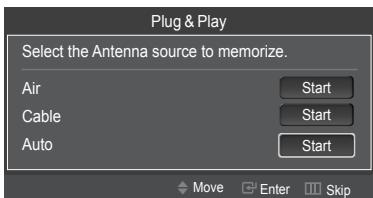
- The message Select the Antenna source to memorize. is displayed.
Press the or button to memorize the channels of the selected connection. Press the ENTER button to select Start.
Air: Air antenna signal.
- Cable: Cable antenna signal.
- Auto: Air and Cable antenna signals.
In Cable mode, you can select the correct signal source among STD, HRC, and IRC by pressing the , , or button, then press the ENTER按钮. If you have Digital cable, select the cable system signal source for both Analog and Digital. Contact your local cable company to identify the type of cable system that exists in your particular area.
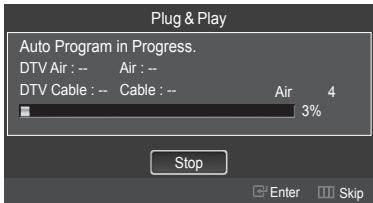
- The TV will begin memorizing all of the available channels.
To stop the search before it has finished, press the ENTER button with Stop selected.
After all the available channels are stored, it starts to remove scrambled channels. The Auto program menu then reappears. Press the ENTER button when channel memorization is complete.
- The message Set the Clock Mode. is displayed. Press the ENTER button.
Press the or button to select Auto, then Press the ENTER button. The message Set to daylight saving time is displayed. If you select Manual, Set current date and time is displayed. For detailed descriptions about the Manual, refer to page 34.
- Press the or button to select Off, On, or Auto, then press the ENTER button.
The image to select time zone in which you live is automatically displayed.
- Press the or button to Select the time zone, then press the ENTER button.
If you have received a digital signal, the time will be set automatically. If not, see page 34 to set the clock.
- The brief instruction on How to get the best performance from your new HDTV is displayed.
Press the ENTER button.
You can access the HD Connection Guide in the Support menu.
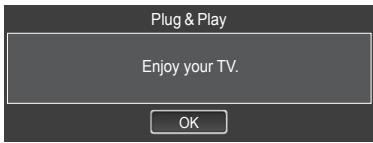
- Press the ENTER button. The message Enjoy your TV. is displayed.
When you have finished, press the ENTER button.
If you want to reset this feature...
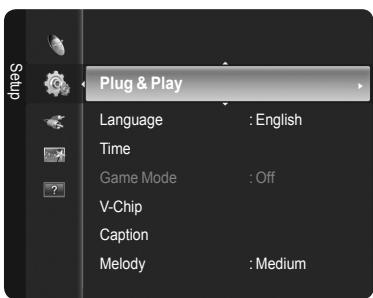
- Press the MENU button to display the menu. Press the or button to select Setup, then press the ENTER button.
- Press the ENTER button again to select Plug & Play. For further details on setting up options, press the ENTER button again.
The Plug & Play feature is only available in the TV mode.
Storing Channels
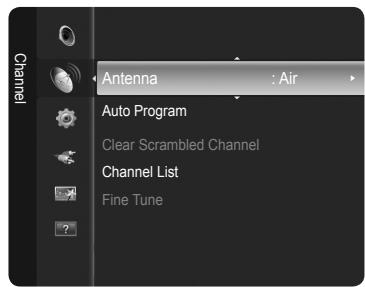
Antenna Air / Cable
Before your television can begin memorizing the available channels, you must specify the type of signal source that is connected to the TV (i.e. an Air or a Cable system).
Press the TOOLS button to display Tools menu. You can also switch the antenna by selecting Tools Switch to Cable (or Air)
Auto Program
Air: Air antenna signal.
- Cable: Cable antenna signal.
- Auto: Air and Cable antenna signals
l STD, HRC and IRC identify various types of cable TV systems. Contact your local cable company to identify the type of cable system that exists in your particular area. At this point the signal source has been selected.
After all the available channels are stored, it starts to remove scrambled channels. The Auto program menu then reappears.
If you want to stop Auto Programming, press the ENTER button. The Stop Auto Program? message will be displayed. Select Yes by pressing the or button, then press the ENTER button.
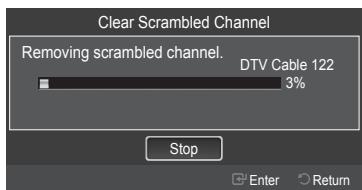
Clearing Scrambled Channel (Digital)
The Clear Scrambled Channel function is used to filter out scrambled channels after Auto Program is completed. This process may take up to 20~30 minutes.
To stop searching scrambled channels: Press the ENTER按钮 to select Stop. Press the button to select Yes, then press the ENTER按钮.
This function is only available in Cable mode.
Fine Tune (Analog)
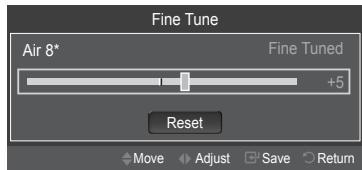
Use fine tuning to manually adjust a particular channel for optimal reception.
If you do not store the fine-tuned channel in memory, adjustments are not saved.
“*” will appear next to the name of fine-tuned channels.
To reset the fine tuning setting, press the button to select Reset, then press the ENTER按钮.
Managing Channels
□ Channel List
Using this menu, you can Add / Delete or set Favorite channels and use the program guide for digital broadcasts.
Press the CH LIST button on the remote control to bring up the channel lists.
- All Channels: Shows all currently available channels.
- Added Channels: Shows all added channels.
- Favorite: Shows all favorite channels.
- Programmed: Shows all current reserved programs.
Using the Color buttons with the Channel List
- Green (Zoom): Enlarges or shrinks a channel number.
- Yellow (Select): Selects multiple channel lists.
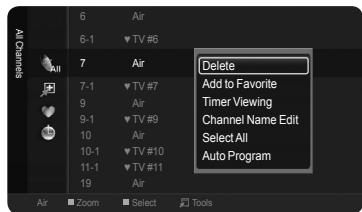
TOOLS (Tools): Displays the Add (or Delete), Add to Favorite (or Delete from Favorite), Timer Viewing, Channel Name Edit, Select All, Deselect All, and Auto Program menus (The Options menus may differ depending on the situation.)
Channel Status Display Icons
| ♥ | A channel set as a Favorite. | ✔ | A channel selected by pressing the yellow button. |
| ◎ | A reserved program | ◎ | A program currently being broadcast. |
□ Channel List Option Menu (in All Channels / Added Channels / Favorite)
Press the TOOLS button to use the option menu.
Option menu items may differ depending on the channel status.
Add/Delete
You can delete or add a channel to display the channels you want.
All deleted channels will be shown on All Channels menu.
A gray-colored channel indicates the channel has been deleted.
The Add menu only appears for deleted channels.
You can also delete a channel to the Added Channels or Favorite menu in the same manner.
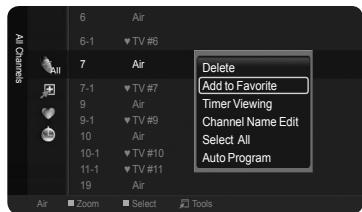
Add to Favorite / Delete from Favorite
You can set channels you watch frequently as favorites.

Press the TOOLS button to display Tools menu.
You can also set the favorite channel by selecting Tools
Add to Favorite (or Delete from Favorite)
The "♥" symbol will be displayed and the channel will be set as a favorite.
All favorite channels will be shown on Favorite menu.
To select the favorite channels you have set up, press the FAV.CH button on the remote control.
Timer Viewing
If you reserve a program you want to watch, the channel is automatically switched to the reserved channel in the Channel List; even when you are watching another channel.
To reserve a program, set the current time first.
Only memorized channels can be reserved.
You can set the channel, day, month, year, hour and minute directly by pressing the number buttons on the remote control.
Reserving a program will be shown on Programmed menu.
Digital Program Guide and Viewing Reservation: When a digital channel is selected, and you press the button, the Program Guide for the channel appears. You can reserve a program according to the procedures described above.
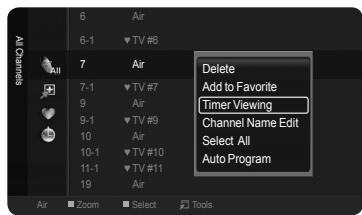
Select All / Deselect All
- Select All: You can select all the channels in the channel list.
- Deselect All: You can deselect all the selected channels in the channel list.
You can perform the add / delete, add to Favorite / delete from Favorite function for multiple channels at the same time. Select the required channels and press the yellow button to set all the selected channels at the same time.
The mark appears to the left of the selected channels.
You can only select Deselect All when there is a selected channel.
Channel Name Edit (Analog)
Channels can be labeled so that their call letters appear whenever the channel is selected.
The names of digital broadcasting channels are automatically assigned and cannot be labeled.
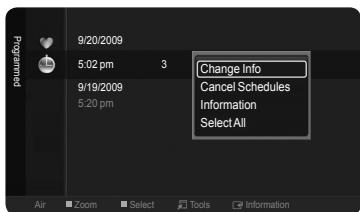
□ Channel List Option Menu (in Programmed)
You can view, modify or delete a reservation.
Press the TOOLS button to use the option menu.
Change Info
Select to change a viewing reservation.
Cancel Schedules
Select to cancel a viewing reservation.
Information
Select to view a viewing reservation. (You can also change the reservation information.)
Select All / Deselect All
You can select (or deselect) all channels in the channel list.
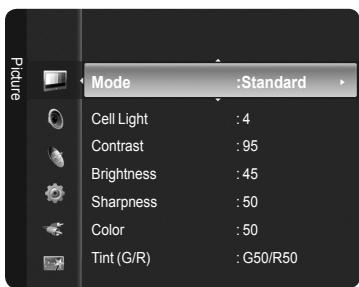
Changing the Picture Settings
Mode
You can select the type of picture which best corresponds to your viewing requirements.
- Dynamic: Select a high-definition picture for bright environments.
- Standard: Selects the optimal picture display for normal environments. This setting is convenient for most situations.
- Movie: Selects a comfortable picture display for dark environments.
Cell Light / Contrast / Brightness / Sharpness / Color / Tint (G/R)
Your television has several setting options that allow you to control the picture quality.
- Cell Light: Adjusts the pixel brightness. 10 is the brightest setting.
- Contrast: Adjusts the contrast level.
- Brightness: Adjusts the brightness level.
- Sharpness: Adjusts the sharpness.
Color: Adjusts the color saturation of the picture using the bar on the screen. - Tint (G/R): The closer to Red 100, the more saturated the red color becomes.
When you make changes to Cell Light, Contrast, Brightness, Sharpness, Color, or Tint (G/R), the OSD will be adjusted accordingly.
When in PC mode, Tint (G/R), Sharpness and Color are not available.
Settings can be adjusted and stored for each external device you have connected to an input of the TV.
The energy consumed during use can be significantly reduced if the brightness level is lowered, which will reduce the overall running cost.
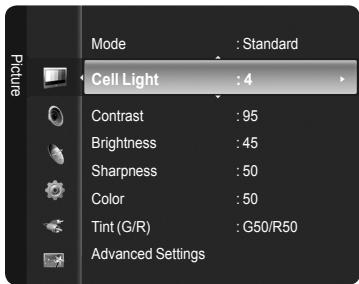
Advanced Settings
You can adjust the detailed settings for your screen including the color and contrast.
Advanced Settings is available in Standard or Movie mode.
In PC mode, you can only make changes to Gamma and White Balance from among the Advanced Settings items.
Black Tone
You can select the black level on the screen to adjust the screen depth.
- Off: Turns the Black Adjust function off.
- Dark: Sets the black color depth to dark.
- Darker: Sets the black color depth to darker.
- Darkest: Sets the black color depth to darkest.
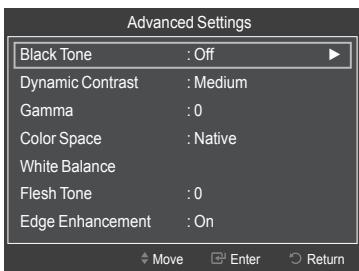
Dynamic Contrast
You can adjust the screen contrast so that the optimal contrast is provided.
- Off: Turns the Dynamic Contrast function off.
- Low: Sets Dynamic Contrast to low.
Medium: Sets Dynamic Contrast to medium.
High: Sets Dynamic Contrast to high.
Gamma
You can adjust the Primary Color (Red, Green, Blue) Intensity.
Color Space
Color Space is a color matrix composed of red, green and blue colors. Select your favorite color space to experience the most natural color.
- Native: Sets the color range wider than that of the input video source.
- Auto: Automatically sets the color range depending on the input video source.
White Balance
You can adjust the color temperature for more natural picture colors.
R-Offset: Adjust the low level red intensity.
- G-Offset: Adjust the low level green intensity.
B-Offset: Adjust the low level blue intensity.
R-Gain: Adjusts the high level red intensity.
G-Gain: Adjusts the high level green intensity.
B-Gain: Adjusts the high level blue intensity.
- Reset: Resets the default white balance.
Changing the adjustment value will refresh the adjusted screen.
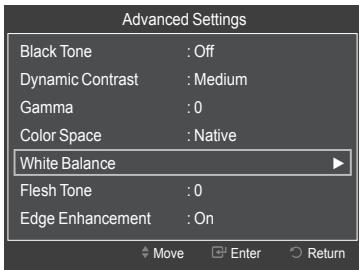
Flesh Tone
You can emphasize the pink flesh tone in the picture.
Changing the adjustment value will refresh the adjusted screen.
Edge Enhancement Off / On
You can emphasize object boundaries in the picture.
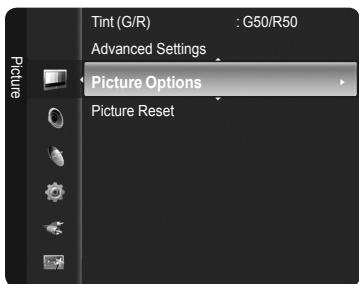
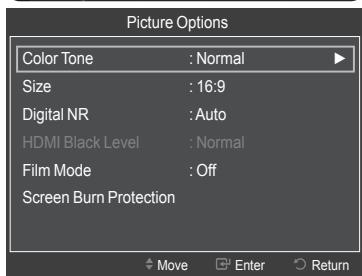
Picture Options
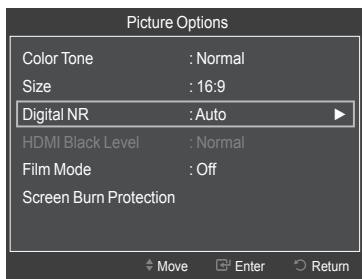
In PC mode, you can only make changes to the Color Tone, Size and Screen Burn Protection from among the items in Picture Options.
Color Tone Cool / Normal / Warm1 / Warm2
You can select the most comfortable color tone for viewing.
Warm1 or Warm2 is only activated when the picture mode is Movie.
Settings can be adjusted and stored for each external device you have connected to an input of the TV.
Size
Occasionally, you may want to change the size of the image on your screen. Your TV comes with six screen size options, each designed to work best with specific types of video input. Your satellite receiver may have its own set of screen sizes as well. In general, though, you should view the TV in 16:9 mode as much as possible.
16:9 : Sets the picture to the 16:9 aspect ratio.
- Zoom1: Stretches the 16:9 aspect ratio picture vertically.
- Zoom2: Stretches the Zoom 1 picture vertically.
- Wide Fit: Stretches the picture both horizontally and vertically to display the optimal picture.
4:3: Sets the picture to the 4:3 aspect ratio.
- Screen Fit: Displays the full native HD signal that cannot be viewed using a normal TV.
Alternate, you can press the P.SIZE button on the remote control repeatedly to change the picture size.
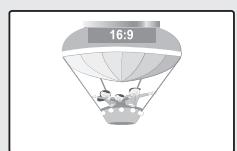
16:9
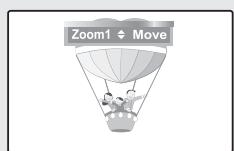
Zoom1
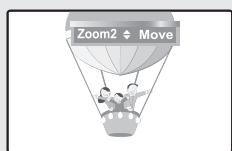
Zoom2
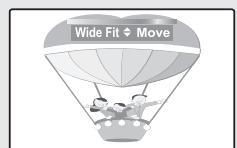
Wide Fit
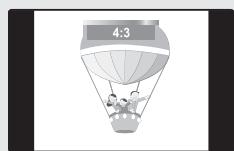
4:3
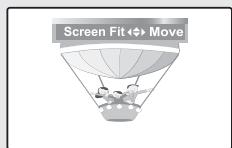
Screen Fit
Temporary image retention may occur when viewing a static image on the set for more than two hours.
After selecting Zoom1, Zoom2 or Wide Fit:
Press the or button to select Position, then press the ENTER button.
Press the or button to move the picture up and down.
After selecting Screen Fit in HDMI (1080i/1080p) or Component (1080i/1080p) mode, you may made need to center the picture: Press the or button to select Position, then press the ENTER button.
Press the , , or button to move the picture.
Reset: Press the or button to select Reset, then press the ENTER button. The TV will be reset to 16:9.
HD (High Definition): 16:9 - 1080i/1080p (1920x1080), 720p (1280x720)
Settings can be adjusted and stored for each external device you have connected to an input of the TV. In PC Mode, only 16:9 and 4:3 mode can be adjusted.
Settings can be adjusted and stored for each external device you have connected to an input of the TV.
| Input Source | Picture Size |
| ATV, Video, Component (480i, 480p) | 16:9, Zoom1, Zoom2, 4:3 |
| Component (720p) | 16:9, Wide Fit, 4:3 |
| DTV(1080i), Component (1080i, 1080p), HDMI (720p, 1080i, 1080p) | 16:9, 4:3, Wide Fit, Screen Fit |
| PC | 16:9, 4:3 |
Digital NR
If the broadcast signal received by your TV is weak, you can activate the Digital Noise Reduction feature to help reduce any static and ghosting that may appear on the screen.
- Off: Turns the Digital NR function off.
- Low: Sets Digital NR to low.
Medium: Sets Digital NR to medium.
High: Sets Digital NR to high. - Auto: Sets Digital NR to Auto.
HDMI Black Level
You can directly select the black level on the screen to adjust the screen depth.
Normal: The screen gets brighter.
Low: The screen gets darker.
This function is active only when an external device is connected to the TV via HDMI. HDMI Black Level function may not be compatible with all external devices.
■ Film Mode
The TV can be set to automatically sense and process film signals from all sources and adjust the picture for optimum quality.
- Off: Basic video image processing applied and No auto-detection for film-based programs.
- Auto: Automatically adjusts for the best image quality between film and video programs.
- Cinema Smooth: Cinema Smooth reproduces film cinema video with greatly reduced or without visible motion judder, as you see it in the movie theater. (PN50B560T5F/PN58B560T5F/PN63B590T5F only)
Only if HDMI 1080p 24Hz signal is input, Cinema Smooth function is activated and you can set ON/OFF.
Film mode is supported in TV, Video, Component (480i / 1080i) and HDMI (1080i).
Screen Burn Protection
- Configures the Screen Burn Protection options to prevent and reduce pixel burn.
- When an image remains in one position too long, it may cause a permanent burn on the screen.
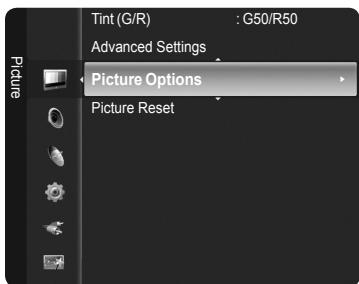
Preventing Screen Burn-in
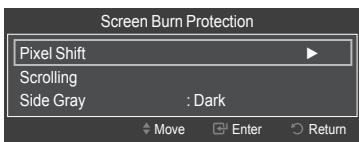
To reduce the possibility of screen burn, this unit is equipped with screen burn prevention technology. This technology enables you to set picture movement up/down (Vertical Line) and side to side (Horizontal Dot). The Time setting allows you to program the time between movement of the picture in minutes.
- Pixel Shift : Using this function, you can minutely move pixels on the PDP in horizontal or vertical direction to prevent after-images on the screen.
Optimum condition for pixel shift;
| Item | TV/AV/Component/HDMI/PC | |
| Horizontal | 0~4 | 4 |
| Vertical | 0~4 | 4 |
| Time(min) | 1~4min. | 2 min |
-
Side Gray : When you watch TV with the screen ratio of 4:3, the screen is prevented from any damage by adjusting the white balance on both extreme left and right sides. To prevent the screen burn from happening, select Dark or Light.
-
Dark: When you set the screen ratio to 4:3, it darkens the left and right sides.
- Light: When you set the screen ratio to 4:3, it brightens the left and right sides.
Reducing the Effects of Screen Burn
If screen burn has occurred, you can select Scrolling to help remove screen burn artifacts.
- Scrolling : This function removes after-images on the screen by moving all the pixels on the PDP according to a pattern. Use this function when there are remaining after-images or symbols on the screen, especially when you displayed a still image on the screen for a long time.
The after-image removal function has to be executed for a long time (approximately 1 hour) to effectively remove afterimages on the screen. If the after-image is not removed after performing the function, repeat the function again.
Press any key on the remote control to cancel this feature.
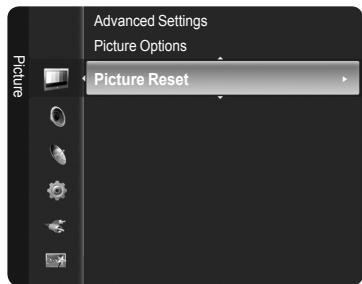
Picture Reset Reset Picture Mode / Cancel
Resetssall picture settings to the default values.
Select a picture mode to be reset. The reset is performed for each picture mode.
Using Your TV as a Computer (PC) Display
Setting Up Your PC Software (Based on Windows XP)
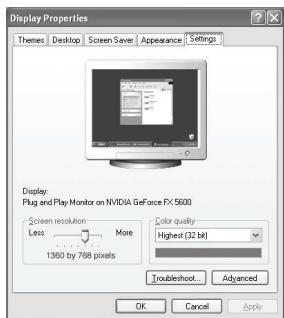
The Windows display-settings for a typical computer are shown below. The actual screens on your PC will probably be different, depending upon your particular version of Windows and your particular video card. However, even if your actual screens look different, the same basic set-up information will apply in almost all cases.
(If not, contact your computer manufacturer or Samsung Dealer.)
- First, click on Control Panel on the Windows start menu.
- When the control panel window appears, click on Appearance and Themes and a display dialog-box will appear.
- When the control panel window appears, click on Display and a display dialog-box will appear.
- Navigate to the Settings tab on the display dialog-box. The correct size setting (resolution) Optimum : 1920 X 1080 pixels. If a vertical frequency option exists on your display settings dialog box, the correct value is 60 or 60 Hz. Otherwise, just click OK and exit the dialog box.
Display Modes
If the signal from the system equals the standard signal mode, the screen is adjusted automatically. If the signal from the system doesn't equal the standard signal mode, adjust the mode by referring to your videocard user guide; otherwise there may be no video. For the display modes listed below, the screen image has been optimized during manufacturing.
D-Sub and HDMI/DVI Input
| Mode | Resolution | Horizontal Frequency (kHz) | Vertical Frequency (Hz) | Pixel Clock Frequency (MHz) | Sync Polarity (H/V) |
| IBM | 640 x 350 | 31.469 | 70.086 | 25.175 | +/- |
| 720 x 400 | 31.469 | 70.087 | 28.322 | -/+ | |
| MAC | 640 x 480 | 35.000 | 66.667 | 30.240 | -/- |
| 832 x 624 | 49.726 | 74.551 | 57.284 | -/- | |
| 1152 x 870 | 68.681 | 75.062 | 100.000 | -/+ | |
| VESA CVT | 720 x 576 | 35.910 | 59.950 | 32.750 | -/+ |
| 1152 x 864 | 53.783 | 59.959 | 81.750 | -/+ | |
| 1280 x 720 | 44.772 | 59.855 | 74.500 | -/+ | |
| 1280 x 720 | 56.456 | 74.777 | 95.750 | -/+ | |
| 1280 x 960 | 75.231 | 74.857 | 130.000 | -/+ | |
| VESA DMT | 640 x 480 | 31.469 | 59.940 | 25.175 | -/- |
| 640 x 480 | 37.861 | 72.809 | 31.500 | -/- | |
| 640 x 480 | 37.500 | 75.000 | 31.500 | -/- | |
| 800 x 600 | 37.879 | 60.317 | 40.000 | +/+ | |
| 800 x 600 | 48.077 | 72.188 | 50.000 | +/+ | |
| 800 x 600 | 46.875 | 75.000 | 49.500 | +/+ | |
| 1024 x 768 | 48.363 | 60.004 | 65.000 | -/- | |
| 1024 x 768 | 56.476 | 70.069 | 75.000 | -/- | |
| 1024 x 768 | 60.023 | 75.029 | 78.750 | +/+ | |
| 1152 x 864 | 67.500 | 75.000 | 108.000 | +/+ | |
| 1280 x 800 | 49.702 | 59.810 | 83.500 | -/+ | |
| 1280 x 800 | 62.795 | 74.934 | 106.500 | -/+ | |
| 1280 x 960 | 60.000 | 60.000 | 108.000 | +/+ | |
| 1280 x 1024 | 63.981 | 60.020 | 108.000 | +/+ | |
| 1280 x 1024 | 79.976 | 75.025 | 135.000 | +/+ | |
| 1360 x 768 | 47.712 | 60.015 | 85.500 | +/+ | |
| 1440 x 900 | 55.935 | 59.887 | 106.500 | -/+ | |
| 1440 x 900 | 70.635 | 74.984 | 136.750 | -/+ | |
| 1680 x 1050 | 65.290 | 59.954 | 146.250 | -/+ | |
| VESA GTF | 1280 x 720 | 52.500 | 70.000 | 89.040 | -/+ |
| 1280 x 1024 | 74.620 | 70.000 | 128.943 | -/- | |
| VESA DMT / DTV CEA | 1920 x 1080p | 67.500 | 60.000 | 148.500 | +/+ |
When using an HDMI/DVI cable connection, you must use the HDMI IN 2(DVI) terminal.
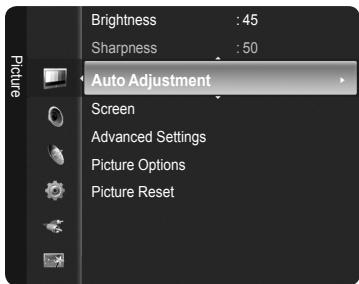
Auto Adjustment
Use the Auto Adjust function to have the TV set automatically adjust the video signals it receives. The function also automatically fine-tunes the settings and adjusts the frequency values and positions.
Press the TOOLS button to display Tools menu.
You can also set the Auto Adjustment by selecting Tools Auto Adjustment.
Preset: Press the SOURCE button to select PC mode.
This function does not work in DVI-Digital mode.
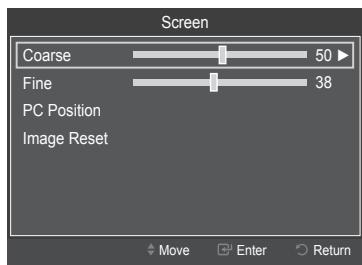
Screen
The purpose of the picture quality adjustment is to remove or reduce picture noise. If the noise is not removed by fine tuning alone, then make the vertical frequency adjustments on your PC and fine tune again.
After the noise has been reduced, re-adjust the picture so that it is aligned on the center of the screen.
Preset: Press the SOURCE button to select PC mode.
Coarse
Adjusts the frequency when vertical noise appears on the screen.
Fine
Adjusts the screen to be clearer.
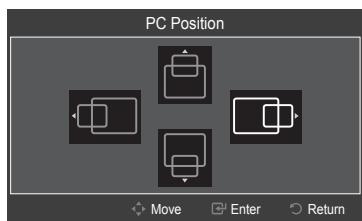
PC Position
Adjust the PC's screen positioning if it does not fit the TV screen. Press the or button to adjusting the Vertical-Position. Press the or button to adjust the Horizontal-Position.
Image Reset
You can replace all image settings with the factory default values.
Changing the Sound Settings
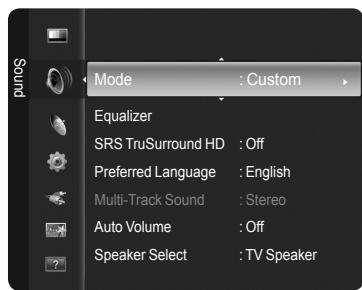
Mode
You can select the sound mode to best suit the programming you're watching.
- Standard: This sound mode is for general purposes.
- Music: Music mode enables you to listen to music as if you are sitting in a concert hall.
- Movie: Movie mode enables you to experience live and full movie sound as if you are sitting in a movie theater.
- Clear Voice: Emphasizes voice over other sounds. Select this sound mode when watching news, soap operas, or documentaries.
- Custom: You can customize the sound settings to suit your personal preferences.
Press the TOOLS button to display Tools menu. You can also set the sound mods by selecting Tools Sound Mode
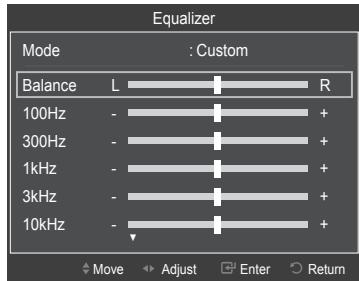
Equalizer
The sound settings can be adjusted to suit your personal preferences.
Mode: Selects the sound mode among the predefined settings.
Balance L/R: Adjusts the balance between the right and left speaker.
- 100Hz, 300Hz, 1kHz, 3kHz, 10kHz (Bandwidth Adjustment): Adjusts the level of different bandwidth frequencies.
- Reset: Resets the equalizer settings to the default values.
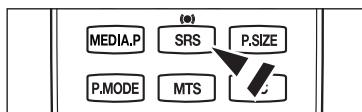
SRS TruSurround HD Off / On
SRS TruSurround HD enables you to enjoy a virtual 5.1 Surround Sound effect over the TV's two speakers.
This function provides not only rich deep bass also improves high frequency resolution.
You can select these options simply by pressing the SRS button on the remote control.

TruSurround HD DIGITAL
TruSurround HD, SRS and the () symbol are trademarks of SRS Labs, Inc.
TruSurround HD technology is incorporated under license from SRS Labs, Inc.
Preferred Language (Digital)
Digital-TV broadcasts are capable of simultaneous transmission of many audio tracks (for example, simultaneous translations of the program into foreign languages).
You can only select the language from among the actual languages being broadcast.
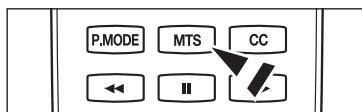
You can listen in a language other than the Preferred Language by pressing the MTS button on the remote control.
Multi-Track Sound (MTS) (Analog)
- Mono: Choose for channels that are broadcasting in mono or if you are having difficulty receiving a stereo signal.
- Stereo: Choose for channels that are broadcasting in stereo.
- SAP: Choose to listen to the Separate Audio Program, which is usually a foreign-language translation.
Depending on the particular program being broadcast, you can listen to Mono, Stereo, or SAP.
Press the MTS button on the remote control repeatedly to select Mono, Stereo, or SAP.
Auto Volume Off / On
Each broadcasting station has its own signal conditions, and so it is not easy to adjust the volume every time the channel is changed. This feature lets you automatically adjust the volume of the desired channel by lowering the sound output when the modulation signal is high or by raising the sound output when the modulation signal is low.
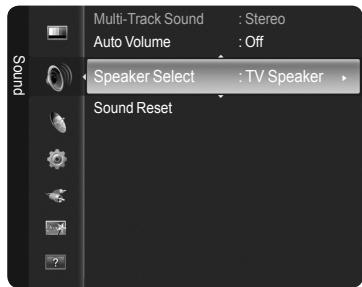
Speaker Select
When you watch TV with it connecting to a Home theater, turn the TV speakers off so you can listen to sound from the Home theater's (external) speakers.
- External Speaker: Uses the external speakers(Home Theater) to output sound.
- TV Speaker: Uses the TV speakers to output sound.
If you select External Speaker in the Speaker Select menu, the sound settings will be limited.
The volume buttons and MUTE buttons do not operate when the Speaker Select is set to External Speaker.
Please set the volume on your Home theater.
| TV's Internal Speakers | Audio Out (Optical, L / R Out) to Sound System | |
| TV / AV / Component / PC / HDMI | TV / AV / Component / PC / HDMI | |
| TV Speaker | Speaker Output | Sound Output |
| External Speaker | Mute | Sound Output |
| Video No Signal | Mute | Mute |

DOLBY
DIGITAL
Manufactured under license from Dolby Laboratories. Dolby and the double-D symbol are trademarks of Dolby Laboratories.
Sound Reset
You can restore the Sound settings to the factory defaults.
- Reset All: All the sound values return to default settings.
- Reset Sound Mode: Current sound values return to default settings.
- Cancel: Select the sound reset options.
Function Description
Configuring the Setup Menu
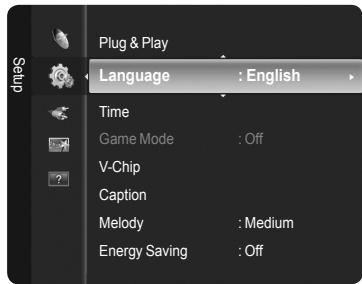
Language
You can set the menu language.
Game Mode Off/On
When connecting to a game console such as PlayStationTM or XboxTM, you can enjoy a more realistic gaming experience by selecting the game menu.
When the Game Mode is On
- Picture mode is automatically changed to Standard and cannot be changed.
Sound mode is automatically changed to Custom and cannot be changed. Adjust the sound using the equalizer. - The Reset in the Sound menu is activated. Reset function initializes the Equalizer settings to the factory default setting.
Game Mode is not available in regular TV mode or Game Mode set to Off.
If the picture is poor when an external device is connected to the TV, check if Game Mode is On.
If you display the TV menu in Game mode, the screen shakes slightly.
The mark () appears on the screen which means that Game Mode is on with the selected source.
This function supports only game function.
Game mode is not available in PC mode.
V-Chip
The V-Chip feature automatically locks out programs that are deemed inappropriate for children. The user must enter a PIN (personal ID number) before any of the V-Chip restrictions are set up or changed.
V-Chip function is not available in HDMI, Component or PC mode.
The default PIN number of a new TV set is '0-0-0-0'.
If you forget the PIN, press the remote-control buttons in the following sequence, which resets the pin to '0-0-0-0': Power Off. MUTE 8 2 4 Power On.
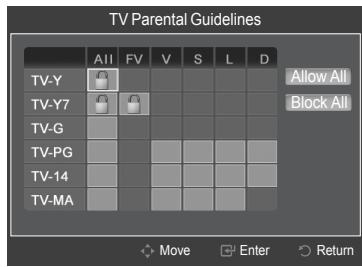
Allow all: Press to unlock all TV ratings. / Block all: Press to lock all TV ratings.
V-Chip Lock Off / On
Turns the V-Chip function on/off.
TV Parental Guidelines
First, set up a personal identification number (PIN) and enable the V-Chip.
Parental restrictions can be set up using either of two methods: The TV guidelines or the MPAA rating.
- Base Categories
- TV-Y: Young children / TV-Y7: Children 7 and over / TV-G: General audience /
TV-PG: Parental guidance / TV-14: Viewers 14 and over / TV-MA: Mature audience
- Sub-ratings
- All: Lock all TV ratings. / FV: Fantasy violence / V: Violence / S: Sexual situation
/ L: Adult Language / D: Sexually Suggestive Dialog
The V-Chip will automatically block certain categories that are more restrictive.
For example, if you block TV-Y category, then TV-Y7 will automatically be blocked. Similarly, if you block the TV-G category, then all the categories in the young adult group will be blocked (TV-G, TV-PG, TV-14 and TVMA). The sub-ratings (D, L, S, V) work together similarly.
MPAA Rating
The MPAA rating system uses the Motion Picture Association of America (MPAA) system and its main application is for movies. When the V-Chip lock is on, the TV will automatically block any programs that are coded with objectionable ratings (either MPAA or TV-Ratings).
G: General audience (no restrictions).
- PG: Parental guidance suggested.
PG-13: Parents strongly cautioned.
- R: Restricted. Children under 17 should be accompanied by an adult.
NC-17: No children under age 17.
X: Adults only.
- NR: Not rated.
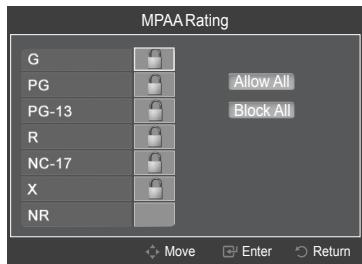
While a particular category is selected, press the ENTER button to activate it.
The " " symbol will be displayed. Press the ENTER button to block or unblock the category.
The V-Chip will automatically block any category that is More restrictive.
For example, if you block the PG-13 category, then R, NC-17 and X will automatically be blocked also.
Canadian English
You can block TV programs depending on their Canadian English rating.
C: Programming intended for children under age 8.
C8+: Programming generally considered acceptable for children 8 years and over to watch on their own.
G: General programming, suitable for all audiences.
- PG: Parental Guidance.
- 14+: Programming contains themes or content which may not be suitable for viewers under the age of 14.
18+: Adult programming.
The V-Chip will automatically block any category that is More restrictive.
For example, if you block G category, then PG, 14+ and 18+ will automatically be blocked also.
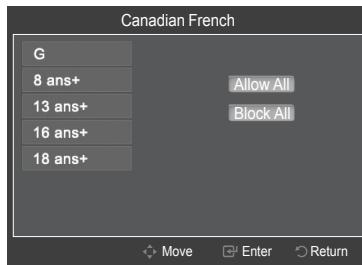
Canadian French
You can block TV programs depending on their French Canadian rating.
G:General
- 8 ans+: Programming generally considered acceptable for children 8 years and over to watch on their own.
13 ans+: Programming may not be suitable for children under the age of 13.
16 ans+: Programming is not suitable for children under the age of 16.
18 ans+: Programming restricted to adults.
The V-Chip will automatically block any category that is More restrictive.
For example, if you block 8 ans+ category, then 13 ans+, 16 ans+ and 18 ans+ will automatically be blocked also.
Downloadable U.S. Rating
Parental restriction information can be used while watching DTV channels
If information is not downloaded from the broadcasting station, the Downloadable U.S. Rating menu is deactivated.
Parental restriction information is automatically downloaded while watching DTV channels. It may take several seconds.
The Downloadable U.S. Rating menu is available for use after information is downloaded from the broadcasting station. However, depending on the information from the broadcasting station, it may not be available for use.
Parental restriction levels differ depending on the broadcasting station. The default menu name and Downloadable U.S. Rating changes depending on the downloaded information.
Even if you set the On-screen display to your desired language, the Downloadable U.S. Rating menu will appear in English only.
The rating will automatically block certain categories that are more restrictive.
The rating titles (For example: Humor Level..etc) and TV ratings (For example: DH, MH, H..etc) may differ depending on the broadcasting station.
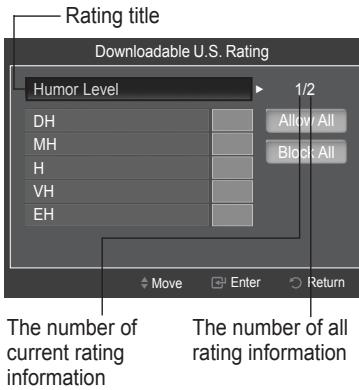
Change PIN
You can change four-digit code to use the V-Chip function.
The default PIN code for a new TV set is '0-0-0-0'.
If you change the PIN code completely, the message PIN is changed successfully. is displayed.
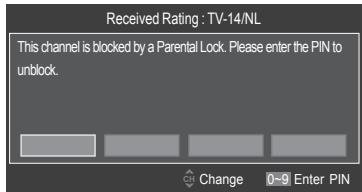
How to Reset the TV after the V-Chip Blocks a Channel (Emergency Escape)
If the TV is tuned to a restricted channel, the V-Chip will block it. The screen will go blank and the following message will appear.
- Enter your PIN.
To resume normal viewing, tune to a different channel using CH button. Under certain conditions (depending on the rating of the local TV programs) the V-Chip might lock out all the channels. In this case, use the V-Chip function for an "emergency escape":
If you forget the PIN, press the remote-control buttons in the following sequence, which resets the pin to '0-0-0-0': Power Off. MUTE 8 2 4 Power On.
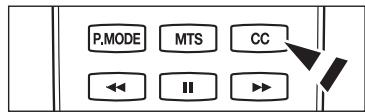
Caption (On-Screen Text Messages)
The Caption feature doesn't work in Component, HDMI or PC modes.
The availability of captions depends on the program being broadcast.
Press the CC button on the remote control to turn the Caption On or Off.
Analog
The Analog Caption function operates in either analog TV channel mode or when a signal is supplied from an external device to TV. (Depending on the broadcasting signal, the Analog Caption function may operate on digital channels.)
- Caption Mode: Default, CC1~CC4, Text1~Text4
Digital
The Digital Captions function operates on digital channels.
- Caption Mode: Default, Service1~Service6, CC1~CC4, Text1~Text4
-
Digital Caption Options
-
Size : You can select the caption font size.
- Font Style : You can select the caption font.
- Foreground Color : You can select the color of the captions.
- Background Color : You can select the background color for the captions.
- Foreground Opacity : You can select the opacity of the caption foreground.
- Background Opacity : You can select the opacity of the background for the captions.
- Return to Default: Returns to the default settings of the broadcasting station for the captions.
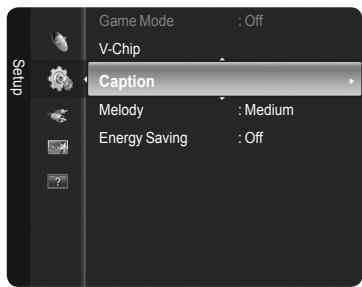
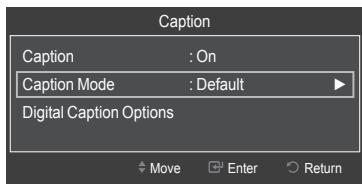
Digital Caption Options are available only when Default and Service1~Service6 can be selected in Caption Mode.
Service1~6 in digital caption mode may not be available depending on the broadcast.
Default means to follow the standard set by the broadcaster.
Foreground and Background cannot be set to have the same color.
Foreground Opacity and Background Opacity cannot be both set to Transparent.
Melody
A melody sound can be set to come on when the TV is powered On or Off.
- Off: Turns off the melody function.
- Low: Sets the melody volume to low.
Medium: Sets the melody volume to medium.
High: Sets the melody volume to high.
The Melody does not play.
- When no sound is output from the TV because the MUTE button has been pressed.
- When no sound is output from the TV because the volume has been reduced to minimum with the VOL [ ] button.
- When the TV is turned off with the Sleep Timer function.
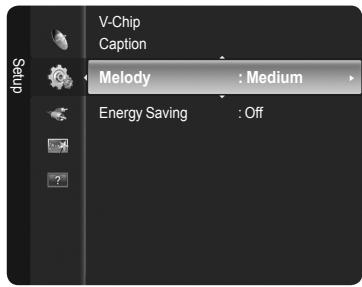
Energy Saving
This feature adjusts the brightness of the TV in order to reduce power consumption. When watching TV at night, set the Energy Saving mode option to High to reduce eye fatigue as well as power consumption.
- Off: Turns the Energy Saving function off.
- Low: Sets the Energy Saving function to low.
Medium: Sets the Energy Saving function to medium. - High: Sets the Energy Saving function to maximum.
Setting the clock is necessary in order to use the various timer features of the TV. Also, you can check the time while watching the TV. (Just press the INFO button.)

Time
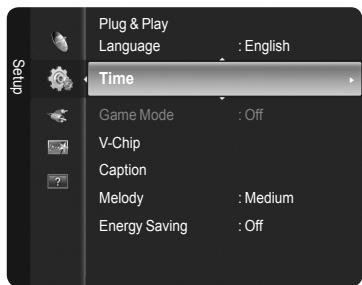
- Press the MENU button to display the menu.
- Press the or button to select Setup, then press the ENTER button.
- Press the or button to select Time, then press the ENTER button.

Clock
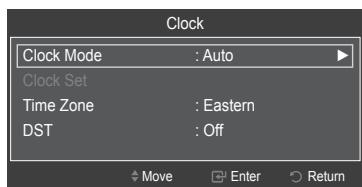
- Clock Mode Auto / Manual
You can set up the current time manually or automatically.
Clock Set
You can set the current time manually.
This function is only available when Clock Mode is set to Manual.
You can set the Month, Day, Year, Hour, or Minute directly by pressing the number buttons on the remote control.
Time Zone
Select your time zone.
This function is only available when Clock Mode is set to Auto.
Depending on the broadcast station and signal, the auto time may not be set correctly. If this occurs, set the time manually.
The Antenna or cable must be connected in order to set the time automatically.
- DST (Daylight Saving Time) Off / On / Auto
Switches the Daylight Saving Time function on or off.
This function is only available when Clock Mode is set to Auto.
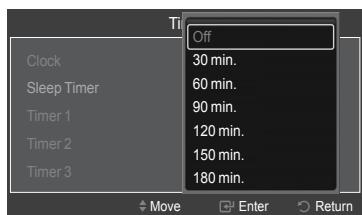
Sleep Timer
The sleep timer automatically shuts off the TV after a preset time
(30, 60, 90, 120, 150 and 180 minutes).

Press the TOOLS button to display Tools menu.
You can also set the sleep timer by selecting Tools Sleep Timer.
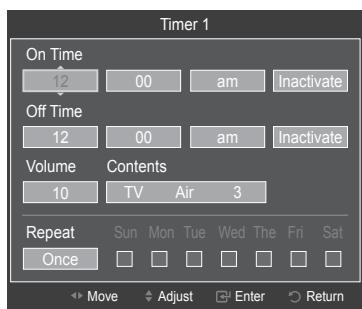
Timer1/Timer2/Timer3
Use this feature to set the TV to turn on or off at a desired time. 3 different On/Off times can be set. You must set the clock first.
- On Time: Set the Hour, Minute, am/pm, and Activate/Inactivate.
(To activate timer with the setting you've chosen, set to Activate.) - Off Time: Set the Hour, Minute, am/pm, and Activate/Inactivate.
(To activate timer with the setting you've chosen, set to Activate.)
Volume: Set the desired volume level. -
Contents: When the On Time is activate, you can turn on a specific channel or play back contents such as photo or audio files.
-
TV/USB: Select TV or USB.
(Make sure that an USB device is connected to your TV.) - Antenna: Select Air or Cable.
- Channel: Select the desired channel.
- Music: Select the folder containing MP3 files on the USB device.
-
Photo: Select the folder containing JPEG files on the USB device.
-
Repeat: Select Once, Everyday, Mon~Fri, Mon~Sat, Sat~Sun or Manual.
When Manual is selected, press the button to select the desired day of the week.
Press the ENTER button over the desired day and the mark will appear.
You can set the hour, minute and channel by pressing the number buttons on the remote control.
Auto Power Off
When you set the timer On, the television will eventually turn off, if no controls are operated for 3 hours after the TV was turned on by the timer. This function is only available in timer On mode and prevents overheating, which may occur if a TV is on for too long time.
Source List
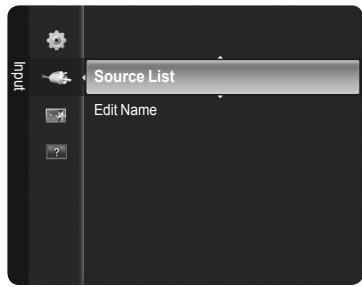
Use to select TV or other external input sources such as DVD / Blu-Ray players / Cable boxes / Satellite receivers (Set-Top Box) connected to the TV. Use to select the input source of your choice.
TV, AV1, AV2, Component1, Component2, PC, HDMI1, HDMI2/DVI, HDMI3, HDMI4.
You can choose only those external devices that are connected to the TV. In the Source List, connected inputs will be highlighted and sorted to the top. Inputs that are not connected will be sorted to the bottom.
Using the Color buttons on the remote with the Source list
- Red (Refresh): Refreshes the connected external devices. Press this if your Source is on and connected, but does not appear in the list.
- TOOLS (Tools): Displays the Edit Name and Information menus.
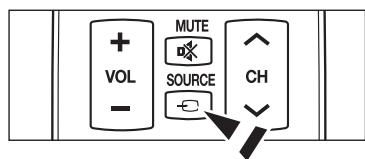
Press the SOURCE button on the remote control to view an external signal source.
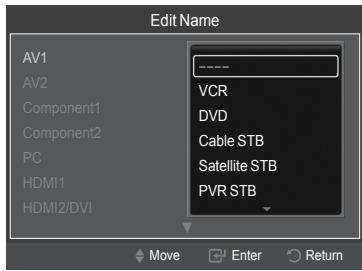
Edit Name
You can name the device connected to the input jacks to make your input source selection easier.
VCR / DVD / Cable STB / Satellite STB / PVR STB / AV Receiver / Game / Camcorder / PC / DVI PC / DVI / TV / IPTV / Blu-Ray / HD DVD / DMA
When a PC with a resolution of 1920 × 1080@60Hz is connected to the HDMI IN 2(DVI) port, you should set the HDMI2/DVI mode to PC in the Edit Name menu.
Support
Self Diagnosis
Picture Test
If you think you have a picture problem, perform the picture test. Check the color pattern on the screen to see if the problem still exists.
Does the problem still exist with this test photo? appears on the screen. If the test pattern does not appear or there is noise in the test pattern, select Yes. If the test pattern is properly displayed, select No.
- Yes: There may be a problem with the TV. Contact the Samsung Call center.
- No: There may be a problem with your external equipment. Please check your connections. If the problem still persists, refer to the external device's user manual.
Sound Test
If you think you have a sound problem, please perform the sound test. You can check the sound by playing a built-in melody sound through the TV.
Does the problem still exist with this sound test? appears on the screen.
If during the sound test you can hear sound only from one speaker or not at all, select Yes.
If you can hear sound from the speakers, select No.
- Yes: There may be a problem with the TV. Contact the Samsung Call center.
- No: There may be a problem with your external equipment. Please check your connections. If the problem still persists, refer to the external device's user manual.
If you hear no sound from the TV's speakers, before performing the sound test, make sure Speaker Select is set to TV speaker in the Sound menu.
The melody will be heard during the test even if Speaker Select is set to External Speaker or the sound is muted by pressing the MUTE button.
Signal Strength (Digital)
Unlike analog channels, which can vary in reception quality from snowy to clear, digital (HDTV) channels have either perfect reception quality or you will not receive them at all. So, unlike analog channels, you cannot fine tune a digital channel. You can, however, adjust your antenna to improve the reception of available digital channels.
If the signal strength meter indicates that the signal is weak, physically adjust your antenna to increase the signal strength. Continue to adjust the antenna until you find the best position with the strongest signal.
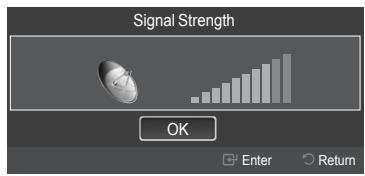
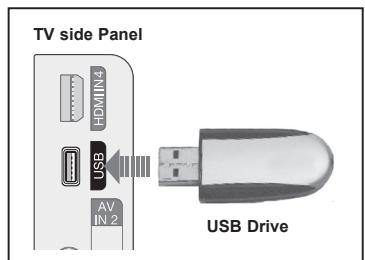
Software Upgrade
Samsung may offer upgrades for your TV's firmware in the future. Please visit Samsung.com or contact the Samsung call center at 1-800-SAMSUNG (726-7864) to receive information about downloading upgrades and using a USB drive. Upgrades will be possible by connecting a USB drive to the USB port.
Please be careful not to disconnect the power or remove the USB drive while upgrades are being applied. The TV will shut off and turn on automatically after completing the firmware upgrade.
When software is upgraded, video and audio settings you have made will return to their default (factory) settings.
We recommend you write down your settings so that you can easily reset them after the upgrade.
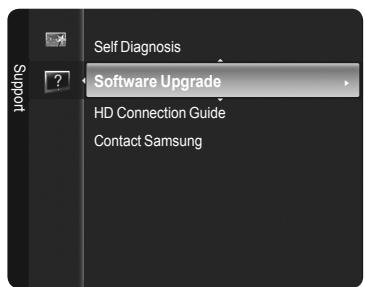
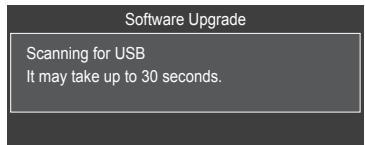
HD Connection Guide
A brief instruction on How to get the best performance from your new HDTV is displayed.
Follow the guide for the best connection method for your HD devices.
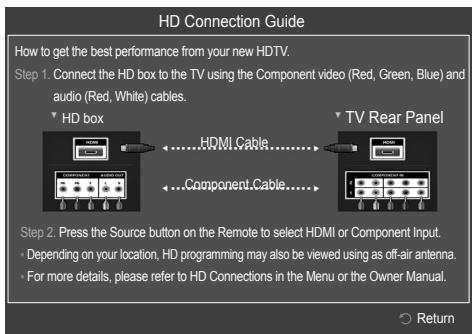
Contact Samsung
You can know the Samsung Call center, website and information for product.
You can move the previous or next page by pressing the or button.
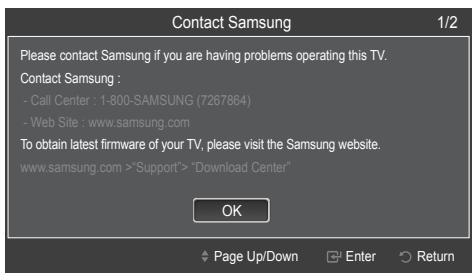
Using the Media Play Function
This function enables you to view and listen to photo (JPEG) and audio files (MP3) saved on a USB Mass Storage Class (MSC) device.
- Press the POWER button on the remote control or front panel.
The TV is powered on. - Connect a USB device containing JPEG and/or MP3 files to the USB jack on the side of the TV.
If you enter the Media Play mode with no USB device connected the message There is no device connected. will appear. In this case, insert the USB device, exit the screen by pressing the MEDIA.P button on the remote control and enter the Media Play screen again.
PTP(Picture Transfer Protocol) is supported, but MTP(Media Transfer Protocol) is not supported.
The file system only supports FAT16/32 (The NTFS file system is not supported).
Certain types of USB Digital camera and audio devices may not be compatible with this TV.
Media Play only supports USB Mass Storage Class devices (MSC). MSC is a Mass Storage Class Bulk-Only Transport device. Examples of MSC are Thumb drives and Flash Card Readers (Both USB HDD and HUB are not supported.)
Please connect directly to the USB port of your TV. If you are using a separate cable connection, there may be a USB Compatibility problem.
Before connecting your device to the TV, please back up your files to prevent them from damage or loss of data. SAMSUNG is not responsible for any data file damage or data loss. Recommended image resolution for Media Play is 6 mega pixels.
Do not disconnect the USB device while it is loading.
MSC supports MP3 and JPEG files, and the PTP device supports JPEG files only.
We recommend the sequentialJPEG,and progressiveJPEG format. ProgressiveJPEG uses a lot of memory and decoding may fail.
The Media Play mp3 format only supports music files with a high sampling frequency (32 kHz, 44.1 kHz, or 48 kHz).
The playing duration of an mp3 file may be displayed as '00:00:00' if its playing time information is not found at the start of the file.
If the horizontal resolution of an image is higher than 5000, it cannot be decoded.
If the vertical resolution of an image is higher than 4000, it cannot be decoded.
The higher the resolution of the image, the longer it takes to display on the screen.
The maximum supported JPEG resolution is 15360x8640 pixels
For unsupported or corrupted files, the Not Supported File Format message is displayed
The Photo or Music List displays up to 300 folders or files.
MP3 files with DRM downloaded from pay sites are not played.
DRM(Digital Rights Management) prevents illegal uses of digital media for copyright protection.
Using the Remote Control Button in the Media Play Menu
| Button | Operations |
| Move the cursor and select an item. | |
| Select the currently selected item. During a Slide Show or Music Play: - Pressing the ENTER button during play pauses the play. - Pressing the ENTER button during pause resumes the play. | |
| Play or pause the Slide Show or Music file. | |
| Return to the previous menu. | |
| Run various functions from the Photo and Music menus. | |
| Stop the current Slide Show or Music file. | |
| Page Up or Down (file list item) | |
| Stop the current function and return to the Media Play main menu. |
Using the Media Play Menu
- Press the MENU button. Press the or button to select Application, then press the ENTER button.
- Press the or button to select Media Play (USB), then press the ENTER button.
The Media Play menu is displayed.
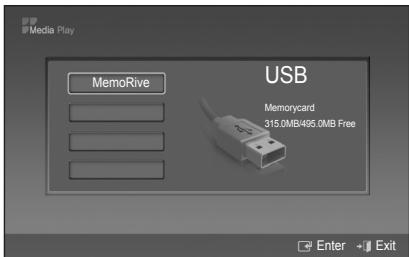
Press the MEDIA.P button on the remote control to display the Media Play menu.
- Press the or button to select the corresponding USB Memory Device, then press the ENTER button.
The Media Play menu differs depending on the USB Memory Device connected to TV.
Some devices may not be supported due to compatibility problems.
- Press the or button to select an icon (Photo, Music, Setup), then press the ENTER button.
To exit Media Play mode, press the MEDIA.P button on the remote control.
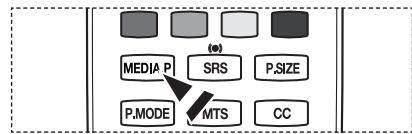

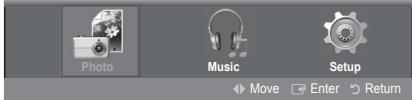
Using the PHOTO (JPEG) List
This menu shows JPEG files and folders saved on an USB memory device.
- Complete Steps 1 to 2 of Using the Media Play Menu. (Refer to page 38)
-
Press the or button to move to Photo, then press the ENTER button. The saved file information is displayed as a folder or file.
-
Press the , , and buttons to select a file.
-
Pressing the ENTER按钮 over a photo icon shows the currently selected photo in full screen.
- Pressing the ENTER button over a folder icon shows the JPEG files included in the folder.
To exit Media Play mode, press the MEDIA.P button on the remote control.
图 Moving to a photo may take a few seconds to load the file. At this point, the icon will appear at the top left of the screen.
It takes time to show JPEG files as Thumbnail images.
This menu only shows files whose file extension is jpg. Files of other formats such as bmp or tiff will not be displayed.
The files are displayed on a page. 15 thumbnail photos are displayed per page.
The thumbnails are numbered from left to right and from top to bottom, from 1 to 15.
Certain types of USB Digital camera and audio devices may not be compatible with this TV.
Folders are displayed first and they are followed by all JPEG files in the current folder.
The folders and MP3 files appear in the order of the time they were saved to the USB memory device.
The folders and JPEG files appear in the order of the time they were saved to the USB memory device.
If the photo is displayed in full screen, you can zoom in and out or rotate the photo on the screen.
While a full screen is displayed, or button will let you see another photo image in the same folder.
Press the button when a Photo icon is selected to start a Slide Show.
Photos without EXIT information may not be displayed as thumbnail images in the PHOTO LIST depending on the picture quality and resolution.
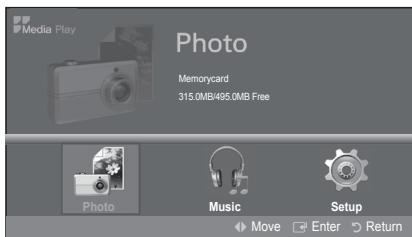
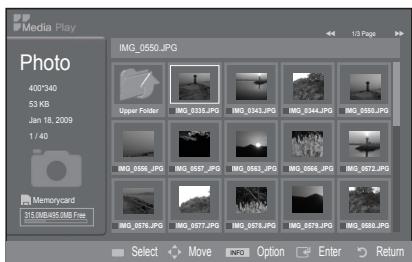
Viewing a Slide Show
- Press the INFO button to display the option (View, Start Slideshow, Delete, Delete All, Deselect All).
- Press the or button to select Start Slideshow then press the ENTER button.
During the slide show, files are displayed in order from the currently shown file.
MP3 files can be automatically played during the Slide Show if the Default Background Music is set to On. To enable this function, MP3 files and other photo files must be located in the same folder on the USB Memory Device.
- Press the INFO button during the slide show to set the following options (Slide Show Speed, Background Music, Background Music Setting, List). Press the or button to select the option, then press the ENTER button. After setting the option, press the ENTER button to make a change.
Using the Menu during a Slide Show
Slide Show Speed
Select to control the slide show speed.
Press the or button to select the required option(Fast, Normal, Slow), then press the ENTER button.
Background Music
Select to choose whether you want to play an MP3 file during a slide show. Press the or button to select the required option(On, Off), then press the ENTER button.
Background Music Setting
While the slide show is in progress, MP3 files and folders under the same directory are displayed.
Select a folder using the or button and press the ENTER button.
Press the ENTER button again to return to the slide show screen. The selected background music is played.
If you turn Off the Background Music, even if the Background Music Setting have been set up, the background music will not be played.
List
The file information is displayed as a folder or JPEG file.
To exit Media Play mode, press the MEDIA.P button on the remote control.
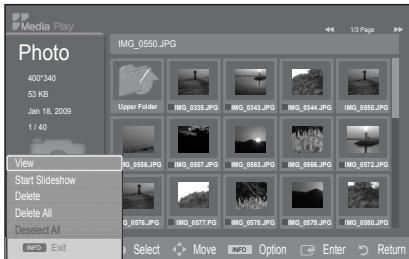
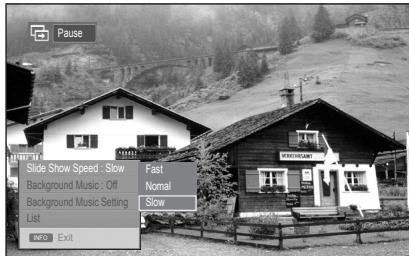
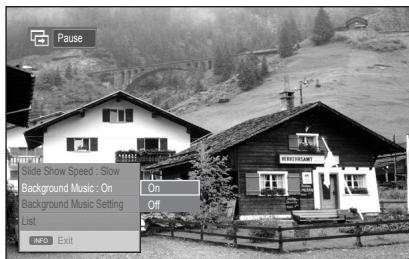
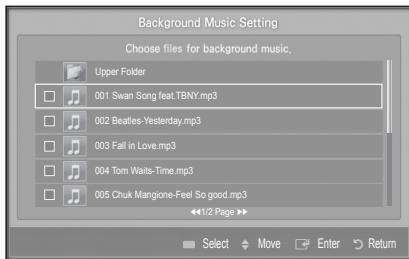
When selecting a photo file, the photo file information is displayed on the left side of the TV screen, such as the resolution, the date modified and the order of the file in the current directory (e.g. 10th out of 15).

:Folder icon

: Photo icon

:Move to the previous folder stage icon
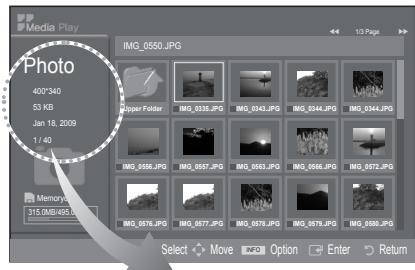
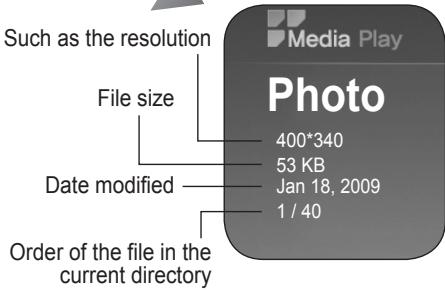
Using the Option Menu
- Complete Steps 1 to 2 of Using the Media Play Menu. (Refer to page 38)
- Press the or button to move to Photo, then press the ENTER button. The saved file information is displayed as a folder or file.
- Press the , , and button to select a file, then press the ENTER按钮. Pressing the button over a photo thumbnail displays the photo in full screen.
- Press the INFO button to display the option (Start Slideshow, Zoom, Rotate, List)
Zoom
-
Press the or button to select Zoom, then press the ENTER button.
Each time the or button is pressed, the photo size increases. (x1 x2 x4) -
x1:Restore a photo to its original size.
- x2:Zoom-in to a photo x2.
-
x4: Zoom-in to a photo x4.
-
To pan up/down/left/right in the zoomed-in photo, press the INFO button to remove option menu, then press the , , , and buttons.
The Start Slideshow, Rotate option is disabled when the Zoom option is selected.
Rotate
-
Press the or button to select Rotate, then press the ENTER按钮.
Each time the or button is pressed, the photo rotates repeatedly. -
0^ : This rotates a photo to its original position
- 90^ : This rotates a photo by 90 degrees
- 180^ : This rotates a photo by 180 degrees
- 270^ : This rotates a photo by 270 degrees
The rotated file is not saved.
The Start Slideshow, Zoom option is disabled when the Rotate option is selected.
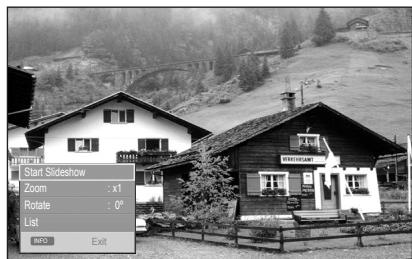
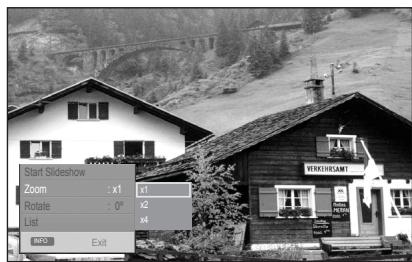
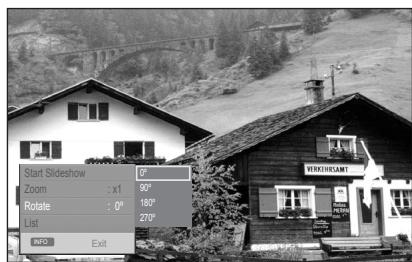
List
- Press the or button to select List, then press the ENTER按钮.
- Move to the photo list.
This menu shows MP3 files from among the files saved on a USB memory device.
- Complete Steps 1 to 2 of Using the Media Play Menu. (Refer to page 38)
-
Press the or button to move to Music, then press the ENTER button. The saved file information is displayed as a folder or file.
-
Press the or button to move to an icon, then press the ENTER button.
Pressing the ENTER button over a musical note icon immediately plays the music file.
Pressing the ENTER button over a folder icon shows the music files included in the folder.
To select a file on the next page, press the 一 ^ 一 or 一 ^ 一 button to move to the next or previous page.
- To select all files or a file, press the INFO button to display the Music menus. Press the ENTER按钮 to select Play, Repeat Music, Delete, Delete All or Deselect All.
To exit Media Play mode, press the MEDIA.P button on the remote control.
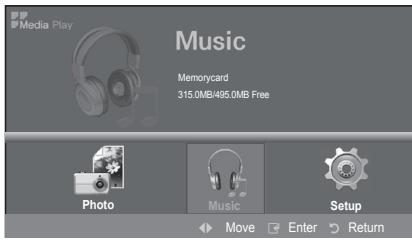
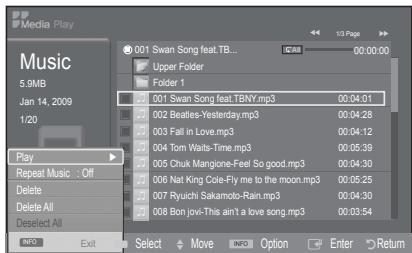
Using the Option Menu
Play
Select to play MP3 files.
Press the button while playing an MP3 file to pause the file.
Press the button to exit Play mode.
This menu only shows files with the MP3 file extension. Files with other file extensions are not displayed, even if they are saved on the same USB device.
The selected file is displayed on the top with its playing time.
To adjust the music volume, press the VOL + or VOL - button on the remote control. To mute the sound, press the MUTE button on the remote control.
Press or buttons to change pages.
: Move to the previous folder stage icon

:Foldericon

: Music list icon

Repeat Music
Select to repeatedly play MP3 files in the current folder.
You can select On or Off
| Music function information icon | |
| Icon | Function |
| All | When all music files in the folder (or the selected file) are repeated. Repeat Music is On. |
| All | When all music files in the folder (or the selected file) are played once. Repeat Music is Off. |
| When pressing the PLAY/PAUSE button on the remote control while music is playing. | |
| When pressing the STOP button on the remote control, the music stops. | |
Using the Setup Menu
Setup display settings you can make in the Media Play menu.
- Complete Steps 1 to 2 of Using the Media Play Menu. (Refer to page 38)
- Press the or button to move to Setup, then press the ENTER button.
- Press the or button to select an item you want, then press the ENTER button.
(Slide Show Speed, Background Music, Background Music Setting, Repeat Music, Screen Saver, Safe Remove)
- Press the or button to select the option, then press the ENTER button.
To exit Media Play mode, press the MEDIA.P button on the remote control.
Slide Show Speed
Select to control the slide show speed.
You can select Fast, Normal, or Slow.
Background Music
Select to determine whether to play an MP3 file during a slide show.
You can select Music On or Music Off.
Background Music Setting
While a slide show is in progress, use the Background Music Setting to select a music file to listen to.
Select a MP3 file as the background music.
Repeat Music
Select to determine whether to repeat playing the music when all MP3 files in the current folder have been played.
You can select On or Off
Screen Saver
Select to set the waiting time before the screen saver appears.
The screenshot will appear when no button is pressed for 10min., 20min., or 1hour.
Safe Remove
The message USB device can now be safely removed from TV. is displayed. You can remove the device safely from the TV.

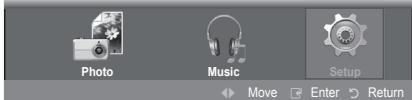
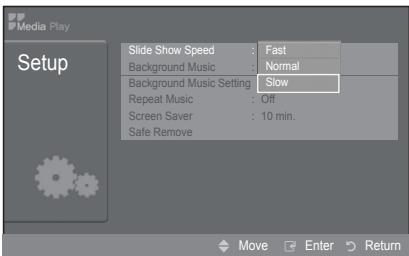
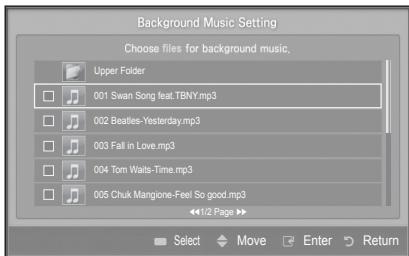
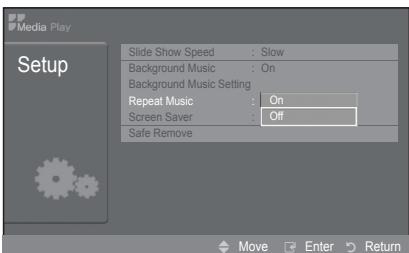
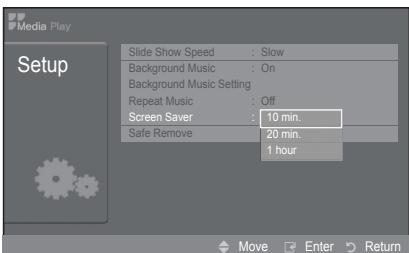
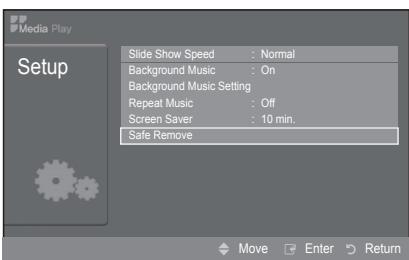
Anynet+
Connecting Anynet+ Devices
Anynet+ is a function that enables you to control all connected Samsung devices that support Anynet+ with your Samsung TV's remote.
The Anynet+ system can be used only with Samsung devices that have the Anynet+ feature. To be sure your Samsung device has this feature, check if there is an Anynet+ logo on it.
To connect to a TV
- Connect the HDMI IN (1, 2(DVI), 3 or 4) jack on the TV and the HDMI OUT jack of the corresponding Anynet+ device using an HDMI cable.
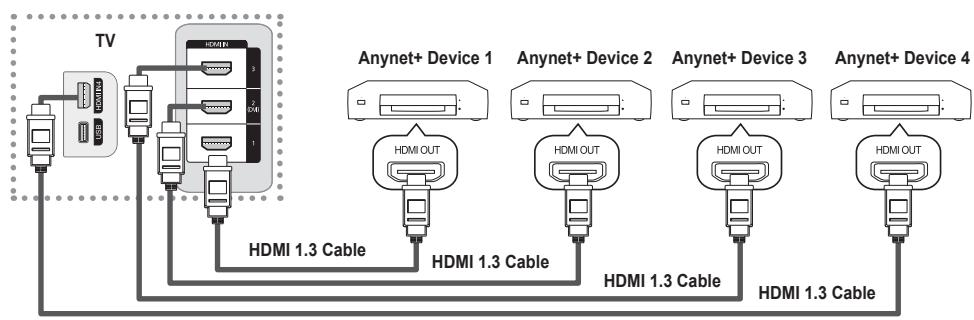
To connect to a Home Theater
- Connect the HDMI IN (1, 2(DVI), 3 or 4) jack on the TV and the HDMI OUT jack of the corresponding Anynet+ device using an HDMI cable.
- Connect the HDMI IN jack of the home theater and the HDMI OUT jack of the corresponding Anynet+ device using an HDMI cable.
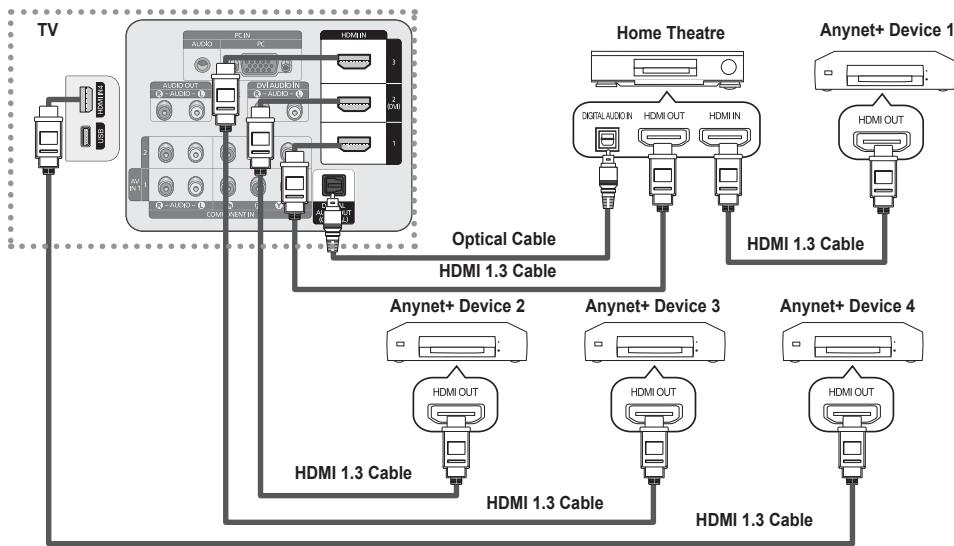
Connect an Optical cable between the DIGITAL AUDIO OUT (OPTICAL) jack on your TV and the Digital Audio Input on the Home Theater.
When following the connection above, the Optical jack only outputs 2 channel audio. You will only hear sound from the Home Theater's Front Left and Right speakers and the subwoofer. If you want to hear 5.1 channel audio, connect the DIGITAL AUDIO OUT (OPTICAL) jack on the DVD / Satellite Box (ie Anynet Device 1 or 2) directly to the Amplifier or Home Theater, not the TV.
Connect only one Home Theater.
You can connect an Anynet+ device using the HDMI 1.3 cable. Some HDMI cables may not support Anynet+ functions.
Anynet+ works when the AV device supporting Anynet+ is in the Standby or On status.
Anynet+ supports up to 12 AV devices in total. Note that you can connect up to 3 devices of the same type.
Continued...
Setting Up Anynet+
The following settings help set the Anynet+ functions.
Press the TOOLS button to display Tools menu. You can also set the Anynet+ by selecting Tools Anynet+ (HDMI-CEC)
To use the Anynet+ Function, Anynet+ (HDMI-CEC) must be set to On
- Press the MENU button. Press the or button to select Application, then press the ENTER按钮.
- Press the or button to select Anynet+ (HDMI-CEC), then press the ENTER button.
- Press the or to select Setup, then press the ENTER button.
- Press the ENTER button to select Anynet+ (HDMI-CEC).
- Press the or button to select On, then press the ENTER button.
The Anynet+ (HDMI-CEC) function is enabled.
If you select Off, Anynet+ (HDMI-CEC) is disabled.
When the Anynet+ (HDMI-CEC) function is disabled, all the Anynet+ related operations are deactivated.
Setting an Anynet+ Device to turn Off Automatically when the TV is Turned Off
-
Press the or button to select Auto Turn Off, then press the ENTER button.
-
Press the or button to select Yes, then press the ENTER按钮.
The Auto Turn Off function is enabled.
If you select No, the Auto Turn Off function is canceled.
- Press the EXIT button to exit.
The active source on the TV remote must be set to TV to use the Anynet+ function.
If you set Auto Turn Off to Yes, connected external devices are also turned off when the TV is turned off. If an external device is still recording, it may or may not turn off.
Scanning and Switching between Anynet+ Devices
- Press the TOOLS button.
Press the or button to select Device List, then press the ENTER button.
Anynet+ devices connected to the TV are listed.
If you cannot find a device you want, press the red button to scan for devices.
- Press the or button to select to a particular device and press the ENTER button. It is switched to the selected device.
Only when you set Anynet+ (HDMI-CEC) to On in the Application menu, the Device List menu appears.
Switching to the selected devices may take up to 2 minutes. You cannot cancel the operation during the switching operation.
The time required to scan for devices is determined by the number of connected devices.
When the device scan is complete, the number of devices found are not displayed.
Although the TV automatically scans devices when it is turned on using the POWER button, devices connected when the TV is already on are not displayed in the device list. In this case, select the Searching Connections menu to search devices.
If you have selected external input mode by pressing the SOURCE button, you cannot use the Anynet+ function. Make sure to switch to an Anynet+ device by using the TOOLS button.
TV Remote Control Buttons Available in Anynet+ Mode
| Device Type | Operating Status | Available Buttons |
| Anynet+ Device | After switching to the device, when the menu of the corresponding device is displayed on the screen. | Numeric buttons ▲/▼/←/▶ ENTER□按钮 Color buttons / EXIT button |
| After switching to the device, while playing a file | ↔ (Backward search) / ⇌ (Forward search) ■ (Stop) / ● (Play) / ● (Pause) | |
| Device with built-in Tuner | After switching to the device, when you are watching a TV program | CH / CH button |
| Audio Device | When Receiver is activated | VOL + / VOL - / ≧MUTE button |
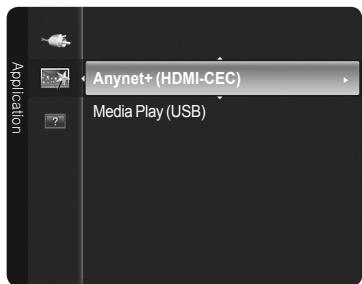
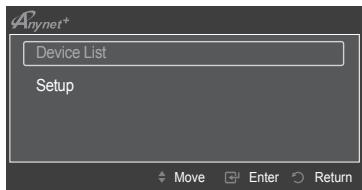
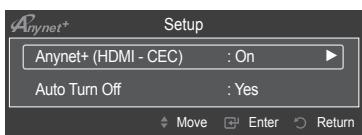
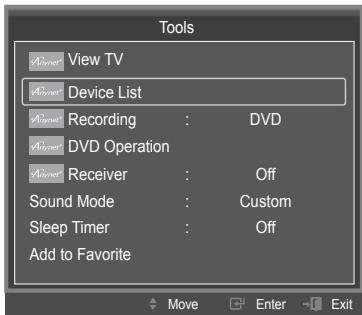
The Anynet+ function only works when the active source on the TV remote control is set to TV.
The button works only while in the recordable state.
You cannot control Anynet+ devices using the buttons on the TV. You can control Anynet+ devices only using the TV remote control.
The TV remote control may not work under certain conditions. In this case, reselect the Anynet+ device.
The Anynet+ functions do not operate with other manufacturers' products.
The l operations may differ depending on the device.
Anynet+Menu
The Anynet+ menu changes depending on the type and status of the Anynet+ devices connected to the TV.
| Anynet+ Menu | Description |
| View TV | Switches from Anynet+ to TV broadcast mode. |
| Device List | Displays the Anynet+ device list. |
| Recording | Starts a recording. (This menu works only for a device supporting recording.) |
| Menu | Shows the menu of the connected device. Example: When a DVD Recorder is connected, the DVD Recorder's title menu appears. |
| Operation | Shows the play control menu of the connected device. Example: When a DVD Recorder is connected, the play control menu of the DVD Recorder appears. |
| Timer Recording | Allows reserving a recording. (This menu works only for a device supporting recording reservations.) |
| Stop Recording | Stops recording. |
| Receiver | Sound is output through the receiver (home theater). |
| Setup | You can set the Anynet+ (HDMI-CEC), auto turn off, and searching connections for using Anynet+. |
□ Recording
You can make a recording of a TV program using a Samsung recorder.
- Press the TOOLS button.
- Press the or button to select Recording Immediately and press the ENTER button. Recording begins.
When there is more than one recording device
When multiple recording devices are connected, the recording devices are listed. Press the or button to select a recording device and press the ENTER button. Recording begins.
When the recording device is not displayed
Select Device List and press the red button to search devices
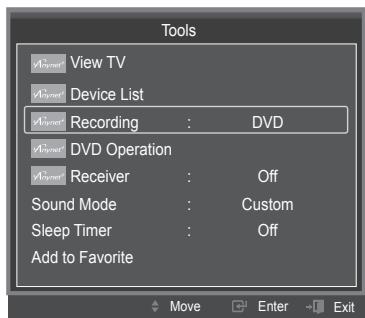
- Press the EXIT button to exit.
Pressing the button will record whatever you are currently watching. If you are watching video from another device, the video from the device is recorded.
Before recording, check whether the antenna jack is properly connected to the recording device. To properly connect an antenna to a recording device, refer to the recording device's users manual.
Listening through a Receiver (Home theater)
You can listen to sound through a receiver instead of the TV speaker.
- Press the TOOLS button. Press the or button to select Receiver.
- Press the or button to select to On.
Now you can listen to sound through the receiver.
- Press the EXIT button to exit.
If your receiver supports audio only, it may not appear in the device list.
The receiver will work when you have properly connected the Optical IN jack of the receiver to the Optical Out jack of the TV.
When the receiver (home theater) is set to On, you can hear sound output from the TV's Optical jack. When the TV is displaying a DTV(air) signal, the TV will send out 5.1 channel sound to the Home theater receiver. When the source is a digital component such as a DVD and is connected to the TV via HDMI, only 2 channel sound will be heard from the Home Theater receiver.
When using the Media Play feature, sound may not output properly through the receiver.
When listening through the receiver, there are restrictions for using the audio-related (MTS, Preferred language) menus.
If there is a power interruption to the TV when the Receiver is set to On (by disconnecting the power cord or a power failure), the Speaker Select may be set to External Speaker when you turn the TV on again.
| Symptom | Solution |
| Anynet+ does not work. | ·Check if the device is an Anynet+ device. The Anynet+ system supports Anynet+ devices only. ·Connect only one receiver (home theater). ·Check if the Anynet+ device power cord is properly connected. ·Check the Anynet+ device's Video/Audio/HDMI 1.3 cable connections. ·Check whether Anynet+ (HDMI-CEC) is set to On in the Anynet+ setup menu. ·Check whether the TV remote control is in TV mode. ·Check whether it is Anynet+ exclusive remote control. ·Anynet+ doesn't work in certain situations. (Searching channels, Operating Media play, Plug & Play, etc.) ·When connecting or removing the HDMI 1.3 cable, please make sure to search devices again or turn your TV off and on again. ·Check if the Anynet+ Function of Anynet+ device is set on. |
| I want to start Anynet+. | ·Check if the Anynet+ device is properly connected to the TV and check if the Anynet+ (HDMI-CEC) is set to On in the Anynet+ Setup menu. ·Press the TV button on the TV remote control to switch to TV. Then press the TOOLS button to show the Anynet+ menu and select a menu you want. |
| I want to exit Anynet+. | ·Select View TV in the Anynet+ menu. ·Press the SOURCE button on the TV remote control and select a device other than Anynet+ devices. ·Press CH, CH LIST, PRE-CH, and FAV.CH to change the TV mode. (Note that the channel button operates only when a tuner-embedded Anynet+ device is not connected.) |
| The message Connecting to Anynet+ device... appears on the screen. | ·You cannot use the remote control when you are configuring Anynet+ or switching to a view mode. ·Use the remote control when the Anynet+ setting or switching to view mode is complete. |
| The Anynet+ device does not play. | You cannot use the play function when Plug & Play is in progress. |
| The connected device is not displayed. | ·Check whether or not the device supports Anynet+ functions. ·Check whether or not the HDMI 1.3 cable is properly connected. ·Check whether Anynet+ (HDMI-CEC) is set to On in the Anynet+ setup menu. ·Search Anynet+ devices again. ·You can connect an Anynet+ device using the HDMI 1.3 cable only. Some HDMI cables may not support Anynet+ functions. ·If it is terminated by an abnormal situation such as disconnecting the HDMI cable or power cord or a power failure, please repeat the device scan. |
| The TV program cannot be recorded. | Check whether the antenna jack on the recording device is properly connected. |
| The TV sound is not output through the receiver. | Connect the optical cable between TV and the receiver. |
Appendix
Troubleshooting
If the TV seems to have a problem, first try this list of possible problems and solutions.
If none of these troubleshooting tips apply, call Samsung customer service at 1-800-SAMSUNG.
| Problem | Possible Solution |
| Poor picture quality. | Try another channel. Adjust the antenna. Check all wire connections. |
| Poor sound quality. | Try another channel. Adjust the antenna. |
| No picture or sound. | Try another channel. Press the SOURCE button. Make sure the TV is plugged in. Check the antenna connections. Make sure the MUTE button is off. |
| No sound or sound is too low at maximum volume. | First, check the volume of units connected to your TV (digital broadcasting receiver, DVD, cable broadcasting receiver, VCR, etc.). Then, adjust the TV volume accordingly. |
| Picture rolls vertically. | Check all connections. |
| The TV operates erratically. | Unplug the TV for 30 seconds, then try operating it again. |
| The TV won't turn on. | Make sure the wall outlet is working. |
| Remote control malfunctions | Replace the remote control batteries. Clean the upper edge of the remote control (transmission window). Check the battery terminals. Press the TV button to put your remote control in the TV mode. Make sure the remote has batteries. Check that the "+" and "-" ends of the batteries are inserted correctly. |
| Digital broadcasting screen problem. | Please check the digital signal strength and antenna input. |
| The image is too light or too dark. | Adjust the Brightness and Contrast. Adjust the Fine tuning. |
| The image is too large or too small. | Adjust the Size settings. |
| The visual qualities of digital channels vary. | The visual qualities of digital channels may vary depending on the original production method (analog or digital). - If the original production method is digital: High visual quality. - If the original production method is analog: The digital program displayed on the screen is originally an analog program which has been converted to digital. The visual quality is of an SD(Standard Definition) grade. |
| Screen is black and power indicator light blinks steadily. | On your computer; check the Power and Signal Cable. The TV is using its power management system. Move the computer's mouse or press any key on the keyboard. |
| On your equipment check (STB, DVD, etc); Power and Signal Cable. The TV is using its power management system. Press the SOURCE button on the panel or remote control. Turn the TV off and on. | |
| Although the TV caption shows HD, the visual quality is not satisfactory. | The HD(High Definition) caption that appears when switching channels or when pressing the Information button on the remote control means the selected channel is a digital channel. If the broadcasting station converts an analog signal into digital and transmits the signal, the visual quality may not be perfect. |
| A distorted picture appears in the corner of the screen. | If Screen Fit is selected in some external devices, a distorted picture may appear in the corner of the screen. This symptom is caused by external devices, not the TV. |
| A strange sound is heard. | This is caused by minor systems operation and is not a defect. |
| Pixels are visible on the screen. | There may be few bright or dark pixels on the screen. These pixels will have no impact on the performance of the product. |
| The "Reset all settings to the default values" message appears. | This appears when you press and hold the EXIT button for a while. The product settings are reset to the factory defaults. |
Case A. Installing the SAMSUNG Wall-Mount
Case B. Installing another company's Wall-Mount
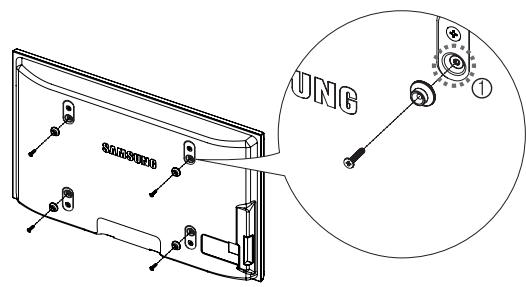
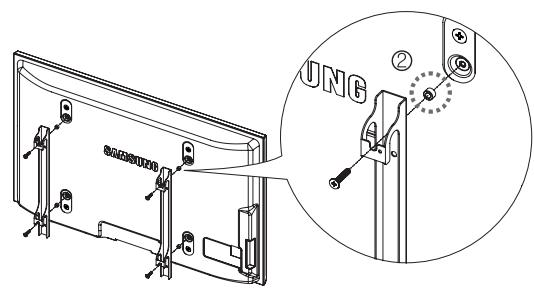
- Install the Wall Mount with a torque range of 15kgf·cm or less. Use care as the parts can be damaged if the torque is out of the specified range.
- Accessory Kit contains Holder-Ring [②] for installing another company's Wall-Mount. (Case B)
Screw down the hole [①] when installing wall-mount on the wall.
How to attach the Stand-Base
Using the screws for securing the stand base and the TV, firmly attach the TV to the stand base.
(The exterior of the set may be different from the picture.)
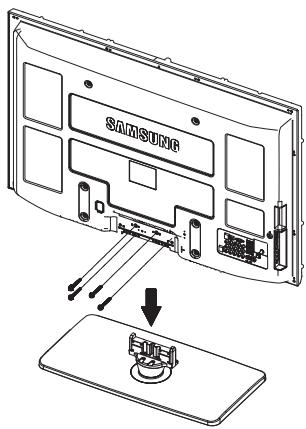
(PN50B550T2F/PN50B560T5F)
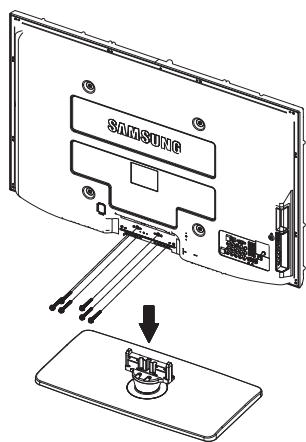
(PN58B550T2F/PN58B560T5F/
PN63B550T2F/PN63B590T5F)
When mounting your TV on a wall, install the cover (O) on the stand-base using two screws.
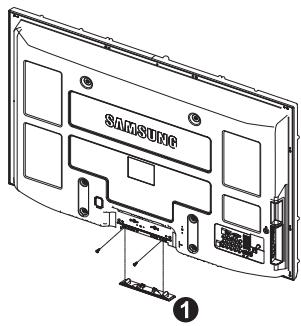
Warning
Firmly secure the stand to the TV before moving it, as the stand may fall and could cause serious injury.
Two or more people should carry the TV. Never lay the TV on the floor because of possible damage to the screen. Always store the TV upright.

Caution
Pulling, pushing, or climbing on the TV may cause the TV to fall. In particular, ensure your children do not hang over or destabilize the TV; doing so may cause the TV to tip over, causing serious injuries or death. Follow all safety precautions provided on the included Safety Flyer. For added stability, install the anti-fall device for safety purposes, as follows.
Accessaries
TV-Holder /
Screw 1
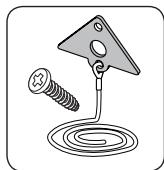
To prevent the TV from falling
- Attach the TV-Holder to the TV by fastening the screw ① (M4*16) into the holes in the center of the TV.
42", 50": Unscrew a screw attached On the back of your TV before attaching the TV-Holder.
Make sure to only use the supplied screw.
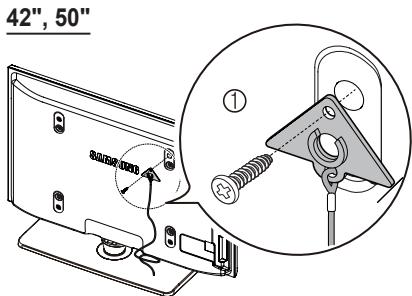
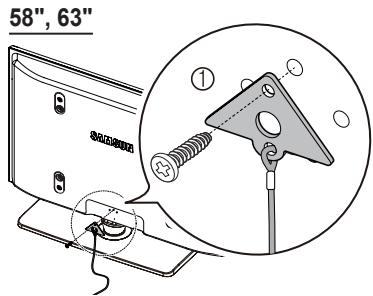
- Firmly fasten the screws to the wall or cabinet where the TV is to be installed. Tie the TV-Holder attached to the TV and the screws fastened on the wall or cabinet so that the TV is fixed.
Purchase the screws to be used on the wall or cabinet separately.
Install the TV close to the wall so that it does not fall.
When attaching the TV to the wall, tie the cord level with the ground or slanted downwards for safety purposes.
Confir that the cord or link does not come loose frequently.
Before moving the TV, separate the connected cord first.
42", 50"
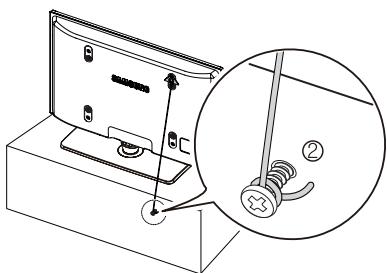
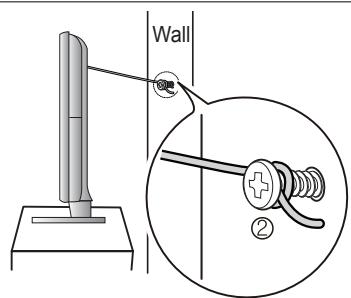
58", 63"
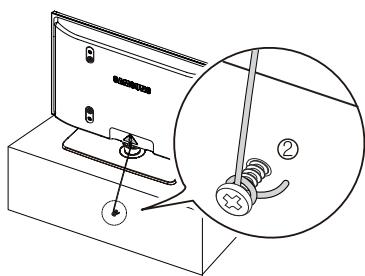
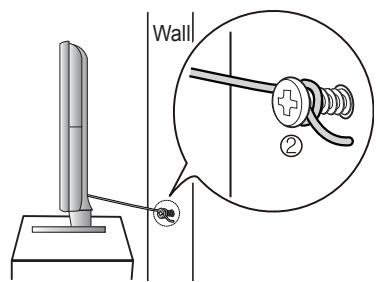
- Verify all connections are properly secured. Periodically check connections for any sign of fatigue or failure. If you have any doubt about the security of your connections, contact a professional installer.
Install your wall mount on a solid wall perpendicular to the floor.
When attaching to other building materials, please contact your nearest dealer.
If installed on a ceiling or slanted wall, it may fall and result in severe personal injury.
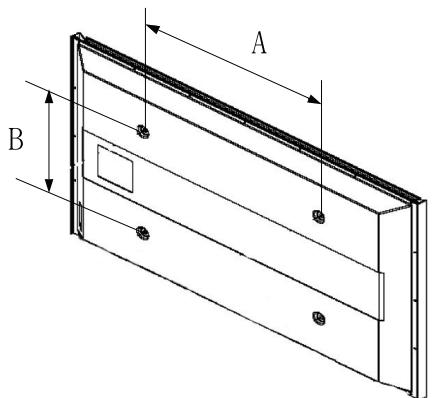
| Product Family | inch | VESA Spec. (A * B) | Standard Screw | Quantity |
| LCD-TV | 19" ~22" | 100 * 100 | M4 | 4 |
| 23"~29" | 200 * 100 | |||
| 30"~40" | 200 * 200 | M6 | ||
| 46"~55" | 400 * 400 | M8 | ||
| 57"~70" | 800 * 400 | |||
| 80" ~ | 1400 * 800 | |||
| PDP-TV | 42"~50" | 400 * 400 | M8 | 4 |
| 58"~63" | 600 * 400 | |||
| 70" ~ | 800 * 400 | |||
| 80" ~ | 1400 * 800 |
The standard dimensions for wall mount kits are shown in the table above.
When purchasing our wall mount kit, a detailed installation manual and all parts necessary for assembly are provided.
Do not use screws longer than the standard dimension, as they may cause damage to the inside of the TV set.
For wall mounts that do not comply with the VESA standard screw specifications, the length of the screws may differ depending on their specifications.
Do not use screws that do not comply with the VESA standard screw specifications.
Do not use fasten the screws too strongly, this may damage the product or cause the product to fall, leading to personal injury. Samsung is not liable for these kinds of accidents.
Samsung is not liable for product damage or personal injury when a non-VESA or non-specified wall mount is used or the consumer fails to follow the product installation instructions.
Our 57" and 63" models do not comply with VESA Specifications. Therefore, you should use our dedicated wall mount kit for this model.
Do not exceed 15 degrees tilt when mounting this TV.

Do not install your Wall Mount Kit while your TV is turned on. It may result in personal injury due to electric shock.
| Model Name | PN50B550T2F/ PN50B560T5F | PN58B550T2F/ PN58B560T5F | PN63B550T2F/ PN63B590T5F |
| Screen Size (Diagonal) | 50 inch (49.9 inches measured diagonally) | 58 inch (58.0 inches measured diagonally) | 63 inch (62.9 inches measured diagonally) |
| PC Resolution | 1920 x 1080 @ 60 Hz | 1920 x 1080 @ 60 Hz | 1920 x 1080 @ 60 Hz |
| Sound (Output) | 10W x 2 | 15W x 2 | 15W x 2 |
| Dimension (W x H x D) | |||
| Body | 48.8 x 30.1 x 2.9 inches (1240 x 766 x 74 mm) | 55.8 x 34.1 x 2.9 inches (1418 x 866 x 74 mm) | 60.2 x 36.7 x 2.9 inches (1531 x 932 x 74 mm) |
| With stand | 48.8 x 32.4 x 11.4 inches (1240 x 822 x 290 mm) | 55.8 x 36.4 x 13.2 inches (1418 x 924 x 335 mm) | 60.2 x 39.1 x 15.3 inches (1531 x 992.5 x 390 mm) |
| Weight | |||
| Body | 73.6 lbs (33.4 kg) | 84.6 lbs (38.4 kg) | 116.6 lbs (52.9 kg) |
| With stand | 84.6 lbs (38.4 kg) | 99.7 lbs (45.3 kg) | 133.6 lbs (60.6 kg) |
| Environmental Considerations | |||
| Operating Temperature | 50 °F to 104 °F (10 °C to 40 °C) | 50 °F to 104 °F (10 °C to 40 °C) | 50 °F to 104 °F (10 °C to 40 °C) |
| Operating Humidity | 10% to 80%, non-condensing | 10% to 80%, non-condensing | 10% to 80%, non-condensing |
| Storage Temperature | -4 °F to 113 °F (-20 °C to 45 °C) | -4 °F to 113 °F (-20 °C to 45 °C) | -4 °F to 113 °F (-20 °C to 45 °C) |
| Storage Humidity | 5% to 95%, non-condensing | 5% to 95%, non-condensing | 5% to 95%, non-condensing |
This device is a Class B digital apparatus.
Design and specifications are subject to change without prior notice.
For the power supply and Power Consumption, refer to the label attached to the product.
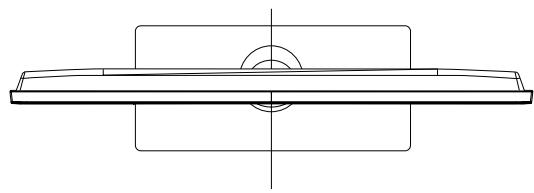
TOP VIEW
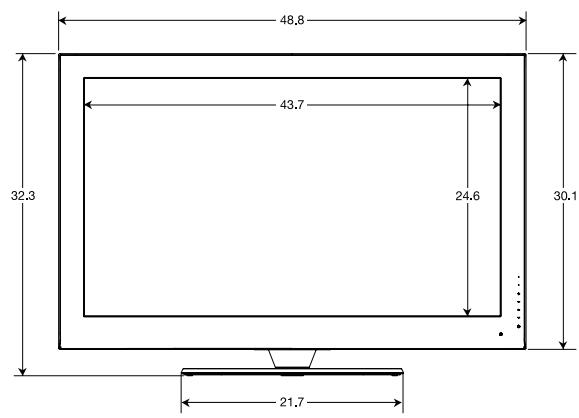
FRONT VIEW
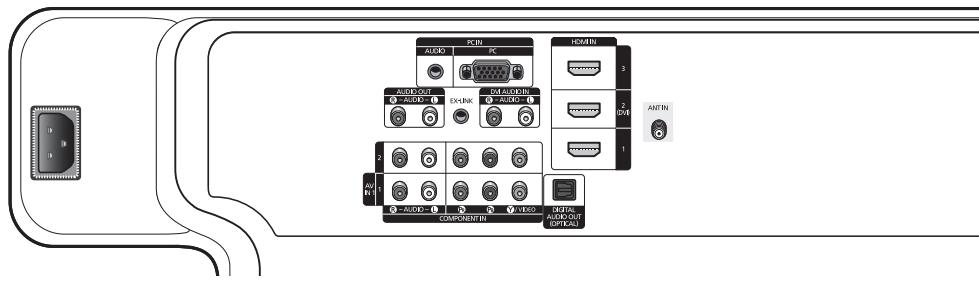
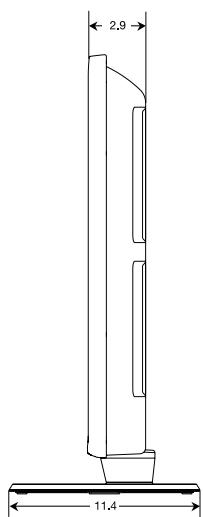
JACK PANEL DETAIL 7.2 x 3.7 inches
SIDE VIEW
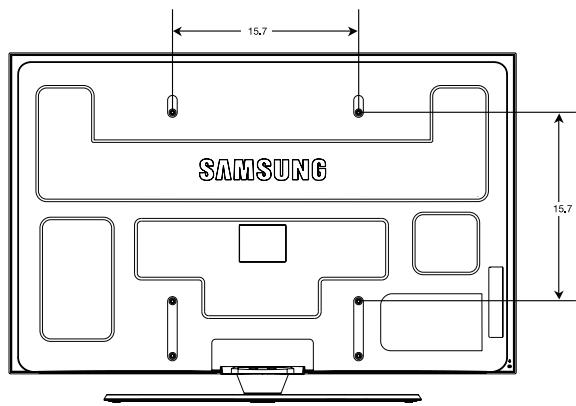
REAR VIEW
NOTE: All drawings not necessarily to scale. Some
dimensions are subject to change without prior notice
Refer to dimensions on each unit prior to performing the calculation. Note that the value of is fixed.
any carpentry. Not responsible for typographical or
printed errors.
© 2009 Samsung Electronics America, Inc.
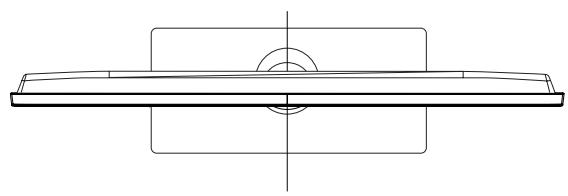
TOP VIEW
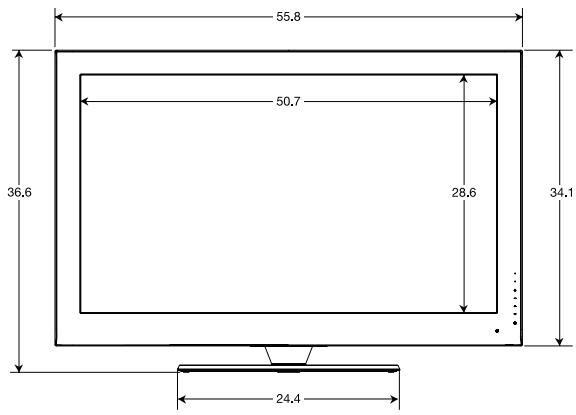
FRONT VIEW
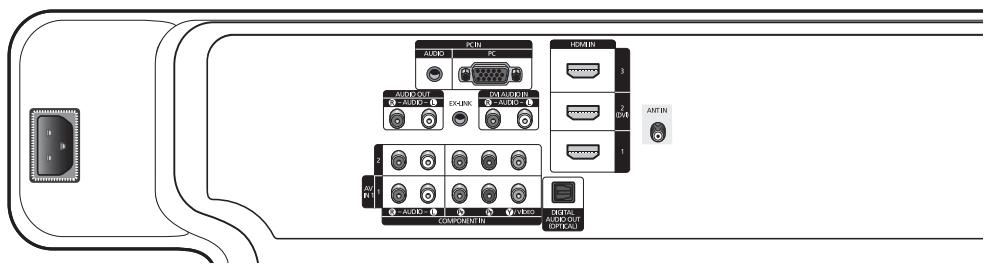
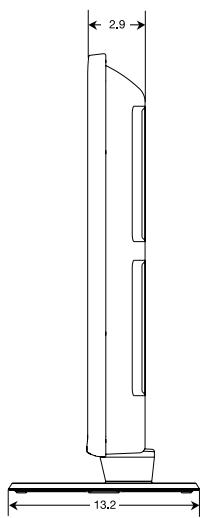
JACK PANEL DETAIL 7.2 x 3.7 inches
SIDE VIEW
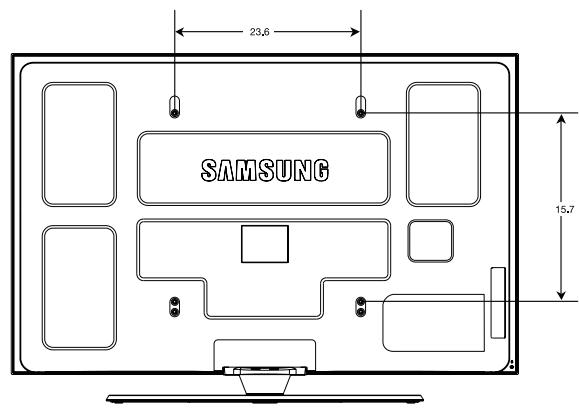
REAR VIEW
NOTE: All drawings not necessarily to scale. Some dimensions are subject to change without prior notice. Refer to dimensions on each unit prior to performing any carpentry. Not responsible for typographical or printed errors.
© 2009 Samsung Electronics America, Inc.
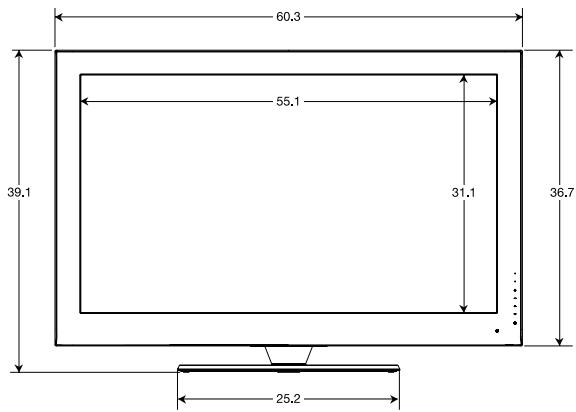
FRONT VIEW
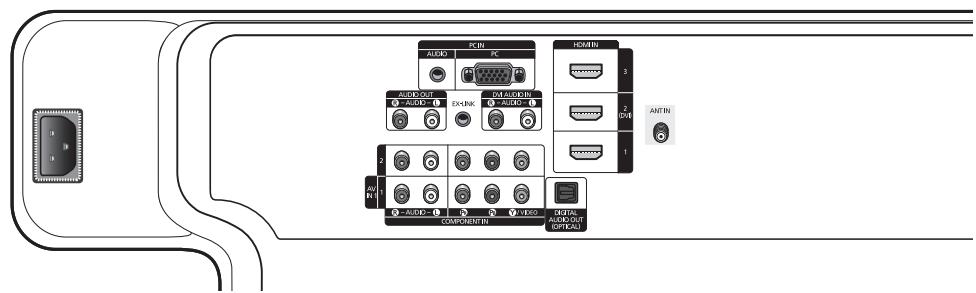
TOP VIEW
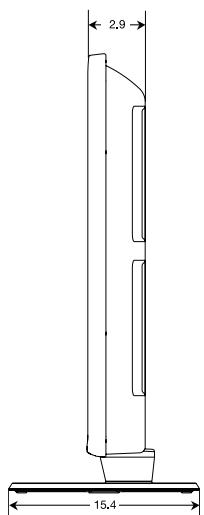
JACK PANEL DETAIL 7.2 x 3.7 inches
SIDE VIEW
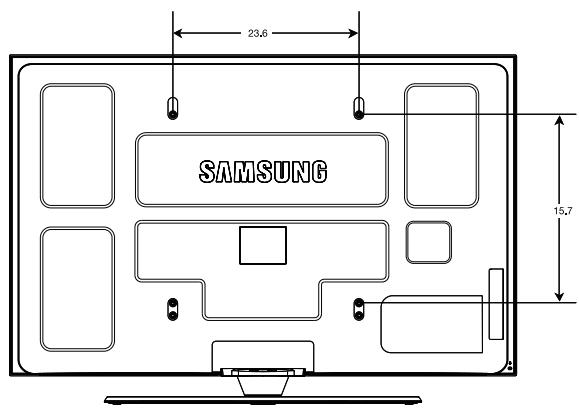
REAR VIEW
NOTE: All drawings not necessarily to scale. Some dimensions are subject to change without prior notice. Refer to dimensions on each unit prior to performing any carpentry. Not responsible for typographical or printed errors.
© 2009 Samsung Electronics America, Inc.
Cable audio/cable video (PN58B550T2 sefument)
PN50B560T5F/PN58B560T5F/PN63B590T5F
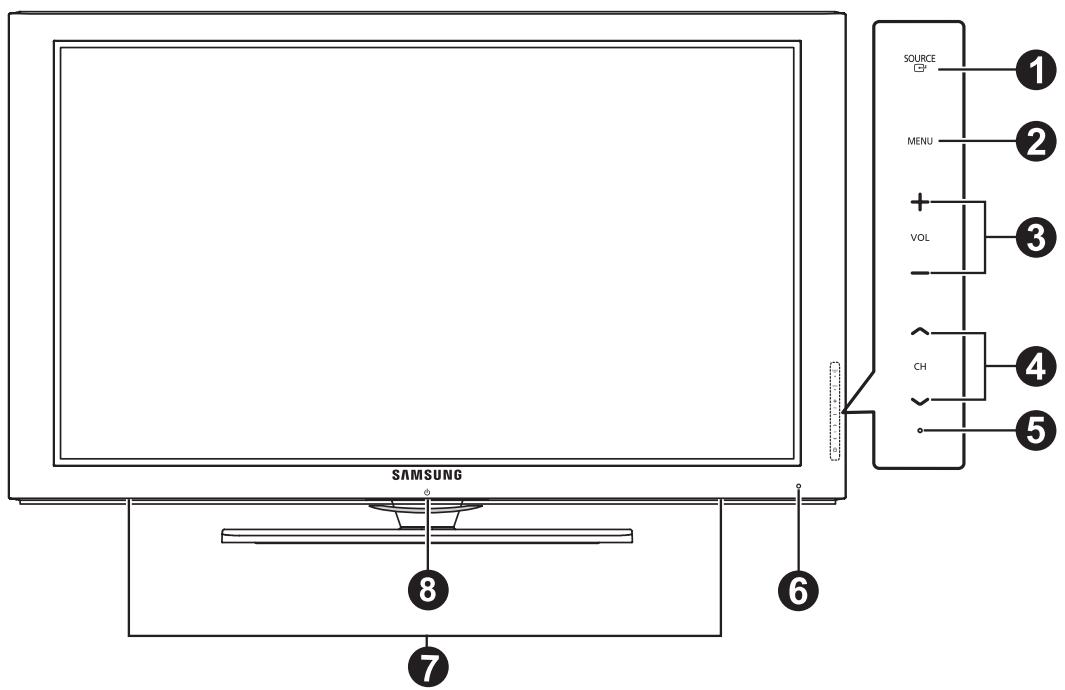
SOURCE
DIGITAL AUDIO OUT (OPTICAL)
Information, modification
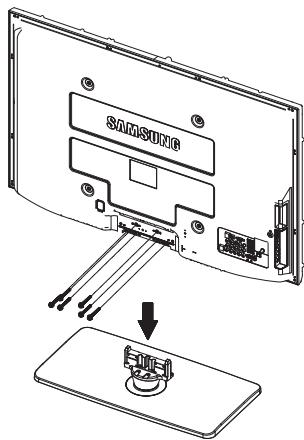
(PN58B550T2F/PN58B560T5F/
PN63B550T2F/PN63B590T5F)