 ManualGo.com
SC-D23 - Camcorder SAMSUNG - Free user manual and instructions
Find the device manual for free SC-D23 SAMSUNG in PDF.


Download the instructions for your Camcorder in PDF format for free! Find your manual SC-D23 - SAMSUNG and take your electronic device back in hand. On this page are published all the documents necessary for the use of your device. SC-D23 by SAMSUNG.
USER MANUAL SC-D23 SAMSUNG
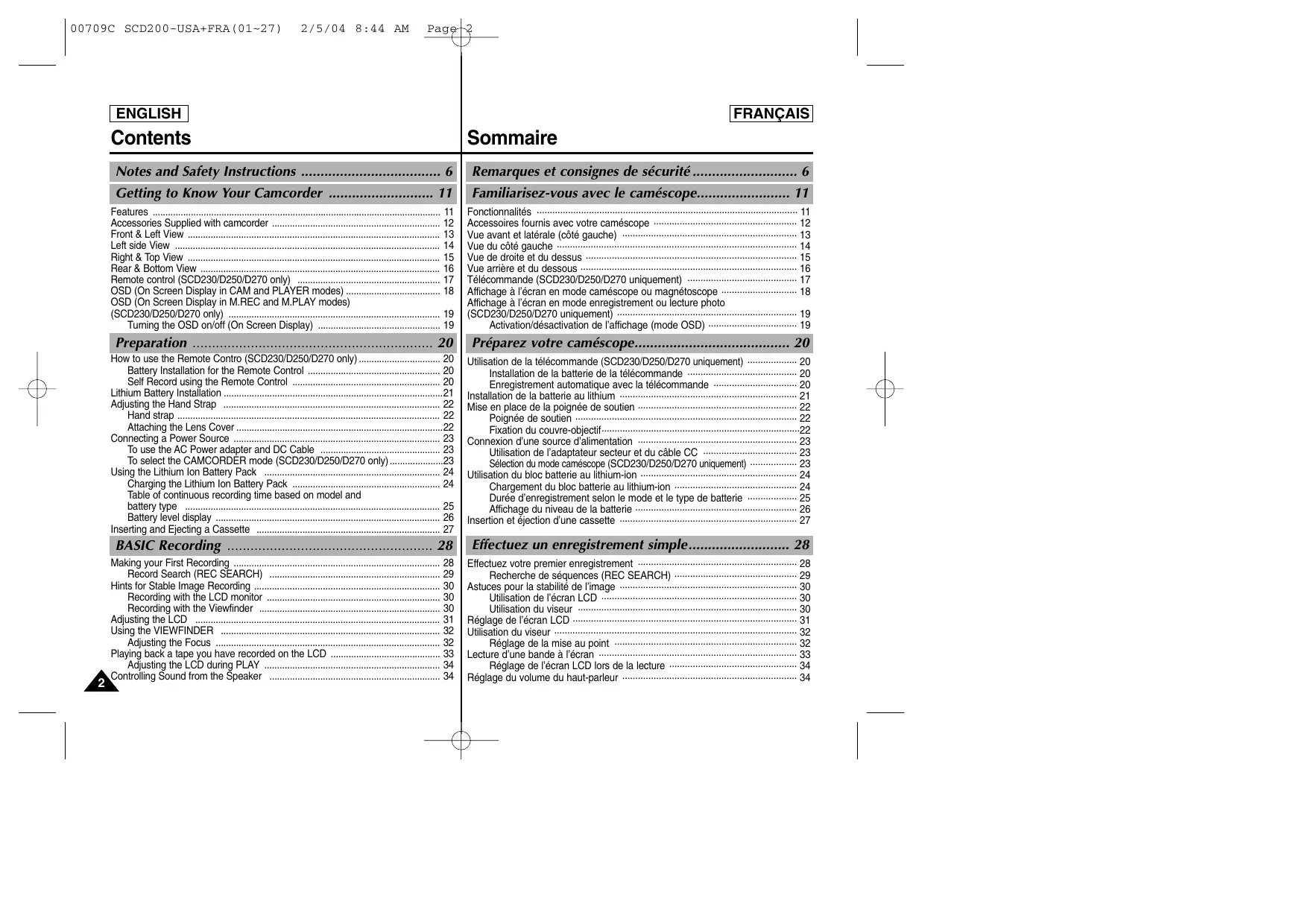
- Sommaire Remarques et consignes de sécurité p. 6
- Getting to Know Your Camcorder p. 11
- Familiarisez-vous avec le caméscope p. 11
- Features p. 11
- Accessories Supplied with camcorder p. 12
- Front & Left View p. 13
- Left side View p. 14
- Right & Top View p. 15
- Rear & Bottom View p. 16
- Remote control (SCD230/D250/D270 only) p. 17
- OSD (On Screen Display in CAM and PLAYER modes) p. 18
- OSD (On Screen Display in M.REC and M.PLAY modes) (SCD230/D250/D270 only) p. 19
- Turning the OSD on/off (On Screen Display) p. 19
- Fonctionnalités ···································································································· 11 Accessoires fournis avec votre caméscope ······················································· 12 Vue avant et latérale (côté gauche) ··································································· 13 Vue du côté gauche ···························································································· 14 Vue de droite et du dessus ················································································· 15 Vue arrière et du dessous ··················································································· 16 Télécommande (SCD230/D250/D270 uniquement) ·········································· 17 Affichage à l’écran en mode caméscope ou magnétoscope ····························· 18 Affichage à l’écran en mode enregistrement ou lecture photo (SCD230/D250/D270 uniquement) ····································································· 19 Activation/désactivation de l’affichage (mode OSD) ·································· 19 Preparation p. 20
- Préparez votre caméscope p. 20
- How to use the Remote Contro (SCD230/D250/D270 only) p. 20
- Battery Installation for the Remote Control p. 20
- Self Record using the Remote Control p. 20
- Lithium Battery Installation p. 21
- Adjusting the Hand Strap p. 22
- Hand strap p. 22
- Attaching the Lens Cover p. 22
- Connecting a Power Source p. 23
- To use the AC Power adapter and DC Cable p. 23
- To select the CAMCORDER mode (SCD230/D250/D270 only) p. 23
- Using the Lithium Ion Battery Pack p. 24
- Charging the Lithium Ion Battery Pack p. 24
- Table of continuous recording time based on model and battery type p. 25
- Battery level display p. 26
- Inserting and Ejecting a Cassette p. 27
- Utilisation de la télécommande (SCD230/D250/D270 uniquement) ··················· 20 Installation de la batterie de la télécommande ·········································· 20 Enregistrement automatique avec la télécommande ································ 20 Installation de la batterie au lithium ···································································· 21 Mise en place de la poignée de soutien ····························································· 22 Poignée de soutien ····················································································· 22 Fixation du couvre-objectif············································································22 Connexion d’une source d’alimentation ····························································· 23 Utilisation de l’adaptateur secteur et du câble CC ···································· 23 Sélection du mode caméscope (SCD230/D250/D270 uniquement) ·················· 23 Utilisation du bloc batterie au lithium-ion ···························································· 24 Chargement du bloc batterie au lithium-ion ··············································· 24 Durée d’enregistrement selon le mode et le type de batterie ··················· 25 Affichage du niveau de la batterie ······························································ 26 Insertion et éjection d’une cassette ···································································· 27 BASIC Recording p. 28
- Effectuez un enregistrement simple p. 28
- Making your First Recording p. 28
- Record Search (REC SEARCH) p. 29
- Hints for Stable Image Recording p. 30
- Recording with the LCD monitor p. 30
- Recording with the Viewfinder p. 30
- Adjusting the LCD p. 31
- Using the VIEWFINDER p. 32
- Adjusting the Focus p. 32
- Playing back a tape you have recorded on the LCD p. 33
- Adjusting the LCD during PLAY p. 34
- Controlling Sound from the Speaker p. 34
- Effectuez votre premier enregistrement ····························································· 28 Recherche de séquences (REC SEARCH) ··············································· 29 Astuces pour la stabilité de l’image ···································································· 30 Utilisation de l’écran LCD ··········································································· 30 Utilisation du viseur ···················································································· 30 Réglage de l’écran LCD ······················································································ 31 Utilisation du viseur ····························································································· 32 Réglage de la mise au point ······································································ 32 Lecture d’une bande à l’écran ············································································ 33 Réglage de l’écran LCD lors de la lecture ················································· 34 Réglage du volume du haut-parleur ··································································· 34 00709C SCD200-USA+FRA(01~27) 2/5/04 8:44 AM Page 3 FRANÇAIS ENGLISH Contents Advanced Recording p. 35
- Use of various Functions p. 35
- Setting menu items p. 35
- Set the camcorder to CAM or PLAYER mode and M.REC or M.PLAY mode (SCD230/D250/D270 only) p. 36
- Availability of functions in each mode p. 37
- CLOCK SET p. 38
- WL. REMOTE (SCD230/D250/D270 only) p. 39
- BEEP SOUND (SCD230/D250/D270 only) p. 40
- SHUTTER SOUND (SCD230/D250/D270 only) p. 41
- DEMONSTRATION p. 42
- PROGRAM AE p. 43
- Setting the PROGRAM AE p. 44
- Zooming In and Out with DIGITAL ZOOM p. 46
- Zooming In and Out p. 46
- Digital Zoom p. 47
- DIS (Digital Image Stabilizer) p. 48
- DSE (Digital Special Effects) SELECT p. 49
- Selecting an effect p. 50
- REC MODE p. 51
- AUDIO MODE p. 52
- WIND CUT p. 53
- DATE/TIME p. 54
- TV DISPLAY p. 55
- Using Quick Menu p. 56
- Setting the Quick menu p. 57
SHUTTER SPEED & EXPOSURE ............................................................... 58
- SLOW SHUTTER(Low Shutter Speed) p. 59
- EASY Mode (for Beginners) p. 60
- MF/AF (Manual Focus/Auto Focus) p. 61
- Auto Focusing p. 61
- Manual Focusing p. 61
- BLC (Back Light Compensation) p. 62
- Fade In and Out p. 63
- To Start Recording p. 63
- To Stop Recording (use FADE IN / FADE OUT) p. 63
- Audio dubbing (SCD230/D250/D270 only) p. 64
- Dubbing sound p. 64
- Dubbed Audio Playback p. 65
- PHOTO Image Recording p. 66
- Searching for a PHOTO picture p. 66
- Sommaire Perfectionnez vos enregistrements Fonctions du mode menu ··················································································· 35 Liste des réglages ······················································································ 35 Réglez le caméscope sur CAMERA ou PLAYER, ou bien sur M.REC ou M.PLAY (SCD230/D250/D270 uniquement) ······························ 36 Fonctions disponibles pour chaque mode ················································· 37 Réglage de l’horloge (CLOCK SET) ·························································· 38 Activation/désactivation de la télécommande (WL. REMOTE) (SCD230/D250/D270 uniquement) ···························································· 39 Activation/désactivation de la sonorité (BEEP SOUND) (SCD230/D250/D270 uniquement) ···························································· 40 Bruit de l’obturateur (SHUTTER SOUND) (SCD230/D250/D270 uniquement) ···························································· 41 Mode DEMONSTRATION ·········································································· 42 Exposition automatique (PROGRAM AE) ·················································· 43 Réglage de l’exposition automatique ························································· 44 Équilibrage du blanc (WHT. BALANCE) ···················································· 45 Utilisation du zoom numérique ··································································· 46 Zoom avant et arrière ················································································· 46 Zoom numérique (DIGITAL ZOOM) ··························································· 47 Stabilisateur électronique d’images (DIS) ·················································· 48 Effets spéciaux numériques (DSE) ···························································· 49 Sélection d’un effet ····················································································· 50 Mode d’enregistrement (REC MODE) ······················································· 51 Mode AUDIO ······························································································· 52 Fonction coupe-vent (WIND CUT) ····························································· 53 Affichage de la date et de l’heure (DATE/TIME) ········································ 54 Affichage (fonction TV DISPLAY) ······························································· 55 Menu rapide ········································································································ 56 Utilisation du menu rapide ·········································································· 57 Vitesse d’obturation et exposition p. 35
(SHUTTER SPEED & EXPOSURE) ·························································· 58
- Obturation lente (SLOW SHUTTER) ·································································· 59 Mode EASY (débutants) ····················································································· 60 Mise au point manuelle/automatique (MF/AF) ··················································· 61 Mise au point automatique ········································································· 61 Mise au point manuelle ·············································································· 61 Contre-jour intelligent (BLC) ··············································································· 62 Fondu en ouverture et en fermeture (FADE) ····················································· 63 Début de l’enregistrement ·········································································· 63 Fin de l’enregistrement (avec fondu) ························································· 63 Doublage sonore (AUDIO DUBBING) (SCD230/D250/D270 uniquement) ····································································· 64 Réalisation du doublage sonore ································································· 64 Écoute du son doublé ················································································· 65 Enregistrement d’une image fixe ········································································ 66 Recherche d’images fixes ·········································································· 66 3 00709C SCD200-USA+FRA(01~27) 2/5/04 8:44 AM Page 4 FRANÇAIS ENGLISH Contents Sommaire Playback p. 70
- Visionnez une cassette p. 70
- NITE PIX (0 lux recording) p. 67
POWER NITE PIX...................................................................................................68
- Various Recording Techniques p. 69
- Tape Playback p. 70
- Playback on the LCD p. 70
- Playback on a TV monitor p. 70
- Connecting to a TV which has Audio/Video input jacks p. 70
- Connecting to a TV which has no Audio and Video input jacks p. 71
- Playback p. 71
- Various Functions while in PLAYER mode p. 72
- Playback pause p. 72
- Picture search (Forward/Reverse) p. 72
- Slow playback (Forward/Reverse) (SCD230/D250/D270 only) p. 72
- Frame advance (To play back frame by frame) (SCD230/D250/D270 only) p. 73
- X2 Playback (Forward/Reverse ) (SCD230/D250/D270 only) p. 73
- Reverse playback (SCD230/D250/D270 only) p. 73
- ZERO MEMORY (SCD230/D250/D270 only) p. 74
- PB DSE (Playback Digital Special Effects) p. 75
- PB ZOOM Capture de nuit (NITE PIX) ················································································· 67 Capture de nuit renforcée (POWER NITE PIX) ················································· 68 Différentes techniques d’enregistrement ···························································· 69 Lecture d’une bande ··························································································· 70 Lecture sur l’écran LCD ·············································································· 70 Lecture sur l’écran de votre téléviseur ······················································· 70 Connexion à un téléviseur avec entrée A/V ··············································· 70 Connexion à un téléviseur sans entrée A/V ··············································· 71 Lecture de la cassette ················································································ 71 Fonctions du mode magnétoscope ···································································· 72 Arrêt sur image (mode pause) ··································································· 72 Recherche d’image avant/arrière ······························································· 72 Lecture au ralenti avant/arrière (SCD230/D250/D270 uniquement) ········ 72 Lecture image par image (SCD230/D250/D270 uniquement) ·················· 73 Lecture X2 avant/arrière (SCD230/D250/D270 uniquement) ···················· 73 Lecture arrière (SCD230/D250/D270 uniquement) ··································· 73 Mémoire compteur (ZERO MEMORY) (SCD230/D250/D270 uniquement) ····· 74 Effets spéciaux numériques en lecture (PB DSE) ············································· 75 Zoom en lecture (PB Zoom) ··············································································· 76 Recording in PLAYER mode (SCD250/D270 only) p. 76
Transfert d’images numériques avec l’interface USB ········································ 80 Configuration système requise ··········································································· 80 Installation du programme DVC Media 5.1 ························································ 81 Utilisation de la fonction «Caméra d’ordinateur» ······································· 81 Utilisation de la fonction «Disque amovible» ············································· 82 Utilisation de la fonction de diffusion en temps réel via le port
USB (USB STREAMING) ··········································································· 82
- Connexion à un PC ····························································································· 82 Digital Still Camera mode (SCD230/D250/D270 only) p. 83
- Appareil photo numérique (SCD230/D250/D270 uniquement) 83 MEMORY STICK (SCD250/D270 only) p. 83
- Memory Stick Functions p. 83
- Inserting and ejecting the Memory Stick p. 84
- Mémorisation sur carte MEMORY STICK (SCD250/D270 uniquement) ·········· 83 Fonctions disponibles avec la carte Memory Stick ···································· 83 Insertion/retrait de la carte Memory Stick ·················································· 84 00709C SCD200-USA+FRA(01~27) 2/5/04 8:44 AM Page 5 FRANÇAIS ENGLISH Contents Sommaire Structure of folders and files on the Memory Stick p. 85
- Image Format p. 85
- Selecting the CAMCORDER mode p. 85
- Selecting the image quality p. 87
- Select the image quality p. 87
- Number of images on the Memory Stick p. 87
- Recording Still images to a Memory Stick in M.REC Mode p. 88
- Recording images to a Memory Stick p. 88
- Recording an image from a cassette as a still image p. 89
- Viewing Still images p. 90
- To view a Single image p. 90
- To view a slide show p. 90
- To view the Multi Display p. 91
- Copying still images from a cassette to Memory Stick p. 92
- Marking images for printing p. 93
- Protection from accidental erasure p. 94
- Deleting Still images p. 95
- Formatting the Memory Stick p. 96
- Attention p. 96
- MPEG RECORDING p. 97
- Selecting the moving picture sizes p. 98
- MPEG Playback p. 99
- Structure des dossiers et fichiers sur la carte Memory Stick ···················· 85 Format des images ····················································································· 85 Sélection du mode du caméscope ····································································· 85 Numéro de fichier mémoire ················································································ 86 Sélection de la qualité d’image ··········································································· 87 Sélection de la qualité d’image ·································································· 87 Nombre d’images pouvant être stockées sur la carte Memory Stick ······························································································ 87 Enregistrement d’images sur une carte Memory Stick ······································ 88 Enregistrement d’images sur une carte Memory Stick ······························ 88 Enregistrement d’une image à partir d’une cassette ································· 89 Visualisation d’images fixes ················································································ 90 Visualiser une seule image ········································································ 90 Visualiser les images sous forme de diaporama ······································· 90 Visualiser plusieurs images à la fois ·························································· 91 Copie d’images fixes d’une cassette sur la carte Memory Stick ······················· 92 Marquage des images pour leur impression ······················································ 93 Protection contre un effacement accidentel ······················································· 94 Effacement des images fixes mémorisées ························································· 95 Formatage d’une carte Memory Stick ································································ 96 Avertissement ····························································································· 96 ENREGISTREMENT MPEG ·············································································· 97 Sélection de tailles d'image mobile ···································································· 98 Lecture MPEG ····································································································· 99 Maintenance p. 100
- Conseils d’utilisation p. 100
- After finishing a recording p. 100
- Cleaning and Maintaining the Camcorder p. 101
- Cleaning the Video Heads p. 101
- Using Your Camcorder Abroad p. 102
- Power sources p. 102
- Color system p. 102
- Fin d’un enregistrement ···················································································· 100 Nettoyage et entretien du caméscope ····························································· 101 Nettoyage des têtes vidéo ········································································ 101 Utilisation du caméscope à l’étranger ······························································ 102 Sources d’alimentation ············································································· 102 Normes de couleurs ················································································· 102 Troubleshooting p. 103
- Dépannage p. 103
- Troubleshooting p. 103
- Self Diagnosis Display p. 103
- Moisture Condensation p. 103
- Self Diagnosis Display in M.REC, M.PLAY mode (SCD230/D250/D270 only) p. 104
- Dépannage ········································································································ 103 Auto-diagnostic ························································································· 103 Condensation ···························································································· 103 Indicateurs de l’auto-diagnostic en mode M.REC/M.PLAY (SCD230/D250/D270 uniquement) ························································· 104 Specifications p. 106
- Spécifications techniques p. 106
- INDEX p. 107
- INDEX p. 107
- Warranty (Canada users only) p. 108
- Garantie pour le Canada p. 108
00709C SCD200-USA+FRA(01~27) 2/5/04 8:44 AM Page 6 FRANÇAIS ENGLISH Notes and Safety Instructions Remarques et consignes de sécurité Notes regarding the rotation of the LCD screen Rotation de l’écran LCD Please rotate the LCD screen carefully as illustrated. Over rotation may cause damage to the inside of the hinge that connects the LCD screen to the Camcorder.
1. LCD screen closed.
2. Standard recording using the LCD
screen. ■ A LCD Monitor is opened applying a finger to LCD open knob.
3. Recording when looking at the
LCD screen from the top.
4. Recording when looking at the
LCD screen from the front.
5. Recording with the LCD screen
1. A sudden rise in atmospheric temperature may cause
condensation to form inside the camcorder.
(DEW) protection feature is activated, leave the camcorder for at least two hours in a dry, warm room with the cassette compartment opened and the battery pack removed. Notes regarding CAMCORDER
1. Do not leave the camcorder exposed to high temperature
(above 60°C or 140°F). For example, in a parked car in the sun or exposed to direct sunlight.
2. Do not let the camcorder get wet.
Keep the camcorder away from rain, sea water, and any other form of moisture. If the camcorder gets wet, it may get damaged. Sometimes a malfunction due to exposure to liquids cannot be repaired.
Make sure that the battery pack is fully charged before starting to record. To preserve battery power, keep your camcorder turned off when you are not operating it. If your camcorder is in CAM mode, and it is left in STBY mode without being operated for more than 5 minutes with a tape installed, it will automatically turn itself off to protect against unnecessary battery discharge. Make sure that the battery pack is fitted firmly into place. Dropping the battery pack may damage it. A brand new battery pack is not charged. Before using the battery pack, you need to charge it completely. It is a good idea to use the viewfinder rather than the LCD when making a long recordings, because the LCD uses up more battery power. Bloc batterie
- When the battery reaches the end of its life, please contact your local dealer. The batteries have to be dealt with as chemical waste.
Do not film with the camera lens pointing directly at the sun. Direct sunlight can damage the CCD(Charge Coupled Device). Viseur électronique Notes regarding electronic viewfinder
1. Do not position the camcorder such that the viewfinder is pointing
towards the sun. Direct sunlight can damage the inside of the viewfinder. Be careful when placing the camcorder under sunlight or near a window exposed to sunlight.
1. The LCD display has been
manufactured using high precision technology. However, there may be tiny dots (red, blue or green in color) that appear on the LCD display. These dots are normal and do not affect the recorded picture in any way.
2. When you use the LCD display under direct sunlight or outdoors,
it maybe difficult to see the picture clearly. If this occurs, we recommend using the viewfinder.
3. Direct sunlight can damage the LCD monitor.
Poignée de soutien Notes regarding the hand strap
1. The lithium battery maintains the clock function and user settings;
even if the battery pack or AC adapter is removed.
2. The lithium battery for the camcorder lasts about 6 months under
normal operation from time of installation.
3. When the lithium battery becomes weak or dead, the date/time
indicator will display “---” when you set the DATE/TIME to ON. In this case, replace the lithium battery with a new one(type CR2025).
4. Danger of explosion if battery is incorrectly replaced.
Replace only with the same or equivalent type.
Digital data transfer function with IEEE1394 By incorporating the IEEE 1394 (i.LINK™ : i.LINK is a serial data transfer protocol and interconnectivity system, used to transmit DV data) high speed data transport port, both moving and still images can be transferred to a PC, making it possible to produce or edit various images. USB interface for digital image data transfer (SCD230/D250/D270 only) You can transfer images to a PC using the USB interface without an add-on card. PHOTO The PHOTO function lets you capture an object as a still along with sound, while in Camera mode. 800x Digital zoom Allows you to magnify an image up to 800 times its original size. Color TFT LCD A high-resolution color TFT LCD gives you clean, sharp images as well as the ability to review your recordings immediately. Digital Image Stabilizer (DIS) The DIS compensates for any handshake, reducing unstable images particularly at high magnification. Various digital effects The DSE (Digital Special Effects) allows you to give your films a special look by adding various special effects. Back Light Compensation (BLC) The BLC function compensates for the bright background behind a subject you're recording. Program AE The Program AE enables you to alter the shutter speed and aperture to suit the type of scene/action to be filmed. NITE PIX The NITE PIX function enables you to record a subject in a dark place. Digital Still Camera function (SCD230/D250/D270 only) ■ Using Memory Stick, you can easily record and playback standard still images. ■ You can transfer standard still images on the Memory Stick to your PC using the USB interface. MPEG Recording (SCD230/D250/D270 only) MPEG recording makes it possible to record video onto a Memory Stick. Fonctionnalités
(SCD230/D250/D270 only)
7. Lithium battery for
Remote Control or Clock. (TYPE: CR2025)
(SCD230/D250/D270 only)
(SCD230/D250/D270 only)
(SCD230/D250/D270 only)
TFT LCD Monitor (see page 31)
DISPLAY Mode Switch (TAPE/MEMORY STICK) (SCD230/D250/D270 only)
3. FOCUS Adjustment knob
Memory Stick Slot (SCD230/D250/D270 only)
7. Manual focus (see page 61)
8. Shutter speed and EXPOSURE
12. USB (SCD230/D250/D270 only)
(SCD230/D250/D270 only)
15. Audio recording mode (see page 52)
16. Zero memory indicator
(SCD230/D250/D270 only) (see page 74)
17. Remaining Tape (measured in minutes)
22. Self recording and waiting timer
(SCD230/D250/D270 only) (see page 20)
23. DIS (see page 48)
4. Program AE (activation/désactivation du
Turning the OSD on/off (On Screen Display) Turning OSD on/off Press the DISPLAY button on the left side panel. - Each press of the button toggles the OSD function on and off. - When you turn the OSD off, In CAM mode: The STBY, REC, EASY.Q modes are always displayed on the OSD, even when the OSD is turned OFF and the key input is displayed for 3 seconds then turned off. In PLAYER mode: When you press any Function button, the function is displayed on the OSD for 3 seconds before it turns off. OSD in M.REC mode
indicator is displayed in the LCD.
3. Press the START/STOP button to start the timer.
- Self Timer starts counting down from 10 with a beep sound. - In the last one second of the countdown, the beep sound gets faster, then recording starts automatically. - If you want to cancel the Self Timer function before recording, press the SELF TIMER button.
4. Press START/STOP again when you wish to stop recording.
1. Open the lithium battery cover from
2. Position the Lithium cell in the holder,
with the positive ( ) terminal face outward.
3. Close the lithium battery cover.
3. Refermez le couvercle.
Note The lithium battery must be inserted in the correct direction.
Warning: Keep the LITHIUM BATTERY out of the reach of
00709C SCD200-USA+FRA(01~27) 2/5/04 8:44 AM Page 23 FRANÇAIS ENGLISH Preparation Connecting a Power Source There are two types of power source that can be connected to your camcorder. - The AC Power Adapter and AC cord : used for indoor recording. - The Battery Pack : used for outdoor recording. To use the AC Power adapter and DC Cable
1. Connect the AC Power adapter to
2. Connect the AC cord to a wall
The plug and wall socket type may differ according to your resident country.
3. Connect the DC cable to the
DC jack socket of the camcorder. (When the battery is attached on the set, you should keep outside the projection of the DC cable.)
4. Set the camcorder to each mode by
holding down the tab on the power switch and turning it to the CAM or PLAYER mode.
00709C SCD200-USA+FRA(01~27) 2/5/04 8:44 AM Page 24 FRANÇAIS ENGLISH Preparation Préparez votre caméscope Using the Lithium Ion Battery Pack Utilisation du bloc batterie au lithium-ion ✤ La durée d’enregistrement dépend : - du modèle de bloc batterie utilisé. - de l’utilisation du zoom. - Par conséquent, nous vous recommandons d’avoir à disposition plusieurs batteries. Chargement du bloc batterie au lithium-ion ✤ The amount of continuous recording time available depends on. - The type and capacity of the battery pack you are using. - How often the Zoom function is used. It is recommended that you have several batteries available. Charging the Lithium Ion Battery Pack
1. Attach the battery pack to the camcorder.
2. Connect the AC Power adapter to an
AC cord and connect the AC cord to a wall socket.
3. Connect the DC cable to the DC jack
socket on the camcorder.
4. Turn the Camera power switch to off,
and the charging indicator will start to flash, showing that the battery is charging. Charging rate Less than 50% Twice per second Three times per second Blinking stops and stays on On for a second and off for a second 50% ~ 75% 75% ~ 90% 90 ~ 100% Error - Reset the battery pack and the DC cable
The battery pack may be charged a little at the time of purchase. To prevent reduction in the life and capacity of the battery pack, always remove it from the camcorder after it is fully charged. CHARGE
5. When the battery is fully charged, disconnect the
Temps de charge You must use the lithium ion battery pack of SB-LSXXX type. The battery pack should be recharged in an environment of between 32°F (0°C) and 104°F (40°C). The battery pack should never be charged in a room temperature that is below 32°F (0°C). The life and capacity of the battery pack will be reduced if it is used in temperatures below 32°F (0°C) or left in temperatures above 104°F (40°C) for a long period, even when it is fully recharged. Do not put the battery pack near any heat source (fire or flames, for example). Do not disassemble, process, pressure, or heat the Battery Pack. Do not allow the + and - terminals of the battery pack to be shortcircuited. It may cause leakage, heat generation, induce fire and overheating.
b. Utilisée de 20 à 40 % c. 40~80% used d. 80~95% used e. Completely used (flickers) (The camcorder will turn off soon, change the battery as soon as possible) ✤ Please refer to the table on page 25 for approximate continuous recording times. ✤ The recording time is affected by environmental temperature and conditions. The recording time becomes very short in a cold environment. The continuous recording times in the operating instructions are measured using a fully charged battery pack at 77°F(25°C). As the environmental temperature and conditions may differ when you actually use the camcorder, the remaining battery time may not be the same as the approximate continuous recording times given in these instructions. Tips for Battery Identification A charge mark is provided on the battery pack to help you remember whether it has been charged or not. Two colors are provided (red and grey)-you may choose which one indicates charged and which indicates discharged. (SB-LS110 only)
c. Utilisée de 40 à 80 % d. Utilisée de 80 à 95 % e. Entièrement déchargée (le symbole clignote) (Le caméscope va bientôt s’éteindre, changez la batterie dès que possible.) ✤ Veuillez vous reporter au tableau de la page 25 pour obtenir les durées approximatives d’enregistrement. ✤ La durée d’enregistrement peut varier selon la température ambiante. En particulier, au froid, elle est extrêmement réduite. Dans ce mode d’emploi, la durée théorique d’enregistrement est calculée avec un bloc batterie complètement chargé et à une température de 25°C. En fonction des conditions d’utilisation de votre caméscope, la durée d’enregistrement correspondant à la charge restante de la batterie peut différer des valeurs données dans le tableau indicatif. Comment savoir si vous avez chargé la batterie? Un indicateur de charge bicolore (rouge et noir) présent sur la batterie vous aide à vous rappeler si vous avez chargé la batterie ou non. Utilisez la couleur de votre choix pour indiquer que la batterie est chargée ou non. (SB-LS110 uniquement) 00709C SCD200-USA+FRA(01~27) 2/5/04 8:44 AM Page 27 FRANÇAIS ENGLISH Preparation Préparez votre caméscope Inserting and Ejecting a Cassette ✤ When inserting a tape or closing a cassette holder, do not apply excessive force. This may cause a malfunction. ✤ Do not use any tapes other than Mini DV cassettes.
1. Connect a power source and slide the
TAPE EJECT switch and open the cassette door. - The cassette holding mechanism rises automatically.
2. Insert a tape into the cassette holder with
the tape window facing outward and the protection tab bottom.
3. Press the area marked PUSH on the
cassette holding mechanism until it clicks into place. push - The cassette is loaded automatically.
4. Close the cassette door.
- Close the door completely until you can hear a “click”. Note When you have recorded something that you wish to keep, a. SAVE you can protect it so that it will not be accidentally erased. a. Protecting a tape : Push the safety tab on the cassette so that the hole is uncovered. b. Removing the tape protection : If you no longer wish to keep the recording on the cassette, push the write-protect tab back so that it b. REC covers the hole.
- How to store a tape a. Avoid places with magnets or magnetic interference. b. Avoid humidity and dust prone places. c. Keep the tape in an upright position and avoid storing it in direct sunlight. d. Avoid dropping or knocking your tapes. Insertion et éjection d’une cassette ✤ Ne forcez pas pour insérer une bande ou refermer le compartiment à cassette. Vous risqueriez de provoquer un dysfonctionnement. ✤ N’utilisez pas d’autres types de bandes que les Mini DV.
1. Connect a Power source to the
2. Remove the LENS CAP.
3. Set the power switch to the
CAM position. ■ Open the LCD monitor. ■ Set the mode switch to the TAPE position. (SCD230/D250/D270 only) Make sure that STBY is displayed. ■ If the protection tab of the cassette is open, STOP and PROTECTION! will be displayed. ■ Make sure the image you want to record appears in the LCD monitor or viewfinder. ■ Make sure the battery level indicates that there is enough remaining power for your expected recording time. FADE S.SHOW
4. To start recording, press the START/STOP button.
■ REC is displayed in the LCD. To stop recording, press the START/STOP button again. ■ STBY is displayed in the LCD.
While recording, it is very important to hold the camcorder correctly. Fix the LENS cap firmly by clipping it to the hand strap. (refer to the figure) Recording with the LCD monitor
1. Hold the camcorder firmly using the hand strap.
2. Place your right elbow against your side.
3. Place your left hand under or beside the LCD to support
and adjust it. Do not touch the built-in Remote Sensor or Infrared Light.
4. Choose a comfortable, stable position for the shots that
you are taking. You can lean against a wall or on a table for greater stability. Do not forget to breathe gently.
5. Use the LCD frame as a guide to determine the horizontal plane.
6. Whenever possible, use a tripod.
Recording with the Viewfinder
1. Hold the camcorder firmly using the hand strap.
2. Place your right elbow against your side.
3. Place your left hand under the camcorder to support it.
Be sure not to touch the built-in Remote Sensor or Infrared Light.
4. Choose a comfortable, stable position for the shots that
you are taking. You can lean against a wall or on a table for greater stability. Do not forget to breathe gently.
5. Place your eye firmly against the viewfinder eyecup.
6. Use the viewfinder frame as a guide to determine the
1. Set the POWER switch to CAM position.
■ In the PLAYER mode, you may only setup the LCD while the tape is playing.
2. Open the LCD screen, and the LCD switches on.
3. Press the MENU button.
4. Move the MENU SELECTOR so
that VIEWER is highlighted and then push the MENU SELECTOR.
it highlights the menu item you want to adjust (BRIGHT SELECT,
■ You may select NORMAL, SUPER or BACK LIGHT (SCD270 only) in the BRIGHT SELECT feature and push the MENU SELECTOR to save the setting. - When you use the LCD BACK LIGHT mode in a dark location or indoors, viewing the image may be difficult. (SCD270 only) ■ Use the MENU SELECTOR to adjust the value of BRIGHT ADJUST and COLOR ADJUST. ■ You can set values for BRIGHT ADJUST between 00 ~ 35 and COLOR ADJUST between 00 ~ 35.
9. Press the MENU button to finish the setting.
9. Une fois le réglage de l’écran terminé, appuyez sur la touche
MENU. Using the VIEWFINDER ✤ At the PLAYER mode, the VIEWFINDER will work when the LCD is closed. ✤ At the CAM mode, the VIEWFINDER will work when the LCD is closed or rotated counterclockwise 180°.
1. Hold down the power switch tab and turn it to the
2. Insert the tape you wish to view. (see page 27)
(REW) button to rewind the tape to the starting point. ■ To stop rewinding, press the (STOP) button. ■ The camcorder stops automatically after rewinding is complete. VOL/MF
3. Open the LCD screen.
Adjust the angle of the LCD screen and set the brightness or color if necessary. REV
(PLAY/STILL) button to start playback. ■ You can view the picture you recorded on the LCD. ■ To stop the PLAY operation, press the (STOP) button.
You can also view the picture on a TV screen, after connecting the camcorder to a TV or VCR. (see page 70) Various functions are available in playback mode. (see page 72)
FADE S.SHOW OL/MF BLC MENU 3-1 TAPE EJECT FADE S.SHOW BLC VOL/MF When you use the LCD screen for playback, you can hear recorded sound from the built-in Speaker. - Follow the instructions below to decrease or mute speaker volume in the PLAYER mode. - Take the following steps to lower the volume or mute the sound while playing a tape on the camcorder.
1. Set the power switch to PLAYER mode.
(PLAY/STILL) to play the tape.
3. When you hear sounds once the tape is in play,
use the MENU SELECTOR to adjust the volume. ■ A volume level display will appear on the LCD. Levels may be adjusted from anywhere between 00 to 19 and you will not hear any sound when the volume is set on 00. ■ If you close the LCD while playing, you will not hear sound from the speaker. MENU
Sound Effect for the photo button
Using the Remote Control DEMO
Selecting the Digital Image Stabilizing
REC MODE Selecting the recording speed
PHOTO SEARCH AUDIO SELECT Searching pictures recorded in TAPE Copying pictures from TAPE onto the Memory Stick Selecting Sound Quality for recording Selecting the Audio playback channel WIND CUT Minimizing wind noise
PB DSE AV IN/OUT (2) Selecting Analog A/V in or out
Selecting Storage Media (MPEG4, PHOTO) to playback
DELETE Deleting Files
LCD ADJUST Setting the Brightness and color Tones of the LCD
TV DISPLAY Selecting OSD on/off of TV
: This Function works in SCD250/D270 MODEL only.
Print images recorded on a memory stick (2)
Selecting Image Resolution : This Function works in SCD230/D250/D270 MODEL only. Fonctions
● Set the camcorder to CAM or PLAYER mode and M.REC or M.PLAY mode (SCD230/D250/D270 only)
1. Press the MENU button.
The MENU OSD is displayed. The cursor ( HIGHLIGHT ) indicates the feature you are currently adjusting.
2. Use the MENU SELECTOR and push the MENU SELECTOR on the
left side panel to select and activate the item.
3. You can exit the menu mode by pressing the MENU button.
Availability of functions in each mode Requested Mode Operating Digital functions DIS Mode DIS D.ZOOM
When a menu item on the LCD is marked with an X , that item cannot be activated. When you select an item that cannot be changed, an error message will be displayed. D.ZOOM PHOTO (TAPE)
O : The requested mode will work in this operating mode. ✕ : You can not change the requested mode. : The operating mode will be released and the requested mode will work.
- : The operating mode will be released and the requested mode will work. (the data during the operating mode will be backed up)
■ The menu list will appear.
minutes. ■ The word COMPLETE! will appear, and a few seconds later, the menu screen will automatically return to the sub menu.
9. You can set the day, hour and minute following the
same procedure for setting the year and month.
■ The menu list will appear.
the remote control. The setting switches between ON/OFF each time you push the MENU SELECTOR. INITIAL SET CLOCK SET WL.REMOTE BEEP SOUND SHUTTER SOUND DEMONSTRATION
5. To exit, press the MENU button.
■ If you set the remote to OFF in the menu and try to use it, the remote icon will blink for 3 seconds and disappear on the LCD.
■ The menu list will appear.
CLOCK SET WL.REMOTE the BEEP SOUND. BEEP SOUND SHUTTER SOUND The setting switches between ON/OFF each time DEMONSTRATION you push the MENU SELECTOR. ■ You will hear a Beep Sound when you select the ON setup. ■ When you press the START/STOP button to start recording, the BEEP SOUND is automatically set to OFF so you can’t hear it any longer.
■ The menu list will appear.
6. Push MENU SELECTOR to switch between ON
■ The menu list will appear.
3. Move the MENU SELECTOR to highlight INITIAL.
4. Select DEMONSTRATION from the submenu and
push the MENU SELECTOR.
5. To activate the DEMONSTRATION, set
DEMONSTRATION ON. ■ Press the menu button to quit the menu. ■ The demonstration will begin.
6. To end the DEMONSTRATION, set the
The DEMONSTRATION function only works without a TAPE installed. The DEMONSTRATION mode is automatically activated when the camcorder is left idle for more than 10 minutes after switching to the CAM mode (no tape is inserted in the camcorder). If you press other buttons (FADE, BLC, PHOTO, EASY) during the DEMONSTRATION mode, the DEMONSTRATION stops temporarily and resumes 10 minutes later if you do not operate any other functions. While setting the NITE PIX to ON, the DEMONSTRATION function does not work.
Auto balance between the subject and the background. To be used in normal conditions. The shutter speed automatically varies from 1/60 to 1/250 per second, depending on the scene. ■ SPORTS mode (
For recording people or objects moving quickly. ■ PORTRAIT mode (
For recording correctly when there is only light on the subject and not the rest of the picture. ■ SAND/SNOW mode (
For focusing on the background of the subject, when the background is out of focus. The PORTRAIT mode is most effective when used outdoors. The shutter speed automatically varies from 1/60 to 1/1000 per second.
For recording when people or objects are darker than the background because of reflected light from sand or snow. ■ High S. SPEED(High Shutter Speed) mode (
■ The menu list will appear.
While setting the NITE PIX to ON, the PROGRAM AE function does not work. The PROGRAM AE function will not operate in EASY mode.
the subject is of one dominant color. DIS
■ The menu list will appear.
When NITE PIX is set to ON, the WHT.BALANCE function does not work. The WHT.BALANCE function will not operate in EASY mode. Turn the digital zoom off (if necessary) to set a more accurate white balance. Reset the white balance if lighting conditions change. During normal outdoor recording, setting to AUTO may provide better results.
1. Move the zoom lever slightly for
a gradual zoom, move it further for a high-speed zoom. Your zooming is monitored on the OSD.
2. T(Telephoto) side:
Subject appears closer.
3. W(Wide angle) side:
Subject appears farther away.
Note You can record a subject that is a minimum of 1 m (about 3.2 feet) away from the lens surface in the TELE position, or about 10 mm (about 0.5 inch) away in the WIDE position.
■ The menu list will appear.
3. Move the MENU SELECTOR highlight to CAMERA
and push the MENU SELECTOR. ■ The sub menu list will appear.
4. Move the MENU SELECTOR to activate the
DIS function, push the MENU SELECTOR. ■ The DIS menu is changed to ON. ■ If you do not want to use the DIS function, set the DIS menu to OFF. ■ The setting switches between ON/OFF each time you push the MENU SELECTOR. ■ The DIS function will not turn off during the Recording.
It is recommended that you deactivate the shake compensation function when using a tripod. If you use the DIS function, the picture quality may deteriorate
While setting the NITE PIX to ON, the DSE function does not work. The DSE function will not operate in EASY mode. ART MOSAIC SEPIA NEGA MIRROR BLK&WHT
■ The menu list will appear.
3. Move the MENU SELECTOR to highlight A/V and
push the MENU SELECTOR.
4. Select REC MODE from the submenu and push
the MENU SELECTOR. ■ The REC MODE toggles between SP and LP with each press.
5. To exit, press the MENU button.
We recommend that you use this camcorder to play back any tapes recorded on this camcorder. Playing back a tape recorded in other equipment may produce mosaic shaped distortion. When you record a tape in SP and LP modes, or LP mode only, the playback picture may be distorted or the time code may not be written properly between scenes. Record using SP mode for best picture and sound quality.
00709C SCD200-USA+FRA(28~60) 2/5/04 8:51 AM Page 52 FRANÇAIS ENGLISH Perfectionnez vos enregistrements Advanced Recording ● AUDIO MODE ● Mode AUDIO ✤ The AUDIO MODE function works in CAM and PLAYER (SCD250/D270 only) modes. ✤ This camcorder records sound in two ways. (12bit, 16bit) ■ 12bit : You can record two 12bit stereo sound tracks. The original stereo sound can be recorded onto the MAIN (SOUND1) track. Additional stereo sound can be dubbed onto the SUB (SOUND2) track. ■ 16bit : You can record one high quality stereo sound using the 16bit recording mode. Audio dubbing is not possible when using this mode.
1. Set the camcorder to CAM mode.
■ The menu list will appear.
4. Select the AUDIO MODE from the menu and
00709C SCD200-USA+FRA(28~60) 2/5/04 8:51 AM Page 53 FRANÇAIS ENGLISH Advanced Recording Perfectionnez vos enregistrements ● WIND CUT ● Coupe-vent (WIND CUT) ✤ The WIND CUT function works in CAM and PLAYER (SCD250/D270 only) modes. ✤ The WIND CUT function minimizes wind noise or other noise while recording. - When the wind cut is on, some low sounds are eliminated along with the sound of the wind.
5. This feature toggles ON/OFF each time you push
the MENU SELECTOR. is shown in the display when you turn the WIND CUT on.
Make sure WIND CUT is set to off when you want the microphone to be as sensitive as possible. Use the WIND CUT when recording in windy places such as the beach or near buildings. Important
■ The menu list will appear.
DATE TIME DATE&TIME The DATE/TIME is not affected by the OSD ON/OFF (DISPLAY) button. The DATE/TIME will read “- - -” in the following conditions. - During playback of a blank section of a tape. - If the tape was recorded before setting the DATE/TIME in the Camera’s memory. - When the lithium battery becomes weak or dead. Before you use the DATE/TIME function, you must set the Clock. See CLOCK SET on page 38. Important
1. Set the camcorder to CAM, PLAYER, M.REC and
4. Select the TV DISPLAY mode in list, push the
you want and then push the MENU SELECTOR to change the values. Important Notes
1. Set the power switch to CAM mode.
2. Move the MENU SELECTOR until you see icon (
) on, and then push the MENU SELECTOR. ■ You see a screen on which you can select SHUTTER SPEED and EXPOSURE. ■ Move the MENU SELECTOR to select the item you want and then push the MENU SELECTOR. ■ SHUTTER SPEED can be set to 1/60, 1/100, 1/250, 1/500, 1/1000, 1/2000, 1/4000 or 1/10000. ■ EXPOSURE can be set between 00 and 29.
3. To exit from the setting screen, select the icon (
) and push the MENU SELECTOR. Recommended Shutter speeds when recording ✤ Outdoor sports such as golf or tennis : 1/2000 or 1/4000. ✤ Moving cars or trains or other rapidly moving vehicles such as roller coasters : 1/1000, 1/500 or 1/250 ✤ Indoor sports such as basketball : 1/100 Notes
If you want to use the selected shutter speed and exposure value, you should begin the recording with the shutter speed and the exposure adjustment screens displayed on the LCD. If you manually change the shutter speed and the exposure value when Auto-exposure option is selected, manual changes are applied first. The image may not seem as smooth when a high shutter speed is set. The camcorder returns to the auto shutter setting and auto exposure setting when you set the NITE PIX to ON, or change to the EASY, SLOW SHUTTER modes. When recording with a SHUTTER SPEED of 1/1000 or higher, make sure the sun is not shining into the lens.
button, SHUTTER SPEED is changed to 1/30, 1/15, 1/8, off.
When using "SLOW SHUTTER" the image takes on a slow motion like effect. The SLOW SHUTTER function will not operate in EASY mode. Important
1. Set the power switch to CAM mode.
2. By pressing the EASY button, all functions on the
camera will be set to off and the recording settings will be set to the following basic modes: ■ Battery level, recording mode, counter, DATE/TIME, and DIS ( ) will be displayed. ■ The word “EASY.Q” will appear on the LCD at the same time. EASY However, the DATE/TIME will only be seen if it has been previously set. (see page 54)
3. Press START/STOP to start recording.
■ Recording will begin using the basic automatic settings.
4. Pressing the EASY button again in the STBY mode
and then turns the EASY mode off. ■ The EASY function will not turn off when you have recording. ■ The camera will return to the settings that were set prior to activating EASY mode. Notes
VOL/MF Manual Focusing ✤ In the following cases you may obtain better results by adjusting the focus manually. a. A picture containing several objects, some close to the camcorder, others further away. b. A person enveloped in fog or surrounded by snow. c. Very shiny or glossy surfaces like a car. d. People or objects moving constantly or quickly like an athlete or a crowd.
until the object is in focus. ■ Zoom out a little if focusing is difficult.
4. To return to AF (Auto Focus:
push the MENU SELECTOR again.
- BLC off ✤ Back lighting exists when the subject is darker than the background: ■ The subject is in front of a window. ■ The person to be recorded is wearing white or shiny clothes and is placed against a bright background; the person’s face is too dark to distinguish his/her features. ■ The subject is outdoors and the background is overcast. ■ The light sources are too bright. ■ The subject is against a snowy background.
■ Normal - BLC - Normal ■ BLC enhances the subject. TAPE EJECT FWD
While setting the NITE PIX to ON, the BLC function does not work. The BLC function will not operate in EASY mode.
1. Before recording, hold down the FADE
button. The picture and sound gradually disappear (fade out).
2. Press the START/STOP button and at
the same time release the FADE button. Recording starts and the picture and sound gradually appear (fade in). To Stop Recording (use FADE IN / FADE OUT) FADE S.SHOW
3. When you wish to stop recording, hold
down the FADE button. The picture and sound gradually disappear (fade out).
4. When the picture has disappeared,
press the START/STOP button to stop recording. ✤ La fonction FADE est disponible uniquement en mode caméscope. ✤ Lors de l’enregistrement de vos films, vous pouvez utiliser certains effets spéciaux, tels que le fondu en ouverture ou en fermeture, afin de donner un aspect professionnel à vos séquences.
✤ The AUDIO DUBBING function only works in PLAYER Mode. ✤ You can add sound to the original sound on a pre-recorded tape, recorded in SP mode with 12bit sound. ✤ Use the internal and external microphones or other audio equipment. ✤ The original sound will not be erased. Dubbing sound
1. Set the camcorder to PLAYER mode.
■ If you want to use an external microphone, connect the microphone to the external MIC input jack on the camcorder. ■ When you wish to dub using the External A/V input, connect the AUDIO/VIDEO cable to the camcorder by inserting the AUDIO/VIDEO cable into the AV Jack at the front side of the camcorder. (SCD250/D270 only) - Press the MENU button, move the MENU SELECTOR to highlight A/V and push the Audio (L) Audio (R) MENU SELECTOR. - Move the MENU SELECTOR to highlight AV AV IN IN/OUT and push the MENU SELECTOR to select AV IN/OUT. - Push the MENU SELECTOR to select (SCD250/D270 only) AV IN.
(PLAY/STILL) button and find the timeframe of the scene to be dubbed.
(PLAY/STILL) button to pause the scene. FADE S.SHOW
4. Press the A.DUB button on the Remote
Control. ■ A.DUB will be displayed on the LCD. BLC ■ The camcorder is in a ready-to-dub state TAPE for dubbing.
(PLAY/STILL) button to start dubbing. ■ Press the (STOP) button to stop the dubbing. Notes
SOUND [ 2 ] MIX [ 1 + 2 ] playback channel. ■ Push the MENU SELECTOR to confirm the audio playback channel. - SOUND1 : play the original sound. - SOUND2 : play the dubbed sound. - MIX(1+2) : play back SOUND1 and 2 equally mixed.
1. Press the PHOTO button and hold it.
■ The still picture appears on the LCD monitor. ■ If you do not wish to record, release the button.
2. Release the PHOTO button and press the PHOTO
button again in 2 seconds. ■ The still picture is recorded for about 6~7 seconds.
3. After the PHOTO has been recorded, the camcorder returns to
STBY mode. Recherche d’images fixes Searching for a PHOTO picture ✤ La fonction PHOTO SEARCH est disponible uniquement en mode magnétoscope. ✤ The PHOTO SEARCH works in PLAYER mode only.
1. Press the MENU button.
■ The MENU list will appear.
2. Move the MENU SELECTOR to highlight A/V.
3. Push the MENU SELECTOR to enter the submenu.
4. Select PHOTO SEARCH from the submenu and
push the MENU SELECTOR. ■ Or press the PHOTO SEARCH button on the remote control. (SCD230/D250/D270 only)
5. Search the PHOTO using the
(FF) and (REW) buttons. ■ The PHOTO search process appears on the LCD while you are searching. ■ After completing the search, the camcorder displays the still image.
1. Réglez le caméscope sur CAM (mode caméscope).
2. Slide the NITE PIX switch to ON.
(NITE PIX indicator) appears on the LCD monitor. ■ The infrared(invisible rays) light is turned on automatically.
3. To cancel the NITE PIX function, slide the
NITE PIX switch to OFF. STBY 0:00:00 6 0 min NITE PIX
The maximum recording distance using the infrared light is about 3 m (about 10 feet). If you use the NITE PIX function in normal recording situations (ex. outdoors by day), the recorded picture may be tinted green. In the NITE PIX mode, certain functions are not available, such as White Balance, Program AE, DSE, BLC. If focusing is difficult with the auto focus mode when using the NITE PIX function, focus manually. Do not cover the Infrared Light with the hand.
2. Turn on the NITE PIX switch, and then press the
SLOW SHUTTER button. NITE PIX OFF
3. Press the SLOW SHUTTER button to set shutter
speed. The SLOW SHUTTER function enables you to record a subject more brightly.
4. When using POWER NITE PIX the image takes
on a slow motion like effect.
5. To cancel the POWER NITE PIX function, press
the SLOW SHUTTER button to set to “off ” and then turn off the NITE PIX switch.
1. General recording.
2. Downward recording.
Vous suivez l’enregistrement en visionnant l’écran LCD par le dessus. Making a recording with a top view of the LCD screen.
3. Upward recording.
In circumstances where it is difficult to use the LCD monitor, the viewfinder can be used as a convenient alternative.
5. Recording with the Viewfinder.
1. Connect the camcorder and TV with the
2. Set the power switch on the camcorder to PLAYER mode.
■ Reportez-vous au mode d’emploi du téléviseur ou du magnétoscope.
3. Turn on the TV and set the TV/VIDEO selector on the TV to VIDEO.
You may use the S-VIDEO plug to obtain better quality pictures if you have a S-VIDEO connector on your TV. Even if you use a S-VIDEO plug, you need to connect an audio cable. If you connect the cable to the AV Jack, you will not hear sound from the speakers of CAMCORDER.
Set the power switch on the camcorder to CAMCORDER
Play the tape. ✤ You can connect your camcorder to a TV through a VCR.
The playback mode (SP/LP) is selected automatically. Important
Mosaic shaped distortion may appear on the screen while in some of the various playback modes. - Mosaic shaped distortion or noise may be experienced when you play back tapes recorded in LP which contain various playback functions. Sound will only be heard during normal SP or LP playback. Important
00709C SCD200-USA+FRA(61~107) 2/5/04 8:52 AM Page 74 FRANÇAIS ENGLISH Playback ZERO MEMORY (SCD230/D250/D270 only) ✤ The ZERO MEMORY function works in both CAM and PLAYER modes. ✤ You can mark a point on a tape that you want to return to following playback.
1. Press the ZERO MEMORY button on the remote control before the
recording or during the playback at the point you wish to return. ■ The time code is changed to a tape counter that is set to zero memory with the M 0:00:00(Zero memory indicator) ■ If you want to cancel the zero memory function, press the ZERO MEMORY button again.
2. Finding the zero position.
■ When you have finished playback, fast forward or rewind the tape. - The tape stops automatically when it reaches the zero position. ■ When you have finished recording, press the power switch on the PLAYER and press the (REW) button. - The tape stops automatically when it reaches the zero position.
3. The tape counter with the M (Zero memory indicator) disappears
from the display and the tape counter is changed to the time code. Lecture de la cassette Mode mémoire compteur (ZERO MEMORY) (SCD230/D250/D270 uniquement) ✤ Cette fonction est disponible à la fois en mode caméscope et magnétoscope. ✤ Vous pouvez marquer sur la bande l’endroit où vous voulez vous repositionner après la lecture.
In the following situations, ZERO MEMORY mode may be canceled automatically: - At the end of the section marked with the ZERO MEMORY function. - When the tape is ejected. - When you remove the battery pack or power supply. The zero memory may not function correctly where there is a break between recordings on the tape. Important
1. Set the camcorder to the PLAYER mode and then
4. Select PB DSE from the sub-menu and push the
5. Push the MENU SELECTOR to enter the submenu.
6. Select PB DSE item (off, mirror, mosaic) from the
You cannot apply the PB DSE function to the pictures which are being input from the external. Once you modify an image using the PB DSE function, it cannot be imported to your PC from the camcorder’s DV jack.
1. Press the PB ZOOM button in playback mode or in
2. The image is magnified starting from the center of
image and the four arrows which allows you to move the image in the four directions appear.
3. You can zoom in from 1.2x to 8.0x by moving the
5. You can change the arrow direction(vertical,
4. You can move the image in the arrow directions
You cannot apply the PB ZOOM function to the pictures which are being input from an external video source. The PB ZOOM image cannot be imported to your PC from the camcorder’s DV jack. Important
1. Connect the camcorder and VCR or TV with
the AUDIO/VIDEO cable.
2. Set the power switch of the camcorder to
3. Turn on the VCR or TV.
4. Insert the blank tape with protection tab closed
into the camcorder. ■ If you want to record from a connected VCR, ANTENNA insert a recorded VHS tape into the VCR.
5. Push the MENU button, move the
MENU SELECTOR to highlight A/V and push the MENU SELECTOR.
IN/OUT and push the MENU SELECTOR to select AV IN/OUT.
7. Push the MENU SELECTOR to select AV IN.
■ “AV IN” and picture appear on the LCD monitor. ■ OUT: Releases the INPUT mode
8. Press the START/STOP button to set the camcorder
to REC PAUSE mode. ■ “PAUSE” on the LCD monitor.
9. Select the TV program or playback the VHS tape.
10. Press START/STOP button to start recording.
■ If you want to pause recording for a while, press the START/STOP button again.
11. To stop recording, press the (STOP) button.
When you transmit data from the camcorder to another DV device, some functions may not work. If this occurs, please reconnect the DV cable or turn the power OFF and ON again. When you transmit data from the camcorder to PC, PC function button is not available in M.PLAY mode. Do not use the camcorder and IEEE1394 together as this will cause IEEE1394 to shut off. Important
from the DV IN/OUT port of the camcorder to the DV IN/OUT port of the other DV device. ■ Make sure that DV IN appears on the screen.
3. Press the START/STOP button to begin
REC PAUSE mode. ■ PAUSE is displayed on the OSD.
4. Start playback on the other DV device while you monitor the
5. Press the START/STOP button to start recording.
■ If you want to pause recording momentarily, press the START/STOP button again.
6. To stop recording, press the
When using this camcorder as a recorder, the pictures that appear on a monitor may seem uneven, however recorded pictures will not be affected. Operations are not guaranteed for all the recommanded computer environments mentioned above.
1. Insert the software CD into CD-ROM drive.
- Installation selection screen appears on the monitor.
2. If the installation selection screen does not appear
after inserting the CD click “Run” on the Windows “Start” menu and execute SETUP.EXE file to begin installation. - When CD-ROM drive is set to “D:drive”, type “D:/setup.exe” and press Enter.
3. Click the icons listed below to install the selected
software. ■ The program automatically checks and installs the driver. ■ DVC Driver: USB removable Disk Driver (Windows® 98SE only) USB PC CAMERA Driver USB Streaming Driver ■ DVC Media 5.1 ■ DirectX 9.0a ■ Windows Media Player 9.0 ■ Editing Software Using the “PC camera” function ✤ You can use this camcorder as a PC CAMERA. ✤ When you connect to a Web site that can provide video chatting functions, you can use your camcorder for such functions. ✤ When you use the voice input at video chatting (or net-meeting) function, connect the external microphone to the soundcard of PC. ✤ Using the camcorder with PC installed Net-meeting program, you can conduct video conference. ✤ The PC CAMERA's screen size is 160x120 pixels. ✤ If PC is connected with the USB to the camcorder, the buttons which excepts the POWER SWITCH, MODE SWITCH, ZOOM SWITCH and NITE PIX SWITCH are not operated.
1. Set the mode switch to Tape, set the power switch to CAM.
2. Connect one end of the USB cable to the USB jack on the camcorder and
the other end to the USB connector on your computer. Interface USB FRANÇAIS (SCD230/D250/D270 uniquement) Installation du programme DVC Media 5.1 ✤ Le guide de l’utilisateur de DVC Media 5.1 est inclus au format PDF (Portable Document Format) dans le CD(D:\help\) d’accompagnement. Il est consultable à l’aide du logiciel Acrobat Reader également compris dans le CD. (Acrobat Reader est un logiciel public d'Adobe Systems, Inc.) ✤ Ne connectez pas le caméscope à votre PC avant d’installer le programme. ✤ Si d’autres périphériques sont connectés à votre PC (appareil photo numérique, scanner), déconnectez-les avant d’installer le programme. ✤ Cette procédure d’installation est valable pour le système d’exploitation Windows® 98 SE. Installation du logiciel
l’autre au port de votre ordinateur. 00709C SCD200-USA+FRA(61~107) 2/5/04 8:52 AM Page 82 ENGLISH USB interface (SCD230/D250/D270 only) Using the “removable Disk” function ✤ You can easily transfer data from a memory stick to a PC without additional add-on cards via a USB connection.
1. Set the mode switch to memory, set the power switch to CAM or PLAYER.
2. Connect one end of the USB cable to the USB jack on the camcorder and
the other end to the USB connector on your computer. Using the “USB streaming” function ✤ USB streaming data type is MPEG4. ✤ To use the USB STREAMING, the DVC Media 5.1, DirectX 9.0a and Windows Media Player 9.0(included in the CD) program must be installed to the PC. ✤ You can view the moving picture of the CAMCORDER from the PC using the USB STREAMING. Also you can store it to a moving picture of the "asf" file format, or a still image of the "jpg" file format at PC.
1. Set the mode switch to TAPE, set the power switch to CAM or PLAYER.
2. Connect one end of the USB cable to the USB jack on the camcorder and
the other end to the USB connector on your computer.
3. Execute the DVC Media 5.1 program.
If you want the detailed description of USB streaming, refer to the DVC Media 5.1 User's Manual. Connecting to a PC
1. Connect a USB cable to the USB port on the PC.
2. Connect the other end of the USB cable into the proper terminal on the
camcorder. (USB jack) - If a PC is connected to the camcorder with a USB cable only the Power Switch, Zoom Switch, mode switch and NITE PIX operate. Disconnecting the USB cable ✤ After completing the data transmission, you must disconnect the cable in the following way:
1. Select the removable disc icon and click the right mouse button to select [Eject].
2. Select [Confirm] and disconnect the USB cable when the Windows Splash
screen appears. Interface USB (SCD230/D250/D270 uniquement) Utilisation de la fonction «Disque amovible» ✤ Le port USB vous permet de transférer facilement les données d’une carte Memory Stick vers un ordinateur, sans cartes supplémentaires.
Important You can use most of the camera’s functions when recording to the Memory Stick. ” appears on the screen while recording to the Memory Stick. While recording or loading an image, do not eject or insert the Memory Stick. - Inserting or ejecting a Memory Stick while recording or loading an image can cause data damage. If you want to save all images on the Memory Stick, set the write protection tab on the Memory Stick to LOCK.
● “Memory Stick” and are trademarks of Sony Corporation. ● All other product names mentioned herein may be the trademarks or registered trademarks of their respective companies. Furthermore, “™”and “®” are not mentioned in each case in this manual. ● “Memory Stick PRO” can not be used with this unit.
00709C SCD200-USA+FRA(61~107) 2/5/04 8:52 AM Page 84 FRANÇAIS Mode appareil photo Digital Still Camera mode (SCD230/D250/D270 only) numérique (SCD230/D250/D270 uniquement) ENGLISH Inserting and ejecting the Memory Stick ● Inserting the Memory Stick
1. Turn the Power switch to OFF.
2. Insert the Memory Stick into the Memory Stick
slot located right side of the camcorder, in the direction of the arrow. ● Ejecting the Memory Stick
1. Turn the Power switch to OFF.
2. Push the Memory Stick, then it comes out of
the camcorder automatically.
3. Pull out the Memory Stick.
✤ Do not attempt to pull the Memory Stick out without first pushing it in. Insertion/retrait de la carte Memory Stick ● Insertion de la carte
If you set the camcorder to M.PLAY mode, the last recorded still image appears. - If there are no recorded images on the Memory Stick, NO STORED PHOTO! or NO STORED MPEG4! and will display on the screen. While recording, loading, erasing or formatting, do not turn off the power or change the mode. Please turn the power off before you insert or eject the Memory Stick. You could lose data on the Memory Stick. Do not allow metal substances to come in contact with the terminals of the Memory Stick. Do not bend, drop or apply strong shock to Memory Stick. After pulling the Memory Stick out from the camcorder, please keep the Memory Stick in a soft case to prevent static shock. The stored contents may be changed or lost as a result of misuse, static electricity, electric noise or repair. Save important images separately. Samsung is not responsible for data loss due to misuse.
2. Set the power switch to CAM.
■ M.PLAY mode (Memory PLAYBACK mode)
1. Set the mode switch to MEMORY STICK.
2. Set the power switch to PLAYER.
1. Set the mode switch to MEMORY and the power
Switch to the CAM mode.
2. Press the MENU button.
■ The menu list will appear.
When using a Memory Stick that contains image files from another device, the file numbering will begin after the largest number that is memorized whether in the camera or the the Memory Stick. File numbering starts from 0001 again when 9999 files have been saved. PHOTO 320X240
2. Set the power switch to the CAM
3. Press the MENU button.
TAPE ■ The menu list will appear.
select the image quality. ■ Push the MENU SELECTOR to confirm the image quality. ■ If you exit the sub-menu without pushing the MENU SELECTOR, the quality mode is not changed.
2. Set the power switch to CAM.
3. Press the PHOTO button and hold it.
■ The still picture appears on the LCD monitor. ■ If you do not wish to record, release the button and wait for more than 2 seconds. TAPE
4. Release the PHOTO button and press the
PHOTO button again in 2 seconds. ■ The still image is recorded to the Memory Stick. ■ While the camcorder is recording the still image, “ ” appears on the screen. PHOTO
4. Press the PHOTO button and hold it.
■ The camcorder is set to playback pause(STILL) mode. ■ If you do not wish to record, release the button and wait for more than 2 seconds.
5. Release the PHOTO button and press the PHOTO button again in
2 seconds. ■ The still image is recorded to the Memory Stick. ■ While the camcorder is recording the still image, “ appears on the screen.
(S.SHOW) button again. touche (S. SHOW).
2. Set the power switch to PLAYER mode.
■ The last recorded image appears.
3. To view six stored images on single screen,
press the MULTI button. ■ A selection mark ( ) appears under the image. ■ Move the MENU SELECTOR to select a image.
4. To return to single playback mode, press the MULTI button again.
5. The camcorder automatically performs the photo
search to find still images and copying starts. REC MODE PHOTO SEARCH COPY AUDIO MODE AUDIO SELECT WIND CUT PB DSE OUT
(STOP) button to stop copying. ■ Copying stops when the cassette is finished or Memory Stick is full.
push the MENU SELECTOR. ■ The submenu will appear.
1. Set the mode switch to MEMORY STICK.
2. Set the power switch to PLAYER.
■ The last recorded image appears.
(FWD) and (REV) buttons, search for the still image that you want to mark.
4. Press the MENU button.
5. Move the MENU SELECTOR to highlight
MEMORY and push the MENU SELECTOR. ■ The MEMORY SET submenu will appear.
1. Set the mode switch to MEMORY STICK.
2. Set the power switch to PLAYER.
■ The last recorded image appears. ■ If there are no recorded images on the Memory Stick, NO STORED PHOTO! or NO STORED MPEG4! and will display on the screen.
and push the MENU SELECTOR. ■ The submenu of MEMORY SET will appear.
PROTECT and push the MENU SELECTOR.
ON or OFF. ■ THIS FILE : protects the currently selected file from erasure.
(FWD) and (REV) buttons, search for the still image that you wish to protect.
00709C SCD200-USA+FRA(61~107) 2/5/04 8:52 AM Page 95 FRANÇAIS Mode appareil photo Digital Still Camera mode (SCD230/D250/D270 only) numérique (SCD230/D250/D270 uniquement) ENGLISH Deleting Still images Effacement des images fixes mémorisées ✤ You can erase the still images recorded on the Memory Stick. ✤ If you want to delete protected images, you must first deactivate the image protection. ✤ An image which has been deleted cannot be recovered.
1. Set the mode switch to MEMORY STICK.
2. Set the power switch to PLAYER.
(FWD) and (REV) buttons, search for the still image that you want to delete.
4. Press the MENU button.
5. Move the MENU SELECTOR to highlight
MEMORY and push the MENU SELECTOR. ■ The MEMORY SET submenu will appear.
6. Move the MENU SELECTOR to highlight
DELETE and push the MENU SELECTOR. ■ Using the MENU SELECTOR, select either THIS FILE or ALL FILES and push the MENU SELECTOR. ■ THIS FILE : deletes only the file currently selected. ■ ALL FILES : deletes all files stored in the Memory Stick.
7. A box will appear to verify whether you wish to
delete the image(s). ■ Using the MENU SELECTOR, select the item. ■ EXECUTE : deletes the selected image(s). ■ CANCEL : does not delete the selected image(s) and returns to the previous menu. ✤ Vous pouvez effacer les images contenues dans la carte Memory Stick. ✤ Pour supprimer les images protégées, vous devez préalablement désactiver la protection de ces images. ✤ Il est impossible de récupérer une image supprimée.
If you try to delete a protected image, “PROTECT!” appears on the screen.
Set the mode switch to MEMORY STICK. Set the power switch to PLAYER mode. Press the MENU button. Move the MENU SELECTOR to highlight MEMORY and push the MENU SELECTOR. ■ The sub menu will appear. Select FORMAT from the list and push the MENU SELECTOR.
“ALL FILES ARE DELETED! FORMAT REALLY?”
appears on the screen. Using the MENU SELECTOR, select the item. ■ NO : To return to previous menu ■ YES : To start formatting. Push the MENU SELECTOR. If you selected the “YES”, “COMPLETE!” is appeared on the screen when the MEMORY STICK formatting is finished. To exit the menu, push the MENU button.
If you want to format the Memory Stick on your PC, use only the “Memory Stick formatter” supplied with the software CD. Important
Si vous souhaitez formater la carte Memory Stick sur le PC, utilisez le «Memory Stick formatter» (Formateur Memory Stick) fourni avec le CD du logiciel. 00709C SCD200-USA+FRA(61~107) 2/5/04 8:52 AM Page 97 FRANÇAIS Mode appareil photo Digital Still Camera mode (SCD230/D250/D270 only) numérique (SCD230/D250/D270 uniquement) ENGLISH MPEG RECORDING ✤ You can record moving picture images with audio onto the Memory Stick. Saving the pictures captured by a camera as a moving picture file onto MEMORY STICK
1. Check whether MEMORY STICK is inserted into
the camcorder. If it is not in the camcorder, insert it onto the slot.
2. Set the mode switch to MEMORY STICK position.
3. Set the power switch to CAM mode.
4. Press the START/STOP button, the images are
recorded onto the MEMORYSTICK in MPEG4. ■ You can record 10 ~ 20 seconds continuously in once by the recording object. ■ You can record a camera still image onto memory stick by pressing the Photo button instead of the START/STOPbutton.
5. Press the START/STOP button to stop the
■ The MPEG4 SIZE toggles between 320 ✕ 240 / 160 ✕ 120 with each push.
(FWD) and (REV) buttons, search for the moving picture that you want to playback.
8. Press the PLAY/STILL button.
■ The moving pictures recorded onto the MEMORY STICK are played back. Notes
There could be any broken or mosaic pictures
while playing the MPEG4 moving picture images, MEMORY SET but it is not malfunction.
Sharp G.726 Audio Codec is automatically installed PHOTO QUALITY MPEG4 SIZE through Internet when you play the MPEG4 file. PRINT MARK If sharp G.726 Audio Codec is not properly installed PROJECT FILE NO on your PC, it could not play Audio in DELETE FORMAT the MPEG4 file. The moving picture images that you recorded in the Memory Stick might not be allowed to play by the camcorder of another brands. The MPEG4 file recorded by another camcorder might not be allowed to play by this camcorder. - You need Microsoft Windows Media Player Version 9 or higher version and Sharp G.726 Audio Codec in order to play MPEG4 file on the Memory Stick on your PC. (Microsoft Windows Media Player Version 9 (Eng) is included in the CD that is supplied.) - You can download the Microsoft Windows Media Player applied each languages on Microsoft Website, “http://www.microsoft.com/windows/windowsmedia/download/ default.asp”. Important
Des images parasites ou brouillées peuvent apparaître lors de la lecture d’images mobiles MPEG4, mais il ne s’agit pas d’un dysfonctionnement. MPEG4 ■ Le codec audio Sharp G.726 est installé automatiquement 320X240 via Internet lorsque vous lisez un fichier MPEG4. SERIES ■ Si ce codec audio n’est pas installé correctement sur l’ordinateur, la lecture des donnés audio MPEG4 est impossible. Les images mobiles enregistrées sur la carte Memory Stick peuvent ne pas être compatibles avec les caméscopes d’autres marques. Les fichiers MPEG4 enregistrés avec un autre caméscope risquent de ne pas être lus par le vôtre. - Vous devez disposer de Microsoft Windows Media Player version 9 ou ultérieure et du codec audio Sharp G.726 pour lire les fichiers MPEG4 d'une carte Memory Stick sur votre ordinateur. Le logiciel Microsoft Windows Media Player version 9 (en anglais) est inclus sur le CD fourni avec le caméscope. - Vous pouvez télécharger la version française Microsoft Windows Media Player à partir du site Web Microsoft suivant : http://www. microsoft.com/windows/windowsmedia/download/default.asp. 00709C SCD200-USA+FRA(61~107) 2/5/04 8:52 AM Page 100 FRANÇAIS ENGLISH Maintenance Conseils d’utilisation After finishing a recording Fin d’un enregistrement ✤ At the end of a recording you must remove the power source. ✤ When recording with a Lithium Ion Battery Pack, leaving the pack on the camcorder can reduce the life span of the battery. Hence, it should be removed from the camcorder.
1. Slide the TAPE EJECT switch in the direction
of the arrow. ■ Opening the cassette door ejects the tape automatically. ■ Please wait while the tape is completely ejected.
2. After removing the tape, close the door and
store the camcorder in a dust free environment. ■ Dust and other foreign materials can cause square-shaped noise or jerky images.
Pack. ■ Press the BATTERY RELEASE button and slide the battery pack in the direction of the arrow.
(STOP) button after 10 seconds.
Check the quality of the picture using a videocassette. If the picture quality has not improved, repeat the operation. If the problem continues, contact your local authorized service center. Clean the video heads with a dry type cassette cleaner.
00709C SCD200-USA+FRA(61~107) 2/5/04 8:52 AM Page 102 FRANÇAIS ENGLISH Maintenance Using Your Camcorder Abroad ✤ Each country or region has its own electric and color systems. ✤ Before using your camcorder abroad, check the following items. Power sources
You can view your recording in the viewfinder. However, to view it on a television or copy it to a videocassette recorder, the television or VCR must be NTSC-compatible and have the appropriate audio/video jacks. Otherwise, you may need to use a transcoder. ● PAL-compatible Countries/Regions Australia, Austria, Belgium, Bulgaria, China, CIS, Czech Republic, Denmark, Egypt, Finland, France, Germany, Greece, Great Britain, Holland, Hong Kong, Hungary, India, Iran, Iraq, Kuwait, Libya, Malaysia, Mauritius, Norway, Romania, Saudi Arabia, Singapore, Slovak Republic, Spain, Sweden, Switzerland, Syria, Thailand, Tunisia, etc. ● NTSC-compatible Countries/Regions Bahamas, Canada, Central America, Japan, Korea, Mexico, Philippines, Taiwan, United States of America, etc. Note You can make recordings with your camcorder and view pictures on the LCD from anywhere in the world.
the tape reached its end. Change to a new one. TAPE END! TAPE! slow there is no tape in camcorder. Insert a tape. PROTECTION! slow the tape is record protected. If you want to record, release the protection. ....D
slow the camcorder has some mechanical fault. slow moisture condensation has formed in the camcorder. Affichage Clignotement
3. Detach the battery.
4. Reattach the battery.
- If unresolved contact your local service representative. see below. Moisture Condensation ✤ If the camcorder is brought directly from a cold place to a warm place, moisture may condense inside the camcorder, on the surface of the tape, or on the lens. In this condition, the tape may stick to the head drum and be damaged or the unit may not operate correctly. To prevent possible damage under these circumstances, the camcorder is fitted with a moisture sensor. ✤ If there is moisture inside the camcorder, (DEW) is displayed. If this happens, none of the functions except cassette ejection will work. Open the cassette compartment and remove the battery. Leave the camcorder for at least two hours in a dry warm room. TAPE END! TAPE! PROTECTION! ....D