EPSILONE 400 - Range hood ROBLIN - Free user manual and instructions
Find the device manual for free EPSILONE 400 ROBLIN in PDF.



User questions about EPSILONE 400 ROBLIN
0 question about this device. Answer the ones you know or ask your own.
Ask a new question about this device
Download the instructions for your Range hood in PDF format for free! Find your manual EPSILONE 400 - ROBLIN and take your electronic device back in hand. On this page are published all the documents necessary for the use of your device. EPSILONE 400 by ROBLIN.
USER MANUAL EPSILONE 400 ROBLIN
RECOMMENDATIONS AND SUGGESTIONS 23
CHARACTERISTICS 26
INSTALLATION 28
USE 38
MAINTENANCE 40
INHALTSVERZEICHNIS
DE
The Instructions for Use apply to several versions of this appliance. Accordingly, you may find descriptions of individual features that do not apply to your specific appliance.
INSTALLATION
- The manufacturer will not be held liable for any damages resulting from incorrect or improper installation.
- The minimum safety distance between the cooker top and the extractor hood is 650~mm (some models can be installed at a lower height, please refer to the paragraphs on working dimensions and installation).
- Check that the mains voltage corresponds to that indicated on the rating plate fixed to the inside of the hood.
- For Class I appliances, check that the domestic power supply guarantees adequate earthing. Connect the extractor to the exhaust flue through a pipe of minimum diameter 120mm . The route of the flue must be as short as possible.
- Do not connect the extractor hood to exhaust ducts carrying combustion fumes (boilers, fireplaces, etc.).
- If the extractor is used in conjunction with non-electrical appliances (e.g. gas burning appliances), a sufficient degree of aeration must be guaranteed in the room in order to prevent the backflow of exhaust gas. The kitchen must have an opening communicating directly
with the open air in order to guarantee the entry of clean air. When the cooker hood is used in conjunction with appliances supplied with energy other than electric, the negative pressure in the room must not exceed 0,04 mbar to prevent fumes being drawn back into the room by the cooker hood.
- The air must not be discharged into a flue that is used for exhausting fumes from appliances burning gas or other fuels (not applicable to appliances that only discharge the air back into the room).
- In the event of damage to the power cable, it must be replaced by the manufacturer or by the technical service department, in order to prevent any risks.
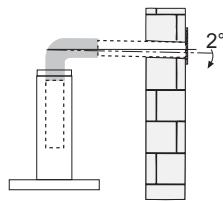
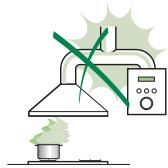
- If the instructions for installation for the gas hob specify a greater distance specified above, this has to be taken into account. Regulations concerning the discharge of air have to be fulfilled.
- Use only screws and small parts in support of the hood.
Warning: Failure to install the screws or fixing device in accordance with these instructions may result in electrical hazards.
- Connect the hood to the mains through a two-pole switch having a contact gap of at least 3mm .
USE
- The extractor hood has been designed exclusively for domestic use to eliminate kitchen smells.
- Never use the hood for purposes other than for which it has been designed.
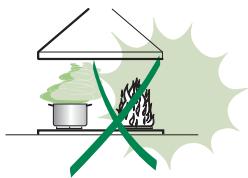
- Never leave high naked flames under the hood when it is in operation.
- Adjust the flame intensity to direct it onto the bottom of the pan only, making sure that it does not engulf the sides.
- Deep fat fryers must be continuously monitored during use: overheated oil can burst into flames.
- Do not flambe under the range hood; risk of fire.
- This appliance can be used by children aged from 8 years and above and persons with reduced physical, sensory or mental capabilities or lack of
experience and knowledge if they have been given supervision or instruction concerning use of the appliance in a safe way and understand the hazards involved. Children shall not play with the appliance. Cleaning and user maintenance shall not be made by children without supervision.
-
This appliance is not intended for use by persons (including children) with reduced physical, sensory or mental capabilities, or lack of experience and knowledge, unless they have been given supervision or instruction concerning use of the appliance by a person responsible for their safety.
-
"CAUTION: Accessible parts may become hot when used with cooking appliances."
MAINTENANCE
- Switch off or unplug the appliance from the mains supply before carrying out any maintenance work.
- Clean and/or replace the Filters after the specified time period (Fire hazard).
- The Grease filters must be cleaned every 2 months of operation, or more frequently for particularly heavy usage, and can be washed in a dishwasher.
- The Activated charcoal filter is not washable and cannot be regenerated, and must be replaced approximately every 4 months of operation, or more frequently for particularly heavy usage.
- "Failure to carry out cleaning as indicated will result in a fire hazard".
- Clean the hood using a damp cloth and a neutral liquid detergent.
The symbol on the product or on its packaging indicates that this product may not be treated as household waste. Instead it shall be handed over to the applicable collection point for the recycling of electrical and electronic equipment. By ensuring this product is disposed of correctly, you will help prevent potential negative consequences for the environment and human health, which could otherwise be caused by inappropriate waste handling of this product. For more detailed information about recycling of this product, please contact your local city office, your household waste disposal service or the shop where you purchased the product.
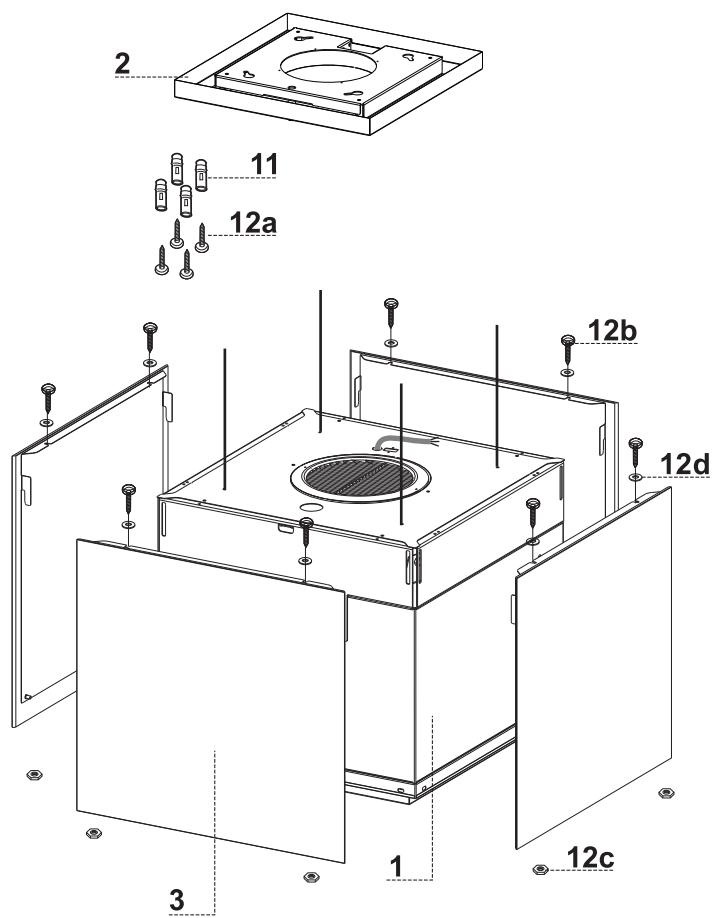
Components
| Ref. | Q.ty | Product Components |
| 1 | 1 | Hood Canopy complete with: Controls, Light, Filters, Motor. |
| 2 | 1 | Hood support plate. |
| 3 | 4 | Glass elements |
| Ref. | Q.ty | Installation Components |
| 11 | 4 | Wall Plugs Ø 10 |
| 12a | 4 | Screws 4.2 x 44.4 |
| 12b | 8 | Screws 4 x 8 |
| 12c | 8 | Nuts |
| 12d | 8 | Washers D.4,3 x 10 |
| Q.ty | Documentation | |
| 1 | Instruction Manual |
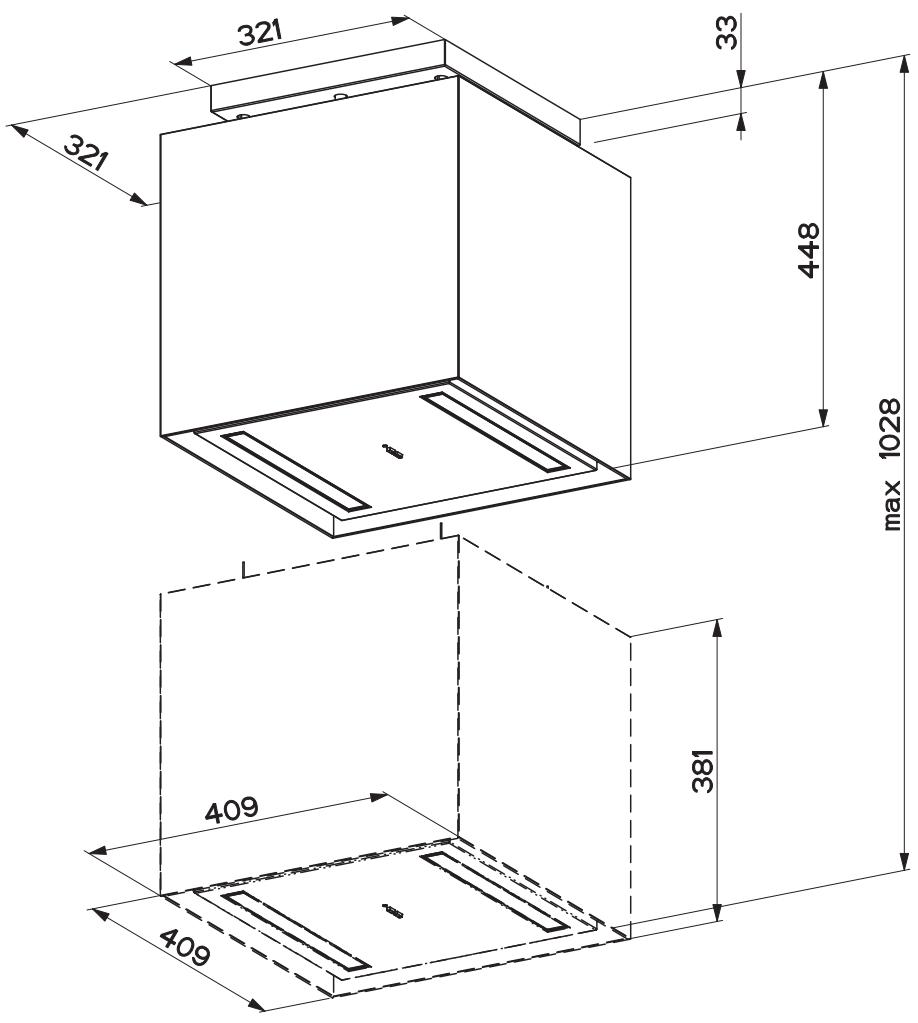
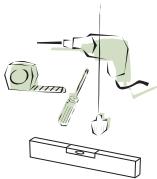
This hood is designed to be mounted on the ceiling/on a shelf, above a free-standing Hob (min. 650 mm), in:
- Ducting version: Evacuation to the outside.
- Recirculation version: Internal recirculation.
Sequence of operations - Installation
- Preparing for installation
- Drilling the Ceiling/Shelf and Fixing the support plate
- Connections
- Fitting the Hood canopy
Functional Check - Disposal of Packaging
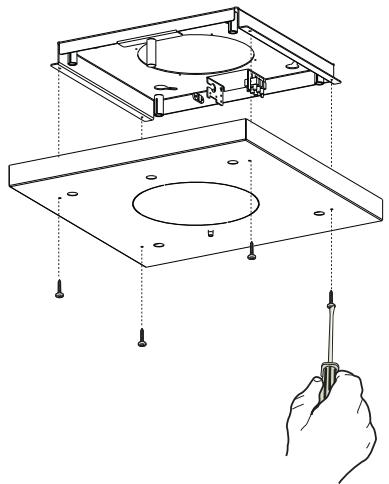
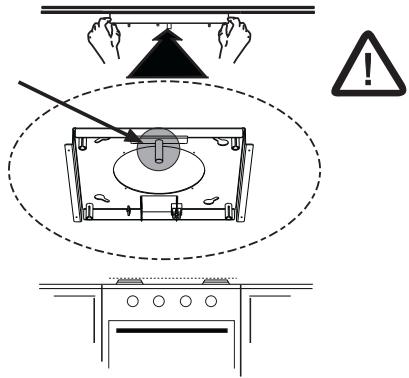
Opening the Plate and preparing for assembly
- Unfasten the screws joining the Plate to its Cover.
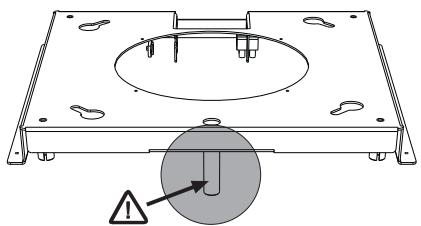
- Take the Plate and position it the right way round, as shown in the figure. The pawn must face towards the installer.
Ceiling/Shelf drilling and Plate Fixing
CEILING/SHELF DRILLING
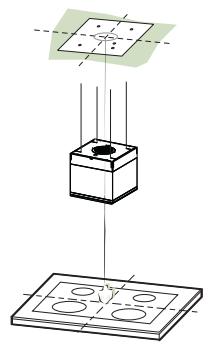
- Use a plumb-line and mark the centre of the cooking hob on the Support Ceiling/Shelf
- Rest the Plate against the Ceiling/Shelf, making sure it is the right way up, as shown in the figure.
- Mark the centres of the holes in the plate.
-
Drill the following points:
-
Ceilings in solid concrete: As per concrete plugs used.
- Ceilings in hollow bricks with 20mm resistance thickness: Drill a hole 10mm (insert Plugs 11 supplied immediately).
- Ceilings with Wood Beams: As per Wood Screws used (not supplied).
- Wooden shelf, with a resistant thickness of 15 mm : drill a hole 7 mm .
- Feeding the electric supply cable: drill a hole 10mm
-
Air Outlet (Ducting Version): according to the diameter of the connection to the external ducting pipe.
-
Insert two screws, crossing them and leaving 4 - 5mm from the ceiling:
-
for solid concrete, concrete plugs, not provided.
- for hollow bricks with approx. 20mm resistance thickness, screws 12a, provided.
- for wooden beams, wood screws, not provided.
- for wooden shelves, screws with washers and nuts, not provided.
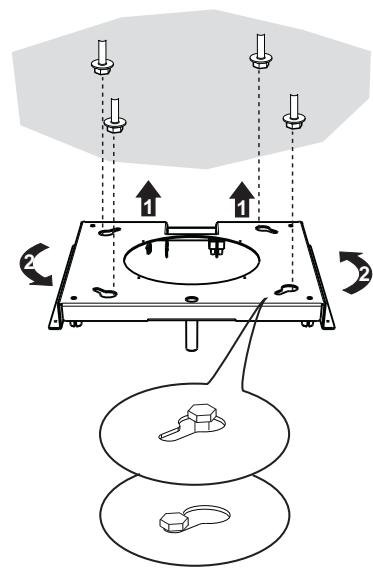
FIXING THE PLATE
- Lift up the Fixing plate and fit the slots onto the two screws previously inserted in the ceiling, and turn until they are at the centre of the adjustment slot.
Warning: The plate must be facing in the direction shown in the figure
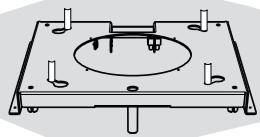
- Tighten the two screws completely and screw in the other two provided; before locking the screws completely it is possible to make adjustments by turning the piece, making sure that the screws do not come out of the adjustment slot.
- The unit must be securely fastened both due to the weight of the Hood and the stress caused by occasional sideways pressure on the Appliance when in position. Once the unit has been fixed, make sure that the plate is stable.
- In all cases where the Ceiling is not sufficiently strong at the point of suspension, the Installation technician must strengthen it with suitable plates and counterplates, anchored to structurally sound elements.
- Check that the plate is level on the ceiling.
CONNECTING HOOD-PLATE CABLES
N.B. Before proceeding with installation the Hood must be raised to a height of at least 650 mm above the cooker hob by means of a support or with the assistance of another person. Be careful not to exceed the maximum Hood extension indicated in the dimensional drawing.
This operation is essential, as the Hood Cables are to be connected to the Plate mounted on the ceiling, and this must be done without the weight of the Hood bearing down on the structure.
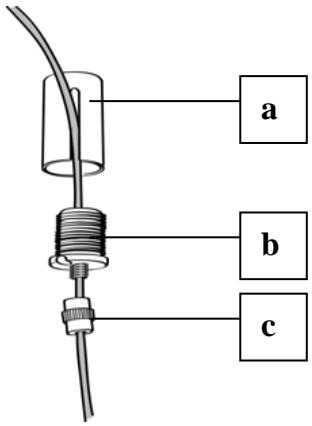
The system used to fix the 4 Cables comprises 3 components:
- Threaded pawl (a) already mounted on the ceiling Plate.
- Cable locking screw (b), provided.
- Safety knob (c), provided.
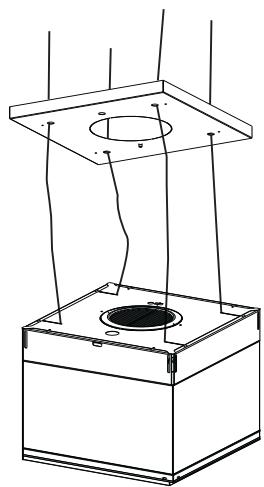
- Insert the Hood power cable into the hole provided in the Cover.
Warning: Do not break or remove the clamp fixing the power cable to the Hood
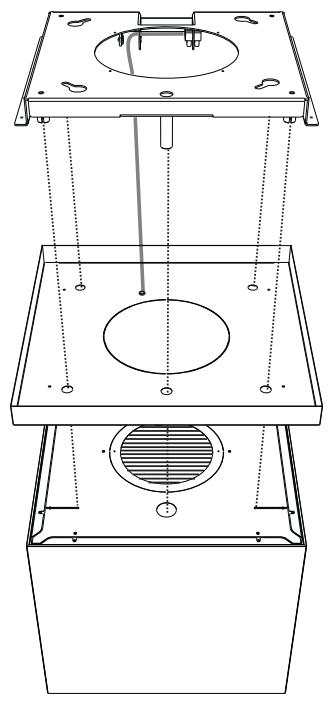
- Pass the 4 cables (connected to the Hood Canopy) through the respective holes in the Plate Cover after dismantling as above, making sure that they face the same way as the plate connected to the ceiling.
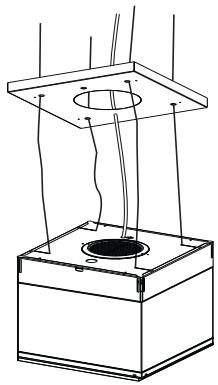
- Pay attention to the direction in which the Plate is fixed to the ceiling (the Plate limit pawl has a corresponding hole on the Plate cover and on the Hood canopy).
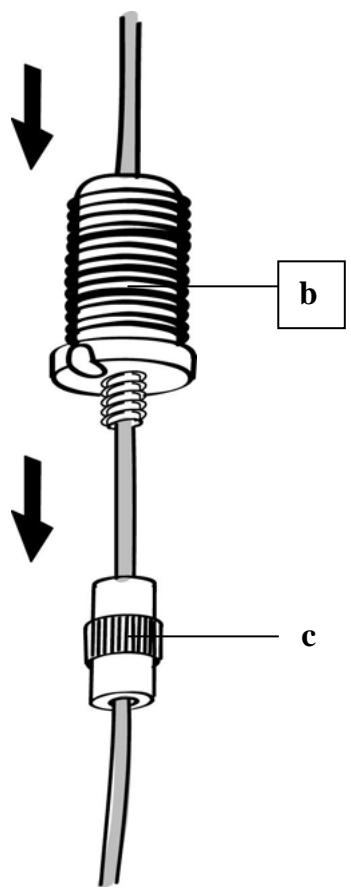
- Insert the safety knobs (c) into the respective cables, with the thread to the top.
-
Insert the cable locking screws (b) into the respective cables.
-
Pass the Cables into the slots on the threaded pawls (a) and tighten the cable locking screws (b) into the pawls themselves.
- When the operation has been completed, the result should be as shown in the figure for all 4 cables.
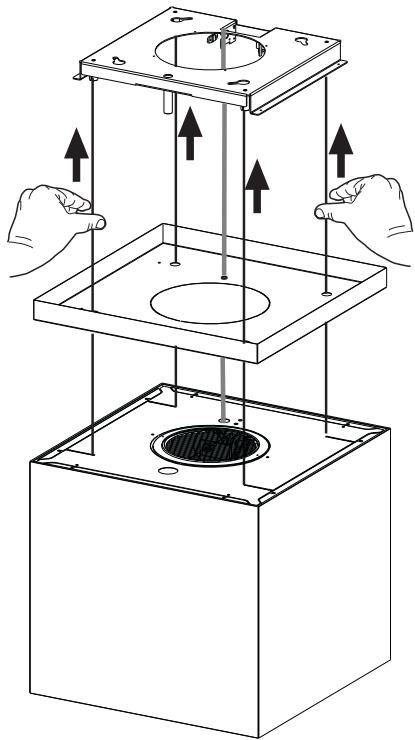
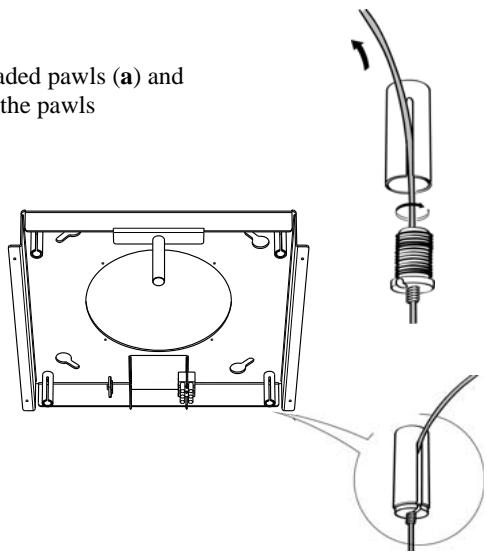
- At this point, all 4 cables are now connected to the Plate.
Tension the Cables by pushing them upwards, so that they slide inside the cable locking screw and out through the slot in the threaded pawl.
This is possible because the cable locking screw involves a system that allows the Cable to slide in one direction only, preventing it from sliding in the other direction.
Make sure that the Cables are all the same length, to facilitate final levelling operations. The left front cable must not be slacker than the others.
LEVELLING THE HOOD
- The hood canopy must be levelled.
-
The Hood is levelled by adjusting the safety pawls C.
-
Rest a spirit level on the hood.
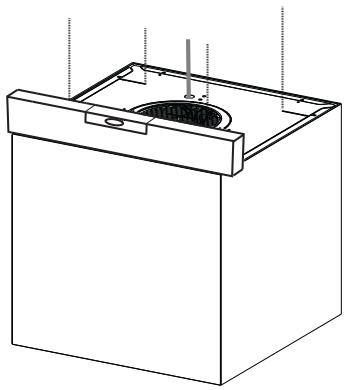
- Exerting an upwards pressure on the safety knobs "unlocks" movement of the Cable. By inserting or extracting the cable from the cable locking screw it is possible to make adjustments to level the mobile hood canopy.
- Once the hood has been set level, the safety knobs must be tightened.
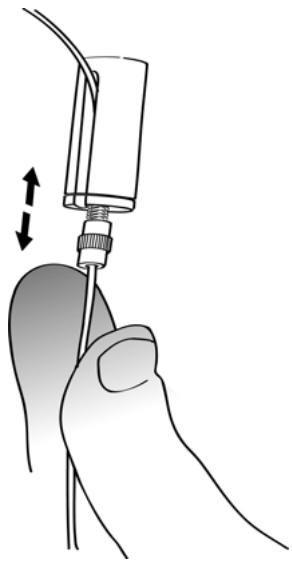
Warning:
- Make sure that all 4 of the support cables are taut.
- Make sure that none of the 4 support cables have been damaged during installation.
- Remember that the minimum distance between the Hood and the cooker hob must be 650mm and make sure that you do not exceed the maximum Hood extension indicated in the dimensional drawing.
Connections
AIR OUTLET - DUCTING VERSION
To install the hood in the ducting version, please refer to the instructions provided in the ducting kit specific to the hood.
AIR OUTLET - RECIRCULATION VERSION
- Open the lighting unit by pulling on the notch provided.
- Remove the grease filter.
- Make sure that the Activated charcoal odour filter has been fitted.
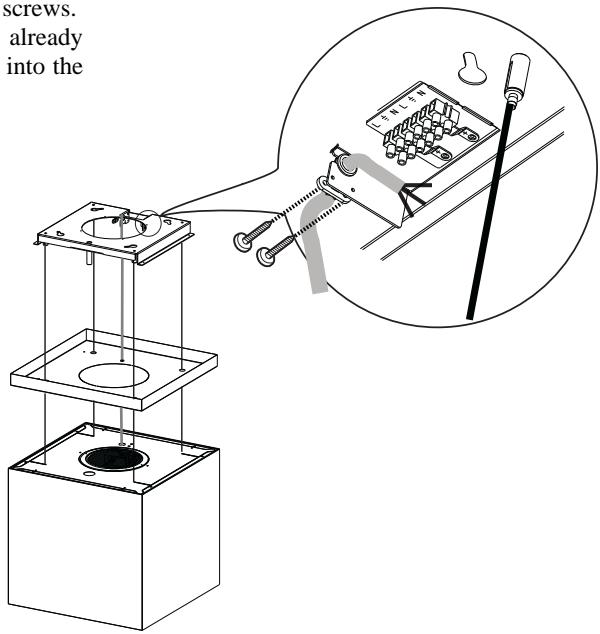
FIXING THE POWER SUPPLY CABLE
- Tighten the power supply cable and fix it to the Bracket on the ceiling mounted Plate, using the tongue already mounted and 2 screws.
- Slot the rubber cable raceway already threaded onto the power cable into the slot to prevent future damage.
- Connect the Hood to the Mains Power Supply, inserting a bipolar switch with a contact aperture of at least 3mm .
- Remove the Grease filters (see paragraph "Maintenance") and make sure that the Power cable has been properly inserted into the Suction fan socket.
- At this point it is possible to remove the clamp fastening the power cable to the Hood Canopy.
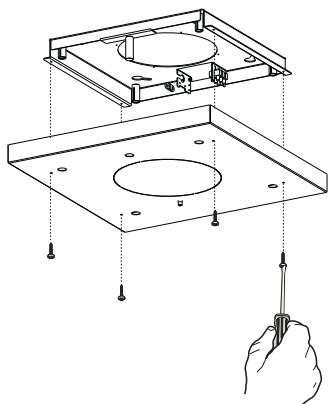
FITTING THE PLATE COVER
- Screw the Cover back onto the Plate using the screws removed previously.
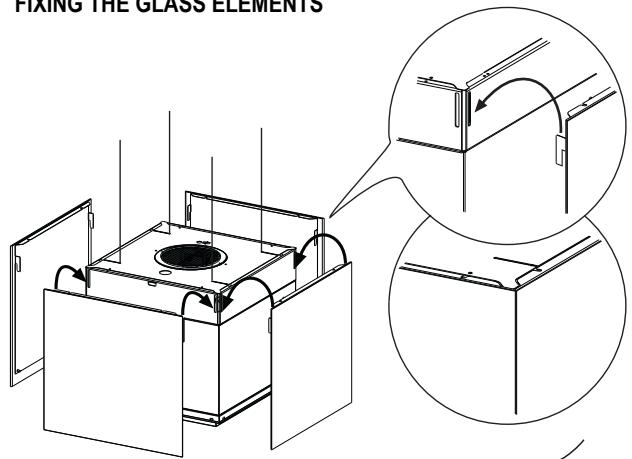
FIXING THE GLASS ELEMENTS
- Hook the 4 Glass Elements to the Hood Canopy by inserting the fins into the slots provided.
- Level the 4 glass elements manually by making small adjustments to the glass elements themselves.
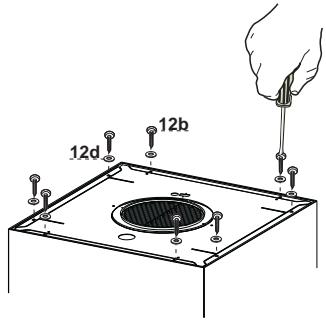
Fix the 4 Glass elements from above using the screws 12b and Washers 12d provided, making sure that they are kept level with one another.
- Finally fix the 4 Glass elements from below using the nuts 12c provided, making sure that they are kept level with one another.
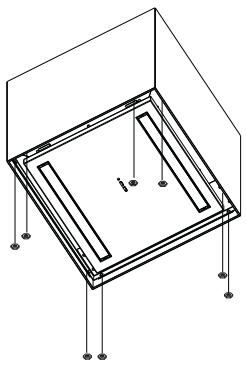
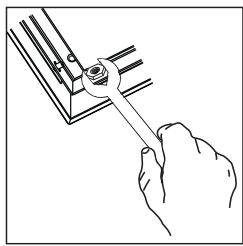
Warning!
Check that the Glass elements in the Hood are perfectly aligned and level. If it is not, adjustments can be made by loosening nuts 12c or screws 12b so that when the Glass elements are moved they align perfectly.
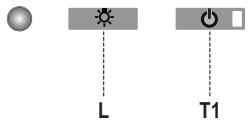
Control panel
| Button | Function | Display |
| L | Turns the lights On/Off. | - |
| T1 | Hood Down Press for 2 seconds to raise the Hood. Press briefly to turn the Motor On/Off. | On/Off |
| Hood Up Press once: The Hood lowers. Press a second time: The Hood Stops. When the movement has been completed the motor turns on at Speed two. | Off/Off |
The electronic control system recognises and signals two types of fault.
| Led T1 | |
| Slow flashing | Current absorption threshold exceeded:If an overload condition occurs, the fault is signalled by LED T1 on the keyboard flashing once every 2 seconds. Check that nothing is blocking normal hood movements.The signal remains active until a new hood open/close command is given. |
| Rapid flashing | Hood opening safety microswitch tripped:If the safety microswitch trips, the fault is signalled by LED T1 on the keyboard flashing quickly (once every 250 ms). This means that the hood has passed the microswitch.......Call Technical Assistance!You can continue to use the hood's light and motor functions while this fault is active. Whenever the motor is on, LED T1 will continue to flash, indicating that the fault is still present. |
REMOTE CONTROL
The appliance can be controlled using a remote control powered by a 1.5V carbon-zinc alkaline batteries of the standard LR03-AAA type (not included).
- Do not place the remote control near to heat sources.
- Used batteries must be disposed of in the proper manner.
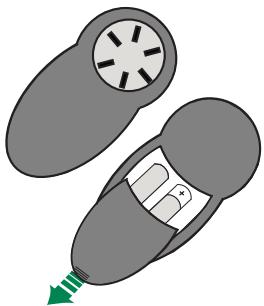
Control panel
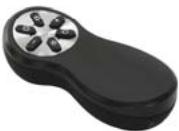
| Button | Function | Display |
| Turns the Motor On/Off. | - | |
| Hood Closed: - Press the button briefly to start lowering the hood - It will stop when the button is pressed again. When the movement has been completed the motor will start at speed 2. | - | |
| Hood Open: - Press and hold for 2 seconds to activate raising of the hood, which stops when it reaches the stop. - Press (briefly) to stop the movement (before the stop is reached). - Press again briefly to turn the motor on/off. - Press and hold for 2 seconds to start raising of the hood. - If the motor is on, it will first stop the motor and then start the movement. | - | |
| - | Decreases the speed of the Motor. | - |
| + | Increases the speed of the Motor. | - |
| ① | INTENSIVE - This can only be activated with the hood lowered and when the delay or 24h functions are not active. - Activates Intensive speed from any other speed. To disable it, simply press the same button again or turn the motor off. - Intensive speed is timed to run for 6 minutes. At the end of the 6 minutes the system will automatically return to the speed that was set before. | The led on the motor button (on the hood controls) will flash once a second. |
| Press briefly for the Delay Function: Can only be activated if the Intensive or 24h function is not active. Activates and deactivates total shutdown of the hood (motor+lights) after 30 minutes: To disable the Delay, simply press the button again or turn the motor off. | The led on the motor button (on the hood controls) will flash once every 0.5 seconds. | |
| Press and hold for 2 sec. for the 24H Function: Can only be activated if the Intensive or Delay function is not active. Activates and deactivates the 24H function for 10 minutes every hour, for 24 hours. After this time it is deactivated. | The led on the motor button (on the hood controls) will flash once every 2 seconds. | |
| Turns the Hood lights On/Off. |
Grease filter
The filter must be cleaned every 2 months of operation, or more frequently for particularly heavy usage, and can be washed in a dishwasher.
CLEANING METAL SELF- SUPPORTING GREASE FILTER
- Open the lighting unit by pulling on the nocth.
- Remove the filter one by one pushing it towards the back side of the hood unit and simultaneously pulling downwards.
- Any kind of bending of the filter has to be avoided when washing it. Before fitting it again into the hood make sure that it is completely dry.
- When fitting the filter into the hood pay attention that they are mounted in correct position the handle facing outwards.
- Replace the lighting unit.
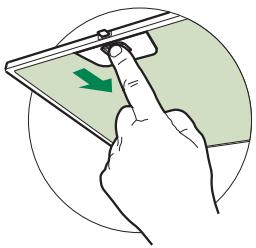
Activated Charcoal Filter (Recirculation Version)
This cannot be washed or regenerated, and must be changed approximately once every 4 months, or more frequently in the case of particularly intensive use.
CHANGING
- Open the light unit.
- Remove grease filter.
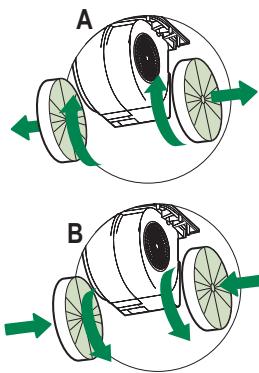
- Remove the saturated Activated Charcoal Filters, as indicated (A).
- Fit the new Filters, as indicated (B).
- Fit the anti-grease filter and the Light Unit back into position.
Lighting unit
- For replacement contact technical support ("To purchase contact technical support").
Intervention procedure in the event of problems with the movement
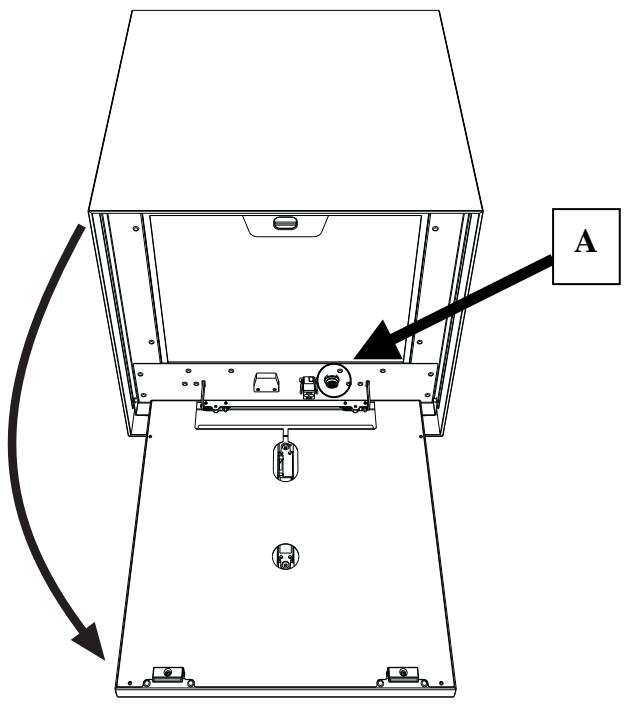
- Check that the fuse is properly inserted and has not burnt out; to replace it if necessary open the lighting unit and unscrew the fuse holder visible to the left of the motor unit, replacing the fuse with another of the same type (Ref. A).
- Check that the hood canopy is fitted level (the use of a spirit level is recommended).
- Check that the four cables are all at the same tension.
If the above operations do not solve the problem, contact the Technical Service Department.
COMMERCIAL GUARANTEE AND GUARANTEE FOR AFTER SALES SERVICE
COMMERCIAL GUARANTEE
The commercial guarantee provided by FRANKE FRANCE SAS for products of the ROBLIN brand is limited to distribution professionals. It is applicable in continental France, Corsica and the DOM-TOM (French overseas departments and territories).
The commercial guarantee is a guarantee of 2 years for parts (excluding labour and travel expense). It applies starting from the billing date for the equipment to the consumer, provided that this occurs in the 12 months following the date of sale by ROBLIN to the Customer.
In order to satisfy the consumer at the time of any intervention by the after-sales service department, the Customer agrees to direct it to the service put in place by ROBLIN in order to organise the service intervention as quickly as possible. The after-sales service department may be contacted at the following number: 04 88 78 59 93.
The items to be provided to the ROBLIN after-sales service department are:
A description of the malfunction observed
The commercial reference of the product and its serial number
- A copy of the purchase invoice of the consumer and his contact information.
This guarantee applies to any technical or functional problems. The following are excluded from the commercial guarantee:
- Breakdowns related to accessories or consumables (filters, bulbs...),
- Damage, malfunctions or defects attributable to external causes,
- Damage due to corrosion, improper connection or feed,
- Damage due to non-respect of the instructions provided by ROBLIN (installation, assembly...),
- Breakdowns resulting from modification of the construction and characteristics of equipment of the ROBLIN brand,
- Breakdowns and damage occurring after use of spare parts which do not correspond to those provided originally by ROBLIN, or due to an absence of maintenance,
- Breakdowns resulting from professional or commercial use of the equipment.
AVAILABILITY OF SPARE PARTS
In application of article R 111-3 of the Consumer Code, for products placed on the market starting from 1 March 2015, ROBLIN guarantees the availability of the spare parts necessary for use of its Products for a period of 10 years following purchase of the product by the consumer, with the invoice being deemed as proof, provided that dated within the 12 months following the date of sale by ROBLIN to the Customer.