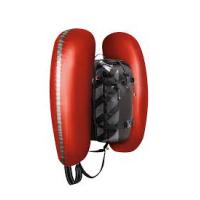
AVALANCHE AIRBAG SYSTEM - Mountain Safety System ABS PETER ASCHAUER GMBH - Free user manual and instructions
Find the device manual for free AVALANCHE AIRBAG SYSTEM ABS PETER ASCHAUER GMBH in PDF.



User questions about AVALANCHE AIRBAG SYSTEM ABS PETER ASCHAUER GMBH
0 question about this device. Answer the ones you know or ask your own.
Ask a new question about this device
Download the instructions for your Mountain Safety System in PDF format for free! Find your manual AVALANCHE AIRBAG SYSTEM - ABS PETER ASCHAUER GMBH and take your electronic device back in hand. On this page are published all the documents necessary for the use of your device. AVALANCHE AIRBAG SYSTEM by ABS PETER ASCHAUER GMBH.
USER MANUAL AVALANCHE AIRBAG SYSTEM ABS PETER ASCHAUER GMBH
natural_image
Simple line drawing of a cylindrical object with a cap, enclosed in a circle (no text or symbols)14
natural_image
Simple line drawing of a cylindrical object inserted into a circular frame, with no text or symbols present.15

natural_image
Illustration of a hand holding a mechanical component inside a circular frame (no text or symbols)
natural_image
Illustration of a hand using a tool to cut a red circular component (no text or symbols visible)
natural_image
Illustration of a modern safety harness with ABS branding and black straps (no text or symbols)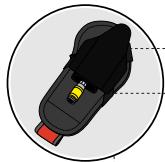
natural_image
Diagram of a black and yellow object inside a circular frame, with no visible text or symbols.6
7
8
9
10
11
TEN PRINCIPLES OF AVALANCHE SAFETY
DE Die eigene Verschüttung zu verhindern gilt als oberste Maxime der Lawinenexperten. Die Vorteile des ABS® TwinBag Systems beruhen auf 10 Prinzipien. Als einziges Selbst-Rettungs-System hat ABS® seine Wirksamkeit eindrucksvoll bewiesen, indem bei mittlerweile 262 dokumentierten Unglücksfällen mit ausgelöstem ABS® System 97% der Personen überlebt haben:*
EN Avoiding being buried themselves is the top priority of avalanche experts. The benefits of the ABS® TwinBag System are based on 10 principles. ABS® is the only self-rescue system and has impressively demonstrated its efficiency – in meanwhile 262 recorded accidents with a triggered ABS® System, 97% of people have survived:*
FR La règle suprême des experts en avalanches est d'empêcher l'ensevelissement des personnes. Les avantages du système ABS® TwinBag reposent sur 10 principes. ABS®, le seul système d'auto-sauvetage, a prouvé son efficacité de façon impressionnante. En effet, sur les 262 accidents aujourd'hui documentés lors desquels le système ABS® a été déclenché, 97% des personnes ont survécu:*
IT Impedire di restare sepolti è la massima più importante per gli esperti di valanghe. I vantaggi del sistema ABS® TwinBag si basano su 10 principi. L'efficacia dell'unico sistema di autosal-vataggio esistente ABS® è dimostrata in maniera straordinaria dal fatto che in 262 incidenti finora documentati il 97% delle persone colpite sono sopravvissute grazie all'attivazione del sistema ABS®:*
text_image
97% SURVIVALPRINCIPLE 01
HIGHEST
SURVIVAL RATE

text_image
THE ORIGINAL - GERMAN ENGINEERING SINCE 1985PRINCIPLE 02
GERMAN
ENGINEERING

natural_image
Abstract graphic with orange and gray shapes, no text or symbols presentPRINCIPLE 03
DOUBLE SAFETY
natural_image
Illustration of a hand holding an orange pen, with no text or symbols present.PRINCIPLE 04
PNEUMATIC PULL
natural_image
Icon depicting a person with three arms, surrounded by curved arrows indicating rotation or feedback (no text or symbols)PRINCIPLE 05
SEE AND FLEE

natural_image
Illustration of an orange battery with a circular arrow indicating rotation (no text or symbols)PRINCIPLE 09
EASY PACK
AND USE

natural_image
Abstract graphic with orange and black shapes on diagonal lines, no text or symbols presentPRINCIPLE 06
DYNAMIC LIFT
natural_image
Icon showing a checkmark with an orange speech bubble and black checkmark symbol (no text or numbers present)PRINCIPLE 10
INFLATE IT
text_image
Prohibition sign with an ant crossed out, indicating no prohibition or resistancePRINCIPLE 07
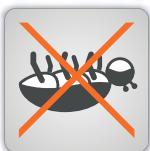
NO BUG EFFECT

natural_image
Simple icon of a person sitting on a striped surface with orange rays, no text or symbols present.PRINCIPLE 08
MAXIMUM
VISIBILITY
→ DEUTSCH Seite 01 - 18
→ ENGLISH Page 19 - 36
→ FRANÇAIS Page 37 - 54
→ ITALIANO Pagina 55 - 72
Inhaltsverzeichnis
natural_image
Illustration of hands installing or adjusting a jacket with an orange arrow (no text or symbols)natural_image
Illustration of a person wearing a full-body safety harness and vest (no text or symbols)natural_image
Illustration of two hands holding a bottle and a dial with orange dial (no text or symbols)natural_image
Two cylindrical mechanical components with a central screw and orange tape, no text or symbols presenttext_image
Diagram illustrating mechanical assembly steps with labeled arrows indicating motion directionnatural_image
Illustration of a hand holding a medical device with orange tool, no text or symbols present
natural_image
Illustration of a hand holding a medical device with an orange tool, no text or symbols presentnatural_image
Illustration of a hand using a device to adjust a component, showing hands and a label 'ABS' (no text or symbols on the diagram itself)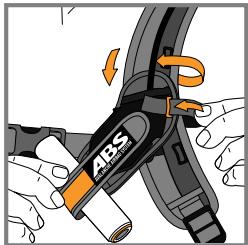
text_image
ABSnatural_image
Illustration of hands installing or adjusting a cable or connector component (no text or symbols visible)natural_image
Illustration of a person wearing a full-body safety harness and vest, standing against an orange background (no text or symbols)natural_image
Illustration of hands using a tool to cut a circular object, with a magnified inset showing the same object (no text or symbols present)Schritt 11
Falten der Airbags
natural_image
Illustration of a hand opening an orange bag with a black arrow symbol (no text or labels)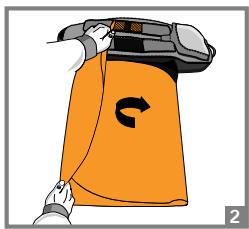
natural_image
Illustration of a hand holding an orange bag with a black arrow symbol (no text or labels)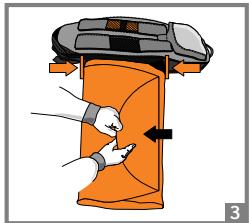
natural_image
Illustration of a robotic arm interacting with an orange device (no text or symbols visible)natural_image
Illustration of two hands assembling a mechanical component with an orange block and arrow (no text or symbols)natural_image
Illustration of a hand inserting a device into a device component (no text or symbols visible)natural_image
Illustration of a hand using a handheld device to adjust or install a component (no text or symbols visible)Schritt 12
natural_image
Illustration of a person running on a slope with multiple steps and motion indicators (no text or symbols)-
Welcome 20
-
Warning Notices and Appropriate Use 21
-
Unit Description and Parts .....22
-
Operation
4.1. Initial Operation and practice activation . . . 22 - 28
4.2. During each tour or operation of the system .... 28
4.3. At the end of each tour 28
- Handling during Avalanche Incident
5.1. Activation 29
5.2. Handling yourself during the avalanche ..... 29
5.3. After the avalanche 29
5.4. Questionnaire for statistical analysis ..... 29
-
How it Works 29 - 30
-
Maintenance
7.1. Self-check 30
7.2. Post-avalanche check 30 - 31
7.3. Customer service 31
- Components
8.1. Airbags 31
8.2. Suction and release valve 31
8.3. Puncture unit 31
8.4. Activation handle 32
8.5.Cartridge 32
8.6. Carrying system 32
-
Storage and Cleaning 32
-
Transport 33
-
Working Life 33
-
Additional Information
12.1. Troubleshooting 34-35
12.2.Warranty 35
12.3. Technical data 35-36
12.4. Permits/Conformance 36
12.5. Service Centers 36
1. Welcome
Congratulations on your purchase of the ABS Avalanche Airbag System.
This manual provides you with information about the function and use of the ABS Avalanche Airbag System. It applies to every out of bounds snow sport enthusiast.
Please read this manual carefully before you use this equipment. Pay special attention to the warning notices and strictly adhere to the information within. In order to be able to easily consult this user manual we suggest that you keep it in a convenient location. Make sure you include it if you choose to pass this equipment on.

Sections in the manual that are marked with this symbol identify risks which, if not observed will lead to serious consequences.
The ABS Avalanche Airbag System is an emergency equipment, which under certain conditions can prevent a total burial if activated. It cannot prevent the release of an avalanche. An element of deadly risk remains even if the user doesn't get buried. Every avalanche is absolutely life threatening regardless of any equipment. Therefore the ABS Avalanche Airbag System should not encourage you to take greater risks.
For the functioning of the ABS Avalanche Airbag you need an activation unit (cartridge + handle). Each ABS system is tested prior to delivery. The extreme situation of an avalanche requires a practiced approach to the ABS system. ABS therefore highly recommends that the triggering of the airbag is practiced as part of your personal training.
Please read the user manual before you practice your first activation by pulling the activation handle. Complete the warranty form online under www.abs-airbag.com. Your warranty claim will then be extended to 4 years.
- Do not attach the activation handle to the ABS-System unless you have attached a full cartridge first.
- Always change the activation handle and cartridge after an activation of the system!
- Only when both parts have been changed is the system ready to use again.
- Remove the activation handle when airbag is not in use.
Always use the ABS Avalanche Airbag System in combination with an avalanche transceiver, shovel and probe.
The ABS-System is Made in Germany.
2. Warning notices and appropriate use
⚠ The ABS Avalanche Airbag cannot prevent an avalanche.
⚠️ Every avalanche is always absolutely life threatening, with or without an ABS Avalanche Airbag.
The ABS Avalanche Airbag should not in any way increase your willingness to take risks.
The function and action of the ABS-System is limited solely to preventing the total burial of an avalanche victim. However, there may be situations when this is only partially or not at all possible.
The ABS-System has to be activated. It is important to practice this in order to be able to react properly in case of emergency. For your own safety you should practice the activation once a season.
⚠ The ABS-System requires careful handling and proper inspection before each use.
⚠ Activation handle and cartridge are refillable.
Only attach the activation handle if a full cartridge has been attached. Activation without a cartridge or with an empty one will damage the system and render it non-functional. It will have to be sent to your respective service center for inspection.
⚠️ If the red line is clearly visible the activation handle is not charged and therefore not functioning!
⚠ Do not use damaged handles as there is a danger that they could burst while releasing!
Do not try to pull the pin outside the brass quick coupler located at the backpack strap. You will risk injury.
⚠ It is essential that the pin is protected from dirt. Should the pin have come in contact with dirt, do not clean it yourself. Send it to your respective service center for an exchange instead.
⚠️ Pay attention to the expiration date of the release handle.
⚠️ Only use original ABS cartridges, refills, parts or spares.
⚠️ Do not alter, change or perform any repair on the system. Only an authorized ABS Service Center should perform any work or repair on the system. Any unauthorized work will void you warranty as well as make the system inoperable.
The cartridge should screw in easily right to the back stop. If you experience any resistance or if it is really hard to turn the cartridge right up to the back stop, then this cartridge cannot be used!
The full cartridge cannot be exposed to heat (stove, sun etc.). Do not throw or stress the cartridge. Risk of explosion! Max. temperature is 50^ C (+122 F).
When packing the airbags make sure that nothing can damage the airbags and that the airbags are able to open up freely. This applies especially to attachable parts like ice picks, poles, skis, etc.
⚠️ Fold the airbags according to the instructions. Improper folding inhibits the opening of the airbags, can lead to malfunctioning and damage the backpack.
⚠️ Keep children away from the ABS System.
⚠️ Be careful not to endanger other people when practicing the activation of the airbag.
In order to avoid an unwanted or inadvertent activation where other people could be harmed by such an accidental activation, it is recommended that you remove the handle, especially on chairlifts, in gondolas, in or around a helicopter, the bus, train, automobile, etc.
3. Unit description and Parts
Please unfold picture page
1) Puncture unit
2) Airbags
3) Airbags compartment
4) Suction and release unit
5) Release valve
6) Plastic flap
7) Brass quick coupler
8) Handle plate
9) Chest strap
10) Waist belt
11) Leg strap
4. Initial Operation
4.1 Initial operation and practice release
The uncompromising functioning and the personal handling by the user of the ABS Avalanche Airbag System are critical. The handling is straightforward but must be done with care and according to the steps outlined below:
Step 1
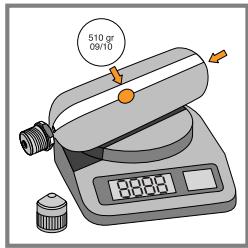
Checking the cartridge weight
Check the weight of the cartridge without the cartridge cap before each use. The weight is listed on the bottom or the side of the cartridge. Tolerance limit +/- 5 grams (0.18 oz). Your retail shop will exchange any cartridge with a weight that differs more than the tolerance limit at no charge.
text_image
510 or 09/10A completely full cartridge is an absolute prerequisite for the proper functioning of the ABS Avalanche Airbag.
Step 2
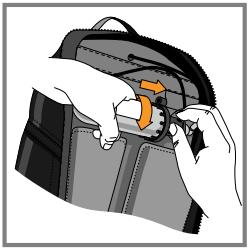
Attaching the cartridge
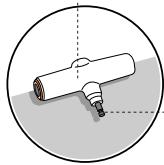
Check if the puncturing unit is clean before attaching the cartridge. The piercing pin must be visible in the middle. Screw in the full cartridge right up to the back stop and tight enough that there is no possibility of another turn.
natural_image
Illustration of hands installing or adjusting a bag with an orange arrow (no text or symbols)Check that the cartridge is screwed in tightly before each use of the airbag to avoid leakage and malfunctions.
It should be easy to screw in the cartridge right up to the back stop. Make sure that the cartridge doesn't get screwed in on an angle. If you experience any resistance or if it is really hard to turn the cartridge right up to the back stop, then this cartridge cannot be used! Your retail shop will exchange the cartridge at no charge.
Step 3
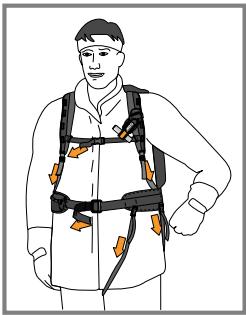
Attaching straps and belts
Put the backpack on and adjust shoulder straps to fit your body. Always fasten waist belt, chest and leg straps and fit them according to your body. The ABS-System will only be of use to you if the backpack stays on your body during an emergency!
Most of the weight of the pack should be resting on your hips rather than being carried by your shoulders.
natural_image
Illustration of a person wearing a full-body safety harness and vest (no text or symbols)The carrying system meets the high European standards (TÜV guidelines) for extreme operational demands. The tensile strength for all weight bearing straps equals 3000 N (674lbs).
Tip! Put on your backpack before you attach the activation handle. This way you avoid an unwanted or inadvertent activation.
Step 4
Checking the activation handle
The activation handle is charged with a small pressurized capsule, which contains 0.19 grams of explosives. It can therefore only be used once. By pulling the attached activation handle the pressurized capsule explodes. The resulting pressure punctures the cartridge and the airbags are filled.
The pressurized capsule functions for a limited time only. We therefore do not recommend the use of unused cartridges after 3 winter seasons.
The metal pin on the side opening of the release handle indicates the maximum operating time. Starting in winter 2010 the side opening of the activation handle will have a red cap. The cap indicates the replacement year. The replacement month is always May in the year indicated. Please observe the following expiry dates:

natural_image
Illustration of two hands holding a bottle and a dial with an orange dial (no text or symbols)gold-colored metal pins Expiry date May 2013
Expiration year is shown on the colored cap. The expiry month is always May in the year indicated.
Unused, expired release handles can be exchanged for a fee.
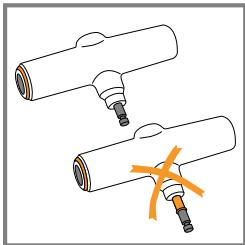
The pin has to be firmly fixed and the red line should not be visible. If the red line is visible on the pin, the handle has not been charged and therefore will not function properly!
Do not use damaged handles as this might cause it to burst during the activation function.
natural_image
Two cylindrical mechanical components with a central pin and an orange X mark, no text or symbols present.Do not try to pull the pin outside of the brass quick coupler – there is a risk of injury!
Protect the handle from contamination! Always store the handle away from children!
For the wireless activation handle please consult the special instruction manual.
Step 5
Attaching activation handle
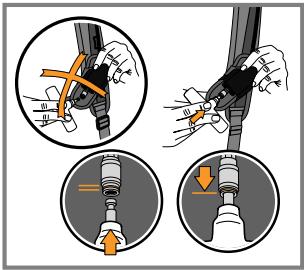
In order to attach the activation handle, align the pin with the brass coupler and push the handle in. With the other hand flip up the plastic flap, thus administering counter pressure. The brass coupler will automatically snap back.
text_image
Diagram illustrating mechanical assembly steps with labeled arrows indicating motion directionOnly then is the handle attached properly and ready to use. If the handle will not attach refer to point 12.1. If the handle is not attached properly and is stuck due to the coupler snapping back into place, a proper activation will be impossible.
Attention! Only attach the handle if a full cartridge has been screwed in. When activating without a cartridge or with an empty one, the system will be damaged and the pin must be exchanged. Please direct all inquires to your respective Service center.
If you followed all the steps up to this point your ABS-System is now operational. However, we recommend that you finish studying the instruction manual before you conduct your practice activation.
Step 6
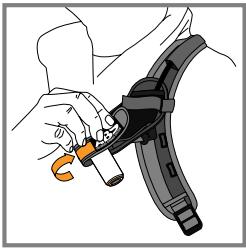
Velcro closure
The Velcro closure secures the activation handle in order to avoid unwanted activations. Before you leave a patrolled area, the red Velcro closure must be completely loosened and attached behind the activation handle to facilitate an unhindered activation. A tightly fastened Velcro usually prohibits an activation.
natural_image
Illustration of a hand holding a medical device with orange filters, no text or symbols present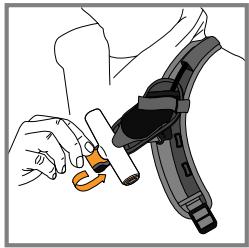
natural_image
Illustration of a hand holding a small object with an orange belt, next to a black safety belt device (no text or symbols visible)In order to completely eliminate unwanted activations we recommend that you remove the activation handle. Particularly in situations when you could endanger yourself and other people such as on chairlifts, in gondolas, in or around a helicopter, the bus, train, automobile, etc.
For the wireless activation handle please consult the special instruction manual.
Step 7
Height adjustment of the activation handle
Check when wearing the backpack if the activation handle is positioned in a way that works for you. Usually that is the case, if not, the handle attachment can be adjusted to the appropriate height. The proper position of the activation handle should be between chest and shoulder.

natural_image
Illustration of hands using a device to adjust or install a component, no text or symbols visible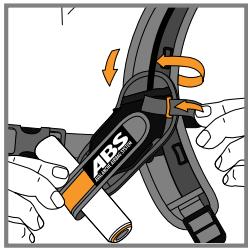
text_image
ABSIn order to adjust the height open and undo the Velcro closure, attach the handle plate to the appropriate plastic grommet and fasten the Velcro closure.
Make sure that the activation handle is not obstructed by clothing and that it can be easily reached.
A retail shop will be able to attach the activation handle on the right hand strap if so desired by left-handed clients. A special handle plate is therefore needed.
Step 8
Remove activation handle
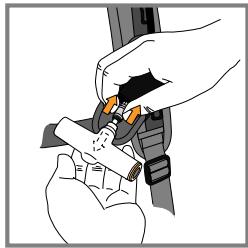
In order to remove the handle, undo the Velcro closure and push the coupler upwards. The activation handle will pop out without
natural_image
Illustration of hands installing or adjusting a cable or connector component (no text or symbols visible)you pulling on it. Do not pull the charged activation handle, the system will be activated! If you are not able to remove the activation handle refer to point 12.1.
Remove the handle when ABS backpack is not in use and store it in the pocket located at the hip strap.
Step 9
Practice activation
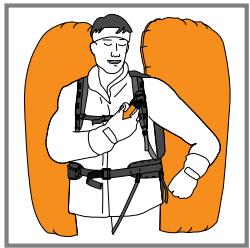
We want you to feel 100% comfortable with the ABS-System. We therefore strongly recommend that you practice the triggering as part of your training so that the functional principle can be demonstrated as realistically as possible.
Please ensure that during the practice activation the distance to people and objects is approximately 1 m (3.28 feet) in order to avoid adverse affects. Activate the handle with a strong, rapid pull.
The required activation force equals approx. 8 kg (17.64 lb; 80 N). The airbags will inflate within 2-3 seconds.
natural_image
Illustration of a person wearing a full-body safety harness and vest, standing against an orange background (no text or symbols)Attention! Background noise after inflation is caused by the release valve, which automatically equalizes the pressure. The inflation of the airbags varies according to the outside temperature and elevation.
Step 10
Deflate airbags
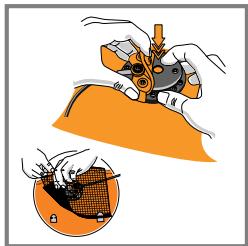
First open the net cover over the suction and release valve.
Now fold up the red cover and press the release valve in the center of the black suction and release valve. At the same time, compress the airbag until it is completely empty. Now close the net cover again.
natural_image
Illustration of hands using a tool to cut a component into an orange bowl (no text or symbols present)Step 11
Folding airbags
Attention! Improper folding will result in poor opening of the airbags. This can lead to malfunction and damage to the backpack!
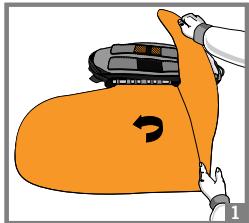
Therefore please fold the air-bags according to the following instructions.
- Lie the airbags down with the suction and release valve facing the ground. The smooth side of the airbag should be facing up.
- Fold the upper part of the airbag to the level of the airbag compartment.
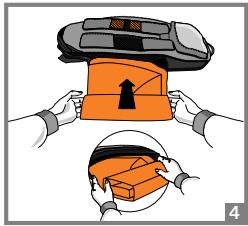
- Now fold the bottom part of the airbag. The airbag width must correspond to the width of the airbag compartment.
natural_image
Illustration of a hand opening an orange bag with a black arrow symbol (no text or labels)
natural_image
Illustration of a hand holding an orange bag with a black arrow symbol (no text or labels)
natural_image
Illustration of a hand pressing down on an orange mechanical component with arrows indicating motion (no text or symbols)- Now fold the airbag three times towards the backpack ensuring that each fold is approx. a hand's breadth wide so that the airbag can easily unfold.
natural_image
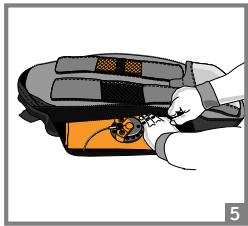
Illustration of two hands assembling a mechanical component with an orange block and arrow indicating assembly (no text or symbols)- Now push the airbags in the designated compartments. The suction and release valve must be clearly visible on top of the airbag material.
natural_image
Illustration of a hand using a tool to adjust or install a mechanical component (no text or symbols visible)- Fasten the Velcro closures of the airbag compartments tightly.

natural_image
Illustration of a hand using a tool to adjust or install a car component (no text or symbols visible)Step 12
Replace cartridge and activation handle
After every activation the cartridge and the activation handle must be replaced. Proceed according to step 1, 2 and 4, 5. The ABS-System is then once again operational.
Proceed now with the practice activation and complete the online form in order to extend the warranty (www.abs-airbag.com under ABS-System).
4.2 During each tour or operation of the system
Follow steps 1 - 6 of the Initial Operation
1 Checking cartridge weight
2 Attaching cartridge
3 Attaching straps and belts
4 Checking activation handle
5 Attaching activation handle
6 Velcro closure
4.3 At the end of the tour
Follow step 8 Removing activation handle of the Initial Operation. The cartridge can remain attached.
5. Handling during avalanche incident
5.1 Activation
Activate the ABS Avalanche Airbag without hesitation as soon as you become aware of an avalanche. It is better to activate once too often than not at all.
In order to activate pull hard and fast on the activation handle and try to escape. The airbags are self inflating, independent of whether you are skiing, are falling, are lying on top of the airbag or are already captured by the moving snow. The inflated airbags will not compromise your possible escape or avoidance of rocks etc., which you should always try to do.
5.2 Handling yourself during the avalanche
Once you have activated, only concentrate on your fall line. The way that the airbags are attached on the sides of the pack allows you to freely move your arms. Fight by swimming and pushing away obstacles. Try to steady yourself and protect your head. The shape of the airbags will help to protect your head without compromising your movements and ability to see. Try to twist out of your ski bindings. Never put your hands through the pole straps and never use safety straps with your bindings. If possible keep your mouth closed. When the avalanche is coming to a halt, try to keep your upper body and arms above the snow and free yourself from the avalanche as soon as possible.
5.3 After the avalanche
Find a safe place. Try to help other victims if possible. Only deflate the airbags when there is absolute certainty that there is no longer any danger of avalanches and attach another cartridge and activation handle immediately if possible. In case you are still in an avalanche prone area, leave the airbags inflated.
5.4 Questionnaire for statistical analysis
Please report each activation you had to perform with your ABS Avalanche Airbag. The Federal Institute for Snow and Avalanche Research in Davos (SLF) conducts a central statistic. The findings from actual activations are very important for the further development of the system. You can request the Questionnaire directly from us or download it from our website.
Complete and sign the form and send it to the competent avalanche center in your country, directly to the SLF or to your ABS service center.
6. How it works
With the ABS Avalanche Airbag you have purchased a device based on many years of experience in avalanche research, rescue and statistics. Led by the one outstanding fact, that a predominant number of all avalanche victims (skiers and snowboarders) are still alive when the avalanche comes to a halt. However, most of them are buried, are unable to free themselves and are often not visible to the rescuer. And this is where the race with death begins and is lost by those victims, who are totally buried and have blocked airways.
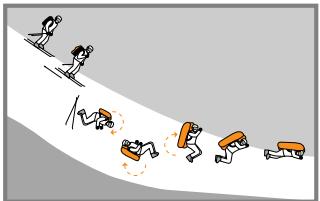
The main obstacle for a successful rescue is when the burial depth is one meter or more. Often the time it takes to shovel these victims out of such snow depths exceeds their survival time. Therefore it is absolutely vital to prevent a burial as good as possible. One pull of the activation handle and within seconds the ABS Avalanche Airbag provides the physical prerequisites for this to happen.
natural_image
Illustration of a person running with a briefcase and a ramp, no text or symbols presentThe moving snow flushes large volume objects to the surface. If these objects have a smaller dimensional weight then the surrounding snow, they will stay at the surface.
The additional airbag volume of 170 liters helps that you will stay on top of the moving snow. The weight, shape as well as the attachment of the airbags, also contribute to this. A large surface area combined with a flexible attachment that fits close to the body convert the flow force into buoyancy. The ABS Avalanche Airbag System has already prevented hundreds of snow enthusiasts from being buried.
7. Maintenance
7.1 Self check
- The ABS Avalanche Airbag is maintenance free if the following points are observed.
- Unfold both airbags at least once a year. We also recommend a yearly practice activation, preferably at the beginning of the season. The activation can easily be practiced on a safe site.
- Check the release valve in the black suction and release unit. Push the red button several times. It has to completely click back into place each time.
- Inspect the condition of the backpack straps, buckles, airbag compartments and Velcro closures on a regular basis.
- Check whether the puncturing unit which holds the cartridge is free of dirt
- The activation handle should easily fit into the coupler. You can add a drop of ABS oil to the coupler if you have problems removing the handle. A sample tube of ABS oil is included and can be ordered from ABS.
- Make sure that the full cartridge is screwed in tightly each time before using the ABS Avalanche Airbag.
7.2 Post-avalanche check
Every use can negatively affect the material. Often the damage is not visible with the naked eye. We therefore recommend sending the ABS-backpack and empty cartridge to your service centre for a prophylactic inspection. Please send the filled out questionnaire to be used for statistical analysis of avalanche accidents to us or the Swiss avalanche institute (see item 5.4).
If you are unable to send the ABS Avalanche Airbag in right away we recommend to check the following:
– check the airbags visually for punctures
– check the airbag fastening straps for tears
– check the shoulder, waist and chest straps as well as the seems for tears
- check all buckles (adjustment buckles at the shoulder straps, waist and chest strap)
– check buckles as well as leg straps for tears and deformation
In any case send the ABS Avalanche Airbag System to your respective service center for inspection.
7.3 Customer service
After three seasons the manufacturer recommends a general inspection. The ABS Avalanche Airbag including cartridge and activation handle have to be send to your respective service center. The ABS customer service will charge for this inspection. The customer service includes a much more extensive inspection of all ABS parts than the practice activation or self check.
The appropriate ABS customer service for each of the countries is listed on our web page www.abs-airbag.com under contacts.
8. Components
8.1 Airbags
Each of the two airbags has a volume of 85 liters when inflated. They are inflated simultaneously but have separate closure and suction valves. If one of the airbags is damaged the other one will remain inflated for a sufficient amount of time. The inner pressure equals approx. 0.1 bar.
8.2 Suction and release valve
This combination part is attached directly to the airbag. The button for the release valve is located in the middle of the black suction and release unit. It is protected from unwanted pressure by a red plastic cover.
The net cover over the suction and release valve prevents snow entering the airbag when it is being filled. Damaged nets can be replaced at any time.
8.3 Puncture unit
The puncture unit into which the cartridge is screwed into is housed in a compartment at the top of the backpack. Make absolutely sure that it stays clean and that no objects can damage it. Therefore always close the cover. A screwed in cartridge can be unscrewed from the puncture unit at any time. Only the pull on the attached handle will activate the cartridge. We generally recommend to always leaving the cartridge attached.
8.4 Activation handle
The activation handle is equipped with a blank cartridge. By attaching the handle to the coupler at the shoulder strap of the backpack and then pulling the activation handle, the blank cartridge will ignite. The explosion pressure travels through the tube to the puncture unit. There a cartridge containing nitrogen will be pierced with the pin and the nitrogen is forced through the pressure tubes to the two airbags where in combination with the suction and release valve the airbags get inflated. Inflation time is approx. 2 – 3 seconds!
8.5 Cartridge
The cartridges contain only harmless gas, the same as in our air. The inside pressure is 300 bar (Carbon cartridge 340 bar). The piercing of the cartridge should only occur within the puncture unit of the ABS-system. Any manipulation at the closure or at the cartridge can trigger an explosion which may result in a high risk of injury and or death, including bystanders.
Each cartridge is designed for temperatures from -40^ to +50^ (-40F to +122 F). Empty cartridges can only be filled by ABS. The exchange can only be done at an ABS retail shop. Avoid impacts such as dropping the cartridge.
Depending on the model, the cartridges comply with the following guidelines:
– Steel cartridge Europe: EG guidelines
– Steel cartridge North America: DOC and TC certified
– Carbon cartridge: EG guidelines
8.6 Carrying system
The authorized carrying systems are identified by the ABS logo. The various straps and belts comply with the TÜV requirements for extreme operational demands. The tensile strength for all weight bearing straps equals 3000N (674lbs). In order to ensure that the ABS Avalanche Airbag System stays on the person's body during an avalanche, it is imperative that the waist belt, chest strap and leg straps are properly fastened. The greatest chance that the ABS Avalanche Airbag to remain on your body during an Avalanche is if waist belt, chest strap and leg straps are properly fastened.
9. Storage and cleaning
Make sure before each use that the full cartridge is screwed in tightly and check the weight as described in steps 1 and 2 of the Initial Operation. Otherwise you can leave the cartridge attached.
Always make sure that the protective cap is on the cartridge when the cartridge is not attached to the airbag. It is recommended to remove the handle after each use. The ABS Avalanche Airbag should be stored in a dry, rodent free area and away from children.
Use only soapy water to clean the airbag or the backpack. Do not use harsh cleaning agents like bleach or OxiCleaner. Do not wash in a washing machine. Protect the suction and release valve from water and other liquids.
Attention: after cleaning make sure that the system is completely dry before use – or you risk freezing the components which will not operate as intended.
10. Transport
Generally you are allowed to take your airbag on the airplane. The guidelines are outlined in the IATA (International Air Transport Association) reference guide under dangerous goods Table 2.3A. However, you have to register the ABS-Airbag with your airline 14 days before your departure. One activation unit is allowed for each ABS backpack, and the activation handle must not be docked.
We strongly recommend that you request the IATA guidelines from your respective service center or that you download them yourself from our website in order to be able to show them at the ticket counter. We also recommend that you put the copy of the IATA guidelines along with your cartridge, activation handle and backpack in your carry-on luggage. If you are traveling within the USA you need to comply with FAA rules.
When you transport the cartridge outside the airbag the protective cap must be on the cartridge.
11. Working Life
By adhering to the manufacturer recommended maintenance schedule of 3 seasons, the working life mainly depends on the degree of usage and mostly refers to the backpack. When using the system according to the instructions and on an average of 50 days per season, the ABS-System (not the backpack) can be expected to function for 10 years. It is important to perform the suggested practice activation by activating the ABS System once year.
If the backpack/carrying system shows signs of wear and tear it is possible to transfer the ABS Avalanche Airbag into a new backpack/carrying system or into the Freeride pack. The transfer will be carried out by the manufacturer. Please contact your respective service center for more details. If there is any damage to the carrying system, the buckles or the airbag itself is damaged, by a puncture for example, the system must be exchanged.
12. Additional information
12.1 Troubleshooting
| Malfunction | Troubleshooting |
| I pulled the activation handle without the cartridge | - the undamped explosion pressure will damage the or with an empty cartridge-system and render it unuse-able and must be repaired- Direct all queries to your respective service center |
| Activation handle does not attach | - Put a drop of ABS oil into the coupler. Push up coupler, attach and remove handle several times until the coupler is functioning properly- If this doesn't work the system has to be sent to your respective service center- Do not try to attach the handle with force- If you are out in the field and you have no ABS oil with you, push the coupler up, attach the handle and then push the coupler down |
| Malfunction | Troubleshooting |
| The charged activation handle does not come off | - You must leave the full cartridge in place- Gently push the coupler upwards, wiggle the handle from side to side and carefully try pulling it down- In addition apply a drop of ABS oil to the handle and turn it to increase lubrication- If this doesn’t work the system has to be sent in for service |
| The airbags are difficult to remove from the compartments and are hard to inflate | - Were the airbags folded properly?- Did the weight of the cartridge match the filled weight?- If you answered both with yes you have to send the airbag in for service- If you are unsure about either one of these points, perform a practice activation- If the problem persists send the ABS-System in for service |
| After inflating the airbags there is a definite background noise | - This noise is due to the release valve equalizing the pressure- After a few minutes the pressure drop should not be clearly visible any more- If the pressure drop is still clearly visible, the system needs to be repaired. Send the ABS-System in for service |
12.2 Warranty
To extend your warranty of the ABS-System from 2 years to 4 years please complete the warranty card on-line no later than 30 days after your purchase under abs-airbag.com. (The ABS-System does not include the backpack).
It is required to successfully perform the practice activation according to steps 1-12 of the instructions for use and to continue self-testing the unit year after year.
ABS AIRBAGS warrants that the product will meet the specifications stated in the instructions and ABS AIRBAGS agrees to replace the product free of charge if the product does not conform to the specifications. Notice for replacement must be given within 60 days of the discovery of the defect.
In consideration of the above promises by ABS AIRBAGS, the buyer agrees to and accepts the following conditions:
- That this warranty is in lieu of all other warranties, expressed or implied;
- That ALL WARRANTIES OF MERCHANTABILITY OR OF FITNESS FOR A PARTICULAR PURPOSE ARE HEREBY EXCLUDED AND/OR WAIVED;
- That the buyer's sole remedy shall be to obtain replacement of the product free of charge from ABS AIRBAGS; and That this remedy is in lieu of all other remedies or claims for damages, consequential or otherwise, which the buyer may have against ABS AIRBAGS.
ABS AIRBAGS shall have no liability for Any loss or injury caused, in whole or in part, by its actions, omissions, or negligence, or for contingencies beyond its control;
The warranty extends only to you, the original purchaser. It is not transferable to anyone who subsequently purchases the ABS AIRBAGS from you.
12.3 Technical data
| Volume of airbag: | 2 x 85 liter airbags |
| Weight of system: | Approx. 1200g |
| Release: | Pyrotechnical ignition in the activation handle |
| Filling procedure: | Within approx. 1 second 90 liters (23,8 US gallon) of a gas-air mix is forced into the two airbags while the remaining approx. 80 liters (21,1 US gallon) will take 1.5 seconds (depending on outside temperature and elevation). |
| Cartridges: | Are made from highly durable materials with an allowable pressure of more than 300 bar (4400 psi). Depending on the model, the cartridges comply with the guidelines of the EG or DOC/ TC for North America. |
| Carrying system: | Complies with the TÜV requirements for extreme operational demands. The tensile strength for all weight bearing straps equals 3000 N (674lbf). |
| Operating temperature: | From -40°C to +50 °C (-40F to +122F) |
12.4 Permits and conformance
Manufacturer: ABS Peter Aschauer GmbH Country of origin: Germany
Type: ABS Avalanche Airbag System
The nature of the materials and the kind of workmanship used for the development of the ABS Avalanche Airbag System are based on the standard values of comparable usage requirements. These standard values form the requirement profile for the material and operating tests conducted by TÜV Süd Product Service GmbH within the Federal Consumer Product Safety Act, according to PPE directive 89/686 EWG as well as the CE guidelines. Yet during an avalanche incident there could be forces and circumstances, which will exceed these standard values. We would therefore explicitly point out that the ABS Avalanche Airbag System in its entirety and in parts (airbag material, attachments, backpack, etc.) cannot withstand all possible demands which will arise during an avalanche incident.
Die ABS Peter Aschauer GmbH is a certified company according to ISO 9001:2000 standards.
The ABS System is Made in Germany.
12.5 Service centers
The ABS customer service centers for the different countries are listed under contact on our website www.abs-airbag.com
Table des matières
natural_image
Illustration of hands installing a bag with an orange arrow indicating rotation (no text or symbols)natural_image
Illustration of a person wearing a full-body safety harness and vest (no text or symbols)natural_image
Illustration of two hands holding a bottle and a dial with an orange dial (no text or symbols)natural_image
Two cylindrical mechanical components with a central fastener and orange clamped band (no text or symbols)text_image
Diagram illustrating mechanical assembly steps with labeled components and directional arrows indicating motionnatural_image
Illustration of a person using a handheld device to adjust or install a black strap (no text or symbols visible)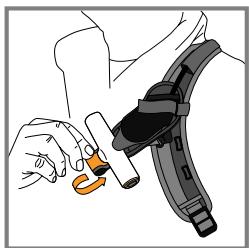
natural_image
Illustration of a person adjusting a wristband with a belt buckle (no text or symbols)natural_image
Close-up of hands using a device to adjust or install a component, no visible text or symbols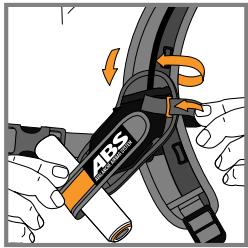
natural_image
Close-up of hands installing a black ABS cable with orange tape, showing mechanical components and motion arrows (no text or symbols)natural_image
Illustration of hands installing or adjusting a cable or connector component (no text or symbols visible)natural_image
Illustration of a person wearing a full-body safety harness and vest, standing against an orange background (no text or symbols)natural_image
Illustration of hands using a tool to cut a surface with a magnified inset showing the same object (no text or symbols present)Etape 11
Pliage des airbags
natural_image
Illustration of a hand opening an orange bag with a black arrow symbol (no text or labels)
natural_image
Illustration of a hand holding an orange bag with a black arrow symbol (no text or labels)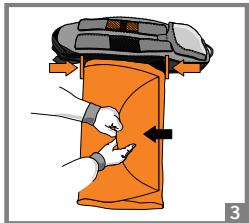
natural_image
Illustration of a hand pressing down on an orange mechanical component with a black arrow indicating motion (no text or symbols)natural_image
Illustration of two hands assembling a mechanical component with an orange block and arrow (no text or symbols)natural_image
Illustration of a hand using a tool to adjust or install a mechanical component (no text or symbols visible)natural_image
Illustration of a hand using a tool to adjust or install a car component (no text or symbols visible)Etape 12
natural_image
Illustration of a person running on a track with a briefcase and briefcase nearby (no text or symbols)natural_image
Illustration of hands installing or adjusting a jacket with an orange arrow (no text or symbols)natural_image
Illustration of a person wearing a full-body safety harness and vest (no text or symbols)natural_image
Illustration of two hands holding a bottle and a dial with an orange dial (no text or symbols)natural_image
Two cylindrical mechanical components with a central pin and an orange X mark, no text or symbols present.text_image
Diagram illustrating mechanical assembly steps with labeled arrows indicating motion directionnatural_image
Illustration of a person using a handheld device to adjust or install a black safety belt (no text or symbols visible)
natural_image
Illustration of a hand adjusting a belt buckle (no text or symbols present)natural_image
Illustration of hands using a device to adjust or install a component, no text or symbols visible
text_image
ABSnatural_image
Illustration of hands installing or adjusting a cable or connector component (no text or symbols visible)natural_image
Illustration of a person wearing a full-body safety harness and orange belt (no text or symbols)natural_image
Illustration of hands using a tool to cut a component into an orange bowl (no text or symbols present)Punto 11
natural_image
Illustration of a hand opening an orange bag with a black arrow symbol (no text or labels)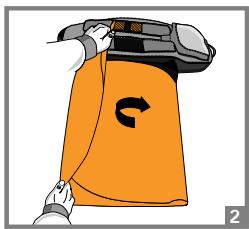
natural_image
Illustration of a hand holding an orange bag with a black arrow symbol (no text or labels)
natural_image
Illustration of a hand pressing down on an orange mechanical component with arrows indicating motion (no text or symbols)natural_image
Illustration of two hands assembling a mechanical component with an orange block and arrow (no text or symbols)natural_image
Illustration of a hand using a tool to adjust or install a mechanical component (no text or symbols visible)natural_image
Illustration of a hand using a tool to adjust or install a car component (no text or symbols visible)Punto 12
natural_image
Illustration of a person running on a track with a briefcase and motion arrows (no text or symbols)natural_image
Aerial view of a skier descending a snowy slope with visible cracks and snowflakes (no text or symbols)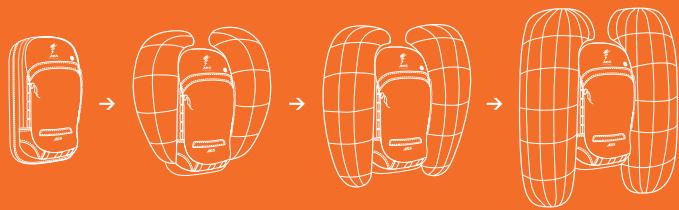
flowchart
graph LR
    A["Device 1"] --> B["Package 1"]
    B --> C["Package 2"]
    C --> D["Package 3"]
WWW.ABS-AIRBAG.COM