 ManualGo.com
TXNR616 - Audio/Video Receiver ONKYO - Free user manual and instructions
Find the device manual for free TXNR616 ONKYO in PDF.



Download the instructions for your Audio/Video Receiver in PDF format for free! Find your manual TXNR616 - ONKYO and take your electronic device back in hand. On this page are published all the documents necessary for the use of your device. TXNR616 by ONKYO.
USER MANUAL TXNR616 ONKYO
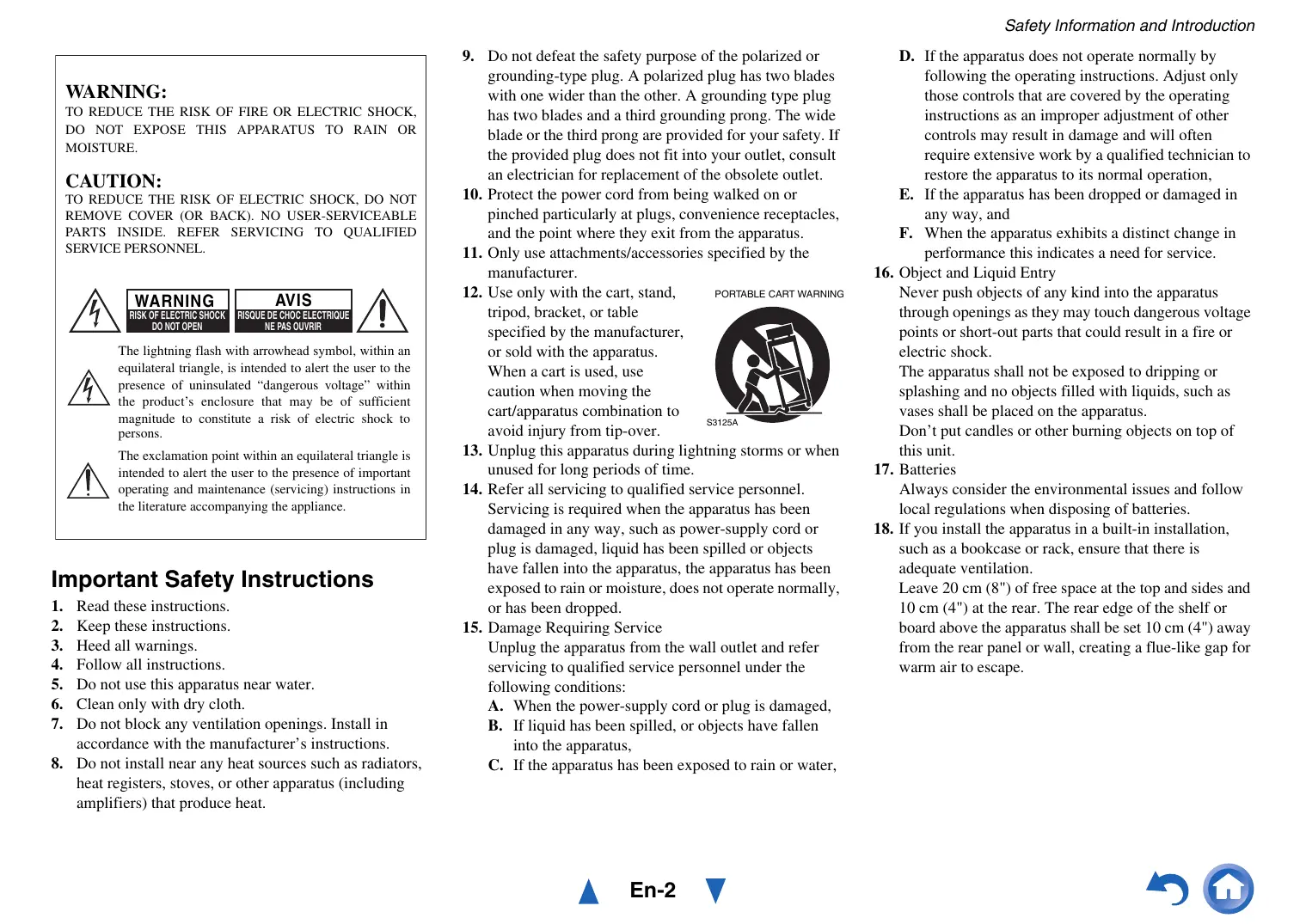
SERVICE PERSONNEL. [WARNING |] AVIS SK EC Sho | RSQUE DE CIO ELCIRIQUE GONG oral NEMS OUR The lightning flash with arrowhead symbol, within an equilateral triangle, is intended to alert the user to the Â\ presence of uninsulated “dangerous voltage” within the products enclosure that may be of sufficient magnitude to constitute a risk of electric shock 10 persons. The exclamation point within an equilateral triangle is intended to alert the user to the presence of important operating and maintenance (servicing) instructions in the literature accompanying the appliance. Important Safety Instructions SPRhPRHRE Read these instructions. Keep these instructions. Heed all warnings. Follow all instructions. Do not use this apparatus near water. Clean only with dry cloth. Do not block any ventilation openings. Install in accordance with the manufacturer’s instructions. Do not install near any heat sources such as radiators, heat registers, stoves, or other apparatus (including amplifiers) that produce heat.
. Use only with the cart, stand, Do not defeat the safety purpose of the polarized or grounding-type plug. À polarized plug has two blades with one wider than the other. A grounding type plug has two blades and a third grounding prong. The wide blade or the third prong are provided for your safety. If the provided plug does not fit into your outlet, consult an electrician for replacement of the obsolete outlet. Protect the power cord from being walked on or pinched particularly at plugs, convenience receptacles, and the point where they exit from the apparatus. Only use attachments/accessories specified by the manufacturer.
PORTABLE GART WARNING
tripod, bracket, or table specified by the manufacturer, or sold with the apparatus. When a cart is used, use caution when moving the cart/apparatus combination to avoid injury from tip-over. Unplug this apparatus during lightning storms or when unused for long periods of time. Refer all servicing to qualified service personnel. Servicing is required when the apparatus has been damaged in any way, such as power-supply cord or plug is damaged, liquid has been spilled or objects have fallen into the apparatus, the apparatus has been exposed to rain or moisture, does not operate normally, or has been dropped. Damage Requiring Service Unplug the apparatus from the wall outlet and refer servicing to qualified service personnel under the following conditions: A. When the power-supply cord or plug is damaged, B. If liquid has been spilled, or objects have fallen into the apparatus, C. If the apparatus has been exposed to rain or water, sa25A À En2 Y
Safety Information and Introduction D. If the apparatus does not operate normally by following the operating instructions. Adjust only those controls that are covered by the operating instructions as an improper adjustment of other controls may result in damage and will often require extensive work by a qualified technician to restore the apparatus to its normal operation, E. If the apparatus has been dropped or damaged in any way, and F. When the apparatus exhibits a distinct change in performance this indicates a need for service. Object and Liquid Entry Never push objects of any kind into the apparatus through openings as they may touch dangerous voltage points or short-out parts that could result in a fire or electric shock. The apparatus shall not be exposed to dripping or splashing and no objects filled with liquids, such as vases shall be placed on the apparatus. Don't put candles or other burning objects on top of this unit. Batteries Always consider the environmental issues and follow local regulations when disposing of batteries. If you install the apparatus in a built-in installation, such as a bookcase or rack, ensure that there is adequate ventilation. Leave 20 cm (8") of free space at the top and sides and 10 cm (4") at the rear. The rear edge of the shelf or board above the apparatus shall be set 10 cm (4") away from the rear panel or wall, creating a flue-like gap for warm air {0 escape.
1. Recording Copyright—Unless its for personal use
only, recording copyrighted material is illegal without the permission of the copyright holder.
2. AC Fuse—The AC fuse inside the unit is not user-
serviceable. If you cannot turn on the unit, contact your Onkyo dealer.
3. Care—Occasionally you should dust the unit all over
with a soft cloth. For stubborn stains, use a soft cloth dampened with a weak solution of mild detergent and water. Dry the unit immediately afterwards with a clean cloth. Don't use abrasive cloths, thinners, alcohol, or other chemical solvents, because they may damage the finish or remove the panel lettering.
CAREFULLY. AC outlet voltages vary from country to country. Make sure that the voltage in your area meets the voltage requirements printed on the unit’s rear panel (e.g., AC 230 V, 50 Hz or AC 120 V, 60 Hz). The power cord plug is used to disconnect this unit from the AC power source. Make sure that the plug is readily operable (easily accessible) at all times. For models with [POWER] button, or with both [POWER] and [ON/STANDBY] buttons: Pressing the [POWER] button to select OFF mode does not fully disconnect from the mains. If you do not intend to use the unit for an extended period, remove the power cord from the AC outlet. For models with [ON/STANDBY] button only: Pressing the [ON/STANDBY] button to select Standby mode does not fully disconnect from the mains. If you do not intend to use the unit for an extended period, remove the power cord from the AC outlet.
Preventing Hearing Loss Caution Excessive sound pressure from earphones and headphones can cause hearing loss. Batteries and Heat Exposure Warning Batteries (battery pack or batteries installed) shall not be exposed to excessive heat as sunshine, fire or the like. Never Touch this Unit with Wet Hands—Never handle this unit or its power cord while your hands are wet or damp. If water or any other liquid gets inside this unit, have it checked by your Onkyo dealer. Handling Notes If you need to transport this unit, use the original packaging to pack it how it was when you originally bought it. Do not leave rubber or plastic items on this unit for a long time, because they may leave marks on the case. This unit’s top and rear panels may get warm after prolonged use. This is normal. If you do not use this unit for a long time, it may not work properly the next time you turn it on, so be sure to use it occasionally. À En3 Y Safety Information and Introduction For U.S. models FCC Information for User CAUTION: The user changes or modifications not expressly approved by the party responsible for compliance could void the user's authority to operate the equipment. NOTE: This equipment has been tested and found to comply with the limits for a Class B digital device, pursuant to Part 15 of the FCC Rules. These limits are designed to provide reasonable protection against harmful interference in a residential installation. This equipment generates, uses and can radiate radio frequency energy and, if not installed and used in accordance with the instructions, may cause harmful interference to radio communications. However, there is no guarantee that interference will not occur in a particular installation. If this equipment does cause harmful interference to radio or television reception, which can be determined by turning the equipment off and on, the user is encouraged to try to correct the interference by one or more of the following measures: + Reorient or relocate the receiving antenna. + Increase the separation between the equipment and receiver. + Connect the equipment into an outlet on a circuit different from that to which the receiver is connected. + Consult the dealer or an experienced radio/TV technician for help.
NOTE: THIS CLASS B DIGITAL APPARATUS
JUSQU'AU FOND. For British models Replacement and mounting of an AC plug on the power supply cord of this unit should be performed only by qualified service personnel. IMPORTANT The wires in the mains lead are coloured in accordance with the following code: Blue: Neutral Brown: Live As the colours of the wires in the mains lead of this apparatus may not correspond with the coloured markings identifying the terminals in your plug, proceed as follows: The wire which is coloured blue must be connected to the terminal which is marked with the letter N or coloured black. The wire which is coloured brown must be connected to the terminal which is marked with the letter L or coloured red. IMPORTANT The plug is fitted with an appropriate fuse. If the fuse needs 10 be replaced, the replacement fuse must approved by ASTA or BSI to BS1362 and have the same ampere rating as that indicated on the plug. Check for the ASTA mark or the BSI mark on the body of the fuse. If the power cord’s plug is not suitable for your socket outlets, cut it off and fit a suitable plug. Fit a suitable fuse in the plug. For European Models Declaration of Conformity We, ONKYO EUROPE ELECTRONICS GmbH LIEGNITZERSTRASSE 6, 82194 GROEBENZELL, GERMANY declare in own ility, that the ONKYO product described in this à ion manual is in compliance with the corresponding technical standards such as EN60065, EN55013, ENS5020 and EN61000-3-2, -3-3. GROEBENZELL, GERMANY K. MIYAGI ONKYO EUROPE ELECTRONICS GmbH À En4 Y Safety Information and Introduction
Supplied Accessories Make sure you have the following accessories: Indoor FM antenna (> page 19) AM loop antenna (> page 19) Power cord (Taiwanese models) (> page 19) Speaker cable labels (> page 13) Speaker setup microphone (> page 35) Remote controller (RC-837M) and two batteries (AA/R6) (Note for China: The battery for the remote controller is not supplied for this unit.) Quick Start Guide
- In catalogs and on packaging, the letter at the end of the product name indicates the color. Specifications and operations are the same regardless of color. Binstalling the batteries
KE © CET Batteries (AA/R6) Note + Ifthe remote controller doesn't work reliably, try replacing the batteries. + Don’t mix new and old batteries or different types of batteries. + If you intend not to use the remote controller for a long time, remove the batteries to prevent damage from leakage or corrosion. + Remove expired batteries as soon as possible to prevent damage from leakage or corrosion. B Aiming the remote controller To use the remote controller, point it at the AV receiver’s remote control sensor, as shown below. Remote control sensor AV receiver Approx. 16 ft. (5 m) Thank you for purchasing an Onkyo AV Receiver. Please read this manual thoroughly before making connections and plugging in the unit. Following the instructions in this manual will enable you to obtain optimum performance and listening enjoyment from your new AV Receiver. Please retain this manual for future reference. À Ens5 Y Safety Information and Introduction
Table of Contents Safety Information and Introduc: Important Safety Instructions . Precautions . Supplied Accessories. Table of Content: Features Front & Rear Panels. Front Panel Display … Rear Panel 10 Remote Controller. 11 Controlling the AV Receiver 11 Connecting Your Speakers . About AV Connections. Connecting Components with HDMI 16 Connecting Your Components … 17 Connecting Onkyo R1 Components 18 Connecting the Antennas. 19 Connecting the Power Cord 19 Turning On/Off the AV Rec Turning On Turning Off Initial Setu Selecting the Language for the Onscreen Setup Menus Audyssey 2EQ: Auto Setup. Source Connection. Remote Mode Setup . Network Connection Terminating the Initial Setup er. Playback. Playing the Connected Component. Controlling Contents of USB or Network Devices Understanding Icons on the Display Playing an iPod/iPhone via USB... Playing a USB Device... Listening to Tuner Internet Radio Registering Other Internet Radio Changing the Icon Layout on the Network Service Screen. Playing Music Files on a Server Remote Playback Listening to AM/FM Radio Using Basic Functions Using the Automatic Speaker Setup Using the Listening Modes . Using the Home Menu. Using the Sleep Timer Setting the Display Brightness: Displaying Source Information Changing the Input Display. Using the Whole House Mode Using the Music Optimizer Muting the AV Receiver Using Headphones . Advanced Operations On-screen Setup Using the Quick Setup Using the Audio Settings of Quick Setup Using the Setup Menu (HOME) . About the HYBRID STANDBY indicator . Setup menu items. Input/Output Assign Speaker Setup. Audio Adjus! Source Setup Listening Mode Preset Miscellaneous … Hardware Setup Remote Controller Setup . Lock Setup. Multi Zone. Making Multi Zone Connections Controlling Multi Zone Components À En6 Y Safety Information and Introduction Controlling Other Components iPod/iPhone Playback via Onkyo Dock Using the Onkyo Dock... Controlling Your iPod/iPhone . Controlling Other Components. Preprogrammed Remote Conti Looking up for Remote Control Codes Entering Remote Control Codes. Remapping Colored Buttons Remote Control Codes for Onkyo Components Connected via R Resetting the REMOTE MODE Buttons... Resetting the Remote Controller Controlling Other Components Appendi Troubleshooting.. Firmware Update … Connection Tips and Video Signal Path Using an RIHD-compatible TV, Player, or Recorder About HDMI... Network/USB Features. License and Trademark Information Specifications.
To reset the AV receiver to its factory defaults, turn it on and, while holding down CBL/SAT, press GON/STANDBY (> page 79).
Features Amplifier + 100 Watts/Channel @ 8 ohms (FTC) + 160 Watts/Channel @ 6 ohms (IEC) + 175 Watts/Channel @ 6 ohms (JEITA) + Optimum Gain Volume Cireuitry + H.C.P.S. (High Current Power Supply) Massive High Power Transformer + 3 Stage Inverted Darlington Amplifier Design Processing + THX Select? Plus Certified + Incorporates Qdeo!M technology for HDMI Video Upscaling (to 4K Compatible) + HDMI (Audio Return Channel, 3D, DeepColor, x.v.Color, Lip Sync, DTS-HD Master Audio, DTS-HD High Resolution Audio, Dolby TrueHD, Dolby Digital Plus, DSD and Multi-CH PCM) + Dolby Pro Logic IIz and Audyssey DSXTM + Non-Scaling Configuration + A-Form Listening Mode Memory + Direct Mode + Pure Audio Mode (European, Australian and Asian models) + Music Optimizer for Compressed Digital Music files + 192 kHz/24-bit D/A Converters + Powerful and Highly Accurate 32-bit Processing DSP + Jitter Cleaning Circuit Technology Connections + 8 HDMI Inputs (1 on front panel) and 2 Outputs + Onkyo RIHID for System Control + 4 Digital Inputs (2 Optical/2 Coaxial) + Component Video Switching (1 Input/1 Output) + Banana Plug-Compatible Speaker Posts
- In Europe, using banana plugs to connect speakers to an audio amplifier is prohibited. + Powered Zone 2 + Bi-Amping Capability for FL/FR with SBL/SBR + Internet Radio Connectivity (SiriusXM Internet Radio/vTuner/Last.fm/Pandora/Rhapsody/Slacker/ AUPEO!)
- Available services may vary depending on the region. + Network Capability for Streaming Audio Files + 2 USB Inputs (Front/Rear) for Memory Devices and iPod®/iPhone® models (Enables Display of Album Artwork)
- Only the front-panel USB input is compatible with iPod/Phone. + MHL-Enabled AUX Front Input Miscellaneous + 40 FM/AM Presets + Audyssey 2EQ® to correct room acoustic problems + Audyssey Dynamic EQ® for loudness correction + Audyssey Dynamic Volume® to maintain optimal listening level and dynamic range + Crossover Adjustment (40/50/60/70/80/90/100/120/150/200 Hz) + A/V Sync Control Function (up to 800 ms) + Auto Standby Function + On-Screen Display via HDMI + Preprogrammed RI-Compatible Remote À En7 Y Safety Information and Introduction
Front & Rear Panels Front Panel (North American and Taiwanese models) O © @ © © Safety Information and Introduction Œuropean, Australian and Asian models) © ® ®@ © © © [ J @ @ 0 © For detailed information, see the pages in parentheses. @ GON/STANDBY button (20) @ ZONE 2 and ZONE 3 buttons (46, 71) @ Remote control sensor (5) @ Display (9) ® LISTENING MODE buttons (37) © DIMMER button (North American and Taiwanese models) (45) @ MEMORY button (32) TUNING MODE button (31) @ SETUP button (50) 0 © @@ TUNING 4/Y (31), PRESET </> (32), cursor and ENTER buttons @ RETURN button @ MASTER VOLUME control and indicator (23) @ MUSIC OPTIMIZER button and indicator (North American and Taiwanese models) (46, 49) PHONES jack (46) & AUX INPUT HDMI/MHL jack (16) @ TONE and Tone Level buttons (48) © Input selector buttons (23) @ DISPLAY button (45) VIDEO jack (17) À Ens Y @ USB port (17) © SETUP MIC jack (35) @ HYBRID STANDBY indicator (51) @ PURE AUDIO button and indicator (European, Australian and Asian models) (37) @ RT/PTY/TP button (European, Australian and Asian models) (33) #5 ©
Display D9806 ? Safety Information and Introduction (a) _—— 24 D TD+TruHD DSDPCM TH [LIPLI x zEX Noo:6) | !IL'dts HD MSTR 96/24 ES Exp! J'u.Opt'> TUNED 4 FM STEREO iSLEEP 'MUTING
bdd For detailed information, see the pages in parentheses. © 22 (Zone 2) indicator (71) © Z3 (Zone 3) indicator (71) @® 3D indicator This lights when a 3D input signal is detected. @ Headphone indicator (46) @® æ-, 11 and cursor indicators (25) © Listening mode and format indicators (37) @ Audyssey indicator (34, 59) Audyssey DSX indicator (41) Dynamic EQ indicator (59) Dynamic Vol indicator (59) M.Opt indicator (46, 49)
(North American, European, Australian and Asian models) O0 @ © O] (Taiwanese models) Safety Information and Introduction @ DIGITAL IN COAXIAL and OPTICAL jacks @ COMPONENT VIDEO IN and OUT jacks @ USB port @ ETHERNET port @ FM ANTENNA jack and AM ANTENNA terminal © HDMI IN and HDMI output (HDMI OUT MAIN and HDMI OUT SUB) jacks @ SPEAKERS terminals
(CENTER, FRONT, SURROUND, SURROUND
BACK or FRONT HIGH, ZONE 2) Power cord (North American, European, Australian and Asian models) @ RI REMOTE CONTROL jack Composite video and analog audio jacks (BD/DVD IN, CBL/SAT IN, STB/DVR IN, GAME IN, PC IN, TV/CD IN) @ MONITOR OUT V jack @ SUBWOOFER PRE OUT jacks @ ZONE 2/ZONE 3 LINE OUT jacks AC INLET (Taiwanese models) See “Connecting the AV Receiver” for connection @ pages 12 to 19). À En-100 Y
Safety Information and Introduction Remote Controller To control the AV receiver, press RECEIVER to select Receiver mode. ñ You can also use the remote controller to control Controlling the AV Receiver Onkyo Blu-ray Disc/DVD player, CD player, and other components. See “Entering Remote Control Codes” for more details (> page 75). For detailed information, see the pages in parentheses. @ 6 RECEIVER button (20) @ REMOTE MODE/INPUT SELECTOR buttons (23) © 4/Y/<4/> and ENTER buttons @ Q SETUP button (47) © Listening Mode buttons (37) © DIMMER button (45) @ DISPLAY button (45) MUTING button (46) @ VOL 4/Y button (23) RETURN button @ HOME button (44) @ SLEEP button (45) E Controlling the tuner To control the AV receiver’s tuner, press AM or FM (or RECEIVER). © 4/Y buttons (31) © D.TUN button (31) © DISPLAY button © CH +/- button (32) © Number buttons (31) À Enti Y # ©
Connecting the AV Receiver Connecting Your Speakers Speaker Configuration The following table indicates the channels you should use depending on the number of speakers that you have. No matter how many speakers you use, a powered subwoofer is recommended for a really powerful and solid bass. To get the best from your surround sound system, you need 10 set the speaker settings automatically (> page 34) or manually (> page 54).
Surround back speaker 1°2 Surround back speakers’? v Front high speakers" v If you’re using only one surround back speaker, connect it to the SURROUND BACK or FRONT HIGH L terminals. Front high and surround back speakers cannot be used at the same time. Connecting the Speaker Cables The following illustration shows how to connect the speakers to each pair of terminals. If you’re using only one surround back speaker, connect it to the SURROUND BACK or FRONT HIGH L terminals. Tip + You can specify whether surround back or front high speakers are connected in the “Speaker Configuration” menu (> page 54)or during Audyssey 2EQ® Room Correction and Speaker Setup (@ page 34). Surround right Connections Surround left Surround back/ Surround back/ Front high Front high right left = Screw-type speaker terminals Strip 1/2" to 5/8" (12 to 15 mm) of insulation from the ends of the speaker cables, and twist the bare wires tightly, as shown. 1/2" to 5/8" (12 to 15 mm)
À En12 Y Front right Front left BE Push-type speaker terminals Strip 3/8" to 1/2" (10 to 12 mm) of insulation from the ends of the speaker cables, and twist the bare wires tightly, as shown. 3/8" to 1/2"(10 to 12 mm) DA ral
= ? Ne B Banana Plugs (North American models) + If you are using banana plugs, tighten the speaker terminal before inserting the banana plug. + Do not insert the speaker code directly into the center hole of the speaker terminal.
Attaching the Speaker Cable Labels The speaker terminals are color-coded for identification purpose. Speaker Color Front left, Front high left, Zone 2 left White Front right, Front high right, Zone 2 right |Red Center Green Surround left Blue Surround right Gray Surround back left Brown Surround back right Tan The supplied speaker cable labels are also color-coded and you should attach them to the positive (+) side of each speaker cable in accordance with the table above. Then all you need to do is to match the color of each label to the corresponding speaker terminal. æ Le - œ
Speaker Connection Precautions Read the following before connecting your speakers: + (North American and Taiwanese models) You can connect speakers with an impedance of between 6 and 16 ohms. If you use speakers with a lower impedance, and use the amplifier at high volume levels for a long period of time, the built-in amp protection circuit may be activated. + (European, Australian and Asian models) You can connect speakers with an impedance of between 4 and 16 ohms. If the impedance of any of the connected speakers is 4 ohms or more, but less than 6 ohms, be sure to set the minimum speaker impedance to “4ohms” (> page 54). If you use speakers with a lower impedance, and use the amplifier at high volume levels for a long period of time, the built-in protection circuit may be activated. Connections + Disconnect the power cord from the wall outlet before + Don't connect more than one cable to each speaker making any connections. terminal. Doing so may damage the AV receiver. + Read the instructions supplied with your speakers. + Don't connect one speaker to several terminals. + Pay close attention to speaker wiring polarity. In other words, connect positive (+) terminals only to positive (+) terminals, and negative (—) terminals only to negative (—) terminals. If you get them the wrong way around, the sound will be out of phase and will sound unnatural. + Unnecessarily long, or very thin speaker cables may affect the sound quality and should be avoided. + Be careful not to short the positive and negative wires. Doing so may damage the AV receiver. + Make sure the metal core of the wire does not have contact with the AV receiver’s rear panel. Doing so may damage the AV receiver.
Using Dipole Speakers Using Powered Subwoofers Connections Bi-amping the Front Speakers
(GERD)] (GED) Cp) (CBb» You can use dipole speakers for the surround and surround back speakers. Dipole speakers output the same sound in two directions. Dipole speakers typically have an arrow printed on them to indicate how they should be positioned. The surround dipole speakers (a) should be positioned so that their arrows point toward the TV/screen, while the surround back dipole speakers (b) should be positioned so that their arrows point toward each other, as shown. AI] AI] Powered subwoofer 1/3 of wall position To find the best position for your subwoofer, while playing a movie or some music with good bass, experiment by placing your subwoofer at various positions within the room, and choose the one that provides the most satisfying results. You can connect the powered subwoofer with two SUBWOOFER PRE OUT jacks respectively. The same signal is output from each jack. Tip + If your subwoofer is unpowered and you”re using an external amplifier, connect the subwoofer pre out jack to an input on the amplifier. À Ent4 Y Important: + When making the bi-amping connections, be sure to remove the jumper bars that link the speakers’ tweeter (high) and woofer (low) terminals. + Bi-amping can be used only with speakers that support bi- amping. Refer to your speaker manual. Bi-amping provides improved bass and treble performance. When bi-amping is used, the AV receiver is able to drive up to a 5.1 speaker system in the main room. Once you’ve completed the bi-amping connections as shown and turned on the AV receiver, you must set the speaker setting to enable bi-amping (+ page 54).
© QI ruvecter (high) a al Woofer (low) 5 œ Front left Front right #5 ©
About AV Connections Connecting AV components HDMI cable — : Video & Audio TV, projector, etc. | AV receiver |
Blu-ray Disc/ DEN DVD player Game console Other cables —: Video : Audio TV, projector, etc. AV receiver
Blu-ray Disc/ EN DVD player Game console + Before making any AV connections, read the manuals supplied with your AV components. + Don't connect the power cord until you’ve completed and double-checked all AV connections. + Push plugs in all the way to make good connections (loose connections can cause noise or malfunctions). + To prevent interference, keep audio and video cables away from power cords and speaker cables. AV Cables and Jacks B HDMI HDMI connections can carry digital video and audio. sou DB— > HE Component video Component video separates the luminance (Y) and color difference signals (PB, PR), providing the best picture quality (some TV manufacturers label their component video sockets slightly differently). Y “ Green Pa "© 1 Pa "© ra E Composite video Composite video is commonly used on TVs, DVDs, and other video equipment. <En— © co E Optical digital audio Optical digital connections allow you to enjoy digital sound such as PCM", Dolby Digital or DTS. The audio quality is the same as coaxial. E ä E Coaxial digital audio Coaxial digital connections allow you to enjoy digital sound such as PCM"!, Dolby Digital or DTS. The audio quality is the same as optical. CD — Orange À En:15 Y Connections B Analog audio (RCA) Analog audio connections (RCA) carry analog audio. “1° For PCM signals, the supported sampling rates are 32/44.1/48/88.2/96 kHz. With HDMI connections, 176.4 and 192 KHz are also supported. Note + The AV receiver does not support SCART plugs. + The AV receiver’s optical digital jacks have shutter-type covers that open when an optical plug is inserted and close when its removed. Push plugs in all the way. + To prevent shutter damage, hold the optical plug straight when inserting and removing.
Connecting Components with HDMI Satellite/cable set-top box, etc. Game console
Connections Camocorder, etc. Blu-ray Disc/DVD player Set top box/Digital video recorder, etc. © If your TV doesn’t support Audio Return Channel (ARC), you need to connect an optical digital cable together with the HDMI cable to the AV receiver.
- When listening to an HDMI component through the AV receiver, set the HDMI component so that its video can be seen on the TV screen (on the TV, select the input of the HDMI component connected to the AV receiver). If the TV power is off or the TV is set to another input source, this may result in no sound from the AV receiver or the sound may be cut off. Connect your components to the appropriate jacks. The default input assignments are shown below. W: Assignment can be changed ( page 52). Jack Components INI Blu-ray Disc/DVD player v IN2 Satellite/cable set-top box, etc. v IN3 Set top box/Digital video recorder, etc. v IN4 Game console v INS Personal computer v IN6 Other components v INT Other components v Front Camcorder, etc.
OUTSUB |Projector, etc. See also: + “Connection Tips and Video Signal Path” (> page 89) + “Using an RIHD-compatible TV, Player, or Recorder” (> page 92) + “About HDMI” ( page 94) À En-:16 Y Tip + To listen to the audio of a component connected via HDMI through your TV's speakers, enable “HDMI Through” (> page 66) and set the AV receiver to standby mode. Note + In the case of Blu-ray Disc/DVD players, if no sound is output despite following the above-mentioned procedure, set your Blu- ray Disc/DVD players HDMI audio settings to PCM. B Audio Return Channel (ARC) function The Audio Return Channel (ARC) function enables an HDMI capable TV to send the audio stream to HDMI OUT MAIN on the AV receiver. + This function can be used when: — Your TV is ARC capable, and — The TV/CD input selector is selected, and “HDMI Control(RIHD)" is set to “On”( page 65), and — “Audio Return Channel” is set to “Auto” (> page 66). BE MHL (Mobile High-Definition Link) With its support for MHL (Mobile High-Definition Link), the AUX (Front) input allows you to deliver high- definition video from a connected mobile device. #5 ©
Connecting Your Components
Connect your components to the appropriate jacks. The default input assignments are shown below. See “Connection Tips and Video Signal Path” for more information (> page 89). The on-screen menus appear only on a TV that is connected to HDMI OUT MAIN. If your TV is connected to other video outputs, use the AV receiver’s display when changing settings. W': Assignment can be changed (> page 53). .[Jack/Port Components USB, VIDEO‘! iPod/iPhone (video playback) @ [uses iPod/iPhone, MP3 player, USB flash drive RI dock, etc. DIGITAL IN OPTICAL 1 (GAME) |Game consoles [2 OPTICAL2(TV/CD) _ |TV. CD player [2 COAXIAL 1 (BD/DVD) [Blu-ray Disc/DVD player |[w COAXIAL 2 (CBL/SAT) |Satellite/cable set-top box, |# RI dock, etc. COMPONENT VIDEO IN (CBL/SAT) Satellite/cable set-top box, | OUT TV, projector, etc. 5] [ETHERNET Router [6] [MONITOR OUT TV, projector, etc. BD/DVD IN Blu-ray Disc/DVD player CBL/SATIN Satellite/cable set-top box, etc. STB/DVR IN Set top box/Digital video recorder, ete GAMEIN Game console, RI dock PCIN Personal computer TV/CD IN TV, CD player, cassette tape deck, MD, CD-R, Turntable"4, RI dock À Eni7 Y Connections Note “1 When the USB input is selected, you can input video signals from the VIDEO jack. Video signals input from VIDEO will be output from the MONITOR OUT and HDMI output jacks. Do not connect the AV receiver's USB port to a USB port on your computer. Music on your computer cannot be played through the AV receiver in this way. Only the front-panel USB input is compatible with iPod/iPhone. Connect a turntable (MM) that has a phono preamp built-in. If your turntable (MM) doesn't have it, you'll need a commercially available phono preamp. If your turntable has a moving coil (MC) type cartridge, you’Il need a commercially available MC head amp or MC transformer as well as a phono preamp. See your turntable’s manual for details. + With connection [3], you can enjoy Dolby Digital and DTS. (To listen in Zone 2/3 as well, use [8] and (6].) + With connection [6], you can enjoy audio from external components while you are in Zone 2/3. + With connection [6], if your Blu-ray Disc/DVD player has both the main stereo and multichannel outputs, be sure to connect the main stereo.
Connecting Onkyo RI Components 1 Makesure that each Onkyo component is connected with an analog audio cable (connection [] in the hookup examples) (> page 17). 2 Make the RI connection (see the illustration). 3 M you’re using an RI Dock, or cassette tape deck, change the Input Display (> page 45). With RI (Remote Interactive), you can use the following special functions: MB System On/Auto Power On When you start playback on a component connected via RL while the AV receiver is on standby, the AV receiver will automatically turn on and select that component as the input source. B Direct Change When playback is started on a component connected via RL the AV receiver automatically selects that component as the input source. Remote Control You can use the AV receiver’s remote controller to control your other FRI-capable Onkyo component pointing the remote controller at the AV receiver’s remote control sensor instead of the component. You must enter the appropriate remote control code first ( page 76). éé:
g., cassette tape deck > at RI Dock Note + Use only fRI cables for RI connections. I cables are supplied with Onkyo components. + Some components have two FRI jacks. You can connect either one to the AV receiver. The other jack is for connecting additional RI-capable components. + Connect only Onkyo components to FI jacks. Connecting other manufacturer s components may cause a malfunction. + Some components may not support all I functions. Refer to the manuals supplied with your Onkyo components. + While Zone 2/3 is on, the System On/Auto Power On and Direct Change RI functions do not work. À En18 Y Connections
Connecting the Antennas This section explains how to connect the supplied indoor FM antenna and AM loop antenna. The AV receiver won't pick up any radio signals without any antenna connected, so you must connect the antenna to use the tuner. North American and syyso European, Australian Taiwanese models and Asian models DÉS É< © $ œ— + Insert the plug fully Insert the plug fully Push. Insert wire. Release. into the jack. into the jack. AT 77 Assembling the AM loop antenna œ 2 & + Q
+ Be careful not to injure yourself when using thumbtacks. Thumbtacks, etc.
AM loop antenna (supplied) Indoor FM antenna (supplied) Note + Once your AV receiver is ready for use, you'Il need to tune into a radio station and position the antenna to achieve the best possible reception. + Keep the AM loop antenna as far away as possible from your AV receiver, TV, speaker cables, and power cords. Tip + If you cannot achieve good reception with the supplied indoor FM antenna, try a commercially available outdoor FM antenna instead. + If you cannot achieve good reception with the supplied indoor AM loop antenna, try using it with a commercially available outdoor AM antenna. À En-19 Y Connections Connecting the Power Cord 1 (Taivanese models) Connect the supplied power cord to the AV receiver”s AC INLET. . md To AC wall outlet 2 Plug the power cord into an AC wall outlet. Note + Before connecting the power cord, connect all of your speakers and AV components. + Turning on the AV receiver may cause à momentary power surge that might interfere with other electrical equipment on the same circuit. If this is a problem, plug the AV receiver into a different branch circuit. Do not use a power cord other than the one supplied with the AV. receiver. The supplied power cord is designed exclusively for use with the AV receiver and should not be used with any other equipment. Never disconnect the power cord from the AV receiver while the other end is still plugged into a wall outlet. Doing so may cause an electric shock. Always disconnect the power cord from the wall outlet first, and then the AV receiver.
Press RECEIVER followed by ORECEIVER on the remote controller. The AV receiver comes on and its display lights. Turning Off 1 Press OON/STANDBY on the front panel.
Press RECEIVER followed by ORECEIVER on the remote controller. The AV receiver will enter standby mode. To prevent any loud surprises when you turn on the AV receiver, always turn down the volume before you turn it off. Tip + The HYBRID STANDBY indicator may light depending on the status of settings (> page 51). + For details on power management settings, see “Auto Standby” (> page 67). À En20 Y Turning On & Basic Operations HE Smooth Operation in a Few Easy Steps (Initial Setup) To ensure smooth operation, here’s a few easy steps to help you configure the AV receiver before you use it for the very first time. These settings only need to be made once. See “Initial Setup” for details (+ page 21). Mif the “Firmware Update Available” window appears. When a new version of the firmware is available, the notification window “Firmware Update Available” pops up. This notification only appears when the AV receiver is connected to your home network ( page 95). To perform the firmware update, follow the instructions on screen. Use A/Y and ENTER on the AV receiver or remote controller to select one of the options. } Update Now: Starts the firmware update. Refer to “Firmware Update” ( page 85). > Remind me Later: The update notification will pop up again the next time you turn the AV receiver on. > Never Remind me: Disables the automatic update notification. Tip + The update notification window can be enabled or disabled in “Update Notice” (> page 68).
Initial Setup This section explains the settings that we recommend you 10 make before using the AV receiver for the very first time. À setup wizard is launched upon first-time use to let you perform those settings. The on-screen menus appear only on a TV that is connected to HDMI OUT MAIN. Selecting the Language for the Onscreen Setup Menus This step determines the language used for the onscreen setup menus. See “Language” in “OSD Setup” (> page 65). Tip + Pressing HOME will close the setup wizard. To restart the initial setup, select “Initial Setup” in the “Hardware Setup” menu @ page 68). After selecting the language for on-screen setup menus, a welcome screen is displayed. Anal Setup Moment Have you connected all he speakers and devices? Beloe string, please connect speakers and sources, Now au Joue 1 start iii Sup? 1 Step : Audsse 20: Auto Satup 204 Sep: Source Connection Sr Step: Remote Mode Setup At Step: Network Connection
HOUE Ext 1 Use 4/Y on the AV receiver or remote controller to select one of the following options, and then press ENTER. »Yes: Continues to “Audyssey 2EQ: Auto Setup”. » No: Skips the settings and terminates the initial setup. The setup wizard goes to “Terminating the Initial Setup” ( page 22). You can always restart the initial setup by selecting “Initial Setup” in the “Hardware Setup” menu (> page 68). À En21 Y Turning On & Basic Operations Audyssey 2EQ: Auto Setup This step performs the automatic speaker setup. À Use A/Y to select one of the following options, and then press ENTER. > Do it Now: The automatic speaker setup is performed following instructions on screen. Refer to step 2 of “Using the Automatic Speaker Setup” ( page 34). When this setting is complete, the setup wizard continues to “Source Connection”. > Doit Later: Skips this setting. Press ENTER and continue to “Source Connection”.
Source Connection This step checks the connection of source components.
Use A/Y to select one of the following options, and then press ENTER. Yes, Continue: Performs the checkings. > No, Skip: Skips this step and continues to “Remote Mode Setup”. Select the input selector for which you want to check the connection and press ENTER. The picture of the corresponding source should appear on screen With a verification prompt. When prompted, use A/Y to select one of the following options and then press ENTER. PYes: Confirms that the source is properly displayed. » No: Displays an error report. Follow the troubleshooting instructions and recheck the source. Use A/Y to select one of the following options, and then press ENTER. »Yes: Returns to step 2. > No, Done Checking: The setup wizard continues to “Remote Mode Setup”. Remote Mode Setup With this step, you can enter remote control codes for the components you want to operate. À Use A/Y to select one of the following options, and then press ENTER. »Yes: Performs the remote control code input. Refer to step 5 of “Looking up for Remote Control Codes” (> page 74). » No, Skip: Skips this step and continues to “Network Connection”. 2 When you're finished, select one of the following options and press ENTER. » Yes, Done: The setup wizard continues to “Network Connection”. » No, not yet: You can enter other remote control codes. À En22 Y Turning On & Basic Operations Network Connection This step checks your network connection. À Use A/Y to select one of the following options, and then press ENTER. PYes: Performs the checkings. » No, Skip: Skips this step and terminates the initial setup. Note + If you use both wired and wireless network connections, the wireless will take priority. For further details, see the instruction manual provided with your wireless device. 2 Follow the instructions on screen to perform the network checking. The checking is complete when the message “Successfully connected.” appears at the middle of the screen. Press ENTER to terminate the initial setup. 3 fan error message appears, select one of the following options and press ENTER. > Retry: Performs the checking again. » No, Doit Later: Skips this step and terminates the initial setup. The setup wizard goes to “Terminating the Initial Setup”. Terminating the Initial Setup This step ends the initial setup process. 1 Press ENTER. To restart the initial setup, select “Initial Setup” in the “Hardware Setup” menu (> page 68). #5 ©
Playback The on-screen menus appear only on a TV that is connected to HDMI OUT MAIN. If your TV is connected to other video outputs, use the AV receiver”s display when changing settings. This section describes the procedure for using the remote controller, unless otherwise specified. Playing the Connected Component E Operating with the remote controller RECEIVER
j j & © N re) Use the input selector buttons to select the input source. Start playback on the source component. To adjust the volume, use the MASTER VOLUME control. Select a listening mode and enjoy! BE Screen saver If there is no video signal on the current input source and no operation for a specific time (three minutes by default), a screen saver automatically comes on. Tip + The time until the screen saver activates itself can be changed in the “Screen Saver” setting (> page 65). + The screen will return to its previous state if the AV recciver is operated. #5 ©
Controlling Contents of USB or Network Devices Press USB or NET first Turning On & Basic Operations
This button displays the top menu for each media or service. This button stops playback. A/Y and ENTER @ |MODE These buttons navigate through the menus.
This button cycles through pages. PLAYLIST </> In Standard Mode (iPod/iPhone), this button selects playlis
This button starts playback. @® |re« This button selects the beginning of the current song. Pressing this button twice selects the previous song.
This button fast-reverses the current song. This button pauses playback. @ |SEARCH You can toggle between the playback screen and the list screen during playback. DISPLAY This button switches between song information during playback. Press this button while the list screen is displayed to return to the playback screen. ALBUM +/- In Standard Mode (iPod/iPhone), this button selects albums. MENU This button returns to top menu of the Internet Radio service. RETURN This button returns to the previous menu.
This button fast-forwards the current song.
Cal This button selects the next song. À En24 Y You can switch between Standard Mode and Extended Mode during iPod/iPhone playback. @ | RANDOM This button performs random playback. © |REPEAT Press this button repeatedly to cycle through the repeat modes. Tip + See “Controlling Other Components” about the operation of other components (> page 74). Note + The buttons you can use will differ depending on the devices and media used for playback.
Understanding Icons on the Display This section describes icons that appear on the AV receiver’s display during media playback. Icon Folder Track Playback Pause Fast Forward Fast Reverse Artist Album Repeat One Track Repeat Folder (USB Device) Repeat Shuffle Shuffle Album (iPod/iPhone) Playing an iPod/iPhone via USB The on-screen menus appear only on a TV that is connected to HDMI OUT MAIN. This section explains how to play musicWideo files on the iPod/Phone. Compatible iPod/iPhone models Made for: iPod touch (1st, 2nd, 3rd and 4h generation), iPod classi iPod nano (2nd, 3rd, 4th, 5th and 6th generation), iPhone 4S, iPhone 4, iPhone 3GS, iPhone 3G, iPhone 1 Press USB repeatedly to select the “USB(Front)” input. Tip + The same operation can be done by selecting “USB” in the Home menu. 2 Connect the USB cable that comes with the iPod/Phone to the USB port on the front of the AV receiver. While reading the contents of your iPod/iPhone, the message “Connecting..” appears on the AV receiver”’s display. The USB indicator lights. It will flash if the AV receiver cannot read the iPod/Phone. Tip + When connecting your iPod/iPhone with a USB cable, we recommend you use an official USB cable from Apple Inc. À En25 Y + While the message “Connecting Turning On & Basic Operations 3 Press MODE repeatedly to switch to Extended Mode (Music) or Extended Mode (Video). A list of your iPod/iPhone model’ contents appears. Tip + If you want to operate using the iPod/iPhone or the remote controller, press MODE repeatedly to switch to Standard mode. + When you disconnect the iPod/iPhone, the AV receiver remembers the current mode. This means that if you disconnect when in Extended Mode (Music), the AV receiver will start in Extended Mode (Music) the next time you connect the iPod/iPhone. 4 Use A/T to select a folder, and then press ENTER to open it. Tip + You can also use the A/Ÿ, ENTER and TUNING MODE buttons on the front panel. TUNING MODE allows you to switch modes. 5 Use A/Y to select a music/video file, and press ENTER or = to start playback. Note ‘appears on the AV receivers display, do not disconnect the USB cable supplied with your iPod/iPhone or the USB device from the USB port. + If you connect an iPod or iPhone to the USB port, no sound will be output from the headphones jack.
Extended Mode (Music) Control The music content information is displayed (lists are displayed), and you can control the music content while looking at the screen. Top screen list: Playlists, Artists, Albums, Genres, Songs, Composers, Shuffle Songs, Now Playing. Note + In this mode, video contents are not displayed, even if they are input from the VIDEO jack on the AV receiver's front panel Extended Mode (Video) control The video content information is displayed (lists are displayed), and you can control the video content while looking at the screen. Top screen list: Movies, Music Videos, TV Shows, Video Podcasts, Rentals. Note + To view the video contents of your iPod/iPhone, connect it to the USB port and VIDEO jack on the AV receiver’s front panel, using the official Apple Composite AV Cable + Depending on your iPod/Phone model and generation, the displayed items may vary and the support for Extended Mode (Video) is not guaranteed. Standard Mode Control The content information is not displayed, but can be operated using the iPod/iPhone or the remote controller. Playing a USB Device The on-screen menus appear only on a TV that is connected to HDMI OUT MAIN. This section explains how to play music files from a USB device (e.g, USB flash drives and MP3 players). See also: + “Network/USB Features” (> page 95). 1 Press USB repeatedly to select the “USB(Front)” or “USB(Rear)” input. 2 Plug your USB device into the AV receiver’s USB port. The USB indicator lights. It will flash if the AV receiver cannot read the USB device. 3 Press ENTER. A list of the device’s contents appears. To open a folder, use A/Y to select it, and then press ENTER. 4 Use A/Y to select a music file, and press ENTER or »- to start playback. Note + While the message “Connecting...” appears on the AV receiver's display, do not disconnect the USB cable supplied with your iPod/Phone or the USB device from the USB port. À En26 Y Turning On & Basic Operations
Listening to ner Internet Radio You need to connect the AV receiver to your home network (> page 95). The on-screen menus appear only on a TV that is connected to HDMI OUT MAIN. The vTuner Internet Radio Service is a portal site featuring radio stations from all over the world. You can search for stations by categories such as genre or location. The AV receiver is preinstalled with this service. 1 Press NET. The network service screen appears, and the NET indicator lights. If it flashes, verify that the Ethernet cable is firmly connected to the AV receiver. Tip + The same operation can be done by selecting “Network Service” in the Home menu. 2 UseA/Y/<» to select “YTuner Internet Radio” and then press ENTER. SZ Use A/ to select a program and then press ENTER. Playback starts.
Muse Great rit AyFarorte Tip + You can find stations similar to the one being played. During playback, press MENU on the remote controller, select “Stations like this” and press ENTER. B Adding vTuner Internet Radio Stations to Favorites There are two ways you can register specific Internet radio stations (programs) from the Tuner Internet Radio. Adding to My Favorites The selected program will be added to “My Favorites” on the network service screen, which appears when pressing NET on the remote controller.
1. Press MENU with the station selected or while a
2. Use A/Y to select “Add to My Favorites”, and press
/» 10 select “OK”, and press ENTER. Tip + You can rename the stations saved in “My Favorites”. Adding to vTuner Internet Radio’s Favorites Select “vTuner Internet Radio” and press ENTER to display the “Favorites” folder that appears on the same screen as “Stations By Genre”, “Stations By Location”, etc. This is where your favorite Internet radio bookmarks will be stored. To register your favorite stations using a personal computer, you need to connect your PC to the same network as the AV receiver. Enter the ID# (MAC address) of your unit on the http:/onkyo.vtuner.com/. You can then register your favorite radio programs. The ID# is shown at the bottom of the “YTuner Internet Radio” top menu, and the AV receiver’s MAC address is shown on “Network” of the Setup menu (> page 67). À En27 Y Turning On & Basic Operations
Registering Other Internet Radio You need to connect the AV receiver to your home network (> page 95). The on-screen menus appear only on a TV that is connected to HDMI OUT MAIN. Internet radio URLS in the following formats are supported: PLS, M3U, and podcast (RSS). However, depending on the type of data or audio format used by the Internet radio station, you may not be able to listen to some stations. To listen to other Internet radio stations, you must register your station in “My Favorites” of the network service screen, as described below. Note + Services available may vary depending on the region. See the Separate instructions for more information. 1 Select “Network” on the Setup menu to verify your IP address (> page 68). Take a note of the IP address. 2 On your computer, start your web browser. Enter the AV receiver”’s IP address in the browser’s Internet address (URL) field. If you are using Internet Explorer®, you can also enter the URL by selecting “Open...” on the “File” menu. Information on the AV receiver is then shown on your Internet browser (Web Setup). 4 Cüick on the “My Favorites” tab, and enter the Internet radio station’s name and URL. LA] 5 Click “Save” to save the Internet radio station. The Internet radio station is then added to “My Favorites”. To play the registered station, press NET, and then select “My Favorites” on the network service screen. À list of registered Internet radio Stations appears. Select the one that you saved and press ENTER. Tip + If you want to add a new station directly from “My Favorites”, select an empty slot in the list and press MENU. Then, select “Create New Station” and press ENTER. Pressing ENTER again will display the keyboard screen. Use that Keyboard to enter the station’s name and URL respectively, and then press ENTER. + If you want to delete a station saved in “My Favorites”, press MENU with the station selected or while the station is playing. Then, use A/Ÿ to select “Delete from My Favorites” and press ENTER. You can also delete stations from the Web Setup. + If you want to rename a station, select the desired station and press MENU. Then, use A/Y 10 select “Rename this station” and press ENTER. + You can save up to 40 Internet radio stations. À En28 Y Turning On & Basic Operations Changing the Icon Layout on the Network Service Screen The layout of icons can be customized by switching their positions on the network service screen. 1 Press NET. The network service screen appears, and the NET indicator lights. If it flashes, verify that the Ethernet cable is firmly connected to the AV receiver. Tip + The same operation can be done by selecting “Network Service” in the Home menu. Press MODE/D (blue) on the remote controller.
Use A/Y/</» to select an icon to move, and then press ENTER. Use A/Y/</»> to select another icon as the destination, and then press ENTER. The icons switch positions and the message “Completed!” appears. If you press RETURN, the “Custom Mode” process will be cancelled or it will go back one step.
Playing Music Files on a Server You need to connect the AV receiver to your home network (> page 95). The on-screen menus appear only on a TV that is connected to HDMI OUT MAIN. This section explains how to play music files on a computer or media server through the AV receiver (Server Playback). 1 Start your computer or media server. 2 Press NET. The network service screen appears. The NET indicator lights. If it flashes, confirm the network connection. Tip + The same operation can be done by selecting “Network Service” in the Home menu. 3 UseA/Y/<> to select “dina”, and press ENTER. Tip + To go back to the previous screen, press RETURN 4 Use AN to select a server, and then press ENTER. The menu is displayed according to the server functions. Note + The search function does not work with media servers which do not support this function. + Photos and movies stored on a media server cannot be accessed from the AV receiver. + Depending on the sharing settings in the media server, the AV receiver may not able to access the content. See the instruction manual of the media server.
Aristname y favorte album Note + Depending on the media server, 4/»»/L8 may not work. + Ifthe message “No Item.” appears, this means that no information can be retrieved from the server. In this case, check your server, network, and AV receiver connections. À En29 Y Turning On & Basic Operations Windows Media Player 11 Setup This section explains how to configure Windows Media Player 11 so that the AV receiver can play the music files stored on your computer.
Start Windows Media Player 11. On the “Library” menu, select “Media Sharing”. The “Media Sharing” dialog box appears. Select the “Share my media” check box, and then click “OK”. A list of the supported devices appears. Select the AV receiver in the list, and then click “Allow”. The corresponding icon will be checked. Click “OK” to close the dialog box. This completes the Windows Media Player 11 configuration. You can now play the music files in your Windows Media Player 11 library through the AV receiver. Tip + Windows Media Player 11 can be downloaded for free from the Microsoft web site.
Remote Playback You need to connect the AV receiver to your home network (> page 95). The on-screen menus appear only on a TV that is connected to HDMI OUT MAIN. Remote Playback means you can play the music files stored on a media server or personal computer with the AV receiver by operating the controller device in the home network. Windows Media Player 12 Setup This section explains how to configure Windows Media Player 12 so that the AV receiver can play the music files stored on your personal computer. 1 Start Windows Media Player 12. 2 On the “Stream” menu, select “Turn on media streaming”. A dialog box appears. Tip + If the media streaming is already activated, clicking on “More streaming options.” in the “Stream” menu will display a list of the playback devices connected to the network. You can skip step 3. 3 Move your cursor and click on “Turn on media streaming”. A list of media server appears. Wording may vary slightly depending on the network location. 4 On the “Media streaming options”, select the AV receiver and confirm that it is set to “Allow”. 5 Click “OK” to close the dialog box. This completes the Windows Media Player 12 configuration. You can now play the music files in your Windows Media Player 12 library. Tip + On the “Stream” menu, confirm that “Allow remote control of my Player...” is checked. Using Remote Playback 1 Turn on the AV receiver. 2 Start Windows Media Player 12. To enable remote playback, you must first configure Windows Media Player 12. 3 On Windows Media Player 12, right-click on a music file. The right-click menu appears. Tip + For selecting another media server, select the desired media server from the “Other Libraries” menu on Windows Media Player 12. 4 Select the AV receiver in “Remote playback”. The “Play to” window appears and playback on the AV receiver starts. Operations during remote playback can be made from the “Play to” window of Windows 7 on your personal computer. A playback screen will be displayed on the connected TV. À En30 Y Turning On & Basic Operations 5 Adjusting the Volume. You can adjust the volume by adjusting the volume bar in the “Remote playback” window. The default maximum volume level is 82 (0dB). If you wish to change this, enter the value from the Web Setup in your browser. Refer to step 3 of “Registering Other Internet Radio” for details (> page 28). The volume value of the remote window and the volume value of the AV receiver may not always match. Adjustments you make to the volume in the AV receiver will not be reflected in the “Remote playback” window. Note + Remote playback cannot be used in any of the following cases: — Nenwork services are being used. — Contents are being played from a USB device or iPod/iPhone. — Zones are turned on.
Listening to AM/FM Ra This section describes the procedure of using the buttons on the front panel, unless otherwise specified. Using the Tuner With the built-in tuner you can enjoy AM and FM radio Stations. You can store your favorite stations as presets for quick selection. You can also change the frequency steps ( page 65). 1 Press AM or FM to select either “AM” or “FM”. In this example, FM has been selected. Band Frequency (Actual display depends on the country.) Tuning into Radio Stations B Auto tuning mode 1 Press TUNING MODE so that the AUTO indicator lights on the AV receiver’s display. 2 Press TUNING 4/Y. Searching stops when a station is found. When tuned into a station, the TUNED indicator lights. When tuned into a stereo FM station, the FM STEREO indicator lights as shown. »> TUNED 4 | AUTO FM 2 Tip + Tuning into weak FM stereo stations If the signal from a stereo FM station is weak, it may be impossible to get good reception. In this case, switch 10 manual tuning mode and listen to the station in mono. À Ensi Y Turning On & Basic Operations BE Manual tuning mode In manual tuning mode, FM stations will be in mono. 1 Press TUNING MODE so that the AUTO indicator goes off on the AV receiver’s display. 2 Press and hold TUNING 4/Y. The frequency stops changing when you release the button. Press the buttons repeatedly to change the frequency one step at a time. B Tuning into stations by frequency You can tune into AM and FM stations directly by entering the appropriate frequency. 1 Onthe remote controller, press AM or FM to select “AM° or “FM”, followed by D.TUN. (Actual display depends on the country.) 2 Within 8 seconds, use the number buttons to enter the frequency of the radio station. For example, to tune to 87.5 (FM), press 8, 7, 5. If you have entered the wrong number, you can retry after 8 seconds.
Presetting AM/FM Stations You can store a combination of up to 40 of your favorite AM/FM radio stations as presets. 1 Tune into the AM/FM station that you want to store as a preset. See the previous section. 2 Press MEMORY. The preset number flashes. (Actual display depends on the country.) 3 While the preset number is flashing (about 8 seconds), use PRESET </> to select a preset from 1 through 40. 4 Press MEMORY again to store the station or channel. The station or channel is stored and the preset number tops flashing. Repeat this procedure for all of your favorite AM/FM radio stations. El Selecting Presets 1 To select a preset, use PRESET </> on the AV receiver, or the remote controller’s CH +/-. Tip + You can also use the remote controller’s number buttons to select a preset directly. B Deleting Presets À Select the preset that you want to delete. See the previous section. 2 While holding down MEMORY, press TUNING MODE. The preset is deleted and its number disappears from the AV receiver’s display. À En32 Y Turning On & Basic Operations Using RDS (excluding North American and Taiwanese models) RDS works only in areas where RDS broadcasts are available. When tuned into an RDS station, the RDS indicator lights. When the station is broadcasting text information, the text can be displayed. E What is RDS? RDS stands for Radio Data System and is a method of transmitting data in FM radio signals. It was developed by the European Broadcasting Union (EBU) and is available in most European countries. Many FM stations use it these days. In addition to displaying text information, RDS can also help you find radio stations by type (e.g., news, sport, rock, etc.). The AV receiver supports four types of RDS information: PS (Program Service) When tuned to an RDS station that’s broadcasting PS information, the station’s name will be displayed. Pressing DISPLAY will display the frequency for 3 seconds. RT (Radio Text) When tuned to an RDS station that's broadcasting text information, the text will be shown on the AV receiver's display as described in the next section. PTY (Program Type) This allows you to search for RDS radio stations by type @ page 33). TP (Traffic Program) This allows you to search for RDS radio stations that broadcast traffic information (> page 33). Le To be continued #5 ©
Note + In some cases, the text characters displayed on the AV receiver may not be identical to those broadcast by the radio station. AIso, unexpected characters may be displayed when unsupported characters are received. This is not a malfunction. + Ifthe signal from an RDS station is weak, RDS data may be displayed intermittently or not at all. B Displaying Radio Text (RT) 1 Press RT/PTY/TP once. The RT information scrolls across the AV receivers display. Note + The message “Waiting” may appear while the AV receiver waits for the RT information. + Ifthe message “No Text Data” appears, no RT information is available. BFinding Stations by Type (PTY) You can search for radio stations by type. 1 Press RT/PTY/TP twice. The current program type appears on the AV receiver’s display. 2 Use PRESET </»> to select the type of program you want. See the table shown later in this chapter. 3 To start the search, press ENTER. The AV receiver searches until it finds a station of the type you specified, at which point it stops briefly before continuing with the search. 4 When a station you want to listen to is found, press ENTER. If no stations are found, the message “Not Found” appears. Æ Listening to Traffic News (TP) You can search for stations that broadcast traffic news. 1 Press RT/PTY/TP three times. If the current radio station is broadcasting TP (Traffic Program), “[TP]” will appear on the AV receiver’s display. If “TP” without square brackets appears, this means that the station is not broadcasting TP. 2 To locate a station that is broadcasting TP, press ENTER. The AV receiver searches until it finds a station that’s broadcasting TP. If no stations are found, the message “Not Found” appears. À Ens33 Y Turning On & Basic Operations RDS program types (PTY) Type Display None None News reports News Current affairs Affairs Information Info Sport Sport Education Educate Drama Drama Culture Culture Science and technology Science Varied Varied Pop music Pop M Rock music Rock M Middle of the road music Easy M Light classics Light M Serious classics Classics Other music Other M Weather Weather Finance Finance Children's programmes Children Social affairs Social Religion Religion Phone in Phone In Travel Travel Leisure Leisure Jazz music Jazz Country music Country National music Nation M Oldies music Oldies Folk music Folk M Documentary Document Alarm test TEST Alarm Alarm! #5 ©
Using Basic Functions With the supplied calibrated microphone, Audyssey 2EQ® automatically determines the number of speakers connected, their size for purposes of bass management, optimum crossover frequencies to the subwoofer (if present), and distances from the primary listening position. Audyssey 2EQ then removes the distortion caused by room acoustics by capturing room acoustical problems over the listening area in both the frequency and time domain, The result is clear, well-balanced sound for everyone. Audyssey 2EQ can be used with Audyssey Dynamic EQ® and Audyssey Dynamic Volume® (+ page 59). Before using this function, connect and position all of your speakers. Audyssey 2EQ offers two ways of measuring: the “Audyssey Quick Start” and “Audyssey 2EQ Full Calibration”. + “Audyssey Quick Start” uses the measurement from one position to perform the speaker setting only. + “Audyssey 2EQ Full Calibration” uses the measurement from three positions to correct room response in addition to the speaker setting. The more positions are used in measuring, the better the listening environment will become. We recommend using a measurement from three positions to create the best listening environment. The Quick Start takes 2 minutes and Full Calibration takes about 10 minutes. Total measurement time varies depending on the number of speakers. Measurement procedure To create a listening environment in your home theater that all listeners will enjoy, Audyssey 2EQ takes measurements at up to three positions within the listening area. Position the microphone at ear height of a seated listener with the microphone tip pointed directly at the ceiling using a tipod. Do not hold the microphone in your hand during measurements as this will produce inaccurate results. @ First measurement position Also referred to as the Main Listening Position, this refers to the most central position where one would normally sit within the listening environment. Audyssey 2EQ uses the measurements from this position to calculate speaker distance, level, polarity, and the optimum crossover value for the subwoofer. @ Second measurement position The right side of the listening area. @ Third measurement position The left side of the listening area. The distances from position D to © and D to @ must be at least 1 meter (3.3 fL.). : Listening area @ to @: Listening position À En34 Y Turning On & Basic Operations Note + Make the room as quiet as possible. Background noise and Radio Frequency Interference (RFI) can disrupt the room measurements. Close windows, televisions, radios, air conditioners, fluorescent lights, home appliances, light dimmers, or other devices. Turn off the cell phone (even if it is not in use) or place it away from all audio electronics. + The microphone picks up test tones played through each speaker as Audyssey 2EQ Room Correction and Speaker Setup runs. + Audyssey 2EQ Room Correction and Speaker Setup cannot be performed while a pair of headphones is connected.
1 Turn on the AV receiver and the connected TV. On the TV, select the input to which the AV receiver is connected. 2 Set the speaker setup microphone at the Main Listening Position ®, and connect it to the SETUP MIC jack. SETUP MIC jack 29} The speaker setting menu appears. Speaker setup microphone Note + The on-screen menus appear only on a TV that is connected 10 HDMI OUT MAIN. If your TV is connected to other video outputs, use the AV receiver”’s display when changing settings. 3 When you’ve finished making the settings, press ENTER. ÉRTE QUDISSES) Speakers Type (Front) Norma 4» Poverd Zone 2 le Surround BscFront High Surround Bsck Perform the “Speaker Setup” according to your speaker configuration: — Speakers Type (Front) (> page 54) - Powered Zone 2 (> page 54) — Surround Back/Front High (> page 54) 4 Use AN to select “Audyssey Quick Start” or “Audyssey 2EQ Full Calibration”, and then press ENTER. 5 Press ENTER. Audyssey 2EQ® Room Correction and Speaker Setup Start. Test tones are played through each speaker as Audyssey 2EQ Room Correction and Speaker Setup runs. This process takes a few minutes. Please refrain from talking during measurements and do not stand between speakers and the microphone. Do not disconnect the speaker setup microphone during Audyssey 2EQ Room Correction and Speaker Setup, unless you want to cancel the setup. If you select “Audyssey Quick Start”, you will go to step 8. 6 Pince the speaker setup microphone at the next position, and then press ENTER. Audyssey 2EQ performs more measurements. This takes a few minutes. 7 When prompted, repeat step 6. 8 Use A/Y to select an option, and then press ENTER. HORS vi Spa Cotguatn = se Sao us Font se Eur we pet Lsurouns some 8 . Font ons Sama ba Eu s = #8 Sara Bak ES El ® Cane The options are: } Save: Save the calculated settings and exit Audyssey 2EQ Room Correction and Speaker Setup. }> Cancel: Cancel Audyssey 2EQ Room Correction and Speaker Setup. À En35 Y Turning On & Basic Operations Tip + You can view the calculated settings for the speaker configuration, speaker distances, and speaker levels by using 4». Q Use 4/Y to select a target, and use /> to change the setting. After the results of Audyssey 2EQ have been saved, the menu will display the “Audyssey” (> page 59), “Dynamic EQ” (> page 59), “Dynamic Volume” (@ page 59) settings. Note + When “Audyssey Quick Start” has been used for measurement, “Audyssey” cannot be selected. + These settings are applied to all input selectors. 10 Press ENTER. 11 Disconnect the speaker setup microphone. Note + You can cancel Audyssey 2EQ Room Correction and Speaker Setup at any point in this procedure simply by disconnecting the setup microphone. + Do not connect or disconnect any speakers during Audyssey 2EQ Room Correction and Speaker Setup. + Ifthe AV receiver is muted, it will be unmuted automatically when Audyssey 2EQ Room Correction and Speaker Setup starts. + Changes to the room after Audyssey 2EQ Room Correction and Speaker Setup requires you run Audyssey 2EQ Room Correction and Speaker Setup again, as room EQ characteristics may have changed.
Error Messages Changing the Speaker Setup Manually While Audyssey 2EQ® Room Correction and Speaker Setup is in progress, one of the error messages below may appear. ELLE QUES Aie le 1188 HG Rey Cancel Error message The options are: > Retry: Try again. } Cancel: Cancel Audyssey 2EQ Room Correction and Speaker Setup. + Ambient noise is too high. The background noise is too loud. Remove the source of the noise and try again. + Speaker Matching Error! The number of speakers detected was different from that of the first measurement. Check the speaker connection. + Writing Error! This message appears if saving fails. Try saving again. If this message appears after 2 or 3 attempts, contact your Onkyo dealer. + Speaker Detect Error This message appears if a speaker is not detected. “No” means that no speaker was detected. Tip + See “Speaker Configuration” for appropriate settings G@ page 12). You can manually make changes to the settings found during Audyssey 2EQ Room Correction and Speaker Setup. See also: + “Speaker Configuration” (> page 54) + “Speaker Distance” (> page 55) + “Level Calibration” ( page 55) + “Equalizer Settings” (> page 56) Note + Please note that THX recommends any THX main speakers be set 10 “80HZ(THX)”. If you set up your speakers using Audyssey 2EQ Room Correction and Speaker Setup, please make sure manually that any THX speakers are set 10 “80HZ(THX)” crossover (> page 54) + Sometimes due to the electrical complexities of subwoofers and the interaction with the room, THX recommends setting the level and the distance of the subwoofer manually. + Sometimes due to interaction with the room, you may notice irregular results when setting the level and/or distance of the main speakers. If this happens, THX recommends setting them manually. Using a Powered Subwoofer If you're using a powered subwoofer and it outputs very low-frequency sound at a low volume level, it may not be detected by Audyssey 2EQ Room Correction and Speaker Setup. If the “Subwoofer” appears on the “Review Speaker Configuration” screen as “No”, increase the subwoofer’s volume to the half-way point, set it to its highest crossover frequency, and then try running Audyssey 2EQ Room Correction and Speaker Setup again. Note that if the volume is set 100 high and the sound distorts, detection issues may occur, so use an appropriate volume level. If the subwoofer has a low-pass filter switch, set it to Off or Direct. Refer to your subwoofer’s instruction manual for details. À En36 Y Turning On & Basic Operations
(European, Australian and Asian models) PURE AUDIO MOVIE/TV, MUSIC, GAME, THX MOVIE/TV button This button selects the listening modes intended for use with movies and TV. MUSIC button This button selects the listening modes intended for use with music. GAME button This button selects the listening modes intended for use with video games. THX button This button selects the THX listening modes. À Ens37 Y Turning On & Basic Operations PURE AUDIO button and indicator Œuropean, Australian and Asian models) This button selects the Pure Audio listening mode. When this mode is selected, the AV receiver’s display and video circuitry are turned off. Only video signals input through HDMI input can be output from an HDMI output. The indicator lights when this mode is selected. Pressing this button again will select the previous listening mode. + The Dolby Digital and DTS listening modes can only be selected if your Blu-ray Disc/DVD player is connected to the AV receiver with a digital audio connection (coaxial, optical, or HDMI). + The listening modes you can select depends on the format of the input signal. To check the format, see “Displaying Source Information” (> page 45). + While a pair of headphones is connected, you can select the following listening modes: Pure Audio (European, Australian and Asian models), Mono, Direct, and Stereo.
Turning On & Basic Operations About Listening Modes Input Source Speaker Layout The following audio formats are supported by the listening The illustration shows which speakers are activated in each modes. channel. See “Speaker Configuration” for the speaker setup (> page 54). The AV receiver’s listening modes can transform your listening room into a movie theater or concert hall, with high fidelity and stunning surround sound. m Explanatory Notes SEE | This is stereo (stercophonic) sound. Two [Ex] independent audio signal channels are reproduced through two speakers. This is mono (monophonic) sound. This is 5.1-channel surround sound. This surround system has five main channels of sound and a sixth subwoofer channel (called the point-one channel). TT
FF ee) LAC This is 7.1-channel surround sound, This is a further sound enhancement to 5.1-channel sound [EX] with two additional speakers that provide greater sound envelopment and more accurate positioning [ @ | el of sounds. GS This is DTS-ES surround sound. This surround ] system can produce a discrete or a matrix-encoded > sixth channel from existing DTS 5.1 encoded material. Gi This is Dolby Digital EX surround sound. This Tv provides a center back surround channel from 5.1- channel sources. le Il : ï x | @@ Front speakers @ Center speaker @ ® Surround speakers © Subwoofer(s) @ ® Surround back speakers © @ Front high speakers À Ens8 Y 4 O
Turning On & Basic Operations MB Onkyo-Original DSP Listening Modes Listening Mode Description Input [Speaker Listening Mode Description Input [Speaker Sourcep layout Source |Layout T-D (Theater- With this mode you can enjoy a virtual [MON (Z-16.16.1 Orchestra Suitable for classical or operatie music, this [MON] |(E:1] Dimensional) surround sound even with only two or three ms mode emphasizes the surround channels in NEA T=0 speakers. This works by controlling how rchestra order to widen the stereo image, and Det ne the ne s ae rares simulates the natural reverberation of a large ood resulis may not be possible if there s se E 100 much reverb, so we recommend that you DTS-ES use this mode in an environment with ltile Es Unplugged Suitable for acoustic instruments, vocals and or no natural reverb, jazz, this mode emphasizes the front stereo image, giving the impression of being right in front of the stage. Unplugged Studio-Mix Suitable for rock or pop music, listening to music in this mode creates a lively sound field with a powerful acoustic image, like being at a club or rock concert. TV Logic This mode adds realistic acoustics to TV shows produced in a TV studio, surround Studio-Mix WU Logis effects to the entire sound, and clarity to voices. Game-RPG In this mode, the sound has à dramatic feel with a similar atmosphere to Orchestra Game-RPG mode. Game-Action In this mode, sound localization is distinct : with emphasis on bass. Game-Action Game-Rock In this mode, sound pressure is emphasized to heighten live feel Game-Rock Game-Sports In this mode, reverberation is increased and sound localization decreased slightly. Game-Sports All Ch Stereo Ideal for background music, this mode fils the entire listening area with stereo sound from the front, surround, and surround back speakers. AII Ch Stereo Full Mono In this mode, all speakers output the same sound in mono, so the sound you hear is the same regardless of where you are within the listening room. Full Mono À Ens3s Y 4
Listening Modes Turning On & Basic Operations Listening Mode Description Input |Speaker Listening Mode Description Input [Speaker SourcepLayout Source |Layout DTS In this mode, audio from the input source is [EXC (5.151 Pure Audio" 12 In this mode, the display and video circuiry [MN |2.115:115.1 DTs output without surround-sound processing. Poeme | red of minimicin possible noise È DTS-HD High [pen conmer ques peer IEXEI (EE sources for the ultimate in high-fidelity ET Resolution Audio dunes AN Sync nd nu or Fe audio reproduction. (As the video cireuitry is sance yne AC 61651 turned off, only video signals input through DTS-HD HA processing set via the audio setup are HDMI IN can be output from an HDMI DTSHD Maser bled. See “On-sereen Setup” for more output(s).) DUEX Audio laster details (> page 47) [5.1ch RIEXIERI] Direct In this mode, audio from the input source is BTE output without surround-sound processing. DTS-HD MSTR DEEE The speaker configuration (presence of DTS Express ET G161 speakers) and speaker distance settings are enabled, but much of the processing set via DTS Express the audio setup is disabled. See “On-screen DTS 96/2465 This mode is for use with DTS 96/24 Setup” for more details (> page 47). sources. This is high-resolution DTS with a Stereo Sound is output from the front left and right Bi16161 DHSRESIEE 96 KHz sampling rate and 24-bit resolution, speakers and subwoofer. providing superior fidelity. Use it with EEE DVDS that bear the DTS 96/24 logo. Mono Use this mode when watching an old movie DTS-ES Discrete7 |This mode is for use with DTS-ES Discrete no with a mono soundtrack. or use it with the _ soundtrack, which use a discrete surround foreign language soundtracks recorded in the ES Discrete back channel for true 6.1/7.1-channel left and right channels of some movies. It playback, The seven totally separate audio can also be used with DVDs or other sources channels provide better spatial imaging and containing multiplexed audio, such as 360-degree sound localization, perfect for Karaoke DVDs. sounds that pan across the surround Multichannel This mode is for use with PCM multichannel channels. Use it with DVDs that bear the sourc DTS-ES logo, especially those with a DTS- Muller ES Discrete soundtrack. DSD'4 In this mode, audio from the input source is DTS-ES Matrix This mode is for use with DTS-ES Matrix |A |(7.1-SB] mes output without surround-sound processing. soundtracks, which use a matrix-encoded = The speaker configuration (presence of ES Matrix ack-channel for 6.1/7.1-channel playback. Dolby Digital speakers), crossover frequency, speaker Use it ith DVDS that bar the DTS.ES Dolby D distance, A/V Syne and much of the logo, especially those with a DTS-ES Matrix Dolby Digital Plus’ 5 Dolby D + Dolby TrueHD Dolby TrueHD processing set via the audio setup are enabled. See “On-screen Setup” for more details (> page 47). soundtrack. En-40 Y
Turning On & Basic Operations Listening Mode Description Input |Speaker Listening Mode Description Input |Speaker Source |Layout Source |Layout Dolby Pro Logic IIx'# |Dolby Pro Logic IIx expands any 2-channel DTS Neo:6 This mode expands any 2-channel source for Dolby Pro Logic Il |source for 7.1-channel playback. It provides up to 7.1-channel playback. It uses seven _ à very natural and seamless surround-sound full-bandwidth channels of matrix decoding REAMOPRIE) experience that fully envelops the listener. for matrix-encoded material, providing a _ As well as music and movies, video games very natural and seamless surround sound REAMVEPIS can also benefit from the dramatic spatial experience that fully envelops the listener. ffects and vivid + DTS Neo:6 Ci FRE effects and vivid imaging. neorecremae | DTS Neo:6 Cinema STEREO If you’re not using any surround back STEREO Use this mode with any stereo movie (e.g.. Enne DDOUO speakers, Dolby Pro Logic IL will be used us TV, DVD, VHS). instead of Dolby Pro Logic IIx. EISE) WIEMKE) + DTS Neo:6 Music PLIx Music * Dolby PLIIx Movie Use this mode with any stereo music source Use this mode with any stereo or Dolby. (e.g., CD, radio, cassette, TV, VHS, DVD). FURIGEE Surround (Pro Logic) movie (e.g.. TV. TDTS Neué DS ich | DVD, VHS). Dolby PLIIX Music Use this mode with any stereo or Dolby Surround (Pro Logic) music source (e.g.. CD, radio, cassette, TV, VHS, DVD) Dolby PLIIX Game Use this mode with video games, especially those that bear the Dolby Pro Logic II logo. Neo:6 This mode uses DTS Neo:6 to expand 5.1- channel sources for 6.1/7.1-channel playback. Audyssey DSX 9 Audyssey DSX Dolby PLIX Movie Dolby PLIIX Music These modes use the Dolby Pro Logic Lx modes to expand 5.1-channel sources for 7.1-channel playback. Dolby Pro Logic llz Height PLIz Height Dolby Pro Logie Iz Height is designed to more effectively use existing program material when height channel speaker outputs are present. Dolby Pro Logic Iz Height can be used 10 upmix a variety of sources from movies and musie, but are particularly well-suited to upmix game content. PLI Movie DSX PLI Music DSX Dolby EX Dolby EX Dolby D EX These modes expand 5.1-channel sources for 6.1/7.1-channel playback. They” re especially suited to Dolby EX soundtracks that include à matrix-encoded surround back channel. The additional channel adds an extra dimension and provides an enveloping surround sound experience, perfect for rotating and fly-by sound effects. PLI Game DSX + Audyssey DSX Audyssey DSXTY is a scalable system that adds new speakers to improve surround impression. Starting with a 5.1 system Audyssey DSX adds only height channels in this deployment. The pair of Height channels reproduce important acoustical and perceptual cues, which greatly enhance the surround experience. In addition to these new Height channels, Audyssey DSX applies Surround Envelopment Processing to enhance the blend between the front and surround channels. Dolby Pro Logic II Movie + Audyssey DSX Dolby Pro Logic II Music + Audyssey DSX Dolby Pro Logic IL Game + Audyssey DSX The combination of Dolby Pro Logic Il and Audyssey DSX modes can be used. The PLII and Audyssey DSX indicators light on the AV receiver’s display. STEREO À En41
Turning On & Basic Operations Listening Mode Description Input |Speaker Listening Mode Description Input |Speaker Source |Layout Source |Layout THX Founded by George Lucas, THX develops + Dolby Pro Logic H/IIx Movie + TEX [SEE] (G:1] stringent standards that ensure movies are Cinema reproduced in movie theaters and home + Dolby Pro Logic I/IIx Music + THX theaters just as the director intended. THX Music Modes carefully optimize the tonal and + Dolby Pro Logic I/IIx Game + THX spatial characteristics of the soundtrack for Games reproduction in the home-theater The combination of Dolby Pro Logic environment. They can be used with 2- TILL 8 and THX Cinema/Musto/Games channel matrixed and multichannel sources. Sd bac doc Outout den modes can be used. urround back speaker oUtput depends on The PLI/PLIIX and THX indicators light the source material and the selected listening ; mode on the AV receiver”s display. SL THX Creme * Dolby Pro Logic IIx Movie + THX [&.ich | THX Cinema Cinema THX Music THX Games THX Cinema mode corrects theatrical soundtracks for playback in a home theater environment. In this mode, THX Loudness Plus is configured for cinema levels and Re-EQ, Timbre Matching, and Adaptive Decorrelation are active. THX Music THX Music mode is tailored for listening to music, which is typically mastered at significantly higher levels than movies. In this mode, THX Loudness Plus is configured for music playback and only Timbre Matching is active. THX Games THX Games mode is meant for spatially accurate playback of game audio, which is often mixed similarly to movies but in a smaller environment. THX Loudness Plus is configured for game audio levels, with Timbre Matching active. Dolby Pro Logic 1x Music + THX Music The combination of Dolby Pro Logic IIx and THX Cinema/Music modes can be used. The PLIIx and THX indicators light on the AV receiver’s display. Dolby Pro Logie Iz Height + THX Cinema Dolby Pro Logic Iz Height + THX Music Dolby Pro Logic Iz Height + THX Games The combination of Dolby Pro Logic IIz Height and THX Cinema/Music/Games modes can be used. The PLHZ and THX indicators light on the AV receiver’s display. À En4 Y
Listening Mode Description Speaker Layout THX S2 Cinema THX S2 Music THX S2 Games THX Surr EX + DTS Neo:6 Cinema + THX Cinema + DTS Neo:6 Music + THX Music + DTS Neo:6 + THX Cinema + DTS Neo:6 + THX Music + DTS Neo:6 + THX Games The combination of DTS Neo:6 and THX Cinema/Music/Games modes can be used. The Neo:6 and THX indicators light on the AV receiver's display. + THX Select2 Cinema This mode expands 5. 1-channel sources for 7.1- channel playback. It does this by. analyzing the composition of the surround source, optimizing the ambient and directional sounds to produce the surround back channel output. THX Select? Music This mode is designed for use with music. It expands 5.1-channel sources for 7.1- channel playback. THX Select? Games This mode is designed for use with video games. It can expand 5.1-channel sources for 6.1/7.1-channel playback. Turning On & Basic Operations Note “1° (North American and Taiwanese models) This listening mode is not available.
2. Pure Audio cannot be selected when Zone 2/3 is active.
Besides, if you activate Zone 2/3 while Pure Audio is selected, the listening mode will automatically switch to Direct. 3 Based on the audio channel signal contained in the source, the corresponding speakers will output the sound. “4° The AV receiver can input the DSD signal from HDMI IN. Depending on the player, setting the output on the player side to PCM might bring better sound. ‘5 Forthe Blu-ray Discs, Dolby Digital is used in a 3.1/5.1-channel speaker system. 6 DTS is used depending on the configuration of the AV receiver. ‘7° If there are no surround back speakers, DTS is used ‘8 If there are no surround back speakers, Dolby Pro Logic II is used.
9. This listening mode can be selected only when all the following conditions are satisfied:
— Center speaker is connected. — Front high speakers is connected. + The listening modes cannot be selected with some source formats. THX Surround EX This mode expands 5. 1-channel sources for 6.1/7.1- channel playback. Ils especially suited to Dolby Digital EX sources. THX Surround EX, also known as Dolby Digital Surround EX, is a joint development between Dolby Laboratories and THX Ltd. Dialogue Normalization Dialogue Normalization (DialogNorm) is a feature of Dolby Digital, which is used to Keep the programs at the same average listening level so the user does not have to change the volume control between Dolby Digital, Dolby Digital Plus and Dolby TrueHD programs. When playing back software which has been encoded in Dolby Digital, Dolby Digital Plus and Dolby TrueHD, sometimes you may see a brief message in the front panel display which will read “DialogNorm: X dB” (X being a numeric value). The display is showing how the program level relates with THX calibration level. If you Want to play the program at calibrated theatrical levels, you may wish to adjust the volume, For example, if you see the following message: “DialogNorm: + 4 dB” in the front panel display, to keep the overall output level at THX calibrated loudness, just turn down the volume control by 4 dB. However, unlike a movie theater where the playback loudness is preset, you can choose your preferred volume setting for best enjoyment. + Dolby Pro Logic II Game + THX Select2 Games The combination of Dolby Pro Logic II Game and THX Select2 Games modes can be used. The PLII and THX indicators light on the AV receiver's display. STERI À En-43 Y
Using the Home Menu The Home menu provides quick access to frequently used menus. The Home menu appears only on a TV that is connected to HDMI OUT MAIN. If your TV is connected to other video outputs, use the AV receiver”s display when changing settings. 1 Press RECEIVER followed by HOME. The Home menu will be superimposed on the TV screen. 2 Use <> or A/Y and ENTER to make the desired selection. Press HOME to close the menu. E Network Service You need to connect the AV receiver to your home network (> page 95). > With this selection, you can use various Internet radio services or play the contents stored in media connected to your home network (DLNA) (+ pages 27 to 30). Note that this selection will be grayed out for a short while after the AV receiver is turned on. Please wait until it becomes operable. Press ENTER to display the network service screen. If you want to use the Internet radio services, use A/Y//» 10 select the desired service. Pressing ENTER again switches to that selection. If you want to play music files on a server, use A/V/4/» to select “dina” and then press ENTER. USB » With this selection, you can play contents of portable players (iPod, etc.) and USB storage devices connected to the AV receiver’s USB port (> pages 25, 26). Note that this selection will be grayed out for a short while after the AV receiver is turned on. Please wait until it becomes operable. First, press USB repeatedly to select the “USB(Front)” or “USB(Rear)” input. Then, press ENTER to select a drive or browse the contents of the media connected, followed by A/Y to select the desired folder or track. Pressing ENTER as a track is selected will start playback. Note + Only the front-panel USB input is compatible with iPod/iPhone. À En-44 Y Turning On & Basic Operations MinstaPrevue } With this selection, you can preview audio/video streams coming from HDMI inputs previously assigned to input selectors (except for HDMI IN 5/ 6/7). Even with multiple components connected through HDMI, you can easily switch between inputs as their previews are displayed on a single screen. Press ENTER to display the main preview (currently selected HDMI input) and the additional previews (other HDMI inputs). Using A/Y or Æ/# to select a preview thumbnail and pressing ENTER will switch the AV receiver to that input source. Tip + Ifno video signals are present, the thumbnails will be filled in black. + You can specify the number of preview thumbnails as well as their positioning on screen (> page 67). Note + This function cannot be selected when: — HDMI IN 5/6/7 is the current HDMI input source, or — No signal is present on the current input source. + "Wide Mode” may be adjusted automatically while in InstaPrevue mode (> page 61). E Setup » With this selection, you can access the common settings of the on-screen Setup menu. Press ENTER to display the Setup menu (> page 50). Tip + You can also access frequently used settings from Quick Setup (> page 47). BFirmware Update } With this selection, you can update the firmware of the AV receiver. Note that this selection will be grayed out for a short while after the AV receiver is turned on. Please wait until it becomes operable. Press ENTER to start the procedure (> page 85). #5 ©
Using the Sleep Timer With the sleep timer, you can set the AV receiver to turn off automatically after a specified period. 1 Press RECEIVER once followed by SLEEP repeatedly to select the required sleep time. The sleep time can be set from 90 to 10 minutes in 10 minute steps. The SLEEP indicator lights on the AV receiver's display when the sleep timer has been set. The specified sleep time appears for about 5 seconds, then the previous display reappears. Tip + If you need to cancel the sleep timer, press SLEEP repeatedly until the SLEEP indicator goes off. + To check the time remaining until the AV receiver sleeps, press SLEEP. Note that if you press again on SLEEP as the time being displayed is 10 minutes or less, the sleep timer will go off. Setting the Display Brightness You can adjust the brightness of the AV receivers display, and switch the MASTER VOLUME indicator off and on in conjunction. 1 Press RECEIVER once followed by DIMMER repeatedly to cycle through the following patterns: + Normal brightness + indicator off. + Dim brightness + indicator off. + Dimmer brightness + indicator off. + Normal brightness + indicator on (default). Tip + (North American and Taiwanese models) Alternatively, you can use DIMMER on the AV receiver. Displaying Source Information You can display various information about the current input source as follows. 1 Press RECEIVER once followed by DISPLAY repeatedly to eycle through the available information. Tip + Alternatively, you can use DISPLAY on the AV receiver. The following information can be typically displayed. Input source & volume"! JC Listening mode Signal format’? Sampling frequency"? FES Input signal resolution £ Output resolution “When AM or FM radio is used, the band, preset number, and frequency are displayed. “2 Ifthe input signal is digital, the signal format is displayed. Information is displayed for about three seconds, then the previously displayed information reappears. À En45 Y Turning On & Basic Operations Changing the Input Display When you connect an FRI-capable Onkyo component, you must configure the input display so that RI can work properly. This setting can be done only from the front panel. 1 Press TV/CD or GAME. “TV/CD” or “GAME” appears on the AV receiver’s display. 2 Press and hold down the same button (about 3 seconds) to change the input display. Repeat this step to select the desired input display. mTV/CD: TV/CD — DOCK L TAPE € m GAME: GAME & DOCK Note + “DOCK” can be selected for the “TV/CD” or “GAME” input selector, but not at the same time. + Enter the appropriate remote control code before using the remote controller for the first time (> page 76).
Using the Whole House Mode The Whole House Mode is useful when you want to add extra background music to your home party: this allows you to enjoy the same stereo music as the main room in separate rooms (Zone 2/3). The Whole House Mode selects the same input source for Multi Zone as the main rooms. See also: + “Speaker Setup” (> page 54) + “Multi Zone” (> page 70) 1 While holding down ZONE 2, press ZONE 3 on the front panel. To cancel the Whole House Mode, change the input source for the main room or select a listening mode (> page 37). Note + The Whole House Mode only supports analog audio. + To adjust the volume of Multi Zone, switch the AV receiver 10 Multi Zone control. See “Adjusting the Volume for Zone 2" (+ page 71) for the volume adjustment of Multi Zone. + The Whole House Mode is not available in either of the following cases: — The “Audio TV Out” setting is set 10 “On” @ page 66). — “HDMI Control(RIHD)" is set to “On” ( page 65) and you're listening through your TV speakers. Using the Music Optimizer The Music Optimizer function enhances the sound quality of compressed music files. 1 (North American and Taiwanese models) Press MUSIC OPTIMIZER on the front panel. The M.Opt indicator lights on the AV receiver’s display. The MUSIC OPTIMIZER indicator lights on the front panel. Tip + Alternatively, you can use Q SETUP on the remote controller. + See “Music Optimizer” for more details (> page 49). Muting the AV Receiver You can temporarily mute the output of the AV receiver. 1 Press RECEIVER followed by MUTING. The output is muted and the MUTING indicator flashes on the AV receiver’s display. Tip + To unmute, press MUTING again or adjust the volume. + Muting is automatically cancelled when the AV receiver is set to standby. À En-46 Y Turning On & Basic Operations Using Headphones
Connect a pair of stereo headphones with a Standard plug (1/4 inch or 6.3 mm) to the PHONES jack. While the headphones plug is inserted in the PHONES jack, D indicator lights. Note + Always turn down the volume before connecting your headphones. + While the headphones plug is inserted in the PHONES jack, the speakers are turned off. (The Powered Zone 2 speakers are not turned off.) + When you connect a pair of headphones, the listening mode is set to Stereo, unless it's already set to Stereo, Mono, Direct, or Pure Audio (European, Australian and Asian models). + If you connect an iPod or iPhone to the USB port on the AV receiver, no sound will be output from the headphones jack.
On-screen Setup With the AV receiver connected to a TV, there are two ways of changing the settings on-screen: using the Quick Setup or the Setup Menu (HOME). BE Quick Setup The Quick Setup provides quick access to frequently used settings. You can change settings and view the current information. BE Setup menu (HOME) The Setup menu (HOME) provides a convenient way to change the AV receiver’s various settings. Settings are organized into 9 categories. The on-screen menus appear only on a TV that is connected to HDMI OUT MAIN. If your TV is connected to other video outputs, use the AV receiver’s display when changing settings. This section describes the procedure for using the remote controller unless otherwise specified. Using the Quick Setup ENTER AN Ie Q SETUP 1 Press RECEIVER followed by Q SETUP. The Quick Setup will be superimposed on the TV screen. 2 Use A/Y and ENTER to make the desired selection. Press Q SETUP to close the menu. Press RETURN to return to the previous menu. Explanatory Notes @——8 Music Optimizer > On @ Seuting target @ Seting options (default setting underlined) EDDvo rar Audio Video Information Listening Mode À En47 Y Advanced Operations Binput } You can select input sources and view the following information: the name of input selectors, input assignments, radio information, and ARC function setting. If an HDMI input other than HDMI IN 5, 6, and 7 is assigned to an input selector, a preview of the video stream will be displayed. "1 “EXTRAL” and “EXTRA2” can only be selected if they are assigned to HDMI, component, coaxial, or optical inputs. Use A/Y to select an input source and view the related information. Pressing ENTER switches to the selected input source. B Audio (> page 48) } You can change the following settings: “Bass”, “Treble”, “Subwoofer Level”, “Center Level”, “Audyssey”, “Dynamic EQ 2”, “Dynamic Volume’?”, “Late Night”, “Music Optimizer”, “Re-EQ” and “Re-EQ(THX)”. B Video’: } You can change the following settings: “Wide Mode” and “Picture Mode’4”. See also: + “Picture Adjust” ( page 61) informations } You can view the information of the following items: “Audio”, “Video” and “Tuner”. Listening Mode } You can select the listening modes that are grouped in the following categories: “MOVIE/TV”, “MUSIC”, “GAME”, and “THX”. Use A/Y to select the category and Æ/» to select the listening mode. Press ENTER to switch to the selected listening mode. Le To be continued #5 ©
+ The video preview is not displayed when: — HDMI IN 5/6/7 is the current HDMI input source, or — No signal is present on the current input source. “Dynamic EQ” and “Dynamie Volume” cannot be selected when any of the THX listening modes is selected, with “Loudness Plus” set to “On” or “Preserve THX Settings” set to “Yes” (> page 56). When the “Monitor Out” setting is set 10 “Sub”, “Video” cannot be selected (> page 52). Only when you have selected “Custom” in the “Picture Mode” (> page 61), pressing ENTER allows you to adjust the following items via the Quick Setup: “Brightness”, “Contrast”, “Hue” and “Saturation”. Press RETURN to return to the “Picture Mode” setting. Depending on the input source and listening mode, not all channels shown here output the sound. + This setting is not available in either of the following cases: — The “Audio TV Out” setting is set to “On” ( page 66). — “HDMI Control(RIHD)" is set to “On” (> page 65) and you’re listening through your TV speakers. Using the Audio Settings of Quick Setup You can change various audio settings from the Quick Setup (> page 47). Note + These settings are not available in either of the following cases: — The “Audio TV Out” setting is set 10 “On” (> page 66). — “HDMI Control(RIHD)" is set 10 “On” ( page 65) and you”re listening through your TV speakers. Tone Control BBass »-10dB to 0dB to +10dB in 2 dB steps You can boost or cut low-frequency sounds output from the front speakers. mTreble »-10dB to 0dB to +10dB in 2 dB steps You can boost or cut high-frequency sounds output from the front speakers. You can adjust the bass and treble for the front speakers, except when the Direct, Pure Audio (European, Australian and Asian models) or THX listening mode is selected. Operating on the AV receiver 1 Press TONE repeatedly to select either “Bass” or “Treble”. 2 Use - and + to adjust. À En48 Y Advanced Operations Speaker Levels EH Subwoofer Level »-15dB to 0dB to +124B in 1 dB steps H Center Level »-12dB to 0dB to +12dB in 1 dB steps You can adjust the volume of each speaker while listening 10 an input source. These temporary adjustments are cancelled when the AV receiver is set to standby. To save the setting you made here, go to “Level Calibration” (> page 55) before setting the AV receiver to standby. Note + You cannot use these function while the AV receiver is muted + These settings cannot be used while a pair of headphones is connected. + Speakers that are set to “No” or “None” in “Speaker Configuration” (> page 54) cannot be adjusted.
Audyssey B Audyssey See “Audyssey” in “Source Setup” (> page 59). B Dynamic EQ See “Dynamic EQ” in “Source Setup” ( page 59). B Dynamic Volume See “Dynamic Volume” in “Source Setup” (> page 59). Note + These technologies can be used when all the following conditions are met — Room Correction and Speaker Setup is completed. Note that “Audyssey” requires the “Audyssey 2EQ Full Calibration” method. — Any listening mode other than Direct or Pure Audio Œuropean, Australian and Asian models) is selected. — A pair of headphones is not connected. + The setting is stored individually for each input selector. + “Dynamic EQ° and “Dynamic Volume” cannot be selected when any of the THX listening modes is selected, with “Loudness Plus” set to “On” or “Preserve THX Settings” set 10 “Yes” (> page 56). Late Night Late Night For Dolby Digital and Dolby Digital Plus sources, the options are: »ofr > Low: Small reduction in dynamic range. » High: Large reduction in dynamic range. For Dolby TrueHD sources, the options are: } Auto: The Late Night function automatically. >off set to “On” or “Off” s setting on to reduce the dynamic range of Dolby Digital material so that you can still hear quiet parts even when listening at low volume levels —ideal for watching movies late at night when you don’t want to disturb anyone. Note + The effect of the Late Night function depends on the material that you are playing and the intention of the original sound designer, and with some material there will be little or no effect when you select the different options. + The Late Night function can be used only when the input source is Dolby Digital, Dolby Digital Plus, or Dolby TrueHD. + The Late Night function is set to “Off” when the AV receiver is set to standby. For Dolby TrueHD sources, it will be set to “Auto”. + With Dolby TrueHD sources, the Late Night function cannot be used when “TrueHD Loudness Management” is set 10 “Off”. Music Optimizer E Music Optimizer >On The Music Optimizer function enhances the sound quality of compressed music files. When set to “On”, the M.Opt indicator lights on the AV receiver’s display, and the MUSIC OPTIMIZER indicator (North American and Taiwanese models) lights on the front panel. Tip + (North American and Taiwanese models) Altenatively, you can use MUSIC OPTIMIZER on the AV receiver. Note + The Music Optimizer function only works with PCM digital audio input signals with a sampling rate below 48 KHz and analog audio input signals. + The Music Optimizer is disabled when the Direct or Pure Audio European, Australian and Asian models) listening mode is selected. + The setting is stored individually for each input selector. À En-49 Y Advanced Operations Re-EQ With the Re-EQ function, you can compensate a soundtrack whose high-frequency content is too harsh, making it more suitable for home theater viewing. BRe-EQ >Or
This function can be used with the following listening modes: Dolby Digital, Dolby Digital Plus, Dolby TrueHD, Multichannel, DTS, DTS-HD High Resolution Audio, DTS-HD Master Audio, DTS Express, DSD, Dolby EX, Dolby Pro Logic Ilz Height, Dolby PLIIx Movie, DTS Neo:6 Cinema and 5.1-channel source + Neo:6. M Re-EQ(THX) Off »On This function can be used with the following listening modes: THX Cinema, THX Surround EX, and THX Select2 Cinema. Note + These settings are stored individually for each input selector. In THX listening mode however, the setting will return to “On” when the AV receiver is turned off. + These settings cannot be used while a pair of headphones is connected.
Using the Setup Menu (HOME) Remote indicator RECEIVER ENTER
RETURN Press RECEIVER followed by HOME. Use <> to select “Setup”, and then press ENTER. Use A/Y to select a main menu item, and then press ENTER. Use A/Y to select a sub menu item, and then press ENTER. GO À © ND Use A/Y to select a setting target, and use </> to change the setting. Press HOME to close the menu. Press RETURN to return to the previous menu. Note + This procedure can also be performed on the AV receiver by using SETUP, the cursor buttons, and ENTER. + During Audyssey 2EQ® Room Correction and Speaker Setup, messages, etc. that are displayed on the TV screen will appear on the AV receiver”’s display. H Screen saver If there is no video signal on the current input source and no operation for a specific time (three minutes by default), a screen saver automatically comes on. Tip + The time until the screen saver activates itself can be changed in the “Screen Saver” setting (> page 65). + The screen will return to its previous state if the AV receiver is operated. À En-50 Y Advanced Operations Explanatory Notes Speaker Setup @——Speaker Configuration @-——# Subwoofer » No @ Main Menu @ Sub Menu @ Seting target @ Seting options (default setting underlined) Main Menu & g Sub Menu
About the HYBRID STANDBY indicator By way of optimized cireuitry, this function reduces power consumption when the AV receiver is in standby mode. The HYBRID STANDBY indicator will light in either of the following conditions: “HDMI Through” is enabled (the HDMI indicator is off). —“Network Standby” is enabled (the NET indicator is off). HYBRID STANDBY Note + If Zones are turned on or, if a mobile device connected to the Front Input (MHL) is charging, the HYBRID STANDBY indicator won’t light. Setup menu items Main menu item Sub menu item Input/Output Assign Monitor Out @ page 52) HDMI Input Component Video Input Digital Audio Input Speaker Setup Speaker Settings (> page 54) Speaker Configuration Speaker Distance Level Calibration Equalizer Settings THX Audio Setup Audio Adjust Multiplex/Mono ( page 57) Dolby DTS Audyssey DSX Theater-Dimensional LFE Level Source Setup Audyssey @ page 59) IntelliVolume AN Syne Name Edit Picture Adjust Listening Mode Preset ( page 63) STB/DVR GAME
EELCTN rPuvOutput Assign Monitor Out 4 5, > “Setup” > tet On the “Monitor Out” settings, you can select whether or not to have the video sources” images output through the HDMI output. If you connect your TV to HDMI output, “Monitor Out” setting is automatically set and composite video and component video sources are upconverted” and output. Composite video, component video HDMI
Composite video, component video Note + See “Video Connection Formats” (> page 89) for charts showing how the “Monitor Out” and “Resolution” settings affect the video signal flow through the AV receiver. Select this if your TV is connected to HDMI OUT MAIN. } Sub: Select this if your TV is connected to HDMI OUT SUB. > Both: Select this if your TVs are connected to HDMI OUT MAIN and HDMI OUT SUB. Video signals are output from both HDMI outputs at the resolution supported by both TVs. Resolution > Through: Select this to pass video through the AV receiver at the same resolution and with no conversion. » Auto: Select this to have the AV receiver automatically convert video at resolutions supported by your TV. > 480p (480p/576p), 720p, 1080ï, 1080p: Select the desired output resolution. > 1080p/24: Select this for 1080p output at 24 frames per second. »4K Upscaling: Select this for an output resolution four times that of 1080p. Depending on the resolution supported by your TV, it will result in either 3840 x 2160 or 4096 x 2160 pixels. You can specify the output resolution for HDMI OUT MAIN and have the AV receiver upconvert the picture resolution as necessary to match the resolution supported by your TV. Note + Depending on the incoming video signal, the video playback may not be smooth or the vertical resolution may be lowered. In this case select anything other than “1080p/24”. + Ifthe “Monitor Out” setting is set to “Sub”, this setting is fixed 10 “Through”. + Ifthe “Monitor Out” setting is set to “Both”, this setting is fixed 10 “Auto”. À Ens52 Y Advanced Operations HDMI Input If you connect a video component to an HDMI input, you must assign that input to an input selector. For example, if you connect your Blu-ray Disc/DVD player to HDMI IN 2, you must assign “HDMI2” to the “BD/DVD” input selector. If you've connected your TV to the AV receiver with an HDMI cable, composite video and component video sources can be upconverted” and output by the HDMI output. You can set this for each input selector by selecting the “----- option. See “Video Connection Formats” for more information on video signal flow and upconversion (> page 89). Composite video, component video HDMI
Composite video, component video Here are the default assignments. Input selector Default assignment
BE BD/DVD, CBL/SAT, STB/DVR, GAME, PC, TV/CD, EXTRA1, EXTRA2 > HDMI1, HDMI2, HDM13, HDMI4, HDMIS, HDMI6, HDMI7: Select the input to which the component has been connected. LEEEEES Output composite video and component video sources from the HDMI output. The video output signal from the HDMI output is the one configured in “Component Video Input”. Each HDMI input cannot be assigned to two input selectors or more. When HDMH1 - HDMI have already been assigned, you must first set any unused input selectors to - = - + =” or you will be unable to assign HDMI - HDMI? to other input selectors. Tip “EXTRAL” and “EXTRA2” can be selected as input sources in “Input” of “Quick Setup” (> page 47). Note + If no video component is connected to HDMI output (even if the HDMI input is assigned), the AV receiver selects the video source based on the setting of “Component Video Input”. + When an HDMI IN is assigned to an input selector as explained here, the same HDMI IN will be set as a priority in the “Digital Audio Input”. In this case, if you want to use the coaxial or optical audio input, make the appropriate selection in the “Audio Selector” setting (> page 62). + Do not assign an HDMI IN to the TV/CD selector while “HDMI Control(RIHD)" is set 10 “On” (> page 65), otherwise appropriate CEC (Consumer Electronics Control) operation will not be guaranteed. + If you assign *--- = ” 10 an input selector that is currently selected in “HDMI Through” (> page 66), the “HDMI Through” setting will be automatically switched to “Of” + “AUX” is used only for input from the front panel. Component Video Input Advanced Operations Digital Audio Input If you connect a video component to a component video input, you must assign that input to an input selector. For example, if you connect your Blu-ray Disc/DVD player to COMPONENT VIDEO IN, you must assign “INL” to the “BD/DVD” input selector. If you connect a component to a digital audio input, you must assign that input to an input selector. For example, if you connect your CD player to the OPTICAL IN 1, you must assign “OPTICAL1” to the “TV/CD” input selector. Here are the default assignments. Here are the default assignments. Input selector Default assignment Input selector Default assignment BD/DVD COAXIALI
BD/DVD - CBL/SAT COAXIAL2
CBL/SAT STBDVR |-----
STB/DVR GAME OPTICALI
GAME - PC eee PC AUX -----(Fixed) AUX - (Fixed) TV/CD OPTICAL2
EXTRAI EXTRA2 EXTRA2 |----. 5 BD/DVD, CBL/SAT, STB/DVR, GAME, PC, TV/CD, EXTRA1, EXTRA2 >INI: Select the input to which the component has been connected. Output composite video sources from the HDMI output. Tip XTRAL and “EXTRA2" can be selected as input sources in “Input” of “Quick Setup” (> page 47) Note + When composite video and component video sources are upconverted for HDMI OUT SUB, only signals with a resolution of 480i/576i are output and the resolution remains the same. If your TV doesn't support this resolution, there will be no picture (> page 91). + “AUX” is fixed to the “---- ‘option. À En-53 Y B BD/DVD, CBL/SAT, STB/DVR, GAME, PC, TV/CD, EXTRA1, EXTRA2 } COAXIALI, COAXIAL2, OPTICALI, OPTICAL2: Select the input to which the component has been connected. LEE Select if the component is connected to an analog audio input. Tip XTRAL” and “EXTRA2” can be selected as input sources in Input” of “Quick Setup” (> page 47). Note + When an HDMI IN is assigned to an input selector in ‘HDMI Input” (> page 52), the same HDMI IN will be set as a priority in this assignment. In this case, if you want to use the coaxial or optical audio input, make the appropriate selection in the “Audio Selector” (> page 62). + Supported sampling rates for PCM signals (stereo/mono) from a digital input (optical and coaxial) are 32/44.1/48/88.2/96 kHz/16, 20, 24 bit. + “AUX is fixed to the “----- ‘option.
Speaker Setup le © »‘450 “sep > 081 manne CET] Some of the settings in this section are set automatically by Audyssey 2EQ® Room Correction and Speaker Setup (> page 34). Here you can check the settings made by Audyssey 2EQ Room Correction and Speaker Setup function, or set them manually, which is useful if you change one of the connected speakers after using Audyssey 2EQ Room Correction and Speaker Setup function. Speaker Settings If you change these settings, you must run Audyssey 2EQ Room Correction and Speaker Setup again (> page 34). If you bi-amp the front speakers, you must change the “Speakers Type (Front)” setting. For details on speaker wire connection, see “Bi-amping the Front Speakers” G page 14). Note + When bi-amping is used, the AV receiver is able to drive up 10 5.1 speakers in the main room. + Before you change these settings, turn down the volume. ll Speaker Impedance (European, Australian and Asian models) > 4ohms: Select if the impedance of any speaker is 4 ohms or more but less than 6. > 6ohms: Select if the impedances of all speakers are between 6 and 16 ohms. Note + (North American and Taiwanese models) Speakers with an impedance of less than 6 ohms are not supported. = Speakers Type (Front) > Normal: Select this if you’ve connected your front speakers normally. » Bi-Amp: Select this if you’ve bi-amped your front speakers. H Powered Zone 2 »No PYes: Zone 2 speakers can be used. (Powered Zone 2 enabled). Note + Ifthe “Speakers Type (Front)” setting is set to “Bi-Amp”, Powered Zone 2 cannot be used. + When the “Powered Zone 2” setting is set 10 “Yes” and Zone 2 is turned on, the surround back and front high speakers cannot be used. Speaker Configuration This setting is set automatically by Audyssey 2EQ Room Correction and Speaker Setup (+ page 34). With these settings, you can specify which speakers are connected and a crossover frequency for each speaker. Specify “Full Band” for speakers that can output low frequency bass sounds adequately, for example, speakers with a good sized woofer. For smaller speakers, specify a crossover frequency. Sounds below the crossover frequency will be output by the subwoofer instead of the speaker. Refer to your speaker’s manuals to determine the optimum crossover frequencies. If you set up your À Ens54 Y Advanced Operations speakers using Audyssey 2EQ Room Correction and Speaker Setup, please make sure manually that any THX speakers are set to “80Hz(THX)” crossover. EH Subwoofer »Yes > No BFront » Full Band } 40Hz to 80Hz(THX) to 100Hz, 120Hz, 150Hz, 200Hz Note + Ifthe “Subwoofer” setting is set to “No”, the “Front” setting is fixed at “Full Band”. BE Center'‘i, Surround‘ » Full Band } 40Hz to 80Hz(THX) to 100Hz, 120Hz, 150Hz, 200Hz » None B Front High'1235 » Full Band » 40Hz to 80Hz(THX) to 100Hz, 120Hz, 150Hz, 200Hz » None B Surround Back"! » Full Band } 40H to 80HZ(THX) to 100Hz, 120Hz, 150Hz, 200Hz » None Note “1 “Full Band” can be selected only when “Full Band” is selected in the “Front” setting. If the “Surround” setting is set to “None”, this setting cannot be selected. If the “Speakers Type (Front)" setting is set to “Bi-Amp”, or the “Powered Zone 2° setting is set to “Yes” together with Zone 2 turned on, this setting cannot be selected. If anything else than “None” is selected in “Front High”, this setting is automatically set to “None”. If anything else than “None” is selected in “Surround Back”, this setting is automatically set to “None”.
& Surround Back Ch bich: Select if only one surround back speaker L is connected. »2ch: Select if two (left and right) surround back speakers are connected. Note + If the “Surround Back” setting is set to “None”, this setting cannot be selected. + If the “Powered Zone 2” setting is set to “Yes” and Zone 2 is turned on, this setting cannot be selected. BLPF of LFE (Low-Pass Filter for the LFE Channel) > 80Hz, 90Hz, 100Hz, 120Hz »off: Low-Pass Filter is not applied. With this setting, you can specify the cutoff frequency of the LFE channel’s low-pass filter (LPF), which can be used to filter out unwanted hum. The LPF only applies to sources that use the LFE channel. Note + If you're using THX-certified speakers, select “80H”. & Double Bass Note + When the “Subwoofer” setting is set to “No” or the “Front” setting to anything other than “Full Band”, this setting is fixed to + This setting is set to “On” automatically when the “Subwoofer” and “Front” settings are set for the first time to “Yes” and “Full Band” respectively. + If you're using THX-certified speakers, select “Of(THX)”. Speaker Distance This setting is set automatically by Audyssey 2EQ Room Correction and Speaker Setup (+ page 34). This setting is NOT set automatically by Audyssey 2EQ® Room Correction and Speaker Setup (@ page 34).
» Of(THX) Turn this setting on to boost bass output by feeding bass sounds from the front left, right, and center channels to the subwoofer. Here you can specify the distance from each speaker to the listening position so that the sound from each speaker arrives at the listener’s ears as the sound designer intended. Unit » feet: Distances can be set in feet. Range: 1.0ft to 30.0ft in
» meters: Distances can be set in meters. Range: 0.30m to 9.00m in 0.30 meter steps. (The default setting varies from country to country.) E Left, Front High Left, Center, Front High Right, Right, Surround Right, Surround Back Right, Surround Back Left, Surround Left, Subwoofer > Specify the distance from each speaker to your listening position. Note + Speakers that you set to “No” or “None” in “Speaker Configuration” cannot be selected (> page 54). + When the “Powered Zone 2” setting is set to “Yes” and Zone 2 is turned on, the surround back and front high speakers cannot be used. À En55 Y Advanced Operations Level Calibration This setting is set automatically by Audyssey 2EQ Room Correction and Speaker Setup (> page 34). Here you can adjust the level of each speaker with the built-in test tone so that the volume of each speaker is the same at the listening position. Note + These settings cannot be calibrated in either of the following cases: — The “Audio TV Out” setting is set to “On” (> page 66). “HDMI Control(RIHD)" is set to “On” ( page 65) and you’re listening through your TV speakers. — The AV receiver is muted. B Left, Front High Left, Center‘, Front High Right, ight, Surround Right, Surround Back Right, Surround Back Left, Surround Left »-12dB to 0dB to +12dB in 1 dB steps. E Subwoofer i »-154B to 0dB to +12dB in 1 dB steps. Note + Speakers that you set to “No” or “None” in “Speaker Configuration” cannot be selected (> page 54). + When the “Powered Zone 2” setting is set 10 “Yes” and Zone 2 is turned on, the surround back and front high speakers cannot be used. + The test tone is output at the standard level for THX, which is 0 dB (absolute volume setting 82). If you normally listen at volume settings below this, be careful because the test tone will be much louder. “1° For the center speaker and subwoofer, the level settings made by using the Quick Setup are saved in this menu (> page 48). Tip + If you're using a handheld sound level meter, adjust the level of each speaker so that it reads 75 dB SPL at the listening position, measured with C-weighting and slow reading. #5 ©
Equalizer Settings THX Audio Setup With the Equalizer settings, you can adjust the tone of speakers individually with a 5-band equalizer. The volume of each speaker can be set (> page 55). M Manual Equalizer >On: You can adjust the equalizer for each speaker manually. Continue with the following procedure: À Press Y to select “Channel”, and then use 4/> to select a speaker. 2 Use A/Y toselect a frequency, and then use the 4/> to adjust the level at that frequency. The volume at each frequency can be adjusted from —6dB to 0dB to +6dB in 1 dB steps. Tip + You can select: “63Hz”, “250Hz”, “1000Hz”, “4000Hz”, or “16000HZ”. And for the subwoofer, “25Hz”, “40Hz”, “63Hz”, “100Hz”, or “160Hz”. + Low frequencies (e.g., 63Hz) affect bass sounds; high frequencies (e.g., 16000Hz) affect treble sounds. SZ Use A to select “Channel”, and then use 4/> to select another speaker. Repeat steps 1 and 2 for each speaker. You cannot select speakers that you set to “No” or “None” in the “Speaker Configuration” (> page 54). off: Tone off, response flat. Note + When the Direct or Pure Audio (European, Australian, and Asian models) listening mode is selected, the equalizer settings have no effect. + If “Audyssey” is enabled, it prevails over this setting (@ page 59). E Surr Back Speaker Spacing » <ift (<0.3m) D 1ft-4ft (0.3m-1.2m) » >4ft (>1.2m) You can specify the distance between your surround back speakers. Note + Cannot be set if: —“Surround Back” is set 10 “None” (> page 54). —“Surround Back Ch” is set to “Lch” (> page 55). — “Powered Zone 2” is set to “Yes” (> page 54) and Zone 2 turned on (> page 71) m THX Ultra2/Select2 Subwoofer »No bYes If you”re using a THX-certified subwoofer, set this setting 10 “Yes”. Note + If the “Subwoofer” setting is set to “No”, this setting cannot be selected (> page 54). BBGC »or >On You can apply THX’s Boundary Gain Compensation (BGC) to compensate the perceived exaggeration of low frequencies for listeners sitting very close to a room boundary (i.e., wall). Note + This setting is only available if “THX Ultra2/Select2 Subwoofer” is set 10 “Yes”. + Ifthe “Subwoofer” setting is set to “No”, this setting cannot be selected (> page 54). À En:56 Y Advanced Operations M Loudness Plus >off >On When the “Loudness Plus” setting is set to “On”, itis possible to enjoy even subtle nuances of audio expression at low volume. This is only available when the THX listening mode is selected. B Preserve THX Settings »Yes > No If this setting is set to “Yes”, Dynamic EQ and Dynamic Volume have no effect in THX listening mode. Note + This setting is fixed at “Yes” if “Loudness Plus” is set to “On”. B Metadata Compatible »On: When Metadata Compatible is set to “On”, valid metadata is transmitted via the HDMI connections, and can be used by other devices in the system. »Off: ‘When Metadata Compatible is set to “Off”, metadata is not transmitted via the HDMI connections. The HDMI connection in your system is used to deliver uncompressed digital audio and video information from one device to the next. There is also additional information about this digital content that can be delivered. Such additional information is referred to as “metadata”. Metadata Compatible mode should be used when there are home theater components in your system, such as Blu-ray disc players, set top boxes and displays that use this additional metadata. For example, Metadata Compatible mode should be set to ON when there are THX Media Director! M Enabled devices in the system. This ensures that this additional information can be received by your Onkyo AVR and can be sent to other devices that are connected in your home theater system, with no interruption.
THX Loudhness Plus THX Loudness Plus is a new volume control technology featured in THX Ultra? Plus'M and THX Select? Plus'M Certified receivers. With THX Loudness Plus, home theater audiences can now experience the rich details in a surround mix at any volume level. A consequence of turning the volume below Reference Level is that certain sound elements can be lost or perceived differently by the listener. THX Loudness Plus compensates for the tonal and spatial shifts that occur when the volume is reduced by intelligently adjusting ambient surround channel levels and frequency response. This enables users experience the true impact of soundtracks regardless of the volume setting. THX Loudness Plus is automatically applied when listening in any THX listening mode. The new THX Cinema, THX Music, and THX Games modes are tailored to apply the proper THX Loudness Plus settings for each type of content.
Adjust With the Audio Adjust functions and settings, you can adjust the sound and listening modes as you like. Multiplex/Mono BE Multiplex Input Channel > Main > Sub > Main/Sub This setting determines which channel of a stereo multiplex source is output. Use it to select audio channels or languages with multiplex sources, multilingual TV broadcasts, and so on. EH Mono Input Channel » Left + Right »Left > Right This setting specifies the channel to be used for playing any 2-channel digital source such as Dolby Digital, or 2- channel analog/PCM source in the Mono listening mode. Output Speaker > Center: Mono audio is output by the center speaker. » Left / Right: Mono audio is output by the front left and right speakers. This setting determines which speakers output mono audio when the Mono listening mode is selected. Note + Ifthe “Center” setting is set to “None” (> page 54), this setting cannot be selected. À Ens57 Y Advanced Operations Dolby BPL Iix Music (2ch Input) These settings apply to only 2-channel stereo sources. If you're not using any surround back speakers, these settings apply to Dolby Pro Logic II, not Dolby Pro Logic IX. Panorama
»or With this setting, you can broaden the width of the front stereo image when using the Dolby Pro Logic IIx Music listening mode. Dimension »-3 to 0 to +3 With this setting, you can move the sound field forward or backward when using the Dolby Pro Logic IIx Music listening mode. Higher settings move the sound field backward. Lower settings move it forward. If the stereo image feels too wide, or there’s too much surround sound, move the sound field forward to improve the balance. Conversely, if the stereo image feels like it's in mono, or there's not enough surround sound, move it backward. Center Width DO to 3 to7 With this setting, you can adjust the width of the sound from the center speaker when using the Dolby Pro Logic Ix Music listening mode. Normally, if you're using a center speaker, the center channel sound is output from only the center speaker. (If you're not using a center speaker, the center channel sound will be distributed to the front left and right speakers to create a phantom center). This setting controls the front left, right, and center mix, allowing you to adjust the weight of the center channel sound. Là To be continued #5 ©
BPL IIz Height Gain > Low » Mid > High The Height Gain Control in Dolby Pro Logic I1z enables the listener to select how much gain is applied to the front high speakers. There are three settings, “Low”, “Mid” and “High”, and the front high speakers are accentuated in that order. While “Mid” is the default listening setting, the listener may adjust the Height Gain Control to their personal preference. Note + Ifthe “Front High” settings is set to “None” ( page 54), this setting cannot be selected. + Ifthe “Powered Zone 2” setting is set to “Yes” and Zone 2 is turned on, this setting cannot be selected. M Dolby EX } Auto: If the source signal contains a Dolby EX flag, the Dolby EX or THX Surround EX listening mode is used. > Manual: You can select any available listening mode. This setting determines how Dolby EX encoded signals are handled. This setting is unavailable if no surround back speakers are connected. This setting is effective with Dolby Digital, Dolby Digital Plus and Dolby TrueHD only. Note + Ifthe “Surround Back” setting is set to “None” (> page 54), this setting cannot be selected. + Ifthe “Powered Zone 2” setting is set to “Yes” and Zone 2 is turned on, this setting cannot be selected. # TrueHD Loudness Management »Off Night processing on a Dolby TrueHD source. Note + When this setting is set to “Off”, the Late Night function for Dolby TrueHD sources is automatically fixed to “OFF” + When this setting is set to “Off”, the Dialogue Normalization information is not available for Dolby TrueHD sources. DTS M Neo:6 Music Center Image PO to2t05 The DTS Neo:6 Music listening mode creates 6-channel surround sound from 2-channel stereo sources. With this setting, you can specify by how much the front left and right channel output is attenuated in order to create the center channel. Changing the value from “0” to “5” will spread the sound of the center channel to left and right (outwards). Audyssey DSXTM E Soundstage »-34B to Reference to +3dB With this setting, you can adjust the sound stage when using Audyssey DSX. Note + This listening mode can be selected only when all the following conditions are satisfied: — The center speaker is connected. — The front high speakers are connected. — Powered Zone 2 is not in use. À En58 Y Advanced Operations Theater-Dimensional Listening Angle > Wide: Select if the listening angle is 40 degrees. » Narrow: Select if the listening angle is 20 degrees. With this setting, you can optimize the Theater- Dimensional listening mode by specifying the angle of the front left and right speakers relative to the listening position. Ideally, the front left and right speakers should be equidistant from the listening position and at an angle close to one of the two available settings. Front left speaker Ç Front right speaker y 2040" LFE Level B Dolby Digital", DTS”2, Multich PCM, Dolby TrueHD, DTS-HD Master Audio, DSD': >-codB, -204B, -10dB, or 0dB With these settings, you can set the level of the LFE (Low Frequency Effects) channel individually for each input sources. If you find that low-frequency effects are too loud when using one of these sources, change the setting to -20 dB or —co dB. “1° Dolby Digital and Dolby Digital Plus sources “2 DTS and DTS-HD High Resolution sources ‘3 DSD (Super Audio CD) sources #5 ©
Source Setup > © 2 E REX source setup Items can be set individually for each input selector. 4 5, > “Setup” > {] etup” > ON Preparation Press the input selector buttons to select an input source. Audyssey The tone for each speaker is set automatically by Audyssey 2EQ® Room Correction and Speaker Setup. To enable the following settings, you must first perform the Room Correction and Speaker Setup (> page 34). + These technologies cannot be used when: — a pair of headphones is connected, or — either Pure Audio (European, Australian and Asian models) or Direct listening mode is selected. B Audyssey »or > Movie: Select this setting for movie material. The Audyssey indicator will light. > Music: Select this setting for music material. The Audyssey indicator will light. Note + When “Audyssey Quick Start” has been used for measurement, “Audyssey” cannot be selected. + Audyssey equalizing does not work with DSD sources. B Dynamic EQ > On: Audyssey Dynamic EQ® becomes active. The Dynamic EQ indicator will light. With Audyssey Dynamic EQ, you can enjoy great sound even when listening at low volume levels. Audyssey Dynamic EQ solves the problem of deteriorating sound quality as volume is decreased by taking into account human perception and room acoustics. It does so by selecting the correct frequency response and surround volume levels moment-by-moment so that the content sounds the way it was created at any volume level — not just at reference level. Reference Level Audyssey Dynamic EQ Reference Level Offset » 0dB: This should be selected for movie contents. > 5dB: Select this setting for content that has a very wide dynamic range, such as classical music. > 10dB: Select this setting for jazz or other music that has a wider dynamic range. This setting should also be selected for TV content as that is usually mixed at 10 dB below film reference. > 15dB: Select this setting for pop/rock music or other program material that is mixed at very high listening levels and has a compressed dynamic range. Movies are mixed in rooms calibrated for film reference. To achieve the same reference level in a home theater system each speaker level must be adjusted so that —30 dBFS band-limited (500 Hz to 2000 Hz) pink noise produces 75 dB sound pressure level at the listening position. A home theater system automatically calibrated by Audyssey 2EQ will play at reference level when the master volume control is set to the 0 dB position. At that level you can hear the mix as the mixers heard it. À En-59 Y Advanced Operations Audyssey Dynamic EQ is referenced to the standard film mix level. It makes adjustments to maintain the reference response and surround envelopment when the volume is turned down from 0 dB. However, film reference level is not always used in music or other non-film content. Audyssey Dynamic EQ Reference Level Offset provides three offsets from the film level reference (5 dB, 10 dB, and 15 dB) that can be selected when the mix level of the content is not Within the standard. Note + If “Dynamie EQ" setting is set to “OfP”, this technology cannot be used. B Dynamic Volume
> Light: Activates Light Compression Mode. > Medium: Activates Medium Compression Mode. } Heavy: Activates Heavy Compression Mode. This setting affects volume the most. It quiets the loud parts, such as explosions, and boosts the quiet parts so they can be heard. Note + If you want to use Audyssey Dynamic EQ or Audyssey Dynamic Volume® with THX listening modes, set the “Loudness Plus” setting to “Off” and set “Preserve THX Settings” to “No” (> page 56). + If you make Dynamic Volume active, “Dynamie EQ" is set 10 On”. The Dynamie Vol indicator will light. + When “Dynamie EQ" is set 10 “Off”, “Dynamic Volume” is automatically switched to “Off”.
About Audyssey Dynamic EQ® Audyssey Dynamic EQ solves the problem of deteriorating sound quality as volume is decreased by taking into account human perception and room acoustics. Dynamic EQ selects the correct frequency response and surround levels moment-by-moment at any user-selected volume setting. The result is bass response, tonal balance, and surround impression that remain constant despite changes in volume. Dynamic EQ combines information from incoming source levels with actual output sound levels in the room, a prerequisite for delivering a loudness correction solution. Audyssey Dynamic EQ works well by itself. However, if Audyssey 2EQ® is on, the two technologies work in tandem to provide well-balanced sound for every listener at any volume level. About Audyssey Dynamic Volume® Audyssey Dynamic Volume solves the problem of large variations in volume level between television programs, commercials, and between the soft and loud passages of movies. Dynamic Volume looks at the preferred volume setting by the user and then monitors how the volume of program material is being perceived by listeners in real time to decide whether an adjustment is needed. Whenever necessary, Dynamic Volume makes the necessary rapid or gradual adjustments to maintain the desired playback volume level while optimizing the dynamic range. Audyssey Dynamic EQ is integrated into Dynamic Volume so that as the playback volume is adjusted automatically, the perceived bass response, tonal balance, surround impression and dialog clarity remain the same whether watching movies, flipping between television channels or changing from stereo to surround sound content. IntelliVolume Advanced Operations Name Edit MintelliVolume »-12dB to 0dB to +12dB in 1 dB steps. With IntelliVolume, you can set the input level for each input selector individually. This is useful if one of your source components is louder or quieter than the others. Use /» to set the level. If a component is noticeably louder than the others, use Æ 10 reduce its input level. If it's noticeably quieter, use æ to increase its input level. Note + Intelli Volume does not work for Zone 2/3. AN Sync BA/V Sync } Omsec to 800msec in 10 msec steps When using progressive scanning on your Blu-ray Disc/DVD player, you may find that the picture and sound are out of sync. With this setting, you can correct this by delaying the audio signals. To view the TV picture while setting the delay, press ENTER. To return to the previous screen, press RETURN. The range of values you can adjust will depend on whether your TV or display supports HDMI Lip Sync and if the “LipSyne” setting is set to “On” or not (> page 67). Note + AIV Sync is disabled when the Pure Audio (European, Australian and Asian models) or Direct listening mode is used with an analog input source. + This setting cannot be used with the NET input selector. À En-60 Y You can enter a custom name for each individual input selector and radio preset for easy identification. When entered, the custom name will appear on the display. The custom name is edited using the keyboard screen. BH Name À Use A/Y/</r to select a character, and then press ENTER. Repeat this step to enter up to 10 characters. 2 To store a name when you’re done, be sure to select “OK” by using À/V/</>, and then press ENTER. Name input area 4-4.Name Est BDD abedetgniixinm no pars tou vw x y 2 1234 S 678 S 0 - + 1 ii eti Space su — — BakSpae OK CLR AlErase !
Space: Enters a space character. Shift 1: Toggles between lower and upper case characters. + (Lef)/ + (Righb: Moves the cursor left or right in the Name input area. Back Space 2: Moves the cursor backward and deletes one character. OK: Confirms your entry. Tip This can also be performed by using +10 on the remote controller. Press CLR on the remote controller to delete all the characters you have input. Tip + To name a radio preset, select AM or FM, and then select the preset (> page 32). + To restore a name to its default, erase all characters with CLR, select “OK” and then press ENTER. Note + This setting cannot be used for the NET and USB input selectors. Picture Adjust Using Picture Adjust, you can adjust the picture quality and reduce any noise appearing on the screen. To view the TV picture while setting, press ENTER. To return to the previous screen, press RETURN. Æ Wide Mode: This setting determines the aspect ratio. b43: O O O O » Full: + Auto: According to the input signals and monitor output setting, the AV receiver automatically selects the “4:3”, “Full”, “Zoom” or “Wide Zoom” mode. See “Monitor Out” for details on the monitor output setting (> page 52). À En61 Y Advanced Operations M Picture Mode’ 17 > Custom: AI settings can be performed manually. } Cinema: Select when the picture source is a movie or alike. > Game: Select when the video source is a game console. > Through: Does not adjust picture quality (changes resolution). > Direct: Does not adjust picture quality (does not change resolution). The video coming from an analog input and output by HDMI output(s) is processed in the same way as “Through”. With “Picture Mode”, you can change the following settings to be suitable for the movie or game screen by one operation; “Game Mode”, “Film Mode”, “Edge Enhancement”, “Noise Reduction”, “Brightness”, “Contrast”, “Hue”, “Saturation” or “Color Temperature”. BH Game Mode 234
If video signal delay oceurs during playback on a video component (i.e., game console), select the corresponding input source and set the “Game Mode” setting to “On”. The delay will decrease but in return the picture quality will become poor.
B Film Mode?4 } Video: “Film Mode” detection is not applied and the input signal is handled as a video source. } Auto: Detects whether the input signal is a video or a movie. If it is a movie, the appropriate conversion is applied. The AV receiver will adjust to the picture source, automatically converting it to the appropriate progressive signal and reproducing the natural quality of the original picture. B Edge Enhancement 215 »ofr > Low > Mid » High With this setting, you can make the picture appear sharper. B Noise Reduction‘2#5 »or > Low > Mid » High With this setting, you can reduce noise appearing on the screen. Select the desired level. BBrightness'1°24 »-50 to 0 to +50 With this setting, you can adjust the picture brightness. “-50" is the darkest. “+50” is the brightest. H Contrast 124 »-50 to 0 to +50 With this setting, you can adjust contrast. “-50° is the least. “+50” is the greatest. BHue 24 »-50 to 0 to +50 With this setting, you can adjust the color hue between “50” and “+50”. M Saturation‘ 124 »-50 to 0 to +50 With this setting, you can adjust saturation. “-50° is the weakest color. “+50” is the strongest color. E Color Temperature’? » Warm > Normal > Cool With this setting, you can adjust the color temperature. Note ture Adjust” cannot be used when: — The NET input selector is selected, or — “Monitor Out” is set to “Sub”. This procedure can also be performed on the remote controller by using the Quick Setup (> page 47). When the “Picture Mode” setting is set to anything other than “Custom”, this setting cannot be used. If the “Resolution” setting is set to “4K Upscaling” (> page 52). this setting is fixed at “Of”. 4 Press CLR if you want to reset to the default value. If the “Game Mode” setting is set to “On”, this setting is fixed at “Off”. *6 When a 3D video source is input, “Wide Mode” is fixed to “Ful ‘7 When “Metadata Compatible” is enabled, “Picture Mode” is fixed to “Direct” ( page 56). À En62 Y
Advanced Operations Audio Selector M Audio Selector > ARC: The audio signal from your TV tuner can be sent to HDMI OUT MAIN of the AV receiver."1 With this selection, the TV’s audio can be automatically selected as a priority among other assignments. > HDMI: This can be selected when HDMI IN has been assigned as an input source. If both HDMI (HDMI IN) and digital audio inputs (COAXIAL IN or OPTICAL IN) have been assigned, HDMI input is automatically selected as a priority. } COAXIAL: This can be selected when COAXIAL IN has been assigned as an input source. If both coaxial and HDMI inputs have been assigned, coaxial input is automatically selected as a priority. > OPTICAL: This can be selected when OPTICAL IN has been assigned as an input source. If both optical and HDMI inputs have been assigned, optical input is automatically selected as a priority. } Analog: The AV receiver always outputs analog signals. You can set priorities of audio output when there are both digital and analog inputs. Note + This setting can be made only for an input source that is assigned to HDMI IN, COAXIAL IN, or OPTICAL IN. + This setting cannot be used with the NET and USB input selectors. + When using the Whole House Mode, “Audio Selector” is fixed to “Analog”. “1 You can select “ARC? if you select the TV/CD input selector. But you cannot if you’ ve selected “Off” in the “Audio Return Channel” setting (> page 66).
Setting the Incoming Digital Signal (Fixed Mode) BFixed Mode » Of: The format is detected automatically. If no digital input signal is present, the corresponding analog input is used instead. PCM: Only 2-channel PCM format input signals will be heard. If the input signal is not PCM, the PCM indicator will flash and noise may also be produced. > DTS: Only DTS (but not DTS-HD) format input signals will be heard. If the input signal is not DTS, the dts indicator will flash and there will be no sound. When “HDMI”, “COAXIAL” or “OPTICAL” is selected in the “Audio Selector” setting, you can then specify the signal type in “Fixed Mode”. Normally, the AV receiver detects the signal format automatically. However, if you experience either of the following issues when playing PCM or DTS material, you can manually set the signal format to PCM or DTS. + Ifthe beginnings of tracks from a PCM source are cut off, try setting the format to PCM. + If noise is produced when fast forwarding or reversing a DTS CD, try setting the format to DTS. Note + The setting will be reset 10 “Off” when you change the setting in “Audio Selector”. Listening Mode Preset
© - St > * “Setup” > 15 te Mode Preset You can assign a default listening mode to each input source that will be selected automatically when you select each input source. For example, you can set the default listening mode to be used with Dolby Digital input signals. You can select other listening modes during playback, but the mode specified here will be resumed once the AV receiver has been set to standby. À Use A/Y to select the input source that you want to set, and then press ENTER. The following menu appears.
54. Listning HodePreset 8omvo
AnalogPOU LastVait 4 Monolutilx Source LastVait 2h Soures LastValié Dolby Dolby D PlsTrueHD LastValié DISDTS ESDTS-HD LastValié Other ui Soures LastValié Defauit string mode fr analog and PCH sources. À En563 Y Advanced Operations 2 Use A/Y to select the signal format that you want to set, and then use Æ/> to select a listening mode. Only listening modes that can be used with each input signal format can be selected (> pages 37 to 43). The “Last Valid” option means that the listening mode selected last will be used. The “Straight Decode” option means that straight decoding listening mode (Dolby Digital, DTS, ete.) is selected. Note + For the “AM” or “FM input selector, only “Analog” will be available. + For the “NET” or “USB” input selector, only “Digital” will be available. B Analog/PCM/Digital With this setting, you can specify the listening mode used when an analog (CD, TV, LD, VHS, MD, turntable, radio, cassette, cable, satellite, etc.) or PCM digital (CD, DVD), etc.) audio signal is played. Note + For the “AUX”, “EXTRA1”, and “EXTRA2” input selectors, only “PCM is available. BE Mono/Multiplex Source With this setting, you can specify the listening mode used when à mono digital audio signal is played (DVD, etc.). MB2ch Source With this setting, you can specify the listening mode used when 2-channel (2/0) stereo digital sources, such as Dolby Digital or DTS, are played. B Dolby D/Dolby D Plus/TrueHD With this setting, you can specify the listening mode used when Dolby Digital or Dolby Digital Plus format digital audio signals are played (DVD, ete.). Specifies the default listening mode for Dolby TrueHD sources, such as Blu-ray or HD DVD (input via HDMI). #5 ©
With this setting, you can specify the listening mode used when DTS or DTS-HD High Resolution format digital audio signals are played (DVD, LD, CD, ete.). Specifies the default listening mode for DTS-HD Master Audio sources, such as Blu-ray or HD DVD (input via HDMD. M Other Multich Source Specifies the default listening mode for multichannel PCM sources from HDMI IN such as DVD-Audio, and DSD multichannel sources such as Super Audio CD. Miscellaneous
© - St > * “Setup” > 15 LE 11 1er L 1 scellaneous Volume Setup E Volume Display > Absolute: Displayed range is Min, 1 to 99, Max. > Relative (THX): Displayed range is -codB, -81dB to +18dB. With this setting, you can choose how the volume level is displayed. The absolute value 82 is equivalent to the relative value 0 dB. Note + If the absolute value is set to 82, “82Ref” will appear on the display and the THX indicator will flash. BE Muting Level »—codB (fully muted), -504B to -10dB in 10 dB steps. This setting determines how much the output is muted when the muting function is used (> page 46). & Maximum Volume » Off, 50 to 99 (Absolute display) -32dB to +17dB (Relative display) With this setting, you can limit the maximum volume. To disable this setting, select “Off”. À En64 Y Advanced Operations M Power On Volume } Last, Min, 1 to 99 or Max (Absolute display) » Last, -codB, -81dB to +18dB (Relative display) With this preference, you can specify the volume setting to be used each time the AV receiver is turned on. To use the same volume level that was used when the AV receiver was turned off, select “Last”. The “Power On Volume” setting cannot be set higher than the “Maximum Volume” setting. BE Headphone Level »-12dB to 0dB to +12dB With this setting, you can specify the headphone volume relative to the main volume. This is useful if there’s a volume difference between your speakers and your headphones.
OSD Setup H On Screen Display »On Off This preference determines whether operation details are displayed on-screen when an AV receiver function is adjusted. Even when “On” is selected, operation details may not be output if the input source is connected to an HDMI IN. M Language (North American models) » English, Deutsch, Français, Español, Italiano, Nederlands, Svenska (European, Australian, Asian and Taiwanese models) » English, Deutsch, Français, Español, Italiano, Nederlands, Svenska, 1% This setting determines the language used for the on-screen menus. B Screen Saver } 3min, Smin, 10min Off With this setting, you can set the time until the screen saver activates itself. Once active, the screen saver will go off and the screen will return to its previous state if the AV receiver is operated in any way. Hardware Setup © »459 "sur > 15 RECU Hardware Setup Tuner BAM/FM Frequency Step (North American and Taiwanese models) > 10kKHz/200kKHz: > 9kHz/50kHz: Select the frequency step according to your area. BH AM Frequency Step (European, Australian and Asian models) > 10kHz: > 9kHz: Select the frequency step according to your area. For AM/FM tuning to work properly, you must specify the AM/FM frequency step used in your area. Note + When this setting is changed, all radio presets will be deleted. À En565 Y Advanced Operations HDMI B'HDMI Control(RIHD) >Or
Turn this setting on to allow RAHD -compatible components connected via HDMI to be controlled by the AV receiver (> page 92). Note + When the setting is set to “On” and the menu is closed, the names of connected RUIHID -compatible components and “RIHD On” are displayed on the AV receiver. “Search...” — “(name)” — “RIHD On” When the AV receiver cannot receive the name of the component, ici displayed as “Player*” or “Recorder*”, etc. (**” shows up and indicate the number of components, when two or more are received). When an FRIHD -compatible component is connected to the AV receiver via an HDMI cable, the name of the connected component is displayed on the AV receiver display. For example, while you are watching TV broadcasting, if you operate a Blu-ray Disc/DVD player (being powered on) with the remote control of the AV receiver, the name of the Blu-ray Disc/DVD player will be displayed on the AV receiver. Set it to “OFF when a connected piece of equipment is not compatible or it is unclear whether the equipment is compatible or not. If operation is not normal when set 10 “On”, change the setting 10 “Of”. Refer to the connected component’s instruction manual for details. When the “HDMI Control(RIHD)" setting is set to “On”, the power consumption on standby mode slightly increases. {Depending on the TV status, the AV receiver will enter standby mode as usual.) The FIHID control does not support HDMI OUT SUB. Use HDMI OUT MAIN instead. When the source equipment is connected with the RI connection, it may malfunction if “HDMI Control(RIHD)" is set 10 “On”.
B HDMI Through »ofr > BD/DVD, CBL/SAT, STB/DVR, GAME, PC, AUX, TV/CD, EXTRA1, EXTRA2: Selects the input source for which the HDMI Through function is enabled. » Last: The HDMI Through function is activated on the input source selected at the time of setting the AV receiver 10 standby mode. When enabling the HDMI Through function, regardless of whether the AV receiver is on or in standby, both audio and video streams from an HDMI input will be output to the TV or other components via HDMI connection. The HDMI indicator will be dimly-lit in standby mode. Note that the indicator may not light under certain conditions (> page 51). This setting is fixed to “Auto” automatically when the above “HDMI Control(RIHD)" setting is set to “On”, resulting in automatic input source selection. Note + Only an input source assigned to an HDMI IN via “HDMI Input” setting is enabled (> page 52). + The power consumption in standby mode will increase during the HDMI Through function: however in the following cases, the power consumption can be saved: — The TV is in standby mode. — You are watching a TV program. + Refer to the connected component's instruction manual for details. + Depending on the connected component, the correct input source may not be selected with the setting fixed to “Auto”. + This setting is set to “OfP” automatically when the “HDMI Control(RIHD)" setting is set to “Off” M Audio TV Out »or >On This preference determines whether the incoming audio signal is output from the HDMI output. You may want to turn this preference on if your TV is connected to the HDMI output and you want to listen to the audio from a connected component through your TV's speakers. Normally, this should be set to “Off”. Note + If “On” is selected and the audio can be output from the TV, the AV receiver will output no sound through its speakers. In this case, “TV Speaker” appears on the AV receiver’s display by pressing DISPLAY. + When “HDMI Control(RIHD)" is set to “On”, this setting is fixed to “Auto”. + With some TVs and input signals, no sound may be output even when this setting is set to “On”. + When “Audio TV Out” or “HDMI Control(RIHD)" is set 10 “On” and you’re listening through your TV's speakers @ page 16), tuming up the AV receiver’s volume control will make the sound be output from the AV receiver’s front left and right speakers. To stop the AV receiver’s speakers producing sound, change the settings, change your TV°s settings, or turn down the AV receiver’s volume. + Listening mode cannot be changed when this setting is set 10 “On” and the input source is not HDMI. À En566 Y Advanced Operations B Audio Return Channel (ARC) >off > Auto: The audio signal from your TV tuner can be sent to HDMI OUT MAIN of the AV receiver. The audio return channel (ARC) function allows an ARC capable TV to send the audio stream to HDMI OUT MAIN of the AV receiver. To use this function, you must select the TV/CD input selector and your TV must be ARC capable. The ARC indicator will light when the audio signal is detected. Default setting: “--- 7 Note + This setting is fixed to “- - - =” when the “HDMI Control(RIHD)” setting is set to “OFF”. + This setting is set to “Auto” automatically when the “HDMI Control(RIHD)” setting is set to “On’” for the first time. + If you set “Audio Return Channel” to “Auto”, the “Audio Selector” settings of the TV/CD input selector will be automatically switched to “ARC” ( page 62). After changing the settings of the “HDMI Control(RIHD)”, “HDMI Through” or “Audio Return Channel”, turn off the power on all connected pieces of equipment and then turn them on again. Refer 10 the user’s manuals for all connected pieces of equipment.
BLipSync off »On This function allows the AV receiver to automatically correct any delay between the video and the audio, based on the data from the connected monitor. Note + This function works only if your HDMI-compatible TV supports HDMI Lip Sync. BinstaPrevue These settings apply to “InstaPrevue” of the Home menu (2 page 44) and specify the preview display of HDMI video streams. Sub Window > Multi: © Displays preview thumbnails all at once. } Single: Displays preview thumbnails one-by-one. With this setting, you can set the number of preview thumbnails displayed. Position (with “Sub Window” set to “Multi”) » Top, Bottom, Left, Right (with “Sub Window” set to “Single”) > Upper Left, Upper Right, Lower Left, Lower Right With this setting, you can set the position of preview thumbnails on the TV screen. Advanced Operations Auto Standby Network B Auto Standby Off After modifying the network settings, you must confirm }On the changes by executing “Save”. ‘When “Auto Standby” is set to “On”, the ASb indicator lights and the AV receiver will automatically enter standby mode if there is no operation for 30 minutes with no audio and no video signal input. “Auto Standby” will appear on the AV receiver’s display and OSD 30 seconds before the Auto Standby comes on. Default setting: On (European, Australian and Asian models), Off (North American and Taiwanese models) Note + Setto “On”, the Auto Standby function may activate itself during playback with some sources. + The Auto Standby function does not work when Zone 2/3 is on. À En67 Y This section explains how to configure the AV receiver’s network settings manually. If your router’s DHCP server is enabled, you don't need to change any of these settings, as the AV receiver is set to use DHCP to configure itself automatically by default (i.e., DHCP is set to “Enable”). If, however, your router’s DHCP server is disabled (you’re for example using static IP), you’Il need to configure these settings yourself, in which case, a knowledge of Ethernet networking is essential. What’s DHCP? DHCP (Dynamic Host Configuration Protocol) is used by routers, computers, the AV receiver, and other devices to automatically configure themselves on a network. What’s DNS? The DNS (Domain Name System) translates domain names into IP addresses. For example, when you enter a domain name such as www.onkyousa.com in your Web browser, before accessing the site, your browser uses DNS to translate this into an IP address, in this case
BMAC Address This is the AV receiver’s MAC (Media Access Control) address. This address cannot be changed. B DHCP } Enable » Disable This setting determines whether or not the AV receiver uses DHCP to automatically configure its IP Address, Subnet Mask, Gateway, and DNS Server settings. Le To be continued #5 ©
Note + If you select “Disable”, you must configure the “IP Address”, “Subnet Mask”, “Gateway”, and “DNS S yourself. BP Address } Class A: “10. } Class B “172.16.0.0” to “172.31.255.255" } Class C: “192.168.0.0” to “192.168.255.255" Enter a static IP address provided by your Internet Service Provider (ISP). Most routers use Class C IP addresses. & Subnet Mask Enter the subnet mask address provided by your ISP (typically 255.255.255.0). 0” 10 “10.255.255.255" E Gateway Enter the gateway address provided by your ISP. B DNS Server Enter the DNS server address provided by your ISP. BE Proxy URL To use a Web proxy, enter its URL here. BE Proxy Port If you’re using a Web proxy, enter a proxy port number here. E Network Standby >On
This setting enables or disables control over the network. ‘When enabled, the NET indicator will be dimly-lit while the AV receiver is in standby mode. Note that the indicator may not light under certain conditions ( page 51). Note + When set to “On”, the power consumption slightly increases in standby mode. E Update Notice } Enable > Disable ‘When this setting is enabled, you will be notified if a firmware update via network is available. Note + Selecting “Never Remind me” on the notification window will switch this setting to “Disable” (> page 20) + For details on the update notification, see “If the “Firmware Update Available” window appears.” (> page 20). jal Setup If you skipped the initial setup wizard, for example on first-time use, you can reaccess it from here. See “Initial Setup” (> page 21). À En58 Y Advanced Operations Remote Controller Setup 2 © - L la LE u Remote Controller Setup Remote ID 4 50% Ÿ> “Setup” > tot HRemote ID »1,2,0r3 When several Onkyo components are used in the same room, their remote ID codes may overlap. To differentiate the AV receiver from other components, you can change its remote ID from “1”, to “2” or “3”. Note + If you do change the AV receivers remote ID, be sure to change the remote controller to the same ID (see below), otherwise, you won’t be able to control it with the remote controller. Changing the remote controller’s ID ile holding down , press and hol While holding down RECEIVER d hold down Q SETUP until the remote indicator lights (about 3 seconds). 2 Use the number buttons to enter ID 1, 2, or 3. The remote indicator flashes twice. Remote Mode Setup See “Looking up for Remote Control Codes” @ page 74). #5 ©
Lock Setup 1 3,%, 4 , 5% € > © > LES Setup” > tet EL Loxsetup With this preference, you can protect your settings by locking the setup menus. E Setup > Locked > Unlocked When “Locked” is selected, the setup menus will be locked and you cannot change any setting. À En569 Y Advanced Operations
Multi Zone In addition to the main listening room, you can also enjoy playback in the other room, or as we call Multi Zone. And, you can select a different source for each room. Making Multi Zone Connections There are two ways you can connect Zone speakers:
1. Connect them directly to the AV receiver.
2. Connect them to an additional amplifier.
Connecting Your Zone 2 Speakers Directly to the AV receiver This setup allows you to select different sources for Main room and Zone 2. This is called Powered Zone, as the Zone 2 speakers are powered by the AV receiver. To use this setup, you must activate the Powered Zone 2 setting (> page 54). Main room
AV receiver Le) Zone 2 Note + With this setup, the volume of Zone 2 is controlled by the AV receiver. + When Powered Zone 2 is used, playback in the main room is reduced to 5.1 channels. À En70 Y Advanced Operations Connecting the Zone Speakers to an Additional Amplifier This setup allows 7.1-channel playback in your main listening room and 2-channel stereo playback in Zone 2/3. Main room O RE AV receiver Zone 2 Receiver/ integrated amp Zone 3 Receiver integrated amp Note + The volume of Zone 2/3 must be set on the Zone 2/3 amplifier. #5 ©
Controlling Multi Zone Components B Operating on the AV receiver Input selector buttons
OON/STANDBY 1 To turn on Zone 2/3 and select an input source, press ZONE 2 or ZONE 3 followed by an input selector button within 8 seconds. Zone 2/3 turns on, the Z2 or Z3 indicator lights on the AV receiver’s display. To select the same source as the main room's, press ZONE 2 or ZONE 3 twice. “Z2 Sel: Source” or “Z3 Sel: Source” appears on the AV receiver’s display. 2 Toturn off Zone 2/3, press ZONE 2 or ZONE 3 followed by OON/STANDBY within 8 seconds. The zone is turned off. B Operating on the remote controller To control Zone 2/3, you must press ZONEZ2 or ZONE3 on the remote controller first. ORECEIVER ZONE2 ZONE3 1 Press ZONEZ2 or ZONES, then point the remote controller at the AV receiver and press ORECEIVER. Zone 2/3 turns on, the Z2 or Z3 indicator lights on the AV receiver’s display. To select an input source for Zone 2/3, press ZONEZ or ZONES, followed by an INPUT SELECTOR button. To turn off Zone 2/3, press ZONE2 or ZONES, followed by ORECEIVER. The zone is turned off. Adjusting the Volume for Zone 2 E Operating on the remote controller 1 Press ZONE2. 2 Use VOL A/Y. E Operating on the AV receiver 1 Press ZONE 2 (the Z2 indicator on the AV receiver’s display flash). 2 Use MASTER VOLUME control within 8 seconds. À En7i Y Advanced Operations If your Zone 2 speakers are connected to a receiver or integrated amplifier in Zone 2, use its volume control to adjust the volume. Muting Zone 2 B Operating on the remote controller 1 Press ZONEZ followed by MUTING. Tip + Tounmute, press ZONE2 followed by MUTING again. Zone can also be unmuted by adjusting the volume. Note + Only analog input sources are output from the ZONE 2/ZONE 3 LINE OUT jacks and ZONE 2 L/R terminals. Digital input sources are not output. If no sound is heard when an input source is selected, verify that the source is connected to an analog input. + You cannot select different AM or FM radio stations for your main room and Zone 2/3. The same AM/FM radio station will be heard in each room. Namely, if you have selected an FM station for the main room, that station will also be output in Zone 2/3. + When you have selected NET or USB as input selector, the last selector selected will be set for Main room and Zone 2/3. + When Zone 2/3 is activated and its input selector is selected, the power consumption of standby mode slightly increases. + While Zone 2/3 is on, FI functions will not work. + When setting the AV receiver to standby mode while Zone 2/3 is active, the Z2 or Z3 indicator is dimly lit. + Activating Zones in the main room when the listening mode is set to Pure Audio (European, Australian and Asian models) will automatically switch it to Direc + “AUX”, “EXTRAL” and “EXTRA2" cannot be selected as input sources for Zone 2/3 + When “AUX”, “EXTRAL” or “EXTRA2" is the input source of Main room and Zone 2/3 is set 10 share the same source, no sound will be output from Zone 2/3. #5 ©
iPod/iPhone Playback via Onkyo Dock Using the Onkyo Dock The Dock is sold separately. Models sold are different depending on the region. For the latest information on the Onkyo Dock components, see the Onkyo web site at: http:/www.onkyo.com Before using the Onkyo Dock components, update your iPod/Phone with the latest software, available from the Apple web site. For supported iPod/iPhone models, see the instruction manual of the Onkyo Dock. RI Dock With the RI Dock, you can easily play the music of your iPod/iPhone, or watch the slideshows and videos of your iPod/iPhone on a TV. In addition, the on-screen display (OSD) allows you to view, navigate, and select your iPod/iPhone models contents on your TV, and with the supplied remote controller, you can control your iPod/iPhone from the comfort of your sofa. You can even use the AV receiver’s remote controller to operate your iPod/iPhone. Note + Enter the appropriate remote control code before using the AV. receivers remote controller for the first time (> page 75). + Connect the RI Dock to the AV receiver with an FI cable @ page 18) + Set the RI Docks RI MODE switch to “HDD” or “HDD/DOCK”. + Serthe AV receiver’s Input Display to “DOCK” (> page 45) E System Function System On ‘When you turn on the AV receiver, the RI Dock and iPod/iPhone turn on automatically. In addition, when RI Dock and iPod/iPhone are on, the AV receiver can be turned on by pressing OSOURCE. Auto Power On If you press the remote controller’s = (Playback) while the AV receiver is on standby, the AV receiver will automatically turn on, select your iPod/iPhone as the input source, and your iPod/iPhone will start playback. irect Change If you start iPod/Phone playback while listening to another input source, the AV receiver will automatically switch to the input to which the RI Dock is connected. Other Remote Operations You can use the remote controller that came with the AV receiver to control other iPod/iPhone functions. The available functionality depends on the AV receiver. À En72 Y Controlling Other Components iPod/iPhone Alarm If you use the Alarm function on your iPod/iPhone to start playback, the AV receiver will turn on at the specified time and select your iPod/iPhone as the input source automatically. Note + Linked operations do not work with video playback or when the alarm is set to play a sound. + If you use your iPod/iPhone with any other accessories, iPod/Phone playback detection may not work + The System On function may not work depending on the RI Dock. B Operating Notes + Use the AV receiver's volume control to adjust the playback volume. + While your iPod/iPhone is inserted in the RI Dock, its volume control has no effect. + If you do adjust the volume control on your iPod/iPhone while its inserted in the RI Dock, be careful that it's not set 100 loud before you reconnect your headphones.
Controlling Your iPod/iPhone By pressing the REMOTE MODE button that's been programmed with the remote control code for your Dock, you can control your iPod/iPhone in the Dock with the buttons described further in this section. See “Entering Remote Control Codes” for details on entering a remote control code (+ page 75). See the Dock’s instruction manual for more information. RI Dock + Set the RI Docks RI MODE switch to “HDD” or “HDD/DOCK”. + SOURCE may not work with a remote control code (without RI). In this case, make an I connection and enter the remote control code 81993 (with RD). M With the RI Control Make an RI connection and enter the remote control code 81993 (with RD). + Set the AV receiver’s Input Display to “DOCK” ( page 45). & Without the RI Control You must enter the remote control code 82990 first (> page 76). Press the appropriate REMOTE MODE button first.
teur TOPNEU À En73 Y Controlling Other Components BRI Dock operation Available buttons @ |TOP MENU"! @® |CSOURCE ?
© |A/Y/<4/>, ENTER © |DISPLAY'5
PLAYLIST 47» @ [MUTING (®] , 4, >>, ALBUM +/- niet] © |VOL ar @ |REPEAT © [MENU RANDOM @ [MODE + + With some iPod/iPhone models, generations and RI Docks, certain buttons may not work as expected. + For detailed operation of iPod/Phone, please refer to the instruction manual of the RI Dock. “1 TOP MENU works as the mode button when used with the DS-A2 RI Dock. This button does not turn the Onkyo DS-A2 or DS-A2X RI Dock on or off. Also, your iPod/iPhone may not respond the first time you press this button, in which case you should press it again. This is because the remote controller transmits the On and Standby commands alternately, so if your iPod/iPhone is already on, it will remain on when the remote controller transmits the On command. Similarly, if your iPod/iPhone is already off, it will remain off when the remote controller transmits the Off command. DISPLAY turns on backlight for a second. Resume mode With the Resume function, you can resume playback of the song that was playing when you removed your iPod/iPhone from the RI Dock.
Controlling Other Components You can use the AV receiver’s remote controller to control your other AV components. This section explains how to enter the remote control code for a component that you want to control: DVD, TV, CD, etc. Preprogrammed Remote Control Codes The following REMOTE MODE buttons are preprogrammed with remote control codes for controlling the components listed. You do not need to enter a remote control code to control these components. For details on controlling these components, see the indicated pages. BD/DVD Onkyo Blu-ray Disc player ( page 77) TV/CD Onkyo CD player ( page 76) Looking up for Remote Control Codes You can look up for an appropriate remote control code from the on-screen menu. Note + This can only be carried out using the on-screen menu. 1 Press RECEIVER followed by HOME. Use <> to select “Setup”, and then press ENTER. Use A/Y to select “Remote Controller Setup”, and then press ENTER. Use 4/Y to select “Remote Mode Setup”, and then press ENTER. Use A/Y to select a remote mode, and then press ENTER. The menu of category selection appears. GO R & N 6 Use A/Y to select a category, and then press ENTER. The keyboard screen for brand name input appears. 7 Use A/Y/</» to select a character, and then press ENTER. Repeat this step for the first three characters of the brand name. When you have entered the 3rd character, select “Search” and press ENTER. A list of brand names is retrieved. If the desired brand name is not found: Use > to select “Not Listed”, and then press ENTER. The keyboard screen for brand name input appears. 8 Use A/Y to select a brand, and then press ENTER. A remote control code with its instructions are displayed. Follow the procedure. À En74 Y Controlling Other Components © If you can control the component, use A/Y to select “OK”, and then press ENTER. The on-screen menu returns to the “Remote Mode Setup” front screen. If you cannot control the component, use A/Y to select “Try next code” and press ENTER. The next code is displayed.
Entering Remote Control Codes You’Il need to enter a code for each component that you Want to control. 1 Look up the appropriate remote control code in the separate Remote Control Codes list. The codes are organized by category (e. player, TV, etc.). 2 While holding down the REMOTE MODE button to which you want to assign a code, press and hold down DISPLAY (about 3 seconds). The remote indicator lights. DVD Note + Remote control codes cannot be entered for RECEIVER and the multi zone button. + Only TV remote control codes can be entered for TV. + Except for RECEIVER, TV, and the multi zone button, remote control codes from any category can be assigned for the REMOTE MODE buttons. However, these buttons also work as input selector buttons ( page 23), so choose a REMOTE MODE button that corresponds with the input to which you connect your component. For example, if you connect your CD player to the CD input, choose TV/CD when entering its remote control code. 3 Within 30 seconds, use the number buttons to enter the 5-digit remote control code. The remote indicator flashes twice. If the remote control code is not entered successfully, the remote indicator will flash once slowly. Note + Though the provided remote control codes are correct at the time of release, they are subject to change. Remapping Colored Buttons You can change the configuration of colored buttons, with which REMOTE MODE buttons are preset. 1 While holding down the REMOTE MODE button that you want to program, press and hold down À (Red) until the remote indicator lights (about 3 seconds). You can only change colored buttons for components whose codes belong to categories of the Remote Control Codes list (BD/DVD player, TV, cable set-top box, etc). 2 Within 30 seconds, press the colored buttons in the order that you want to reassign them. The button presses are assigned to each button from left to right. The remote indicator flashes twice, indicating that the sequence has been successfully assigned. If the sequence is not successfully assigned, the remote indicator will flash once slowly. Tip + To reset the REMOTE MODE buttons to their default settings, see “Resetting the REMOTE MODE Buttons” ( page 76). Note + If any other button than the colored buttons is pressed, the operation will be cancelled. + This operation cannot be done while the AV receiver is in Receiver mode or when ZONE 2/3 is active. À En75 Y Controlling Other Components
Remote Control Codes for Onkyo Components Connected via RI Onkyo components that are connected via RI are controlled by pointing the remote controller at the AV receiver, not the component. This allows you to control components that are out of view, in a rack, for example. 1 Make sure the Onkyo component is connected with an RI cable and an analog audio cable (RCA). See “Connecting Onkyo RI Components” for details (> page 18). 2 Enter the appropriate remote control code for REMOTE MODE button, by referring to the previous section. »42157: Onkyo cassette tape deck with RI » 81993: Onkyo Dock with RI & Press the REMOTE MODE button, point the remote controller at the AV receiver, and operate the component. Controlling Onkyo components without RI If you want to control an Onkyo component by pointing the remote controller directly at it, or you want to control an Onkyo component that's not connected via RI, use the following remote control codes: » 30627: Onkyo DVD player without RI » 71817: Onkyo CD player without RI » 32900/33100/33500: Onkyo Blu-ray Disc player » 32901/33104/33504: Onkyo HD DVD player » 70868: Onkyo MD recorder without FI » 71323: Onkyo CD recorder without RI » 82990: Onkyo Dock without RI À En76 Y Controlling Other Components Resetting the REMOTE MODE Buttons You can reset a REMOTE MODE button to its default remote control code. 1 While holding down the REMOTE MODE button that you want to reset, press and hold down HOME until the remote indicator lights (about 3 seconds). 2 Within 30 seconds, press the REMOTE MODE button again. The remote indicator flashes twice, indicating that the button has been reset. Each REMOTE MODE button is preprogrammed with a remote control code. When a button is reset, its preprogrammed code is restored. Resetting the Remote Controller You can reset the remote controller to its default settings. 1 While holding down RECEIVER, press and hold down HOME until the remote indicator lights (about 3 seconds). 2 Within 30 seconds, press RECEIVER again. The remote indicator flashes twice, indicating that the remote controller has been reset.
Controlling Other Components By pressing the REMOTE MODE button that's been programmed with the remote control code for your component, you can control your component as described below. For details on entering a remote control code for other components, see “Entering Remote Control Codes” ( page 75). Controlling a TV TV is preprogrammed with the remote control code for controlling a TV that supports the FIHID ! (limited to some models). The TV must be able to receive remote control commands via FIHD and be connected to the AV receiver via HDMI. If controlling your TV via FRIHD doesn't work very well, program your TV’s remote control code into TV and use the TV remote mode 10 control your TV. Use the following remote control codes: > 11807/13100/13500: TV with RIHD Controlling a Blu-ray Disc/DVD Player, HD DVD Player or DVD Recorder BD/DVD is preprogrammed with the remote control code for controlling a component that supports the FR1HD' (limited to some models). The component must be able to receive remote control commands via FRHHD and be connected to the AV receiver via HDMI. Use the following remote control codes: » 32910/33101/33501/31612: Blu-ray Disc/DVD player with RIHID “The RIHID supported by the AV receiver is the CEC system control function of the HDMI standard. Press the appropriate REMOTE MODE button first. À En77 Y Controlling Other Components ATV operation Available buttons @ |, INPUT, TV VOL 4/7 |@ |Number: 1 109,0 @ |GUIDE Number: +10°1 CINE © |DISPLAY ENTER © |MUTING @ |SETUP GICFS Om ,ILE,<<>»>, |@]|PREVCH ed mp1 @ RETURN © |A (Red)! @ |AUDIO": B (Green)'1 & |CLR C (Yellow) 1 D (Blue)! B Blu-ray Disc player / HD DVD player operation Available buttons
© [AN /4 © |DISPLAY ENTER © [MUTING @ |SETUP © |CH+#= ® Er, DISC +/- HA, 1 @ [MENU © |A (Red) @ RETURN B (Green) @ |AUDIO C (Yellow) @ [CLR D (Blue) @ |Number: 1 to 9,0 Number: +10°1
BE DVD player / DVD recorder operation Controlling Other Components Satellite receiver / Cable receiver operation Available buttons Available buttons @ |TOP MENU SOURCE @ |GUIDE @ [Number: 1 10 9, 0 © AV © |DISPLAY © A Number: +10
ENTER © |MUTING ENTER SOURCE
@ |SETUP © |CH+#- @ |SETUP @ |DISPLAY
© \m,IL EE, 44», DISC +/- Om ,ILE <<»>»>, |©]|MUTING
HE, 2-21 @ | MENU HE, DD © |CH #-
© |A (Red) @ [RETURN © |A Red) @ |PREV CH B (Green) @ |AUDIO": B (Green) @ |RETURN C (Yellow) @ [CLR C (Yellow) @ |AUDIO D (Blue) 1 D (Blue) @ |CLR @ |Number: 1 10 9, 0 u Number: #10 E CD player / CD recorder / MD recorder operation Available buttons HE VCR/PVR operation ONMPTS @ [Number: 1 to 9,0 Available buttons ENTER Number: +10
© |GUIDE OSOURCE @ |SETUP OSOURCE
© aa © | DISPLAY G] © |DISPLAY
ENTER © |MUTING © [MUTING
@ |SETUP © |CH+#- © SEARCH @ [DISC ++
© \m,11m,<4<4»>»>, |©@]|PREVCH REPEAT @& |CLR 6 Di @ [RETURN RANDOM @ |Number: 1 10 9, 0 @ [CLR MODE Number: +10 | Note mCassette tape deck operation + With some components, certain buttons may not work as Available buttons expected, and some may not work at all. © |». « (Reverse OSOURCE + See “Controlling Your iPod/iPhone” about the operation of iPod/iPhone (> page 73) PPD e 4>. |@ |MUTING “The RIHD function is not supported. The FUHID HA, DD : PP À En78 Y supported by the AV receiver is the CEC system control function of the HDMI standard. #5 ©
Troubleshooting If you have any trouble using the AV receiver, look for a solution in this section. If you can't resolve the issue yourself, contact your Onkyo dealer. If you can't resolve the issue yourself, try resetting the AV receiver before contacting your Onkyo dealer. To reset the AV receiver to its factory defaults, turn it on and, while holding down CBL/SAT, press GON/STANDBY. “Clear” will appear on the AV receiver”s display and the AV receiver will enter standby mode. Note that resetting the AV receiver will delete your radio presets and custom settings. RECEVER osPLAY .. o“e Remote indicator RECEIVER HOME To reset the remote controller to its factory defaults, while holding down RECEIVER, press and hold down HOME until the remote indicator lights (about 3 seconds). Within 30 seconds, press RECEIVER again. The on-screen menus appear only on a TV that is connected to HDMI OUT MAIN. If your TV is connected to other video outputs, use the AV receiver’s display when changing settings. Power B Can't turn on the AV receiver Make sure that the power cord is properly plugged — into the wall outlet. Unplug the power cord from the wall outlet, wait five — seconds or more, then plug it in again. = The AV receiver turns off unexpectedly The AV receiver will automatically enter standby 67 mode when Auto Standby has been set and launches. = The AV receiver turns off and after restoring the power, it turns off again The protection circuit has been activated. Remove the 13 power cord from the wall outlet immediately. Make sure that all speaker cables and input sources are properly connected, and leave the AV receiver with its power cord disconnected for 1 hour. After that, reconnect the power cord and turn the power on. If the AV receiver turns off again, unplug the power cord and contact your Onkyo dealer. Caution: If “CHECK SP WIRE” appears on the AV receivers display, the speaker cables may be shorting. WARNING If smoke, smell or abnormal noise is produced by the AV receiver, unplug the power cord from the wall outlet immediately and contact your Onkyo dealer. À En79 Y Appendix &There’s no sound, or it's very quiet Make sure that the digital input source is selected 53 properly. Make sure that all audio connecting plugs are pushed 15 in all the way. Make sure that the inputs and outputs of all components are connected properly. Make sure that the polarity of the speaker cables is 13 correct, and that the bare wires are in contact with the metal part of each speaker terminal. Make sure that the input source is properly selected. 23 Make sure that the speaker cables are not shorting. 13 Check the volume. The AV receiver is designed for — home theater enjoyment. It has a wide volume range, allowing precise adjustment. If the MUTING indicator is flashing on the AV. 46 receiver’s display, press the remote controller’s MUTING button to unmute the AV receiver. While a pair of headphones is connected to the 46 PHONES jack, no sound is output from the speakers. If there's no sound from a DVD player connected to — an HDMIIN, check the DVD players output settings, and be sure to select a supported audio format. Check the digital audio output setting on the = connected device. On some game consoles, such as those that support DVD, the default setting is off. With some DVD-Video dises, you need to select an — audio output format from a menu. If your turntable uses an MC cartridge, you must — connect an MC head amp, or an MC transformer. Make sure that none of the connecting cables are — bent, twisted, or damaged. Not all listening modes use all speakers. 37 Specify the speaker distances and adjust the 55 individual speaker levels. Make sure that the speaker setup microphone is not — still connected.
If the input signal format is set to “PCM” or “DTS”. 63 Set itto “Of”. BH Only the front speakers produce sound When the Stereo or Mono listening mode is selected, 40 only the front speakers and subwoofer produce sound. In the Mono listening mode, only the front speakers 57 output sound if the “Output Speaker” setting is set to “Left / Right”. Check the Speaker Configuration. 54 H Only the center speaker produces sound The front high and surround back speakers produce no sound Depending on the current listening mode, no sound 38 may be produced by the front high and surround back speakers. Select another listening mode. Depending on the sources, the sound produced by the — front high and surround back speakers may be weak. Make sure the speakers are configured correctly. 54 When Powered Zone 2 is used, playback in the main — room is reduced to 5. 1channels and the front high and surround back speakers produce no sound. = The subwoofer produces no sound If you use the Dolby Pro Logic IIx Movie, Dolby Pro — Logic IIx Music, or Dolby Pro Logic IIx Game listening mode with a mono source, such as an AM radio station or mono TV program, the sound is concentrated in the center speaker. In the Mono listening mode, only the center speaker 57 output sound if the “Output Speaker” setting is set to “Center”. Make sure the speakers are configured correctly. 54 &The surround speakers produce no sound When the T-D (Theater-Dimensional), Stereo or — Mono listening mode is selected, the surround speakers produce no sound. Depending on the source and current listening mode, 37 not much sound may be produced by the surround speakers. Try selecting another listening mode. Make sure the speakers are configured correctly. 54 &The center speaker produces no sound When the Stereo or Mono listening mode is selected, — the center speaker produces no sound. In the Mono listening mode, only the front speakers 57 output sound if the “Output Speaker” setting is set to “Left / Right”. Make sure the speakers are configured correctly. 54 When you play source material that contains no — information in the LFE channel, the subwoofer produces no sound. Make sure the speakers are configured correctly. 54 There's no sound with a certain signal format Check the digital audio output setting on the — connected device. On some game consoles, such as those that support DVD, the default setting is off. With some DVD-Video discs, you need to select an — audio output format from a menu. Depending on the input signal, some listening modes 37-43 cannot be selected. E Can't select the Pure Audio listening mode Œuropean, Australian and Asian models) The — Pure Audio listening mode cannot be selected while Zone 2/3 is on. H Can't get 6.1/7.1 playback If no surround back speakers and front high speakers — are connected, or the Zone 2 speakers are being used, 6.1/7.1 playback is not possible. Depending on the number of connected speakers, it is 37-43 not always possible to select all of the listening modes. À Ens0 Y Appendix &The speaker volume cannot be set as required Check to see if a maximum volume has been set. If the volume level of each individual speaker has been adjusted to high positive values, then the maximum master volume possible may be reduced. Note that the individual speaker volume levels are set automatically after the Audyssey 2EQ® Room Correction and Speaker Setup has been performed. M Noise can be heard
34,55 Using cable tes to bundle audio cables with power cords, speaker cables, and the like may degrade the audio performance, so refrain from doing it. An audio cable may be picking up interference. Try repositioning your cables. &The Late Night function doesn't work Make sure the source material is Dolby Digital, Dolby Digital Plus, and Dolby TrueHD. Make sure that the “TrueHD Loudness Management” setting is not set to “On”. The Late Night function doesn”t work when this setting is disabled. B About DTS signals
When DTS program material ends and the DTS bitstream stops, the AV receiver remains in DTS listening mode and the dts indicator remains on. This is to prevent noise when you use the pause, fast forward, or fast reverse function on your player. If you switch your player from DTS to PCM, you may not hear any sound because the AV receiver does not switch formats immediately. In such case, you should stop your player for about three seconds and then resume playback.
Appendix With some CD and LD players, you won't be able to — playback DTS material properly even though your player is connected to a digital input on the AV. receiver. This is usually because the DTS bitstream has been processed (e.g., output level, sampling rate, or frequency response changed) and the AV receiver doesn't recognize it as a genuine DTS signal. In such cases, you may hear noise. Playing DTS program material, using the pause, fast — forward, or fast reverse function on your player may produce a short audible noise. This is not a malfunction. MB The beginning of audio received by an HDMI IN can't be heard Since it takes longer to identify the format of an — HDMI signal than it does for other digital audio gnals, audio output may not start immediately. &There’s no sound during Whole House Mode Make sure you've selected an analog audio input. 53 BThere’s no picture Make sure that all video connecting plugs are pushed 15 in all the way. Make sure that each video component is properly 16,17 connected. If your TV is connected to the HDMI output(s), select 52 “... ” in the “HDMI Input” setting to watch composite video, and component video sources. If the video source is connected to a component video _ 17, 53 input, you must assign that input to an input selector, and your TV must be connected to either the HDMI output(s) or COMPONENT VIDEO OUT. If the video source is connected to a composite video 17 input, your TV must be connected to the HDMI output(s) or the corresponding composite video output. If the video source is connected to an HDMI input, 16,52 you must assign that input to an input selector, and your TV must be connected to the HDMI output(s). (Œuropean, Australian and Asian models) While 37 the Pure Audio listening mode is selected, the video circuitry is turned off and only video signals input through HDMI IN can be output On your TV, make sure that the video input to which. — the AV receiver is connected is selected. There's no picture from a source connected to an HDMI IN Reliable operation with an HDMI-to-DVI adapter is 94 not guaranteed. In addition, video signals from a PC are not guaranteed. When the resolution is set to any resolution not 52 supported by the TV, no video is output from the HDMI outputs. If the message “Resolution Error” appears on the — AV receiver's display, this indicates that your TV does not support the current video resolution and you need to select another resolution on your DVD player. The on-screen menus don't appear On your TV, make sure that the video input to which — the AV receiver is connected is selected. When the AV receiver is not connected to a TV via — HDMI OUT MAIN, on-screen menus are not displayed. The on-screen display does not appear Depending on the input signal, the on screen display 47 may not appear when the input signal from HDMI IN is output 10 a device connected 10 HDMI OUT MAIN. Tuner BReceptionis noisy, FM stereo receptionis noisy, or the FM STEREO indicator doesn't light Relocate your antenna. — À Ensi Y Move the AV receiver away from your TV or = computer. Listen to the station in mono. 31 When listening to an AM station, operating the = remote controller may cause noise. Passing cars and airplanes can cause interference. — Concrete walls weaken radio signals. = If nothing improves the reception, install an outdoor: — antenna. Remote Controller M The remote controller doesn't work Before operating this unit, be sure 10 press — RECEIVER. Make sure that the batteries are installed withthe 5 correct polarity. Install new batteries. Don't mix different types of 5 batteries, or old and new batteries. Make sure that the remote controller is nottoofar 5 away from the AV receiver, and that there’s no obstruction between the remote controller and the AV. receivers remote control sensor. Make sure that the AV receiver is not subjected to — direct sunshine or inverter-type fluorescent lights. Relocate if necessary If the AV receiver is installed in a rack or cabinet — with colored-glass doors, the remote controller may not work reliably when the doors are closed. Make sure you've selected the correct remote 11,77 controller mode. When using the remote controller to control other — manufacturers’ AV components, some buttons may not work as expected. Make sure you've entered the correct remote control 75 code. Make sure to set the same ID on both the AV receiver 68 and remote controller.
H Can't control other components If its an Onkyo component, make sure that the RI 18 cable and analog audio cable are connected properly. Connecting only an FI cable won’t be enough. Make sure you've selected the correct remote 11,77 controller mode. If you’ ve connected an cassette tape deck to the 45 TV/CD IN jack, or an RI Dock to the TV/CD IN or GAME IN jacks, for the remote controller to work properly, you must set the input display appropriately. If you cannot operate it, you will need to enterthe 74 appropriate remote control code. To control another manufacturer’s component, point 75 the remote controller at that component. To control an Onkyo component that's connected via 76. I, point the remote controller at the AV receiver. Be sure to enter the appropriate remote control code first. To control an Onkyo component that's not connected 76 via RI, point the remote controller at the component. Be sure 10 enter the appropriate remote control code first. The entered remote control code may not be correct. — If more than one code is listed, try each one. RI Dock for iPod/iPhone mThere’s no sound Make sure your iPod/Phone is actually playing. — Make sure your iPod/iPhone is properly inserted in — the Dock. Make sure the AV receiver is turned on, the correct — input source is selected, and the volume is turned up. Make sure the plugs are pushed in all the way. = Try resetting your iPod/iPhone. — M There's no video Make sure that your iPod/iPhone models TV OUT — setting is set 10 On. Make sure the correct input is selected on your TV or — the AV receiver. Some versions of the iPod/iPhone do not output _ video. The AV receiver’s remote controller doesn't control my iPod/iPhone Make sure your iPod/iPhone is properly inserted in — the Dock. If your iPod/Phone is in a case, it may not connect properly to the Dock. Always remove your iPod/iPhone from the case before inserting it into the Dock. The iPod/iPhone cannot be operated while it's = displaying the Apple logo. Make sure you've selected the right remote mode. 73 When you use the AV receiver's remote controller, — point it toward your AV receiver. If you still can’t control your iPod/iPhone, start — playback by pressing your iPod/iPhone models Play button. Remote operation should then be possible. Try resetting your iPod/iPhone. = Depending on your iPod/iPhone, some buttons may — not work as expected. = The AV receiver unexpectedly selects my iPod/iPhone as the input source Always pause iPod/iPhone playback before selecting — a different input source. If playback is not paused, the Direct Change function may select your iPod/iPhone as the input source by mistake during the transition between tracks. BiPod/iPhone doesn't work properly Try reconnecting your iPod/iPhone. — mThere’s no sound Only components connected to analog inputs can be — played in Zone 2/3. À En8 Y Appendix &The Zone 2 speakers produce no sound Powered Zone 2 cannot be used if “Speakers Type 54 Œront)" is set to “Bi-Amp”. Music Server and Internet Ra M Can't access the server or Internet radio Check the network connection between the AV. 95 receiver and our router or switch. Make sure that your modem and router are properly — connected, and make sure they are both turned on. Make sure the server is up and running and 96 compatible with the AV receiver. Check the “Network”settings. 67 BE Playback stops while listening to music files on the server Make sure your server is compatible with the AV 96 receiver. If you download or copy large files on your = computer, playback may be interrupted. Try closing any unused programs, use a more powerful computer, or use a dedicated server. If the server is serving large music files to several — nenvorked devices simultaneously, the network may become overloaded and playback may be interrupted. Reduce the number of playback devices on the nenwork, upgrade your network, or use a switch instead of a hub. H Can't connect to the AV receiver from a Web browser If you”re using DHCP, your router may not always 67 allocate the same IP address to the AV receiver, so if you find that you can’t connect 10 a server or Internet radio station, recheck the AV receiver’s IP address on the “Network” screen. Check the “Network” settings. 67
USB Device Playback B Can't access the music files on a USB device Make sure the USB device is plugged in properly. — The AV receiver supports USB devices that support 96. the USB mass storage device class. However, playback may not be possible with some USB devices even if they conform to the USB mass storage device class. USB memory devices with security functions cannot — be played. BE Standby power consumpi
In the following cases, the power consumption in 65,66, standby mode may reach up to a maximum of 8.3 W: 68 — The “HDMI Control(RIHD)" setting is set to “On”. (Depending on the TV status, the AV receiver will enter standby mode as usual.) = The “HDMI Through” setting is set 10 other than “Of. — The “Network Standby” setting is set 10 “On”. If an MHL-enabled mobile device is connected tothe 16 AUX (front) input, the power consumption in standby mode will increase. &The sound changes when | connect my headphones When a pair of headphones is connected, the listening — mode is set to Stereo, unless it's already set to Stereo, Mono, Direct, or Pure Audio (European, Australian and Asian models). &The speaker distance cannot be set as required The values entered may be automatically adjusted — with values best-suited for your home theater. The display doesn't work The display is tumed off when the Pure Audio — Œuropean, Australian and Asian models) listening mode is selected. E How do | change the language of a multiplex source Use the “Multiplex” setting in the “Audio Adjust” 57 menu to select “Main” or “Sub”. The RI functions don’t work To use fRI, you must make an MI connection and an 18 analog audio connection (RCA) between the component and AV receiver, even if they are connected digitally. While Zone 2/3 is selected, the I functions don't 18 work. The functions System On/Auto Power On and Direct Change don't work for components connected via RI These functions don't work when Zone 2/3 is turned 18 on. = When performing “Automatic Speaker Setup”, the measurement fails and the message “Ambient noise is too high.” is displayed. Appendix To turn the setting off, repeat the above process so that “Video ATT :Off” appears on the AV receiver’s display, and release the buttons. + Video Attenuation This setting can be made for the BD/DVD, CBL/SAT, STB/DVR, GAME or USB input. If you have a game console connected to the composite video input, and the picture isn’t very clear, you can attenuate the gain. Video ATT :Off: (default). Video ATT :On: Gain is reduced by 2 dB. if the picture on your TV/monitor connected to the HDMI output(s) is unstable, try switching the DeepColor function off To turn off the DeepColor function, simultaneously press the STB/DVR and OON/STANDBY buttons on the AV receiver. While holding down STB/DVR, press GON/STANDBY until “Deep Color:Off” appears on the AV receiver’s display. Then, release both buttons. To reactivate the DeepColor function, repeat the above process until “Deep Color:On” appears on the AV receiver’s display and release the buttons. This can be caused by a malfunction in your speaker — unit. Check if the unit produces normal sounds. The following settings can be made for the composite video inputs You must use the buttons on the unit to make these settings. On the AV receiver, press the input selector for the input source that you want to set and the SETUP button simultaneously. While holding down the input selector button, press SETUP until “Video ATT :On” appears on the AV receiver’s display. Then, release both buttons. À Ens3 Y The AV receiver contains a microcomputer for signal processing and control functions. In very rare situations, severe interference, noise from an external source, or Static electricity may cause it to lockup. In the unlikely event that this happens, unplug the power cord from the wall outlet, wait at least five seconds, and then plug it back in. Onkyo is not responsible for damages (such as CD rental fees) due to unsuccessful recordings caused by the unit’s malfunction. Before you record important data, make sure that the material will be recorded correctly. Before disconnecting the power cord from the wall outlet, set the AV receiver to standby.
Important Note Regarding Video Playback The AV receiver can upconvert component video and composite video sources for display on a TV connected to the HDMI output(s). However, if the picture quality of the source is poor, upconversion may make the picture worse or disappear altogether. In this case, try the following: 1 If the video source is connected to a component video input, connect your TV to COMPONENT VIDEO OUT. If the video source is connected to a composite video input, connect your TV to MONITOR OUT V. 2 On the main menu, select “Input/Output Assign”, and then select “Component Video Input” @ page 53). If the video source is connected to COMPONENT VIDEO IN, select the relevant input selector, and assign it to “IN1”. If the video source is connected to a composite video input, select the relevant input selector, and assign it to Tip + To by-pass the upconversion, set the “Picture Mode” setting to “Direct” (> page 61). À En-84 Appendix
Firmware Update To update the firmware of the AV receiver, you can choose from the following two methods: update via network, or update via USB storage. Choose the one that best suits your environment. Before proceeding with the update, please read the corresponding explanations carefully. BE Update via network You need a wired Internet connection to update the firmware. Æ Update via USB storage (> page 87) Please prepare a USB storage device such as a USB flash memory stick. You need at least 32 MB of available space to update the firmware. Note + Check the network connection before updating. + Do not touch any cable or device connected to the AV receiver during the update process. + Do not attempt to access the AV receiver from your PC while it is being updated. + Do not shutdowmn the power of the AV receiver while it is being updated. + The storage media in the USB card reader may not work. + Ifthe USB device is partitioned, each section will be treated as an independent device. + Ifthe USB device contains a lot of data, the AV receiver may take a while to read it. + Operation is not guaranteed for all USB devices, which includes the ability to power them. + Onkyo takes no responsibility whatsoever for the loss or damage of data resulting from the use of a USB device with the AV receiver. Onkyo recommends that you back up your important music files beforehand. + If you connect a USB hard disk drive to the USB port, Onkyo recommends that you use its AC adapter to power it. + USB hubs and USB devices with hub functions are not supported. Do not connect your USB device via a USB hub. + USB devices with security functions are not supported. Limitation of liability The program and accompanying online documentation are furnished to you for use at your own risk. Onkyo will not be liable and you will have no remedy for damages for any claim of any kind whatsoever concerning your use of the program or the accompanying online documentation, regardless of legal theory, and whether arising in tort or contract. In no event will Onkyo be liable to you or any third party for any special, indirect, incidental, or consequential damages of any kind, including, but not limited to, compensation, reimbursement or damages on account of the loss of present or prospective profits, loss of data, or for any other reason whatsoever. See the Onkyo web site for latest information. À Ens5 Y Appendix mware Network Updating the The AV receiver allows you to update the firmware using network connection on the rear panel Note + Make sure your AV receiver and TV are turned on and an Ethernet cable is connected to the rear panel of the AV receiver. + Never unplug or turn off the AV receiver while it is being updated. + Never plug or unplug an HDMI or Ethernet cable during the update process. + Do not attempt to access the AV receiver from your PC while it is being updated. + Never unplug the power cord during the update process. + It takes up t0 60 minutes to complete the firmware update. + The AV receiver will retain all your settings after the update is finished. Before Starting + Set the “HDMI Control(RIHD)" setting to “Off” (> page 65). + Turn off the controller device connected via Ethernet cable. + Turn off Multi Zone if this function is present. + Stop playback of contents from Internet Radio, iPod/iPhone, USB or servers, etc. Là To be continued
Update Procedure Troubleshooting 1 Press RECEIVER followed by HOME on the remote controller. The Home menu appears on the TV screen. 2 Select “Firmware Update” and press ENTER. Note that the “Firmware Update” option will be grayed out for a short while after the AV receiver is turned on. Please wait until it becomes operable. Select “Update via NET” and press ENTER. LA] Select “Update” and press ENTER. The update process will begin. During the update process, the on-screen display may disappear depending on the updated program. When this occurs, you can still view the update progress on the AV receiver’s display. The on-screen display will reappear after the update is complete, and upon turning the AV receiver off and on again.
5 The message “Completed!” appears on the AV receiver’s display, indicating that the update has been completed. 6 Turnoffthe AV receiver using © ON/STANDBY on the front panel. Do not use ORECEIVER on the remote controller. Once turned off, the AV receiver will automatically turn on again. Congratulations! You now have the latest firmware installed on your Onkyo AV receiver. Case 1: If “No Update” is displayed on the AV receiver’s display, it means that the firmware has already been updated. You do not need to do anything further. Case 2: If an error occurs, “Error!! *-**” is displayed on the AV receiver’s display. (Alpha-numeric characters on the front display are denoted by asterisks.) Refer to the following table and take appropriate action. BErrors during an update via network Error Code Description ‘10,20 The Ethernet cable was not detected. Reconnect the cable properly. 11, *213, "21, |Internet connection error. ‘28 Check the following items: + Make sure the IP address, subnet mask, gateway address, and DNS server are configured properly. Make sure the router is turned on. + Make sure the AV receiver and the router are connected with an Ethernet cable. + Make sure your router is configured properly. See the instruction manual of the router. If your network allows only one client connection and there is any other device already connected, the AV receiver will not be able 10 access the network. Consult your Internet Service Provider (ISP). + If your modem does not function as a router, you will need a router. Depending on your network, you may need to configure the proxy server if necessary. See the document provided by your ISP. If you are still unable to access the Internet, the DNS or proxy server may be temporarily down. Contact your ISP. Others Retry the update procedure from the beginning. If the error persists, please contact Onkyo Support (> page 88) and provide the error code. À Ens6 Y Appendix Case 3: If an error oceurs during the update process, disconnect then reconnect the AC power cord and try again. Case 4: If an error occurs due to a wrong selection of input sources, turn off and on the AV receiver. Then retry the update. Case 5: If you do not have an Internet connection to the network, please contact Onkyo Support (> page 88).
Updating the Firmware via USB The AV receiver allows you to update the firmware using a USB device. Note + Never unplug or turn off the AV receiver during the update process. + Never plug or unplug an HDMI cable or a USB device during the update process. + Never unplug the USB storage device containing the firmware file or the AC power cord during the update process. + Do not attempt to access the AV receiver from your PC while it is being updated. + It takes up 10 60 minutes to complete the firmware update. + The AV receiver will retain all your settings after the update is finished. Before Starting + Set the “HDMI Control(RIHD)" setting to “Off” @ page 65). + Turn off the controller device connected via Ethernet cable. + Turn off Multi Zone if this function is present. + Stop playback of contents from Internet Radio, iPod/iPhone, USB or servers, etc. + If there is any data in the USB device, remove it first. Update Procedure 1 Connect a USB device to your PC. If there is any data in the USB device, remove it first. 2 Download the firmware file from the Onkyo web site. The file name is as follows: ONKAVRE EE PES zip Unzip the downloaded file. The following three files are created: ONKAVRE EE br GPL ONKAVRE EE EEE Of)
Copy the extracted files to the USB device. Be careful not to copy the zip file. 4 Remove the USB device from your PC and connect it to the USB port on the AV receiver. When the AV receiver has two USB ports, you can use either one. 5 Make sure the AV receiver and TV are turned on. Ifthe AV receiver is in standby mode, press dON/STANDBY on the AV receiver to light up the front display. 6 Select the USB input source. “Now Initializing.…” appears on the AV receiver’s display and then the name of the USB device is displayed. It takes 20 to 30 seconds to recognize the USB device. 7 Press RECEIVER followed by HOME on the remote controller. The Home menu appears on the TV screen. 8 Select “Firmware Update” and press ENTER. 9 Select “Update via USB” and press ENTER. À Ens87 Y
Appendix Select “Update” and press ENTER. The update process will begin. During the update process, the on-screen display may disappear depending on the updated program. When this occurs, you can still view the update progress on the AV receiver’s display. The on-screen display will reappear after the update is complete, and upon turning the AV receiver off and on again. Do not turn off the AV receiver and do not remove the USB device during the update process. The message “Completed!” appears on the AV receiver’s display, indicating that the update has been completed. Remove the USB device. Turn off the AV receiver using OON/STANDBY on the front panel. Do not use ORECEIVER on the remote controller. Once turned off, the AV receiver will automatically turn on again. Congratulations! You now have the latest firmware installed on your Onkyo AV receiver.
Troubleshooting Case 1: If “No Update” is displayed on the AV receiver’s display, it means that the firmware has already been updated. You do not need to do anything further. Case 2: If an error oceurs, “Error!! **#*” is displayed on the AV receiver’s display. (Alpha-numeric characters on the front display are denoted by asterisks.) Refer to the following table and take appropriate action. BErrors during an update via USB Error Code Description “10,720 The USB device was not detected. Make sure the USB flash memory or USB cable is properly connected to the USB port. If the USB storage device has its own power supply, use it to power the USB device. 14 The firmware file was not found in the root folder of the USB device, or the firmware file is for another model. Retry and download the file on the support page of the web site, following, the on-site instructions. If the error persists, please contact Onkyo Support and provide the error code. Others Retry the update procedure from the beginning. If the error persists, please contact Onkyo Support and provide the error code. Case 3: If an error oceurs during the update process, disconnect then reconnect the AC power cord and try again. Case 4: If an error occurs due to a wrong selection of input sources, turn off and on the AV receiver. Then retry the update.
Unit 1033, 10/F, Star House, No 3, Salisbury Road, Tsim Sha Tsui Kowloon, Hong Kong. Tel: 852-2429-3118 Fax: 852-2428-0039 http/www.onkyochina.com Asia, Oceania, Middle East, Africa Please contact an Onkyo distributor referring to Onkyo SUPPORT site. http/www.ntl.onkyo.com/support/irmware/index.html The above-mentioned information is subject to change without prior notice. Visit the Onkyo web site for the latest update. À Ens8 Y Appendix
Connection Tips and Video Signal Path The AV receiver supports several connection formats for compatibility with a wide range of AV equipment. The format you choose will depend on the formats supported by your components. Use the following sections as a guide. The on-screen menus appear only on a TV that is connected to HDMI OUT MAIN. If your TV is connected to other video outputs, use the AV receiver”s display when changing settings. Video Connection Formats Video components can be connected by using any one of the following video connection formats: composite video, component video, or HDMI, the later offering the best picture quality. Tip + For optimal video performance, THX recommends that video signals pass through the system without upconversion (e.g., component video input passing through to component video output). + To by-pass the upconversion, set the “Picture Mode” setting to “Direct” (> page 61). & “Monitor Out” set to “HDMI Main” or “HDMI Sub” Video input signals flow through the AV receiver as shown, with composite video and component video sources all being upconverted for the HDMI output. Use these settings if you connect either HDMI OUT MAIN or HDMI OUT SUB of the AV receiver to your TV. The composite video and component video outputs pass through their respective input signals as they are. Video Signal Flow Chart [ Blu-ray Disc/DVD player, etc. ]
Component HDMI Composite AV receiver MONITOR OUT Composite Component HDMI Ÿ Ÿ Ÿ [ TV, projector, etc. ] Note + When composite video and component video sources are upconverted for HDMI OUT SUB, only signals with a resolution À Enso Y Appendix of 480i/576i are output and the resolution remains the same. If your TV doesn't support this resolution, there will be no picture ( page 91). M “Monitor Out” set to “Both” Video input signals flow through the AV receiver as shown, with composite video and component video sources all being upconverted for both HDMI outputs. Use this setting if you connect both HDMI OUT MAIN and HDMI OUT SUB of the AV receiver to your TV. Note that video signals are output from both HDMI outputs at the resolution supported by both TVs. The composite video and component video outputs pass through their respective input signals as they are. Video Signal Flow Chart [ Blu-ray Disc/DVD player, etc. ] L Ÿ LV Component HDMI Composite AV receiver = MONITOR OUT Component HDMI Ÿ 2 TV, projector, etc. Composite Note + When “Monitor Out” is set to “Both”, the “Resolution” setting cannot be selected.
Signal Selection If signals are present at more than one input, the inputs will be selected automatically in the following order of priority: HDMI, component video, composite video. However, for component video only, regardless of whether a component video signal is actually present, if a component video input is assigned to the input selector, that component video input will be selected. And if no component video input is assigned to the input selector, this will be interpreted as no component video signal being present. In the Signal Selection Example shown below, video signals are present at both the HDMI and composite video inputs. However, the HDMI signal is automatically selected as the source and the video is output by the HDMI outputs. Signal Selection Example [ Blu-ray Disc/DVD player, etc. ] Composite Component HDMI AV receiver Composite ‘Component HDMI L Ÿ L [ TV, projector, etc. ] Audio Connection Formats Audio components can be connected by using any of the following audio connection formats: analog, optical, coaxial, or HDMI. ‘When choosing a connection format, bear in mind that the AV receiver does not convert digital input signals for analog line outputs and vice versa. If signals are present at more than one input, the inputs will be selected automatically in the following order of priority: HDMI, digital, analog. Audio Signal Flow Chart [ Blu-ray Disc/DVD player, etc. ] Y + YŸ _Ÿ Analog Optical Coaxial HDMI TV, projector, etc. ] “1° Depends on the “Audio TV Out” setting (> page 66).
2. This is possible when “Audio Return Channel” is set 10
“Auto” (> page 66), the TV/CD input selector is selected, and your TV is ARC capable. Tip + When a signal is input via HDMI and the corresponding input selector is selected, the HDMI indicator lights. In the case of an optical or coaxial connection, the DIGITAL indicator lights. In the case of an analog connection, neither of the HDMI and DIGITAL indicators light. À En90 Y Appendix
Appendix Video Resolution Chart The following tables show how video signals at different resolutions are output by the AV receiver. NTSC/PAL V': Output available Output |HDMI Component Composite Input 4K 1080p/24 |1080p |1080i 720p 480p/576p |480i/576i |1080p |1080i 720p 480p/576p |480i/576i |480i/576i HDMI 1080p/24 |” v? 1080p v v v? 1080i v v v V2 v 720p v v v v V2 480p/576p |” v v v v V2 480 576 | v v v v v V2 Component 1080p v 1080i v 720p v 480p/576p v 480576 |” v v v v 2 V2 v Composite 480576 |” v v v v 2 V2 v “1 Supported resolutions: [3840 x 2160 24/25/30 Hz], [4096 x 2160 24 Hz] “2 Supported resolutions for HDMI OUT SUB. À En91
Using an RIHD- compatible TV, Player, or Recorder RIHD, which stands for Remote Interactive over HDMI is the name of the system control function found on Onkyo components. The AV receiver can be used with CEC (Consumer Electronics Control), which allows system control over HDMI and is part of the HDMI standard. CEC provides interoperability between various components, however, operation with components other than RAHD-compatible components cannot be guaranteed. About RIHID -compatible components Operations that can be performed with RIHD connection The following components are FIHID-compatible (As of January 2012). mTV + Toshiba TV + Sharp TV E Players/Recorders + Onkyo and Integra FIHID-compatible players + Toshiba players and recorders + Sharp players and recorders (only when used together with Sharp TV)
- Models other than those mentioned above may have some interoperability if compatible with CEC, which is part of the HDMI Standard, but operation cannot be guaranteed. Note + For proper linked operations, do not connect more FRIHID - compatible components than the quantities specified below, to the HDMI input terminal — Blu-ray Disc/DVD players: up to three. — Blu-ray Disc/DVD recorders/Digital Video Recorders: up to three. — Cable/Satellite Set-top boxes: up to four. + Do not connect the AV receiver 10 another AV receiver/AV amplifier via HDMI. + Proper linked operations are not guaranteed when more RIHD -compatible components than the above-mentioned quantities are connected. À En9 Y Appendix B For RIHD-compatible TV The following linked operations are enabled by connecting the AV receiver to an MIHID-compatible TV. + The AV receiver will enter standby mode when the TV is set to standby. + You can set on the menu screen of the TV to either output the audio from the speakers connected to the AV receiver, or from the speakers of the TV. + Itis possible to output the audio coming from the tuner or auxiliary input of your TV to the speakers of the AV receiver. (A connection such as an optical digital cable or similar is required in addition to the HDMI cable.) + Input to the AV receiver can be selected with the remote controller of the TV. + Operations such as volume adjustment or similar for the AV receiver can be performed from the remote controller of the TV. B For RIHD-compatible players/recorders The following linked operations are enabled by connecting the AV receiver to an FHID-compatible player/recorder. + When playback is started on the player/recorder, AV receiver will switch to the HDMI input of the player/recorder that is playing back. + Operation of the player/recorder is possible using the remote controller supplied with the AV receiver.
- Depending on the model used, not all operations may be available. Le To be continued #5 ©
BHovw to connect and setup 1 Confirm the connection and settings.
1. Connect the HDMI OUT MAIN jack to the HDMI
input jack of the TV. Blu-ray Disc/DVD player, etc. C2] HDMI connection AV receiver
connection connection (OPTICAL) TV, projector, etc.
2. Connect the audio output from the TV to the
OPTICAL IN 2 jack of the AV receiver using an optical digital cable. Note + When the audio return channel (ARC) function is used with an ARC capable TV, this connection is not necessary ( page 66).
3. Connect the HDMI output of the Blu-ray
Disc/DVD player/recorder to the HDMI IN 1 jack of the AV receiver. Note + ILis necessary to assign the HDMI input when connecting the Blu-ray Disc/DVD player/recorder to other jacks € page 52). Do not assign an HDMI IN to the TV/CD selector at this time, otherwise appropriate CEC (Consumer Electronics Control) operation will not be guaranteed. 2 Change each item in the “HDMT” menu according to the following settings: + HDMI Control(RIHD): On + Audio Return Channel (ARC): Auto See details of each setting (> pages 65, 66). 3 Confirm the settings.
1. Turn on the power for all connected components.
2. Turn off the power of the TV, and confirm that the
power of the connected components is turned off automatically with the link operation.
3. Turn on the power of the Blu-ray Disc/DVD
player/recorder, and verify the following: + The AV receiver automatically turns on, and selects the input to which the Blu-ray Disc/DVD player/recorder is connected. + The TV automatically turns on, and selects the input to which the AV receiver is connected.
5. Following the operating instructions of the TV,
select “Use the TV speakers” from the menu screen of the TV, and confirm that the audio is output from the speakers of the TV, and not from the speakers connected to the AV receiver.
6. Select “Use the speakers connected from the AV
receiver” from the menu screen of the TV, and confirm that the audio is output from the speakers connected to the AV receiver, and not from the TV speakers. Note + Perform the above operations when you use the AV receiver for the first time, when the settings of each component are changed, when the main power of each component is turned off, when the power cable is disconnected from the power supply, or when there has been a power outage. À En-93 Y Appendix Operate with the remote controller. For buttons that can be operated (> page 77). Note Audio from DVD-Audio or Super Audio CD may not output from the TV speakers. You will be able to output the audio from the TV speakers by setting the audio output of the DVD player to 2ch PCM. (It may not be possible depending on the player models.) Even if you set to output audio on the TV speakers, audio will be output from the speakers connected to the AV receiver when you adjust the volume or switch the input on the AV receiver. To output audio from the TV speakers, re- do the corresponding operations on the TV. In case of an HD connection with FI and RI audio control compatible components, do not connect the F1 cable at the same time. On the TV, when you select anything other than the HDMI jack to which the AV receiver is connected, the input on the AV receiver will be switched to *TV/CD”. The AV receiver will automatically power on in conjunction when it determines it to be necessary. Even if the AV receiver is connected to an FIHID compatible TV or player/recorder, it will not power on if it is not necessary. It may not power on in conjunction when the TV is set to output audio from the TV. Linked functions with the AV receiver may not work depending on the component model connected. In such cases, operate the AV receiver directly.
About HDMI Designed to meet the increased demands of digital TV, HDMI (High Definition Multimedia Interface) is a new digital interface standard for connecting TVs, projectors, Blu-ray Disc/DVD players, set-top boxes, and other video components. Until now, several separate video and audio cables have been required to connect AV components. With HDMI, a single cable can carry control signals, digital video, and up to eight channels of digital audio (2- channel PCM, multichannel digital audio, and multichannel PCM). The HDMI video stream (1.e., video signal) is compatible with DVI (Digital Visual Interface) 1, so TVs and displays with a DVI input can be connected by using an HDMI-to- DVI adapter cable. (This may not work with some TVs and displays, resulting in no picture.) The AV receiver uses HDCP (High-bandwidth Digital Content Protection)"2, so only HDCP-compatible components can display the picture. The AV receiver s HDMI interface is based on the following: Audio Return Channel, 3D, x.v.Color, DeepColor, Lip Syne, DTS-HD Master Audio, DTS-HD High Resolution Audio, Dolby TrueHD, Dolby Digital Plus, DSD and Multichannel PCM. Supported Audio Formats + 2-channel linear PCM (32-192 kHz, 16/20/24 bit) + Multichannel linear PCM (up to 7.1 ch, 32-192 KHz, 16/20/24 bit) + Bitstream (DSD, Dolby Digital, Dolby Digital Plus, Dolby TrueHD, DTS, DTS-HD High Resolution Audio, DTS-HD Master Audio) Your Blu-ray Disc/DVD player must also support HDMI output of the above audio formats. À En Y Appendix About Copyright Protection The AV receiver supports HDCP (High-bandwidth Digital Content Protection)"2, a copy-protection system for digital video signals. Other devices connected to the AV receiver via HDMI must also support HDCP. DVI (Digital Visual Interface): The digital display interface standard set by the DDWG'3 in 1999. HDCP (High-bandwidth Digital Content Protection): The video encryption technology developed by Intel for HDMI/DVI. If designed to protect video content and requires a HDCP-compatible device to display the encrypted video. DDWG (Digital Display Working Group): Lead by Intel, Compaq, Fujitsu, Hewlett Packard, IBM, NEC, and Silicon Image, this open industry group's objective is to address the industry”s requirements for a digital connectivity specification for high-performance PCS and digital displays. Note + The HDMI video stream is compatible with DVI (Digital Visual Interface), so TVs and displays with a DVI input can be connected by using an HDMI-to-DVI adapter cable. (Note that DVI connections only carry video, so you’Il need to make a Separate connection for audio.) However, reliable operation with such an adapter is not guaranteed. In addition, video signals from a PC are not supported. + The HDMI audio signal (sampling rate, bit length, etc.) may be restricted by the connected source component. If the picture is poor orthere"s no sound from a component connected via HDMI, check its setup. Refer to the connected component's instruction manual for details.
Network/USB Features The following diagram shows how you can connect the AV receiver to your home network. In this example, it's connected to a LAN port on a router, which has a 4-port 100Base-TX switch built-in. Internet radio Computer or media server Network Requirements M Ethernet Network For the best results, a 100Base-TX switched Ethernet network is recommended. Although i?s possible to play music on a computer that's connected to the network wirelessly, playback may be unreliable, so it is recommended to use wired connections. M Ethernet Router À router manages the network, data-routing and supplying of IP addresses. Your router must support the following: + NAT (Network Address Translation). NAT allows several networked computers to access the Internet simultaneously via a single Internet connection. The AV receiver needs Internet access for Internet radio. + DHCP (Dynamic Host Configuration Protocol). DHCP supplies IP addresses to the network devices, allowing them to configure themselves automatically. + A router with a built-in 100Base-TX switch is recommended. Some routers have a built-in modem, and some Internet Service Providers (ISP) require you to use specific routers. Please consult your ISP or computer dealer if you’re unsure. M CAT5 Ethernet cable Use a shielded CATS Ethernet cable (straight-type) to connect the AV receiver to your home network. H internet Access (for Internet radio) To receive Internet radio, your Ethernet network must have Internet access. À narrowband Internet connection (e.g., 56K modem, ISDN) will not provide satisfactory results, so a broadband connection is strongly recommended (e.g., cable modem, xDSL modem, etc.). Please consult your ISP or computer dealer if you’re unsure. Note + To receive Internet radio with the AV receiver, your broadband Internet connection must be working and able to access the Web. À En95 Y Appendix Consult your ISP if you have any problems with your Internet connection. + The AV receiver uses DHCP to configure its network settings automatically. If you want to configure these settings manually, see “Network” (> page 67). + The AV receiver does not support PPPOE settings, so if you have a PPPOE-type Internet connection, you must use a PPPOE- compatible router. + Depending on your ISP, you may need to specify a proxy server to use Internet radio. If your computer is configured to use a proxy server, use the same settings for the AV receiver ( page 68).
Server Requirements li Server playback The AV receiver can play digital music files stored on a computer or media server and supports the following technologies: + Windows Media Player 11 + Windows Media Player 12 + Windows Media Connect 2.0 + DLNA-certified media server If the operating system of your computer is Windows Vista, Windows Media Player 11 is already installed. Windows Media Player 11 for Windows XP can be downloaded for free from the Microsoft web site. + The computer or media server must be on the same network as the AV receiver. + Up to 20,000 folders can be displayed, and folders may be nested up to 16 levels deep. Note + Depending on the media server, the AV receiver may not recognize it, or may not be able to play its music files. Minimum system requirements for Windows Media Player 11 on Windows XP Operating system Windows XP Home Edition (SP2), Windows XP Professional (SP2), Windows XP Tablet PC Edition (SP2), Update Rollup 2 for Windows XP Media Center Edition 2005 (KB900325), October 2006 Update Rollup for Windows XP Media Center Edition (KB925766) Processor: 233 MHz Intel Pentium II, Advanced Micro Devices (AMD), etc. Memor 64MB Hard disk: 200 MB of free space Drive: CD or DVD drive Modem: 28.8 kbps Sound card: 16-bit sound card Monitor: Super VGA (800 x 600) Video card: 64 MB VRAM, DirectX 9.0b Software: Microsoft ActiveSyne (only when using a Windows Mobile-based Pocket PC or smartphone) Microsoft Internet Explorer 6 or Netscape 7.1 Web browser: BE Remote playback + Windows Media Player 12 + DLNA-certified (within DLNA Interoperability Guidelines version 1.5) media server or controller device. The setting varies depending on the media server or controller devices. Refer to your devices’ instruction manual for details. If the operating system of your personal computer is Windows 7, Windows Media Player 12 is already installed. For more information, see the Microsoft web site. À En%6 Y Appendix USB Device Requirements + USB mass storage device class (but not always guaranteed). + FATI6 or FAT32 file system format. + If the storage device has been partitioned, each section will be treated as an independent device. + Up to 20,000 folders can be displayed, and folders may be nested up to 16 levels deep. + USB hubs and USB devices with hub functions are not supported. Note + Ifthe media you connect is not supported, the message “No Storage” will be displayed. + If you connect a USB hard disk drive to the AV receiver's USB port, we recommend that you use its AC adapter to power it. The AV receiver supports USB MP3 players that support the USB Mass Storage Class standard, which allows USB devices to be connected to computers without the need for special drivers or software, Note that not all USB MP3 players support the USB Mass Storage Class standard. Refer to your USB MP3 players instruction manual for details. Protected WMA music files on an MP3 player cannot be played. Onkyo accepts no responsibility whatsoever for the loss or damage to data stored on a USB device when that device is used with the AV receiver. We recommend that you back up your important music files beforehand. MP3 players containing music files that are managed with special music software are not supported. Operation is not guaranteed for all USB devices, which includes the ability to power them. + Do not connect your USB device via a USB hub. The USB device must be connected directly to the AV receiver's USB port. If the USB device contains a lot of data, the AV receiver make take a while to read it. + USB devices with security functions cannot be played. #5 ©
Supported Audio File Formats For server playback and playback from a USB device, the AV receive supports the following music file formats. Variable bit-rate (VBR) files are supported. However, playback times may not display correctiy. Note + With remote playback, the AV receiver does not support the following music file formats: FLAC and Ogg Vorbis. + In the case of server playback, the above-mentioned file formats may not be played depending on the server type. BE MP3 (.mp3 or .MP3) + MP3 files must be MPEG-1/MPEG-2 Audio Layer 3 format with sampling rates of 8 KHz, 11.025 KHz, 12 KHz, 16 kHz, 22.05 KHz, 24 kHz, 32 KHz, 44.1 KHz, 48 kHz and bitrates of between 8 kbps and 320 kbps. Incompatible files cannot be played. BWMA («wma or .WMA) WMA stands for Windows Media Audio and is an audio compression technology developed by Microsoft Corporation. Audio can be encoded in WMA format by using Windows Media® Player. + WMA files must have the copyright option turned off. + Sampling rates of 8 kHz, 11.025 KHz, 12 KHz, 16 KHz,
22.05 kHz, 24 kHz, 32 KHz, 44.1 KHz, 48 KHz, bitrates of
between 5 kbps and 320 kbps, and WMA DRM are supported. + WMA Pro/Voice formats are not supported. B WMA Lossless (.wma or .WMA) + Sampling rates of 44.1 KHz, 48 KHz, 88.2 KHz, 96 KHz are supported. + Quantization bit: 16 bit, 24 bit E WAV (.wav or .WAV) WAV files contain uncompressed PCM digital audio. + Sampling rates of 8 kHz, 11.025 kHz, 12 kHz, 16 kHz,
22.05 kHz, 24 KHz, 32 kHz, 44.1 KHz, 48 KHz, 64 KHz,
88.2 kHz, 96 kHz, 176.4 KHz and 192 KHz are supported.
+ Quantization bit: 8 bit, 16 bit, 24 bit BAAC (-aac/.m4a/.mp4/.3gp/.3g2/.AAC/.M4A/.MP4/ .3GP or .3G2) AAC stands for MPEG-2/MPEG-4 Audio. + Sampling rates of 8 kHz, 11.025 kHz, 12 kHz, 16 kHz,
22.05 kHz, 24 KHz, 32 kHz, 44.1 KHz, 48 KHz, 64 KHz,
88.2 kHz, 96 kHz and bitrates of between 8 kbps and
320 kbps are supported. MFLAC (.flac or FLAC) FLAC is a file format for lossless audio data compression. + Sampling rates of 8 kHz, 11.025 kHz, 12 kHz, 16 KHz,
22.05 kHz, 24 kHz, 32 KHz, 44.1 KHz, 48 KHz, 64 kHz,
88.2 kHz, 96 kHz, 176.4 KHz and 192 KHz are supported.
+ Quantization bit: 8 bit, 16 bit, 24 bit E Ogg Vorbis (.ogg or .0GG) + Sampling rates of 8 kHz, 11.025 kHz, 12 kHz, 16 kHz,
22.05 kHz, 24 KHz, 32 KHz, 44.1 KHz, 48 KHz and
bitrates of between 48 kbps and 500 kbps are supported. Incompatible files cannot be played. M LPCM (Linear PCM) + Sampling rates of 8 kHz, 11.025 kHz, 12 kHz, 16 KHz,
22.05 kHz, 24 kHz, 32 KHz, 44.1 KHz, 48 KHz, 64 kHz,
88.2 kHz, 96 kHz, 176.4 KHz and 192 KHz are supported.
+ Quantization bit: 8 bit, 16 bit, 24 bit
- Only for playback via network. À En97 Y Appendix About DLNA The Digital Living Network Alliance is an international, cross-industry collaboration. Members of DLNA develop a concept of wired and wireless interoperable networks where digital content such as photos, music, and videos can be shared through consumer electronics, personal computers, and mobile devices in and beyond the home. The AV receiver complies with the DLNA Interoperability Guidelines version 1.5.
License and Trademark Information “xv.Color” is a trademark of Sony Corporation. Edts Lors Manufactured under license under US. Patent Nos: 5,956,674; 5,974,380: 6.226,616: 6.487.535; 7.212.872; 7.333,99: 7,392,195; 7,272,567 & other U.S. and worldwide patents issued & pending. DTS-HD, the Symbol, & DTS-HD and the Symbol together are registered trademarks & DTS-HD Master Audio is a trademark of DTS, Inc. Product includes software. © DTS, Inc. AI Rights Reserved. HDoLBy TRUEIE PRG LOGIC Il Manufactured under license from Dolby Laboratories. Dolby, Pro Logic, Surround EX and the double-D symbol are trademarks of Dolby Laboratories. Appendix THX and the THX logo are trademarks of THX Ltd. which may be registered in some juridictions. AI rights reserved. THX Select2 Plus Before any home theater component can be THX Select2 Plus certified, it must pass a rigorous series of quality and performance tests. Only then can a product feature the THX Select? Plus logo, which is your guarantee that the Home Theater products you purchase will give you superb performance for many years to come. THX Select? Plus requirements define hundreds of parameters, including power amplifier performance, and pre- amplifier performance and operation for both digital and analog domains. THX Select2 Plus receivers also feature proprietary THX technologies (e.g., THX Mode) which accurately translate movie soundtracks for home theater playback. 2Ea AUDYSSEY DYNAMIC VOLUME Manufactured under license from Audyssey Laboratories", Inc. US. and foreign patents pending. Audyssey 2EQ®, Audyssey Dynamic EQ®, Audyssey Dynamic Volume® and Audyssey DSXTN are registered trademarks and trademark of Audyssey Laboratories, Inc. “DLNA®, the DLNA Logo and DLNA CERTIFIED'M are trademarks, service marks, or certification marks of the Digital Living Network Alliance. Windows and the Windows logo are trademarks of the Microsoft group of companies. Qdeo and QuietVideo are trademarks of Marvell or its affiliates. Re-Equalization and the “Re-EQ” logo are trademarks of THX Lid. Music Optimizer® js a trademark of Onkyo Corporation. Homr HDMI, the HDMI Logo, and High-Definition Multimedia Interface are trademarks or registered trademarks of HDMI Licensing LLC in the United States and other countries.”
InstsPrevus InstaPrevue and the InstaPrevue logo are trademarks or registered trademarks of Silicon Image, Inc. in the United States and other countries. Made for iPod [iPhone iPhone, iPod, iPod classic, iPod nano, iPod shuffle, and iPod touch are trademarks of Apple Inc. registered in the U.S. and other countries. “Made for iPod” and “Made for iPhone” mean that an electronic accessory has been designed to connect specifically to iPod or iPhone, respectively, and has been certified by the developer to meet Apple performance standards. Apple is not responsible for the operation of this device or its compliance with safety and regulatory standards. Please note that the use of this accessory with iPod or iPhone may affect wireless performance. “MEL, the MHL Logo, and Mobile High-Definition Link are trademark or registered trademarks of MHL LLC in the United States and other counties.” À En98 Y
Specifications Amplifier Section Rated Output Power All chann (North American) 100 watts minimum continuous power per channel, 8 ohm loads, 2 channels driven from 20 Hz to 20 KHz, with a maximum total harmonic distortion of 0.08% (FTC) (Others) 7 ch x 160 W at 6 ohms, 1 kHz, 1 ch driven of 1% (IEC) Maximum Effective Output Power (Asian) 7 ch x 175 W at 6 ohms, 1 kHz, 1 ch driven (EITA) Dynamic Power*
- IEC60268-Short-term maximum output power 240 W (3 Q, Front) 210 W (4 Q, Front) 120 W (8 Q, Front) Distortion+Noise) 0.08% (20 Hz - 20 kHz, half power) Damping Factor 60 (Front, 1 kHz, 8 Q) Input Sensitivity and Impedance (Unbalance) 200 mV/47 kQ (LINE) Rated RCA Output Level and Impedance 200 mV/2.2 kQ (LINE OUT) Maximum RCA Output Level and Impedance 2 VI2.2 kQ (LINE OUT) Frequency Response 5 Hz- 100 kHz/+1 dB, -3 dB (DSP bypass) Tone Control Character 210 dB, 30 Hz (BASS) +10 dB, 20 kHz (TREBLE) 106 dB (LINE, IHF-A) (North American and Taiwanese) 6Q-16Q (Others) 4Q-16Q THD4N (Total Harmo: Signal to Noise Ratio Speaker Impedance Video Section Input Sensitivity/Output Level and Impedance 1 Vp-p/15 Q (Component Y)
0.7 Vp-p/75 Q (Component Ps/Cs, P/Cr)
1 Vp-p/75 Q (Composite) Component Video Frequency Response 5 Hz - 100 MHz/+0 dB, -3 dB Tuner Section FM Tuning Frequency Range (North American) 87.5 MHz - 107.9 MHz (Taiwanese) 87.5 MHz - 108.0 MHz (Others) 87.5 MHz - 108.0 MHz, RDS AM Tuning Frequency Range 522/530 kHz - 1611/1710 kHz Preset Channel 40 General (North American and Taiwanese) AC 120 V, 60 Hz Œuropean and Australian) AC 230 V, 50 Hz (Others) AC 220 - 240 V, 50/60 Hz (North American and Taiwanese) 6.3 À (Others) 620 W No-sound Power Consumption (North American and Taiwanese) 85 W Œuropean and Australian) 80 W (Others) 80 W (230 V) 85 W (240 V) Stand-by Power Consumption (North American and Taiwani (Others) 0.2 W Dimensions (W x H x D) 435 mm x 173.5 mm x 328 mm 17-1/8" x 6-13/16" x 12-15/16"
Power Supply Power Consumption
Speaker Outputs Main (L, R, C, SL, SR, SBL/FHL, SBR/FHR) + ZONE2 (L, R) Phones 1 (6.3 6) M Others Setup Mic 1 RI 1 USB 1 (Front)/1 (Rear) Ethernet 1 Specifications and features are subject to change without notice.
ONKYO Using Internet Radio Common Procedures in Internet Radio Menu Note + Available services may vary depending on the region. 1 Press NET. A list of the network services appears, and the NET indicator lights. If it flashes, verify that the Ethernet cable is firmly connected to the AV receiver. 2 Select the desired service and press ENTER. The top page of the selected service appears. Using Multiple Accounts The AV receiver supports multiple user accounts, which means you can freely switch between several logins. After registering user accounts, login is performed from the “Users” screen. 1 Press MENU while the Users screen is displayed. The following menu items appear: Add new user: Remove this user: You can either store a new user account, or delete an existing one. Tip + Some of the services don't allow the use of multiple user accounts. + You can store up to 10 user accounts. + To switch between accounts you must first log out from the current account, and log in again on the “Users” screen. À En1 Y Using Internet Radio Pandora® internet radio -Getting Started (US. only) . Using Rhapsody (U.S. only)... Using the SiriusXM Internet Radio (North American only) … . Using Last.fm Internet Radio... Using Slacker Personal Radio
Pandora® internet radio Getting Started (U.S. only) Pandora is a free, personalized Internet radio service that plays the music you know and helps you discover music you’Il love. 1 Use A/Y to select “I have a Pandora Account” or “L°m new to Pandora” and then press ENTER. If you are new to Pandora select “L°’m new to Pandora”. You will see an activation code on your TV screen. Please write down this code. Go to an Internet connected computer and point your browser to www.pandora.com/onkyo Enter your activation code and then follow the instructions to create your Pandora account and your personalized Pandora Internet radio stations. You can create your stations by entering your favorite songs and artists when prompted. After you have created your account and stations you can return to your Onkyo receiver and press enter to begin listening to your personalized Pandora Internet radio. If you have an existing Pandora account, you can add your Pandora account to your Onkyo receiver by selecting “I have a Pandora Account” and logging in with your email and password. Tip + If you want to use multiple user accounts, see “Using Multiple Accounts” ( page 1). Login can be made from the “Users” screen. 2 To play a station, use A/Y to select the station from your station list, and then press ENTER. Playback starts and the playback screen appears. Create a New Station: Enter the name of a song, artist, or genre and Pandora will create a unique radio station for you based on the musical qualities of that song, artist, or genre. M Menu ltems Like this song: Give a song “thumbs-up” and Pandora will play more music like it. I don't like this song: Give a song “thumbs-down” and Pandora will ban that song from the current station. Why is this song playing?: Discover some of the musical attributes that Pandora uses to create your personal radio stations. Don't play the song for a month: If you are tired of a song, you can put the song to sleep and Pandora will not play it for one month. Create station from this artist: Creates a radio station from this artist. À En2 Y Using Internet Radio Delete this station: This will permanently delete a station from your Pandora account. AI of your thumbs feedback will be lost should you choose to re-create the station with the same song or artist. Create station from this song: Creates a radio station from this song. Rename this station: Lets you rename the current radio station. Bookmark this artist: Pandora will bookmark your favorite artist for your profile on www.pandora.com. Bookmark this song: Pandora will bookmark the current song and allow you to buy them all from Amazon or iTunes in one step! Add to My Favorites: Adds a station to My Favorites list. PANDORA iametre PANDORA, the PANDORA logo, and the Pandora trade dress are trademarks or registered trademarks of Pandora Media, Inc. Used with permission.
Using Rhapsody (U.S. only) À Use A/Y to select “Sign in to your account” and then press ENTER. To use Rhapsody, you need an account. If you don't have one yet, you can create a new account at www.rhapsody.com/onkyo If you have an existing Rhapsody account, select “Sign in to your account” and press ENTER. Enter your user name (usually your email) and password in the next keyboard screen, or in Web Setup. Using the keyboard screen
1. Use 4/V/4/> and ENTER to enter your user
3. Press ENTER. The “Confirm your entries”
Tip + If you want to use multiple user accounts, see “Using Multiple Accounts” (> page 1). Login can be made from the “Users” screen. 2 Use A/Y to select the menu, then press ENTER. Search: You can search for music by Artist, Album, or Track. Music Guide: You can play tracks from Genres, Top Artists, Top Albums, Top Tracks, New Releases, and Staff Picks. Rhapsody Channels: Listen to radio channels programmed by Rhapsodys top-notch editors. Playlists: Play your own personal playlists. My Library: Bookmark your favorite albums and tracks from the Rhapsody catalog using My Library. Account Info: Confirm your account information. Sign Out: Sign out from your Rhapsody account. À En3 Y Using Internet Radio 3 Use A/Y to select a channel, and press ENTER or »- to start playback. Playback starts and the playback screen appears. You can control the tracks with the buttons on the remote control. Enabled buttons: m=, E RANDOM, REPEAT Note + On Rhapsody Channels, some of the buttons don't work. Lx, ee Di, m Menu ltems Add track to My Library: Bookmark currently-playing tracks. Add album to My Library: Bookmark currently-playing albums. Add playlist to My Library: Bookmark currently-playing playlists. Add channel to My Channels: Bookmark currently-playing Rhapsody radio channels. Add to My Favorites: Adds a track, channel or playlist to My Favorites list. Tip + You can remove bookmarked tracks, albums, and Rhapsody Channels from My Library
(North American only) Your Onkyo AV receiver includes a free trial of SiriusXM Internet Radio. The “Account Info” screen shows how many days are left in your trial. After the trial period expires, if you want to continue listening to the service, you must subscribe. To subscribe go to www.siriusxm.com/internetradio with your computer. When you subscribe, you will be provided with a username and password which has to be entered into the AV receiver. To use SiriusXM Internet Radio, you must have your AV receiver connected to the Internet. Using the remote control, follow these steps: À Use A/" to select “Sign In”, and then press ENTER. If you have an existing SIRIUS account, you can sign in by selecting “Sign In”. Enter your user name and password in the next keyboard screen, or in Web Setup. If you don’t know your username or password, call Sirius XM at (888) 539-7474 for assistance. Tip + If you want to use multiple user accounts, see “Using Multiple Accounts” ( page 1). Login can be made from the “Users” screen. M Using the keyboard screen
1. Use 4/V/4/> and ENTER to enter your user
3. Press ENTER. The “Confirm your entries”
“Please wait...” appears and then “SiriusXM Internet Radio” screen appears which displays the category available for selection. 2 Use A/Y to select the category and then press ENTER. The channel list screen for the selected category appears. 3 Use A/Y to select the desired channel and then press ENTER. The playback screen for the selected channel appears and you can listen to SiriusXM Internet Radio. You can control the tracks with the buttons on the remote control. Enabled buttons: M M Menu ltems Add to My Favorites: Adds a channel to My Favorites list. À En4 Y Using Internet Radio ((Siriusxmi)) SiriusXM Internet Radio subscriptions are sold separately and are governed by the Sirius Terms and Conditions (see www.sirius.com). Be sure to read this agreement before you purchase your subscription. Sirius, XM and all related marks and logos are trademarks of Sirius XM Radio Inc. and its subsidiaries. All rights reserved.
Using Last.fm Internet Radio Last.fm is a music service that learns what you love... Your new Onkyo AV receiver is very clever. If you have a free Last.fm account, it will keep track of all the songs you”ve just played. When you visit the Last.fm website, you can see personal charts of the music you’ve enjoyed, Share them with friends and see what they like, too. With thousands of biographies, reviews and an endless choice of personalised, ad-free radio stations, Last.fm is a great way to discover music. Pick up your free Last.fm account today at www.last.fm/join Get a subscription and you can enjoy the best of ad-free Last.fm Radio on your Onkyo AV receiver without a computer! Recommended Radio: Discover smart personalised recommendations that adapt as your tastes change. Artist Radio: Pick any artist and we’l play you a whole station of music inspired by your choice. My Library: Sit back and enjoy selections from all the music you’ve heard since you joined Last.fm. Tag Radio: Polish funk? Death pop? Think of a style and we’1l entertain you with it for hours. Start your free trial straight away when you create your account and see for yourself what it's like to have the world’s music at your fingertips. Latest prices and full information are available at www.last.fm/subscribe À Use A/ to select “Sign in to your account”, and then press ENTER. If you have the existing Last.fm account, you can sign in to your account to select “Sign in to your account”. Enter your user name and password in the next keyboard screen. M Using the keyboard screen
1. Use A/V/</ and the ENTER to enter your user
3. Press ENTER. The “Confirm your entries”
“Please wait...” appears and then “Last.fm Internet Radio” screen appears. Tip + If you want to use multiple user accounts, see “Using Multiple Accounts” ( page 1). Login can be made from the “Users” screen. 2 Use A/Y to select menu and then press ENTER. Search Station: You can search station by Artist, Tag, or User Name. Top Artists Station: You can play tracks of top-rated artists. Top Tags Station: You can play tracks of top-rated tags. Personal Station: + You can play tracks from personalized station (Your Library”, “Your Neighbourhood” and “Your Recommendations”). À Ens5 Y Using Internet Radio Profile: You can play tracks from “Recently Listened Tracks”, “Library” and “Neighbours”. Account Info: Confirm your account information. Sign Out: It signs out from your account. 3 Use A/Y toselect a station, and press ENTER or to start playback. Playback starts and the playback screen appears. M Menu ltems I Love this track: Track information is saved in Last.fm server, and playback frequency increases. Ban this track: Track information is saved in Last.fm server, and playback frequency reduces. Add to My Favorites: Adds a station to My Favorites list. B Using scrobbling control Use A/Y to select “Enable”, and then press ENTER. Internet radio services provided by a third party may be terminated with or without notice. Internet radio services may not be available in some areas.
If you do not have an account, create one on the Slacker website (www.slacker.com) with your computer. If you already have a Slacker account, select “Sign in to your account” and then press ENTER. The keyboard screen appears. You can enter information from the remote control or the keys on the main unit. Ifthere are no mistakes in the information you have entered, use A/Y/</» to select “OK” then press ENTER. An account information confirmation screen appears. If you do not have an account, select “Access without Sign In” and press ENTER to use a restricted version of the service. Note that use will be restricted. Tip + If you want to use multiple user accounts, see “Using Multiple Accounts” (> page 1). Login can be made from the “Users” screen. Use A/Y to select a menu item and then press ENTER. To sign out, use A/Y to select “Sign out” from this screen and then press ENTER. Use A/Y to select a station and then press ENTER or æ to start playback from the station. The playback screen appears. 6 You can control the tracks with the buttons on the remote control. Enabled buttons: me, LE, M, >-2>1 M Menu ltems Rate Song as Favorite: Stores information to server, making it more likely that the song will be played again. Ban Song: Stores information to server, making it less likely that the song will be played again. Ban Artist: Stores information to server, making it less likely that the songs from this artist will be played again. Mark Favorite: Adds the currently playing station to your favorites. Unmark Favorite: Deletes the currently playing station from your favorites. Add song to Library: Adds the currently playing track to your library. Delete song from Library: Deletes the currently playing track from your library. Add to My Favorites: Adds a station or song to My Favorites list. À En6 Y Using Internet Radio
ONKYO Using Internet Radio Common Procedures in Internet Radio Menu Note + Available services may vary depending on the region. 1 Press NET. A list of the network services appears, and the NET indicator lights. If it flashes, verify that the Ethernet cable is firmly connected to the AV receiver. 2 Select the desired service and press ENTER. The top page of the selected service appears. Using Multiple Accounts The AV receiver supports multiple user accounts, which means you can freely switch between several logins. After registering user accounts, login is performed from the “Users” screen. 1 Press MENU while the Users screen is displayed. The following menu items appear: Add new user: Remove this user: You can either store a new user account, or delete an existing one. Tip + Some of the services don't allow the use of multiple user accounts. + You can store up to 10 user accounts. + To switch between accounts you must first log out from the current account, and log in again on the “Users” screen. À En1 Y Using Last.fm Internet Radi Using Internet Radio
Using Last.fm Internet Radio Last.fm is a music service that learns what you love... Your new Onkyo AV receiver is very clever. If you have a free Last.fm account, it will keep track of all the songs you”ve just played. When you visit the Last.fm website, you can see personal charts of the music you’ve enjoyed, Share them with friends and see what they like, too. With thousands of biographies, reviews and an endless choice of personalised, ad-free radio stations, Last.fm is a great way to discover music. Pick up your free Last.fm account today at www.last.fm/join UK and Germany only: Get a subscription and you can enjoy the best of ad-free Last.fm Radio on your Onkyo AV receiver without a computer! Recommended Radio: Discover smart personalised recommendations that adapt as your tastes change. Artist Radio: Pick any artist and we’l play you a whole station of music inspired by your choice. My Library: Sit back and enjoy selections from all the music you’ve heard since you joined Last.fm. Tag Radio: Polish funk? Death pop? Think of a style and we’1l entertain you with it for hours. Start your free trial straight away when you create your account and see for yourself what it's like to have the world’s music at your fingertips. Latest prices and full information are available at www.last.fm/subscribe À Use A/ to select “Sign in to your account”, and then press ENTER. If you have the existing Last.fm account, you can sign in to your account to select “Sign in to your account”. Enter your user name and password in the next keyboard screen. M Using the keyboard screen
1. Use A/V/</ and the ENTER to enter your user
3. Press ENTER. The “Confirm your entries”
“Please wait...” appears and then “Last.fm Internet Radio” screen appears. Tip + If you want to use multiple user accounts, see “Using Multiple Accounts” ( page 1). Login can be made from the “Users” screen. 2 Use A/Y to select menu and then press ENTER. Search Station: You can search station by Artist, Tag, or User Name. Top Artists Station: You can play tracks of top-rated artists. Top Tags Station: You can play tracks of top-rated tags. Personal Station: You can play tracks from personalized station (“Your Library”, “Your Neighbourhood” and “Your Recommendations”). À En2 Y Using Internet Radio Profile: You can play tracks from “Recently Listened Tracks”, “Library” and “Neighbours”. Account Info: Confirm your account information. Sign Out: It signs out from your account. 3 Use A/Y toselect a station, and press ENTER or to start playback. Playback starts and the playback screen appears. Enabled buttons: æ, Mi, >» M Menu ltems I Love this track: Track information is saved in Last.fm server, and playback frequency increases. Ban this track: Track information is saved in Last.fm server, and playback frequency reduces. Add to My Favorites: Adds a station to My Favorites list. B Using scrobbling control Use A/Y to select “Enable”, and then press ENTER.
- Internet radio services provided by a third party may be terminated with or without notice. Internet radio services may not be available in some areas.
DISPLAY Remote Control Codes While holding down the REMOTE MODE button to which you want to assign a code, press and hold down [DISPLAY] (about 3 seconds). The REMOTE MODE button/Remote indicator lights. On Integra products, button names are capitalized. For example, “Remote Mode” button and “Display” button. Notes: + Remote control codes cannot be entered for [RECEIVER] and the multi zone button. + Only TV remote control codes can be entered for [TV]. + Except for [RECEIVER], [TV], and the multi zone button, remote control codes from any category can be assigned for the REMOTE MODE buttons. However, these buttons also work as input selector buttons, so choose a REMOTE MODE button that corresponds with the input to which you connect your component. For example, if you connect your CD player to the CD input, choose [TV/CD] when entering its remote control code. Within 30 seconds, use the number buttons to enter the 5-digit remote control code. The REMOTE MODE button/Remote indicator flashes twice. If the remote control code is not entered successfully, the REMOTE MODE button/Remote indicator will flash once slowly. Notes: + The flashing element of the remote controller wil differ according to your AV receiver s model. + The remote controller is preconfigured with remote controller presets of different components. By entering a code from the Remote Control Code list, you can activate the relevant preset for that component. + When there are multiple codes related to one manufacturer, try and enter them one-by-one until it matches your component. + Depending on the model and year of your component, compatibility is not guaranteed. + With some models, the remote controller may not not work or its compatibility may be limited to part of the components functionality. + Besides, it is not possible to add new codes to the existing remote controller presets. + Though the provided remote control codes are correct at the time of printing, they are subject to change by the manufacturer.