
HMT330 - Humidity and Temperature Sensors VAISALA - Free user manual and instructions
Find the device manual for free HMT330 VAISALA in PDF.

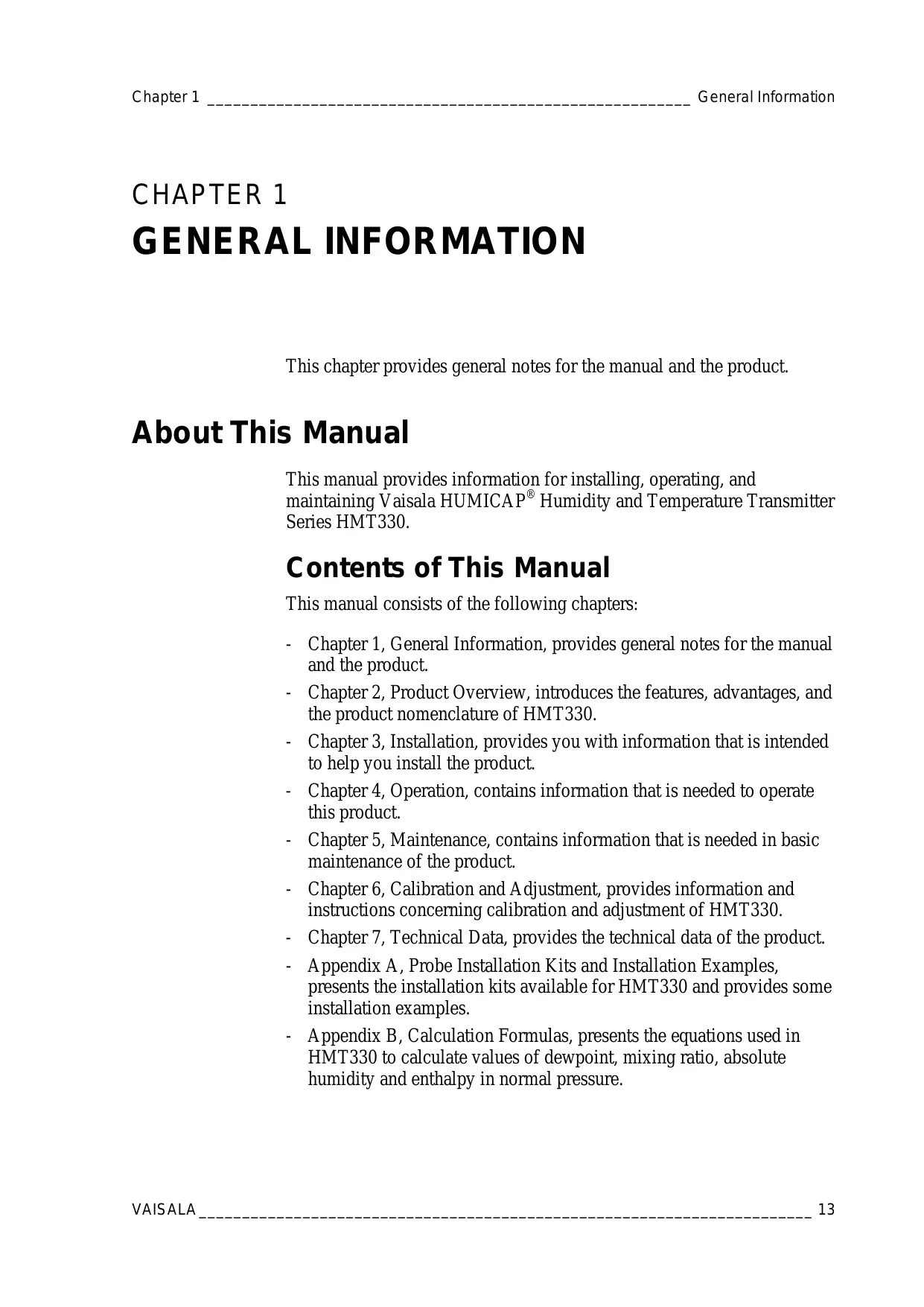

| Product type | Humidity and temperature sensor |
| Brand | VAISALA |
| Model | HMT330 |
| Dimensions (L x W x H) | 130 x 70 x 30 mm |
| Weight | Approximately 200 g |
| Power supply | 24 VDC (external power supply module) |
| Humidity measurement range | 0 to 100 % RH |
| Temperature measurement range | -40 to +60 °C |
| Display | Backlit digital screen |
| Outputs | Analog (0-10 V, 4-20 mA) and relay |
| Main functions | RH/T measurement, display, calibration, alarms |
| User interface | Menu via capacitive keys |
| Maintenance and cleaning | Clean with a soft dry cloth, do not use solvents |
| Safety | Disconnect power before any intervention. Connection by qualified electrician. |
| Spare parts | HUMICAP® sensor, display module, connection terminal block |
| Repairability | Repair by authorized technician only |
| Standards | CE, Low Voltage (2006/95/EC), NMB-003 Canada |
| Warranty | 2 years parts and labor |
Frequently Asked Questions - HMT330 VAISALA
User questions about HMT330 VAISALA
0 question about this device. Answer the ones you know or ask your own.
Ask a new question about this device
Download the instructions for your Humidity and Temperature Sensors in PDF format for free! Find your manual HMT330 - VAISALA and take your electronic device back in hand. On this page are published all the documents necessary for the use of your device. HMT330 by VAISALA.
USER MANUAL HMT330 VAISALA
Vaisala HUMICAP® Humidity and Temperature Transmitter Series HMT330
PUBLISHED BY
Vaisala Oyj
Phone (int.): +358 9 8949 1
P.O.Box 26
Fax: +358 9 8949 2227
FI-00421 Helsinki
Finland
Visit our Internet pages at http://www.vaisala.com/
© Vaisala 2009
No part of this manual may be reproduced in any form or by any means, electronic or mechanical (including photocopying), nor may its contents be communicated to a third party without prior written permission of the copyright holder.
The contents are subject to change without prior notice.
Please observe that this manual does not create any legally binding obligations for Vaisala towards the customer or end user. All legally binding commitments and agreements are included exclusively in the applicable supply contract or Conditions of Sale.
C E
Table of Contents
CHAPTER 1
GENERAL INFORMATION 13
About This Manual 13
Contents of This Manual 13
Version Information 14
General Safety Considerations 14
Feedback. 15
Product Related Safety Precautions 15
ESD Protection. 15
Recycling 16
Regulatory Compliances 16
DNV Type Approval 16
Transmitters with LAN or WLAN Interface 17
Transmitters with WLAN Interface 17
Patent Notice 18
Trademarks 18
License Agreement 18
Warranty 18
CHAPTER 2
PRODUCT OVERVIEW 19
Introduction to HMT330 19
Basic Features and Options 20
Structure of the Transmitter 21
Probe Options 23
Warmed Probe HMT337 25
CHAPTER 3
INSTALLATION 27
Mounting the Housing 27
Standard Mounting without Mounting Plate 27
Wall Mounting with Wall Mounting Kit 28
Mounting with DIN Rail Installation Kit 30
Pole Installation with Installation Kit for Pole or Pipeline .... 30
Mounting Rain Shield with Installation Kit 32
Panel Mounting Frame 33
Wiring 34
Cable Bushings 34
Grounding the Cables 35
Grounding the Transmitter Housing 36
Signal and Power Supply Wiring 37
Connections to a 24 VAC Power Supply 38
Probe Mounting 40
General Instructions for Probes with a Cable 41
HMT333 for Ducts and Tight Spaces 43
HMT334 for High Pressure and Vacuum Applications......43
HMT335 for High Temperatures. 45
HMT337 for High Humidity Applications 46
Temperature Probe (Optional) 46
HMT338 for Pressurized Pipelines 46
Tightening the Clasp Nut. 48
Optional Modules 49
Installation 50
Warnings 50
Power Supply Module 49
Galvanic Isolation for Output 53
Third Analog Output 53
Installation and Wiring 54
Relays. 55
Installation and Wiring 55
Selecting the Activation State of the Relay 55
RS-422/485 Interface 57
Installation and Wiring 57
LAN Interface. 59
WLAN Interface 60
Attaching the WLAN Antenna 61
Data Logger Module 62
8-Pin Connector 64
CHAPTER 4
OPERATION 65
Getting Started 65
Display/Keypad (Optional) 65
Basic Display 65
Graphic History 66
Menu and Navigation 68
Changing the Language 69
Rounding Setting 69
Display Backlight Setting 69
Display Contrast Setting 70
Keypad Lock (Key guard) 70
Menu PIN Lock. 70
Factory Settings 71
Display Alarms. 71
Configuring a Display Alarm. 72
MI70 Link Program for Data Handling 73
Serial Line Communication 73
User Port Connection 74
Service Port Connection. 75
Connection Cables 75
Installing the Driver for the USB Cable 75
Using the Service Port. 76
LAN Communication 77
Using Display/Keypad 78
Using Serial Line 79
Using Display/Keypad 80
Using Serial Line 82
IP Configuration 77
Wireless LAN Configuration 80
Telnet Settings. 83
Web Configuration for LAN and WLAN 83
Terminal Program Settings 84
Opening a Serial/USB connection 84
Opening a Telnet session (LAN/WLAN) 85
List of Serial Commands 87
Getting Measurement Message from Serial Line. 89
Starting Continuous Outputting 89
R. 89
Stopping Continuous Outputting 90
S. 90
Outputting Reading Once 90
SEND 90
SEND D 90
Formatting Serial Line Message 91
FTIME and FDATE 91
FST 91
General Settings 92
Changing Quantities and Units 92
Using Display/Keypad 92
Using Serial Line 93
FORM 93
UNIT 95
Pressure Compensation Setting 95
Using Display/Keypad 95
Using Serial Line 96
PRES and XPRES 96
Date and Time. 97
Using Display/Keypad 97
Using Serial Line 97
User Port Serial Settings. 98
Using Display/Keypad 98
Using Serial Line 99
SERI 99
SMODE 99
INTV 100
ECHO 100
Data Filtering 101
FILT 101
Device Information 101
? 102
HELP 103
ERRS 103
VERS 103
Resetting Transmitter Using Serial Line 103
RESET 103
Locking Menu/Keypad by Using Serial Line 104
LOCK 104
Data Recording. 104
Selecting Data Recording Quantities 105
DSEL 105
View Recorded Data 105
DIR 105
PLAY 107
Deleting the Recorded Files. 108
UNDELETE 108
Analog Output Settings 108
Changing Output Mode and Range 108
Analog Output Quantities 110
AMODE/ASEL 111
Analog Output Tests 112
ITEST 112
Analog Output Fault Indication Setting 113
AERR. 113
Operation of Relays 114
Quantity for Relay Output 114
Measurement-Based Relay Output Modes 114
Relay Setpoints 114
Hysteresis 115
Relay Indicating Transmitter Error Status 115
Enabling/Disabling Relays. 116
Setting Relay Outputs 117
RSEL 118
Testing Operation of Relays 119
RTEST 119
Operation of the RS-485 Module 120
Networking Commands 120
SDELAY 120
SERI 121
ECHO 121
SMODE 121
INTV 122
ADDR 122
SEND 123
OPEN 123
CLOSE 123
Sensor Functions 124
Chemical Purge (Optional) 124
Automatic Chemical Purge (Interval Purge) 125
Manual Chemical Purge 125
Chemical Purge in Power Up 125
Starting and Configuring Chemical Purge 126
Using Buttons on Motherboard 126
Using Display/Keypad (Optional) 126
Using Serial Line 127
PURGE 127
PUR. 127
Sensor Heating 128
Setting Humidity Sensor Heating 128
XHEAT 128
CHAPTER 5
MAINTENANCE. 131
Periodic Maintenance. 131
Cleaning 131
Changing the Probe Filter 131
Changing the Sensor 132
Error States 133
Technical Support 135
Return Instructions 135
Vaisala Service Centers 136
CHAPTER 6
CALIBRATION AND ADJUSTMENT 137
Opening and Closing the Adjustment Mode 137
Relative Humidity Adjustment 139
UsingPush-Buttons 139
Using Display/Keypad 140
Using Serial Line 141
CRH 141
Relative Humidity Adjustment after Sensor Change. 142
Using Display/Keypad 142
Using Serial Line 142
FCRH 142
Temperature Adjustment 143
Using Display/Keypad 143
Using Serial Line 143
Analog Output Adjustment 145
Using Display/Keypad 145
Using Serial Line 145
ACAL 145
Feeding Adjustment Information 146
Using Display/Keypad 146
Using Serial Line 146
CTEXT 146
CDATE 146
CHAPTER 7
TECHNICAL DATA 147
Specifications 147
Performance 147
Relative Humidity 147
Temperature (+ Operating Pressure Ranges) 148
Optional Temperature Probe 148
Calculated Variables 149
Accuracies of Calculated Variables 149
Accuracy of Dewpoint Temperature ^ C 149
Accuracy of Mixing Ratio g/kg (Ambient Pressure
1013 mbar) 149
Accuracy of Wet Bulb Temperature ^ C 150
Accuracy of Absolute Humidity g / m^3 150
Dewpoint Temperature (HMT337 Warmed Probe Option)151
Operating Environment 151
Inputs and Outputs 152
Mechanics 152
Transmitter Weight. 153
Technical Specifications of Optional Modules 153
Power Supply Module 153
Analog Output Module 153
Relay Module 154
RS-485 Module 154
LAN Interface Module 154
WLAN Interface Module 154
Data Logger Module 155
Options and Accessories 155
Dimensions (mm/inch) 157
HMT331 159
HMT333 160
HMT334 160
HMT335 161
HMT337 161
HMT338 162
Temperature Probe 162
APPENDIX A
PROBE INSTALLATION KITS AND INSTALLATION EXAMPLES 163
Duct Installation Kits (for HMT333/337/335) 163
Duct Installation Kit for Temperature Probe (for HMT337) 164
Pressure Tight Swagelok Installation Kits (for HMT337)..165
RH Probe Installation. 165
Temperature Probe Installation 165
Examples of Vapor Tight Installations with Cable Gland.166
RH-Probe Installations (for HMT333/337) 166
T- Probe Installations (HMT337) 167
Example of Climate Chamber Installation 168
Example of Installation Through Roof 169
Ball Valve Installation Kit for HMT338 170
Meteorological Installation Kit (for HMT337) 172
APPENDIX B
CALCULATION FORMULAS 173
List of Figures
Figure 1 Transmitter Body. 21
Figure 2 Inside the Transmitter. 22
Figure 3 HMT331 Fixed Probe 23
Figure 4 HMT331 Short Cable Probe. 23
Figure 5 Probe Options 24
Figure 6 Standard Mounting. 27
Figure 7 Mounting with Wall Mounting Kit. 28
Figure 8 Dimensions of the Plastic Mounting Plate (mm/inch) 28
Figure 9 Dimensions of the Probe Holder Plate (mm/inch) 29
Figure 10 Mounting with the DIN Rail Installation Kit 30
Figure 11 Vertical Pole 30
Figure 12 Horizontal Pole. 31
Figure 13 Mounting with Metal Wall Mounting Plate. 31
Figure 14 Dimensions of the Metal Mounting Plate (mm/inch) 32
Figure 15 Mounting the Rain Shield with the Installation Kit. 32
Figure 16 Panel Mounting Frame 33
Figure 17 Panel Mounting Dimensions (mm/inch) 34
Figure 18 Cable Bushings 34
Figure 19 Grounding the Screen of Electrical Cable. 35
Figure 20 Screw Terminal Block on Motherboard 37
Figure 21 Connections to 24 VAC Power Supply. 39
Figure 22 Measurement Error at 100% RH 40
Figure 23 Horizontal Mounting of Probe. 41
Figure 24 Vertical Mounting of Probe 42
Figure 25 HMT344 Probe 44
Figure 26 Tightening the Nut. 44
Figure 27 Cleaning of Tightening Cone. 45
Figure 28 HMT338 Probe 47
Figure 29 Sealing of Fitting Body into Process 47
Figure 30 Tightening the Clasp Nut. 48
Figure 31 Power Supply Module 49
Figure 32 Galvanic Output Isolation Module 53
Figure 33 Third Analog Output 53
Figure 34 Third analog output selection. 54
Figure 35 Relay Module 56
Figure 36 RS-485 Module 57
Figure 37 4-Wire RS-485 Bus 58
Figure 38 LAN Interface Module. 60
Figure 39 WLAN Interface Module 61
Figure 40 Data Logger Module. 63
Figure 41 Wiring of Optional 8-Pin Connector. 64
Figure 42 Basic Display. 66
Figure 43 Graphical Display 66
Figure 44 Graphical Display with Data Logger. 67
Figure 45 Main Menus. 68
Figure 46 Display Alarm Active 71
Figure 47 Display Alarms 72
Figure 48 Modifying an Alarm Limit. 72
Figure 49 Service Port Connector and User Port Terminal on Mother Board
Figure 50 Connection Example Between PC Serial Port and User Port..74
Figure 51 Network Interface Menu 78
Figure 52 IP Configuration Menu. 78
Figure 53 Wireless LAN Settings. 81
Figure 54 Entering Network SSID. 81
Figure 55 Selecting the Wireless Network Type. 81
Figure 56 Web Configuration Interface for WLAN. 84
Figure 57 Opening a Serial Connection. 85
Figure 58 Opening a Telnet Connection. 86
Figure 59 Device Information on Display. 102
Figure 60 Current/Voltage Switches of Output Modules 109
Figure 61 Measurement-Based Relay Output Modes 114
Figure 62 FAULT/ONLINE STATUS Relay Output Modes. 116
Figure 63 Relay Indicators on Display. 117
Figure 64 Decrease of Sensor Gain 124
Figure 65 Purge Buttons on Motherboard 126
Figure 66 Chemical Purge Settings. 126
Figure 67 Performing Chemical Purge 127
Figure 68 Changing the Sensor. 132
Figure 69 Error Indicator and Error Message 133
Figure 70 Adjustment and Purge Buttons. 138
Figure 71 Adjustment Menu. 138
Figure 72 Selecting Point 1 Reference Type. 140
Figure 73 Accuracy over Temperature Range. 148
Figure 74 Accuracy in Dewpoint Measurement. 151
Figure 75 Transmitter Body Dimensions 157
Figure 76 WLAN Antenna Dimensions 158
Figure 77 HMT331 Fixed Probe Dimensions. 159
Figure 78 HMT331 Short Cable Probe Dimensions 159
Figure 79 HMT333 Probe Dimensions 160
Figure 80 HMT334 Probe Dimensions 160
Figure 81 HMT335 Probe Dimensions 161
Figure 82 HMT337 Probe Dimensions 161
Figure 83 HMT338 Probe Dimensions 162
Figure 84 Optional Temperature Probe Dimensions 162
Figure 85 Duct Mounting Installation Kit 163
Figure 86 Duct Mounting Installation Kit for T-Probe. 164
Figure 87 Swagelok Installation Kit for RH-probe. 165
Figure 88 Swagelok Installation Kit for T-Probe 165
Figure 89 Cable Installation with Cable Gland 166
Figure 90 Probe Installation with Cable Gland 166
Figure 91 Vapor Tight Installation. 167
Figure 92 Wall Mounting Installation. 167
Figure 93 Climate Chamber Installation (not Available from Vaisala) ....168
Figure 94 Example of Installation through Roof 169
Figure 95 Installing the HMT338 Probe Through a Ball Valve Assembly 170
Figure 96 Meteorological Installation Kit for Outdoor Installation 172
List of Tables
Table 1 Manual Revisions 14
Table 2 Application, Location Classes.. 16
Table 3 Quantities Measured by HMT330 19
Table 4 Optional Quantities Measured by HMT330. 19
Table 5 HMT338 Probe Dimensions 47
Table 6 Connecting the Twisted Pair Wires to the Screw Terminals....58
Table 7 4-Wire (Switch 3: On) 59
Table 8 2-Wire (Switch 3: Off) 59
Table 9 Observation Periods and Resolution 62
Table 10 Wiring of 8-Pin Connector 64
Table 11 Periods for Trend and Max/Min Calculations 67
Table 12 Graph Information Messages in Cursor Mode 68
Table 13 Default Serial Communication Settings for the User Port. 74
Table 14 Communication Settings for the Service Port 76
Table 15 IP Settings for the LAN and WLAN Interfaces 77
Table 16 Wireless LAN Settings. 80
Table 17 Measurement Commands.. 87
Table 18 Formatting Commands.. 87
Table 19 Data Recording Commands. 88
Table 20 Chemical Purge Commands 88
Table 21 Calibration and Adjustment Commands.. 88
Table 22 Setting and Testing the Analog Outputs 88
Table 23 Setting and Testing the Relays 88
Table 24 Other Commands 89
Table 25 FORM Command Modifiers. 94
Table 26 Multiplication Factors. 96
Table 27 Selection of Output Modes. 100
Table 28 Filtering Levels 101
Table 29 Error Messages 134
Table 30 Indicator Led Functions. 138
Table 31 Calculated Variables (Typical Ranges) 149
Table 32 Transmitter Weight (in kg/lb) 153
This page intentionally left blank.
CHAPTER 1
GENERAL INFORMATION
This chapter provides general notes for the manual and the product.
About This Manual
This manual provides information for installing, operating, and maintaining Vaisala HUMICAP® Humidity and Temperature Transmitter Series HMT330.
Contents of This Manual
This manual consists of the following chapters:
- Chapter 1, General Information, provides general notes for the manual and the product.
- Chapter 2, Product Overview, introduces the features, advantages, and the product nomenclature of HMT330.
- Chapter 3, Installation, provides you with information that is intended to help you install the product.
- Chapter 4, Operation, contains information that is needed to operate this product.
- Chapter 5, Maintenance, contains information that is needed in basic maintenance of the product.
- Chapter 6, Calibration and Adjustment, provides information and instructions concerning calibration and adjustment of HMT330.
- Chapter 7, Technical Data, provides the technical data of the product.
- Appendix A, Probe Installation Kits and Installation Examples, presents the installation kits available for HMT330 and provides some installation examples.
- Appendix B, Calculation Formulas, presents the equations used in HMT330 to calculate values of dewpoint, mixing ratio, absolute humidity and enthalpy in normal pressure.
Version Information
Table 1 Manual Revisions
| Manual Code | Description |
| M210566EN-A | September 2004 - First release. |
| M210566EN-B | November 2004 |
| M210566EN-C | September 2005 |
| M210566EN-D | November 2006 |
| M210566EN-E | June 2007 - New options added: Data logger module, USB-RJ45 cable, new sensors HUMICAP® 180R and HUMICAP® 180RC. Support for Chinese language. |
| M210566EN-F | May 2008 - New options added: LAN Interface, WLAN Interface. Display Alarm feature added. |
| M210566EN-G | June 2009 - Added PuTTY terminal application instructions, revised description of the MI70 Link software. Removed instructions for HyperTerminal. Removed Humicap 180L2 sensor option. |
| M210566EN-H | November 2009 - This manual. Added HMT331 short cable probe. Added DNV type approval in the Regulatory Compliances section. |
General Safety Considerations
Throughout the manual, important safety considerations are highlighted as follows:
WARNING
Warning alerts you to a serious hazard. If you do not read and follow instructions very carefully at this point, there is a risk of injury or even death.
CAUTION
Caution warns you of a potential hazard. If you do not read and follow instructions carefully at this point, the product could be damaged or important data could be lost.
NOTE
Note highlights important information on using the product.
Feedback
Vaisala Customer Documentation Team welcomes your comments and suggestions on the quality and usefulness of this publication. If you find errors or have other suggestions for improvement, please indicate the chapter, section, and page number. You can send comments to us by e-mail: manuals@vaisala.com
Product Related Safety Precautions
The Vaisala HUMICAP® Humidity and Temperature Transmitter Series HMT330 delivered to you has been tested for safety and approved as shipped from the factory. Note the following precautions:
WARNING
Ground the product, and verify outdoor installation grounding periodically to minimize shock hazard.
CAUTION
Do not modify the unit. Improper modification can damage the product, lead to malfunction, or make the product noncompliant with applicable legislation.
ESD Protection
Electrostatic Discharge (ESD) can cause immediate or latent damage to electronic circuits. Vaisala products are adequately protected against ESD for their intended use. However, it is possible to damage the product by delivering electrostatic discharges when touching, removing, or inserting any objects inside the equipment housing.
To make sure you are not delivering high static voltages yourself:
- Handle ESD sensitive components on a properly grounded and protected ESD workbench. When this is not possible, ground yourself to the equipment chassis before touching the boards. Ground yourself with a wrist strap and a resistive connection cord. When neither of the above is possible, touch a conductive part of the equipment chassis with your other hand before touching the boards.
- Always hold the boards by the edges and avoid touching the component contacts.
Recycling

Recycle all applicable material.

Dispose of batteries and the unit according to statutory regulations. Do not dispose of with regular household refuse.
Regulatory Compliances
DNV Type Approval
The Vaisala HUMICAP® Humidity and Temperature Transmitter Series HMT330 is found to comply with Det Norske Veritas' Rules for Classification of Ships, High Speed & Light Craft and Det Norske Veritas' Offshore standards.
Applicable tests carried out according to Standard for Certification No. 2.4, April 2006.
Table 2 Application, Location Classes
| Type | HMT330 |
| Temperature | B |
| Humidity | B |
| Vibration | A |
| EMC | B |
| Enclosure | B/IP65 |

DNV
TYPE APPROVED PRODUCT
CERTIFICATE NO.: A-11440
Transmitters with LAN or WLAN Interface
This equipment has been tested and found to comply with the limits for a Class B digital device, pursuant to Part 15 of the FCC Rules. These limits are designed to provide reasonable protection against harmful interference in a residential installation. Operation is subject to the following two conditions: (1) this device may not cause interference, and (2) this device must accept any interference, including interference that may cause undesired operation of the device.
This equipment generates, uses and can radiate radio frequency energy and, if not installed and used in accordance with the instructions, may cause harmful interference to radio communications. However, there is no guarantee that interference will not occur in a particular installation. If this equipment does cause harmful interference to radio or television reception, which can be determined by turning the equipment off and on, the user is encouraged to try to correct the interference by one or more of the following measures:
- Reorient or relocate the receiving antenna.
- Increase the separation between the equipment and receiver.
- Connect the equipment into an outlet on a circuit different from that to which the receiver is connected.
- Consult the dealer or an experienced radio/TV technician for help.
Transmitters with WLAN Interface
This equipment has been designed to operate with a 2 dBi half-wave antenna. Antennas with a gain greater than 2 dB are strictly prohibited for use with this device. The required antenna impedance is 50 ohms.
To reduce potential radio interference to other users, the antenna type and its gain should be so chosen that the equivalent isotropically radiated power (e.i.r.p.) is not more than that permitted for successful communication.
This Class [B] digital apparatus complies with Canadian ICES-003.
The Vaisala HUMICAP® Humidity and Temperature Transmitter Series HMT330 is protected by, for example, the following patents and their corresponding national rights:
Finnish patents 98861 and 99164, French patents 6650303 and 9504397, German patents 69418174 and 19513274, Japanese patents 3585973 and 2801156, UK patents 0665303 and 2288465, U.S. patent 5607564.
Trademarks
HUMICAP® is a registered trademark of Vaisala Oyj.
Windows® is a registered trademark of Microsoft Corporation in the United States and/or other countries.
License Agreement
All rights to any software are held by Vaisala or third parties. The customer is allowed to use the software only to the extent that is provided by the applicable supply contract or Software License Agreement.
Warranty
For certain products Vaisala normally gives a limited one-year warranty. Please observe that any such warranty may not be valid in case of damage due to normal wear and tear, exceptional operating conditions, negligent handling or installation, or unauthorized modifications. Please see the applicable supply contract or Conditions of Sale for details of the warranty for each product.
CHAPTER 2
PRODUCT OVERVIEW
This chapter introduces the features, advantages, and the product nomenclature of the Vaisala HUMICAP® Humidity and Temperature Transmitter Series HMT330.
Introduction to HMT330
The HMT330 transmitter provides reliable humidity measurement in a wide range of applications. Analog outputs can be chosen between current and voltage signals. Alternatively, digital outputs RS-232 (standard) or RS-422/485 (optional) can be selected.
The quantities measured and calculated by HMT330 are presented in Table 3 below. The quantities available as an option are presented in Table 4 below.
Table 3 Quantities Measured by HMT330
| Quantity | Abbreviation | Metric Unit | Non Metric Unit |
| Relative humidity (RH) | RH | %RH | %RH |
| Temperature (T) | T | °C | °F |
Table 4 Optional Quantities Measured by HMT330
| Quantity | Abbreviation | Metric Unit | Non Metric Unit |
| Dewpoint / Frostpoint Temperature (Td/f) | TDF | °C | °F |
| Dewpoint Temperature (Td) | TD | °C | °F |
| Absolute humidity (a) | A | g/m3 | gr/ft3 |
| Mixing ratio (x) | X | g/kg | gr/lb |
| Wetbulb temperature (Tw) | TW | °C | °F |
| Humid air volume/ dry air volume (by volume or by weight) (H2O) | H2O | ppmv/ppmw | ppmv/ppmw |
| Water vapor pressure (Pw) | PW | hPa | lb/in2 |
| Water vapor saturation pressure (Pws) | PWS | hPa | lb/in2 |
| Enthalpy (h) | H | kJ/kg | Btu/lb |
| Difference of T and Td/f (ΔT) | DT | °C | °F |
Basic Features and Options
- Several probes for various applications
- User friendly display
- Calculated output quantities available
- Different probe mounting kits, sensor protection options and probe cable lengths
- Transmitter mounting kits for multiple installation purposes
- Chemical purge for applications where interfering chemicals in the measuring environment pose a risk
- Warmed probe and sensor heating for high humidity conditions (HMT337)
- Additional temperature sensor (HMT337)
- USB connectivity for service connections via the optional USB-RJ45 cable
-
Optional modules:
-
isolated power supply
- power supply module
- RS-422/485-module
- LAN and WLAN interfaces
- data logger module with real time clock
- additional analog output module
-relay module
Structure of the Transmitter

0604-005
Figure 1 Transmitter Body
The numbers refer to Figure 1:
1 = Signal + powering cable gland
2 = Cable gland for optional module, or WLAN antenna connector
3 = Cable gland for optional module
4 Cover screw (4 pcs)
5 = Display with keypad (optional)
6 Cover LED
Figure 2 Inside the Transmitter

0508-010
The following numbers refer to Figure 2:
1 = Service port (RS-232)
2 = DIP switches for analog output settings
3 = Power supply and signal wiring screw terminals
4 = Relay, data logger, RS-422/485, LAN, or WLAN module (optional)
5 = Grounding connector
6 = Power supply module (optional)
7 = Relay, data logger, or analog output module (optional)
8 = Humidity probe cable
9 = Temperature probe cable (optional)
10 = Output isolation module (optional)
11 = Adjustment buttons (chemical purge buttons) with indicator LED
Probe Options
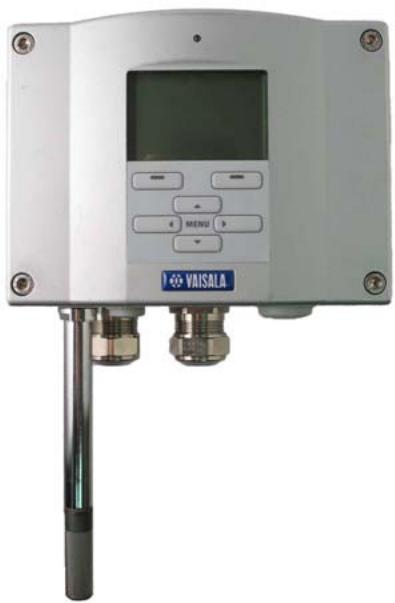
The HMT331 is intended for demanding wall-mounted applications. The standard version has a fixed probe.
Figure 3 HMT331 Fixed Probe
0911-058
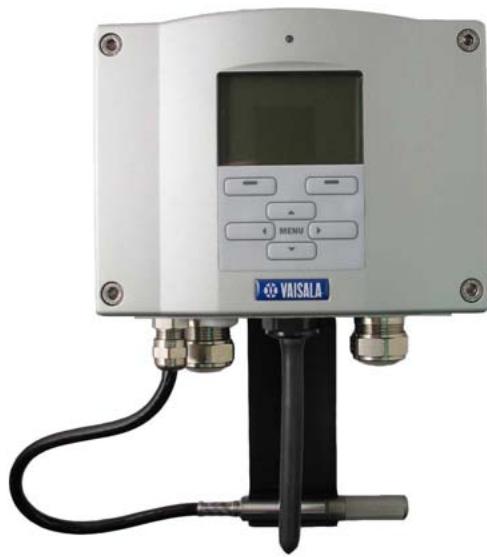
The HMT331 short cable probe is a special version for use with the WLAN module. It has the HMT333 probe on a short cable (21 cm), and a mounting plate with a probe holder.
Figure 4 HMT331 Short Cable Probe
0911-059

①

②
(3)

(4)

5
0911-066
Figure 5 Probe Options
The following numbers refer to Figure 5:
1 = HMT333 for ducts and tight spaces
2 = HMT334 for high pressure and vacuum applications (up to 100 bars)
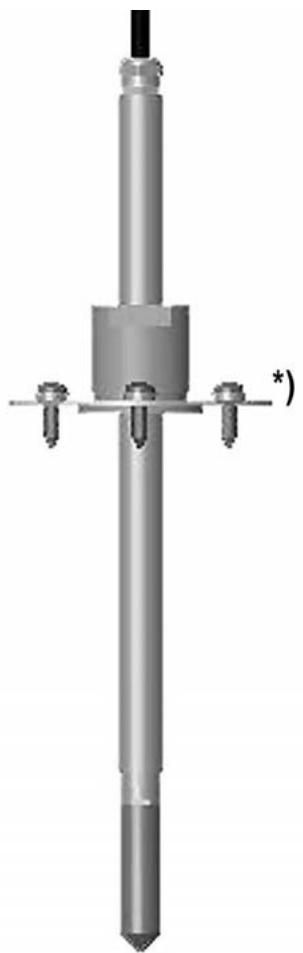
3 = HMT335 for high temperatures (up to 180^ , vapor tight) *) Flange available as an option
4 = HMT337 for high humidity applications (optional warmed and vapor tight probe)
5 = HMT338 for pressurized pipelines (up to 40 bar)
Probe cable lengths are 2m 5m and 10m
Warmed Probe HMT337
Temperature difference between the probe and external environment can cause a risk of condensation on the sensor. A wet probe cannot observe the actual humidity in the ambient air. If the condensed water is contaminated, the life span of the probe may shorten and calibration may change.
HMT337 probe shall be used in applications where condensation can occur due to high humidity and rapid humidity changes. The warmed probe is heated continuously so that its temperature is always higher than in environment. This prevents condensation on the probe. The power consumption of the warmed probe is slightly higher than other probes.
This page intentionally left blank.
CHAPTER 3
INSTALLATION
This chapter provides you with information that is intended to help you install the product.
Mounting the Housing
The housing can be mounted either without the mounting plate or with optional mounting plates.
Standard Mounting without Mounting Plate
Mount the housing by attaching the transmitter to a wall with 4 screws, for example M6 (not provided).
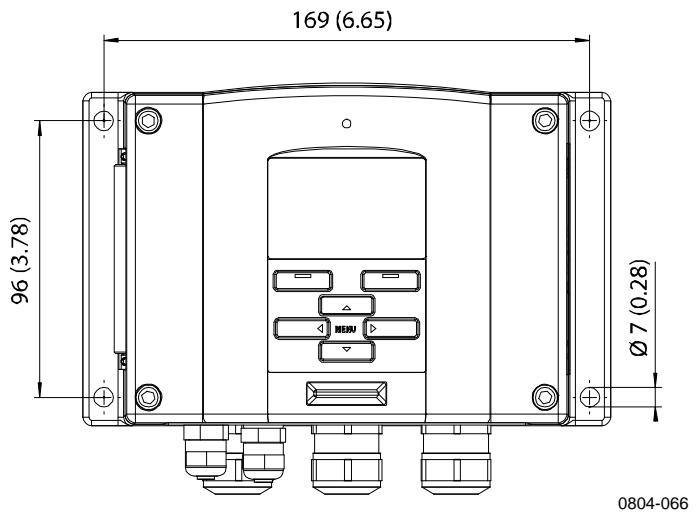
Figure 6 Standard Mounting
Wall Mounting with Wall Mounting Kit
When mounting with wall mounting kit the mounting plate (Vaisala order code 214829) can be installed directly on wall or onto a standard wall box (also US junction box). When wiring through back wall, remove the plastic plug from the wiring hole in the transmitter before mounting.
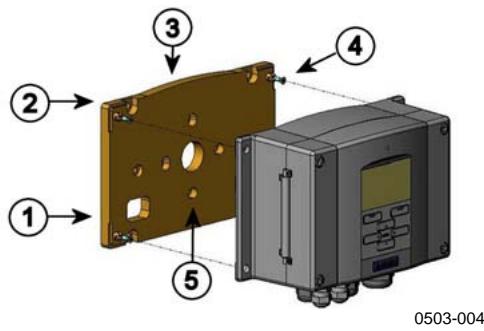
Figure 7 Mounting with Wall Mounting Kit
The following numbers refer to Figure 7:
1 = Plastic mounting plate
2 = Mount the plate to wall with 4 screws M6 (not provided)
3 = The arched side up
4 = Attach the HMT330 to the mounting plate with 4 fixing screws M3 (provided)
5 = Holes for wall/junction box mounting
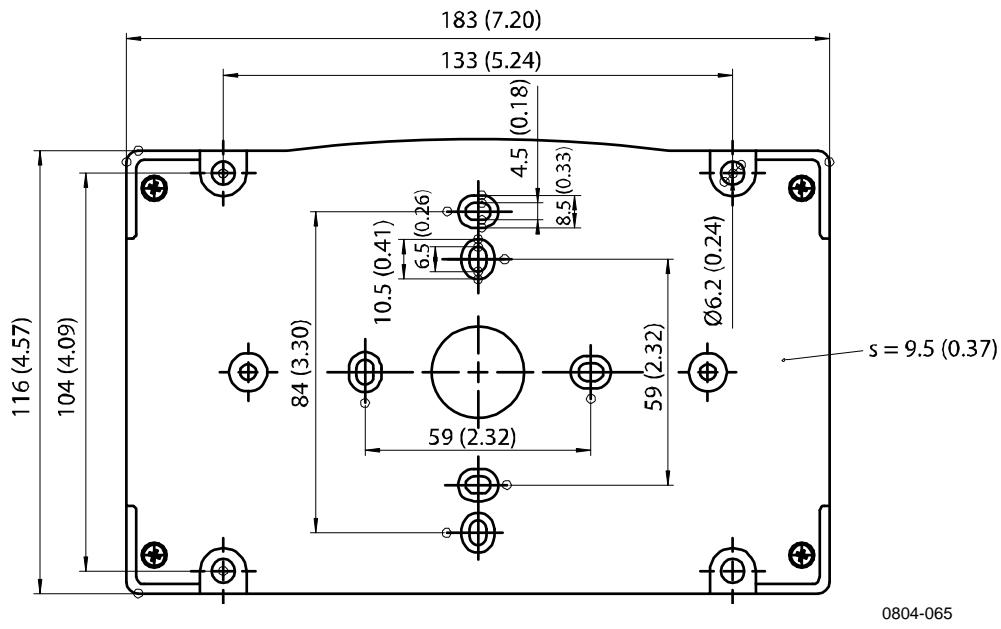
Figure 8 Dimensions of the Plastic Mounting Plate (mm/inch)
The HMT331 short cable probe is designed to be wall mounted with the probe holder plate (Vaisala order code 226252). The probe holder plate is similar to the standard mounting plate, except for the probe holder at the bottom.

Figure 9 Dimensions of the Probe Holder Plate (mm/inch)
Mounting with DIN Rail Installation Kit
DIN rail installation kit includes a wall mounting kit, 2 clip-fasteners and 2 screws M4× 10 DIN 7985 (Vaisala order code: 215094).
- Attach two spring holders to the plastic mounting plate by using the screws provided in the installation kit.
- Attach the HMT330 to the plastic mounting plate with the 4 screws provided for that purpose.
- Press the transmitter onto the DIN rail so that the clip-fasteners snap into the rail.
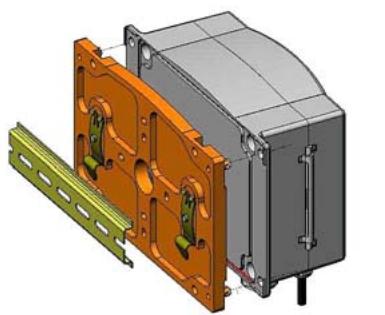
0503-002
Figure 10 Mounting with the DIN Rail Installation Kit
Pole Installation with Installation Kit for Pole or Pipeline
Installation kit for pole or pipeline (Vaisala order code: 215108) includes the metal mounting plate and 4 mounting nuts for pole mounting. When mounting, the arrow in the metal mounting plate must point upwards; see Figure 13 on page 31 below.

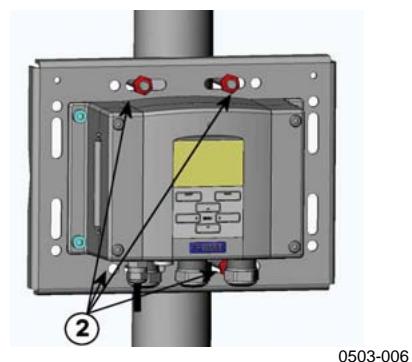
Figure 11 Vertical Pole
The following numbers refer to Figure 11:
1 = Fixing brackets (2 pcs) M8 (provided) for 30 ... 102 mm poles.
2 = Mounting nuts M8 (4 pcs)

Figure 12 Horizontal Pole
The following number refers to Figure 12:
1 = Mounting nuts M8 (4 pcs)
Metal mounting plate is included in rain shield with installation kit and installation kit for pole or pipeline.
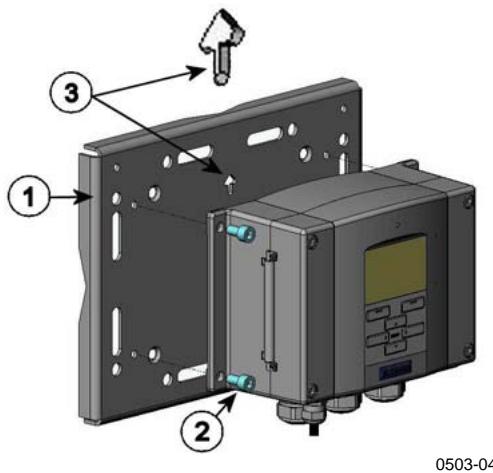
Figure 13 Mounting with Metal Wall Mounting Plate
The following numbers refer to Figure 13:
1 = Mount the plate to wall with 4 screws M8 (not provided)
2 = Attach the HMT330 to the mounting plate with 4 fixing screws M6 (provided)
3 = Note the position of the arrow when mounting. This side must be up when mounting.
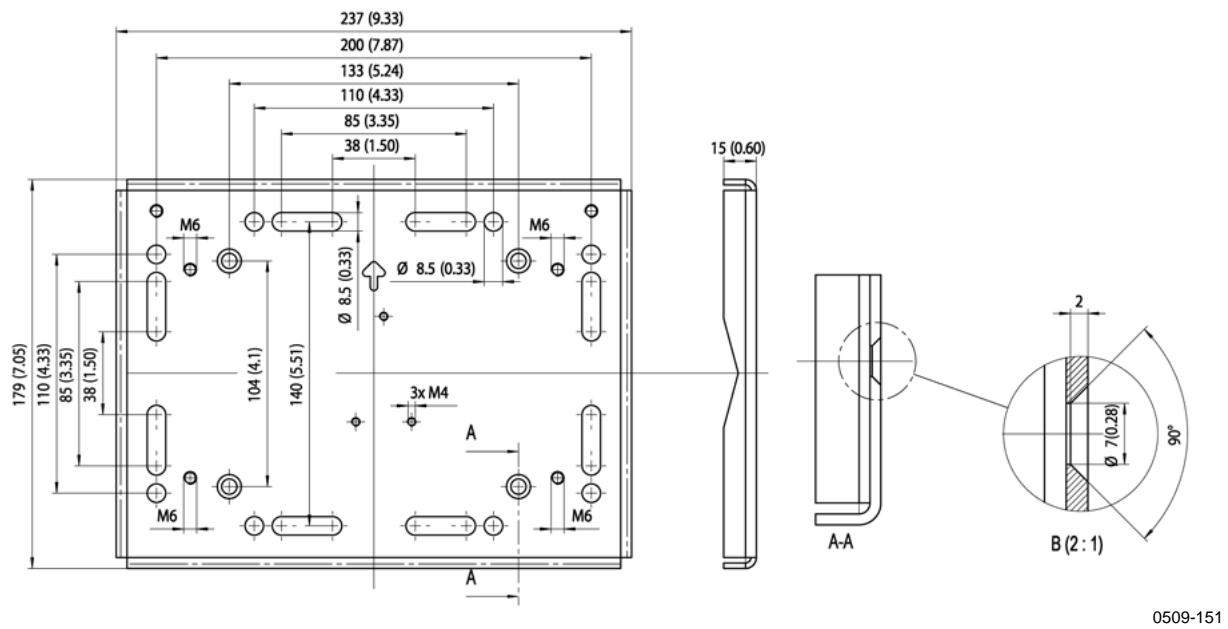
Figure 14 Dimensions of the Metal Mounting Plate (mm/inch)
Mounting Rain Shield with Installation Kit

Figure 15 Mounting the Rain Shield with the Installation Kit
The following numbers refer to Figure 15:
1 = Assemble the rain shield with the installation kit (Vaisala order code: 215109) to the metal mounting plate with 2 (M6) mounting screws (provided).
2 = Assemble the mounting plate with rain shield with installation kit to the wall or to the pole (see pole installation).
3 = Assemble the HMT330 to the mounting plate with 4 fixing screws (provided).
Panel Mounting Frame
To enable a neat and dirt free embedded installation of the transmitter, a panel mounting frame is available as an option (Vaisala order code: 216038). The frame is a thin, flexible plastic frame for the transmitter, with adhesive tape on one side.
The frame is used to hide any rough edges of the installation hole, and provide a more finished look. Note that the panel mounting frame is not intended to bear the weight of the transmitter, and does not include any mounting supports.
Use the panel mounting frame as follows:
- Use the frame as a template to mark the required size for the installation hole in the panel.
- Cut the hole in the panel.
- Mount the transmitter through the panel with suitable supports.
- Remove the paper protecting the adhesive tape on the frame, and attach the frame around the transmitter. Refer to Figure 16 below.
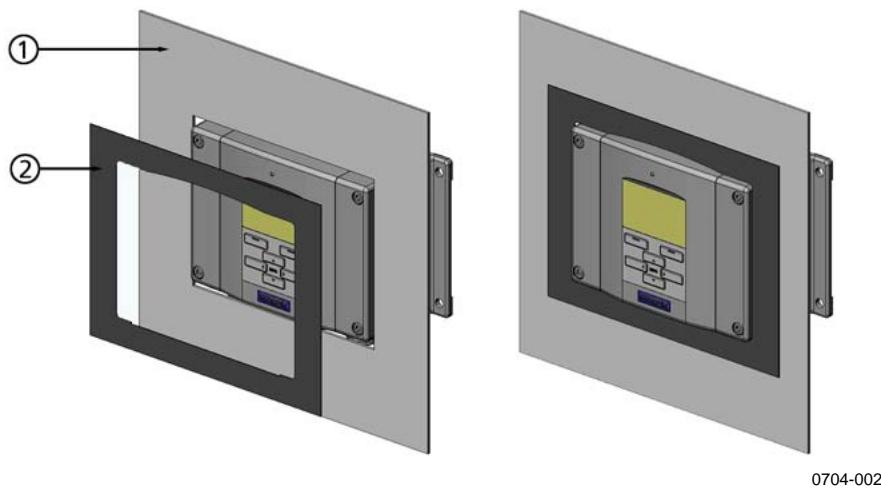
Figure 16 Panel Mounting Frame
The following numbers refer to Figure 16:
1 = Panel (not included)
2 = Panel mounting frame

Figure 17 Panel Mounting Dimensions (mm/inch)
Wiring
Cable Bushings
A single electrical cable with screen and three to ten wires is recommended for power and analog/serial connections. The cable diameter should be 8 ... 11 mm. The number of cable bushings depends on the transmitter options. See the following recommendations for the cable bushings:

Figure 18 Cable Bushings
The following numbers refer to Figure 18:
1 = Cable for signal/powering 8 11mm
2 = Cable for optional module 8 11mm
3 = Cable for optional power supply module 8 11mm
NOTE
When there is high electric noise level (for example, near a powerful electric motor) in the operating environment it is recommended to use shielded cable or take care that the signal cables are separated from other cables.
Grounding the Cables
Ground the screen of the electrical cable properly to achieve the best possible EMC performance.

Fig. 1
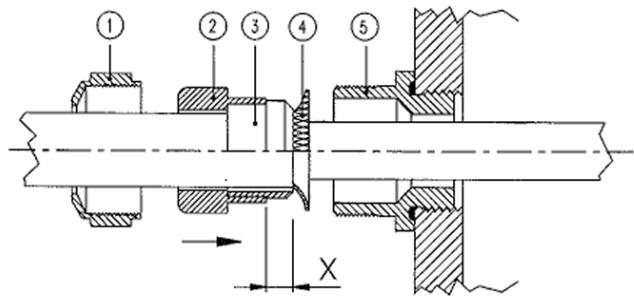
Fig. 2
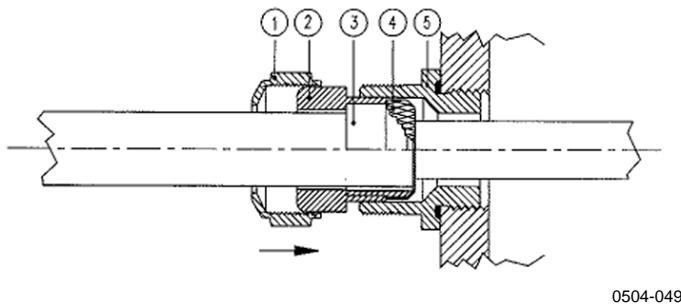
Fig. 3
Figure 19 Grounding the Screen of Electrical Cable
- Cut back outer sheath to desired length.
- Cut back screen braiding or screen foil to dimension X (see figure 3).
- Push the domed cap nut (item 1) and the seal insert with contact socket of the gland (item 2 + 3 ) onto the cable as shown in the diagram.
- Bend over the screen braiding or screen foil by about 90^ (item 4).
- Push the seal insert with the contact socket of the gland (item 2+3) up to the screen braiding or screen foil.
- Mount lower part (item 5) on the housing.
- Push the seal with the contact socket of the gland and (item 2+3) flush into the lower part (item 5).
- Attach the domed cap nut (item 1) onto the lower part (item 5).
Grounding the Transmitter Housing
In case you need to ground the transmitter housing, the grounding connector is found inside the housing, see Figure 2 on page 22. Note that the probe is connected to the same potential as the housing. Make sure that different groundings are made to the same potential. Otherwise harmful ground currents may be generated.
If it is needed to have galvanic isolation of the power supply line from the output signals, the HMT330 can be ordered with an optional output isolation module. This module prevents harmful grounding loops.
Signal and Power Supply Wiring
When connecting the transmitter with 8-pin connector, see section 8-Pin Connector on page 64. When wiring the power supply module, see section Power Supply Module on page 49.
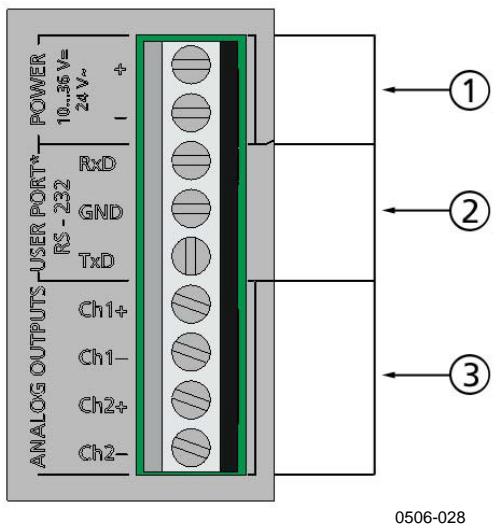
Figure 20 Screw Terminal Block on Motherboard
The following numbers refer to Figure 20:
1 = Power supply terminals 10 ... 35 VDC, 24 VAC
2 = User port (RS-232 terminals)
3 = Analog signal terminals
WARNING
Make sure that you connect only de-energized wires.
- Unfasten the four cover screws and open the transmitter cover.
- Insert the power supply wires and signal wires through the cable bushing in the bottom of the transmitter; see the grounding instructions in the previous sections.
- Connect the analog output cables to terminals: Ch1+, Ch1-, Ch2+, Ch2-. Connect the RS-232 user port cables to terminals RxD, GND and TxD. For more information about the RS-232 connection refer to section Serial Line Communication on page 73.
-
When wiring the optional modules, see the corresponding section for instructions:
-
RS-422/485 Interface on page 57
- Relays on page 55
Third Analog Output on page 53 - LAN Interface on page 59
-
WLAN Interface on page 60
-
Connect the power supply wires to the connectors: POWER 10 ... 35V+ 24V~ (+) and (-) terminals. If you are using 24 VAC power supply, see the note below before connecting the supply wires.
- Turn on the power. The indicator led on the cover lit continuously during normal operation.
- Close the cover and fasten the cover screws. The transmitter is ready for use.
Connections to a 24 VAC Power Supply
Separate floating supply for each transmitter is recommended (see the upper part of Figure 21 on page 39). If you have to connect several transmitters or other instruments to one AC supply, the phase () must always be connected to the (+) connector of each transmitter (see the lower part of Figure 21).
CAUTION 24 VAC POWER SUPPLY USE
To prevent fire and/or damage, if either 24 VAC wire is grounded or connected to a "-", "0", or "GND" terminal of any other device, you must connect the same wire on the "--" terminal also on this instrument.
No common loop - RECOMMENDED!


transmitter
Common loop formed - NOT recommended!
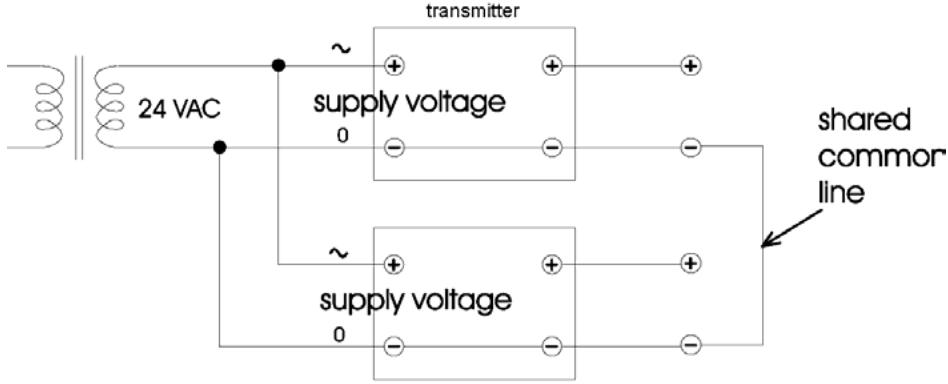
Figure 21 Connections to 24 VAC Power Supply
transmitter
0703-041
Probe Mounting
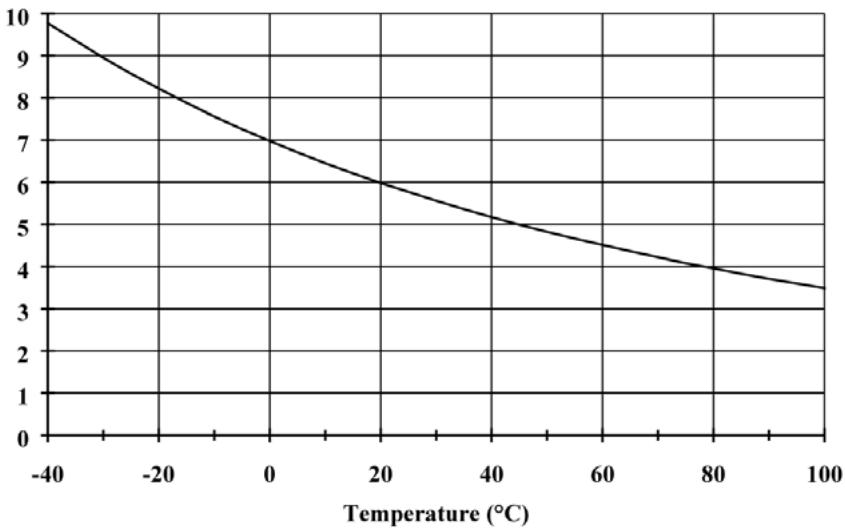
In humidity measurement and especially in calibration it is essential that temperature of the probe and measuring environment is the same. Even a small difference in temperature between the environment and the probe causes an error. As the curve below shows, if the temperature is +20^ and the relative humidity 100% RH , a difference of ± 1^ between the environment and the probe causes an error of ± 6% RH .
The graph below illustrates the measurement error at 100% RH when the difference between the ambient and sensor temperature is 1^ C .
Figure 22 Measurement Error at 100% RH
0507-023
General Instructions for Probes with a Cable
Mount the probes with a cable horizontally; this way, any water condensing on the tube cannot flow onto the sensor.
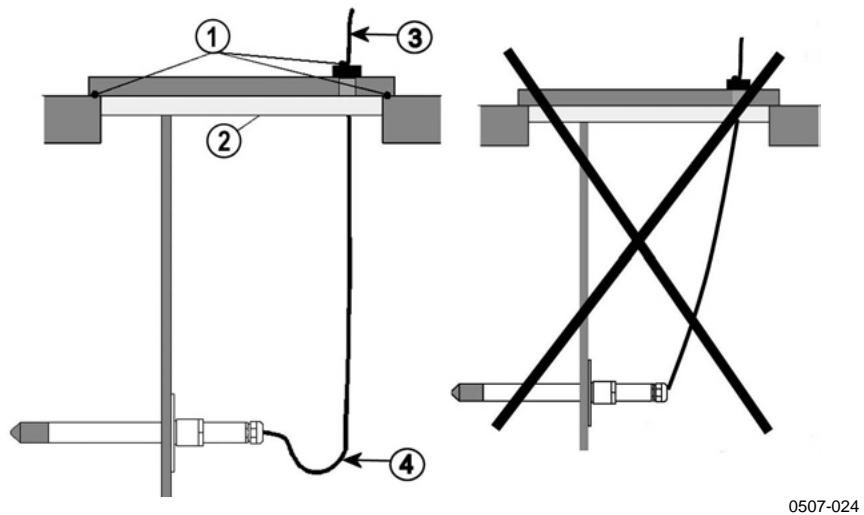
Figure 23 Horizontal Mounting of Probe
The following numbers refer to Figure 23:
1 = To be sealed.
2 = To be insulated.
3 = Insulate the cable.
4 = Let the cable hang loosely. This prevents condensed water running to the probe along the cable.
When there is no alternative but to install the probe in the process vertically, the point of entry must be carefully insulated. The cable must also be allowed to hang loosely as this prevents any condensed water from running onto the probe along the cable.

Figure 24 Vertical Mounting of Probe
The following numbers refer to Figure 24:
1 = To be sealed.
2 = Insulate the cable.
3 = To be insulated.
4 = Let the cable hang loosely. This prevents condensed water running to the sensor along the cable.
NOTE
Please do not attach a heated probe (HMT337) to metal structures to avoid condensation problems caused by heat conduction along the metal.
If the process temperature is much higher than that of the environment, the whole probe and preferably plenty of cable must be inside the process. This prevents measuring inaccuracy caused by heat conduction along the cable.
When mounted on the side of a duct or channel, the probe must be inserted from the side of the duct. If this is not possible and the probe must be inserted from the top, the point of entry must be carefully insulated.
For Vaisala probe installation kits and some installation examples, see Appendix A on page 163.
HMT333 for Ducts and Tight Spaces
The HMT333 is a small size ( = 12mm ) general-purpose probe suitable for ducts and channels with the installation kit available from Vaisala.
The HMT333 provides for two measuring range options. The first probe version is equipped with a flexible cable and can be used when measuring in environments up to 80^ . The second version is suitable for measuring in environments up to 120^ .
See Appendix A on page 163 for the following probe installation kits for HMT333 and installation examples.
- Duct mounting kit
- Cable gland.
HMT334 for High Pressure and Vacuum Applications
The HMT334 probe is for the dewpoint measurements in pressurized rooms and industrial processes. The probe is provided with a nut, a fitting screw and a sealing washer. Keep the fitting screw and the nut in place on the body of the probe during handling to prevent damage to the highly polished surface of the probe. Follow the instructions below to achieve a leak-tight assembly:
- Remove the fitting screw from the nut and the probe.
- Attach the fitting screw to the chamber wall with a sealing washer. Tighten the fitting screw into the threaded sleeve with a torque wrench. The tightening torque is 150 ± 10 Nm ( 110 ± 7 ft-lbs).
- Insert the body of the probe into the fitting screw and attach the nut manually to the fitting screw so that the connection feels tight.
- Mark both the fitting screw and the nut hex.
Figure 25 HMT344 Probe

0506-029
The following numbers refer to Figure 25:
1 Tightening cone
2 = Nut
3 = Fitting screw, M22x1.5 or NPT 1/2"
4 = Sealing washer
5 = Probe; 12mm
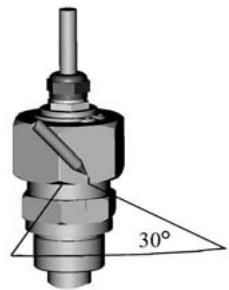
- Tighten the nut a further 30^ (1/12) turn or if you have a torque wrench tighten it with a torque of 80 ± 10 Nm ( 60 ± 7 ft-lbs).
Figure 26 Tightening the Nut
0503-034
NOTE
When re-tightening the nut after detachment the nut must be tightened without increased effort.
- Clean and grease the tightening cone of the fitting screw after every tenth detachment. Change the sealing washer every time the fitting screw is detached. Use high-vacuum grease (for example Dow Corning) or similar grease.
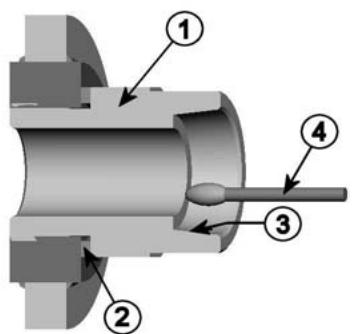
0503-033
Figure 27 Cleaning of Tightening Cone
The following numbers refer to Figure 27:
1 = Fitting screw
2 = Sealing washer
3 Tightening cone
4 = Clean cotton stick
CAUTION
In pressurized processes it is essential to tighten the supporting nuts and screws very carefully to prevent loosening of the probe by the action of pressure.
NOTE
When installed in a process with a pressure differing from normal atmospheric pressure, please enter the pressure value of the process (in hPa or mbar) into the transmitter memory via the serial line (see command PRES and XPRES on page 96) or by using display/Keypad.
HMT335 for High Temperatures
HMT335 is installed similarly than the HMT333 probe but without the supporting bar. Refer to Appendix A on page 163 for more information on the duct installation kit for HMT335.
To avoid incorrect humidity readings, the temperature differences between inside and outside of the duct must not be remarkable.
HMT337 for High Humidity Applications
The HMT337 is for environment where relative humidity is very high, near saturation. The warmed probe prevents the saturation of the sensor. An additional temperature probe is also available.
See Appendix A on page 163 for a presentation of the following probe installation kits for HMT337 with installation examples:
- Duct mounting kit
- Cable gland
- Pressure tight Swagelok connector
- Vaisala's Meteorological Installation kit
The installation kits are available for both humidity and temperature probe.
Temperature Probe (Optional)
An additional temperature probe is available to measure the ambient temperature when the HMT337 (with probe warming) is used. The additional temperature probe allows you to measure other humidity quantities apart from dewpoint and mixing ratio. The temperature probe must be connected to the transmitter at the factory. Do not cut and reconnect the cable yourself.
You must install the additional temperature probe in the same measurement environment as the HMT337 probe. Make sure that heat does not transfer from the warmed probe to the temperature probe. For an example installation, refer to section Example of Installation Through Roof on page 169.
HMT338 for Pressurized Pipelines
Due to the sliding fit the HMT338 is easy to install into and remove from the pressurized process. The probe is especially suitable for the measurements in pipelines. See section Ball Valve Installation Kit for HMT338 on page 170.


Figure 28 HMT338 Probe
The following numbers refer to Figure 28:
1 = Clasp nut, 24mm hex nut
2 = Fitting body, 27mm hex head
The following two fitting body options are available:
- Fitting Body ISO1/2 solid structure
- Fitting Body NPT1/2 solid structure
Table 5 HMT338 Probe Dimensions
| Probe type | Probe Dimension | Adjustment Range |
| Standard | 178 mm | 120 mm |
| Optional | 400 mm | 340 mm |

Figure 29 Sealing of Fitting Body into Process
Tightening the Clasp Nut
- Adjust the probe to a suitable depth according to the type of installation.
- Tighten the clasp nut first manually.
- Mark the fitting screw and the clasp nut.
- Tighten the nut a further 50 - 60^ (ca. 1/6 turn) with a wrench. If you have suitable torque wrench, tighten the nut to max 45 ± 5 ~Nm ( 33 ± 4 ft-lbs).

Figure 30 Tightening the Clasp Nut
The following numbers refer to
Figure 30 on page 48:
1 = Probe
2 = Clasp nut
3 = Fitting screw
4 = Pen
NOTE
Take care not to over tighten the clasp nut to avoid difficulties when opening it.
CAUTION
Take care not to damage the probe body. A damaged body makes the probe less tight and may prevent it from going through the clasp nut.
CAUTION
In pressurized processes it is essential to tighten the supporting nuts and screws very carefully to prevent loosening of the probe by the action of pressure.
NOTE
When installed in a process with a pressure differing from normal atmospheric pressure, please enter the pressure value of the process (in hPa or mbar) into the transmitter memory via the serial line (see command PRES and XPRES on page 96) or by using display/Keypad.
Optional Modules
Power Supply Module
The AC (mains) power connection may be connected to the power supply module only by an authorized electrician. A readily accessible disconnect device shall be incorporated in the fixed wiring.

Figure 31 Power Supply Module
The following numbers refer to Figure 31:
1 = Connect AC (mains) voltage wires to these terminals
2 = Grounding terminal
3 = In case the module is not installed in the factory: Connect wires from these terminals to the POWER 10 ... 35V 24V terminals of the mother board.
$$ \begin{array}{l} 4 = + \ 5 = - \ \end{array} $$
Installation
- Disconnect the power and open the transmitter cover.
- Remove the protective plug from the cable gland and thread the wires. In case the power supply module is installed in the factory, continue with the step 5.
- Attach the power module to the bottom of the housing with four screws. See the position Figure 2 on page 22.
- Connect the wires from the terminals of the power supply module marked with + and - to the terminals POWER 10 ... 35 V 24V on the motherboard of the transmitter.
- Connect the AC mains voltage wires to the power supply module terminals marked with N and L .
- Attach the grounding wire to the grounding terminal on the right-hand side of the transmitter.
- Connect the power. The LED on the cover of the transmitter is lit continuously during normal operation.
WARNING
Do not detach the power supply module from the transmitter when the power is on.
WARNING
Do not connect the mains power to power supply module when it is not installed in the transmitter.
WARNING
Always connect the protective ground terminal.
Warnings
Galvanic Isolation for Output
If galvanic isolation of the power supply line from the output signals is needed, HMT330 can be ordered with optional output isolation module. This module prevents harmful grounding loops.
NOTE
Output isolation module is not needed when using the power supply module.

Figure 32 Galvanic Output Isolation Module
The following number refers to Figure 32:
1 = Output isolation module
Third Analog Output

Figure 33 Third Analog Output
The following numbers refer to Figure 33:
1 = Flat cable pins
2 = Screw terminals for signal line
3 = DIP switches to select the output mode and range
Installation and Wiring
- Disconnect the power. In case the analog output module is installed in the factory, continue with the step 4.
- Open the transmitter cover and fasten the analog output module to the position for MODULE 2 with four screws. Refer to Figure 2 on page 22.
- Connect the flat cable between the analog output module and the motherboard's connector for MODULE 2.
- Take out the protective plug from the cable gland and thread the wires.
- Connect the wires to the screw terminals marked with Ch+ and Ch- .
- Select the current/voltage output by setting ON either of the switches 1 or 2.
- Select the range by setting ON one of the switches 3 ... 7.
NOTE
Only one of the switches 1 and 2 can be ON at a time.
Only one of the switches 3 ... 7 can be ON at a time.
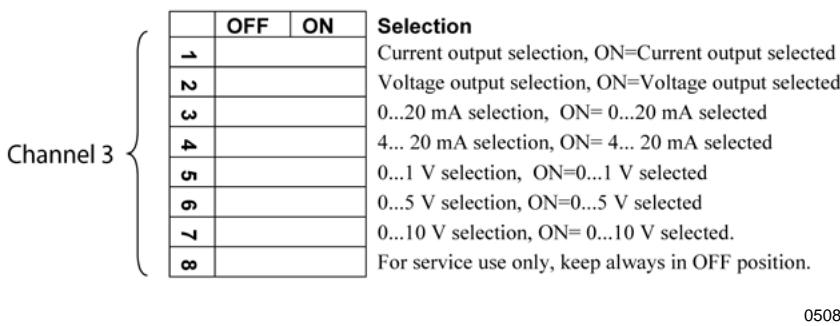
Figure 34 Third analog output selection
- Connect the power.
- Select the quantity and scale the channel via the serial line or display/Keypad, see section Analog Output Quantities on page 110. For testing the analog output, see section Analog Output Tests on page 112. For fault indication setting, see section Analog Output Fault Indication Setting on page 113.
Relays
HMT330 can be equipped with one or two configurable relay modules. Each module contains two configurable relays. See the contact ratings in section Technical Specifications of Optional Modules on page 153.
Installation and Wiring
- Disconnect the power and open the transmitter cover. In case the relay-module is installed in the factory, continue with step 5.
- Attach the relay module to the bottom of the housing with four screws. See the position in Figure 2 on page 22.
- When the mains power is in use attach the grounding wire to the grounding terminal.
- Connect the flat cable between the relay module and the MODULE 1 or MODULE 2 pins of the motherboard.
- Take out the protective plug from the cable gland and thread the relay wires.
- Connect the wires to the screw terminals: NO, C, NC. Refer to section Selecting the Activation State of the Relay below.
CAUTION
For installations in the USA: If your transmitter has both the relay module and a LAN or WLAN module, the maximum voltage you are allowed to connect to the relay module is 50V .
- Connect the power and close the cover.
Selecting the Activation State of the Relay
The middlemost C terminal and either one of the terminals NO/NC must be connected. The polarity can be freely selected.
NO Normally open
C Common relay
NC Normally closed
Relay NOT activated: C and NC outputs are closed, NO is open
Relay IS activated: C and NO outputs are closed, NC is open.
NOTE
For instructions on how to operate the relay (for example, select quantity for the relay output and set the relay setpoints) see section Operation of Relays on page 114.
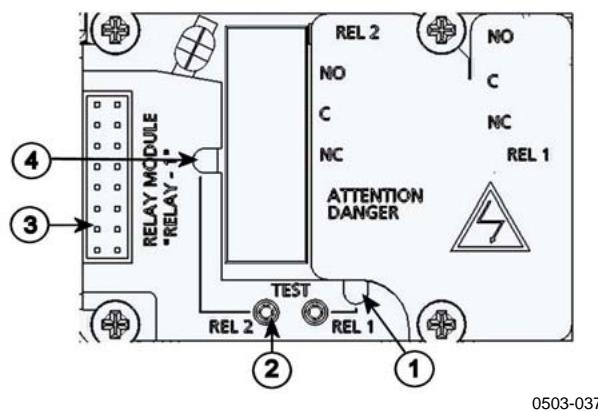
Figure 35 Relay Module
The following numbers refer to Figure 35:
1 = Indication led for the relay 1 or 3
2 = Relay test buttons
3 = Flat cable pins
4 = Indication led for relay 2 or 4
WARNING
The relay module may contain dangerous voltages even if the transmitter power has been disconnected. Before opening the transmitter you must switch off both the transmitter and the voltage connected to the relay terminals.
WARNING
Do not connect the mains power to relay unit without grounding the transmitter.
RS-422/485 Interface
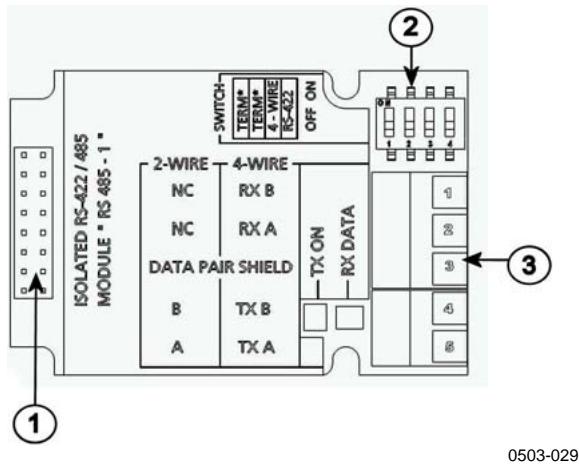
Figure 36 RS-485 Module
The following numbers refer to Figure 36:
1 = Flat cable pins
2 = Selection switches
3 = Screw terminals for wiring
NOTE
The markings on the module and in this manual are according to the line driver manufacturers' application notes, where A is positive against B when measured with a voltmeter.
When connecting the module, be prepared to swap the A and B wires if you have a communication problem.
Installation and Wiring
- Disconnect the power. In case the RS-485-module is installed in the factory, continue with the item 4.
- Open the transmitter cover and attach the RS-485 module to the bottom of the housing with four screws.
- Connect the flat cable between the RS-485 module and the motherboard's pins MODULE1 (Communications).
- Pull the network wirings through the cable gland.
- Connect the twisted pair wires (1 or 2 pairs) to the screw terminals as presented in Table 6 below:
Table 6 Connecting the Twisted Pair Wires to the Screw Terminals
| Screw terminal | Data line (2-wire RS-485) | Data line (4-wire RS-485/422) |
| 1 | (not connected) | RxB |
| 2 | (not connected) | RxA |
| 3 | Data pair shield | Data pair shield |
| 4 | B | TxB |
| 5 | A | TxA |
- If you use RS-485 (or RS-422) to connect just one HMT330 to a master computer, enable the internal termination of HMT330 by switching switches 1 and 2 ON. Make sure that the master's end of the line is also terminated (by using master's internal termination or with a separate terminator).
If you are connecting many transmitters to the same RS-485 bus, make sure that switches 1 and 2 are OFF and terminate the bus with separate terminators at both ends. This allows removing any transmitter without blocking the bus operation.
NOTE
If you use the internal termination of the transmitter at the end of the RS-485 bus (instead of using separate terminators) removing that transmitter will block the bus operation.
- Use the bus type (4-wire/2-wire) to select the selection switch 3. In 4-wire mode RS-485 master sends data to the HMT330 through terminals RxA and RxB and receives data from HMT330 through terminals TxA and TxB.
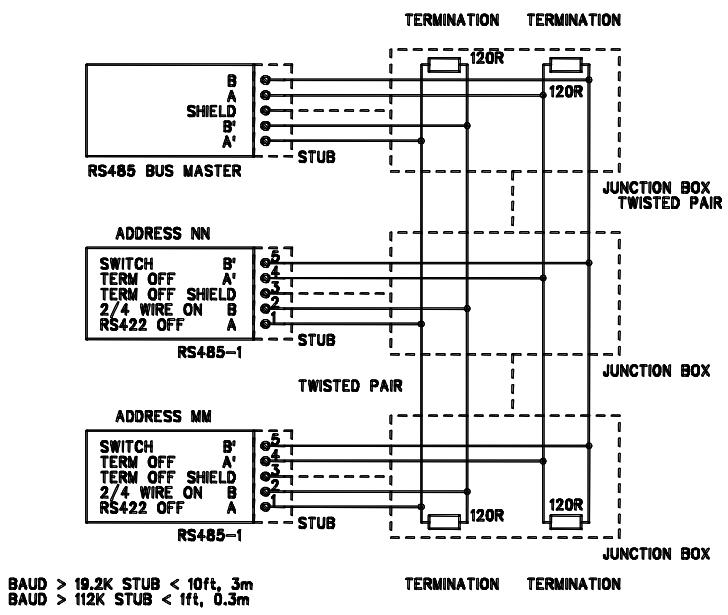
Figure 37 4-Wire RS-485 Bus
Table 7 4-Wire (Switch 3: On)
| RS-485 master | Data | HMT330 |
| TxA | → | RxA |
| TxB | → | RxB |
| RxA | ← | TxA |
| RxB | ← | TxB |

Table 8 2-Wire (Switch 3: Off)
| RS-485 master | Data | HMT330 |
| A | ← | A |
| B | ← | B |
- When operating in communication mode RS-422, set both switches 3 and 4 to ON position (4-wire wiring is required for RS-422 mode).
- Connect the power and close the cover.
LAN Interface
The optional LAN interface enables an Ethernet connection to the transmitter. The user can establish a virtual terminal session using a telnet client program such as PuTTY. When the LAN Interface is in use, serial communication using the User Port is disabled.
The LAN interface module must be installed at the factory (when ordering the transmitter), or by a Vaisala Service Center. Once installed, the module is automatically used by the transmitter. The physical connection to the network is made to the RJ45 connector on the LAN interface module, using a standard twisted pair Ethernet cable (10/100Base-T). Transmitters with the optional LAN interface are delivered pre-installed with a suitable cable and cable gland.
The LAN interface can use both static and dynamic network settings. If the interface is configured to use dynamic settings, the network where the LAN interface is connected must have a DHCP server that provides the settings.
The network configuration can be done using the optional display and keypad, or by using the service port. For instructions, see section LAN Communication on page 77. The LAN interface also provides a web configuration interface, which you can access by entering the IP address of the LAN interface in the address field of a web browser. For instructions on how to verify the current settings and status of the LAN interface, see section Device Information on page 101.
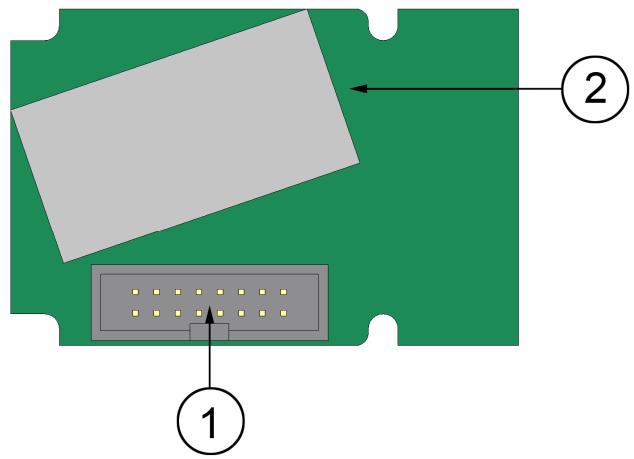
0709-003
Figure 38 LAN Interface Module
The following numbers refer to Figure 38 above:
1 = Flat cable connector
2 = RJ45 connector with indicator LEDs for link and activity
WLAN Interface
The optional WLAN interface enables a wireless Ethernet connection (IEEE 802.11b) to the transmitter. The user can establish a virtual terminal session using a telnet client program such as PuTTY. When the WLAN Interface is in use, serial communication using the User Port is disabled.
The interface supports Wired Equivalent Privacy (WEP) and Wi-Fi Protected Access (WPA). For WEP, 64 and 128 bit encryption is supported, with open system or shared key authentication. WPA is used in the Pre-Shared Key (PSK) mode, with either TKIP or CCMP protocol.
Similarly to the LAN Interface, the WLAN interface can use both static and dynamic network settings. If the interface is configured to use
dynamic settings, the network where the WLAN interface is connected must have a DHCP server that provides the settings.
The WLAN interface also provides a web configuration interface, which you can access by entering the IP address of the WLAN interface in the address field of a web browser.
Figure 39 WLAN Interface Module

0802-103
The following numbers refer to Figure 39 above:
1 = Flat cable connector
2 = Connector for antenna cable (connected to transmitter cover)
NOTE
The WLAN interface is not recommended for use with the HMT331 fixed probe model (for wall-mounted applications). The HMT331 short cable probe is designed to be used with the WLAN interface.
Attaching the WLAN Antenna
The LAN interface module must be installed at the factory (when ordering the transmitter), or by a Vaisala Service Center. Before taking the transmitter into use, the user must attach the antenna of the WLAN interface into the RP-SMA connector on the transmitter cover. The location of the antenna is shown in Figure 76 on page 158.
Data Logger Module
The optional data logger module extends the data storage for the measurement data. When the data logger is present, this storage is automatically used by the transmitter. The stored data can be browsed using the optional display module, and accessed through the serial connections. See sections Graphic History on page 66 and Data Recording on page 104.
The data logger module contains non-volatile flash memory providing 4 years 5 months of storage for 3 parameters at a 10 second sampling interval. When the memory is full, the data recording will not stop. Instead, the oldest data is overwritten. For each parameter and observation period, the module stores the minimum and maximum values during the interval, as well a data trend value that is averaged from samples taken during the interval (see Table 9 on page 62).
Table 9 Observation Periods and Resolution
| Observation Period | Period for Trend/Max/Min Calculations (Resolution) |
| 20 minutes | 10 seconds |
| 3 hours | 90 seconds |
| 1 day | 12 minutes |
| 10 days | 2 hours |
| 2 months | 12 hours |
| 1 year | 3 days |
| 4 years | 12 days |
The quantities that are logged are the same that have been selected for measurement using the display/Keypad or the serial line. When taking the transmitter into use, verify that the desired quantities are selected. If you change the quantities later, the transmitter will start logging the new quantities, and stop logging the quantities that are no longer selected. Changing the quantities does not delete any measurement data that is already in memory.
The data logger module has a real time clock with a battery back-up. The clock has been set to the Coordinated Universal Time (UTC) at the factory, and its time cannot be set by the user. The data that is stored in the logger's memory is timestamped using the logger's clock.
When date and time are set on the transmitter, they are stored to the transmitter's memory as an offset from the time on the logger's clock. When browsing the stored data, the time offset is applied to the timestamps shown in the graphical history, and data outputted from the serial port. The timestamps in the data logger's memory remain as they were originally stored.
You can compensate for the clock drift (less than ± 2 min/year) by setting the time on the transmitter. This updates the time offset used on the display and the serial port. You can set the time by using the keypad/display or the serial commands.

0706-068
Figure 40 Data Logger Module
The following numbers refer to Figure 40 above:
1 = Flat cable pins
2 Battery
After a reset or a power up, it will usually take at least 10 seconds before the data logger module is initialized. The real time clock and the data logging and reading functions are not available before the initialization is complete.
The indicator LED on the module will blink green during normal operation. If the LED is lit in red color, there is a problem with the module. The transmitter will also indicate the problem by activating the "Add-on module connection failure" error. If the module is not operating correctly, the transmitter must be sent to Vaisala for maintenance.
The data logger module must be installed at the factory (when ordering the transmitter), or by a Vaisala Service Center. Once installed, the module is automatically used by the transmitter. When the module requires a new battery, the transmitter must be sent to Vaisala for maintenance.
8-Pin Connector

Figure 41 Wiring of Optional 8-Pin Connector
Table 10 Wiring of 8-Pin Connector
| PIN/Terminal | Wire | Serial Signal | Analog Signal | |
| RS-232 (EIA-232) | RS-485 (EIA-485) | |||
| 1 | White | Data out TX | A | - |
| 2 | Brown | (serial GND) | (serial GND) | Signal GND (for both channels) |
| 3 | Green | - | - | Ch 2+ |
| 4 | Yellow | - | - | Ch 1 + |
| 5 | Grey | Supply - | Supply - | Supply - |
| 6 | Pink | Supply + | Supply + | Supply + |
| 7 | Blue | Data in RX | B | - |
| 8 | Shield/Red | Cable shield | Cable shield | Cable shield |
CHAPTER 4
OPERATION
This chapter contains information that is needed to operate this product.
Getting Started
Within a few seconds after power-up the LED on the cover of the transmitter is lit continuously indicating normal operation. When using the optional display and turning the transmitter on the first time, the language selection menu window opens. Select the language with arrow buttons and press the SELECT button (the left-hand button).
The pressure has an effect on humidity calculations and accuracy. Therefore, accurate calculations can be achieved only when the ambient pressure is taken into consideration. For instructions on how to set the pressure, see section Pressure Compensation Setting on page 95.
Display/Keypad (Optional)
Basic Display
Display shows you the measurement values of the selected quantities in the selected units. You can select 1 ... 3 quantities for the numerical basic display (see section Changing Quantities and Units on page 92.)
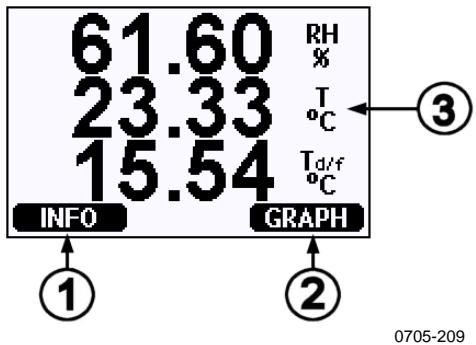
Figure 42 Basic Display
The following numbers refer to Figure 42:
1 = The Info shortcut button, see section Device Information on page 101
2 = The Graph shortcut button, see section Graphic History on page 66
3 = Quantities selected for display
NOTE
From any view, a four-second press on the right-hand function button takes you directly to the basic display.
Graphic History
The graphical display shows the data trend or min/max graph of the selected quantities, one at a time. The graph is updated automatically while measuring.
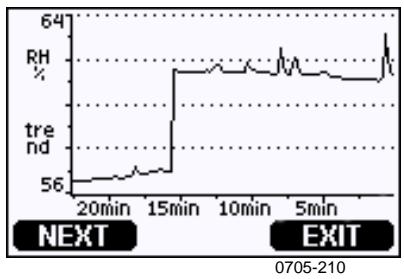
Figure 43 Graphical Display
Trend graph: Shows you a curve of average values. Each value is a calculated average over a period. See Table 11 on page 67 below.
Max/min graph: Shows you the minimum and maximum values in a form of curve. Each value is max/min over a time period. See Table 11 below.
Table 11 Periods for Trend and Max/Min Calculations
| Observation Period | Period for Trend/Max/Min Calculations (Resolution) |
| 20 minutes | 10 seconds |
| 3 hours | 90 seconds |
| 1 day | 12 minutes |
| 10 days | 2 hours |
| 2 months | 12 hours |
| 1 year | 3 days |
| 4 year* | 12 days |
- Shows the maximum logging period of the data logger module (available when data logger module is installed)
Use the following functions in the graphical display:
- Press the NEXT button to change between the trend graph and max/min graph for the quantities selected for display.
- Press the EXIT button to return to the basic display.
- Press the arrow buttons to zoom in and out in the graph window.
- Press the arrow buttons move the cursor (vertical bar) along the time axis. The cursor mode allows you to observe individual measuring points. The numerical value at the cursor position is shown at the left upper corner. The right upper corner shows the time from the present to the chosen moment (without the logger module), or the date and time at the cursor position (when the logger module is installed).
- If the optional data logger module is installed, you can scroll the cursor off the screen to move to a new point on the time axis. The new date will be displayed, and the cursor will be centered at the date where the cursor scrolled off the screen.

Figure 44 Graphical Display with Data Logger
The time that is shown below the graph is adjusted with the current time offset of the transmitter. If you change the transmitter's date and time setting, the displayed timestamps in the history graph change accordingly. For an explanation of the effect of changing the date and time manually, see section Data Logger Module on page 62.
Table 12 Graph Information Messages in Cursor Mode
| Message | Interpretation |
| Power outage | Power failure (marked also with dashed vertical line) |
| No data | Quantity has not been selected for the display |
| Device failure | General device failure |
| T meas. failure | Temperature measurement/sensor failure |
| RH meas. failure | Humidity measurement/sensor failure |
| Adj. mode active | Adjustment mode active (data recorded in the adjustment mode is not displayed) |
A question mark after time tells you that at least one power failure (dashed vertical line) has occurred after the chosen moment. In this case, the exact time difference between the present and the cursor position is not exactly known.
Menu and Navigation
You can change settings and select functions in the menus.
- Open the MAIN MENU by pressing any of the arrow buttons in the basic (numeric) display mode.
- Move in the menus by using the arrow buttons.
- Open a submenu with button.
- Press to return to the previous level.
- Function button EXIT returns you back to the basic display.

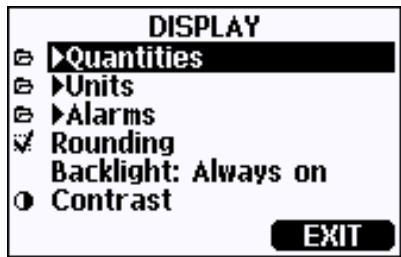

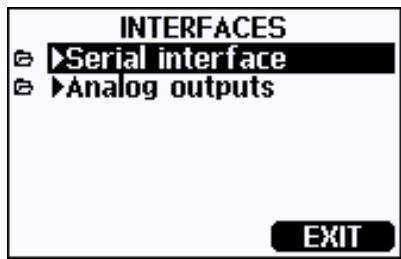
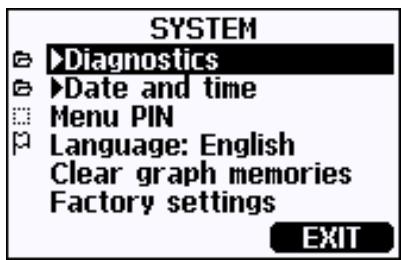
Figure 45 Main Menu
0705-208, 0802-040
Some menu items, such as Purge in the Measuring menu, are only shown if supported by the transmitter and the installed options.
Changing the Language
- Go back to the basic display by keeping the right-hand button pressed for four seconds.
- Open the Main menu by pressing any of the buttons.
- Scroll to the System menu option, and press the button. The menu option is indicated with the wrench × symbol.
- Scroll to the Language menu option, and the left-hand = button. The menu option is indicated with the flag symbol.
- Select the language with the buttons, and confirm the selection by pressing the left-hand button.
- Press the right-hand button to exit to the basic display.
Rounding Setting
Round off one decimal by using the Rounding function. The default setting is rounding on. Rounding has no effect on quantities without decimals.
- Open the MAIN MENU by pressing any of the arrow buttons.
- Select Display and confirm by pressing the arrow button.
- Select Rounding and press ON/OFF button.
- Press EXIT to return to the basic display.
Display Backlight Setting
As a default the display backlight is always on. In the automatic mode the backlight stays on for 30 seconds from the last press of any button. When pressing any button, the light turns on again.
- Open the MAIN MENU by pressing any of the arrow buttons.
- Select Display, press the arrow button.
- Select Backlight, press the CHANGE button.
- Select On/Off/Automatic, press the SELECT button.
- Press EXIT to return to the basic display.
Display Contrast Setting
- Open the MAIN MENU by pressing any of the arrow buttons.
- Select Display, press the arrow button.
- Select Contrast, press the ADJUST button.
- Adjust the contrast by pressing the arrow buttons.
- Press OK and EXIT to return to the basic display.
Keypad Lock (Key guard)
This function locks the keypad and prevents unintentional key presses.
- Keep pressing the left-hand function button for 4 seconds to lock the keypad (at any display).
- To unlock the keypad, press the OPEN button for 4 seconds.
Menu PIN Lock
You can prevent unauthorized changes of the device settings by activating the menu PIN lock. When this function is activated, the basic display and graphical view are available but access to the menus is locked. The key symbol indicates the activation of this feature.
- Open the MAIN MENU by pressing any of the arrow buttons.
- Select System, press the arrow button.
- Select Menu PIN, press the ON button.
- Enter a PIN code by using the arrow buttons. Press OK to confirm the setting. Now the PIN lock is on and a key symbol is shown in a display.
- Press EXIT to return to the basic display. Returning to the menu is possible only by entering the correct PIN code.
When you want to turn off the PIN lock, go to the menu by giving the PIN code and select System, Menu PIN, press OFF button.
In case you have forgotten the PIN code, open the transmitter cover and press the ADJ button once. Wait for a few seconds and the adjustment menu opens. Select Clear menu PIN, press CLEAR.
NOTE
You can also disable the keypad completely with serial command LOCK.
Factory Settings
Use the display/Keypad to restore the factory settings. This operation does not affect the adjustments. Only settings available in the menus are restored.
- Press any of the arrow buttons to open the MAIN MENU.
- Select System by pressing the arrow button.
- Select Factory settings and press the REVERT button to confirm your selection. Press the YES button to reset all settings to the factory defaults.
See section General Settings on page 92 for a description of the other menu options.
Display Alarms
The Display Alarm feature provides two independently configurable alarms for transmitters with the display/Keypad option. Each alarm tracks a selected quantity, with a freely configurable low and high limit. Each alarm also has a configurable hysteresis value to prevent unnecessary triggering when the measurement fluctuates around an alarm limit. The alarms can be configured for any quantity supported by the transmitter. The configuration of the Display Alarms can only be done using the display/Keypad option.
An alarm is activated when the selected quantity goes higher than the high limit, or lower than the low limit, much in the same way as the relays. When an alarm is activated, an alarm note is displayed on the display, and the lights of the display will blink.
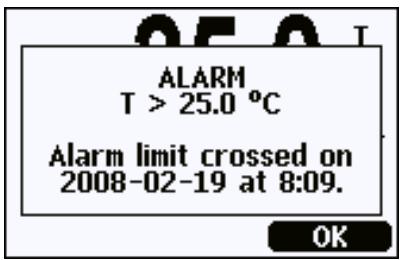
0802-041
Figure 46 Display Alarm Active
Multiple alarms can be active at the same time; the alarm that was triggered first will be shown on the display. The next active alarm is revealed when the currently shown alarm is acknowledged by pressing the OK button.
Note that activated alarms are only shown on the screen. There are no alarm messages output to the serial line, or markers placed in the graph data. After an alarm has been acknowledged, you must refer to the data graphs to see when the measured quantities have exceeded the limits.
Configuring a Display Alarm
- Enter the Main Menu by pressing an arrow key on the keypad.
- Use the arrow keys to select Display, followed by Alarms, to open the Display Alarms menu. The Display Alarms menu shows the currently enabled and disabled alarms.

0802-069
Figure 47 Display Alarms
- Use the arrow keys to select an alarm to configure. The alarm editing page opens.
NOTE
Changes you do on the alarm editing page will take effect immediately, and may cause an alarm to appear on the screen.
- To select a quantity for the alarm, press the Change button and select the quantity from the list.
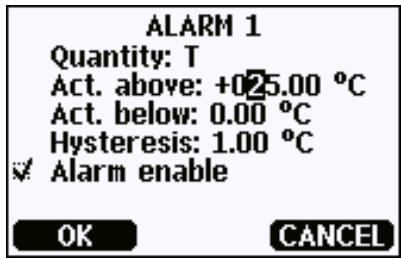
- To modify or remove the alarm limit values, move the selection over the Act. above or Act. below field and press the Set button. You will be prompted to Modify or Remove the value.
0802-070
Figure 48 Modifying an Alarm Limit
When modifying the value, use the arrow up and down buttons to change the value under the cursor. Left and right arrow buttons
move the cursor. Select the OK button to accept the modified value, or Cancel to undo the modification.
- Set a suitable Hysteresis value to prevent the alarm from being triggered unnecessarily by small measurement changes that pass the alarm limit repeatedly.
- Set or clear the Alarm enable checkbox to enable or disable the alarm.
- Press the Exit button to leave the alarm configuration screen and return to the basic view.
MI70 Link Program for Data Handling
The real-time window function of the MI70 Link program allows you to monitor transmitter readings directly with a PC when transmitter is connected with a serial or USB cable. You can also transfer recorded data from the main transmitter memory in numeric or graphical format, for further use in a spreadsheet program (such as Microsoft Excel) or virtually any other application.
Follow the steps below to connect your transmitter to the MI70 Link program using the serial interface:
- Connect your PC to the transmitter. Refer to section Serial Line Communication on page 73.
- Check that the HMT330 is powered.
- Start the MI70 Link program.
- Start using the program. There is usually no need to select a COM port manually, the MI70 Link software can detect it automatically.
The MI70 Link program, and the optional connection cables, are available from Vaisala. See list of accessories in section Options and Accessories on page 155.
Serial Line Communication
Connect the serial interface by using either the user port or the service port.
For permanent interfacing to host system, use the user port. You can change the serial settings and operate in RUN, STOP and POLL modes.
For temporary connections, use the service port. The service port is always available with fixed serial settings.
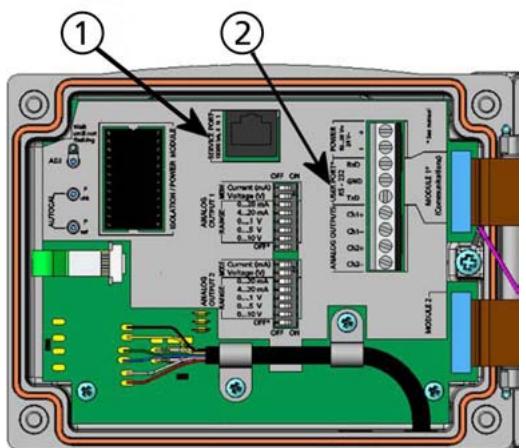
0605-039
Figure 49 Service Port Connector and User Port Terminal on Mother Board
The following numbers refer to Figure 49 above:
1 = Service port connector
2 = User port terminals
User Port Connection
Use a suitable serial cable between the user port RxD, GND and TxD screw terminals and the PC serial port, see Figure 50 on page 74.
Table 13 Default Serial Communication Settings for the User Port
| Parameter | Value |
| Bauds | 4800 |
| Parity | Even |
| Data bits | 7 |
| Stop bits | 1 |
| Flow control | None |
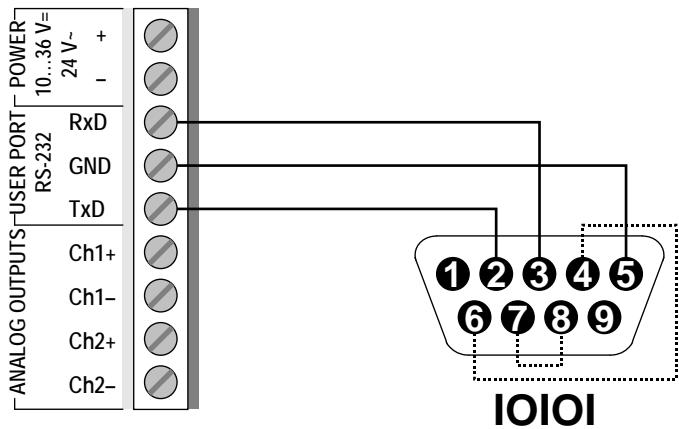
0506-033
Figure 50 Connection Example Between PC Serial Port and User Port
Connections to pins 4, 6, 7 and 8 on PC serial port are required only if you are using software requiring hardware handshaking.
After power-up the transmitter (in STOP-mode) outputs the software version and the command prompt.
HMT330/5.00 >
In RUN mode a measurement output starts immediately after power-up.
In POLL mode, the transmitter does not output anything after power-up (see section SMODE on page 99).
NOTE
User port cannot be used when the RS-485 module is connected.
Service Port Connection
Connection Cables
To connect to the service port, you need a suitable cable with an RJ45 connector. Depending on the connections of your PC, you can either use the Serial Connection Cable (optional accessory 19446ZZ) or the USB-RJ45 Serial Connection Cable (optional accessory 219685). The USB cable enables you to connect the transmitter to a PC via a standard type A USB port. Note that the USB cable does not enable high speed data transfer, since the bit rate is limited by the serial interface of the service port.
Installing the Driver for the USB Cable
Before taking the USB cable into use, you must install the provided USB driver on your PC. When installing the driver, you must acknowledge any security prompts that may appear. The driver is compatible with Windows 2000, Windows XP, Windows Server 2003, and Windows Vista.
- Check that the USB cable is not connected. Disconnect the cable if you have already connected it.
- Insert the media that came with the cable, or download the driver from www.vaisala.com.
-
Execute the USB driver installation program (setup.exe), and accept the installation defaults. The installation of the driver may take several minutes.
-
After the driver has been installed, connect the USB cable to a USB port on your PC. Windows will detect the new device, and use the driver automatically.
- The installation has reserved a COM port for the cable. Verify the port number, and the status of the cable, using the Vaisala USB Instrument Finder program that has been installed in the Windows Start menu.
Windows will recognize each individual cable as a different device, and reserve a new COM port. Remember to use the correct port in the settings of your terminal program. If you are using the Vaisala MI70 Link application, you do not need to check the COM port, as the MI70 Link detects the USB connection automatically.
There is no reason to uninstall the driver for normal use. However, if you wish to remove the driver files and all Vaisala USB cable devices, you can do so by uninstalling the entry for Vaisala USB Instrument Driver from the Add or Remove Programs (Programs and Features in Windows Vista) in the Windows Control Panel.
Using the Service Port
- Unfasten the screws on the transmitter cover, and open the transmitter.
- Connect the desired cable (serial interface cable or USB cable) to your PC and the service port connector on the transmitter. For the location of the service port, refer to Figure 49 on page 74.
- Open a terminal program and set the communication settings as follows:
Table 14 Communication Settings for the Service Port
| Parameter | Value |
| Bauds | 19200 |
| Parity | None |
| Data bits | 8 |
| Stop bits | 1 |
| Flow control | None |
For a detailed explanation of using a terminal program, see section Terminal Program Settings on page 84.
- Power-up the HMT330.
LAN Communication
To enable LAN communication, a LAN or WLAN interface must be physically connected to the network, and the networking settings must be suitable for your network. For a description of interfaces, see sections LAN Interface on page 59 and WLAN Interface on page 60.
The LAN and WLAN interfaces both operate by accessing the serial interface (User Port) of the transmitter. All commands that are available using the serial interface are available through the LAN and WLAN interfaces; refer to section List of Serial Commands on page 87. For instructions on how to connect using a terminal program, see section Terminal Program Settings on page 84.
IP Configuration
The IP settings of the LAN and WLAN interfaces are described in Table 15. The current settings can be viewed on the serial line or using the device information display; see section Device Information on page 101.
Table 15 IP Settings for the LAN and WLAN Interfaces
| Parameter | Description |
| Automatic configuration (DHCP) | If enabled, the transmitter will retrieve its network settings (including the IP Address) from a server in the network. If disabled, static network settings are used instead. |
| Web configuration | If enabled, the settings of the interface can be changed using a web browser. The configuration page can be accessed by browsing to the IP address of the transmitter. |
| IP Address | The four part network ID of the transmitter. Must be set manually if automatic configuration is not used.Example value: 192.168.0.222 |
| Netmask | Used together with the IP address to determine which network the transmitter is a part of. Must be set manually if automatic configuration is not used.A common netmask is 255.255.255.0. |
| Gateway | IP address of the server that enables the transmitter to access other networks. Must be set manually if automatic configuration is not used.Example value: 192.168.0.1 |
| MAC | The MAC address is the unique hardware address of the LAN or WLAN interface. Cannot be changed. |
Using Display/Keypad
You can configure the IP settings of the LAN and WLAN interfaces using the display/Keypad as follows:
- Press any of the arrow buttons to open the MAIN MENU.
- Press the arrow button to select Interfaces.
- Press arrow button to select Network settings. There will be a delay as the transmitter refreshes the network information.
- You are now in the Network Interface menu. Selecting the IP configuration option opens the IP configuration menu.
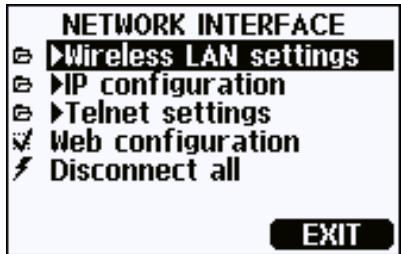
0802-113
Figure 51 Network Interface Menu
The Network Interface menu also allows you to enable or disable the Web configuration option, or Disconnect all users that are currently accessing the LAN or WLAN interface.
- In the IP configuration menu, select Automatic configuration (DHCP), or enter the IP address, Netmask and Gateway manually. If automatic configuration is enabled, manual configuration cannot be done.
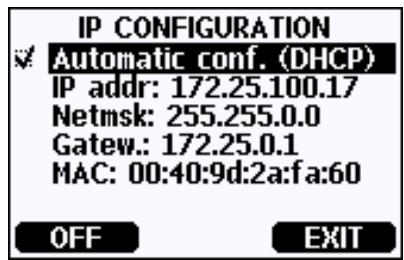
0709-004
Figure 52 IP Configuration Menu
To enter a value manually, use the arrow buttons to select the parameter to change, and press Change. A cursor will appear in the first digit. Move the cursor using the arrow buttons, and change the value under the cursor using the arrow buttons. Confirm the selection by pressing OK.
- After configuring the desired parameters, press EXIT to return to the basic display.
Using Serial Line
Use the serial line command NET to view or set the network settings for the LAN and WLAN interfaces. You can also refresh the network information or disconnect all active connections.
NET [REFRESH] [DISCONNECT] [DHCP WEB] [DHCP IP SUBNET GATEWAY WEB]
where
REFRESH = Updates the network information and displays it
DISCONNECT = Disconnects all current sessions
DHCP = ON or OFF. Enables or disables the automatic IP configuration.
WEB = ON or OFF. Enables or disables the Web Configuration page.
IP = The four part network ID of the transmitter. Must be set manually if automatic configuration is not used.
SUBNET = Used together with the IP address to determine which network the transmitter is a part of. Must be set manually if automatic configuration is not used.
GATEWAY = IP address of the server that enables the transmitter to access other networks. Must be set manually if automatic configuration is not used.
Examples:
>net refresh OK DHCP : OFF IP address : 192.168.0.101 Subnet mask : 255.255.255.0 Default gateway: 192.168.0.1 Web config. : OFF MAC address : 00:40:9d:2c:d2:05 Telnet : Not connected >
>net on off
DHCP : ON
IP address : 192.168.0.104
Subnet mask : 255.255.255.0
Default gateway: 192.168.0.1
Web config. : OFF
MAC address : 00:40:9d:2c:d2:05
Telnet : Connected
OK
>
| >net off 192.168.0.101 255.255.255.0 192.168.0.1 off | |
| DHCP | : OFF |
| IP address | : 192.168.0.101 |
| Subnet mask | : 255.255.255.0 |
| Default gateway: | 192.168.0.1 |
| Web config. | : OFF |
| MAC address | : 00:40:9d:2c:d2:05 |
| Telnet | : Connected |
| OK | |
| > | |
Wireless LAN Configuration
The settings of the WLAN interface are described in Table 16. The current settings can be viewed on the serial line or using the device information display; see section Device Information on page 101.
Table 16 Wireless LAN Settings
| Parameter | Description |
| SSID | The service set identifier (i.e. network name) of the wireless network to connect to. 1 ... 32 characters. |
| Security type | The security type of the wireless network. The options are: |
| OPEN | |
| OPEN/WEP | |
| WPA-PSK/TKIP | |
| WPA-PSK/CCMP | |
| All other choices except OPEN require a security key; see below. | |
| Security key | The encryption key or passphrase that is used with an encrypted network. |
Using Display/Keypad
You can configure the Wireless LAN settings using the display/keyboard as follows:
- Press any of the arrow buttons to open the MAIN MENU.
- Press the arrow button to select Interfaces.
- Press the arrow button to select Network settings. There will be a delay as the transmitter refreshes the network information.
- Press the arrow button to select Wireless LAN settings.
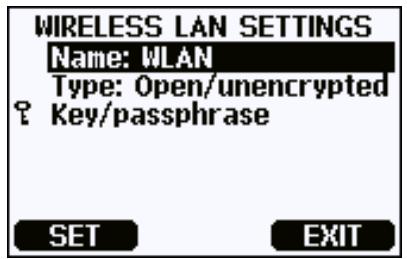
0802-111
Figure 53 Wireless LAN Settings
- The Name entry on the page shows the SSID of the currently selected wireless network. To change the SSID, press the SET button. Use the arrow buttons to change the character under the cursor, and arrow buttons to more the cursor. Press the OK button when done.
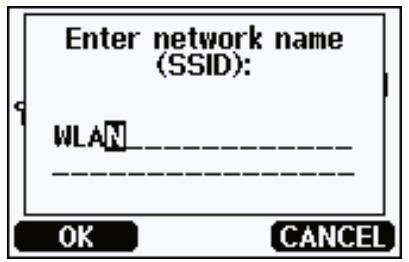
0802-110
Figure 54 Entering Network SSID
- To change the currently selected Network type, select the Type entry and press the Change button. Select the new type from the list and press the Select button.
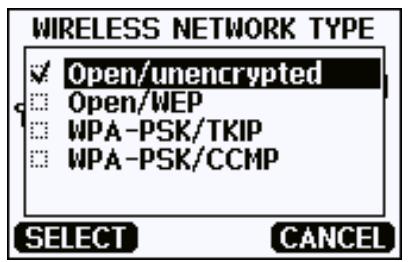
0802-112
Figure 55 Selecting the Wireless Network Type
-
If you have selected an encrypted network type (WEP or WPA), you must enter the security key to be used. Select the Key/passphrase entry and press the Set button. Enter the key in the same way as the SSID, and press the OK button. With the WEP encryption you must enter the encryption key in hexadecimal (10 hexdecimals for 64-bit encryption or 26 hexadecimal for 128-bit encryption). A WPA key must be 8 ... 63 ASCII characters.
-
After setting the wireless network parameters, press the Exit button in the Wireless Network Settings menu. You will be asked to confirm the new settings. Note that when new settings are saved, all currently active WLAN connections are disconnected.
Using Serial Line
Use the serial line command WLAN to view or set the wireless network settings. If you set an encrypted network type, you will be asked to enter the security key. With the WEP encryption you must enter the encryption key in hexadecimal (10 hexdecimals for 64-bit encryption or 26 hexadecimal for 128-bit encryption) or with plain ASCII characters (5 characters for 64-bit encryption or 13 characters for 128-bit encryption). A WPA key must be 8 ... 63 ASCII characters.
WLAN [SSID TYPE]
where
SSID = The network name in 1 ... 32 characters
TYPE = The security type of the wireless network. The options are:
OPEN
OPEN/WEP
WPA-PSK/TKIP
WPA-PSK/CCMP
Examples:
>wan ?
Network SSID : WLAN-AP
Type : OPEN
>
>wan accesspoint wpa-psk/tkip
Network SSID : accesspoint
Type : WPA-PSK/TKIP
WPA-PSK phrase ? thequickbrownfox
Warning: Active connection will be disconnected. Save changes (Y/N) ? y OK
Telnet Settings
When a telnet connection is established via the LAN or WLAN interface, the session has the same communication mode, run interval, poll address and echo settings as the serial port (user port) session would have.
These settings can be changed using the display/Keypad, using the serial line (user port or service port), or on-the-fly during the telnet session.
The display menu path to the telnet settings is:
Main menu Interfaces Network Interface Telnet settings.
The commands for changing the settings are SMODE, INTV, ADDR, and ECHO.
Web Configuration for LAN and WLAN
The LAN and WLAN interfaces both have a web configuration page that is accessible using a browser. If you have not disabled the page from the network settings, you can access it with a web browser at the IP address of the interface.
When accessing the web configuration page, you must first log in.
Username: user
Password: vaisala
The web configuration page provides similar network configuration options as the serial line and the display/Keypad. It also has additional options for advanced users. For example, there are more options for securing the wireless network.
If these additional options are used, they will appear as custom configurations when viewed from the serial line or the display/Keypad.
VAISALA
Vaisala WLAN Interface Configuration and Management
Home
Configuration
Network
System
Management
Connections
Administration
Update Firmware
Factory Default
Settings
Reboot
Logout
Network Configuration
IP Settings
Configure the network below. IPv6 settings are shown here for informational purposes.
IPv6
Link Local Address:
FE80::240:9DFF:FE2C:D1DF
Site Local Adress:
none
IPv4 and DNS
Obtain an IP address automatically using DHCP
Use the following IP address:
-
IP Address:
-
Subnet Mask:
Default Gateway:
-
Primary DNS:
-
Secondary DNS:
s to DHCP, IP address, Subnet Mask, and DNS may effect your browser connection.
Apply
Wireless LAN Settings
Wireless Security Settings
Wireless 802.1x Authentication Settings
Advanced Network Settings
0802-114
Figure 56 Web Configuration Interface for WLAN
Terminal Program Settings
The instructions below describe how to connect to the HMT330 using the PuTTY terminal application for Windows. Perform the necessary cabling and configuration of the transmitter before following the instructions.
PuTTY is available for download at www.vaisala.com.
Opening a Serial/USB connection
- Power up the HMT330 and start the PuTTY application.
- Select the Serial & USB settings category, and check that the correct COM port is selected in the Serial or USB line to connect to field. Change the port if necessary.
If you are using a Vaisala USB cable, you can check the port that it uses by clicking the USB Finder... button. This opens the Vaisala USB Instrument Finder program that has been installed along with the USB drivers.
- Check that the other serial/USB line settings are correct for your connection, and change if necessary. The default settings (shown in Figure 1) are used by the Service Port of the HMT330.
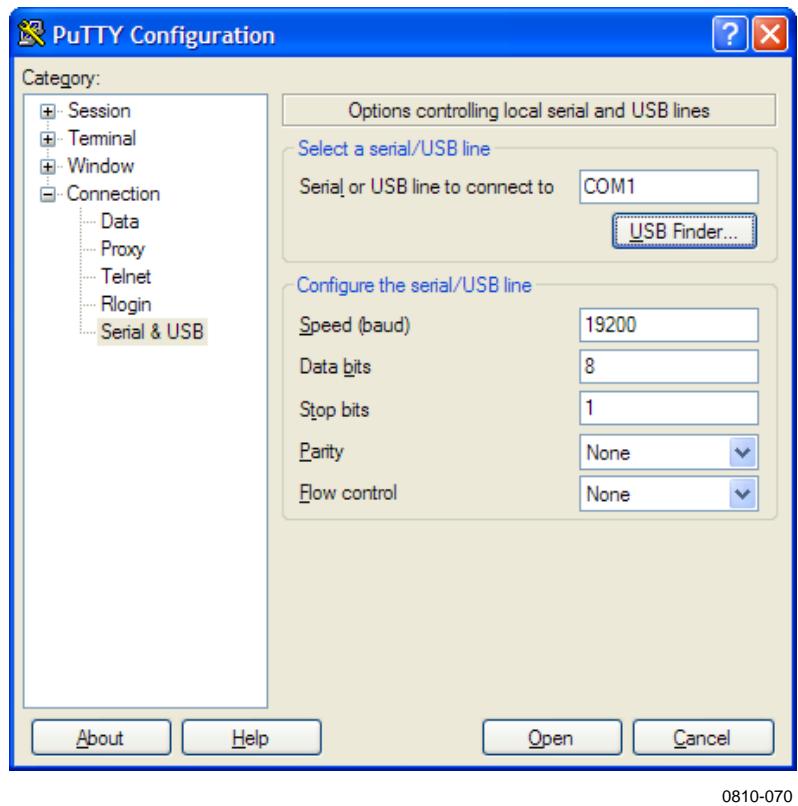
Figure 57 Opening a Serial Connection
- Click the Open button to open the connection window and start using the serial line.
If PuTTY is unable to open the serial port you selected, it will show you an error message instead. If this happens, restart PuTTY and check the settings.
Opening a Telnet session (LAN/WLAN)
NOTE
The instructions below assume that the LAN/WLAN interface on the transmitter is correctly configured and the network connection is already done.
- Power up the instrument and start the PuTTY application. If your transmitter acquires a network address using DHCP, wait for a minute for this to complete, then verify the address from the transmitter.
-
In the Session window, select the Telnet connection type.
-
Enter the IP address of your transmitter in the Host Name (or IP address) field. If you do not know the port, the default port 23 is likely correct.
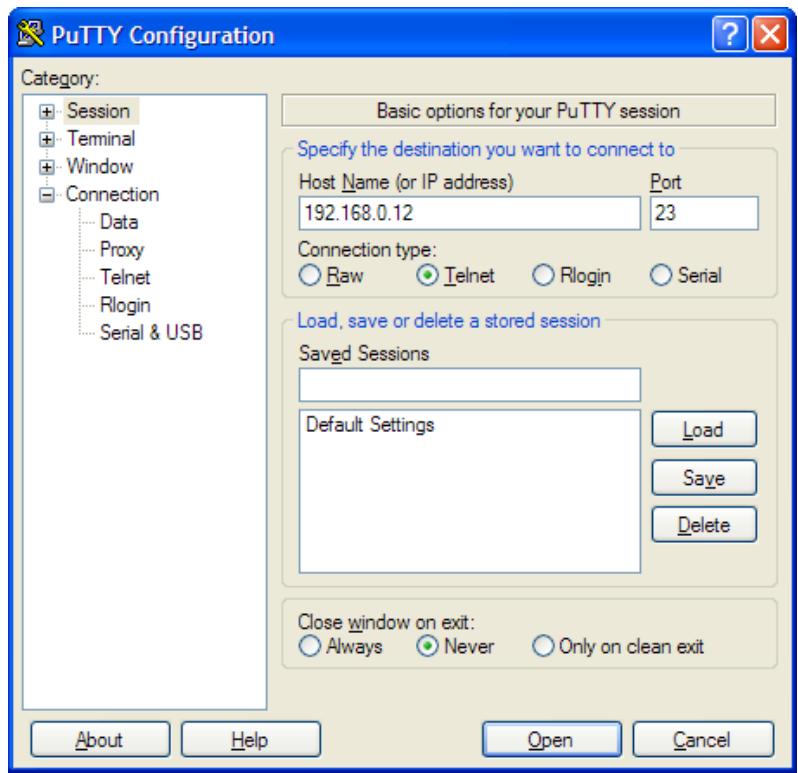
0810-071
Figure 58 Opening a Telnet Connection
- Click the Open button to open the connection window and start using the telnet session.
If PuTTY is unable to connect the IP address you entered, it will show you an error message instead. If this happens, check the IP address and the connections, restart PuTTY, and try again.
List of Serial Commands
The bold text in the brackets is the default setting. To issue a command, type it on your computer and press the Enter key.
Table 17 Measurement Commands
| Command | Description |
| R | Start the continuous outputting |
| S | Stop the continuous outputting |
| INTV [0 ... 255 S/MIN/H] | Set the continuous output interval (for RUN mode) |
| SEND [0 ... 99] | Output the reading once |
| SEND D | Outputting the reading with the raw data |
| SMODE [STOP/RUN/POLL] | Set the serial interface mode |
| SDELAY | View or set user port (RS232 or RS485) answer minimum delay |
| SERI [baud p d s] | User Port settings (Default: 4800 E 7 1) baud: 300 ... 115200 |
| ADDR [0 ... 99] | Set the transmitter address (for POLL mode) |
| NET | View or set networking parameters for LAN and WLAN interfaces |
| WLAN | View or set wireless network parameters for WLAN interface |
| OPEN [0 ... 99] | Open a temporary connection to a POLL mode device |
| CLOSE | Close the temporary connection (Back to POLL mode) |
Table 18 Formatting Commands
| Command | Description |
| FORM | Set the output format of SEND and R commands |
| TIME | Set the time |
| DATE | Set the date |
| FTIME [ON/OFF] | Add time to SEND and R outputs |
| FDATE [ON/OFF] | Add date to SEND and R outputs |
| FST [ON/OFF] | Add the state of probe heating and chemical purge in connection with SEND and R commands |
| UNIT | Select the metric or non-metric output units |
Table 19 Data Recording Commands
| Command | Description |
| DIR | Display recorded files |
| PLAY [0 ... 21] [START END] | Output recorded data file. Start and end times can only be specified if the data logger module is installed. The times must be given in the following format: yyyy-mm-dd hh:mm:ss |
| DSEL | Select data recording and display quantities. |
| DELETE | Delete all data files, including the memory of the optional data logger module |
| UNDELETE | Recover the deleted files that have not been overwritten |
Table 20 Chemical Purge Commands
| Command | Description |
| PUR | Set the automatic chemical purge |
| PURGE | Start the manual chemical purge |
Table 21 Calibration and Adjustment Commands
| Command | Description |
| CRH | Relative humidity calibration |
| CT | Temperature calibration |
| CTA | Additional temperature probe calibration |
| FCRH | Relative humidity calibration after sensor change |
| CTEXT | Give the text to calibration information field |
| CDATE | Set the calibration date |
| ACAL | Analog output calibration |
Table 22 Setting and Testing the Analog Outputs
| Command | Description |
| AMODE | View the analog output modes |
| ASEL | Select the parameters for the analog outputs |
| ITEST | Test the analog outputs |
| AERR | Change the analog error output values |
Table 23 Setting and Testing the Relays
| Command | Description |
| RSEL | Set and view the relays |
| RTEST | Test the relays |
Table 24 Other Commands
| Command | Description |
| ? | Output information about the device |
| ?? | Output information about the device in POLL mode |
| ECHO [ON/OFF] | Turn the serial interface echo ON/OFF |
| ERRS | List present transmitter errors |
| FILT | Set the result filtering |
| FIND | All devices in POLL mode send their addresses |
| HELP | List the most common commands |
| LOCK | Lock the menu and disable the keypad |
| PRES [hPa] | Set the value for pressure compensations |
| VERS | Display the software version information |
| XHEAT | Sensor heating |
| XPRES [hPa] | Set the value for pressure compensations, temporarily |
Getting Measurement Message from Serial Line
Starting Continuous Outputting
R
Enter the R command to start the continuous output of measurements.
Example:
\[
\begin{aligned}
& \text { R } = 60.5 \% \text { RH } T = 23.7 ^ {\prime} C \text { Tdf } = 15.6 ^ {\prime} C \text { Td } = 15.6 ^ {\prime} C a = 13.0 \\
& g / m3 x = 11.1 g / kg T w = 18.5 ^ {\prime} C H2O = 17889 ppm V p w = \\
& 17.81 hPa pws = 29.43 hPa h = 52.3 kJ/kg dT = 8.1 ^ {\prime} C
\end{aligned}
\]
If a value is too long to fit to the allocated space in the output, or if there is an error in outputting the quantity, the value is displayed with stars ‘*’.
Example:
[ \mathrm{RH} = \text{***.}\% \mathrm{RH} \quad \mathrm{T} = 31.0^{\prime} \mathrm{C} ]
You can change the format of the output with the following commands:
- Outputting interval can be changed with the INTV command.
- Output message format can be changed with the FORM command.
- Status of chemical purge and probe heating can be added with the FST command.
- Date and time information can be added with commands FDATE and FTIME
Stopping Continuous Outputting
S
Use the S command to end the RUN mode. After this command all other commands can be used. You can also press the Esc button or reset the transmitter to stop the outputting.
See command SMODE to change the default (power-up) operation mode.
Outputting Reading Once
SEND
Use the SEND command to output the reading once in STOP mode. The output format depends on which parameters the transmitter can output.
Examples:
[ \mathrm{RH} = 98.4\% \mathrm{RH} \quad \mathrm{T} = 31.1^{\prime} \mathrm{C} ]
RH = 98.4% RHT = 31.1^ = 36.0^ = 36.0^ = 42.4 g/m3 x= 38.8 g/kg Tw= 30.8 'C ppm= 62414 pw= 59.53 hPa pws= 60.52 hPa h= 130.7 kJ/kg
Outputting Reading with Raw Data
SEND D
Example:
send d 24.1720 15.0399 -3.5743 189.2324 15.0709 15.0399 23.9765
Where the readings (from the left) are:
24.1720 = Temperature of the humidity probe (°C)
15.0399 = RH (%RH)
-3.5743 = Tdf (C)
189.2324 = Capacitance (pF)
15.0709 = RH raw: calculated from scaled capacitance (%RH)
15.0399 = Enhancement factor corrected RH (%RH)
23.9765 = Temperature of the additional temperature probe (optional) (^)
Formatting Serial Line Message
FTIME and FDATE
FTIME and FDATE commands will enable/disable output of time and date to the serial line. To add time to R and SEND outputs enter:
FTIME [x]
To add date to R and SEND outputs enter:
FDATE [x]
where
x = ON or OFF
Example:
>send
RH= 98.4 %RH T= 31.0 'C
>ftime on
Form. time : ON
>send
03:47:59 RH= 98.4 %RH T= 31.0 'C
>fdate on
Form. date : ON
>send
2004-07-05 03:48:03 RH= 98.4 %RH T= 31.0 'C
>
FST
To output the state of optional probe heating and chemical purge in connection with SEND and R commands enter:
FST [x]
where
x = ON or OFF (default)
Example:
>fst on
Form. status : ON
>send
N 0 RH= 40.1 %RH T= 24.0 'C Td= 9.7 'C Tdf= 9.7 'C a=
8.7 g/m3 x= 7.5
g/kg Tw= 15.6 'C ppm= 11980 pw= 12.00 hPa pws= 29.91 hPa
h= 43.2 kJ/kg
>purge
Purge started, press any key to abort.
>send
S 134 RH= 40.2 %RH T= 24.1 'C Td= 9.8 'C Tdf= 9.8 'C a=
8.8 g/m3 x= 7.5
g/kgTw=15.7'C ppm= 12084 pw= 12.10 hPa pws= 30.11 hPa
h= 43.5 kJ/kg
For more information on chemical purge, see section Chemical Purge (Optional) on page 124.
Where the state of the probe is indicated by the following letters and values:
| N ... xxx = | Normal operation | where h xxx= | Probe heat power |
| X ... xxx = | Sensor heating | where xxx = | Sensor temperature (°C) |
| H ... xxx = | Chemical purge | where xxx = | Sensor temperature (°C) |
| S ... xxx = | Sensor cooling after purge | where xxx = | Sensor temperature (°C) |
General Settings
Changing Quantities and Units
To change quantities and units use serial commands or the optional display/Keypad. See Table 3 on page 19 for available quantities and Table 4 on page 19 for optional quantities.
NOTE
Only the quantities selected when ordering the device can be selected as a display output quantity.
Using Display/Keypad
Use display/Keypad to select the display output quantities.
- Press any of the arrow buttons to open the MAIN MENU.
- Press the arrow button to select Display.
- Press arrow button to select Quantities.
- Select the quantity by using the arrow buttons. Confirm the selection by pressing SELECT. You can select 1 ... 3 display quantities at a time.
- Press EXIT to return to the basic display.
To select display units:
- Press any of the arrow buttons to open the MAIN MENU.
- Press the arrow button to select Display.
-
Use the arrow buttons to select Units. Confirm the selection by pressing the right-hand arrow button.
-
Use the arrow buttons to select display units. Confirm the selection by pressing CHANGE. The unit changes from metric to non-metric or the other way round.
- Press EXIT to return to the basic display.
NOTE
Changing the display quantities/units (by using the display/Keypad) has no effect on the serial output data.
Using Serial Line
Use the serial line command FORM to change the format, and the command UNIT to select metric or non-metric output units.
FORM
Use the serial line command FORM to change the format or select a certain quantities for the output commands SEND and R.
FORM [x]
where
x = Formmatter string
Theformatter string consists of quantities and modifiers. If noformatter string is entered, the command will display the currently activeformatter string. Note that the hash symbol “#” is shown as a backslash “\” when viewing the currentformatter string.
Example:
form
3.1 "RH=" RH " U4 3.1 "T=" T " U3 3.1 "Tdf=" Tdf " U3
3.1 "Td=" Td " U3 3.1 "a=" a " U7 4.1 "x=" x " U6 3.1
"Tw=" Tw " U3 6.0 "H20=" H20 " U5 4.2 "pw=" pw " U4
4.2 "pws=" pws " U4 4.1 "h=" h " U7 3.1 "dT=" dT " U3 r n >
When entering the command, use the abbreviations of the quantities. For more information on quantities, see Table 3 and Table 4 on page 19.
The modifiers are presented in Table 25 on page 94.
Table 25 FORM Command Modifiers
| Modifier | Description |
| x.y | Length modifier (number of digits and decimal places) |
| #t | Tabulator |
| #r | Carriage-return |
| #n | Line feed |
| "" | String constant |
| #xxx | Special character, code "xxx" (decimal), for example #027 for ESC |
| U5 | Unit field and length |
| ADDR | Transmitter address with two characters [00...99] |
| ERR | Error flags for P, T, Ta, RH [0000 ... 1111], 0 = no error |
| STAT | Transmitter status in 7 character field, for example: N 0 no heating h 115 probe heating active, power 115/255 H 159.0 purge heating active, temperature 159°C S 115.0 purge cooling active, temperature 115°C X 95.0 sensor heating active, temperature 95°C |
| SN | Transmitter serial number |
| TIME | Time [hh:mm:ss] |
| DATE | Date [yyyy-mm-dd] |
| OK | Pressure stability indicator, two characters [OK or ""] |
| CS2 | Modulus-256 checksum of message sent so far,ascii encoded hexadecimal notation |
| CS4 | Modulus-65536 checksum of message sent so far,ascii encoded hexadecimal notation |
| CSX | NMEA xor-checksum of message sent so far,ascii encoded hexadecimal notation |
| A3H | Pressure tendency [* or 0...8] |
Example:
>form "RH=" 4.2 rh U5 #t "T=" t U3 #r #n OK
>send
RH= 16.03%RH T= 74.66'F
>form "Tfrost=" tdf U3 #t "Temp=" t U3 #r#n OK
>send
Tfrost= 36.0'C Temp= 31.0'C
>
Command 'FORM/' will return the default output format. The default output format depends on the device configuration.
form / OK >send RH = 98.4% RHT = 31.1^ >
UNIT
Use the UNIT command to select metric or non-metric output units:
UNIT [x]
where
$$ \mathrm {x} = \mathrm {M} \text {o r} \mathrm {N} $$
where
M = Metric units
N = Non-metric units
NOTE
This command changes both the serial output and display units to either metric or non-metric units. When you want to output both metric and non-metric units simultaneously on the display, select the display units later by using the display/Keypad.
Pressure Compensation Setting
The pressure has an effect on humidity calculations and accuracy. Therefore, accurate calculations can be achieved only when the process pressure is taken into consideration.
Note that conversions from mmHg and inHg are defined at 0^ and for mmH_2O and inH_2O at 4^ .
NOTE
Pressure compensation is intended to be used in normal air only. When measuring in other gases, please contact Vaisala for further information.
Using Display/Keypad
Use display/Keypad to set the pressure compensation. To select the pressure unit using display/Keypad, see section Changing Quantities and Units on page 92.
- Press any of the arrow buttons to open the MAIN MENU.
- Select Measuring and press the arrow button to confirm your selection.
- Select Pressure compensation and press the arrow button to confirm you selection.
- Press SET and enter the pressure value in the chosen unit by using the arrow buttons.
- Press OK and EXIT to return to the basic display.
Using Serial Line
PRES and XPRES
Command XPRS should be used if the value is changed frequently. Its value is not retained at reset, and when set to 0; last value set with PRES is used instead. Use the serial line and do the following:
PRES [aaaa.a]
XPRES [aaa.a]
where
aaaa.a = Absolute process pressure (hPa)
Example:
>pres Pressure : 1013.00 hPa ?
>pres 2000 Pressure : 2000.00 hPa >
Table 26 Multiplication Factors
| From | To: hPa |
| mbar | 1 |
| Pa N/m2 | 0.01 |
| mmHg torr | 1.333224 |
| inHg | 33.86388 |
| mmH2O | 0.09806650 |
| inH2O | 2.490889 |
| atm | 1013.25 |
| at | 980.665 |
| bar | 1000 |
| psia 1) | 68.94757 |
1) psia = psi absolute.
Example:
29.9213 inHg = 29.9213 × 33.86388 = 1013.25 hPa
Date and Time
Using Display/Keypad
If the optional Data Logger Module is installed, you can change the time and date using the display/Keypad.
- Press any of the arrow buttons to open the MAIN MENU.
- Select System and press the arrow button to confirm your selection.
- Select Date and time and press the arrow button.
- Press the SET button to enter the adjustment mode, and use the arrow buttons to select and change the values.
- You can also change the date and time formats that are shown in the graphs. The selected formats are only used in graphical display, they do not change the formats that are used in the serial communication.
- Press EXIT to return to the basic display.
Using Serial Line
To set time enter the TIME command. To set date enter the DATE command.
TIME
DATE
These time and date settings are shown on the timestamps of PLAY command. When you want to include time and date in the R and SEND commands, use the FTIME and FDATE commands.
Example:
TIME
Time
:13:42:49?
DATE
: 2007- 05- 31 ?
NOTE
If the optional Data Logger Module is not installed, time and date are cleared to 2000-01-01 00:00:00 at reset or at power failure.
User Port Serial Settings
Using Display/Keypad
The communication settings for the user port can be changed via the serial line or by using the optional display/Keypad. The communication settings for the service port are fixed and not changeable.
- Press any of the arrow buttons to open the MAIN MENU.
- Select Interfaces and press the arrow button to confirm your selection.
- Select Serial interface and press the arrow button to confirm your selection.
- Select Bit rate/Serial format/Comm. mode by pressing the CHANGE button. Use the arrow buttons to select and press SELECT to confirm your selection.
- If you selected RUN communication mode, select RUN interval for and press SET to confirm your selection.
- Use the arrow buttons to set the measuring interval and the unit. Press OK to confirm your settings.
- If you selected POLL communication mode, select POLL address and press SET to confirm your selection.
- Use the arrow buttons to set the transmitter address. Press OK to confirm the setting.
- Use the arrow buttons to select ECHO. Press ON to turn to it on. Press OFF to turn it off.
- Press EXIT to return to the basic display.
The new user port settings set using the display/Keypad are effective immediately.
Using Serial Line
SERI
Use the serial line command SERI [b p d s] to set communication settings for the user port.
SERI [bpds]
where
b = Bit rate (110, 150, 300, 600, 1200, 2400, 4800, 9600, 19200, 38400, 57600, 115200)
&=&Parity~(n~=~none,~e~=~even,~o~=~odd)&=&Data~bits~(7~or~8)&=&Stop~bits~(1~or~2)
Example:
>SERI 600 N 81
600 N 81
>
You need to reset the transmitter to activate the new communication settings set with command SERI.
The settings can be changed one parameter at a time or all parameters at once:
>SERIO changing parity only 4800 O71
>SERI600N81 changing all parameters 600 N81
>
SMODE
Use the command SMODE to set the user port start-up operating mode.
SMODE [xxxx]
where xxx = STOP, RUN or POLL
Table 27 Selection of Output Modes
| Mode | Output | Available Commands |
| STOP | Only with the SEND command | All (default mode) |
| RUN | Automatic output | Only command S |
| POLL | Only with the SEND [addr] command | Use with RS-485 buses, see Operation of the RS-485 Module on page 120. |
Selected output mode will be activated after power outages.
INTV
Use the command INTV to set the outputting interval for the RUN mode.
INTV [xxx yyy]
where
xxx = Output interval (0 ... 255). 0: the fastest possible output rate. yyy = Unit (s, min or h)
Example:
>INTV 10 min
Output intrv. : 10 min >
ECHO
Use the command ECHO to set the user port echo. The command either enables or disables echo of characters received.
ECHO [x]
where
x = ON (default) or
= OFF
NOTE
You can use the SERI, SMODE, INTV and ECHO commands to change/view the user port settings even if you are currently connected to the service port.
Data Filtering
The averaging data filter calculates an average over a certain period of time. The lowest measurement noise is achieved with the extended filtering. There are three filtering levels available.
Table 28 Filtering Levels
| Setting | Filtering level |
| OFF | No filtering |
| ON (default) | Standard = short filtering (approximately 15 s moving average) |
| EXTENDED | Extended filtering (default: approximately 1 min average) |
Use display/Keypad to set the filtering level.
- Press any of the arrow buttons to open the MAIN MENU.
- Select Measuring by pressing the arrow button.
- Select Filtering and press CHANGE to confirm your selection.
- Select Off/Standard/Extended and press SELECT to confirm your selection.
- Press EXIT to return to the basic display.
FILT
Use the serial line command FILT [xxx] to set the filtering level.
FILT[xxx]
where
$$ \mathrm {x x x} = \quad \text {O F F}, \mathrm {O N} \text {o r} \text {E X T} (\text {d e f a u l t} = \text {O F F}) $$
Device Information
Use the display/Keypad or the serial line to display the device information.
Press the INFO button in the basic display to see the following information:
- Current sensor operation (for example, chemical purge), if any, in progress
- Present or past unacknowledged errors, if any
- Device information
- Adjustment information fed by the user
-
Measuring settings
-
Information on chemical purge settings (when applicable)
- Display Alarm settings
- Serial interface information
- Network settings and status of the LAN and WLAN interfaces
- Analog output information
- Relay output information (when applicable)

0706-002
Figure 59 Device Information on Display
Proceed in the information views by pressing the MORE button as many times as you get the desired information. You can browse through the information displays also with arrow buttons. Press OK to return to the basic display.
?
Use the serial line command? to check the current transmitter configuration. Command ?? is similar but can also be used if the transmitter is in POLL mode.
Example:
??
HMT330 / 4.03
Serial number : B2930015
Batch number : B2350091
Adjust. date : 2006-07-19
Adjust. info : Helsinki / FIN
Date : 2007-05-30
Time : 13:41:55
Serial mode : STOP
Baud P D S : 4800 E 7 1
Output interval: 0 s
Address : 0
Echo : ON
Pressure : 1013.25 hPa
Filter : OFF
Ch1 output : 4...20mA
Ch2 output : 4...20mA
Ch1 RH low : 0.00 %RH
Ch1 RH high : 100.00 %RH
Ch2 T low : -40.00 'C
Ch2 T high : 60.00 'C
Module 1 : LOGGER-1
Module 2 : not installed
>
HELP
Use the command HELP to list the commands.
Example:
>help
? ACAL ADDR AERR ALSEL
ASCL ASEL CDATE CLOSE CODE
CRH CT CTA CTEXT DATE
DELETE DIR DSEL DSEND ECHO
ERRS FCRH FDATE FILT FORM
FST FTIME HELP INTV ITEST
MODS NET OPEN PLAY PRES
R RESET SEND SERI SMODE
TEST TIME UNDELETE UNIT VERS
WLAN XPRES
ERRS
Use the command ERRs to display transmitter error messages, see Table 29 on page 134.
Example:
> ERRs NO ERRORS
Example:
>ERRS
FAIL
Error: Temperature measurement malfunction
Error: Humidity sensor open circuit
VERS
Use the command VERS to display software version information.
Example:
>vers HMT330 / 5.00 >
Resetting Transmitter Using Serial Line
RESET
This command resets the device. The user port switches to start-up output mode selected with command SMODE.
Locking Menu/Keypad by Using Serial Line
LOCK
Use the LOCK command to prevent the user from entering the menu using the keypad, or to lock the keypad completely. You can optionally set a 4-digit PIN code, for example 4444.
If a PIN code has been set, the user will be prompted to enter the code when trying to access the menu. Entering the code correctly will disable the lock until the user returns back to the basic view.
LOCK [x] [yyyy]
where
x = Keypad locking level, range 0...2. The options are:
0 - No lock (enables full access)
1 - Menu locked, but graphs are accessible
2 - Keypad completely disabled
yyyy = 4-digit PIN code. The code can only be set when keyp locking level is 1.
Examples:
>lock 1 4444
Keyboard lock : 1 [4444]
>
>lock 1
Keyboard lock : 1
>
Data Recording
Data recording function is always on and collects data automatically into the memory of the device. If the optional data logger module is installed, the transmitter uses it automatically. Recorded data does not disappear from the memory when the power is switched off. Collected data can be observed in a form of a graph in the graphical view of the display or it can be listed out by using the serial line or MI70 Link program.
Selecting Data Recording Quantities
If the device is provided with the optional display, the recorded quantities are always those selected for the display. Up to three quantities can be recorded at a time. For instructions on how to select the display quantities with the keypad, see section Changing Quantities and Units on page 92.
DSEL
Use the serial line command DSEL to select the quantities to be recorded if the transmitter is not equipped with display/Keypad.
DSEL [xxx]
where
xxx = Data recording quantity. See Table 3 on page 19 and Table 4 on page 19 for the quantities.
Example:
>dsel rh t tdf RH T Tdf >
Enter the command without parameters and press ENTER to display the current recording parameters.
View Recorded Data
If the device is provided with the optional display, the graphical display shows the data of the selected quantities, one at a time. See section Graphic History on page 66 for details about graphical display.
You may also dump the logged data to the serial line in numeric form with the following commands.
DIR
Use the serial line and enter the DIR command to check the available files.
Without the data logger module, the device records six files (six observation periods) for each selected quantity. The data logger raises the number of recorded files to seven for each quantity. Thus, the total amount of the files varies between 6 and 21. See Table 11 on page 67.
Select, for example, three quantities (RH, T, and Tdf). The last column illustrates the number of data points that has been stored in the file.
Example (data logger module installed):
| >dir | ||||
| File description | Oldest data available | No. of points | ||
| 1 | RH (10 s intervals) | 2007-05-30 08:26:50 | 13996800 | |
| 2 | RH (90 s intervals) | 2007-05-30 05:25:30 | 1555200 | |
| 3 | RH (12 min intervals) | 2007-05-29 05:48:00 | 194400 | |
| 4 | RH (2 h intervals) | 2007-05-19 02:00:00 | 19440 | |
| 5 | RH (12 h intervals) | 2007-03-23 12:00:00 | 3240 | |
| 6 | RH (3 d intervals) | 2006-04-20 00:00:00 | 540 | |
| 7 | RH (12 d intervals) | 2002-12-16 00:00:00 | 135 | |
| 8 | T (10 s intervals) | 2007-05-30 08:26:50 | 13996800 | |
| 9 | T (90 s intervals) | 2007-05-30 05:25:30 | 1555200 | |
| 10 | T (12 min intervals) | 2007-05-29 05:48:00 | 194400 | |
| 11 | T (2 h intervals) | 2007-05-19 02:00:00 | 19440 | |
| 12 | T (12 h intervals) | 2007-03-23 12:00:00 | 3240 | |
| 13 | T (3 d intervals) | 2006-04-20 00:00:00 | 540 | |
| 14 | T (12 d intervals) | 2002-12-16 00:00:00 | 135 | |
| 15 | Tdf (10 s intervals) | 2007-05-30 08:26:50 | 13996800 | |
| 16 | Tdf (90 s intervals) | 2007-05-30 05:25:30 | 1555200 | |
| 17 | Tdf (12 min intervals) | 2007-05-29 05:48:00 | 194400 | |
| 18 | Tdf (2 h intervals) | 2007-05-19 02:00:00 | 19440 | |
| 19 | Tdf (12 h intervals) | 2007-03-23 12:00:00 | 3240 | |
| 20 | Tdf (3 d intervals) | 2006-04-20 00:00:00 | 540 | |
| 21 | Tdf (12 d intervals) | 2002-12-16 00:00:00 | 135 | |
Example (without data logger module):
| >dir | ||||
| File description | Oldest data available | No. of points | ||
| 1 | RH (10 s intervals) | 2008-04-11 23:41:10 | 135 | |
| 2 | RH (90 s intervals) | 2008-04-11 20:41:11 | 135 | |
| 3 | RH (12 min intervals) | 2008-04-10 21:03:41 | 135 | |
| 4 | RH (2 h intervals) | 2008-03-31 18:03:41 | 135 | |
| 5 | RH (12 h intervals) | 2008-02-04 12:03:41 | 135 | |
| 6 | RH (3 d intervals) | 2007-03-04 00:03:41 | 135 | |
| 7 | T (10 s intervals) | 2008-04-11 23:41:11 | 135 | |
| 8 | T (90 s intervals) | 2008-04-11 20:41:11 | 135 | |
| 9 | T (12 min intervals) | 2008-04-10 21:03:41 | 135 | |
| 10 | T (2 h intervals) | 2008-03-31 18:03:41 | 135 | |
| 11 | T (12 h intervals) | 2008-02-04 12:03:41 | 135 | |
| 12 | T (3 d intervals) | 2007-03-04 00:03:41 | 135 | |
| 13 | Tdf (10 s intervals) | 2008-04-11 23:41:11 | 135 | |
| 14 | Tdf (90 s intervals) | 2008-04-11 20:41:11 | 135 | |
| 15 | Tdf (12 min intervals) | 2008-04-10 21:03:41 | 135 | |
| 16 | Tdf (2 h intervals) | 2008-03-31 18:03:41 | 135 | |
| 17 | Tdf (12 h intervals) | 2008-02-04 12:03:41 | 135 | |
| 18 | Tdf (3 d intervals) | 2007-03-04 00:03:41 | 135 | |
PLAY
Use the PLAY command to output the selected file to the serial line. If the data logger module is installed, you can specify an interval to be outputted.
Data in the output is TAB delimited. This is compatible with most spreadsheet programs. Before giving the command, set the local date and time with TIME and DATE commands, if needed.
PLAY [x] [start_date start_time end_date end_time]
where
x = Number of the data file that will be outputted, range 0...21. The numbers correspond to the output of the DIR command; refer to the example on page 105. Selecting number 0 will output all data files.
start_date = Starting date of the interval to be outputted. Must be given in the following format: yyyy-mm-dd
start_time = Starting time of the interval to be outputted. Must be given in the following format: hh:mm:ss
end_date = Ending date of the interval to be outputted. Must be given in the following format: yyyy-mm-dd
end_time = Ending time of the interval to be outputted. Must be given in the following format: hh:mm:ss
Example:
>play 3 2007-05-05 00:00:00 2007-05-06 00:00:00
RH (12 min intervals) 2007-05-05 00:00:00 121
Date Time trend min max
yyyy-mm-dd hh:mm:ss %RH %RH %RH
2007-05-05 00:00:00 19.16 18.99 19.33
2007-05-05 00:12:00 19.30 19.09 19.55
2007-05-05 00:24:00 20.01 19.28 21.17
2007-05-05 00:36:00 21.21 20.98 21.44
2007-05-05 00:48:00 19.57 17.72 21.11
2007-05-05 01:00:00 19.09 18.62 19.84
...
The <ESC> key can be used to interrupt the output listing.
NOTE
Output of large amounts of recorded data can result in huge data files and take a long time, up to several days for the entire memory of the data logger at 10 second resolution. To make it easier to process the data it is recommended to select the largest suitable data interval, and to specify the start and end times carefully.
Deleting the Recorded Files
You can delete the recorded data files using the keypad/display, or the DELETE command on the serial line. The deletion is always done for all data; you cannot delete individual files.
Note that the transmitter automatically overwrites the old data when the memory is full, so manual deletion of the recorded files is not necessary in normal use.
To delete the data files using the keypad/display:
- Press any of the arrow buttons to open the MAIN MENU.
- Select System by pressing the arrow button.
- Select Clear graph memories by pressing the CLEAR button. Press the YES button to confirm the selection.
CAUTION
This function clears the entire data history of the transmitter, including all graphs and the content of the optional data logger module.
UNDELETE
Similarly to the DELETE command, the UNDELETE command is used without any arguments. It will recover all deleted data that has not been overwritten yet.
Analog Output Settings
The analog outputs are set in the factory according to the order form. In case you want to change the settings, follow these instructions. See section Third Analog Output on page 53.
Changing Output Mode and Range
Both output channels have their own DIP switch module with 8 switches; see the position in Figure 2 on page 22 (DIP switches for analog output settings).
- Select the current/voltage output; switch ON either of the switches, 1 or 2.
- Select the range; switch ON one of the switches from 3 to 7.
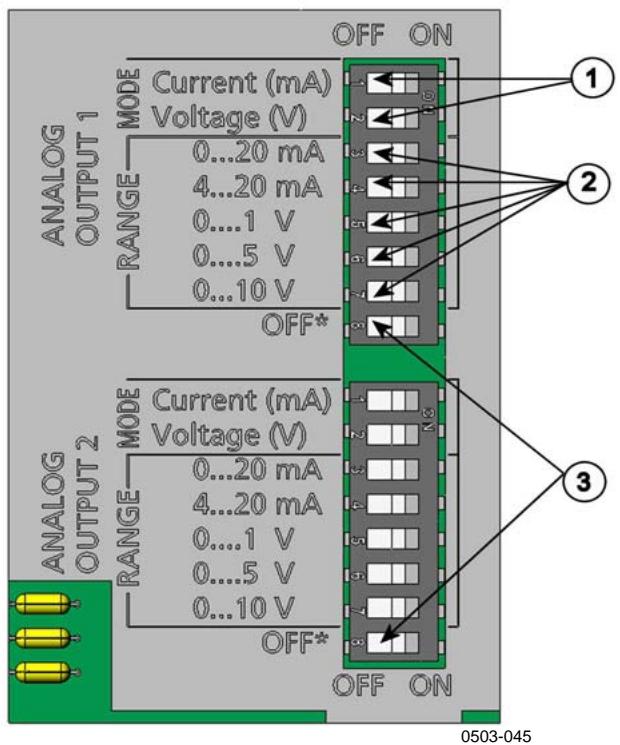
Figure 60 Current/Voltage Switches of Output Modules
The following numbers refer to Figure 60 above:
1 = Current/voltage selection output switches (from 1 to 2)
2 = Current/voltage range selection switches (from 3 to 7) in analog output 1 and 2.
3 = Switches for service use only. Keep in OFF position always.
NOTE
Only one of the switches 1 or 2 must be ON at a time.
Only one of the switches 3 to 7 must be ON at a time.
Example: 0 ... 5 V voltage output selected for channel 1 and 4 ... 20 mA selected for channel 2.

Selection
Voltage output selected
0 ... 5 V selected
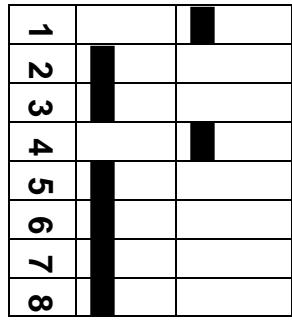
Current output selected
4 ... 20mA selected
NOTE
If you have customized the error output setting (AERR), check that the set error values are still valid after changing the output mode/range, see section Analog Output Fault Indication Setting on page 113.
Analog Output Quantities
Use the display/keyboard to change and scale the analog output quantities.
- Press any of the arrow buttons to open the MAIN MENU.
- Select Interfaces by pressing the arrow button.
- Select Analog outputs by pressing the arrow button.
- Select Output 1/2/3 by pressing the arrow button.
- Select Quantity by pressing the arrow buttons. Confirm your selection by pressing CHANGE.
- Select the quantity by using the arrow buttons. Press SELECT to confirm your selection.
-
Select Scale, lower limit, by pressing the arrow buttons. Press SET to confirm your selection. Press OK to confirm your setting.
-
Select the upper limit by pressing the arrow buttons. Use the arrow buttons to set the upper limit value. Press SET to confirm your selection. Press OK to confirm your setting.
- Press EXIT to return to the basic display.
AMODE/ASEL
Use the serial line to select and scale the analog output quantities. Connect the transmitter to the PC. Open the terminal connection between your PC and the transmitter.
- Check the analog output modes with the AMODE command.
Example:
>amode Ch1 output :0. .1V Ch2 output :0. .1V >
- Select and scale the quantities for the analog outputs with the command ASEL. Note that the optional quantities can be selected only if they have been selected when ordering the device.
ASEL [xxx yyy zzz]
where
xxx = Quantity of channel 1 yyy = Quantity of channel 2 zzz = Quantity of the optional analog output channel 3
Enter always all the quantities for all outputs. For quantities and their abbreviations see Table 3 on page 19 and Table 4 on page 19.
Use the command ASEL [xxx yyy] as shown in the example below when using a device with two analog outputs.
Example:
>asel rh t
Ch1 (RH) low : 0.00 %RH ? 0
Ch1 (RH) high : 100.00 %RH ? 100
Ch2 (T) low : -40.00 'C ? -50
Ch2 (T) high : 60.00 'C ? 80
>
Analog Output Tests
Use the display/Keypad for testing to test the operation of the analog by forcing the outputs to known values. Measure then the outputs with a current/voltage meter.
- Press any of the arrow buttons to open the MAIN MENU.
- Select System by pressing the arrow button.
- Select Diagnostics by pressing the arrow button.
- Select Analog output tests by pressing the arrow button.
- Select one of the testing options Force 0% / 50% / 100% of scale. Press TEST to confirm your selection. All outputs are tested simultaneously. The actual output value depends on the selected range.
- Press OK to stop testing. Press EXIT to return to the basic display.
ITEST
Use the serial line to test the operation of the analog outputs. Use the command ITEST to force the analog outputs to entered values. The set values remain valid until you enter the command ITEST without parameters or RESET the transmitter.
ITEST [aa.aaa bb.bbb]
where
aa.aaa = Current or voltage value to be set for channel 1 (mA or V) bb.bbb = Current or voltage value to be set for channel 2 (mA or V)
Example:
>itest 20 5
Ch1 (Td) : * 20.000 mA H'672A
Ch2 (T) : * 5.000 mA H'34F9
>itest
Ch1 (Td) : -23.204 'C 16.238 mA H'FFFE
Ch2 (T) : 22.889 'C 8.573 mA H'5950
>
Analog Output Fault Indication Setting
Factory default state for analog outputs during error condition is 0V / 0 mA. Please be careful when selecting the new error value. The error state of the transmitter should not cause unexpected problems in process monitoring.
Use the display/Keypad to set the analog output fault indication.
- Press any of the arrow buttons to open the MAIN MENU.
- Select Interfaces by pressing the arrow button.
- Select Analog Outputs by pressing the arrow button.
- Select Output 1/2/3 by pressing the arrow button.
- Select Fault indication. Press SET to confirm your selection. Enter the fault indication value by using the arrow buttons. Press OK to confirm your setting. This value is outputted if a transmitter error occurs.
- Press EXIT to return to the basic display.
AERR
Use the serial line AERR command to change the error output.
AERR
Example:
> aerr
Ch1 error out : 0.000V ? 5.0
Ch2 error out : 0.000V ? 5.0
>
NOTE
The error output value must be within a valid range of the output mode.
NOTE
The error output value is displayed only when there are minor electrical faults such as humidity sensor damage. When there is a severe device malfunction, the error output value is not necessarily shown.
Operation of Relays
Quantity for Relay Output
A relay monitors the quantity chosen for the relay output. Any of the quantities available can be chosen.
Measurement-Based Relay Output Modes
Relay Setpoints
When the measured value is in between the "above" and "below" values, the relay is passive. When choosing lower value as "above" value and higher value as "below" value, the relay is passive when the measured value is not between the setpoints. You can also set only one setpoint. See Figure 61 below for illustrative examples of the different measurement-based relay output modes.
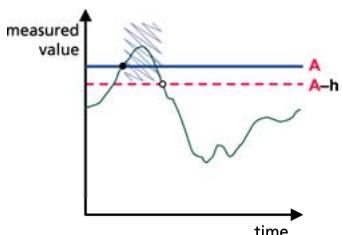
Mode 1: Only "above" setpoint set
Relay is active when value is above the setpoint.

Mode 2:Only "below" setpoint set
Relay is active when value is below the setpoint.
Legend
A "Active above" setpoint value
B "Active below" setpoint value
h Hysteresis value
Relay is active (NO-C connected)
Relay is released
Relay is activated

Mode 3: Both setpoints set, "above" > "below"
Relay is active when value is outside the setpoints.
Mode 4: Both setpoints set, "above" < "below"

Figure 61 Measurement-Based Relay Output Modes
Relay is released when value is outside the setpoints.
0610-076
Mode 4 is usually used if an alarm needs to be triggered when the measured value exceeds a safe range. The relay is active when measurement is in range, and is released if the value goes out of range or the measurement fails.
NOTE
If the measurement of the selected quantity fails or the transmitter loses its power, the relay is released.
Hysteresis
Hysteresis function is to prevent the relay switching back and forth when the measured value is near to the setpoint values.
Relay is activated when the measured value passes the exact value of the setpoint. When returning and passing the setpoint again relay is not released before the value reaches the setpoint increased/decreased by the hysteresis value.
Hysteresis should be smaller than difference of the setpoints.
Example: When the 'active above' value is 60% RH and the hysteresis value is 5% RH , relay activates when the relative humidity reaches 60% RH . As the humidity decreases, relay releases at 55% RH .
NOTE
If both setpoints are specified and "above" setpoint is lower than "below" setpoint, the hysteresis works in the opposite direction, that is, relay is released when the measured value passes the exact value of the setpoint.
Relay Indicating Transmitter Error Status
You can set a relay to follow the operation status of the device. By selecting FAULT/ONLINE STATUS for output quantity a relay changes state on the basis of the operation status as follows:
FAULT STATUS
Normal operation: relay active (C and NO outputs are closed)
Not measuring state (error state or power off): relay released (C and NC outputs are closed)
ONLINE STATUS
Live measurement (data available): relay active (C and NO outputs are closed)
No live data (for example: error state, chemical purge or adjustment mode): relay released (C and NC outputs are closed)
See Figure 62 below for illustrative examples of the FAULT/ONLINE STATUSrelay output modes.
Analog output vs. "FAULT STATUS" relay
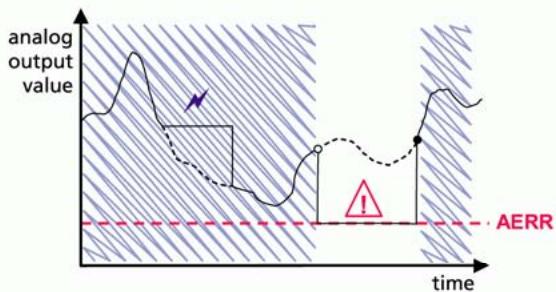
Relay is released in case of a measurement failure only.

Legend
Analog output vs. "ONLINE STATUS" relay
Figure 62 FAULT/ONLINE STATUS Relay Output Modes

Relay is released when the output values are frozen, the adjustment mode is activated, or an instrument failure is detected
0610-077
FAULT/ONLINE STATUS relays are usually used in conjunction with an analog output to obtain validity information for the output value.
NOTE
If transmitter loses its power, all status-based relays are released similarly to the case of an instrument failure.
Enabling/Disabling Relays
You can deactivate the relay outputs for example for service purposes of your system.
Setting Relay Outputs
NOTE
When having only one relay module installed, its relays are called 'relay 1' and 'relay 2'.
When having two relay modules, the relays of the module connected to slot MODULE 1 are called 'relay 1' and relay 2^ and relays connected to slot MODULE 2 are called 'relay 3^ and 'relay 4^

Figure 63 Relay Indicators on Display
The following number refers to Figure 63 above:
1 = Lists enabled relays. Activation state shown in black. Disabled relays are not shown.
Use the display/Keypad to set the relay outputs.
- Press any of the arrow buttons to open the MAIN MENU.
- Select Interfaces, confirm by pressing the arrow button.
- Select Relay outputs, confirm by pressing the arrow button.
- Select Relay 1/2/3/4, confirm by pressing the arrow button.
- Select the Quantity, confirm by pressing Change. Select the Quantity by using the arrow buttons. Confirm your selection by pressing Select.
- Select Act. above / Act. below. Press SET to confirm your selection. (If asked, select MODIFY if you want to set the setpoint by using the arrow buttons. Select REMOVE if you want to remove the setpoint.)
- Select Hysteresis by using the arrow buttons. Press SET to set the hysteresis. Press OK.
- Select Relay enable by using the arrow buttons, press ON/OFF to enable/disable the relay.
RSEL
Use the serial line to select the quantity, setpoints and hysteresis or enable/disable the relay outputs. Enter the RSEL command.
RSEL [q1 q2 q3 q4]
where
q1 = quantity for the relay 1 or Fault/Online q2 = quantity for the relay 2 or Fault/Online q3 = quantity for the relay 3 or Fault/Online q4 = quantity for the relay 4 or Fault/Online
Factory setting: all relays disabled.
Use the quantity abbreviations presented above. See Table 3 on page 19 and Table 4 on page 19.
Example of window limit switch: Selecting relay 1 to follow dewpoint/frost point temperature measurement and relay 2 to follow temperature measurement. Two relay setpoints are set for both relays.
>rsel rh t
Rel1 RH above: 0.00 %RH ? 30
Rel1 RH below: 0.00 %RH ? 40
Rel1 RH hyst : 0.00 %RH ? 2
Rel1 RH enabl: OFF ? ON
Rel2 T above: 0.00 'C ? 30
Rel2 T below: 0.00 'C ? 40
Rel2 T hyst : 0.00 'C ? 3
Rel2 T enabl: OFF ? ON
>
Example of normal limit switch: Selecting relay 1 to follow relative humidity, relay 2 to follow temperature, relay 3 to follow dewpoint and relay 4 to follow dewpoint. One setpoint is chosen for all the outputs.
>rsel rh t td td
Rel1 RH above: 60.00 %RH ? 70
Rel1 RH below: 70.00 %RH ? -
Rel1 RH hyst : 2.00 %RH ? 2
Rel1 RH enabl: ON ? on
Rel2 T above: 50.00 'C ? 60
Rel2 T below: 40.00 'C ? -
Rel2 T hyst : 2.00 'C ? 2
Rel2 T enabl: ON ? on
Rel3 Td above: 5.00 'C ? 10
Rel3 Td below: 0.00 'C ? -
Rel3 Td hyst : 1.00 'C ? 1
Rel3 Td enabl: OFF ? on
Rel4 Td above: 0.00 'C ? 20
Rel4 Td below: 0.00 'C ? -
Rel4 Td hyst : 0.00 'C ? 2
Rel4 Td enabl: OFF ? on
>
Example of using relay 1 as fault alarm: selecting relay 1 to follow the fault status and relay 2 to follow the temperature measurement.
>rsel fault t
Rel1 FAUL above: -
Rel1 FAUL below: -
Rel1 FAUL hyst: -
Rel1 FAUL enabl: ON ?
Rel2 T above: 0.00 'C ? 30
Rel2 T below: 0.00 'C ? -
Rel2 T hyst: 0.00 'C ? 2
Rel2 T enabl: OFF ? ON >
Testing Operation of Relays
Testing activates relays even if they are disabled.
Use the module push buttons to activate the relays. Press the REL 1 or REL 2 button to activate the corresponding relay.
Relay is activated: led is lit
Relay is not activated: led is not lit
Use the display/Keypad to test the operation of relays.
- Open the MAIN MENU by pressing any of the arrow buttons.
- Select System, press the arrow button.
- Select Diagnostics, press the arrow button.
- Select Relay tests, press the arrow button.
- Select Invert relay 1... , press TEST. Now the selected relay output is forced to opposite state. Press OK to return to normal operation.
- Press EXIT to return to the basic display.
RTEST
Use the serial line command RTEST to test the operation of the relays.
RTEST [x1x2x3x4]
where
x = ON / OFF
Example: Activate and then release all four relays.
>rtest on on on on ON ON ON ON
>
>rtest off off off off OFF OFF OFF OFF
>
Enter the command RTEST without parameters to stop testing.
Operation of the RS-485 Module
The RS-485 interface enables communication between RS-485 network and HMT330 transmitter. The RS-485 interface is isolated and offers a maximum communications rate of 115 200 bits/s. (For maximum bus length of 1km , use bit rate 19200b / s or less.)
When selecting an RS-232-RS-485 converter for the network, avoid self powered converters as they don't necessarily support the needed power consumption.
Echo function shall be always disabled (OFF) when using the 2-wire connection. When using the 4-wire connection you can disable/enable the echo setting.
NOTE
User port on HMT330 main board cannot be used and connected when RS-485 module is connected. Service port is operating normally.
Networking Commands
Set the RS-422/485 interface by using the following commands. The other serial line commands are presented in section List of Serial Commands on page 87.
RS-485 configuration commands SERI; ECHO; SMODE; INTV and ADDR may be entered by using either the service port or RS-422/485 port. Also the optional display/Keypad can be used, see section User Port Serial Settings on page 98.
SDELAY
With the SDELAY command you can set delay (response time) for user port (RS232 or RS485), or view currently set delay value. Value corresponds to tens of milliseconds (eg. 5 = 0.050 s minimum answer delay). The value can be set between 0...254.
Example:
> delay Serial delay : 0 ? 10
> delay Serial delay : 10 ?
SERI
Use the SERI command to input RS-485 bus settings.
SERI [b p d s]
where
b = bit rate (300, 600, 1200, 2400, 4800, 9600, 19200, 38400, 57600, 115200)
p = parity ( n = none, e = even, o = odd)
d = data bits (7 or 8)
s = stop bits (1 or 2)
ECHO
Use the ECHO command to enable/disable echo of characters received over the serial line.
ECHO [x]
where
x = ON/OFF (default = OFF)
When using 2-wire connection, echo must be always disabled.
SMODE
Use the SMODE command to set the default serial interface mode.
SMODE [xxxx]
where
xxxx = STOP, RUN or POLL
In STOP mode: measurements output only by command SEND, all commands can be used
In RUN mode: outputting automatically, only command S can be used to stop.
In POLL mode: measurements output only with command SEND [addr].
When several transmitters are connected to the same line, each transmitter must be entered an own address in the initial configuration, and POLL mode must be used.
INTV
Use the INTV command to set the RUN mode output interval.
INTV [n xxx]
where
$$ \begin{array}{l} n = 1 - 2 5 5 \ \mathrm {x x x} = \quad \mathrm {S}, \text {M I N o r H} \ \end{array} $$
This command sets the RUN mode output interval. The time interval is used only when the RUN mode is active. For example, the output interval is set to 10 minutes.
>INTV 10 min
Output intrv. : 10 min >
Setting RUN output interval to zero enables the fastest possible output rate.
ADDR
Addresses are required only for POLL mode (see serial line command SMODE on page 99). Use the ADDR command to input the RS-485 transmitter address.
OPEN [aa]
where
$$ a a = \text {a d d r e s s} (0 \dots 9 9) (\text {d e f a u l t} = 0) $$
Example: the transmitter is configured to address 99.
>ADDR Address : 2 ? 99 >
SEND
Use the SEND command to output the reading once in POLL mode:
SEND [aa]
where
aa = address of the transmitter
OPEN
When all transmitters on the RS-485 bus are in POLL mode the OPEN command sets one transmitter temporarily to STOP mode so that other commands can be entered.
OPEN [aa]
where
aa = address of the transmitter (0 ... 99)
CLOSE
The CLOSE command switches the transmitter back to the POLL mode.
Example:
OPEN 2 (opens the line to transmitter 2, other transmitters stay in POLL mode)
CRH (for example, calibration performed)
...
CLOSE (line closed)
Sensor Functions
Chemical Purge (Optional)
In some specific applications the sensor gain may decrease gradually due to an interference caused by a particular chemical present in the measured gas, for example. The decrease of sensor gain due to an interfering chemical and the effect of the chemical purge process are illustrated below, see Figure 64 below. The sensor polymer absorbs the interfering chemical; and this reduces the ability of the polymer to absorb water molecules and consequently the sensor gain decreases. In chemical purge, heating the humidity sensor to a temperature level of approximately +160^ for several minutes evaporates the interfering chemical.
The purge function starts with heating stage, continues with settling and when the temperature of the sensor is decreased the transmitter returns to normal mode. The whole cycle takes about 6 minutes.
NOTE
Chemical purge function locks the output values for about 6 minutes.
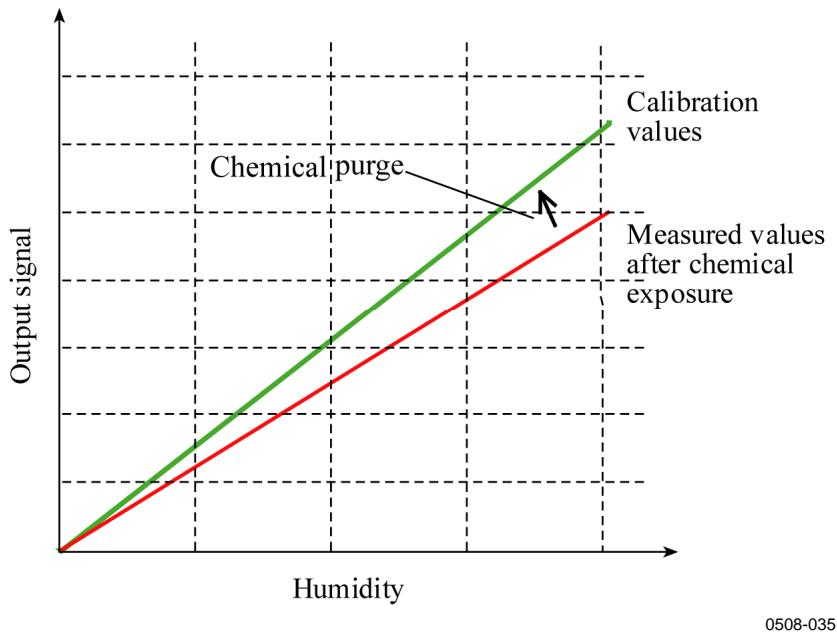
Figure 64 Decrease of Sensor Gain
Before starting the chemical purge note the following:
- The sensor is protected with a PPS grid with stainless steel netting, a stainless steel sintered filter or with membrane SST filter.
- The sensor temperature must be below 100^ . At higher temperatures the chemicals evaporate spontaneously from the sensor and the chemical purge is not necessary.
Automatic Chemical Purge (Interval Purge)
When HMT330 leaves the factory the automatic chemical purge (if chosen) takes place repeatedly with the time intervals set in the factory. User can change the interval in which the purge takes place by using serial commands or with the optional display/Keypad. This can be needed if the measuring environment contains high concentrations of interfering chemicals. The automatic chemical purge can also be turned off if necessary.
Manual Chemical Purge
The chemical purge should be performed always before calibration (see section Calibration and Adjustment on page 137) or when there is a reason to believe that a sensor has become exposed to an interfering chemical. Make sure that the temperature of the sensor has come down to normal temperature before starting a calibration.
Chemical Purge in Power Up
Chemical purge (start-up purge) can be set to start within 10 seconds from the power-up of the device.
Starting and Configuring Chemical Purge
Using Buttons on Motherboard
Start manual chemical purge by pressing simultaneously two PURGE buttons on the motherboard inside the transmitter for a few seconds. Indicator led flashes until purge is complete (up to 6 minutes).
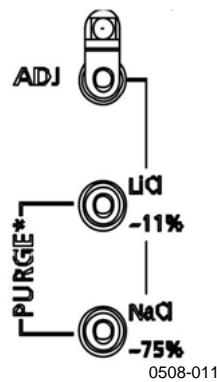
Figure 65 Purge Buttons on Motherboard
Using Display/Keypad (Optional)
Set the automatic and manual chemical purge by using the display/Keypad.
- Open the MAIN MENU by pressing any of the arrow buttons.
- Select Measuring, press button.
- Select Chemical purge, press button.
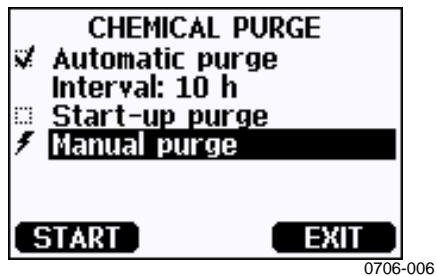
Figure 66 Chemical Purge Settings
- Turn on/off the automatic purge by selecting Automatic purge, press ON/OFF button.
- Set the automatic purge interval by selecting Interval: ..., press SET. Set the purge interval and the unit (hour/day) by using the arrow buttons. The interval must be 1 hour ... 10 days. Press OK.
- Select Start-up purge by using the arrow buttons. Press On/Off to turn the start-up purge on/off.
-
Start manual purge by selecting Manual purge and pressing START.
-
Press EXIT to return to the basic display.
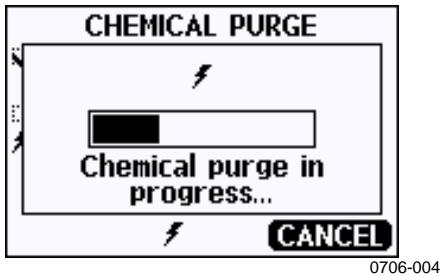
Figure 67 Performing Chemical Purge
Using Serial Line
PURGE
Enter the PURGE command to start chemical purge immediately.
purge
Purge started, press any key to abort.
The prompt '> appears when the heating period is over. However, the transmitter outputs are locked to the values measured before performing chemical purge until the settling time is over.
With PUR command you can enable or disable automatic and power-up chemical purge and set the interval for automatic purge. If the sensor is exposed to chemicals it is recommended to have the chemical purge done at least once in 720min ( = 12 hours). In applications where the chemical exposure is not likely, the interval can be longer.
It is not recommended to change duration, settling, temperature or temperature difference.
PUR
Type PUR and press ENTER to proceed. The maximum interval is 14400 minutes (=10 days).
Example:
>pur
Interval Purge : OFF ?
Interval : 720 min ?
Power-up Purge : OFF ?
Duration : 120 s ?
Settling : 240 s ?
Temperature : 160 'C ?
Temp. diff. : 0.5 'C ?
>
NOTE
To activate the new interval settings immediately, reset the transmitter.
NOTE
When chemical purge in power-up is enabled, wait about 6 min after power-up before taking measurements. The output channels are locked for the first operation minutes to the initial measured values
Sensor Heating
This function is optionally available only in transmitters with HUMICAP®180C or HUMICAP®180RC sensor. It should be used only with the warmed probe.
The sensor heating is recommended for the high humidity environments where even a small temperature differences can cause water to condense on the sensor. The sensor heating speeds up the recovery of the humidity sensor from condensation.
Sensor heating starts-up when the relative humidity of the measuring environment reaches the RH-value set by a user (RH-limit). The user can define the RH-sensor heating temperature as well as the duration of the heating.
After the heating cycle the humidity conditions are checked and new sensor heating is performed if the predefined conditions are reached again.
NOTE
During the sensor heating the outputs are locked to the values measured before the heating cycle.
Setting Humidity Sensor Heating
When the HMT330 leaves the factory the sensor heating follows the factory default values. You can enable/disable the function, change the RH-limit and define the heating temperature and duration of this function.
XHEAT
Enables/disables the sensor heating.
XHEAT [xx]
where:
$$ \mathrm {x x} = \mathrm {O N / O F F} $$
>xheat on Extra heat : ON >xheat off Extra heat : OFF
To configure the sensor heating use the XHEAT command without parameters. Enter the values after question mark. The available ranges include the following:
Extra heat RH -limit (heating function starts-up above the setpoint) 0 ... 100 %RH (default: 95 %RH)
Extra heating temperature 0 ... 200 °C (default: 100 °C)
Extra heating time 0 ... 255 s (default: 30 s)
Example:
>xheat Extra heat : OFF Extra heat RH : 95 ? 90 Extra heat temp: 100 ? 85 Extra heat time: 30 ? 10 >xheat on Extra heat : ON
This page intentionally left blank.
CHAPTER 5
MAINTENANCE
This chapter contains information that is needed in basic maintenance of the product.
Periodic Maintenance
Cleaning
Clean the transmitter enclosure with a soft, lint-free cloth moistened with mild detergent.
Changing the Probe Filter
- Turn the filter counter-clockwise to loosen it.
- Remove the filter from the probe. Be careful not to touch the sensor with the filter. Without the filter in place, the sensor is easily damaged – handle the probe carefully.
- Install a new filter on the probe. When using the stainless steel filter (for fuel cell applications), take care to tighten the filter properly (recommended force 5Nm ).
New filters can be ordered from Vaisala, see section Options and Accessories on page 155.
Changing the Sensor
The user can change the HUMICAP180 and HUMICAP180R sensors. If the transmitter has the chemical purge and/or warmed probe option (which utilize the HUMICAP180C or HUMICAP180RC sensor), the sensor cannot be changed by the user.
Changing the sensor should be considered corrective maintenance, and it is not necessary in normal operation. If the accuracy of the transmitter does not seem to be within specification, it is more likely that the transmitter is in need of calibration and adjustment, and not sensor replacement. Refer to chapter Calibration and Adjustment on page 137.
NOTE
When replacing the sensor, the new sensor must be of the same type as the old sensor (for example, HUMICAP180R). The sensor type can only be changed at a Vaisala Service Center.
- Remove the filter from the probe. See the instructions in section Changing the Probe Filter on page 131.
- Remove the damaged sensor and insert a new one. Handle the new sensor by the plastic socket. DO NOT TOUCH THE SENSOR PLATE.
- Perform a calibration and adjustment as instructed in section Relative Humidity Adjustment after Sensor Change on page 142.
- Attach a new filter on the probe. When using the stainless steel filter, take care to tighten the filter properly (recommended force 5Nm ).
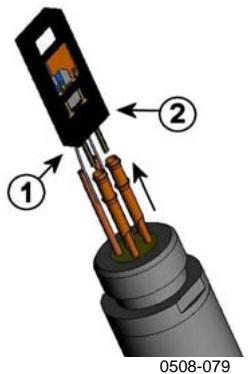
Figure 68 Changing the Sensor
The following numbers refer to Figure 68 above:
1 = Pull out the sensor
2 = Plastic socket
Error States
In error state the quantity is not measured and the output is shown as follows:
- Analog channel outputs 0mA or 0V (you can use the serial line command AERR or display/Keypad to change this fault indication value, see section Analog Output Fault Indication Setting on page 113.)
- The serial port outputs stars (^***)
- The cover LED is blinking
- Optional display: error indicator is lit.
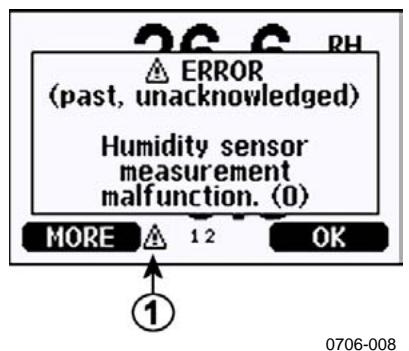
Figure 69 Error Indicator and Error Message
The following number refers to Figure 69 above:
1 = Error Indicator
The error indicator disappears when the error state is over and you have checked the error message. Press the INFO button to display the error message.
You can also check the error message via the serial interface by using the command ERRs. In case of constant error, please contact Vaisala, see Vaisala Service Centers on page 136.
Table 29 Error Messages
| Error Code | Error Message | Action |
| 0 | Humidity sensor measurement malfunction. | Check the integrity of the humidity probe and the probe cable. Clean the probe from dirt, water, ice or other contaminants. |
| 1 | Humidity sensor short circuit | Check the integrity of the humidity probe and the probe cable. Clean the probe from dirt, water, ice or other contaminants. |
| 2 | Humidity sensor open circuit | Check the integrity of the humidity probe and the probe cable. |
| 3 | Temperature sensor open circuit. | Check the integrity of the humidity probe and the probe cable. |
| 4 | Temperature sensor short circuit. | Check the integrity of the humidity probe and the probe cable. Clean the probe from dirt water, ice or other contaminants. |
| 5 | Temperature measurement malfunction | Check the integrity of the humidity probe and the probe cable. Clean the probe from dirt water, ice or other contaminants. |
| 6 | Temperature sensor current leak. | Check the integrity of the humidity probe and the probe cables. Clean the probes from dirt, water, ice or other contaminants. |
| 7 | Internal ADC read error | Internal transmitter failure. Remove the transmitter and return the faulty unit to Vaisala Service. |
| 8 | Additional temperature sensor short circuit | Check the integrity of the temperature probe and the probe cable. Clean the probe cable from dirt, water, ice or other contaminants. |
| 9 | Checksum error in the internal configuration memory | Internal transmitter failure. Remove the transmitter and return the faulty unit to Vaisala Service. |
| 10 | Internal EEPROM read error | Internal transmitter failure. Remove the transmitter and return the faulty unit to Vaisala Service. |
| 11 | Internal EEPROM write error | Internal transmitter failure. Remove the transmitter and return the faulty unit to Vaisala Service. |
| 12 ... 13 | Add-on module 1 (or 2) connection failure | Turn off the power and check the module connection. Turn on the power. |
| 14 | Device internal temperature out of range | Ensure that the operating temperature is within the valid range. |
| 15 | Operating voltage out of range | Ensure that the operating voltage is within the valid range. |
| 18 | Internal ADC reference voltage out of range | Internal transmitter failure. Remove the transmitter and return the faulty unit to Vaisala Service. |
| 19 | Internal analog output reference voltage out of range | Internal transmitter failure. Remove the transmitter and return the faulty unit to Vaisala Service. |
| 20 ... 23 | Configuration switches for analog output 1/2/3 set incorrectly | Check and re-set the switches, see page 54. |
| 24 ... 25 | EEPROM failure on add-on module 1 (or 2) | Disconnect the power and check the analog output module connection. |
| 26 | Communication module installed in incorrect add-on module slot | Disconnect the power and change the communication module to another module slot. |
| 28 ... 29 | Unknown/incompatible module installed in add-on module slot 1 (or 2) | Ensure that the module is compatible with the HMT330. |
| 30 | Internal analog voltage out of range | Internal transmitter failure. Remove the transmitter and return the faulty unit to Vaisala Service. |
| 31 | Internal system voltage out of range | Internal transmitter failure. Remove the transmitter and return the faulty unit to Vaisala Service. |
Technical Support
For technical questions, contact the Vaisala technical support:
E-mail helpdesk@vaisala.com
Fax +358989492790
Return Instructions
If the product needs repair, please follow the instructions below to speed up the process and to avoid extra costs to you.
- Read the section Warranty on page 18.
- Contact a Vaisala Service Center or a local Vaisala representative. The latest contact information and instructions are available from www.vaisala.com. Addresses of the Service Centers are provided in section Vaisala Service Centers on page 136.
Please have the following information on hand:
- serial number of the unit
- date and place of purchase or last calibration
- description of the fault
- circumstances in which the fault occurs/occurred
-
name and contact information of a technically competent person who can provide further information on the problem
-
Pack the faulty product in a strong box of adequate size, with proper cushioning material to avoid damage.
- Include the information specified in step 2 in the box with the faulty product. Also include a detailed return address.
- Ship the box to the address specified by your Vaisala contact.
Vaisala Service Centers
Vaisala Service Centers perform calibrations and adjustments as well as repair and spare part services. See contact information below.
Vaisala Service Centers also offer accredited calibrations, maintenance contracts, and a calibration reminder program. Do not hesitate to contact them to get further information.
European Service Center (Finland)
Controlled Environments and Instruments
North American Service Center
Controlled Environments and Instruments
10-D Gill Street, Woburn, MA 01801, USA.
Phone: 800-408-9456, Fax: +1 781 933 8029
Japan Service Center
42 Kagurazaka 6-Chome, Shinjuku-ku, Tokyo 162-0825, JAPAN.
Phone: +81 3 3266 9611, Fax: +81 3 3266 9610
China Service Center
Floor 2, EAS Building, No. 21, Xiao Yun Road, Dongsanhuan Beilu,
Chaoyang District, Beijing 100027, CHINA.
Phone: +86 10 8526 1199, Fax: +86 10 8526 1155
www.vaisala.com
CHAPTER 6
CALIBRATION AND ADJUSTMENT
The HMT330 is fully calibrated and adjusted as shipped from factory. Typical calibration interval is one year. Depending on the application it may be good to make more frequent checks. Calibration must be done always when there is a reason to believe that the device is not within the accuracy specifications.
It is recommended that calibration and adjustment should be carried out by Vaisala. See section Vaisala Service Centers on page 136.
Calibration and adjustment is carried out either by using the push-keys on the motherboard, through the serial port or with the optional display/Keypad.
(Vaisala portable instruments HM70 and HMI41 can also be used).
Opening and Closing the Adjustment Mode
- Open the transmitter cover. The buttons needed in adjustment are on the left-hand side of the motherboard.
- If the chemical purge option is available, it should be carried out always before calibration. To start chemical purge press simultaneously two PURGE push-keys (on the motherboard) for a few seconds. Red indicator led flashes with short pulses until purge is complete (up to 6 minutes).
- Press the ADJ key to open the adjustment mode.
- Press the ADJ key again to close the adjustment mode.
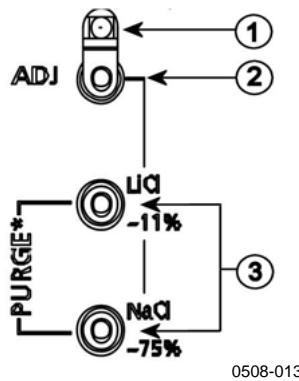
Figure 70 Adjustment and Purge Buttons
The following numbers refer to Figure 70 above:
1 = Indicator led
2 = Adjustment button
3 = Press the purge buttons simultaneously to start chemical purge (if available)
Adjustment menu is displayed only when ADJ button (on the motherboard inside the transmitter) is pressed.
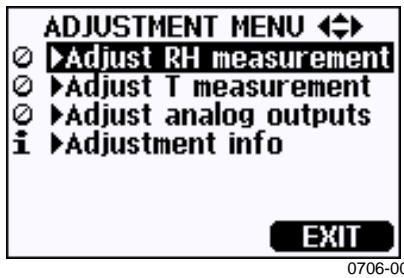
Figure 71 Adjustment Menu
Table 30 Indicator Led Functions
| Indicator Led Function | Description |
| LED off | adjustment locked |
| LED on | adjustment available |
| LED blinking evenly | measurement not stabilized |
| LED blinking with short pulses | performing chemical purge |
NOTE
If using a warmed probe (HMT337 option), probe heating will be interrupted when ADJ key is pressed. Allow sufficient time for the probe to reach ambient temperature before starting the adjustment procedure.
NOTE
Fixed pressure compensation value of 1013.25hPa is used when in adjustment mode
Relative Humidity Adjustment
Using Push-Buttons
A simple push-button adjustment is carried out by using two relative humidity references: 11% RH (LiCl) and 75% RH (NaCl).
- Carry out the chemical purge (if available).
LiCl reference
- Press the ADJ button (see Figure 70 on page 138) on the motherboard to open the adjustment mode. The indicator led starts flashing.
- Remove the filter from the probe and insert the probe into a measurement hole of the 11% RH (LiCl) in the humidity calibrator HMK15. Use the adapter fitting for the probes of HMT334, HMT335, HMT337 and HMT338.
- Wait at least 30 minutes for the sensor to stabilize (the indicator led is lit continuously). Adjustment cannot be done if the conditions are not stabilized (indicator led is flashing).
- When the indicator led is lit continuously, press the button LiCl~11% to adjust the 11% RH condition. After adjustment transmitter returns to normal operation mode (indicator LED is unlit).
NaCl reference
- When adjusting in the second reference 75% RH, press the ADJ button to open the adjustment mode. The indicator led starts flashing.
- Insert the probe into a measurement hole of the 75% RH (NaCl) reference chamber of the humidity calibrator HMK15. Use the adapter fitting for the probes of HMT334, HMT335, HMT337 and HMT338.
- Wait at least 30 minutes for the sensor to stabilize (the indicator led is lit continuously). Adjustment cannot be done if the conditions are not stabilized (indicator led is flashing).
- Press the button NaCl 75% to adjust the 75% RH condition. After adjustment transmitter returns to normal operation mode (indicator led is unlit).
Using Display/Keypad
Note that the difference between the two humidity references must be at least 50% RH.
- Carry out the chemical purge (if available).
- Press the ADJ button (opens the ADJUSTMENT MENU).
- Select Adjust RH measurement, press button.
- Select 1-point/2-point adjustment, press. Press START.
- Select the reference as guided by the display, press SELECT.
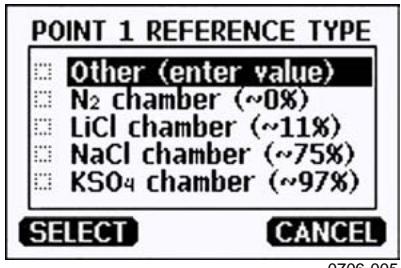
0706-005
Figure 72 Selecting Point 1 Reference Type
- Remove the filter from the probe and insert the probe into a measurement hole of the dry end reference chamber (for example, LiCl: 11% RH in the humidity calibrator HMK15.) Use the adapter fitting for the probes of HMT334, HMT335, HMT337 and HMT338.
- Wait at least 30 minutes for the sensor to stabilize. Follow the stabilization from the GRAPH display.
- Press READY when stabilized. If you have chosen the Other reference value, enter now the reference value by using the arrow buttons.
When carrying out the 2-point adjustment proceed to the next adjustment point and carry out the procedure as described in the previous items.
- Answer YES to confirm the adjustment. Press OK to return to the adjustment menu.
- Press EXIT to close the adjustment mode and return to the basic display. Before closing the adjustment mode, feed the adjustment information into the device, see section Feeding Adjustment Information on page 146.
Using Serial Line
Note that the difference between the two humidity references must be at least 50% RH.
- Connect the HMT330 to a PC. See section Serial Line Communication on page 73. Open a terminal program.
- Carry out the chemical purge (if available).
- Press the ADJ button.
- Remove the filter from the probe and insert the probe into a measurement hole of the dry end reference chamber (for example, LiCl: 11% RH in the humidity calibrator HMK15). Use the adapter fitting for the probes of HMT334, HMT335, HMT337 and HMT338.
- Enter the CRH command and press ENTER.
CRH
- Wait at least 30 minutes for the sensor to stabilize.
- Type C and press ENTER a few times to check if the reading is stabilized.
- When the reading is stabilized, give the reference humidity after the question mark and press ENTER.
>crh
RH : 11.25 Ref1 ? c
RH : 11.25 Ref1 ? c
RH : 11.25 Ref1 ? c
RH : 11.24 Ref1 ? c
RH : 11.24 Ref1 ? 11.3
Press any key when ready ...
- Now the device is waiting for the high end reference. Insert the probe into the measurement hole of the high end reference chamber (for example, NaCl: 75% RH chamber in the humidity calibrator HMK15). Use the adapter fitting for the HMT334, HMT335, HMT337 and HMT338 probes. Press any key when ready.
- Let the probe stabilize for about 30 minutes. You can follow the stabilization by typing C and pressing ENTER.
- When stabilized, type the high end reference value after the question mark and press ENTER.
>crh
RH : 11.25 Ref1 ? c
RH : 11.24 Ref1 ? c
RH : 11.24 Ref1 ? 11.3
Press any key when ready ...
- OK indicates that the adjustment has succeeded and the new calibration coefficients are calculated and stored. Enter the adjustment information (date and text) to the memory of the transmitter; see the commands CTEXT and CDATE.
- Press the ADJ button on the motherboard to close the adjustment mode.
- Take the probe out of the reference conditions and replace the filter.
Relative Humidity Adjustment after Sensor Change
Using Display/Keypad
When using the optional display/Keypad, follow the instructions on Using Display/Keypad on page 140 but select Adj. for new RH sensor (instead of 1-point/ 2-point adjustment).
Using Serial Line
After sensor change, carry out the procedure as described in previous sections. Just replace the CRH command with the FCRH command.
FCRH
Example:
>FCRH
RH : 1.821. ref ? 0
Press any key when ready...
RH : 74.22 2. ref ? 75
OK
>
The OK indicates that the calibration has succeeded.
Temperature Adjustment
Using Display/Keypad
- Press the ADJ button on the motherboard to open the ADJUSTMENT MENU. If using a warmed probe for measuring, probe heating will be interrupted when ADJ key is pressed. Wait some time for the probe to reach ambient temperature.
- Select Adjust T measurement, press key.
- Select 1-point/2-point adjustment, press. Press START.
- Remove the filter from the probe and insert the probe into the reference temperature.
- Wait at least 30 minutes for the sensor to stabilize. Follow the stabilization from the GRAPH display.
- Press READY when stabilized. Give the reference temperature by using the arrow buttons.
When carrying out the 2-point adjustment proceed to the next adjustment point and carry out the procedure as described in the previous item. Please, note that the difference between the two temperature references must be at least 30^ .
- Press OK. Press YES to confirm the adjustment.
- Press OK to return to the adjustment menu.
- Press EXIT to close the adjustment mode and return to the basic display.
Using Serial Line
- Press the ADJ key on the motherboard to open the adjustment mode. If using a warmed probe for measuring, probe heating will be interrupted when ADJ key is pressed. Wait some time for the probe to reach ambient temperature.
- Remove the probe filter and insert the probe into the reference temperature.
- Enter the command CT or (CTA for additional T probe) and press ENTER.
CT
or for additional T probe:
CTA
- Type C and press ENTER a few times to check if the reading is stabilized. Let the reading stabilize, give the reference temperature after the question mark and press ENTER three times.
When using two reference temperatures (2-point calibration) press ENTER only twice and insert the probe to the second reference. When the reading is stabilized, give the second reference temperature after the question mark and press ENTER. Please, note that the difference between the two temperature references must be at least 30^ .
Example (1-point adjustment):
- OK indicates that the calibration has succeeded. Enter the calibration information (date and text) to the transmitter's memory; see the serial commands CTEXT and CDATE.
- Press the ADJ button on the motherboard to close the adjustment mode.
- Take the probe out of the reference conditions and replace the filter.
Analog Output Adjustment
In the analog output calibration the analog output is forced to the following values:
- Current output: 2mA and 18mA
- Voltage output: 10% and 90% of the range
Connect HMT330 to a calibrated current/voltage meter in order to measure either current or voltage depending on the selected output type.
Using Display/Keypad
- Press the ADJ button to open the ADJUSTMENT MENU.
- Select Adjust analog outputs, press button.
- Select the output to be adjusted Adjust analog output 1/2, press START.
- Measure the first analog output value with a multimeter. Give the measured value by using the arrow buttons. Press OK.
- Measure the second analog output value with a multimeter. Give the measured value by using the arrow buttons. Press OK.
- Press OK to return to the adjustment menu.
- Press EXIT to close the adjustment mode and to return to the basic display.
Using Serial Line
Enter the ACAL command and type the multimeter reading for each case. Continue by pressing ENTER.
ACAL
Example (current outputs):
ACAL
Ch1 I1 (mA)? 2.046
Ch1 I2 (mA)? 18.087
Ch2 I1 (mA)? 2.036
Ch2 I2 (mA)? 18.071
Feeding Adjustment Information
This information is shown on the device information fields (see section Device Information on page 101.)
Using Display/Keypad
- If you are not in the adjustment menu, press the ADJ button on the motherboard (opens the ADJUSTMENT MENU).
- Select Adjustment info, press the button.
- Select Date, press SET. Give the date by using the arrow buttons. Press OK.
- Select i, press SET. Enter information text including 17 characters at maximum by using the arrow buttons. Press OK.
- Press EXIT to return to the basic display.
Using Serial Line
CTEXT
Use the CTEXT command to enter text to the adjustment information field.
Example:
>ctext
Adjust. info : (not set) ? HMK15
CDATE
Use the CDATE command to enter date to adjustment information field. Set the adjustment date in format YYYY-MM-DD.
Example.
>cdate
Adjust. date : (not set) ? 2004-05-21
CHAPTER 7
TECHNICAL DATA
This chapter provides the technical data of the product.
Specifications
Performance
Relative Humidity
Measurement range 0 ... 100 %RH
Accuracy (including non-linearity, hysteresis and repeatability)
with HUMICAP ^® 180
HUMICAP®180R
HUMICAP®180C
for typical applications
for typical applications
for applications with chemical purge and/or warmed probe
HUMICAP®180RC
for applications with chemical purge and/or warmed probe
at +15 25^
± 1% RH (0 ... 90% RH)
at -20 +40^
± 1.7% RH (90 ... 100% RH )
at -40 +180^
± (1.0 + 0.008 × reading) % RH
± (1.5 + 0.015 × reading) % RH
Factory calibration uncertainty (+20^)
± 0.6% RH (0 ... 40% RH)
± 1.0% RH (40 ... 97 % RH)
(Defined as ± 2 standard deviation limits.
Small variations possible, see also calibration certificate.)
Response time (90 %) for HUMICAP®180 and HUMICAP®180C in still air
8 s with grid filter
20 s with grid + steel netting filter
40 s with sintered filter
Response time (90%) for HUMICAP®180R and HUMICAP®180RC
at 20^ in 0.1m / s air flow
17 s with grid filter
50 s with grid + steel netting filter
60 s with sintered filter
Temperature (+ Operating Pressure Ranges)
| HMT331 | -40 ... +60 °C (-40 ... +140 °F) |
| HMT333 80 °C | -40 ... +80 °C (-40 ... +176 °F) |
| HMT333 120 °C | -40 ... +120 °C (-40 ... +248 °F) |
| HMT334 | -70 ... +180 °C (-94 ... +356 °F) |
| 0 ... 10 MPa (0 ... 100 bar) | |
| HMT335 (vapor tight) | -70 ... +180 °C (-94 ... +356 °F) |
| HMT337 (vapor tight) | -70 ... +180 °C (-94 ... +356 °F) |
| HMT338 | -70 ... +180 °C (-94 ... +356 °F) |
| 0 ... 4 MPa (0 ... 40 bar) |
Accuracy at +20^(+68^) ± 0.2^
Accuracy over temperature range (see graph below):

Figure 73 Accuracy over Temperature Range
Temperature sensor
Pt 100 RTD 1/3 Class B IEC 751
Optional Temperature Probe
Temperature measurement
| range: | -70 ... + 180 °C (-94 ... +356 °F) |
| Typical accuracy: | 0.1 °C (0.18 °F) |
| Sensor: | Pt100 PRT DIN IEC 751 class 1/4 B |
| Cable length: | 2 m, 5 m, and 10 m |
| Pressure tight: | up to 7 bar |
| Probe material: | stainless steel |
Calculated Variables
Table 31 Calculated Variables (Typical Ranges)
| Variable | HMT331 probe | HMT333 probe | HMT334/335/337/338 probes |
| Dewpoint temperature | -20 ... +60 °C | -20 ... +80 °C | -20 ... +100 °C |
| Mixing ratio | 0 ... 160 g/kg dry air | 0 ... 500 g/kg dry air | 0 ... 500 g/kg dry air |
| Absolute humidity | 0 ... 160 g/m3 | 0 ... 500 g/m3 | 0 ... 500 g/m3 |
| Wet bulb temperature | 0 ... 60 °C | 0 ... +100 °C | 0 ... +100 °C |
| Enthalpy | -40 ... +1500 kJ/kg | -40 ... +1500 kJ/kg | -40 ... +1500 kJ/kg |
| Water vapor pressure | 0 ... 1000 hPa | 0 ... 1000 hPa | 0 ... 1000 hPa |
Accuracies of Calculated Variables
Accuracies of the calculated variables depend on the calibration accuracy of the humidity and temperature sensors; here the accuracies are given for ± 2% RH and ± 0.2^ C .
Accuracy of Dewpoint Temperature °C
Relative humidity
| Temp. | 10 | 20 | 30 | 40 | 50 | 60 | 70 | 80 | 90 | 100 |
| -40 | 1.86 | 1.03 | 0.76 | 0.63 | 0.55 | 0.50 | 0.46 | 0.43 | — | — |
| -20 | 2.18 | 1.19 | 0.88 | 0.72 | 0.62 | 0.56 | 0.51 | 0.48 | — | — |
| 0 | 2.51 | 1.37 | 1.00 | 0.81 | 0.70 | 0.63 | 0.57 | 0.53 | 0.50 | 0.48 |
| 20 | 2.87 | 1.56 | 1.13 | 0.92 | 0.79 | 0.70 | 0.64 | 0.59 | 0.55 | 0.53 |
| 40 | 3.24 | 1.76 | 1.27 | 1.03 | 0.88 | 0.78 | 0.71 | 0.65 | 0.61 | 0.58 |
| 60 | 3.60 | 1.96 | 1.42 | 1.14 | 0.97 | 0.86 | 0.78 | 0.72 | 0.67 | 0.64 |
| 80 | 4.01 | 2.18 | 1.58 | 1.27 | 1.08 | 0.95 | 0.86 | 0.79 | 0.74 | 0.70 |
| 100 | 4.42 | 2.41 | 1.74 | 1.40 | 1.19 | 1.05 | 0.95 | 0.87 | 0.81 | 0.76 |
| 120 | 4.86 | 2.66 | 1.92 | 1.54 | 1.31 | 1.16 | 1.04 | 0.96 | 0.89 | 0.84 |
| 140 | 5.31 | 2.91 | 2.10 | 1.69 | 1.44 | 1.26 | 1.14 | 1.05 | 0.97 | 0.91 |
| 160 | 5.80 | 3.18 | 2.30 | 1.85 | 1.57 | 1.38 | 1.24 | 1.14 | 1.06 | 0.99 |
Accuracy of Mixing Ratio g/kg (Ambient Pressure 1013 mbar)
Relative humidity
| Temp. | 10 | 20 | 30 | 40 | 50 | 60 | 70 | 80 | 90 | 100 |
| -40 | 0.003 | 0.003 | 0.003 | 0.003 | 0.003 | 0.004 | 0.004 | 0.004 | — | — |
| -20 | 0.017 | 0.018 | 0.019 | 0.021 | 0.022 | 0.023 | 0.025 | 0.026 | — | — |
| 0 | 0.08 | 0.09 | 0.09 | 0.10 | 0.10 | 0.11 | 0.11 | 0.12 | 0.13 | 0.13 |
| 20 | 0.31 | 0.33 | 0.35 | 0.37 | 0.39 | 0.41 | 0.43 | 0.45 | 0.47 | 0.49 |
| 40 | 0.97 | 1.03 | 1.10 | 1.17 | 1.24 | 1.31 | 1.38 | 1.46 | 1.54 | 1.62 |
| 60 | 2.68 | 2.91 | 3.16 | 3.43 | 3.72 | 4.04 | 4.38 | 4.75 | 5.15 | 5.58 |
| 80 | 6.73 | 7.73 | 8.92 | 10.34 | 12.05 | 14.14 | 16.71 | 19.92 | 24.01 | 29.29 |
| 100 | 16.26 | 21.34 | 28.89 | 40.75 | 60.86 | 98.85 | 183.66 | 438.56 | — | — |
| 120 | 40.83 | 74.66 | 172.36 | — | — | — | — | — | — | — |
Accuracy of Wet Bulb Temperature ^ C
Relative humidity
| Temp. | 10 | 20 | 30 | 40 | 50 | 60 | 70 | 80 | 90 | 100 |
| -40 | 0.20 | 0.20 | 0.20 | 0.20 | 0.20 | 0.20 | 0.20 | 0.20 | — | — |
| -20 | 0.21 | 0.21 | 0.22 | 0.22 | 0.22 | 0.22 | 0.23 | 0.23 | — | — |
| 0 | 0.27 | 0.28 | 0.28 | 0.29 | 0.29 | 0.29 | 0.30 | 0.30 | 0.31 | 0.31 |
| 20 | 0.45 | 0.45 | 0.45 | 0.44 | 0.44 | 0.44 | 0.43 | 0.43 | 0.42 | 0.42 |
| 40 | 0.84 | 0.77 | 0.72 | 0.67 | 0.64 | 0.61 | 0.58 | 0.56 | 0.54 | 0.52 |
| 60 | 1.45 | 1.20 | 1.03 | 0.91 | 0.83 | 0.76 | 0.71 | 0.67 | 0.63 | 0.60 |
| 80 | 2.23 | 1.64 | 1.32 | 1.13 | 0.99 | 0.89 | 0.82 | 0.76 | 0.72 | 0.68 |
| 100 | 3.06 | 2.04 | 1.58 | 1.31 | 1.14 | 1.01 | 0.92 | 0.85 | 0.80 | 0.75 |
| 120 | 3.85 | 2.40 | 1.81 | 1.48 | 1.28 | 1.13 | 1.03 | 0.95 | 0.88 | 0.83 |
| 140 | 4.57 | 2.73 | 2.03 | 1.65 | 1.41 | 1.25 | 1.13 | 1.04 | 0.97 | 0.91 |
| 160 | 5.25 | 3.06 | 2.25 | 1.82 | 1.55 | 1.37 | 1.24 | 1.13 | 1.05 | 0.99 |
Accuracy of Absolute Humidity g/m3
Relative humidity
| Temp. | 10 | 20 | 30 | 40 | 50 | 60 | 70 | 80 | 90 | 100 |
| -40 | 0.004 | 0.004 | 0.005 | 0.005 | 0.005 | 0.006 | 0.006 | 0.006 | — | — |
| -20 | 0.023 | 0.025 | 0.027 | 0.029 | 0.031 | 0.032 | 0.034 | 0.036 | — | — |
| 0 | 0.10 | 0.11 | 0.12 | 0.13 | 0.13 | 0.14 | 0.15 | 0.15 | 0.16 | 0.17 |
| 20 | 0.37 | 0.39 | 0.41 | 0.43 | 0.45 | 0.47 | 0.49 | 0.51 | 0.53 | 0.55 |
| 40 | 1.08 | 1.13 | 1.18 | 1.24 | 1.29 | 1.34 | 1.39 | 1.44 | 1.49 | 1.54 |
| 60 | 2.73 | 2.84 | 2.95 | 3.07 | 3.18 | 3.29 | 3.40 | 3.52 | 3.63 | 3.74 |
| 80 | 6.08 | 6.30 | 6.51 | 6.73 | 6.95 | 7.17 | 7.39 | 7.61 | 7.83 | 8.05 |
| 100 | 12.2 | 12.6 | 13.0 | 13.4 | 13.8 | 14.2 | 14.6 | 15.0 | 15.3 | 15.7 |
| 120 | 22.6 | 23.3 | 23.9 | 24.6 | 25.2 | 25.8 | 26.5 | 27.1 | 27.8 | 28.4 |
| 140 | 39.1 | 40.0 | 41.0 | 42.0 | 43.0 | 44.0 | 45.0 | 45.9 | 46.9 | 47.9 |
| 160 | 63.5 | 64.9 | 66.4 | 67.8 | 69.2 | 70.7 | 72.1 | 73.5 | 74.9 | 76.4 |
Dewpoint Temperature (HMT337 Warmed Probe Option)
Find the intersection of the dewpoint temperature curve and the dewpoint difference reading (process temperature-dewpoint temperature) on the x-axis and read the accuracy in dewpoint measurement on the y-axis.
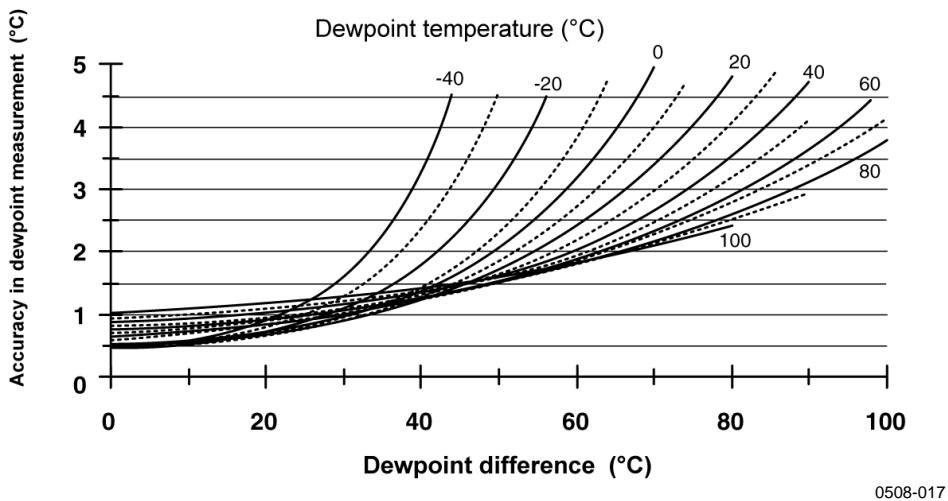
Figure 74 Accuracy in Dewpoint Measurement
Operating Environment
Operating temperature range
for humidity measurement -70...+180°C(-94...+356°F)
see probe specifications
for transmitter body electronics -40 ... +60 °C (40 ... +140 °F)
with display 0 +60^(+32 +140^)
Storage temperature -55 ... +80 °C (-67 ... +176 °F)
Electromagnetic compatibility EN61326-1:1997+Am1:1998 +Am2:2001
Industrial environment
Inputs and Outputs
Operating voltage
with optional power supply module
Start-up time after power-up
10 ... 35 VDC, 24 VAC
100 ... 240 VAC, 50 / 60Hz
3s
Power consumption @ 20^ (Uin 24VDC)
RS-232
Uout 2× 0 ...1V/0...5V/0...10V
Iout 2× 0 20mA
display and backlight
during sensor purge
Analog outputs (2 standard, 3rd optional)
current output
voltage output
Accuracy of analog outputs at 20^
Temperature dependence of the analog outputs
External loads
current outputs
0 ... 1V output
0 ... 5V and 0 ... 10V outputs
Max wire size
Digital outputs
Relay outputs (optional)
Display (optional)
Menu languages
max 25mA
max 25mA
max 60mA
+20mA
+110mA max
0 ... 20 mA, 4 ... 20 mA
0 ... 1 V, 0 ... 5 V, 0 ... 10 V
± 0.05% full scale
± 0.005% /^ full scale
RL < 500 ohm
stranded wires recommended
RS-232, RS-485 (optional)
0.5 A, 250 VAC, SPDT
LCD with backlight, graphic
trend display
English, French, Spanish,
German, Japanese, Russian,
Swedish, Finnish, Chinese.
Mechanics
Cable bushing
Conduit fitting
User cable connector (optional)
option 1
option 2
Probe cable diameter
HMT333 80^
Other probes
Probe cable lengths
Probe tube material
HMT331
Other probes
Housing material
Housing classification
M20x1.5 for cable diameter
8 ... 11mm/0.31..0.43"
1/2"NPT
M12 series 8-pin (male)
with plug (female) with 5m /
16.4 ft black cable
with plug (female) with screw
terminals
6.0mm
5.5 mm
2m,5m or 10m
Chromed ABS plastic
AISI 316L
G-AlSi 10Mg (DIN 1725)
IP 65 (NEMA 4)
Transmitter Weight
Table 32 Transmitter Weight (in kg/lb)
| Probe Type | Probe Cable Length | ||
| 2 m | 5 m | 10 m | |
| HMT333 | 1.1/2.4 | 1.2/2.6 | 1.5/3.3 |
| HMT334 | 1.4/3.1 | 1.6/3.5 | 1.9/4.2 |
| HMT335 | 1.3/2.9 | 1.4/3.1 | 1.7/3.7 |
| HMT337 | 1.2/2.6 | 1.3/2.9 | 1.5/3.3 |
| HMT338 178 mm | 1.3/2.9 | 1.5/3.3 | 1.7/3.7 |
| HMT338 400 mm | 1.4/3.1 | 1.6/3.5 | 1.9/4.2 |
Technical Specifications of Optional Modules
Power Supply Module
Operating voltage Connections
100 ... 240 VAC 50/60 Hz
screw terminals for
0.5 ... 2.5 mm² wire
(AWG 20 ... 14)
for 8 ... 11 mm diameter cable
-40 ... +60 °C (-40 ... +140 °F)
-40 ... +70°C (-40 ... +158 °F)
E249387
Bushing
Operating temperature
Storage temperature
UL file number
Analog Output Module
Outputs
Operating temperature range
Power consumption U_out0 1V U_out0 5V / 0 10V I_out0 20mA
0 ... 20 mA, 4 ... 20 mA,
0 ... 1 V, 0 ... 5 V, 0 ... 10 V
-40 ... +60 °C (-40 ... +140 °F)
max 30 mA
max 30 mA
max 60 mA
External loads current outputs
Max load ^+ cable loop resistance 0...1V 0...5V and 0...10 V
R_L < 500 ohms
540 ohms R_L > 2000 ohms R_L > 10000 ohms
Storage temperature range 3-pole screw terminal Max wire size
-55 ... +80 °C (-67 ... +176 °F)
1.5 mm² (AWG16)
Relay Module
Operating temperature range -40 ... +60 °C (-40 ... +140 °F)
Operating pressure range 500 ... 1300 mmHg
Power consumption @ 24 V
Contacts SPDT (change over), for example,
Contact arrangement Form C
Imax
Imax
Safety standard for the relay component
Storage temperature range
3-pole screw terminal / relay
Max wire size
0.5 A 250 VAC
0.5 A 30 VDC
IEC60950 UL1950
-55 ... +80 °C (-67 ... +176 °F)
2.5mm2 (AWG14)
RS-485 Module
Operating temperature range -40 ... +60 °C (-40 ... +140 °F)
Operating modes 2-wire (1-pair) half duplex
4-wire (2-pair) full duplex
115.2 kbaud
300VDC
Bus isolation
Power consumption @ 24V
External loads standard loads
Storage temperature range
Max wire size
max 50mA
32 RL>10kohm
-55 ... +80 °C (-67 ... +176 °F)
1.5mm2 (AWG16)
LAN Interface Module
Operating temperature range -40 ... +60 °C (-40 ... +140 °F)
Storage temperature range
Operating humidity range
Power consumption @ 24V
Ethernet type
Connector
Supported protocols
5...95%RH
max 60mA
10/100Base-T
RJ45
Telnet
WLAN Interface Module
Operating temperature range -20 ... +60 °C (-4 ... +140 °F)
Storage temperature range
-40 ... +85 °C (-40 ... +185 °F)
Operating humidity range
Power consumption @ 24V
Supported standards
5...95%RH
max 80mA
802.11b
RP-SMA
Telnet
WEP 64/128,WPA
Data Logger Module
Operating temperature range
Storage temperature range
Power consumption @ 24V
Logged parameters
-40 ... +60 °C (-40 ... +140 °F)
-55 ... +80 °C (-67 ... +176 °F)
max 10mA
up to three with trend/min/max values for each
10 s (fixed)
4 years 5 months
13.7 million points / parameter better than ± 2 min/year
Logging interval
Maximum logging period
Logged points
Accuracy of the clock
Battery lifetime
at -40 +30^ (-40 +86^)
at +30 +60^ (+86 +140^)
7 years
5 years
Options and Accessories
| Description | Item code |
| MODULES | |
| Relay Module | RELAY-1 |
| Analog Output Module | AOUT-1 |
| Isolated RS485 Module | RS485-1 |
| Power Supply Module | POWER-1 |
| Galvanic Isolation Module | DCDC-1 |
| SENSORS | |
| HUMICAP180 | HUMICAP180 |
| HUMICAP180R | HUMICAP180R |
| PT100 Sensor | 10429SP |
| FILTERS | |
| PPS Plastic Grid with Stainless Steel Netting | DRW010281SP |
| PPS Plastic Grid Filter | DRW010276SP |
| Sintered Filter AISI 316L | HM47280SP |
| Stainless Steel Filter | HM47453SP |
| Stainless Steel Filter with Membrane | 214848SP |
| TRANSMITTER MOUNTING ACCESSORIES | |
| Wall Mounting Kit | 214829 |
| Probe Holder Plate | 226252 |
| Installation Kit for Pole or Pipeline | 215108 |
| Rain Shield with Installation Kit | 215109 |
| DIN Rail Clips with Installation Plate | 215094 |
| Meteorological Installation Kit | HMT330MIK |
| Panel Mounting Frame | 216038 |
| PROBE MOUNTING ACCESSORIES | |
| HMT334 | |
| Fitting Body M22x1.5 | 17223SP |
| Fitting Body NPT1/2 | 17225SP |
| HMT335 | |
| Mounting Flange For HMT335 | 210696 |
| HMT337 | |
| Swagelok for 12mm Probe 3/8" ISO Thread | SWG12ISO38 |
| Swagelok for 12mm Probe 1/2" ISO Thread | SWG12ISO12 |
| Swagelok for 12mm Probe 1/2" NPT Thread | SWG12NPT12 |
| Swagelok for 6mm Probe 1/2" ISO Thread | SWG6ISO12 |
| Swagelok for 6mm Probe 1/8" ISO Thread | SWG6ISO18 |
| Swagelok for 6mm Probe 1/8" NPT Thread | SWG6NPT18 |
| Cable Gland M20x1.5 with Split Seal | HMP247CG |
| Duct Installation Kit for HMT333 and HMT337 | 210697 |
| Duct Installation Kit for Temperature Probe | 215003 |
| HMT338 | |
| Ball Valve ISO1/2 with Welding Joint | BALLVALVE-1 |
| Fitting Body ISO1/2 Solid Structure | DRW212076SP |
| Fitting Body NPT1/2 Solid Structure | NPTFITBODASP |
| Thread Adapter ISO1/2 to NPT1/2 | 210662SP |
| Manual Press | HM36854SP |
| Plug Kit (ISO 1/2) | 218773 |
| CONNECTION CABLES | |
| Serial Interface Cable | 19446ZZ |
| USB-RJ45 Serial Interface Cable | 219685 |
| MI70 Connection Cable with RJ45 Connector | 211339 |
| HMI41 Connection Cable with RJ45 Connector | 25917ZZ |
| OUTPUT CABLES FOR 8-PIN CONNECTOR | |
| Connection Cable 5m 8-pin M12 Female, Black | 212142 |
| Female Connector 8-pin M12 with Screw Terminals | 212416 |
| Male Connector 8-pin M12 with Cable and Adapter | 214806SP |
| CABLE BUSHINGS | |
| Cable Gland M20x1.5 for 8 ... 11mm Cable | 214728SP |
| Cable Gland M20x1.5 for 11 ... 14mm Cable | 214729 |
| Cable Gland M16x1.5 for Wall Mounting Plate Pass-Through | 216681SP |
| Conduit Fitting M20x1.5 for NPT1/2 Conduit | 214780SP |
| Dummy Plug M20x1.5 | 214672SP |
| WINDOWS SOFTWARE | |
| Software Interface Kit | 215005 |
| OTHER | |
| HMK15 Calibration Adapter for 12 mm Probes with >7 mm Sensor Pins | 211302SP |
| HMK15 Calibration Adapter for 12 mm Probes with <3 mm Sensor Pins | 218377SP |
Dimensions (mm/inch)


Figure 75 Transmitter Body Dimensions
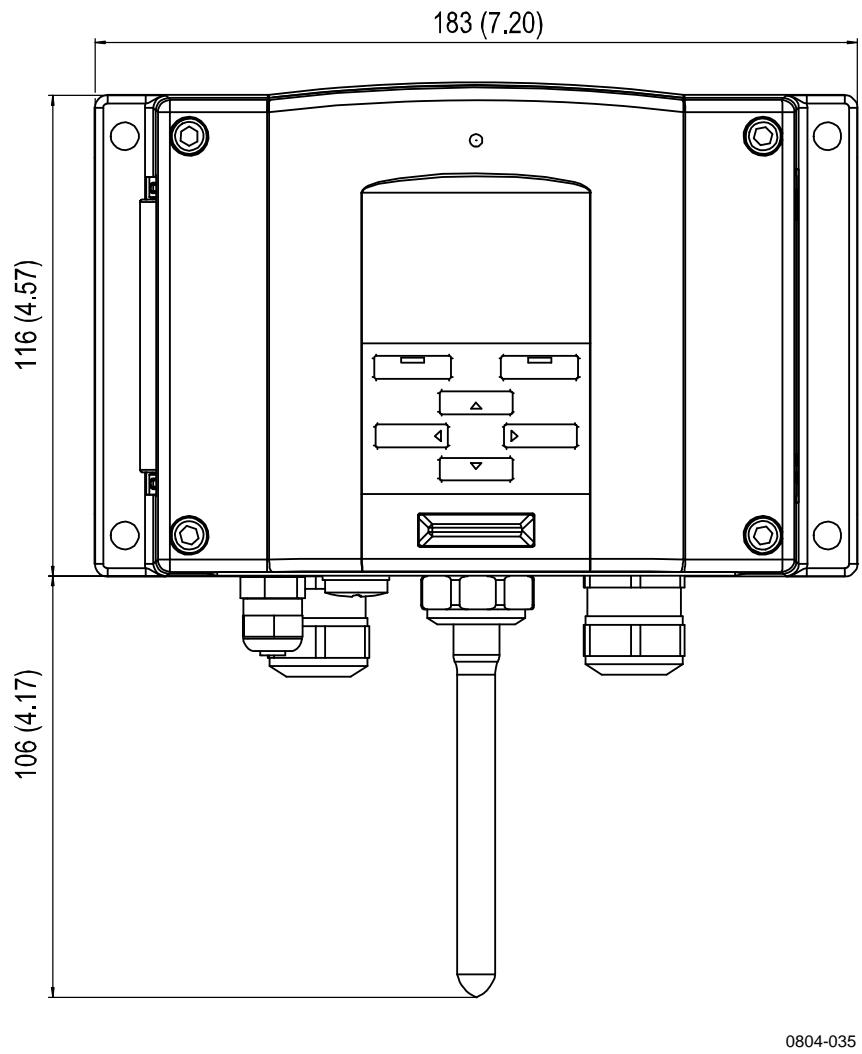
Figure 76 WLAN Antenna Dimensions
HMT331
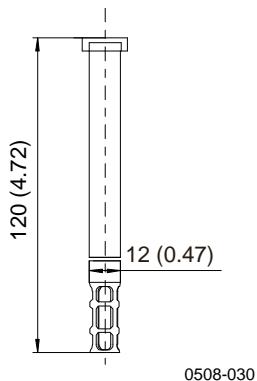
Figure 77 HMT331 Fixed Probe Dimensions
Figure 78 HMT331 Short Cable Probe Dimensions

0911-060
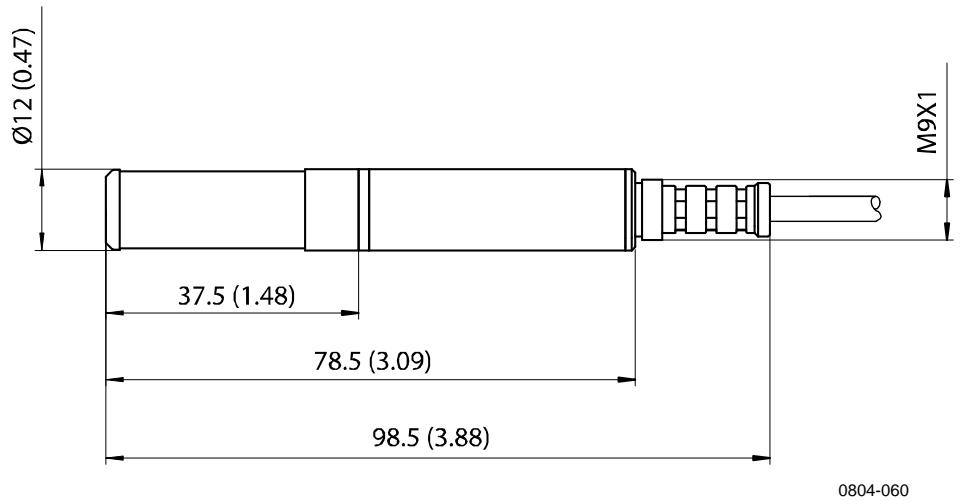
HMT333
Figure 79 HMT333 Probe Dimensions
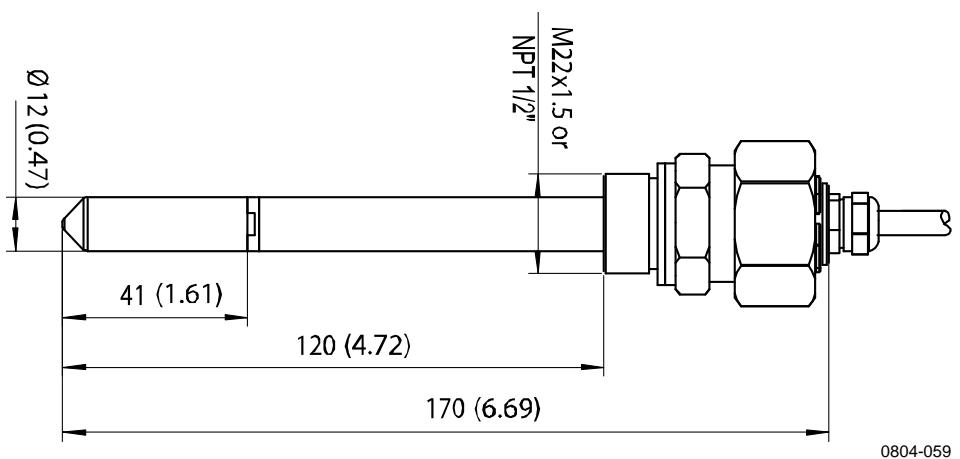
HMT334
Figure 80 HMT334 Probe Dimensions
HMT335

Figure 81 HMT335 Probe Dimensions
The flange is available as an option for the HMT335 probe.
HMT337
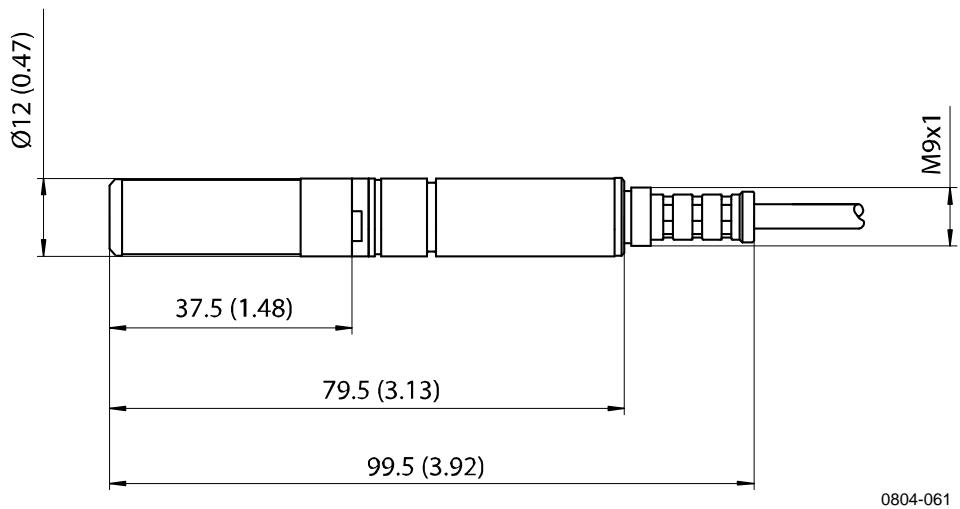
Figure 82 HMT337 Probe Dimensions
HMT338
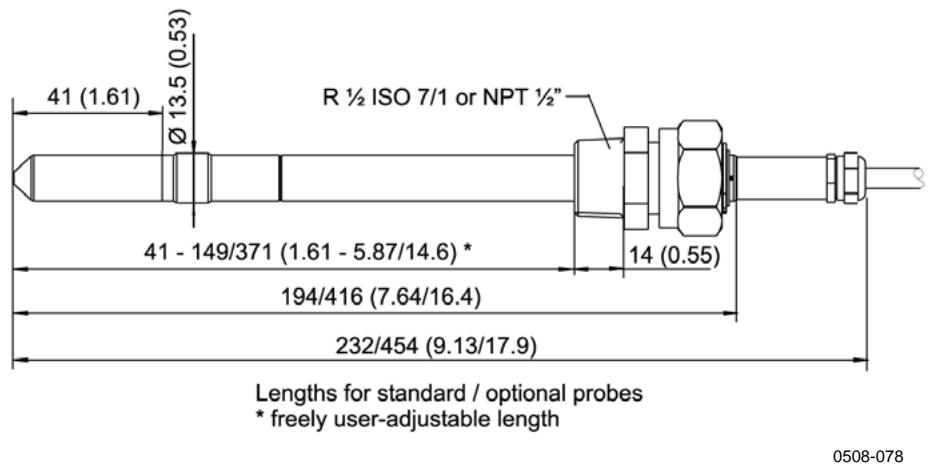
Figure 83 HMT338 Probe Dimensions
Temperature Probe
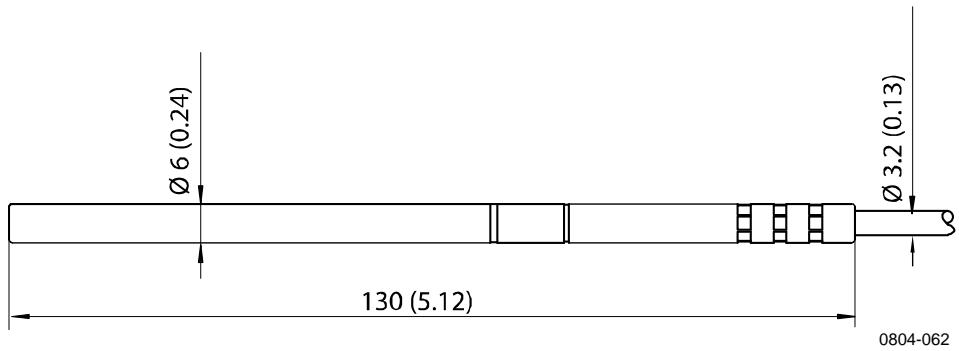
Figure 84 Optional Temperature Probe Dimensions
APPENDIX A
PROBE INSTALLATION KITS AND INSTALLATION EXAMPLES
Duct Installation Kits (for HMT333/337/335)
Duct installation kit includes a flange, a sealing ring, a supporting bar, a probe attaching part, and screws for attaching the flange to the duct wall. Vaisala order codes: 210697 (for HMT333 and HMT337), 210696 (for HMT335, no supporting bar), and 215003 for temperature probe.

Figure 85 Duct Mounting Installation Kit
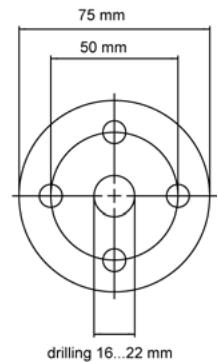
0508-021
The following numbers refer to Figure 85:
1 = Duct wall
2 = Flange
3 = Sealing ring
4 = Supporting bar (not included in the kit for HMT335)
5 = Probe attaching part (to be fixed with the supporting bar)
6 = Relative humidity probe
NOTE
When the temperature difference between the duct and the air outside the duct is remarkable, the supporting bar must be installed as deep in the duct as possible. This prevents errors caused by the heat conduction in the bar and cable.
Duct Installation Kit for Temperature Probe (for HMT337)
Vaisala duct installation kit for the T-probe includes flange, supporting bar, probe attaching part, sealing ring and the fixing screws (4 pcs).
Vaisala order code: 215003.
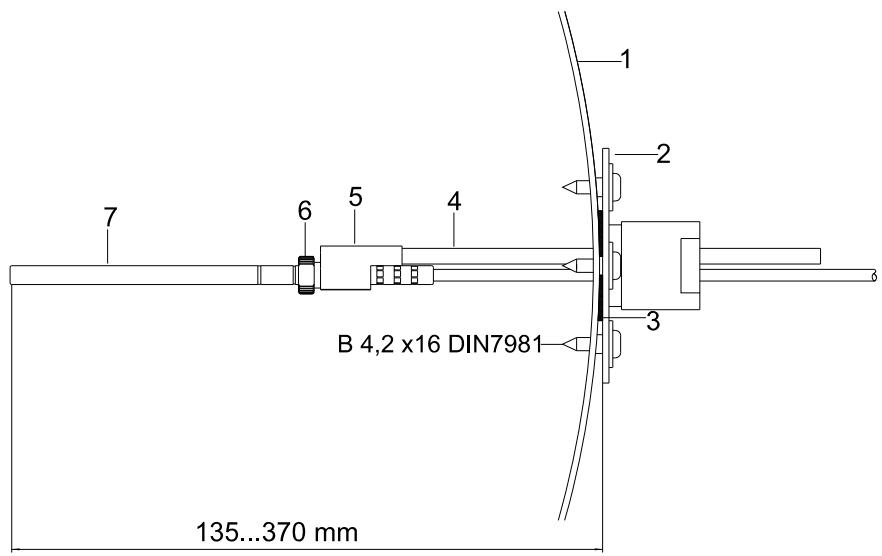
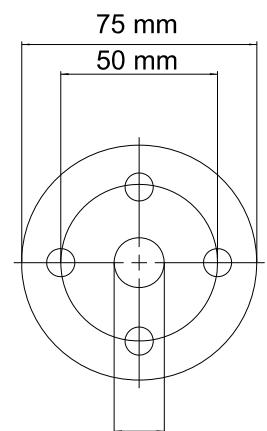
Figure 86 Duct Mounting Installation Kit for T-Probe
drilling 16...22 mm
0507-018
The following numbers refer to Figure 86:
1 = Duct wall
2 = Flange
3 = Sealing ring
4 = Supporting bar
5 = Probe support (to be fixed to the supporting bar)
6 Retainer bushing (to be fixed to the probe support)
7 = Temperature probe (to be fixed to the retainer bushing)
Pressure Tight Swagelok Installation Kits (for HMT337)
RH Probe Installation
Swagelok installation kit for the relative humidity probe includes Swagelok connector with ISO3/8" or NPT1/2" thread. Vaisala order codes: SWG12ISO38 or SWG12NPT12.

Figure 87 Swagelok Installation Kit for RH-probe
The following numbers refer to Figure 87:
1 = Relative humidity probe
2 = Duct connector
3 = ISO3/8" or NPT1/2" thread
4 = Swagelok connector
5 = Ferrules
Temperature Probe Installation
Swagelok installation kit for T-probe includes Swagelok connector with either ISO1/8" or NPT1/8" thread. Vaisala order codes: SWG6ISO18 or SWG6NPT18.
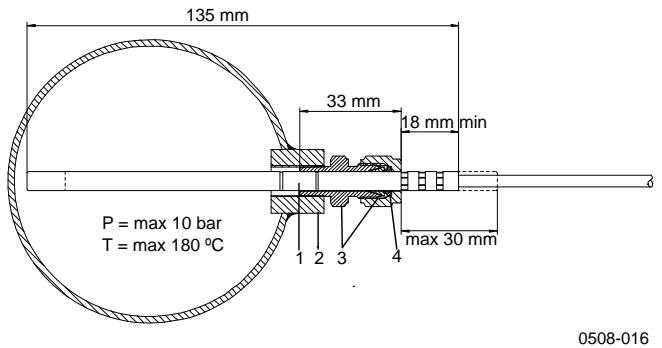
Figure 88 Swagelok Installation Kit for T-Probe
The following numbers refer to Figure 88:
1 = T-probe
2 = Duct connector
3 = Swagelok connector
4 = Ferrules
Examples of Vapor Tight Installations with Cable Gland
RH-Probe Installations (for HMT333/337)
Cable gland AGRO is available from Vaisala (order code: HMP247CG.)

Figure 89 Cable Installation with Cable Gland
The following numbers refer to Figure 89:
1 = Nut (to be tightened to the body)
2 = Seal
3 = Body and O-ring

Figure 90 Probe Installation with Cable Gland
Probe installation with cable gland is not available from Vaisala.
The following numbers refer to Figure 90:
1 = AGRO 1160.20.145 (T= -40 ... +100 °C) Not available from Vaisala.
2 = In pressurized places, use a locking ring (for example: 11 × 1 DIN471).
T- Probe Installations (HMT337)
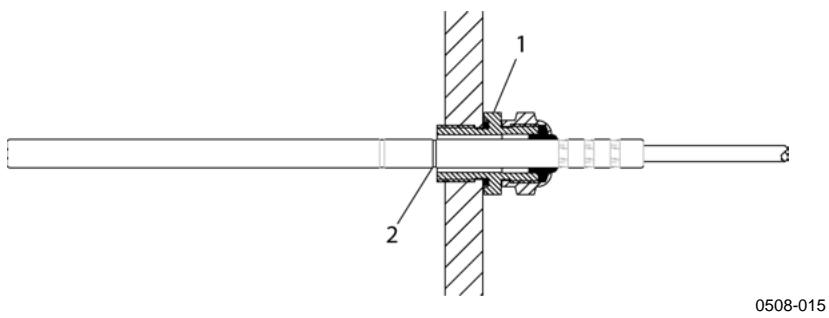
Figure 91 Vapor Tight Installation
Vapor Tight Installation is not available from Vaisala.
The following numbers refer to Figure 91:
1 = Cable gland. For example AGRO 1100.12.91.065 (T= -25 ... +200 °C)
2 = In pressurized processes, use a locking ring (example: 6x 0.7 DIN471)

Figure 92 Wall Mounting Installation
Wall Mounting Installation is not available from Vaisala.
The following numbers refer to Figure 92:
1 = Cable gland. For example AGRO 1100.12.91.065
2 = Compacted PTFE sleeve
3 = Silicon glue between the PTFE sleeve and the cable
4 = Temperature probe
5 = Recommended support to keep the probe in horizontal position
Example of Climate Chamber Installation

0507-016
Figure 93 Climate Chamber Installation (not Available from Vaisala)
The following numbers refer to Figure 93:
1 = PTFE sleeve
2 = Cable gland, for example: AGRO 1100.12.91.065
3 = Stainless steel cable tie or similar fastener
4 = To be sealed (silicone)
5 = Temperature probe
6 = Relative humidity probe
7 = HMP247CG, Cable gland AGRO (available from Vaisala)
NOTE
Let the cables hang loosely to prevent condensed water running to the probe.
Example of Installation Through Roof

Figure 94 Example of Installation through Roof
The following numbers refer to Figure 94:
1 = Insulated probe cables
2 = Sealings
3 = Roof
4 = Cable gland for temperature probe (for example: AGRO 1100.12.91.065)
5 = Temperature probe
6 = Relative humidity probe
7 = Cable gland for relative humidity probe (for example: AGRO 1160.20.145)
8 = Plastic adapter to protect probes from condensation water coming from the pipe. Diameter slightly smaller than tube diameter.
9 = Plastic tube for probe (2 pcs)
10 = Stainless steel tube coming through the roof.
11 = Two thread bars holding the plastic adapter.
12 = Insulated pipe ending.
Ball Valve Installation Kit for HMT338
The ball valve installation kit (Vaisala order code: BALLVALVE-1) is preferred when connecting the probe to a pressurized process or pipeline. Use the ball valve set or a 1/2'' ball valve assembly with a ball hole of 14 mm or more. If you install the probe ( 12 mm ) in a process pipe, please note that the nominal size of the pipe must be at least 1 inch (2.54 cm). Use the manual press handle to press the probe into the pressurized ( < 10 bar) process or pipeline.
Figure 95 Installing the HMT338 Probe Through a Ball Valve Assembly

0507-043
The following numbers refer to Figure 95:
1 = Manual press tool
2 = Handle of the ball valve
3 = Probe
4 = Process chamber or pipeline
5 = Groove on the probe indicates the upper adjustment limit
6 = Filter
7 = Ball of the ball valve
8 = Fitting screw
NOTE
The probe can be installed in the process through the ball valve assembly provided that the process pressure is less than 10 bars. This way, the process does not have to be shut down when installing or removing the probe. However, if the process is shut down before removing the probe, the process pressure can be max. 20 bars.
NOTE
When measuring temperature dependent quantities make sure that the temperature at the measurement point is equal to that of the process, otherwise the moisture reading may be incorrect.
Follow the steps below to install the HMT338 probe through a ball valve assembly. After the installation, the probe should be sitting in the process chamber or pipeline as shown in Figure 95 on page 170.
- Shut down the process if the process pressure is more than 10 bars. If the pressure is lower there is no need to shut down the process.
- Close the ball valve.
- Seal the threads on the fitting body; refer to Figure 29 on page 47.
- Attach the fitting body to the ball valve and tighten it.
- Slide the clasp nut of the probe toward the filter, as far as it will go.
- Insert the probe to the fitting body, and manually tighten the clasp nut to the fitting body.
- Open the ball valve.
- Push the probe through the ball valve assembly into the process. If the pressure is high, use the pressing handle that is provided with the probe. If you push the probe hard without using the handle, you may damage the cable.
Note that the probe must be pushed so deep that the filter is completely inside the process flow.
- Mark the fitting screw and the clasp nut.
- Tighten the clasp nut with a fork wrench a further 50 60^ (ca. 1/6 turn). If you have a suitable torque wrench, tighten the nut to max 45 ± 5 Nm ( 33 ± 4 ft-lbs). Refer to Figure 30 on page 48.
NOTE
Take care not to tighten the clasp nut more than 60^ to avoid difficulties when opening it.
If you wish to remove the probe from the process, note that you have to pull the probe out far enough. You cannot close the valve if the groove on the probe body is not visible.
Meteorological Installation Kit (for HMT337)
The Vaisala meteorological Installation Kit HMT330MIK (Vaisala order code: HMT330MIK) enables the HMT337 to be installed outdoors to obtain reliable measurements for meteorological purposes. For more information, see HMT330MIK brochure and order form.
Figure 96 Meteorological Installation Kit for Outdoor Installation

0804-063
APPENDIX B
CALCULATION FORMULAS
This Appendix contains the formulas used for the calculated output quantities.
The HMT330 series transmitters measure relative humidity and temperature. From these values dewpoint, mixing ratio, absolute humidity and enthalpy in normal pressure are calculated using the following equations:
Dewpoint:
$$ T _ {d} = \frac {T _ {n}}{\frac {m}{\log \left(\frac {P w}{A}\right)} - 1} \tag {1} $$
P_w is the water vapor pressure. The parameters A , m , and T_n depend on temperature according to the following table:
| t | A | m | Tn |
| <0 °C* | 6.1134 | 9.7911 | 273.47 |
| 0 ... 50 °C | 6.1078 | 7.5000 | 237.3 |
| 50 ... 100 °C | 5.9987 | 7.3313 | 229.1 |
| 100 ... 150 °C | 5.8493 | 7.2756 | 225.0 |
| 150 ... 180 °C | 6.2301 | 7.3033 | 230.0 |
1) Used for frostpoint calculation if the dewpoint is negative
Mixing ratio:
$$ x = 6 2 1. 9 9 \cdot \frac {P _ {w}}{p - P _ {w}} \tag {2} $$
Absolute humidity:
$$ a = 2 1 6. 6 8 \cdot \frac {P _ {w}}{T} \tag {3} $$
Enthalpy:
$$ h = (T - 2 7 3. 1 5) \cdot (1. 0 1 + 0. 0 0 1 8 9 \cdot x) + 2. 5 \cdot x \tag {4} $$
The water vapor saturation pressure P_ws is calculated by using two equations (5 and 6):
$$ \Theta = T - \sum_ {i = o} ^ {3} C _ {i} T ^ {i} \tag {5} $$
where:
T = temperature in K
C_i = coefficients
C_0 = 0.4931358
[ C_{1} = -0.46094296 * 10^{-2} ]
C_2 = 0.13746454 * 10^-4
C_3 = -0.12743214 * 10^-7
$$ \ln P _ {w s} = \sum_ {i = - 1} ^ {3} b _ {i} \Theta^ {i} + b _ {4} \ln \Theta \tag {6} $$
where:
b_i = coefficients
b_-1 = -0.58002206*10^4
b_0 = 0.13914993 * 10^1
b_J = -0.48640239 * 10^-1
b_2 = 0.41764768 * 10^-4
[ b_{3} = -0.14452093 * 10^{-7} ]
b_4 = 6.5459673
The water vapor pressure is calculated using:
$$ P _ {w} = R H \cdot \frac {P _ {w s}}{1 0 0} \tag {7} $$
Parts per million by volume is calculated using:
$$ p p m _ {v} = 1 0 ^ {6} \cdot \frac {P _ {w}}{\left(p - P _ {w}\right)} \tag {8} $$
Symbols:
$$ T _ {d} = \text {d e w p o i n t t e m p e r a t u r e (° C)} $$
$$ P _ {w} = \text {w a t e r v a p o r p r e s s u r e (h P a)} $$
$$ P _ {w s} = \text {w a t e r v a p o r s a t u r a t i o n p r e s s u r e (P a)} $$
$$ R H = \text {relative humidity} (\%) $$
$$ x = \text {m i x i n g r a t i o (g / k g)} $$
$$ p = \text {a t m o s p h e r i c p r e s s u r e (h P a)} $$
$$ A = \text {a b s o l u t e h u m i d i t y} (\mathrm {g / m 3}) $$
$$ T = \text {t e m p e r a t u r e} (\mathrm {K}) $$
$$ h = \text {e n t h a l p y (k J / k g)} $$

www.vaisala.com