
AMIS120XL - Monitor AUSTRALIAN MONITOR - Free user manual and instructions
Find the device manual for free AMIS120XL AUSTRALIAN MONITOR in PDF.


User questions about AMIS120XL AUSTRALIAN MONITOR
0 question about this device. Answer the ones you know or ask your own.
Ask a new question about this device
Download the instructions for your Monitor in PDF format for free! Find your manual AMIS120XL - AUSTRALIAN MONITOR and take your electronic device back in hand. On this page are published all the documents necessary for the use of your device. AMIS120XL by AUSTRALIAN MONITOR.
USER MANUAL AMIS120XL AUSTRALIAN MONITOR
The ACM120XL is a 120 watt mixer amplifier designed for commercial installations. It features 8 microphone/line input channels and can be used for either low impedance (4 or 8 ohm) or 25v / 70v line speaker systems. A host of unique features including multiple levels of mating, a VOX relay output, Transformer Balanced 600 Ohm Telephone input, 24 VDC operation and VCA master level control make the AMIS120XL a very flexible amplifier. The unit can be mounted in a standard 19" equipment rack (rack ears supplied) or it can be located on a shelf or table.
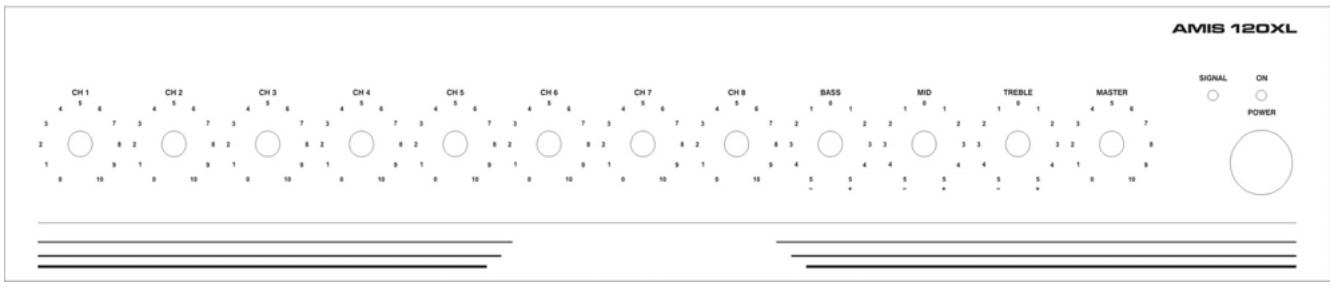
Front Panel Features
WARNING!
TO REDUCE THE RISK OF FIRE OR ELECTRIC SHOCK. DO NOT EXPOSE THIS EQUIPMENT TO RAIN OR MOISTURE.

This symbol is intended to alert the user to the presence of uninsulated "dangerous voltage" within the product's enclosure that may be of sufficient magnitude to constitute a risk of electric shock to persons.

This symbol is intended to alert the user to the presence of important operation and maintenance (servicing) instructions in the literature accompanying the appliance.
Caution: To prevent electric shock do not use this (polarized) plug with an extension cord, receptacle or other outlet unless the blades can be fully inserted to prevent blade exposure.
To prevent electric shock, match wide blade of plug to wide slot, fully insert.
Microphone/Line Level Controls
The level controls for the 8 inputs are labeled Ch1-Ch8. These level controls are used to set up a suitable "mix" of all the various input sources connected to the AMIS120XL. For example, microphones, CD players, cassette decks etc. Once a suitable mix of all inputs has been set up, the overall level can then be adjusted by the "Master" level control on the far right of the AMIS120XL front panel.
Bass Control
The Bass control is part of a 3-band equalization system within the AMIS120XL. The Bass control allows the user to increase or decrease the amount of bass in the system. The control allows for 12dB of cut or boost at 100Hz . If no bass cut or boost is required, the control should be left in the center (0) position.
Mid Control
The Mid control is part of a 3 band equalization system within the AMIS120XL. The Mid control allows the user to increase or decrease the amount of mids in the system. The control allows for 10dB of cut or boost at 600Hz . Depending on the speakers and application, a small cut (decrease) in the mids normally makes the system sound 'warmer'. If no mid cut or boost is required, the control should be left in the center (0) position.
Treble Control
The Treble control is part of a 3 band equalization system within the AMIS120XL. The Treble control allows the user to increase or decrease the amount of treble in the system. The control allows for 9dB of cut or boost at 10kHz . Generally, a small increase of the treble control makes a system sound 'brighter'. If no treble cut or boost is required, the control should be left in the center (0) position.
Master Control
The master control sets the overall output level of the AMIS120XL. It is used in conjunction with the input level controls. When setting up levels, please ensure that proper gain structure practices are followed. In other words, it is not advisable to run the input channels at 10 and the output level at 1. Instead, aim to keep all of the input controls and the master control at around the same level.
Power Switch and "On" LED
The black rocker switch on the right hand side of the front panel is used to switch the amplifier on and off. The 'up' position is on. When the amplifier is connected to an appropriate AC power source and is switched on, the blue LED will illuminate. This LED will always be on when operating on 24VDC.
Signal LED
The green "Signal" LED located next to the 'On' LED indicates that the AMIS120XL is passing audio. The signal LED is a simple method to trouble-shoot installations especially in multi-amplifier projects.
Rack Mounting
The AMIS120XL is supplied with rack ears attached to allow mounting within a standard 19" equipment rack. As is the case with almost all audio products, adequate ventilation and air flow is required. When installing multiple AMIS amplifiers within the one rack, it is recommended that at least 1 rack unit of ventilation space is left between every two amplifiers.
For table or shelf mounting, the rack ears can be removed using a screwdriver. Once the rack ears are removed, please reinstall the screws.
Rear Panel Features
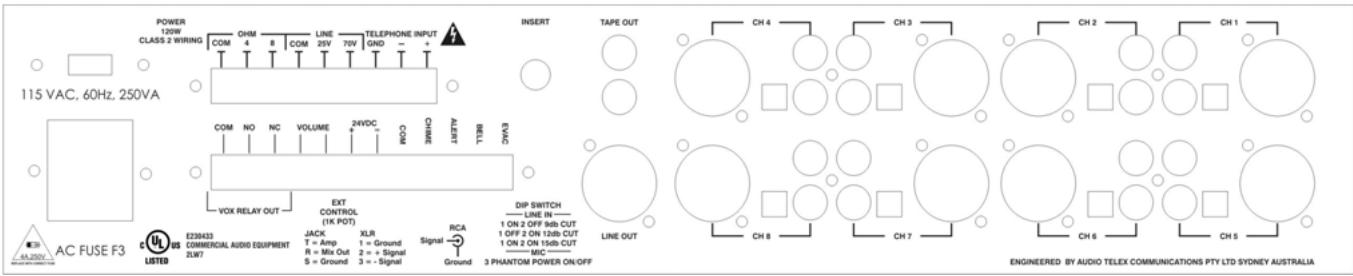
AC Power Inlet
The 3 pin IEC power inlet is located at the bottom left of the rear panel and accepts a standard mains power lead fitted with an IEC connector. The operating voltage is 115volt @60Hz and the inlet is equipped with an in-built AC fuse holder fitted with a 8 Amp slow blow fuse plus a spare fuse. Power consumption is 250 watts (max).
--Please ensure that the mains power cord is disconnected before attempting to check or replace this fuse.---
24 Volt DC Power Inlet
The AMIS120XL features optional 24VDC power to run off a battery supply if required. This is connected via the rear terminal strip. The front panel Power Switch will not switch DC power 'on' or 'off' in DC operation. In this mode the amplifier is always 'on'.
Speaker Output Terminal Strip
Located at the top left of the rear panel is the speaker output terminal strip. Reading from left to right, the connections are:
COM Common or “-” for low impedance speaker loads (4 or 8 ohms).
4 Positive “+” for 4 ohm speaker loads (use with common)
8 Positive “+” for 8 ohm speaker loads (use with common)
COM Common or “-” for 70v or 100v speaker loads (maximum load of 40 ohms at 70v)
25 Positive “+” for 25v line speaker loads (use with common)
70 Positive “+” for 70v line speaker loads (use with common)
Please ensure that the correct "Common" is used. Low impedance and 70/100v loads can be used simultaneously but please pay careful attention to the overall speaker load. When used individually, the low impedance load should be 4 ohms or higher while the 70v line load should not fall below 40 ohms. When both outputs are used simultaneously, ensure that neither output is loaded to maximum.
VOX Relay Output
The terminal strip to the immediate right of the AC inlet features a relay output. This relay is activated when signal is present on any of the priority inputs. This would normally be inputs 1, 2 and 3 however some or all of these channels can be removed from the priority bus via internal links (see "Muting" further on in this manual). The unit is shipped from the factory with inputs 1, 2 and 3 having priority so assuming that this has not been changed, then signal from any of these inputs will activate the VOX relay circuit.
The relay outputs are C (Common), NO (Normally Open) and NC (Normally Closed). The NO or NC selection provides the installer with the option of the relay either opening or closing a contact. This feature is normally used in conjunction with relay override attenuators (volume controls). In this application, the relay output could trigger an accessory power supply which in turn bypasses the remote attenuators. The result is that priority inputs will always be heard irrespective of the attenuator setting. The relay contacts are 3 amps at 125VAC/30VDC.
VCA Control
An external pot (500K) can be connected to the AMIS120XL for remote control of the master level. The external pot is governed by the master level of the amplifier allowing the installer to set the volume, then lock the amplifier in a rack, leaving the user with just a master volume control that cannot go beyond the level set on the master (front panel) control. Connection is via a 2 wire terminal strip on the rear panel of the amplifier.
Tone Generator
The AMIS120XL includes a 4 tone generator module featuring Alert, Evacuate, Pre-Announce and Bell tones. All 4 tones can be activated individually using the rear panel terminal strip. Shorting "Common" to the relevant tone name will activate that particular tone.
The volume level of the tone is set via an internal pot (R63) which is located to the far right (when looking from the front) of the front mixer PCB. The pot is labelled R63 and sets the level of all 4 tones. Please note that the level of the tones is not affected by the "Master" control on the front panel.
When any of the 4 tones are activated, inputs 4 to 8 are muted. Inputs 1, 2 and 3 on the other hand will mix with the tones and can be used at the same time.
600 Ohm Telephone Input
The 600 ohm transformer balanced Telephone Input is paralleled with input 2. If telephone paging is required the XLR & dual RCA inputs should not be used as these inputs will be summed with the Telephone Input into channel 2. The front panel level control will set the gain for the Telephone Input.
Insert Point
The AMIS120XL includes an Insert Point to allow for connection of signal processors such as equalisers, compressors or Feedback Exterminators. The Insert Point is located (electronically) between the mixer and power amplifier sections of the AMIS120XL. It allows for the "mixed" output of the AMIS120XL to be processed externally and then returned to the power amplifier section of the AMIS120XL.
The Insert Point is a 3 conductor (Tip, Ring, Sleeve) socket which accepts a standard stereo 6.35mm (1/4^) jack. The one jack allows for signals to be "sent" to the processor and then "returned" to the power amplifier. The connections are:
Tip Amplifier in. This is the return signal from the processor
Ring Mix Output. This is the signal from the mixer stage which is to be sent to the processor
Sleeve This is the ground connection
When an external processor is used via the insert point, it only affects the power amplifier section of the AMIS120XL. The tape output remains unprocessed.
Tape Output
The AMIS120XL includes a tape recorder output with dual RCA connectors. Although the output signal is mono, dual RCA's are provided to allow for easy connection to domestic or professional tape recorders.
The output level of the tape output is governed by the 8 input controls of the AMIS120XL. The front panel master control does not affect the tape output. In a practical situation, this allows for "on the fly" changes to the power amplifier level (to turn the PA system up or down) without affecting the signal being recorded.
Line Output
A 3 pin male XLR socket is provided to allow for connection to additional power amplifiers. The line level signal is the mixer output of the AMIS120XL allowing this "mixed" signal to be split to other amplifiers. This is most commonly used when more power (than the 120 watts of the AMIS120XL) is required. In this situation, a standard microphone lead is used to connect the line output of the AMIS120XL to the line input of a power amplifier. The speaker load then needs to be split into two (one for each amplifier) making sure that each amplifier is driving no more than it's recommended load.
The line output is a balanced 700mV signal which can be used to connect (daisy-chain) up to 6 power amplifiers. If more than 6 amplifiers are required, a distribution amplifier is recommended.
Microphone Inputs
The AMIS120XL includes 8 microphone inputs. The microphone inputs are via 3 pin XLR female sockets. The microphone inputs are 200 ohm and are suitable for a wide range of dynamic or electret microphones. When using electret microphones, phantom power should be enabled for those particular inputs. Phantom power (15v DC) is available on all XLR inputs and can be switched on or off per channel. To enable phantom power on a particular input channel, simply flip (on the rear panel) dip switch 3 (for that channel) to the on position.
Line Inputs
The ACM120XL includes 8 line (auxiliary) inputs. The line inputs are via dual RCA connectors per channel. Although the ACM120XL is a mono amplifier, dual RCA's are provided to allow for easy connection to domestic or professional line sources. The line inputs are suitable for a wide range of products including tuners, cassette decks and CD players. As the output signal from line sources can vary immensely, four sensitivity settings are available per line input. These settings are adjustable via dip switches 1 and 2 per channel. The options are:
Dip Switch 1 off, 2 off 90mV at 47K ohm
Dip Switch 1on, 2 off 9dB pad (cut)
Dip Switch 1off, 2 on 12dB pad (cut)
Dip Switch 1on, 2 on 15dB pad (cut)
Dip Switch 3 is for the XLR microphone input and switches phantom power on and off (see "Microphone Inputs").
Simultaneous Use of Mic and Line Inputs Per Channel
The AMIS120XL has 8 microphone and 8 line inputs. In most situations only the XLR or the dual RCA's would be used on a particular channel. In some circumstances however, more channels may be needed in which case both the XLR and RCA inputs can be used simultaneously per channel. When using both a mic and line input per channel, both inputs are mixed and are controlled simultaneously via the channel level control.
Line Input Sensitivity
Four sensitivity adjustments are provided for each line input. See "Line Inputs"
Phantom Power
15v DC Phantom Power is selectable per XLR microphone input. See "XLR Microphone Inputs". Phantom Power should only be used on balanced electret microphones. Using phantom power with unbalanced microphones may damage the microphone.
Muting
The AMIS120XL includes an advanced priority/muting system which is installer adjustable. When shipped, the AMIS120XL has three priority inputs. From the factory, Input 1 has overall priority and mutes inputs 2-8 when signal is present. Input 2 has secondary priority and mutes inputs 3-8 when signal is present. Input 3 has a third level of priority and mutes inputs 4-8 when signal is present. Inputs 4-8 have no priority and are mixed. All muting in the AMIS120XL is activated by signal (VOX) whether it be on the XLR or RCA inputs.
A number of muting options are available and can be altered via a series of internal links located on the front mixer board behind inputs 1 and 2.
Muting for any of the first three inputs can be disabled. The muting circuit of input 1 can be disabled by moving the jumper labelled JP1 (located on the front mixer PCB behind input 1 and 2's level controls). Simply move the jumper towards the back of the chassis to disable muting from input 1.
To disable muting from input 2, simply move jumper JP2 towards the back of the chassis.
To disable muting from input 3, simply move jumper JP3 towards the back of the chassis.
Another feature of the mating circuit of the AMIS120XL is the ability to have inputs 1 and 2 on the same priority level. This is handy for situations where phone paging and microphone paging (for example) are of equal importance. In this mode, both inputs can be used at the same time and both will mute all remaining
channels. This feature is also handy for emergency systems where signal from a pre-recorded message could be mixed with a live microphone. To set inputs 1 and 2 to the same priority level, move jumper JP4 towards the front of the chassis and remove and discard jumper J6. Please note that both jumpers (J4 moved and J6 removed) need to be adjusted for this feature to work.

Important Safety Information
- Save the carton and packing material even if the equipment has arrived in good condition. Should you ever need to ship the unit, use only the original factory packing.
- Read all documentation before operating your equipment. Retain all documentation for future reference.
- Follow all instructions printed on unit chassis for proper operation.
- Do not spill water or other liquids into or on the unit, or operate the unit while standing in liquid.
- Make sure power outlets conform to the power requirements listed on the back of the unit.
- Do not use the unit if the electrical power cord is frayed or broken. The power supply cords should be routed so that they are not likely to be walked on or pinched by items placed upon or against them, paying particular attention to cords and plugs, convenience receptacles, and the point where they exit from the appliance.
- Always operate the unit with the AC ground wire connected to the electrical system ground. Precautions should be taken so that the means of grounding of a piece of equipment is not defeated.
- Mains voltage must be correct and the same as that printed on the rear of the unit. Damage caused by connection to improper AC voltage is not covered by any warranty.
- Have gain controls on amplifiers turned down during power-up to prevent speaker damage if there are high signal levels at the inputs.
- Power down & disconnect units from mains voltage before making connections.
- Never hold a power switch in the "ON" position if it won't stay there itself!
- Do not use the unit near stoves, heat registers, radiators, or other heat producing devices.
- Do not block fan intake or exhaust ports. Do not operate equipment on a surface or in an environment which may impede the normal flow of air around the unit, such as a bed, rug, weathersheet, carpet, or completely enclosed rack. If the unit is used in an extremely dusty or smoky environment, the unit should be periodically "blown free" of foreign matter.
-
Do not remove the cover. Removing the cover will expose you to potentially dangerous voltages. There are no user serviceable parts inside.
-
Do not drive the inputs with a signal level greater than that required to drive equipment to full output.
- Do not connect the inputs / outputs of amplifiers or consoles to any other voltage source, such as a battery, mains source, or power supply, regardless of whether the amplifier or console is turned on or off.
- Do not run the output of any amplifier channel back into another channel's input. Do not parallel- or series-connect an amplifier output with any other amplifier output.
Australian Monitor Audio Inc is not responsible for damage to loudspeakers for any reason.
- Do not ground any red ("hot") terminal. Never connect a "hot" (red) output to ground or to another "hot" (red) output!
- Non-use periods. The power cord of equipment should be unplugged from the outlet when left unused for a long period of time.
- Service Information Equipment should be serviced by qualified service personnel when:
A. The power supply cord or the plug has been damaged.
B. Objects have fallen, or liquid has been spilled into the equipment
C. The equipment has been exposed to rain
D. The equipment does not appear to operate normally, or exhibits a marked change in performance
E. The equipment has been dropped, or the enclosure damaged.
Engineered in Sydney, Australia
www.australianmonitor.com
Australian Monitor Audio Inc.
PO Box 3126,
Lynnwood,
WA 98046.
Ph: 425 673 5175
Fax: 425 673 7825
E-mail: sales@australianmonitor.com
techsupport@australianmonitor.com
accounts@australianmonitor.com
International Sales & Corporate Head Office
Private Bag 149, Silverwater NSW 1811
149 Beaconsfield Street, Silverwater NSW 2128
Australia
Ph: 61-2-9647 1411
Fax: 61-2-9748 2537
E-mail: international@australianmonitor.com