
EK5301W - Wood stove NESTOR MARTIN - Free user manual and instructions
Find the device manual for free EK5301W NESTOR MARTIN in PDF.

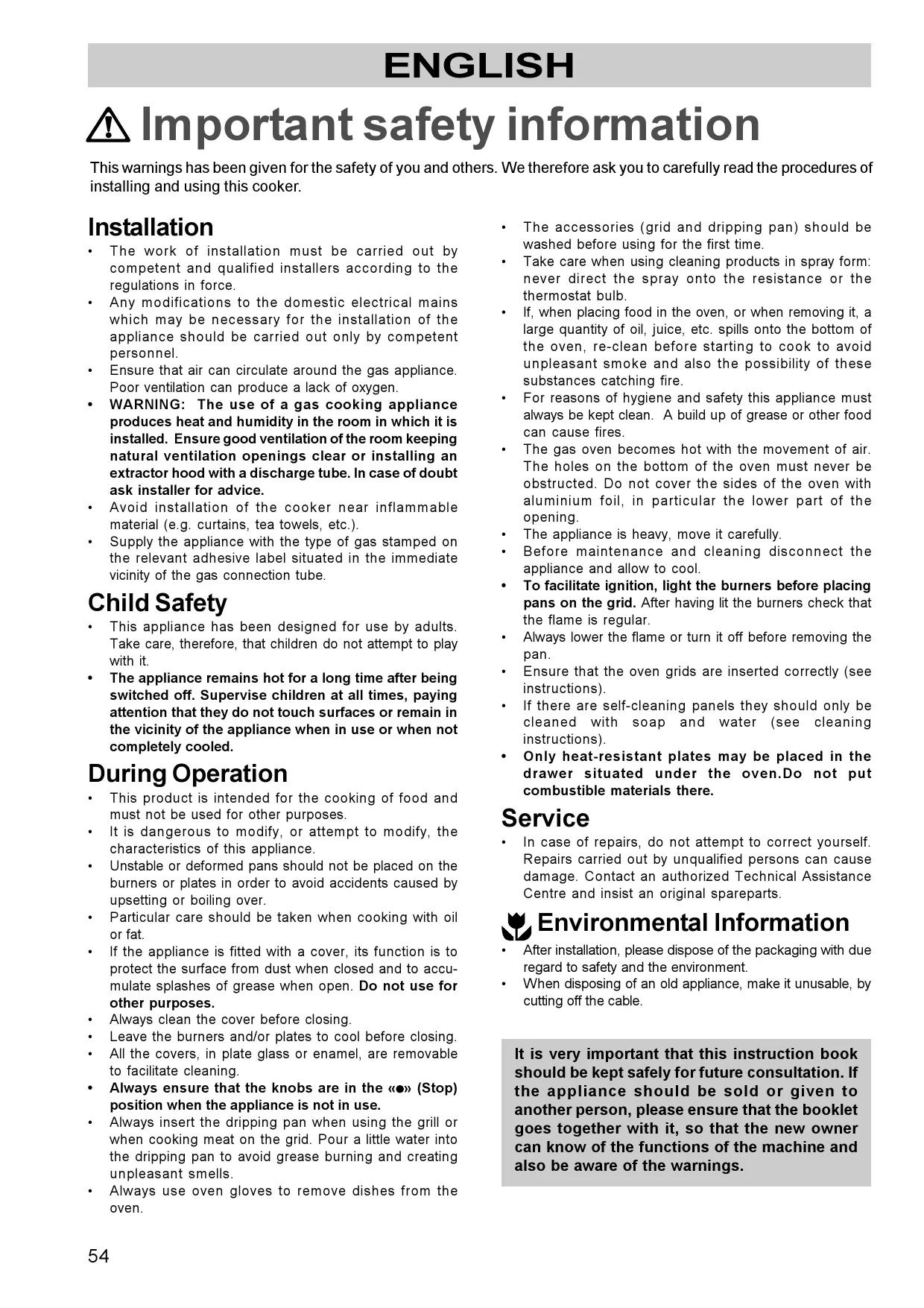

| Product type | Wood stove |
| Brand | NESTOR MARTIN |
| Model | EK5301W |
| Height | 850 mm |
| Width | 500 mm |
| Depth | 600 mm |
| Approximate weight | 80 kg |
| Main material | Cast iron and steel |
| Heating power | 6-8 kW |
| Efficiency | ~75% |
| Flue diameter | 150 mm |
| Main functions | Heating and cooking |
| Firebox type | Enclosed firebox with ceramic glass |
| Secondary air system | Glass cleaning (Airwash) |
| Fuel | Wood logs (max length 33 cm) |
| Maintenance and cleaning | Regular cleaning of firebox and glass; annual chimney sweeping |
| Safety | Insulated handle, tempered glass, overheat protection |
| Spare parts and repairability | Available via authorized after-sales service |
| General information | Complies with European standards; professional installation recommended |
Frequently Asked Questions - EK5301W NESTOR MARTIN
User questions about EK5301W NESTOR MARTIN
0 question about this device. Answer the ones you know or ask your own.
Ask a new question about this device
Download the instructions for your Wood stove in PDF format for free! Find your manual EK5301W - NESTOR MARTIN and take your electronic device back in hand. On this page are published all the documents necessary for the use of your device. EK5301W by NESTOR MARTIN.
USER MANUAL EK5301W NESTOR MARTIN
Important safety information
This warnings has been given for the safety of you and others. We therefore ask you to carefully read the procedures of installing and using this cooker.
Installation
- The work of installation must be carried out by competent and qualified installers according to the regulations in force.
- Any modifications to the domestic electrical mains which may be necessary for the installation of the appliance should be carried out only by competent personnel.
- Ensure that air can circulate around the gas appliance. Poor ventilation can produce a lack of oxygen.
- WARNING: The use of a gas cooking appliance produces heat and humidity in the room in which it is installed. Ensure good ventilation of the room keeping natural ventilation openings clear or installing an extractor hood with a discharge tube. In case of doubt ask installer for advice.
- Avoid installation of the cooker near inflammable material (e.g. curtains, tea towels, etc.).
- Supply the appliance with the type of gas stamped on the relevant adhesive label situated in the immediate vicinity of the gas connection tube.
Child Safety
- This appliance has been designed for use by adults. Take care, therefore, that children do not attempt to play with it.
- The appliance remains hot for a long time after being switched off. Supervise children at all times, paying attention that they do not touch surfaces or remain in the vicinity of the appliance when in use or when not completely cooled.
During Operation
- This product is intended for the cooking of food and must not be used for other purposes.
It is dangerous to modify, or attempt to modify, the characteristics of this appliance. - Unstable or deformed pans should not be placed on the burners or plates in order to avoid accidents caused by upsetting or boiling over.
- Particular care should be taken when cooking with oil or fat.
- If the appliance is fitted with a cover, its function is to protect the surface from dust when closed and to accumulate splashes of grease when open. Do not use for other purposes.
Always clean the cover before closing. - Leave the burners and/or plates to cool before closing.
- All the covers, in plate glass or enamel, are removable to facilitate cleaning.
- Always ensure that the knobs are in the «●» (Stop) position when the appliance is not in use.
-
Always insert the dripping pan when using the grill or when cooking meat on the grid. Pour a little water into the dripping pan to avoid grease burning and creating unpleasant smells.
Always use oven gloves to remove dishes from the oven. -
The accessories (grid and dripping pan) should be washed before using for the first time.
Take care when using cleaning products in spray form: never direct the spray onto the resistance or the thermostat bulb. - If, when placing food in the oven, or when removing it, a large quantity of oil, juice, etc. spills onto the bottom of the oven, re-clean before starting to cook to avoid unpleasant smoke and also the possibility of these substances catching fire.
- For reasons of hygiene and safety this appliance must always be kept clean. A build up of grease or other food can cause fires.
- The gas oven becomes hot with the movement of air. The holes on the bottom of the oven must never be obstructed. Do not cover the sides of the oven with aluminium foil, in particular the lower part of the opening.
The appliance is heavy, move it carefully. - Before maintenance and cleaning disconnect the appliance and allow to cool.
- To facilitate ignition, light the burners before placing pans on the grid. After having lit the burners check that the flame is regular.
Always lower the flame or turn it off before removing the pan. - Ensure that the oven grids are inserted correctly (see instructions).
- If there are self-cleaning panels they should only be cleaned with soap and water (see cleaning instructions).
- Only heat-resistant plates may be placed in the drawer situated under the oven. Do not put combustible materials there.
Service
- In case of repairs, do not attempt to correct yourself. Repairs carried out by unqualified persons can cause damage. Contact an authorized Technical Assistance Centre and insist an original spareparts.

Environmental Information
After installation, please dispose of the packaging with due regard to safety and the environment.
- When disposing of an old appliance, make it unusable, by cutting off the cable.
It is very important that this instruction book should be kept safely for future consultation. If the appliance should be sold or given to another person, please ensure that the booklet goes together with it, so that the new owner can know of the functions of the machine and also be aware of the warnings.
Contents
For the user
Important safety information 54
Dimensions of the appliance 55
Using the hob 56
Using the oven 57
Suggestions for using the oven 60
Suggestions for gas burners 60
Cooking table 62
Cleaning and maintenance 63
Something not working 65
For the installer
Technical data 66
Instructions for the installer 67
Gas connection 68
Adaptation to different kinds of gas 69
Electrical connection 70
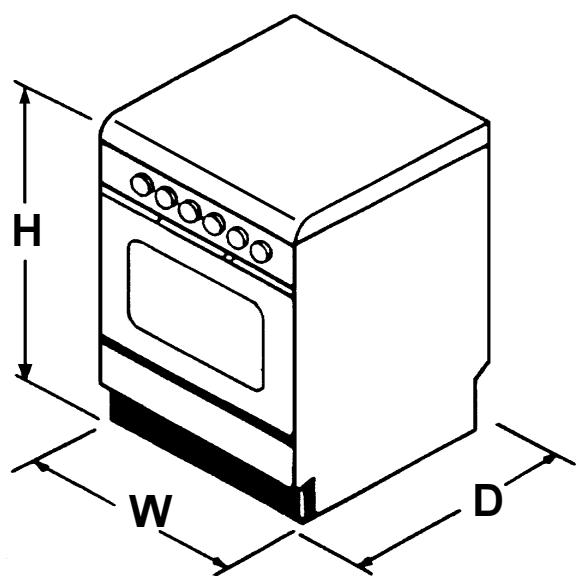
Dimensions of the appliance
| Height | Width | Depth | |
| A) | 850 mm | 600 mm | 600 mm |
| B) | 850 mm | 500 mm | 600 mm |
MANUFACTURER: ELECTROLUX ZANUSSI S.p.A.
VialeBologna298
47100 FORLI (Italy)
Guide to Use the instructions
The following symbols will be found in the text to guide you throughout the Instructions:

Safety Instructions

Step by step instructions for an operation

Hints and Tips

Environmental information

This appliance complies with the following E.E.C. Directives:
73/23 - 90/683 (Low Voltage Directive);
89/336 (Electromagnetical Compatibility Directive);
90/396 (Gas Appliance Directive);
93/68 (General Directives);
and subsequent modifications.
These instructions are only for the countries stated by the symbol printed on the front cover of this instruction book.
Using the hob
Control knobs on the front panel
The knobs (Fig. 1) for using the gas hob are found on the control panel. The regulation knobs should be turned in three main positions:
Symbols
No gas supply

Maximum gas supply

Minimum gas supply

Ignition of gas burners
To ignite a burner, before positioning the saucepan:
- Push the Control Knob inwards and turn it anti-clockwise to its maximum setting keeping the Control Knob pressed in.
- At the same time, press the electronic ignition button so as to obtain sparks. Keep the button pressed until a flame appears (sparks are produced approximately once per second).
- Models with thermocouple (fig. 2 - D): Once a flame has appeared, hold the Control Knob pressed in for around 5 seconds so as to activate the Oven Safety Device (Thermocouple).
- Should the bumer extinguish, repeat the operation, maintaining the Control Knob pressed for 15 seconds, maximum.
- Now adjust the Control Knob to the setting desired.

When lighting the oven manually: Hold a flame near the burner. Never turn the Control Knob before approaching the burner with the flame.
If after a few attempts the burner does not ignite, check that the baffle and its cap are correctly positioned.
To interrupt the supply of gas, turn the knob in a clockwise direction to the position "●".

During cooking, when using fats or oils, take particular care as they can, when overheated, self-ignite.
Recommended pottery
Remember that a wide-bottomed pan allows a faster cooking than a narrow one.
Always use pots which properly fit what you have to cook.
Particularly make sure that the pans are not too small for liquids, since these could easily overflow.
Moreover, the pans should not be too large for a faster cooking. In fact, grease and juices may spread on the bottom and burn easily.
It is better to use non-openable moulds for baking cakes. In fact, an openable mould lets juices and sugar leak through, falling on the bottom of the oven and consequently burning on the bottom of the baking tray, making cleaning difficult.
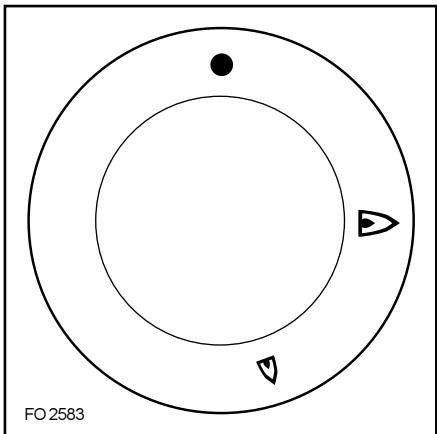
Fig. 1
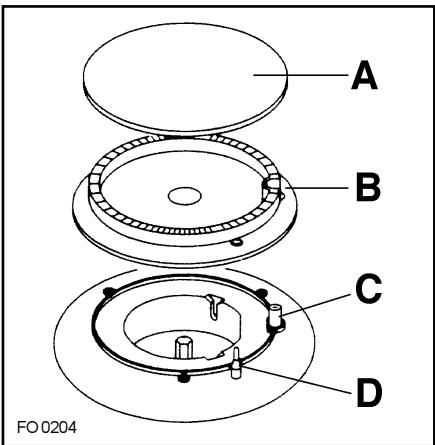
A-Burner cap
B-Burner crown
C - Ignition candle
D - Thermocouple (depending on models)
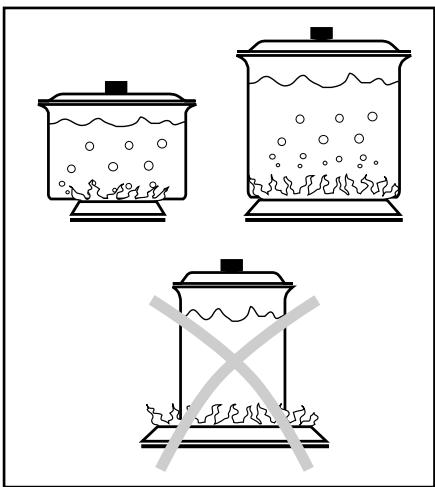
Fig. 3
Avoid putting plastic-handled pans in the oven as they are not heat-proof.
You should use oans with the right diameter to fit the burner, in order to make the most out of it, thus reducing gas consumption as in Fig. 3.
It is also advisable to cover any boiling casserole and, as soon as the liquid starts boiling, lower the flame enough to keep the boiling point.
Using the oven
Gas oven
Automatic Ignition
- Push the Oven/Grill Control Knob (fig. 4) inwards and turn it anti-clockwise to its maximum setting (8) keeping the Control Knob pressed in.
- At the same time, press the electronic ignition button so as to obtain sparks. Keep the button pressed until a flame appears (sparks are produced approximately once per second).
- Once a flame has appeared, hold the Control Knob pressed in for around 5 seconds so as to activate the Oven Safety Device (Thermocouple).
Manual ignition
- Open the oven door and hold a flame near the hole in the bottom as shown in fig. 5;
- push the oven knob in (Fig. 4) and turn it anticlockwise until the maximum temperature position is reached:
- Once a flame has appeared, hold the Control Knob pressed in for around 5 seconds so as to activate the Oven Safety Device (Thermocouple).
- Should the bumer extinguish, repeat the operation, maintaining the Control Knob pressed for 15 seconds, maximum.
- Now adjust the Control Knob to the setting desired (see table 1).

When cooking with the oven, the lid must be kept open to avoid over-heating.
Electric grill
Press and turn the knob clockwise until the stop position is reached, at the same time the grill control light will come on. Place the dripping pan under the wire shelf so as to prevent fat from dripping on the bottom of the oven.

While the grill is in function, leave the door half-open and to put the protective screen to the knob (fig. 6).
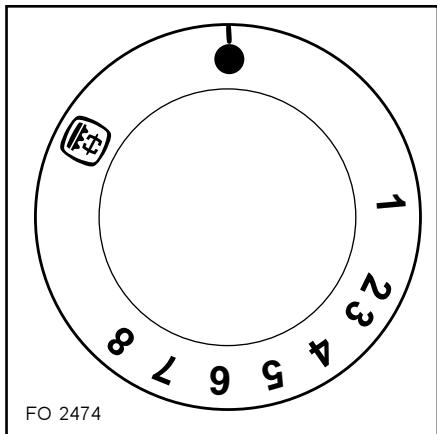
Fig. 4
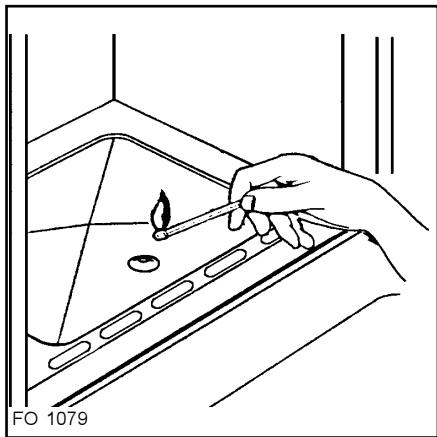
Fig. 5
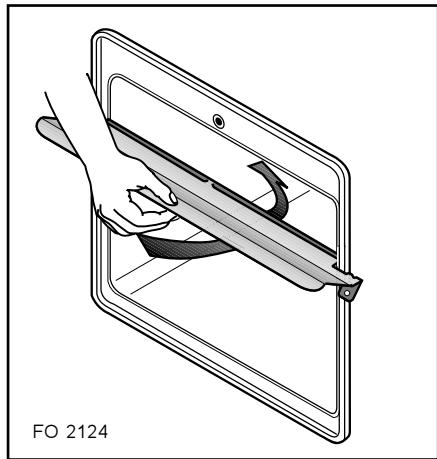
Fig. 6-a
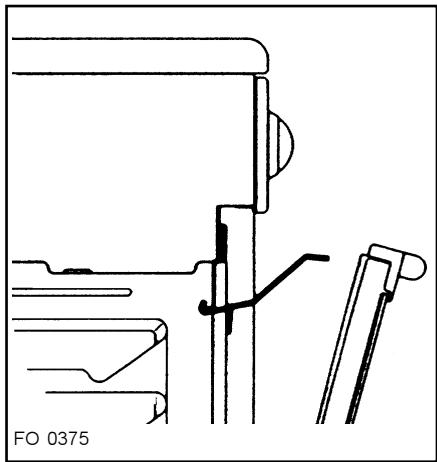
Table 1: Temperatures approximating to the Thermostat Settings
| 1 | 2 | 3 | 4 | 5 | 6 | 7 | 8 |
| 140°C | 150°C | 160°C | 180°C | 200°C | 220°C | 240°C | MAX |

Electric oven (EK 6510)
Control switch (Fig. 7)
Permits the choice of cooking temperature most suitable and separate action of the heating elements.
Explanation of symbols:
0
Oven switched off

Oven lamp
50-max
Range of temperature regulation

Lower heating element

Upper heating element

Grill element
To select the temperature turn the switch in a clockwise direction and place sign in front of the symbol corresponding to the temperature required, included between 50^ and max.
The temperature will be maintained constant by the thermostat.
If a different type of heating is required, for example more heat on the bottom or the top, you should turn the switch to the symbols (heat from below) or (heat from above).
In these conditions the temperature will never exceed 220^ for and 180^ for and will not be regulated by the thermostat.
When grilling, it is sufficient to turn the switch so that the sign is in front of the symbol l .

When the grill is in use the oven door must be left ajar and the switch protection shield inserted (Fig. 6).

When cooking in the oven or grill, in order to avoid over-heating, always leave the appliance's cover open.
Thermostat control light (^)
Once the oven temperature has been selected, the temperature light will come on and remain on until the oven has reached the correct setting; after that, it will go on and off with the thermostat, showing how the temperature is being maintained.
Audible Signal Timer (EK 6327)
This allows you to select a cooking time (Fig. 8). After this period of time has elapsed, the sounder rings, but does not halt cooking.
- Set the Oven Control Knob to the OFF Position.
- For cooking times of less than 15 minutes, tum the knob to a higher position, then bring it back to the setting desired.
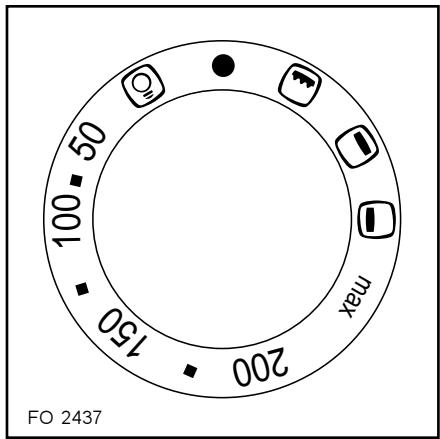
Fig. 7
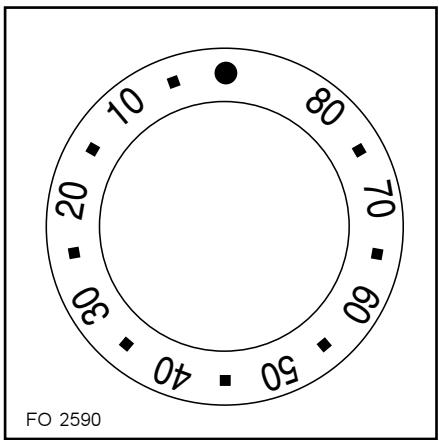
Fig. 8
Oven accessories
The oven is supplied with an enamelled dripping pan for the collection of cooking juices from grilled meat or kebabs, and a grill for cooking grilled food, which can also be placed in a dish.
In models equipped with an oven grill with stopper (fig. 9) and when grilling, to avoid dirtying the oven excessively, we advise you to insert the dripping pan (A-fig. 9) in the specific grids, situated under the grill (B-fig.9).
If you need to cook with the dripping pan on the oven grill, place as shown in Fig. 9.
Cooking with the turnspit (fig. 10)
Some models are equipped with a turnspit (fig.10-a). For correct use, proceed as follows:
- slide the spit into the food to be cooked and secure well;
- place the spit on the support and slide the whole into the third runner from the bottom of the oven cavity (fig. 10-b);
- insert the end of the spit into the rotisserie motor housing (the orifice in the wall at the back of the oven - see fig. 10-b);
- remove the spit handle;
- turn the oven knob to the grill position or, when required for some models, turn on the motor by means of the appropriate switch (F3) placed on the control panel.

When cooking with the turnspit you are advised to leave the oven door half open and to fit the knob protection shield as shown in fig. 6.
Models with oven lamp switch (O)
The oven lamp switch allows you to turn on the oven internal illumination.

When using the oven for the first time
When using the oven for the first time:
a) set the thermostat knob to MAX;
b) allow the oven to run empty for approximately 45 minutes;
c) open a window for ventilation.
During this time, an unpleasant odour may be emitted. This is absolutely normal, and is caused by residues of manufacturing.
Once this operation is carried out, let the oven cool down, then clean the oven cavity with a soft cloth soaked in warm soapy water.
Before cooking for the first time, carefully wash the grid and the dripping pan.
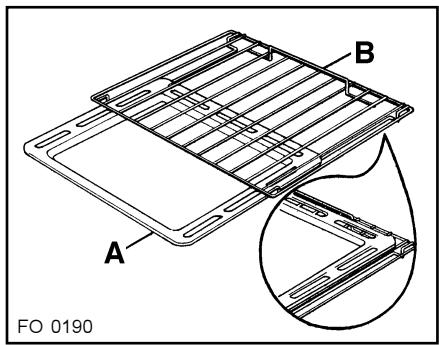
Fig. 9
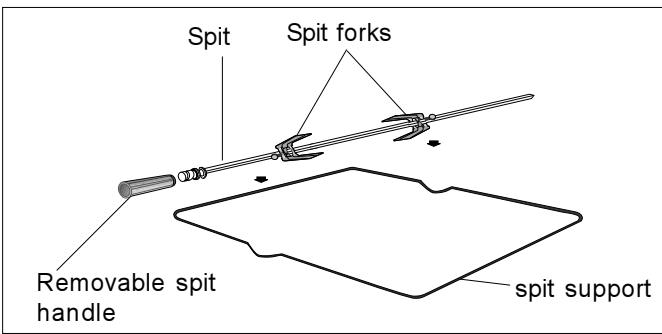
Fig. 10 - a
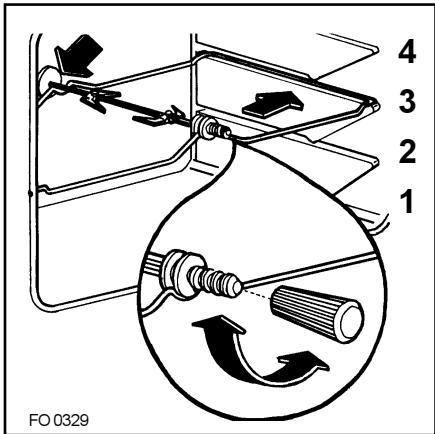
Fig. 10 - b
Suggestions for gas burners
Start your cooking with a big flame by turning the knob to the symbol . Then adjust the flame as necessary.
The outside of the flame is much hotter than its inside (nucleus). Accordingly, the top of the flame should lick the bottom of the pan. Excessive flames mean a waste of gas.
In contrast with electric grids, gas burners do not require flat-bottomed pans: the flames lick the bottom and spread the heat all over the surface.
No special pans are required for gas burners. However, thinwalled pans transmit the heat to the food more quickly than thick-walled ones.
Since heat doesn't spread evenly on the pan's bottom, the food may only be partially heated. Consequently it is advisable to stir the food many times.
A thick pan bottom prevents partial overheating as it allows sufficient thermic compensation.
Avoid very small pans. Wide and shallow pans are more suitable than narrow and deep ones as they allow a faster heating. Cooking is not quickened by placing narrow pans on wide burners. The result is just a waste of gas. For a proper usage, place small pans on small burners and large pans on large burners.
Remember to cover pans to reduce gas consumption.
i Suggestions for using the oven
Using the oven
For the cooking of cakes
Pre-heat the oven, unless indicated differently, for at least 10 minutes before use. Do not open the oven door when cooking dishes which must raise (e.g. raised pastries and soufflés); the jet of cold air would block the raising process. To check if cakes are cooked, insert a toothpick into the mixture; if it comes out clean the cake is ready. Wait until at least 3/4 of the cooking time has passed before doing this check.
As a general rule remember that:
a dish which is well-cooked on the outside but not sufficiently cooked inside would have required a lower temperature and longer cooking time. On the contrary, a "dry" texture would have required a shorter time and higher cooking temperature.
For the cooking of meat
Meat to be cooked in the oven should weigh at least 1 kilo to avoid its becoming too dry. If you want roasts with a good colour, use very little oil. If the piece is lean, use oil or butter or a little of both. Butter or oil are on the other hand unnecessary if the piece has a strip of fat. If the piece has a strip of fat on one side only, put it in the oven with this side upwards; when melting the fat will grease the lower side sufficiently.
Red meat should be removed from the fridge one hour before cooking otherwise the sudden change of temperature could cause it to become tough. A roast, especially if of red meat, must not be salted at the
beginning of cooking as salt causes juices and blood to seep out of the omeat, thus preventing the formation of a well-browned crust.
It is advisable to salt the outside of the meat after just over half the cooking time.
Place the roast in the oven in a dish having a low rim; a deep dish shields heat.
Meat can be placed on an ovenproof dish or directly on the grill, under which the dripping pan will be inserted to collect juice. Ingredients for gravy should only be put in the dish immediately if cooking time is brief, otherwise they should be added during the last half hour.
Begin cooking rare meat at a high temperature, reducing the temperature to finish cooking the inside.
The cooking temperature for white meat can be moderate throughout.
The degree of cooking can be checked by pressing the meat with a fork; if it does not give the meat is cooked.
At the end of cooking it is advisable to wait at least 15 minutes before cutting the meat in order that the juices are not lost.
Before serving plates can be kept warm in the oven at minimum temperature.
For the cooking of fish:
Cook small fish from start to finish at a high temperature. Cook medium-sized fish initially at a high temperature and then gradually lower the temperature.
Cook large fish at a moderate temperature from start to finish.
Check that baked fish is cooked by gently lifting one side of the gut; the meat must be white and opaque throughout, except in the case of salmon, trout or similar.
Grilling
The following types of meat are suitable for grilling. Mostly meat or offal cut in slices or pieces of various sizes, but not usually very thick, poultry cut in half and flattened, fish, some vegetables (e.g. courgettes, aubergines, tomatoes, etc.), skewers of meat or fish and seafood.
Meat and fish to be grilled should be lightly brushed with oil and always placed on the grill; meat should be salted upon completion of cooking; whereas fish should be salted on the inside before cooking. The grill should be positioned in the guides nearest or furthest from the grill element according to the thickness of the meat, in order to avoid burning the surface and cooking the inside insufficiently.
The formation of smoke caused by drops of juice and fat can be avoided by pouring 1 or 2 glasses of water into the dripping pan.
The grill can also be used to brown, toast bread and grill certain types of fruit, such as bananas, halved grapefruit, slices of pineapple, apples, etc. Fruit should not be placed too near the source of heat.
Cooking times
Cooking times can vary according to the type of food, its consistency and its volume. It is advisable to watch when cooking for the first time and check results since when preparing the same dishes, in the same conditions, similar results are obtained.
The "TABLE OF COOKING TIMES" relating to cooking in the oven and by grill is provided as a guide.
Experience will show possible variations to the values set out in the table.
Nevertheless carefully follow the indications given in the receipe you intend to follow.
Attention: do not place any utensils such as dripping pan, cake tins, casseroles, pyrex dishes, aluminium foil or other on the base of the oven when the oven is in use. A stagnation of heat would result which would compromise the results of cooking and could damage the oven enamel.
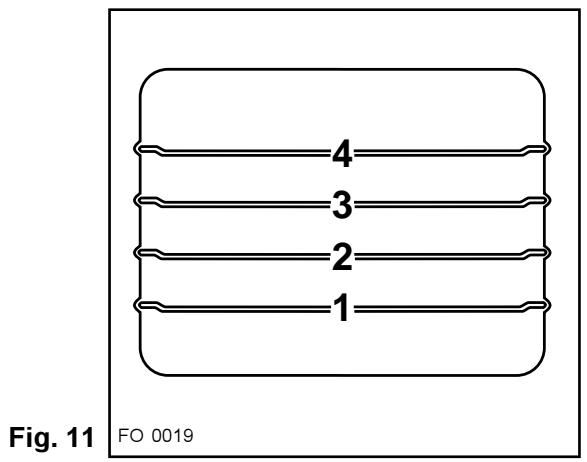
Cooking table
| Kinds of food | Temperature °C* | Inserting slide** | Cooking time in minutes | |
| Gas oven | Electric oven | |||
| Beaten mixture cakes in moulds | ||||
| Black and white flour cake | 175 | 2 | 2 | 60-70 |
| Royal flat bread-cake | 175 | 3 | 2 | 60-70 |
| Margherita cake | 175 | 3 | 2 | 35-40 |
| Pastry | ||||
| Bottom of cake to be garnished | 200 | 3 | 2 | 15-20 |
| Butter-milk curd cake | 200 | 2 | 1 | 35-40 |
| Jam cake | 200 | 2 | 1 | 35-40 |
| Leavening dough cakes in moulds | ||||
| Brioche | 200 | 2 | 2 | 35-40 |
| Small cakes | ||||
| Pastry | 170 | 3 | 2 | 10-15 |
| Cream puff | 200 | 3 | 2 | 30-40 |
| Meringue | 140 | 3 | 2 | 120 |
| Lasagne | 225 | 2 | 2 | 40-50 |
| Meat (cooking time for every cm of thickness) | ||||
| Long cooking roast meat | 175 | 2 | 2 | 12-15 |
| Short cooking roast meat | 200 | 2 | 2 | 10-12 |
| Meat-loaf | 200 | 2 | 2 | 30-40 |
| Poultry | ||||
| Duck 1 1/2 - 2 kg | 200 | 2 | 2 | 120-180 |
| Goose 3 kg | 200 | 2 | 2 | 150-210 |
| Roast chicken | 200 | 2 | 2 | 60-90 |
| Turkey 5 kg | 175 | 2 | 2 | about 240 |
| Game | ||||
| Hare | 200 | 2 | 2 | 60-90 |
| Roe-deer rib | 200 | 2 | 2 | 90-150 |
| Deer haunch | 175 | 2 | 2 | 90-180 |
| Vegetables | ||||
| Boiled vegetable flan | 200 | 2 | 2 | 40-45 |
| Fish | ||||
| Grey mullets | 200 | 2 | 2 | 40-50 |
| Pizza | 240 | 2 | 1 | 20-25 |
| Grill | ||||
| Chops | 3 | 3 | 15-20 | |
| Sausages | 3 | 3 | 20-25 | |
| Grilled chicken | 2 | 2 | 60-70 | |
| Roast veal on the spit 0,6 kg | 70-80 | |||
| Chicken on the spit | 60-90 | |||
- Table 1: Temperatures approximating to the Thermostat Settings
| 1 | 2 | 3 | 4 | 5 | 6 | 7 | 8 |
| 140°C | 150°C | 160°C | 180°C | 200°C | 220°C | 240°C | MAX |
** The number of the slide refers to the lowest one (fig. 11), excepted the position on the bottom of the oven, since the dripping pan can't be inserted.
Cleaning and maintenance

Before each operation, disconnect the appliance.
Cleaning the cooker
Drops of sauce, fruit juice etc., should be removed as soon as possible with a soft cloth soaked in warm detergent water. Do not use steel wool or knives to take off layers of crust. Remove stubborn marks with a well wetted soap impregnated pad, but care must be taken not to scratch the enamel. Wash the enamelled grids with water and detergent; these can also be washed a dishwasher.
Take off the burner covers and the grids and wash them carefully with warm water and detergent. Dry them well before putting them back in position.
Moreover, make sure that these are properly re-placed. The burner can be rubbed with steel wool or a slightly abrasive cloth.
Clean the oven door and crystal cover, in models equipped with these items, only with warm water, and avoid the use of rough cloths or abrasive substances; in cookers with an automatic ignition the sparkling bulb should be cleaned periodically and accurately to avoid difficulties in lighting; furthermore check that the burner holes are not obstructed.
Cleaning the oven
Clean carefully the oven cavity after use when it is still warm. In fact, at this moment it is easy to take off deposits of fat or other substances such as fruit juice, sugar particles or fat. You can use warm detergent water or one of the appropriate spray oven cleaners. Do not direct the spray at the mat steel parts as this could damage them and always follow the manufacturer's instructions. Clean the oven accessories (grate, grid-plate etc.) with warm water and detergent.
Remove possible incrustations with a slightly abrasive powder.

Never line any part of the oven with aluminium foil. It would result in an accumulation of heat which might damage the cooking results and also damage the enamel.
Controls - Sundries
Periodically check the condition of the flexible pipe of gas connection and make it replaced by skilled technicians as soon as it shows abnormalities. Annual replacement is recommended.
Have the cocks periodically lubricated by skilled technicians. In case of unusual working have the range checked by skilled technicians.
In ranges with cylinder holder, do not use this space to leave a non-connected or an empty cylinder.
Oven lamp replacement (Fig. 12)
Disconnect the appliance. Unscrew the lamp and substitute it with another fitting for a higher temperature (300^) with the following characteristics:
Tension: 230 V (50Hz)
Power: 15W
Convection: E14
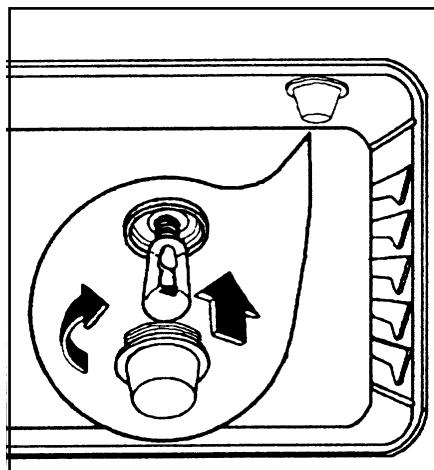
Fig. 12
FO 0424
Cleaning the oven door
For a more complete cleaning of the oven door, it is advisable to disassemble it in the following way (Fig. 13): open the door fully, turn the two caps situated on the arm of the hinge to 180^ , partially close the door to an angle of 30^ , lift the door and extract from the front.
Re-mount the door by reversing the operation described above.
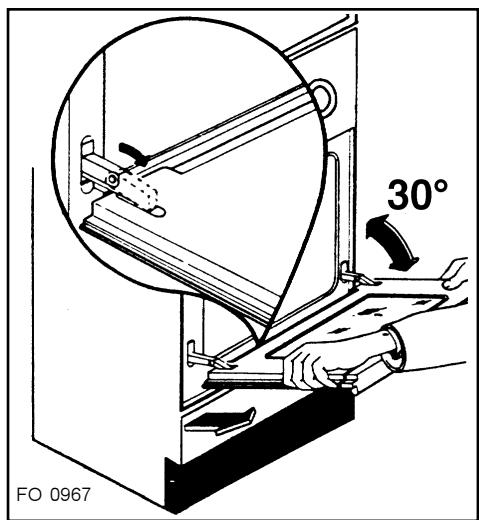
Fig. 13
Lid cleaning
All the cooker lids can be disassembled, to allow a better cleaning.
Enamelled lids can be dissassembled as shown in fig. 14.
After a proper cleaning, carefully reposition the lid into its hinges.
Cleaning of the oven with enamel coating
Principle:
Cleaning of the smooth and shiny enamel oven walls should be done manually.
Regular maintenance:
After preparing meat dishes, the oven walls should be cleaned by means of a sponge and a detergent in order to remove possible fat splashes. By doing so, the oven will produce less steam when using it the next bme and it will remain clean for a longer period. Soils from overboiling on the bottom plate can be eliminated more easily if the bottom plate is removed from the oven.
Long-term maintenance:
Use only appropriate products available on the market.
Cleaning the Catalytic Enamel Oven (depending on models)
Principle
The catalytic side panels can neutralise most food and splashes of grease when the temperature exceeds 220^ .
To facilitate cleaning, it is advisable to heat the oven, empty, above this temperature for 1 to 2 hours a week.

Practical advice:
- Manual cleaning of catalytic side panels is not advisable.
- These side panels are irreremediably damaged by the use of sprays, steel wool soaked in soap or other detergents.
- With time some discolouring of the side panels may occur. This will not affect the catalytic action.
- Once the side panels are saturated the cleaning process ceases. This does not effect the appliance's operation.
- Follow the advice given below in order to reduce to a minimum the formation of splashes in the oven.
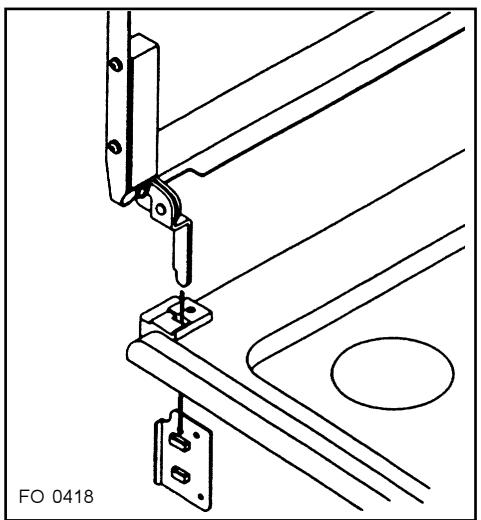
Fig. 14
Maintenance
When cooking gives rise to a great deal of grease splashing (fowl, grills, etc.), either the cooking period or the temperature could be insufficient to eliminate all these greases. When this occurs, after cooking, set the Control Knob to its maximum setting then allow to heat, with the oven emptied of all the accessories, for 45 minutes, then posHion the Control Knob to 電 / 電 for a further 5 minutes.
When this operation is started with the oven already cold, the cleaning process will take 60 minutes.
Never spray cleaning products onto any surfaces coated with catalytic enamel.

The oven walls become hotter than normal during the cleaning sequence. Please keep young children well away. Never use the Hob burners during the cleaning sequence.
The sole plate is coated with a vitreous enamel, brilliant and smooth to the touch. For this, manual cleaning is necessary. When spills occur on the sole plate, remove it for ease of cleaning with a sponge and a mild detergent.
Something not working
If the appliance doesn't work properly check the following points before asking for service:
| ·The flow of gas seems abnormal | Make sure that: — the flame speader holes are not obstructed; — the pressure regulator is working; — the bottle valve is completely open. |
| ·Gas smell in the room | Make sure that: — the gas valve is not open; — the gas supply tube is well positioned and in good condition; remember to replace it at least once a year. Never look for an escape of gas with a match; use instead soapy water. |
| ·The oven doesn't heat | — Make sure that the oven knobs are in the correct working positions. |
| ·Cooking time is too long | — Check that the temperature is correct for the type of food to be cooked. |
| ·The cooker produces smoke | — We advise you to clean the oven after use. Splashes of fat can occur during the cooking of meat and, if the oven isn't cleaned properly, these produce smoke and bad smell. (see paragraph concerning cleaning). |
| ·The oven lamp doesn't work | — The lamp has burnt out. To replace it follow the instructions given in the relative paragraph. |
If, after following all the above checks the appliance still doesn't work, call your nearest Service Centre givin them all the necessary information, such as model and serial number of the appliance.
Maintenance - Technical assistance
The gas cocks must be periodically lubricated to ensure good working and safety.
Maintenance should be performed as follows:
- Remove the knob and panel after having taken out fastening screws.
- Loosen the two screws located at the sides of the cock bar.
- Remove the cone and clean it carefully.
- Then, apply a thin layer of grease non soluble in water, suitable for gas cocks. Take care not to obstruct the gas flow holes by an excess of grease.
Reassemble the whole with utmost care performing the operations described above inversely.
Original spare parts
This machine, before leaving the factory, has been tested and studied by many experts and specialists, in order to give you the best results.
Any repair work which needs to be carried out should be done with the utmost care and attention.
For this reason we reccomend that for any problem you contact the dealer who sold it to you, or our nearest authorized Service Centre, specifying the nature of the problem and the particular model which you own.
Original spare parts, certified by the manufacturer of the product and marked with the following sign,
can only be found at our approved Technical Assistance Centres and in authorised Spare Parts Shops.
Technical data
Gas Oven
| Electric Grill | 1800 W |
| Oven lamp | 15 W |
| Turning spit (depending on models) | 4 W |
| Max. power rating: | 1819 W |
| Voltage tension (50 Hz) | 230 V |
Electric Oven
| Top element | 1000 W |
| Bottom element | 1200 W |
| Top + Bottom element | 2200 W |
| Grill | 1800 W |
| Oven lamp | 15 W |
| Turning spit | 4 W |
| Max. power rating: | 2219 W |
| Voltage tension (50 Hz) | 230 V |
Hob
| Lid | enamelled |
| Auxiliary burner | 1 kW |
| Semi-rapid burner | 2 kW |
| Rapid burner | 3 kW |
| Electric ignition | depending on models |
| Thermocouple | depending on models |
Dimensions of the appliance
| Height | 850 mm | |
| Width | EK 5301 | 500 mm |
| EK 6322 - EK 6327 - EK 6510 | 600 mm | |
| Depth | 600 mm | |
| Appliance | Class 1 and Class 2 | Sub-Class 1 |
| Category: | II2E+3+ | |
| Appliance set for use with gas type: G20-25 / 20-25 mbar | ||
Burner characteristics
| Normal power | Reduced power | NATURAL GAS | LPG | |||||
| BURNER | kW | kW | Mark 1/100 | m3/h | Mark 1/100 | g/h | ||
| G20 20 mbar | G25 25 mbar | G 30 | G 31 | |||||
| Auxiliary | 1 | 0,33 | 70 | 0,095 | 0,111 | 50 | 72,5 | 71,5 |
| Semi-rapid | 2 | 0,45 | 96 | 0,190 | 0,221 | 71 | 145 | 143 |
| Rapid | Natural gas: 3 LPG: 2,8 | 0,65 | 119 | 0,286 | 0,332 | 86 | 203 | 200 |
| Oven | 3 | 1,00 | 116 | 0,286 | 0,332 | 82 | 218 | 214 |
Instructions for the installer
The following instructions are meant for a qualified installer, in order that the operations of installation, regulation, and service are executed according to the existing regulations.
Whenever changes are mode involving the disconnection of the machine it is necessary to proceed with maximum caution.

THE MANUFACTURING COMPANY DECLINES ANY RESPONSABILITY FOR POSSIBLE DAMAGES
RESULTING FROM AN INSTALLATION WHICH DOESN'T COMPLY WITH THE RULES IN FORCE
Installation environment
Warning - This unit can be installed and can work only in constantly ventilated rooms, according to rules in force.
In order to make the gas unit work properly, it is necessary that air sufficient to gas combustion can naturally flow in the room. (The installer must follow the rules in force).
The air flow into the room must come directly through openings of external walls. These openings (or opening) should be realized in such a way not to be occluded both from inside and outside.
Installation and maintenance must be carried out by a qualified technician, in compliance with rules in force, particularly NBND 51003.
The electric coconnection must be carried out in compliance with rule NBN.
Our responsibility will not be involved in case of accidents caused by a defective or non-existent earth connection.
Combustion products discharge
Gas cooking units must discharge combustion products through hoods directly connected to flues or outside.
Positioning
This appliance belongs to the class "X". It has been designed to be placed close to furniture units not exceeding the height of the working level (EN 60 335-2-6)
Levelling
The appliance is provided with adjustable small feet placed in the back and front corners od the base.
By adjusting the small feet (fig.15) it is possible to change the height of the appliance so as to ensure a better levelling with other surfaces and a uniform distribution of the liquids contained in pans or pots.

Fig. 15
Gas connection
Gas connection must be carried out according to the rules in force. The manufacturing company release the unit, once tested, adjusted for the kind of gas stated on the rating plate located on the back of the range, next to connection pipe. Be sure that you are going to connect the unit to the same kind of gas written on the plate.
Gas connection (Fig. 16)
LPG : use the rubber pipe holder «C».
Natural gas : use the pipe fitting «A».
Always insert the gasket «B» (Fig. 16). Then proceed with the gas connection, as indicated in the relevant paragraphs.
Connection using a rigid pipe or a flexible metal pipe
To ensure higher safety, it is recommended to carry out the connection to the gas system using rigid pipes (ex. copper) or using flexible stainless steel pipes, to avoid any stress to the unit. Gas feeding pipe fitting is Gc 1/
- For this type of installation, connection to the gas supply should be carried out using only and exclusively flexible metallic tubes in conformity with rules in force.
Connection using flexible non metal pipes
When the connection can be easily inspected in its full extent, there is the chance to use a flexible pipe according to the rules in force. The flexible pipe must be tightly fixed using clamps according to the rules in force. The flexible pipe should be made ready for use in such a way that:
- nowhere it can reach overtemperature, other than room temperature, higher than 30^ C ; if the flexible pipe, to reach the cock, must run behind the range, it must be installed as shown in Fig. 17;
- it is no longer than 1500 ~mm ;
- it shows no throttles;
- it is not subject to traction or torsion;
- it doesn't get in touch with cutting edges or corners;
- it can be easily inspected in order to check its condition.
The control of preservation of the flexible pipe consists in checking that:
- it doesn't show cracks, cuts, marks of burnings both on the end parts and on its full extent;
- the material is not hardened, but shows its normal elasticity;
- the fastening clamps are not rusted;
-expiry term is not due.
If one or more abnormalities are seen, do not repair the pipe, but replace it.

IMPORTANT
Once installation is complete, check the perfect seal of every pipe fitting, using a soapy solution, never a flame.
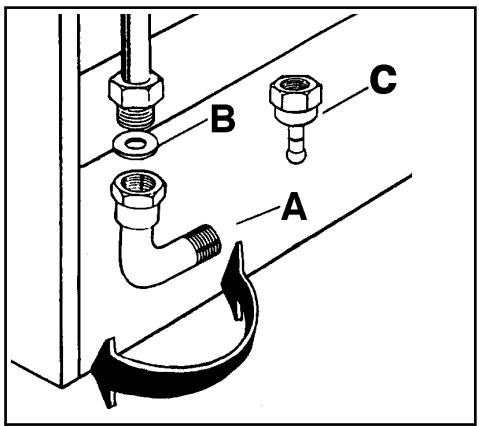
Fig. 16
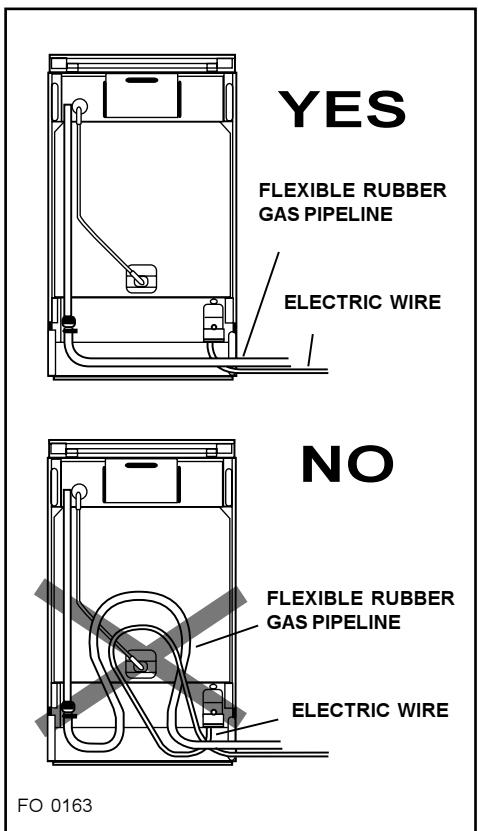
Fig. 17
Adaptation to different kinds of gas
To adapt the appliance to a different kind of gas from the one the appliance has been set for, follow the instructions below in their order.
Hob burners nozzles
1. Nozzles replacement
- Remove the pan supports.
- Extract the caps and the wall baffles of the burners.
- Using a socket spanner 7 unscrew and remove (fig. 18) the nozzles replacing them with the ones required for the kind of gas in use (see Technical data).
Reassemble the parts following the same procedure backwards.
These burners do not need any primary air regulation.
2. Adjustment of minimum level
To adjust the minimum level:
1) turn the knob to the position of minimum flame;
2) remove the knob (Fig. 19);
3a) in case of conversion from natural gas to LPG, tightly screw the by-pass screw of the cocks;
3b) when converting from LPG to natural gas unscrew about one-fourth turn by-pass screw, until a regular small flame is reached.
Reassemble the parts following the same procedure backwards.
Check that, turning quickly the knob from the maximum position to the minimum one, the flame does not go out.
Gas oven burner nozzle
1. Nozzle replacement
To replace the gas oven nozzle, follow this procedure:
a) remove the bottom of the oven;
b) undo screw 1 (fig. 20) and take the oven burner out;
c) with a socket spanner 7 unscrew and remove the nozzle, situated in the bottom of the oven, and replace it with the proper one (see Technical data);
d) reassemble the burner following the same procedure backwards.
2. Minimum level adjustment of gas oven burner
After setting the oven on maximum temperature with closed door for about 10 minutes, turn the knob of the thermostat on minimum.
To reach the thermostat by-pass screw and adjust the minimum level, act as follows:
- take out the knobs;
- remove the front panel;
in case of conversion from natural gas to LPG, tightly screw the by-pass screw of thermostat (fig. 21); - converting from LPG to natural gas, unscrew the bypass screw, until a regular small flame is reached.
- finally check that turning quickly the tap from maximum position to minimum position, the flame does not go out;
- reassemble the front panel and the knobs.
The oven burner do not need any primary air regulation.
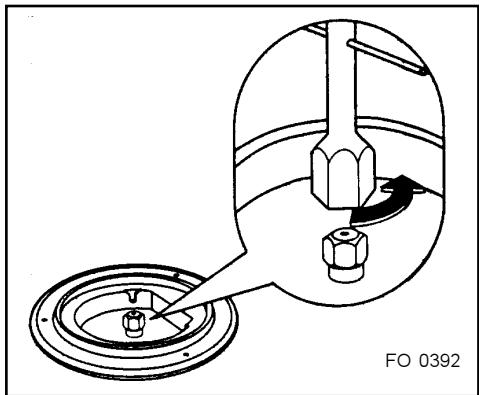
Fig. 18
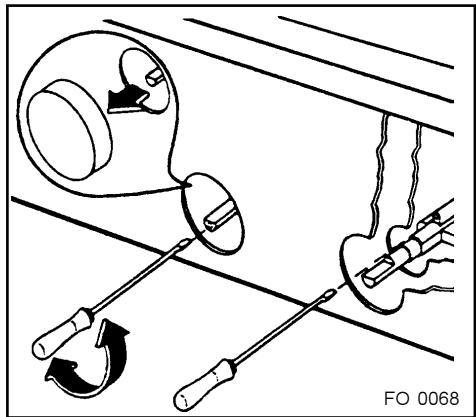
Fig. 19
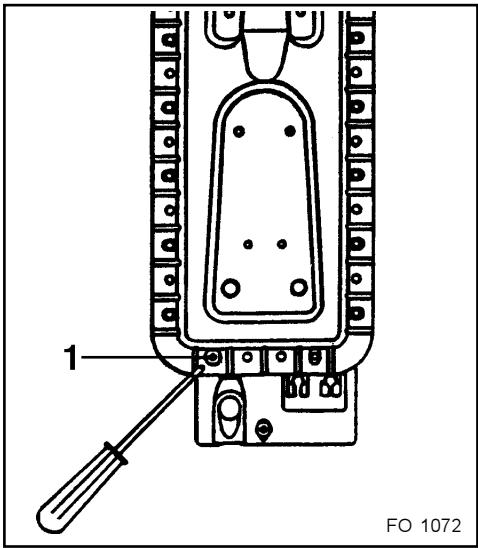
Fig. 20
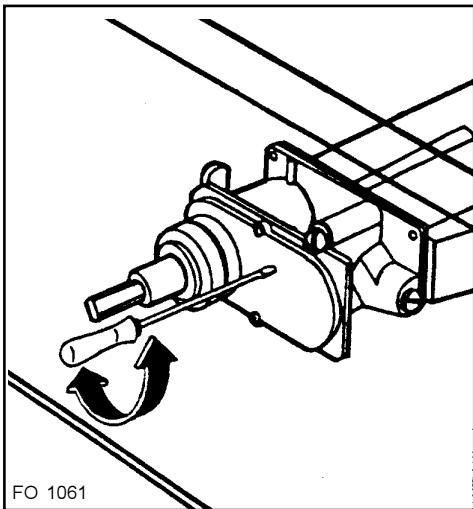
Fig. 21
Electrical connection
The unit is preset to work with a voltage of single phase 230V .
Before making the connection make sure that:
the energy power available in the user's house is sufficient for the normal supply of this appliance (see rating plate).
the unit is correctly connected to earth through a suitable plug and according to the installation country Laws.
the socket or the omnipolar switch used for the connection must be easily reached with the installed appliance.
The appliance is supplied with electric cord, incorporating a plug. The plug has to be connected to an adequate socket.
If you wish to directly connect to the mains, you have to interpose an omnipolar switch with a minimum opening between contacts of 3mm between the unit and the mains, complying with the existing regulations. The brown live wire (originating from the clamp of the cooker junction box) must always be connected to the phase of the mains supply. In any case, the supply cord must be positioned in such a way as it doesn't reach in any point a temperature higher by 50^ than the room temperature.
Replacement of the electric cable
Should the supply cord need to be replaced, use only the following cable types: H07 RN-F, H05 RN-F, H05 RR-F, H05 VV-F, H05 V2V2-F (T90), H05 BB-F. It is necessary that the yellow/green earth wire is about 2cm longer than the live and neutral ones (fig. 22). After the connection, test the heating elements for about 3 minutes to ensure that they are working correctly.
The manufacturer refuses any responsibility in cases where normal safety measures are not observed.
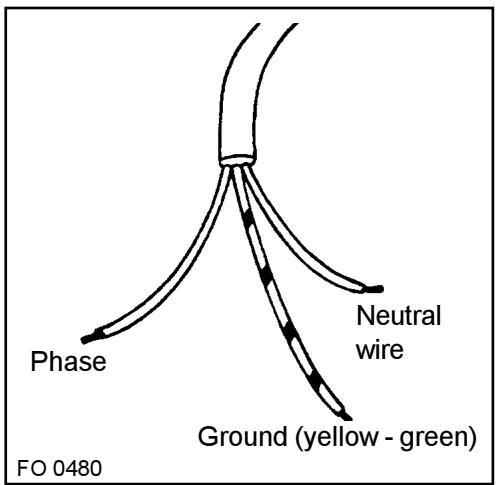
Fig. 22