
HGS - INSTALLATION - Electric generator GE - Free user manual and instructions
Find the device manual for free HGS - INSTALLATION GE in PDF.

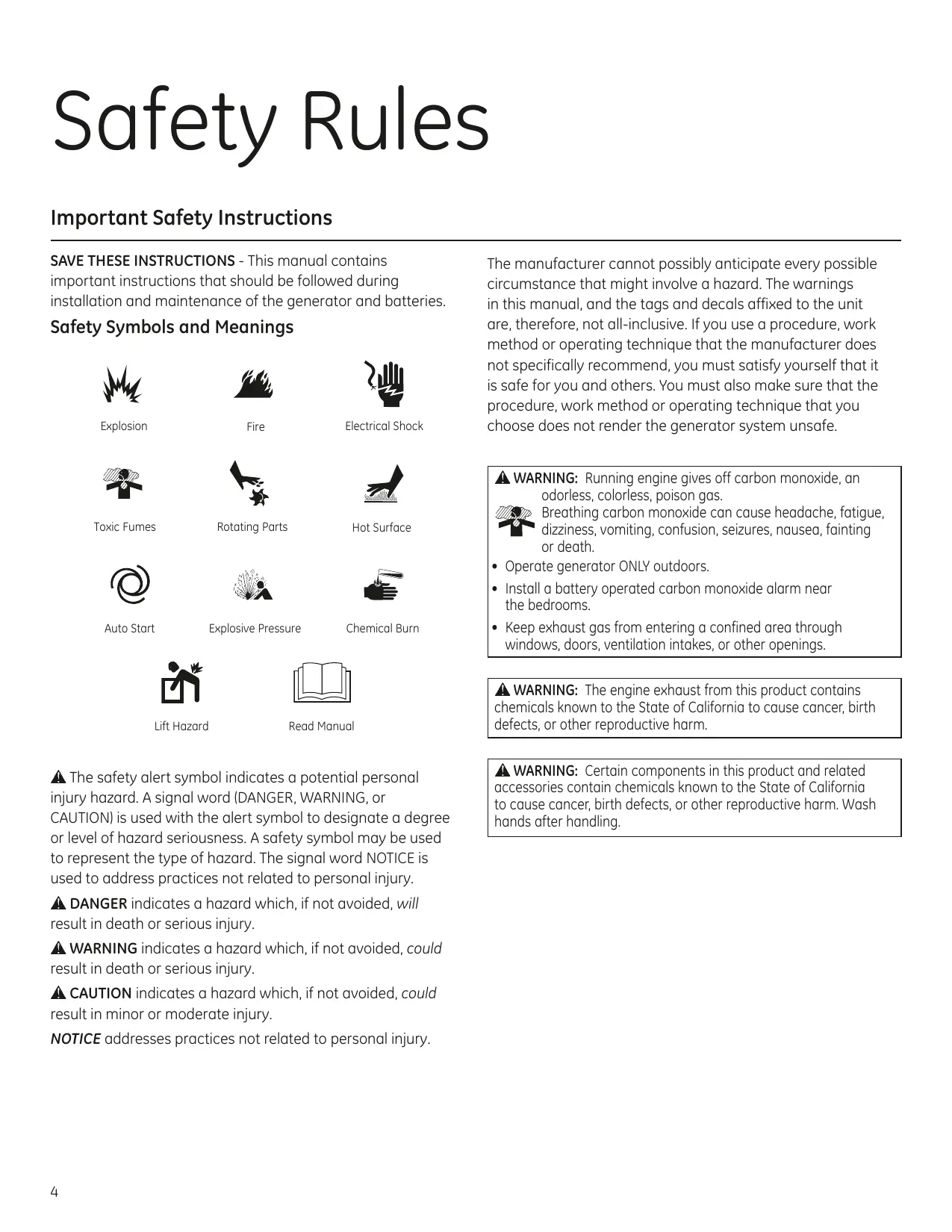


| Product Type | Residential Emergency Electrical Generator |
| Brand | GE |
| Model | HGS - INSTALLATION |
| Weight | Over 155 kg (340 lb) |
| Fuel | Natural gas or liquefied propane (LP) |
| Output Power | 240 V single-phase, 60 Hz (output voltage 239-262 V, frequency 62.0-62.5 Hz at no load) |
| Main Features | Automatic start during power outage, weekly exercise cycle, remote LED panel, digital display of fault codes |
| Safety | Carbon monoxide detection, low oil pressure shutdown, overheating, overspeed, battery fault, backfeed protection |
| Maintenance and Cleaning | Check engine oil level (SAE 5W-30), 12 V AGM 350 CCA battery, purge fuel lines, inspect for leaks |
| Spare Parts and Repairability | Natural gas/propane conversion kit provided, spare 15 A fuse, 2- and 10-pole connectors, oil drain pan, touch-up paint |
| General Information | Outdoor installation required, minimum 1.5 m from combustible materials, requires a UL-listed transfer switch |
Frequently Asked Questions - HGS - INSTALLATION GE
User questions about HGS - INSTALLATION GE
0 question about this device. Answer the ones you know or ask your own.
Ask a new question about this device
Download the instructions for your Electric generator in PDF format for free! Find your manual HGS - INSTALLATION - GE and take your electronic device back in hand. On this page are published all the documents necessary for the use of your device. HGS - INSTALLATION by GE.
USER MANUAL HGS - INSTALLATION GE
GE Home Generator Systems
7,000 Watt
Home Generator System
Installation and Start-Up Manual
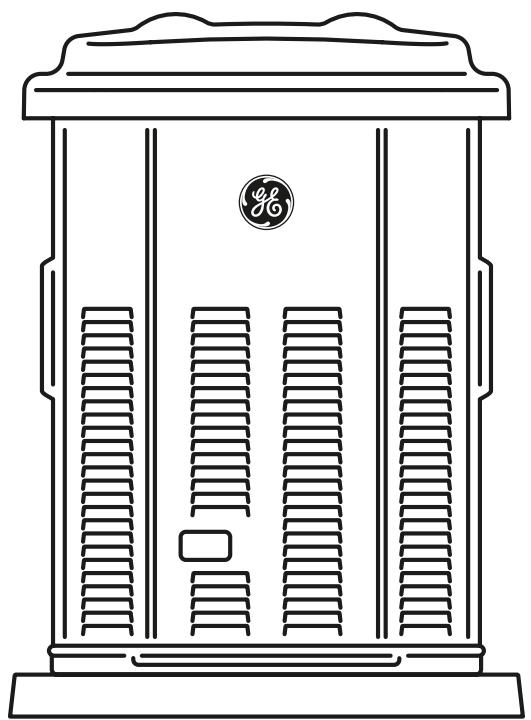
Thank you for purchasing this quality-built GE home generator. We're pleased that you've placed your confidence in the GE brand. When operated and maintained according to the instructions in the operator's manual, your home generator will provide many years of dependable service.
This manual contains safety information to make you aware of the hazards and risks associated with residential generator systems and how to avoid them. This generator system is designed and intended only for use as an optional home standby system that provides an alternate source of electric power and to serve loads such as heating, refrigeration systems, and communication systems that, when stopped during any power outage, could cause discomfort or inconvenience. Save these instructions for future reference.
This generator requires professional installation before use. The installer should follow the instructions completely.
Where to Find Us
You never have to look far to find support and service for your generator. For quick service when you need it most fill out the information below and keep your original receipt with this manual. You may contact Customer Service at (888) 575-8226, or use the Service Center Locator at BRIGGSandSTRATTON.COM, which provides a list of Authorized Service Dealers.
For Future Reference
Please fill out the information below and keep with your receipt to assist in unit identification for future purchase issues.
DATE OF PURCHASE
GENERATOR
Model Number

Model Revision
Serial Number

ENGINE
Model Number

Table of Contents
Important Safety Instructions 4
Installation 7
Home Owner Responsibilities 7
Installing Dealer/Contractor Responsibilities 7
Unpacking Precautions. 7
Shipment Contents 8
Generator Location 8
Electrical and Fuel Inlet Locations. 10
The Gaseous Fuel System 12
Fuel Consumption 14
System Connectors 15
Grounding the Generator. 16
Final Installation Considerations 19
Initial Start-up (No Load) 20
Engine Adjustment 21
Test Shutdown(s) Procedure 22
Fuel Conversion 23
Schematic Diagram. 24
Wiring Diagram 25
Operation. 26
Automatic Operation Sequence 26
Setting Exercise Timer 26
Installation Inspection 27
Safety Rules
Important Safety Instructions
SAVE THESE INSTRUCTIONS - This manual contains important instructions that should be followed during installation and maintenance of the generator and batteries.
Safety Symbols and Meanings

Explosion

Fire

Electrical Shock

Toxic Fumes

Rotating Parts

Hot Surface

Auto Start

Explosive Pressure

Chemical Burn

Lift Hazard

Read Manual
The safety alert symbol indicates a potential personal injury hazard. A signal word (DANGER, WARNING, or CAUTION) is used with the alert symbol to designate a degree or level of hazard seriousness. A safety symbol may be used to represent the type of hazard. The signal word NOTICE is used to address practices not related to personal injury.
DANGER indicates a hazard which, if not avoided, will result in death or serious injury.
WARNING indicates a hazard which, if not avoided, could result in death or serious injury.
CAUTION indicates a hazard which, if not avoided, could result in minor or moderate injury.
NOTICE addresses practices not related to personal injury.
The manufacturer cannot possibly anticipate every possible circumstance that might involve a hazard. The warnings in this manual, and the tags and decals affixed to the unit are, therefore, not all-inclusive. If you use a procedure, work method or operating technique that the manufacturer does not specifically recommend, you must satisfy yourself that it is safe for you and others. You must also make sure that the procedure, work method or operating technique that you choose does not render the generator system unsafe.

WARNING: Running engine gives off carbon monoxide, an odorless, colorless, poison gas.

Breathing carbon monoxide can cause headache, fatigue, dizziness, vomiting, confusion, seizures, nausea, fainting or death.
- Operate generator ONLY outdoors.
- Install a battery operated carbon monoxide alarm near the bedrooms.
- Keep exhaust gas from entering a confined area through windows, doors, ventilation intakes, or other openings.

WARNING: The engine exhaust from this product contains chemicals known to the State of California to cause cancer, birth defects, or other reproductive harm.

WARNING: Certain components in this product and related cessions contain chemicals known to the State of California cause cancer, birth defects, or other reproductive harm. Wash ends after handling.
WARNING: Storage batteries give off explosive hydrogen gas during recharging. Slightest spark will ignite hydrogen and cause explosion. Battery electrolyte fluid contains acid and is extremely caustic.
Contact with battery contents will cause severe chemical burns. A battery presents a risk of electrical shock and high short circuit current.
- DO NOT dispose of battery in a fire. Recycle battery.
- DO NOT allow any open flame, spark, heat, or lit cigarette during and for several minutes after charging a battery.
- DO NOT open or mutilate the battery.
- Wear protective goggles, rubber apron, rubber boots and rubber gloves.
- Remove watches, rings, or other metal objects.
- Use tools having insulated handles.
WARNING: Propane and Natural Gas are extremely flammable and explosive. Fire or explosion can cause severe burns or death.
- Install the fuel supply system according to NFPA 37 and other applicable fuel-gas codes.
- Before placing the generator into service, the fuel system lines must be properly purged and leak tested.
- After the generator is installed, you should inspect the fuel system periodically.
- NO leakage is permitted.
- DO NOT operate engine if smell of fuel is present or other explosive conditions exist.
- DO NOT smoke around the generator. Wipe up any oil spills immediately. Ensure that no combustible materials are left in the generator compartment. Keep the area near the generator clean and free of debris.
WARNING: Hazardous Voltage - Contact with power lines can cause electric shock or burn. Lifting Hazard / Heavy Object - Can cause muscle strain or back injury.
- If lifting or hoisting equipment is used, DO NOT contact any power lines.
- DO NOT lift or move generator without assistance.
- DO NOT lift unit by roof as damage to generator will occur.
WARNING: Generator produces hazardous voltage.
Failure to properly ground generator can result in electrocution.
Failure to isolate generator from power utility can result in death or injury to electric utility workers due to backfeed of electrical energy.
- When using generator for backup power, notify utility company.
- DO NOT touch bare wires or bare receptacles.
- DO NOT use generator with electrical cords which are worn, frayed, bare or otherwise damaged.
- DO NOT handle generator or electrical cords while standing in water, while barefoot, or while hands or feet are wet.
- If you must work around a unit while it is operating, stand on an insulated dry surface to reduce the risk of a shock hazard.
- DO NOT allow unqualified persons or children to operate or service generator.
- In case of an accident caused by electrical shock, immediately shut down the source of electrical power and contact the local authorities. Avoid direct contact with the victim.
- Despite the safe design of the residential generator, operating this equipment imprudently, neglecting its maintenance or being careless can cause possible injury or death.
- Remain alert at all times while working on this equipment. Never work on the equipment when you are physically or mentally fatigued.
- Before performing any maintenance on the generator, disconnect the battery cable indicated by a NEGATIVE, NEG or (-) first. When finished, reconnect that cable last.
- After your system is installed, the generator may crank and start without warning any time there is a power failure. To prevent possible injury, always set the generator's system switch to OFF, remove the service disconnect from the disconnect box AND remove the 15 Amp fuse BEFORE working on the equipment.

Contact with muffler area can result in serious burns.
Exhaust heat/gases can ignite combustibles or structures causing a fire.
- DO NOT touch hot parts and AVOID hot exhaust gases.
- Allow equipment to cool before touching.
- DO NOT install the generator closer than 5 feet (1.5m) from any combustibles or structures with combustible walls having a fire resistance rating of less than 1 hour.
- Keep at least minimum distances shown in General Location Guidelines to insure for proper generator cooling and maintenance clearances.
- It is a violation of California Public Resource Code, Section 4442, to use or operate the engine on any forest-covered, brush-covered, or grass-covered land unless the exhaust system is equipped with a spark arrester, as defined in Section 4442, maintained in effective working order. Other states or federal jurisdictions may have similar laws. Contact the original equipment manufacturer, retailer, or dealer to obtain a spark arrester designed for the exhaust system installed on this engine.
- Replacement parts must be the same and installed in the same position as the original parts.

WARNING: Starter and other rotating parts can entangle hands, hair, clothing, or accessories.
- NEVER operate generator without protective housings, covers, or guards in place.
- DO NOT wear loose clothing, jewelry or anything that may be caught in the starter or other rotating parts.
- Tie up long hair and remove jewelry.
- Before servicing, remove 15 Amp fuse from control panel and disconnect Negative (NEG or -) battery cable.

CAUTION: Installing the 15A fuse could cause the engine to start.

- Observe that the 15 Amp fuse has been removed from the control panel for shipping.
- DO NOT install this fuse until all plumbing and wiring has been completed and inspected.
CAUTION: Excessively high operating speeds increase risk of injury and damage to generator.
Excessively low speeds impose a heavy load on generator.
- DO NOT tamper with governed speed. Generator supplies correct rated frequency and voltage when running at governed speed.
- DO NOT modify generator in any way.
NOTICE: Exceeding generators wattage/amperage capacity can damage generator and/or electrical devices connected to it.
See Essential Circuits in operator's manual.
- Start generator and let engine stabilize before connecting electrical loads.
NOTICE: Improper treatment of generator can damage it and shorten its life.
- Use generator only for intended uses.
- If you have questions about intended use, contact your authorized dealer.
- Operate generator only on level surfaces.
- Adequate, unobstructed flow of cooling and ventilating air is critical to correct generator operation.
- The access panels/door must be installed whenever the unit is running.
- DO NOT expose generator to excessive moisture, dust, dirt, or corrosive vapors.
- Remain alert at all times while working on this equipment. Never work on the equipment when you are physically or mentally fatigued.
- DO NOT start engine with air cleaner or air cleaner cover removed.
- DO NOT insert any objects through cooling slots.
- DO NOT use the generator or any of its parts as a step. Stepping on the unit can cause stress and break parts. This may result in dangerous operating conditions from leaking exhaust gases, fuel leakage, oil leakage, etc.
- If connected devices overheat, turn them off and disconnect them from generator.
- Shut off generator if:
-electrical output is lost;
-equipment sparks, smokes, or emits flames;
-unit vibrates excessively.
Installation
This product is intended for use as an optional home generator system which provides an alternate source of electric power and to serve loads such as heating, refrigeration systems, and communication systems that, when stopped during any power outage, could cause discomfort or inconvenience. This product does not qualify for emergency standby as defined by NFPA 70 (NEC).
Every effort has been made to ensure that information in this manual is accurate and current. However, we reserve the right to change, alter, or otherwise improve the product and this document at any time without prior notice.
Home Owner Responsibilities
- Read and follow the instructions given in the operator's manual, especially the section regarding selecting essential circuits.
- Follow a regular schedule in maintaining, caring for and using your home generator, as specified in the operator's manual.
Installing Dealer/Contractor Responsibilities
- Read and observe the safety rules.
Install only an UL approved transfer switch that is compatible with the generator. - Read and follow the instructions given in this installation and start-up manual.
IMPORTANT: If operating the generator below 40^ , it is recommended that a battery and oil warmer be installed. If operating the generator below 32^ , a battery and oil warmer must be installed. Both items are available at your local servicing dealer.
If you need more information on this matter, please call (888) 575-8226, between 8:00 AM and 5:00 PM CT.
Unpacking Precautions
The unit is shipped bolted to its mounting pad, ready for installation. Avoid damage from dropping, bumping, collision, etc. Store and unpack carton with the proper side up, as noted on the shipping carton.
Delivery Inspection
After removing the carton, carefully inspect the generator for any damage that may have occurred during shipment.
IMPORTANT: If loss or damage is noted at time of delivery, have the person(s) making delivery note all damage on the freight bill and affix his signature under the consignor's memo of loss or damage. If loss or damage is noted after delivery, separate the damaged materials and contact the carrier for claim procedures. Missing or damaged parts are not warranted.
Shipment Contents
The home generator system is supplied with:
Home generator
- Pre-attached mounting pad
Fully-serviced oil/lubricating system
- Flexible fuel hook-up hose
- Installation and start-up manual
Operator's manual
- Engine operator's manual
- Installation checklist
- Access door keys
- Spare 15 Amp ATO-type fuse
- Two-pole control panel connector
- Ten-pole control panel connector
Oil drain tray
- Touch up paint
Roof hardware
- Fuel conversion kit
- Remote LED indicator kit (LED/plate/screws)
Not supplied:
Starting battery (see page 19)
- Connecting wire and conduit
- Fuel supply valves/plumbing
Crane, lifting straps, chains or cables
- Hole punches for 16ga steel
- Torque screwdriver, 5 to 50 inch-pound range
Voltage/frequency meter
Generator Location
Before installing the generator, consult with the homeowner and convey the following guidelines, which may affect the desired installation location.
WARNING: Exhaust heat/gases can ignite combustibles or structures causing a fire.
- DO NOT install the generator closer than 5 feet (1.5m) from any combustibles or structures with combustible walls having a fire resistance rating of less than 1 hour.
WARNING: Running engine gives off carbon monoxide, an odorless, colorless, poison gas. Breathing carbon monoxide can cause headache, fatigue, dizziness, vomiting, confusion, seizures, nausea, fainting or death.
- Operate generator ONLY outdoors.
- Install a battery operated carbon monoxide alarm near the bedrooms.
- Keep exhaust gas from entering a confined area through windows, doors, ventilation intakes, or other openings.
Install generator outdoors in an area which will not accumulate deadly exhaust gas. DO NOT install generator where exhaust gas could accumulate and enter inside or be drawn into a potentially occupied building. Ensure exhaust gas is kept away from windows, doors, ventilation intakes or other openings that can allow exhaust gas to collect in a confined area. Prevailing winds and air currents should be taken into consideration when positioning generator.
General Location Guidelines
Install the unit outdoors ONLY.
- Place the unit in a prepared location that is flat and has provisions for water drainage.
- Install the unit in a location where sump pump discharge, rain gutter down spouts, roof run-off, landscape irrigation, or water sprinklers will not flood the unit or spray the enclosure and enter any air inlet or outlet openings.
- Install the unit where it will not affect or obstruct any services (including covered, concealed and underground), such as telephone, electric, fuel, irrigation, air conditioning, and so forth.
- Install the unit where air inlet and outlet openings will not become obstructed by leaves, grass, snow, etc. If prevailing winds will cause blowing or drifting, you may need to construct a windbreak to protect the unit.
Install the generator as close as possible to the transfer switch and fuel supply to reduce the length of wiring, conduit, and piping.
IMPORTANT: Laws or local codes may regulate the distance to the fuel supply.
The minimum clearances from aerial view of generator (B) to combustible (D), and non-combustible (A) materials is shown at right:
- These distances are provided to give generator location guidance relative ONLY to combustibles, generator cooling, and maintenance.
- The minimum distances in the figure are as shown. All four sides of the generator cannot be enclosed or restricted, even if the minimum distances are maintained. DO NOT connect (A) and/or (D) to (E)
- A roof cannot be used.
- Exhaust (C) must not be allowed to accumulate.
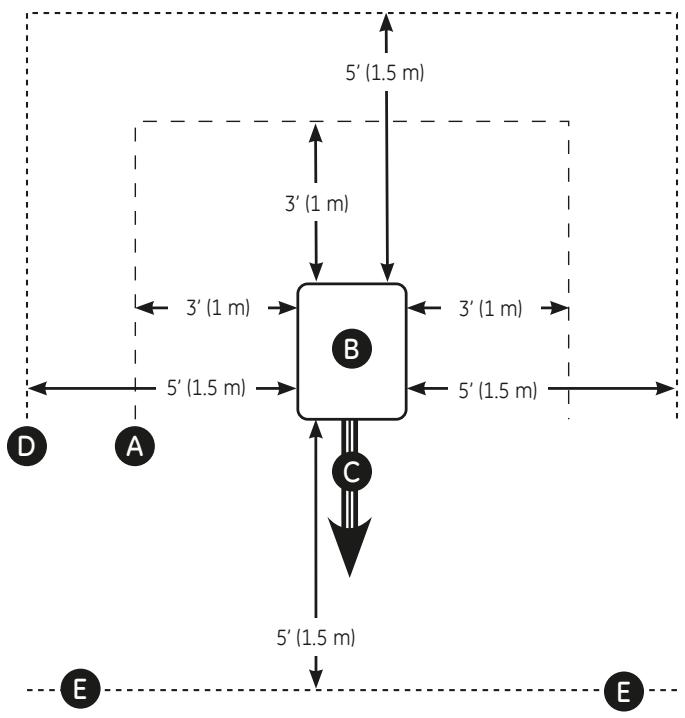
A Non-Combustible material with Fire Resistant Rating of 1 hour or greater
B Home Standby Generator
C Engine Exhaust
D Combustible Material or Structure with a Fire Resistance Rating of less than 1 hour.
E Any structure or material. DO NOT connect (A) and/or (D) to (E).
Electrical and Fuel Inlet Locations
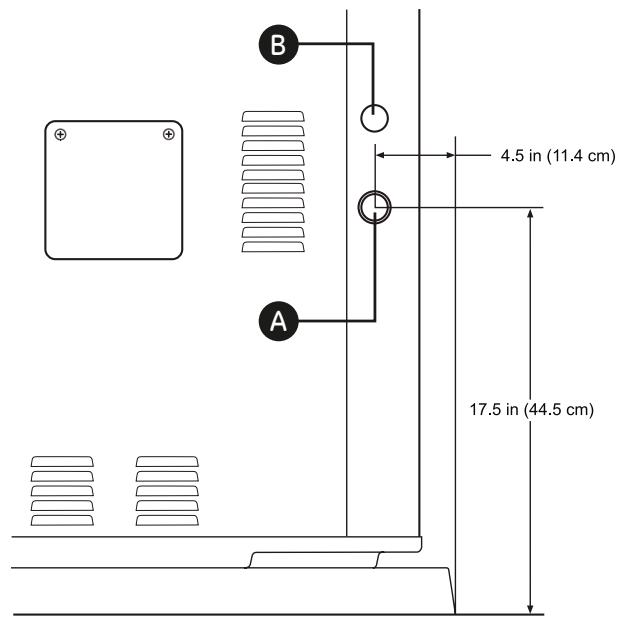
The 3/4 inch N.P.T. fuel inlet connector (A) and electrical inlet location (B) is shown at right.
The home generator is shipped already attached to its mounting pad. Unless mandated by local code, a concrete slab is not required.
If mandated by local code, construct a concrete slab at least 3 inches thick and 6 inches longer and wider than the unit. Attach unit to slab with 1 / 4'' diameter (minimum) masonry anchor bolts long enough to retain the unit.
Lifting the Generator
The generator weighs more than 340 pounds (155 kg). Proper tools, equipment and qualified personnel should be used in all phases of handling and moving the generator.

WARNING:

Hazardous Voltage - Contact with power lines can cause electric shock or burn. Lifting Hazard / Heavy Object - Can cause muscle strain or back injury.
- If lifting or hoisting equipment is used, DO NOT contact any power lines.
- DO NOT lift or move generator without assistance.
- DO NOT lift unit by roof as damage to generator will occur.
Lifting pockets are provided at each corner between the base of the generator and its mounting pad. Retouch any chipped paint with supplied touch-up paint.
The home generator is equipped with several access openings and a removable roof to permit simple oil and filter servicing.
To remove roof:
Remove the four screws and lift off. Replace roof in reverse order.
To remove access cover:
Remove the two screws, tilt cover out, and lift cover off panel. Replace cover in reverse order.
To remove side panel (if necessary):
- Remove roof.
- Remove screw(s) attaching side panel.

WARNING: Contact with muffler and engine parts can result in serious burns.

- DO NOT touch hot parts and AVOID hot exhaust gases.
-
Allow equipment to cool before touching.
-
Pull panel outward (away) from unit while pulling panel upward and out of base.
To install side panel:
- Guide bottom of side into base.
- Push panel until it is flush with sides.
- Replace panel screw(s).
- Replace roof and screws.
Each home generator is supplied with a set of identical keys. These keys fit the locks that secure the access door.
To open access door:
- Insert key into lock of access door and turn key one quarter turn counterclockwise.
- Grasp door's handle and turn one quarter turn counterclockwise to open. Remove key.
To close access door:
- Close door and turn doors handle one quarter of a turn clockwise.
- Insert key into lock of access door and turn key one quarter turn clockwise. Remove key.
The information below is provided to assist gaseous fuel system technicians in planning installations. In no way should this information be interpreted to conflict with applicable fuel gas codes. Consult with your local fuel supplier or Fire Marshall if questions or problems arise.

WARNING: Propane and Natural Gas are extremely flammable and explosive.
Fire or explosion can cause severe burns or death.
- LP gas is heavier than air and will settle in low areas.
- Natural gas is lighter than air and will collect in high areas.
- The slightest spark can ignite these fuels and cause an explosion.
- DO NOT light a cigarette or smoke.
TO THE INSTALLER: Consult with the home generator owner(s) and convey any technical considerations that might affect their installation plans before applying these general guidelines.
The following general rules apply to gaseous fuel system piping:
- The piping should be of a material that conforms to federal and local codes, rigidly mounted and protected against vibration.
- Piping should be protected from physical damage where it passes through flower beds, shrub beds, and other cultivated areas where damage could occur.

CAUTION: The supplied flexible gaseous pipe is not to be talled underground or in contact with the ground.
- The entire flexible gaseous pipe must be visible for periodic inspection and must not be concealed within nor contact nor run through any wall, floor, or partition.
- Install the flexible, gaseous hose (supplied) between the generator Fuel Inlet port and rigid piping to prevent thermal expansion or contraction from causing excessive stress on the piping material.
NOTE: Where local conditions include earthquake, tornado, unstable ground, or flood hazards, special consideration shall be given to increase strength and flexibility of piping supports and connections.
- Piping must be of the correct size to maintain the required supply pressures and volume flow under varying generator load conditions with all gas appliances connected to the fuel system turned on and operating.

WARNING: Propane and Natural Gas are extremely flammable and explosive.
Fire or explosion can cause severe burns or death.
- Before placing the generator into service, the fuel system lines must be properly purged and leak tested.
-
No leakage is permitted.
-
Use a pipe sealant or joint compound approved for use with NG/LPG on all threaded fittings to reduce the possibility of leakage.
- Installed piping must be properly purged and leak tested, in accordance with applicable codes and standards.
Consider the following factors when planning the fuel supply system installer:
- The generator engine is fitted with a fuel mixer system that meets the specifications of the California Air Resources Board for "tamper-proof" fuel systems.
- A minimum of one accessible, approved manual shutoff valve shall be installed in the fuel supply line within 6 ft (1.8 m) of the generator. A union or flanged connection shall be provided downstream from this valve to permit removal of controls.
- Natural gas fuel supply pressure at the generator's fuel inlet port should be between 5 to 7 inches of water (in. W.C.) at full load with all gas appliances turned on and operating.
- LP gas fuel supply pressure should be 11 to 14 inches of water (in. W.C.) at full load with all gas appliances turned on and operating.
The generator has been factory set to run on natural gas. If you need to change from natural gas to LP gas, the unit will need to be reconfigured, as described in Fuel Conversion.
It is recommended that the fuel connection incorporate the following components:
- A manual fuel shut-off valve located in the interior of the building.
- A manual fuel shut-off valve located outside the building, just before the generator unit.
- Where the formation of hydrates or ice is known to occur, piping should be protected against freezing. The termination of hard piping should include a sediment trap where condensate is not likely to freeze.
- A manometer port should be provided.
The manometer port permits temporary installation of a manometer to ensure that the engine receives the correct fuel pressure to operate efficiently throughout its operating range.
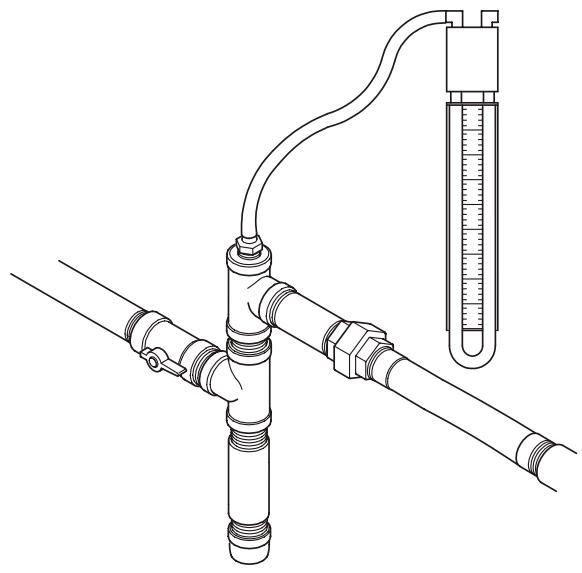
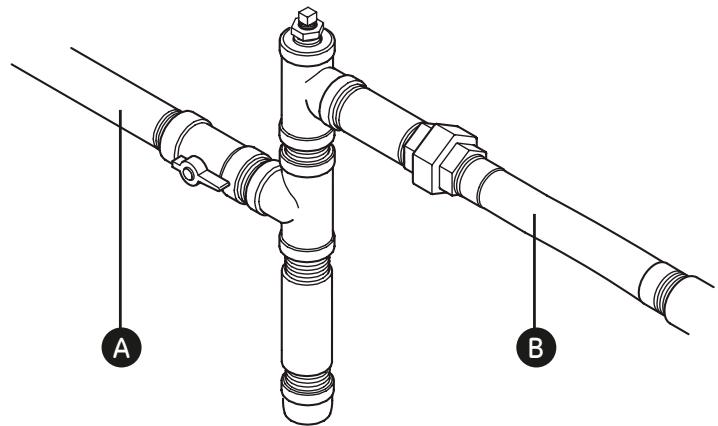
When the initial test runs are completed, the manometer is removed and the port is plugged. A typical final fuel connection assembly is shown here, where (A) is the fuel supply and (B) goes to the home generator.
Fuel Pipe Sizing
There are numerous on-line or otherwise-published references for fuel pipe sizing. For example, NFPA 54 - National Fuel Gas Code, 2006 (Item #: 320-6031-06) is a common resource.
The installer should consider the specific gravity of gas and compensate for a nominal amount of restriction from bends, fittings, etc. If an unusual number of fittings, bends, or other restrictions are used, refer to federal and local codes for guidance.
Estimated fuel supply requirements at half and full load for natural gas and LP vapor fuels are shown here.
| Natural Gas | LP Vapor | ||
| 1/2 Load | Full Load | 1/2 Load | Full Load |
| 80 C | 137 C | 33 C | 56 C |
| 80,000 B | 137,000 B | 82,500 B | 140,000 B |
| C = Cubic feet per hour B = BTU's per hour | |||
| Physical Properties | LP Vapor | Natural Gas |
| Normal Atmospheric State | Gas | Gas |
| Boiling Point (in °F): | ||
| Initial | -44 | -259 |
| End | -44 | -259 |
| Heating Value: | ||
| BTU per gallon (Net LHV*) | 83,340 | 63,310 |
| BTU per gallon (gross**) | 91,547 | |
| Cubic feet (gas) | 2,500 | 1,000 |
| Density*** | 36.39 | 57.75 |
| Weight† | 4.24 | 2.65 |
| Octane Number: | ||
| Research | 110+ | 110+ |
| Motor | 97 | |
| * LHV (Low Heat Value) is the more realistic rating. ** Gross heat value does not consider heat lost in the form of water during combustion. *** Density is given in "Cubic Feet of Gas per Gallon of Liquid". † Weight is given in "Pounds per Gallon of Liquid". | ||
Low Voltage connections to signal fault contacts, transfer switch communication, remote LED and auxiliary 12VDC power are made via a removable ten-pole connector plug.
Compare this illustration with your generator to familiarize yourself with the location of these connections:
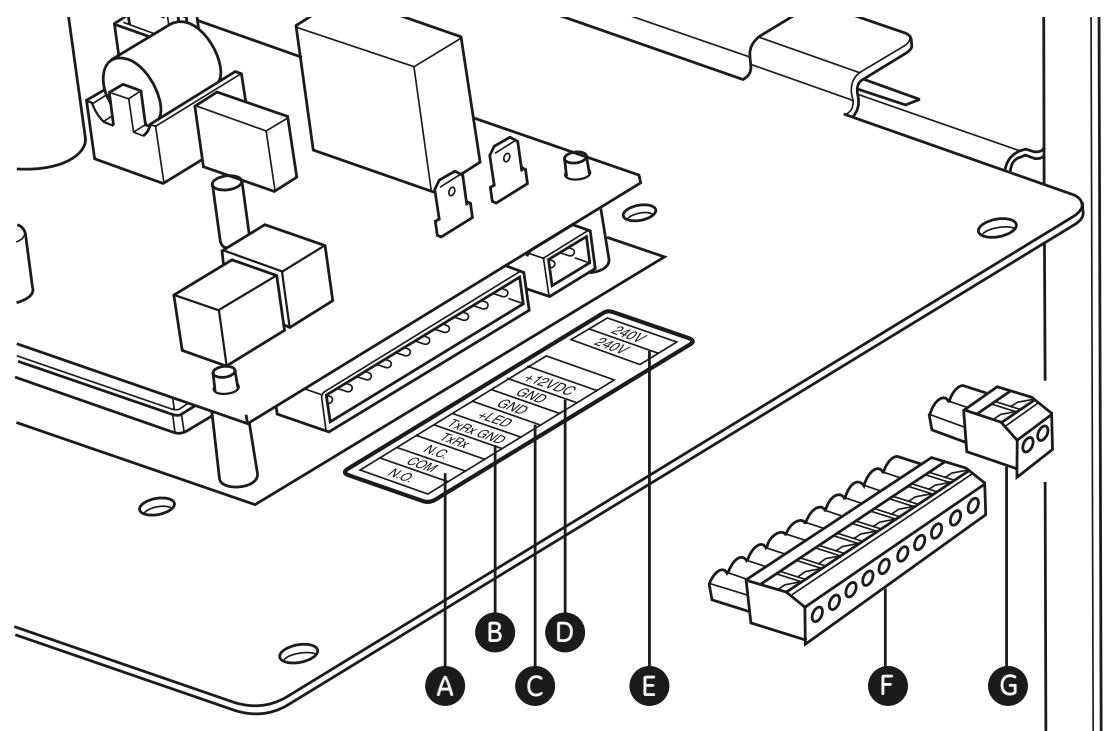
A - Fault Contacts — Use NO, COM and NC to hook up a siren, light, etc. to alert you in case of a fault. Contacts reverse state (NO goes to NC and vice versa) upon a fault condition.
B - Transfer Switch Communication - Use TxRx and TxRx GND to transfer switch to monitor generator functions.
C - Remote LED Output - Use this to hook up the remote LED supplied with the generator. The remote LED will turn on and off in a series of blinks if certain faults are detected in the generator.
D - +12 Volt DC, .5 Amp Output — Internal power supply.
E - 240 Volt Utility - Use to hook up the 240V utility leads from the transfer switch to the generator.
F - Ten-pole Connector Plug
G - Two-pole Connector Plug
IMPORTANT:
- For power output connection, use #10 AWG minimum 300 volt 75^ C - 90^ C copper wire
- For Utility Circuit connection use #14 AWG minimum 300 volt 75^ C - 90^ C copper wire
- For transfer switch communication use #18 AWG twisted pair conductors, no greater than 200 ft in length, 300 volt 75^ - 90^ copper wire
- When connecting to the connector plugs, fasten only one wire to each connector screw.
- Torque connector plug screws to 7 in-lb (7.9 Newton meter).
Generator AC Connection System
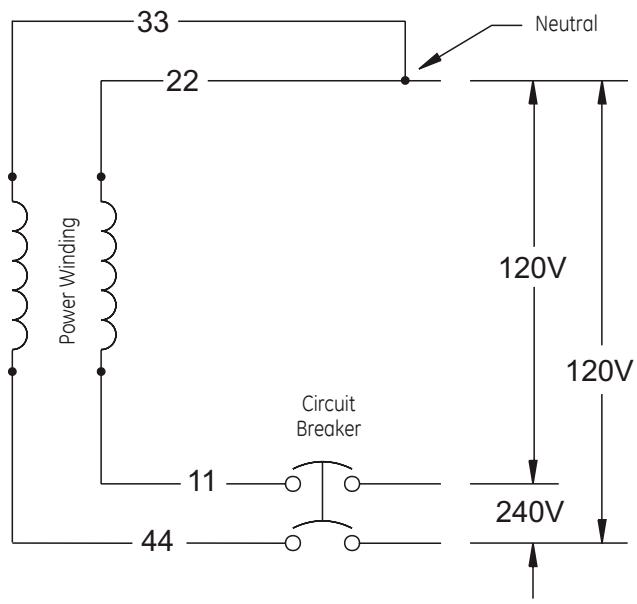
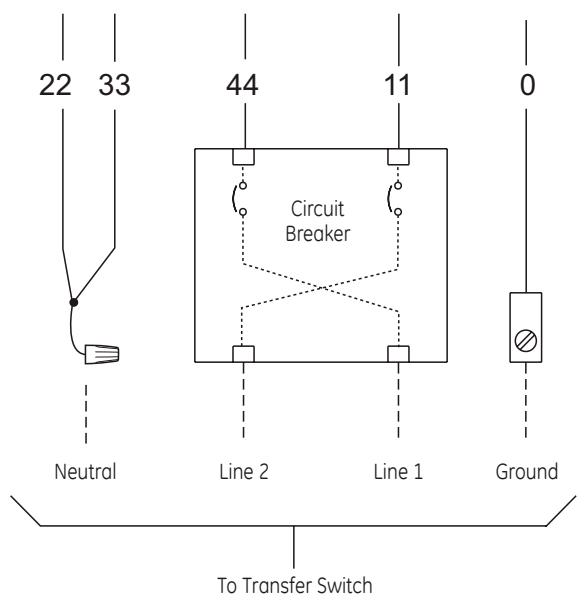
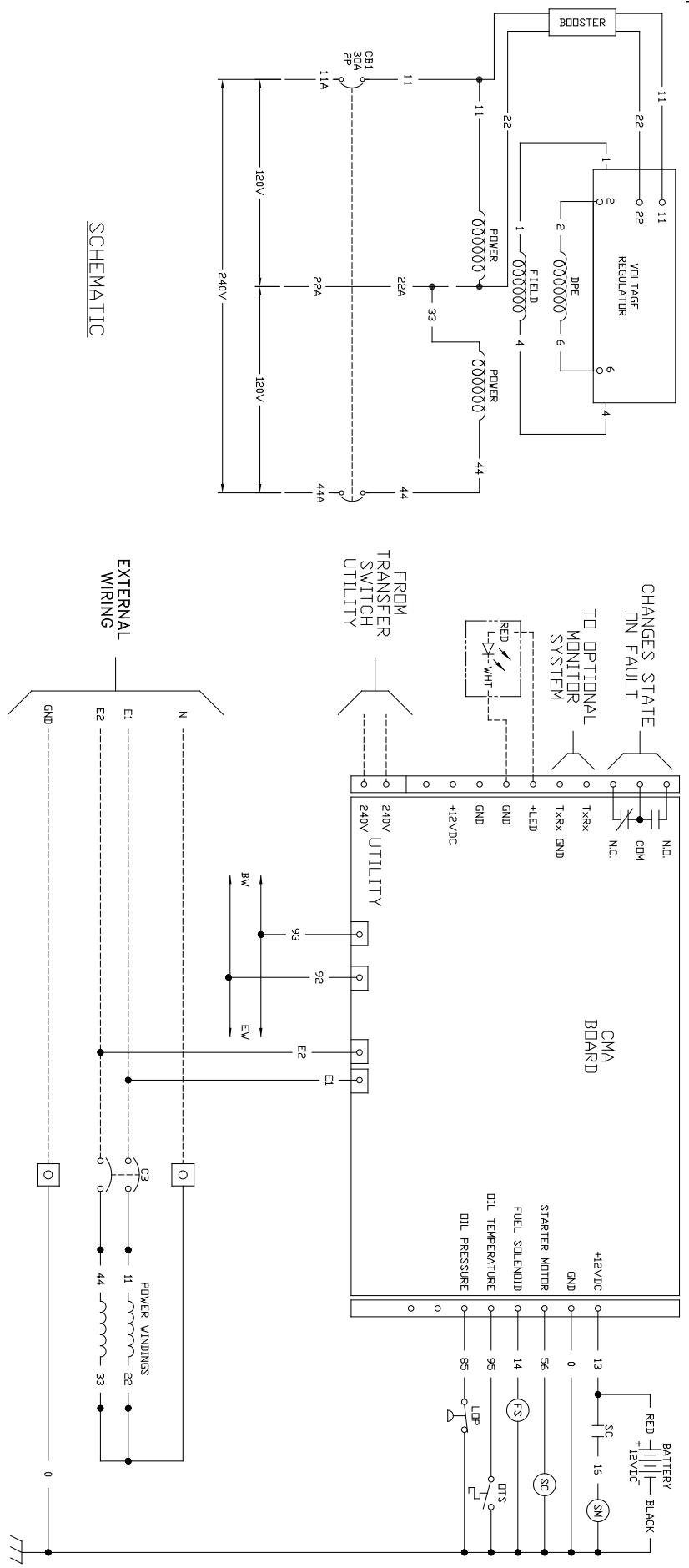
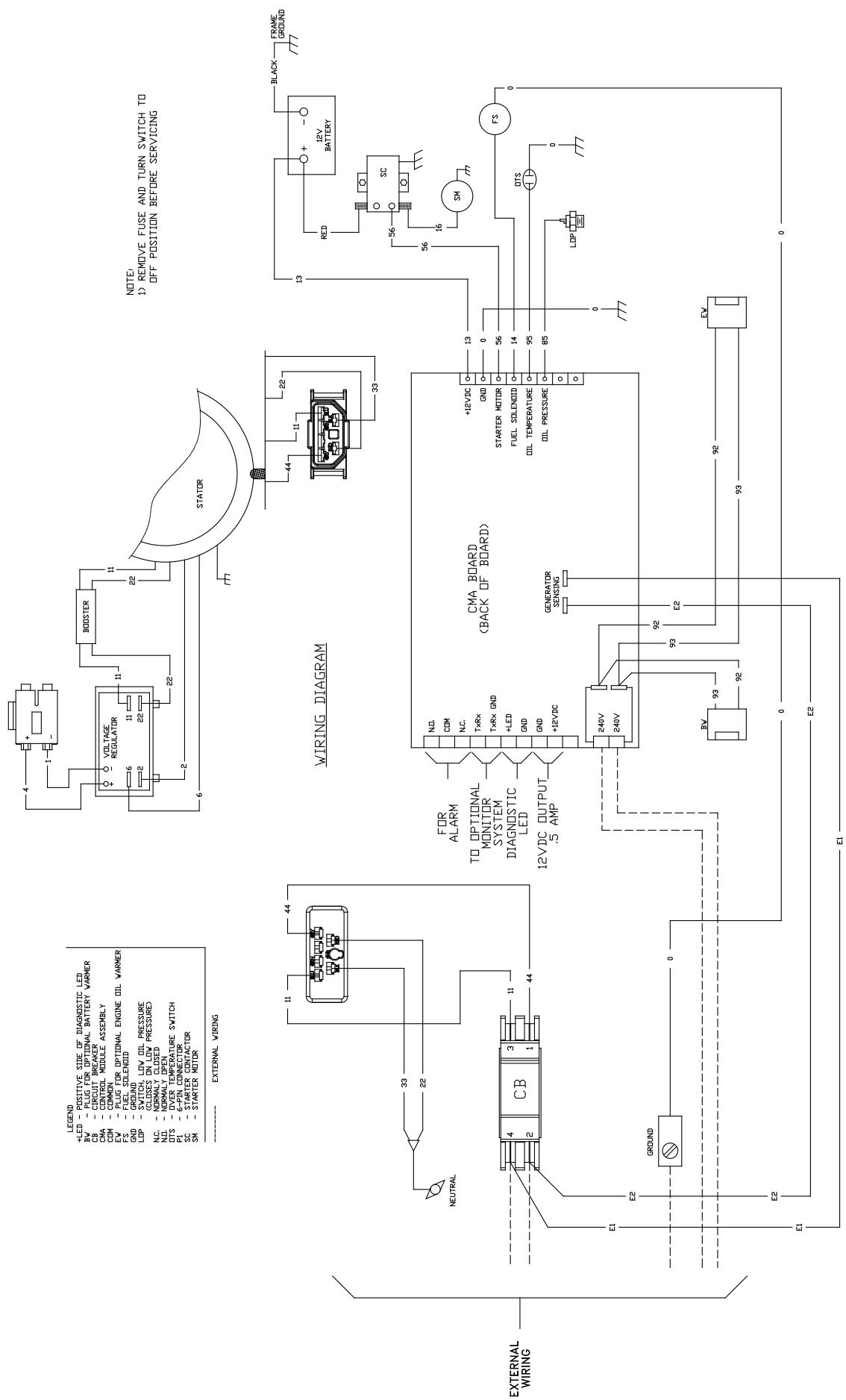
A single-phase, three-wire AC connection system is used in the home generator. The stator assembly consists of a pair of stationary windings with two leads brought out of each winding. The junction of leads 22 and 33 forms the neutral lead, as shown schematically and as a wiring diagram. A complete schematic and wiring diagram can be found later in this manual.
NOTE: Neutral is not bonded to ground at generator.
Grounding the Generator
Ground the home generator per applicable codes, standards, and regulations. The generator GND lug is located inside the control panel box.
Utility Circuit Connection
"240V Utility" leads must be routed in conduit. The "240V Utility" leads deliver power to the generator's circuit board, optional battery warmer and optional oil warmer. This power also charges the battery. When power on these leads is lost, the generator will start.
Using provided 2 pole connector plug and installer-supplied minimum 300V, 14 AWG copper wire, connect each control circuit terminal in the generator to the two-amp fuse terminals in the automatic transfer switch.
When making connections, obey wire type and torque specifications printed on the circuit breaker and neutral/ ground connector.
Transfer Switch Communication
(Units with an ACCM II or later control board only)
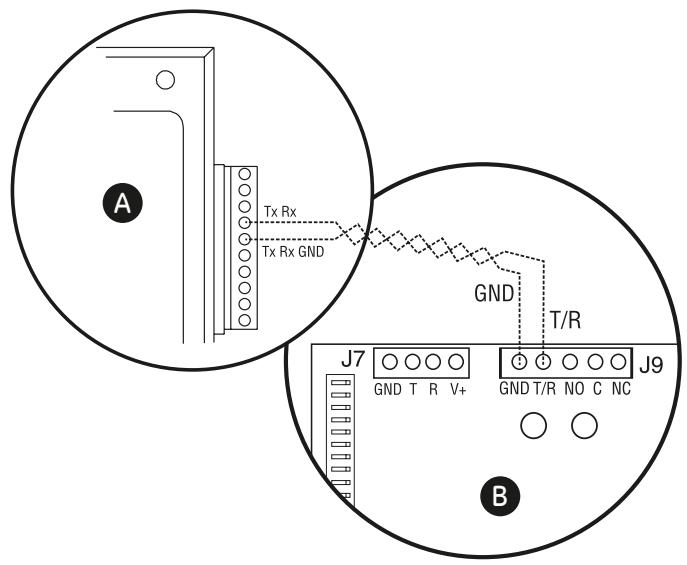
Using #18 AWG twisted pair conductors, no greater than 200 ft in length, connect Tx Rx and Tx Rx Ground from the generator control panel (A) to the GND and T/R on the transfer switch control board (B).
Fault Detection System
The generator may have to run for long periods of time with no operator present. For that reason, the system is equipped with sensors that automatically shut down the generator in the event of potentially damaging conditions, such as low oil pressure, high temperature, over speed, and other conditions. Refer to Fault Detection System in the operator's manual for more detailed information.
The owner will use the remote LED indicator to observe the status of the home generator system. The remote LED will turn on and off in a series of blinks if certain faults are detected in the generator system. Consult with the owner for a convenient location. Locate the electrical box in an area visible by the home owner such as near a garage door opener or security control panel.
To install the remote LED indicator:
- Push the LED through the mounting plate from the front until it snaps in place.
IMPORTANT: The LED is polarity sensitive.
- Using provided 10 pole connector and installer-supplied minimum 18AWG wire, connect the remote LED to the generator control board +LED and GND connection. Use wire nuts to attach wire to LED leads.
- Attach mounting plate to installer-supplied electrical box.
The home generator control panel, located inside the generator housing, is shown below.
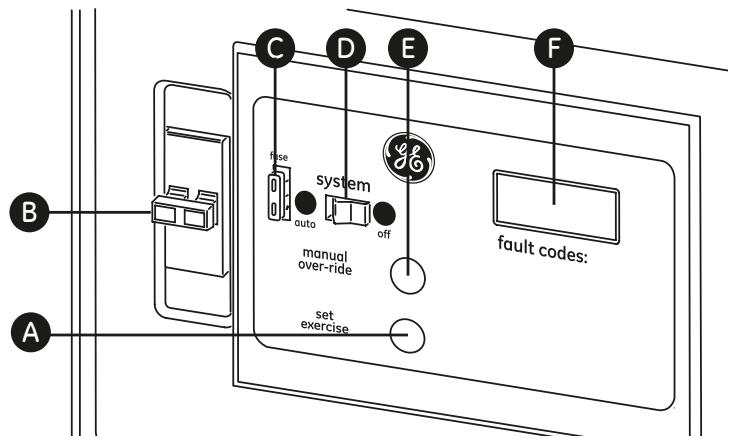
Brief descriptions of the controls used during installation are:
A - Set Exercise - Used to set the exercise cycle.
B - Circuit Breaker — Must be ON to supply power to the transfer switch.
C - 15 Amp Fuse - Protects DC control circuits.
D - System Switch - Switches modes to OFF or AUTO.
E - MANUAL OVER-RIDE - Used to manually start and stop the generator.
F - Digital Display - Displays running time in hours or fault codes.
More information may be found in Controls in the operator's manual.
System Switch
This two-position switch is the most important control on the home generator and is used as follows:
- "AUTO" position is the normal operating position. If a utility power outage is sensed, the system will start the generator. When utility power is restored, lets the engine stabilize internal temperatures, shuts off the generator, and waits for the next utility power outage.
- "OFF" position turns off running generator, prevents unit from starting and resets any detected faults.
15 Amp Fuse
Protects the home generator DC control circuits. If the fuse has 'blown' (melted open) or was removed, the engine cannot crank or start. Replace the fuse using only an identical ATO 15A fuse. One spare fuse is supplied with the unit. If fuse was blown or removed, you will need to reset the exercise timer (see Setting Exercise Timer).
Engine Oil
NOTICE: Any attempt to crank or start the engine before it has been properly serviced with the recommended oil will result in equipment failure.
- Refer to Maintenance in the operator's manual and engine manual for oil fill information.
- Damage to equipment resulting from failure to follow this instruction will void engine and generator warranty.
This engine is shipped from the factory pre-run and filled with synthetic oil (SAE 5W-30). This allows for system operation in a wide range of temperature and climate conditions. Before starting the engine, check oil level and ensure that engine is serviced as described in the engine operator's manual.
NOTE: The use of synthetic oil does not alter the required oil change intervals described in the engine operator's manual.
Battery
The installer must supply and install a valve-regulated rechargeable 12 volt starting battery. The starting battery MUST conform to the specifications shown in this chart.
| Battery Specifications | |
| Volts | 12 Volt DC |
| Amps (MIN) | 350 CCA (cold cranking amps) |
| Type | AGM |
| Terminal Hardware | M8 |
| Dimensions (MAX): | |
| Width | 5.325 inches (135mm) |
| Length | 7.875 inches (200mm) |
| Height | 6.875 inches (175mm) |
Install the battery as described in Servicing the Battery in the Maintenance section of the operator's manual. Always make sure the NEGATIVE cable is connected last and that the red POSITIVE terminal insulator is fully in place.
WARNING: Battery posts, terminals and related accessories contain lead and lead compounds, chemicals known to the State of California to cause cancer and reproductive harm. Wash hands after handling.
Fuel Supply System
Ensure that all fuel pipe connections are tight, secure and without leaks.
Ensure that all gas line shutoff valves are OPEN and that adequate fuel pressure is available whenever automatic operation is desired.
Before operating the home generator or placing it into service, inspect the entire installation carefully. Then begin testing the system without any electrical loads connected, as follows:
NOTE: Unit has been set-up for NG operation at the factory. Fuel conversion, if needed, must be completed prior to performing these steps. See Fuel Conversion later in this section.
- Remove four screws that secure control panel to enclosure to expose unit's circuit breaker.
- Connect an accurate frequency meter to line side of generator's main circuit breaker.
- Set generator's main circuit breaker to ON (closed) position.
- Install 15 Amp fuse in control panel.
- Set generator's system switch to AUTO.
- Push and hold MANUAL OVER-RIDE button on control panel for about six seconds. Engine will start.
NOTE: When the generator is started for the very first time, it will require that air in the gaseous fuel lines be purged. This may take a few minutes.
- Listen for unusual noises, vibration or other indications of abnormal operation. Check for oil leaks while engine runs.
- Let engine warm up for about five minutes to allow internal temperatures to stabilize.
- Check generator output at load side of circuit breaker. Voltage should be 239 - 262 Volts, frequency should be 62.0 - 62.5 Hz.
NOTE: If either parameter is outside these ranges, perform Engine Adjustment described later in this section.
- Check generator output between one generator connection lug and neutral lug, then between other generator connection lug and neutral lug. In both cases, voltage reading should be between 119 and 131 Volts.
IMPORTANT: DO NOT proceed until you are certain that generator AC voltage and frequency are correct and within the stated limits. To obtain the proper generator frequency, see Engine Adjustment.
- Push and hold MANUAL OVER-RIDE button on control panel until engine stops.
- Reinstall control panel into enclosure.
There are regional variances in the composition of natural gas. Each home generator unit leaves the factory set for NG operation. If the generator output voltage or frequency measured during Initial Start-Up is outside the listed ranges, the combustibility of the gas supplied at the installation site may be substantially different from the fuel used at the factory.
To adjust the engine for this difference, proceed as follows.
- Remove four screws that secure control panel to enclosure to expose unit's circuit breaker.
- Connect an accurate frequency meter to line side of generator's main circuit breaker.
- Ensure that the 15 Amp fuse is installed.
- Set the generator's main circuit breaker ON.
- Set the generator's system switch to AUTO.
- Push MANUAL OVER-RIDE button on control panel. When the engine starts, allow it to warm up for five minutes.
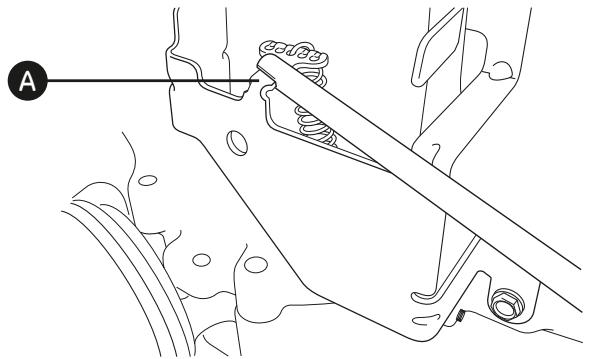
- Normal no load frequency is 62.0 to 62.5Hz . If adjustment is needed at no load, remove unit side panels. Using needle nose pliers, bend spring anchor tang (A) slowly up or down until frequency is 62.0 to 62.5Hz .
- Turn service disconnect to transfer switch OFF. After a short time delay, transfer switch will connect to generator.
- Load generator to full load.
- After load stabilizes, frequency should be above 57.0 ~Hz .
- If frequency is below 57.0 ~Hz , bend spring anchor tang slowly up or down until frequency is above 57.0 ~Hz .
- Turn service disconnect to transfer switch ON. Transfer switch will connect to utility power after five minutes.
- Push and hold MANUAL OVER-RIDE button on control panel until engine stops.
-
After the engine has stopped:
-
If an adjustment was made in step 11, repeat steps 2 through 7.
- If an adjustment was not made in step 11, proceed to step 15.
IMPORTANT: If no load frequency falls out of the no load range shown in step 7 after full load adjustment is made, contact an authorized service center.
- Reinstall control panel into enclosure, then reinstall side panels.
The installer will test the system to verify that diagnostic messages are correctly shown on the system control panel digital display, as follows:
FC_1 - Low Battery
No test procedure required for this fault.
FC_2 - Low Oil Pressure:
Locate wire #85 connected to the oil pressure switch (A):
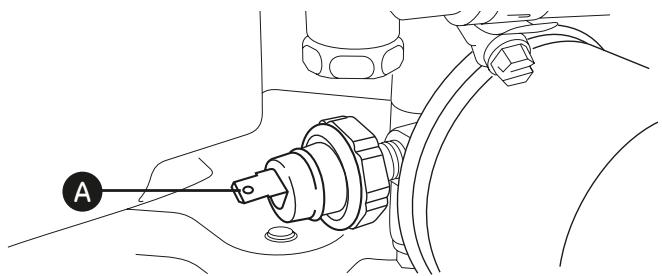
Connect an installer-supplied jumper wire to wire #85. With the system switch in AUTO position, push the manual over-ride switch to start the generator. With the generator running, connect other end of jumper to a good ground location such as the engine block. The generator will shut down and FC_2 will be displayed on the system control panel. Remove the jumper wire. Turn the system switch to OFF for 30 seconds to clear the fault.
FC_3 - Low Voltage
With the system switch in AUTO position, push and hold MANUAL OVER-RIDE to start the generator. With the generator running at no load, turn the generator circuit breaker to OFF. The generator should shut down and FC_3 will be displayed on the system control panel. Turn the system switch to OFF for 30 seconds to clear the fault. Turn the circuit breaker to ON position.
FC_4 - Engine Fails to Start
With the generator not running, turn the installer supplied manual fuel valve to the OFF position. With the system switch in AUTO, turn off utility power. The engine will crank, attempting to start. After approximately a two-minute start attempt (10 seconds of crank, 10 seconds of rest) the generator should terminate the start attempt and FC_4 will be displayed on the system control panel. Turn the system switch to OFF for 30 seconds to clear the fault. Turn the installer supplied fuel valve to the ON position.
FC_5 - Low Frequency
With the system switch in AUTO position, push and hold MANUAL OVER-RIDE to start the generator. Locate the governor lever and SLOWLY lower engine speed. Do NOT change engine speed using the governor adjustment nut. When the generator reaches a speed slower than 55Hz for
three seconds the generator will shut down and FC_5 will be displayed on the system control panel. Turn the system switch to OFF for 30 seconds to clear the fault.
FC_6 - Engine Overspeed
With the system switch in AUTO position, push and hold MANUAL OVER-RIDE to start the generator. Locate the governor lever and SLOWLY raise engine speed. Do NOT change engine speed using the governor adjustment nut. When the generator output frequency is 65-70 Hz after three seconds the generator will shut down and FC_6 will be displayed on the system control panel. If the generator output frequency is greater than 70 Hz the generator will shut down immediately. Turn the system switch to OFF for 30 seconds to clear the fault.
FC_7 - High Temperature
Locate wire #95 connected to the temperature switch (B):
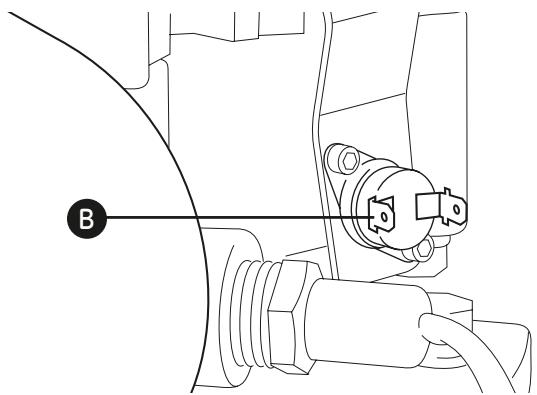
Connect an installer-supplied jumper wire to wire #95. With the system switch in AUTO position, push and hold MANUAL OVER-RIDE to start the generator. With the generator running, connect other end of jumper to a good ground location such as the engine block. The generator should shut down and display FC_7 on the system control panel. Remove the jumper wire. Turn the system switch to OFF for 30 seconds to clear the fault.
FC_8 - Transfer Switch Fault
Verify that utility power is present at the Automatic Transfer Switch. With the system switch in AUTO position, remove one of the fuses from the transfer switch. FC_8 will display on the system control panel. Turn the system switch to OFF for 30 seconds to clear the fault. Reinstall the fuse in the transfer switch.
Analyze Test Results
If any test procedure above does not cause the generator to shut down and display the indicated fault, repair the fault condition before putting the unit into service.
The engine of your home generator system is factory calibrated to run on natural gas (NG). It may also be operated on liquefied petroleum (LP) vapor. The LP Conversion kit (supplied) is required to convert the unit to LP vapor fuel. LP fuel inlet pressure must be between 11 and 14 inches water column at full load with all gas appliances turned on and operating.
To configure the fuel system for LP use:
- Set generator's system switch to OFF.
- Remove 15 Amp fuse from control panel.
- Remove roof and side panels.
- Change main jet in fuel mixer following instructions provided in LP Conversion Kit.
- Replace side panels and roof.
- Reinstall 15 Amp fuse in control panel.
- Set generator's system switch to AUTO.
The system is now ready to operate automatically using LP vapor fuel.
Operation
Automatic Operation Sequence
The generator's control panel houses a logic control circuit board. This control board constantly monitors utility power source voltage. Should that voltage drop below a preset level, control board action will signal the engine to crank and start.
When utility source voltage is restored above a preset voltage level, the engine is signaled to shut down.
The actual system operation is not adjustable and is sequenced by sensors and timers on the control board, as follows:
Utility Voltage Dropout Sensor
- This sensor monitors utility source voltage.
- If utility source voltage drops below about 70 percent of the nominal supply voltage, the sensor energizes a 10 second timer. The timer is used to 'sense' brown-outs.
- Once the timer has expired, the engine will crank and start.
Utility Voltage Pickup Sensor
This sensor monitors utility power supply voltage. When that voltage is restored above 80 percent of the nominal source voltage, a time delay starts timing and the engine will go to engine cool-down.
Engine Cool-down Timer
- When the load is transferred back to the utility power source, the engine cool-down timer starts timing.
- The timer will run for about one minute, then the generator will stop.
- Minimum engine run time is 5 minutes.
Setting Exercise Timer
The home generator is equipped with an exercise timer that will start and exercise the system once every seven days. During this exercise period, the unit runs for approximately 20 minutes and then shuts down. Electrical load transfer DOES NOT occur during the exercise cycle (unless an utility power outage occurs during the cycle).
A button on the control panel is labeled "SET EXERCISE" (see System Control Panel). The specific day and the specific time of day this button is pressed is programmed into the control board memory. This date and time is then used to automatically initiate the system exercise cycle. The "SET EXERCISE" legend on the control panel will flash until the set exercise cycle is set.
To perform the Set Exercise procedure:
- Choose the day and time you want your home generator to exercise.
- On that day and time, press and hold "SET EXERCISE" for three seconds.
NOTE: "SET EXERCISE" will flash until the button is pressed for three seconds, then "SET EXERCISE" will illuminate for 5 seconds, and finally turn off.
- The unit will then start and run it's 20 minute exercise cycle.
For example, if you press SET EXERCISE on Sunday morning at 10:00 AM, the unit will run an immediate exercise cycle and an exercise cycle every following Sunday at 10:00 AM (+/- 1/2 hour).
NOTE: "Set Exercise" will only work if the unit is in the AUTO mode and this exact procedure is followed. The exerciser will need to be re-set if the 15 Amp fuse is removed or changed, or if the 12 Volt battery is disconnected.
If you want to change the day and time the unit exercises, simply perform the "Set Exercise" procedure at the exact weekday and time you want it to take place.
Before placing the generator system into service, inspect the entire installation carefully.
Complete the "Installation Checklist" as you make the inspection. Ensure all items have been filled-in and all signatures have been obtained. Instruct the owner to mail the white copy to:
Warranty Registration
P.O.Box 239
Jefferson, WI 53549
This completes the installation and start-up instructions. The operator's manual provides full details on Operation, Maintenance and Troubleshooting for this generator system.
GE Home Generator Systems
7,000 vaitos
Sistema generator dométrico
Warranty Registration
P.O.Box239
Jefferson, WI 53549
Warranty Registration
P.O.Box 239
Jefferson, WI 53549
- Installation and Start-Up Manual
- Where to Find Us
- For Future Reference
- DATE OF PURCHASE
- GENERATOR
- ENGINE
- Table of Contents
- Safety Rules
- Important Safety Instructions
- Safety Symbols and Meanings
- Installation
- Home Owner Responsibilities
- Installing Dealer/Contractor Responsibilities
- Unpacking Precautions
- Delivery Inspection
- Shipment Contents
- The home generator system is supplied with:
- Not supplied:
- Generator Location
- General Location Guidelines
- Electrical and Fuel Inlet Locations
- Lifting the Generator
- To remove roof:
- To remove access cover:
- To remove side panel (if necessary):
- To install side panel:
- To open access door:
- To close access door:
- Fuel Pipe Sizing
- IMPORTANT:
- Generator AC Connection System
- Grounding the Generator
- Utility Circuit Connection
- Transfer Switch Communication
- Fault Detection System
- To install the remote LED indicator:
- System Switch
- Amp Fuse
- Engine Oil
- Battery
- Fuel Supply System
- FC_1 - Low Battery
- FC_2 - Low Oil Pressure:
- FC_3 - Low Voltage
- FC_4 - Engine Fails to Start
- FC_5 - Low Frequency
- FC_6 - Engine Overspeed
- FC_7 - High Temperature
- FC_8 - Transfer Switch Fault
- Analyze Test Results
- To configure the fuel system for LP use:
- Operation
- Automatic Operation Sequence
- Utility Voltage Dropout Sensor
- Utility Voltage Pickup Sensor
- Engine Cool-down Timer
- Setting Exercise Timer
- To perform the Set Exercise procedure:
Brand : GE
Model : HGS - INSTALLATION
Category : Electric generator